Lost in Translation

Lost in Translation

Our second favorite restaurant in Rheindürkheim, Germany in the late ‘80s was Pfeffermühle (The Peppermill). Das Letzte Essen (The Last Meal) didn’t occur there, but that is where the story started.

Recently, Cath and I were thinking about Pfeffermühle. I’d made Cathy a special meal one night for dinner, Steak au Poirve (Steak with Pepper Sauce). As we were eating dinner, she said “Do you remember the couple we met at…”, before she could go on, I finished her thought “…at Pfeffermühle? The ones who came to dinner?” “That’s them!”, she answered. “Do you remember her sayingDies ist das letzte Essen?”” (This is the last meal). We both started laughing…
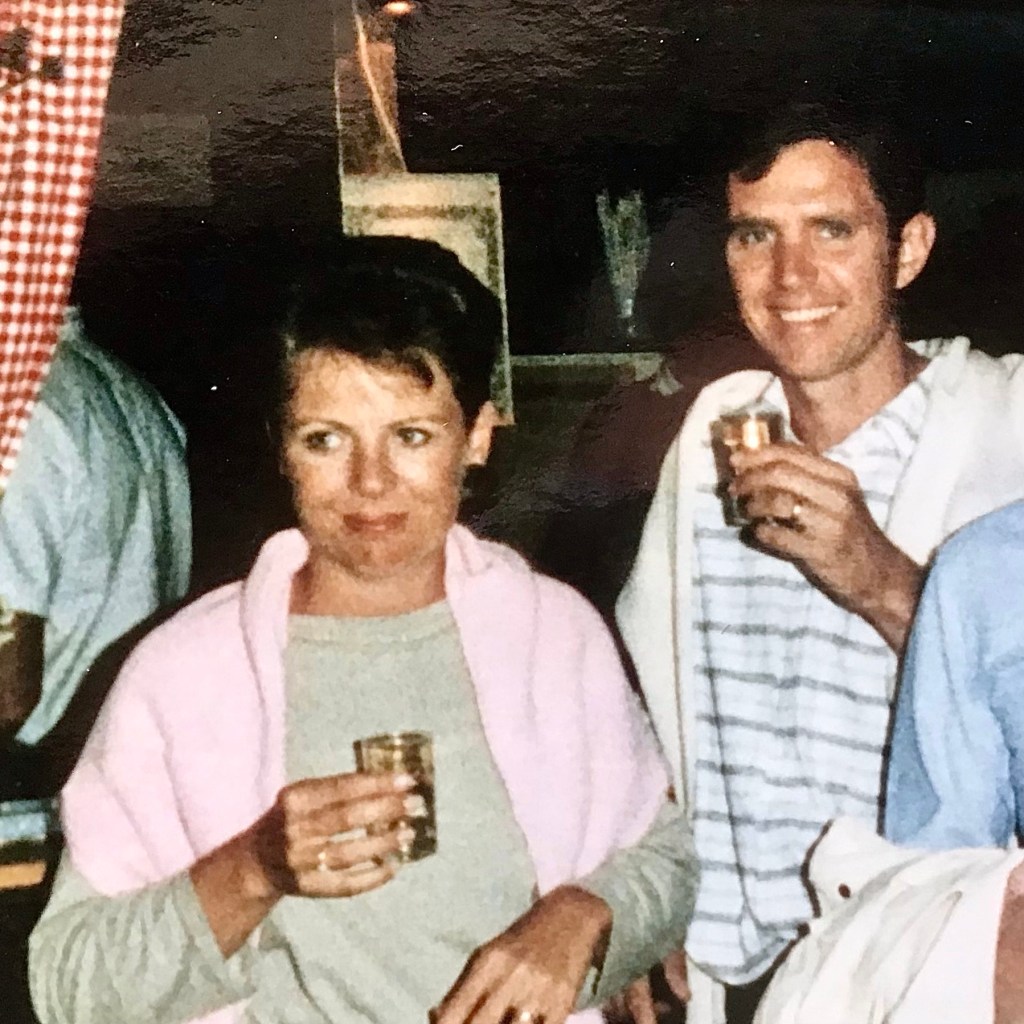
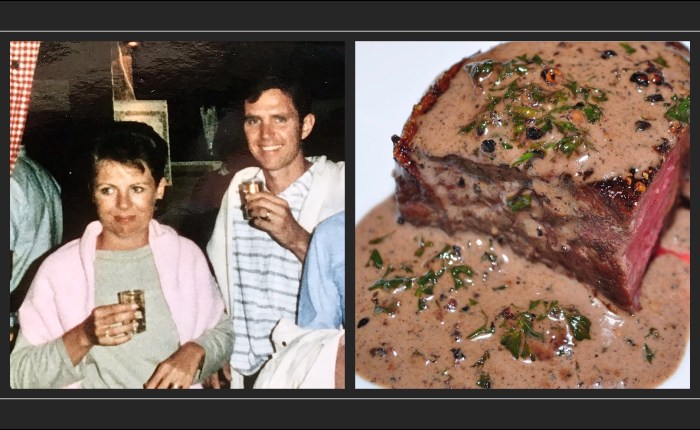
Cathy and I About the Time of “The Last Meal”

Pfeffermühle was located just outside of Rheindürkheim, on Sommerdamm Strasse, the main road to Worms. It opened after we had already lived there for a year or so. Bruno, the owner, was from Italy and moved to Germany after spending several years in California. Although the restaurant was nondescript on the outside, once inside, the white tablecloths and napkins caught your attention.

The food made an even bigger impression. They served both pizzas and traditional Italian fare. Two great food memories that stay with me even today were their lasagna, and how good their pizzas were. One of the pizzas came with an over-easy egg in the center of it. Yea, I know it sounds strange, but it was really tasty. I’m not sure about now, but at the time, you always ate pizza with a knife and fork in Europe, so the egg was no problem.

Bruno worked the front of the restaurant, while his wife was the chef in the back. He was quite the host and spoke fluent Italian, English and German. He made everyone feel welcome when they arrived, and Pfeffermühle soon became popular. If you were there on a Friday or Saturday night, the place was always jammed.

We became regulars, and as is often the case, over time, would recognize other regulars. There weren’t really any Americans, but Germans came from several nearby towns, and we became friendly with a few couples we ran into regularly.

One evening it was turning late and only a few tables were still occupied. We recognized a couple sitting at a table near ours, and started talking with them. They invited us to their table for a nightcap, and that’s how we first met Gerhard and Hannah. We shared a drink or two, and everyone agreed we needed to get together some time in the future. With that, we all said good night and didn’t think any more about it.

Except…

We ran into them the next week, and then again two weeks later. That night, I bought the drinks. As the evening was ending, Gerhard invited us to dinner at their home in Osthofen a week later. We readily accepted.

The following Saturday, we drove the three kilometers to Osthofen, where we ate a wonderful meal. I don’t remember what we had, but I do remember he served French red wine with the meal. At the time, we didn’t know any Germans who did that, and it made an impression. The Germans make wonderful white wines, but their reds? There weren’t too many of them, and they weren’t that good at the time. Usually, you drank white wine or beer with dinner, no matter the meal.

Of course we wanted to return the favor, and invited them for dinner a couple of weeks later.

Cath and I stressed a bit about what to cook, as we wanted a nice meal. I don’t remember what we did for an appetizer, but we finally agreed the main course would be “Steak au Poirve” from a cookbook a friend had recently given us. It was a bit elegant. It was also the first time we would ever make it. For dessert, we would make a “Champaign Granita”.

Charollais is a Specific Kind of French Beef

The big night finally arrived and Gerhard and Hannah arrived at our home. We served some drinks and were bringing out appetizers when Hannah said “Dies ist das letzte Abendmahl”. What? Did we hear correctly? “This is the Last Supper”?** Was today some German religious holiday we were unaware of?

Was hast du gesagt?” (“What did you say?”)

Heute ist das letzte Abendmahl. Das letzte Essen.” (“Today is the Last Supper. The last meal.”)

Oh man, we must have screwed something up. Today must be some important holiday of which we were unaware. Either that, or she was going away somewhere and this was her last real meal. What were we going to do? And then she explained…

…The next day, she was starting a diet. Tonight’s dinner was her last meal before going on the diet…

Cathy and I started laughing, and they gave us a look. We then explained our lost in translation problem with “The Last Supper” and the religious connotations, and they started laughing as well.

The dinner went well, and the “Steak au Poirve” served with potatoes turned out to be a fine last meal before starting a diet. I followed Gerhard’s lead from the previous dinner and we drank some kind of red California Cab I’d bought at the military Class 6 store. The dessert wasn’t perfect, but we served it with Sekt (German sparkling wine) and no one seemed to mind. Over dinner, we all made a couple of jokes about the last supper, and whether this was worthy. Eventually, after coffee and schnapps at the end of the meal, they left and drove home.
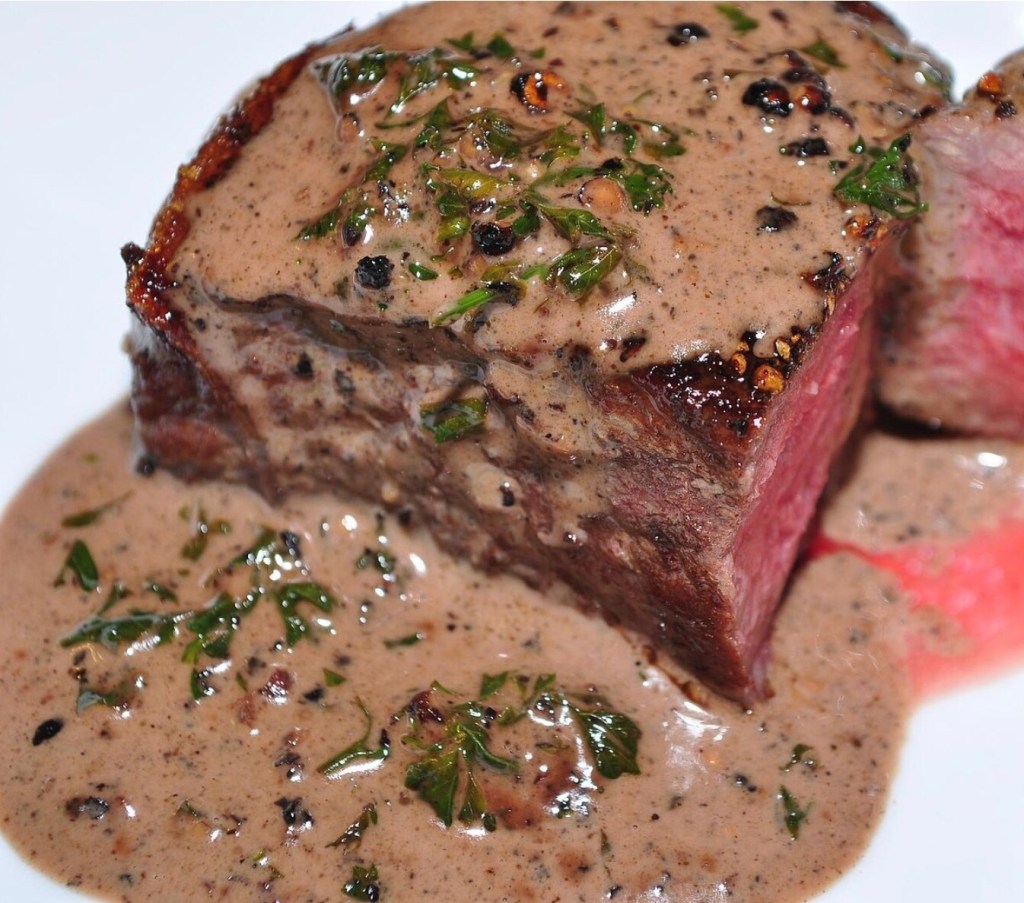
Steak au Poirve

We saw them occasionally after that at Pfeffermühle and had a late evening drink with them a time or two. Perhaps six months later, we returned to the States and lost track of them. Pre-Internet, there was of course no exchange of email addresses or cell phone numbers.

This story is really about just a bit of nothing, but we still remembered the evening, and chuckled about The Last Supper, although it’s 44 years later. Even small old memories can be good for the soul, especially when they come out of no where.

Addendum:

** – For those who may not be aware, The Last Supper is the final meal that Jesus shared with his apostles before his crucifixion. It became the basis for the holy communion. In the Gospel of Matthew, Jesus prays thanks for bread, divides it, and hands the pieces of bread to his disciples, saying “Take, eat, this is my body.” Later in the meal Jesus takes a cup of wine, offers another prayer, and gives it to those present, saying “Drink from it, all of you; for this is my blood of the covenant, which is poured out for many for the forgiveness of sins.” It is immortalized in DaVinci’s famous painting. Our dinner wasn’t anywhere near Easter, but the Germans have A LOT of religious holidays, which is why we thought we may have been unaware of some other holiday.
Pickerell, The Biltmore, and The Whiskey Tasting

Pickerell, The Biltmore, and The Whiskey Tasting

When Rob Grubbs asked if I would help “host” the whiskey tasting for the West Point Class of ‘78 mini-reunion, I took about a nano-second to respond yes. The evening, if possible, turned out even better than I imagined. It was one of those rare occasions of reality exceeding expectations.

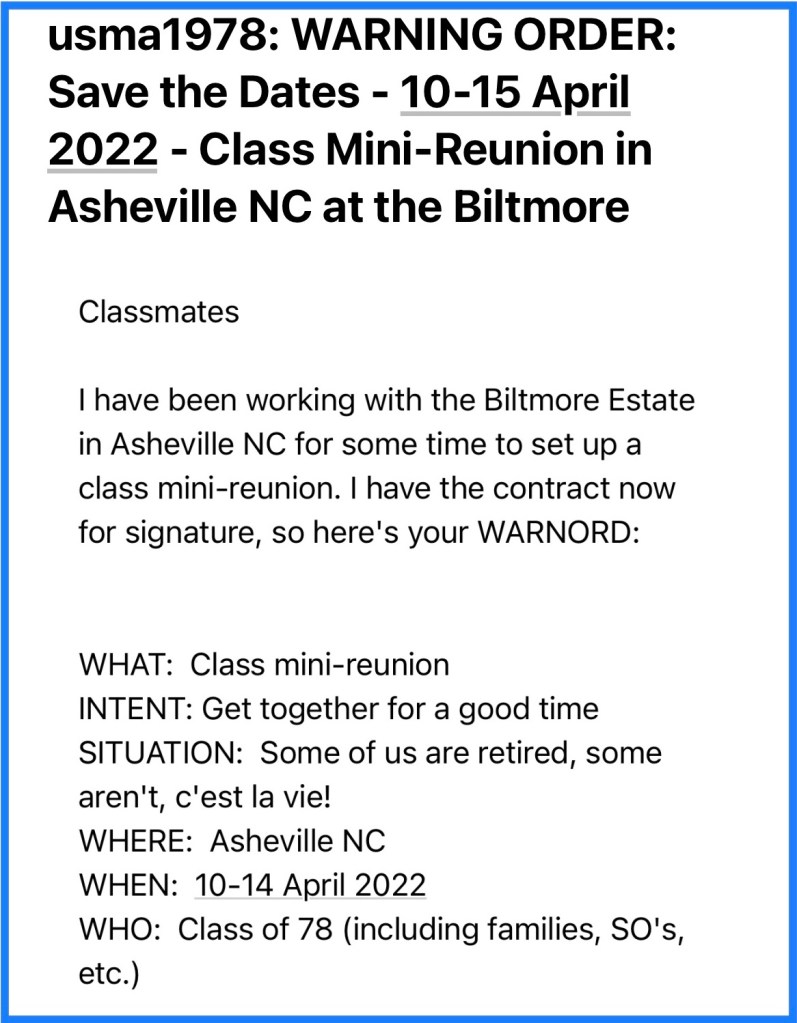
Rob sent the original invitations for the April ‘22 West Point Class of ‘78 mini-reunion, in August of ‘21 in the form of a military Warning Order. The reunion would be at The Biltmore Estate in Asheville,NC, and there was an immediate interest. Ultimately, 129 classmates, significant others, and family members made the trip.

The Original “Warning Order” From Rob Grubbs

The five days of the mini reunion were great fun, with a combination of group events and laid back small get-togethers. Dinners, a picnic, wine tastings, tours, just hanging out… it was nice. For me, a highlight was the Whiskey Tasting on the second night. What originally started as an idea for a bourbon and cigar event, morphed into a bourbon whiskey tasting, and then morphed again into the event it became.

Rob asked Bill Moeller to host and organize the tasting, and they then drafted me to assist Bill. Bill had the brilliant idea of bringing a focus to one of our departed classmates, Dave Pickerell, who later became known as The “Johnny Appleseed” of Craft and Rye Whiskey. The Army, in it’s infinite wisdom, sent Dave to grad school in Chemistry. The rest, as they say, is history.

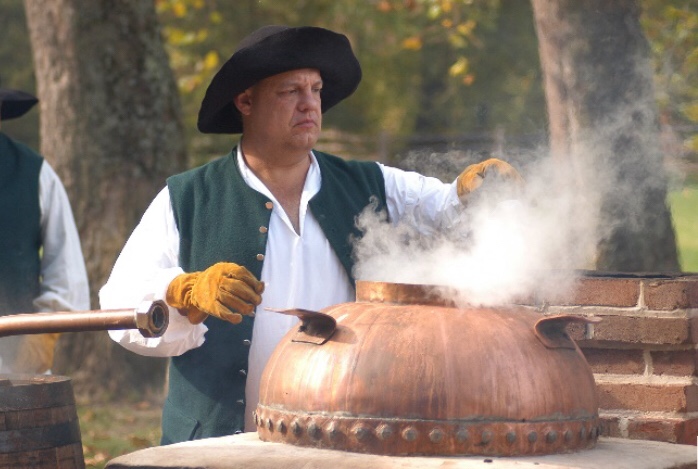
After a stint teaching back at West Point, Dave later left the Army and eventually went to work for bourbon distiller Makers Mark, where he became the Master Distiller and worked for 14 years. After leaving Makers Mark, he struck out on his own. Almost immediately, he was one of the distillers called to Mount Vernon to recreate George Washington’s original Rye Whiskey. Not only did Dave distill rye whiskey using Washington’s recipe, he would dress in colonial period clothes at Mount Vernon for special whiskey social events. This was around 2005, about the time craft distilleries were beginning. Dave ultimately helped over 50 distilleries get off the ground, and consulted with over 50 others.

Dave in Colonial Attire at the Mount Vernon Still

Dave was particularly known for a couple of events. One was the establishment of WhistlePig, a Vermont distillery dedicated to Rye Whiskey – Some people say they make the best Rye Whiskey in the world. The second event was his collaboration with the band Metallica, when they created their whiskey, Blackened. What makes Blackened unique?

Dave was fascinated with the effects of sound – the way an organ can play a note that shakes an entire building. The thought of what sound could do to whiskey at a molecular level stayed with him. As it happened, Metallica and Dave harnessed the vibrations that make a Metallica concert historic. The convergence of these ideas resulted in a sonic-enhancement method utilizing a variation of the band’s song frequencies to disrupt the whiskey inside the barrel, causing increased wood interaction and increasing the wood-flavor characteristics in the whiskey. Sonic-enhancement does not replace traditional aging methods and Blackened is typically aged an average of 7-8 years. Each batch of Blackened has a unique playlist of Metallica songs used to sonically-enhance the whiskey during finishing.

Picture of Dave Pickerell (Center), and Metallica from a Rolling Stone Article About Blackened

After discussions between Bill, Rob and I, it was decided our tasting would focus on whiskeys connected to Dave, and conclude with a toast to him, and our 71 other departed Classmates.

The list for the tasting was as follows:

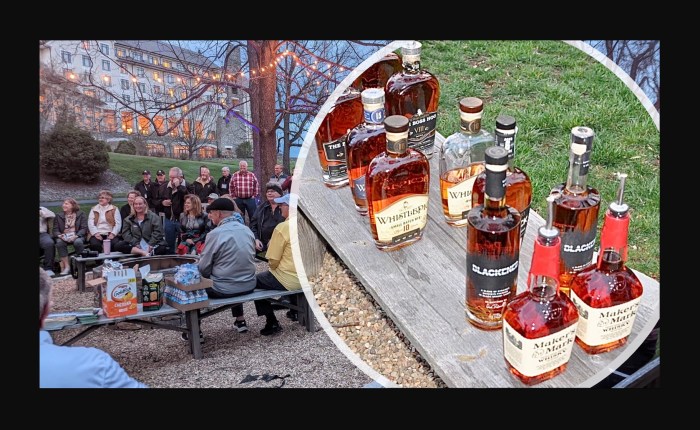
  • Makers Mark – where Dave worked so long as the Master Distiller
  • Blackened – His collaboration with Metallica
  • Piggyback – A WhistlePig Rye developed for use in Cocktails. Dave passed away just before the release. As a nod to Dave’s legacy, WhistlePig added the dates 1956-2018 (Dave’s birth and death years) to the neck label of each bottle, The WhistlePig pig logo usually includes a top hat, however for Piggyback, the pig wears a Stetson hat which Dave always wore.
  • WhistlePig 10 year old Rye
  • WhistlePig 15 year old Rye
  • The Boss Hog – WhistlePig’s top whiskey, which included final finishing in Philippine Rum barrels.

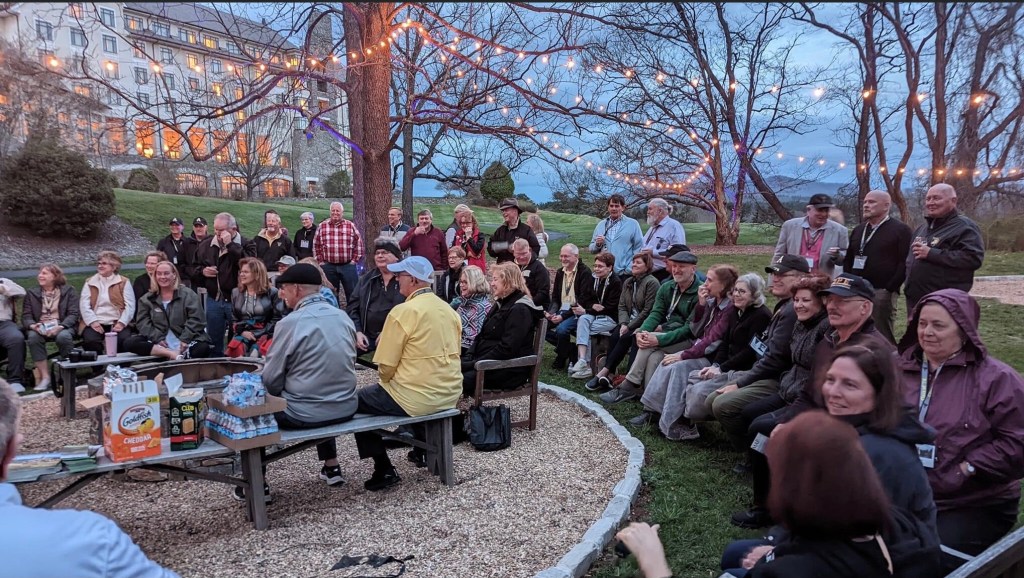
On the Monday of the reunion, approximately 100 classmates, spouses and friends gathered at dusk in a glade just below the Biltmore Inn itself. Seventy were there to taste, and another thirty came for the fellowship. As the sun fell, the overhead string lights came on, adding just a touch of magic to the atmosphere.

Dusk was Falling as we Gathered Below The Biltmore

Bill wrote a script for he and I to introduce the whiskies, while also imparting a bit of history about the interaction of whiskey and the United States Army over the course of our Nation’s History. It is perhaps no coincidence that June 14th is Flag Day, the birthdate of the United States Army in 1775, and National Bourbon Day ;-).

Bill and I Sharing a Laugh Just Before the Start of the Whiskey Tasting

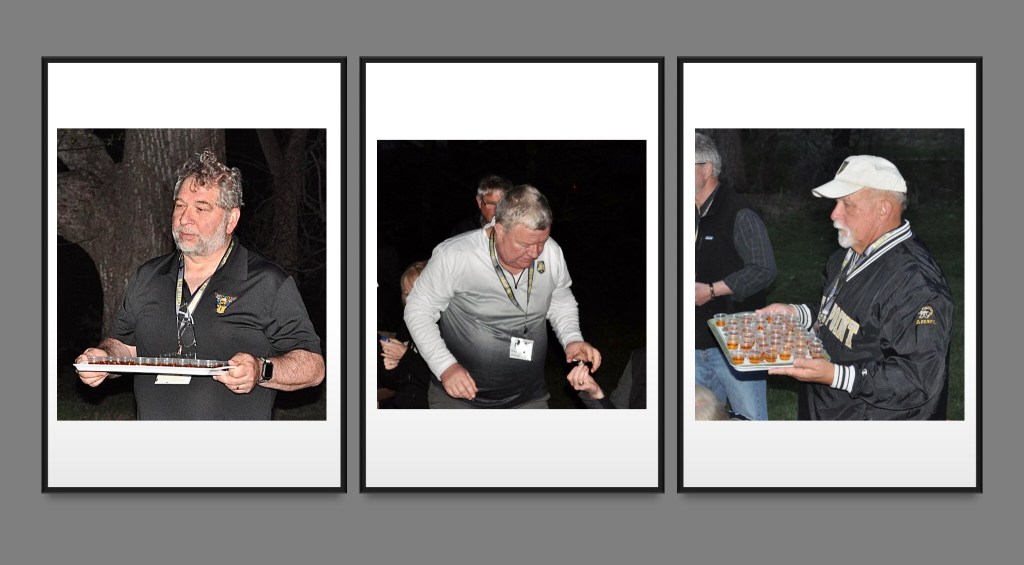
A little after 8PM, we started. Bill and I drafted our wives, Cathy and Bridget, as the official whiskey pourers, and several classmates volunteered to deliver the samples to the crowd.

Bridget and Cathy … Whiskey Pourers, Extraordinaire

What followed was a lot of living, learning and laughter, with a bit of drinking and history thrown in. Between tastings, Bill and I talked to the crowd about whiskey rations in the Revolutionary War, the Civil War and WWI. We also shared how whiskey was a part of the history between Lewis and Clark, and Lincoln and Grant. Stories were told of Dave Pickerell’s life and his impact on whiskey. As the night wore on, the crowd grew louder and more rambunctious.

Bond, Brent and Gus Delivering the Whiskey

A little after 9PM we were serving the last of the official tastings, The Boss Hog. The light was gone from the sky now and there were only the overhead lights. As the final glasses were served, we raised them in a toast to Dave, and our 71 other departed classmates. Suddenly, Grant Short led us in an impromptu singing of “The Alma Mater”, with it’s refrain of: “And when our work is done, Our course on earth is run, May it be said, “Well done”, Be thou at peace“. I have to admit to feeling a bit of a shiver as we sang, and it wasn’t from the weather – the words seemed extra special that night. Of course as we finished the song, all responded with a vigorous “BEAT NAVY!”

Seventy two of our classmates are gone. They will never be forgotten.

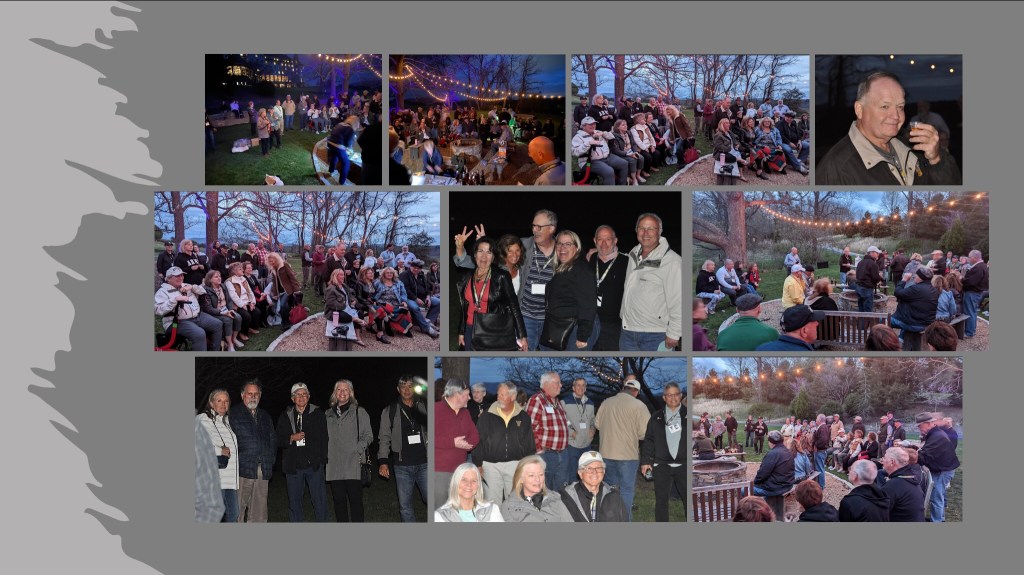
The formal part of the program was over, but the crowd remained. There was still a fair amount of whiskey left and war stories, both literally and figuratively, to be told. The crowd moved around, circled and shifted. Old friends were given hugs, and as always happens at these reunions, new friends were made. Cigars were lit and more whiskey was shared.

The Proud and Great Class of ‘78 Enjoying Life

Eventually, around 1030PM a soft rain started falling. As the crowd thinned, we packed up the remaining bottles, along with the water and snacks and moved back to the Biltmore. Some folks stayed up for a last drink at the bar, while others drifted off to bed. It was a fine night for the Proud and Great Class of ‘78, and our first group whiskey tasting. I hope it isn’t the last.

.. Feel free to forward this blog …..

Addendum:

– Special thanks to:

  • Rob and Jan Grubbs for organizing the mini reunion overall – what a wonderful event.
  • My wife Cathy and Bill’s wife Bridget who served as pourers for the event. We couldn’t have done it with out them. Also, classmates Brent Holmes, Bond Wells and Gus Hellzen who delivered the whiskey samples (in the dark) to all, without spilling a drop.
  • Rob Grubbs and Marion Seaton who took the photos in this blog.
  • Several classmates donated additional bottles of whiskey for tasting and drinking after the “official” tasting. Hats off to: Rob Grubbs, John Kimmel, Brian Keenan, and Joe Spenneberg among others.

– Huge thanks to Bill Moeller, who provided much of the information for this blog, and provided a wonderful history of the interaction of whiskey and the US Army over the course of history. The event would not have been what it was without him.

– You can read the Rolling Stone article about Dave Pickerell and Metallica here: https://www.rollingstone.com/music/music-features/metallica-whiskey-distilling-process-blackened-723508/ . Dave joked that he never made the cover of Rolling Stone, but he did get on the inside… ;-).

– Some of the history of whiskey allotments for the Army in past wars includes:

  • During the Revolutionary War, each soldier was issued a gill (4 ounces) of whiskey per day. Washington directed field commanders to reward valor on the battlefield with additional whiskey rations.
  • During the Civil War, whiskey was used by medics to treat patients, steady the nerves of soldiers, and heavily consumed during breaks in the chaos.
  • During WWI, soldiers on the front line were issued an ounce of whiskey, two times a day, 7 days a week. Resting soldiers received half that amount.

The American Experiment

The American Experiment

I will turn 67 on April 10th. That’s a little more than one quarter of the 246 year American Experiment. In January, 1790, George Washington said, “The establishment of our new government seemed to be the last great experiment for promoting human happiness by a reasonable compact in civil society.“* I’m trying to decide how well Washington’s words have held up.

To me, the Constitution and it’s amendments are still a reasonable compact. After that, things are a bit more dicey. As a country, we don’t act particularly civil, or happy these days.

If you look at history, America and Americans have always been contentious, but we seem well past that these days. Civility has gone by the wayside in government, and often in society. Our Congressmen and Senators routinely insult each other and anyone who disagrees with them. Many also have no problem insulting their constituents if he or she disagrees with them. Hate is a word that often comes to mind.

It carries over to our society as well. If there is disagreement, many folk no longer know how to act civilly, or even worse, choose to act uncivilly. Rather than discuss, or ignore something, the preferred response is often to insult or belittle, often with vulgarity. Anyone attend a school board meeting lately? And it’s not just about politics. We fight about noise pollution, light pollution, how people choose to raise their children, shopping sales and parking spots. Our ultimate “right” appears to be the right to be obnoxious.

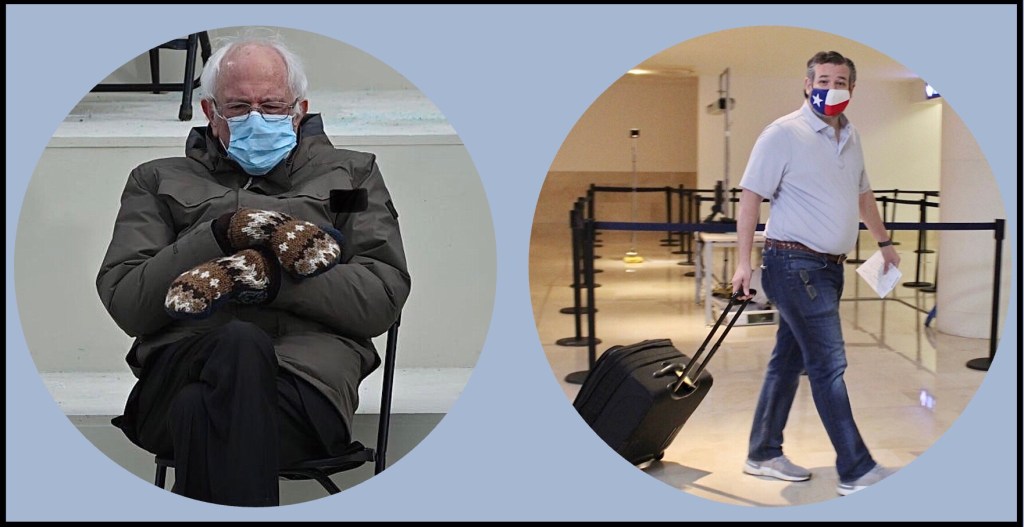
Happiness, at a government or society level, is also in short supply. Our politicians at the national level wear a scowl much more often than a smile. How often do we see Ted Cruz or Bernie Sanders smile? As Americans, many of us are pretty much unhappy about everything – immigration, the news, the price of gas, healthcare, our neighbors with different views, Covid, not using Daylight Savings Time all the time, boomers upset with millennials, everyone upset with boomers, sports referees… No issue is too big or small to escape our ire.

What are the odds of smiles under those masks?

Some days, we appear to be Whiny America, forgetting we could be in Ukraine, or any number of troubled spots around the world.

We have had discord and conflict throughout our history, and certainly there were times worse than what we are experiencing today. The Civil War, The Depression, WWII, The McCarthy era, Vietnam and the upheaval of the ‘60s to name a few.

We have also fought over issues throughout our history. State’s Rights, Western Expansion, Slavery, Women and the Right to vote, Labor and unions, Civil Rights, Gay Rights, Individual versus societal rights, the place of Religion in America … the list goes on.
I was born in 1955. Fools long for the mirage of the “good old days” in the ‘50s, forgetting that we were fighting in Korea, the prospect of nuclear holocaust was real, Civil Rights hardly existed, and Joe McCarthy was trying to tear apart the country with outrageous lies in the US Senate. People forget Happy Days was a fictitious TV show, not American reality.

What makes today appear worse? Maybe the internet-connected-world shines a brighter light on the American Experiment, allowing us to see all of the dark holes that have always been there, but were previously hidden. Maybe it’s not worse. Maybe it’s just our time and turn to experience the tumult that is the American Experiment. Or, maybe our lives have become so otherwise comfortable, this is just the next level of angst over the American Experiment – my way, or the highway, with no room for alternatives.

Maybe, instead of looking at society, we can start by looking at ourselves first, and find some civility, some happiness and some sanity.

You would think each of us could control whether we are civil or not. We can try and take our hatred down a notch or two and find ways to engage civilly with those who are “different” from us. And if we can’t find a way to engage civilly, perhaps we shouldn’t engage at all, rather than becoming mime worthy caricatures.

And Happiness? Certainly a tougher question and each of us is somewhere different on the continuum between abject sadness and blazing joy. We all have personal issues affecting our state of happiness over time, but happiness is often found in the eye of the beholder. Indeed, some people who have the right to be upset about health issues, are happy because they have one more day upright. I think a lesson is there for all of us.

Maybe part of the question is whether we can find happiness without making someone else unhappy.

For me, as I’m about to enter my 68th year on this planet and in this country, I have two thoughts. One, I’m going to strive to maintain my civility, no matter the situation. As for happiness, while I know I won’t always be happy, I’m going to look for happiness where I can find it, in events both big and small. Whether an upcoming vacation, a negative test result, or a new flower blooming in the garden, I will seek out happiness, and let it infect me.

I have no doubt The American Experiment will continue for the foreseeable future. We are a resourceful nation and people, and our strength and good fortune have brought us to where we are today. Like many families, we Americans fight with each other. Is it too much to ask for a little more civility in our lives and fights? That might even help with our collective happiness.

Addendum:

⁃ * Washington penned these words in a letter to English historian, Catharine Macaulay, on 9 January 1790. The entire quote in that part of the letter reads: “The establishment of our new Government seemed to be the last great experiment, for promoting human happiness, by reasonable compact, in civil Society. It was to be, in the first instance, in a considerable degree, a government of accomodation as well as a government of Laws. Much was to be done by prudence, much by conciliation, much by firmness.” You can find a link to the entire letter here: https://founders.archives.gov/documents/Washington/05-04-02-0363 .

⁃ Thanks to my friends Tim Stouffer and Mark Dunavan who both provided thoughts and inputs for this blog.

– As always, thank to my friend Colleen for her editorial assistance. I remain a work in progress.

The Palette of Our Life

The Palette of Our Life

Through Cathy, I’ve gained an appreciation for the colors that make up the palette of our life. As an engineer, the journey hasn’t been a simple one. Sometimes though, you can teach an old dog new tricks.

Over the decades, the two of us have seen life through different lenses.

For me, it has usually been about form, and lines and precision. It’s hard for me to say whether I was always this way, or I became this way. Did my childhood background start me on the road to becoming a military officer, an engineer and a business leader? Or was it something that was self-reinforcing over time? Even in my hobbies, whether running, or reading, or photography, there was a certain precision… trying to reduce my times on a run, or capturing greater detail in a photo, there was a linearity to it. The gauziness of color didn’t really register in my brain.

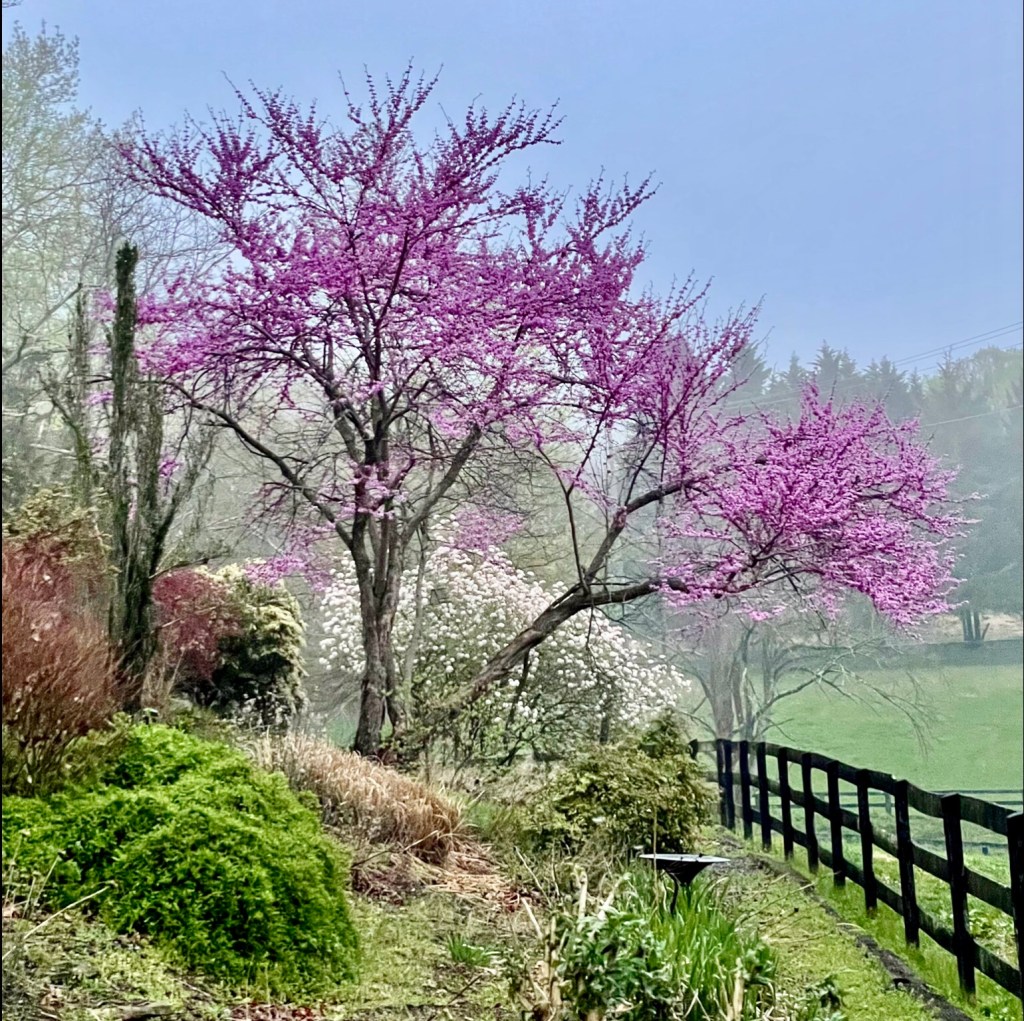
For Cathy, her view is much more about color and the senses. This is most obvious in our gardens. While our gardens are made up hundreds of plants and flowers, and requires much hard work on her part, it is the flow of color over the seasons that defines them. There are constantly changing colors and hues. Only a fool, or an engineer, would miss them and their beauty.

A Redbud in the Garden Last Spring

For years, I didn’t get it, or understand it. Or perhaps even worse, I didn’t think about it.

And then about seven years ago, I retired. There are many great things about retirement, and most retirees will happily enumerate them to you ad nauseam. For me, the greatest gift is the luxury of time. Time to do the things you want, or time to do nothing at all and not feel guilty about it.

One of the things I started doing with my time, was taking care of the morning feeding of the horses. It was easy enough, and made me feel like I was contributing at home. There was also an unintended consequence.

After feeding the horses, while walking back to the house, I would notice little bursts of color in the garden. Why were flowers blooming in February? And then March? And then everywhere by May? Our hillside garden was awash in color, both from the flowers, and the many hues of green from the plants themselves. Now mind you, these colors and flowers were there for years, but it was as if I was seeing them for the first time. Cathy had created all of this, and I was blind to it.

Some Photos of Just a Few of the Flowers in Cathy’s Gardens

Thank God, we all have the ability to grow, even when we appear set in our ways. As spring arrives, I walk through the gardens looking at the new growth and colors peeping out. This year is different than the past. Our hellebores, crocuses and daffodils are blooming at the same time, when typically they would bloom sequentially. The engineer in me wants to understand why, but it’s not stopping me from enjoying this beautiful March we are having.

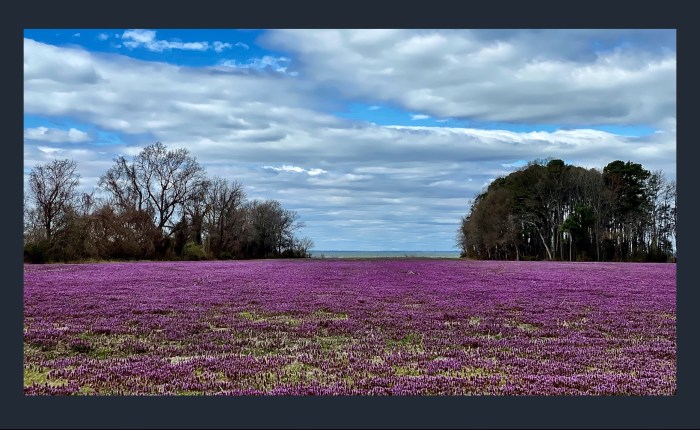
I see color now, or perhaps a better description is I see more color now. Sure, I always saw the red, yellow and orange leaves of autumn, or the red white and blue fireworks on the Fourth of July, or a multicolored string of Christmas lights. Now, I also see the purple ground cover in a field in the spring, the mixed colors in a neighbor’s garden, the infinite shades of grey in the sky and sea on a cloudy day. I’m a better person for all of it.

On a Recent Drive to the Chesapeake Bay, a Sea of Purple…

I’m still Max and keep spreadsheets, to-do lists, and can be pretty anal about time. Happily, I’ve also gained an appreciation for color. I excitedly show Cathy pictures of her flowers and of the garden and she smiles at me. Even though she has seen those colors and flowers for decades, she’s a good partner and encourages me in my growing understanding of color, and of who she is.

It makes me feel pretty lucky.

The Black Death

The Black Death

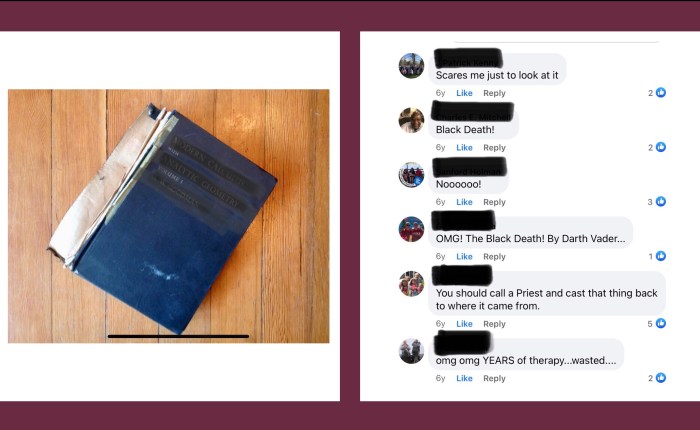
The Black Death. That’s what we called it. Among us Plebes at West Point, feelings were strong, and universal. To this day, grown men shudder when they see a picture of The Black Death. How could a single book leave such a strong impression? What devilry was this? What book of spells could cause such consternation?

Yes, Grown Men Still Shudder when they See a Photo of The Black Death

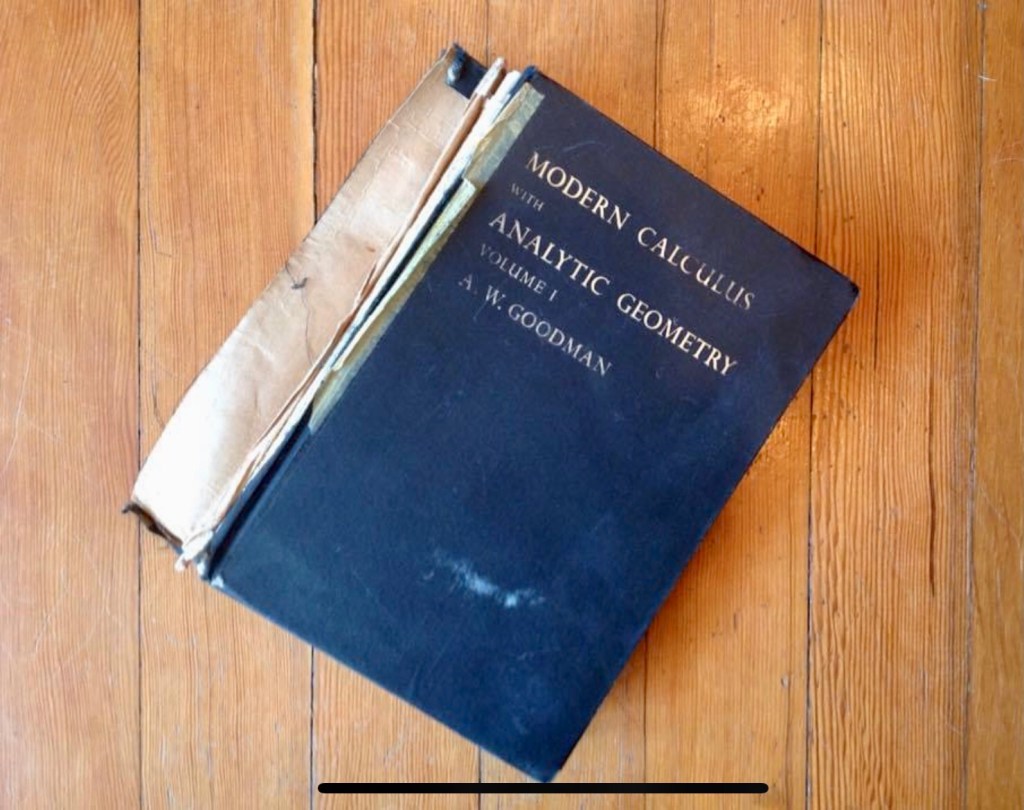
Of course it wasn’t just any book. This book was “Modern Calculus With Analytic Geometry (Volume 1)” by A.W. Goodman. We never called it that though. We called it The Black Death, or sometimes The Black Plague. The book was black, but I suppose our title referred to the entire experience of Plebe (Freshman) math at West Point as much as anything.

The Black Death, in all it’s Glory

After Beast Barracks our first summer at West Point, it was a relief to get to the academic year. Unfortunately, we didn’t quite know was waiting for us. In addition to the normal Plebe challenges, Calculus was a required course for all, and provided our introduction to The Black Death.

This wasn’t just any old math course. There were several “attributes” that put the class  into the category of those things you never forget.  My classmates and I laugh about it now, but it’s still a bit of a nervous laugh.

First off, the class of ‘78 went to Plebe math five days a week, including Saturdays, with 90 minutes for each class. Prior classes attended Calculus class six days a week for 75 minutes per class and thought ‘78 was getting over, since it was only five days a week ;-).

In the class itself, we had normal homework, quizzes and tests. In addition, we suffered a unique form of torture called “The Boards”, also known as “Recitations”. A couple of days a week, the professor would call out “Take Boards.” We cadets stood up and each of us went to one of the blackboards that covered the walls in the classroom. The professor then asked us to work through a calculus problem on the board. It might have been one of the previous night’s homework problems, or it might have been the proof of some theorem. After several minutes, he called “Cease Work!” and then called on one of the students to walk through, or recite, their problem solution. Sometimes it was a cadet who had the solution mapped out perfectly. Other times? Well, other times it might be a cadet whose answer wasn’t correct. It could make for some tense/fumbling moments. Recitations had taken place at the Academy since at least 1869.

Somethings Never Change – Cadets “Taking Boards” in 1900

Of course that sly b@stard Goodman contributed to our pain. While there were often theorems in the book that provided the mathematical proof for the result, it wasn’t always the case. If there was ever a theorem in the book where it said “The proof is intuitively obvious to the casual observer”, you knew it would be a problem for the boards, or a quiz, or a test. For most of us, the solution was never “intuitively obvious”.

At the time, West Point was on a 3.0 grading scale. 3.0 was a perfect score. 2.0 was the lowest passing grade. If you scored a 2.5 on a quiz, you built up five “tenths”. If you scored a 1.7 on a quiz, that was the equivalent of an F and you were down three “tenths”. For those near the bottom of the class in math (or any course), the phrase “2.0 (pronounced “Two OH”) and go” became common. Basically it meant over the course of the semester (and year) you needed to finish with a 2.0 average. Any tenths over that were wasted.

We were quizzed and tested on a regular basis and over time, each of us fell somewhere on the spectrum between 3.0 and less than 2.0. Every few weeks, the math department reordered us cadets by current math class grade ranking. That is, those with the highest grade average, migrated to the “top” sections, while those with the lowest scores would migrate to the “bottom” sections. Each section had about 15 or 17 students. The theory was those in the top sections could cover more material, while those in the lower sections could receive the extra help needed. This reordering of the class on a regular basis was first implemented in the 1820s and was unencumbered by progress for the next 160 years.

The lowest section also earned the nickname “the ejection section” and the guy with the very lowest grade was in the ejection seat. My classmate Rick Steinke, was in the ejection section and ejection seat at various times. At the end of the semester and year, some number of cadets weren’t going to have a grade over 2.0 and one of three things would happen. Rick’s recollection – “That is where I was at the end of first semester, plebe year. Of the bottom 30, as I recall: 1/3 of us did not make it to the next semester (they were booted from the academy); another 1/3 were turned back a year; and another 1/3 went to summer school. I believe I was the only plebe who escaped unscathed, with just a couple of tenths to spare. Thanks to Captain Art Bonifas*, my first semester Professor, and Major Bachman my second semester P, I made it through. Also, Marty Vozzo, my roommate (and several years later, a math professor back at West Point), told me which theorems and equations I needed to memorize. Divine intervention, my brother.”

Rick DID survive the Ejection Section, and the Ejection Seat

Time passed, and we moved on. Obviously lots of Plebes did quite well in Calculus. Many excelled at it.

My classmate Joe Spenneberg, returned to teach math at West Point a decade later, from ‘88-‘91. By the time he returned, Goodman was gone, as were The Boards. The cadets still attended math five days a week, but only for an hour at a time. Also, classes were no longer “reordered” on a regular basis. The course work changed some as well – instruction started with “discrete math”, before migrating to integrals and “continuous math”. In Joe’s words, “The jump between discrete and continuous was key. We told them to imagine that the discrete step is infinitesimally small, which introduces the concept of the limit which is essential to being able to define a derivative …” as Joe was recently explaining this to me, I fogged over about then ;-).

Joe also told me a total of nine or ten of our classmates DID return and teach math at West Point.  To the best of my knowledge, as a class we never ostracized them. 

I’m sure Mr. Adolph Winkler Goodman, who died in 1989, had no idea about his effect on Plebes at West Point. I don’t think it mattered if you were a star man (top 5% of the class) or a goat (bottom of the class), everyone called it The Black Death. Yea, we laugh about it now, but it was pretty serious stuff then. Looking back, it was one of those commonalities that united all of us. You don’t think about a math class uniting people, but I sure think The Black Death did so for us. The only other class with a similar effect was boxing, but that’s another story for another time.

As I was working on this blog last week, I had a dream one night.  I was back at West Point, and you guessed it, in math class.  It was finals and I was in the classroom with several classmates.  Time was passing and for some reason, while I had a copy of the test, I couldn’t find my paper to write my answers down.  I knew the answers, but I couldn’t find the piece of paper to write them on. Classmates started finishing the test and leaving the classroom AND I still hadn’t started.  I was trying to ask the teacher for help, and getting no response…  

I woke up in a sweat.  Looking around, I was in my own bed, with Cathy sound asleep next to me.  I settled back to sleep and chalked it up to one last gift from Mr Goodman and The Black Death. 

Addendum:

⁃ * The name Captain Art Bonifas might sound familiar to you. After leaving West Point, Captain Bonifas was stationed in Korea. In what came to be known as “The Korean Axe Murder incident ”, Bonifas was bludgeoned to death by North Korean soldiers in an international border incident in August of 1976. The world was pretty tense for a couple of weeks after his death. You can learn more about the incident here: https://en.m.wikipedia.org/wiki/Korean_axe_murder_incident

⁃ Special thanks to classmates Rick Steinke, Joe Spenneberg and David Fitzpatrick, who contributed both content and editing to this blog. All three were involved in teaching and Higher Education after their time at West Point. Rick is a former Harvard National Security Fellow, and later served as the Associate Dean at the George C. Marshall European Center for Security Studies. Joe and David both returned to teach at the Academy, and Dave continues to teach History at Washtenaw Community College in Ann Arbor, MI.

– If interested, here’s a blog about my first two hours at West Point: https://mnhallblog.wordpress.com/2017/03/18/first-two-hours-at-west-point/

⁃ For some additional history about West Point and Math, you can try this article – Mathematics Education at West Point: The First Hundred Years: https://www.maa.org/book/export/html/116851. Founded in 1802, West Point was the first engineering school in the United States, and had a uniquely technical curriculum for its time. The first two years of the curriculum was dominated by mathematics. The information in this blog on the history of “Taking Boards”, and the reordering of the class on a regular basis were both documented in this article.

⁃ You can learn more about the restructuring of math instruction at West Point in the late 1980s and early 1990s here: https://www.westpoint.edu/sites/default/files/inline-images/academics/academic_departments/mathematical_sciences/Math/v04_issue1.pdf

Baseball’s Hubris

Baseball’s Hubris

(With apologies to Ernest Lawrence Taylor).
Oh, somewhere in this favoured land the sun is shining bright,
The band is playing somewhere, and somewhere hearts are light;
And somewhere men are laughing, and somewhere children shout,
But there is no joy in Baseball, the fans are all locked out.

Of course Taylor’s poem, Casey at the Bat is a classic. The famous last stanza is a monument to hubris:

And somewhere men are laughing, and somewhere children shout,
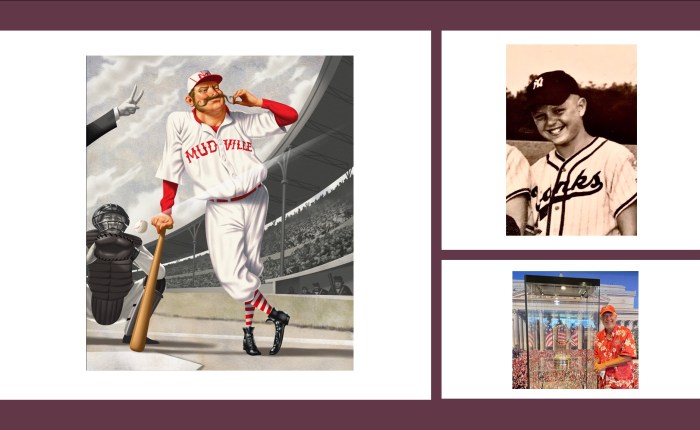
But there is no joy in Mudville – mighty Casey has struck out.

Unfortunately, the billionaire owners and millionaire players are fighting over money again this year. Like the Mighty Casey, their hubris knows no bounds. They need to be careful, or they too might strike out.

Who doesn’t have a seat at the table? We fans.

I’ve been a baseball fan since I was a kid. Although I started as a White Sox fan like most of my friends at the time, I’ve been a Cardinal fan since ‘64, when they won the World Series and my father convinced me of the error of my ways.

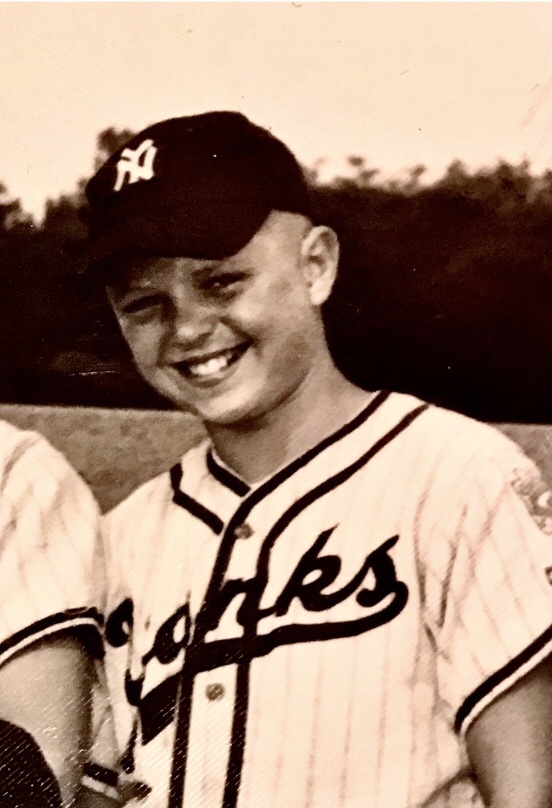
I was a Cardinal Fan, but Played for the Yanks in Little League

I’ve remained a Cardinal fan, but I’ve also followed other teams over the years. Truth be told, I love live baseball. I may take a nap watching a game on TV, but in the ballpark? I love it. There is nothing like being at the ball park. The excitement, smells, and sounds. Having a beer and a brat. The roar of the crowd. It’s a very nostalgic feeling.

Busch Stadium in Saint Louis. Note the Arch in the Background.

Over the years, I’ve attended live baseball games all over the country. Certainly the Cards, Cubs and White Sox back home, but I followed several other teams as well.

Many folks hate the Yankees, however, when I was at West Point in the ‘70s, military personnel could attend games for free and I went to a few. The military wasn’t particularly popular then, and their gesture has always stayed with me. When we moved to DC in ‘89, there was no local baseball, but the Orioles were just up the road. Cath and I attended the occasional game at the old Memorial Stadium, and then when they built Camden Yard, we bought a mini season ticket plan with friends.

When the Nats came to DC, I became a season ticket holder with three other friends. They were great seats, right behind home plate. We kept those tickets for their first two years at RFK stadium, and then they jacked the prices up, and we let them go.

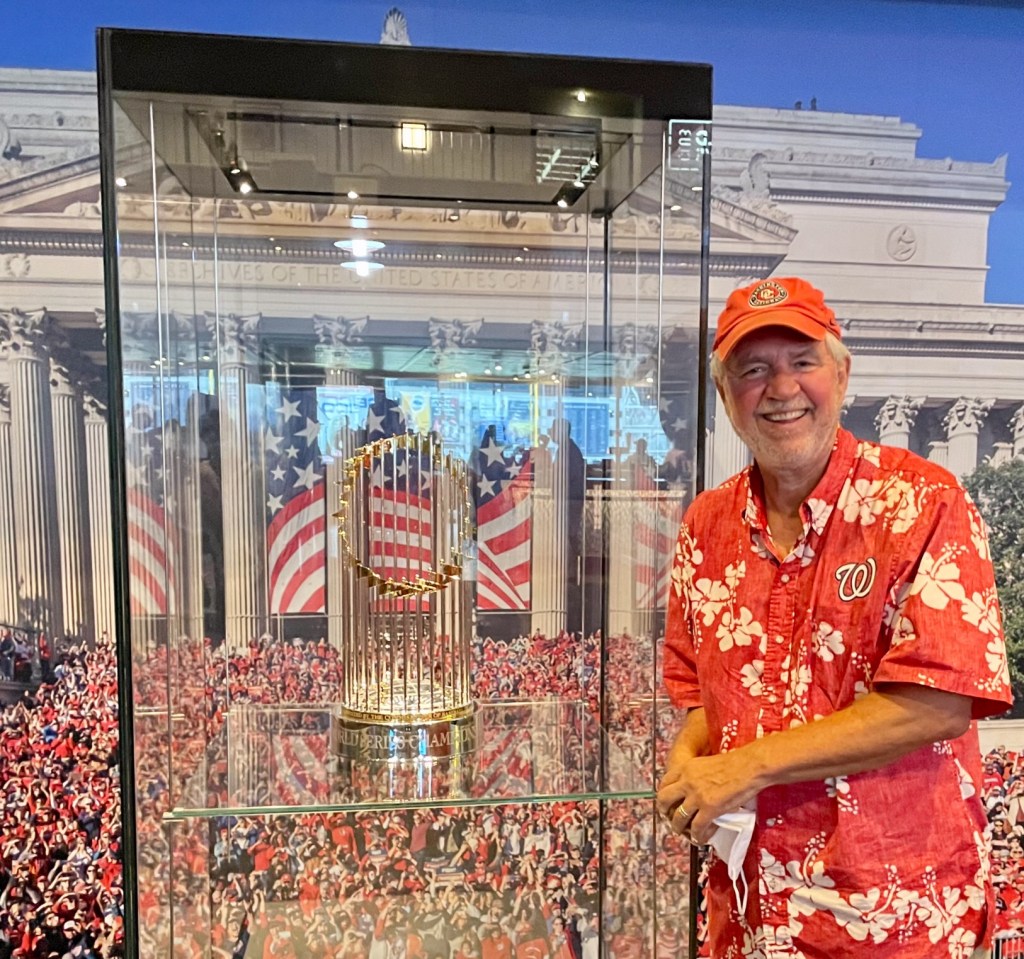
Several years later, I joined another group of four guys and have been attending Nats games ever since. I saw the All Star game in ‘18 when it was in DC, and made one of the World Series games in 2019, when they won it all. I still root for the Cardinals, but I’m as much of a Nats Fan as a Cardinal Fan these days. Don’t tell my dad – he’d probably roll over in his grave… 😉

Posing with the Nats’ World Series Trophy

I love baseball.

And now? Now, I just don’t get it. The 2020 season was lost due to Covid. The first third of the 2021 season only had limited seating, again due to Covid. You would think the last thing anyone would want now, is an impact on the 2022 season, and yet, here we are. The first two series of the season are already cancelled, and they are about to cancel more.

I won’t pretend to understand the intricacies of the current negotiations. What I do know is that they are continuing to lose fans. Greed never looks good, and to this fan, that’s what it looks like. Greed on the part of the owners, and greed on the part of the players.

It’s true fans don’t have a seat at the negotiating table. Ultimately though, fans DO have a vote – they can vote with their pocket books. It seems to me that both the owners and the players could learn something from Casey’s hubris.

This fan of baseball for the past sixty years is considering his options for the future.

Addendum:

– Special Thanks to my niece, Tami Harmon, who provided several suggestions for this blog. A life long Cubs fan, she knows quite a bit about baseball.

Casey at the Bat was originally written in 1888. You can find a link to the complete poem here: https://www.poetryfoundation.org/poems/45398/casey-at-the-bat

– UPDATE: Two days after this blog was originally published, the two sides reached an agreement. I’m sure this write up is what pushed them across the line. ;-).

Sunrise or Sunset?

Sunrise or Sunset?

Sunrise, or Sunset? Which do you favor? Both can be equally beautiful. Both can be equally colorful. Both are fleeting. It’s a bit deeper than just color and beauty though, isn’t it? I enjoy them both, but if I could only pick one? Not an easy question to answer, but I would probably say…

It’s easy to say you must be a morning person to see the sunrise, although I think that’s a bit of a cop-out. For myself, I wake up at approximately the same time all year long – about 6:45-7:00AM. That means in the dead of winter, I see some gorgeous sunrises. For the rest of the year? I’m out of luck, unless traveling or something. Virtually all of us are up at least occasionally at sunrise. Maybe not often, but at least occasionally for travel or work, or something else going on, so let’s take the morning person argument off the table.

Many photographers and photography sites seem to favor sunrise – better light, or at least cleaner light I suppose. Maybe that’s true, but to my naked eye? I don’t see the difference.

So what is the difference? Maybe it’s more metaphysical and less about color and light.

Who doesn’t like sunrise and the start of a new day? Poetry and quotes are filled with “wisdom” on this subject – The symbolism of darkness going back to light. The chance to pursue new opportunities with a clean slate. The promise of a new day and all that entails. The stillness of a new morning, that perhaps gives us the chance to think clearly and cleanly, almost as if the morning dew washed away our cobwebs from the night. This is stuff that reaches out to our core and there are elements of truth in all of it.

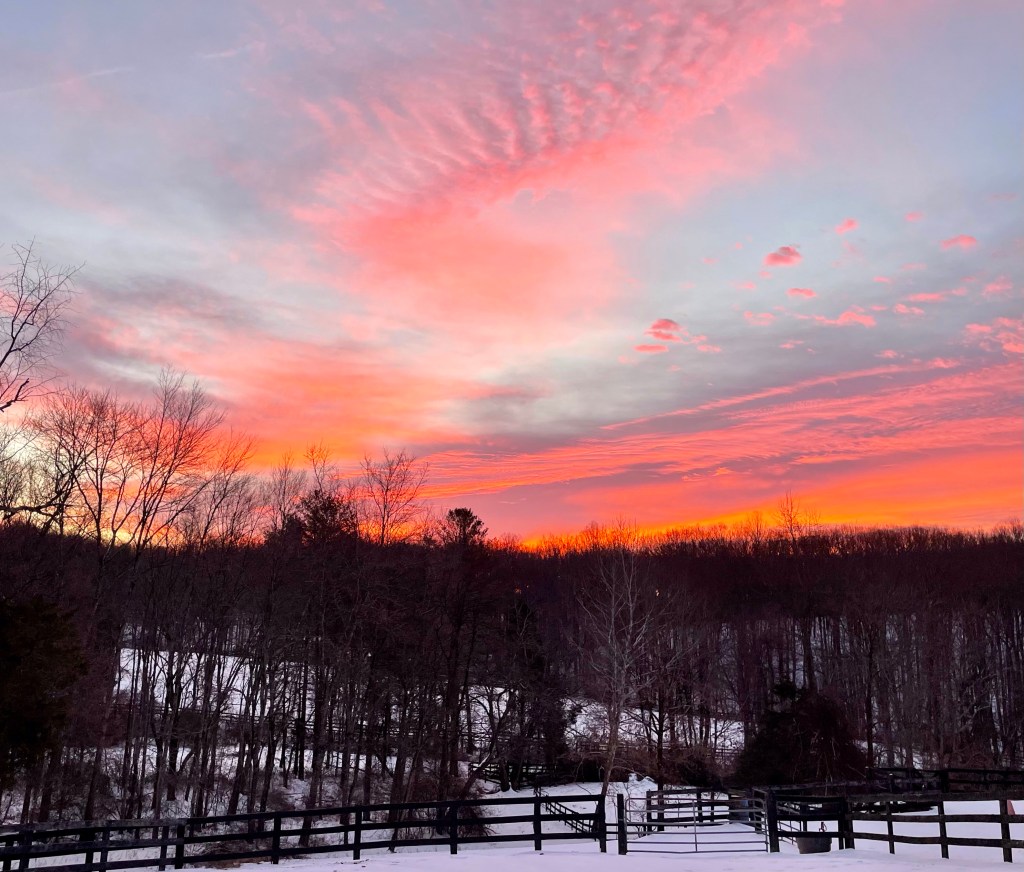
Sunrise at Rohan Farm one day this winter

Ah, but sunsets… They provide a close to the day and our activities. They let us take a small pause as we watch the setting sun, reflect back on the day, and maybe think about what did, or didn’t, happen that day. And if we are with others? I’ve learned over the years that for me, nothing says fellowship, like drinking a “sundowner” with friends while watching the dying light of day. That shared feeling of quiet and peacefulness is pretty wonderful. The warmth of those feelings often extend into the evening hours. And of course, most of us see many more sunsets than sunrises over the course of our lives.

A Sunset in Africa last fall

As I think about it now, the feelings I experience at sunrise and sunset are different. I hadn’t thought about it before, but it’s real and it’s true. I guess I’d sum it up as thinking about new beginnings versus a time of reflection. How do you choose between those two versions of truth?

This is, quite frankly, too much thought about things that happen everyday. And of course, we don’t generally talk about, or remember those sunrises and sunsets happening in the rain, or the fog, or on a cloudy day. Most of us will experience 20,000-30,000 sunrises and sunsets over the course of our lives. I think it’s OK that not all of them are “perfect”. 😉

So which is it for you? Sunrise or Sunset?

For me,

Lariat Advance

Lariat Advance

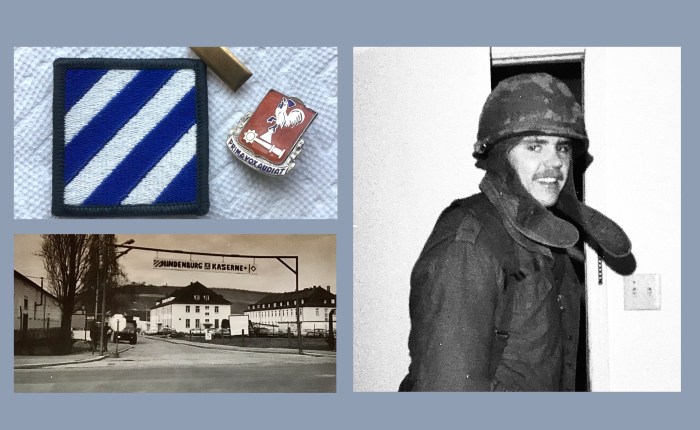
The call came at about 3:40AM in late February, 1979. I answered the phone, “LT Hall.” – “Max, this is Captain Ward. A Lariat Advance Alert was called at 3:25AM this morning.” – “Got it sir – on my way.” I called my Platoon Sergeant, Paul Teague to notify him, and kissed Cathy goodbye, with a “See you when I can”. I was out the door for the drive to Hindenburg Kaserne by 3:50AM.

We lived in the little town of Helmstadt, Germany, about 15 minutes from Hindenburg Kaserne (Barracks, or Army Post) in Würzburg. My mind raced on the drive to the barracks.

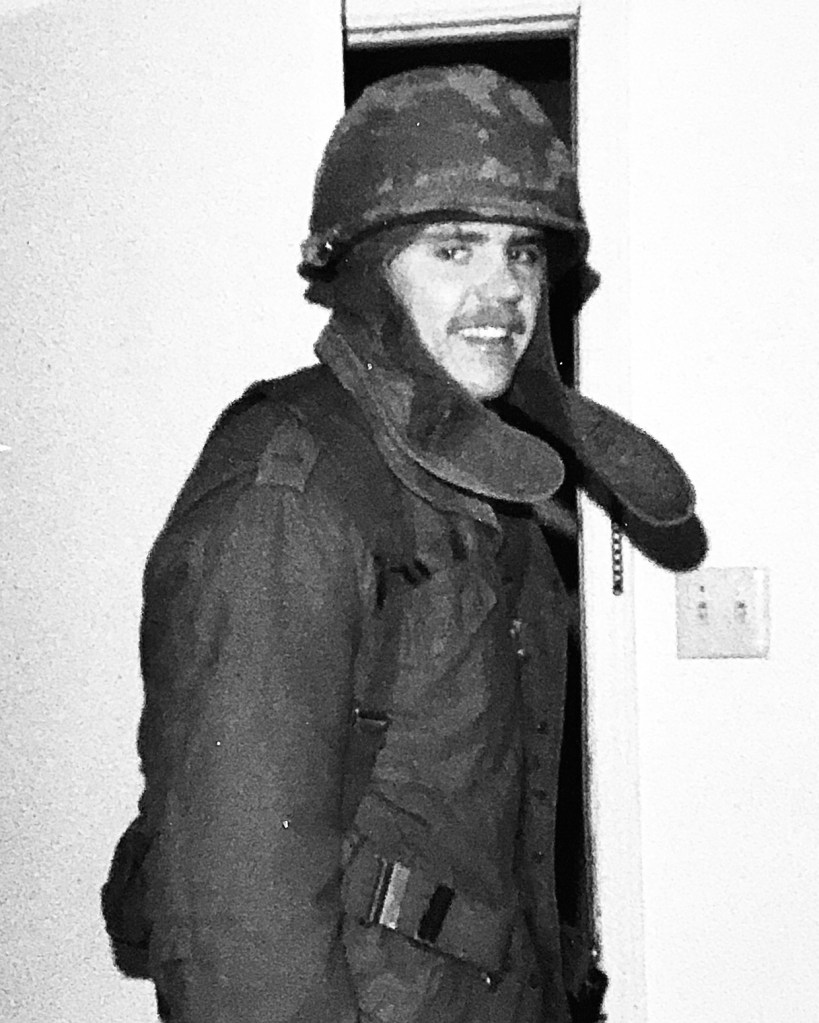
LT Hall in 1979

This was my first Lariat Advance. I’d joined the 123D Signal Battalion, 3rd Infantry Division in January of ‘79. A Lariat Advance was a US Armed Forces Cold War mobilization alert in Germany. The thing was, you never knew if it was a drill, or in response to a real world situation. If just a practice, it might be called off after a couple of hours. BUT, you could also deploy and link up with the unit you supported (2nd Brigade, 3ID in my case), or even deploy to your General Defense Plan (GDP) location. For my platoon, that was near the village of Hof, and the Hof Gap on the the Czech/East German border. The Hof Gap was considered a major Armor Route for a Russian invasion of West Germany. The pucker factor increased significantly if you deployed there on an alert.

My unit, B Company, 2nd Platoon, was always the first unit scheduled for departure, as we had farther to go. We would depart two hours after the alert was originally called. In this case, we needed to be lined up at the Kaserne Gate and ready to go at 5:25AM.

Main Gate, Hindenburg Kaserne

I arrived at the Kaserne a few minutes after 4:00AM. As I climbed out of the car, I promptly locked my keys in the car. “D@mn!” I stood looking at the car, shaking the door when one of my squad leaders, Sergeant Santos ran by and called out – “Yo, L.T. (Pronounced Ell-Tee), what’s up?” – “I locked my keys in the car.” He stopped, looked at me for a second and then said, “Forget ‘em. We’ll get them later – we gotta go!

He was right, of course. I left the car and ran to the Company HQ and checked in with the CO. Next, over to the Armorer, where I picked up my .45 pistol, and finally, I ran back outside and over to our Platoon Bay. It was probably about 4:15AM.

Sergeant Teague had also just arrived and he gave me a status report. About 80% of our troops were on the Kaserne, with the others expected shortly. We then looked at our vehicles’ status. Our platoon had around 20 vehicles in all – a combination of jeeps, a 2 1/2 Ton truck (the Deuce) and several Gamma Goats. Gamma Goats were six wheeled vehicles that could, at least in theory, perform off road much like a tank, or other tracked vehicle. We needed to determine which deadlined vehicles could be made readily available, by cannibalizing* other deadlined vehicles. We agreed that of our four deadlined Gamma Goats we could maybe get three ready, and still make the 5:25 departure time.

A Gamma Goat, with Comm Shelter

The next half hour was total chaos. By then, all of our troops but one were on the Kaserne and had picked up their weapons. We continued loading both personal and platoon equipment into our vehicles. Cases of C-rations were loaded into the Deuce, along with other supplies. Two of the deadlined vehicles were fixed, but we were still having problems with the third. Somewhere in there, we received word we would deploy to Kitzingen, and link up with 2nd Brigade’s HQ elements. It was now 4:55AM, a half hour before departure.

Suddenly, a feeling of great calm and clarity settled over me. The world seemingly slowed down. Sergeant Teague and I agreed it was too late to fix the last vehicle and to hell with it, we would roll with what we had. We held a quick meeting with our three section leaders and strip maps to Kitzingen were passed out for each of the vehicles (remember this was all pre cellphones or google maps). We lined up the vehicles in the motor pool and proceeded to the gate, with my Jeep in the lead. Sergeant Teague was in the last Jeep at the end of the convoy. At 5:15, we were at the gate where the Battalion Commander, Colonel Swedish and Command Sergeant Major Johnson greeted us. We spoke briefly and they wished us good luck.

5:25AM came, and we rolled. The rest of the day passed in a bit of a blur. Google maps says the drive from Würzburg to Kitzingen takes a half hour, but at convoy speed, it probably took us about an hour. We arrived and I reported in to the 2nd Brigade Operations Officer (S3). Then, as is often true in the Army, we sat and waited. And waited. I stayed in touch with the Brigade S3, and also with my Company Commander via FM radio. After a couple of hours passed, we received word it was a drill, and perhaps another two hours later, we were released and returned to Hindenburg Kaserne.

The drive back took another hour. Once back at Hindenburg, we offloaded all of our equipment, washed our vehicles, and then topped all of them off with fuel, so they were ready to go. Cannibalized parts were returned to their original vehicles. A weapons count was done by the armorer, and it was verified all weapons were turned in and accounted for.

I reported to Company Headquarters that all recovery tasks were completed. Once all three platoons were finished, Captain Ward let me know we could dismiss the troops, which I did.

By now, it was late afternoon or early evening, and my keys were still locked in the car. I started thinking about how I was going to get home, when Sergeant Santos came up. “Hey L.T. Let’s get those keys.” – “Sure, how are going to do that?” Ramos just smiled, and then pulled a Slim Jim** out of his jacket. Two minutes later, the door was open, and I had my keys. I thanked him, and decided right then and there, I didn’t need to know why he owned a Slim Jim.

A Slim Jim – Need your car door opened?

With Russia and the Ukraine in the news, I was thinking about that first Lariat Advance. Forty years ago, we were concerned about, and prepping for war with, the USSR. After The Berlin Wall fell in 1989 and the Cold War ended, I thought those days were behind us, at least for Europe. With Mr. Putin’s current aggression, that no longer seems the case. I’ve been thinking about an Intelligence flyer that came out, right after The Wall fell, warning us about the long term goals of the Russians:

“We will Smash them with our clenched fist.”

It is no longer Communism against capitalism, but it is still Russia versus the West. Sometimes the more things change, the more they stay the same. I’m wishing Godspeed and safety to all of our troops.

Addendum:

Cannibalize – If a vehicle was determined to have a safety issue, or something major wrong with it during operations or an inspection, it was put on the deadline report and the appropriate parts were ordered. You were not allowed to drive deadlined vehicles, until they were repaired. In the event of an alert, you “Cannibalized” one of the vehicles to remove parts to put in the remaining vehicles. It might be something as simple as a brake signal bulb (safety feature), or something more serious like a transmission problem. Cannibalization was frowned upon, as you could literally reduce one of your vehicles to a pile of parts in order to fix other vehicles. That one vehicle would stay on deadline forever. This is why we were to return cannibalized parts to the original vehicle when we returned to the Kaserne.

• **Slim Jim – For those unaware, a Slim Jim is a slender device used to break into a car by fishing down the side of window and into the door for the locking mechanism.

Grad School, and Learning to Cook

Grad School, and Learning to Cook

Embarrassment is what started it. Well, embarrassment, a class in Stochastic Communications and Trout Almandine. In 1984, I started learning how to cook, largely after being embarrassed at a friend’s house on a Sunday afternoon.

Last week, I published a blog about cooking a German dish, Erbseneintopf (Split Pea Soup) in 1982, and I received notes from several friends asking if that’s when I started learning to cook. The answer was no, that didn’t really come till later.

It’s true Erbseneintopf was the first recipe I collected, but as to cooking, my skills were limited. Yea, I could do steaks, brats, and burgers on the grill, but not much else. Cathy did the vast majority of cooking for us, and that (from my view point) seemed to work out fine.

Things changed in 1984.

The Army, in it’s infinite wisdom, sent me to Grad School to pursue a master’s degree in Electrical Engineering. I was in the Army Signal Corps and they were looking for engineers to help with the new field of Computer Networks. We all take the Internet and computer networks for granted now, but back then, it was brand new, except for some research networks like The Arpanet, a DoD funded network.

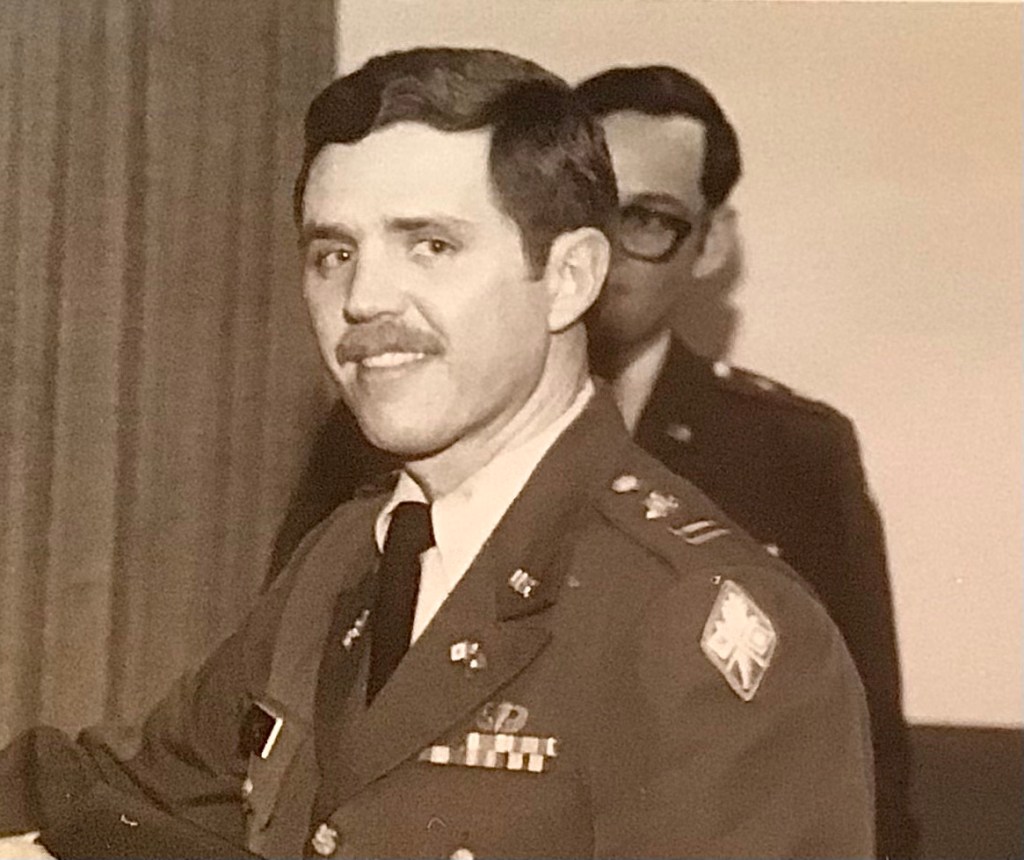
Captain Hall, The Future “Cook”. The Photo was Taken During my Time at Grad School.

As I started my graduate program, something quickly became obvious. My math skills were rusty and needed work. I’d studied calculus, differential equations, linear equations, and probability and statistics at West Point, but that was several years before and I’d forgotten most of it.

In the fall of 1984, I was required to take a class in Stochastic Communications – it was a theory class about how communication systems act in the presence of noise, and was very math heavy. A friend of mine, Gerry, was also taking the class and we often studied together to understand the math.

One Sunday afternoon, Gerry was at my house and we were working through some tough problems. At some point, I said, “Hey, feel like some dinner? How about if I order us a pizza?” Gerry agreed, and I ordered a pizza from the Pizza Hut just down the road. When they delivered the pie, we took a break and had a beer with our dinner. Eventually, we resumed our studies, and then quit an hour or two later.

Nothing Says Fine Dining Like a Pizza from Pizza Hut…

A couple of weeks later on another Sunday afternoon, we were studying at Gerry’s apartment. Eventually, we were getting hungry and Gerry said “How about a break for dinner?”, to which I readily agreed. I expected him to pick up the phone. Instead he said, “Come on, let’s go to the kitchen.

We arrived in the kitchen and after opening a bottle of wine and pouring two glasses, he proceeded to the fridge where he pulled out some trout filets and asparagus. He then brought out some almonds, garlic, and God only knows what else from his cabinets. What? Was he actually going to cook a dinner?

Gerry spent the next half hour or so preparing the meal, while we continued drinking and talking. He toasted the almonds, sautéed some garlic and eventually pan fried the trout, while sautéing the asparagus in another pan. Half an hour later, it all came together on our two plates with the almonds scattered over the trout and the asparagus served on the side.

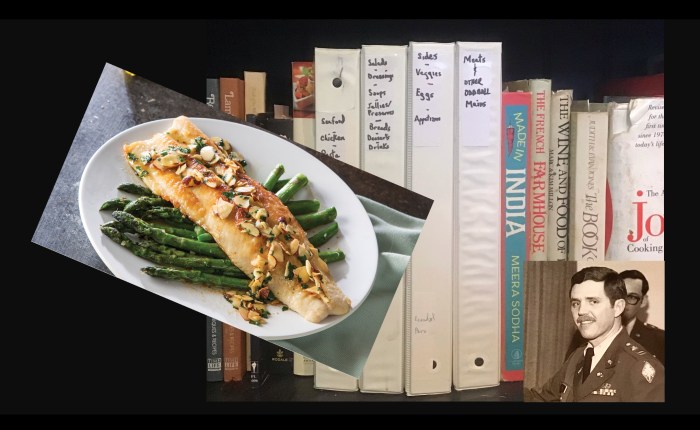
Trout Almandine with Asparagus on the Side – a Treat from my Friend, Gerry.

Holy Cow! A real meal, and a great one. I believe I was in a bit of shock. Thinking back to the Pizza Hut pizza I’d served two weeks before, I was also a bit embarrassed.

On the way home, I thought to myself, “What the hell is wrong with this picture? A bachelor comes to a married guy’s house and has delivery pizza from a chain restaurant for dinner, while the married guy goes to the bachelor’s house and has a gourmet meal!?!?” Right then and there, I decided I needed to learn how to cook.

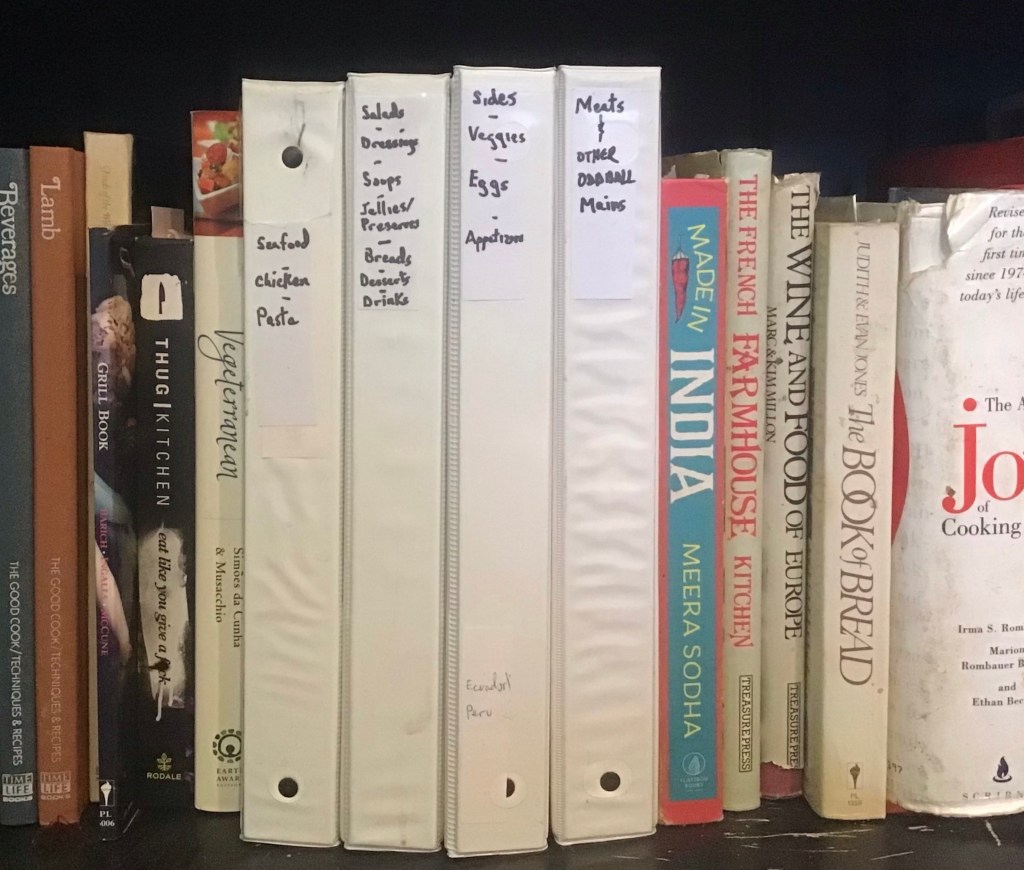
And so, my cooking journey began. Cathy still did most of the cooking, but I started cooking some as well, especially on weekends. I’d find different recipes to try and slowly expanded my repertoire. I also started collecting cookbooks, some basic, some focused on specific cuisines. I went through bread and muffin phases, German and French phases, Vegetarian, Stir Fry’s, and eventually Indian curries, among other recipes.

Just a Few of the Couple Dozen Cookbooks I Now Own

I found I enjoyed cooking, and I started to cook decently, but man, was I a messy cook. I knew nothing about “Mise en place” (prepping things ahead of time), or cleaning as you go. While I could turn out a great meal, the kitchen was a disaster. Cathy’s mom said something to Cath about it one time, and Cathy basically told her to be quiet, I was at least cooking some of the meals now. 😉

Eventually I retired from work around 2015, and and over time, started cooking my share of our meals. I also learned about Mise en place and cleaning the kitchen as I cooked. It only took me about 30 years to learn those two basic lessons. Better late than never, I guess.

So, that’s my story. Who knows, If I hadn’t been rusty in math and in need of help, maybe none of this would have happened. You don’t always know what will send you down a different pathway in life. I’m glad I discovered this one.

Addendum:

⁃ Strangely, there is no Trout Almandine recipe in my collection of recipes. I never asked Gerry for it at the time. If I’m making it now, I use a variation of a recipe I found online. C’est la vie

– Gerry went on to get his PhD in Electrical Engineering – he was a smart guy about many things. Unfortunately, over the years, we lost touch with each other.

Erbseneintopf

Erbseneintopf

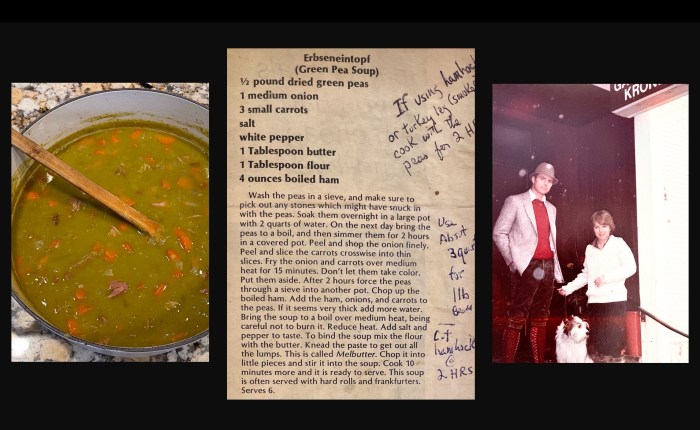
The oldest recipe in my recipe collection is for Erbseneintopf – a German Split Pea Soup. It came from The Stars and Stripes newspaper in Germany in ‘82 or ‘83, and is now a bit tattered. The first time I tasted the soup in a Gasthaus, I thought I’d died and gone to heaven. Getting the recipe was a bonus.

Erbseneintopf. The word and the soup are both a mouthful. Erbseneintopf literally translates to “Pea One-Pot”, and is really closer to a stew. Made properly, it is a thick soup with little chunks of sausage or ham hock in it. I’m not talking the puny American ham hocks, but the big German kind – meaty and smoky. The meat gives the stew a wonderful flavor. It’s a simple, hearty meal.

I believe the first time I had the dish was in a little village near Stuttgart, although I can’t remember the name of the town, or the Gasthaus, for the life of me. At the time, we often went for a walk in the woods on a Sunday afternoon, as many Germans did, and then would stop at a nearby Gasthaus for a late lunch, and a beer or two. We’d usually have some sort of simple meal – a bratwurst, or goulash soup, or some charcuterie and cheese. On one of those trips, it started snowing. Eventually we made it back to the village and the Gasthaus, where Erbseneintopf was on the menu, and despite the green color, I gave it a try. It was delicious. It became one of those dishes that stayed in my mind and I started looking for it on the menu anytime we went to a new Gasthaus – especially in winter.

Cathy, Top and I, probably in ‘82, outside a Gasthaus as it was snowing one Sunday

There were a few other dishes that stuck in my brain back then, and I would stalk them for a while – eating the dish anytime I saw it on a new place’s menu. One of those was Cordon Bleu. I spent a couple of years looking for the perfect Cordon Bleu during our travels across Germany, France and Northern Italy, and dragged visiting friends with me on my quest. Another dish was Käsespätzle, basically a German adult version of Mac ‘n Cheese, with homemade noodles, onions and cheese – It was total comfort food and a bazillion calories.

Cordon Bleu, käsespätzle, schnitzel, wurst, certain kinds of steak, pommes frites (french fries) and a host of other dishes all became a part of our life. We loved German food, but never tried cooking it at home. I’m not sure why. Maybe we knew we couldn’t match what we were eating in the Gasthauses.

Then one day, the world changed. Around 1982, our local military newspaper, The Stars and Stripes*, started a monthly feature with recipes for different German dishes. Some were simple, some more complicated. I’d read the recipes, but didn’t really think much about them, and then one day, they published several soup recipes – Gulaschsuppe, Linseneintopf (Lentil Soup), Tomatencremesuppe (Tomato Soup), and at the bottom of the page – a recipe for Erbseneintopf! I promptly cut the recipe out of the paper.

A little faded, and tattered, but the recipe works just fine.

This was most excellent. I spoke with a German friend about the recipe and she thought it looked authentic. Her one suggestion was to swap out the boiled ham called for in the recipe and replace it with chopped up ham hock, or some smoky local German sausage. It was a good suggestion.

A week or two later, we made the dish for the first time and lightning struck. We couldn’t believe how much it tasted like the restaurant version. The ham hocks provided the smokiness, while the “Melbutter” (see recipe – a mixture of flour and butter) thickened the soup. This baby was a keeper. At the time it was actually one of the very few dishes I cooked, or could cook. Yea, I did steaks, burgers and brats on the grill, but cooking something in the kitchen? I was out of my league there. This soup was probably just about it.

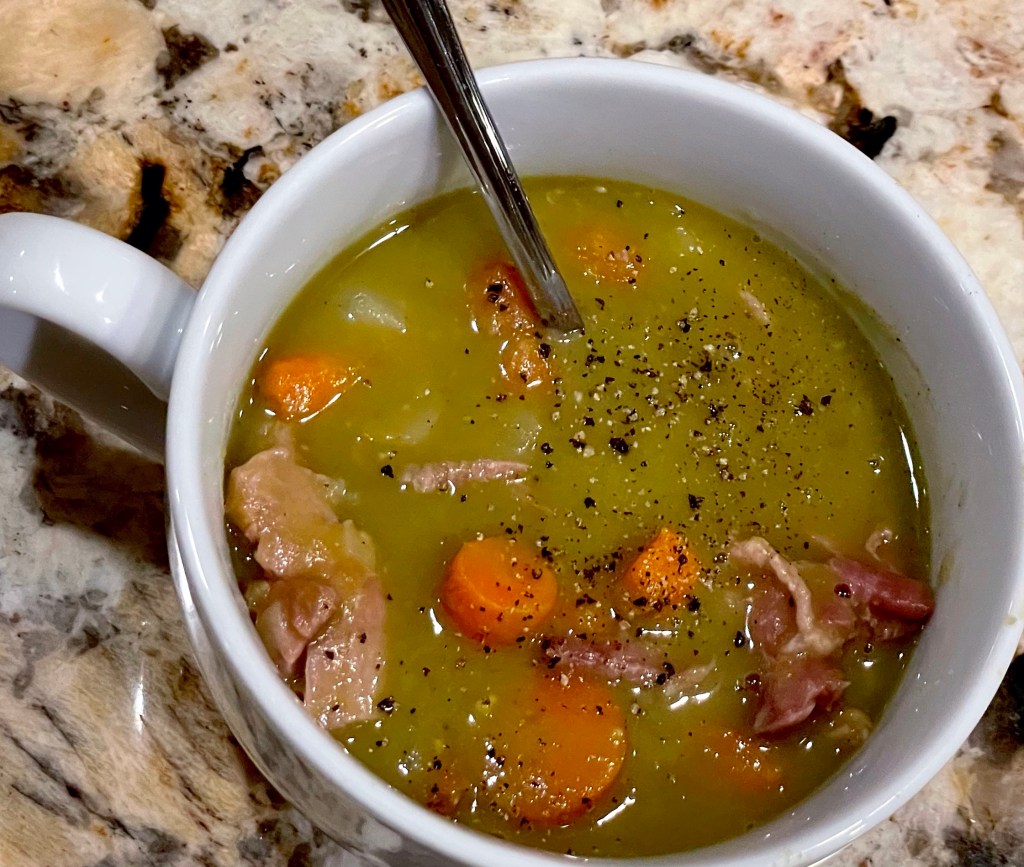
A bowl of Erbseneintopf. Still delicious, after all these years.

Erbseneintopf has remained a part of my winter repertoire ever since. I’ve only made one change since cooking it that first time. Here in the States, it’s sometimes hard to find good German sausage, or ham hocks with a bit more meat on them. As a result, I often substitute a smoked turkey leg for the ham hocks. It gets the job done.

Looking for a good winter soup on a cold, snowy day? Erbseneintopf might be just what you need. It’s peasant food at it’s best. As with many soups and stews, it’s even better on the second day.

Addendum:

⁃ * The Stars and Stripes newspaper was first published during the Civil war. Later, it was delivered to US forces in France during WWI, and became an overseas fixture during WWII. It continued through Korea and Vietnam, and is still published at overseas military locations to this day, although there were discussions during the Trump presidency of cancelling it (it wasn’t). It operates from inside DoD, but is editorially separate and independent from it. The newspaper has been published continuously in Europe since 1942.

⁃ I also struck pay dirt a month or two later when The Stars and Stripes published recipes for Spätzle and Käsespätzle, and our friends Jim and Res bought us a Spätzlemaker for Christmas. The Spätzlemaker is 40 years old now, and in great shape. We still use it a couple times of year.

⁃ My friend Tim Stouffer reminds me occasionally about my Cordon Bleu quest. He visited Cath and I several times throughout the ‘80s. On at least a couple of those visits, I know I inflicted my obsession with Cordon Bleu on him.