During my Firstie (senior) year at West Point, there was a required Philosophy course. I am not sure what my expectations were going into the class, but there were ideas that stuck with me my entire life, including a discussion on God’s existence, or a lack thereof.
At the time, West Point did not have majors. We all graduated with General Engineering degrees and an Area of Concentration. While we were required to study English, a foreign language, history, other social science classes, law, and physical education, the focus was on required STEM type courses – Calculus, differential equations, probability and statistics, chemistry, physics, mechanical engineering, fluid dynamics, thermal dynamics, electrical engineering and so on. My Area of Concentration was in Operations Research, also heavily math focused.

The philosophy class was under the purview of the English Department, and while we had a couple of papers due in the class, what I mostly remember were wide-ranging questions and discussions about life, including the idea of God, and the seemingly very un-West Point concept of meditation.
To this day, two meditation techniques I learned in that class have stuck with me.
The first was using a mantra to calm my mind. The mantra I started with then, and use to this day is “Be though at rest, be though at peace. Be thou at rest, be thou at peace …”. Repeated silently over and over for a period of time, it reduces the clutter in my mind and helps bring clarity. It is also useful when trying to sleep after a stressful day.
The second technique was closing my eyes and picturing a flower in my mind. I always mentally use a rose. Once relaxed and I see the flower, I look at it as if seeing it for the first time. I notice the details of the flower overall and of each petal. I feel the texture and smell its scent. I watch the flower open in my mind and see the inner stamens and pistil. If my mind drifts, I quietly bring my focus back to the flower. After doing this for a few minutes, I return from the meditation and almost always feel better for it.
I also distinctly remember a discussion we had about God and his or her existence. It was not about a Christian God, or a Jewish or Muslim God, or a Buddhist or some other God. It was about the concept of God. This was six years after West Point eliminated compulsory chapel service in 1972.
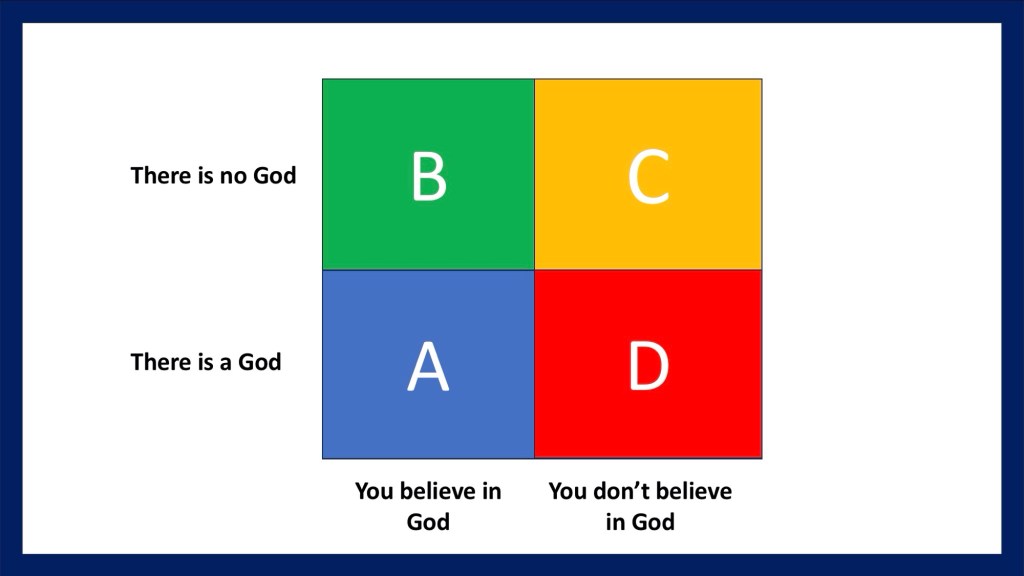
At the start of that class, I remember the professor talking about faith, or lack of faith. But then he went down a different path about whether to believe in God or not. He drew a large square on the board and divided it into equal quarters. On one side, aligned with the squares, he wrote “There is a God” and “There is no God.” On the bottom of the drawing, aligned with each of the squares, he wrote “You believe in God” and “You don’t believe in God.” It looked like the picture you see here:
He looked at us, and then said something like:
“Now, you all are engineers. Let’s approach this from an engineering or math perspective. I have drawn a decision/choice matrix on the board. Let’s evaluate each of the squares.
In Square A, there is a God, and you believe in God. You backed the right horse. You spent a lifetime going to church, doing good things, praying, and believing in God. Surely God will reward you.
In Square B, there is no God, but you believed in God. OK. You wasted some time going to church when you didn’t have to and prayed when it did no good. You felt better for doing those things, so no harm done.
In Square C, there is no God, and you don’t believe in God. As with Square A, you backed a winning horse. You didn’t waste time going to church, you didn’t waste time praying, and you lived the life you wanted.
Now, on to Square D, the last one. There is a God, but you don’t believe in God. This is where we run into a problem …”
He smiled then, and maybe made a joke about not mixing math and probabilities, with discussions concerning God.
I do not remember much of the rest of the class. I know we talked about faith and believing or not believing in things you cannot see. There was no proselytizing by anyone. The discussion may have continued over a couple of classes.**
I grew up a Methodist and remain a Christian. Did that matrix influence my faith in God one way or another? No. But, it did open my mind to thinking of possibilities and alternatives.
Yea, this was all in a philosophy class that started 48 years ago this month. It was only one semester long, but I clearly remember those specific lessons. Given it was our final semester, and all I wanted was to graduate and put West Point behind me, it is a wonder I retained anything at all. And yet, more than any of the math I learned, most of which is long forgotten, those three tidbits have stayed with me ever since.
Addendum:
- In writing this blog, I queried several classmates on whether they remembered the class. Most did. One classmate recalled how the concept of Heaven/Hell mattered to the scoring of the matrix and that the class went into theories of “life after death” to include reward/punishment. Another classmate recalled that we were the first class to have this as a mandatory course. Others remember papers and discussions on Greek Philosophers, giving a speech on phantom pain, discussions on whether salmon possessed free will, and hearing a lecture exploring God’s existence from a rational perspective.
- ** Blog update, post being published. Several classmates, and a couple of other folk have reminded me that this was a presentation/version of “Pascal’s Wager” which you can read more about here: https://en.wikipedia.org/wiki/Pascal%27s_wager – I don’t remember that term at all, but it fits perfectly and is a great part of the discussion on the subject. Now, I am sure that was the context of the class, but as I said to someone recently, my memory is more like a series of snapshots, rather than a movie or video. I have moments of great clarity around certain things, but there are vacant spaces on either side. 😉
Discover more from Live Life Exuberantly
Subscribe to get the latest posts sent to your email.


Nice one Max – I enjoy reviewing things that my foggy “Senior Moment” memory has forgotten. THANKS!
LikeLiked by 1 person
Foggy “Senior Moment” memory is a good description for all of us. 😉
LikeLike
Of course, the problem of choosing to “believe” in God because of this matrix and the wager on a better outcome is not real belief – and thus does you no good with the God who really is there. His requirement is real faith and devotion.
LikeLiked by 1 person