80 years ago on May 6th, 1943, Dad and the other men of 1st Battalion, 60th Regimental Combat Team were given the order to fix bayonets. They were about to attack Djebel Cheniti in Tunisia by direct assault with a bayonet charge. I’ve thought quite a bit about how that attack may have affected Dad and his outlook on life.
A year ago, I was doing research for another blog about dad and the closing days of the North African Campaign in 1943. I was shocked to learn about a battle that dad never mentioned. At the time, his unit had been in continuous combat for two months.
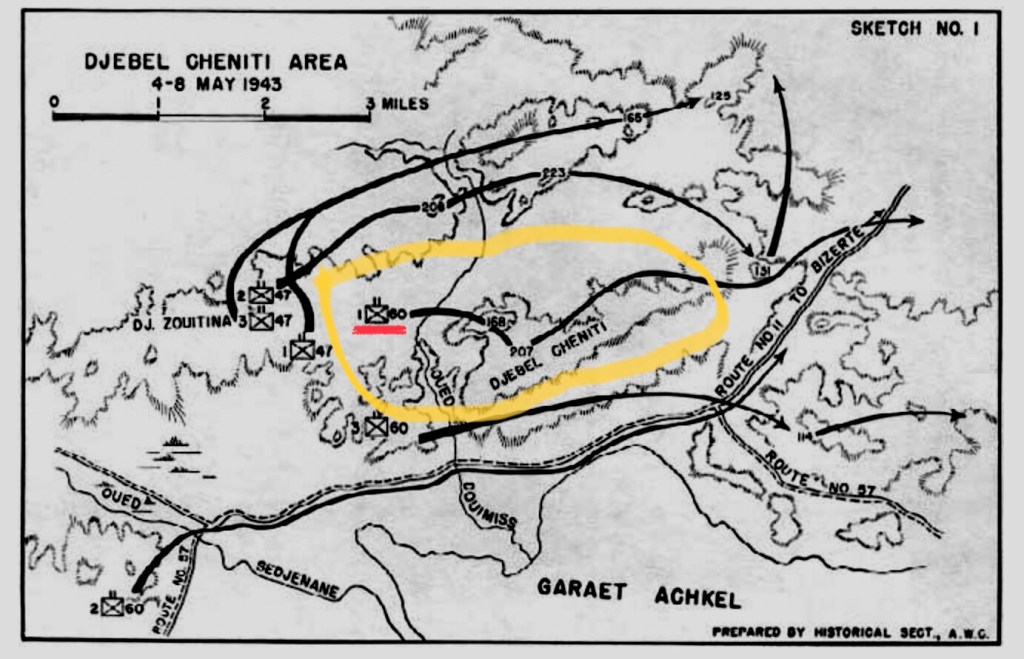
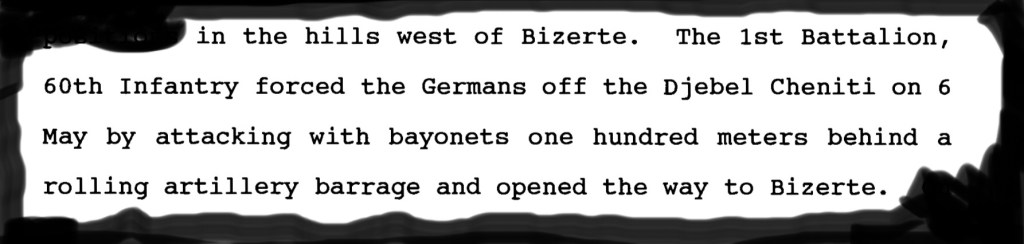
From the history books: “One last ring of rugged hills now remained between the Ninth Infantry Division and Bizerte. The German troops on Djebel Cheniti, the highest point on the 8 mile wide area of the Bizerte Isthmus, halted the advance. To break this bottleneck, General Manton S. Eddy (Commander of the 9th Infantry Division), devised a plan with two parts. The division would mount a flanking maneuver around the hills, while the 1st Battalion of the 60th Regimental Combat Team (dad’s unit – about 500 men) would attack Djebel Cheniti by direct assault with fixed bayonets. They would follow artillery fire that pounded the slopes at 100-yard intervals.”
Let’s take a pause in the story for a second. Fix Bayonets is a command that probably goes back as far as the introduction of muskets. What the command literally means is you are attaching your bayonet to the end of your rifle. What it actually means is one of two things – 1) you are preparing to charge the enemy in close-quarters or 2) getting ready to defend yourself from an imminent enemy assault. Either way, it is close-in fighting. With a rifle and a bayonet, you are perhaps three feet away from your enemy. There is no hiding. There is no ducking away. Army Field Manual 23-25 captures it succinctly: “The will to meet and destroy the enemy in hand-to-hand combat is the spirit of the bayonet. It springs from the fighter’s confidence, courage, and grim determination.” In my own bayonet training nearly 50 years ago at West Point, they were even more to the point: “What is the spirit of the bayonet?” “To Kill!”
At that distance, it is kill or be killed. There is no middle ground.
… … …
May 6th 1943 was a slippery, muddy and rainy day. The order was given to fix bayonets around 1PM and behind rolling artillery, the battalion attacked. They moved forward quickly and only 100 yards behind the falling artillery barrage. On the map, it looks like the total distance they needed to cover was a little over a mile. After three hours they took Hill 168. Moving on to Hill 207 they met stronger resistance. An artillery concentration disorganized the enemy and the battalion attacked again before the German troops could recover. By nightfall, they had taken the summit of Hill 207, although there were still Germans on the southeastern slopes. In a war that lasted years, there were only brief mentions of the battle in the history books, but all of them mentioned the fixed bayonets.
The next morning, May 7th, German machine gun crews began taking off for Bizerte as the division advanced. The 60th moved to cut off the Bizerte road and On May 8th, Bizerte fell. The war in North Africa was over and their immediate mission accomplished.
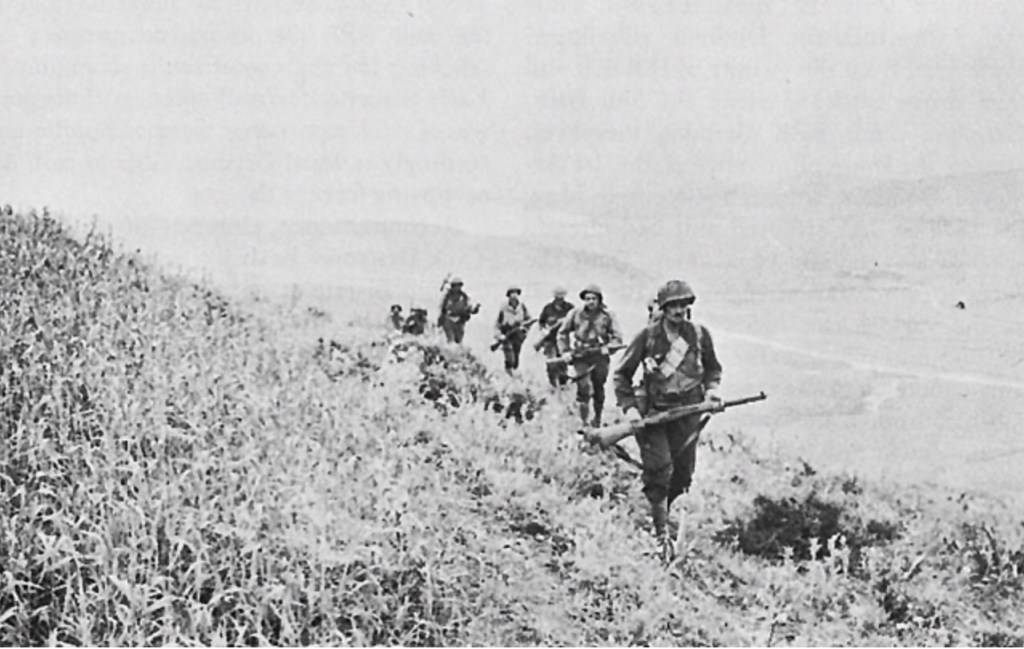
In the words of the 9th Infantry Division Record, “Djebel Cheniti was a brilliant demonstration of Infantry “leaning up against” artillery preparation. One of the strongest positions in the final Axis defense was assaulted by one battalion of Infantry with fixed bayonets, with artillery blasting a shell-strewn pathway for its advance. Another story in the annals of foot soldiers, who do the dirty tasks of warfare”.
Why am I blogging about this now? The story has haunted me since first learning about it. I’ve thought about it quite a bit over the past year. I never heard dad say anything about Djebel Cheniti. I never heard dad say anything about a bayonet charge. Not one damned word. The more I thought about it, the more I thought about how it must have influenced his life.
I have to figure after you’ve been in a bayonet charge, everything else in your life, maybe for the rest of your life, must seem easier. When you are that close to death, and you survive, what else in your life is really going to be a threat to you? Money issues? Work Issues? Mortgage issues? Sickness? Wouldn’t just about everything pale in comparison?
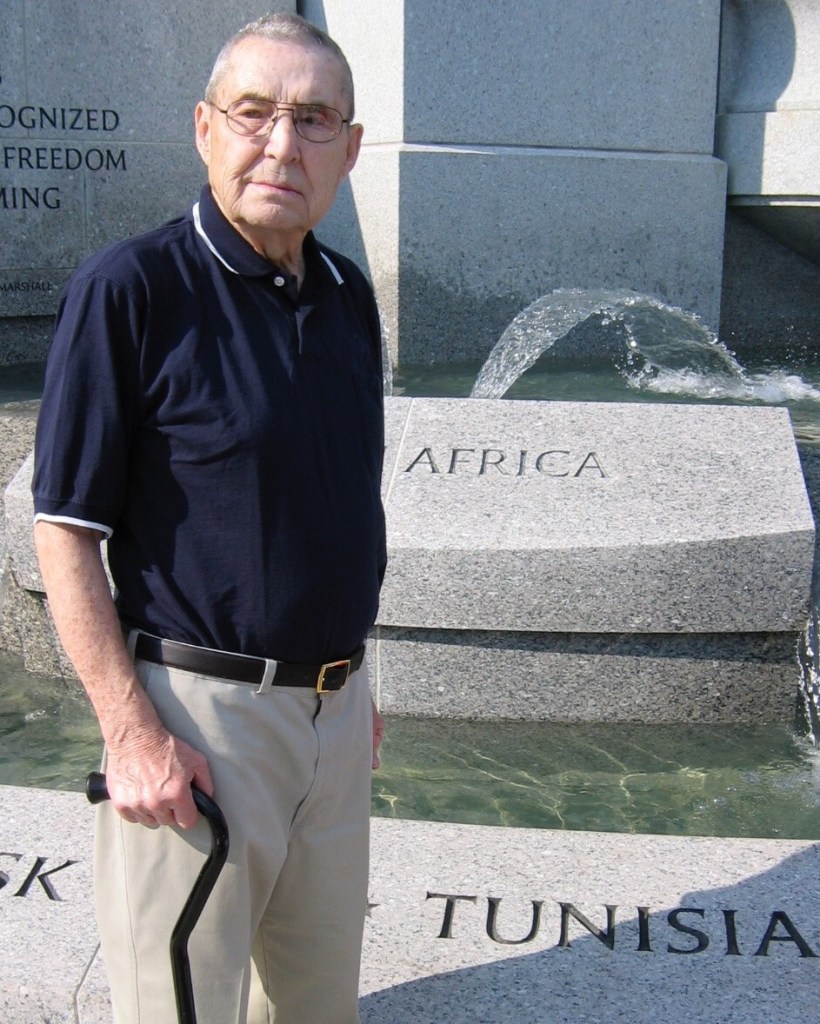
It would explain a lot about dad. His lust for life. His enjoyment of life. His ability to keep everything in perspective, even when things were going badly. His gentleness and tolerance. His quiet firmness in facing down jerks and bullies. Perhaps he already had all of those traits and would have developed into the same man, but I’m not so sure. I think a bayonet charge at the age of 19 might make everything else in life just a wee bit easier to contemplate and to handle. Maybe every day after May 6th, 1943 was a gift not to be squandered. Dad’s gone now. How I wish we had time for one more conversation.
Addendum:
- The last major American bayonet charge occurred during the Korean War in 1951. You can read a bit about it here: https://www.army.mil/article/30673/hero_who_led_last_major_u_s_bayonet_charge_dies
- Dad was in almost continual combat from November of ‘42 to August of ‘43 when he was wounded in Sicily. I’m sure all of that combat, and his wounding affected him and changed him, but the bayonet attack is what has stuck in my mind as a singular event, maybe even more than his wounding. He told bits and pieces of different battles over those months, and mostly they involved funny incidents. He even eventually told me the story of how he was wounded, when he was recovering from the stroke he suffered in the ‘90s. The bayonet attack? Not a single word.
- The blog I was working on when I found out about the bayonet charge was a funny story about dad and “Al Capone” – “My Dad, then Twenty year old Sergeant Willie I. Hall, looked at the German soldier and said “Chicago”. The German answered “Chicago?” Dad stared back. “Chicago … Al Capone”. Now the German’s eyes’ widened. Everyone knew who” […] continue at: https://mnhallblog.wordpress.com/2022/05/08/dad-and-al-capone/
- Historical parts of this blog were derived from these sources: The 9th Division History; Center of Military History: TO BIZERTE WITH THE II CORPS 23 April – 13 May 1943; The US Army in WWII by George Howe; and The Development of Combat Effective Divisions in the United States Army During WWII, a thesis by Peter R. Mansoor.
- Thanks to my sister, Roberta, and niece, Tami, for their thoughts and inputs. And of course thanks as always to Colleen for her editing support.
Discover more from Live Life Exuberantly
Subscribe to get the latest posts sent to your email.
 Live Life Exuberantly
I enjoy your writing. This is a good read. Thanks
Hope you and Cathy are well!
LikeLiked by 1 person
Dustin – good to hear from you and thank you. We are good. Hope you are as well.
LikeLike
…that which dies not kill us, makes us stronger, huh? Dad was one tough dude!
The Brits made a bayonet charge in Afghanistan, easy enough to find online if you want to read about.
Thanks for a great morning read, Max!
LikeLiked by 1 person
Thanks! Will take a look. And good to hear from you.
LikeLike