The Black Death. That’s what we called it. Among us Plebes at West Point, feelings were strong, and universal. To this day, grown men shudder when they see a picture of The Black Death. How could a single book leave such a strong impression? What devilry was this? What book of spells could cause such consternation?

Of course it wasn’t just any book. This book was “Modern Calculus With Analytic Geometry (Volume 1)” by A.W. Goodman. We never called it that though. We called it The Black Death, or sometimes The Black Plague. The book was black, but I suppose our title referred to the entire experience of Plebe (Freshman) math at West Point as much as anything.
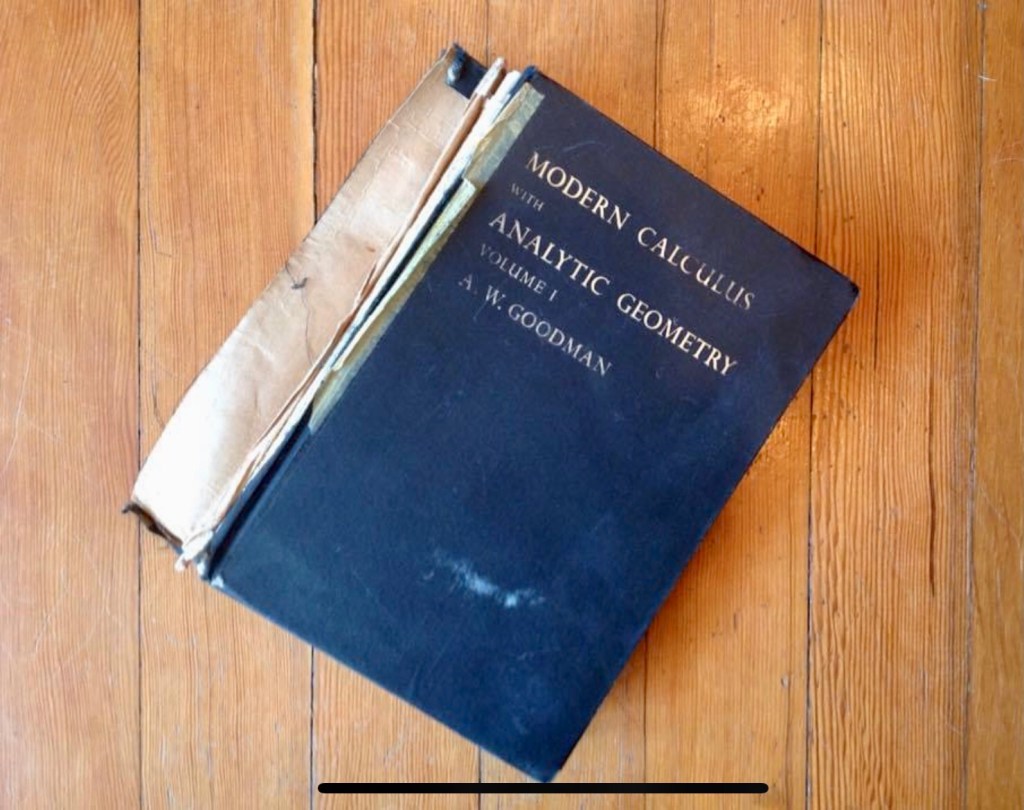
After Beast Barracks our first summer at West Point, it was a relief to get to the academic year. Unfortunately, we didn’t quite know was waiting for us. In addition to the normal Plebe challenges, Calculus was a required course for all, and provided our introduction to The Black Death.
This wasn’t just any old math course. There were several “attributes” that put the class into the category of those things you never forget. My classmates and I laugh about it now, but it’s still a bit of a nervous laugh.
First off, the class of ‘78 went to Plebe math five days a week, including Saturdays, with 90 minutes for each class. Prior classes attended Calculus class six days a week for 75 minutes per class and thought ‘78 was getting over, since it was only five days a week ;-).
In the class itself, we had normal homework, quizzes and tests. In addition, we suffered a unique form of torture called “The Boards”, also known as “Recitations”. A couple of days a week, the professor would call out “Take Boards.” We cadets stood up and each of us went to one of the blackboards that covered the walls in the classroom. The professor then asked us to work through a calculus problem on the board. It might have been one of the previous night’s homework problems, or it might have been the proof of some theorem. After several minutes, he called “Cease Work!” and then called on one of the students to walk through, or recite, their problem solution. Sometimes it was a cadet who had the solution mapped out perfectly. Other times? Well, other times it might be a cadet whose answer wasn’t correct. It could make for some tense/fumbling moments. Recitations had taken place at the Academy since at least 1869.

Of course that sly b@stard Goodman contributed to our pain. While there were often theorems in the book that provided the mathematical proof for the result, it wasn’t always the case. If there was ever a theorem in the book where it said “The proof is intuitively obvious to the casual observer”, you knew it would be a problem for the boards, or a quiz, or a test. For most of us, the solution was never “intuitively obvious”.
At the time, West Point was on a 3.0 grading scale. 3.0 was a perfect score. 2.0 was the lowest passing grade. If you scored a 2.5 on a quiz, you built up five “tenths”. If you scored a 1.7 on a quiz, that was the equivalent of an F and you were down three “tenths”. For those near the bottom of the class in math (or any course), the phrase “2.0 (pronounced “Two OH”) and go” became common. Basically it meant over the course of the semester (and year) you needed to finish with a 2.0 average. Any tenths over that were wasted.
We were quizzed and tested on a regular basis and over time, each of us fell somewhere on the spectrum between 3.0 and less than 2.0. Every few weeks, the math department reordered us cadets by current math class grade ranking. That is, those with the highest grade average, migrated to the “top” sections, while those with the lowest scores would migrate to the “bottom” sections. Each section had about 15 or 17 students. The theory was those in the top sections could cover more material, while those in the lower sections could receive the extra help needed. This reordering of the class on a regular basis was first implemented in the 1820s and was unencumbered by progress for the next 160 years.
The lowest section also earned the nickname “the ejection section” and the guy with the very lowest grade was in the ejection seat. My classmate Rick Steinke, was in the ejection section and ejection seat at various times. At the end of the semester and year, some number of cadets weren’t going to have a grade over 2.0 and one of three things would happen. Rick’s recollection – “That is where I was at the end of first semester, plebe year. Of the bottom 30, as I recall: 1/3 of us did not make it to the next semester (they were booted from the academy); another 1/3 were turned back a year; and another 1/3 went to summer school. I believe I was the only plebe who escaped unscathed, with just a couple of tenths to spare. Thanks to Captain Art Bonifas*, my first semester Professor, and Major Bachman my second semester P, I made it through. Also, Marty Vozzo, my roommate (and several years later, a math professor back at West Point), told me which theorems and equations I needed to memorize. Divine intervention, my brother.”

Time passed, and we moved on. Obviously lots of Plebes did quite well in Calculus. Many excelled at it.
My classmate Joe Spenneberg, returned to teach math at West Point a decade later, from ‘88-‘91. By the time he returned, Goodman was gone, as were The Boards. The cadets still attended math five days a week, but only for an hour at a time. Also, classes were no longer “reordered” on a regular basis. The course work changed some as well – instruction started with “discrete math”, before migrating to integrals and “continuous math”. In Joe’s words, “The jump between discrete and continuous was key. We told them to imagine that the discrete step is infinitesimally small, which introduces the concept of the limit which is essential to being able to define a derivative …” as Joe was recently explaining this to me, I fogged over about then ;-).
Joe also told me a total of nine or ten of our classmates DID return and teach math at West Point. To the best of my knowledge, as a class we never ostracized them.
I’m sure Mr. Adolph Winkler Goodman, who died in 1989, had no idea about his effect on Plebes at West Point. I don’t think it mattered if you were a star man (top 5% of the class) or a goat (bottom of the class), everyone called it The Black Death. Yea, we laugh about it now, but it was pretty serious stuff then. Looking back, it was one of those commonalities that united all of us. You don’t think about a math class uniting people, but I sure think The Black Death did so for us. The only other class with a similar effect was boxing, but that’s another story for another time.
As I was working on this blog last week, I had a dream one night. I was back at West Point, and you guessed it, in math class. It was finals and I was in the classroom with several classmates. Time was passing and for some reason, while I had a copy of the test, I couldn’t find my paper to write my answers down. I knew the answers, but I couldn’t find the piece of paper to write them on. Classmates started finishing the test and leaving the classroom AND I still hadn’t started. I was trying to ask the teacher for help, and getting no response…
I woke up in a sweat. Looking around, I was in my own bed, with Cathy sound asleep next to me. I settled back to sleep and chalked it up to one last gift from Mr Goodman and The Black Death.
Addendum:
⁃ * The name Captain Art Bonifas might sound familiar to you. After leaving West Point, Captain Bonifas was stationed in Korea. In what came to be known as “The Korean Axe Murder incident ”, Bonifas was bludgeoned to death by North Korean soldiers in an international border incident in August of 1976. The world was pretty tense for a couple of weeks after his death. You can learn more about the incident here: https://en.m.wikipedia.org/wiki/Korean_axe_murder_incident
⁃ Special thanks to classmates Rick Steinke, Joe Spenneberg and David Fitzpatrick, who contributed both content and editing to this blog. All three were involved in teaching and Higher Education after their time at West Point. Rick is a former Harvard National Security Fellow, and later served as the Associate Dean at the George C. Marshall European Center for Security Studies. Joe and David both returned to teach at the Academy, and Dave continues to teach History at Washtenaw Community College in Ann Arbor, MI.
– If interested, here’s a blog about my first two hours at West Point: https://mnhallblog.wordpress.com/2017/03/18/first-two-hours-at-west-point/
⁃ For some additional history about West Point and Math, you can try this article – Mathematics Education at West Point: The First Hundred Years: https://www.maa.org/book/export/html/116851. Founded in 1802, West Point was the first engineering school in the United States, and had a uniquely technical curriculum for its time. The first two years of the curriculum was dominated by mathematics. The information in this blog on the history of “Taking Boards”, and the reordering of the class on a regular basis were both documented in this article.
⁃ You can learn more about the restructuring of math instruction at West Point in the late 1980s and early 1990s here: https://www.westpoint.edu/sites/default/files/inline-images/academics/academic_departments/mathematical_sciences/Math/v04_issue1.pdf
Discover more from Live Life Exuberantly
Subscribe to get the latest posts sent to your email.
 Live Life Exuberantly
Taking calc classes is bad enough, but having nightmares about it decades after the fact just goes to show that the terror is always there, lurking below the surface. Great read Max.
LikeLiked by 1 person
There’s some truth Dave!
LikeLike
Max, EE? The only way I got through Cow Juice was to promise my “P” I’d never do anything more complex with electricity beyond wiring a wall switch.
LikeLiked by 1 person
Hahaha! Trust me. I get it. !
LikeLike
I actually held my copy of The Black Death in my hands this past weekend, as I cleared my stuff out of a storage facility. I didn’t throw it away, which means it is somewhere in my basement right now.
As for the math we learned, I have primarily used it to help others pass math courses. In addition to my bride, I have assisted two friends who returned to school as adults and faced daunting math requirements.
What surprises me most, is the fact that I can read my friends math assignments and, with a minimum of effort, recall how to approach the problems before them. Who knew?
LikeLiked by 1 person
That’s pretty amazing
LikeLike
I had calculus in high school so was placed in the advanced course track which was 18 months instead of 2 years of calculus. My fond memories include asking my star man roommate Doug Bowman if he had worked a certain homework problem involving triple integrals. He replied he had. I asked to see it and he stated he had done it in his head. I hit him with said Black Death text. I also remember it being thrown into a bonfire one fine spring day.
LikeLiked by 1 person
Hahaha…. Great memories Bond, and yea, that sounds like something Doug might have said… 😉
LikeLike
I love your writing, Max, but this one hit home. I did my undergrad engineering at “General Motors Institute” the other no-cost engineering school for the fifth of five children. We had calc 1, 2, 3 and then differential equations. The first time through diffyque I couldn’t afford the book. Second time through I had purchased a used one. After two years of rigorous math fifty years ago I’d prefer they had taught me to do my taxes!
LikeLiked by 1 person
Hahahah… yea, Army sent me to get my Masters in EE. I used the math then, but never again after that… 😉
LikeLike
Great read as usual Max. I still have nightmares! Seriously, not often but maybe once or twice a year I have some nightmare about events during my times as a cadet. Glad to wake up safe and sound from them!
Good memories though. Wouldn’t change one bit!
LikeLiked by 2 people
Indeed! I think we all do… 😉
LikeLiked by 1 person