
233 years ago, on July 24th, 1797, my friend Mary’s great great great great great Grandfather signed his will. In it, he freed two of his slaves, Sancho and Peter. Sort of. It turns out he added a couple of conditions complicating both of their lives. Let’s be honest and blunt – there never was such a thing as a good slave master. Never. Forget Gone with the Wind, forget revisionist history, forget the teacher or high school friend posting on Facebook about how good the slaves actually had it.
George Nixon owned the Woodburn Estate on Harmony Church Road, just north of us in Loudoun County, Virginia. Parts of the estate still exist and you can view some of the remaining buildings. As you look at the Mill, it’s good to remember it was built by slaves in 1777.
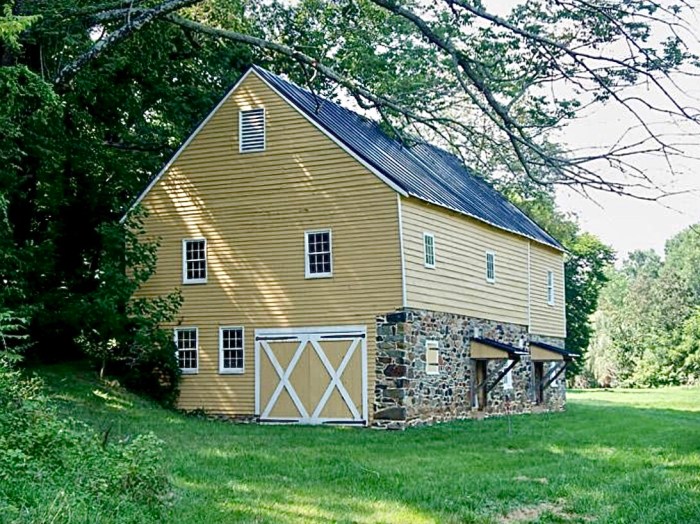
In 1797, George wrote his new will. It was six pages long. In a short paragraph, on the third page, he freed two of his slaves, Sancho and Peter. When George passed away three years later, it was presented for probate on December 8th, 1800. His descendants continued to argue for another 19 years about the will.
It’s worth looking at the stories of Sancho and Peter individually.
For Sancho, the words in the will are quite simple: “I do hereby emancipate and free my slave Sancho: at the expiration of forty days after my death…”.

Sancho was set free after George’s death and settled in Waterford, Virginia. What’s not mentioned in the will is George didn’t set Sancho’s wife free. The census of 1810 shows Sancho in a “household” of four people: himself, along with his enslaved wife and two enslaved children. In the 1820 census, he and his wife, now both over 45, are shown as emancipated, and his two children still enslaved. He had evidently saved enough money to buy his wife and go through the legal process of emancipating her*, but not yet his children. He had a son under 14 years of age, and a daughter between 14 and 25 years old – both were still slaves.
My friend Mary shared with me that a previously enslaved person could buy their spouse and children, but then obtaining their freedom (emancipation) was a time-consuming and costly process that went through the court system. And, of course, the children born to Sancho and his wife were born enslaved because the status of the child was dependent on the status of the mother.
In 1830, according to the census, Sancho, now over 55, and his family had moved to Leesburg. By then, thirty years after he was set free, we can confirm Sancho’s wife and both children are also emancipated, along with two younger children, also free. It’s unclear if they are his children, or grandchildren.
Think about that. Sancho is set free in 1800, but his wife and children aren’t emancipated until twenty to thirty years later. This is the price of freedom from a “good” slave master.
Peter wasn’t quite as lucky as Sancho. Here’s what George’s will said:
“I do also emancipate and set free my slave, Peter, when he arrives at the age of 30 years provided, nevertheless, of the said slave should he estimate the blessings of liberty and freedom at so low a rate as to entail slavery on his own children by taking a wife that is a slave, he shall remain a slave himself until he is 35 years of age and then be free. If within that time he shall be so ungrateful as to depart from that good behavior and faithful conduct he has hereto observed, he shall remain a slave until he is 40 years of age.”
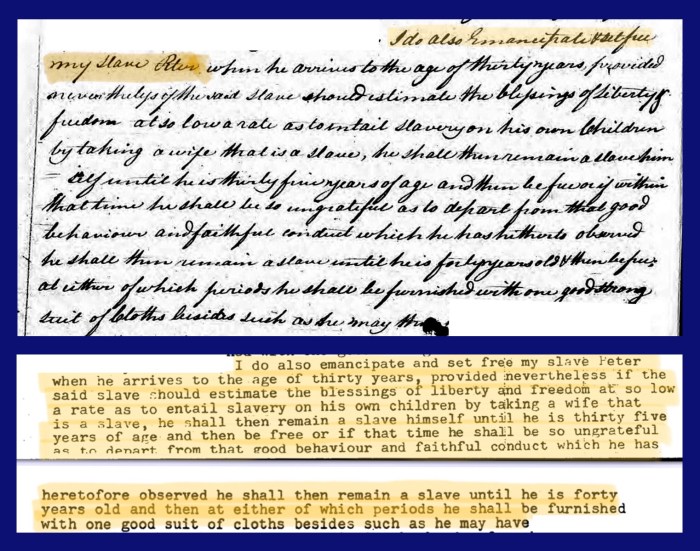
Imagine you are Peter. You are in love with a woman. Your choice? Marry her and add five years of slavery to your life, knowing when you are eventually free, she will still be a slave; or become a free man, perhaps never to see the woman you love again. Oh, and by the way, don’t do anything to upset the master along the way, or you add ten years to your time as a slave.
After George died in 1800, the fate of Peter is unknown. We don’t know if he received his freedom, if he married and remained a slave those five extra years, or if he died while a slave. He simply vanished from history, with no record found anywhere.
Black lives didn’t matter much in Virginia in the eighteenth and nineteenth centuries. They mattered to the extent a white man decided they mattered. If you were lucky, maybe you were given your freedom. If you were more lucky, maybe you could eventually buy the lives of your wife and children. Of course Virginia found a way to complicate things even more. In 1806, a law was passed mandating all former slave people leave the state upon obtaining their freedom. Black lives just didn’t matter.
Today, we of course have the Black Lives Matter (BLM) movement. First established in 2013, BLM has gained broad support, particularly following the killing of George Floyd. As this is America, where imitation is the sincerest form of flattery, we now also have All Lives Matter, Blue Lives Matter, and White Lives Matter. I should point out the “White Lives Matter” slogan was chanted by torch-wielding alt-right protesters during the 2017 Unite the Right rally in Charlottesville, Va that resulted in three deaths. I believe Sancho and Peter would have no problem recognizing that crowd.
If you think BLM in all caps is a socialist inspired/Soros funded/violence propelling organization (it’s not), then try and rethink the issue without the capital letters. This isn’t Virginia, or America of the 1800s. In today’s world, we should all agree black lives matter.
We are making progress. Here in my corner of Virginia, a diverse coalition of The League of Women Voters, the NAACP, and the Virginia Interfaith Center for Public Policy are holding a weekly Vigil for Action in support of Black Lives Matter. These aren’t communist, or violence prone organizations or people. They are part of the fabric of our community. Every Saturday morning at the Courthouse Square in Warrenton, 65 to 100 people meet and hold a prayer vigil with one or two speakers. The mayor and some of the town council members have shown up in support. These vigils will continue every week through Labor Day. As with the vast majority of protests across the country, no stores have been ransacked, no property destroyed, and no people injured. In fact the only disturbance to the area is the honking horns of passing cars in support of the protest.
I think about Sancho and Peter, and wonder what they would make of America in 2020. They would certainly be happy at the elimination of slavery, and show astonishment and then celebrate the country having elected an African American president. They would no doubt take pride in the success of blacks in all walks of life. For all of those successes, I doubt they would show surprise at the racism still existing in America. They would know restricted voting access for the discrimination it is. I’m betting they would recognize the dog whistles from some politicians and shudder. And, despite my personal revulsion with many of the comments I hear, or read online, the fact that a segment of our population still thinks black lives don’t matter much would not shock them, even after the passing of 233 years.
—– Feel free to share this blog —–
ADDENDUM:
- * When a slave was purchased, he/she was purchased as a slave–even if they happened to be your spouse or child. As an example, if a husband purchased his wife, she was still a slave until emancipated. Emancipation is the legal process of changing an enslaved person to a free person. In Virginia, prior to 1782, it required a special act by the General Assembly which meant very few people were emancipated. A 1782 law allowed slaveholders to free their slaves by their last wills and testaments or other writings which were to be proved in a county court by two witnesses.
- Many thanks to my friend Mary Haak for sharing this story of her distant relations. She has told this and other stories of slave holding relatives here in Virginia and in Maryland. She works constantly to dispel revisionist histories of ‘the old south’. Here’s some additional information from Mary: “In 1860, on the eve of the Civil War, there were 1.2 million people living in Virginia. Of those, over 490,000, more than 40%, were enslaved men, women and children. Culpeper County had an enslaved population of 55.7%; Fauquier 48%; Rappahannock 39.8%; and Loudoun, (where Quakers made up a large portion of the white community), 25%. Various branches of my ancestral family enslaved at least 187 men, women and children in Loudoun county. Although I have relatives that would disagree, I am under no illusion that my ancestors were “good slaveholders.” Such creatures, as with the tooth fairy and unicorns, are myths. To pretend those enslavers were “a product of their time” is to ignore the environment in which they lived. The local Quaker community had objected vigorously to the immorality of slavery for years and abolitionists were outspoken regarding the harshness and inhumanity of the institution”.
- Here’s some additional information about the Warrenton, Va. Vigil for Action: “The vigil for Black Lives Matter will be held every Saturday until Labor Day, 10-10:45 AM at Courthouse Square Plaza, Old Town Warrenton. Wearing a mask and keeping physical distance, come stand in solidarity with your neighbors and advocate for understanding and political action to end systemic racism. Homemade signs are encouraged.” The vigil is sponsored by the League of Women Voters, the NAACP and the Virginia Interfaith Center for Public Policy (VICPP). For more information, you can visit: https://www.virginiainterfaithcenter.org/vigil-for-action-black-lives-matter/
- I’ve written four other blogs about race relations. You can find them here:
- September 2016: Diversity, Really? A blog about education and racism. https://mnhallblog.wordpress.com/2016/09/20/diversity-really/
- August 2017: This is not my America. A blog about my niece and the KKK and Nazi incidents in Charlottesville, Virginia in August, 2017. https://mnhallblog.wordpress.com/2017/08/14/this-is-not-my-america/
- April, 2020: “Letter from Birmingham Jail”, Revisited. A blog about Martin Luther King Jr, his jailing in Birmingham on Good Friday 1963, and his subsequent publishing of “Letter from Birmingham Jail”. https://mnhallblog.wordpress.com/2020/04/07/letter-from-birmingham-jail-revisited/
- June 2020: I am Number 35,591. A blog about my graduation from West Point, and white privilege. https://mnhallblog.wordpress.com/2020/06/06/i-am-number-35591/
Discover more from Live Life Exuberantly
Subscribe to get the latest posts sent to your email.
 Live Life Exuberantly
While wandering through the new online additions to the Loudoun County Court archives, I came across some gems. I found Sancho’s emancipation records. They were signed by Charles Binns, Clerk of the Court on June 20, 1801. Sancho is described as “of dark complexion, about 38 years of age, 5 feet 7 inches and ½ high.” That’s about 10 years older than he reports in the census records. There is also information in a chancery court record about Sancho buying his wife. He borrowed $150 and couldn’t keep to the schedule to pay it back so he was sued by the lender. What’s important is that his wife now has a name–Sarah, and he bought her from Alexander Waugh of Centreville. It took him almost 10 years to pay off the debt. What’s interesting is that Loudoun County Clerk Charles Binns’ sister is married to Alexander Waugh.
LikeLiked by 1 person
OMG! How cold you were able to track this down!!
LikeLike
A quick clarification: I certainly wasn’t including Sancho when I said “no good slaveholders.” Sorry for any misunderstanding. The argument that “blacks owned slaves, too” is beyond disingenuous.
LikeLiked by 1 person
No misunderstanding. I know what u meant.
LikeLike
Max — This blog piece is so moving; brought tears to my eyes. I wonder, too, what happened to Peter. George’s conditions for the emancipation of Peter were such torment; infuriating. Thanks for writing this, and helping remind us that there were no good slaveholders. Here’s hoping that someday Americans won’t need that reminder.
LikeLike
Sancho’s story speaks to one of the enduring defenses of white supremacists: “Blacks owned slaves too!” It should be pointed out, first, that two wrongs don’t make a right. Period. But also important is that a historical record often doesn’t tell the whole story. Yes, Sancho owned slaves. He bought his wife and children, and they remained slaves until he could emancipate them.
LikeLiked by 1 person
Hadn’t even thought about that. So true.
LikeLike
Thank you so much for empowering me to refute those who throw around the argument “blacks owned slaves too!”
LikeLiked by 1 person
Peter has always been a weight I’ve dragged around with me for years ever since I discovered him in George Nixon’s will. The burden seems a little lighter today. I don’t know where you ended up, Peter, but I hope you are resting easier today with your story told.
LikeLiked by 1 person