Grad School, and Learning to Cook

Grad School, and Learning to Cook

Embarrassment is what started it. Well, embarrassment, a class in Stochastic Communications and Trout Almandine. In 1984, I started learning how to cook, largely after being embarrassed at a friend’s house on a Sunday afternoon.

Last week, I published a blog about cooking a German dish, Erbseneintopf (Split Pea Soup) in 1982, and I received notes from several friends asking if that’s when I started learning to cook. The answer was no, that didn’t really come till later.

It’s true Erbseneintopf was the first recipe I collected, but as to cooking, my skills were limited. Yea, I could do steaks, brats, and burgers on the grill, but not much else. Cathy did the vast majority of cooking for us, and that (from my view point) seemed to work out fine.

Things changed in 1984.

The Army, in it’s infinite wisdom, sent me to Grad School to pursue a master’s degree in Electrical Engineering. I was in the Army Signal Corps and they were looking for engineers to help with the new field of Computer Networks. We all take the Internet and computer networks for granted now, but back then, it was brand new, except for some research networks like The Arpanet, a DoD funded network.
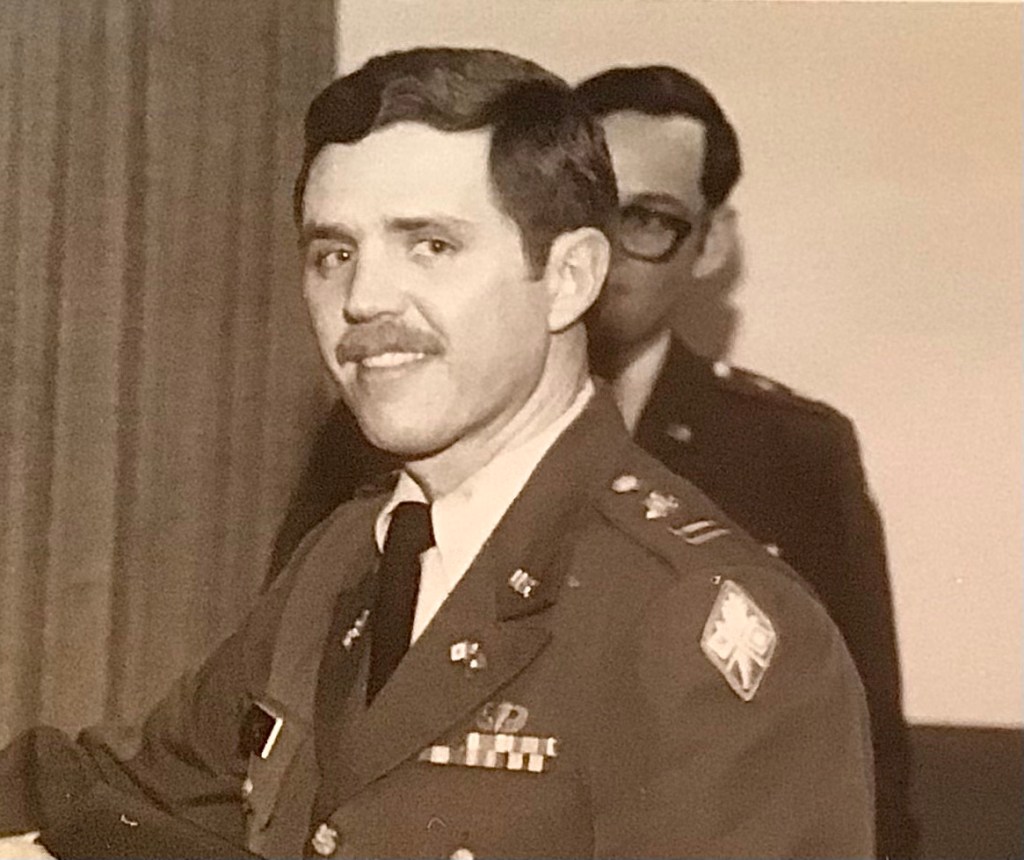
Captain Hall, The Future “Cook”. The Photo was Taken During my Time at Grad School.

As I started my graduate program, something quickly became obvious. My math skills were rusty and needed work. I’d studied calculus, differential equations, linear equations, and probability and statistics at West Point, but that was several years before and I’d forgotten most of it.

In the fall of 1984, I was required to take a class in Stochastic Communications – it was a theory class about how communication systems act in the presence of noise, and was very math heavy. A friend of mine, Gerry, was also taking the class and we often studied together to understand the math.

One Sunday afternoon, Gerry was at my house and we were working through some tough problems. At some point, I said, “Hey, feel like some dinner? How about if I order us a pizza?” Gerry agreed, and I ordered a pizza from the Pizza Hut just down the road. When they delivered the pie, we took a break and had a beer with our dinner. Eventually, we resumed our studies, and then quit an hour or two later.
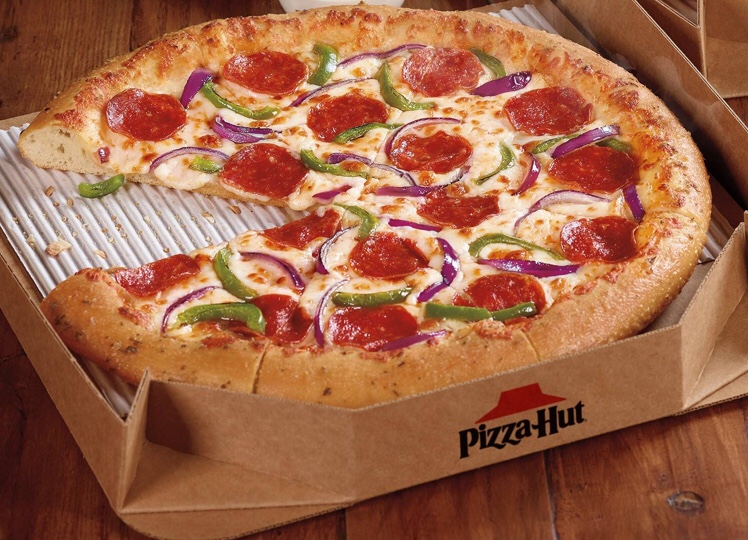
Nothing Says Fine Dining Like a Pizza from Pizza Hut…

A couple of weeks later on another Sunday afternoon, we were studying at Gerry’s apartment. Eventually, we were getting hungry and Gerry said “How about a break for dinner?”, to which I readily agreed. I expected him to pick up the phone. Instead he said, “Come on, let’s go to the kitchen.

We arrived in the kitchen and after opening a bottle of wine and pouring two glasses, he proceeded to the fridge where he pulled out some trout filets and asparagus. He then brought out some almonds, garlic, and God only knows what else from his cabinets. What? Was he actually going to cook a dinner?

Gerry spent the next half hour or so preparing the meal, while we continued drinking and talking. He toasted the almonds, sautéed some garlic and eventually pan fried the trout, while sautéing the asparagus in another pan. Half an hour later, it all came together on our two plates with the almonds scattered over the trout and the asparagus served on the side.

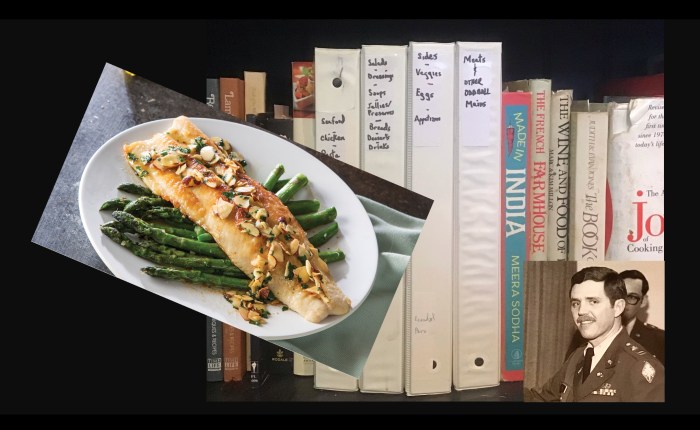
Trout Almandine with Asparagus on the Side – a Treat from my Friend, Gerry.

Holy Cow! A real meal, and a great one. I believe I was in a bit of shock. Thinking back to the Pizza Hut pizza I’d served two weeks before, I was also a bit embarrassed.

On the way home, I thought to myself, “What the hell is wrong with this picture? A bachelor comes to a married guy’s house and has delivery pizza from a chain restaurant for dinner, while the married guy goes to the bachelor’s house and has a gourmet meal!?!?” Right then and there, I decided I needed to learn how to cook.

And so, my cooking journey began. Cathy still did most of the cooking, but I started cooking some as well, especially on weekends. I’d find different recipes to try and slowly expanded my repertoire. I also started collecting cookbooks, some basic, some focused on specific cuisines. I went through bread and muffin phases, German and French phases, Vegetarian, Stir Fry’s, and eventually Indian curries, among other recipes.
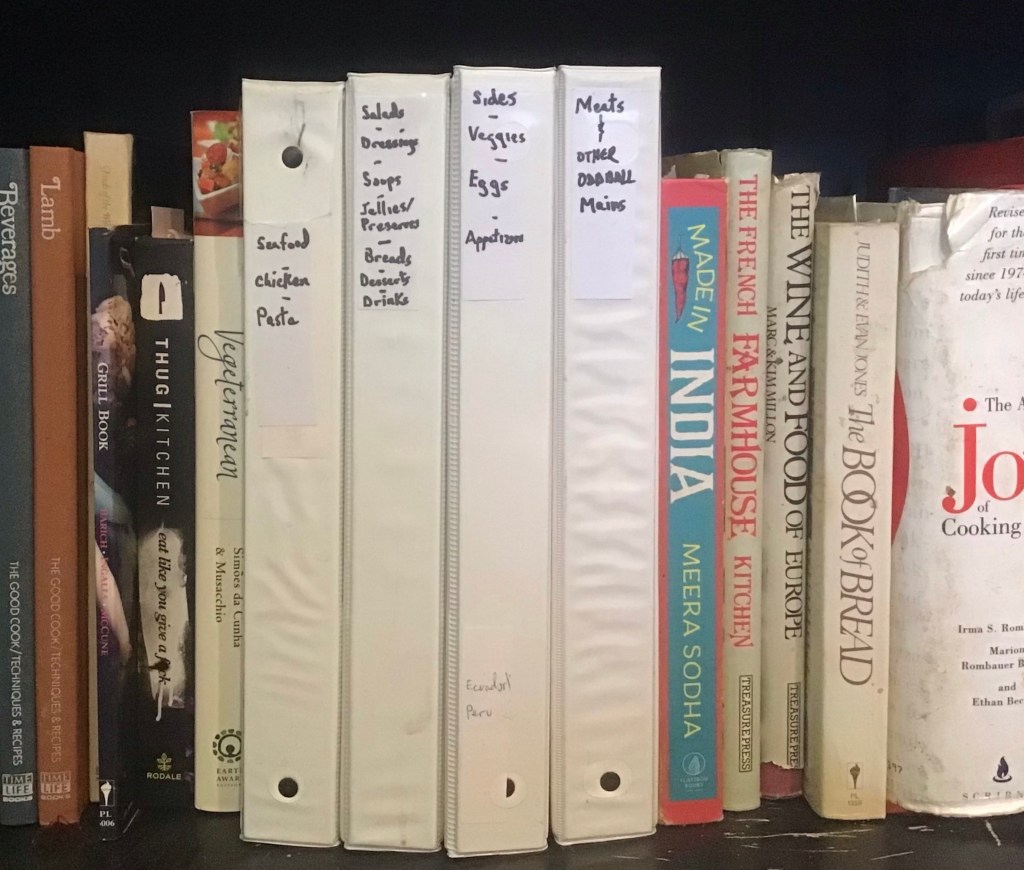
Just a Few of the Couple Dozen Cookbooks I Now Own

I found I enjoyed cooking, and I started to cook decently, but man, was I a messy cook. I knew nothing about “Mise en place” (prepping things ahead of time), or cleaning as you go. While I could turn out a great meal, the kitchen was a disaster. Cathy’s mom said something to Cath about it one time, and Cathy basically told her to be quiet, I was at least cooking some of the meals now. 😉

Eventually I retired from work around 2015, and and over time, started cooking my share of our meals. I also learned about Mise en place and cleaning the kitchen as I cooked. It only took me about 30 years to learn those two basic lessons. Better late than never, I guess.

So, that’s my story. Who knows, If I hadn’t been rusty in math and in need of help, maybe none of this would have happened. You don’t always know what will send you down a different pathway in life. I’m glad I discovered this one.

Addendum:

⁃ Strangely, there is no Trout Almandine recipe in my collection of recipes. I never asked Gerry for it at the time. If I’m making it now, I use a variation of a recipe I found online. C’est la vie

– Gerry went on to get his PhD in Electrical Engineering – he was a smart guy about many things. Unfortunately, over the years, we lost touch with each other.
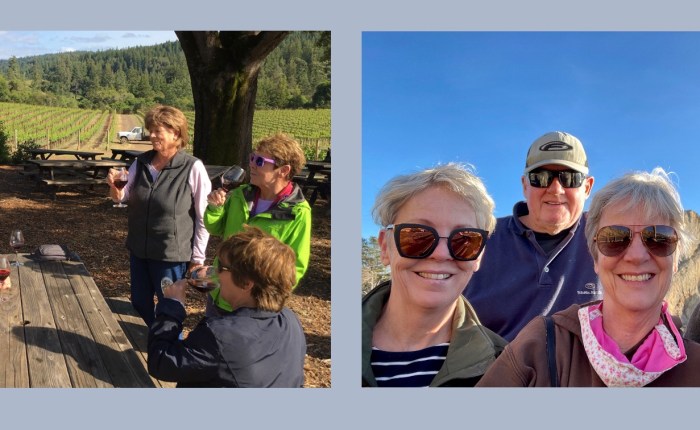
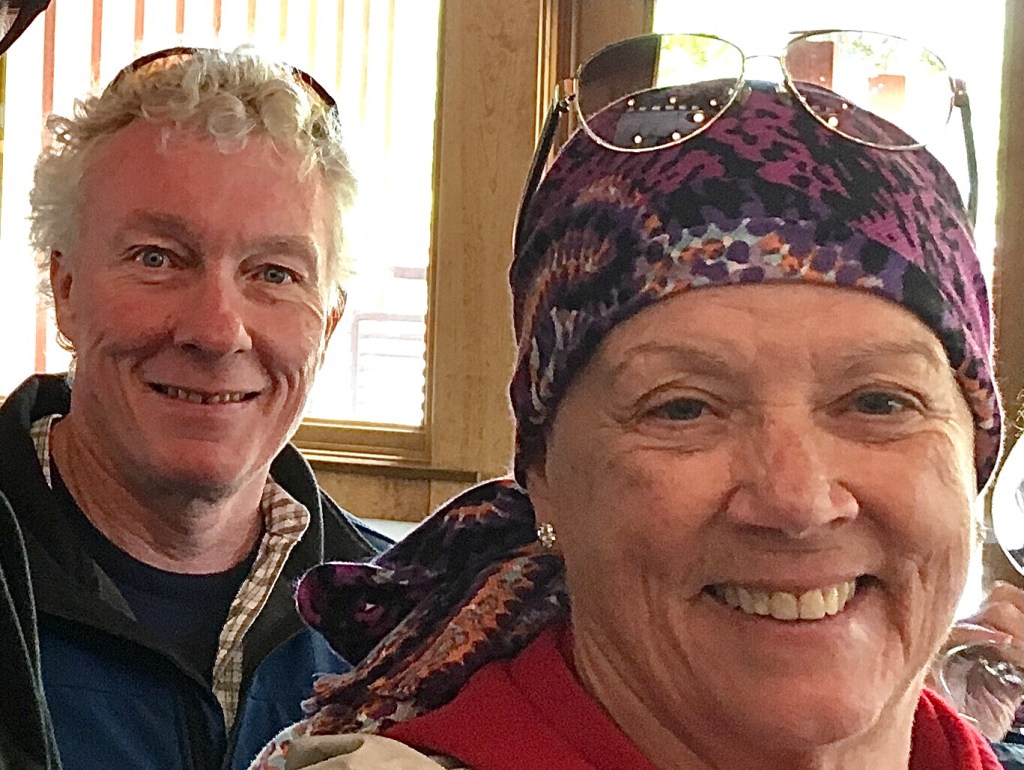
The Tribe – Together Again

The Tribe – Together Again

It’s good to keep memories alive, and laugh and cry for those we have lost. It’s also good to remember that life is for the living – to try and savor each and every day, and the time we have with those we love.

Before New Year’s Eve 2021, the last time we were all together was almost three years ago at the 2019 Anderson Valley (California) Pinot Festival. The difference was there were six of us then, and only four of us now. Don passed away in October of 2019, and Kim in August of 2021. I like to think Kim and Don were with us in spirit this year. We certainly ate and drank enough to cover them. 😉

Don and Kim at the 2019 Anderson Valley Pinot Festival

Cathy’s sister Bonnie married Don in ‘96 and the four of us were great friends from then on. They introduced us to their friends Kim and John, perhaps ten or fifteen years ago. Over the ensuing years, we saw Kim and John just about every time we visited California. Inevitably they would spend a couple of days at Bonnie and Don’s when we were in town. Often it was for either the annual Anderson Valley Pinot Festival, or perhaps the winter white wine Alsace Festival, but there were also a couple of Christmases or New Year’s Eves in the mix.

In 2018, the Californians all came to Virginia for a vacation over New Years and we again enjoyed fun times. It’s always wonderful when you find people you get along with in multiple locations and over time – you realize you are a part of the same tribe. At the time, we talked about the six of us linking up at Kim and John’s vacation place in Hawaii, “sometime in the future.”

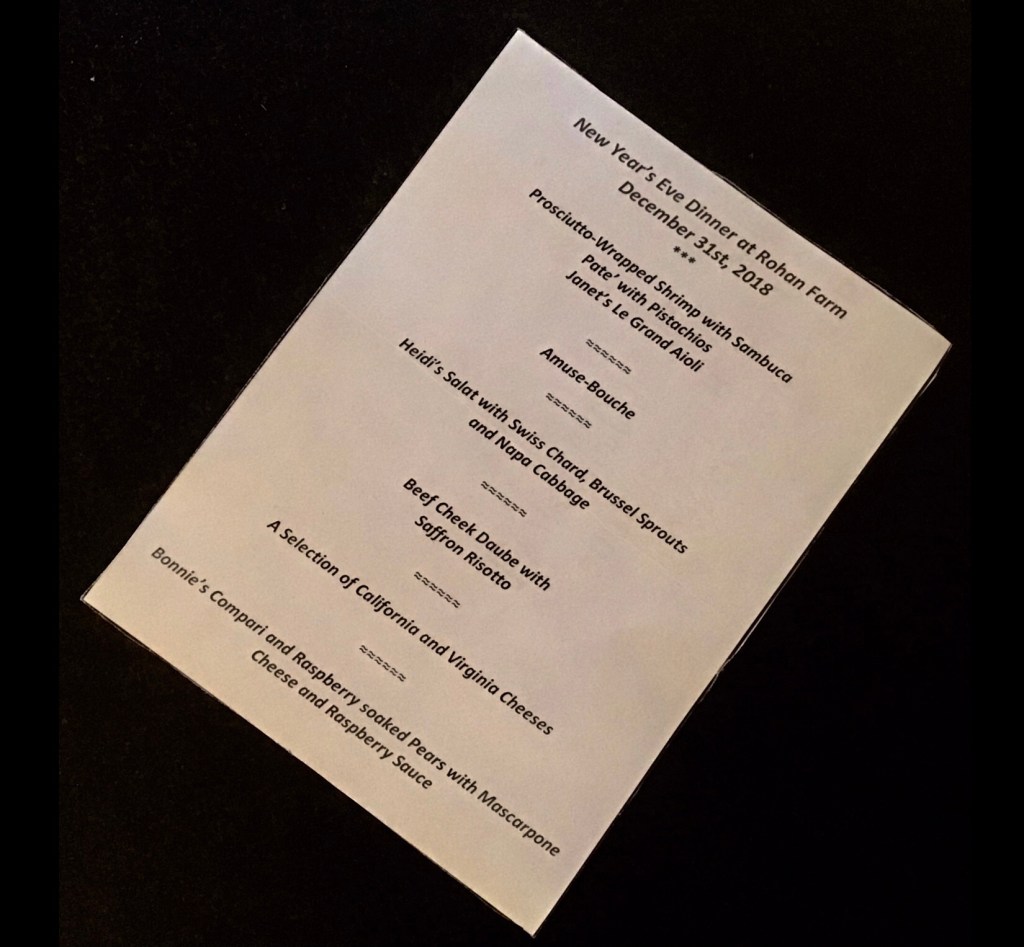
New Year’s Eve Menu at Rohan Farm in 2018

The following May, we were all together again at Bonnie and Don’s for the 2019 Pinot Festival. Kim was dealing with cancer, but it didn’t slow her, or us, down. At the time, we of course didn’t realize it was the last time all six of us would be together.

Pinot Festival 2019! From the left – Don, John, Kim, Cathy and Bonnie.

Don passed away five months after that Pinot Festival and Kim a little over two years later in August of ‘21. Covid provided an overlay for all of that time. We had reservations for Pinot Festival in May of ‘20 and ‘21, but it was cancelled both years due to Covid.

Time Passed.

We came to California this year for Bonnie’s birthday and to celebrate New Year’s Eve, and were delighted to find out that John would join us for both of those events.

We arrived first, and John drove up from Santa Cruz a couple of days later. The time passed in a whirlwind of fun, food, wine, poker games, walks and talks. We of course remembered and talked about Don and Kim throughout our time together. For John, it had only been 4 months or so since Kim passed away – they were married for 53 years. Bonnie and Don had 23 years together. As she noted, it’s not easy, and everything takes time. On New Year’s Eve, we toasted Kim with one of her favorite wines. On New Year’s Day, we went to Point Arena for a hike and toasted Don with beers and some tasty pizza.

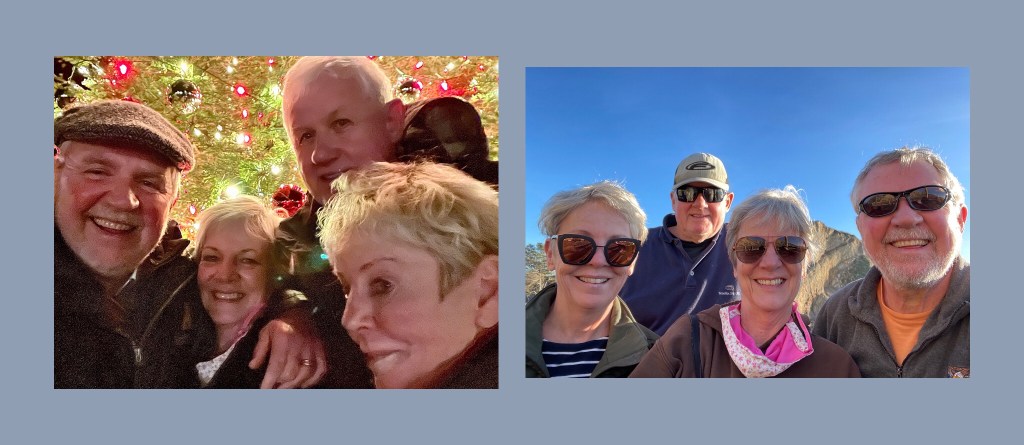
Good Times Celebrating Bonnie’s Birthday on Dec 29th in Healdsburg, and later on New Year’s Day at Point Arena

We also spoke about many other things and didn’t forget to enjoy life and the time we were having together. John invited Cathy and I to Hawaii again. There was laughter and joking, smiles and stories. We kept old memories alive, while also making new ones. It was good to be with the tribe again. We consumed our fair share of food and al’ahol over the five days we spent together.

John eventually left for the drive back to Santa Cruz. There were hugs all around and promises to see each other sooner rather than later. John made sure to invite us to Hawaii again and we readily agreed to give serious consideration for a trip there.

It’s good to keep memories alive, and laugh and cry for those we have lost. It’s also good to remember that life is for the living – to try and savor each and every day, and the time we have with those we love. As the days fly by, I want to race with the wind and also stop and smell the roses. Can you do both? I want to keep trying.

—-

Ecclesiastes 5:18-20 – Even so, I have noticed one thing that is good. It is good for people to eat well, drink a good glass of wine and enjoy their work – whatever they do under the sun – for however long God lets them live. To enjoy your work and accept your life, that is indeed a gift from God. People who do this rarely look with sorrow on the past, for God has given them reason for joy.

Wabi Sabi

Wabi Sabi

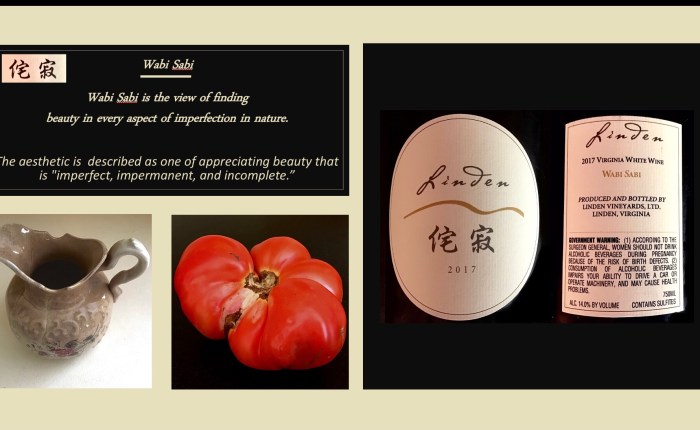
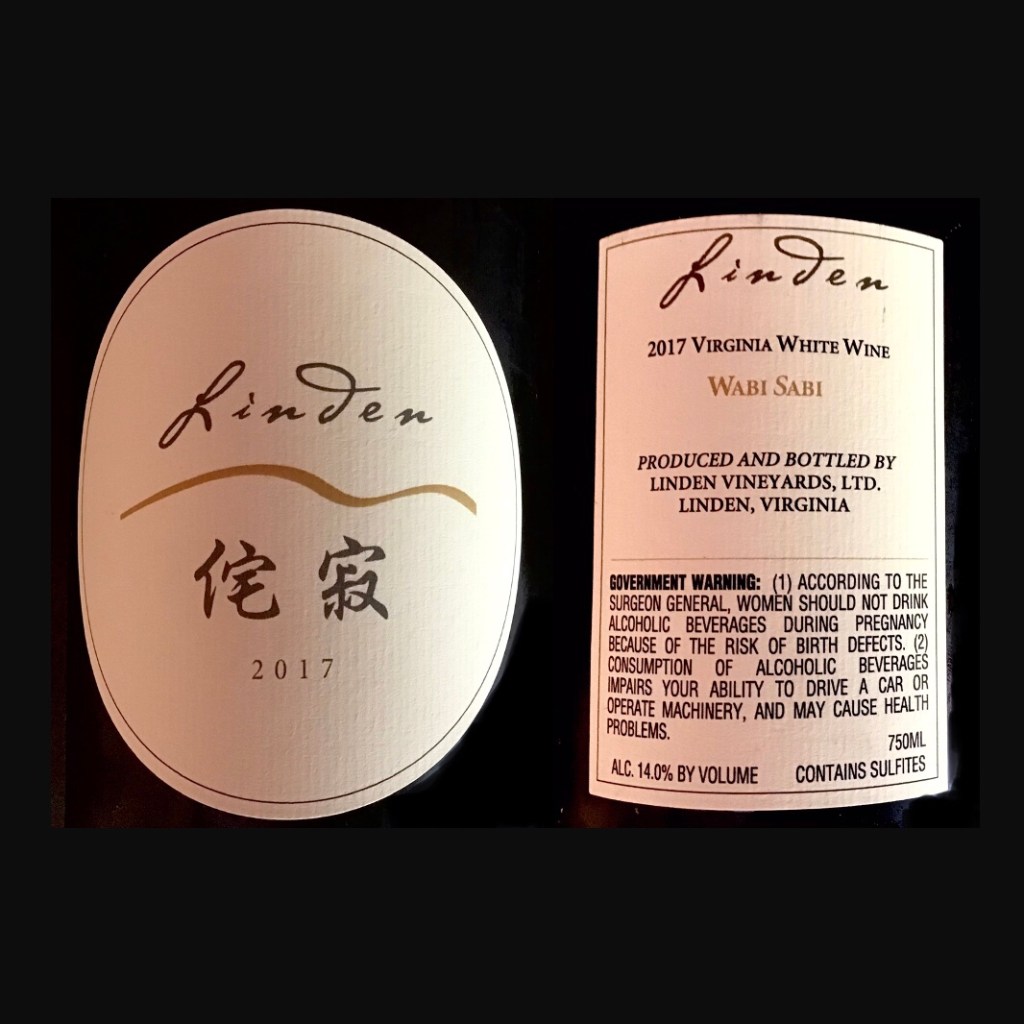
I was recently at Linden Vineyards for a wine tasting. It was a beautiful day. While there, I recalled a nice little wine they made in 2017 called Wabi Sabi. Jim Law, the owner and winemaker, said this about the wine when it was released in 2020 – “Wabi Sabi refers to a Japanese aesthetic that reveres the “imperfect, impermanent, and incomplete … It is an unintentional wine that resulted in a spontaneous decision ” I was so taken with Jim’s description of Wabi Sabi, I started looking into the concept.

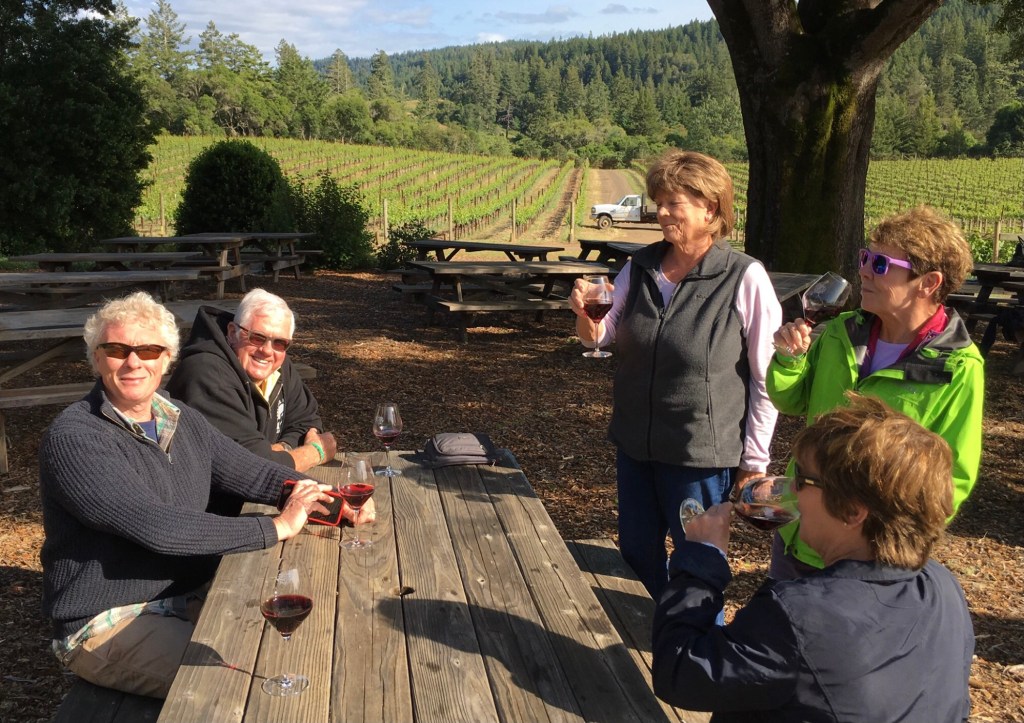
Wine Tasting at Linden on a Beautiful Day

After a year of researching online, and reading one book, I’m no expert. But I learned some things I’m trying to blend into my outlook, and my life. (yes, you can sometimes teach an old dog new tricks.)

The concept of Wabi Sabi is hundreds of years old and almost the opposite of order and perfection. As an engineer, and former military guy, this is 180 degrees from much of my professional career. It has taken some mental adjustments and rethinking. With Wabi Sabi, beauty is “spontaneous, fleeting, and singular”.

Stop and say that again, out loud to yourself. Spontaneous. Fleeting. Singular. Think of the changing colors of a maple tree’s leaves in autumn, before they finally fall to the ground.

It’s a very different view of beauty than we have here in the US and the western world in general, and focuses more on the simple and imperfect. Here, we often seem to think of beauty in terms of a state of perfection that is unattainable for most of us. Something that is often out of our reach.

Wabi Sabi stresses a simpler way of looking at and appreciating things in our lives. It also pushes two views at the same time – against the accumulation of objects to no set purpose, and recognizing the good things you already have in your life.

In the book, WABI SABI SIMPLE,* Richard Powell states it even more plainly – “Wabi Sabi nurtures all that is authentic by acknowledging three realities: nothing lasts, nothing is finished, and nothing is perfect.

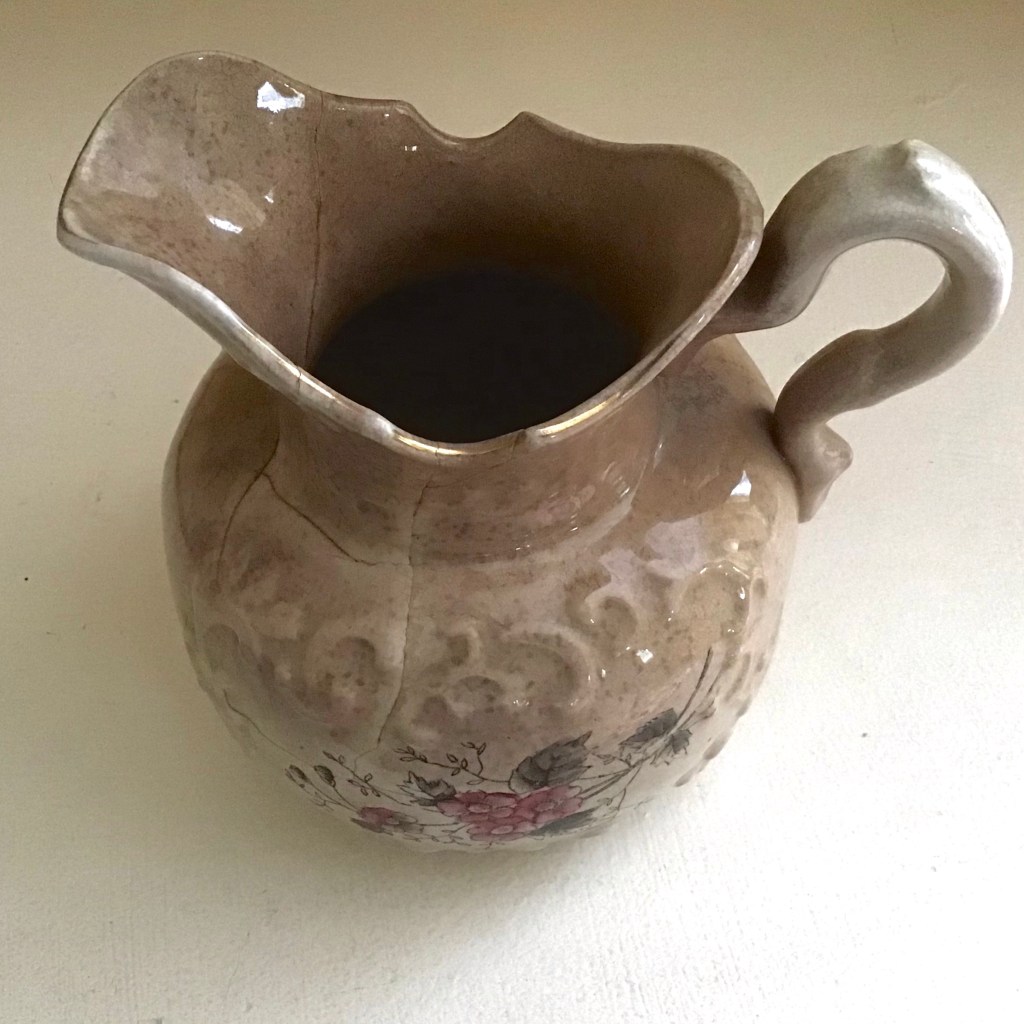
It is the crack in an old pitcher from your grandmother or an old friend, that makes it unique and dear, and maybe more interesting with a story behind it. You know you cannot replace it, and you treasure it. Someday, you also know it might break.

A Gift to Cathy from Mrs Pray** – Some Simple Wabi Sabi

Perhaps it is seen in the gnarly heirloom tomato with a blemish that you have grown in your garden, as opposed to the perfectly shaped tomato at the supermarket. Each of those home grown tomatoes is unique in it’s shape, pretty to look at, and will certainly wither on the vine if you do not pick and eat it. And, think of how much better a home grown tomato tastes than one that comes from the store.

An Heirloom Tomato from the Garden

Think of the handcrafted items you make or buy, or receive as a gift, as opposed to those mass produced items we all pick up at nearby big box stores.

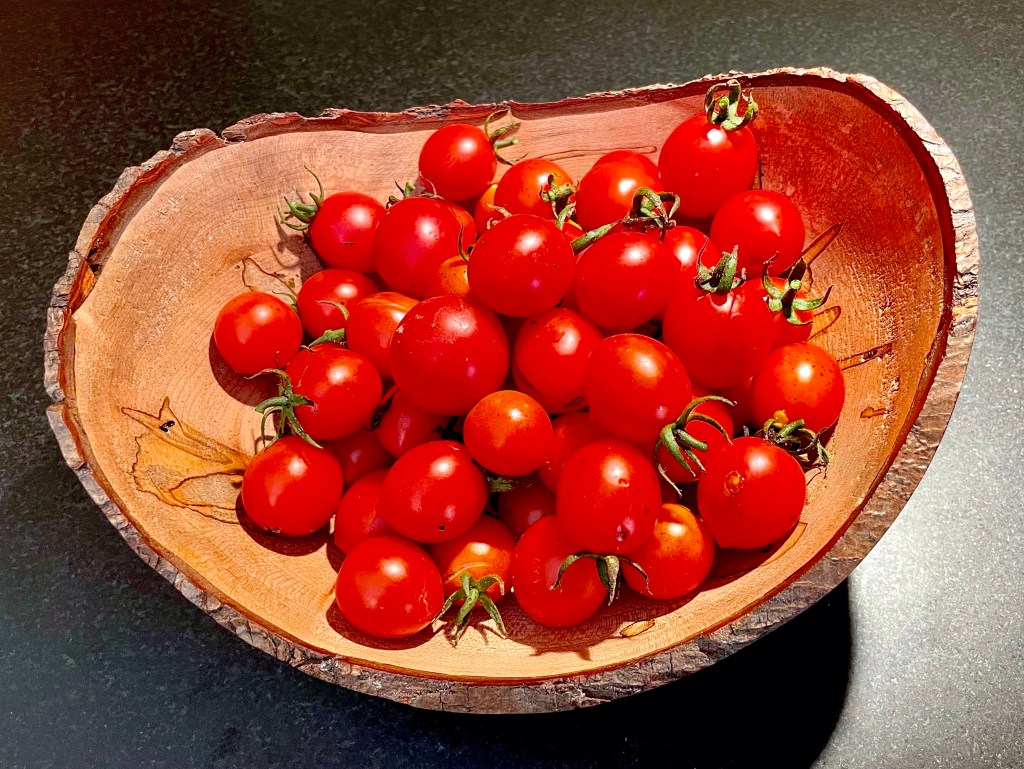
A Handmade Wooden Bowl we Received as a gift from our Friend, Kirby.

Again, I’m not an expert. Having said that, I am trying to relook at my life and how I view things. I think a bit of Wabi Sabi could help.

As to the Wabi Sabi wine at Linden, Jim also said this “Wabi Sabi reflects our philosophy behind the wine. It is an unintentional wine that resulted in a spontaneous decision. This is unusual for traditional, conservative, methodical Linden Vineyards. Once all blending decisions were made at the winery, there were several lots of wine that had no home. These misfit barrels were blended and bottled without intention or name.”

Linden’s Wabi Sabi … A Wonderful Little Wine.

Jim may have blended those barrels without intention, but the result was a wonderful little wine. It wasn’t perfect, but tasted awfully nice on a summer day. I have only one bottle left, and Linden has no more. Soon, my last bottle will be gone as well. Wabi Sabi indeed.

Addendum:

⁃ * The book I read on Wabi Sabi is titled “WABI SABI SIMPLE” by Richard R Powell. It’s a slim volume, and has some interesting thoughts for life and for work. One comment made was “maintain a conscious perspective that no job is perfect, no job is forever, and no job finishes completely.” Food for thought.

⁃ ** In the spring of 1973, Cathy and I were both in High School and had been dating for about a year. We took part in a High School Volunteer program to help out older folks around town. We worked together and went to the home of Mr. and Mrs. Pray, who we had never met before. We spent the day helping to clean up their yard, and clean and fix some things in their home. At the end of the day, Mrs Pray served us cake and something to drink. She tried to pay us, which of course we refused. She then disappeared for a moment and came back with the pitcher in the photograph above and gave it to Cathy. It was from her Grandmother, who was born in 1856 and started using the pitcher in 1875. I think it’s one of the most beautiful and generous gifts we ever received.

– In January of 2020, I wrote a blog called “Perfectly Imperfect”. Looking back at the blog now, I was already on a journey towards Wabi Sabi, and didn’t realize it. It’s always interesting to me when I find events in my life that overlap, and I’m not even aware of it at the time. Read this blog, and tell me if it doesn’t sound like Wabi Sabi by another name: https://mnhallblog.wordpress.com/2020/01/01/perfectly-imperfect/

⁃ For what it’s worth, Linden’s Wabi Sabi wine was a combination of Vidal Blanc, Sémillon and Viognier, not your typical blend. I love Linden Vineyards here in Virginia. They make excellent wines, by any standard. Want to know more about them? Here’s a link to a 2021 article about Jim Law and Linden – https://vinepair.com/articles/linden-vineyards-virginia/ and here’s a link to Linden’s website: https://www.lindenvineyards.com/

Making a Three Day Beef Daube

Making a Three Day Beef Daube

The weather had finally turned cold(er) here in the Virginia Piedmont and they were calling for snow over the next two days. This was the perfect time to make a Beef Daube and I was on a mission.

Daube is a French word that translates to stew. All daubes are stews, but not all stews are daubes. To me, daubes are thicker and richer, and are almost like a stew “sauce”, if that makes sense. I loved my mom’s beef stew, but this beef daube is something else.

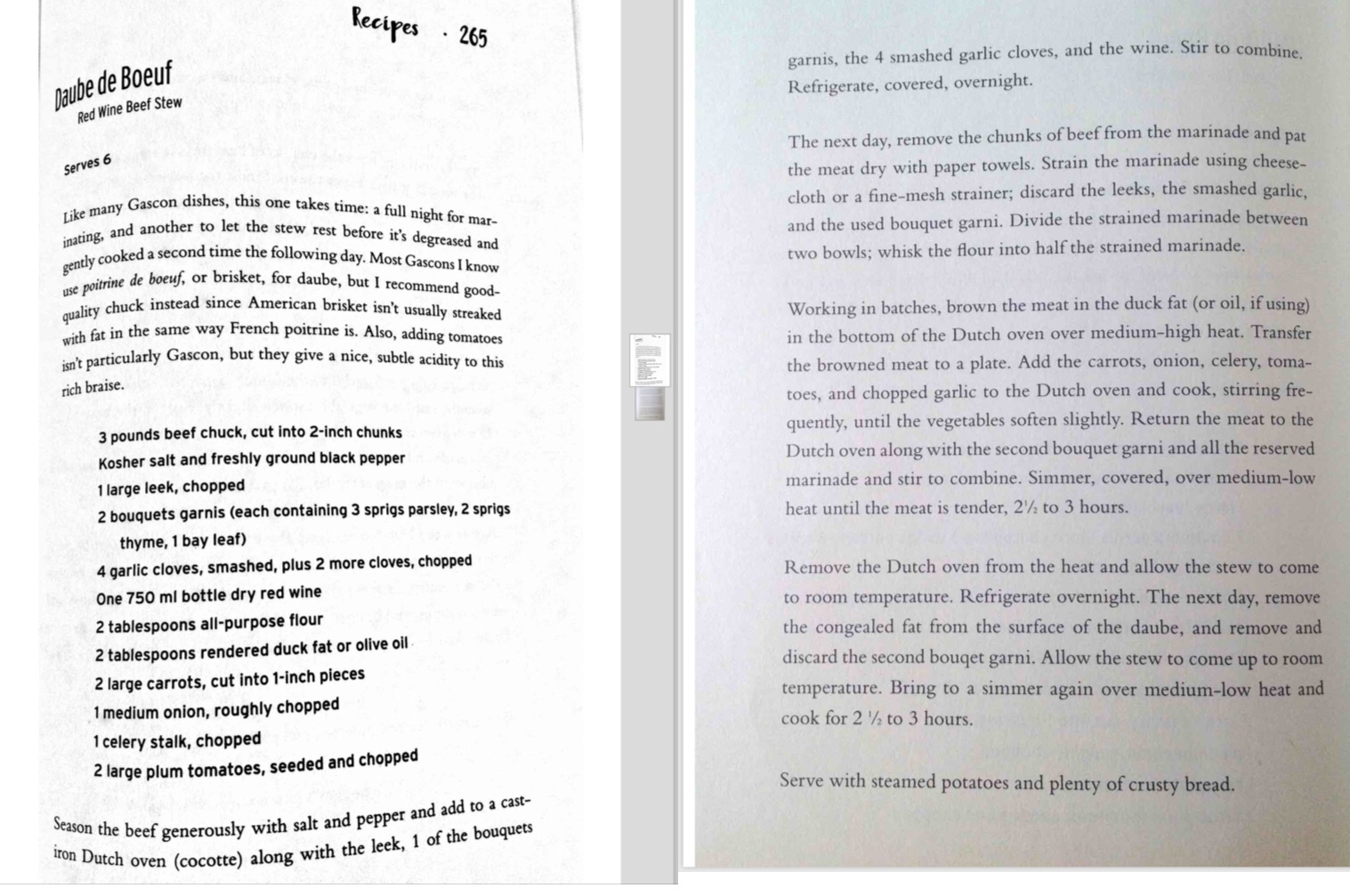
This particular recipe is for a Three Day Beef Daube. It’s from a book my old friend Tim lent me called “Duck Season”. The book is about the Gascony region of France, and if you enjoy reading about other countries, particularly their food, drink and culture, I highly recommend it. The dish takes three days to make, although the steps are pretty easy. Day one – marinate the beef; day two – make and cook the daube for 2-3 hours and let it rest over night; and day three – gently simmer the daube for a couple of hours and then eat. That’s all there is to it.

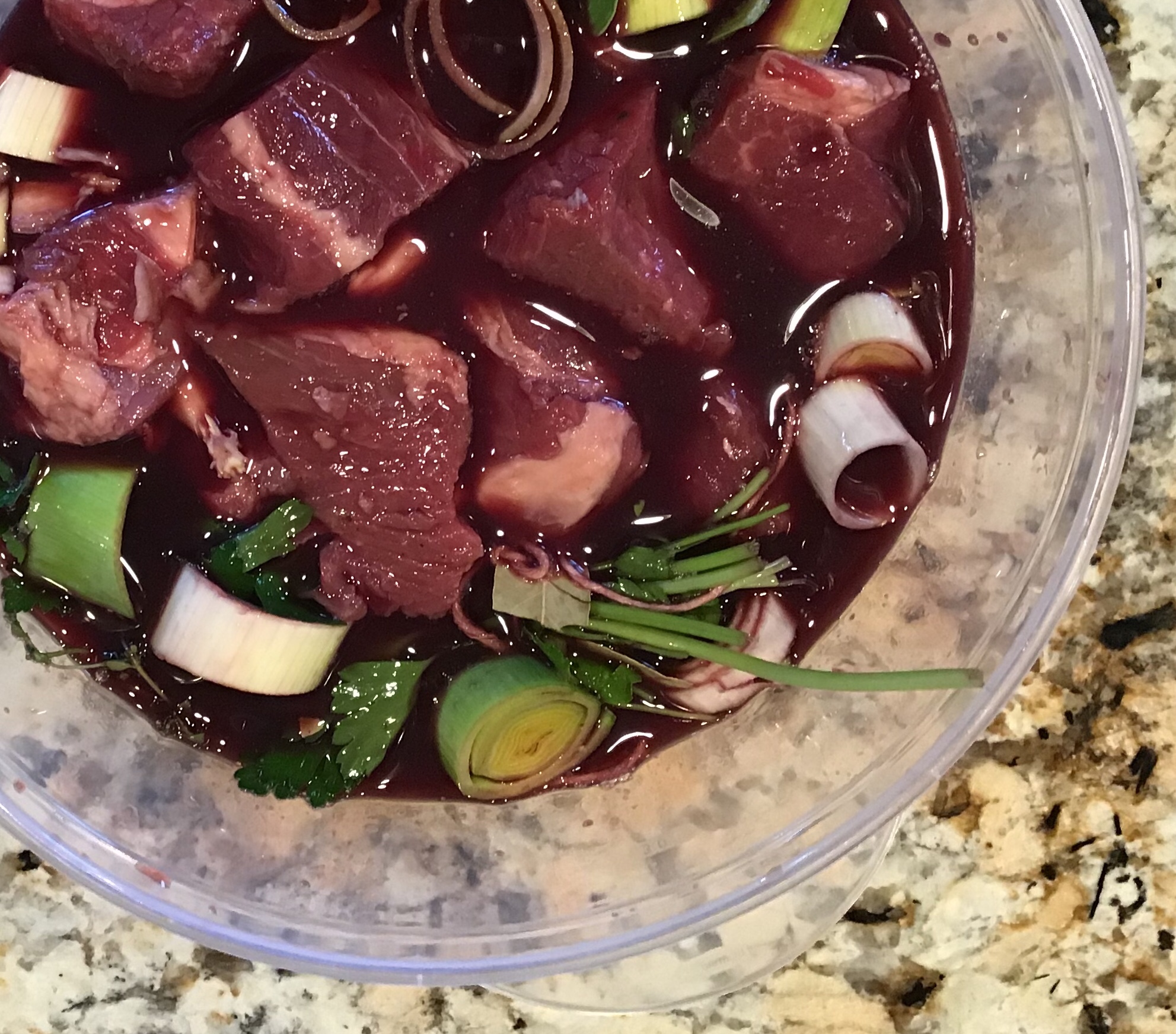
Last Thursday, I pulled the chuck roast out of the freezer to thaw, and made up my shopping list. On Friday morning, I went shopping for the few things I still needed – a leek, some parsley and thyme. We had everything else at home. After a quick lunch, I cut up the beef and added it to a bowl which already included smashed garlic, sliced leak, a bouquet garni, and a bottle of red wine. Day one was done, with plenty of time left to take our dog Carmen for a walk, and in anticipation of the snow, to bring more firewood into the house.
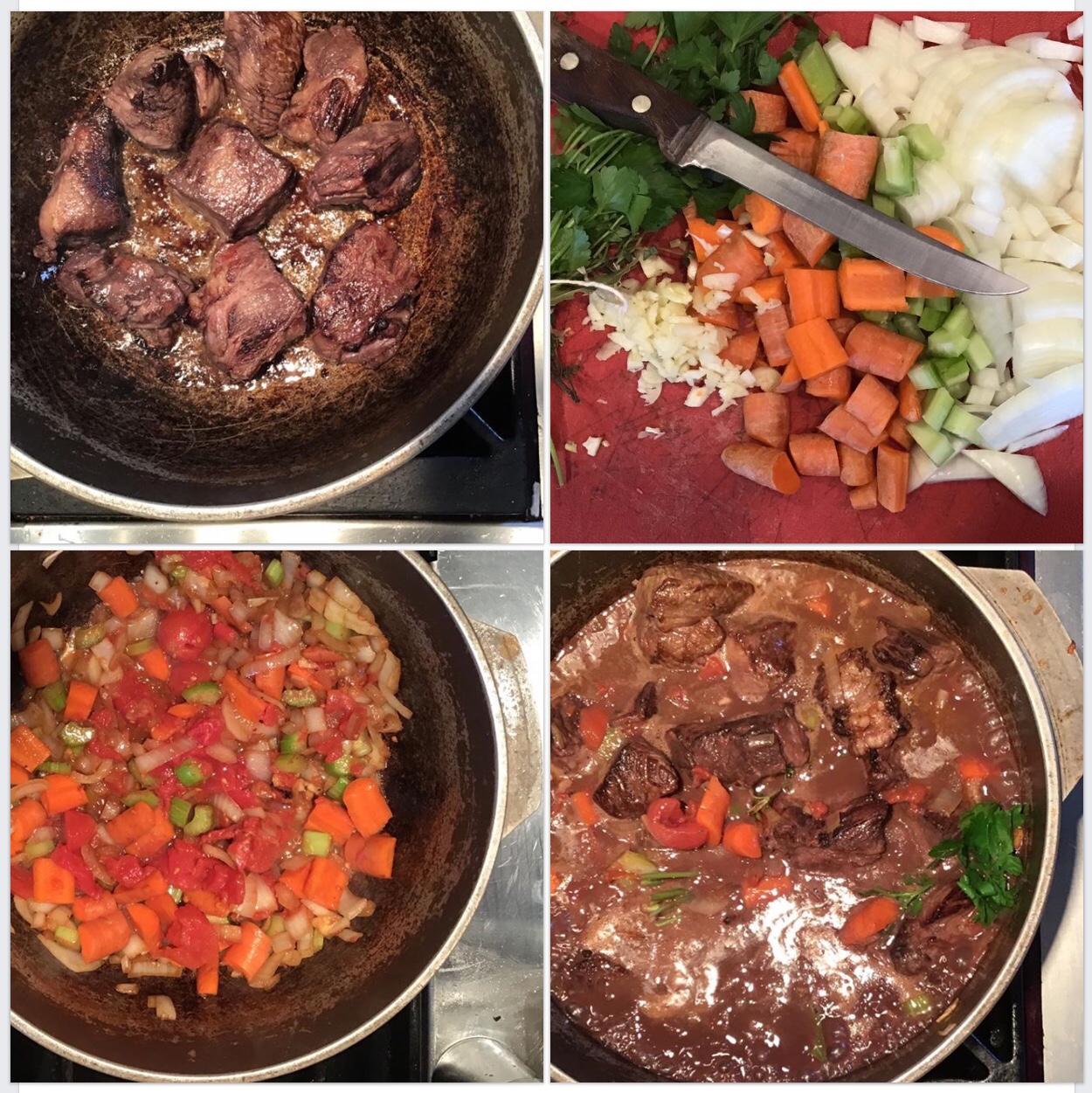
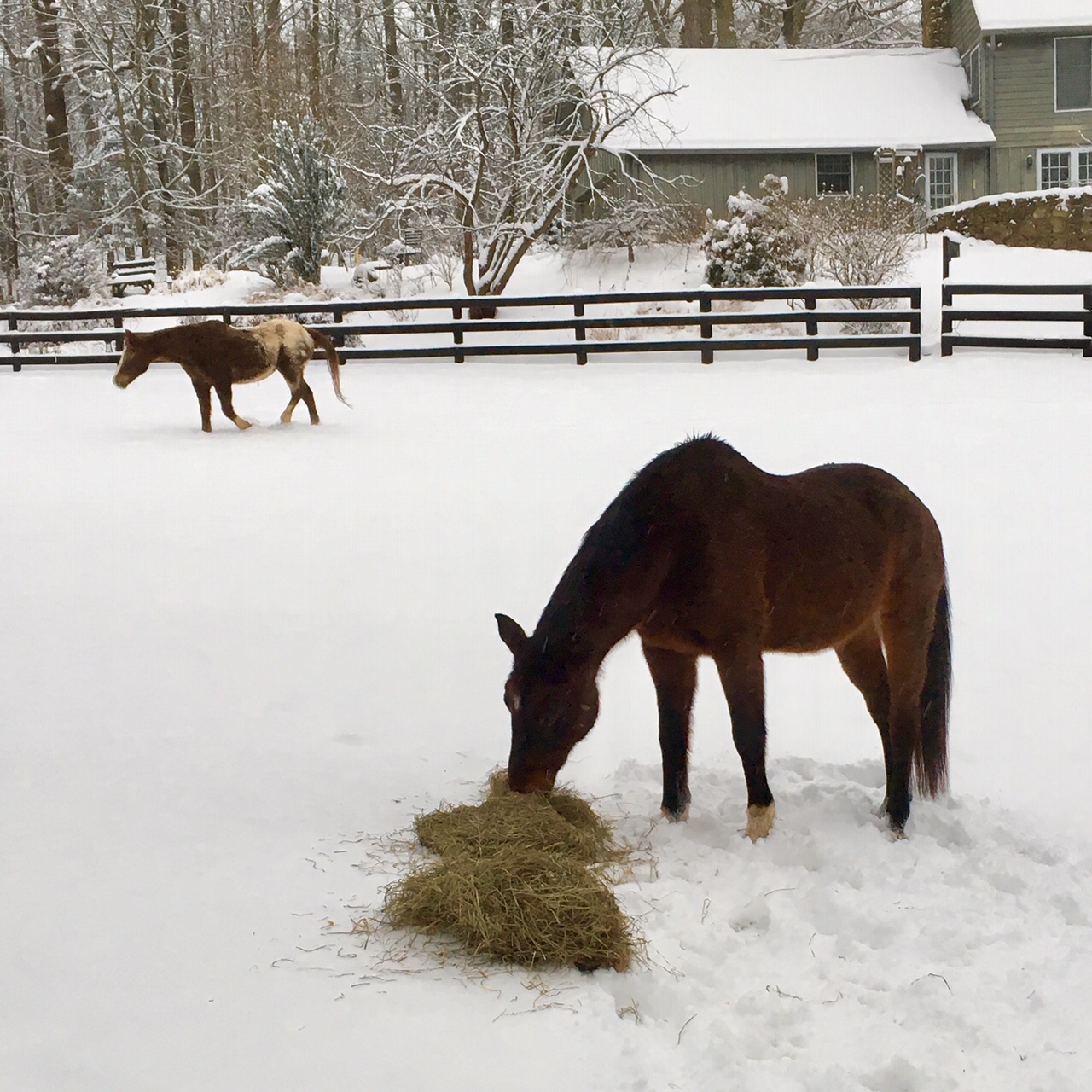
Day two started grey and cold. When I went to the barn in the morning to feed the horses, there was a skim of ice on the pond and the air had that “pregnant with snow” feeling you sometimes get right before a storm. Predictions for snow amounts rose from 2-4” to 3-7”.

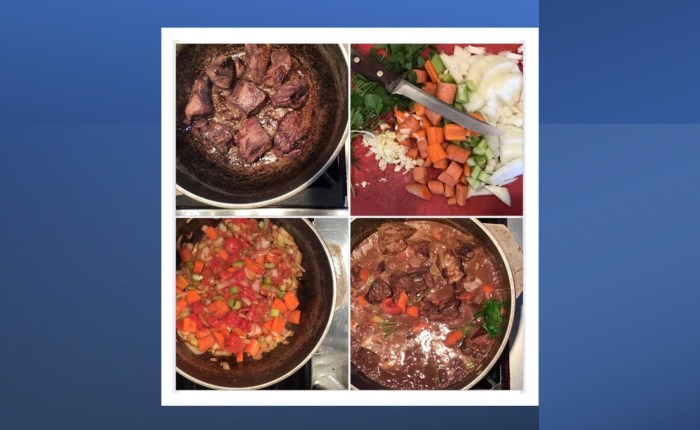
I continued with the daube around noon and day 2 was only a bit more work than day 1. I browned the beef; chopped up and sauté garlic, onions, celery, carrots and tomato; added the beef back to the pot with the vegetables, along with a new bouquet garni; and added the strained and reserved wine marinade to the pot. Once that was done, it simmered on low heat for about 3 hours.
I’ve found it’s best to take your dog for a walk while the stew is simmering, so you don’t drive yourself mad with the wonderful smells coming from the kitchen. After returning from your walk, you are faced with the most difficult part of day 2. You don’t eat the daube on day 2, no matter how good it smells or tastes. Instead, you remove it from the heat, cool it to room temperature and let the daube rest overnight in the fridge. Remember, don’t eat the daube at this point in time.

Sunday, Day 3, greeted us with a blanket of snow. About 7 inches had fallen, with more expected over the course of the day. After feeding the horses in the morning, and then having my own breakfast, I plowed our drive and around the barn, and then plowed the drives of several elderly neighbors. I made it back inside for lunch, and then some playoff football.
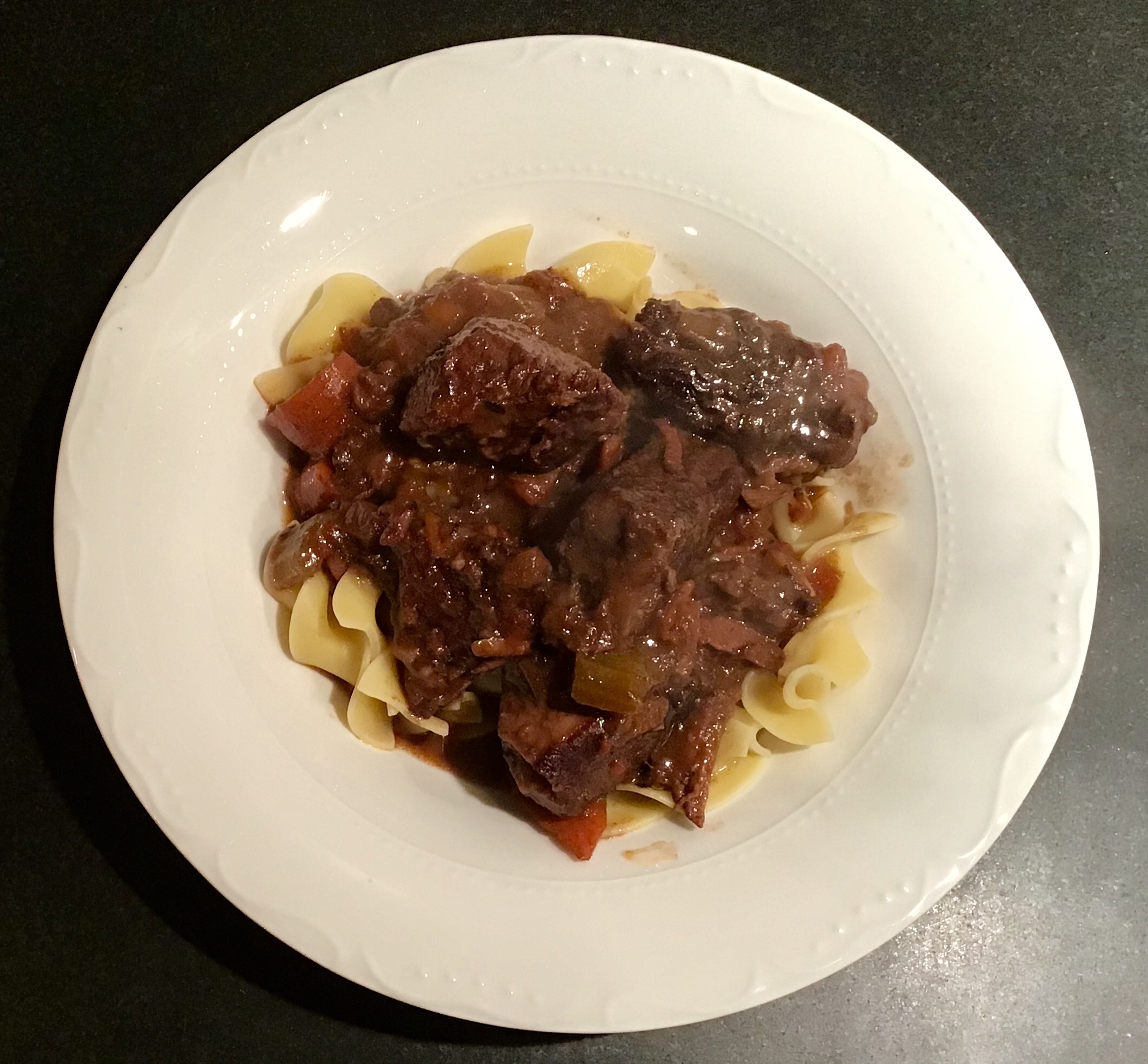
During the afternoon, I started reheating the daube. After removing the congealed fat from the top of the daube, the pot went back on the stove for a gentle three hour simmer. Now the smells were truly driving me crazy and the football was barely a distraction. I took one more walk with Carmen and could see that we had another 3-4 inches of snow today. It was still snowing at dusk as we finished our walk, and I may need to plow again tomorrow, but that will wait.

About a half hour before dinner, I threw a baguette in the oven to warm up, and finally it was time. We served the daube over egg noodles and had it with the bread and a bottle of wine. I breathed in the aroma and took my first bite. What a great ending for a snowy weekend…

_____
Addendum: Here’s the recipe. It’s from the book “Duck Season”, by David McAninch.