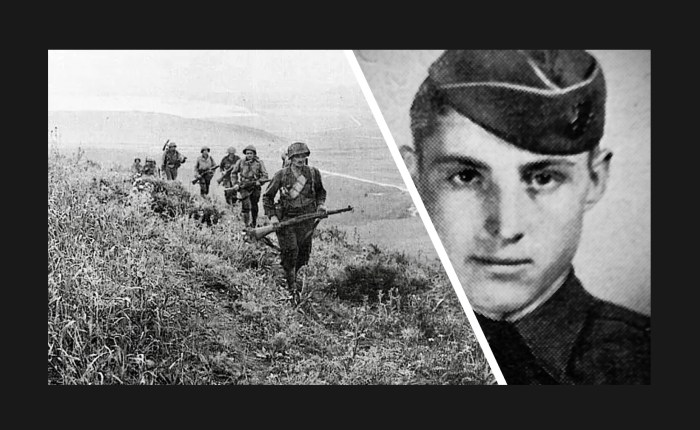
It was May of 1943 in Bizerte, Tunisia. My Dad, then twenty year old Sergeant Willie I. Hall looked at the German soldier and said “Chicago”. The German answered “Chicago?” Dad stared back. “Chicago. Al Capone”. Now the German’s eyes’ widened …
… After the battle at Maknassy, Dad’s unit, the 60th Regimental Combat Team (RCT) reunited with the rest of the 9th Infantry Division. In late April of ‘43, the push was on to finish the war in North Africa, and in the words of the division Commander, Major General Eddy, “A world spotlight will be focused on us from the moment we attack until we have killed, captured, or driven every Axis soldier from Tunisia…”
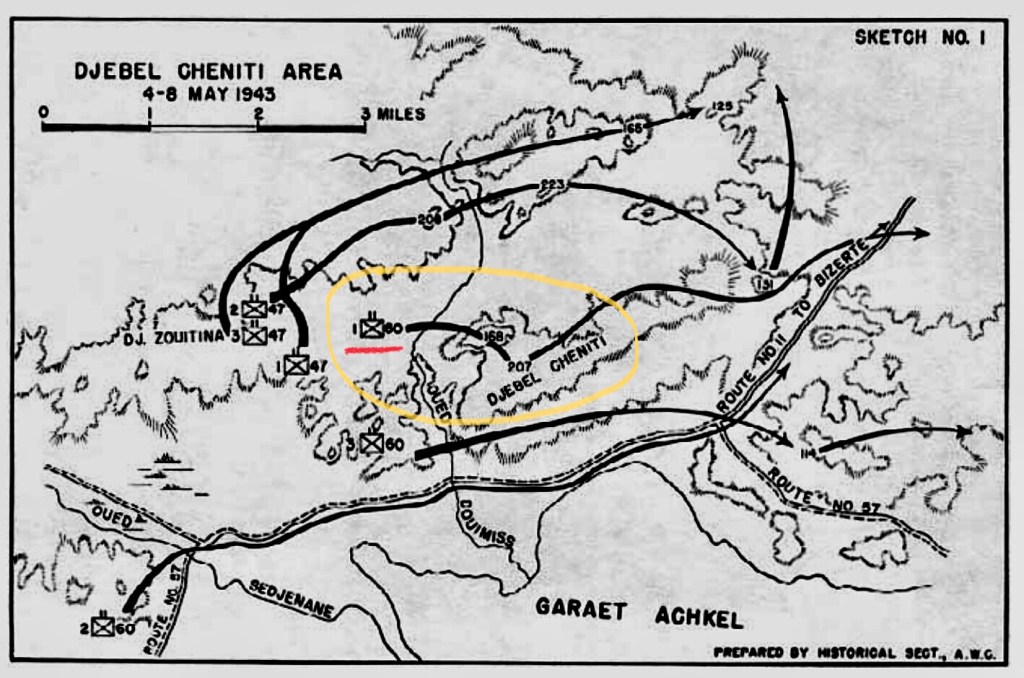
The history books tell us that as a part of their assault, the 60th, attacked through the Sedjenane Forest and after driving the Germans out of the area, hit a bottleneck at Djebel Cheniti. On May 5th, the 1st Battalion of the 60th (Dad’s Battalion – about 500 men) attacked Hills 207 and 168 (see diagram below) and Djebel Cheniti by a direct assault with fixed bayonets. You read that right. Fixed Bayonets. In the words of the 9th Infantry Division Record, “One of the strongest positions in the final Axis defense was assaulted by one battalion of Infantry, with artillery blasting a shell-strewn pathway for its advance. Another story in the annals of foot soldiers, who do the dirty tasks of warfare”. After several hours, they took the hills and Cheniti.
I never heard dad say a word about the battle at Cheniti. Not one.*
1st Battalion, 60th RCT’s Path While Attacking Djebel Cheniti and then Bizerte
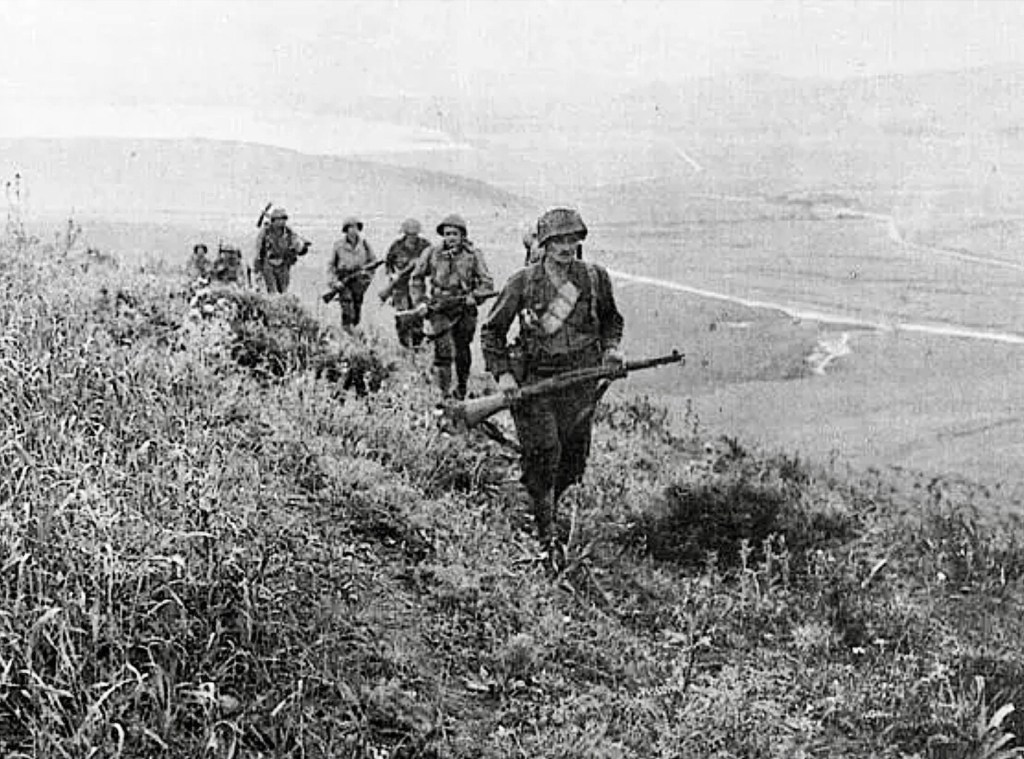
On the 8th of May, they arrived in Bizerte, and on May 9th, the Germans surrendered. The battle for North Africa was over. In the words of one soldier of the 60th, “We were all 20 pounds lighter and 20 years older.”
Soldiers of the 60th RCT in the Hills outside Bizerte, Tunisia on May 7, 1943.
At this point, I’m sure you are saying, “This is all great history Max, but what the hell does it have to do with your Dad and Al Capone?” Good question.
Now we come to the rest of the story.
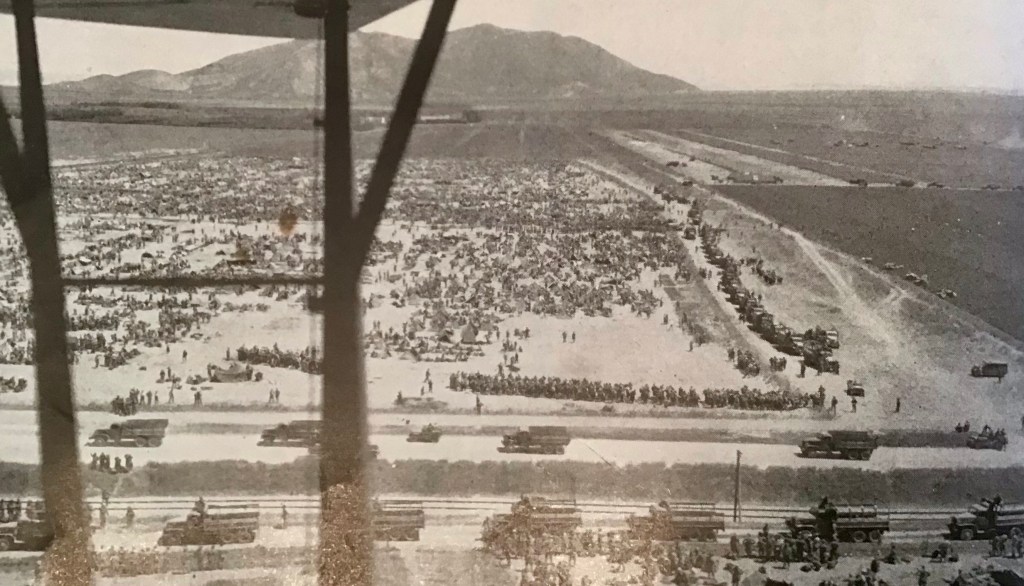
With the collapse of Rommel’s Africa Corps, the allies captured prisoners. A lot of prisoners. Over 275,000 Axis prisoners were taken in all, including 25,000 in and around Bizerte alone. This included General Jürgen von Arnim, the German Supreme Commander.
There were, of course, no prisons, so in the immediate aftermath they confined the Germans in large “holding pens” with single strands of barbed wire around each of the pens. The 9th, along with other units, were then drafted into guarding the prisoners until more secure facilities could be established.
Prisoner Holding Pens Near Bizerte, Tunisia
Dad talked about guarding the Germans and the Italians. You have to remember just a few days or weeks before, they were in a kill or be killed mode with the enemy, with plenty of butchery to go around. All that separated the two sides now was a bit of barbed wire. According to Dad, the Italians never had much fight, and the captured Germans knew they were beat, so they generally behaved. Still, you needed to be careful.
During the days they were on duty, dad’s platoon always guarded the same area, and after a while, they would recognize certain prisoners, talk a bit back and forth, and maybe even pass a cigarette across the wire. At the same time, Dad said he wanted to make sure he looked tough so no one did anything stupid.
As Dad tells the story, he was talking with a few of the Germans one day and someone asked where he was from. He answered “Illinois”, but the Germans looked confused. So dad thought about it a bit, and then trying to look a bit tougher he said “Chicago”. The German answered “Chicago?” Dad stared back. “Chicago … Al Capone”. Now the German’s eyes widened. Everyone knew who Al Capone was.
The German looked at Dad and said with a smile “Al Capone…. Ratatatatat….” While making a machine gun like motion with his hands.
Dad looked back at the German, nodded his head, patted his M1 Garand Rifle and without smiling, said “Ja, Al Capone.” The German stopped smiling and didn’t say anything else.
Dad always told the Al Capone story with a chuckle. When getting to the punchline, he would draw himself up to look bigger and meaner. But he was deadly serious about the Germans not trying anything. After what they had been through, I don’t think it would have taken much for him to put a bullet in someone, for doing something stupid.
A little over two months later, after a bit of rest and relaxation, Dad and the 60th were back in Combat against the Germans on the Island of Sicily. There, he was wounded and almost died. You can find a link for that story in the Addendum below.
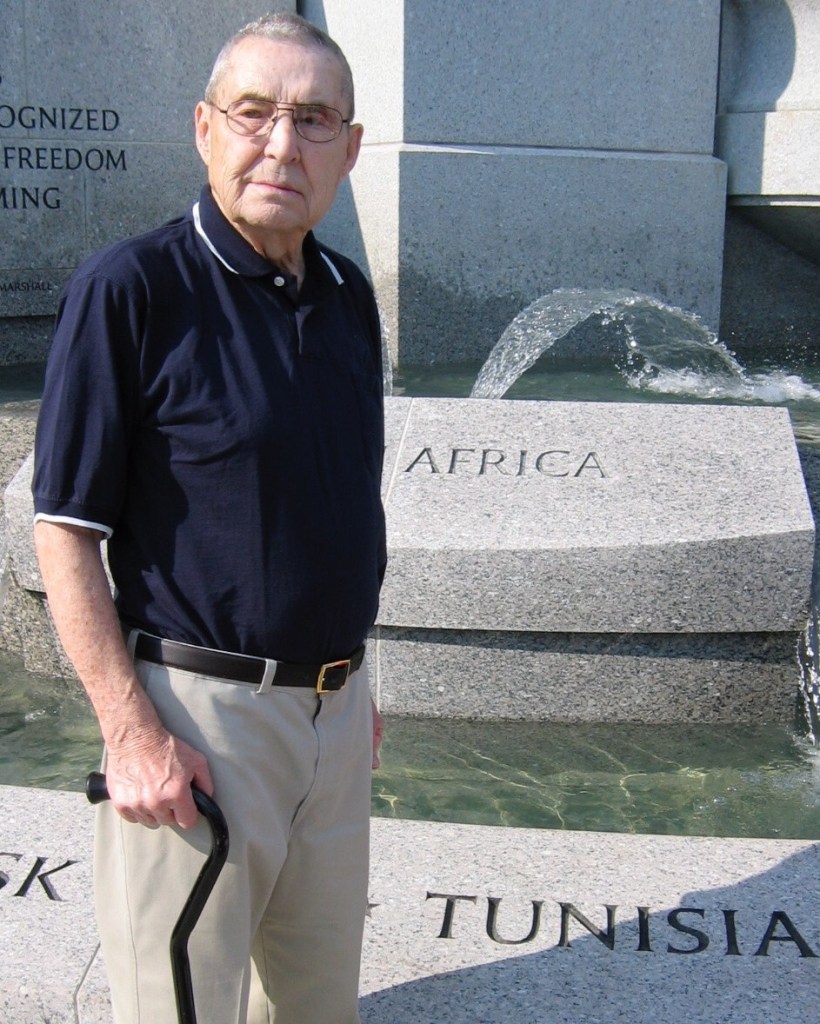
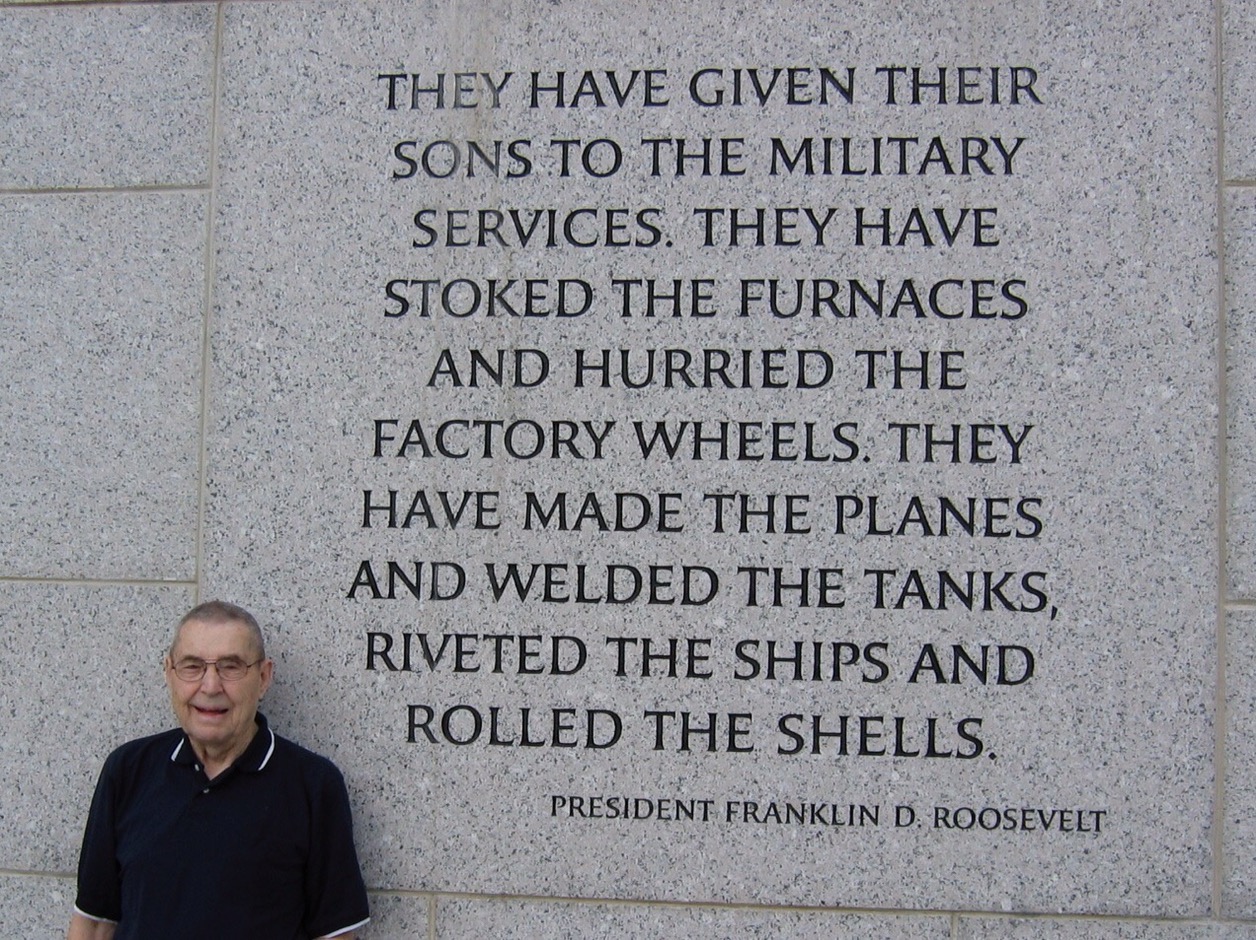
Dad at the WWII Memorial in 2008.
Addendum:
* Except for the story of how he was wounded, Dad never said much about any of the battles he was involved in. For the most part, he told funny stories about events during the war. I was shocked when doing some research for this blog to find he had been involved in a charge with fixed bayonets. As a soldier, you know things aren’t going to be pretty when you receive an order to fix bayonets. That is combat at its most up close and personal. I have to figure that after you’ve been given the command to fix bayonets, and then taken part in a bayonet charge, everything else in your life, maybe for the rest of your life, must seem pretty easy. It may explain a bit about why Dad always had such a good attitude throughout his life.
Al Capone – As everyone knows, after being the Crime Boss of Chicago for much of the Twenties, Al Capone was incarcerated for tax evasion in 1931. He was released from prison in 1939, but wouldn’t die until 1947. He had a worldwide reputation for murder and violence that may have been the equivalent of his actual deeds.
Crazy Ivan* anyone? Another Submarine story from my buddy, Bob Bishop**… It was mid-September, 1970. Our submarine, the USS Finback, had been commissioned way back in February, but we were still doing a number of exercises and independent operations to get additional sea time under our belt. On this particular exercise, we were to provide “services” to anti-submarine warfare (ASW) configured Navy patrol aircraft, to give them an idea of how to use their ASW gear and try to find a real live nuclear submarine. This exercise was to involve every ASW patrol plane on the US east coast, NATO members in western Europe, and one reserve squadron from Chicago (don’t ask me why there is an ASW squadron in Chicago).
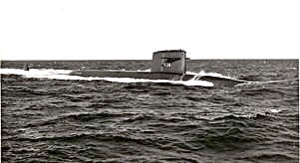
The USS Finback (SSN 670)
In the Atlantic Ocean, that meant a complex organizational challenge for a lot of people. For each exercise, using radar and radio communications, we would vector a Navy Lockheed P-2 Neptune or P-3 Orion aircraft on top of our location so they could mark where we were. We would then submerge and maneuver. If they didn’t find us in 50 minutes (marking our location by dropping a transmitting sonar buoy), we would broach or surface, show them where we were, and they would then clear the area for the next plane to arrive at the top of the hour. We did this for 18-20 hours a day most days, for 4½ weeks.
During the exercise, we also did occasional helo transfers of a CO/XO from an aircraft squadron to our ship, so they could get a sense of what it was like to be on a submarine and how we operated during these exercises. I particularly remember one squadron XO, a Commander (I was a lowly Lieutenant, but was pretty comfortable with what I knew and no longer frightened by a senior officer), who came in the Control Room after midnight one night. I was the Officer of the Deck (OOD) – the officer on duty responsible for driving the ship, responding to emergencies and so on, unless the Commanding Officer came on deck to relieve me. I had the 0000 to 0600 watch and we were in the middle of conducting the ASW exercises.
We talked over a number of things he was curious about, and he watched as I/we went through a couple of the exercise cycles. Chatting after the third one, he observed “I think I understand your plan. You alternate going to port or starboard as soon as you submerge.” I responded, “Well, not actually”, and we walked over to the chart table. A piece of paper was taped on top of the glass top of the chart table. A mechanical device under the glass receives inputs of the ship’s speed and direction and moves a little light accordingly. Every minute the quartermaster puts a pencil dot where the “bug” (the light) was. As a result, you could see where the ship had been.
I quickly explained how “the bug” worked and showed him where we started the last run and where we ended up 50 minutes later. I then explained that the Captain gave the OOD the latitude to do whatever he wanted, so I decided to spell the Helmsman’s (the person actually steering the ship) name in cursive each watch. I think the letter I was on for that particular run was a “b.” The Lt Commander looked at me, aghast. “You mean, you don’t have a pattern, a routine?” “Nope,” I said, “It all depends on when I am on watch and who the Helmsman is. Although sometimes I use the name of the Stern Planesman or the Diving Officer.”
He walked quietly away, mumbling to himself.
During the 4 1/2 weeks of the exercise, not a single plane ever found us, even though they knew where we started each time. A discussion about the capabilities of ASW aircraft is a subject for another day, but I’ll leave it at this – ASW aircraft (including helicopters) vs. a US Navy nuclear submarine? Bet on the submarine, every time.
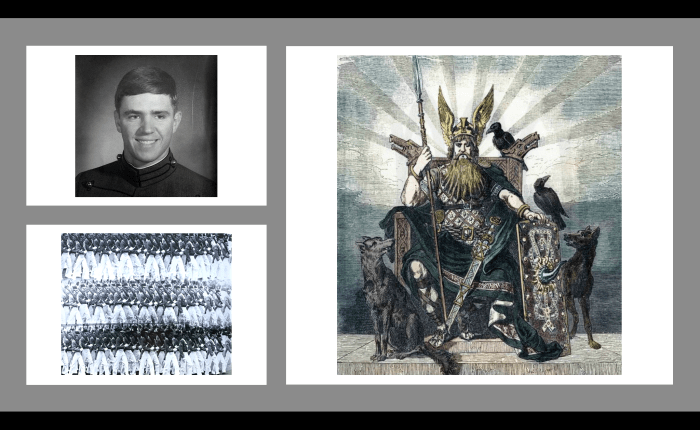
Bob in 1964, and then about 50 years later
Addendum:
– * Crazy Ivan references a maneuver sometimes performed by Russian submarines, and made famous in the movie. The Hunt For Red October.
⁃ ** My friend Bob Bishop graduated from the United States Naval Academy in 1964 and had several tours on Nuclear Submarines during the Cold War. At the time, Admiral Hyman G. Rickover, the founder of the modern nuclear Navy, personally interviewed and approved or denied every prospective officer being considered for a nuclear ship. The selection rate was not very high.
– This story is pretty much all Bob’s. All I did was add some editing assistance and publish it.
⁃ The USS Finback (SSN-670) was a nuclear-powered fast attack submarine. Bob was a “plankowner” – a member of the initial crew. He was the third officer to report on board.
⁃ You can read another of Bob’s submarine adventures here. It’s a compelling Cold War story. The movie, The Hunt for Red October, is child’s play, compared to what these sailors did on a daily basis. …The Comms Officer ran in and handed the CO the decoded message. The CO read the message, took the lanyard from his neck, unlocked the firing key cabinet, and reached in for the firing key. We were about to […] Continue at: https://mnhallblog.wordpress.com/2021/06/23/we-knew-we-were-at-war/
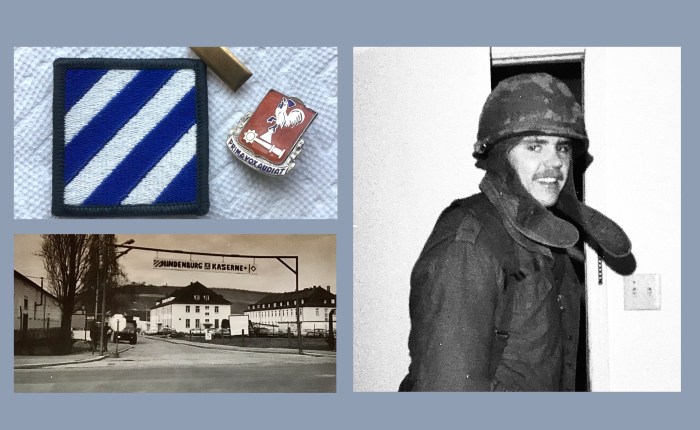
The call came at about 3:40AM in late February, 1979. I answered the phone, “LT Hall.” – “Max, this is Captain Ward. A Lariat Advance Alert was called at 3:25AM this morning.” – “Got it sir – on my way.” I called my Platoon Sergeant, Paul Teague to notify him, and kissed Cathy goodbye, with a “See you when I can”. I was out the door for the drive to Hindenburg Kaserne by 3:50AM.
We lived in the little town of Helmstadt, Germany, about 15 minutes from Hindenburg Kaserne (Barracks, or Army Post) in Würzburg. My mind raced on the drive to the barracks.
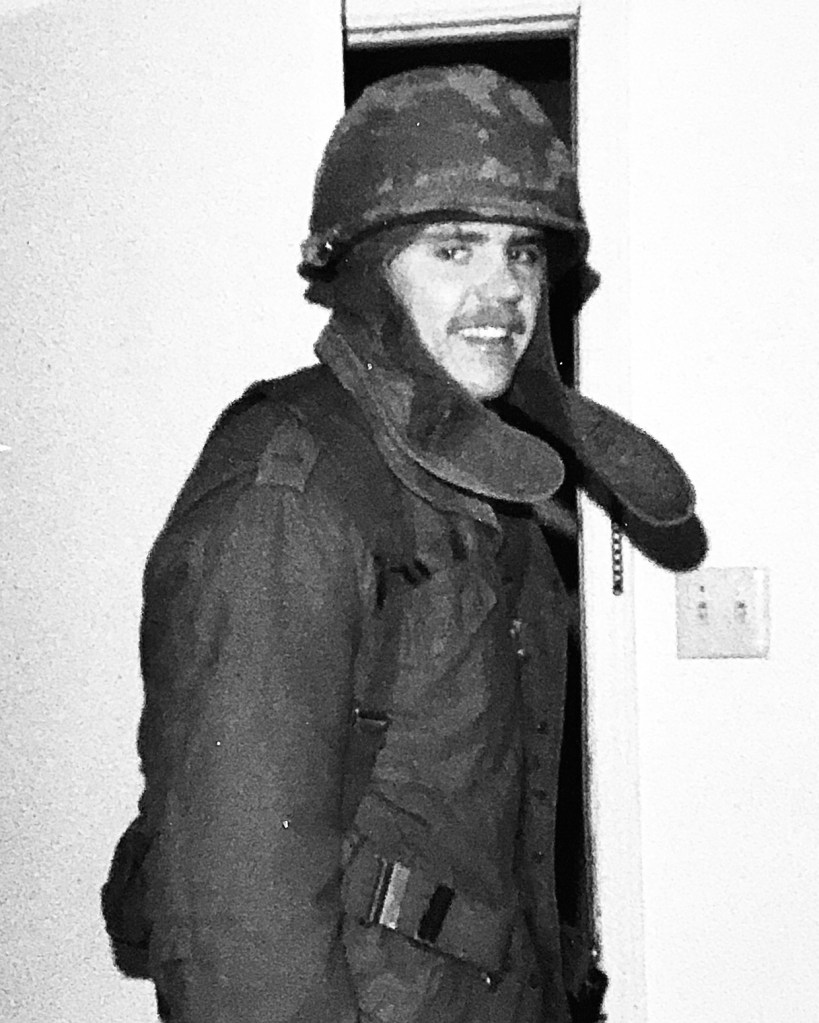
LT Hall in 1979
This was my first Lariat Advance. I’d joined the 123D Signal Battalion, 3rd Infantry Division in January of ‘79. A Lariat Advance was a US Armed Forces Cold War mobilization alert in Germany. The thing was, you never knew if it was a drill, or in response to a real world situation. If just a practice, it might be called off after a couple of hours. BUT, you could also deploy and link up with the unit you supported (2nd Brigade, 3ID in my case), or even deploy to your General Defense Plan (GDP) location. For my platoon, that was near the village of Hof, and the Hof Gap on the the Czech/East German border. The Hof Gap was considered a major Armor Route for a Russian invasion of West Germany. The pucker factor increased significantly if you deployed there on an alert.
My unit, B Company, 2nd Platoon, was always the first unit scheduled for departure, as we had farther to go. We would depart two hours after the alert was originally called. In this case, we needed to be lined up at the Kaserne Gate and ready to go at 5:25AM.
Main Gate, Hindenburg Kaserne
I arrived at the Kaserne a few minutes after 4:00AM. As I climbed out of the car, I promptly locked my keys in the car. “D@mn!” I stood looking at the car, shaking the door when one of my squad leaders, Sergeant Santos ran by and called out – “Yo, L.T. (Pronounced Ell-Tee), what’s up?” – “I locked my keys in the car.” He stopped, looked at me for a second and then said, “Forget ‘em. We’ll get them later – we gotta go!”
He was right, of course. I left the car and ran to the Company HQ and checked in with the CO. Next, over to the Armorer, where I picked up my .45 pistol, and finally, I ran back outside and over to our Platoon Bay. It was probably about 4:15AM.
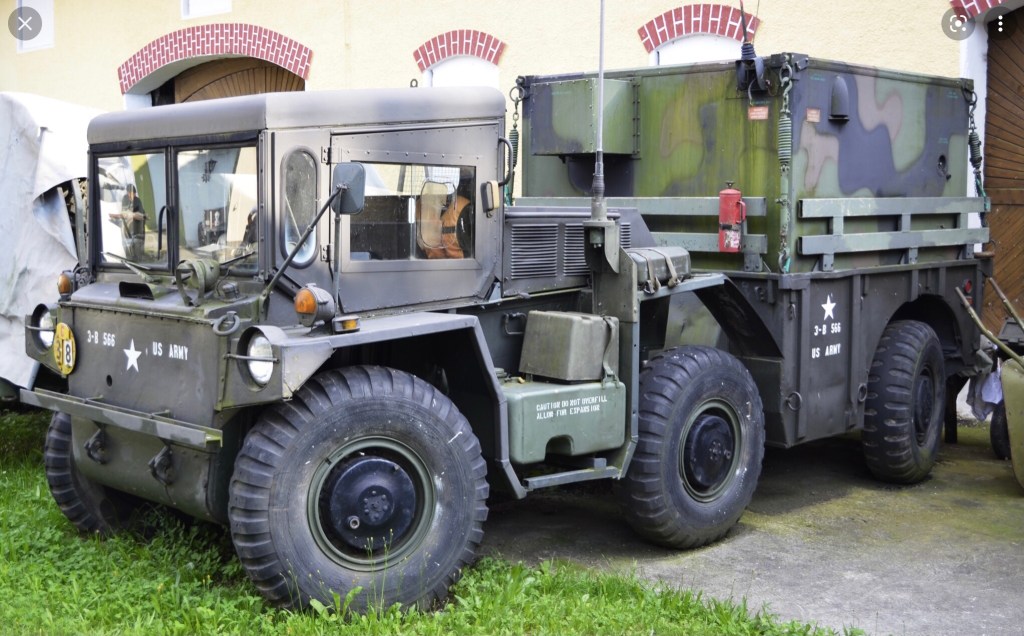
Sergeant Teague had also just arrived and he gave me a status report. About 80% of our troops were on the Kaserne, with the others expected shortly. We then looked at our vehicles’ status. Our platoon had around 20 vehicles in all – a combination of jeeps, a 2 1/2 Ton truck (the Deuce) and several Gamma Goats. Gamma Goats were six wheeled vehicles that could, at least in theory, perform off road much like a tank, or other tracked vehicle. We needed to determine which deadlined vehicles could be made readily available, by cannibalizing* other deadlined vehicles. We agreed that of our four deadlined Gamma Goats we could maybe get three ready, and still make the 5:25 departure time.
A Gamma Goat, with Comm Shelter
The next half hour was total chaos. By then, all of our troops but one were on the Kaserne and had picked up their weapons. We continued loading both personal and platoon equipment into our vehicles. Cases of C-rations were loaded into the Deuce, along with other supplies. Two of the deadlined vehicles were fixed, but we were still having problems with the third. Somewhere in there, we received word we would deploy to Kitzingen, and link up with 2nd Brigade’s HQ elements. It was now 4:55AM, a half hour before departure.
Suddenly, a feeling of great calm and clarity settled over me. The world seemingly slowed down. Sergeant Teague and I agreed it was too late to fix the last vehicle and to hell with it, we would roll with what we had. We held a quick meeting with our three section leaders and strip maps to Kitzingen were passed out for each of the vehicles (remember this was all pre cellphones or google maps). We lined up the vehicles in the motor pool and proceeded to the gate, with my Jeep in the lead. Sergeant Teague was in the last Jeep at the end of the convoy. At 5:15, we were at the gate where the Battalion Commander, Colonel Swedish and Command Sergeant Major Johnson greeted us. We spoke briefly and they wished us good luck.
5:25AM came, and we rolled. The rest of the day passed in a bit of a blur. Google maps says the drive from Würzburg to Kitzingen takes a half hour, but at convoy speed, it probably took us about an hour. We arrived and I reported in to the 2nd Brigade Operations Officer (S3). Then, as is often true in the Army, we sat and waited. And waited. I stayed in touch with the Brigade S3, and also with my Company Commander via FM radio. After a couple of hours passed, we received word it was a drill, and perhaps another two hours later, we were released and returned to Hindenburg Kaserne.
The drive back took another hour. Once back at Hindenburg, we offloaded all of our equipment, washed our vehicles, and then topped all of them off with fuel, so they were ready to go. Cannibalized parts were returned to their original vehicles. A weapons count was done by the armorer, and it was verified all weapons were turned in and accounted for.
I reported to Company Headquarters that all recovery tasks were completed. Once all three platoons were finished, Captain Ward let me know we could dismiss the troops, which I did.
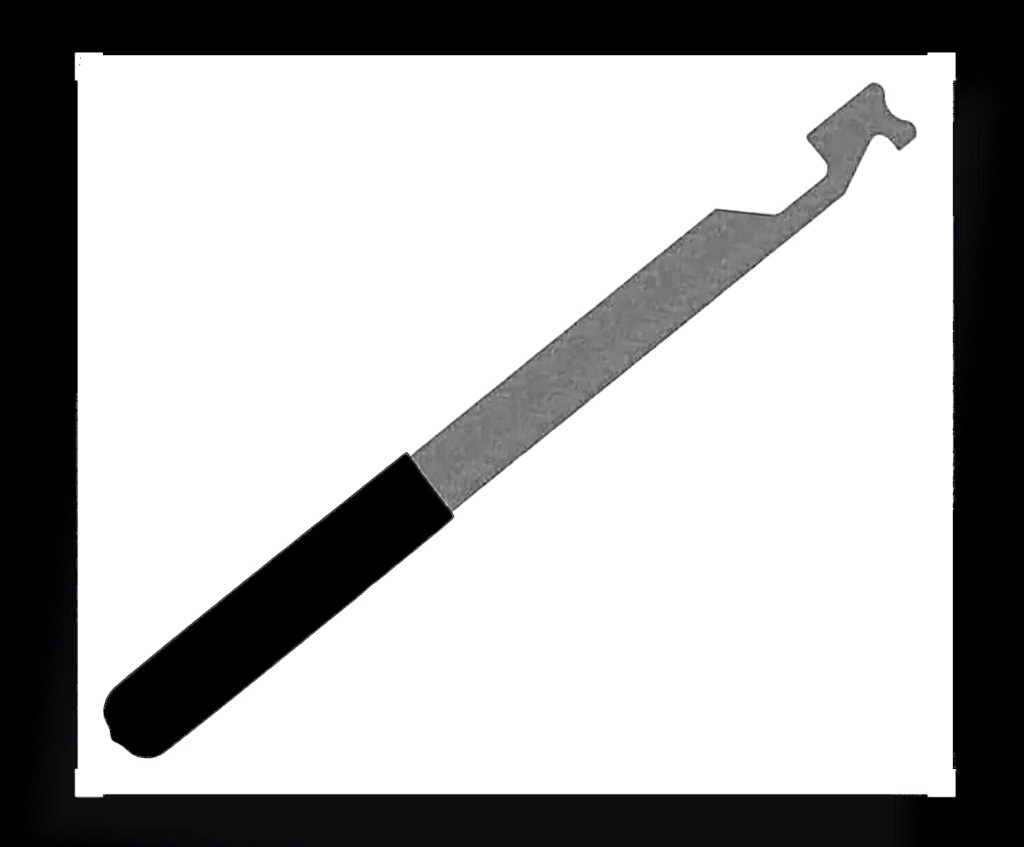
By now, it was late afternoon or early evening, and my keys were still locked in the car. I started thinking about how I was going to get home, when Sergeant Santos came up. “Hey L.T. Let’s get those keys.” – “Sure, how are going to do that?” Ramos just smiled, and then pulled a Slim Jim** out of his jacket. Two minutes later, the door was open, and I had my keys. I thanked him, and decided right then and there, I didn’t need to know why he owned a Slim Jim.
A Slim Jim – Need your car door opened?
With Russia and the Ukraine in the news, I was thinking about that first Lariat Advance. Forty years ago, we were concerned about, and prepping for war with, the USSR. After The Berlin Wall fell in 1989 and the Cold War ended, I thought those days were behind us, at least for Europe. With Mr. Putin’s current aggression, that no longer seems the case. I’ve been thinking about an Intelligence flyer that came out, right after The Wall fell, warning us about the long term goals of the Russians:
“We will Smash them with our clenched fist.”
It is no longer Communism against capitalism, but it is still Russia versus the West. Sometimes the more things change, the more they stay the same. I’m wishing Godspeed and safety to all of our troops.
Addendum:
• Cannibalize – If a vehicle was determined to have a safety issue, or something major wrong with it during operations or an inspection, it was put on the deadline report and the appropriate parts were ordered. You were not allowed to drive deadlined vehicles, until they were repaired. In the event of an alert, you “Cannibalized” one of the vehicles to remove parts to put in the remaining vehicles. It might be something as simple as a brake signal bulb (safety feature), or something more serious like a transmission problem. Cannibalization was frowned upon, as you could literally reduce one of your vehicles to a pile of parts in order to fix other vehicles. That one vehicle would stay on deadline forever. This is why we were to return cannibalized parts to the original vehicle when we returned to the Kaserne.
• **Slim Jim – For those unaware, a Slim Jim is a slender device used to break into a car by fishing down the side of window and into the door for the locking mechanism.
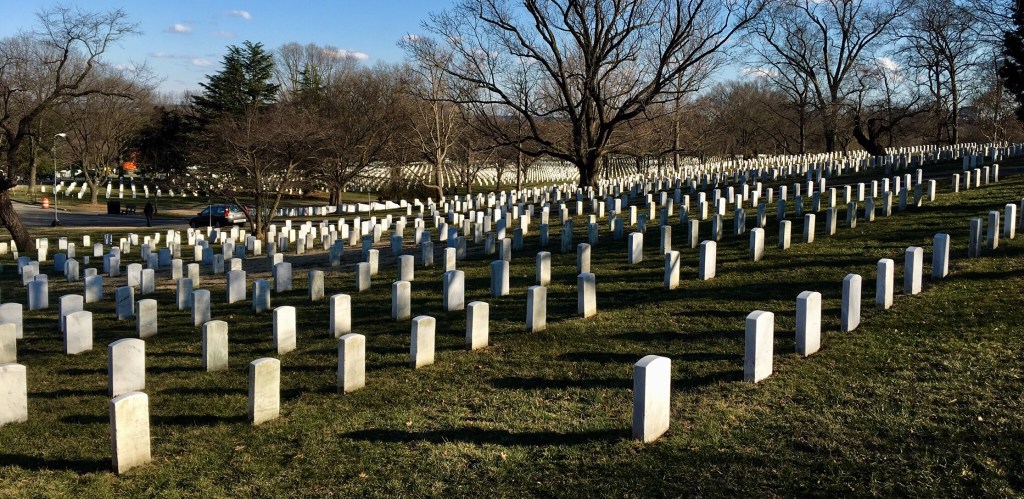
In “Sympathy for the Devil” Mick Jagger famously sang “I shouted out Who killed the Kennedys? When after all it was you and me.” One might ask the very same question about Afghanistan. As we approach the 20th anniversary of 9/11, I can’t help but wonder how much culpability all of us have for these 2,455 soldier’s deaths and 2 Trillion dollars spent.
Arlington Cemetery
Some folks are suddenly concerned about the last 13 who died in Afghanistan, but they don’t seem to have cared about the thousands who died in the previous two decades. Of course the 2,455 soldiers killed doesn’t include the 3,476 contractors who also died there.
Death by Numbers
And, there is of course the money. In the 20 years since September 11, 2001, the United States has spent more than $2 trillion on the war in Afghanistan (all government agencies, not just DoD). That’s $300 million dollars per day, every day, for the last two decades.
Where are we, the American People, in all of this? It’s as if we as a nation have Attention Deficit Hyperactivity Disorder (ADHD) with our very own combination of inattentiveness, impulsivity, and then hyperactivity. Doesn’t that describe how we as a country react to so many things?
Did we previously care about the Afghan women? The translators? Our GIs there? Now, we are magically, gravely concerned. Where were we one year, five years, ten years or twenty years ago? Sadly, we all know the answer to that question.
Our Presidents, Republican and Democrat committed our troops to Afghanistan. Our Congress, Republicans and Democrats alike approved the dollars spent there. It’s pretty easy to engage in a 20 year war with other people’s sons and daughters, and finance it with deficit spending. Just send kids, guns and money… And Now? Now all anyone wants to do is find someone to blame. American hypocrisy knows no limit and has no shame.
It’s not a problem though. With our collective ADHD, our attention will soon flit to some other topic du jour and those twenty years will quickly fade away. We might briefly look at the problems that confront us here and now at home – disease, healthcare, environmental challenges, domestic terrorism, inequality and border issues to name a few. Will we have the moral courage, conviction and concentration to do the hard work and address these and other concerns?
Where is the soul of America these days? Where have our humanity, faith and decency gone? Perhaps we should start with those.
Maybe, on this 20th anniversary of 9/11 we can quietly remember how we felt 20 years ago. We can at least try to reclaim some of our humanity, faith and decency. If we don’t, the rest of the Stone’s lyrics might well prove prophetic for us as a nation.
⁃ Thanks to my friends Tim, Mark, Colleen, Larry and Donna for their thoughts and contributions to this blog. They all added different views and ideas that greatly improved my original efforts.
⁃ It’s a bit difficult to come to a definitive number of US deaths in Afghanistan. Some figures count only those who die in country. Others add in those wounded there, who die elsewhere. Still others also add those who died in other countries in support of operations in Afghanistan. I’ve have found no totals that also include those who have committed suicide back here at home.
Bob Bishop is a friend of mine and shared this story with me from his time aboard a Ballistic Missile Submarine. It’s a compelling story from the Cold War and I hope you will give it a read. The movie, “The Hunt for Red October” is a bit of child’s play, compared to what these guys did on a daily basis. My only contribution here is a bit of editing.
My first real duty station was the USS Nathanael Greene (SSBN-636), Blue Crew*. She had just completed her fourth patrol (two Blue, two Gold) when I reported aboard in April 1966 in Charleston, South Carolina. She was about as seasoned as I was and commissioned the same year I graduated from the Academy. We were in the middle of the Cold War, and Russia was building submarines as fast as we were. Vietnam was still just a little country somewhere over there, on the other side of the Pacific.
Bob, at Graduation from The Naval Academy in 1964
Every day on patrol on a Fleet Ballistic Missile submarine (FBM) is, in many ways, just like the day before or the day after. You have watches to stand, duties to perform, qualifications to train for and, at random times, all-hands drills (such as, “FIRE IN THE TORPEDO ROOM,” or “FLOODING IN THE MISSILE COMPARTMENT”) to wake you if you are off-watch or to interrupt the routine of your duties if you are on watch.
While on patrol, all FBMs, like the Nathanael Greene, must remain in constant radio contact to receive any and all incoming traffic all day, every day. However, a FBM only broke radio silence to send a message in a dire emergency, as sending a message would risk giving away the ship’s position to any nearby enemy ship or aircraft.
Because any change in the volume of message traffic from the sender (i.e., the Pentagon) could have some intelligence value, the radio schedule is purposefully full 24 hours a day.
The most important messages are the operational orders — to change a submarine’s patrol area and thus its missile target package. The Navy filled the remaining time with national news, sports scores and stories, all of it in coded 5-character groups. Every ship received the same radio broadcast, but you only really paid attention to messages sent for your ship. All of the news, sports scores, etc. were printed out and attached to a clipboard in the Radio Shack for anyone to read.
The Navy used the same radio system to conduct simultaneous tests of the combat readiness of all FBMs on patrol through a periodic WSRT (Weapons System Readiness Test). The WSRT begins (and the clock starts counting) with the receipt of a special message which begins, exactly as a real launch message would, with the heading “Top Secret — Cryptographic.” The text that follows, even though still in five-character groupings, is in a code that can only be deciphered through use of a special code book.
When such a message was received, the radioman immediately alerts the Captain (CO) and Executive Officer (XO) a potential Launch message has been received, and the Officer of the Deck instantly sounds “BATTLE STATIONS – MISSILE.” Every member of the crew has an assigned battle station, in addition to their regular job, and moves there at a dead run.
Meanwhile, the Communications Officer hustles to the Radio Shack, as does another officer designated at the start of the patrol by the CO to fulfill the required Two-Man rule. The Communications Officer opens the first safe, and the other officer opens the inner safe where the code book is kept. They extract the code book and break the text into English. They then rush to the Control Room to give the CO the plain-text message. Based on the message, the CO unlocks a cabinet in the overhead just forward of the #1 periscope shear, and pulls out the appropriate firing key – black if it is a drill and red if it is Launch. It’s a little cabinet, maybe 3 inches high by 14 inches wide and 8 inches deep, but within it is the key to launch 16 ICBMs towards their targets thousands of miles away.
WSRTs occurred about every eight to ten days. The time and day chosen were “random.” The experience of the “Old Salts” suggested the frequency was selected by somebody in the Pentagon seemingly based on a roll of the dice – it was never sooner than 2 days after the previous drill, and always within 12 days. It also never occurred on a Sunday morning (i.e., between Saturday midnight and Sunday noon) – to give the crew a break from the chaotic 24/7 pace of shipboard life and to allow an opportunity for anyone who wanted to worship (as a result, Jewish services were also held on Sunday mornings).
The USS Nathanael Greene (SSBN-636) at Sea
Fast forward two years…
The world had become a much more dangerous place. The summer of 1968 was a time of great turmoil, both nationally and internationally. Vietnam was raging. The USSR invaded Czechoslovakia and crushed the Prague uprising. North Korea had captured the USS Pueblo. France was in turmoil – as student protests turned into riots, workers joined them striking across the nation and Charles de Gaulle dissolved the National Assembly. At home, LBJ decided not to run, due to the Vietnam War. Rev. Martin Luther King, Jr., was assassinated in April, resulting in race riots across the country. Whole blocks of cities were ablaze. Bobby Kennedy’s assassination in June added still another dimension to the generally bleak outlook. It was a time of high unemployment in the U.S, strained race relations, unprecedented heat waves, and scattered power outages. The tone and tenor of the news we received in those coded messages was alarming.
You couldn’t help but be affected by thinking about where your loved ones were, how they were, and what was going on around them. I had married a scant 3 months before, between patrols, and Suzan was in DC. The turmoil there was frequently mentioned in the news reports, both as local news and as a setting for reporting on what the Federal government was doing to respond.
I was a Lieutenant now, in charge of the largest Division in the Engineering Department, and on my fifth patrol. I was the only junior officer qualified both to operate the ship and to run the nuclear plant (the only other officers qualified both “forward” and “aft” were the XO and the Engineer). As a result, instead of a typical watch rotation of one in three (six hours on and twelve hours off), I was standing a watch aft as Engineering Officer of Watch, in charge of the nuclear plant et al., then a watch forward as Officer of the Deck, in charge of driving the ship (so my schedule was twelve hours on and six hours off, repeated every 18 hours).
It was late on a Saturday afternoon, and we had just finished a WSRT. My Battle Station was, with Chief Blackmon, to oversee the operation of the Torpedo Fire Control System, which was on the starboard side of the Control Room. Once we launched our sixteen ICBMs, we would immediately leave the launch area and become an attack submarine, to seek out, track and sink any hostile ships. During Battle Stations, my boss, Bill Fernow, the Engineer, was aft, watching over the nuclear plant and other engineering systems.
As we stood down from Battle Stations, there was a palpable tension in the ship because of what seemed to be the deteriorating situation in the U.S. and the world. More than one of us was thinking “Someday this could be real.”
I was dog-tired, but the WSRT had occurred while I was Engineering Officer of the Watch, so after we secured from Battle Stations, I went aft to relieve my boss. He looked at me, and then at his watch, looked up and smiled and said, “I’ll take it from here. You look like you could use some sack time.”
I didn’t argue. I went forward to Officer’s Quarters, and leapt into my rack. Forty minutes later, I was woken for my next watch, the 1800 to 2400 shift.
After a quick bite in the Wardroom, I went up to the Control Room to assume the Conn.
I was relieved at 11:45 p.m. after a thankfully routine watch, sat down in the Wardroom for a quick sandwich, and was asleep within seconds of hitting my rack. Exhaustion does that to you. (When the patrol was over, I found I had logged just a bit over 5 hours of sleep per 24-hour period – for 72 days.)
At 3:42 a.m., the klaxon sounded and the cry “BATTLE STATIONS – MISSILE” came over the 1MC. The advantage of being so tired was that you wore your jumpsuit to bed so you didn’t have to waste precious seconds getting your clothes off, or on. I was at my station at the Fire Control panel in the Control Room within 20 seconds, probably the last 10 seconds of which I became cognizant of the situation we were going into.
The last WSRT was just hours ago and never – never – had there been another WSRT so close to the previous one. And it was early morning on a Sunday.
Battle Stations is always a time of pressure – to do your job as well as possible and to hope your systems performed as designed. This time, however, there was a unique quiet. Everyone knew this was the real thing.
There was no emotion, only a deathly quiet. Given my Battle Station location in the Control Room, I was standing about six feet from the XO, and the CO was about eight feet to my left, standing on the raised platform of the Conn. I could hear each of the stations reporting “Battle Stations manned and ready” to the XO’s sound-powered phone-talker. When the last of the stations had reported in, I watched the XO turn to the CO and report formally “Battle Stations are manned, Captain.”
Although everyone was tightly focused on making sure they did what they were supposed to do exactly right, part of each of our brains was recognizing the inevitability that we would never again see everything we knew and loved. Our families, our country, were surely gone. Our future was the ship, and our sole mission was to launch our missiles, seek the solace of the deep, and then seek revenge.
At that moment, the Communications Officer ran into the Control Room and handed the CO the decoded message. The CO read the message, took the lanyard from his neck, unlocked the firing key cabinet, and reached in for the firing key. We were about to launch… And then, he took out the black key, the WSRT drill key, NOT the red firing key.
Among those of us who could see what had just occurred, there was a moment of disbelief, the sure knowledge that you couldn’t believe your eyes. A double-take, and then the realization it really was a drill after all. The sense of relief was palpable, almost as if everyone, at the same time, slowly exhaled the breath they had been holding since Battle Stations had been called what seemed like hours ago, but was in reality, only a few minutes.
We knew we were at war. And then, suddenly, not. Just as there had been no sobbing or other shows of emotion when we each realized we were at war, there were also no cheers or high-fives to find that we weren’t. Instead, there was only a somber reflection that we were, to a man, trained and ready, but fortunately had not been called upon.
Bob Enjoying Life a Couple of Years Ago
Addendum:
– * Submarines have two separate identical crews, called Blue and Gold, which alternate manning the boat. While one crew is deployed, the other is in port for leave, refresher training, and preparation for their next patrol. This maximizes the amount of time the submarine itself is deployed. At the time, a typical deployment was 72 days – the complete cycle, taking over from the other crew, making needed repairs, installing new equipment, and a short sea trial to test everything out, meant nearly 100 days away from home, twice a year.
– Special thanks to my friend Bob Bishop for sharing this story. Bob graduated from the United States Naval Academy in 1964. At the time, Admiral Hyman G. Rickover, the founder of the modern nuclear Navy, personally interviewed and approved or denied every prospective officer being considered for a nuclear ship. The selection rate was not very high.
“Maknassy” – I can still hear Dad say the word, although he died in 2010. It wasn’t quite a snarl, but it was close. The battle, in March and April of 1943, was vicious. The Germans were slowly getting backed into a corner in Tunisia, and they knew it was either kill or be killed.
General Patton took over II Corps on March 6th, after the debacle at Kaserine Pass. On the 12th of March, Patton detached the 60th Combat Team, Dad’s unit, from the 9th Infantry Division and attached it to the First Armored Division. As a part of his upcoming operation at El Guettar, and the British Army actions under Montgomery to the south, the First was assigned a series of missions aimed at Maknassy Pass. Patton never liked to deploy armor without supporting infantry, and the 60th was given the task. Dad was a 19 year-old Sergeant, with 2 1/2 years in the army.
March 17th was the beginning of what became known in history books as the “Twenty Days of Maknassy”. According to Dad, the rain had poured for days turning the ground and roads into deep mire and mud. The Tanks were ineffective and couldn’t move. It would be up to the Infantry to get the battle started. They were directed to attack a small junction town, Station de Sened “The place everybody fought for, and nobody wanted”.
Dad explained “we started in the grass and mud to the front of the German positions. You couldn’t raise your head without getting shot, plus there were minefields in front of us. After darkness came, we moved”.
Move indeed. The 60th circled the town and climbed the backside of a steep hill, Djebel Goussa, that was to the side of Sened. Djebel Goussa was 600 feet above the valley floor and looked directly down onto Sened. They attacked on the night of the 19th. It was a brutal fight, with individuals, squads and platoons moving slowly up the hill until, by the afternoon of the 20th, they had displaced the Germans. As they now held the high ground, this also forced the enemy to evacuate Station de Sened.
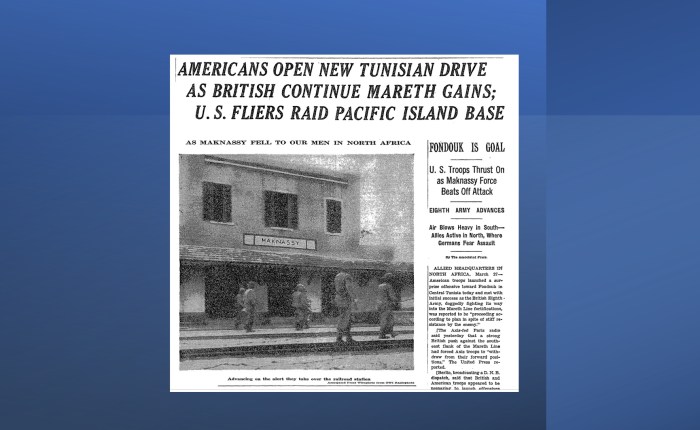
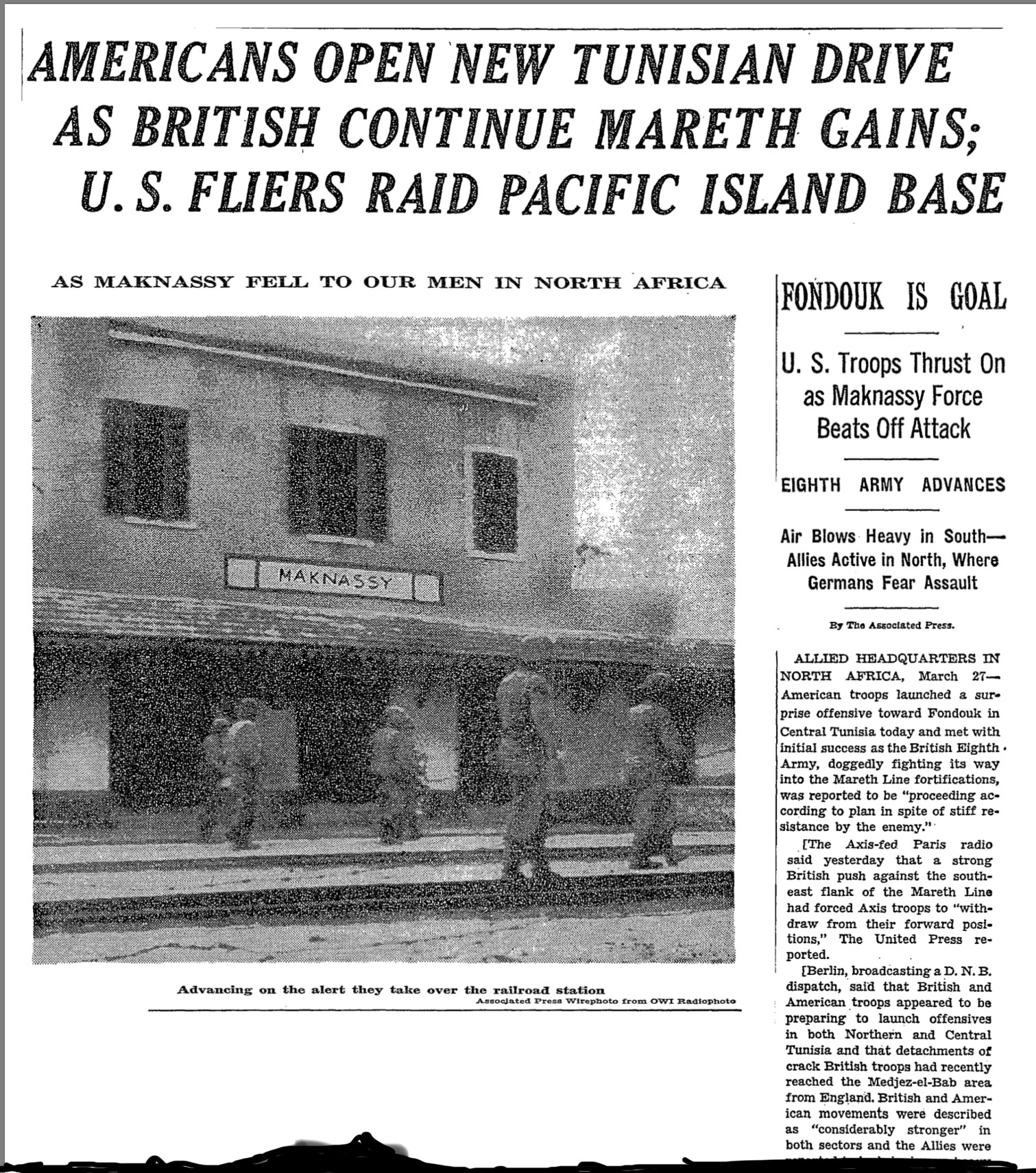
The Germans retaliated with heavy shelling. Undaunted, the 60th moved and attacked again a day later, entering the town of Maknassy itself on the morning of the 22d. The Germans left sometime during the night, and the 60th entered without firing a shot. The New York Times headline back home featured a picture of the unit entering the town near the Railway Station. The easy part was over.
The 60th Combat Team enters Maknassy
They now moved on Maknassy Pass, 5 miles past Maknassy, their ultimate objective. The Germans were dug in on hills in the pass, including Hill 322, which was guarded by Rommel’s personal Guard. The tanks couldn’t go through the pass with the Germans controlling the heights, so naturally, the task again fell to the Infantry.
The 60th attacked a series of hills on the nights of the 22d and 23d with mixed success. As dad explained “we always attacked at night, but the Germans were well dug in. And they had mines on many of the approaches. The Germans used mines everywhere. The going was very slow.” They did take several of the hills, particularly on the north side of the pass, but the Germans still controlled the south side. Hill 322 was attacked many times but never taken. The advance bogged down, but the US Forces acted forcefully enough to cause the Germans to deploy reserve units, keeping them from engaging with Montgomery and the British, further to the south. Dad said that from where they were, they could actually see the open land on the other side of the pass, even though the Germans still controlled the south side of the pass. That open ground was what the tanks needed.
The history books tell us that the battle fell into a stalemate, with the Germans occupying some of the hills, and the US the others for the next several days. On 31 March, the commander of the 1st Armored Division ordered the 60th into another attack. According to one source, “Most of the unit (the 60th), had defended their limited gains east and north of Maknassy against unremitting pressure from the Germans, for the last four days. They had little relief or rest, and many casualties, and their performance during the attack reflected their poor condition.” The attack failed.
Dad talked with me about those days as well. They were dug in on the side of mountains with deep foxholes. Deep because of the continual shelling from German artillery. You didn’t show yourself during the daytime because of snipers. The same went for the Germans, and they also generally stayed undercover. One day Dad was looking across the valley with binoculars and saw a German outside his foxhole improving his positions. Dad said “You son of a bitch…” and took aim and fired. The bullet hit a rock about 6 inches behind the German, and he jumped back in his foxhole. One of Dad’s buddies in a neighboring foxhole called out “You missed him, Bill….”
On the 2nd and 3rd of April, the 60th received over 240 replacements for the men who had been killed or wounded. This translates to roughly a 25-30% casualty rate over the preceding 2 weeks. The new recruits arrived none too soon, as the Germans mounted a massive attack on the night of the 4th. The attack lasted all night, but the 60th held and the Germans retreated in the early dawn hours.
On April 7th, although the men of the 60th didn’t know it yet, the enemy had withdrawn. It was quiet all day and then something happened. Dad and his foxhole mate, Boggs, saw something just outside the valley. It was a vehicle approaching from the south. Suddenly, the vehicle stopped. As dad watched through binoculars, two guys got out of the vehicle and…..started making tea. It was a British scout vehicle. The Brits, along with the rest of the US forces attacking at El Guettar had broken through and were driving north. Dad and Boggs came down from the hills and approached the Brits. They spoke together for a while and traded some cigarettes for biscuits. The Brits then packed up their kit, and headed north. It’s not recorded in any history book, but I believe that was the first link up between Montgomery’s Eighth Army coming from the south, and the US 1st Armored Division driving East from Maknassy. The Twenty Days of Maknassy were over.
I love it when small history is a part of big history. Dad told these stories of Maknassy, with the mud, the minefields, and the night attacks in piecemeal fashion. The stories of the “missed shot” and the Brits having tea were always shared with a laugh. I remember listening to Dad as a kid. He never told stories of either the heroics, or the butchery, of war. It was always more about the humor of the situation, or some particular hardship they went through. It was only later when I read the details of some of the battles, that I was able to overlay dad’s stories onto the actual events of the battle. Greatest Generation indeed.
Addendum:
1. If you ever watched the movie, “Patton”, the tank battle shown in Africa is at El Guettar, of which the actions at Maknassy were a part of. The movie projects it as a single day battle, but the actual events took place over nearly three weeks, and was in support of Montgomery’s attack coming from the south.
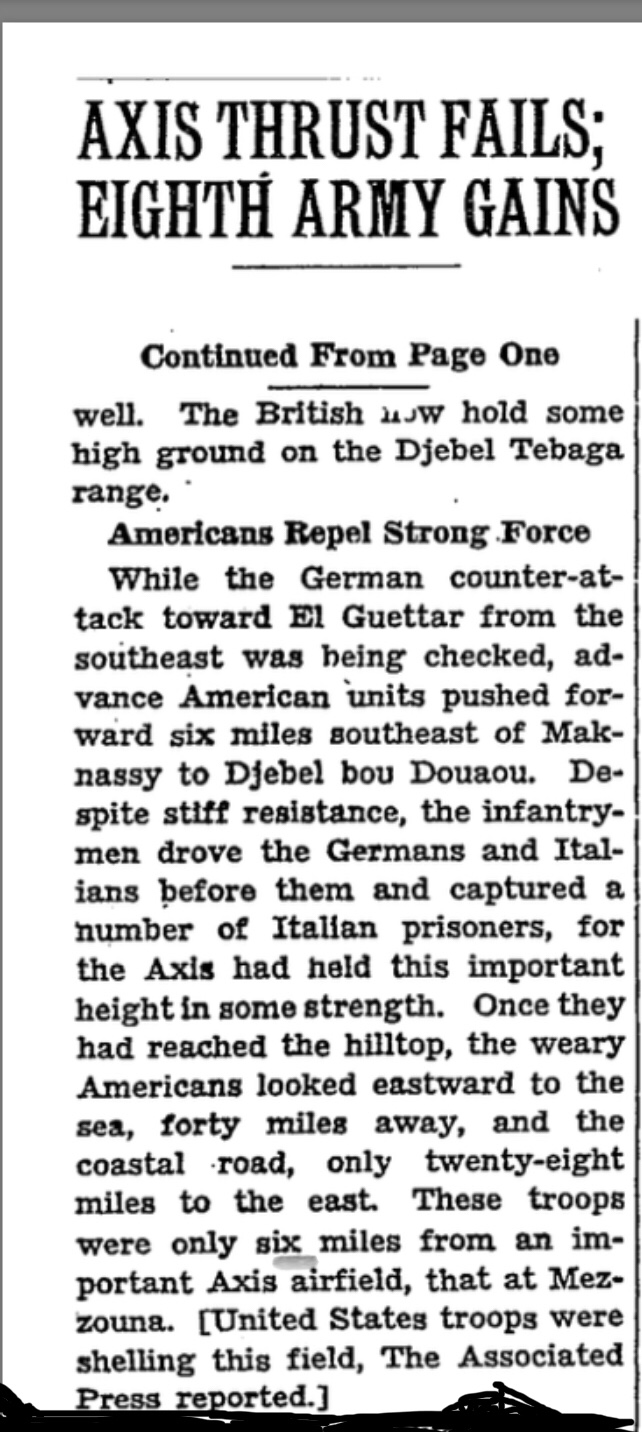
2. In addition to my conversations with Dad, I was able to piece together many of the larger details of the battle from three other sources: The New York Times (editions from March and April of 1943); the book “Eight Stars to Victory, a History of the Veterans Ninth U.S. Infantry Division” (published in 1948); and this site on line: https://www.ibiblio.org/hyperwar/USA/USA-MTO-NWA/USA-MTO-NWA-28.html – “Northwest Africa, Seizing the Initiative in the West”, by George F Howe.
3. Over the past couple of years, I’ve written several blogs about Dad’s time in the Army. They were never posted in any particular order. If you are interested in reading more about dad’s life during WWII, you can get some glimpses in the following blogs, listed here in chronological order:
Not everyone can get kicked out of a walled city twice in one night, but dad found a way….
In February of ’43, after relieving the 1st Infantry Division at Kasserine Pass, the 9th Infantry Division spent the next several months in combat across Tunisia. I remember dad telling some stories of those times and the names don’t role across the tongue lightly – Maknassy, Jefna, the Sedjenane Valley, Mateur, Bizerte…. Forgotten names in history books now, but deadly important then. I think the great WWII columnist Ernie Pyle got it right in his description of the Infantry in North Africa:
“IN THE FRONT LINES BEFORE MATEUR, MAY 2, 1943…..
There is now a thin line of men. For four days and nights they have fought hard, eaten little, washed none, and slept hardly at all. Their nights have been violent with attack, fright, butchery, and their days sleepless and miserable with the crash of artillery…..The men are walking. Their walk is slow, for they are dead weary, as you can tell even when looking at them from behind. They are young men, but the grime and whiskers and exhaustion make them look middle-aged…..There is an agony in your heart and you almost feel ashamed to look at them. They are just guys from Broadway and Main Street, but you wouldn’t remember them. They are too far away now. They are too tired. Their world can never be known to you, but if you could see them just once, just for an instant, you would know that no matter how hard people work back home they are not keeping pace with these infantrymen in Tunisia.”
They kept at it and on May 9th, the enemy surrendered In Africa. By then, they had fought and beaten the French, Italians, and Germans and were feeling pretty good about themselves.
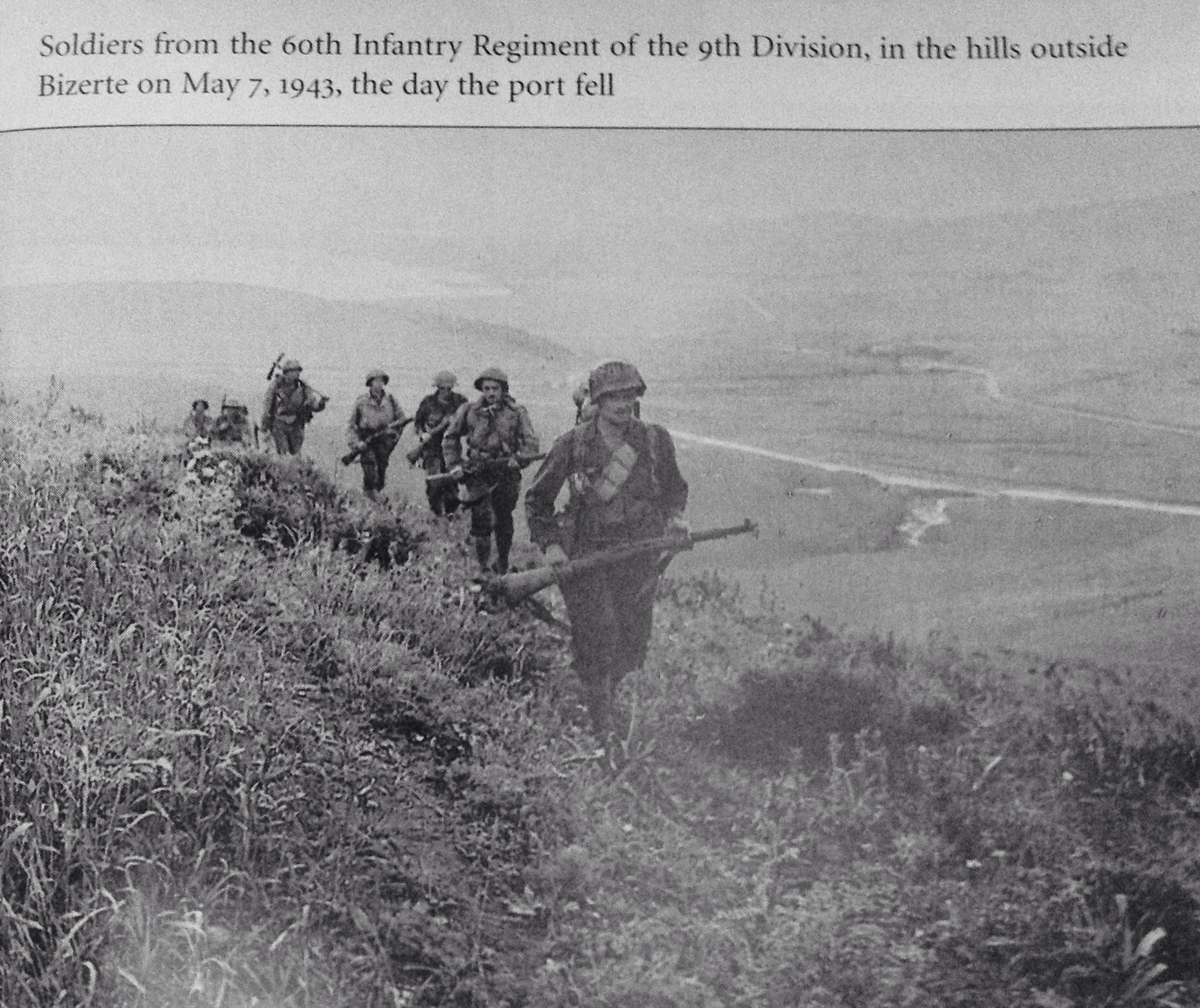
Dad’s unit, on the date Bizerte fell (from “An Army at Dawn”, by Atkinson)
At the end of May, the division was in bivouac and had almost seven weeks of light duty and downtime. The nearest town was a walled city, Sidi bel Abbes, about 30 miles away. The Army, in it’s generosity and wisdom, was giving day passes on a quota system. They’d truck the GIs there during the day, and bring them back to the encampment at nightfall.
Over the course of June, Dad made it there multiple times and drank wine, ate French food, and visited a couple of houses of ill repute. Not a bad way to spend time in your 19th year of life.
In any case, he eventually returned one time to often to Sidi bel Abbes. Towards the end of June, dad and a buddy got a pass and caught the truck ride to town, where they spent the day partying, drinking, and committing other questionable acts. They missed the truck back to the camp and kept partying until they were caught by the MPs who were patrolling the town. The MPs actually cut them a break and didn’t arrest them. They just kicked them out of the walled city, meaning they would have to walk the 30 miles back to camp. They knew they were already in trouble at this point, so they said the hell with it and climbed the wall and went back into the city.
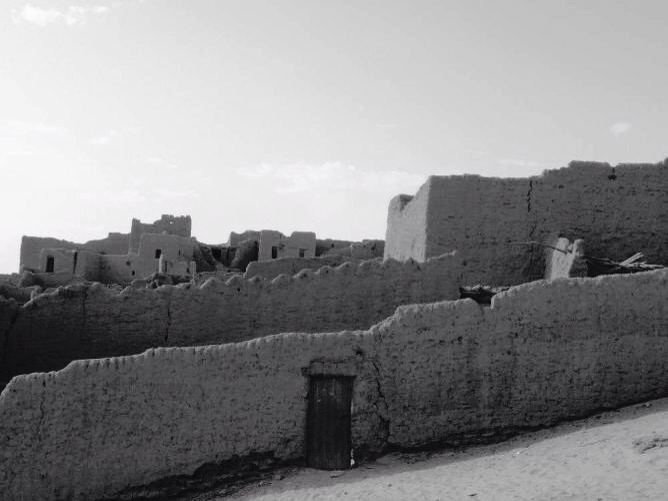
Part of the wall around Sidi bel Abbes
More partying ensued and they were trying to find a particular address they had been given. The MPs saw them again and gave chase. With the wine they had consumed, they were in no real shape to get away, and were caught a second time. This time, rather than just depositing them outside the gate to the town, the MPs drove them back to the encampment, and turned them over to the company First Sergeant.
The next day, dad reported in to the CO. “Sir! Sergeant Hall reporting as ordered”.
The CO looked up from his desk, then looked back down. “That will be all Private Hall”.
And so, dad, who entered North Africa as a Sergeant, departed as a Private. In his words, “Hell, what were they going to do to you for acting up? Short of murder, Or armed robbery, no one went to the stockade, especially if you were an Infantryman. Combat veterans at that point were of incredibly high value, so maybe you got busted, but you stayed with your unit.”
Dad left Africa on July 24th, on a ship bound for Sicily. They landed at Polermo on August 1, while being bombed by the Germans. He didn’t know it yet, but his time with the 9th Infantry Division would be over on August 8th when he was severely wounded. In fact, his buddies thought he was probably going to die. He survived, and was in the Army for two more years, but never did rejoin the 9th…