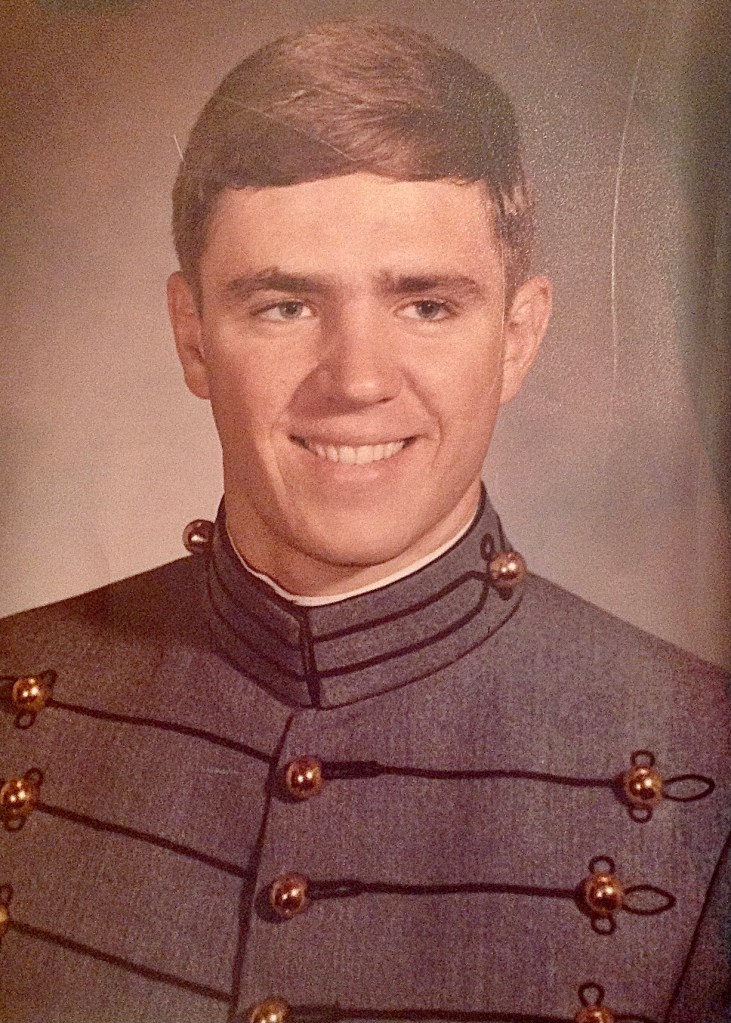
I was in Warrenton between stops at the dry cleaners and the UPS store when Iron Butterfly’s “In-A-Gadda-Da-Vida” came on the radio. Talk about flashbacks. I don’t think I’d heard it in decades. When I came out of the UPS store several minutes later, it was still playing and my mind drifted back to Plebe year at West Point.
As Plebes (Freshmen), we weren’t allowed to have stereo equipment in our rooms during the first semester. I suppose some sort of depravation challenge for us. Second semester, the restriction was lifted, and many of us went to the Cadet Store to dutifully buy audio equipment of varying quality.
Me, as a Plebe at West Point
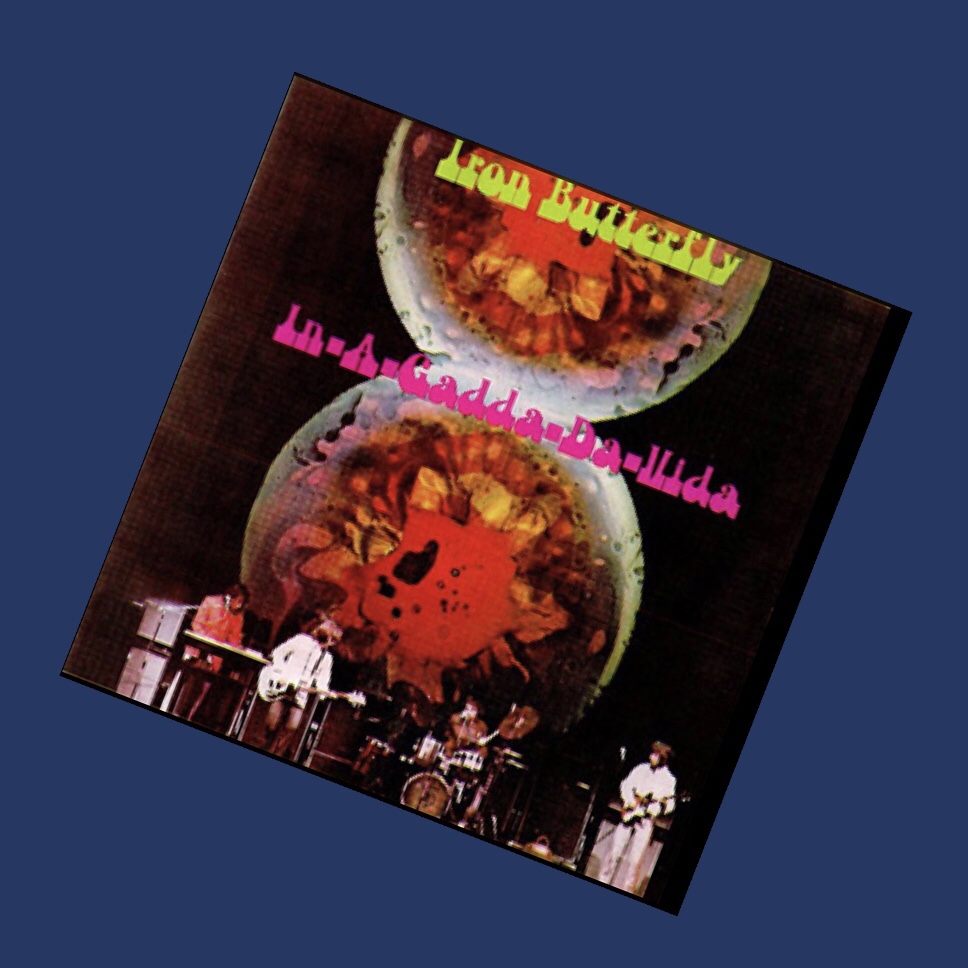
Of course I started buying albums of various types as well. Sometime in the middle of the semester, a friend dropped by and said something like “Have you listened to Iron Butterfly’s In-A-Gadda-Da-Vida?” Now the album was actually released in 1968. Not only had I never heard it, I’d never heard of it. I looked at the album and said “Hey, there’s only one song on this side.” My friend looked at me like I was stupid, and put the album on the turntable.
Full On 1968…
I was blown away. Seventeen minutes for one song. It went on and on and on. The lyrics were simple and repeated. And then somewhere in the middle is that incredible drum solo. I was hooked and bought a copy. For the next month, I hardly played anything else.
The Lyrics were … Simple … and Repeated Over and Over
Eventually, my infatuation faded a bit and it moved into a normal musical rotation. By Firstie (Senior) year, it moved to the back of the albums and was rarely played.
….
Back in my car, the drum solo was pounding and I cranked the volume. I was lost somewhere between nostalgia and thinking to myself “Hmmm, this is still pretty good.”
The drum solo eventually finished, and so too did the song about half way home. When I arrived at our house, I looked through my old albums for Iron Butterfly. It wasn’t there. Somewhere along the way, it evidently didn’t make the cut for our next move. Or maybe someone borrowed it and it never came home.
I know in today’s world, I can call it up online and listen to it anytime I want, and now that I’ve remembered it, maybe I will. Or I could pay Apple and downline the single. I don’t know that I’ll do either, but yesterday was a pretty cool drive home and I enjoyed the trip back in time.
Addendum:
⁃ In-A-Gadda-Da-Vida actually started as “In the Garden of Eden” and a reference to Adam and Eve. When one of the band members first wrote down the words from a band mate’s recording that was slurred (due to alcohol consumption), In a gadda da vida is what he heard, and what was written down. The rest is rock history.
Here are two YouTube videos of the song. First one contains a video of the band (very blurry and very ‘60s). Second one is just the album cover, but I think the audio is better.
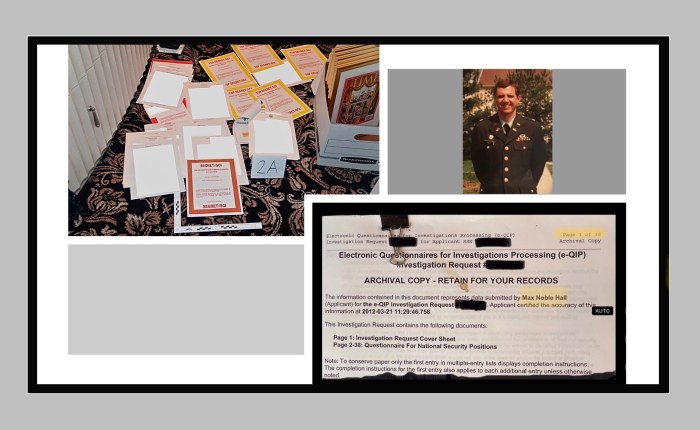
I have held various security clearances for decades in the past. I spent years working in a Special Compartmented Information Facility (SCIF), both in the military, and as a civilian. I’m not here to judge, but I’d probably be in jail if I’d done what our former President did.
One of the things we learned about classified information early on is that in order to access classified documents, or programs, there are actually two requirements. First, you need the security clearance level required for that information. Second, you must have a “need to know” the information. That is, holding a TOP SECRET* (TS) clearance isn’t a sufficient reason to see a TS document. You also must have a specific need to see the particular information.
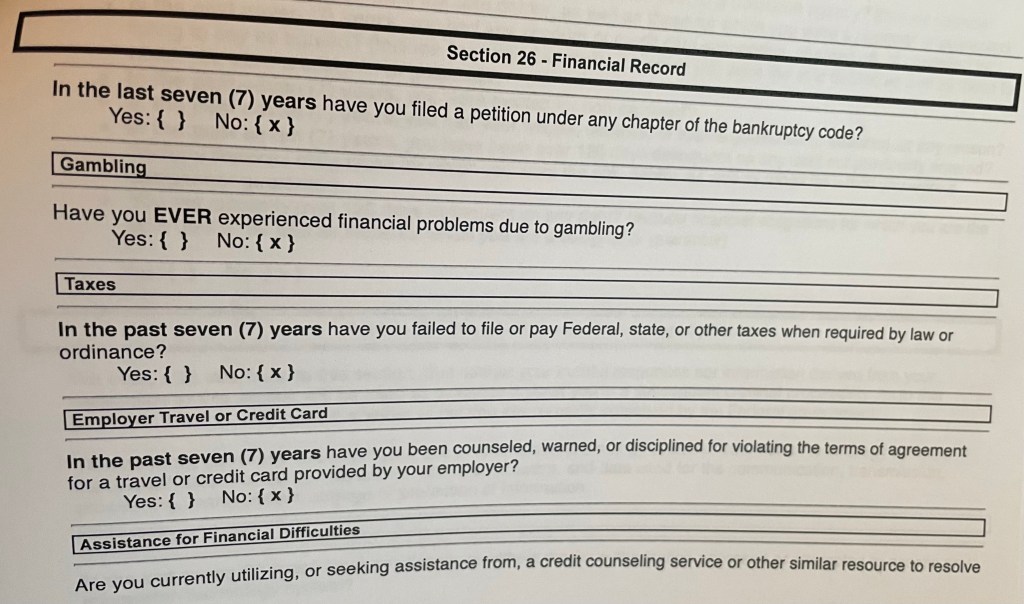
I obtained my first clearance, SECRET, while still at West Point in the seventies. They don’t just give you a SECRET clearance, or any clearance for that matter. You fill out a form answering several pages of questions, they do a background check, interview family and friends and determine whether you are “trustworthy”. The process takes a while. For most folk, unless you have done hard drugs, committed a crime, declared bankruptcy, or declared hostility to the United States, it isn’t too hard to receive a SECRET clearance.
Bankruptcy is One of the Reasons you Can be denied a Clearance.
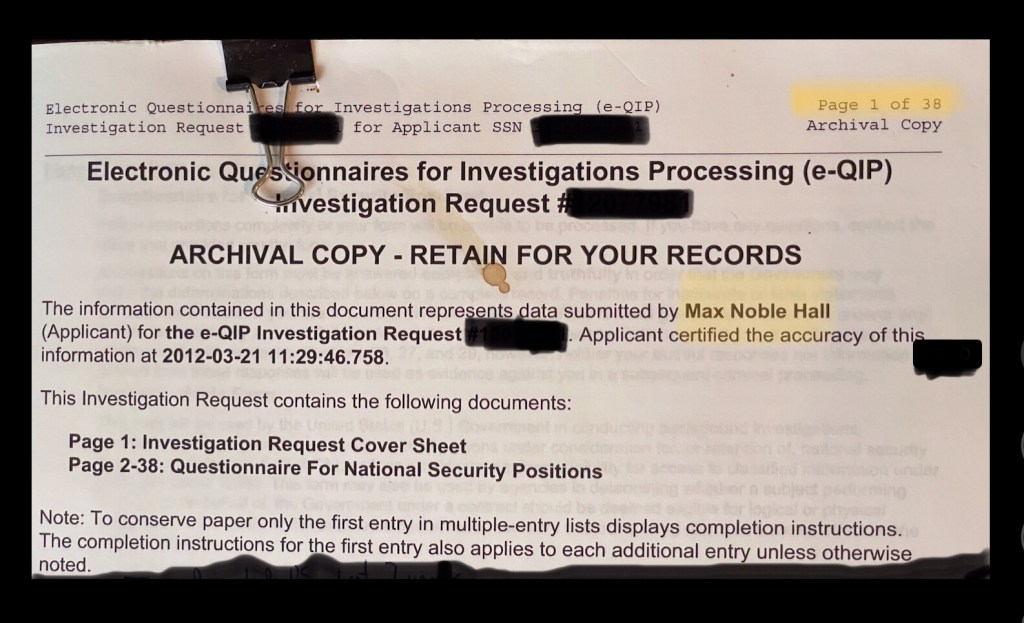
In 1989, we returned from an assignment in Germany to the States and I transferred to a job in the DC area. For that work, I underwent a Special Background Investigation (SBI) in order to receive a TS/SCI/SI/TK (TOP SECRET, Special Compartmented Information, Special Intelligence, Talent Keyhole, clearance). These are a wee bit harder to obtain. Actually, a lot harder. It took months and months for the investigations to take place and for the government to grant my clearance (today, it’s not unusual for the process to take nearly a year). I provided information on where I’d lived over the course of my life, background about my jobs and employers, info on family members and friends, and several references. I documented all overseas travel. I documented any communications I had with East Bloc or communist personnel. In addition to verifying the information I provided, and talking with my references, the government also interviewed neighbors, former bosses, coworkers and family members. They physically went to my prior homes, talked with neighbors and asked about my habits. It’s an intensive and invasive process. When I finally received my clearance, I was also eventually “read in” to a couple of highly classified Special Access Programs (SAPs) further restricting who could access the information.
My TS Renewal in 2012 – All 38 Pages of It.
Everything we did in support of those SAPs was done in a SCIF. To access the SCIF, in addition to the combination lock, there was a retina reader at the outside door, and it was only after your eye was scanned that the door would unlock. Our particular SCIF also required two person access. That is, a person was not allowed in the facility by him or herself. There was a requirement for at least two people to occupy the SCIF, whenever it was opened. This was to prevent someone taking unauthorized information or files out of the SCIF.
The SCIF had intrusion detection systems, and needed to meet a host of other requirements effecting communication systems, the size of duct work and special wiring and HVAC requirements. Cell phones, or any other personal electronic devices weren’t allowed in the SCIF. Inside the facility, all of our classified information was stored in safes which met certain requirements. When you opened the safe, you initialed a form that you opened the safe, and what day and time it was. At the end of the day, when you returned the classified documents to the safe, after locking the safe, you again initialed the form, provided the time you locked it, and the date and time were then verified by a second person.
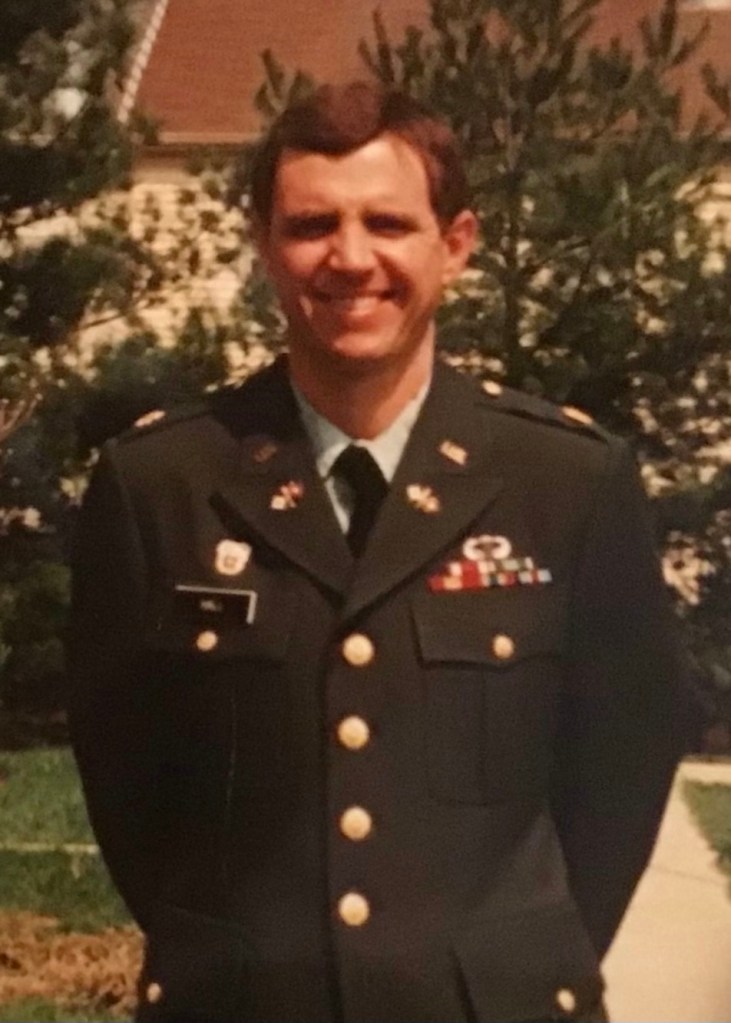
This is me, During the Time I was Working in my First SCIF
If you ever transported classified information outside the SCIF to another location, you needed a special permit. The classified info was double wrapped. You followed a schedule in delivering the information, including the expected arrival time. If there were schedule variances, you notified the authorities.
When I left those SAPs several years later, I was sworn to secrecy, and signed papers indicating I wouldn’t reveal anything about those programs for seventy years.
Honestly, it was all a pain in the ass. BUT, we all understood why it was required, and so we complied without complaining. We understood the security of the nation could be put at risk if there were security compromises, whether intentional or not.
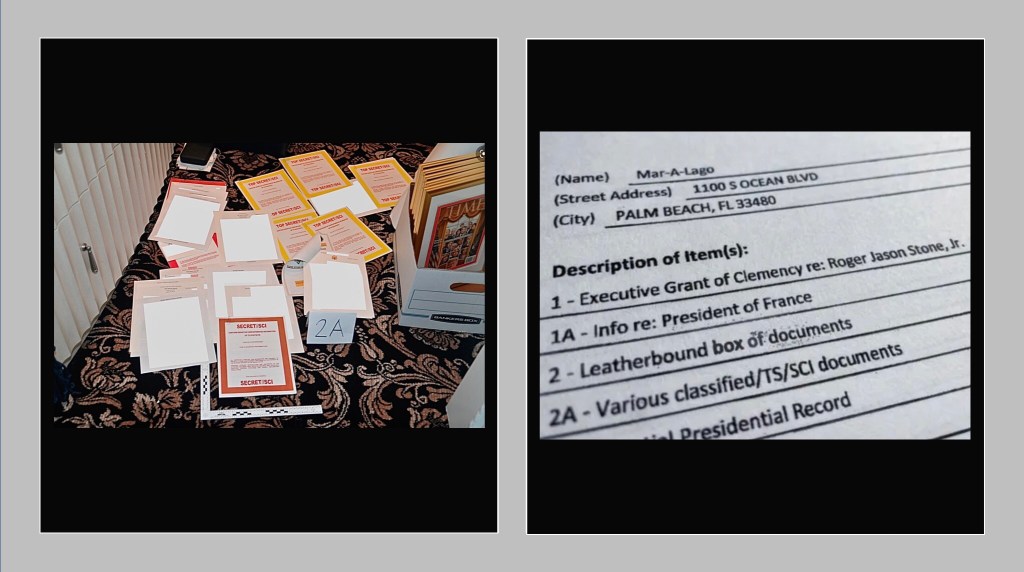
I don’t know what is in the material the former President took to Florida. I also don’t know what he intended to do with it. I doubt we ever will. Based on the covers and documents shown in the now world famous photo, there was TS/SCI material, SECRET/SCI material and other classified information. There were empty SCI folders, with the info, perhaps, stored elsewhere. None of this was stored in a SCIF. As the President was now the former President, there was no longer a “need to know”. The information should not have been at Mar-a-Lago.
Just. Totally. Unbelievable.
Was this a politically motivated search? I don’t know, but given the material found, it’s a moot point. The search was justified. What he did was wrong. Are there always two standards for everything – one for the former President, and one for everyone else? Why do citizens continue to listen to his claptrap**?
Here are some things I do know:
The government held constant dialogs with the former President, his staff, and his lawyers about returning the missing information for over a year, as required by the the Presidential Records Act (enacted after the criminal Nixon tried to destroy documents in 1974).
The former President’s lawyers apparently lied when they swore in June there was no more classified information stored in Florida.
In 2005, former National Security Advisor, Sandy Berger, was convicted of removing, and then destroying five classified documents from the National Archives. He received a $50,000 fine, two years of probation and 100 hours of community service.
In 2015, General Petraeus was convicted for mishandling classified information with his lover. He received a $100,000 fine and two years of probation.
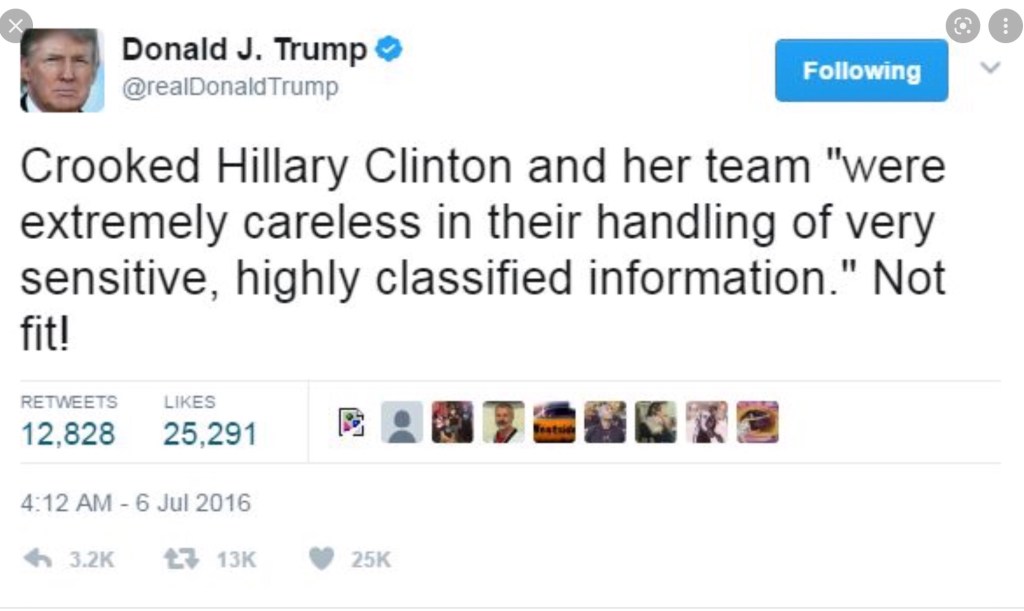
When Hilary Clinton was investigated for her server, people were calling for her prosecution and spoke of how she was unfit for office. Many of those same people are now saying what the former President has done is no big deal, and he can do what he wants.
With the former President, there are Always Two Sets of Standards. Always.
The final thing I know is that If I had done anything remotely close to this, I would have been dishonorably discharged if in the military, fired if a civilian, received a huge fine, and very possibly gone to jail. My public life would have been over.
Of course, unlike some people, I couldn’t shoot someone in the middle of 5th Avenue and get away with it either.
Addendum:
One of the reasons I published this blog is I became aware that many people have no idea what is required to get a clearance, or what is required for the correct handling of classified information. I thought it might be useful for folk to actually understand why this is a big deal, if you work with classified documents. Feel free to share the blog with others.
*TOP SECRET material is defines as something “that would cause exceptionally great damage to US national security and US persons should it reach the eyes of a foreign adversary.”
**Claptrap – noun – absurd or nonsensical talk or ideas.
The Presidential Records Act was enacted in 1978 after President Nixon sought to destroy records relating to his presidential tenure upon his resignation in 1974. The law superseded the policy in effect during Nixon’s tenure that a president’s records were considered private property, making clear that presidential records are owned by the public.
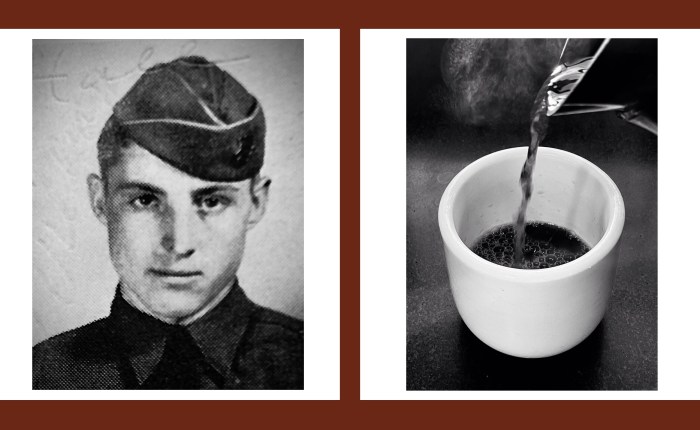
Sometimes, it’s the little things we remember. With a small assist from Burt Lancaster, I once surprised Dad with a present of WWII mess hall coffee mugs he’d been trying to find in antique shops for years. The gift brought joy to both of us at the time, and continues giving me comfort to this day.
Dad always liked his coffee. From the time we were kids, I remember the role it played in his life. On early weekday mornings, he packed the big thermos with him as he left for work on the railroad. On weekends, there was a pot available all day long on Saturdays, and half the day on Sunday. On Saturday mornings, various uncles or aunts stopped by. They all sat around the kitchen table drinking endless cups of coffee, while telling, or retelling, the stories of their youth, and the war years. We kids often listened in, laughing at the stories we came to know by heart.
I started understanding a bit more about his love for coffee when I was applying to West Point. On a couple of occasions, dad drove me to Fort Sheridan (an Army Post in Illinois that no longer exists) for a physical and a fitness test. As we were walking on the Post, he surprised me by becoming a bit nostalgic for the “good old days” in the Army, and talked about how good the coffee was. I think he may have even joked with one of the folk we interfaced with about reenlisting, if he could have a cup of coffee from the Mess Hall. It’s strange, the things you remember, but I distinctly recall the conversations about Army coffee on those trips. It was about 27 years after World War II and he was 48 at the time.
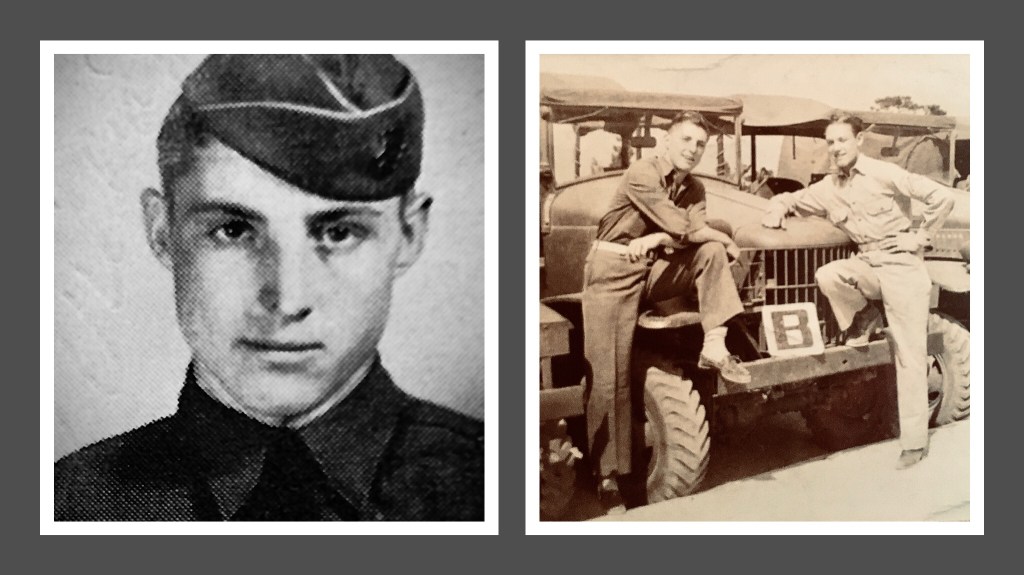
Dad in the “Good Old Days” in 1941, Sometime Before Pearl Harbor
I eventually graduated from West Point and Cath and I were deployed to Germany for most of the ‘80s. We didn’t see Mom and Dad much during our time overseas.
In ‘85, Dad retired from the railroad, and he and mom started traveling more, particularly to jazz concerts around the country. They also managed to visit us in Germany in ‘88. While there, dad talked about their travels. In a side conversation, he mentioned they also typically visited “antique” stores during their trips. He was looking for mess hall coffee mugs from WWII, but hadn’t found any. I was intrigued. What the hell do WWII mess hall coffee mugs look like, and why did he want them?
In Dad’s words, they were thick, heavy white mugs with no handle. You could put both hands around the mug when you took your first sip in the morning, and the mug warmed your hands. He’d used them throughout his time in the Army during the war. I mean, he was waxing poetic about these mugs. I still didn’t quite know what they looked like, but that was OK. During their visit, we stopped in a couple of shops with older items, and Dad would poke around. His thinking was maybe during the occupation of Germany after the war, some mugs made it into the local economy. The looking was to no avail, and no mugs were found.
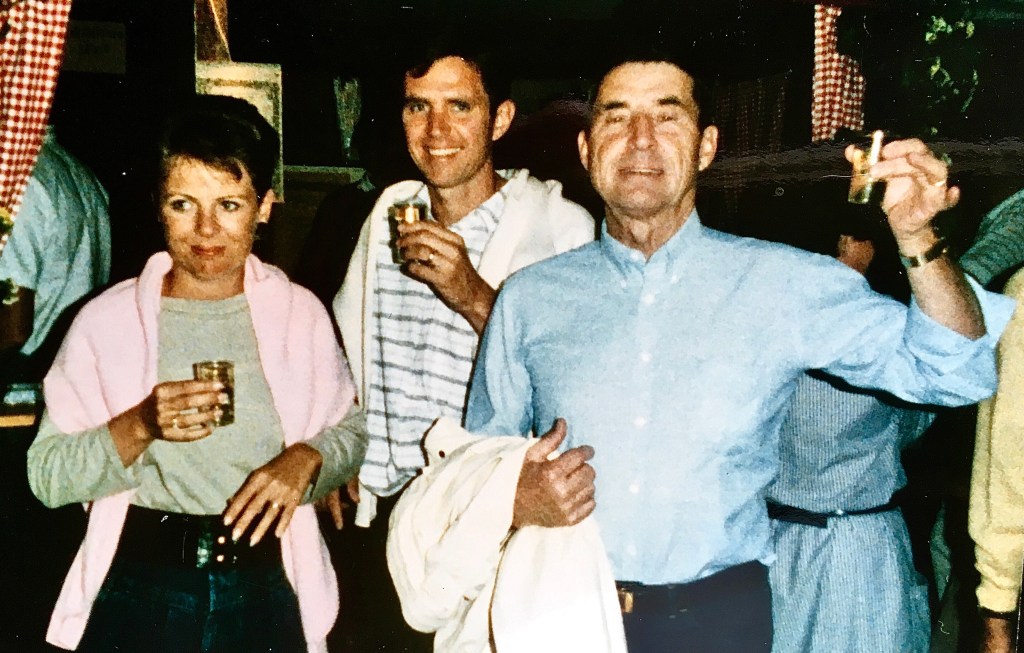
Dad, Cathy and I at a Winefest on the ‘88 Trip to Germany.
We eventually returned to the States in ‘89, and on a visit at Mom and Dad’s over Christmas, Dad and I were watching TV. The classic WWII movie, From Here to Eternity, was on. You know the movie… Burt Lancaster, Montgomery Clift, Frank Sinatra, Donna Reed, Debora Kerr and Ernest Borgnine. It has the great scene with Lancaster and Kerr kissing on the beach as the waves crash over them.
As we were watching, Dad suddenly shouted out “There’s the coffee mug! Look in Burt’s hand!” What!? I look up, and I’ll be damned. Just as the Japanese are about to attack Pearl Harbor, there’s Burt with a white, thick, handleless coffee mug… which he immediately throws on the ground to go out and confront the attacking Japanese.
Everyone Knows the Scene of Burt and Deborah Kerr on the Beach, but Dad and I Were More Interested in Burt and the Coffee Mug.
I’d completely forgotten about the mugs until Dad’s outburst. Of course I immediately asked him how the hunt was going. He’d visited a lot of shops, but never seen any, or really even met anyone who knew what he was looking for.
At the time, I was involved in a couple of classified Black programs for the military and traveling a fair amount. Cathy couldn’t know where I was going, only the approximate day of my return. On the trips, we could only use cash, and no credit cards were allowed. We often had some spare time, and now that I knew how the mugs looked, I too started poking around in the occasional store.
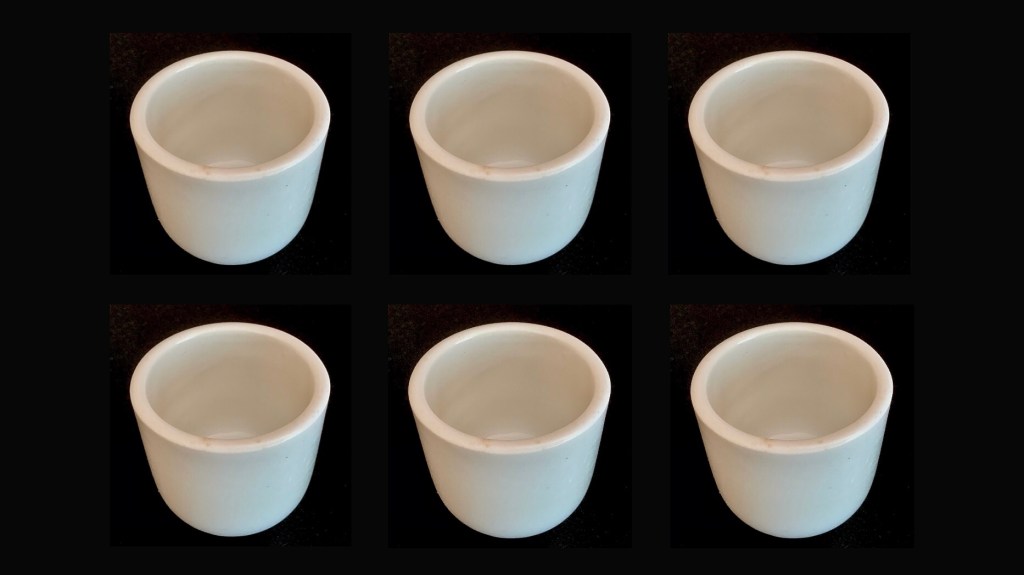
A couple of years went by, and I wasn’t having much luck either. That changed in the spring of ‘93. I was looking around a junk shop in the middle of no where, and there they were – Six of them! Holy hell. Were these really them? I asked the owner what he knew about them, which wasn’t much, only that they were old coffee mugs. It was enough for me. I counted out some cash, bought all six mugs, and returned home with them a week later.
Six Handleless Coffee Mugs, Bought with Cash at an Unnamed Location
Cathy and I thought about giving them to Dad for a Christmas or Birthday present, however those were still a while away. Mom and Dad were coming for a visit in July, and we decided we would give them to him then, with a twist. Rather than just hand them over, we would not say anything, serve soup in them, and see if Dad noticed.
They finally made it to Virginia and the big night arrived. It was a beautiful evening, and we ate dinner in the backyard on the picnic table. Cathy made Gazpacho for a first course, and we served it in the mugs. As she and I brought the soup out, we set a mug in front of each of us.
I could hardly contain myself, I was so excited. We started eating and both Mom and Dad complemented Cath on the soup. There was no word from Dad on the mugs. Were these not the right ones? We continued eating, and all of a sudden Dad paused, and started looking at his mug. He looked more intently, and then, “Say! I … I … I think these are the mess hall coffee mugs!”, at which point I burst out laughing.
Dad verified these were INDEED the mugs. By then, we were all laughing, and I told him the story of how I found them.
We used those mugs for coffee in the morning for the rest of their visit. Dad would use both hands, and bring it up to his mouth and nose to inhale the smell of the fresh brewed coffee, probably the same way he did back in 1940-‘45. When they left, I sent four of the mugs home with them, and kept two for us.
Nostalgia and Coffee. What’s Not to Like?
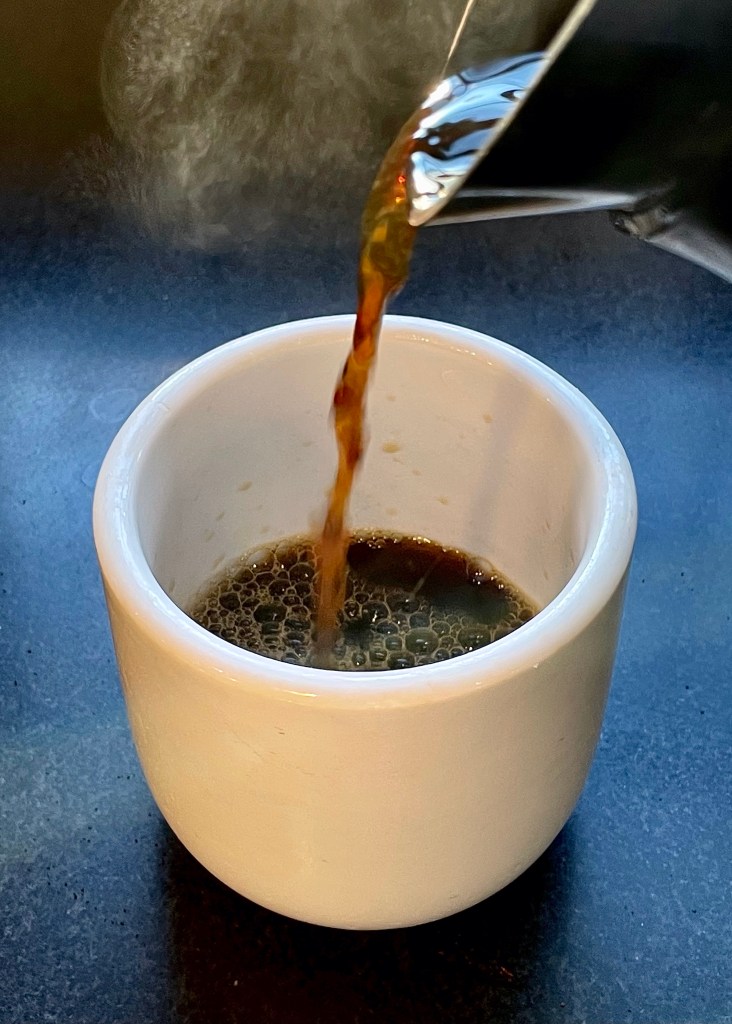
Eventually, Dad passed away in 2010. At some point in time, mom gave the four mugs back to us. Occasionally, I use one of them for my own Cuppa Joe in the morning. I feel the warmth of the mug in my hands, inhale the smell of the fresh brewed coffee, and think back to Dad – It’s a wonderful way to start the day.
Addendum:
If you want to see the scene of Burt Lancaster with the coffee mug as the Japanese are attacking Pearl Harbor, you can view it here: https://youtu.be/2UxTGH7cR5Y
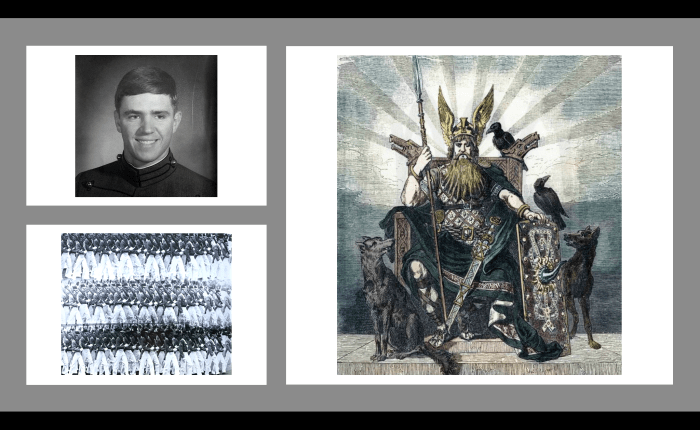
Odin is not only the god called upon in preparation for war, he is the god of poetry, the dead and magic as well. In a little known side gig, he was also petitioned by cadets at West Point to cancel parades with thunderstorms.
One fall day Plebe Year, my company, B-3, along with our entire regiment, was standing in formation in Central Area waiting for the start of yet another weekday afternoon parade. Central Area is out of view of the general public and where we lined up in preparation for parades. While the upperclassmen were more relaxed, we plebes stood there in full dress uniform, our tar buckets on our heads, and our M14 rifles extended at parade rest. The sky was dark with clouds and foretold the possible arrival of an impending storm. Somewhere in the distance, I heard a plaintive chant starting up, but I couldn’t make out what they were saying. Suddenly, it grew louder, closer and more distinct –
OOOOOOOO-DIIIN… OOOOOOOO-DIIIN… OOOOOOOO-DIIIN…
One of our upperclassmen called out – “Beanheads! Take up the chant!!” (Beanhead was one of the less flattering terms the upperclassmen would call us Plebes)
What?!
“Beanheads!! Take up the call to ODIN. Let’s see if we can get this parade canceled!”
The thirty or so of us Plebes in B-3 quickly joined the cacophony.
OOOOOOOO-DIIIN… OOOOOOOO-DIIIN… OOOOOOOO-DIIIN…
Soon, all 300 or so Plebes in the regiment were chanting. I have no idea what it sounded like to anyone in the bleachers on the parade ground itself, but they had to have heard us. We were LOUD and unrelenting. Always the same pace, always the same mournful sound, we continued…
OOOOOOOO-DIIIN… OOOOOOOO-DIIIN… OOOOOOOO-DIIIN…
…
Parades… I never knew anyone at West Point, or in the military for that matter, who actually liked taking part in a parade. The public may enjoy watching them, but the participants? The cadets or soldiers who actually march in the parade? I don’t recall anyone ever saying to me “Wow Max, I am so looking forward to cleaning my weapon, dressing up in uniform, standing around in the hot sun (or freezing cold), and then marching in a review in front of the General. How about you?”
At West Point we did a lot of marching, and A LOT of parades, starting the day we arrived. The soundtrack of that first day was the drums from the Hellcats (West Point’s drum and bugle corps, made up of professional soldiers). They beat their drums all day long, as we learned to march and keep in step. That evening? We paraded to our swearing in ceremony, with parents, family, and the general public looking on.
Our last official parade took place the day before graduation in 1978.
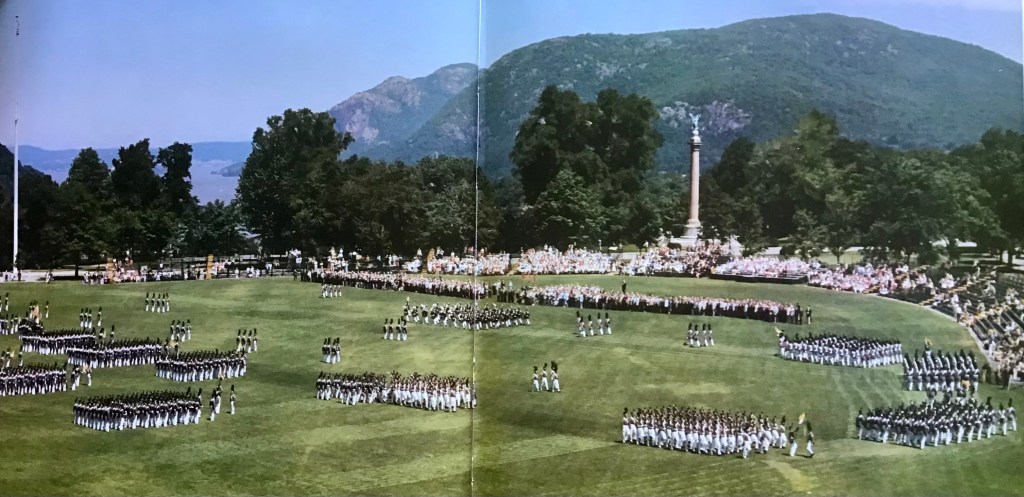
In between those two events, we marched in an untold number of parades. Mondays through Thursdays, one of the four regiments would be in a parade for the public virtually every afternoon in the spring and fall. On Football Saturdays, there would be a double-regimental parade for every home game, and on Homecoming, the entire Corps of Cadets would perform in a parade. While we didn’t parade in the winter, the overall schedule resumed in the spring, and graduation provided another parade for the entire Corps. I learned to hate parades.
We Marched in an Untold Number of Parades at West Point
… In Central Area, our petition to Odin continued …
OOOOOOOO-DIIIN… OOOOOOOO-DIIIN… OOOOOOOO-DIIIN…
A few raindrops started to fall. And then, a few more and it turned in to something between a sprinkle and a light shower. Our chant droned on.
OOOOOOOO-DIIIN… OOOOOOOO-DIIIN… OOOOOOOO-DIIIN…
I could see our commander conferring with the Battalion commander nearby. Suddenly, he returned. “COMPANY… ATTENNNSHUN!” We snapped to attention, the chanting stopped and there was silence, except for the sound of the rain hitting our hats and the ground. Would we march, or not?? Our Commander called out: “B-3 …DISMISSED!”
It worked! We all sprinted to our rooms, gaining an extra hour of rack time.
That evening as we assembled for dinner formation, our squad leader informed us that appealing to Odin to cancel a parade was an Old West Point tradition, and advised us to study up on him. He would quiz us later.
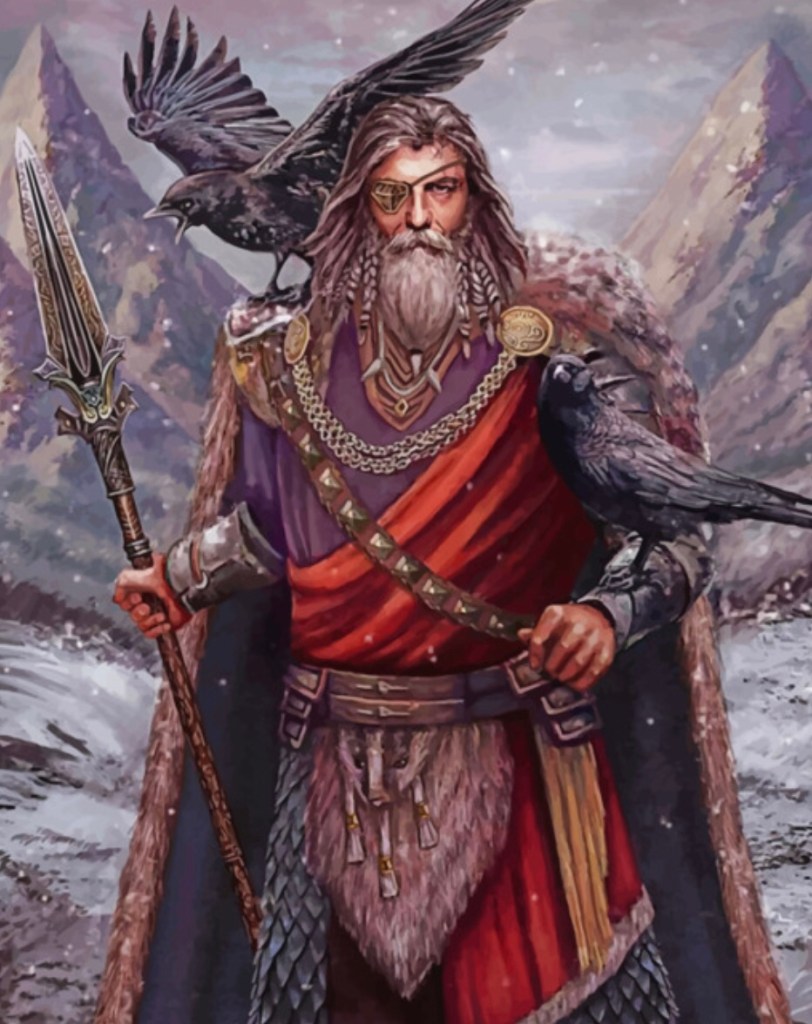
We learned Odin was the god of war in Germanic and Norse mythology. He was a protector of heroes, and fallen warriors joined him in Valhalla. In a bit of a juxtaposition, he was also the god of poets. He was associated with healing, death, royalty, knowledge, battle, victory, and sorcery. He gave up one of his eyes to gain wisdom. You will notice no where in that description is there any mention of rain, storms, or weather. Evidently, that skill was buried in history.
Odin… a god with Many Talents
Over my remaining years at West Point, there were many times we appealed to Odin for rain to cancel a parade. The vast majority of the time, he ignored our pleas, and we emerged through the Sally Ports and onto The Plain for our parade before the Great American Public. They say the gods are fickle. Maybe that was the case with Odin.
As I was thinking about writing this blog a couple of months ago, 40-some years after that initial appeal to Odin, I was trading messages with a few classmates. We were discussing how infrequently parades were actually cancelled due to calling Odin, when Leroy Hurt said, “By the way, I finally found out why we chanted to Odin.” What!?
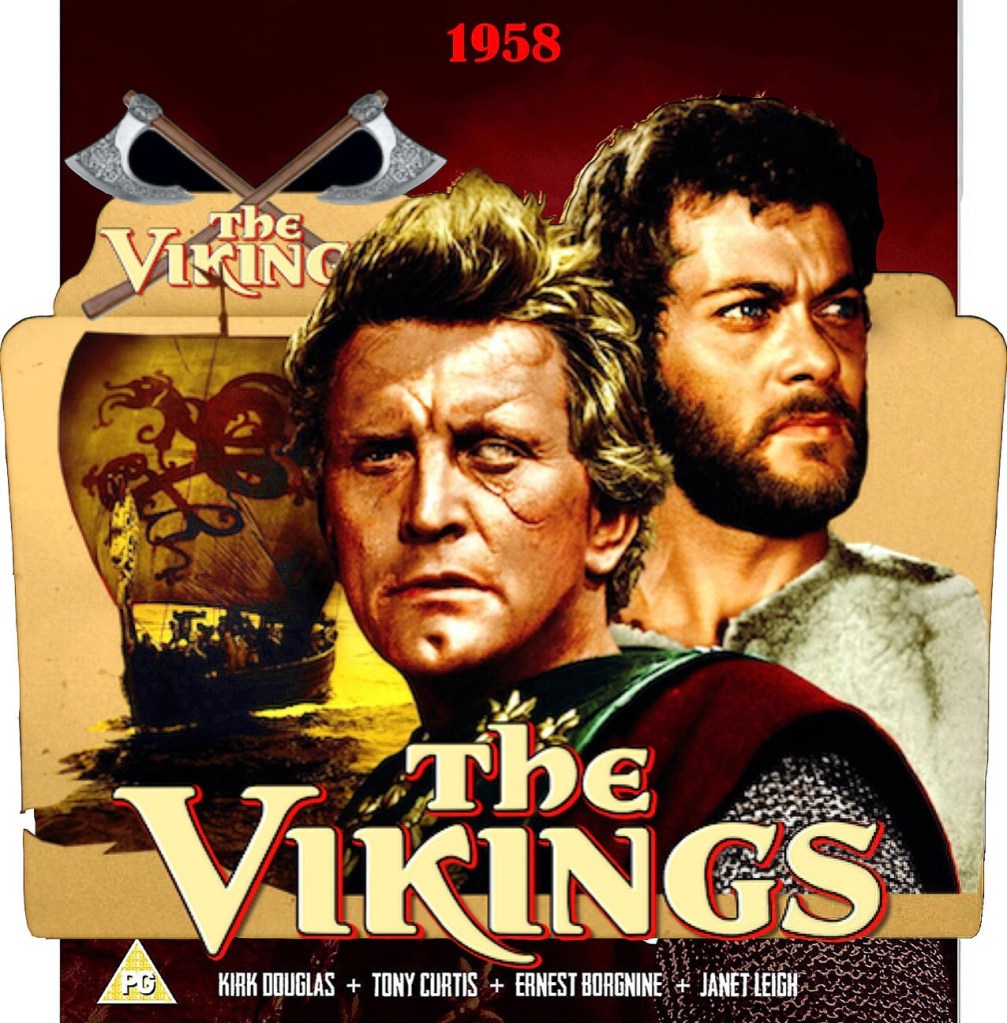
It turns out Leroy is teaching a class on West Point History. In his research for the class, he came across a book called “The West Point Sketchbook”, published in 1976. In the book, the authors state that in 1958, some cadets saw the movie “The Vikings”. It’s a so-so adventure movie, with an all-star cast of Kirk Douglas, Tony Curtis, Ernest Borgnine and Janet Leigh. Throughout the movie, The Vikings make various appeals and chants to Odin, including asking him to effect the weather and bring rain. In the movie, it worked. The cadets brought the Odin chant back to West Point, and the rest, as they say, is history.
Kirk Douglas and Tony Curtis BOTH Appeal to Odin in the Classic Movie, The Vikings
Of course time and history evolve. Another classmate, Pete Eschbach was recently back at West Point and spoke with a few cadets about some of our past traditions. None of the current cadets had ever heard of appealing to Odin to cancel a parade. Not one. For the West Pointers reading this blog, Pete privately speculated to me that “Perhaps both The Corps, and Odin have… (gone to hell)”.* Maybe with the increases in technology, and the weather apps we have today, it’s no longer required. The weather is a foregone conclusion, and an appeal to Odin isn’t going to change things one way or another. Another mystery…
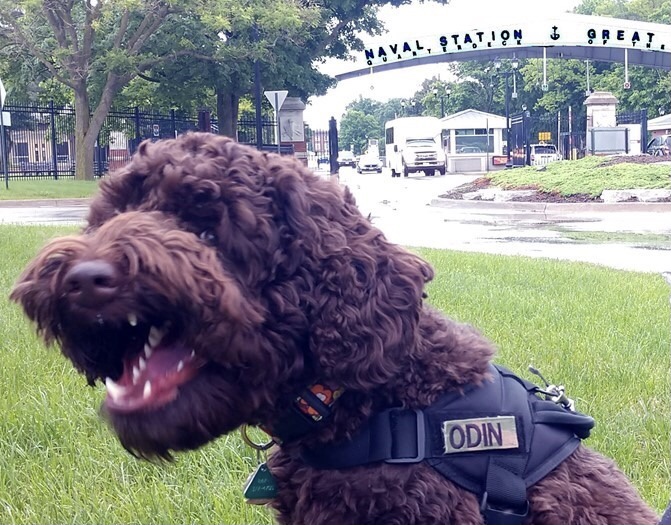
The legend of Odin may have died at West Point, but he remains an item of interest for me and my classmates. Occasionally, one of us still calls on him. Classmate Joe Mislinski even named his dog Odin. Joe lives pretty close to the Great Lakes Naval Station, where Navy basic training is conducted. He likes to occasionally take Odin for a walk outside the station, once a parade has already started. From the look of the slick streets in the photo below, Odin still has the occasional magic touch.
Odin… Bringing Rain to a Navy Parade
Addendum:
⁃ * Pete was making a bit of an inside joke to me about “Perhaps both The Corps, and Odin have… (gone to hell)”. In a tradition probably as old as West Point itself, among old grads you frequently hear the phrase, “The Corps Has…” Every class at West Point believes that the classes who came after them had it easier than they did. Gone to Hell is never stated, but always implied. 😉
⁃ Thanks to classmates Peter Eschbach and Leroy Hurt for their contributions to this blog, and their reviews. They were invaluable. Special Thanks to Joe Mislinksi for suggesting the idea for a blog about Odin, and providing a picture of his dog Odin!
⁃ In The West Point Sketch Book, it is reported that prior to 1958, Plebes would whistle a song called the “Missouri National” to try and bring on rain. Part of the adapted lyrics include: And now the rain drops patter down/ Our hearts fill with delight/ For hear the OD sounding off-/ “There is no parade tonight.”
⁃ The movie, The Vikings, is actually not bad. You might give it a watch sometime when you have nothing to do. In the meantime, here are several of the callouts to Odin, throughout the movie: https://youtu.be/uAM85DFfR24
If you wish to read a few of the previous blogs from my time at West Point, you can find them here:
High School graduation had come and gone, and the month of June was racing by. In just a few days, I would report to West Point. For our last night together, Cathy had the idea for an “adult” farewell dinner at her house. Never mind that we were just kids of 17 and 18.
How she was able to make it all happen, remains a bit of a mystery to me to this day. In addition to planning our dinner she asked her folks if we could have a bottle of wine with the meal. They agreed, and then checked with my folks to make sure they were OK with it. Amazingly, they agreed as well.
It was finally the last night in Ottawa. I arrived at Cathy’s just as her mom and dad were departing, along with her sisters, Cindy and Bonnie. I don’t remember where they went – maybe the movies or a drive in. All I knew is we would have the house to ourselves.
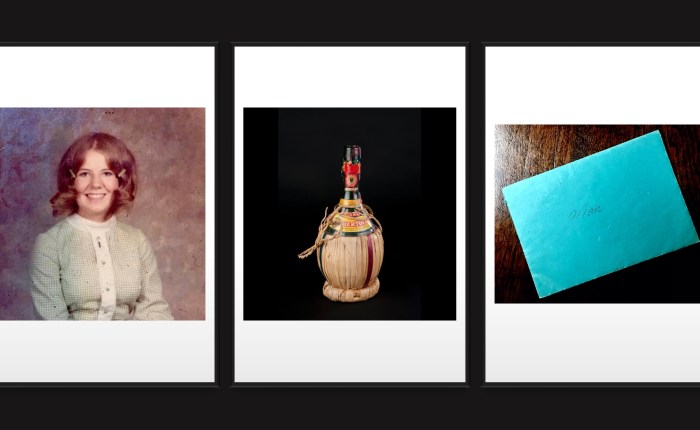
We opened the wine, a straw covered Chianti bottle, and sipped on it as Cathy finished cooking. She was making spaghetti with a meat sauce, a meal of hers I love to this day. As we sat down for dinner, she also brought out a salad.
Dinner was Served, Along With a Nice Chianti
It’s funny, in my minds eye looking back, we were both adults, and also kids playing at being adults. I don’t know if that makes sense, but it’s how I remember the night. It was somber and sad, and fun all at the same time. We finished dinner eventually and continued to sip on the wine until it too was gone. We talked about everything, and nothing. We talked of the future and when we hoped to see each other again. We promised to write… and finally, it was time for me to go home. We said our goodbyes, and then said them again several more times. Finally there was a long hug, a last kiss and I drove off into the night, with a crazy collection of mixed up feelings inside. I didn’t sleep much that night.
The next morning arrived. Normally, Dad would have had us up at oh-dark-thirty to depart, but for whatever reason, he decided to break the trip to New York into two days, so we were leaving around mid morning. We were finishing packing the car when my old buddy Howard showed up. We’d known each other since kindergarten, and he wasn’t going to let me escape without saying goodbye. We too promised we’d write each other when we could.
At this point, mom, dad, my two sisters, Howard and I were all standing in the driveway. As we were getting ready to leave, Cathy came racing up on her bicycle. We all stood there for a bit talking. If you’ve ever seen American Graffiti, it was a little like the final scene at the airport with Richard Dreyfus saying goodbye to family and friends, before he departs on the plane for college.
The Last Few Minutes of my Departure Weren’t Unlike Richard Dreyfus’s Departure at the End of American Graffiti
I hugged my sisters goodbye and shook Howard’s hand. Cathy and I had a final kiss, and as we were hugging, she pressed a letter into my hand. She whispered “Don’t open this ‘til later…” With that, mom, dad and I climbed in the car and with honks and waves, were on our way.
I looked at that envelope for a long time. I believe we were in either Indiana or, maybe, Ohio before I opened it. I probably read the letter about 50 times on the drive east, and another 500 times during my time at West Point. I won’t share the contents here, but know the letter still sits in a drawer on my side of the bed, and I occasionally pull it out and read it.
I Still Occasionally Read that First Letter from Cathy
I think about that dinner, and the letter. We were just kids in so many ways, but we were also adults, or thought we were. The world turned out to not be quite as black and white as we imagined it in those last 24 hours in Ottawa, but here we are, decades later, reminiscing about our past, and still thinking about the future and what it holds for the two of us.
Addendum:
It’s worth noting a couple of things from that pre-Internet era:
There are no pictures of that last dinner or the farewell the next day. Why? With no cell phones or iPhones to document the events, we simply lived them. Who’s to say which is better?
People actually did write letters to each other back in the day. Particularly that first summer at West Point, the letters that came from Cathy, Howard, mom and dad and others helped sustain me.
I will turn 67 on April 10th. That’s a little more than one quarter of the 246 year American Experiment. In January, 1790, George Washington said, “The establishment of our new government seemed to be the last great experiment for promoting human happiness by a reasonable compact in civil society.“* I’m trying to decide how well Washington’s words have held up.
To me, the Constitution and it’s amendments are still a reasonable compact. After that, things are a bit more dicey. As a country, we don’t act particularly civil, or happy these days.
If you look at history, America and Americans have always been contentious, but we seem well past that these days. Civility has gone by the wayside in government, and often in society. Our Congressmen and Senators routinely insult each other and anyone who disagrees with them. Many also have no problem insulting their constituents if he or she disagrees with them. Hate is a word that often comes to mind.
It carries over to our society as well. If there is disagreement, many folk no longer know how to act civilly, or even worse, choose to act uncivilly. Rather than discuss, or ignore something, the preferred response is often to insult or belittle, often with vulgarity. Anyone attend a school board meeting lately? And it’s not just about politics. We fight about noise pollution, light pollution, how people choose to raise their children, shopping sales and parking spots. Our ultimate “right” appears to be the right to be obnoxious.
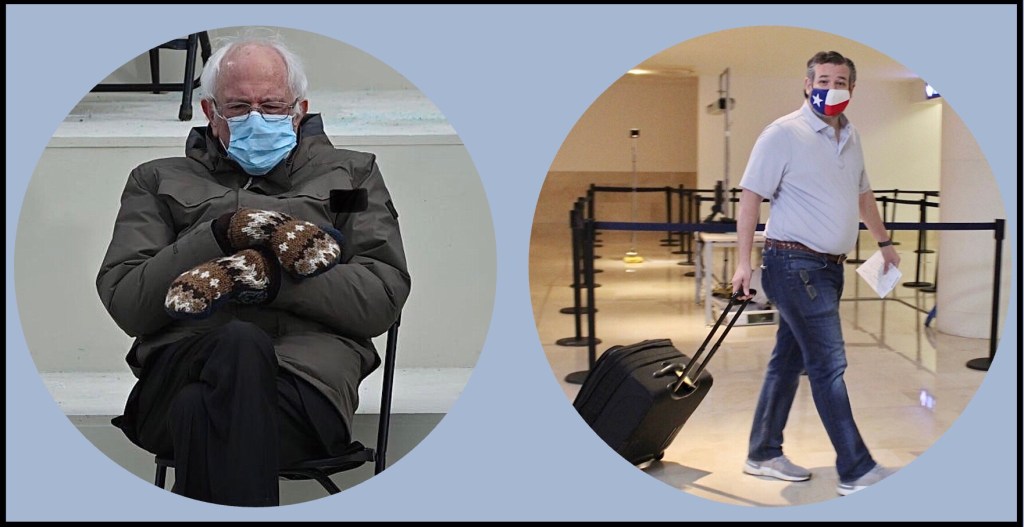
Happiness, at a government or society level, is also in short supply. Our politicians at the national level wear a scowl much more often than a smile. How often do we see Ted Cruz or Bernie Sanders smile? As Americans, many of us are pretty much unhappy about everything – immigration, the news, the price of gas, healthcare, our neighbors with different views, Covid, not using Daylight Savings Time all the time, boomers upset with millennials, everyone upset with boomers, sports referees… No issue is too big or small to escape our ire.
What are the odds of smiles under those masks?
Some days, we appear to be Whiny America, forgetting we could be in Ukraine, or any number of troubled spots around the world.
We have had discord and conflict throughout our history, and certainly there were times worse than what we are experiencing today. The Civil War, The Depression, WWII, The McCarthy era, Vietnam and the upheaval of the ‘60s to name a few.
We have also fought over issues throughout our history. State’s Rights, Western Expansion, Slavery, Women and the Right to vote, Labor and unions, Civil Rights, Gay Rights, Individual versus societal rights, the place of Religion in America … the list goes on.
I was born in 1955. Fools long for the mirage of the “good old days” in the ‘50s, forgetting that we were fighting in Korea, the prospect of nuclear holocaust was real, Civil Rights hardly existed, and Joe McCarthy was trying to tear apart the country with outrageous lies in the US Senate. People forget Happy Days was a fictitious TV show, not American reality.
What makes today appear worse? Maybe the internet-connected-world shines a brighter light on the American Experiment, allowing us to see all of the dark holes that have always been there, but were previously hidden. Maybe it’s not worse. Maybe it’s just our time and turn to experience the tumult that is the American Experiment. Or, maybe our lives have become so otherwise comfortable, this is just the next level of angst over the American Experiment – my way, or the highway, with no room for alternatives.
Maybe, instead of looking at society, we can start by looking at ourselves first, and find some civility, some happiness and some sanity.
You would think each of us could control whether we are civil or not. We can try and take our hatred down a notch or two and find ways to engage civilly with those who are “different” from us. And if we can’t find a way to engage civilly, perhaps we shouldn’t engage at all, rather than becoming mime worthy caricatures.
And Happiness? Certainly a tougher question and each of us is somewhere different on the continuum between abject sadness and blazing joy. We all have personal issues affecting our state of happiness over time, but happiness is often found in the eye of the beholder. Indeed, some people who have the right to be upset about health issues, are happy because they have one more day upright. I think a lesson is there for all of us.
Maybe part of the question is whether we can find happiness without making someone else unhappy.
For me, as I’m about to enter my 68th year on this planet and in this country, I have two thoughts. One, I’m going to strive to maintain my civility, no matter the situation. As for happiness, while I know I won’t always be happy, I’m going to look for happiness where I can find it, in events both big and small. Whether an upcoming vacation, a negative test result, or a new flower blooming in the garden, I will seek out happiness, and let it infect me.
I have no doubt The American Experiment will continue for the foreseeable future. We are a resourceful nation and people, and our strength and good fortune have brought us to where we are today. Like many families, we Americans fight with each other. Is it too much to ask for a little more civility in our lives and fights? That might even help with our collective happiness.
Addendum:
⁃ * Washington penned these words in a letter to English historian, Catharine Macaulay, on 9 January 1790. The entire quote in that part of the letter reads: “The establishment of our new Government seemed to be the last great experiment, for promoting human happiness, by reasonable compact, in civil Society. It was to be, in the first instance, in a considerable degree, a government of accomodation as well as a government of Laws. Much was to be done by prudence, much by conciliation, much by firmness.” You can find a link to the entire letter here: https://founders.archives.gov/documents/Washington/05-04-02-0363 .
⁃ Thanks to my friends Tim Stouffer and Mark Dunavan who both provided thoughts and inputs for this blog.
– As always, thank to my friend Colleen for her editorial assistance. I remain a work in progress.
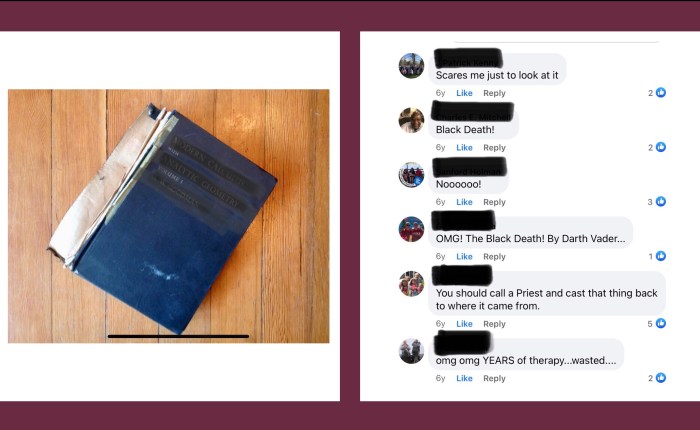
The Black Death. That’s what we called it. Among us Plebes at West Point, feelings were strong, and universal. To this day, grown men shudder when they see a picture of The Black Death. How could a single book leave such a strong impression? What devilry was this? What book of spells could cause such consternation?
Yes, Grown Men Still Shudder when they See a Photo of The Black Death
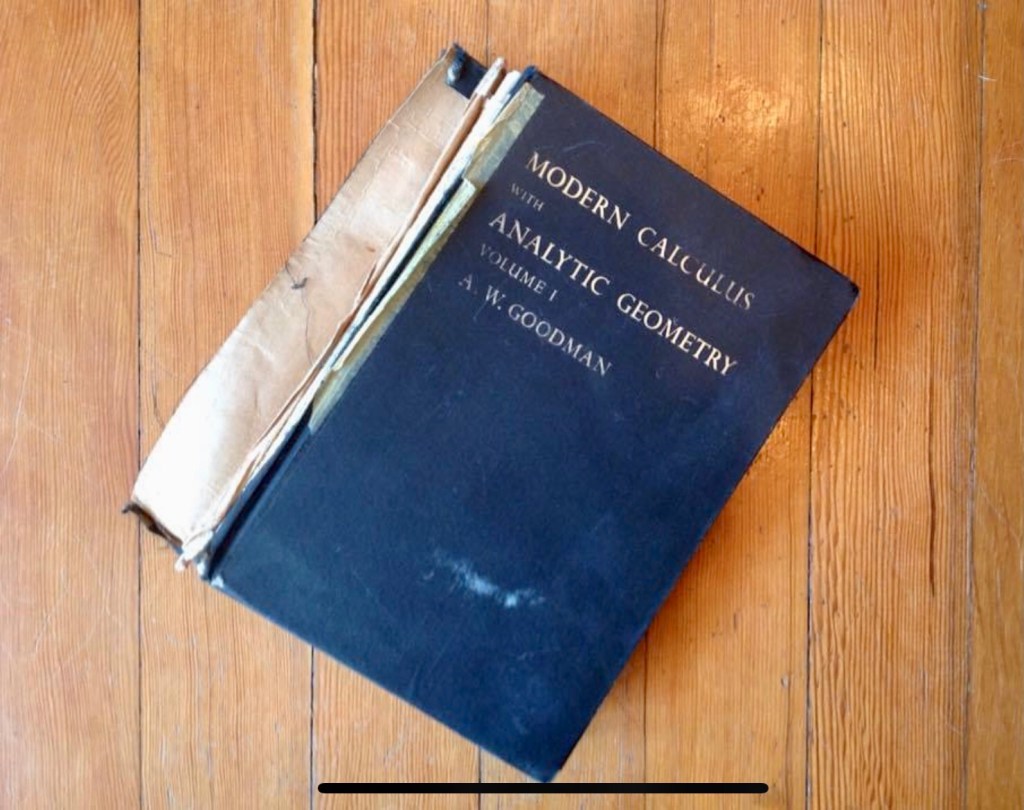
Of course it wasn’t just any book. This book was “Modern Calculus With Analytic Geometry (Volume 1)” by A.W. Goodman. We never called it that though. We called it The Black Death, or sometimes The Black Plague. The book was black, but I suppose our title referred to the entire experience of Plebe (Freshman) math at West Point as much as anything.
The Black Death, in all it’s Glory
After Beast Barracks our first summer at West Point, it was a relief to get to the academic year. Unfortunately, we didn’t quite know was waiting for us. In addition to the normal Plebe challenges, Calculus was a required course for all, and provided our introduction to The Black Death.
This wasn’t just any old math course. There were several “attributes” that put the class into the category of those things you never forget. My classmates and I laugh about it now, but it’s still a bit of a nervous laugh.
First off, the class of ‘78 went to Plebe math five days a week, including Saturdays, with 90 minutes for each class. Prior classes attended Calculus class six days a week for 75 minutes per class and thought ‘78 was getting over, since it was only five days a week ;-).
In the class itself, we had normal homework, quizzes and tests. In addition, we suffered a unique form of torture called “The Boards”, also known as “Recitations”. A couple of days a week, the professor would call out “Take Boards.” We cadets stood up and each of us went to one of the blackboards that covered the walls in the classroom. The professor then asked us to work through a calculus problem on the board. It might have been one of the previous night’s homework problems, or it might have been the proof of some theorem. After several minutes, he called “Cease Work!” and then called on one of the students to walk through, or recite, their problem solution. Sometimes it was a cadet who had the solution mapped out perfectly. Other times? Well, other times it might be a cadet whose answer wasn’t correct. It could make for some tense/fumbling moments. Recitations had taken place at the Academy since at least 1869.
Somethings Never Change – Cadets “Taking Boards” in 1900
Of course that sly b@stard Goodman contributed to our pain. While there were often theorems in the book that provided the mathematical proof for the result, it wasn’t always the case. If there was ever a theorem in the book where it said “The proof is intuitively obvious to the casual observer”, you knew it would be a problem for the boards, or a quiz, or a test. For most of us, the solution was never “intuitively obvious”.
At the time, West Point was on a 3.0 grading scale. 3.0 was a perfect score. 2.0 was the lowest passing grade. If you scored a 2.5 on a quiz, you built up five “tenths”. If you scored a 1.7 on a quiz, that was the equivalent of an F and you were down three “tenths”. For those near the bottom of the class in math (or any course), the phrase “2.0 (pronounced “Two OH”) and go” became common. Basically it meant over the course of the semester (and year) you needed to finish with a 2.0 average. Any tenths over that were wasted.
We were quizzed and tested on a regular basis and over time, each of us fell somewhere on the spectrum between 3.0 and less than 2.0. Every few weeks, the math department reordered us cadets by current math class grade ranking. That is, those with the highest grade average, migrated to the “top” sections, while those with the lowest scores would migrate to the “bottom” sections. Each section had about 15 or 17 students. The theory was those in the top sections could cover more material, while those in the lower sections could receive the extra help needed. This reordering of the class on a regular basis was first implemented in the 1820s and was unencumbered by progress for the next 160 years.
The lowest section also earned the nickname “the ejection section” and the guy with the very lowest grade was in the ejection seat. My classmate Rick Steinke, was in the ejection section and ejection seat at various times. At the end of the semester and year, some number of cadets weren’t going to have a grade over 2.0 and one of three things would happen. Rick’s recollection – “That is where I was at the end of first semester, plebe year. Of the bottom 30, as I recall: 1/3 of us did not make it to the next semester (they were booted from the academy); another 1/3 were turned back a year; and another 1/3 went to summer school. I believe I was the only plebe who escaped unscathed, with just a couple of tenths to spare. Thanks to Captain Art Bonifas*, my first semester Professor, and Major Bachman my second semester P, I made it through. Also, Marty Vozzo, my roommate (and several years later, a math professor back at West Point), told me which theorems and equations I needed to memorize. Divine intervention, my brother.”
Rick DID survive the Ejection Section, and the Ejection Seat
Time passed, and we moved on. Obviously lots of Plebes did quite well in Calculus. Many excelled at it.
My classmate Joe Spenneberg, returned to teach math at West Point a decade later, from ‘88-‘91. By the time he returned, Goodman was gone, as were The Boards. The cadets still attended math five days a week, but only for an hour at a time. Also, classes were no longer “reordered” on a regular basis. The course work changed some as well – instruction started with “discrete math”, before migrating to integrals and “continuous math”. In Joe’s words, “The jump between discrete and continuous was key. We told them to imagine that the discrete step is infinitesimally small, which introduces the concept of the limit which is essential to being able to define a derivative …” as Joe was recently explaining this to me, I fogged over about then ;-).
Joe also told me a total of nine or ten of our classmates DID return and teach math at West Point. To the best of my knowledge, as a class we never ostracized them.
I’m sure Mr. Adolph Winkler Goodman, who died in 1989, had no idea about his effect on Plebes at West Point. I don’t think it mattered if you were a star man (top 5% of the class) or a goat (bottom of the class), everyone called it The Black Death. Yea, we laugh about it now, but it was pretty serious stuff then. Looking back, it was one of those commonalities that united all of us. You don’t think about a math class uniting people, but I sure think The Black Death did so for us. The only other class with a similar effect was boxing, but that’s another story for another time.
As I was working on this blog last week, I had a dream one night. I was back at West Point, and you guessed it, in math class. It was finals and I was in the classroom with several classmates. Time was passing and for some reason, while I had a copy of the test, I couldn’t find my paper to write my answers down. I knew the answers, but I couldn’t find the piece of paper to write them on. Classmates started finishing the test and leaving the classroom AND I still hadn’t started. I was trying to ask the teacher for help, and getting no response…
I woke up in a sweat. Looking around, I was in my own bed, with Cathy sound asleep next to me. I settled back to sleep and chalked it up to one last gift from Mr Goodman and The Black Death.
Addendum:
⁃ * The name Captain Art Bonifas might sound familiar to you. After leaving West Point, Captain Bonifas was stationed in Korea. In what came to be known as “The Korean Axe Murder incident ”, Bonifas was bludgeoned to death by North Korean soldiers in an international border incident in August of 1976. The world was pretty tense for a couple of weeks after his death. You can learn more about the incident here: https://en.m.wikipedia.org/wiki/Korean_axe_murder_incident
⁃ Special thanks to classmates Rick Steinke, Joe Spenneberg and David Fitzpatrick, who contributed both content and editing to this blog. All three were involved in teaching and Higher Education after their time at West Point. Rick is a former Harvard National Security Fellow, and later served as the Associate Dean at the George C. Marshall European Center for Security Studies. Joe and David both returned to teach at the Academy, and Dave continues to teach History at Washtenaw Community College in Ann Arbor, MI.
⁃ For some additional history about West Point and Math, you can try this article – Mathematics Education at West Point: The First Hundred Years: https://www.maa.org/book/export/html/116851. Founded in 1802, West Point was the first engineering school in the United States, and had a uniquely technical curriculum for its time. The first two years of the curriculum was dominated by mathematics. The information in this blog on the history of “Taking Boards”, and the reordering of the class on a regular basis were both documented in this article.
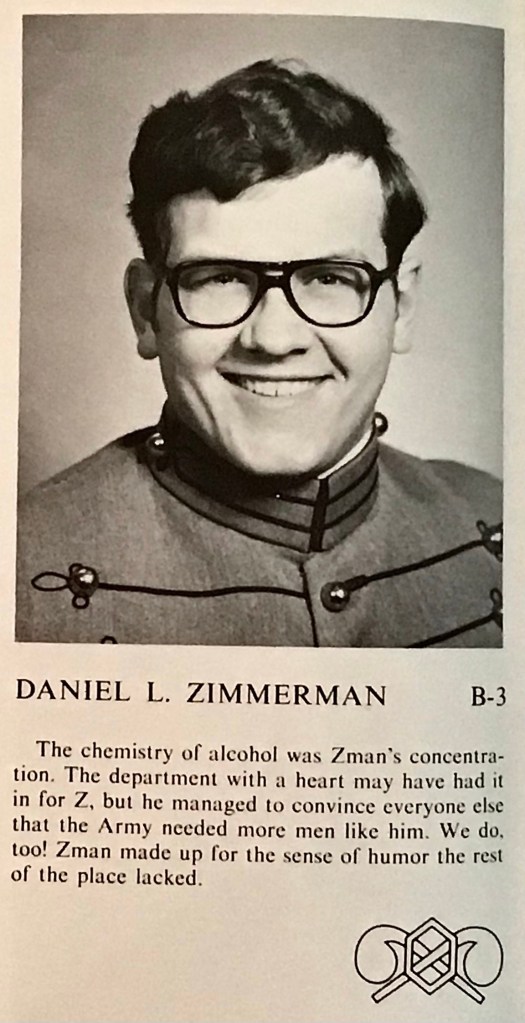
It’s always tough when a West Point brother dies, but this one hit me harder than most. Zman is gone. I’ve lost other classmates over the years, but Zman was the first from my company, and I felt a great sadness on hearing the news. I suppose it was sadness both for his passing, and the passing of our youth.
Dan Zimmermann was a big guy with a big personality. The kind of guy whose good mood was infectious. We had some good times at WooPoo U (West Point) our Firstie (Senior) year, although I also remember him studying a lot – he was taking P Chem, a class not for the faint of heart. Still, I remember an evening or two (or three) of partying.
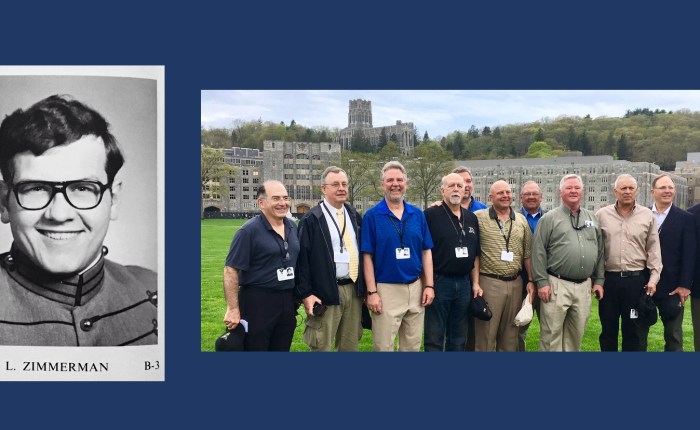
Dan’s Graduation Picture
After graduation in 1978, we reunited several months later in Wurzburg, Germany. I was stationed with the 123d Signal Bn (3ID) at Hindenburg Kaserne, and he was across town with a Chemical unit. I can’t remember now if he was a part of 3ID or some other unit. Over the next three years, we managed to hit more than a few Bier and Wien Fests together in the surrounding area.
I remember one evening in ‘80 or ‘81 when the town he lived in held something called a “Heckenwirtschaft.” In Franconia, a part of Bavaria, small towns would occasionally allow the small wine growers to open their homes as limited seating “pubs” – an event called a “Heckenwirtschaft”. Dan’s landlord was one of the people who opened their homes. We spent the night wandering from house to house, and in their cellars or kitchens sampled some good white wines and wonderful homemade foods. It was a great time – one of those evenings when it’s just you and the locals, and because of Dan’s landlord, we were treated like locals as well. Nights like that don’t come around all that often and I remember it to this day. We may have overserved ourselves a bit that evening.
We lost track of each other after our next assignments and didn’t see each other for a couple of decades. In 2015, Cath and I held a mini-reunion for my West Point Company, B-3. There were about eighteen of us here for the weekend and Dan joined up at the last minute for the two nights of festivities. It’s funny, but the whole group of us clicked back together, as if it was Firstie year in 1978. There were stories told, both old and new. The bonds we’d forged decades before on the banks of the Hudson River still held strong.
We saw each other for what turned out to be the last time at our 40th reunion at West Point in 2018. He had become the National Sergeant at Arms for the American Legion, and told us about escorting both candidates, Secretary Clinton and Mr. Trump, to the stage in 2016, when each spoke at the Legion’s National Meeting prior to the election.
B-3 Classmates at the 40th Reunion in 2018. Dan is in the Center in the Back.
In 2020, Cathy and I were going to hold another mini B-3 reunion in May here in Warrenton, Virginia. Dan and I traded emails and spoke, and he was planning to come. Unfortunately, in April, we cancelled the get-together due to Covid. Dan called me after that and we talked for about 10 or 15 minutes about Covid, along with this and that. It was the last time we spoke with each other. He didn’t mention the lung cancer he already knew he was dying of.
It’s Forty-some years since our graduation from West Point in 1978 and those years have passed much too quickly. I think of Dan, and my other classmates, both living and dead. Our class will still have plenty of good times together, and many more reunions. Having said that, the chapel service honoring our departed classmates at those reunions becomes just a little sadder each time.
I’ve also been thinking about the great Dire Straits/Mark Knopfler song, “Brothers in Arms” and it’s refrain,
“You did not desert me
My brothers in arms…”
Whenever I hear the song, I think of both West Point and my time in the Army. The song is bittersweet, and also a testament to those who have served, and the brotherhood that exists between them. Released in 1985, it also reminds me of my 8 1/2 years with the Army in Germany that decade.
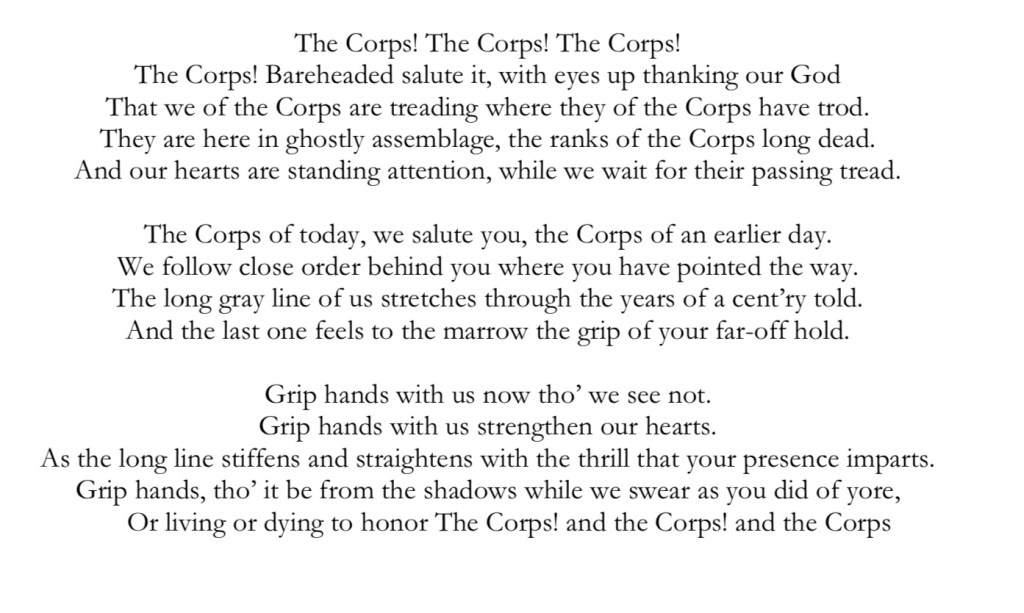
And of course, I can’t help but remember the song “The Corps” from West Point. It celebrates the continuity of The Long Gray Line, past, present and future.
Grip hands with us now tho’ we see not. Grip hands with us strengthen our hearts … Grip hands, tho’ it be from the shadows…
Rest In Peace Zman, Rest in Peace. You are gone, but not forgotten.
– Thanks as always to my friend Colleen for her super editorial assistance. I’m alway thankful for her corrections to my poor English. I’m better than when I started this blog 5 years ago, but still have room for improvement. Thanks Colleen!












 Live Life Exuberantly