Carmen’s Surgery

Carmen’s Surgery

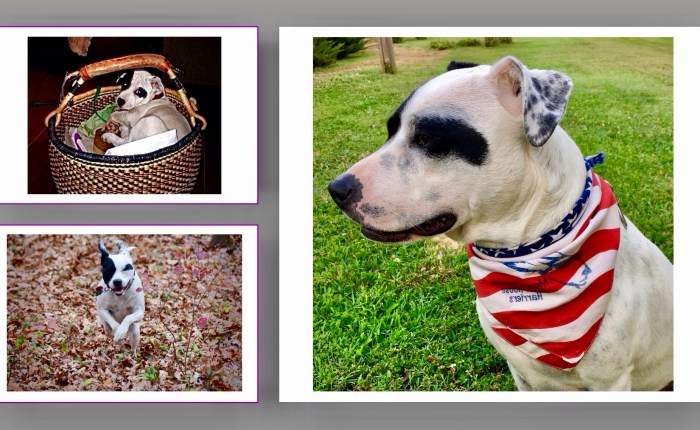
My walking companion for the past nine years is sidelined. Carmen needed surgery last week to repair a ruptured ligament in her left rear leg. We went down this road with a previous dog, Holly, and are familiar with the journey. It doesn’t make it any less distressing for the three of us.
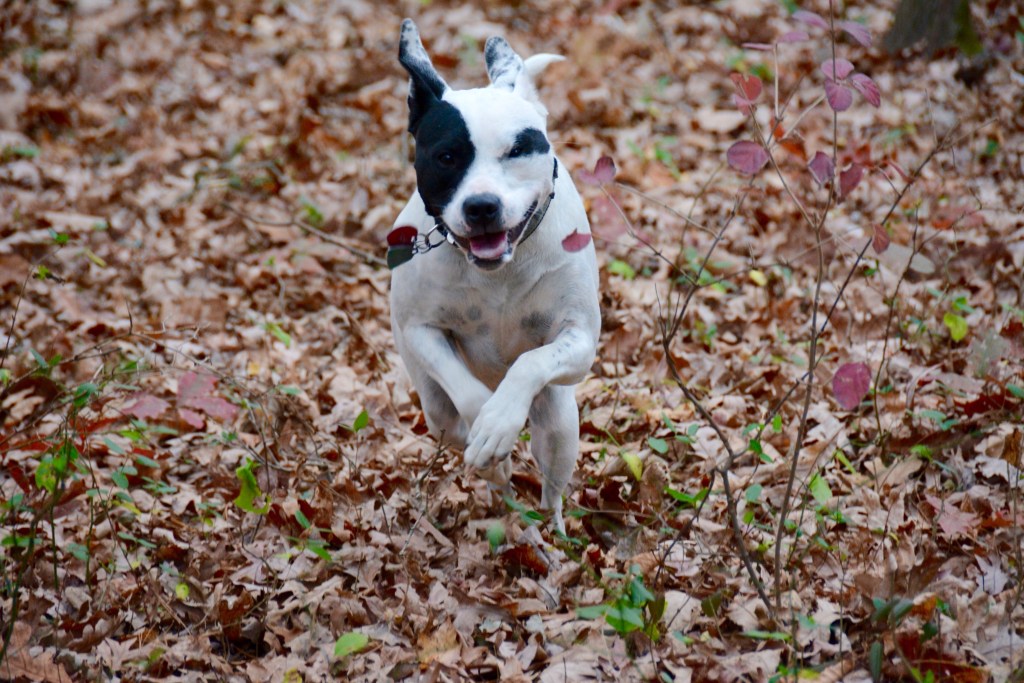
Carmen in Happier Times.

Yep, nine years of walking together came to an end about ten days ago. Our neighbors haven’t done a good job of managing their dog Kylie and keeping him under control*. I actually like Kylie. He’s a Golden Retriever and friendly enough. The problem is, after two years they still don’t keep Kylie at home. They “think” they do; the reality is something else and Kylie wanders. Ten days ago, we found him in our yard again playing roughly with Carmen and jumping on her. It wasn’t done meanly, but he outweighs her by 25 pounds. I sent him home, and then noticed Carmen limping. That night the limp worsened and the next morning, she wouldn’t put weight on the leg. That’s when we went to the vet.

Evaluations, tests, X-rays … the results came back. She needed surgery for a torn ligament in her leg. We were lucky there was a cancellation for another patient and scheduled her surgery for the following Wednesday.

X-ray of Camen’s Knee, and an Explanation of the Surgery.

The first morning after the doctor’s initial evaluation was a challenge. I took her outside on a leash to do her business. She gave me a look as I put on the leash – “Well, this is strange.” As she did a three-legged hop down the driveway, she became visibly upset and stopped in her tracks when I diverted her onto the grass to potty. “What?! What are you doing?! We ALWAYS walk to the barn in the morning!” I had no way of explaining this was for her own good and I was just looking out for her. After she finished, I carried her back towards the house, before putting her on the ground. She dutifully hopped into the house on her three good legs.

She’s a good dog, and a brave dog. I hated seeing her hop around as a tripod before the surgery. There were no complaints. Just the sad look in her eyes when I left the house without her to go for a walk, or to clean the horse stalls. I knew she’d happily try to three-leg-hop for two miles with me if I let her. She doesn’t understand, of course.

Wednesday came and the surgery went well. She had a procedure called a TPLO**. Our surgeon, DR Nicholson let us know, “Carmen did great!” Bringing her home, the first day was tough for all three of us. Carmen was out of it and mostly slept. We were able to get her to drink a little water and take her pain pills with a little peanut butter, but that was it. She didn’t want to stir and we didn’t force it. Finally, it was time for bed. She was sleeping so soundly, we didn’t take her out.
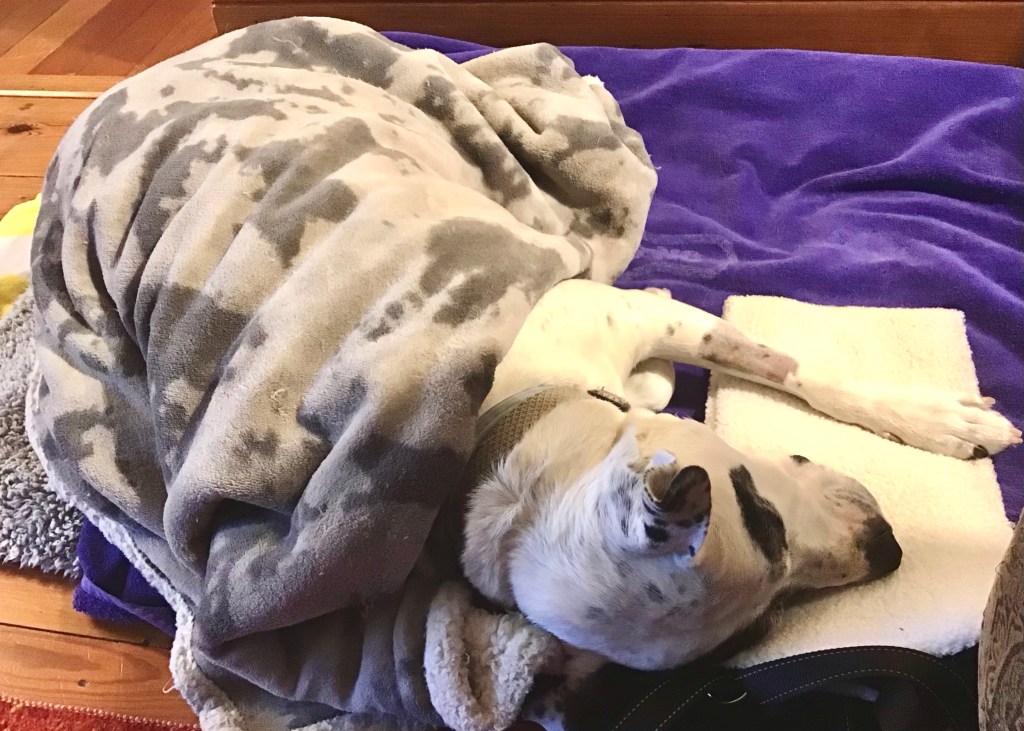
Knocked Out the First Night.

I slept on the couch that night, and her bed was nearby. Around 3AM I woke and sensed something. I looked to my right and Carmen was sitting up, looking at me. After putting her leash on, I carried her outside and gently put her down. She tripodded a bit and then urinated. She hopped a dozen steps or so, and then poo’d as well. I carried her back inside, gave her a treat and some more water and we shared a look. That’s when I knew she was going to be OK.

We both slept in the next morning. After feeding the horses, I returned and a while later, Carmen stirred. Cath and I both greeted her and she gave us a small tail wag. A brief walk outside to do her business, then some water, a little food, and more pills.

Later, we looked at each other again. It was time to start rehab and so we did. She tripodded out for another pee, and then we did our first Physical Therapy (PT) session – a five minute walk. Two more PT sessions followed that day. Also, we now had to occasionally use an Elizabethan Collar*** to keep her from licking her stitches.

Carmen in Her Elizabethan Collar.

She slept through the next night and in the morning, we walked to the barn. Well, I walked and she hopped. She was happy back at the barn and sniffed around. We fed the horses and returned to the house. Our first PT session of the 2nd day was complete.
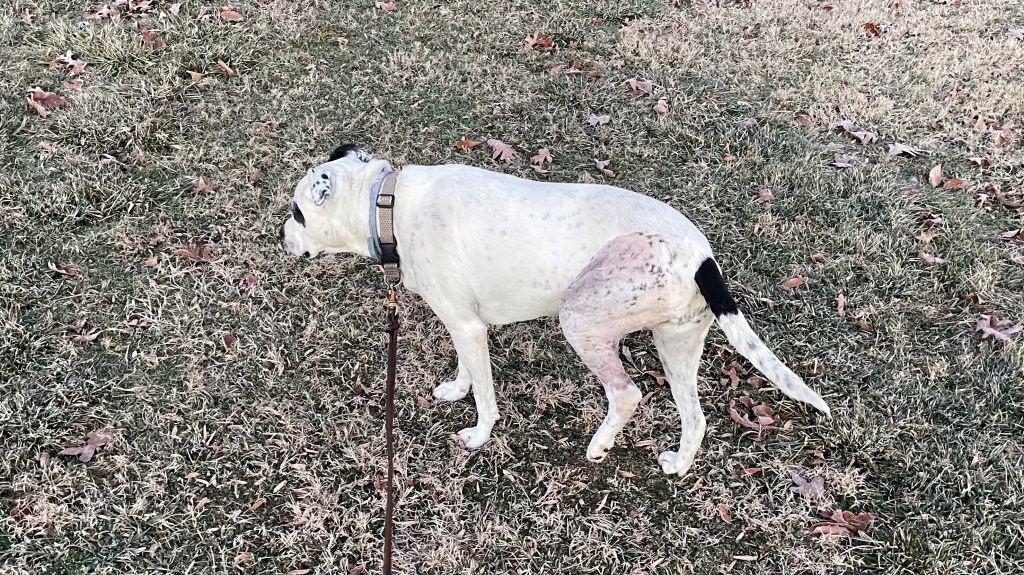
Doing PT.

Time passed and by day three post-surgery, she was more normal and more alert. PT continued and she put more weight on her leg. It was a warm February day, and what she really wanted was a chance to lay in the sun like the old days, pre-injury. We both spent some time soaking up rays.
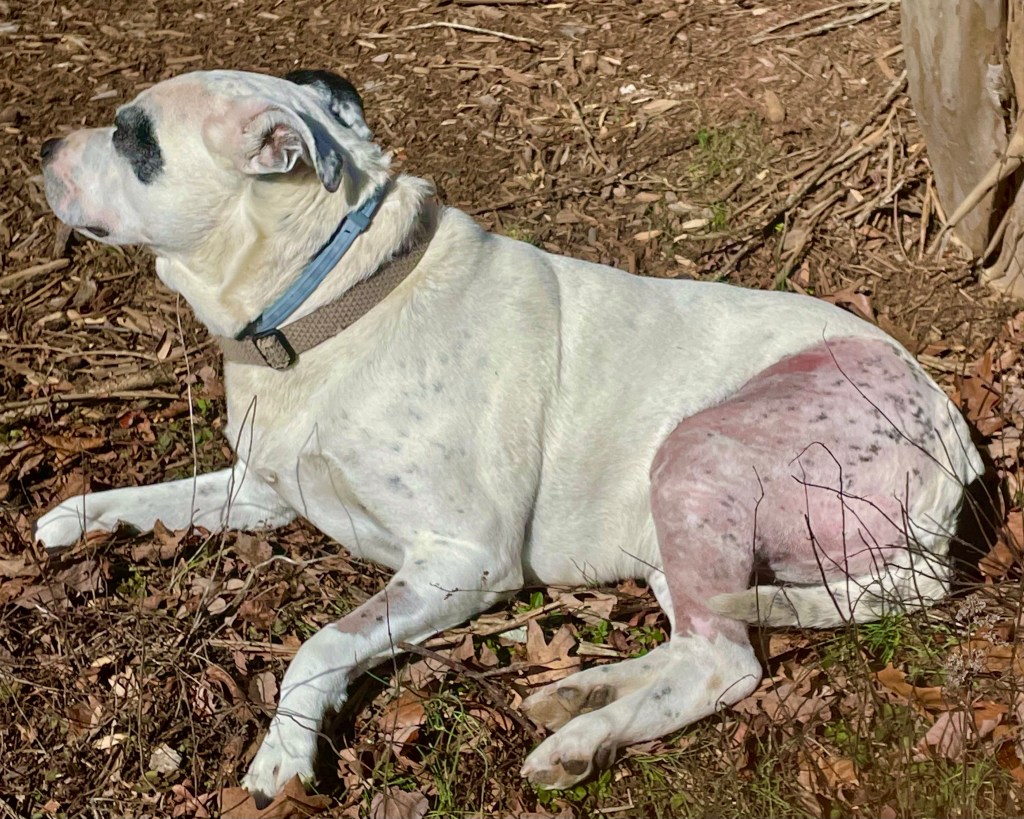
Sometimes, a Little Warm Sunshine Helps as Much as PT

Over the next several days, Cath and I both spent time exercising Carmen. We do our three sessions a day religiously and you can see her improving. She is using the injured leg more as she walks. As a patient, her attitude is great. We should all be so enthusiastic when we need to do PT after injuries or surgery.

And so it begins. The first week is in the books. We have goals and checkpoints along the way – the three-week mark; the 6-8 week time period; three months… With hard work, good luck and God’s grace, Carmen will be “normal” in five to six months.

Right now, we’re taking it one day at a time.

Addendum:

  • * After the first vet visit, I had a not particularly pleasant conversation with Kylie’s owner. He was “surprised” Kylie was still coming to our place and was sorry (I called bullshit – Kylie is at our place at least once a week and visits other neighbors as well). I told him he needed to control Kylie – A fence, an underground fence, or only letting Kylie out when he was with him. If I saw Kylie on our property again, we would have an issue. He agreed. Of course, Kylie was on our property again two days later. I let the owner know if I saw Kylie again, I would call animal control. He assured me they are putting in a fence and for now, Kylie wouldn’t be outside unless tied up. We’ll see. I don’t hate Kylie or hold him responsible. I do put blame on his owners. It’s never good when your dog needs to go through surgery. It’s a bit sad when it was avoidable. Too little too late, as they say. Maybe I should have been an ass about Kylie earlier.
  • ** TPLO Surgery – You can’t really repair a dog’s ligaments. Instead, they now do something called Tibial Plateau Leveling Osteotomy (TPLO) surgery, a major advancement in the treatment of ligament rupture. “This surgery changes the angle and relationship between the thigh bone (femur) and the shin bone (tibia). The overall intent of the surgery is to reduce the amount the tibia shifts forward during a stride. This is accomplished by making a semicircular cut through the top of the tibia, rotating the top of the tibia, and using a bone plate to allow the tibia to heal. This realignment of the surfaces within the knee (stifle) helps to provide stability during a stride and helps to reduce future joint inflammation and osteoarthritis. By carefully adjusting the angle or slope of the top of the tibia, surgeons can create a more normal configuration of the knee joint and reduce mechanical stress.” You can learn more here: https://en.m.wikipedia.org/wiki/Tibial-plateau-leveling_osteotomy
  • *** I like “Elizabethan Collar” or E-Collar so much better than “Cone of Shame”. No need to make fun of them when they are vulnerable.
The little c

The little c

The surgery went well. As far as cancers go, squamous cell carcinoma (a type of skin cancer) is usually pretty minor, but it was still good to have the surgery over and done with. Cancer is one of those words that draws your attention, or at least it draws my attention.

It all started late last winter when I noticed a scaly spot on my forehead. I didn’t think much about it at first. Due to my AFIB, I take Eliquis, a blood thinner. One of the results of blood thinners is scrapes, cuts and wounds sometimes heal a bit weirdly. The blood doesn’t clot quite the same way it does for a normal person and as a result, minor scrapes or cuts can take a while to heal. That’s what I thought was going on with this scrape.

Unfortunately, it didn’t disappear and I mentioned it to Cathy. She looked and recommended I consult a doctor, so I called the Warrenton Dermatology and Skin Therapy Center at the end of April. They were a bit backed up and scheduled an appointment for me on May 9th.

On May 9th, I arrived at the Center and explained why I was there. They examined the spot and thought it looked OK, but there was something right next to the spot that concerned them. After numbing my forehead, they took a biopsy and told me the results would be back in ten days to two weeks and they would call me.

10 days came and went, then 11, then 12, then 13 days and still no word. Finally on Day 14 I called them. The results had just arrived, but hadn’t yet been reviewed by a doctor. And… They couldn’t release the results until a doctor reviewed them.

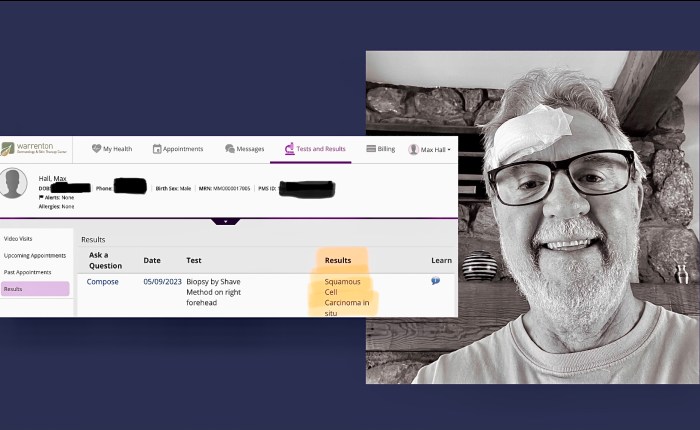
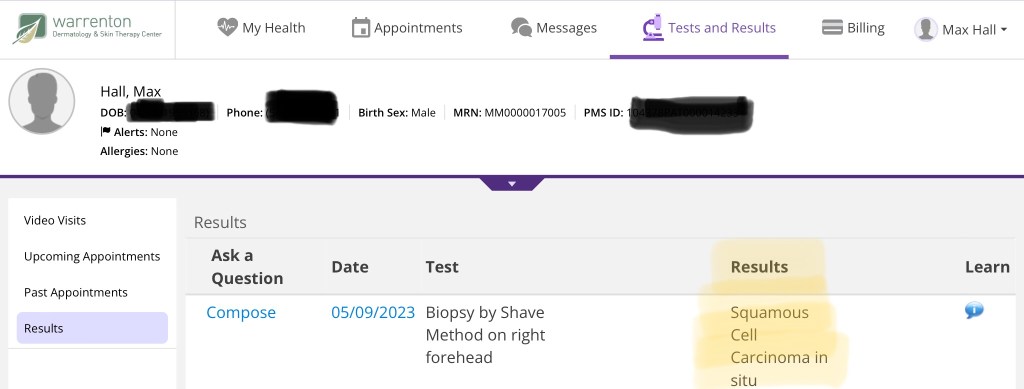
The next day, May 23d, I received a call from Danielle at the center. The biopsy came back positive for squamous cell carcinoma. What? What did you say? Squamous Cell Carcinoma.

A Diagnosis of Squamous Cell Carcinoma

Danelle continued to speak, and after a few seconds, I started listening again. They recommended the removal of the cancer with Mohs Surgery. They could do it there, or if I wanted to go with another dermatologist, I could. Another dermatologist? Until two weeks ago, I didn’t know any dermatologists… I told them their office was fine. After consulting calendars, the first available date was Saturday, June 3rd – 8AM and 12 noon were available. Was there nothing in between? Well, no, Danelle informed me – the surgery could take one to four hours, I should wear comfortable clothes, and bring something to read or pass the time.

What!?!

It turns out the surgery, while relatively simple, can take some time. Here’s how Mohs surgery works (according to the Mayo Clinic):

You are given a local anesthetic. After the anesthetic takes effect, the surgeon uses a scalpel to remove the visible portion of the cancer. The surgeon also takes a thin layer of tissue underneath and around the cancer. A temporary bandage is placed where the skin was removed. This takes only a few minutes.

The tissue is then taken to the lab for analysis. This part of the procedure usually takes the longest time and you'll wait about an hour in a waiting room.

In the lab, the surgeon cuts the tissue sample into sections and looks at them with a microscope. If there is more cancer, your Mohs surgery continues.


The surgeon removes an additional layer of tissue from the affected area. Again, you'll wait while the surgeon looks at the tissue in the lab.

This process continues until the last tissue sample removed is cancer-free. During the procedure, you may receive another shot of local anesthetic if necessary.

I chose the 8AM slot and the appointment was in the book. Of course after that, I did more research, and came to realize I was pretty lucky.

According to the Mayo Clinic, there are three major types of skin cancer – basal cell carcinoma, squamous cell carcinoma and melanoma. While squamous cell is considered relatively “mild”, if left untreated it can destroy nearby healthy tissue, spread to the lymph nodes or other organs, and may be fatal, although this is uncommon.

I also learned skin cancers are caused by many things, but most often are the result of overexposure to the sun. I guess my days of lifeguarding back in the early ‘70s may have had something to do with it. Not only did we not use any type of sunscreen, we used baby oil to tan more quickly. Whoops.

Time passed and I spoke with others. It turns out I’m actually a bit late to the skin cancer party. I learned numerous friends and acquaintances around my age have developed skin cancer. Many had the Mohs procedure, and all said it wasn’t a big deal.

On the 2nd of June, I made a big steak dinner with a salad. I mean, what the hell, if you are having a cancerous growth removed, it seemed a reasonable thing to do. A couple of glasses of wine, and a couple of hours of bad TV later, I went to bed and slept like a rock.

The next morning, after having some coffee and a small breakfast, I drove to the Center in Warrenton. On the way there, Taj Mahal and Keb’ Mo’ were singing “Waiting on the World to Change” on the radio and while I’m not sure why, it seemed to fit somehow.

I arrived at the center just before 8AM that Saturday. Doctor Dolan and his assistant, Amanda started their work just after 8:00. After Amanda put about 5 shots in my forehead to numb it, the Doctor came in. He was retired Navy, which for some strange reason gave me comfort. By 8:20, DR Dolan had taken the first cuttings and Amanda was cauterizing the one-inch wound. I recognized that peculiar smell of burning flesh from a previous surgery, but didn’t feel anything, as the anesthetic was still doing its job. Amanda escorted me to the waiting room where I did some reading while waiting for the results.

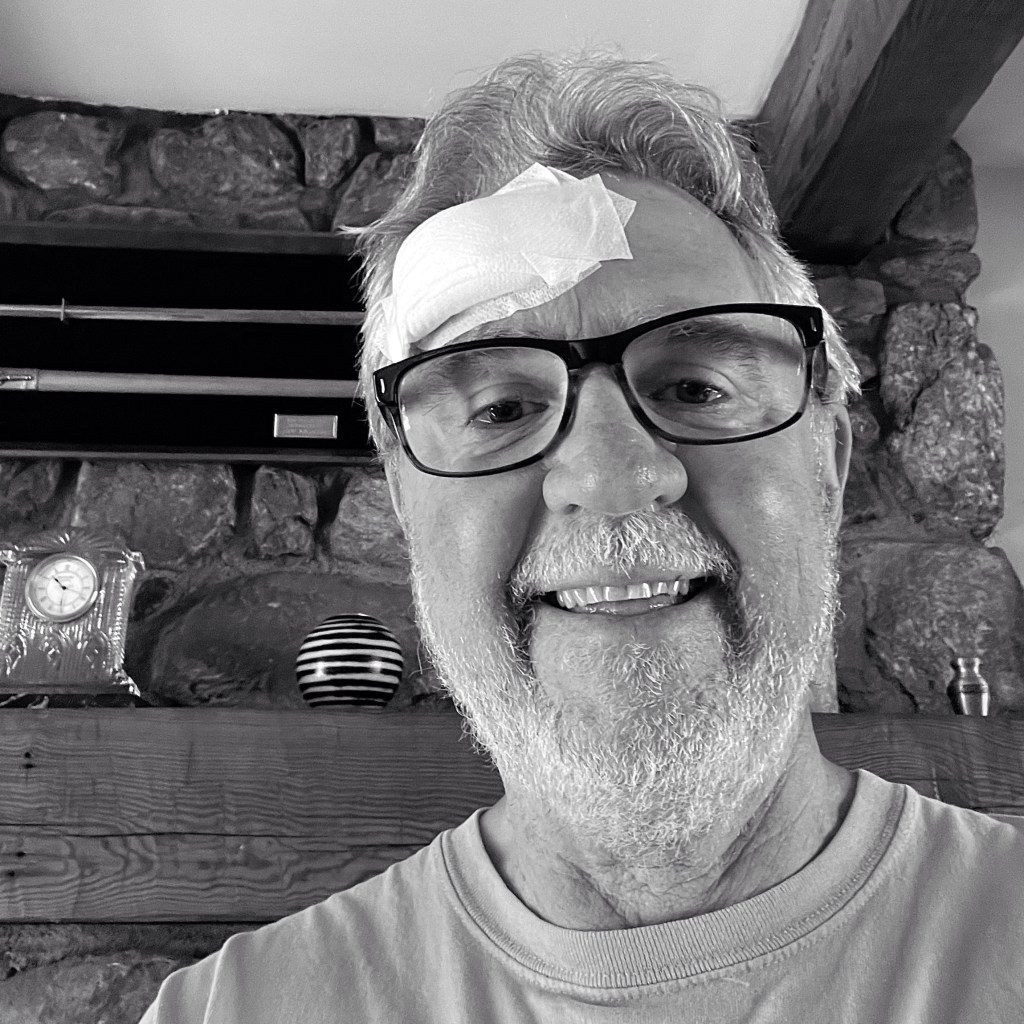
Thirty minutes later, Amanda came and gave me the good news. I was clear after the first pass. She said I was probably the easiest and shortest surgery the doctor would have all day. We went back to one of the rooms where the good doctor stitched me up. Seven or eight stitches I think but if you look at the picture, they’re big stitches. That’s fine with me. Just a little more character added to my forehead, and vitamin E should make it disappear over the course of the next year.

Mohs Surgery in Four Easy Steps.

There was a headache for a day or two, and a slight black eye in my future, but that was alright. Things were OK, at least for now.

In 1964, actor John Wayne was diagnosed with lung cancer. Some people recommended he hide the diagnosis due to concerns about his image – they thought it might make him look weak. At the time, many public figures hid illnesses they had for image reasons. He chose the opposite path. During a press conference after the surgery the Duke said “They told me to withhold my cancer operation from the public because it would hurt my image. Isn’t there a good image in John Wayne beating cancer? Sure, I licked the Big C.”

Squamous Cell Carcinoma isn’t the “Big C”. We have friends and family who are dealing with, or have dealt with breast cancer, lung cancer, pancreatic cancer, brain cancer, prostate cancer, melanomas… there’s a lot of bad stuff falling into the “Big C” category. I know I’m quite lucky and this is fairly minor, so let’s just call it the “little c”.

One of the things for people to remember is that any cancer, even something relatively minor like my “little c” squamous cell carcinoma can kill you if left untreated. If you see something that doesn’t quite look right on your skin, have it checked out. If everything is fine, all you did was lose an hour of time. And if it turns out to be a cancer of some sort, you did the right thing and can have it treated.

No need to be macho. No need to be stoic. Just get the damned thing checked out.

Really. Just Get the Damned Thing Checked Out.
— Feel Free To Share This Blog —

Addendum:

– If you live in the Warrenton/western DC suburbs area, I highly recommend the Warrenton Dermatology and Skin Therapy Center. They are great, and take care of you. You can find more about them here: https://www.warrentondermatology.com/