October 21st, 2024 is the 156th anniversary of the 1868 dedication of a statue at West Point honoring General John Sedgwick. In August of this year, my West Point Class of ‘78 took part in a rededication ceremony for the statue. You may ask why – The story spans two centuries.
It’s happening here in Virginia. We’ve seen the influx of more illegal and unwanted aliens. Their numbers are in the millions and growing. Trying to eliminate them by the usual methods isn’t working. Yep, the Spotted Lanternfly is causing problems and it’s going to get worse.
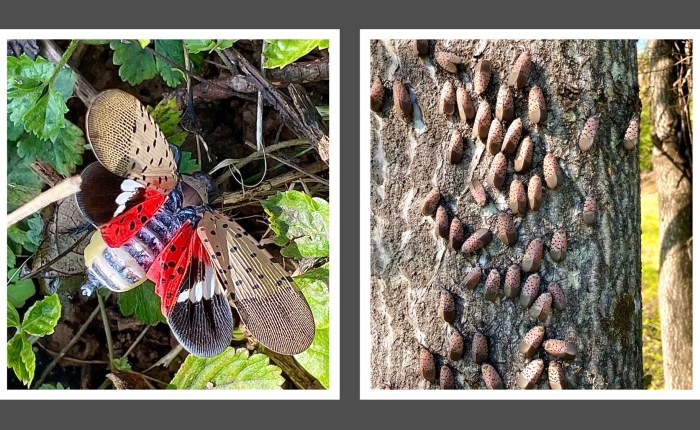
The Spotted Lanternfly is an invasive species, native to China and Vietnam. It first arrived in America in 2014 in Pennsylvania, probably via some kind of shipping container. Spreading slowly at first, it eventually arrived in Virginia a few years ago. Two years ago, there were none here at the farm. Last year we saw a few, and this year there are lots of them.
ASpotted Lanternfly in the Backyard.
The major concern is that they cause damage to some native plants, including grapes, soybeans and trees, particularly walnut and maple trees. “Nymphs and adults feed on plants, using their piercing mouthparts to suck sap from trunks and stems. This has been shown to cause stunted growth, localized damage, and reduced yields.” *. It has no known predators at this point, although some birds like to eat them. In my view, trying to kill them by hand (by smashing them) is fairly worthless at this point, as there are so many of them.
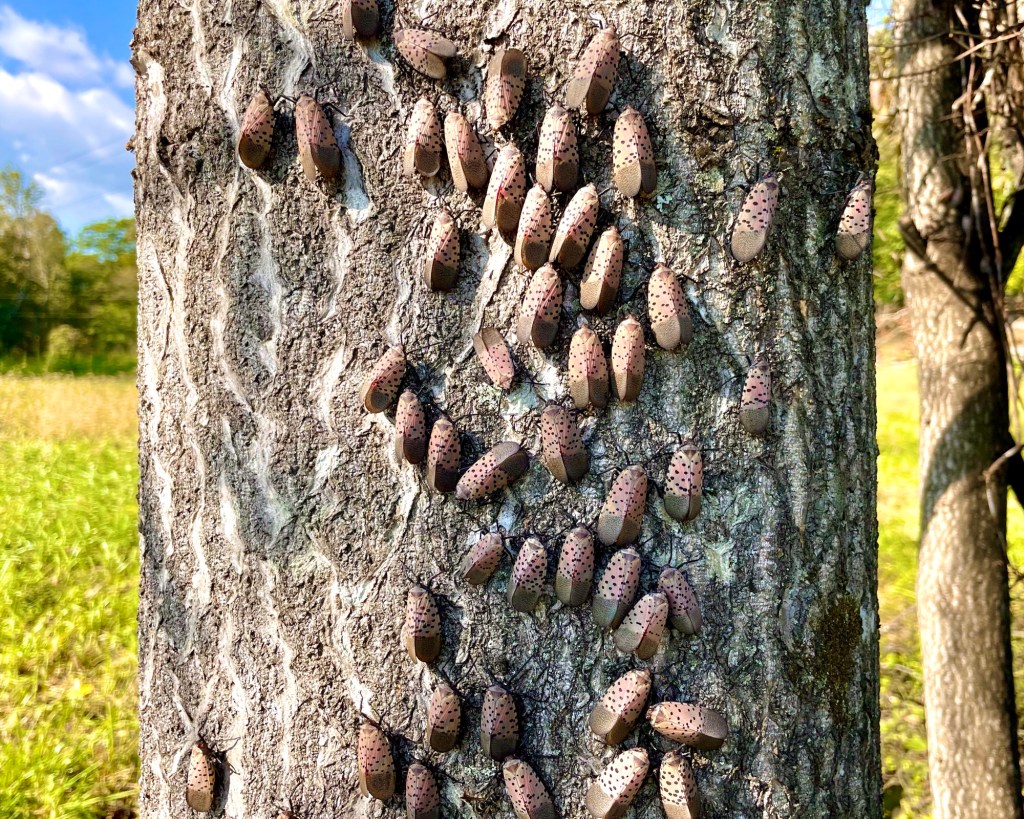
In an interesting twist, the Spotted Lanternfly’s favorite host is the “Tree of Heaven”, another invasive species! Originally from China, the Tree of Heaven was brought to America in the late 1700s as both a shade and an ornamental tree. Unfortunately, it can crowd out native species with its dense shade, AND with a toxin it spreads in the ground that inhibits other plants from growing nearby. As an added “feature”, it stinks in the Fall.
Spotted Lanterflies Feasting on a Tree of Heaven Trunk.
It’s tough to kill the Tree of Heaven. If they are small, you can pull them out. If they are bigger, you can pull them out with a tractor. If they are large trees, you can cut them down and apply poison to the stump, but its roots spread and develop shoots establishing many more trees. There are other ways to kill them, but they are more complicated and you must stay vigilant afterwards We have plenty of them here on the property and across the Virginia Piedmont. If you kill all of those on your property and your neighbor does nothing, you are going to have problems, as they produce a prolific number of seeds that spread in Autumn. Some folk call it the “Tree from Hell”, rather than the Tree of Heaven.
Tree of Heaven With Flowers
We are working on controlling both the Spotted Lanternfly and the Tree of Heaven, although it’s an ongoing battle. Maybe the Spotted Lanternfly is helping in the Tree of Heaven battle, but it’s hard to tell at this point. The Lanternfly is a beautiful insect. Unfortunately, the beauty is only skin deep.
Oktoberfest in München, Germany is from September 21 to October 6th this year. Thinking back, I remember our adventures there in ‘87 with our friends Tim and Bobby. Cathy injured her arm on the rollercoaster at the fest grounds and had to drink her liter mugs of bier with one arm in a sling for the rest of the day.
Our old friend Tim and his buddy Bobby visited us in the Fall of ‘87. At the time, we were stationed in Worms, Germany. Upon arrival, they spent a few days at our house*, and then boarded a train to tour parts of Germany, Austria and Northern Italy. Before they left, we agreed we’d all meet at a location in the München Bahnhof (Train Station) eight days hence and go to Oktoberfest together. This was before cellphones, or texts or email so coordination was a bit trickier. Plus, phone calls in Europe, especially country-to-country were expensive and we avoided them unless necessary.
Cathy and I had, of course, visited many bier and wein festivals in Germany over the years. We usually enjoyed the smaller local festivals more than the big ones. To borrow a word from the Germans, the smaller fests tended to be more “Gemütlich”, a word that doesn’t really translate well to English, but roughly means a combination of fun, pleasant, comfortable, friendly and of good cheer. When Tim asked about joining them at THE Oktoberfest, we agreed to give it a go, and would meet them in München.
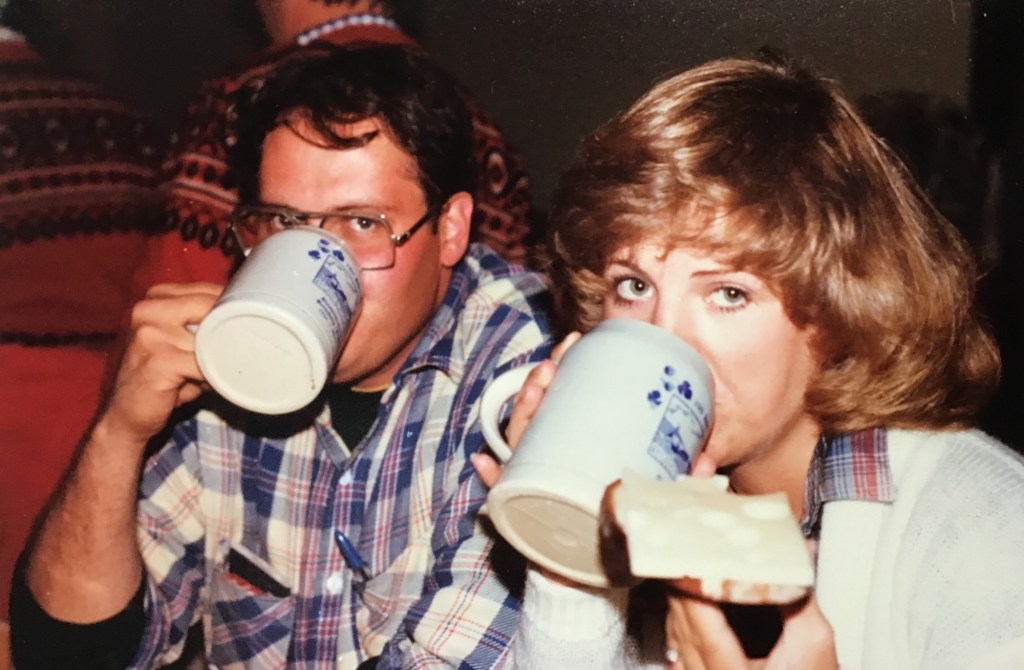
Tim and Cathy Drinking Bier on Another Occasion at the Kreuzburg Monastery,
The München Oktoberfest is huge – part bierfest, part carnival, part party and part madhouse. Last year, visitors consumed over 6.5 million liters (a little over 1.7 million gallons) of bier at the festival. Only bier brewed at the city of Munich’s breweries is served. Anyone who has visited München knows about the Hofbrau Haus, but there are actually five other breweries in the city besides Hofbrau, including: Augustiner, Hacker-Pschorr, Löwenbräu, Paulaner and Spaten. The breweries all adhere to Germany’s beer purity law from 1516, the Reinheitsgebot, which states beer is only made from four ingredients: water, malt, hops, and yeast.
On the day before our link up, Cathy and I drove to Augsburg, Germany, about an hour outside of München. There we had reservations for a Gasthaus for the next two nights and for Tim and Bobby on the second night. We spent the night in Augsburg and the next morning, took the train to München. At the Bahnhof in München, all of us miraculously arrived at the appointed time. Then it was off to the Fest!
Paulaner was always my favorite München bier, so when we arrived at the Fest Grounds, we made a beeline to the Paulaner tent. Each of the breweries have massive tents that can hold thousands of people. People sometimes hang all day at one tent, while others move from place to place. The only problem with the second option is the tents fill up early and stay packed. Giving up your seats in one tent doesn’t guarantee seats in another.
Partial View of an Oktoberfest Tent.
As we were finishing our first liter at Paulaner, we were trying to decide what to do next. Someone suggested that if we were going to ride any carnival rides, we should do that now, before consuming more bier. We made the ill-fated decision to ride the rollercoaster before going to the Hacker-Pschorr tent.
At the roller coaster, Tim and I climbed in one car and Bobby and Cathy jumped in the next. I should point out Bobby was only a few inches taller than Cathy, but probably weighed 75 pounds more. You might see where this is going.
The rollercoaster took off and rapidly gained speed. At the second corner, it made a sharp left turn and Bobby slid hard into Cathy, slamming her into the right side of the rollercoaster car. When we all got off the rollercoaster a few minutes later, Cathy could not move or lift her right arm without pain. In fact, she could hardly move the arm at all. What to do!?
Well, it turned out Oktoberfest had its very own first aid station with doctors and we visited it (in 2023, over 8,000 people used the aid station during the festival). Still early in the day, there were no patients yet. Cathy got right in, while Tim, Bobby and I waited outside. Eventually she returned with her arm in a sling. They didn’t believe she broke any bones, but had severely pulled the muscles around the shoulder and strained some ligaments. They put her in a sling to immobilize her arm and gave her aspirin for the pain.
What to do now? Of course we headed to the Hacker-Pschorr tent and ordered four biers. As the biers arrived, Cath ran into a slight problem. She’s right-handed and that’s the arm she injured, so she had to drink with her left hand. It sounds simple, but liter mugs are heavy, especially when full of bier. She ended up holding the stein in her left hand and then used her right hand (in the sling) to support the mug from the bottom. It was quite the operation. ;-).
The rest of the day was a fun time, and anyone who knows Cathy, knows she’s a trooper. We made it to a couple of other tents along the way and also ate some great food. I think Cath and Bobby both had the famous roast chicken, while Tim and I ordered grilled ham hocks the size of small hams. I’ve never seen ham hocks that big before or since. They were huge, and oh-so-tasty.
Eventually it was getting late and we caught a train back to Augsburg. It was crammed with other revelers heading out of the city. There were various states of intoxication, but people were all in a good mood – a few were still singing German songs, while others tried to sleep. About an hour later we arrived in Augsburg, and finally made it to the hotel and bed.
The next morning, I woke up and felt surprisingly good. After taking a shower, I heard Cathy call out to me. She was in bed, but couldn’t turn over or get out of bed – her arm was of no use. I turned her over and other than her arm hurting like hell, she was ok. We put her arm back in the sling.
We linked up with Bobby and Tim for breakfast and then the four of us made the drive back to Worms. The next day, Cathy went to the doctor’s office. Diagnosis? Just as the doctor said at Oktoberfest, she had some pulled muscles and strained ligaments. She ended up wearing the sling for two more weeks.
We joked later that rather than riding the roller coaster early, we should have skipped it all together and stuck to the bier tents. It would have been a safer day. 😉
Addendum:
* You can read about the first part of Tim and Bobby’s trip to visit us in ‘87 here: In the ‘80s when we lived in Germany, several family members and friends visited us. To “help” them overcome jet lag, we made sure the first couple of days were action packed with eating, drinking and activities to keep them occupied. It almost proved one friend’s undoing in 1987 […] Continue here: https://mnhallblog.wordpress.com/2023/09/12/tim-and-bobbys-visit/
Colonel Bayshore called me into his office. “Max we have a problem at the new Alternate Support Headquarters (ASH) in England and need you on a plane.” “What’s the problem?” “A grounding issue.” “Ummm, I don’t know anything about grounding.” “None of us do. Here’s the manual.”
In 1988 Cath and I were stationed in Germany with the Information Systems Engineering Command (ISEC). I was a Captain at the time and had my master’s in electrical engineering. ISEC did all kinds of complex Information Technology (IT) implementations.
When Colonel Bayshore called me into his office to talk about the ASH*, it was a classified site. The US European Command (EUCOM) ASH was in High Wycombe, England and where EUCOM HQ would bug out, if they needed to evacuate Germany during a war. Originally built in 1942 during WWII for other reasons, the US government later rebuilt the bunker to support the ASH during the Cold War. It was an underground complex and built to survive not only conventional bombings, but even an ElectroMagnetic Pulse (EMP) nuclear attack.
The site wasn’t yet occupied. The system installations were handled by a different organization than ours, with much of the IT work completed by a contractor. Most work was completed with systems installed, but one of the classified rooms had a problem. Whenever you used the secure phones in the room, there was crosstalk with other phones, making it impossible to have a classified conversation. The ASH facility could not pass its security accreditation until the issue was resolved. This meant the faculty could not undergo final testing or become operational. An engineer “somewhere” thought it was a grounding problem. They contacted ISEC for outside support, resulting in Colonel Bayshore’s call to me.
Sergeant First Class (SFC) George Walls would also go on the trip. George was great and a super technician. We would work as a team at the ASH until we solved the problem.
The next day, George and I started reading “MIL-HDBK-419A – Grounding, Bonding, and Shielding for Electronic Equipments and Facilities Volume 2 of 2” (Volume 1 was theory. Volume 2 was applications). At 394 pages, it was a massive document and told us everything and anything we could possibly want to know about grounding buildings and electrical systems within those buildings
Vol II of Mil-Handbook 419A – All 394 Pages of it.
A day later, we were on a plane crossing the Channel. We continued reading and rereading MIL-HDBK-419A.
Arriving in England at the ASH, we met our government point of contact (POC) and a representative from the contractor. They were skeptical we would find anything, but welcomed our help. Our job was to identify issues, but not to fix them. The contractor would complete the corrections, once tasked by the government.
After giving us a tour of the facility, they offered to accompany us as we started our work. We politely declined, and let them know if we needed any help, we would contact them. We didn’t want anyone looking over our shoulders – partly to minimize outside interference in our investigation, and partly so no one could see how green we were in our knowledge of grounding. Quoting from the book/movie “MASH”, we were “The pros from Dover”** and we didn’t want anyone questioning that.
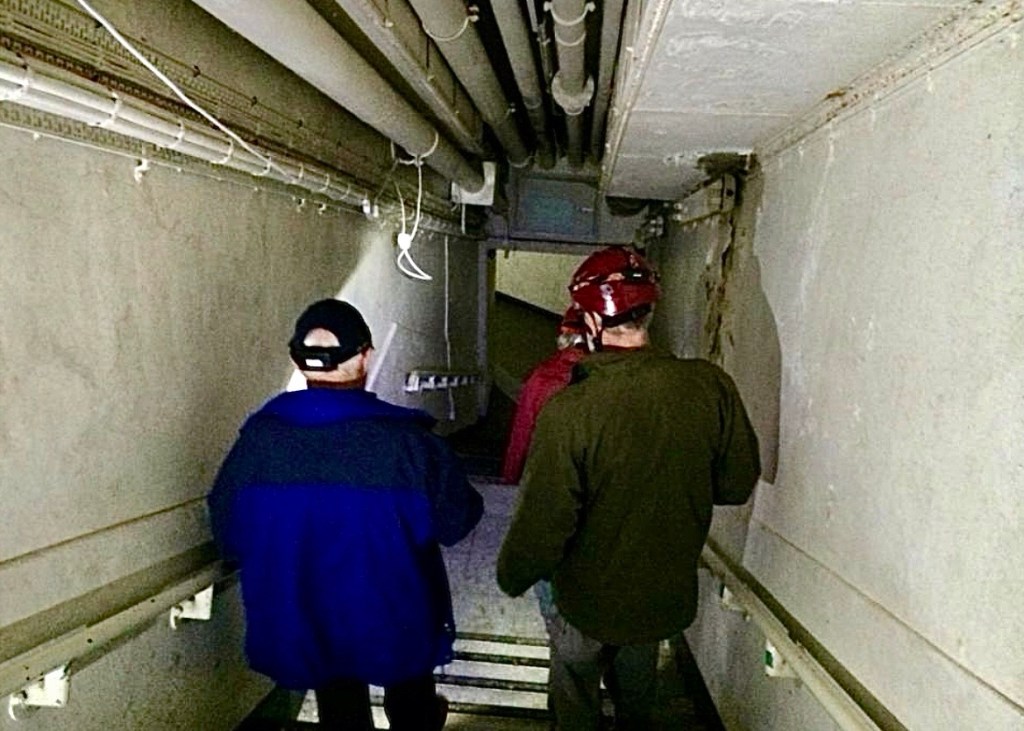
The Descent Into the Bunker Complex.
We started our work in the classified room with the crosstalk problem and spent two days checking every system, circuit, wall plate, ground connection and the entire ground grid underneath the raised floor in the room. We found some wall plates that weren’t grounded and one improperly grounded system, but found no issues related to the crosstalk problem.
From there, we proceeded to the classified phone switch room and did the same type of inspection. Again, we discovered several issues, but none that we believed caused the crosstalk. We hadn’t solved the problem, but our list of grounding issues within the facility continued growing.
Next, we went to the Tech Control Facility (TCF) where all connectivity (cables, wires and radio channels) for the systems going into or out of the ASH passed through. We documented more and different grounding issues.
With the growing list of problems, I called COL Bayshore and recommended we inspect the entire underground facility for grounding issues, including all rooms, systems and connections. This was outside our original scope, but both George and I were concerned with what we were finding. COL Bayshore agreed, but needed approval for the expanded work. The next day, the powers-that-be gave approval.
We spent the next few weeks at the ASH continually documenting grounding issues. Many were minor, but some were major. As one example, in a room housing the Worldwide Military Command and Control System (WWMCCS), all systems were properly connected to the ground grid below the raised floor, but the ground grid itself was not connected external to the room, making it worthless. In another case, the grounding cable for an external backup generator was almost cut in half. At some point in the past, the generator startup battery arced to the ground cable, nearly severing it.
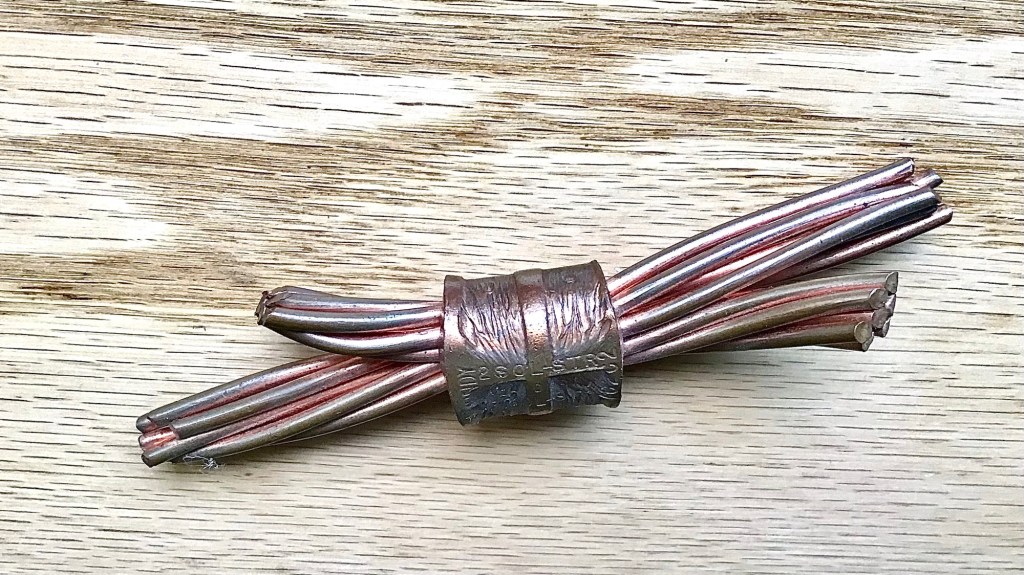
A Piece of the Below Floor Ground Grid.
After about three weeks, we finished our inspection. Our list of grounding issues was twenty or thirty pages long and many items needed correction prior to the facility going operational. We sent a copy back to our headquarters at ISEC and also gave a copy to the facility government POC. Needless to say, with the number of identified problems, there was a bit of shock both back at our unit, and in the facility.
Unfortunately, we still hadn’t solved the crosstalk issue.
That night as George and I were having dinner and a beer, we talked things over. We tossed some ideas back and forth, and ultimately decided we would track a single phone circuit in the classified room from the phone to the connection plate to the classified switch to the TCF and see if we could find the problem. Maybe it wasn’t a grounding issue.
The next day, we were back in the classified room and pulled one of the phones from its cable and inspected it. Nothing…Nada…Nope. From there we traced the phone cable to the wall plate. We took apart the wall plate and pulled out the physical jack the phone plugged into. As we looked at one side we noted the connection port, a resistor, and a couple of capacitors – nothing too exciting there. We turned it over and started tracing the circuitry. HELLO! What’s this? Two capacitors were interconnected and double connected to different circuit posts in the jack where the phone itself connected.
Front and Back of the Phone Jack
We stared at the wiring and started talking. Was this the issue? There was only one way to find out. George pulled out a pair of wire cutters and …snip snip… cut the connections for the suspected capacitor.
We reassembled everything, plugged the phone in and made a call. NO CROSSTALK!
We notified COL Bayshore and then spoke with the POC and the contractor about what we found. They were shocked (and surprised we had the temerity to cut the connections). We eventually tracked down why the connectors were incorrectly wired. It turns out the phones all came from the US for the classified system. The contractor obtained the connectors in Europe. They may have worked with the European equivalent phone, but they would not work with the US version as wired.
George and I were still in England for the next couple of days and had become minor celebrities of sorts. Calls came in from both DC and Fort Huachuca, Az where they completed the original system implementation/design work. The calls were a bit funny. People congratulated us, but couldn’t quite believe we solved the problem, or how we solved it. They asked several questions – some we could answer, some we couldn’t. It didn’t really matter to George or me by then. We’d finished something no one else had solved, mostly through detailed work, and a little bit of luck.
A couple of days later we made our way home to Germany, mission accomplished.
I have thought about the trip more than a few times since then. Becoming an “instant expert” was important. I knew I wasn’t really an expert at the start, but I knew we had more knowledge about grounding than anyone else connected to the program. By the time we finished, we truly were grounding experts.
Finding the many grounding problems was important. The issues probably would have gone unnoticed until a system failed, possibly during a real-world crisis.
Lastly, it was important to remember that sometimes the problem isn’t what you think it is, or what others think it is. Sometimes it’s something so small and innocuous it goes unnoticed, just sitting there looking innocent. Keeping an open mind is always important.
Charlie sent an email to all of us company B-3 West Point ‘78 grads. Colonel Bob Radcliffe, our Tactical (TAC) Officer when we were cadets, passed away. My mind did an immediate flashback to my last two years at school. He made such a difference in my life and was a true mentor and leader.
For me, I’ll always remember him as Major Radcliffe. That was his rank when he served as our TAC. By way of explanation, each of the 36 companies had an active duty officer assigned as a TAC Officer. The TACs:
“Are the primary leader developers/integrators of the Academy’s developmental programs. They oversee each cadet’s individual development in the academic, military, physical, and moral-ethical dimensions within the framework of the Cadet Company. The TACs train, lead, coach, and mentor cadets, with a continual focus on leader development. The TAC is … responsible for the establishment and maintenance of a command climate that fosters individual and unit excellence in all program areas.”
There were of course all kinds of TACs at West Point. Most were good, but some were martinets and some were too folksy. Major Radcliffe was one of the good ones. From my perspective, he was one of the great ones. He knew how to strike the right balance in his work with us.
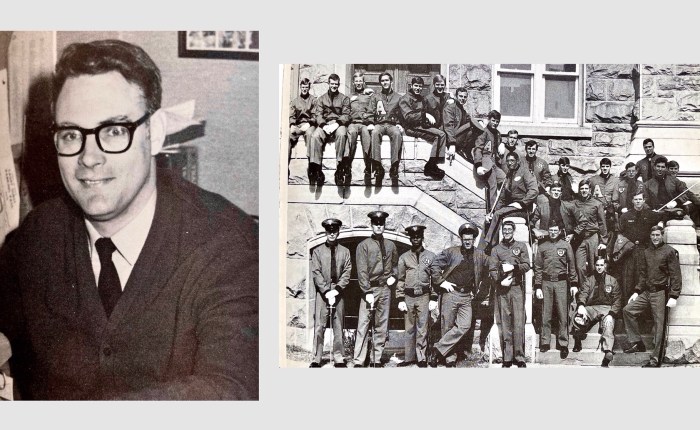
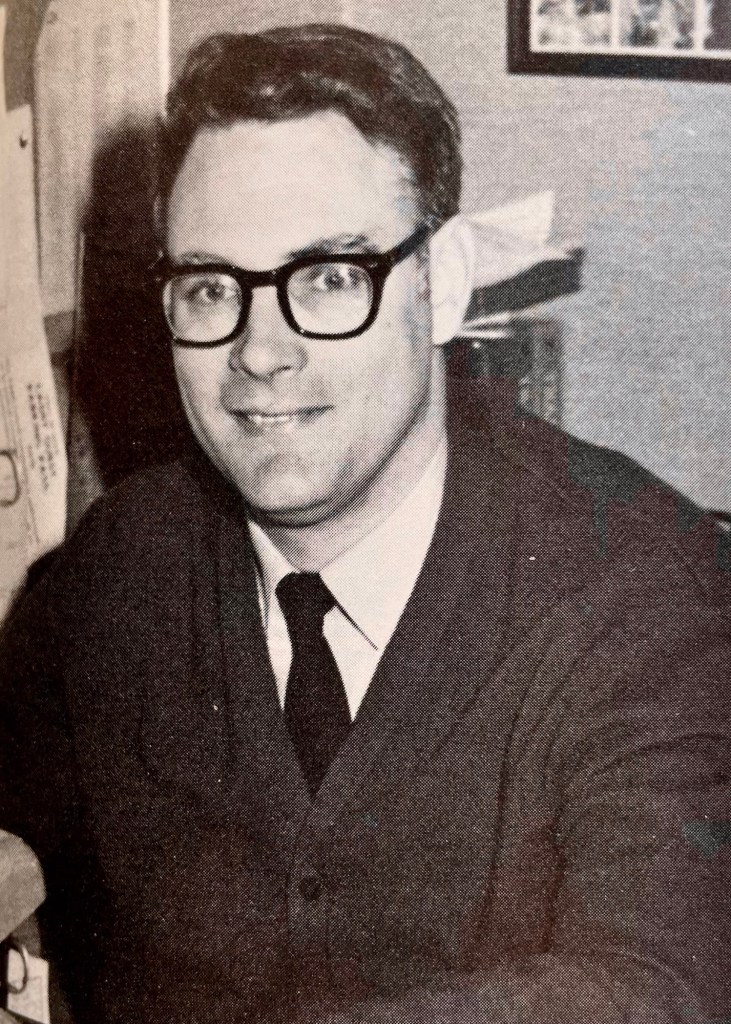
Major Radcliffe in our 1978 Yearbook.
He was a Grad himself from the class of 1965. He was also a first team All American Lacrosse player while at the Academy. After graduating and commissioning in the Infantry, he obtained his Airborne wings and Ranger tab. He did a couple of tours in Vietnam, where he earned the Combat Infantry Badge, the Silver Star and the Bronze Star for Valor.
He made us toe the line as Cadets, but also had a human side. When Cathy and I learned she had MS, he worked with me to obtain an immediate weekend pass to see her in DC, which was so important for me. We weren’t engaged yet, but he came through. He also helped rescue me from myself when I screwed up on something at school. For both of those items, I will be eternally grateful.
Additionally, Major Radcliffe had a sense of humor. I remember going to his home a few times for cookouts or dinners. On one occasion, he surprised us when he lifted his sweatshirt revealing the T-shirt he wore underneath. It said, “US Team. Southeast Asia War Games. 1960-1975. Second Place.” Sense of humor indeed.
A Wry Sense of Humor
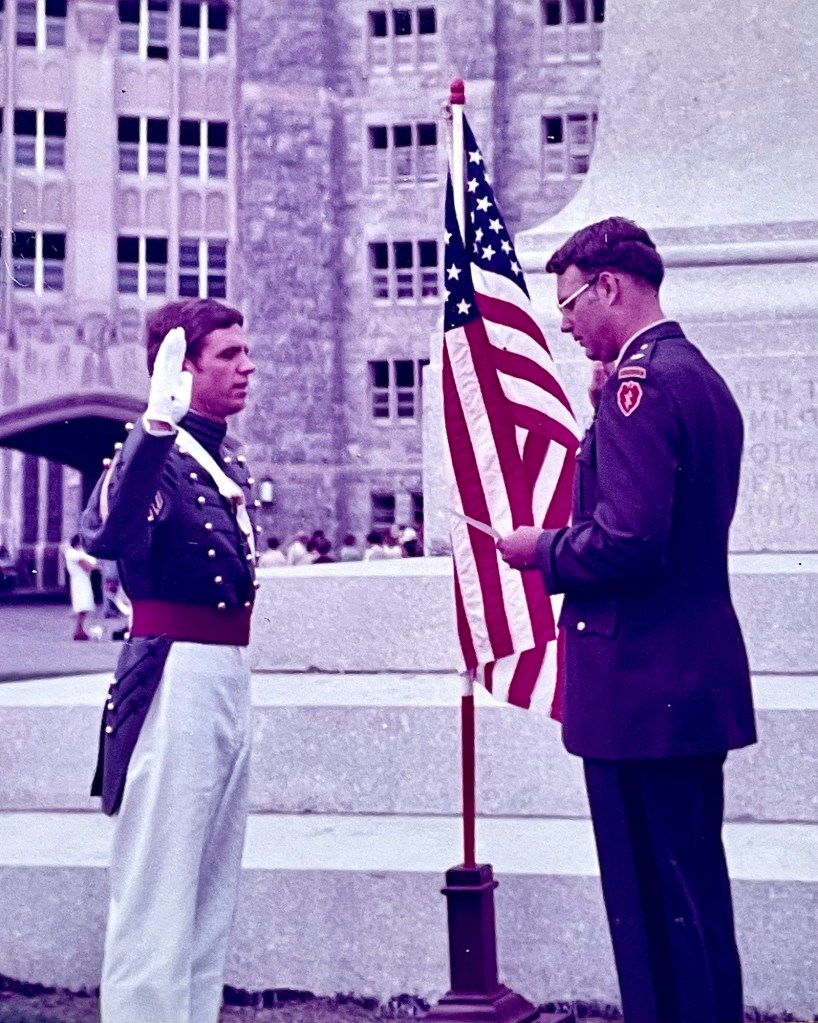
My last official interaction with Major Radcliffe was when he swore me in as a Second Lieutenant on Graduation Day. We were at Washington Monument on The Plain and I remember it as if it were yesterday. Mom, of course, snapped the picture.
My Swearing in Ceremony with Major Radcliffe.
I only saw him a couple times after graduation. Once in the military at an exercise or meeting somewhere. The second time was by chance in an airport. We were both civilians by then and chatted briefly, while waiting for connecting flights. In 2020, Cathy and I were going to host a mini B-3 reunion and we invited him to the event. We traded a couple of emails back and forth and he looked forward to attending. Unfortunately, COVID intervened and we cancelled the get together.
Yes, when Charlie’s email arrived in my inbox, I had my flashback to West Point. I also thought about his impact on my life and how he, along with West Point itself, changed the arc of my life. We didn’t call it mentorship back then, but that’s what it was. His mentorship and his leadership made a difference for many of us, and I’m glad he was in my life. It’s a debt I can’t repay.
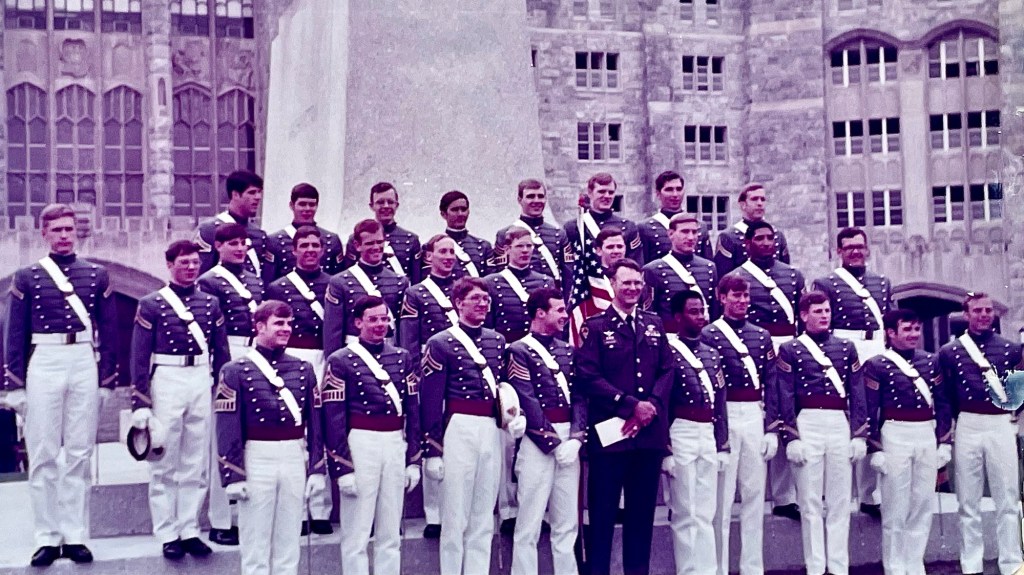
Company B-3 Firsties (Seniors) with Major Radcliffe on Graduation Day.
Addendum:
The photo of Major Radcliffe in the South East Asia war games shirt is courtesy of company mate Charlie Wright. I’d told the story of the shirt for years, but Charlie had the actual proof of it.
Thanks to company mate Charlie Bartolotta for providing some of the information in this blog.
In the summer of ‘87, my folks visited us in Germany. We had a grand time touring Germany, Austria, Northern Italy and Switzerland. One of the highlights was Glacier Skiing at Sölden, Austria and then afterwards, hanging at the Lodge drinking bier, while Cathy worked on her tan.
On our first tour in Germany from ‘79-83, Mom and Dad visited once for a vacation in the summer of 1982. I was a Company Commander in the 34th Signal Battalion at the time and the day we were to leave on vacation with them, the phone rang about 4AM. Cath said, “Don’t Answer it”. I said, “I have to.” She answered back, “Don’t answer it.” I answered the phone.
The call came from Battalion Headquarters and we deployed on an alert for the next three days. While I was in the field, Cath showed Mom and Dad around Southern Germany and the Black Forest. When I returned from the alert, we travelled the next ten days together. Dad understood what happened with the alert and why I had to go, but I’m not sure Mom did.
When we moved back to Germany in ‘85, we didn’t think Mom and Dad could afford another visit. Airline travel was expensive, as was the trip itself. Then, fate intervened. Dad hit 5 out of 6 numbers on a lottery ticket and won several thousand dollars. Never ones to let extra money go to waste, they scheduled a visit with us in Worms in the summer of 1987.
When they arrived, we spent the first few days near Worms and the village of Rheindurkheim, where we lived. In addition to introducing them to local friends, we spent an evening at one of our favorite Weinfests. Everyone enjoyed themselves, or at least that’s what the photos seemed to indicate.
Prost!
Eventually, we left Rheindurkheim and headed South for the main part of the vacation. I’m not sure why, but Cath and I decided to take our skis along and get some Glacier skiing in, something we’d never done before. Looking back now, it seems an odd decision. Mom and Dad wouldn’t ski, but I’m sure we talked with them about it. In any case, off we went down the Autobahn with the skis strapped on the roof rack of our Saab.
After visiting good friends Jim and Res in Stuttgart for a night, we made our way to the Alps. We planned a drive through Austria, Northern Italy and Switzerland, but started with Sölden, Austria where we would ski. In the 1980s, you could still ski Sölden virtually all year long*.
Glacier skiing is a bit different from regular skiing. You have to hit the slopes early, and most people only ski in the AM. By late morning, the sun has warmed the slope and the glacier starts turning to slush. Also, as the morning wears on, the snow/ice on the glacier tends to become gravelly, not quite ice and not quite snow.
That first night at Sölden, we ate dinner in the little Gasthaus where we were staying. We discussed skiing the following morning. Cathy was thinking about skiing in her bikini and I was up for wearing a pair of shorts. Ultimately, we decided to ski in sweats and jeans. If we fell, the gravelly snow would scrape us up pretty good.
The next day, after an early breakfast of Kaffee, Brotchen, Wurst und Käse (Coffee, rolls, sausage and cheese) we made our way to the slope and were skiing by 7:30AM. We’d told Mom and Dad they could hang at the Gasthaus, but they insisted on coming with us to the ski lodge. Dad took a photo as we headed to the lift.
Cath and I spent the next three hours skiing the glacier and it was wonderful. The piste (ski trail) wasn’t crowded, the snow was in great shape and we were skiing well. Occasionally, we’d check on Mom and Dad who were drinking Kaffee on a picnic table outside the lodge. Dad snapped some pics of us skiing, but for the life of me, I can’t find them. Around 10:30 the snow started getting slushy. By 11, we were through. We started getting wet from the knees down and were tired from the morning’s activities. In the additional good news department, we hadn’t fallen all morning.
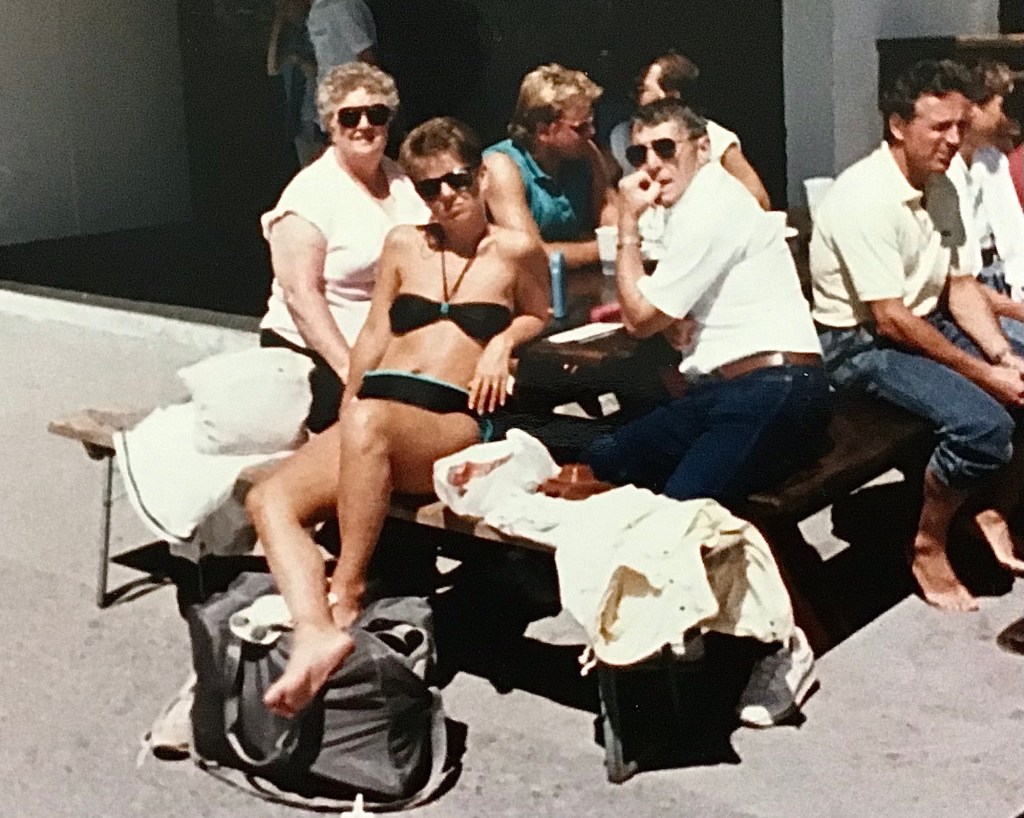
We stacked our skis in a rack, joined Mom and Dad and ordered some biers. Cathy stripped off her sweater and jeans, revealing the bikini she wore underneath. In the photo I took of Cath with Mom and Dad, I love the bored/sullen Euro look she adopted. Just another ho-hum day skiing the Alps and catching rays.
Cathy Working on Her Tan after Skiing in the Morning.
We spent one more night in Sölden, before heading for Nauders, Austria right on the Italian border. We’d previously skied a couple of winters there. After a couple of days seeing friends, we eventually crossed into Italy and then Switzerland, having an occasional roadside lunch of bread, cheese and wine. One day we forgot glasses, but that didn’t stop us. ;-).
No Glass? No Problem!
We worked our way to Davos, where we enjoyed a multi-course 5-Star meal at a restaurant just outside of town. At our hotel that night, we saw fireworks going off in the mountains across the valley. It was the celebration of the Swiss National Day, their equivalent to our 4th of July and pretty amazing. At the time, we had no clue about the importance of Davos or the World Economic Forum. All we knew was that we ate a great meal that evening and then saw a cool light show in the Alps.
Eventually, we returned to Rheindurkheim and other adventures, before Mom and Dad flew home.
It’s funny, I remember many parts of that vacation**, but for some reason skiing the glacier at Sölden stands out. It was only a small part of the trip, but remains firmly in my mind. Maybe it was the fun of the day. Maybe it was the skiing. Maybe it was just the remembrance of my wife soaking up sunshine in a bikini at the ski lodge after a morning of good play. All our days should be so happy.
Addendum:
I should point out that there were MANY women sunbathing in bikinis, not just Cathy. She’s the only one I took a picture of ;-).
* These days at Sölden, due to Global Warming the glacier is receding. Skiing stops sometime in May, and picks back up in September.
**When people visited us in Germany, we gave them atypical tours of Germany and Europe. We weren’t big on Churches and Museums, and instead, focused on local activities off the beaten path. On this particular vacation with Mom and Dad, we really wanted to show them parts of the Alps we’d grown to love in both the winter and summer months. I doubt we saw another American the entire time.
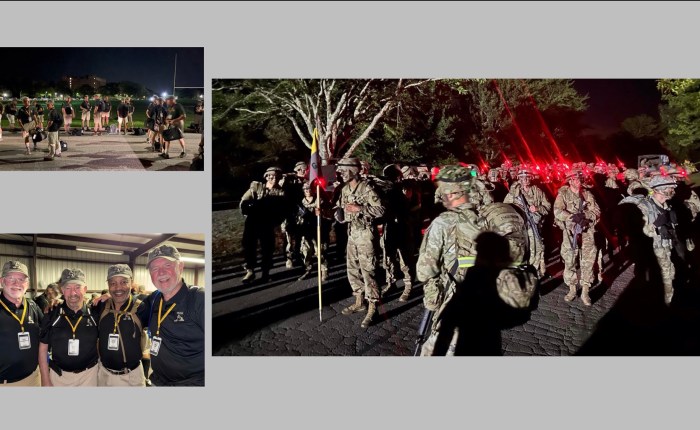
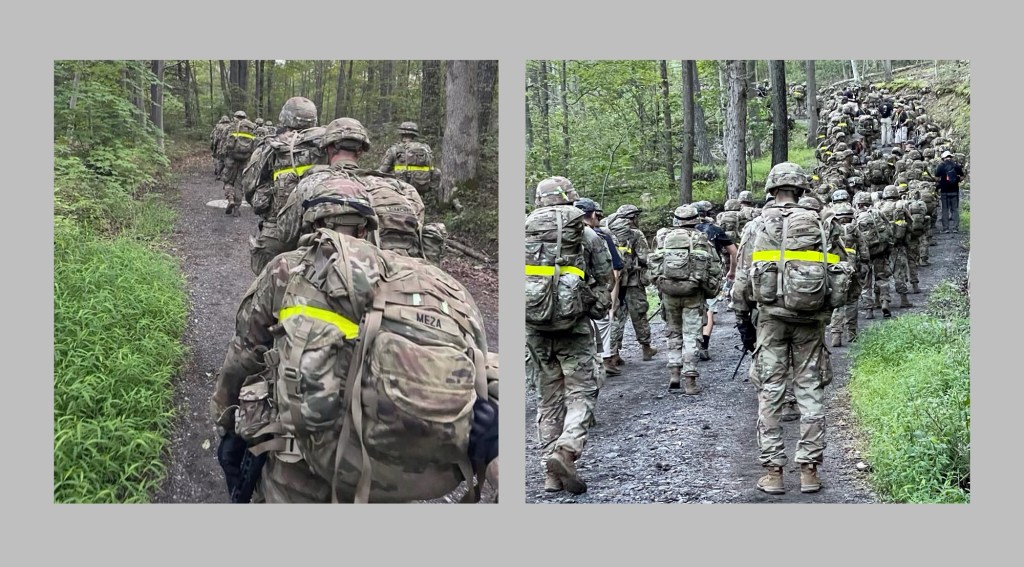
We started gathering around 0130 at Buffalo Soldier Field. Soon, buses would drive us to Lake Frederick. There we would link up with the West Point Class of 2028 and join them for their 14-mile March Back to West Point, which culminates with the end of New Cadet Summer Training, aka Beast Barracks. The Class of ‘28 will graduate exactly 50 years after we graduated in ‘78.
Just about everyone is aware that West Point Graduates are known for being a part of “The Long Gray Line.” The phrase “The Long Gray Line” in its simplest definition is the continuum of all graduates and cadets of the United States Military Academy at West Point, from 1802 to the present. In an effort to strengthen the concept of “The Long Gray Line”, the West Point Association of Graduates (AOG) started a 50 Year Affiliation Program (YAP). It’s an absolutely brilliant idea. The 50 YAP started 25 years ago in 1999, with the class of ’49 supporting ’99.
To bring some perspective, IF the program had existed when I was at West Point, our Affiliation Class would have been the Class of 1928. Classmate Frank Arduni pulled together some facts about that class:
The class graduated 261 new Lieutenants on June 9, 1928. By the time the last member of their class passed away in October 2010 at the age of 104, the class produced 78 General officers. They became pioneers of Army Aviation, and within four years of graduation at least 6 members of the class died as 2LTs in air accidents. Eventually 73 served in the Army Air Corps, two long enough to see it become the Air Force.
28 lost their lives in the Second World War, and at least eight of those as prisoners of war. Six members of the class were “participants” in the Bataan Death March, of whom only one would survive the ordeal.
One member of the class, Robert Albert Howard, was the grandfather of our 1978 classmate, Eric Franks (RIP).
Over the course of the next four years, various members of our class will attend significant events during the Class of 2028’s time at West Point. Some of those events include: their First Day at West Point and the Start of Beast Barracks; Affirmation Day at the start of Cow (Junior) year when they have officially committed to serving in the military; Ring Weekend; Branch Night Firstie (Senior) year, when they select their military branch; and of course, Graduation.
The event that caught my eye was “March Back”. At the end of Beast Barracks, the New Cadets do a forced march of 14 miles from Lake Frederick where they have been for some of their training, back to West Point. A few days later, they transition from “New Cadets” to full fledged members of the Corps of Cadets. Each year a number of graduates (Old Grads) participate in the March Back and interact with the cadets. The 50-year affiliation class is guaranteed 50 of those slots.
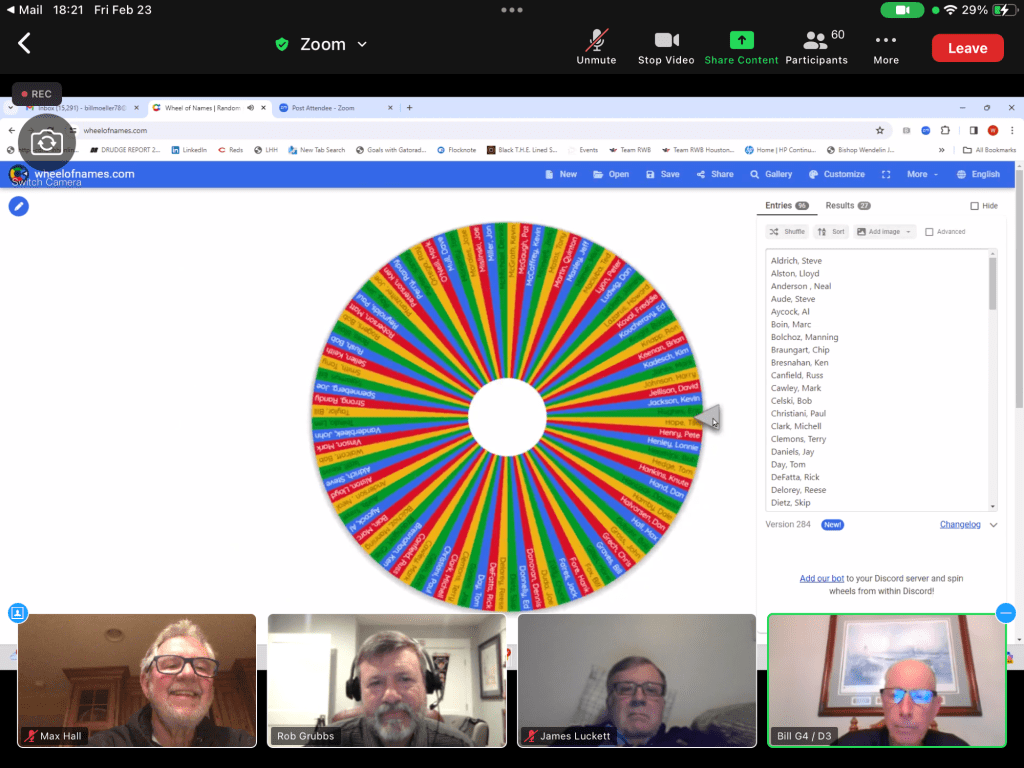
Last winter, our class announced the upcoming events. 118 of us said we wanted to do the March Back. In February, we held an online lottery via Zoom for the guaranteed 50 slots. I was number 76. D@mn. I now needed to rely on some luck and try and sign up for one of the additional slots available to all graduates later in the spring.
The Lottery
In the meantime, I increased the mileage of my daily walks and started going both farther and faster. The March Back itself is 14 miles long, with the first three miles entirely uphill. The pace was to be at 20 minutes/mile, but we were warned the first three uphill miles could go faster.
Route Elevation. The First 5 km Are All Uphill.
In June, I lucked out, signed up early enough online and was selected to participate in the March Back. Ultimately 73 members of the class of ‘78 would make the 14 mile March Back, with another 42 joining us for the final two miles.
Over the next month and a half, I increased my workouts again. I didn’t want to let myself, my classmates or the Class of 2028 down. In addition to daily 5-6 mile walks, I added several 8, 10 and 12 mile hikes over the hills here in Virginia. The longer hikes were at an 18 to 18:40 min pace. I was as ready as I was going to be.
On Saturday, the 10th of August, I made the six-hour drive to West Point. As always when returning to the Academy, my mind filled with a mishmash of thoughts – the March Back of course, but also my own time at West Point, and its impact on my life. It’s 46 years since I graduated, but I still remember reporting to The Man in the Red Sash on my first day as if it was yesterday.
That first night was great and I had the chance to see a number of classmates who were also staying at the Thayer Hotel. We had drinks and dinner while telling stories and catching up on the activities in our lives. Our hair was grayer and we were, perhaps, heavier, but our love for life remained.
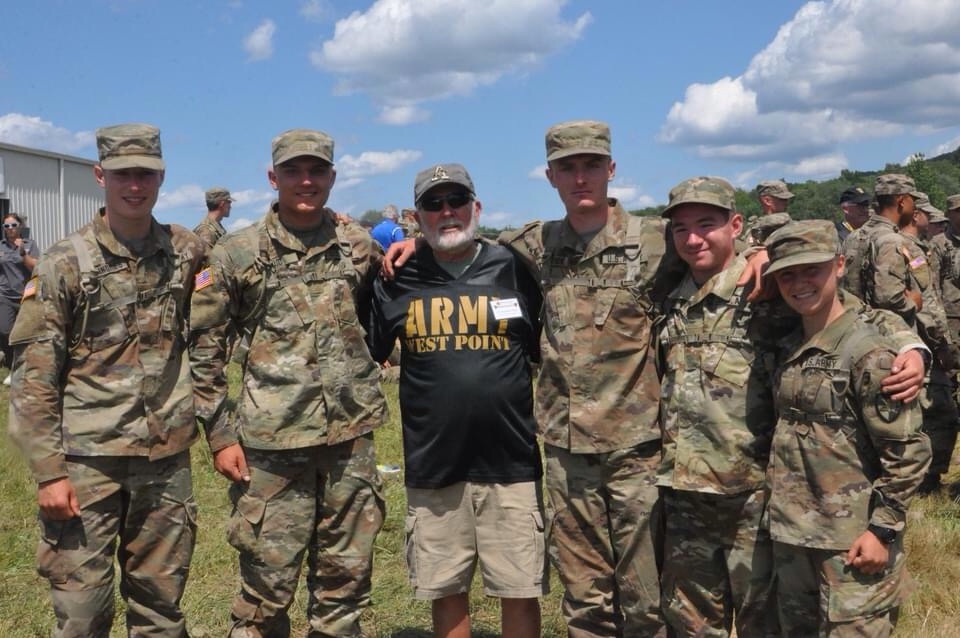
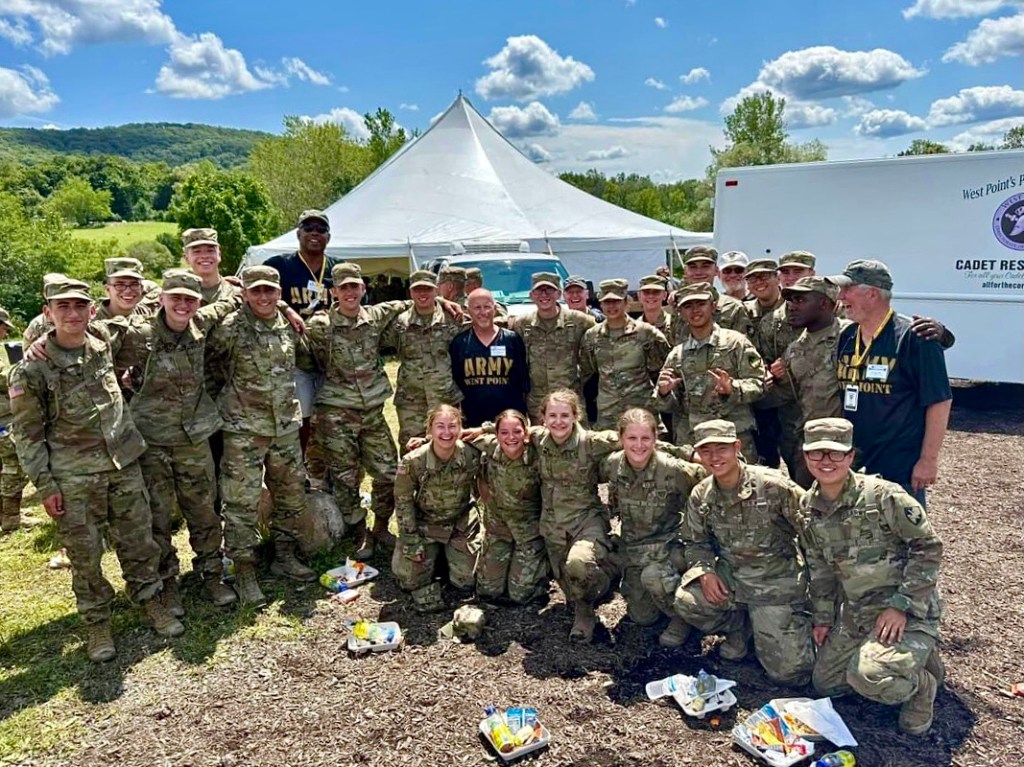
The next day, the AOG bused us ‘78ers out to Lake Frederick to interact with the class of ‘28 prior to the march later that night. At lunch we talked with the New Cadets over hotdogs and hamburgers. It was the start of an amazing 24-hour period. I probably spoke with 7 or 8 different groups during the next three hours and came away universally impressed. You hear stories about kids being unmotivated these days – nothing was further from the truth for these young men and women. They were sharp, motivated, inquisitive and fired up. They had marched 9 miles to Lake Frederick three or four days before in the remnants of Hurricane Debby. It rained during the march and for the next two nights when they slept outside without tents. You’d have thought they would be depressed or unmotivated, but the exact opposite was true. They were charged up and attentive. I was inspired by all of those I met and spoke with.
Classmate Bob Rush with Members of the Class of ‘28Some of the Class of ‘28 with a Couple of us Old Grads
We eventually boarded our buses for the trip back to West Point. My mind kept playing and replaying the time with the New Cadets. Yes, we were there to help them understand the concept of The Long Gray Line, and hopefully we were doing that. What I hadn’t understood earlier was how motivating these young people would be for me. Their enthusiasm had increased my own. They also brought home the fact that The Long Gray Line extends both into the past AND into the future.
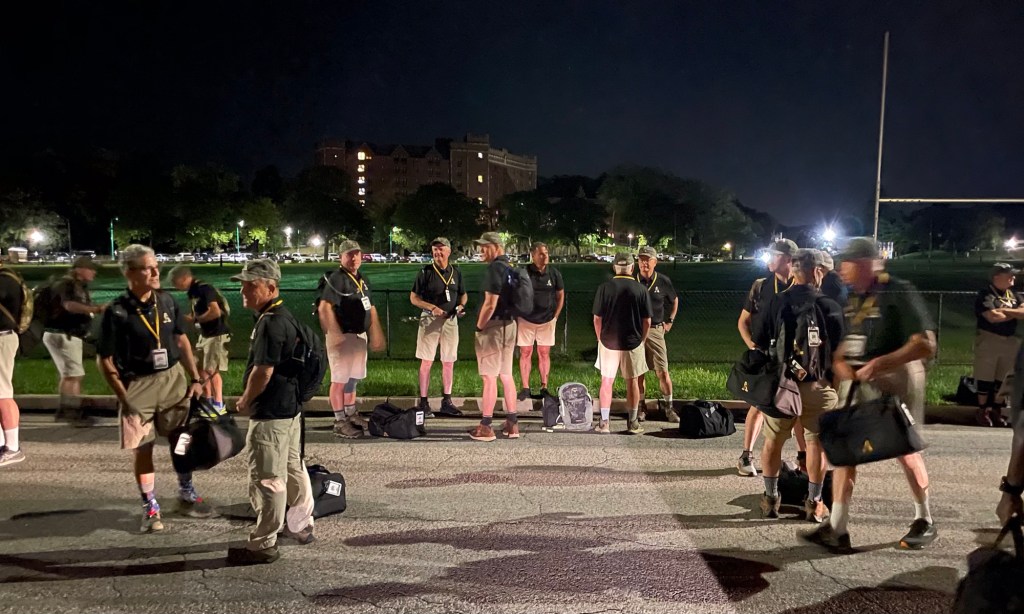
I went to bed around 2100 that night, but didn’t sleep much. Three hours and forty-five minutes later, my alarm went off at 0045. I hopped out of bed and got ready. I left the Thayer and walked the quarter mile to our Assembly Point at Buffalo Soldier Field. When I arrived around 0130, many Grads were already there, milling around.
“Hurry up and Wait”
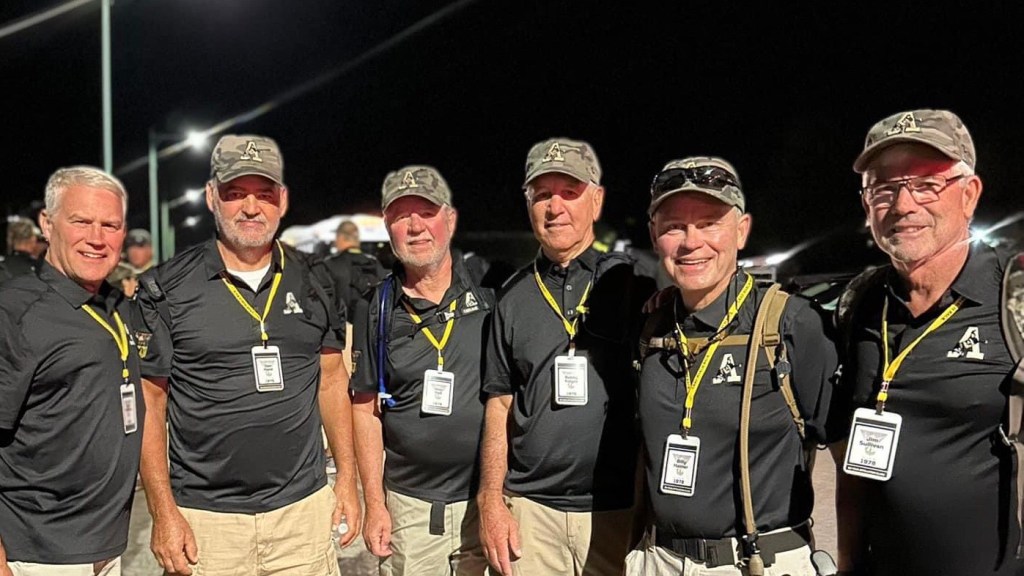
The crowd grew and in the dark we started linking up with friends and classmates. Six of us ‘78ers were marching with Gulf Company and we snapped a pic.
Proud and Great ‘78
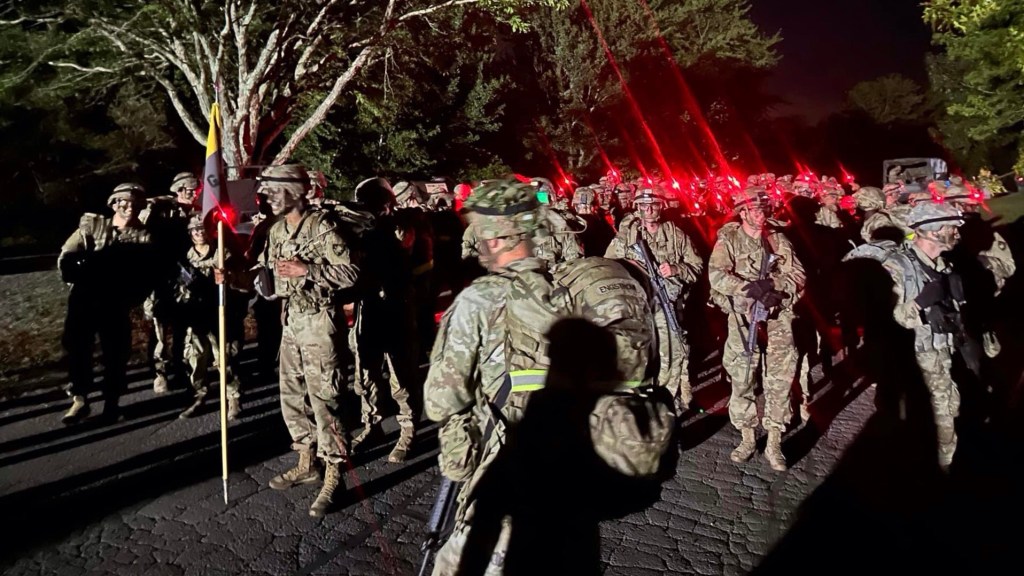
Soon, the buses arrived. We left a little after 0200 and drove to Lake Frederick. After a quick breakfast, they started linking us Old Grads with the companies and platoons we would each march with. I and several others would walk with G-4, the 4th platoon of Gulf Company and they linked us with them around 0415. We grads were only carrying small Camelbak packs with water and maybe a snack, bandaids and a pair of dry socks. The New Cadets? Full uniforms, helmets, 30-40 pound ruck sacks and their M4 rifles. Yep, men and women alike, they were doing a full combat march back to the Academy to start the academic phase of their Plebe year.
Gulf Company, Ready to Roll.
At 0430, right on time, Gulf Company started its return to West Point.
We did the first three miles uphill in the dark. The trail was gravelly and rock strewn but honestly, I didn’t really notice the dark, the climb or the rocks. I was having too much fun talking with the New Cadets and a couple of the Cadet Cadre. The New Cadets were supposed to march in silence, unless they were talking with one of us Old Grads and that’s what they did. But when you started talking with them – man did they open up. They asked me as many questions as I asked them and the time passed quickly. We arrived at the three-mile mark around 0525. True to what they’d warned us about ahead of time, we went out at a spirited 18 Minute/mile pace, but I hadn’t noticed.
After a short break, we continued marching as daylight approached. The New Cadets were in two columns, one on each side of the road, with the cadre and us Old Grads marching in the center between the columns. For the next three hours, I spoke with perhaps 15 or 20 New Cadets. We talked about West Point, Beast Barracks, Plebe Year, the Army, how long I stayed in and where I was stationed, Women at West Point, Women in the Army, Airborne School, the rain from Hurricane Debby, wet boots, what drew them to West Point, why they chose West Point, why I chose West Point, the best part of Beast, the worst part of Beast, square meals, and a whole host of other topics, including the Green Bay Packers and their chances this year. The conversations were full grown adult conversations, not the monosyllabic answers you sometimes receive from youth these days. The next nine miles passed in a blur.
The Class of 2028 on the March
At the 12-mile mark, we arrived at the West Point Ski Slope. We Old Grads said our goodbyes and left the New Cadets. We joined our classmates who were only marching the last two miles into West Point proper. After a break the Class of ‘78 formed up. The Class of 2028 passed in front of us in company formation and unfurled their new motto, “No Calling Too Great – 2028” for the first time. We members of the Proud and Great Class of ‘78 saluted them as they passed.
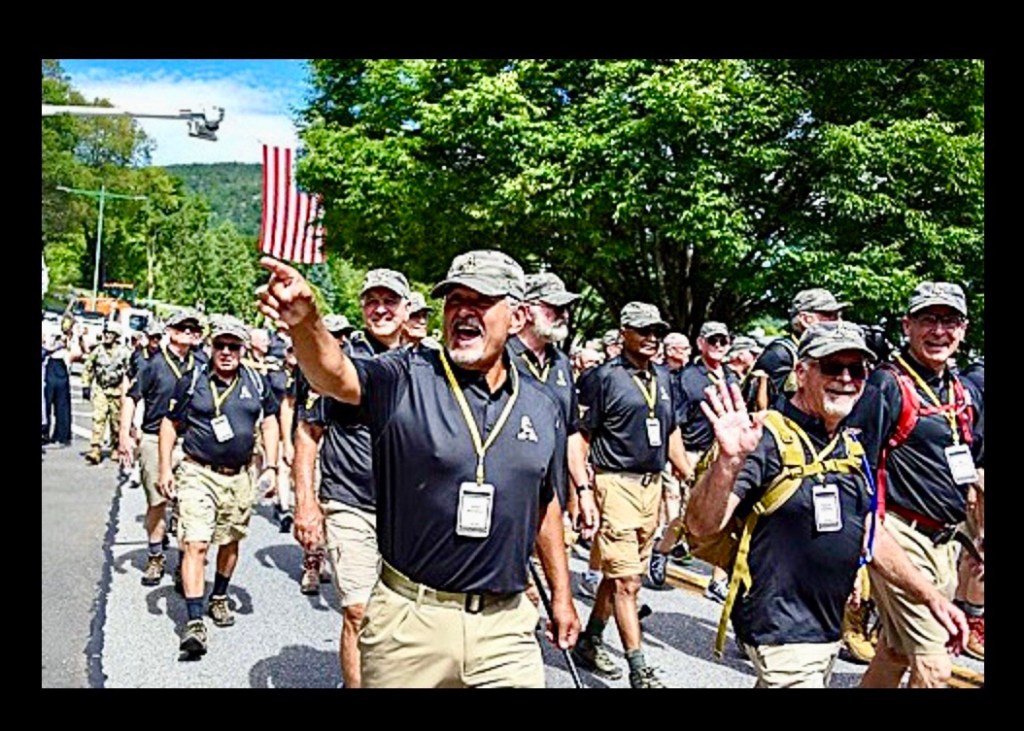
After the Class of ‘28 marched by, the class of ’78 fell in behind them, leading the Old Grad contingent of nearly 400 marchers. We picked up the cadence of the drum, and as one of my classmates mentioned, even at our age we were still marching better than the Naval Academy does. ;-).
José Morales and the Class of ‘78 on the Parade Route
Much of the route for the final two miles was lined with people watching the parade. They too were inspiring with their claps and cheers. I think the last time I marched in a parade was around 1982 in Germany. Eventually we reached main campus and Passed in Review at the Superintendent’s house. We (‘78) chanted “Beat. Navy! Beat. Navy! Beat. Navy!” in time with the drum for the Supe and he laughed.
And then the March Back was over. The Class of ‘28 went to clean their weapons. We ‘78ers walked across The Plain for the rededication of a Statue of Civil War General, John Sedgwick, that the Class of ‘78 had funded a restoration of (stay tuned for a future blog about Sedgwick’s Spurs.) We followed that with a short Memorial Service for our 93 classmates who have passed away and ended with classmate Harry Johnson leading us in singing The Corps. The words to The Corps always ring true, particularly with its references to The Long Gray Line. On this day, it was perhaps a double punch with both the Memorial Service for our departed Classmates and the March Back with the future of the Corps.
The Class gathered one last time a couple hours later for a cookout and a few drinks. We all remarked about what a great time we’d had over the last 24 hours and how impressed we were with the Class of ‘28. We were still enthused, but a bit quieter by now. As evening approached, with hugs and handshakes, we went our separate ways
On my drive home Tuesday morning, my legs were only a little sore. As I drove,I thought about the Class of ‘28 and my interactions with them. My friend and classmate Tony Matos called the weekend magical and I agree. I spoke with young men and women of all colors and ethnicities. I’d spent time with New Cadets from California, Washington, Oregon and Idaho; Oklahoma, Illinois, Indiana, Wisconsin and Minnesota; Georgia, North Carolina, Virginia, New Jersey, New York, and Connecticut. It was as if the melting pot of America was on display for those two days. I’d made the trip to West Point to show and give them a view of the continuity of The Long Gray Line. They gave me so much more – a demonstration of grit and fortitude; a view of encouraging teamwork; a promise of both mental and physical strength; and a look at the future. From my time with the Class of 2028, I felt encouraged. I believe that both now and in the future, West Point, our Army and our Country will be in good hands as the Class of ‘28 answers the call of Duty, Honor, Country.
No Calling Too Great, 2028
Addendum:
Thanks to classmate Frank Arduni for his ongoing research about the class of 1928.
Thanks to classmates Bill Moeller and Tony Matos for their editing support on this blog. Both had great ideas to add.
Thanks to classmates Bill, Tony and Billy Harner, along with the AOG for organizing the March Back activities and making it such a wonderful event for all of us.
The pictures in this blog are from a number of sources, including classmates, the AOG, and my own photos.
Thanks to my wife, Cathy, and friend, Colleen, for their continuing editorial support. I’d be lost without them.
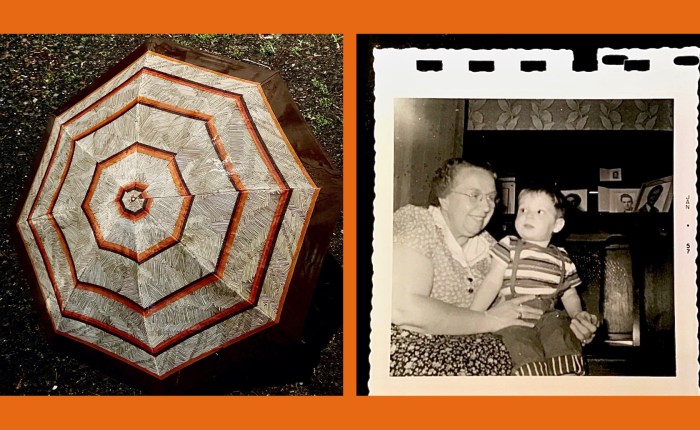
Last week it rained pretty heavily one day. Late at night I took Carmen out to do her business and it was still raining. I grabbed one of our umbrellas and as I opened it, thought of Grandma Grubaugh. We’d given her the umbrella as a young man. It returned to Cath and me when she passed away.
I remember as a child, we kids would give Grandma and Grandpa Grubaugh some sort of homemade Christmas gift, or Mom would buy something and put a tag on it, saying it was from the three of us. When Grandpa died in 1968, it transferred over to just getting something for Grandma.
At some point in time, maybe in High School, or when I left for West Point, I started buying Christmas gifts for Grandma on my own. I don’t really remember much about what I bought her. I mean, what do you buy for a woman who pretty much had everything she needed or wanted? Inevitably it was some knick-knack or something else she didn’t really need. When at West Point, it might have been a pin or brooch related to West Point. Of course she always acted as if it was the most precious thing in the world when she opened the gift on Christmas Day.
Grandma and I at my West Point Graduation.
Later, when Cathy and I married and were living in Germany, we typically sent her some German chocolates or something similar. Or, would have Mom and Dad pick up some steaks for her. We’d learned over the years it was better to give her food she could actually enjoy rather than yet another gift she didn’t really need.
Eventually Grandma passed away in 1996. It fell to Mom and my Aunt Pauline to go through her things and get her house ready for sale. Most of it was straight forward. The aunts and uncles claimed the items they wanted to remember Grandma by, and then we grandkids were offered a choice of remaining items. That’s how I ended up with the pink monkey and blue elephant glasses. I always remembered them from my childhood – drinking milk at Grandma’s kitchen table while eating her homemade date-nut bread.
Blue Monkeys and Pink Elephants
One day during all of this, I received a call from mom. They’d come across a chest and when they opened it, they were a bit shocked. It was full of Christmas and Birthday presents Grandma had received over the years and never used. Each item had a tag saying who gave her the present. There were plates and bowls, and even unopened packages of brassieres (Grandma would never have used the word bra).
Among the items was an umbrella, with mine and Cathy’s name on it. The plastic box was still unopened. Mom gave it to us the next time we were home visiting.
I have to say, it’s a bit of an ugly umbrella. I suppose sometime back in the ‘70s the color combo might have been considered the height of good taste. No plain black or blue or red – it’s an in-your-face design with shades of brown and orange. Color-wise, it’s a perfect match for our 1970s era crockpot. It also turns out it is an incredibly durable product. Made in the ‘70s and first used in the late ‘90s, it’s still functional and going strong in 2024.
‘70s Colors in Full Bloom.
It currently resides in a storage stand in the mudroom, along with a basic black umbrella, a couple of walking sticks and some snowshoes. It’s only used a few times a year – usually late at night when I’m taking Carmen out to do her business and there’s a driving rain. Still, it never fails to make me smile and think of Grandma Grubaugh, a truly treasured gift.
The cashew I was eating one evening last week cracked a filling and broke a piece off of one of my crowns. Sixteen hours later, I was sitting in a chair at Gainesville Dental Associates with the filling repaired and a temporary crown in place. I don’t think people say it very often, but I love my dentist.
It was about 8:30 or 9:00PM and I was watching some bad TV. I decided to have a snack and went in the kitchen and served myself a half a cup of cashews.
As I sat back on the couch, I popped one in my mouth. It crunched and somehow became totally lodged between two teeth, or so I thought at the time. I tried removing it with a toothpick, and then with floss, but when the floss cut in half three times in a row, I knew something was wrong. I eventually removed the nut, but there was a half gap where a tooth used to be. Strangely, I felt no pain.
I called my dentist’s office, Gainesville Dental Associates, and asked if they could call me back in the morning so we could schedule an appointment to have the tooth looked at. I figured, with luck, they could get me in within the next few days.
Early the next morning as I returned from the barn, my phone rang. The dentist’s office was returning my call. I again explained what happened and was hoping for an appointment as soon as possible. “Just a moment.” the person said, and after a few seconds, “Could you be here at 2:50 this afternoon?” “Of course!”, I answered and thanked her profusely.
That afternoon, when I arrived at the dentist’s they escorted me to the exam room. As I spoke with the tech who was taking X-rays and would be assisting the dentist, I expressed my surprise at receiving an appointment so quickly. It turns out the office runs between 7AM and 8PM (they run two shifts) and they always keep a couple of slots free during the day for emergencies. All I can say is what a brilliant idea – I certainly benefited from it.
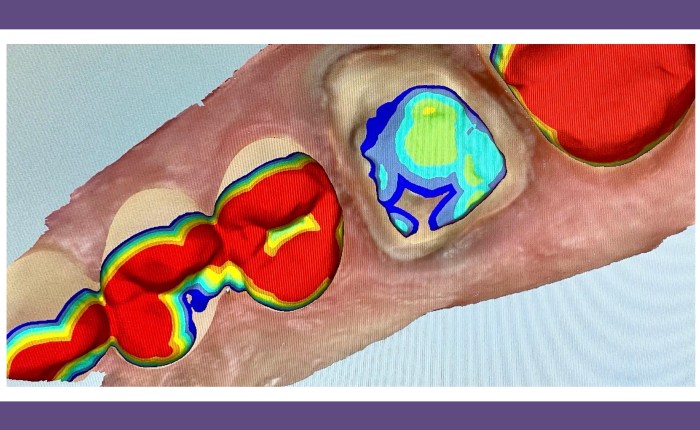
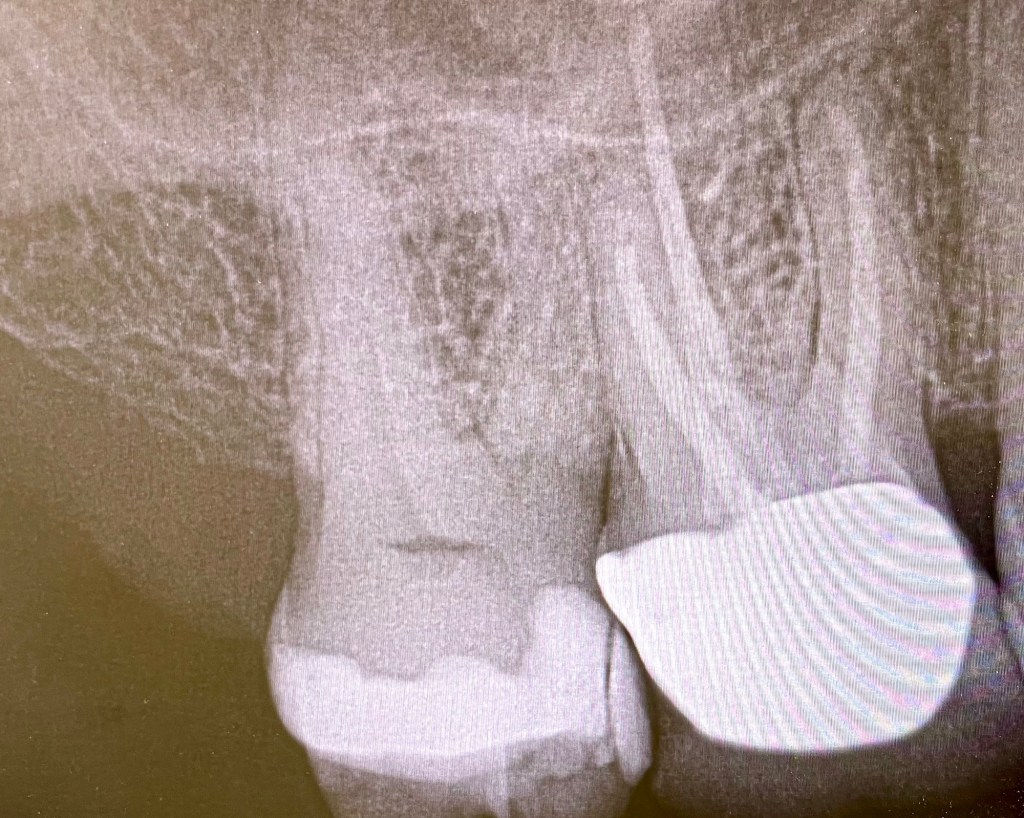
The X-rays showed one of my fillings had cracked, AND part of a crown had cracked and separated from the tooth (and disappeared). There was no pain because the crown covered a root canal from years before and hence, there was no feeling in the tooth. The sharp edge of the remaining part of the crown is what cut my floss the night before. That must have been one hard nut.
Note the Crack in the Filling in the Tooth on the Left.
The dentist came in and we spoke a bit and went over options. Ultimately, we decided to repair the cracked filling and replace the crown. He started immediately.
For the next 1 1/2 hours, the dentist, the tech, and I became buds of sorts. Rock music played in the background and there were bits of conversation. As they were starting to work on the crown they put a small “shield” in my mouth between the tooth and my cheek to help protect the cheek. Of course as time progressed, I kept playing with it with my tongue trying to figure it out, and then trying to decide what it was made of. Finally, I said to the dentist during a break, “What’s the shield made of, plastic or cardboard?” He looked at me and said, “Are you an engineer?” I answered, “what?!”. He said again, “Are you an engineer?”, and I answered, “Well as a matter of fact I am. Why?” He then laughed and said, “My brother’s an engineer and that’s exactly the kind of question he asks!” We both chuckled and talked a bit about engineers and their ways. I told him my favorite engineer joke which he laughed at out loud and planned to tell his brother the next time he saw him. (For the record, the shield is made out of plastic AND cardboard.)
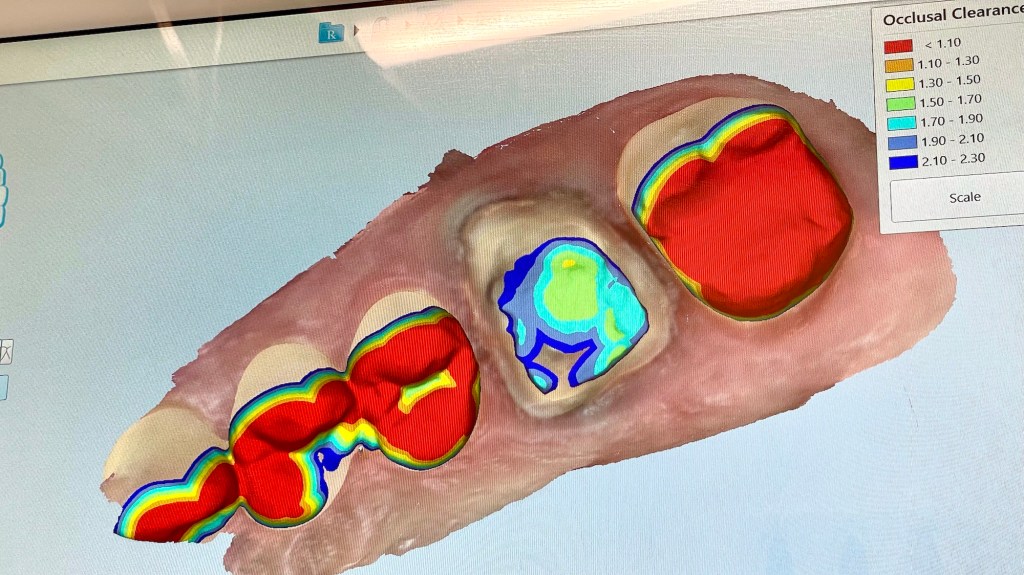
The work continued. They took a mold for my permanent crown and measured for a temporary crown until the permanent crown is ready.
Checking Tooth Clearance, In Preparation for the Crown.
My dentist left and the tech finished putting the temporary crown in place. She then talked about things to do and not do until the permanent crown is in. Chief among the advice – “Do not eat any nuts!”
I’ve been with Gainesville Dental Associates for over 25 years. They’ve been great the whole time. Whether routine cleaning, exams, handling a couple of issues I had, or responding to my plea for help this past week, they’ve always risen to the occasion and done an excellent job. If you live in the Warrenton/Manassas/Gainesville/Haymarket area, you should definitely consider using them. You won’t regret it.
As for me, I’ll be back on August 6th, when they’ll put my permanent crown in.
Strangely, I wrote another blog about a visit to the dentist seven years ago. You can read it here: The incessant high pitch of the drill is whining in my ear….Sort of like 100 mosquitos on steroids. Then the burning bone smell hits my nose. The drill is working its way into my tooth, and for the next hour or so, I’ll be sitting there, getting a root canal […] Continue here: https://mnhallblog.wordpress.com/2017/08/22/is-it-safe%EF%BB%BF/
For privacy reasons, I haven’t named the dentist or technician.
We arrived at the ranger Station in Wrangell-St Elias National Park, Alaska. As we checked in for our backpacking trip to Dixie Pass, an older looking ranger eyed me. After a brief conversation, he asked, “Do you know what grizzly bear scat looks like?” I shook my head no.
Six months before meeting that ranger, Cathy turned 40 years old. We decided to celebrate her milestone birthday in Alaska the next summer and do some backpacking while there. Coincidentally, Cath’s sister Bonnie was marrying Don that June and they asked about coming with us for their honeymoon. We quickly said yes and started outlining the trip.
While we planned to visit several places, the highlight would be a four-day backpacking trip in Wrangell-St Elias National Park (WSNP). It is a vast national park that is the same size as Yellowstone National Park, Yosemite National Park, and Switzerland combined. Only Denali, also in Alaska, is a larger Park.
We specifically chose WSNP because of its remoteness. Unlike Denali, which has buses circling the park and regulates when and how people can enter the park, WSNP is a wilderness area with one 60-mile gravel road dead-ending at the town of McCarthy. I should mention that while McCarthy’s summertime population was 200, its winter population was just 13.
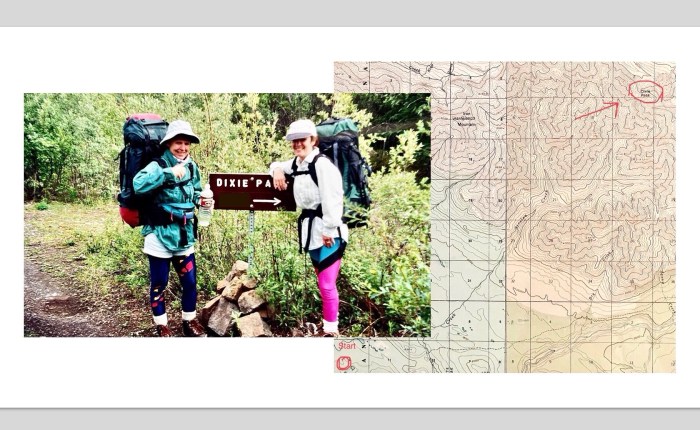
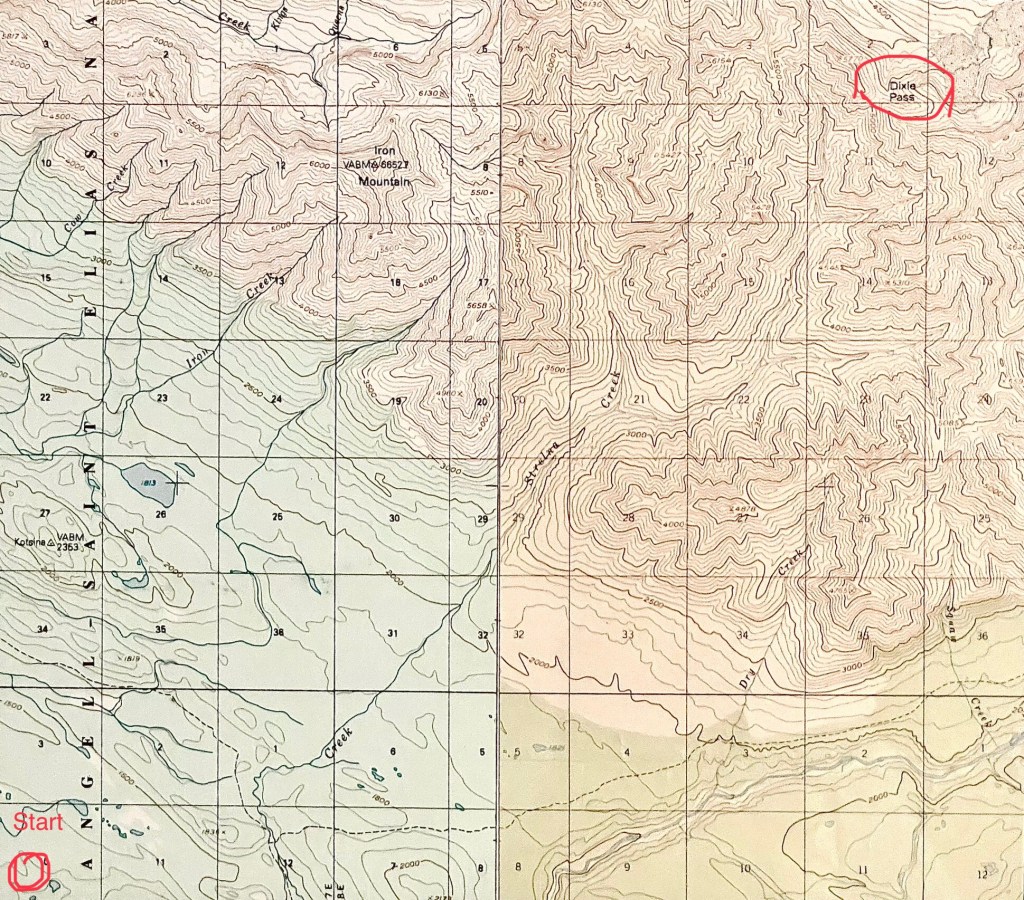
In the WSNP there were no trails, only suggested routes requiring map and compass skills. We eventually settled on a hike to Dixie Pass – a four-day, 28-mile round trip hike with 5,400 feet of elevation gain. The country was remote and about half the hike was above the tree line. It was also mosquito infested until you were above the tree line. Guidebooks suggested checking in and out with the Ranger Station at the entrance of the park for safety reasons.
Part of Our Map for the Hike to Dixie Pass
After Bonnie and Don’s wedding in June of ‘96, the four of us flew to Anchorage. We spent a few days seeing some sites and getting acclimated to the near continuous sunlight. Eventually we made our way to WSNP and checked in at the Ranger Station.
We signed in and spoke with one of the two rangers working that day and told him of our planned hike to Dixie Pass. He gave us a few safety tips and talked about the fact there were both black bears and brown bears (also known as grizzly bears) in the park. While black bears are usually more timid and less confrontational, the grizzly bear was totally different. They could attack even when unprovoked.
The ranger pointedly looked at us and then asked, “Have you bought any jingle-bells for attaching to your pack to make noise, so the bear know you are coming?” I answered, “No, we planned to attach our drinking cups to the outside of our packs so they would make noise.”
“Ahhhhhh. Did you bring any pepper spray with you?” – “Ummm, no. Should we have?”
“Hmmmmmmm. Do you know the difference between black bear skat (poo) and grizzly bear skat?” – “No, we don’t. Could you fill us in?”
He kind of smiled, and then said, “Sure. Black bear scat is sort of brownish and fibrous. You’ll often see berries in it as well. And grizzly bear scat? Well, it’s similar to black bear scat, but it also has jingle bells in it and smells like pepper!”
A half second passed and then all of us, including the ranger, burst out laughing. He’d reeled me in like a bluegill in a pond.
After the laughter ended, he did share that in WSNP, unlike Denali, there generally were no bear problems. There were so few people in the park that when the bear smelled or saw humans, they generally turned around or went in a different direction. They didn’t really know what we were and would probably avoid us. If we did come across a bear, stay still or slowly back away, don’t run, and things would probably turn out fine.
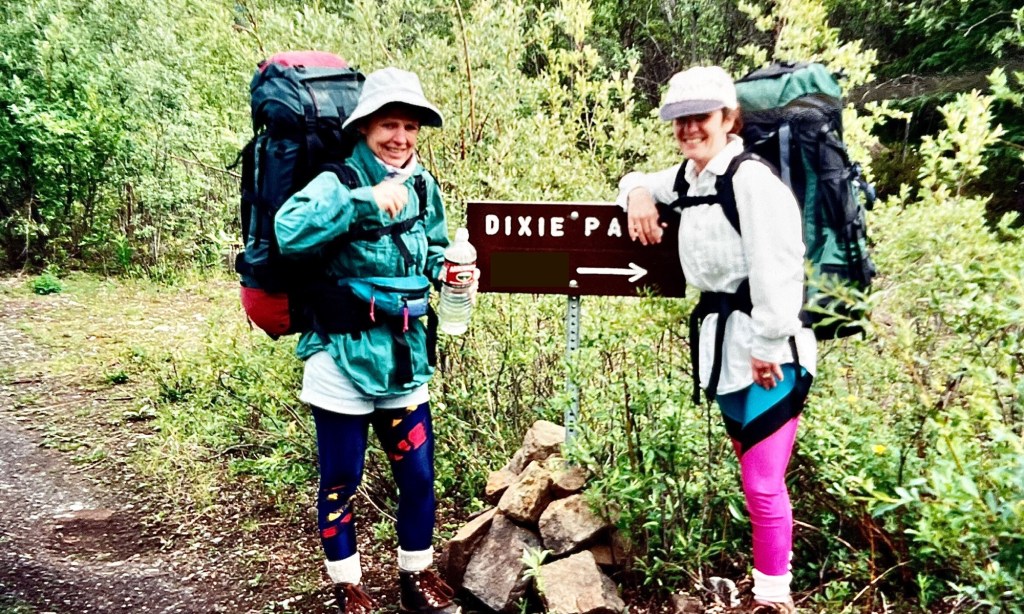
We thanked him for his help and then drove down the gravel road awhile before turning onto a dirt trail for a bit. Eventually, we arrived at a small, cleared area. We saw a small sign pointing towards Dixie Pass. There were no other cars.
Cathy and Bonnie at the Start of the Hike.
The hike itself was wonderful and everything we hoped for – beauty, silence, wilderness – Mother Nature at her best.
We definitely needed a map and compass to guide us, so both Boy Scout and Army skills came in handy. Mountains, valleys, creeks, draws, outcroppings … they all became important in identifying our route.
The mosquitos were horrible until we climbed above the tree line. A half mile into the hike, we needed our head nets and sprayed ourselves with 90% Deet. We used so much Deet, Cath’s running tights basically disintegrated when we returned home and she washed them.
Cathy and Bonnie in Their Mosquito Netting, While Holding a Moose Antler.
The route challenged us. There were multiple creek crossings, some two feet deep, and places where we hiked over snowpack. We switched to Tevas or sandles several times each day to keep our boots dry. There was also plenty of rock hopping where you were using both legs and arms to scramble over the boulders. While not really dangerous, the trail wasn’t for the faint of heart.
Creeks and Snow and Boulders, Oh My!
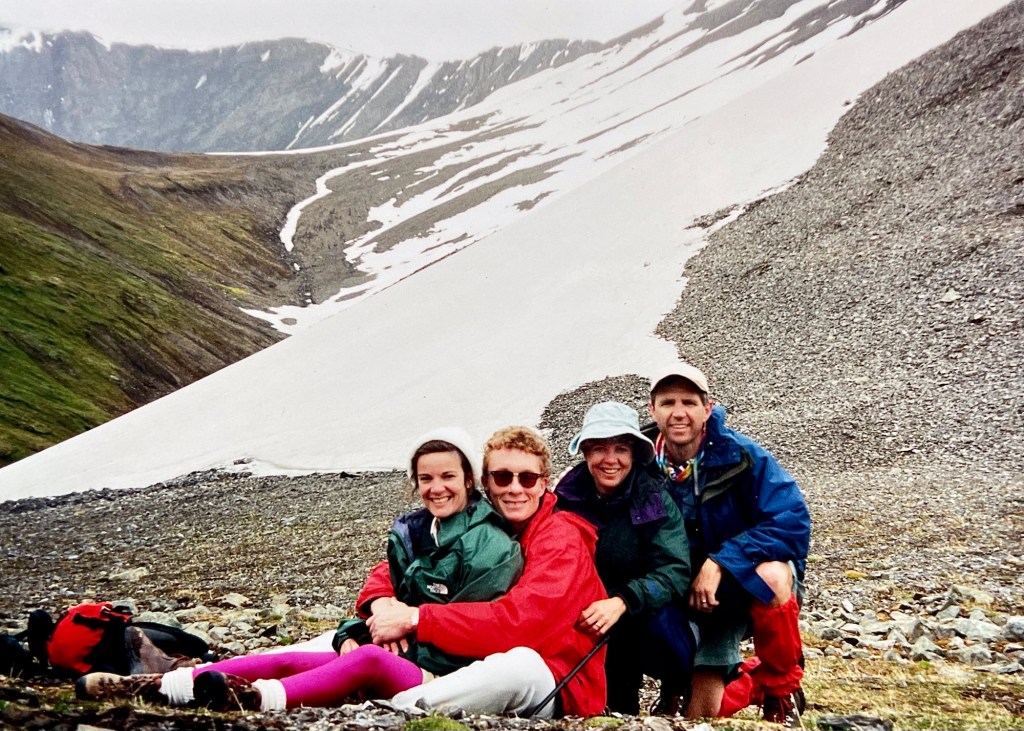
We finally arrived at Dixie Pass where there were gorgeous views in all directions. We lounged around, ate lunch and took some photos. Although it was June 30th, we were snowed on while hiking back down from the pass.
View From Dixie Pass Looking Back at our Approach Route.
On the 3rd morning around breakfast time, we did have a distant encounter with a brown bear, but the ranger was right. When the grizzly smelled us, he turned in another direction and gave us a wide berth. We were probably 75 yards or so away and watched him from a hillside. Still, I have to say it elevated my pulse.
Eventually, we finished the hike and our grand adventure ended. It was both a beautiful and challenging hike – one of those life events you never forget. For me, the story is never complete without also talking about the ranger, the jingle bells and the pepper spray. I laugh to this day when I tell the tale, and it always gets a chuckle.


















 Live Life Exuberantly