Making Espresso

Making Espresso

When we returned from Germany in ‘83 there were many things we missed from our 4 1/2 years in Europe. One of those items was coffee. Good Coffee. Cathy rectified that by buying me a small Espresso/Cappuccino Maker for Christmas that year. 40 years later, it still brews decent coffee, even if it looks old and outdated.

We were happy to return to the States, but in addition to good coffee, there were a number of things we missed from our time overseas, including good bier and cheese. The craft bier movement wouldn’t really hit its stride in the US until the ‘90s. As a result, Michelob or Heileman’s Special Export were what passed for top-shelf domestic beer at the time. The cheese market in the states consisted of American, Swiss and Cheddar once you were outside of Wisconsin or a couple of places in New York and Northern California. That too would change, but in the early ‘80s, it was a desert. Of course you could buy imported beer (back then, Lowenbrau or Heineken), or imported cheese, but there weren’t any real American products. I was further mystified to find the concept of a charcuterie board hadn’t reached the States – how was it possible something we routinely ate for lunch in a German Gasthaus didn’t even exist here?! And don’t get me started on wine…

Yes, I know this all sounds like an old man rant, and if I were saying it now, it would be. I was saying this in 1983, at the grand old age of 28.

Back to coffee. ;-).

Coffee in Germany and Europe was so much more than just a pot of brewed coffee. The Europeans made stronger coffee in general – not more bitter, just stronger and with great flavor. At the Gasthäuser (local restaurants) we visited, it was always made fresh – it wasn’t from a pot that was sitting for hours. In the afternoon, you could visit a Konditorei (the German word for a pâtisserie or confectionery shop) for a coffee and a sweet treat of some sort. The coffees varied from regular, to espresso, to cappuccino, to café au lait (coffee with a separate small pitcher of hot steamed and slightly frothed milk you added to your coffee). One of our great pleasures was sitting outside at a cafe in Berlin, or Paris, or Vienna, or Monte Carlo or any number of cities having a coffee, while watching the world pass by. I become nostalgic even today thinking about it.

There wasn’t the same type of coffee availability here in the States in ‘83. Starbucks started in Seattle in 1971, but didn’t really begin expanding until the late ‘80s. Although local coffee shops existed in some places, The “Local Coffee Shop” was an idea that hadn’t yet come into its own.

At the time, we were stationed in Dayton, Ohio. At a local mall, we discovered a shop that sold coffee beans. (I can’t remember if you could actually also buy a cup of coffee there or not.) In any case, we bought a grinder, and started grinding our own beans for our regular coffee pot at home and were able to make a stronger cup of coffee. We also bought espresso beans and used our Italian stovetop espresso maker (known as a Moka pot, it cost all of $6 when we bought it in Italy in ‘82 – I see they run $25 plus on Amazon now) to make a decent espresso. Half the problem was solved.

Our Old Moka Pot Also Still Works Well.

Cathy solved the other half of the problem that Christmas when she gave me an Espresso/Cappuccino maker. I was thrilled and started using it that very day. It became a fixture at our house and if you visited us in the ‘80s through the mid ‘90s, I practically forced a coffee on you

A Great Christmas Present in 1983!

Espressos? Sure. In addition, my after-dinner cappuccinos became a point of pride and were quite good, if I do say so myself. I’d add a capful of Cointreau for a sweetener and grind a little fresh nutmeg on the top of the foam. We also did Irish Cappuccinos. I think you know how I made those.

Somewhere along the way, other manufacturers started selling upscale Espresso machines of better quality. Now days, you can easily spend between $500 and $1,600 on a high-end espresso/coffee maker. Breville, Rancillo, Gaggia and others all make excellent machines … at a price. Over the years, I looked at a couple of them, but never pulled the trigger. We have a couple of friends who own them. One uses his religiously. Another found it more trouble than it was worth and it now sits on the counter, mostly unused. For my friends* that own super nice espresso machines and are real aficionados, good for you, and I’m happy for you. I’m sure you can probably make a better espresso than I can, and that’s OK.

Coffee shops are now ubiquitous here and these days you can’t trip without falling into one of them. They generally make great coffee. There are a few good local shops near us not named Starbucks, and I prefer those. If you ask, they’ll serve you your coffee in an actual coffee cup – not some crap paper cup.

Over time, I backed off using our little machine quite as much. Life was too busy, or I’d lost interest. And then, after retiring about a decade ago, I started using it more again. Usually, it’s in the afternoon and Cath and I feel the need for a little pick-me-up. I’ll make us cappuccinos and we take a break from life and sit and sip our coffees for ten or fifteen minutes. It’s a nice pause, especially on a winter day with fresh snow outside.

Yes, It Still Makes a Decent Cappuccino. Nutmeg and Cointreau are Optional.

Yes, over the last forty years, we here in the States have caught up to Europe on bier, cheese, good everyday wine and even charcuterie boards. As for coffee, I’m guessing we have more coffee shops than Europe now days.

At home, I would bet we’ve gone through five or six regular coffee machines since 1983. They die every six or seven years. Our Maxim Espresso Machine? It’s a little banged up but works fine and keeps chugging along. How many forty-year-old machines do you have in your home you can say the same thing about?

Addendum:

  • * I do know there are lots of great espresso makers out there, and that those of you who have them can pull a better shot, with more crema than I can. I certainly mean no criticism of those machines and am, at least a little, envious of you. My point in this blog was about my machine being 40 years old, and there’s not much that lasts that long anymore. Still, it’s interesting. In Italy, rather than buying an elaborate espresso machine, over 3/4 of the country still uses their stove-top espresso machine (Moka pots) everyday for their first cup of coffee. You can read more about the Moka pot here: https://en.m.wikipedia.org/wiki/Moka_pot
  • The blue coffee cup with my name on it is a bit precious to me. It was a gift from our old friend Tim in ‘80 or ‘81. He bought it while visiting us in Germany and gave it as a gift. Tim passed away last December.

Valentine’s Day

Valentine’s Day

I’m one of those guys who, although not always in a timely fashion, notices milestones in my life. It turns out this Valentine’s Day is the 51st Cathy and I have shared. Yea, our first was in 1973, when we were both students at Ottawa High School.

Cath and I in the OHS Yearbook for ‘73

At the time, we had been dating for about eight months. I have no memory of what we did on that momentous occasion. Cathy doesn’t either. 🙂

At Homecoming Dance, a few Months Before our First Valentine’s Day.

When I was at West Point, with Cathy in DC, we were always apart and sent letters or cards to each other for the big day. (You remember letters don’t you?) Later in the ‘80s during our tours of duty in Germany with the Army, I’m sure we were separate on at least half of those Valentine’s Day, with me deployed on maneuvers or Temporary Duty somewhere. We probably enjoyed a celebratory dinner after I returned home, but again, I don’t remember.

It’s only since the ‘90s and civilian life that I think we’ve regularly celebrated Valentine’s Day. I know we did trips away or dinners out at nice restaurants several times. Later, we became tired of the rush and crowding of restaurants and celebrated more at home. A nice dinner – steaks, or a special pasta dish, or maybe a cheese and charcuterie board with champagne in front of the fireplace. Sometimes there were gifts, sometimes not.

I was thinking about our past celebrations, as I’ve seen ads in the lead-up to Valentine’s Day this year – Godiva or Ferrero Rocher chocolates; flower delivery services; special cards from Hallmark; sexy underwear; and of course, jewelry, including Kay’s and Pandora. The New York Times even ran an article about “The 31 best Valentine’s Day gifts for her”. One of the “great” things about America is we always find a way to make a buck off of anything.

More Suggestions of Chocolate, Underwear, Flowers and Fake Flowers.

I took a further trip down memory lane and reread our wedding vows. We had dutifully recited, as many couples do, “For better, for worse; For richer, for poorer; in sickness and in health; … as long as we both shall live…” I also reread what Reverend Fred Fullerton*, my high school classmate and the minister at our wedding, asked for in prayer concerning our marriage: “strengthen and deepen it through time… steady it by toil… crown it with greatness through self-discipline… purify it in the crucible of our inevitable human pain…

Fred’s Thoughtful Prayer for our Marriage and Life Together.

We’ve certainly seen for better and worse, trying financial times and our fair share of sickness. I like to think our love has strengthened and deepened over time and we have constantly worked at our marriage over our years together. Challenges and pain have happened, as they inevitably do. As is always the case, how we respond to those challenges is more important than the challenge itself.

In the past year, we’ve had constant reminders of both the joy and the fragility of life. We have celebrated good times with family and friends. We’ve also witnessed deaths with some of those same friends and family members. We’ve confronted new injuries and diseases, both our own and other folk’s. Lately, our lives seem to be on one of those roller coasters all of us occasionally experience.

51 years. Cripes, that’s over half a century. We still enjoy celebrating Valentine’s Day and I think have learned to take nothing in life for granted. This year, we are staying home and will keep it simple – Steak Diane and a nice red wine. We’ll celebrate our past. And then, we’ll clink our glasses and toast our future together for as long as we both shall live.

I love you hon….

Addendum:

  • Reverend Fred Fullerton was my good friend and high school classmate in the OHS class of ‘73. He was also our class president. He became a minister in the Nazarene Church. We are very proud to have been the first marriage service he preformed.

Carmen’s Surgery

Carmen’s Surgery

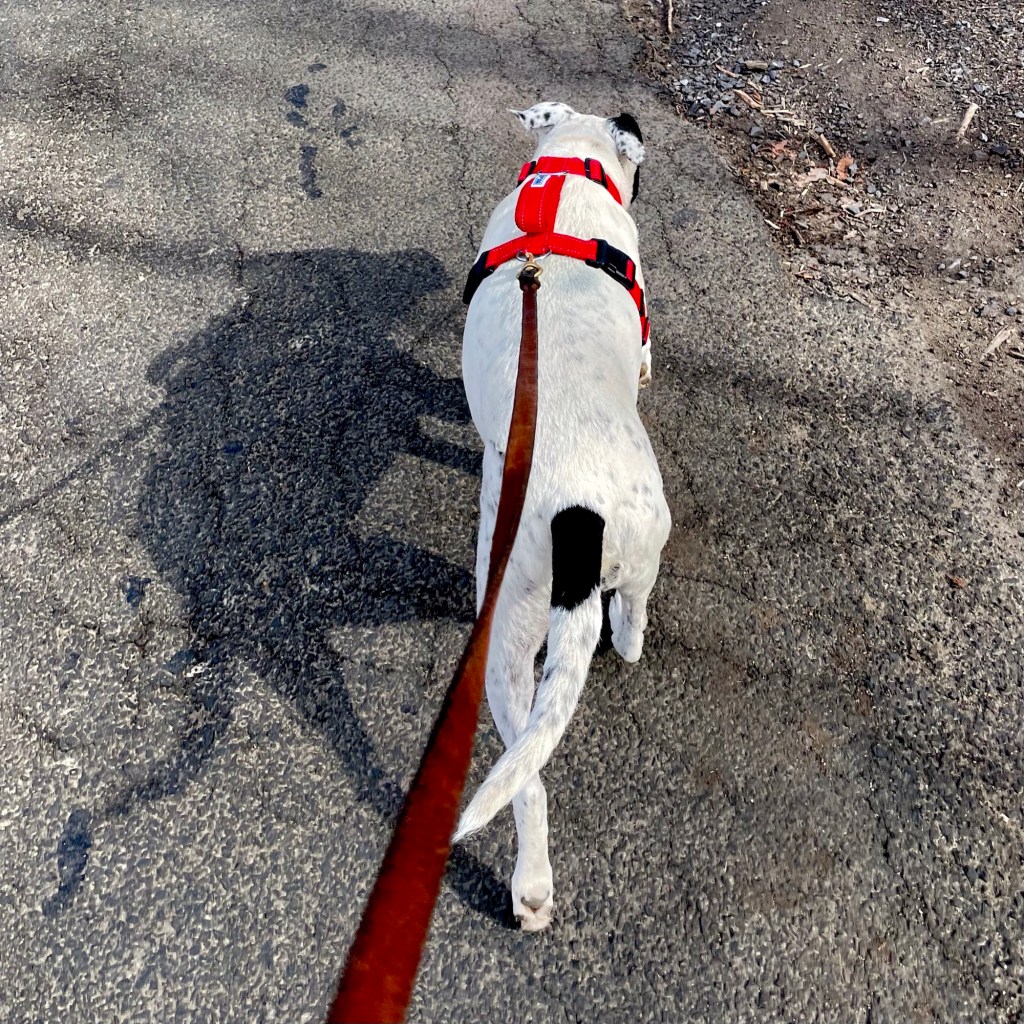
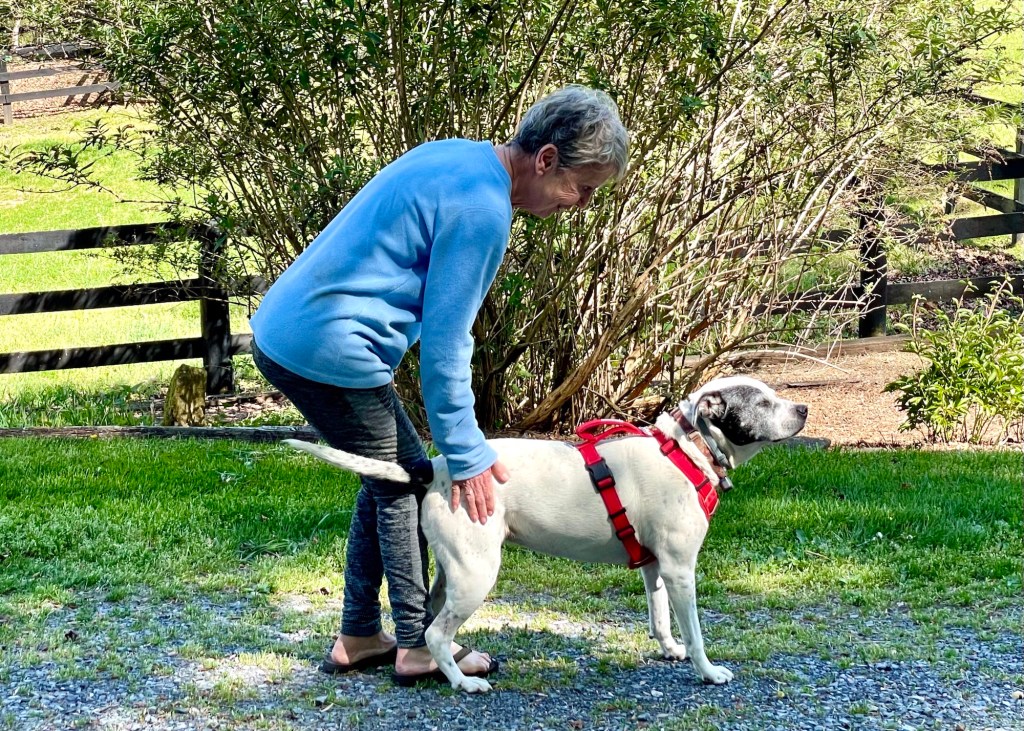
My walking companion for the past nine years is sidelined. Carmen needed surgery last week to repair a ruptured ligament in her left rear leg. We went down this road with a previous dog, Holly, and are familiar with the journey. It doesn’t make it any less distressing for the three of us.

Carmen in Happier Times.

Yep, nine years of walking together came to an end about ten days ago. Our neighbors haven’t done a good job of managing their dog Kylie and keeping him under control*. I actually like Kylie. He’s a Golden Retriever and friendly enough. The problem is, after two years they still don’t keep Kylie at home. They “think” they do; the reality is something else and Kylie wanders. Ten days ago, we found him in our yard again playing roughly with Carmen and jumping on her. It wasn’t done meanly, but he outweighs her by 25 pounds. I sent him home, and then noticed Carmen limping. That night the limp worsened and the next morning, she wouldn’t put weight on the leg. That’s when we went to the vet.

Evaluations, tests, X-rays … the results came back. She needed surgery for a torn ligament in her leg. We were lucky there was a cancellation for another patient and scheduled her surgery for the following Wednesday.

X-ray of Camen’s Knee, and an Explanation of the Surgery.

The first morning after the doctor’s initial evaluation was a challenge. I took her outside on a leash to do her business. She gave me a look as I put on the leash – “Well, this is strange.” As she did a three-legged hop down the driveway, she became visibly upset and stopped in her tracks when I diverted her onto the grass to potty. “What?! What are you doing?! We ALWAYS walk to the barn in the morning!” I had no way of explaining this was for her own good and I was just looking out for her. After she finished, I carried her back towards the house, before putting her on the ground. She dutifully hopped into the house on her three good legs.

She’s a good dog, and a brave dog. I hated seeing her hop around as a tripod before the surgery. There were no complaints. Just the sad look in her eyes when I left the house without her to go for a walk, or to clean the horse stalls. I knew she’d happily try to three-leg-hop for two miles with me if I let her. She doesn’t understand, of course.

Wednesday came and the surgery went well. She had a procedure called a TPLO**. Our surgeon, DR Nicholson let us know, “Carmen did great!” Bringing her home, the first day was tough for all three of us. Carmen was out of it and mostly slept. We were able to get her to drink a little water and take her pain pills with a little peanut butter, but that was it. She didn’t want to stir and we didn’t force it. Finally, it was time for bed. She was sleeping so soundly, we didn’t take her out.

Knocked Out the First Night.

I slept on the couch that night, and her bed was nearby. Around 3AM I woke and sensed something. I looked to my right and Carmen was sitting up, looking at me. After putting her leash on, I carried her outside and gently put her down. She tripodded a bit and then urinated. She hopped a dozen steps or so, and then poo’d as well. I carried her back inside, gave her a treat and some more water and we shared a look. That’s when I knew she was going to be OK.

We both slept in the next morning. After feeding the horses, I returned and a while later, Carmen stirred. Cath and I both greeted her and she gave us a small tail wag. A brief walk outside to do her business, then some water, a little food, and more pills.

Later, we looked at each other again. It was time to start rehab and so we did. She tripodded out for another pee, and then we did our first Physical Therapy (PT) session – a five minute walk. Two more PT sessions followed that day. Also, we now had to occasionally use an Elizabethan Collar*** to keep her from licking her stitches.

Carmen in Her Elizabethan Collar.

She slept through the next night and in the morning, we walked to the barn. Well, I walked and she hopped. She was happy back at the barn and sniffed around. We fed the horses and returned to the house. Our first PT session of the 2nd day was complete.

Doing PT.

Time passed and by day three post-surgery, she was more normal and more alert. PT continued and she put more weight on her leg. It was a warm February day, and what she really wanted was a chance to lay in the sun like the old days, pre-injury. We both spent some time soaking up rays.

Sometimes, a Little Warm Sunshine Helps as Much as PT

Over the next several days, Cath and I both spent time exercising Carmen. We do our three sessions a day religiously and you can see her improving. She is using the injured leg more as she walks. As a patient, her attitude is great. We should all be so enthusiastic when we need to do PT after injuries or surgery.

And so it begins. The first week is in the books. We have goals and checkpoints along the way – the three-week mark; the 6-8 week time period; three months… With hard work, good luck and God’s grace, Carmen will be “normal” in five to six months.

Right now, we’re taking it one day at a time.

Addendum:

  • * After the first vet visit, I had a not particularly pleasant conversation with Kylie’s owner. He was “surprised” Kylie was still coming to our place and was sorry (I called bullshit – Kylie is at our place at least once a week and visits other neighbors as well). I told him he needed to control Kylie – A fence, an underground fence, or only letting Kylie out when he was with him. If I saw Kylie on our property again, we would have an issue. He agreed. Of course, Kylie was on our property again two days later. I let the owner know if I saw Kylie again, I would call animal control. He assured me they are putting in a fence and for now, Kylie wouldn’t be outside unless tied up. We’ll see. I don’t hate Kylie or hold him responsible. I do put blame on his owners. It’s never good when your dog needs to go through surgery. It’s a bit sad when it was avoidable. Too little too late, as they say. Maybe I should have been an ass about Kylie earlier.
  • ** TPLO Surgery – You can’t really repair a dog’s ligaments. Instead, they now do something called Tibial Plateau Leveling Osteotomy (TPLO) surgery, a major advancement in the treatment of ligament rupture. “This surgery changes the angle and relationship between the thigh bone (femur) and the shin bone (tibia). The overall intent of the surgery is to reduce the amount the tibia shifts forward during a stride. This is accomplished by making a semicircular cut through the top of the tibia, rotating the top of the tibia, and using a bone plate to allow the tibia to heal. This realignment of the surfaces within the knee (stifle) helps to provide stability during a stride and helps to reduce future joint inflammation and osteoarthritis. By carefully adjusting the angle or slope of the top of the tibia, surgeons can create a more normal configuration of the knee joint and reduce mechanical stress.” You can learn more here: https://en.m.wikipedia.org/wiki/Tibial-plateau-leveling_osteotomy
  • *** I like “Elizabethan Collar” or E-Collar so much better than “Cone of Shame”. No need to make fun of them when they are vulnerable.

January

January

I may not hate January, but I don’t exactly love it. After the fun and festivities of Thanksgiving, the Christmas holiday season, and New Year’s Eve, January arrives like a fat dose of reality, cold and hard. When I was at West Point, it was the start of what we called “Gloom Period”*.

The weather, reduced daylight, post-holiday debt, broken resolutions, and springtime nowhere in sight all combine, making January a demanding month. Additionally, living on a farm in the country makes January more “real”, or at least more of a challenge than living in the city or the ‘burbs. All of the daily chores go slower, or take longer to do. It’s just a fact of life here on the farm.

There are of course good things about January – a couple of holidays; the fresh start of a new year; skiing, sledding or skating if you are into those and nature collaborates; all of those wonderful soups, stews and casseroles we make and eat in winter; seeing a bright red cardinal framed against the white of the snow; sitting by a fire, while looking out a window at the beauty of the falling snow…

Beauty of the New Fallen Snow.

Looking out a window at the beauty of the falling snow… and knowing I had to get my butt out there ASAP and plow the drive from the barn to the house to the road. This year, after over 700 days of no measurable snow in the Virginia Piedmont, Mother Nature reminded us she is boss. This January, two storms gave us 10 inches of snow and I plowed after each of them. I also plowed an elderly neighbor’s driveway so she could get up and down the hill at her home.

Plowing the Drive From the Barn to the House to the Road.

After the snow, the temperature dropped into the low teens and single digits. This meant placing an extra space heater in the barn tack room to keep the pipes from freezing. We also moved the barn cats into the tack room at night to keep them from freezing. Extra hay was provided for the horses, as well as giving them a fresh bucket of unfrozen water just before bed each night.

Trying to Keep Both Pipes and Cats Protected.

The state and county plowed the roads and then plowed them again. With high winds, the dry snow drifted back over a couple of our country byways, making them nearly impassable. Additionally, a couple of friends ended up with frozen pipes. The pretty white snow wasn’t quite so pretty by then.

Of course I realize compared to friends and family in the midwest, this weather has practically been balmy and the snowfall not so bad. Maybe I’ve grown soft over the years away from home.

This being Virginia, you can count on frequent weather changes, which did happen last week. The snow, ice and freezing temperatures gave way to a day of misting rain and then temperatures first in the 60s, and then the mid 70s the next day. The snow disappeared and the ground turned to mud. This week as the month is ending, the temps are dropping again. So goes January in The Virginia Piedmont.

In the poem, The Wasteland, T.S. Eliot famously said “April is the cruelest month…”. I’m not smart enough to argue with ol’ T.S., so let’s just call January a challenging month and let it go at that. I don’t hate January, and I don’t hate winter. I enjoy our four seasons and have no plans for relocation to a warmer climate. Still, I’m ready for February’s arrival. Yes, it remains winter, but January will be over, and we’ll have Valentine’s Day on February 14th. The 14th is important for another reason as well. The National’s pitchers and catchers report that day, as sure a sign of spring’s approach as anything I know of, and certainly more reliable than a groundhog’s musings.

Enjoy the season as best you can, my friends.

Addendum:

  • * If interested, here’s a blog I previously published about Gloom Period at West Point. “The United States Military Academy at West Point can be a beautiful place, just not in the middle of winter. We called the time from January through early March, Gloom Period. It was a combination of the blahs, a lack of color, a lack of light, and coldness. There was a pervasive grayness to life […] Continue here – https://mnhallblog.wordpress.com/2018/01/21/gloom-period/

Tammy

Tammy

Recently, I stopped in at David’s Barbershop for a haircut. My usual barber wasn’t there and instead, Tammy cut my hair. We were making small talk, when I learned she was one of the original boat people* who escaped from Vietnam. She told a fascinating story filled with both sadness and hope.

You know what I mean by barbershop small talk with a new barber – the weather, what’s new in town, whether I was retired… When I asked where she was originally from, she said Ho Chi Minh City, but left as a young girl. I asked her if she was one of the boat people. She looked at me, nodded and started telling her story.

After the fall of Saigon (now Ho Chi Minh City) in 1975, things became tougher in what was then South Vietnam. The North Vietnamese were rooting out “problems” and people who were, perhaps, too close to the previous government in the South. Tammy’s extended family decided that in order to survive, they needed to leave Vietnam.

They considered going overland to Thailand but discarded the idea. The only practical way was via boat as many others were already doing. Tammy’s aunt, her father’s older sister, took on the task of organizing the escape for their family.

Eventually, she found a boat making the trip to the Philippines. The boat held 50 people total and they secured passage. They were told when and where to meet the boat and have the remaining necessary funds with them.

They Would Attempt to Cross the South China Sea, Heading for the Philippines.

On the appointed day, they arrived early at the location and the boat was waiting for them. They made their final payments and boarded. Her father suddenly remembered something he needed from their house. Tammy doesn’t remember exactly what it was, only that it was important. There was plenty of time, so he left the boat and told them he would be back soon.

Time passed. Her father didn’t return. More time passed and her father still hadn’t returned. Finally, it was time for the boat to leave. Tammy’s aunt tried persuading the captain to delay the departure, but it was to no avail and the ship departed. Tammy never saw her father again.

The journey was a perilous one, as they needed to cross the South China Sea to reach the Philippines. They didn’t encounter pirates on their trip, which was sometimes common, however they did face bad weather and rough seas and the ship became lost. Although the captain piloted them back on route, they spent six days without food or water, before eventually landing in the Philippines. 49 people departed Vietnam. Unlike many of the boats evacuating people, all 49 arrived alive at their destination. Her father would have been the 50th person.

A Boat Similar to the One Tammy and Her Family Used.

Her family spent one or two years in a refugee camp in the Philippines, before eventually relocating to the United States. There she would meet her husband, also a Vietnamese refuge. He became an electrical engineer and eventually worked for the United States government. They raised two sons, one of whom graduated from George Mason with a degree in Cybersecurity, and the other from Virginia Tech with a degree in Software Development.

Tammy finished cutting my hair and I thanked her for the haircut and for sharing her story. I’d gone to the barbershop for a haircut – I also left with a small history lesson.

Tammy.

While driving home, I thought about Tammy, her family and other Vietnamese who came to this country in the aftermath of the Vietnam War. Wikipedia tells us about 2 million people attempted to flee Vietnam by boat. Somewhere between 200,000 and 400,000 people died. Roughly 800,000 were successful in finding a new home. Over 400,000, including Tammy, eventually settled in the United States.

All they wanted was a bit of freedom and a better life than what they saw coming at home. They were willing to risk death or imprisonment. Tammy and her family achieved some version of their dream here in America, although at the price of losing her father. Since then, she has contributed to our country and her children will contribute to our future.

In many ways, her story isn’t so different from the indentured servants, the Puritans, the Irish, the Italians, the Eastern European Jews, the Mexicans or others who have emigrated to America over the course of our history. People left home, often at great peril, to flee persecution, or seek a better life or greater freedom. For many, upon reaching America there was a period of adjustment on their part, and resistance by those already here, before they too were accepted and became a part of the melting pot.

It is a story as old as America itself and regularly repeats over the decades and centuries of our history. Personally, I believe it builds up who we are as a country. They say the strongest steel is forged in the hottest fires. Thank heaven for Tammy and people like her who have faced great adversity and are now a part of America. We need them to continue strengthening the steel of this country.

Addendum:

  • Some older people may have forgotten the story of the Vietnamese Boat People, and those who are younger may have never heard about them. The short version of the story goes like this: the United States left Vietnam in 1973. In 1975 30 North Vietnamese divisions were involved in the fight to take South Vietnam. A great number of the troops defending South Vietnam were concerned about their own families and deserted. The North Vietnamese moved rapidly through South Vietnam and Saigon fell in April of 1975. After the fall, many South Vietnamese were in fear of their lives under the new government and fled, or tried to flee South Vietnam. This took place between 1975 and the early ‘90s, with the highest period of flight from ’78 – ‘79. While some travelled overland, trying to reach Thailand, most went by boat with destinations of Thailand, the Philippines, Malaysia, Hong Kong and Guam.
  • Thanks to my friend and West Point Classmate, Ken Bresnahan, for some assistance with this blog.

Snow Satisfaction

Snow Satisfaction

In 1988, Cath and I enjoyed a ski vacation in the village of Ischgl, Austria, known for both its skiing, and its Après-ski activities. It also presented the opportunity to ski from Austria to Switzerland, as long as we brought our passports. As is usual, Cathy had the last word after we completed the run.

While stationed in Germany in the ‘80s, we took many ski vacations to Austria, sometimes for a long weekend, sometimes for a week. We often went with our friends Jim and Res to the Austrian town of Nauders on the Italian border. The skiing was great there and we enjoyed many fun trips with them.

Good Times With Jim and Res on One of Our Ski Trips.

In ‘88, Jim and Res couldn’t get away, so we decided to go on our own and try a new location. We eventually settled on Ischgl, a village in Austria’s Paznaun Valley with nearly 150 miles of groomed downhill trails. It’s also known as something of a party town with a multitude of Après-ski bars, clubs and restaurants.

We had a great time that week and the town lived up to both its ski and Après reputation. We would ski in the morning, have lunch and a bier at a restaurant on the mountainside, and then ski all afternoon. Eventually, we skied our way back to town and stopped at different places for a drink. Afterwards, we walked to our Gasthaus, cleaned up and went out for dinner, and maybe dancing later. Finally, we’d make it to bed, sleep like the dead, and then do the same thing the next day. It was wonderful, and an easy thing to do when in your early thirties.

Cathy Catching Some Rays on the Slope at Lunch One Day

We learned we could ski from Ischgl, across the border and into the duty-free town of Samnaun, Switzerland. As the crow flies, about 10 kilometers separate the two towns, but It’s farther when skiing. Looking at the map, the route was a combination of ski lifts and Blue and Red trails. (in Europe, Blue are considered easy and Red are intermediate trails). Although we didn’t need passports to enter Switzerland, we would need them to re-enter Austria. We decided to give it a go the next day and have lunch in Samnaun, before returning to Austria.

Ischgl on the Right. Samnaun on the Left.

It was a perfect day with a blue sky as we started towards Samnaun. Through a combination of skiing and a couple of chairlifts, we arrived at the red trail heading into Switzerland. As we descended, it was nice skiing, but then we came upon an icy, relatively steep cat-track, connecting on its far side to a steep descent to the village of Samnaun. Several people stopped there gathering their breath, before continuing. The mountain was on the right side of the track. On the left side, the ground dropped rapidly away into an unskiable valley. As we were watching, many people had problems on the ice and were falling, so some caution was warranted. We were about ready to go when someone came zooming down the slope from above, cut his skis into the snow and ice to turn onto the cat-track and… the skis didn’t grab the ice. Instead of turning, he shot off the side of the mountain, traveled through the air for about 40 feet, and then landed 20 feet below the trail in the snow. Hmmmm.

That caught our attention, particularly Cathy’s. The guy was OK, but now needed to find one of his skis and then climb back up the side of the valley to reach the trail. He couldn’t ski out from where he was.

We watched awhile longer, and then I said to Cath it was time to go. She disagreed and wanted to wait a little longer. More time went by and Cathy still wasn’t quite ready. Finally, I said something like “We can’t stay here, and we can’t go back up. The only way out is down the cat-track.” Eventually we started and slowly made our way. Cathy reverted to snow-plowing and her edges grabbed on the ice. After what seemed like forever, but in reality was probably two or three minutes, we made it past the cat-track. A few people were crashing and burning around us, but we had nary a fall. All that was left was the final descent.

We stood there congratulating ourselves and I pulled out my flask for us to share a short shot of brandy. I filled the cap about half full and handed it to Cathy. She looked in the cap and said, “Really? Do you think I could have a double?!” We both laughed and I filled the cap to the brim. She shot it down, handed it back, and took off on the final descent into Samnaun. After pouring myself a short one, I put away the flask and tore after her, eventually catching up. While the slope was a little steep, the snow was good and we arrived in town without mishap.

Cathy on the Slope.

We took off our skis and found a nice looking Gasthaus. I don’t remember what we ate, but the bier we drank with lunch tasted awfully good. After lingering a while and doing a little shopping, we took a cable car back up the mountain. Following a short ski, and then an additional chairlift ride further up, we arrived at the border crossing into Austria, where we dutifully presented our passports.

Once through customs, we skied down the slope into Austria. We made a couple more runs, and decided to call it quits. It had been a tiring day.

We skied into town to a bar/restaurant we discovered earlier in the week, and after stacking our skis outside, walked in. The place was quite crowded. We found a small table, settled in, and ordered biers along with a couple of Poire Williams*, a French eau de vie (we called them Poor Willies).

As we sipped our biers, the band began playing and their first song was The Stones’ “Satisfaction”. We, along with half the crowd, jumped on the dance floor and started dancing in our ski boots. As we were dancing, the crowd, a mishmash of Austrians, Germans, French, Dutch, Italians and others from who knows where, were all singing at the top of their lungs “I CAN’T GET SNOW… SATISFACTION!” It was one of those perfect moments you can never replicate, but forever remains clear as a bell in your mind’s eye. To this day, I feel my boots hitting the floor in time with the music, hear the crowd singing to “Satisfaction” and see the look of laughter and love in Cathy’s eyes.

Eventually it was time to leave. We went outside to find our skis and make our way home. As we were standing there, Cathy grabbed her crotch with one hand and started pulling at her clothes. I burst out laughing and said, “What the hell are you doing?!” She looked me straight in the eye and answered, “I am adjusting my balls. I kicked that slope’s ass today!” With that, my wife threw her skis over her shoulder and started walking home.

Addendum:

  • Poire Williams is the name of a French eau de vie (literal translation – “water of life”), a clear brandy made from pears. Poire is the French word for pear, while Williams is the type of pear. In Germany and Austria, they make an equivalent bottling called Williams Birne Schnaps. Both are strong, and nothing like the peppermint schnapps we know here in America. Depending on the quality, you might either sip or shoot it.

Sounds of Silence

Sounds of Silence

It was an early winter morning a little before sunrise – that liminal period of time between darkness and light. When I left the house to feed the horses, it was so quiet, the silence felt deafening. I soon discovered the opposite was true. In that cold predawn stillness, sound was everywhere, once I started listening.

That Liminal Period Between Darkness and Light.

I have to admit on most mornings, I’m on autopilot as I walk to the barn. Typically, I’ve only been up about ten or fifteen minutes and haven’t yet had my coffee. It’s pretty rote – walk to the barn, feed the cats, feed the horses and return to the house to make coffee.

I suppose I have the sudden snorting of a buck to thank for my change on this particular day. I stopped and tried to pinpoint his location in the paddock, but couldn’t see him. The question of whether he was sounding an alarm, or merely indicating curiosity was soon answered – I heard muffled footfalls, and then saw six deer leaping our fence before clamoring into a neighbor’s field. Our dog Carmen and I were both so startled, neither of us did anything except watch them go, their white tails vivid in the half-light. I have no idea why Carmen didn’t chase them – it was the first of three unusual non-actions on her part that morning.

The deer must have disturbed some nearby turkeys, as two of them started “gobbling” in the woods by the pond. I looked for them as well, but couldn’t tell if they were on the ground, or the low branches of a tree. Carmen, for the second time that morning, did nothing.

By now, my ears were evidently alert, as I heard a woodpecker tapping near the side of the house. A few footsteps later, the whinnies of our neighbors’ horses came from about 100 yards away. That was unusual for them at this time of the morning. Perhaps something was about, as they were joined by the barking of our friend’s dogs, Jonah and Jebson, about a quarter mile down Swains Road. Carmen’s ears pricked up. Much like the dog telegraph in the movie, 101 Dalmatians, the two frequently start a message that circulates among the other dogs in the neighborhood. This morning, Carmen must have decided they were just gossiping – after listening for a second, she trotted to the barn, with nary a bark.

Jonah and Jebson Trying to Look Innocent

It was chilly in the barn and there was a skim of ice on the water buckets. Our cats, Ollie and Mama Cat, stared silently at me, waiting for their breakfast. The horses weren’t so quiet. Stella and Katie nickered, snorted and pawed the ground. They too wanted their breakfast, but made a much bigger demonstration than the cats about it.

I fed the cats and then the horses, left the barn and started making my way back to the house. It was nearing sunrise now and there was some color in the eastern sky. Carmen and I stopped for a moment just outside the barn and looked to the east. We disturbed a couple of crows who scolded us with their caws, but the cardinals in the nearby evergreen didn’t seem to mind our presence and continued to sing their song of CHEER, CHEER, CHEER ,,, PRETTY, PRETTY ,, PRETTY, PRETTY!

Color and Light in the Eastern Sky.

I thought about the birds and animals, both tame and wild, who were there to greet Carmen and I that morning. It brought to mind one of my favorite quotes from Maya Angelou – “Listen to yourself and in that quietude you might hear the voice of God.” While watching the sun rise that morning, I had an additional thought – In the quietude of a winter’s morning, hear the voices of God’s creatures and feel blessed, for we are all God’s creatures.

The War on Christmas

The War on Christmas

As a Christian, I’m sick of hearing about the War on Christmas. The war on Christmas has nothing to do with people from another religion or immigrants from another country. It has nothing to do with saying Happy Holidays instead of Merry Christmas. What’s it really about? Dollars. The war on Christmas is one waged by American Capitalism, something we all seemingly subscribe to.

While Bill O’ Reilly is credited with starting this crap almost two decades ago, the War on Christmas actually started over 350 years ago when one of the most organized American attacks on Christmas occurred in the 17th century. Who led this attack? What blasphemous organization? The Puritans. Yep, the Puritans banned celebrations of the holiday because it did not accord with their interpretation of the Bible. Let me say that again – they banned celebrations of Christmas, because it did not accord with their interpretation of the Bible. Seriously. In 1659, the Massachusetts Bay Colony enacted a law called “Penalty for Keeping Christmas”. The notion was that such “festivals as were superstitiously kept in other countries” were a “great dishonor of God and offense of others. Anyone found celebrating Christmas by failing to work, feasting, or any other way… shall pay for every such offense five shillings.” That’s right. You honored Christmas by working, not feasting and not celebrating in any other way. It’s too bad Bill wasn’t around in the 17th century. He could have put those Puritans in their place.

Saying “Happy Holidays” doesn’t denigrate a single Christian. It takes nothing away from the Birth of Jesus Christ. What does take away from celebrating the Birth of Jesus? What takes away from the sanctity of the season? What takes away from the message of Christ?

Excess. Too much of everything. Too many presents. Too many lights. Too much eating and drinking. Spending too much money on all of those things. There’s a big difference between the joy of celebrating the birth of Christ and a fat man in a red suit urging you to buy more presents, which most Americans, including Christians, seem to go along with. Nothing quite says Christmas like fighting with another shopper over the last available “cool” toy for this year.

I’m American and I subscribe to capitalism, but capitalism is ruining Christmas. When stores have Christmas decorations up before Halloween, when those same stores have a combination of Christian and secular Christmas music playing NONSTOP starting in early November, when the biggest shopping days of the year occur right after Thanksgiving on Black Friday, Small Business Saturday and Cyber Monday something is wrong. And by the way, all of those stores cater to what they think we are going to buy the most of and what they believe they are going to make the most profit from. It’s pretty simple. Money rules, and most Americans, whether Christian, Jewish, Muslim, Atheist, Agnostic, or some other religion seem to agree. We love spending money during the holidays.

Money, Money, Money.

If you are getting your religious advice and “good feelings” (or lack thereof) from Costco, Target, Starbucks or Walmart, perhaps you should reconsider your source. Maybe the War on Christmas is within yourself. Many so-called Christians buy into the whole capitalistic nature of our secular Christmas celebrations here in America, and you know what? That’s OK. But don’t blame Jews, or Muslims, or Immigrants, or Atheists, or Hollywood or Corporate America for the lack of support of a Christian Christmas holiday. Instead, look in the mirror. Are you doing anything that actually has to do with the birth of Christ or his teachings? What are you doing to celebrate Christmas, besides buying your wife a new necklace (and maybe your mistress a new bracelet), your daughter a new iPhone, your son a new Xbox, bragging (or whining) about your end-of-year bonus and drinking with your friends? Maybe you are celebrating Christmas just like Representative Thomas Massie (R – Kentucky) by sending Christmas cards showing you and your family all packing heat and asking Santa for more ammo? That’s the Christmas spirit!

Representative Massie Spreading the Christmas Message … Or Not.

No one is hating on Christians and no one is hating on Christmas. The last time I checked, we still celebrate Christmas with a national holiday. I note there are no national holidays this year (or any year) for Hanukkah, Kwanza, Boxing Day, Diwali or even Festivus.

It’s time for people to take a pause, exhale and relax. How many of us still occasionally watch the Charlie Brown Christmas special? First released in 1965, it too wrestles with the dichotomy between the birth of Christ and the commercialization of Christmas. Is the show secular or Christian? Snoopy’s doghouse captured first prize in the Christmas decorating competition, but what most of us remember is the scene with Linus, as he quotes from the Gospel according to Luke:

And there were in the same country shepherds abiding in the field, keeping watch over their flock by night. And, lo, the angel of the Lord came upon them, and the glory of the Lord shone round about them: and they were sore afraid. And the angel said unto them, Fear not: for, behold, I bring you good tidings of great joy, which shall be to all people. For unto you is born this day in the city of David a Savior, which is Christ the Lord. And this shall be a sign unto you; Ye shall find the babe wrapped in swaddling clothes, lying in a manger. And suddenly there was with the angel a multitude of the heavenly host praising God, and saying, Glory to God in the highest, and on earth peace, good will toward men.

Charlie Brown and the Message(s) of Christmas.

I think both the Gospel of Luke and Linus got it right – “On earth peace, good will toward men.” Aren’t those words we can all agree on?

With that, I wish all of you a Merry Christmas, and the happiest of Holiday Seasons. May you find peace, and practice good will toward others, no matter your religious beliefs, or the time of year.

May you find peace, and practice good will toward othersA message simple enough for a child to understand.

Addendum:

  • Thanks to my friends Annette and Colleen, along with my wife Cathy for providing editing and review assistance for this blog.

EYES … RIGHT!

EYES … RIGHT!

Every once in a while, something happens, or somebody does something that makes the idea of “The Long Gray Line” real to us West Point graduates. Sometimes it’s an event affecting the world. Sometimes it’s a death. Sometimes it’s only something small. One of those small things happened at our recent 45th class reunion.

A month or so ago, we had our West Point 45th reunion*. It was a wonderful long-weekend seeing the Academy and more importantly, catching up with classmates. A few days after the reunion some of my classmates were exchanging stories online, when one of them asked if anyone else noticed during the parade honoring our class, one cadet staff element maintained “Eyes Right” as they passed our entire class.

  • A side note for those who have not served in the military. Everyone knows what a salute is, from one soldier to a more senior officer, or soldiers saluting the flag as it passes, or is raised or lowered. When there is a parade in the military, as a unit marches past the reviewing stand while carrying their weapons, it’s impractical/impossible for the unit to salute, or present arms to the reviewing party. Instead, the commander calls out the command, “EYES…RIGHT!”, and the entire unit, except for the file of troops on the right side of the unit, turns their head at a 45 degree angle and looks at (salutes/honors) the reviewing party as they march past (the right-hand file of troops continues to look straight ahead, ensuring the unit remains on the line of march). Once the entire unit is past the reviewing party, the command “READY…FRONT!” is given and the soldiers snap their heads back to the front. This is a form of saluting (honoring) the reviewing party while on the march.

Back to the story…

During our reunion, a Saturday morning parade was held in our honor. There were about 300 or so of us who dutifully lined up to the right of the reviewing party, which consisted of the Academy Superintendent, his Command Sergeant Major, the Commander of the 7th Infantry Division, and his Command Sergeant Major. Two of the four Cadet Regiments (eighteen companies total) took part in the review. After Ruffles and Flourishes and the Star Spangled Banner played, the command “PASS…IN REVIEW!” was given and Corp of Cadets began their march past the reviewing party and then our class.

Proud and Great ‘78, Lined up for the Parade Review

By happenstance, I was near the front and left side of our class line, fairly close to where the reviewing party was. We could hear the various staff elements and companies give the command EYES RIGHT as they arrived in front of the reviewing party. Then, after the staff element or company passed completely by the reviewing party, the subsequent READY FRONT command was given. Coincidentally, the READY FRONT command was given just before or after where I was standing, depending on the timing of each commander.

My buddies, Steve, Jay, Gus and I all noticed they were doing EYES RIGHT only for the reviewing party. Someone may have even joked about us not being salute worthy, but someone else pointed out it would be pretty tough, and almost impractical to carry an EYES RIGHT for the entire length of our class, spread out over perhaps forty or fifty yards.

Cadets Passing By Us, Already at the READY FRONT

Eventually the parade ended and after pictures, we headed off for lunch and the football game, and no one thought anymore about the parade.

Well, almost no one.

Joe Mislinski and a few other classmates who were at the end of our class in the reviewing line noticed one staff element held their EYES RIGHT the entire time. It was only after they passed the last member of our class that the commander gave the READY FRONT command. Joe was intrigued and got to work trying to find out who this particular commander was.

One Staff Element Held Their Salute Until They Passed our Entire Class

Another one of our classmates, Bob Greenwalt, videoed the entire parade. Joe watched the video and eventually was able to determine the staff element who retained their salute was the commander and staff of the 2nd Battalion, 2nd Regiment. Through a chain of several cadets Joe knows, he was able to track down the 2nd Battalion Commander. It turns out, he was out that day and the cadet in charge for the parade was Cadet Lieutenant Paul Conroy, class of ‘24. Joe wrote him an email asking if he indeed was the commander for the parade that day and if so, thanked him – “I’m sure you thought it was a small thing to do, to honor us in that way, but it really meant a lot. Thank you, it really warmed our hearts. Grip Hands!”

Cadet Lieutenant Conroy and the 2nd Bn, 2nd Reg Staff holding Their Salute

A bit later, the reply came back from Cadet Conroy – “As the stand-in for the commander, I was responsible for giving the commands “Eyes Right” for my staff to salute and “Ready, Front” for them to drop it. I admit my gesture was not premeditated; it just did not seem right to order my staff to drop their salutes until we had passed all the officers, current or retired, who had served our Army. I waited to call “Ready, Front” until myself and my staff had passed the class line. I could not look behind me, but I assume my entire staff held their salutes as well.

Cadet Conroy’s Reply

After another exchange or two, Joe and Cadet Conroy arranged to link up in person at the upcoming Army Navy Game. Unknown to Cadet Conroy, Joe had a small gift for him and the Battalion staff.

Finally, it was the day of the Army Navy game. If you ever get the chance to go to one, I urge you to do so – it’s a day of pageantry – Cadet and Midshipman march-ons, flyovers, parachute drops, and of course the game itself. No, they aren’t Michigan, Texas, Alabama or Washington vying for the National Title. But that’s OK. These two teams – the passion, the emotion, the rivalry, the ties that bind these two schools. Yes, Michigan and Ohio State have a great rivalry. But when the Army Navy game is over, and the players graduate, these men and women take on joint duties and responsibilities, risking their lives for this great nation.

West Point March-On at Gillette Stadium in Foxboro, MA.

During the game, Joe and Paul texted and arranged a location to link up at the end of the first half. The score was 10-0 Army at halftime when classmates Joe, Paul Chang and Jeff Foley made their way to the bowels of the stadium where they met with Paul, and two of the members from the Battalion Staff – Firstie (Senior) Allen Liu and Cow (Junior) Timothy Jolicoeur. Tim is who originally caught the eye of many of my classmates as he is the one in the photo holding the hand salute the entire time. Three of the cadets, Justus Gabriel, Jake Pinuelas and Wesley Anderson couldn’t make the meeting. Wesley is on the West Point Marathon team and was one of the cadets who ran a game ball from West Point to Gillette Stadium.

As my classmates spoke with the cadets, Joe mentoned how he, Jeff and Paul were there on behalf of our entire class. They gave each of the cadets a Class of ‘78 coin. “Coining” is something done in the military (and some other government organizations). When you “coin” someone outside your unit, it is considered an honor and is because they have done something of value or importance to the unit. The way it’s done is in the form of a handshake. The coining party holds the coin in their right hand and extends the hand for the handshake. The parties shake hands and the receiving party takes the coin after the handshake. For West Pointers, it’s particularly meaningful because of lines from one of our most treasured songs, “The Corps” and the act of “gripping hands”.

The Cadets were surprised and happy. My classmates discussed how meaningful their gesture was for us as a class and how many of us noticed it and remarked to each other about it. They let them know there was chatter about it on our class Facebook page and the class unanimously agreed it was a great idea to do this meetup and present them with the coins.

Class of ‘78 45th Reunion Coin.

There was a bit more small talk, and then all headed back to their respective seats for what turned out to be an exciting second half. If you didn’t see the game, Army won 17-11 after stopping Navy on the one yard line with three seconds left in the game. These games are always thrilling and you shouldn’t leave your seat until they are over. Army has won six of the last eight games between the two Academies. Their margin of victory in those six wins? 36 points. Total.

Chang ’78, Jolicoeur ’25, Mislinski ’78, Conroy ’24, Liu ’24, Foley ’78

So that’s the story. Cadet Lieutenant Conroy will graduate from the Academy in another six months and join The Long Gray Line. “The Long Gray Line” is often talked about in the abstract, but every once in a while, you experience something that makes it real and personal. In the future, I’m guessing if Paul Conroy runs into a member of our class in a bar or restaurant, or some other place in this far-flung world of ours, his money will be no good. Sometimes it’s the little things that make a difference and you notice. The Class of ‘78 noticed on this occasion.

Thanks to you Paul Conroy, and the 2nd Battalion, 2nd Regimental Staff for going out of your way recognizing the Proud and Great Class of ’78. We wish you good luck and Godspeed on your journey with the Army and throughout your life.

Addendum:

  • In a side note, classmate Paul Chang has an interesting connection to Paul Conroy – “Paul Conroy and my youngest son were classmates at the same grade school in San Antonio (Keystone) before we moved to Massachusetts 13 years ago! His mom and I worked together at the Med School and they lived close by. Another classmate from that grade school also went to West Point – Isabella Sullivan, who is one of two West Point Rhodes Scholars this year!
  • Credit goes to classmate Billy Harner for the photo of our class lined up for the parade. It’s used in both the lead in to the blog, and again in the text.
  • Photo of the West Point march-on at the Game was provided by my good friend, Rudy Crespin, who was in attendance at the game. Rudy is a Naval Academy graduate from the Class of ‘87.
  • The two photos of the Cadet Conroy and staff were extracted by Joe Mislinski from the video provided by Bob Greenwalt.
  • Thanks to classmate Rick Makowski, who provided the coins for free from his merchandising company.
  • Thanks to classmates Joe Mislinski and Gus Hellzen, along with my wife Cathy for providing editing assistance with this blog.
  • If interested, here is a link to Bob Greenwalt’s video of the parade. There’s a bit of chatter going on throughout the video, which is also a bit cool. Cadet Conroy and staff come into view at 21:40 and it’s clear that they didn’t do a READY FRONT when everyone else did – https://www.youtube.com/watch?v=HMCKT8QXodE
  • * Here’s a link to the blog about the reunion itself: It was raining as I left our West Point 45th reunion last Sunday. I took the longer, slower route home rather than drive Interstate 95. Tired and emotionally spent, I didn’t trust myself on a route that would have more traffic. I knew I would be thinking about West Point, the reunion and my classmates […] Continue here: https://mnhallblog.wordpress.com/2023/11/01/grip-hands/

Dad and Pearl Harbor

Dad and Pearl Harbor

It was December 6th, 1941. Dad, Noble and other men from B Company, 60th Regimental Combat Team of the 9th Infantry Division had weekend passes. They left Fort Bragg, North Carolina that Saturday for nearby Fayetteville. They didn’t know it yet, but the next day their world would change forever.

That weekend, Dad was a little over 18 years old and had been in the Army for about fifteen months. The 9th Infantry Division reactivated in August of 1940, and Dad joined the unit in September of that year, at the age of 16.

Dad (on the left) in 1941 in the Bravo Company Motor Pool.

In 1940, the population of Fort Bragg was 5,400. One year later, there were 67,000 troops at Bragg and Fayetteville was on the way to becoming a military town, with bars, clubs, restaurants and everything needed to “entertain” the troops, for better or worse.

Fayetteville, 1941.

Dad and the other boys of Company B received their weekend passes that fateful weekend and probably left Bragg around noon. Typical weekend passes went from noon on Saturday to 6PM on Sunday. They usually rented a room or two to use as a base for their partying. Over the years, he told me about some of those weekend passes. Real food, beer, clubs, blues, jazz, dancing and trying to link up with girls. They’d party into the night, and then the next day, after a big breakfast, party some more until they eventually returned to Post. I heard stories about fun times in North Carolina (Fayetteville and Charlotte) in Tunisia and Algeria, and late in the war back in Washington DC. Let’s just say, Dad knew how to party.

For this particular weekend, he didn’t tell me about any of that. What he talked about was the return to Fort Bragg late Sunday afternoon on December 7th.

Dad and several others were returning to the Post in a cab. I think he said there was a formation at 6PM for accountability purposes, but maybe they just had to sign back in. He and his friend, Noble, had partied it up pretty good and were a bit hungover. As they neared Fort Bragg, two things happened. First, traffic was backed up to drive onto the Post – they were checking IDs or checking IDs more closely than normal. Second – the cab driver turned on the car radio.

By 1940, AM radios were considered a standard feature in automobiles. The stations carried news, some radio shows and music. There weren’t lots of stations, and the programming wasn’t all that varied. This time however, the boys of Company B heard the words that would change their lives. An NBC announcer read the following statement, relayed earlier from station KGU in Hawaii:

  • BULLETIN: We have witnessed this morning the attack of Pearl Harbor and the severe bombing of Pearl Harbor by army planes that are undoubtedly Japanese. The city of Honolulu has also been attacked and considerable damage done. This battle has been going on for nearly three hours. One of the bombers dropped within fifty feet of Tanti Towers. It’s no joke -it’s a real war. The public of Honolulu has been advised to keep in their homes and away from the army and navy. There has been severe fighting going on in the air and on the sea …(There then was an interruption, followed by this) . . . We have no statement as to how much damage has been done but it has been a very severe attack. The army and the navy, it appears, now has the air and sea under control.

There is a five-hour time difference between Honolulu and the East Coast. The attack on Pearl Harbor started at 8AM and lasted about 90 minutes (not the three hours in the news bulletin). That means the attack ended about 9:30AM Honolulu time, or 2:30PM East Coast time. The Honolulu station was somewhat delayed in reporting the news, and then of course, in the pre-internet age, it took longer for stations in the Continental US to pick up the bulletin and rebroadcast it. My guess is Dad, Noble and the other guys were hearing this news around 4:30PM or so that afternoon.

What did they do at this point? Wait in the cab to drive onto Fort Bragg? Get out of the cab and run onto Fort Bragg? Leave the cab and start talking with the other gathering soldiers? None of those things happened.

Instead, they directed the cabbie to make a U-Turn and drive back to Fayetteville. They were going to hit the bars again, even though they would be Absent Without Leave (AWOL) and miss the evening formation. They knew instantly this was going to be a shooting war, training was going to get tougher and opportunities to leave Post become slimmer. They weren’t going to miss this chance for a last shebang.

Dad and Noble in ‘41 or Early ‘42 on a Different Weekend Pass.

And of course, when they returned to Fayetteville, they weren’t alone. Soldiers were everywhere drinking and partying. I think Dad said he thought half his battalion was in town. They joined the crowd and partied into the evening. There was a great deal of talk about when and where they would deploy.

Eventually, they returned to Bragg late that night. According to Dad lots of guys had hangovers at morning formation on Monday, December 8th, but nothing was really done about them missing the evening formation. There was too much work to do.

On the evening of the 8th, President Roosevelt gave his famous “A Day which will live in Infamy” speech to a joint session of Congress. The speech was broadcast live by radio and attracted the largest audience in American radio history, with over 80% of Americans allegedly tuning in to hear it.

President Roosevelt Speaking to Congress on Dec 8, 1941.

Eleven months to the day later, on November 8th, 1943, the men of the 60th Regimental Combat Team, including Dad and Noble, landed on the beach under fire in North Africa at Port Lyautey, Morocco as a part of Operation Torch. The counteroffensive had started against the Axis powers in the European Theater of Operations.

When dad joined the Army in 1940, it was for a three-year hitch. It would be 5 years before he was honorably discharged in August of 1945. He took part in the invasions of North Africa and Sicily, where he was wounded and almost died. I think partying several extra hours on the evening of December 7th was probably justified.

Never Forget

Addendum:

  • In 1940, the population of Fort Bragg was 5,400. By the following year, it reached 67,000. Various units trained at Fort Bragg during World War II, including the 9th Infantry Division, the 82D Airborne Division, the 100th Infantry Division, the 2nd Armored Division and various field artillery groups. The population reached a peak of 159,000 during the war years. This past year, Fort Bragg was renamed Fort Liberty.
  • Here is one other Pearl Harbor blog I’ve done: The plaque is only a small one, over in front of The South Ottawa Town-Hall on 1st Avenue. The Hall is still used for occasional meetings, but 1st Avenue is pretty sleepy in that area, so I don’t know how many people actually ever see the plaque. When I walk by, the words always compel me to stop. And think. And remember … Herman Koeppe was 19 the day he died […] https://mnhallblog.wordpress.com/2016/11/30/never-forget/