I was a cookbook junkie for a couple of decades. The last few years, I’ve kept my addiction in check. I try and take it one meal at a time, which has worked … so far. Of course, I continue collecting online recipes and recipes from friends like a fiend.
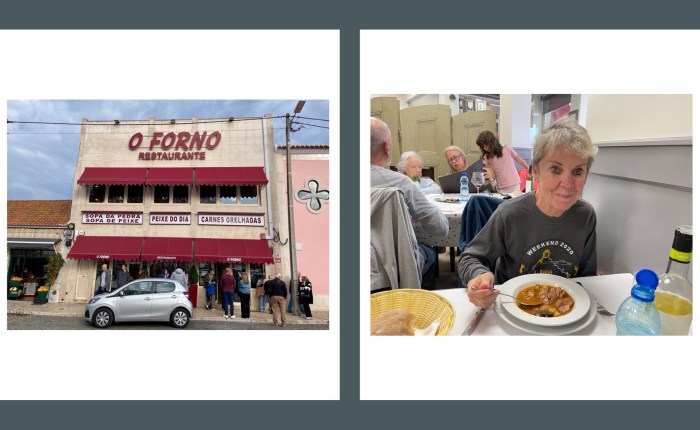
After three days in Lisbon, we were driving north to Nazaré. Big waves were coming, and by luck, we were going to be there to see them. On the way, we detoured for lunch at the restaurant O Forno in the town of Almeirim. O Forno is famous for their Sopa da Pedra (Stone Soup).
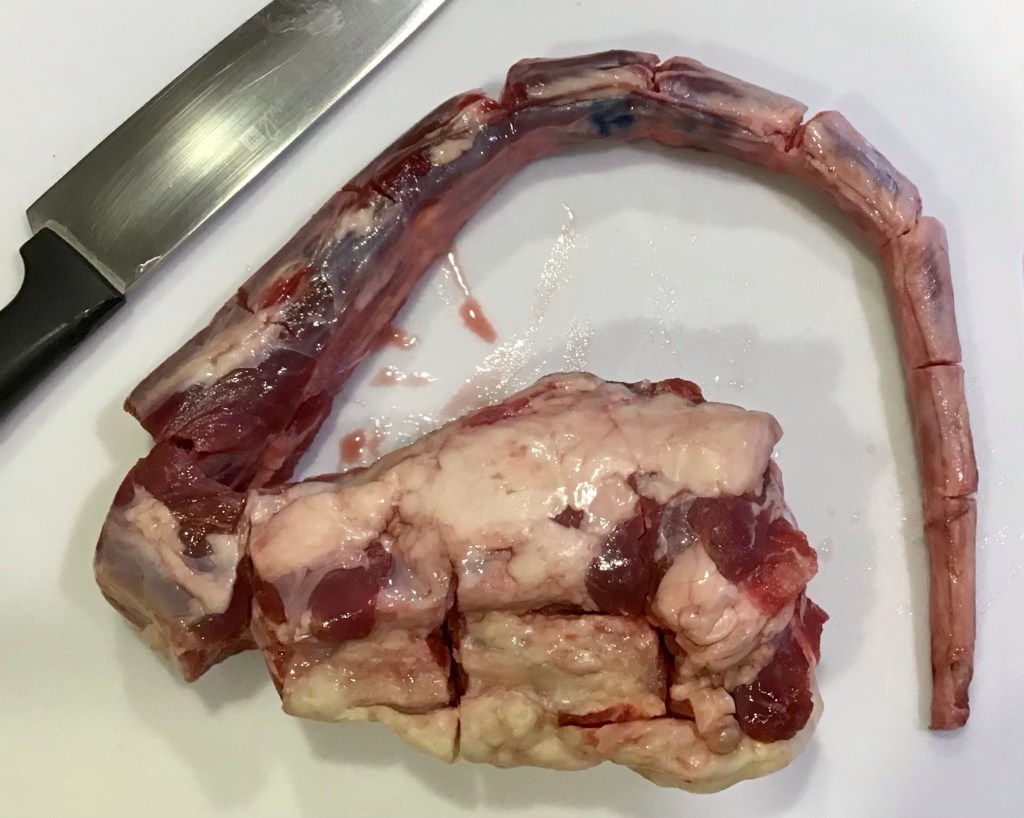
In America, we often ignore cuts of meat used to make excellent dishes elsewhere – beef cheeks and pork jowl are two examples. Oxtail is another. When we lived in Germany, Ochsenschwanzsuppe (Oxtail soup) was a classic you rarely see here. It’s an OMG wonderful dish I’ve made a couple of times now.
Of course, many hear the word Schwanz, and immediately think of the Mel Brooks film, Young Frankenstein and the scene with Inga (the great Terry Garr) using the pseudo-German word schwanzstucker*. I can assure you, there is no schwanzstucker in this Ochsenschwanzsuppe. 😉
Young Frankenstein – Worth Watching Again, Just for the Schwanzstucker Scene!
In today’s world, what we are really talking about is beef tail, but I’m going to stick with Ochsenschwanz, or oxtail, which is what it was called when we originally learned about it in Germany. Plus, it sounds cooler.
Oxtail; You Can Actually Order it in a Butcher Shop These Days.
Oxtail is high in protein, has abundant collagen and is a source of healthy fats. With the high collagen and connective tissue content, oxtail was made for long, slow cooking in dishes such as this soup. It’s a great winter dish. I’ve learned from friends who also cook that it is core to many other ethnic dishes as well. As an example, my friend Antoine Freche says, “Oxtail is the preferred bone source when creating a “silky-smooth” broth for Vietnamese Pho. Oxtails are best since they contain more collagen than a regular beef bone. The collagen is what makes the broth silky-smooth.”
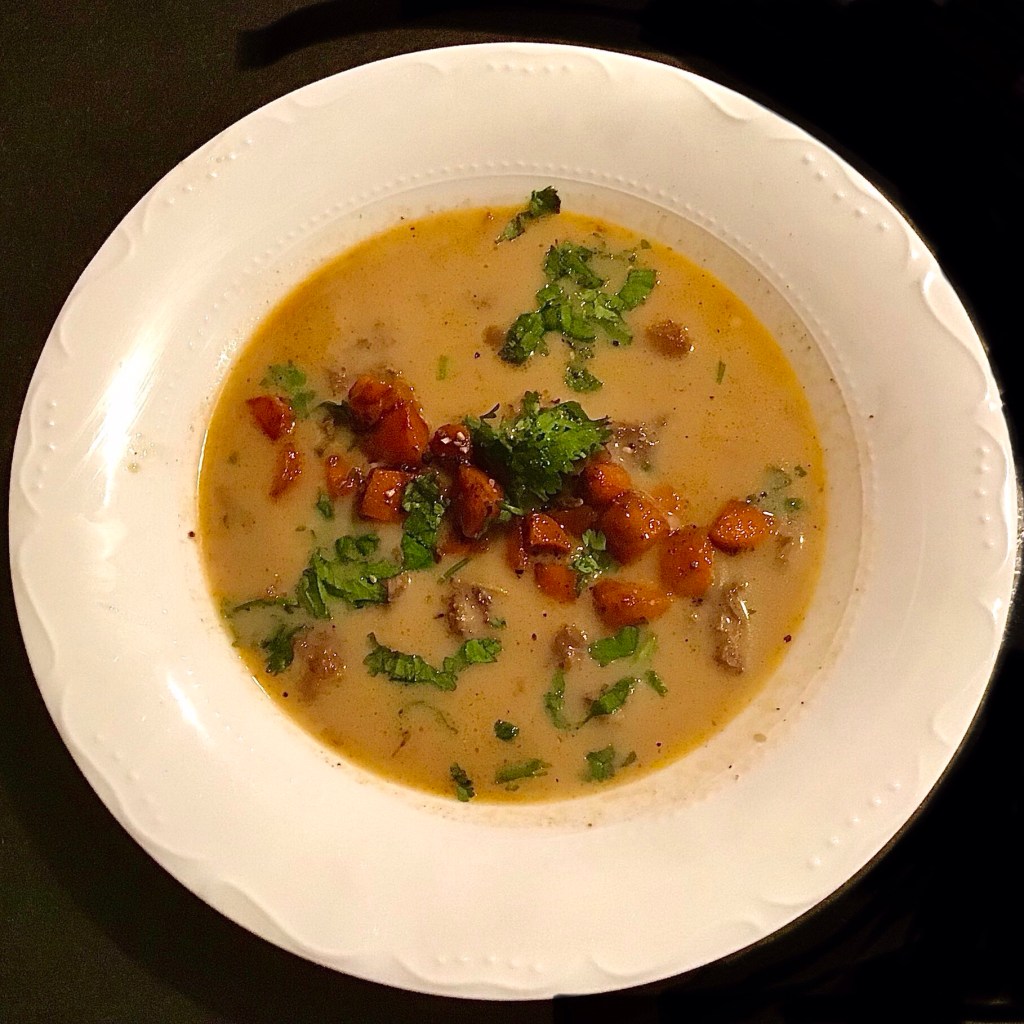
I have to agree with Antoine. The broth in this soup is wonderful. It is a different flavor than a typical beef stew and packed with umami**. Silky and smooth are both great descriptors, but so are tasty, delicious and “OMG this is so f’in good!” I’m already thinking of ways to use this broth for other dishes – it really is that outstanding.
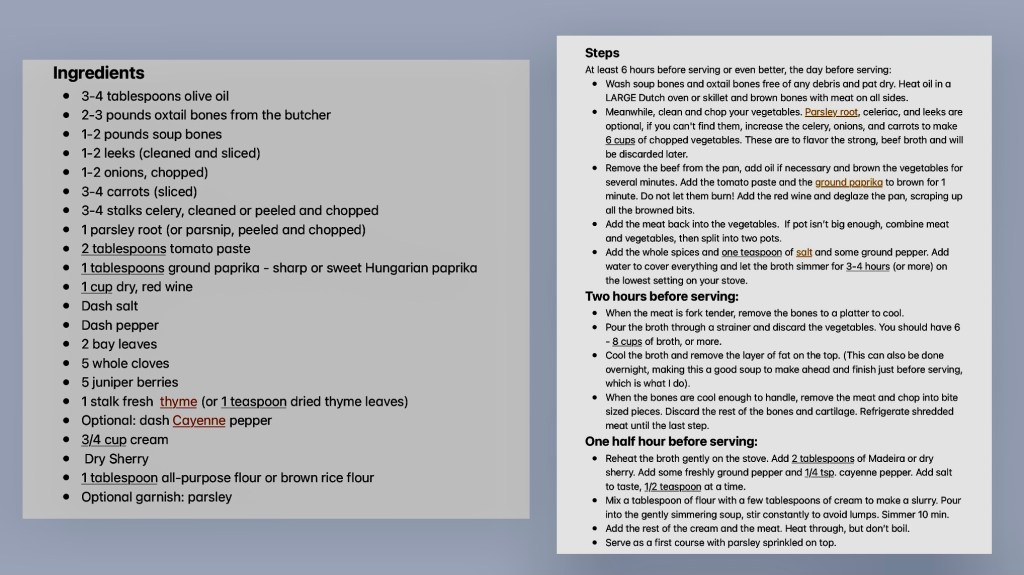
This recipe combines a rich beef and vegetable broth with paprika and pepper to add some bite, along with sherry and cream to round it out. It’s finished with a roux. It takes a while to make but is sooooo good. If you don’t have quite enough Oxtail, add some chuck steak, or some other roast to make up the difference.
Traditionally, Oxtail soup is served as a first course in Germany at restaurants or special events. They have two main versions of Oxtail Soup there – one is a clear broth with beef bits, the other is a “gebundene” (bound) version and is a little heartier. This recipe is a gebundene soup.
Ochsenschwanzsuppe – This is Soooooo Good, and Packed With Umami.
While the original version of this recipe was for a first course, Cath and I have it as a meal. With some bread and a small salad, it’s hard to beat. If you want to add a little to it for a main course, cut up a carrot or two and simmer with the sauce in the final 1/2 hour. As with most soups and stews, it’s better the day after you first cook the broth. The meal is certainly guest worthy, but I won’t judge if just you and your partner eat it by yourselves over two or three days. By the third day, it will be mostly just broth left, but that doesn’t matter. You’ll still be marveling at how tasty it is.
Ochsenschwanzsuppe Recipe.
Addendum:
* Here’s the scene from the Mel Brooks film, Young Frankenstein. It’s a great scene with Inga (Terry Garr) using the pseudo German word schwanzstucker. Gene Wilder’s reaction is classic: https://youtu.be/QuHw5ivCs1A?si=_nb9DdTWr1rlTXF1
** Umami is a fifth category of taste in food (besides sweet, sour, salt, and bitter). For me, the best description is one of savoriness, or perhaps earthiness. Umami means “essence of deliciousness” in Japanese.
Pork Jowl is sometimes considered traditional in Southern Cooking, particularly in a pairing with Black-eyed Peas for good luck on New Years Day. You don’t see it cooked that way much anymore, with folks substituting fatback, or bacon instead. It’s also used in Italy to make Guanciale, a cured meat considered essential for an authentic pasta carbonara.
I have a heavenly recipe for Beef Cheek Daube (stew) that is served over saffron risotto. Like oxtail, it is full of collagen. The first time I made the dish, two of our local grocery stores said there was no such cut of meat as beef cheeks. I ended up going to our wonderful local butcher shop, The Whole Ox, who knew immediately what I was talking about, and got the cheeks for us. The recipe is so good, we once served it on NY Eve.
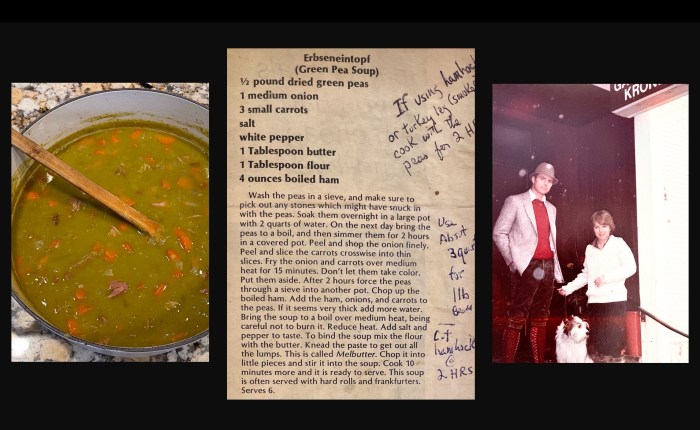
The oldest recipe in my recipe collection is for Erbseneintopf – a German Split Pea Soup. It came from TheStars and Stripes newspaper in Germany in ‘82 or ‘83, and is now a bit tattered. The first time I tasted the soup in a Gasthaus, I thought I’d died and gone to heaven. Getting the recipe was a bonus.
Erbseneintopf. The word and the soup are both a mouthful. Erbseneintopf literally translates to “Pea One-Pot”, and is really closer to a stew. Made properly, it is a thick soup with little chunks of sausage or ham hock in it. I’m not talking the puny American ham hocks, but the big German kind – meaty and smoky. The meat gives the stew a wonderful flavor. It’s a simple, hearty meal.
I believe the first time I had the dish was in a little village near Stuttgart, although I can’t remember the name of the town, or the Gasthaus, for the life of me. At the time, we often went for a walk in the woods on a Sunday afternoon, as many Germans did, and then would stop at a nearby Gasthaus for a late lunch, and a beer or two. We’d usually have some sort of simple meal – a bratwurst, or goulash soup, or some charcuterie and cheese. On one of those trips, it started snowing. Eventually we made it back to the village and the Gasthaus, where Erbseneintopf was on the menu, and despite the green color, I gave it a try. It was delicious. It became one of those dishes that stayed in my mind and I started looking for it on the menu anytime we went to a new Gasthaus – especially in winter.
Cathy, Top and I, probably in ‘82, outside a Gasthaus as it was snowing one Sunday
There were a few other dishes that stuck in my brain back then, and I would stalk them for a while – eating the dish anytime I saw it on a new place’s menu. One of those was Cordon Bleu. I spent a couple of years looking for the perfect Cordon Bleu during our travels across Germany, France and Northern Italy, and dragged visiting friends with me on my quest. Another dish was Käsespätzle, basically a German adult version of Mac ‘n Cheese, with homemade noodles, onions and cheese – It was total comfort food and a bazillion calories.
Cordon Bleu, käsespätzle, schnitzel, wurst, certain kinds of steak, pommes frites (french fries) and a host of other dishes all became a part of our life. We loved German food, but never tried cooking it at home. I’m not sure why. Maybe we knew we couldn’t match what we were eating in the Gasthauses.
Then one day, the world changed. Around 1982, our local military newspaper, The Stars and Stripes*, started a monthly feature with recipes for different German dishes. Some were simple, some more complicated. I’d read the recipes, but didn’t really think much about them, and then one day, they published several soup recipes – Gulaschsuppe, Linseneintopf (Lentil Soup), Tomatencremesuppe (Tomato Soup), and at the bottom of the page – a recipe for Erbseneintopf! I promptly cut the recipe out of the paper.
A little faded, and tattered, but the recipe works just fine.
This was most excellent. I spoke with a German friend about the recipe and she thought it looked authentic. Her one suggestion was to swap out the boiled ham called for in the recipe and replace it with chopped up ham hock, or some smoky local German sausage. It was a good suggestion.
A week or two later, we made the dish for the first time and lightning struck. We couldn’t believe how much it tasted like the restaurant version. The ham hocks provided the smokiness, while the “Melbutter” (see recipe – a mixture of flour and butter) thickened the soup. This baby was a keeper. At the time it was actually one of the very few dishes I cooked, or could cook. Yea, I did steaks, burgers and brats on the grill, but cooking something in the kitchen? I was out of my league there. This soup was probably just about it.
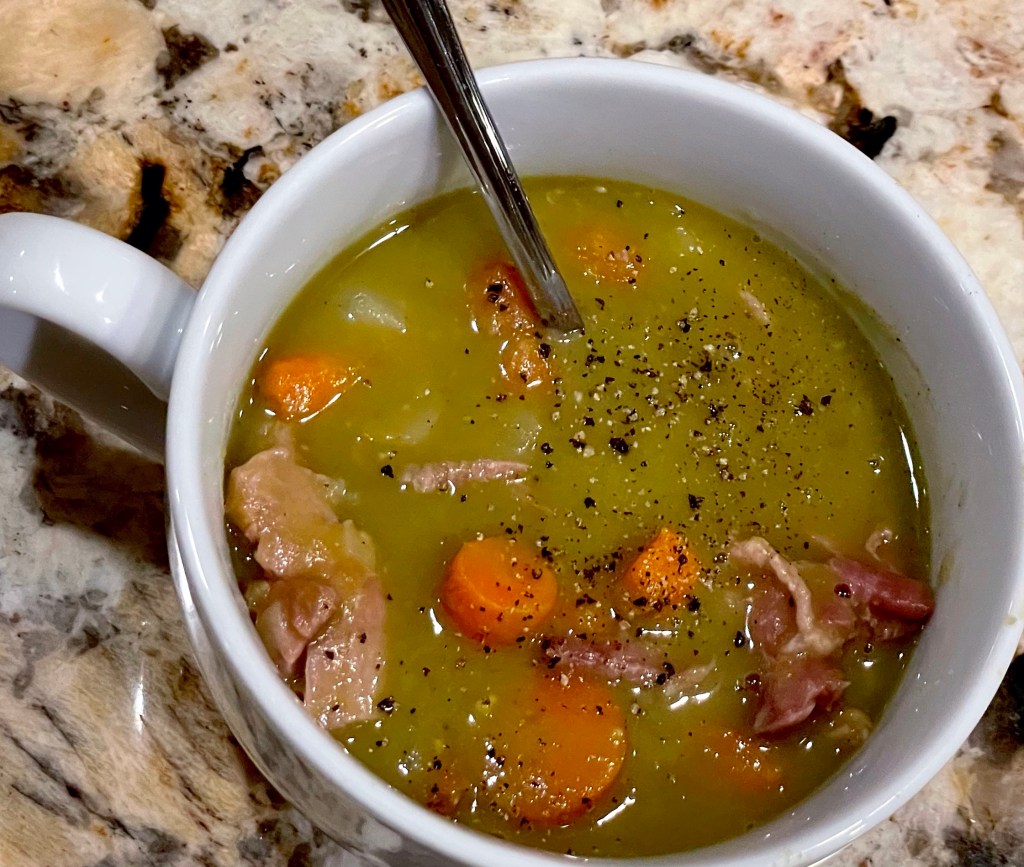
A bowl of Erbseneintopf. Still delicious, after all these years.
Erbseneintopf has remained a part of my winter repertoire ever since. I’ve only made one change since cooking it that first time. Here in the States, it’s sometimes hard to find good German sausage, or ham hocks with a bit more meat on them. As a result, I often substitute a smoked turkey leg for the ham hocks. It gets the job done.
Looking for a good winter soup on a cold, snowy day? Erbseneintopf might be just what you need. It’s peasant food at it’s best. As with many soups and stews, it’s even better on the second day.
Addendum:
⁃ * The Stars and Stripes newspaper was first published during the Civil war. Later, it was delivered to US forces in France during WWI, and became an overseas fixture during WWII. It continued through Korea and Vietnam, and is still published at overseas military locations to this day, although there were discussions during the Trump presidency of cancelling it (it wasn’t). It operates from inside DoD, but is editorially separate and independent from it. The newspaper has been published continuously in Europe since 1942.
⁃ I also struck pay dirt a month or two later when The Stars and Stripes published recipes for Spätzle and Käsespätzle, and our friends Jim and Res bought us a Spätzlemaker for Christmas. The Spätzlemaker is 40 years old now, and in great shape. We still use it a couple times of year.
⁃ My friend Tim Stouffer reminds me occasionally about my Cordon Bleu quest. He visited Cath and I several times throughout the ‘80s. On at least a couple of those visits, I know I inflicted my obsession with Cordon Bleu on him.
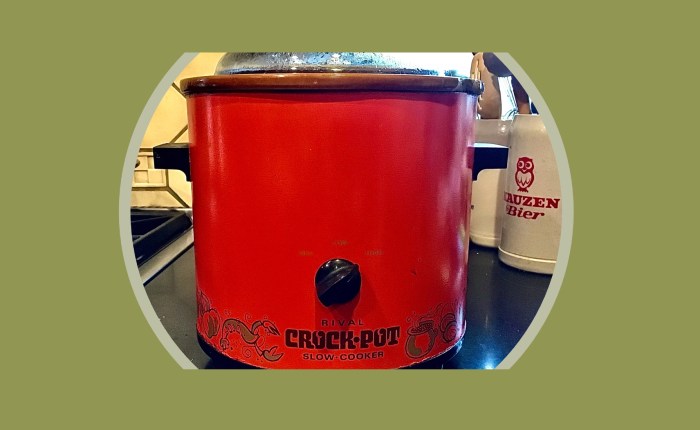
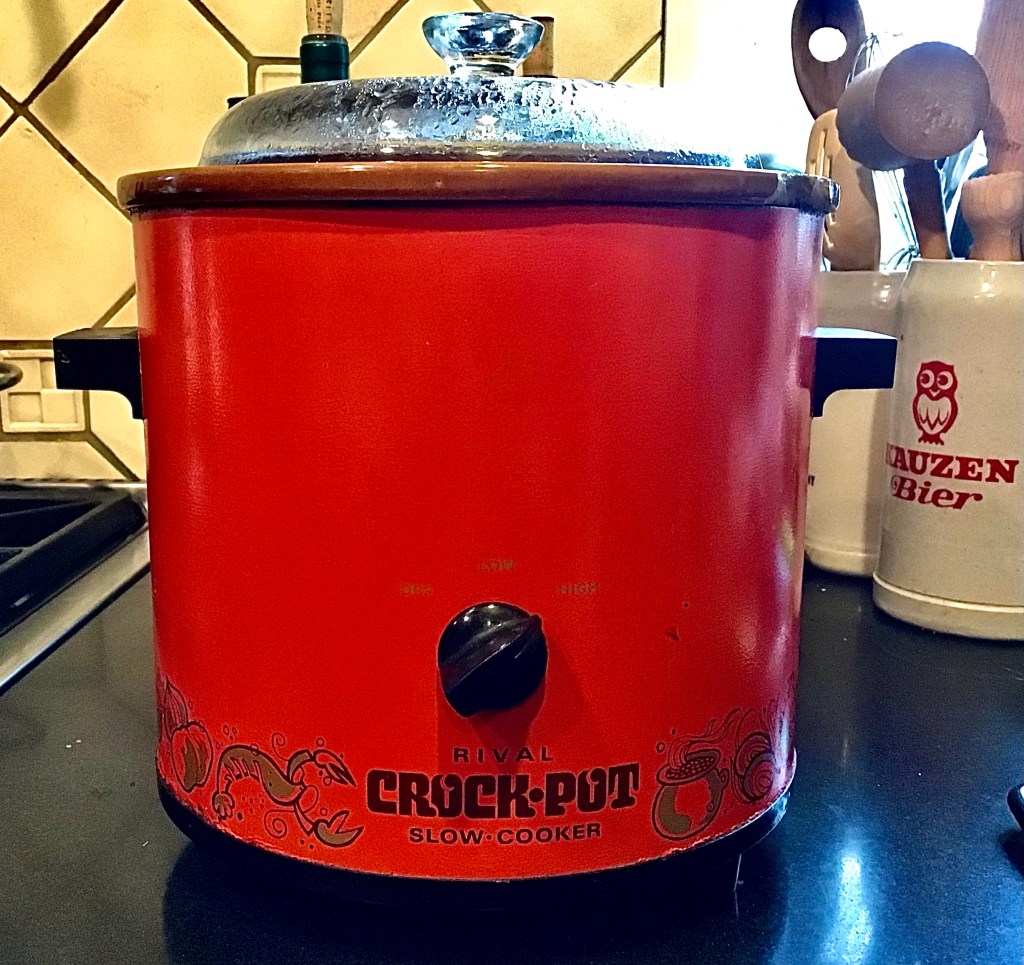
‘Fess up. Who owns, or owned, one of these beauties from the ‘70s? Long before there were Slow Cookers or Instant Pots, there were Crock-Pots. Ours is from 1974 and still chugging along. Seriously, 1974 and it still works. What else do you have that old, and still working? And, you have to love the color…
Cathy’s Crockpot from 1974 – Still Chugging Along…
It’s the 50th anniversary of the invention of the Crock-Pot. Appliance maker Rival unveiled it in 1971 at the National Housewares Show in Chicago. Ads and commercials represented the Crock-Pot as a wonderful, time-saving device, assuring women (yes, this was the ‘70s – almost all cooking related ads focused on women) it would simplify their lives. Hell, baseball player Joe Garagiola even became a pitchman for the Crock-Pot, hawking it as “the perfect gift”. And of course, the Crock-Pot would do all of this great work in those fabulous ‘70 colors.
A Couple of Vintage Crock Pot Ads From the 70s
That color – I’m not sure if it’s called burnt orange, red orange, or just mutant orange. It’s a color you can’t forget. Quite frankly, it and the colors “Autumn Gold” and “Avocado” represent the ‘70s as much as disco, polyester and bell bottoms. If you see anything in one of those colors, you pretty much know what decade it came from.
Burnt Orange, Harvest Gold, and Avocado Green – the Holy Trinity of 70s Colors
Cathy bought this particular Crock-Pot at the age of 18 in the summer of 1974. It was just prior to moving to Washington DC and a job with the FBI. Over the past 47 years, our Crock-Pot has made countless chilis, soups, stews, roasts, and other dishes. We have cooked with it in Germany, Georgia, Oklahoma, Ohio and Virginia. It crossed the Atlantic four times. How many things do you have that have been with you your whole marriage? This pot, along with our love, is one of the few things that has survived those 43 years. It’s pretty much indestructible and part of the fabric of our lives.
Having retired, I do much of the cooking around the house these days and often braise, roast or slow cook in the oven itself. Still, there are some recipes that just call out for the Crock-Pot. I think the simplicity of the device helps – you fill it with the food you are cooking; pick one of the two heat choices, low or high; and walk away for 6, 8, or 10 hours. What’s not to like, other than perhaps the color?
Summer is ending, autumn is arriving, and winter will soon be here. This ol’ Crock-Pot will again earn it’s keep, providing us with comfort food this autumn and winter. Sure, it has a couple of chips around the rim, but the heater still works fine and the lid sits securely on top. It does it’s job. In fact, it does it’s job much better than any number of devices from this century. It just keeps ticking along and will probably be with us for another decade or two. Now that I think about it, we should list it in our Trust for one of our nieces or nephews… 😉
This winter sucked. We didn’t have much snow, but the three ice storms we did have, made travel treacherous, even if just walking to the barn. Of course, I’m not only talking about the weather.
A Long Cold Lonely Winter …
Covid and Covid isolation continued to hold sway over most of us. Then, as the vaccine became available, we were all scrambling to find some way, any way, to receive a shot. They even had a name for us: We were Vaccine Hunters. The slow pace of the rollout was maddening.
We also had that failed, inept insurrection thing back on January 6th. THAT didn’t cheer anybody up. In fact, it made many of us despair for our country.
To top it all off, we have several good friends dealing with serious health challenges. Some, with life and death health issues.
All of these matters combined to cast a pall over this winter. There was a hint of melancholy, at least at our house. The Winter of our Discontent, indeed.
Whether the opening line of Shakespeare’s Richard III, or the title of the 1961 John Steinbeck book, the words “The Winter of our Discontent” aren’t promising. Neither the play, nor the book are particularly cheery. Richard III is of course filled with political and familial intrigue, death and murder, while Steinbeck’s book “The Winter of our Discontent”, examined moral decline in America. Both have more than a little in common with this past winter.
So, how do you fight against a winter of discontent? It could have been all too easy to just try and survive – stay cooped up, become cheerless, and drink too much.
One of the ways we fought it was with Comfort Food. And more specifically, comfort food in the form of soups and stews.
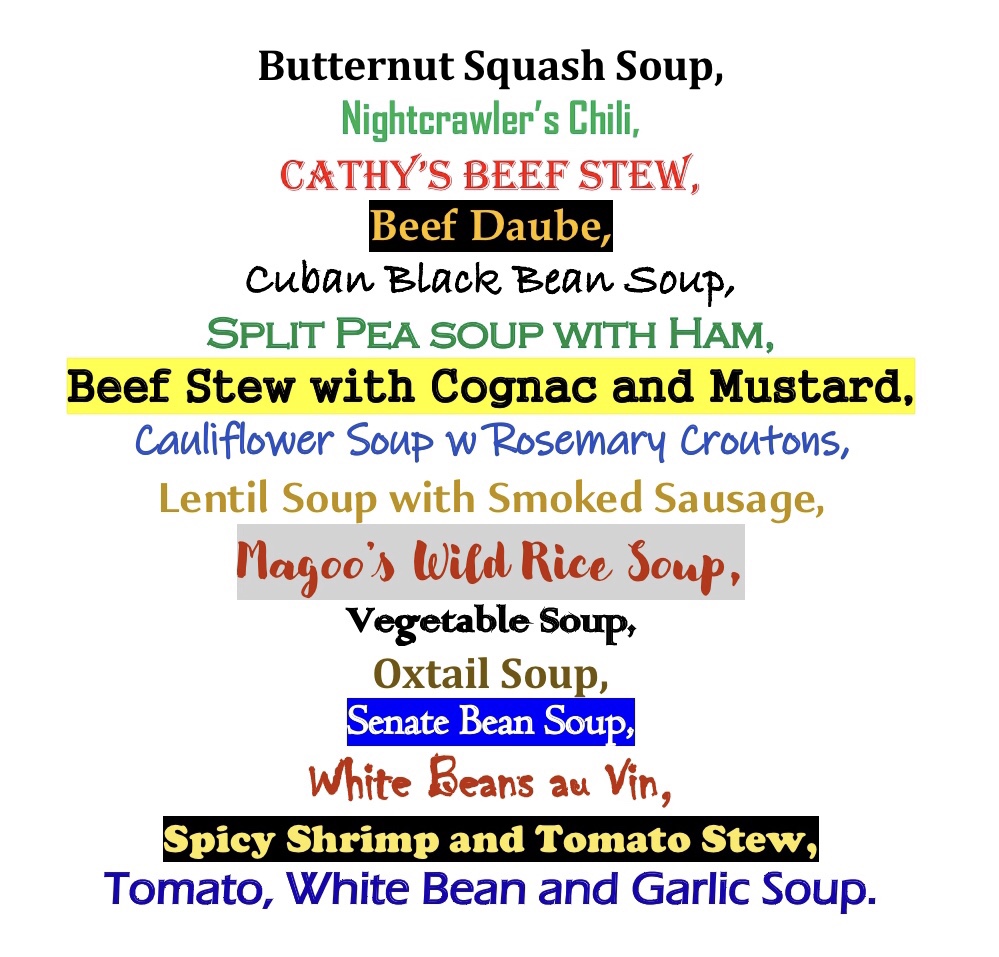
We made and ate more stews and soups than usual this past winter. Actually, I think we had them a couple times a week all season long. Several were old favorites. Others, we made for the first time, and some of those quickly became new favorites. We warmed ourselves with our meals, as much as with the wood stove in the family room. Here’s a list of the assortment we had:
Those soups and stews provided comfort in many ways. Certainly there was the warmth they gave in the bowl and the simplicity of eating a one pot meal. There was also the ritual and pleasure of making them. For me, that brought a bit of relaxation. A few hours in the kitchen, surrounded by the wonderful smells from the simmering pot, along with the warmth of the stove itself, is not a bad way to spend a cold day. I also think their bursts of flavor and color countered the grayness of the season. They furnished a bit of light in the darkness of midwinter, if you will.
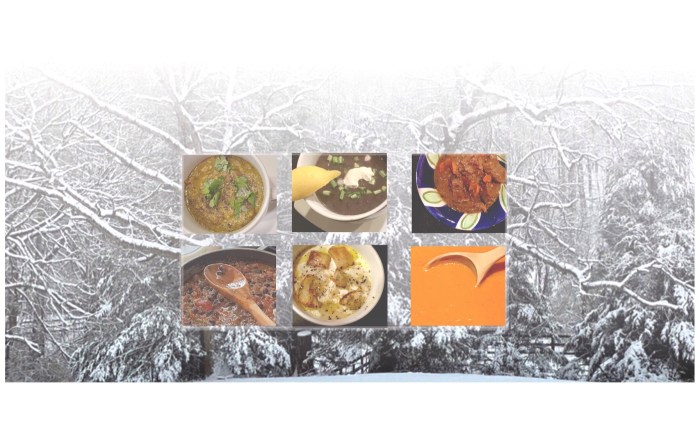
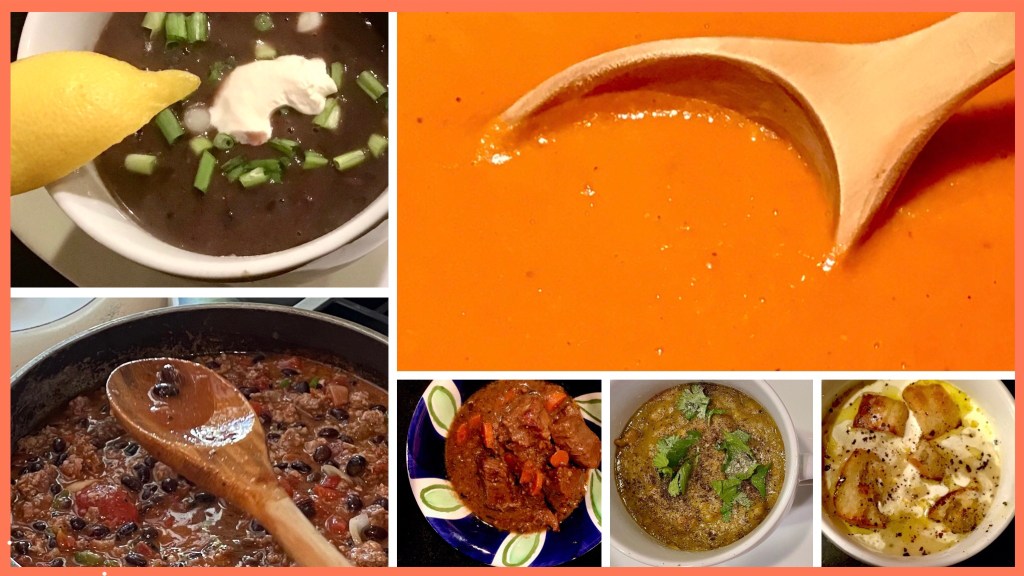
Winter Warmth, Clockwise from upper left – Cuban Black Bean Soup, Butternut Squash Soup, Cauliflower Soup with Rosemary Croutons, Split Pea Soup with Ham, Beef Stew with Cognac and Mustard, and NightCrawler’s Chili
This winter, like all winters, will end. Saturday, March 20th, is the first official day of spring. Although I know we still have some cold, and possibly snowy, days ahead of us, the weather is already turning. Additionally, Cathy and I have both received our Covid shots, and it appears the distribution floodgates are finally opening for all who want the vaccine. Soon, we will all get there.
Among our friends with health issues, some have improved, and others are holding their own. They too are getting Covid vaccines and we hope to see them soon. Unfortunately, two classmates, one from West Point, and one from high school did pass away. We are “at that age” now, where death happens more frequently, but it doesn’t make it any easier.
I’m sure we will have a few more warming winter soups and stews over the next several weeks. And while I’m happy for the sustenance they provided over the past four or five months, my mind is already turning to lighter dishes and meals. The days are growing longer and are not so dark. This winter of our discontent is ending. Spring, and the promise of renewal beckon and I am ready to embrace them. In the immortal words of George Harrison:
Addendum:
– Cathy and I had the good fortune to see the play several years ago at the Shakespeare Theatre here in DC. As with many Shakespeare tragedies, there was plenty of death, murder, political mayhem and family intrigue. If you get a chance to see it, I hope you do so.
– The Winter of Our Discontent was John Steinbeck’s last novel, and published in 1961. He borrowed the title from Shakespeare. It too tells the story of a family, with themes concerning the effects of social pressure, deceit, lying, corruption and death. Steinbeck stated that he wrote the novel to “address the moral degeneration of American Culture during the 1950s and 1960s.”
The weather had finally turned cold(er) here in the Virginia Piedmont and they were calling for snow over the next two days. This was the perfect time to make a Beef Daube and I was on a mission.
Daube is a French word that translates to stew. All daubes are stews, but not all stews are daubes. To me, daubes are thicker and richer, and are almost like a stew “sauce”, if that makes sense. I loved my mom’s beef stew, but this beef daube is something else.
This particular recipe is for a Three Day Beef Daube. It’s from a book my old friend Tim lent me called “Duck Season”. The book is about the Gascony region of France, and if you enjoy reading about other countries, particularly their food, drink and culture, I highly recommend it. The dish takes three days to make, although the steps are pretty easy. Day one – marinate the beef; day two – make and cook the daube for 2-3 hours and let it rest over night; and day three – gently simmer the daube for a couple of hours and then eat. That’s all there is to it.
Last Thursday, I pulled the chuck roast out of the freezer to thaw, and made up my shopping list. On Friday morning, I went shopping for the few things I still needed – a leek, some parsley and thyme. We had everything else at home. After a quick lunch, I cut up the beef and added it to a bowl which already included smashed garlic, sliced leak, a bouquet garni, and a bottle of red wine. Day one was done, with plenty of time left to take our dog Carmen for a walk, and in anticipation of the snow, to bring more firewood into the house.
Day two started grey and cold. When I went to the barn in the morning to feed the horses, there was a skim of ice on the pond and the air had that “pregnant with snow” feeling you sometimes get right before a storm. Predictions for snow amounts rose from 2-4” to 3-7”.
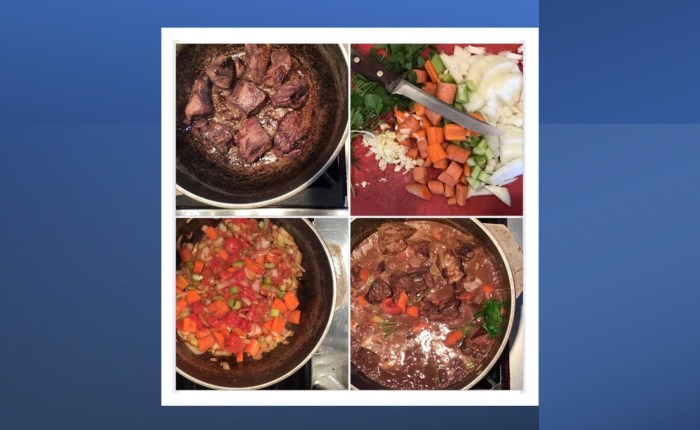
I continued with the daube around noon and day 2 was only a bit more work than day 1. I browned the beef; chopped up and sauté garlic, onions, celery, carrots and tomato; added the beef back to the pot with the vegetables, along with a new bouquet garni; and added the strained and reserved wine marinade to the pot. Once that was done, it simmered on low heat for about 3 hours.
I’ve found it’s best to take your dog for a walk while the stew is simmering, so you don’t drive yourself mad with the wonderful smells coming from the kitchen. After returning from your walk, you are faced with the most difficult part of day 2. You don’t eat the daube on day 2, no matter how good it smells or tastes. Instead, you remove it from the heat, cool it to room temperature and let the daube rest overnight in the fridge. Remember, don’t eat the daube at this point in time.
Sunday, Day 3, greeted us with a blanket of snow. About 7 inches had fallen, with more expected over the course of the day. After feeding the horses in the morning, and then having my own breakfast, I plowed our drive and around the barn, and then plowed the drives of several elderly neighbors. I made it back inside for lunch, and then some playoff football.
During the afternoon, I started reheating the daube. After removing the congealed fat from the top of the daube, the pot went back on the stove for a gentle three hour simmer. Now the smells were truly driving me crazy and the football was barely a distraction. I took one more walk with Carmen and could see that we had another 3-4 inches of snow today. It was still snowing at dusk as we finished our walk, and I may need to plow again tomorrow, but that will wait.
About a half hour before dinner, I threw a baguette in the oven to warm up, and finally it was time. We served the daube over egg noodles and had it with the bread and a bottle of wine. I breathed in the aroma and took my first bite. What a great ending for a snowy weekend…
_____
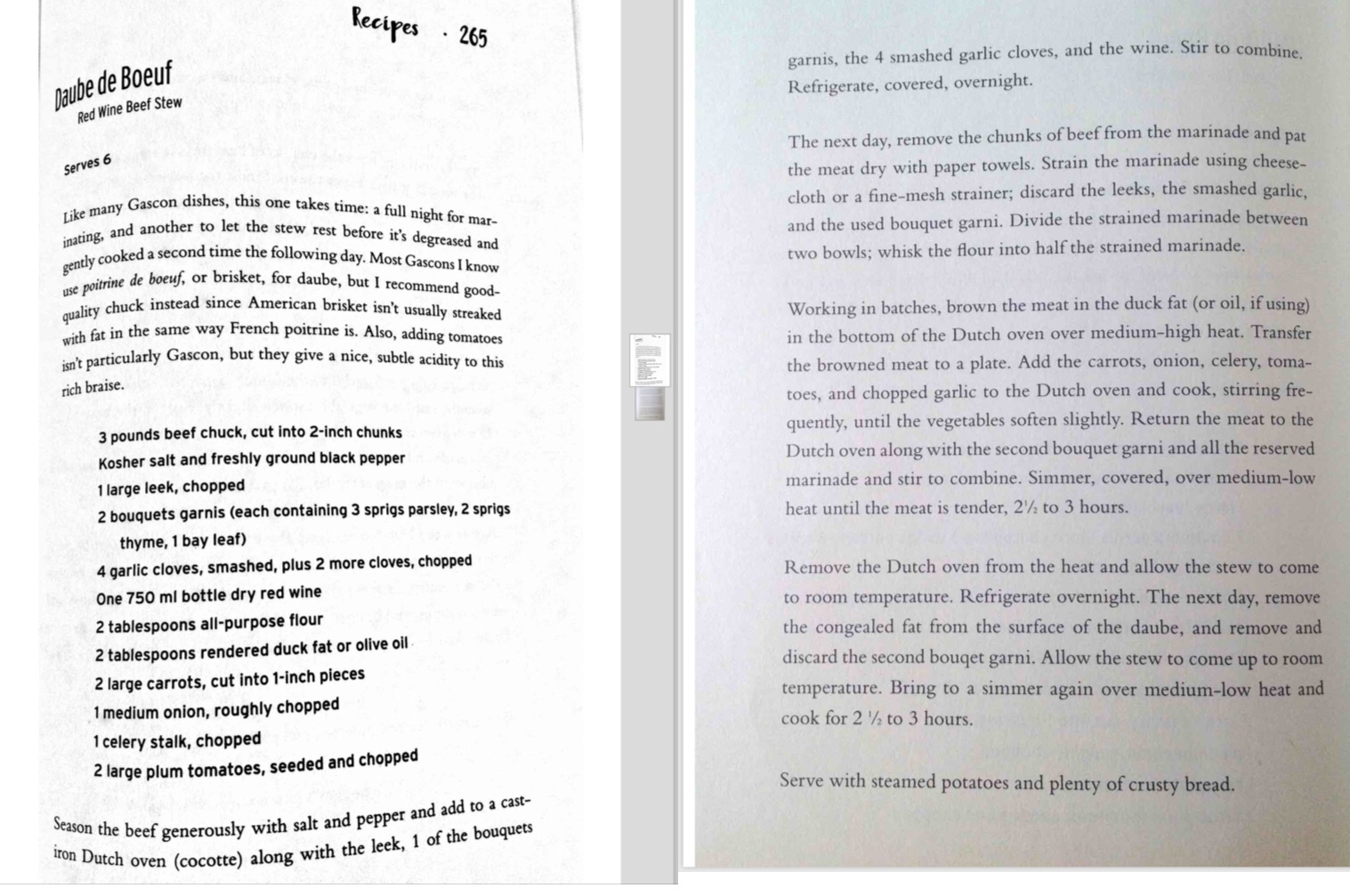
Addendum: Here’s the recipe. It’s from the book “Duck Season”, by David McAninch.











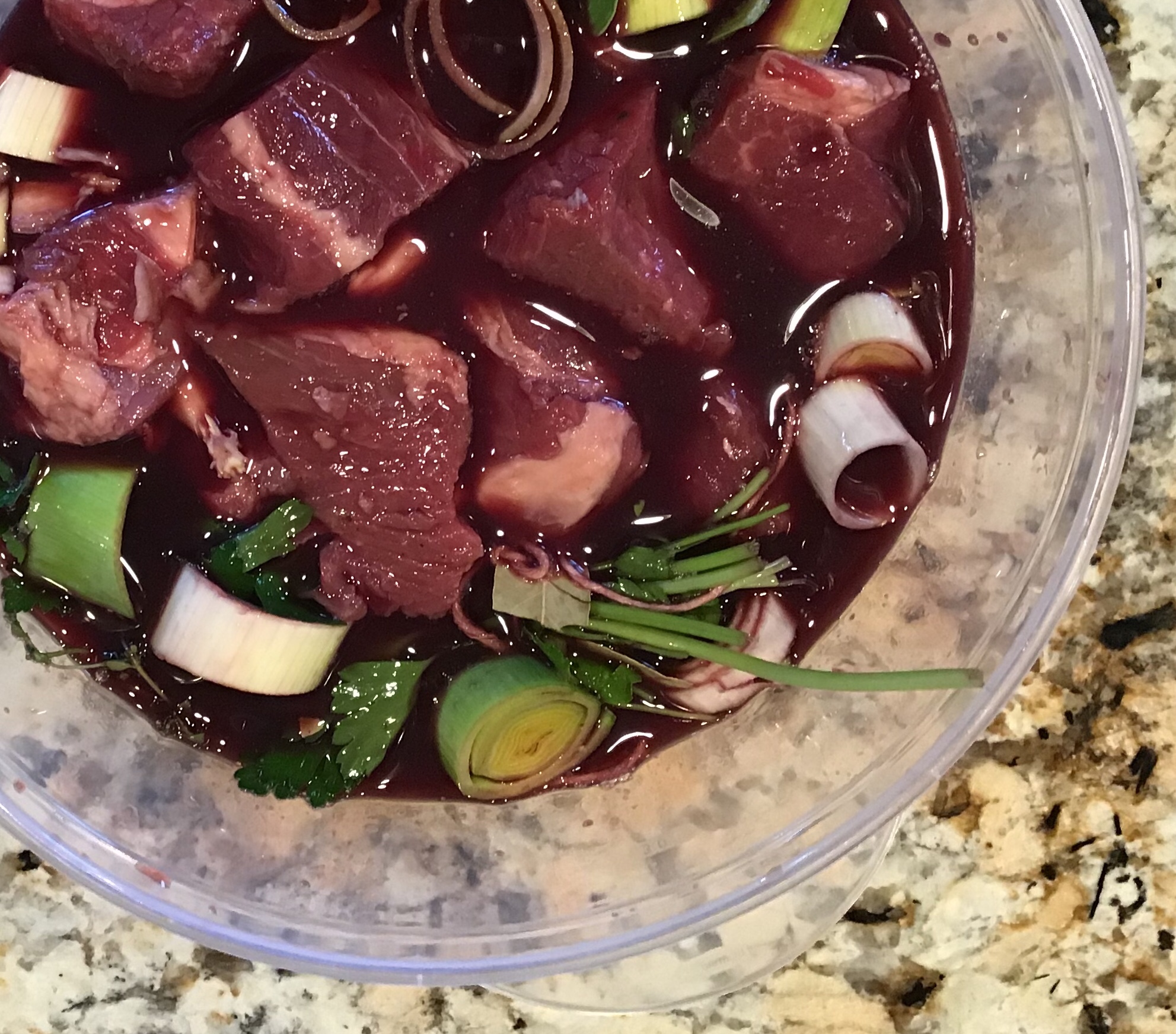 Last Thursday, I pulled the chuck roast out of the freezer to thaw, and made up my shopping list. On Friday morning, I went shopping for the few things I still needed – a leek, some parsley and thyme. We had everything else at home. After a quick lunch, I cut up the beef and added it to a bowl which already included smashed garlic, sliced leak, a bouquet garni, and a bottle of red wine. Day one was done, with plenty of time left to take our dog Carmen for a walk, and in anticipation of the snow, to bring more firewood into the house.
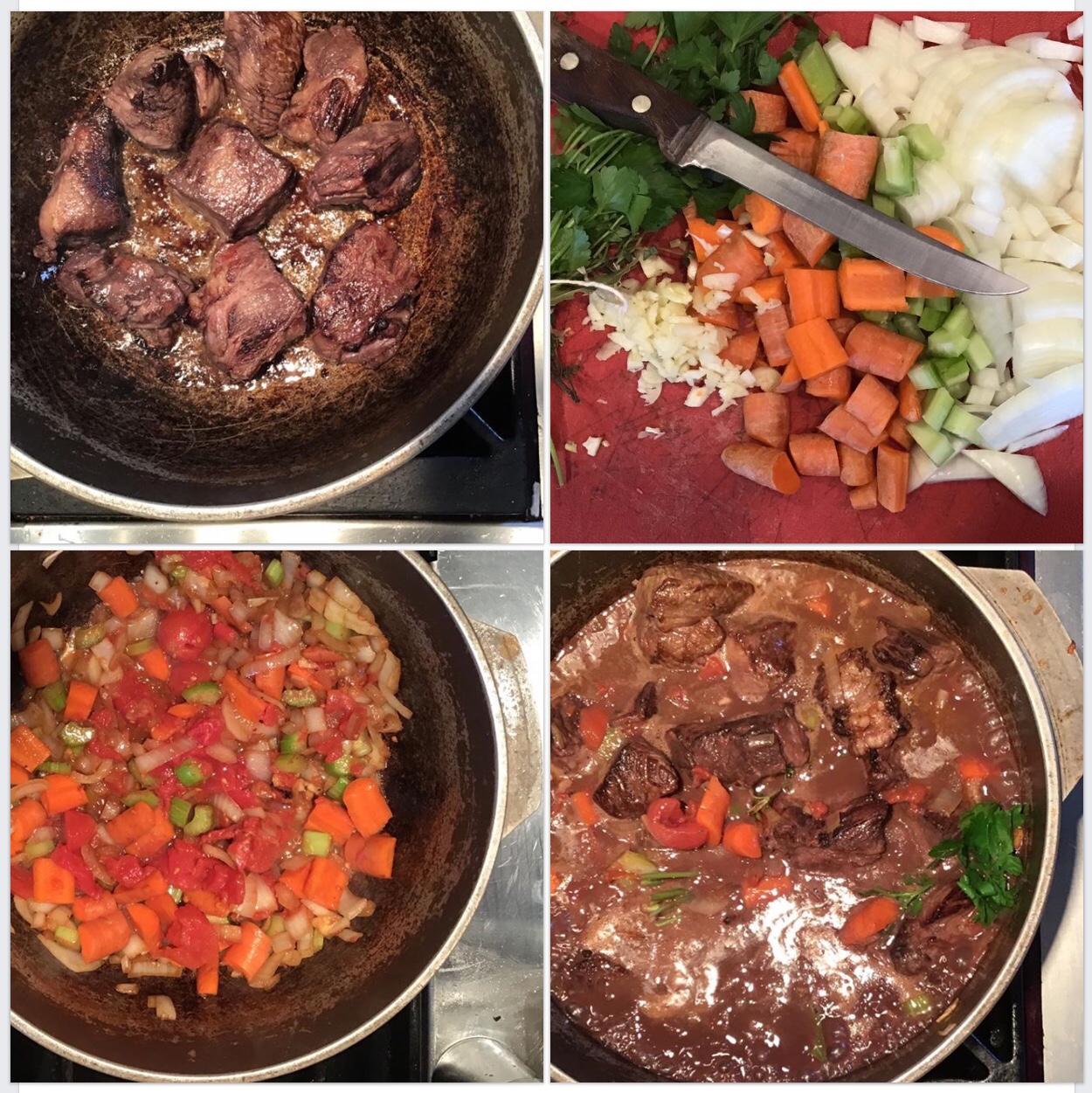 I continued with the daube around noon and day 2 was only a bit more work than day 1. I browned the beef; chopped up and sauté garlic, onions, celery, carrots and tomato; added the beef back to the pot with the vegetables, along with a new bouquet garni; and added the strained and reserved wine marinade to the pot. Once that was done, it simmered on low heat for about 3 hours.
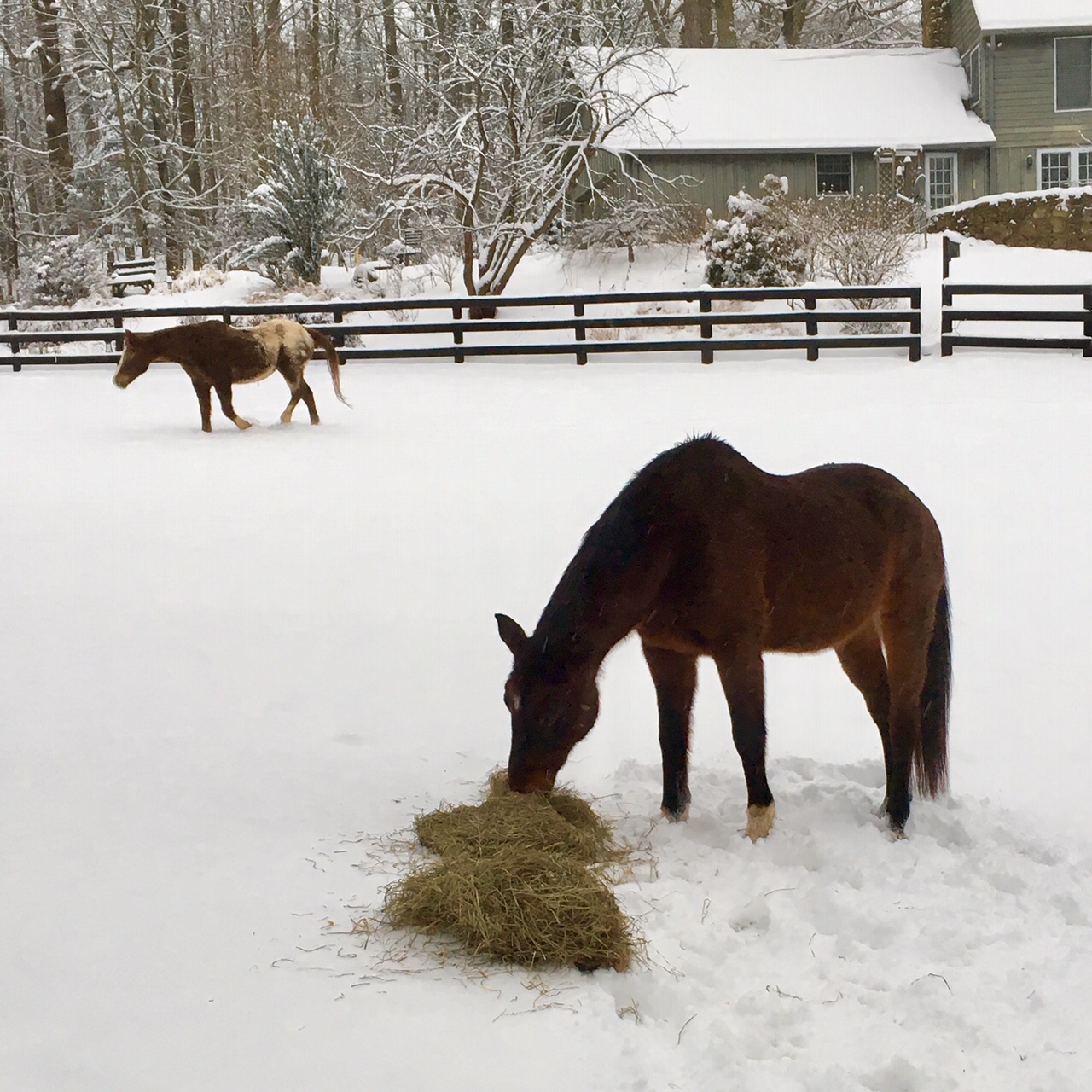 Sunday, Day 3, greeted us with a blanket of snow. About 7 inches had fallen, with more expected over the course of the day. After feeding the horses in the morning, and then having my own breakfast, I plowed our drive and around the barn, and then plowed the drives of several elderly neighbors. I made it back inside for lunch, and then some playoff football.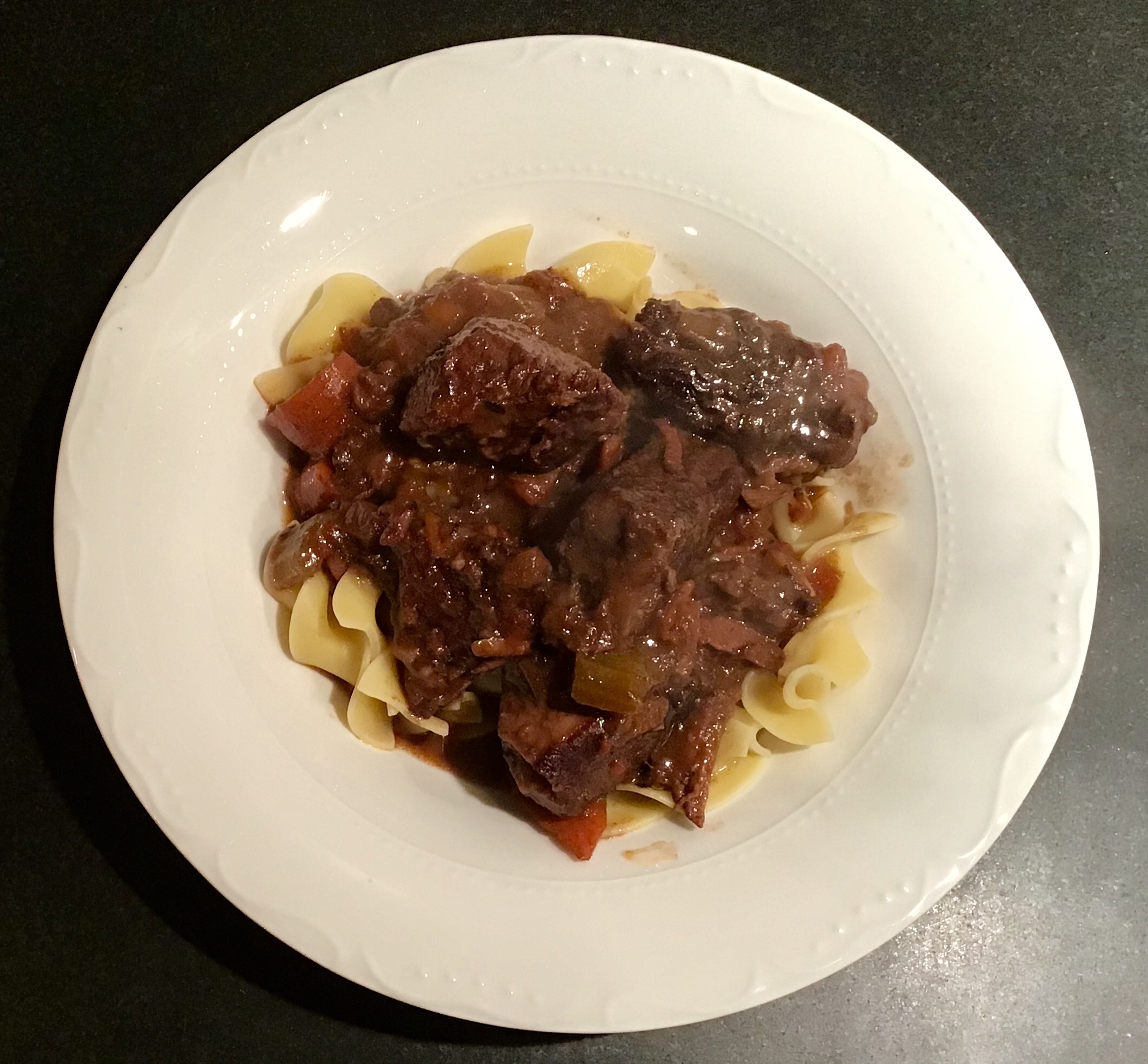
 Live Life Exuberantly