The Chili Dump

The Chili Dump

I hate missing a good party. Unfortunately, we will miss Chili Dump 2022. We made the 2016 version, which featured great chili, a band, Elvis, a bonfire tended by a front-end loader, and 200, or so, of my sister and brother-in-law’s closest friends. What’s a Chili Dump? I’m glad you asked.

My Brother-in-law Jack started his legendary Chili Dump party around 2002 with his then wife, Meg. The first party was a thank you for friends who helped clear the land they were building their home on, and then subsequently helping them build their home. It became an annual event, and as their kids grew older, their friends started attending the party as well. Sadly, Meg passed away in 2013. When my sister Roberta met Jack later, she too was introduced to The Chili Dump. In 2016, we timed our visit home to Illinois so we could attend the party.

On that October ‘16 afternoon, Jack started a fire in the back yard and put a huge pot over it. The pot actually looked more like a cauldron than any pot I’d ever seen. They added the usual chili ingredients – cooked ground beef, tomatoes, tomato juice, hot peppers, beans and spices (and please, I don’t want to hear from any Texans about how beans don’t belong in chili). Soon, the chili started to cook and bubble away. By then, we may have had a beer or two.
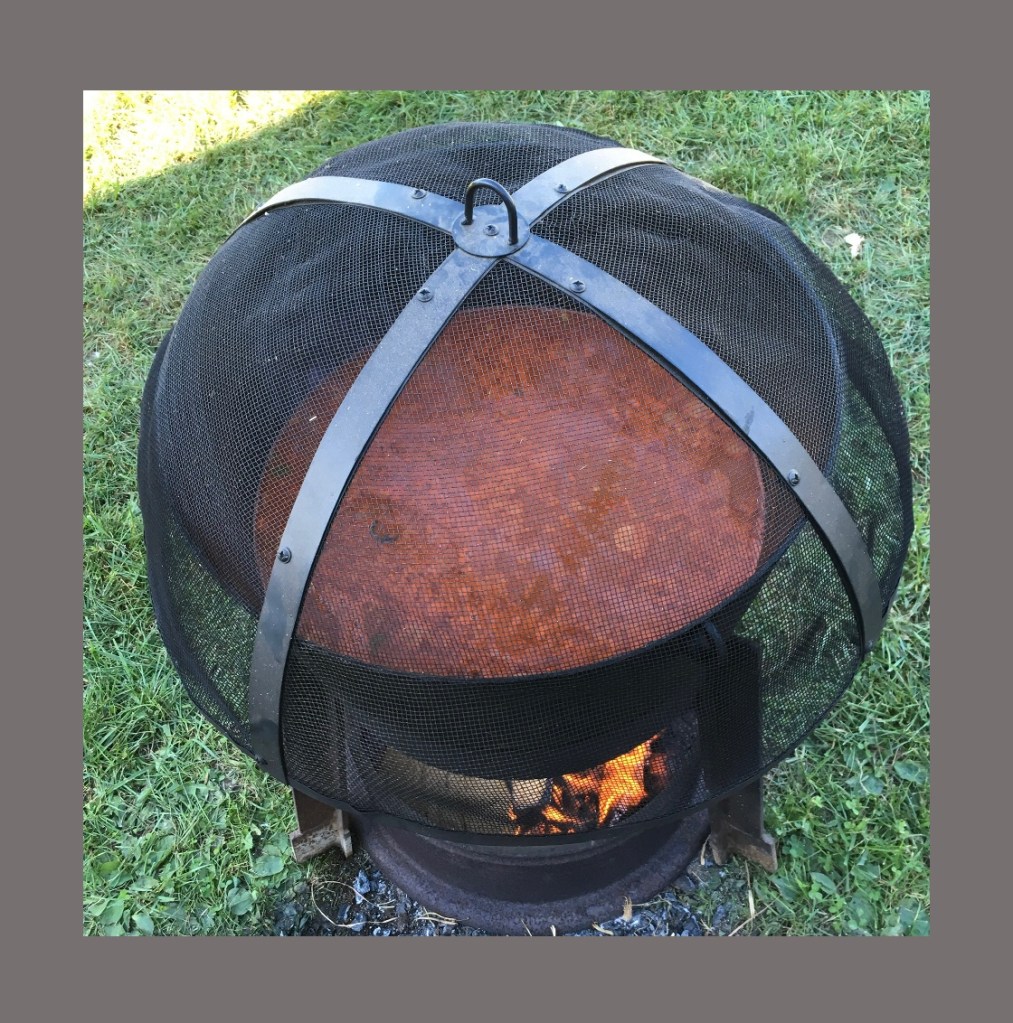
A Cauldron of Chili….

The first friends arrived by ATV, and brought more ingredients to add to the Chili – venison and jalapeños if I recall correctly. Others continued to arrive. Smoked brisket, hotdogs, sausage, bratwurst – they all went into the pot. Wood was added to the fire, to keep the chili cooking. Our friends Tim and Renee arrived from the Chicago ‘burbs with a blend of spices they specifically put together for the chili. Into the pot it went.
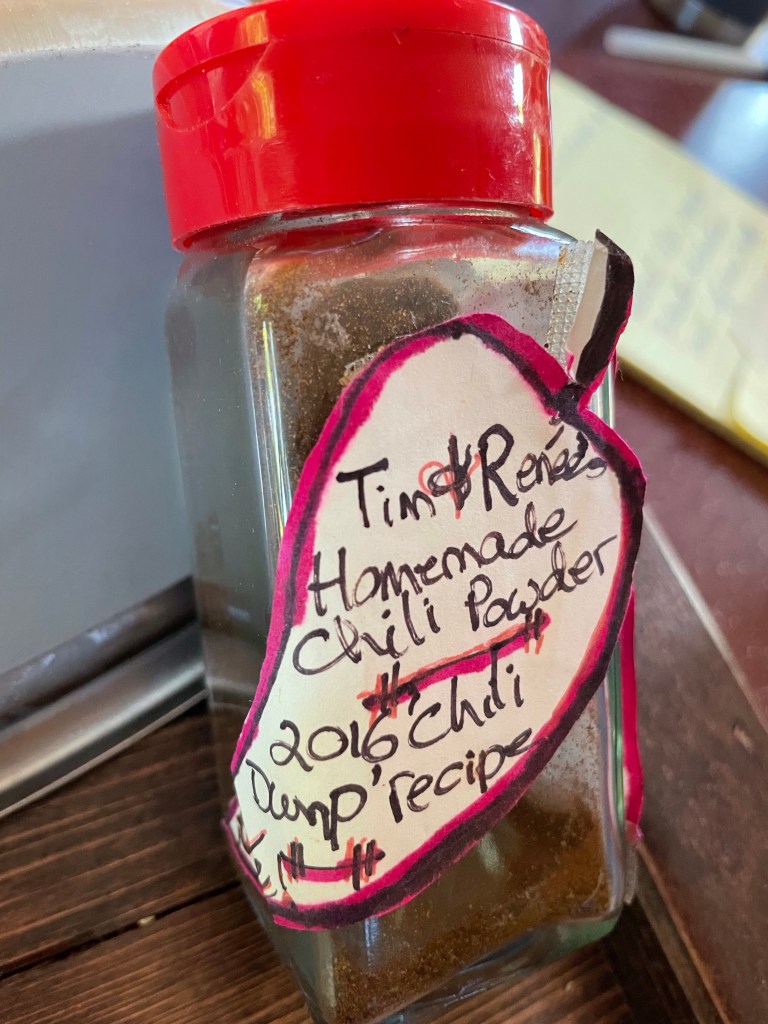
Tim and Renee’s Special Chili Spice for the Chili Dump!

Other folk brought toppings, including sour cream, grated cheddar cheese, sliced jalapeños and fried bacon. Someone made cornbread. There were bags of chips and Doritos added to the serving table. My sister Tanya and her husband Shawn arrived, and added more beef in the pot. Nieces and nephews arrived, and all dutifully put something in the pot. The volume of chili in the pot was definitely increasing.
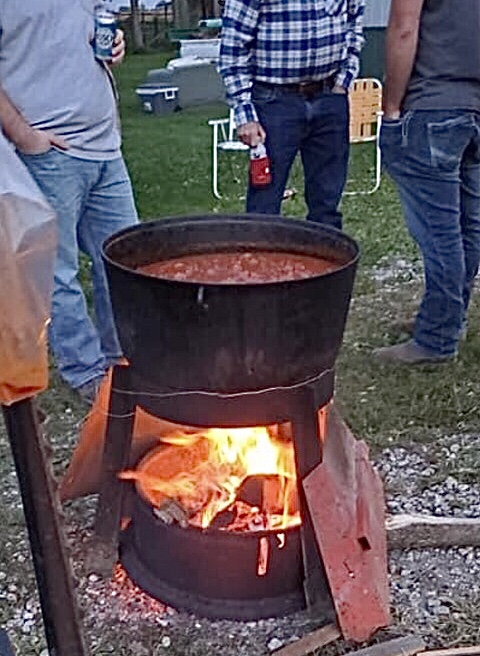
The Pot was Getting Full!

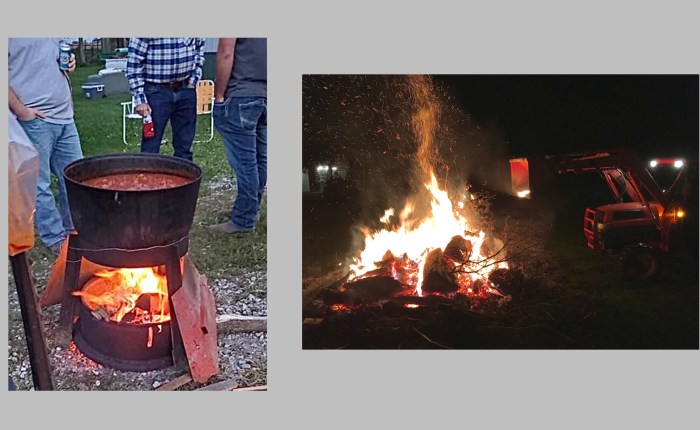
Pickup trucks and cars were now lined up near the cow pasture. It started getting crowded and started getting dark. Around then, Jack lit the bonfire. It was a biiiiiig bonfire…

The Bonfire WAS Big…

Somewhere during all of this, people began sampling the chili. I have to admit, I was a bit skeptical, but then I took my first bite. Wow! This was surprisingly tasty. People kept arriving and adding to the chili. There was now also a steady stream of bowls being filled, so the volume stayed about the same, or maybe started to go down. There were probably 200 people at the farm by then.

Eventually, the Joel Limberg Band started playing. Some folks were dancing, and as at weddings, lots of little kids were hopping around on the dance floor. At some point, the band brought out a surprise guest singer – Elvis. Actually, a Philippine Elvis. Let me tell ya, you haven’t lived until you’ve heard Elvis sing Sweet Caroline, with the crowd joining in on the response – “Sweet Caroline, oh oh oh, Good times never seemed so good – So Good! So Good! So Good!” The party was going strong now!

Yes, Elvis is a bit Blurry, Much Like Parts of the Evening….

More dancing. Talking with family and old friends. Making new friends. More beer. More chili. The chili level in the pot was definitely receding. The bonfire was also going down, but Jack wasn’t ready to let that happen just yet. You know you have a big fire when you need to tend it with a tractor’s front-end loader.

Nothing Says Party, Like Fire in the Front-End Loader…

Although it was getting later, no one was leaving. Suddenly fireworks went off and exploded in the sky. We all watched, and oohed and ahhhed. The neighbors didn’t complain, because most of them were at the party.

Oooohhh! Aaaahhhh!

The band played another set, and it was time for more beer and more chili. The volume in the pot was definitively lower, but the chili was still hot, and still tasty. I noticed the crowd was starting to thin some, although I don’t think the sound volume was any lower.

Well after midnight, Cathy and I finally went to bed. It was a great party, but sometimes it’s good to know your limits.

The next morning, we woke, not feeling overly fuzzy. Jack and Berta were already up and had fed their calves and chickens. Amazingly, they didn’t seem to much worse for wear. I asked Berta how late the party went, and all she said was “Late”.

Our friends Tim and Renee also spent the night and they too woke up and joined the living. Eventually, we all went outside and started cleaning up. We may have partaken of a little “hair of the dog” during the cleanup. A couple of the youngsters also stopped by and with all of us involved, it wasn’t tooooo much work and we finished up after a couple of hours.

That was the 2016 party, and so far, the first and last one we attended. Since then, we’ve been out of the country for a couple of them, and of course covid slowed things down. I should mention they burned a Covid Snowman at the 2020 Chili Dump.

SnowMore Covid ‘19, was Added to the Bonfire in 2020…

I’ve both attended and hosted a number of good parties over the years, here in the States, and overseas in Germany, Austria, France, Belgium and the UK. I have to say the 2016 Chili Dump was one of the best. Anytime you combine chili, beer, Elvis, a bonfire, fireworks and fun people, it has to be pretty good, doesn’t it?

Addendum:

Thanks to my sister, Roberta, for help with this blog.

Eggs and Dichotomies

Eggs and Dichotomies

I recently enjoyed a fun and funny New Yorker article, by Rachel Syme. While reading, I became aware of two dichotomies simultaneously – First, she is a wonderful writer, whose prose blows mine away. Second, I know how to cook a perfect soft boiled egg, while she does not :-).

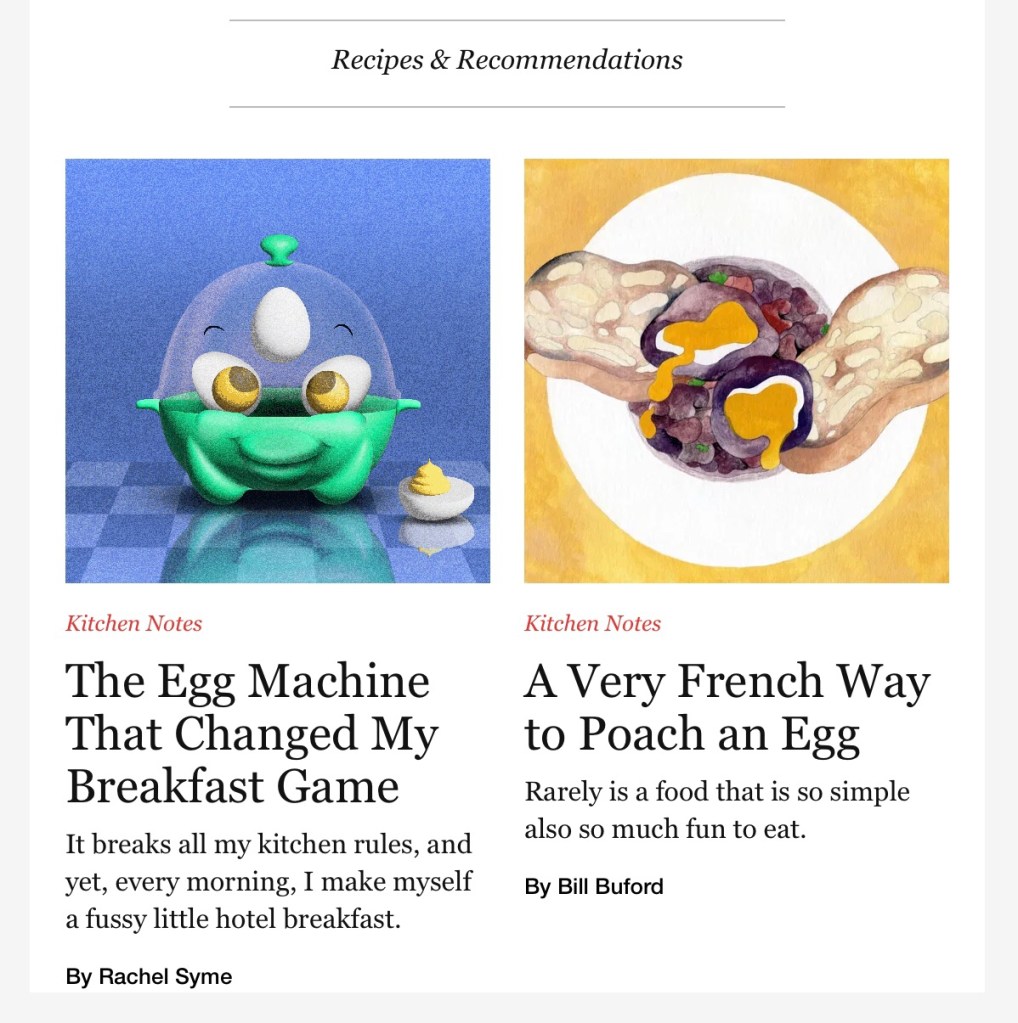
I subscribe to the New Yorker, which has great writing on a multitude of topics. One of the features of my subscription is that I receive emails a couple of times a week with reading suggestions. Last week, the email shared several food related articles, and one of them immediately caught my eye. Maybe it was the lead in … “The Ridiculous Egg Machine That Changed My Breakfast Game – It breaks all my kitchen rules, and yet, every morning, I make myself a fussy little hotel breakfast.” I’m not a kitchen gadget guy, but this sounded intriguing. I knew I was either going to love it, or hate it.
Both Reads were Good, but Syme’s Article Caught my Eye First

The article WAS good, and interesting. I enjoyed the way she wove the story of the egg machine into her own background and family history, while adding something we all crave – a little pampering while at a hotel. She talked about short getaways, and the enjoyment of coffee in bed, and wonderful little breakfasts, including soft boiled eggs.

It made me think of my own introduction to soft boiled eggs. Growing up, eggs were a family staple, particularly on weekends. Saturday mornings often saw eggs scrambled, over easy or sunny-side up, with toast and bacon on the side. Hard boiled eggs? Sure. Always at Easter, but also occasionally for a snack, and a big dose of them in mom’s potato salad. Soft boiled eggs? I don’t remember mom (or dad) ever fixing them. I believe the first time I ever ate one was while stationed in Germany in the early ‘80s. On one weekend trip, we spent the night in a small village Gasthaus. The next morning we came to the dining room for breakfast, where we were greeted with charcuterie, a cheese board, and thick slices of bread, along with something else – soft boiled eggs in small holders, with a tiny comforter over the top of the eggs to keep them warm. The presentation was funny, practical and magical all at the same time. The eggs themselves? Both simple, and delicious. I was hooked.

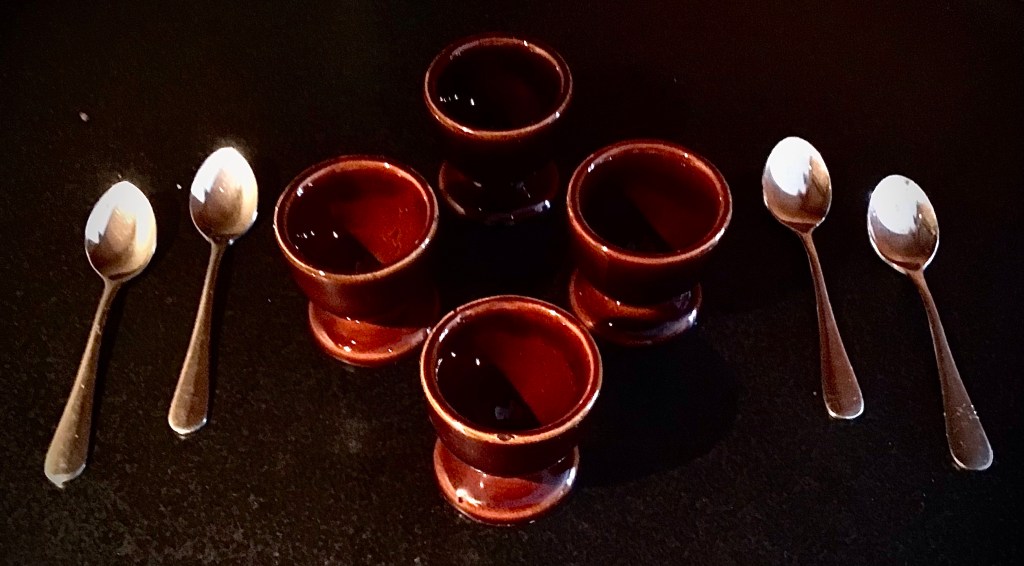
Of course, we then had to make them at home, which led to us buying the little egg cups, and the tiny spoons needed to scoop out that golden delight from the center of the egg. We made them for a year or two, usually on the weekend when guests were staying the night. Then, as is often the case, we got out of the habit, and eventually stopped making them. For thirty years.

The Egg Cups Sat Unused for Thirty Years

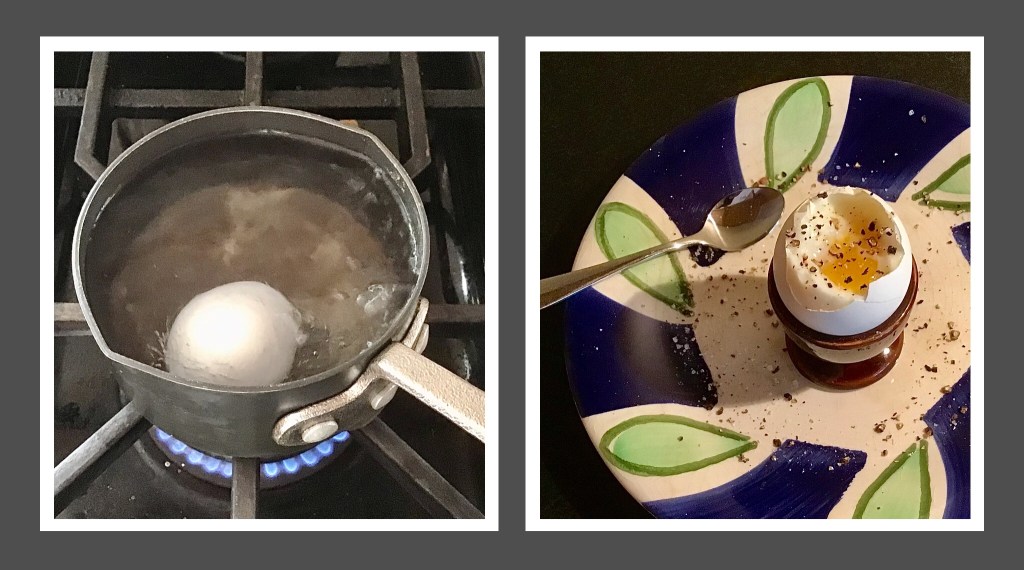
After retiring about eight years ago, I rediscovered the egg cups, and brought them back into use. I’m usually up earlier than Cathy, so we eat breakfast separately. Once about every week or two, I take the four minutes and fifty seconds needed to make a soft boiled egg. Just. The. Way. I. Like. It. A little bit of memory, delight and tastiness all in one egg.

Four Minutes and Fifty Seconds to a Nice Breakfast

Which brings me back to Rachel Syme and her article. The twin dichotomies we share are perfectly summarized in her breakfast description in the article: “Mornings at home were for English muffins with a scoop of marmalade, or muesli with a splash of almond milk. Low-risk stuff. Foolproof … What I kept fantasizing about was a perfect plate of soft-boiled eggs, with a silky, spreadable yolk the consistency of honey. I knew I wasn’t going to be able to manifest this fantasy on my own. Enter the egg machine.

In a million years, I would never come up with the phrase “…with a silky, spreadable yolk, the consistency of honey.” I mean, that is a perfect description. It makes me hungry just reading that line. And then, she adds the kicker “ I knew I wasn’t going to be able to manifest this fantasy on my own. Enter the egg machine.” I wanted to scream out “Rachel! You too can do this. All it takes is four minutes and fifty seconds! Really!”

So there you have it. We all have our talents, we all have our fantasies, and those of us who are lucky enough, recognize the limits of the former, while trying to reach the latter. If Rachel Syme can achieve breakfast nirvana with a DASH Rapid Egg Cooker, who am I to judge? In the meantime, I look forward to reading more of her wonderful writing, and maybe learning a thing or two along the way.

Addendum:

Lost in Translation

Lost in Translation

Our second favorite restaurant in Rheindürkheim, Germany in the late ‘80s was Pfeffermühle (The Peppermill). Das Letzte Essen (The Last Meal) didn’t occur there, but that is where the story started.

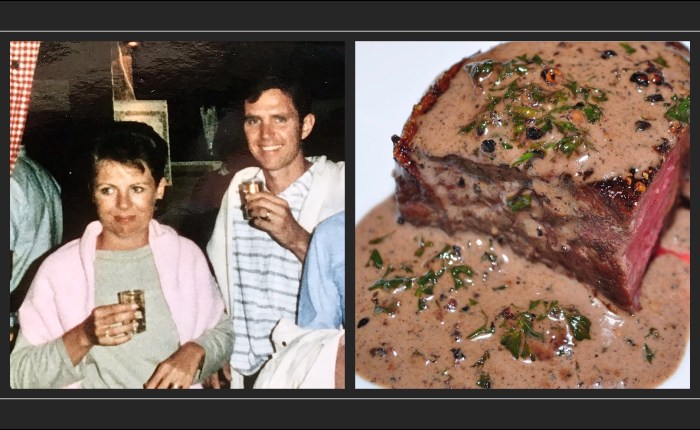
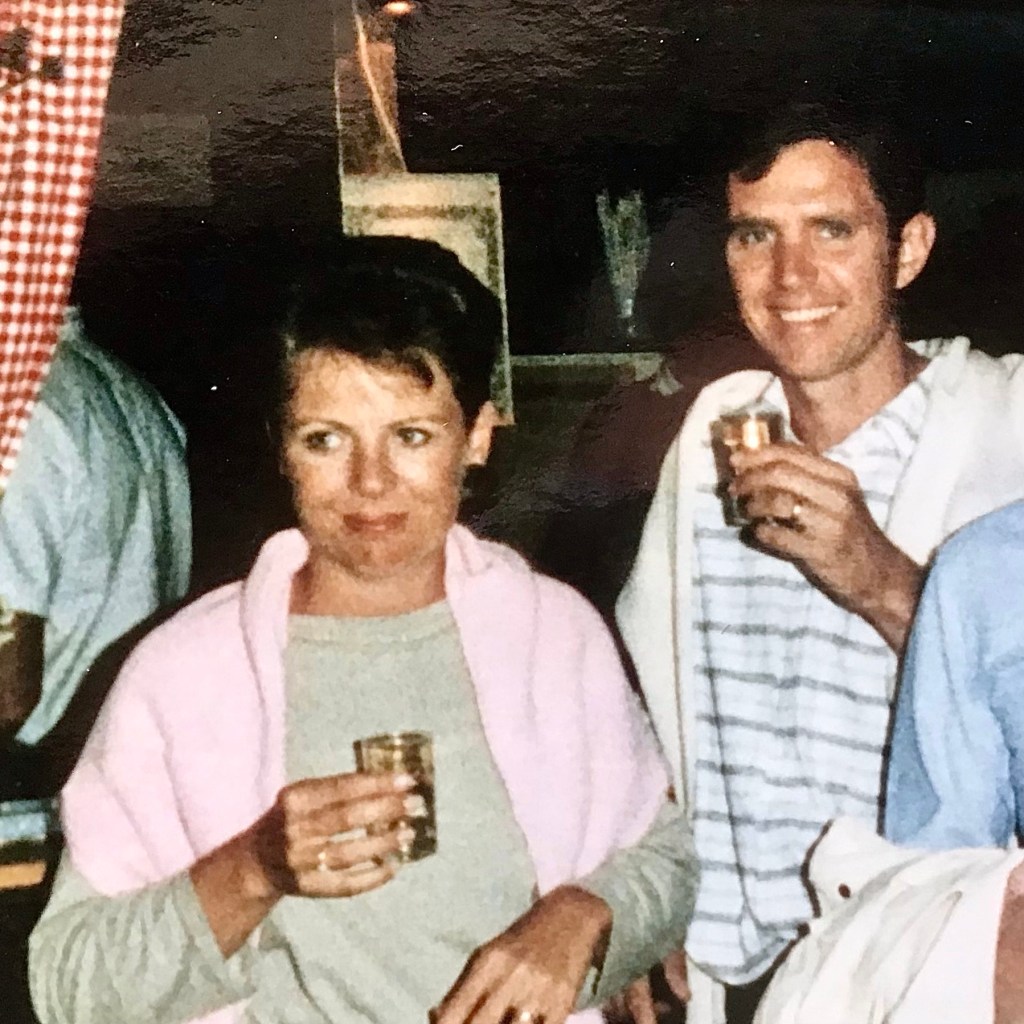
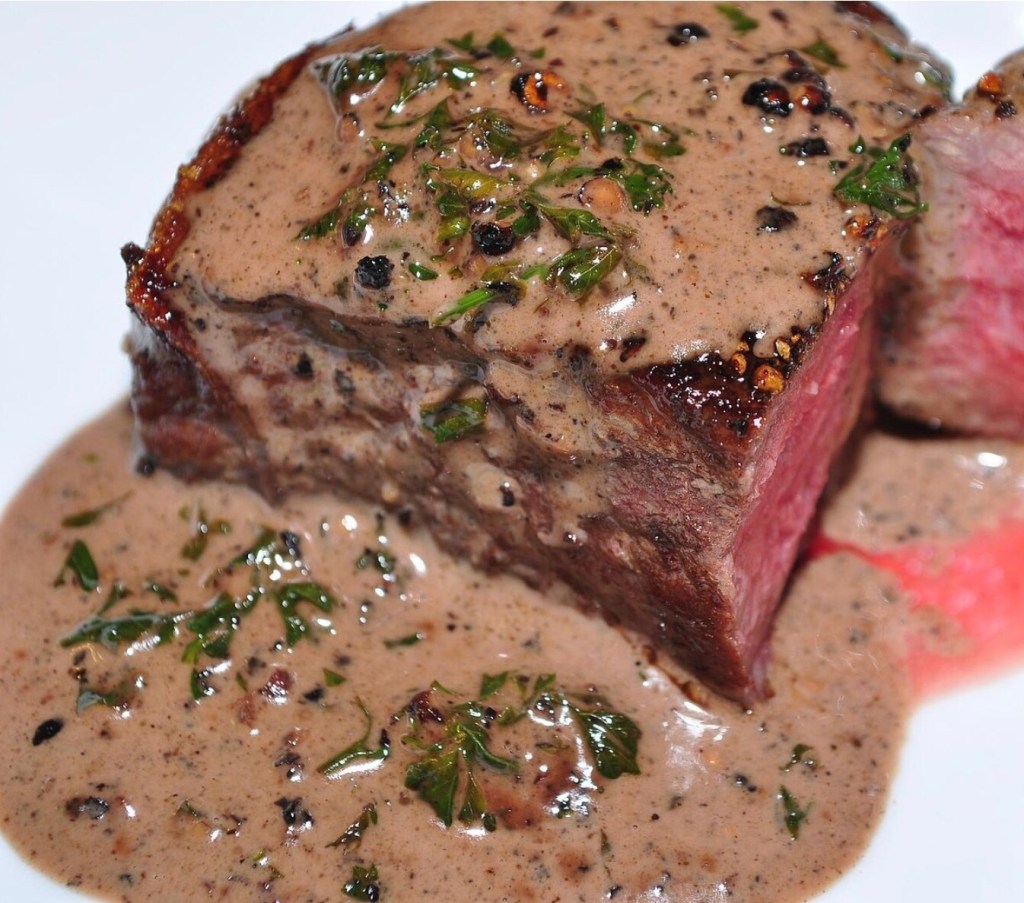
Recently, Cath and I were thinking about Pfeffermühle. I’d made Cathy a special meal one night for dinner, Steak au Poirve (Steak with Pepper Sauce). As we were eating dinner, she said “Do you remember the couple we met at…”, before she could go on, I finished her thought “…at Pfeffermühle? The ones who came to dinner?” “That’s them!”, she answered. “Do you remember her sayingDies ist das letzte Essen?”” (This is the last meal). We both started laughing…

Cathy and I About the Time of “The Last Meal”

Pfeffermühle was located just outside of Rheindürkheim, on Sommerdamm Strasse, the main road to Worms. It opened after we had already lived there for a year or so. Bruno, the owner, was from Italy and moved to Germany after spending several years in California. Although the restaurant was nondescript on the outside, once inside, the white tablecloths and napkins caught your attention.

The food made an even bigger impression. They served both pizzas and traditional Italian fare. Two great food memories that stay with me even today were their lasagna, and how good their pizzas were. One of the pizzas came with an over-easy egg in the center of it. Yea, I know it sounds strange, but it was really tasty. I’m not sure about now, but at the time, you always ate pizza with a knife and fork in Europe, so the egg was no problem.

Bruno worked the front of the restaurant, while his wife was the chef in the back. He was quite the host and spoke fluent Italian, English and German. He made everyone feel welcome when they arrived, and Pfeffermühle soon became popular. If you were there on a Friday or Saturday night, the place was always jammed.

We became regulars, and as is often the case, over time, would recognize other regulars. There weren’t really any Americans, but Germans came from several nearby towns, and we became friendly with a few couples we ran into regularly.

One evening it was turning late and only a few tables were still occupied. We recognized a couple sitting at a table near ours, and started talking with them. They invited us to their table for a nightcap, and that’s how we first met Gerhard and Hannah. We shared a drink or two, and everyone agreed we needed to get together some time in the future. With that, we all said good night and didn’t think any more about it.

Except…

We ran into them the next week, and then again two weeks later. That night, I bought the drinks. As the evening was ending, Gerhard invited us to dinner at their home in Osthofen a week later. We readily accepted.

The following Saturday, we drove the three kilometers to Osthofen, where we ate a wonderful meal. I don’t remember what we had, but I do remember he served French red wine with the meal. At the time, we didn’t know any Germans who did that, and it made an impression. The Germans make wonderful white wines, but their reds? There weren’t too many of them, and they weren’t that good at the time. Usually, you drank white wine or beer with dinner, no matter the meal.

Of course we wanted to return the favor, and invited them for dinner a couple of weeks later.

Cath and I stressed a bit about what to cook, as we wanted a nice meal. I don’t remember what we did for an appetizer, but we finally agreed the main course would be “Steak au Poirve” from a cookbook a friend had recently given us. It was a bit elegant. It was also the first time we would ever make it. For dessert, we would make a “Champaign Granita”.

Charollais is a Specific Kind of French Beef

The big night finally arrived and Gerhard and Hannah arrived at our home. We served some drinks and were bringing out appetizers when Hannah said “Dies ist das letzte Abendmahl”. What? Did we hear correctly? “This is the Last Supper”?** Was today some German religious holiday we were unaware of?

Was hast du gesagt?” (“What did you say?”)

Heute ist das letzte Abendmahl. Das letzte Essen.” (“Today is the Last Supper. The last meal.”)

Oh man, we must have screwed something up. Today must be some important holiday of which we were unaware. Either that, or she was going away somewhere and this was her last real meal. What were we going to do? And then she explained…

…The next day, she was starting a diet. Tonight’s dinner was her last meal before going on the diet…

Cathy and I started laughing, and they gave us a look. We then explained our lost in translation problem with “The Last Supper” and the religious connotations, and they started laughing as well.

The dinner went well, and the “Steak au Poirve” served with potatoes turned out to be a fine last meal before starting a diet. I followed Gerhard’s lead from the previous dinner and we drank some kind of red California Cab I’d bought at the military Class 6 store. The dessert wasn’t perfect, but we served it with Sekt (German sparkling wine) and no one seemed to mind. Over dinner, we all made a couple of jokes about the last supper, and whether this was worthy. Eventually, after coffee and schnapps at the end of the meal, they left and drove home.

Steak au Poirve

We saw them occasionally after that at Pfeffermühle and had a late evening drink with them a time or two. Perhaps six months later, we returned to the States and lost track of them. Pre-Internet, there was of course no exchange of email addresses or cell phone numbers.

This story is really about just a bit of nothing, but we still remembered the evening, and chuckled about The Last Supper, although it’s 44 years later. Even small old memories can be good for the soul, especially when they come out of no where.

Addendum:

** – For those who may not be aware, The Last Supper is the final meal that Jesus shared with his apostles before his crucifixion. It became the basis for the holy communion. In the Gospel of Matthew, Jesus prays thanks for bread, divides it, and hands the pieces of bread to his disciples, saying “Take, eat, this is my body.” Later in the meal Jesus takes a cup of wine, offers another prayer, and gives it to those present, saying “Drink from it, all of you; for this is my blood of the covenant, which is poured out for many for the forgiveness of sins.” It is immortalized in DaVinci’s famous painting. Our dinner wasn’t anywhere near Easter, but the Germans have A LOT of religious holidays, which is why we thought we may have been unaware of some other holiday.

Grad School, and Learning to Cook

Grad School, and Learning to Cook

Embarrassment is what started it. Well, embarrassment, a class in Stochastic Communications and Trout Almandine. In 1984, I started learning how to cook, largely after being embarrassed at a friend’s house on a Sunday afternoon.

Last week, I published a blog about cooking a German dish, Erbseneintopf (Split Pea Soup) in 1982, and I received notes from several friends asking if that’s when I started learning to cook. The answer was no, that didn’t really come till later.

It’s true Erbseneintopf was the first recipe I collected, but as to cooking, my skills were limited. Yea, I could do steaks, brats, and burgers on the grill, but not much else. Cathy did the vast majority of cooking for us, and that (from my view point) seemed to work out fine.

Things changed in 1984.

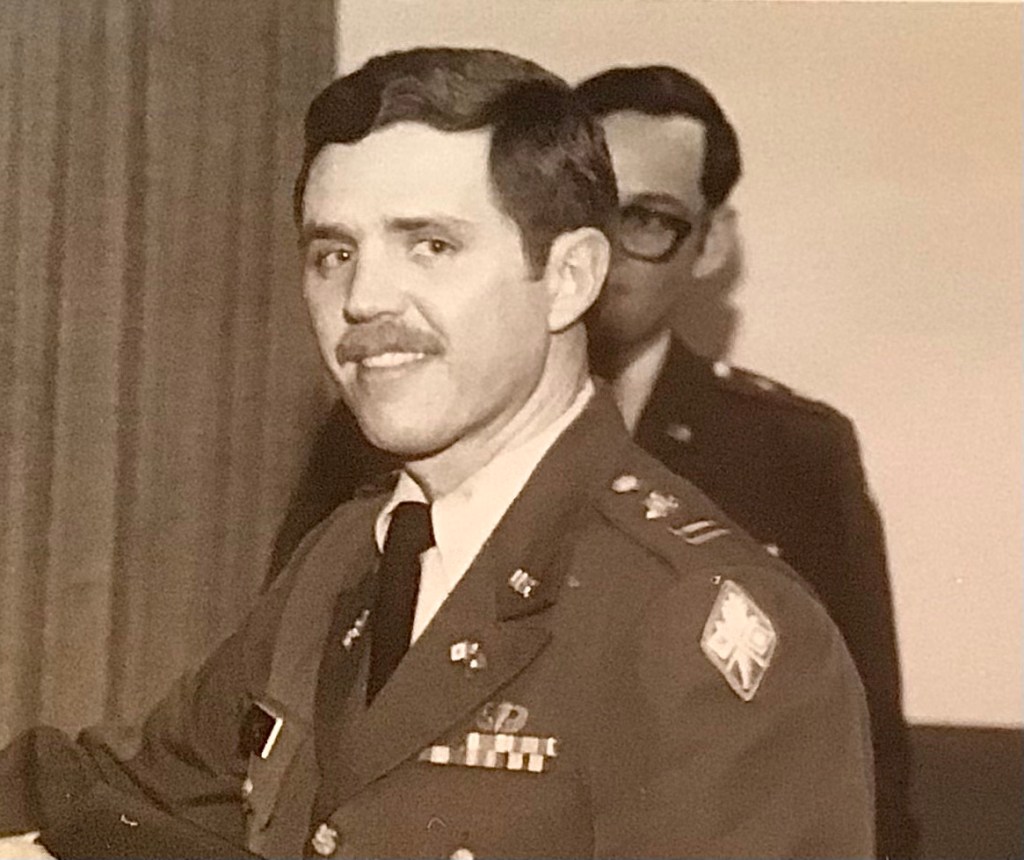
The Army, in it’s infinite wisdom, sent me to Grad School to pursue a master’s degree in Electrical Engineering. I was in the Army Signal Corps and they were looking for engineers to help with the new field of Computer Networks. We all take the Internet and computer networks for granted now, but back then, it was brand new, except for some research networks like The Arpanet, a DoD funded network.

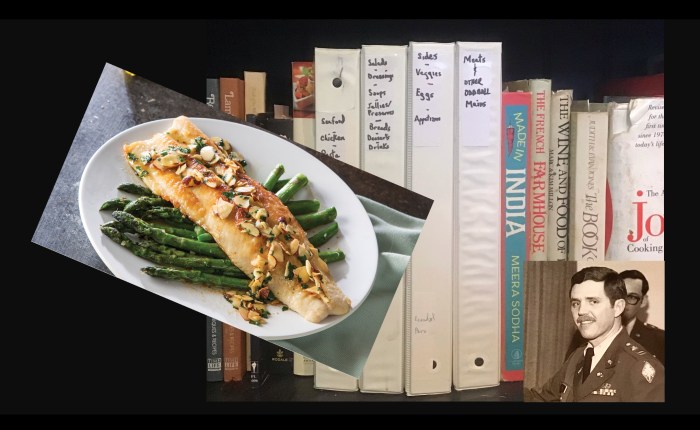
Captain Hall, The Future “Cook”. The Photo was Taken During my Time at Grad School.

As I started my graduate program, something quickly became obvious. My math skills were rusty and needed work. I’d studied calculus, differential equations, linear equations, and probability and statistics at West Point, but that was several years before and I’d forgotten most of it.

In the fall of 1984, I was required to take a class in Stochastic Communications – it was a theory class about how communication systems act in the presence of noise, and was very math heavy. A friend of mine, Gerry, was also taking the class and we often studied together to understand the math.

One Sunday afternoon, Gerry was at my house and we were working through some tough problems. At some point, I said, “Hey, feel like some dinner? How about if I order us a pizza?” Gerry agreed, and I ordered a pizza from the Pizza Hut just down the road. When they delivered the pie, we took a break and had a beer with our dinner. Eventually, we resumed our studies, and then quit an hour or two later.

Nothing Says Fine Dining Like a Pizza from Pizza Hut…

A couple of weeks later on another Sunday afternoon, we were studying at Gerry’s apartment. Eventually, we were getting hungry and Gerry said “How about a break for dinner?”, to which I readily agreed. I expected him to pick up the phone. Instead he said, “Come on, let’s go to the kitchen.

We arrived in the kitchen and after opening a bottle of wine and pouring two glasses, he proceeded to the fridge where he pulled out some trout filets and asparagus. He then brought out some almonds, garlic, and God only knows what else from his cabinets. What? Was he actually going to cook a dinner?

Gerry spent the next half hour or so preparing the meal, while we continued drinking and talking. He toasted the almonds, sautéed some garlic and eventually pan fried the trout, while sautéing the asparagus in another pan. Half an hour later, it all came together on our two plates with the almonds scattered over the trout and the asparagus served on the side.

Trout Almandine with Asparagus on the Side – a Treat from my Friend, Gerry.

Holy Cow! A real meal, and a great one. I believe I was in a bit of shock. Thinking back to the Pizza Hut pizza I’d served two weeks before, I was also a bit embarrassed.

On the way home, I thought to myself, “What the hell is wrong with this picture? A bachelor comes to a married guy’s house and has delivery pizza from a chain restaurant for dinner, while the married guy goes to the bachelor’s house and has a gourmet meal!?!?” Right then and there, I decided I needed to learn how to cook.

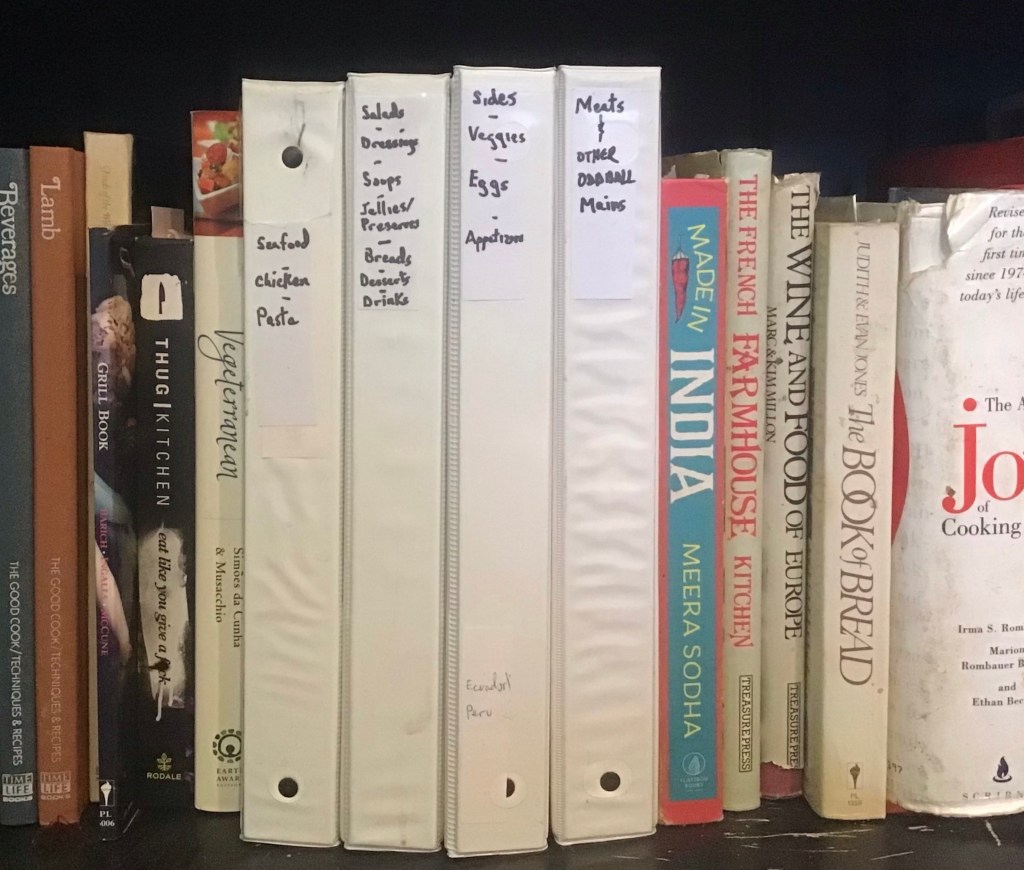
And so, my cooking journey began. Cathy still did most of the cooking, but I started cooking some as well, especially on weekends. I’d find different recipes to try and slowly expanded my repertoire. I also started collecting cookbooks, some basic, some focused on specific cuisines. I went through bread and muffin phases, German and French phases, Vegetarian, Stir Fry’s, and eventually Indian curries, among other recipes.

Just a Few of the Couple Dozen Cookbooks I Now Own

I found I enjoyed cooking, and I started to cook decently, but man, was I a messy cook. I knew nothing about “Mise en place” (prepping things ahead of time), or cleaning as you go. While I could turn out a great meal, the kitchen was a disaster. Cathy’s mom said something to Cath about it one time, and Cathy basically told her to be quiet, I was at least cooking some of the meals now. 😉

Eventually I retired from work around 2015, and and over time, started cooking my share of our meals. I also learned about Mise en place and cleaning the kitchen as I cooked. It only took me about 30 years to learn those two basic lessons. Better late than never, I guess.

So, that’s my story. Who knows, If I hadn’t been rusty in math and in need of help, maybe none of this would have happened. You don’t always know what will send you down a different pathway in life. I’m glad I discovered this one.

Addendum:

⁃ Strangely, there is no Trout Almandine recipe in my collection of recipes. I never asked Gerry for it at the time. If I’m making it now, I use a variation of a recipe I found online. C’est la vie

– Gerry went on to get his PhD in Electrical Engineering – he was a smart guy about many things. Unfortunately, over the years, we lost touch with each other.

Erbseneintopf

Erbseneintopf

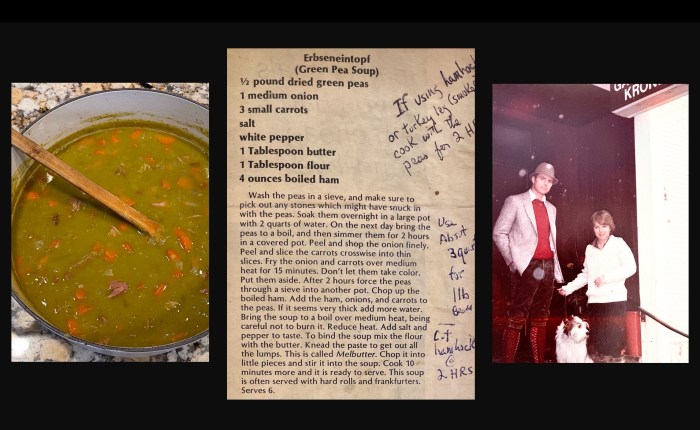
The oldest recipe in my recipe collection is for Erbseneintopf – a German Split Pea Soup. It came from The Stars and Stripes newspaper in Germany in ‘82 or ‘83, and is now a bit tattered. The first time I tasted the soup in a Gasthaus, I thought I’d died and gone to heaven. Getting the recipe was a bonus.

Erbseneintopf. The word and the soup are both a mouthful. Erbseneintopf literally translates to “Pea One-Pot”, and is really closer to a stew. Made properly, it is a thick soup with little chunks of sausage or ham hock in it. I’m not talking the puny American ham hocks, but the big German kind – meaty and smoky. The meat gives the stew a wonderful flavor. It’s a simple, hearty meal.

I believe the first time I had the dish was in a little village near Stuttgart, although I can’t remember the name of the town, or the Gasthaus, for the life of me. At the time, we often went for a walk in the woods on a Sunday afternoon, as many Germans did, and then would stop at a nearby Gasthaus for a late lunch, and a beer or two. We’d usually have some sort of simple meal – a bratwurst, or goulash soup, or some charcuterie and cheese. On one of those trips, it started snowing. Eventually we made it back to the village and the Gasthaus, where Erbseneintopf was on the menu, and despite the green color, I gave it a try. It was delicious. It became one of those dishes that stayed in my mind and I started looking for it on the menu anytime we went to a new Gasthaus – especially in winter.

Cathy, Top and I, probably in ‘82, outside a Gasthaus as it was snowing one Sunday

There were a few other dishes that stuck in my brain back then, and I would stalk them for a while – eating the dish anytime I saw it on a new place’s menu. One of those was Cordon Bleu. I spent a couple of years looking for the perfect Cordon Bleu during our travels across Germany, France and Northern Italy, and dragged visiting friends with me on my quest. Another dish was Käsespätzle, basically a German adult version of Mac ‘n Cheese, with homemade noodles, onions and cheese – It was total comfort food and a bazillion calories.

Cordon Bleu, käsespätzle, schnitzel, wurst, certain kinds of steak, pommes frites (french fries) and a host of other dishes all became a part of our life. We loved German food, but never tried cooking it at home. I’m not sure why. Maybe we knew we couldn’t match what we were eating in the Gasthauses.

Then one day, the world changed. Around 1982, our local military newspaper, The Stars and Stripes*, started a monthly feature with recipes for different German dishes. Some were simple, some more complicated. I’d read the recipes, but didn’t really think much about them, and then one day, they published several soup recipes – Gulaschsuppe, Linseneintopf (Lentil Soup), Tomatencremesuppe (Tomato Soup), and at the bottom of the page – a recipe for Erbseneintopf! I promptly cut the recipe out of the paper.

A little faded, and tattered, but the recipe works just fine.

This was most excellent. I spoke with a German friend about the recipe and she thought it looked authentic. Her one suggestion was to swap out the boiled ham called for in the recipe and replace it with chopped up ham hock, or some smoky local German sausage. It was a good suggestion.

A week or two later, we made the dish for the first time and lightning struck. We couldn’t believe how much it tasted like the restaurant version. The ham hocks provided the smokiness, while the “Melbutter” (see recipe – a mixture of flour and butter) thickened the soup. This baby was a keeper. At the time it was actually one of the very few dishes I cooked, or could cook. Yea, I did steaks, burgers and brats on the grill, but cooking something in the kitchen? I was out of my league there. This soup was probably just about it.

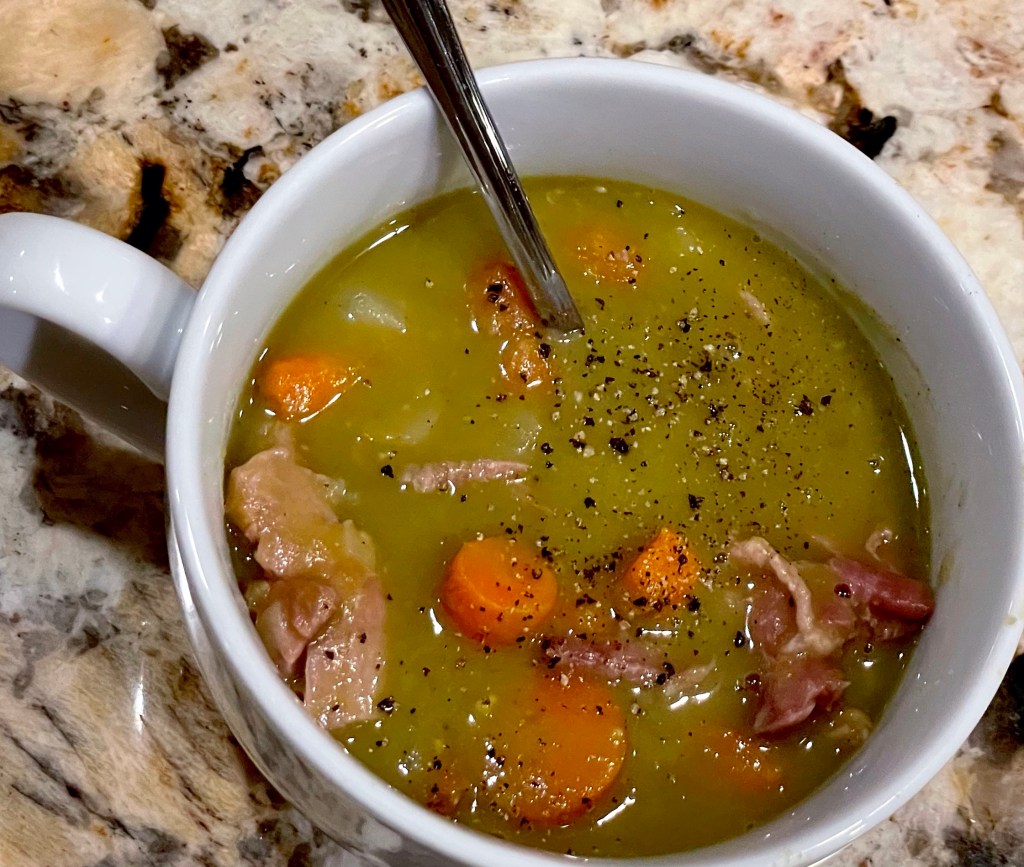
A bowl of Erbseneintopf. Still delicious, after all these years.

Erbseneintopf has remained a part of my winter repertoire ever since. I’ve only made one change since cooking it that first time. Here in the States, it’s sometimes hard to find good German sausage, or ham hocks with a bit more meat on them. As a result, I often substitute a smoked turkey leg for the ham hocks. It gets the job done.

Looking for a good winter soup on a cold, snowy day? Erbseneintopf might be just what you need. It’s peasant food at it’s best. As with many soups and stews, it’s even better on the second day.

Addendum:

⁃ * The Stars and Stripes newspaper was first published during the Civil war. Later, it was delivered to US forces in France during WWI, and became an overseas fixture during WWII. It continued through Korea and Vietnam, and is still published at overseas military locations to this day, although there were discussions during the Trump presidency of cancelling it (it wasn’t). It operates from inside DoD, but is editorially separate and independent from it. The newspaper has been published continuously in Europe since 1942.

⁃ I also struck pay dirt a month or two later when The Stars and Stripes published recipes for Spätzle and Käsespätzle, and our friends Jim and Res bought us a Spätzlemaker for Christmas. The Spätzlemaker is 40 years old now, and in great shape. We still use it a couple times of year.

⁃ My friend Tim Stouffer reminds me occasionally about my Cordon Bleu quest. He visited Cath and I several times throughout the ‘80s. On at least a couple of those visits, I know I inflicted my obsession with Cordon Bleu on him.

Life and the Ritual of Risotto

Life and the Ritual of Risotto

I made Risotto last week. Due to some changes in diet, it was the first time in over a year and it was wonderful. Risotto isn’t hard to make, and it doesn’t take long, but it does require patience and attention. You can’t rush risotto, and to me, that is why making it is both relaxing and a bit zen like.

I’ve been making risotto for years, and have several different recipes. It was a staple part of our dinner rotation. And then about a year ago, I had a couple of blood tests that caused some concern. After engaging in bilateral discussions with my doctor* (… 😉 … ) , I made significant diet changes, and drastically reduced dairy and carbs. Some things were easy, like changing from regular milk to oat milk. Unfortunately, cheese was practically it’s own food group for me, so that required a fair amount of mental adjustment. Pasta, potatoes, white rice, and bread? All eliminated, or severely reduced. I went cold turkey, and just did it. The good news was that after three months, the test results were back to normal, and six months later, they remained normal. As a side benefit, I lost about fifteen pounds.

Over the past six months, we’ve reintroduced small amounts of dairy and carbs into our diet. They’ve become “special” as opposed to every day, and it’s worked out fine. It turns out, sometimes, you can teach an old dog new tricks.

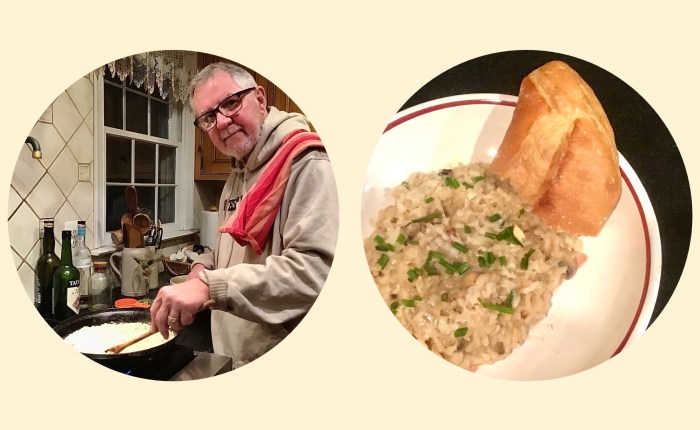
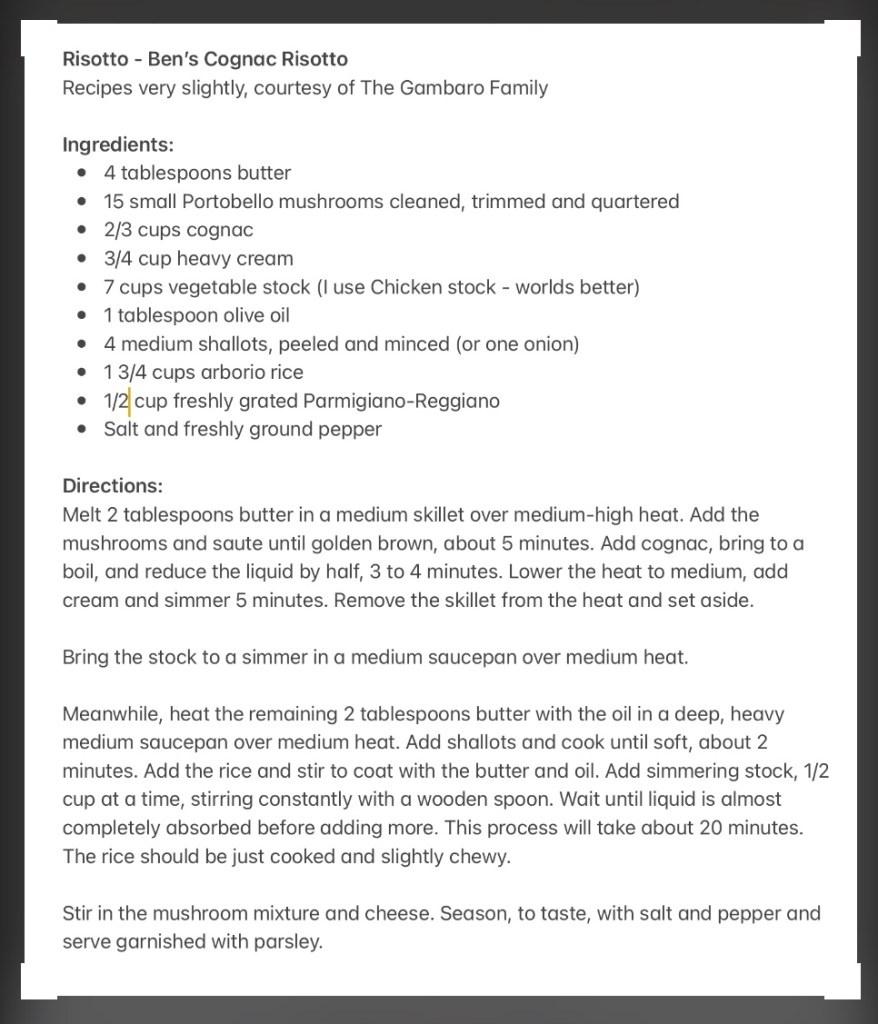
Last Thursday I had a series of follow-up fasting blood tests. I wouldn’t receive the results for a day or two, but decided to celebrate early and chose to make risotto for dinner that night. On the way home, I picked up some cream for the sauce, along with fresh bread from a local bakery. I mean what the hell, in for a penny, in for a pound. While I have several risotto recipes, there was no doubt in my mind about which one I would make – Ben’s Cognac Risotto – a favorite of ours, with mushrooms, shallots, cream, butter, and plenty of Parmesan cheese.

From start to finish, Ben’s Cognac Risotto takes about forty five minutes to an hour to make. As with most risottos, it’s not complicated, however, once you start cooking, you can’t walk away from the stove. You need to be present, both mentally and physically.

That evening , I started heating up the required chicken broth, chopped up the needed shallots and mushrooms, separately measured out the cognac and cream for the sauce, and then grated the Parmesan cheese necessary for the finish.

Shallots and Mushrooms – the Key to Ben’s Cognac Risotto…

The next step is an optional one, but I find it adds to the relaxing nature of making risotto. I walked over to the bar and made myself a martini. In what may be a strange coincidence, I’ve learned that the time it takes to drink a martini, is almost exactly the same length of time it takes to make risotto. Not a martini fan? A Manhattan or Negroni will do, or even a glass of the red wine you opened to serve later with the risotto. Trust me on this. It works.

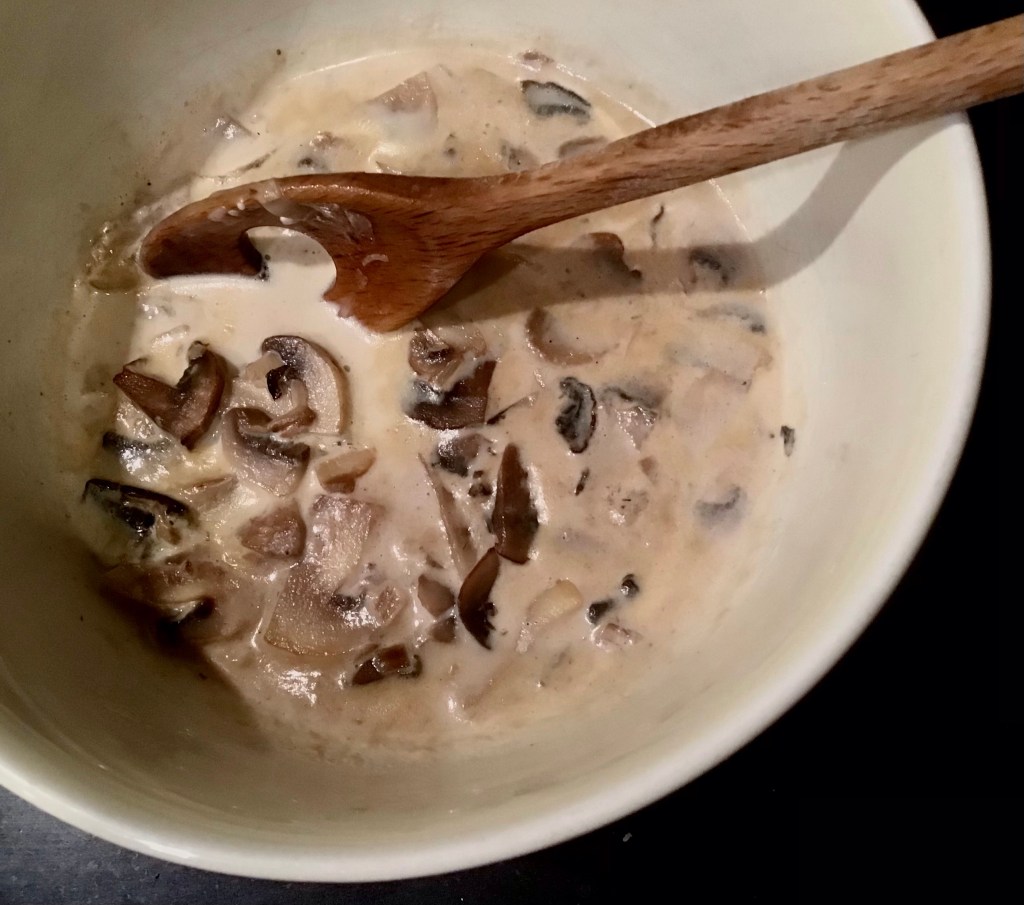
I made the mushroom sauce first and the kitchen filled with that heavenly smell only sautéed mushrooms can bring. After 5 minutes or so, I added the cognac and reduced it, and then added the cream and slowly reduced it some more. I set the sauce aside, and then started to work on the risotto itself. I also let Cathy know dinner would be ready in about twenty minutes, so she could finish setting the table, and pour some wine in our glasses.

Mushrooms, Cognac and Cream – What’s not to like?

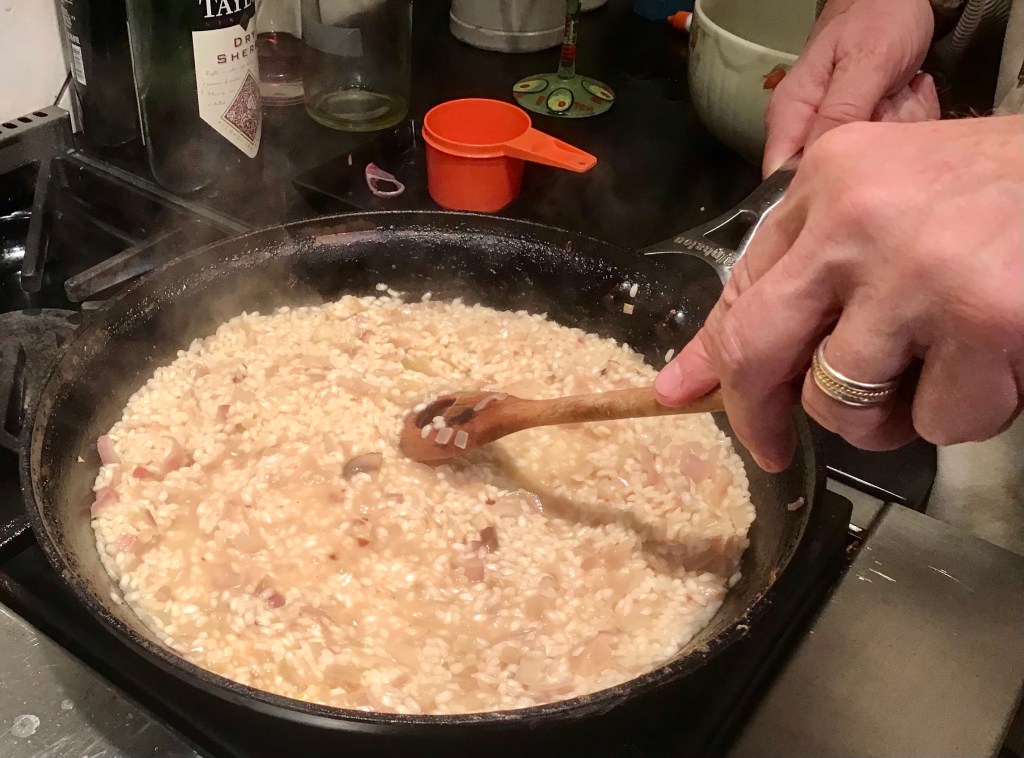
After sautéing the shallots, I added the rice to the pan and stirred a bit. I started adding the broth, about a half a cup at a time, to the rice. Next? The ritual – Keep stirring the rice every few seconds; take a sip of martini; let the rice sit a little, then stir, and add the next portion of broth. And, repeat – Stir the broth into the rice, take a sip of martini, let the rice sit a bit, then stir, and add more broth. And repeat. And repeat. And repeat. A bit of zen zone settles in, or at least it does for me. It’s just me, the spoon, and the rice.

In the Zen Zone – Just me, the Spoon, and the Rice…

As I neared the last of the broth, I tasted the rice, checking for chewiness. You still have the mushroom sauce to add, so a little chewiness is OK. I know that if there’s a bit of broth left, it’s not a big deal.

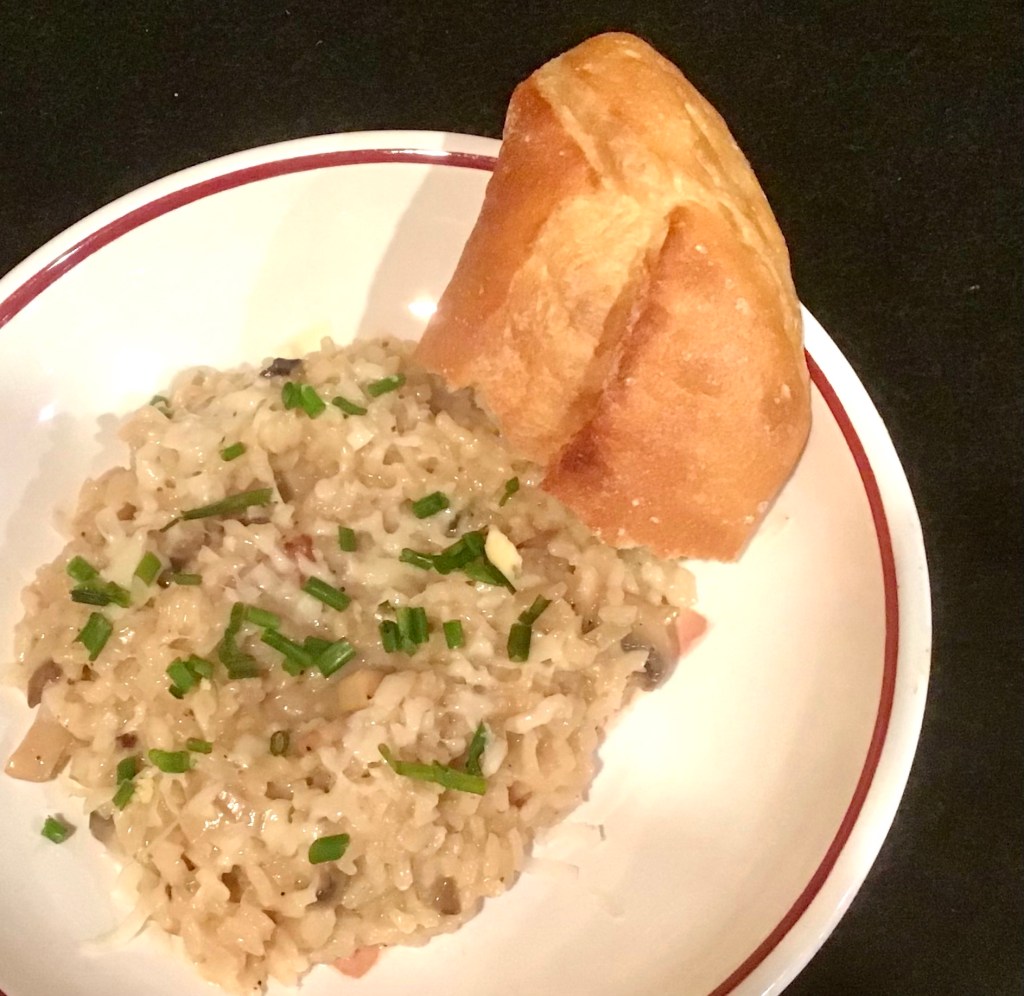
Finally, It was time. I stirred the mushroom sauce into the rice, and let it thicken a bit. I then added the Parmesan and stirred some more. Cathy brought our bowls over, and I put some risotto into each of them, with another dusting of Parmesan on top of each. I took the last sip of my martini, grabbed the bread warming in the oven and crossed to the table. We clinked glasses and then settled into the wonderfulness that is Ben’s Cognac Risotto.

The Wonderfulness that is Ben’s Cognac Risotto…

Cathy asked me if we were maybe celebrating too early, since I hadn’t yet received my test results. I answered I felt good about the tests and wasn’t worried. Besides, it’s a good thing to occasionally celebrate life.

Late the next afternoon, although I hadn’t received a call from the doctor, I logged into my account at her office. The four test results were there – I quickly opened and scanned each of them. Everything was fine, and in fact a couple of tests showed further improvement from last June. The low dairy, low carb diet was working. It also appeared the occasional piece of cheese, serving of roasted potatoes, or bowl of risotto wasn’t having an overly adverse effect on me. I could live with this.

Live is the key word. I’ve reached the age where something is always breaking down, or going a bit haywire in my body. There is always some new thing I need to be aware of for my future health. While healthy over all, Cath and I both have issues that crop up. And of course we have friends who are dealing with greater issues – cancer, loss of eyesight, early onset dementia… getting older isn’t for the faint of heart. But you also have to live, and enjoy life in all of the ways you can. For me, the ritual of risotto is one of those ways, and I’m not ready to give up on it yet. We may not have it as often, but trust me, it’s still going to appear on the menu.

Otherwise, what’s the point?

Addendum:

– * As a side note, I love my doctor, Doctor Emman Hussny, and have been with her for a long time – around twenty years. When she left one practice to start her own, I moved with her. She has a great bedside manner, and encourages leading a healthier lifestyle, without being draconian about it. During checkups, we certainly have discussions about my health, but also discuss other topics of the day. I feel like she genuinely cares about me, and I’m not just another patient flowing through her office.

– Here’s the recipe for Ben’s Cognac Risotto – enjoy! If you want to tone it down a bit, you can substitute milk, or even 2% milk for the cream.

The Orange Crock-Pot

The Orange Crock-Pot

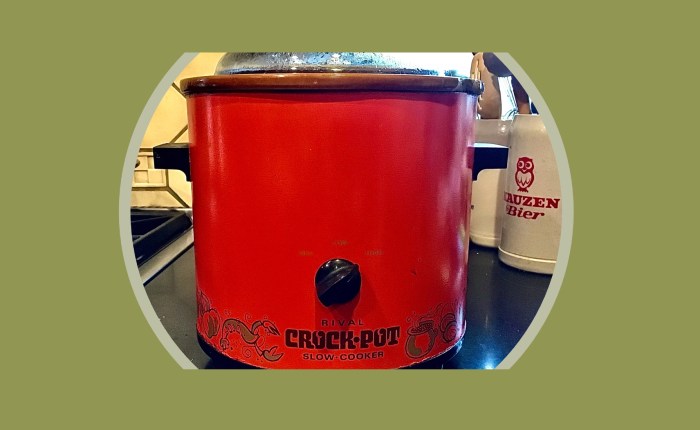
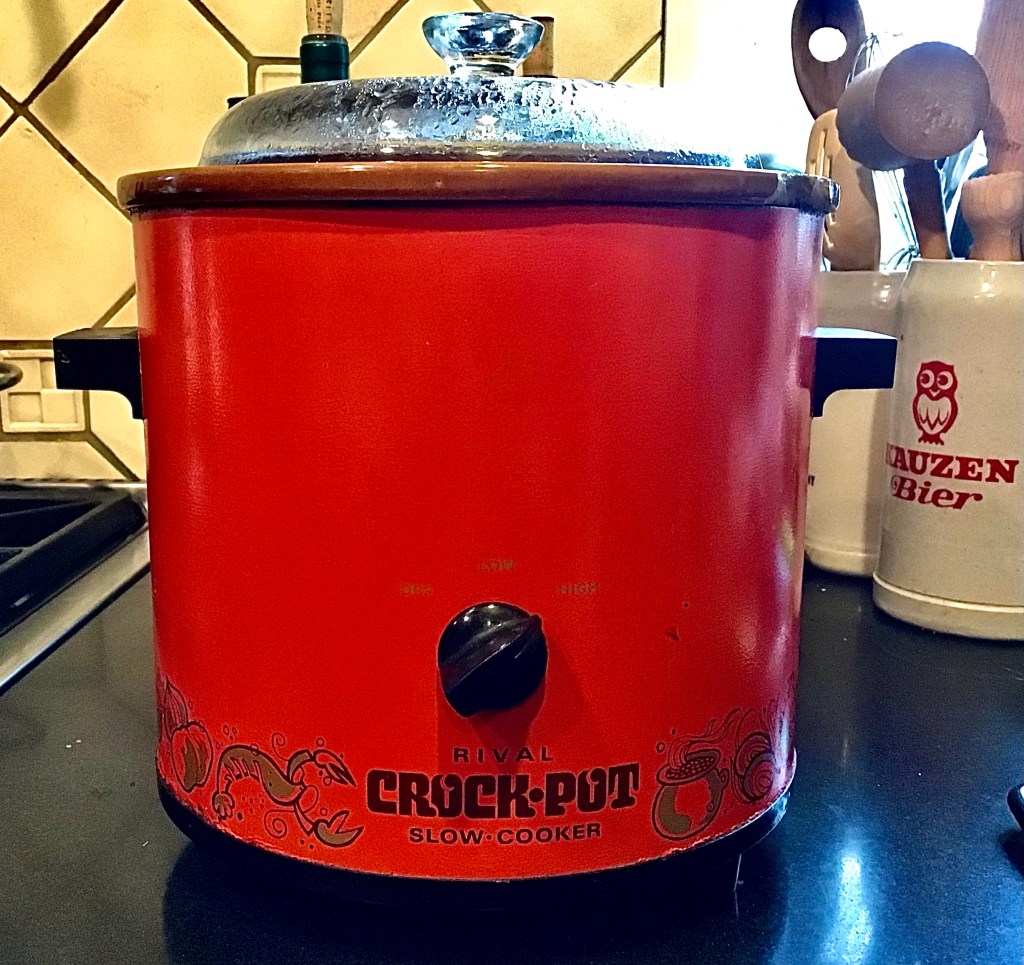
‘Fess up. Who owns, or owned, one of these beauties from the ‘70s? Long before there were Slow Cookers or Instant Pots, there were Crock-Pots. Ours is from 1974 and still chugging along. Seriously, 1974 and it still works. What else do you have that old, and still working? And, you have to love the color…

Cathy’s Crockpot from 1974 – Still Chugging Along…

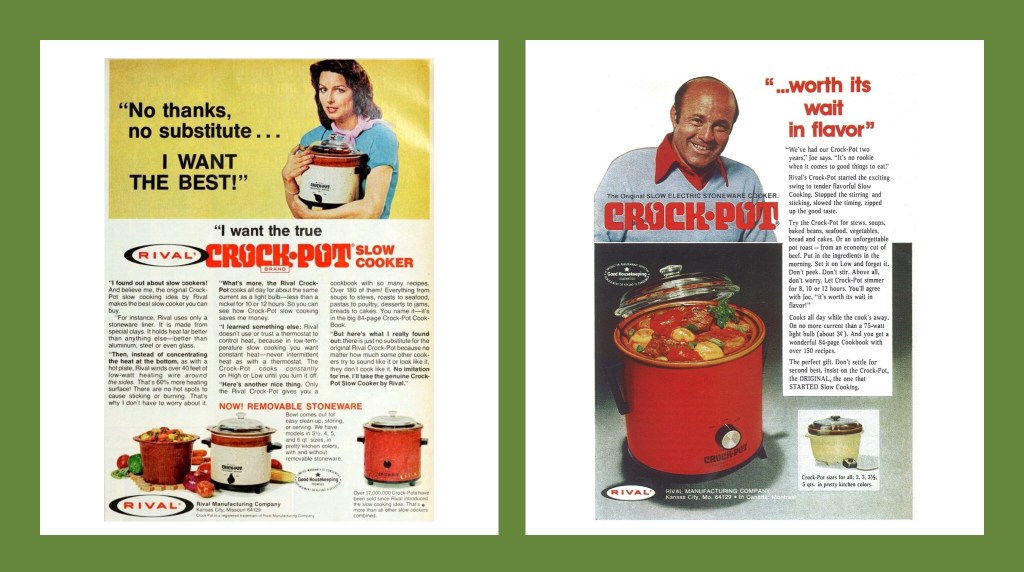
It’s the 50th anniversary of the invention of the Crock-Pot. Appliance maker Rival unveiled it in 1971 at the National Housewares Show in Chicago. Ads and commercials represented the Crock-Pot as a wonderful, time-saving device, assuring women (yes, this was the ‘70s – almost all cooking related ads focused on women) it would simplify their lives. Hell, baseball player Joe Garagiola even became a pitchman for the Crock-Pot, hawking it as “the perfect gift”. And of course, the Crock-Pot would do all of this great work in those fabulous ‘70 colors.

A Couple of Vintage Crock Pot Ads From the 70s

That color – I’m not sure if it’s called burnt orange, red orange, or just mutant orange. It’s a color you can’t forget. Quite frankly, it and the colors “Autumn Gold” and “Avocado” represent the ‘70s as much as disco, polyester and bell bottoms. If you see anything in one of those colors, you pretty much know what decade it came from.

Burnt Orange, Harvest Gold, and Avocado Green – the Holy Trinity of 70s Colors

Cathy bought this particular Crock-Pot at the age of 18 in the summer of 1974. It was just prior to moving to Washington DC and a job with the FBI. Over the past 47 years, our Crock-Pot has made countless chilis, soups, stews, roasts, and other dishes. We have cooked with it in Germany, Georgia, Oklahoma, Ohio and Virginia. It crossed the Atlantic four times. How many things do you have that have been with you your whole marriage? This pot, along with our love, is one of the few things that has survived those 43 years. It’s pretty much indestructible and part of the fabric of our lives.

Having retired, I do much of the cooking around the house these days and often braise, roast or slow cook in the oven itself. Still, there are some recipes that just call out for the Crock-Pot. I think the simplicity of the device helps – you fill it with the food you are cooking; pick one of the two heat choices, low or high; and walk away for 6, 8, or 10 hours. What’s not to like, other than perhaps the color?

Summer is ending, autumn is arriving, and winter will soon be here. This ol’ Crock-Pot will again earn it’s keep, providing us with comfort food this autumn and winter. Sure, it has a couple of chips around the rim, but the heater still works fine and the lid sits securely on top. It does it’s job. In fact, it does it’s job much better than any number of devices from this century. It just keeps ticking along and will probably be with us for another decade or two. Now that I think about it, we should list it in our Trust for one of our nieces or nephews… 😉

Pizza on the Grill

Pizza on the Grill

We recently bought a new gas grill. I’ve always been a charcoal guy, but decided to add a gas grill as well. So – what would be the first meal to come off the grill – Steaks? Brats? Burgers? Chicken? A Pork Tenderloin? It turned out to be a Pizza Margherita. Yep. Seriously. What the hell!?! Well, there’s a bit of a story to go with the decision.

For the last 40 years, I’ve cooked on (mostly) Weber Kettle charcoal grills. The smoke, the flame, the flavor, it all just worked for me. Yea, I always knew there was a bit of inconvenience to it, but that was no big deal, and I’d argue with “gas guys” about why charcoal was superior.

When Cathy’s mom passed away in 2010, we inherited her gas grill. It took me a bit of time to cook on it, but I made the adjustment. I still mostly cooked with charcoal, but if I was in a hurry, or occasionally had something that just needed a quick sear, like shrimp, I’d use mom’s grill. It was also put to use when we did our annual Oktoberfest Run at the farm – When you need to cook 125 Brats and warm up 100 soft pretzels, all available cooking surfaces are pressed into service.

Last week, two independent events happened that changed my outlook.

First, the New York Times cooking section had an article about making your own pizza. I’d always shied away from making my own pizzas in the past. Making the dough seemed like more effort than it was worth. The Time’s recipe? Easy. You just needed a bit of time. It also had a simple recipe for the sauce. Still, it seemed that, while you could make a good pizza in your oven, the oven still wasn’t Pizzeria-oven hot, not even close. I know lots of people make great pizza at home, but it gave me pause.

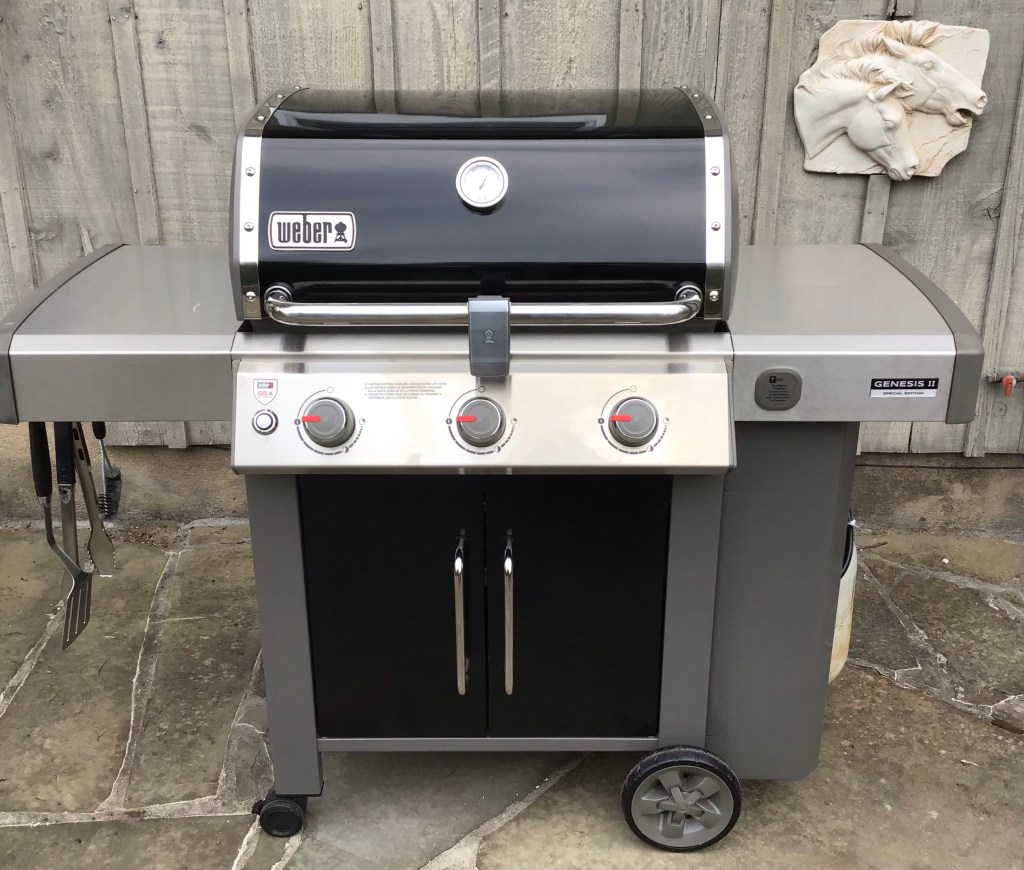
The second event? Cathy and I talked and decided to buy a new gas grill to supplement our charcoal grill. Mom’s old grill was toast. Maybe I’m getting old. Maybe I’m getting soft. In any case, I bit the bullet, and bought a new gas Weber grill. Now with the Weber, as I was reading through the manual, they recommend heating the grill to it’s highest temperature for 20 or 30 minutes before you ever use it. I’m not sure why, maybe to help season everything.

In any case, the day the grill arrived, I heated that puppy up for about half an hour. I went out later to shut it down and glanced at the temperature. Whoa! Over 600 degrees!

A Pizza Oven of a Different Sort

That got me to thinking. 600 degrees still isn’t the 1,000 degrees of a wood pizza oven, or as hot as a commercial pizza oven. But, it’s hotter than most home ovens.

A wood oven, at 1,000 degrees takes about 60 seconds to cook the perfect pie. What could I do at 600 degrees? I decided to find out.

I kept it simple for my first try and just went with a traditional Pizza Margherita. On Saturday afternoon I made the dough and let it rise. While that was happening, I made the sauce they recommended, which was really simple – blended crushed tomatoes, a bit of salt and a swirl of olive oil. I added some garlic and oregano.

The Two Dough Balls for the Crusts

About an hour before dinner time, I put my baking-stone on the grill and started heating it up.

Next? I had a cocktail, got a bottle of Zin out of the cellar and relaxed a bit. Finally it was time to assemble the pizza.

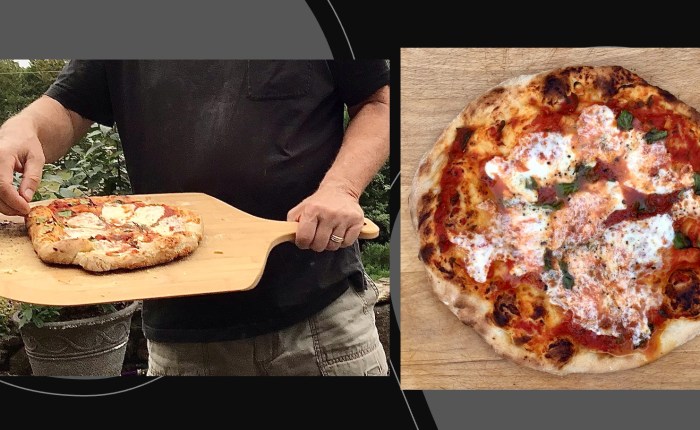
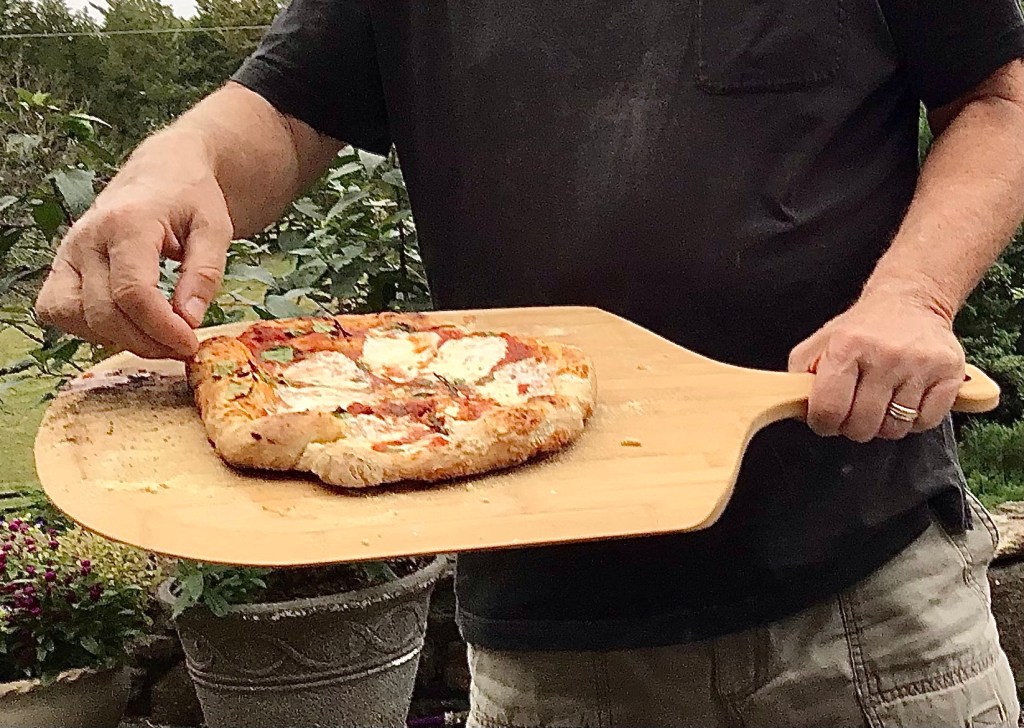
I formed the pie, added some sauce, then placed mozzarella cheese on it, and scattered some basil leaves. I added a quick swirl of olive oil and a grating of pepper. I kept the second round of dough handy, in case I screwed up the first pizza. Into the Weber the pizza went. Six minutes later, I took it out.

Homemade Pizza – Yea Baby!

It looked delicious. I let it cool for a minute or two. Yes, I still remember burning the roof of my mouth on occasion with pizzas straight from the oven… 😉

Finally, it was taste test time, and – Whoa! This was pretty damned good. Was it the best pizza I ever had? No. But it was much better than many pizzas I’ve had. It had a nice crust and a good sauce. The cheese was melted and stringy. This was something I could easily enjoy again and again.

We devoured the first pizza and I quickly made the second one. I added a bit more cheese and basil this time and slid it onto the baking stone. A little under six minutes later, I pulled it out. I’d say Cathy liked the pizza as well, as the second one was also quickly gone.

The Second Pizza was as Good as the First.

I realize I’m late to the “make your own pizza party”, but I’m on board now. The grill made me a believer. I’ve got a few topping ideas for the next pizzas, and some thoughts on how I could improve just a bit. Practice makes perfect, or so they say.

So…I bought this Weber Grill that makes good pizzas. I hear it’s not bad with steaks either. We’ll see sometime in the future.

Addendum:

– I love pizza, although we don’t eat it as much these days (that may change now). I think that’s partly because we have to drive 15 or 20 minutes to the nearest pizza places. It sounds foolish, but growing up in Ottawa, Illinois, we had several great pizza places, and I think it spoiled me a bit. Foremost among the places in Ottawa was Sam’s and Bianchi’s. They are legendary back home. Anyone returning for a visit almost always stops at one of those two places for a pie. If you want to read about me having pizza 116 times at Sam’s in 1972, you can do so here: https://mnhallblog.wordpress.com/2017/04/14/sams-pizza-in-1972/

– Here’s a link to the article from the NYT than inspired me. Give it a shot – it really is pretty simple. https://www.nytimes.com/2014/04/09/dining/a-little-pizza-homework.html

Moules, Pernod and the Brussels Seafood Market

Moules, Pernod and the Brussels Seafood Market

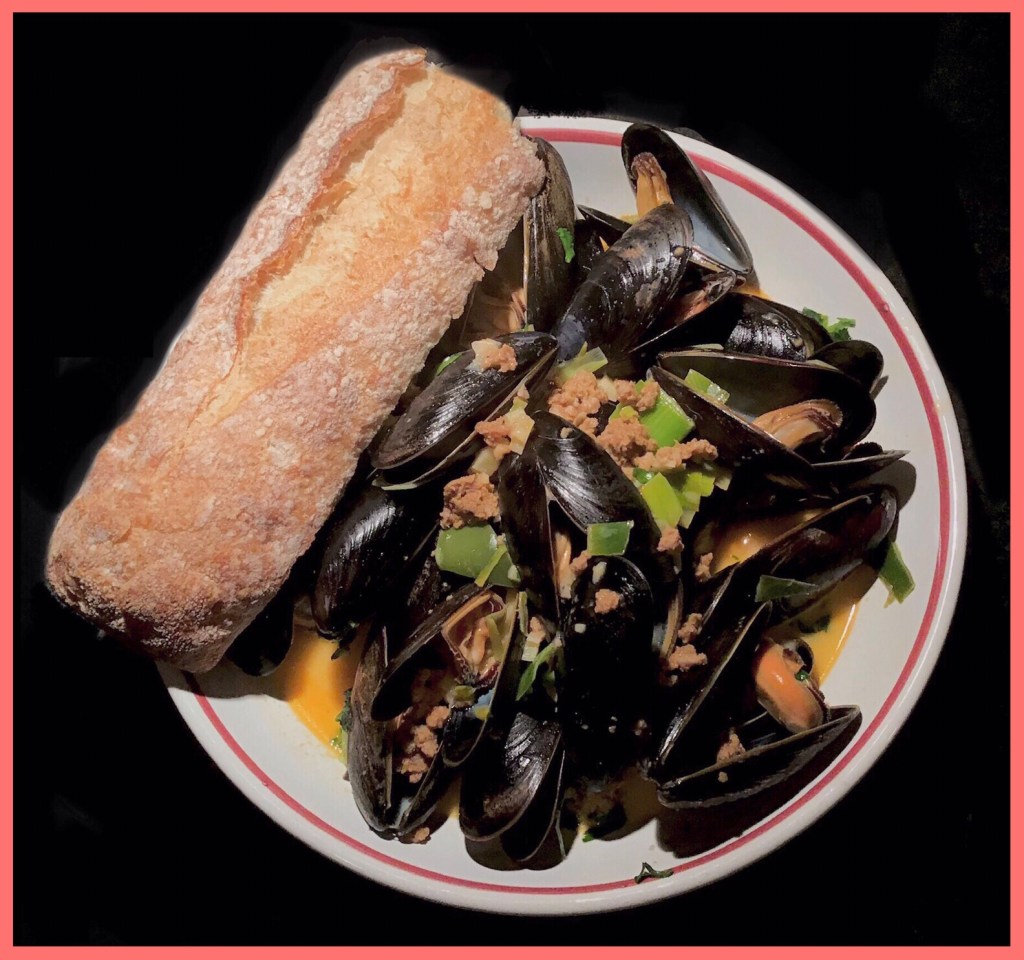
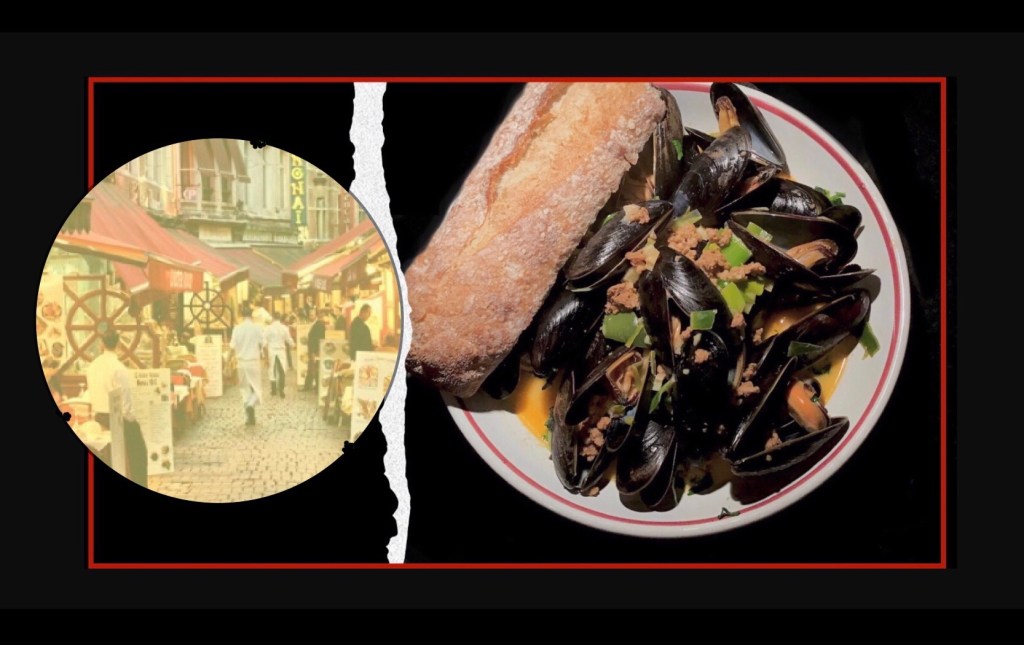
The other evening, Cathy and I made some Mussels Pastis (Mussels with Pernod) at home. It was delicious. It was a new recipe with plenty of Pernod in it, which made it quite good and strongly flavored. The strong flavor caused me to reminisce about Brussels, Belgium and an early morning trip to the seafood market there.

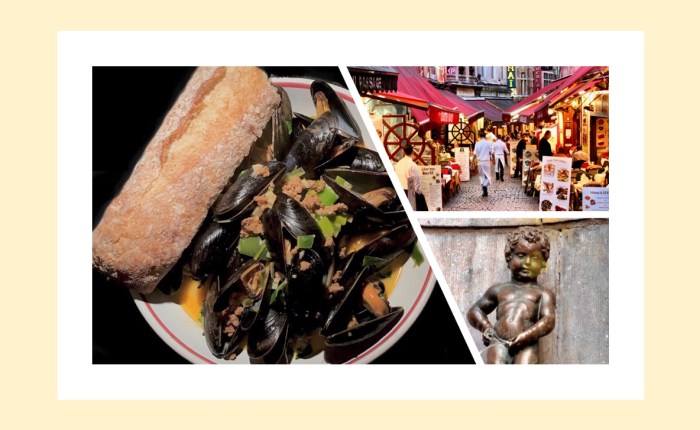
Mussels Pastis – the Wonderful Dish that Brought Back the Memory

It was early in 1988. Although stationed in Germany, I was spending chunks of time in Mons, Belgium. We were upgrading the communications systems at the Supreme Headquarters Allied Powers, Europe (SHAPE), also known as the Headquarters for NATO. My boss, Rich, was there almost full time, while I was dividing time between Germany, Mons, and another HQ in High Wycomb, England.

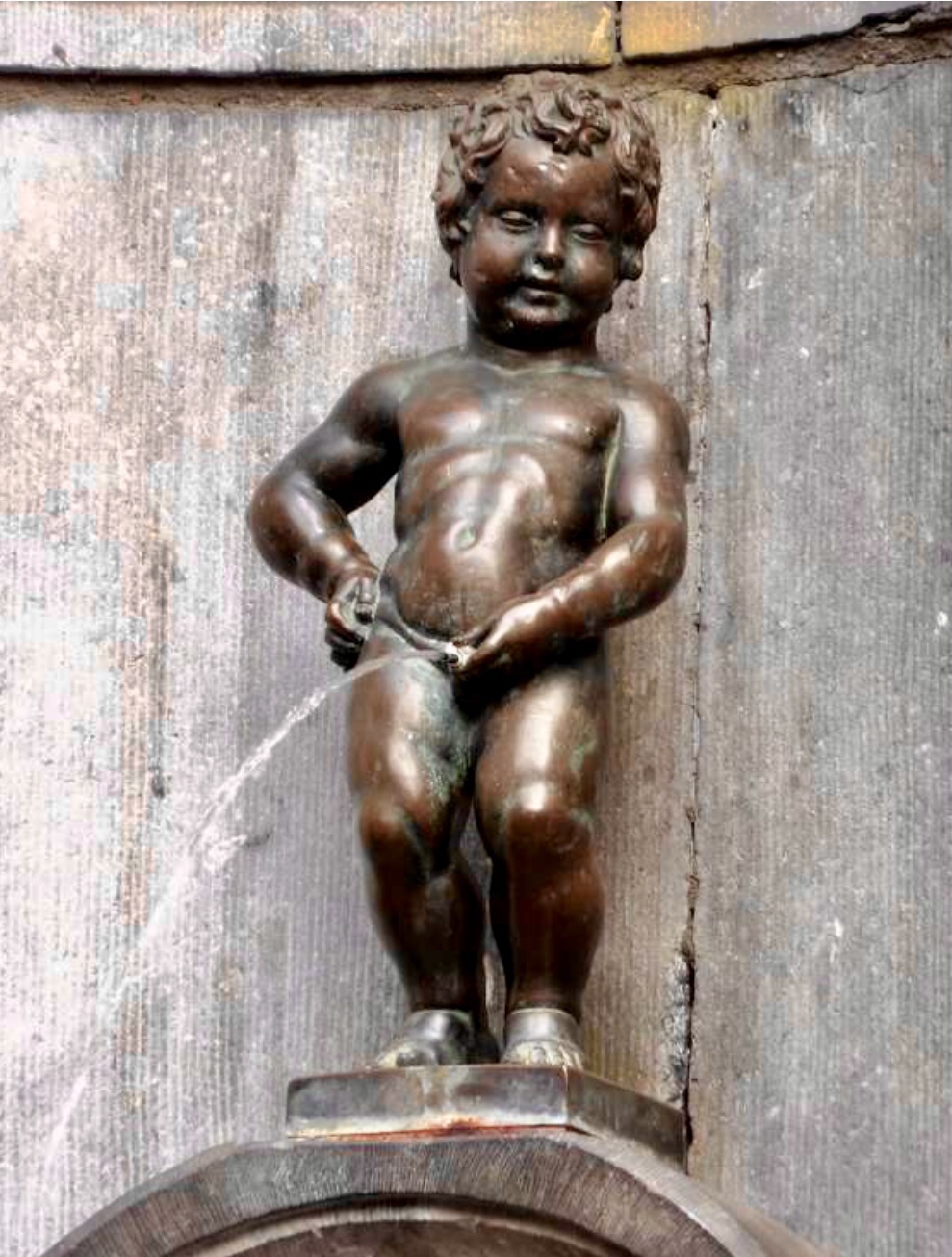
When in Mons, if there over the weekend, we often made a day trip to Brussels, which was only about an hour away. The city has a great history to it, and it was fun to see the sites, including the Grand Canal, and the famous Manneken Pis, which is only about two feet high. There was also of course the famous (infamous?) Red Light District of Brussels, with women on display in storefronts. I suppose it gave a whole different meaning to the term window shopping.

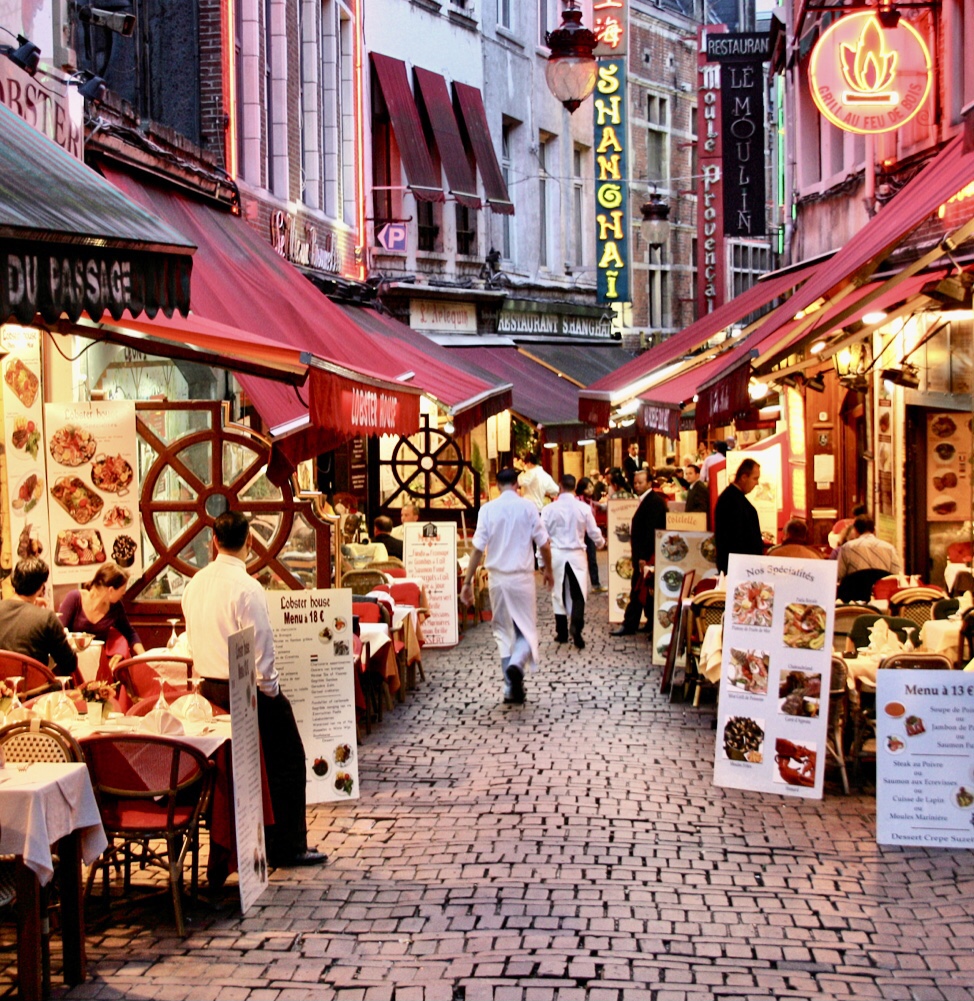
What we really enjoyed was wandering the Rue des Bouchers in the Quays District in the early evening. Here, there were numerous restaurants with outdoor seating, and they also set up temporary wooden “bars” where you could buy a drink, or something lite to eat. We’d walk from place to place having a Belgian beer or French wine, along with some oysters, mussels or shrimp croquettes. Several of the places also served frites (french fries) to die for. Usually, we never sat down at a table for dinner – we’d fill ourselves at the little bars as we ambled along.

Rue des Bouchers

The mussels (Moules) were particularly awesome, and I think Brussels is where I really developed a taste for them. There were soooo many ways they served them: Moules Frites (mussels with those famous Belgian fries), Moules Marinière (mussels in a white wine sauce), Moules à la crème (mussels in a cream sauce) and Moules Pastis (mussels with a Pastis, such as Pernod the anise flavored spirit) were probably the main ones we ate.

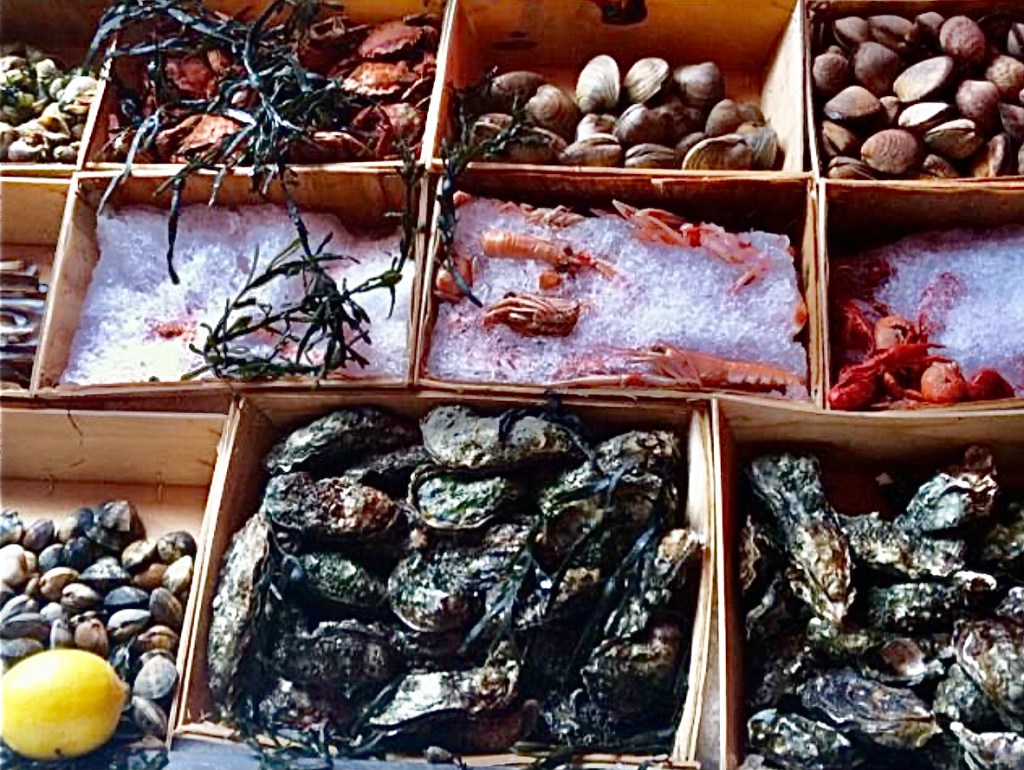
There was one place we went to a couple of times and came to know the guy working the “bar”. We were talking with him about seafood one night, and how good and fresh it was in Brussels. We asked where was a good place to buy fresh seafood, if we wanted to take some back to Germany with us. He told us our best chance was at the wholesale seafood market that ran every day from 5AM to about 10AM, but you needed to arrive early, as the vendors ran out of their prime seafood early. The other catch was, it was a wholesale market, so you had to find fishmongers willing to sell in smaller amounts to individuals. Rich, our coworker Steve, and I talked about it and decided we’d try and take a haul of seafood back to Germany when we could.

The next time I went to Mons, I took our cooler and stopped by Rich’s house to pick up his. About a week later, we were finishing up the current portion of the project and all of us were returning home. We made the plan to pick up the seafood early on a Thursday morning, and have a big seafood dinner/party on Friday night, at Rich’s home.

Allowing ourselves plenty of time, we woke about 2:30AM and were on the road by 3:15. We arrived in Brussels an hour later, but the seafood market wouldn’t open until 5. We locates an open bistro and went in, where we joined some late night partiers, ending their evening; a few men having breakfast before going to work; and several “Ladies of the Night” who were apparently finished for the night and having coffees and brandy. We sat at an open table and ordered some coffee and fresh croissants.

Just after 5AM, we left the pub and walked over to the market. It was huge, and already quite crowded. We wandered among the stalls and trucks for a while looking to see what was available. To be honest, there were so many choices, it was a bit overwhelming. We started talking to a couple of vendors, however when they found out the small amounts (by wholesale standards) we wanted to buy, they quickly ignored us. Eventually, we found a guy willing to deal with us, and we bought everything from him – a couple kinds of fish, some lobster, and of course, plenty of oysters and mussels. Someone went back to our car for the coolers and we loaded them up. The guy was nice enough to put plenty of ice in the coolers as well.

At the Market

We arrived back at our hotel in Mons around 7:30AM and caught a couple hours of sleep, before driving back to Germany later that day. You have to remember this was pre-Internet and pre-cell phone, so it wasn’t until we returned, when we started calling people for the seafood dinner planned for the next night.

Friday night came and we all met at Rich’s house. In addition to Rich and his girlfriend Lynn, there were Cath and I, Steve and his wife Sabine, a few coworkers and Rich’s boss, Ray Sauer and his wife. It was quite the event, with grilled fish and lobster, Moules Pastis, oysters on the half shell, and fried oysters. We washed it all down with plenty of good German Pils, and some of our local dry white wines. A bottle of Sambuca, along with multiple cups of espresso may have made appearances later in the evening as well.

I hadn’t thought about that market trip, or the subsequent party for years. The Mussels with Pernod meal Cathy and I cooked, brought the memory flooding back. For me, good food has never been just about the taste of the food itself. It has always been defined as much by the place and time, and those who we are sharing the meal with. Our taste buds learn to recognize sweet, sour, salty, bitter and umami. Our minds and memories complete and complement our sense of taste. If you are lucky, years later out of nowhere, the taste of a new meal suddenly blesses you with a remembrance from your past.

For me, Good Food is Never Just About Taste

Addendum:

• Cathy and I had another memory from late ‘88 or early ‘89. I was back in Brussels to present a paper at a conference, and Cathy came with me. We were staying at a nice hotel downtown. We went out for a dinner at a nearby bistro and had Moules Frites. On the way back to the hotel, we stopped at a small bar for a nightcap. While having our drink, several “Working Girls” came in and sat at another table. They ordered wine and champagne, seemed to be enjoying themselves and were in a good mood. As it was earlier in the evening, we speculated they might be on break, or getting ready to go work.

• Pastis is an anise-flavored spirit and apéritif traditionally from France. Two of the best known are Pernod and Ricard. If you are looking for a substitute, Ouzo, Sambuca, Herbsaint and Absinthe are other anise flavored liquors, all with different flavor profiles.

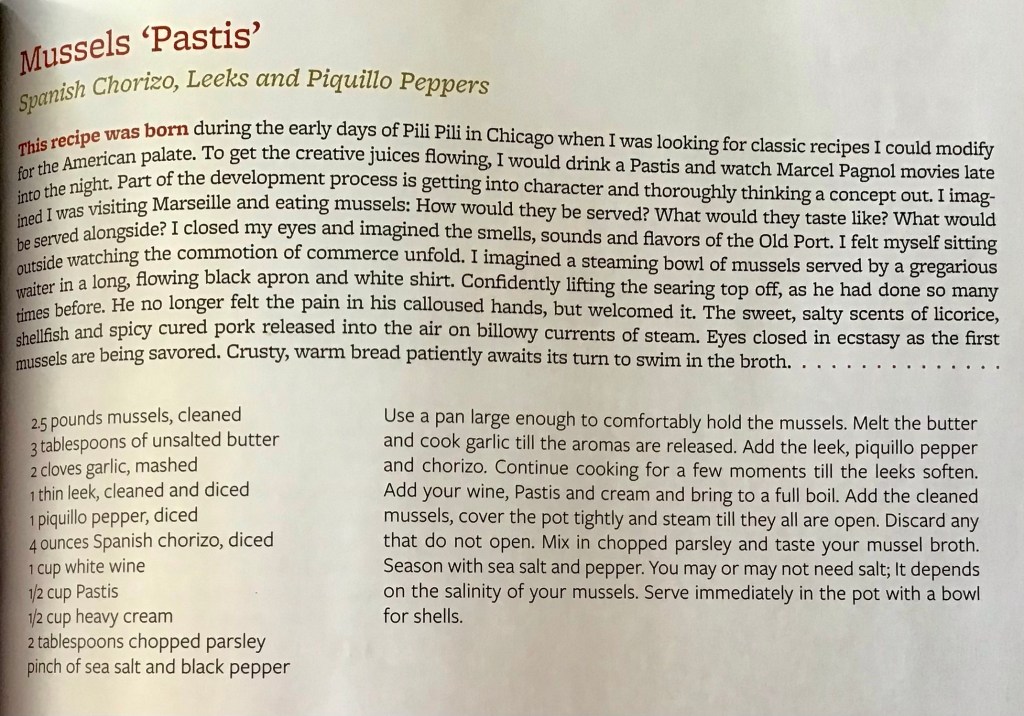
• We’ve made Moules with Pernod at home before, but I never had the same flashback. The previous recipe only had a bit of Pernod in it. This one used a full half of a cup. I think it was the stronger flavor that triggered the memory. The recipe is from a wonderful little cookbook we have called “Cuisine of the Sun”, by François de Mélogue. I like the recipe just the way it is, but if not familiar with Pernod, you may want to cut it just a bit. Here’s a copy of the recipe:

____

Making a Three Day Beef Daube

Making a Three Day Beef Daube

The weather had finally turned cold(er) here in the Virginia Piedmont and they were calling for snow over the next two days. This was the perfect time to make a Beef Daube and I was on a mission.

Daube is a French word that translates to stew. All daubes are stews, but not all stews are daubes. To me, daubes are thicker and richer, and are almost like a stew “sauce”, if that makes sense. I loved my mom’s beef stew, but this beef daube is something else.

This particular recipe is for a Three Day Beef Daube. It’s from a book my old friend Tim lent me called “Duck Season”. The book is about the Gascony region of France, and if you enjoy reading about other countries, particularly their food, drink and culture, I highly recommend it. The dish takes three days to make, although the steps are pretty easy. Day one – marinate the beef; day two – make and cook the daube for 2-3 hours and let it rest over night; and day three – gently simmer the daube for a couple of hours and then eat. That’s all there is to it.

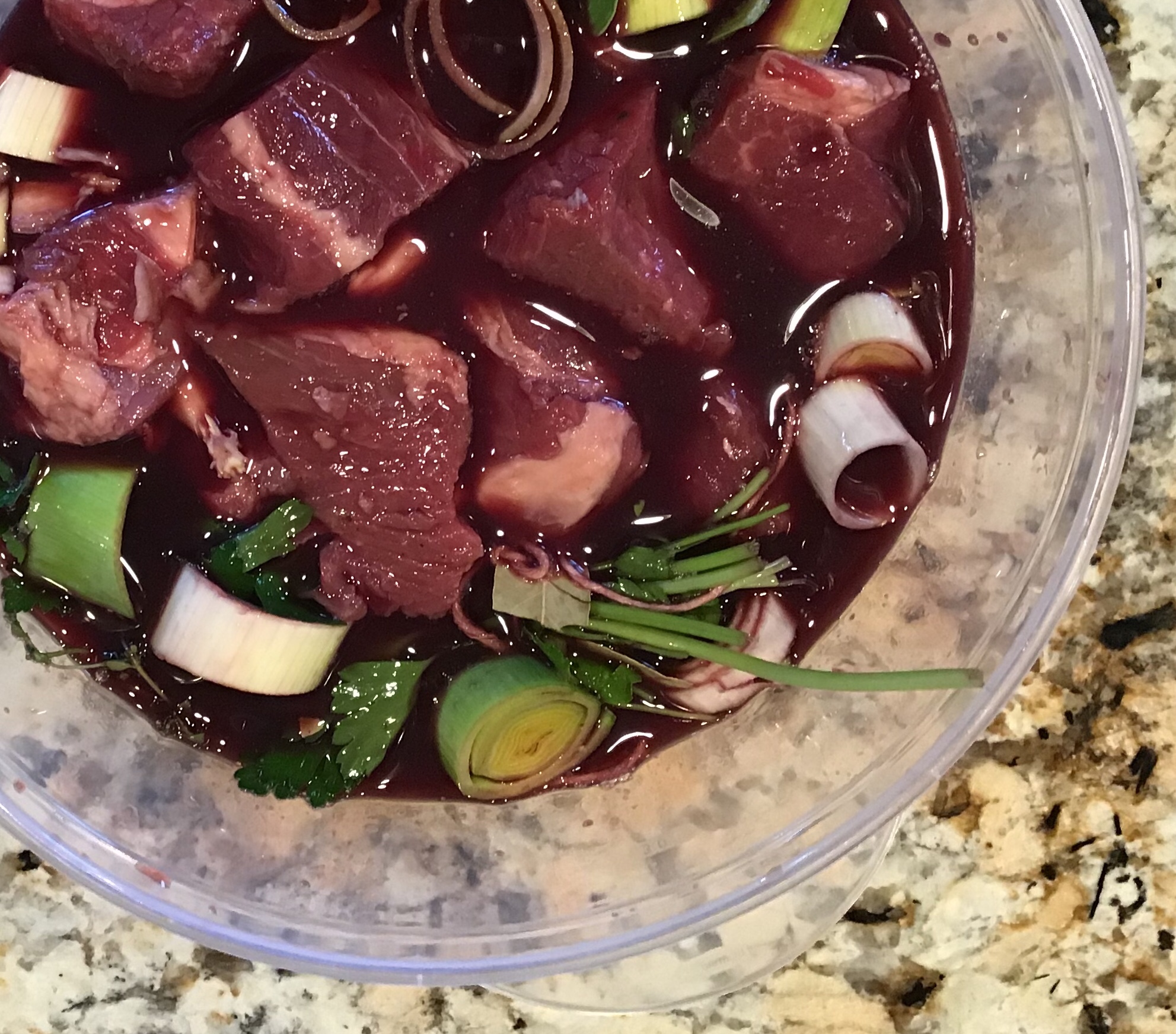
Last Thursday, I pulled the chuck roast out of the freezer to thaw, and made up my shopping list. On Friday morning, I went shopping for the few things I still needed – a leek, some parsley and thyme. We had everything else at home. After a quick lunch, I cut up the beef and added it to a bowl which already included smashed garlic, sliced leak, a bouquet garni, and a bottle of red wine. Day one was done, with plenty of time left to take our dog Carmen for a walk, and in anticipation of the snow, to bring more firewood into the house.
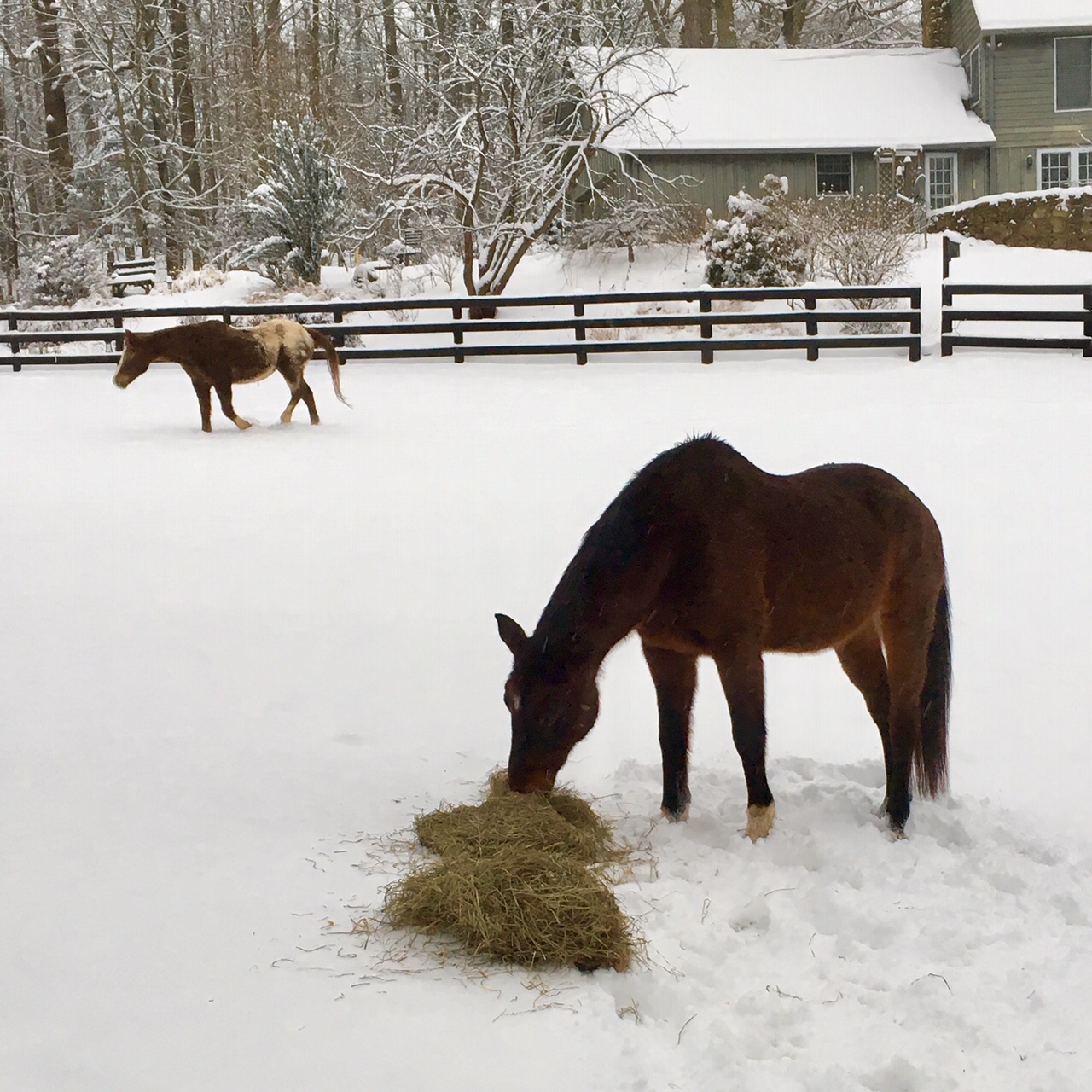
Day two started grey and cold. When I went to the barn in the morning to feed the horses, there was a skim of ice on the pond and the air had that “pregnant with snow” feeling you sometimes get right before a storm. Predictions for snow amounts rose from 2-4” to 3-7”.

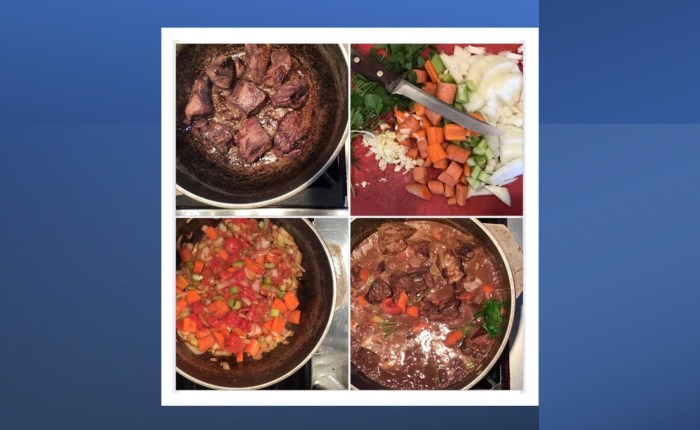
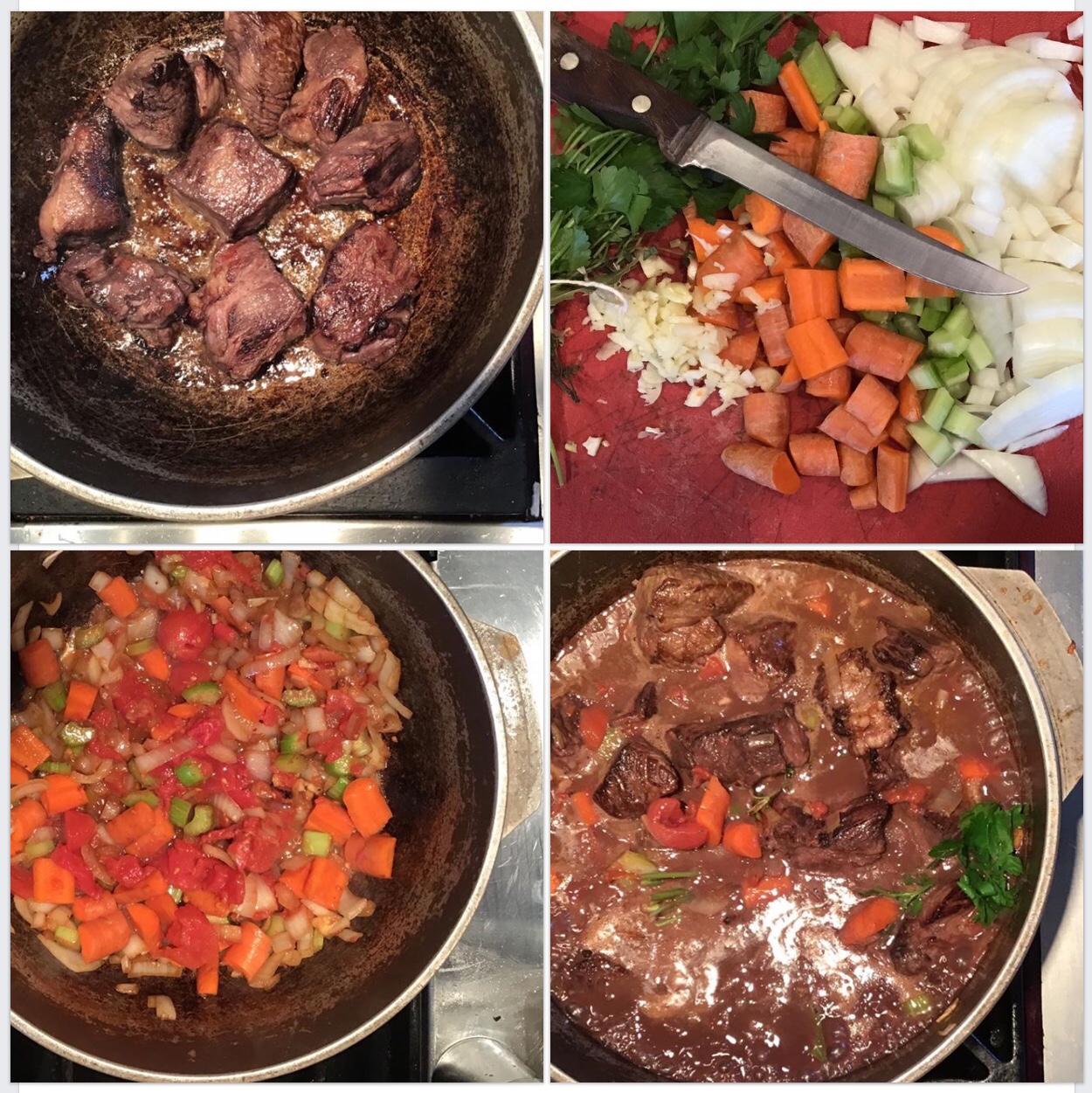
I continued with the daube around noon and day 2 was only a bit more work than day 1. I browned the beef; chopped up and sauté garlic, onions, celery, carrots and tomato; added the beef back to the pot with the vegetables, along with a new bouquet garni; and added the strained and reserved wine marinade to the pot. Once that was done, it simmered on low heat for about 3 hours.
I’ve found it’s best to take your dog for a walk while the stew is simmering, so you don’t drive yourself mad with the wonderful smells coming from the kitchen. After returning from your walk, you are faced with the most difficult part of day 2. You don’t eat the daube on day 2, no matter how good it smells or tastes. Instead, you remove it from the heat, cool it to room temperature and let the daube rest overnight in the fridge. Remember, don’t eat the daube at this point in time.

Sunday, Day 3, greeted us with a blanket of snow. About 7 inches had fallen, with more expected over the course of the day. After feeding the horses in the morning, and then having my own breakfast, I plowed our drive and around the barn, and then plowed the drives of several elderly neighbors. I made it back inside for lunch, and then some playoff football.
During the afternoon, I started reheating the daube. After removing the congealed fat from the top of the daube, the pot went back on the stove for a gentle three hour simmer. Now the smells were truly driving me crazy and the football was barely a distraction. I took one more walk with Carmen and could see that we had another 3-4 inches of snow today. It was still snowing at dusk as we finished our walk, and I may need to plow again tomorrow, but that will wait.

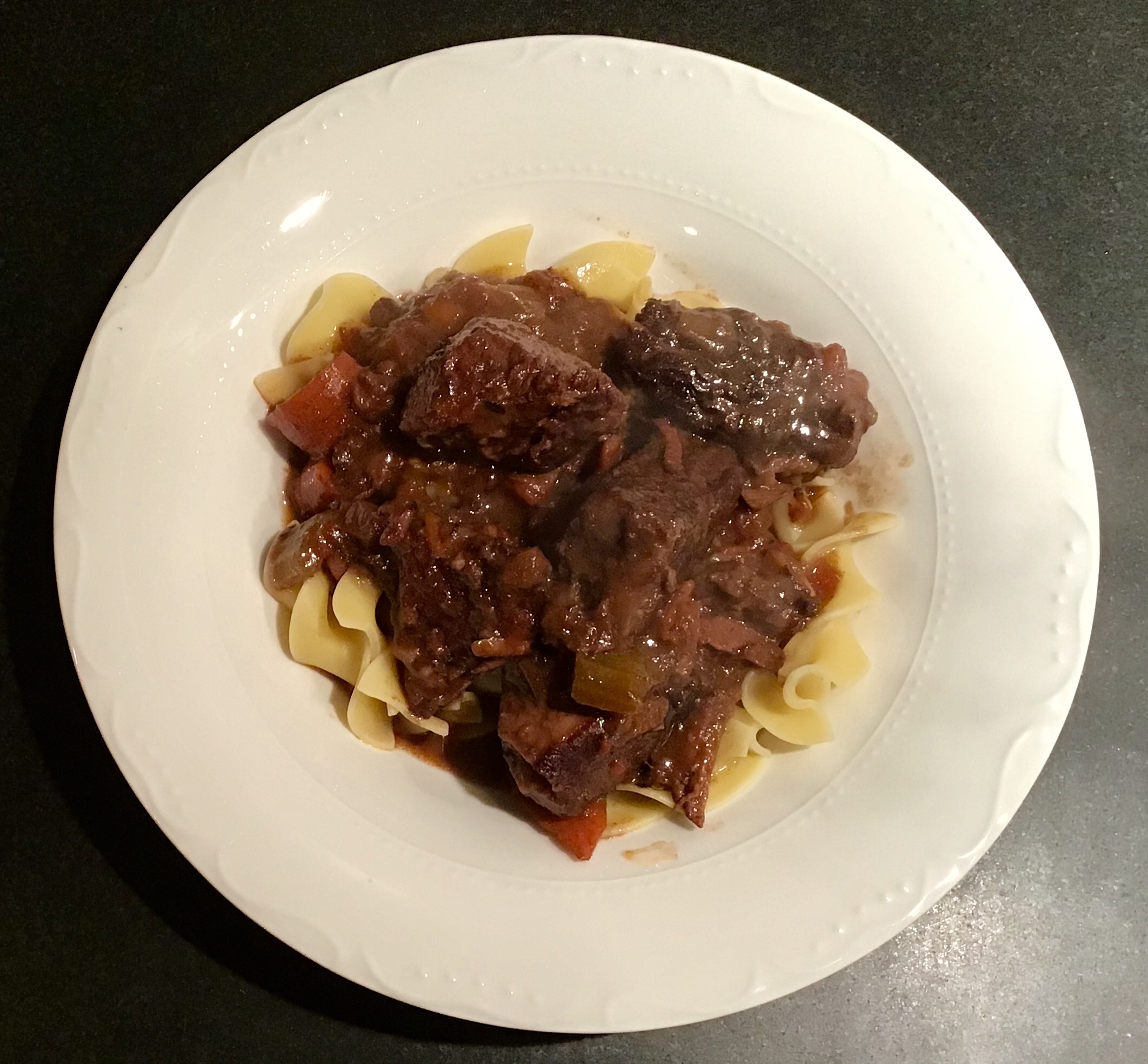
About a half hour before dinner, I threw a baguette in the oven to warm up, and finally it was time. We served the daube over egg noodles and had it with the bread and a bottle of wine. I breathed in the aroma and took my first bite. What a great ending for a snowy weekend…

_____
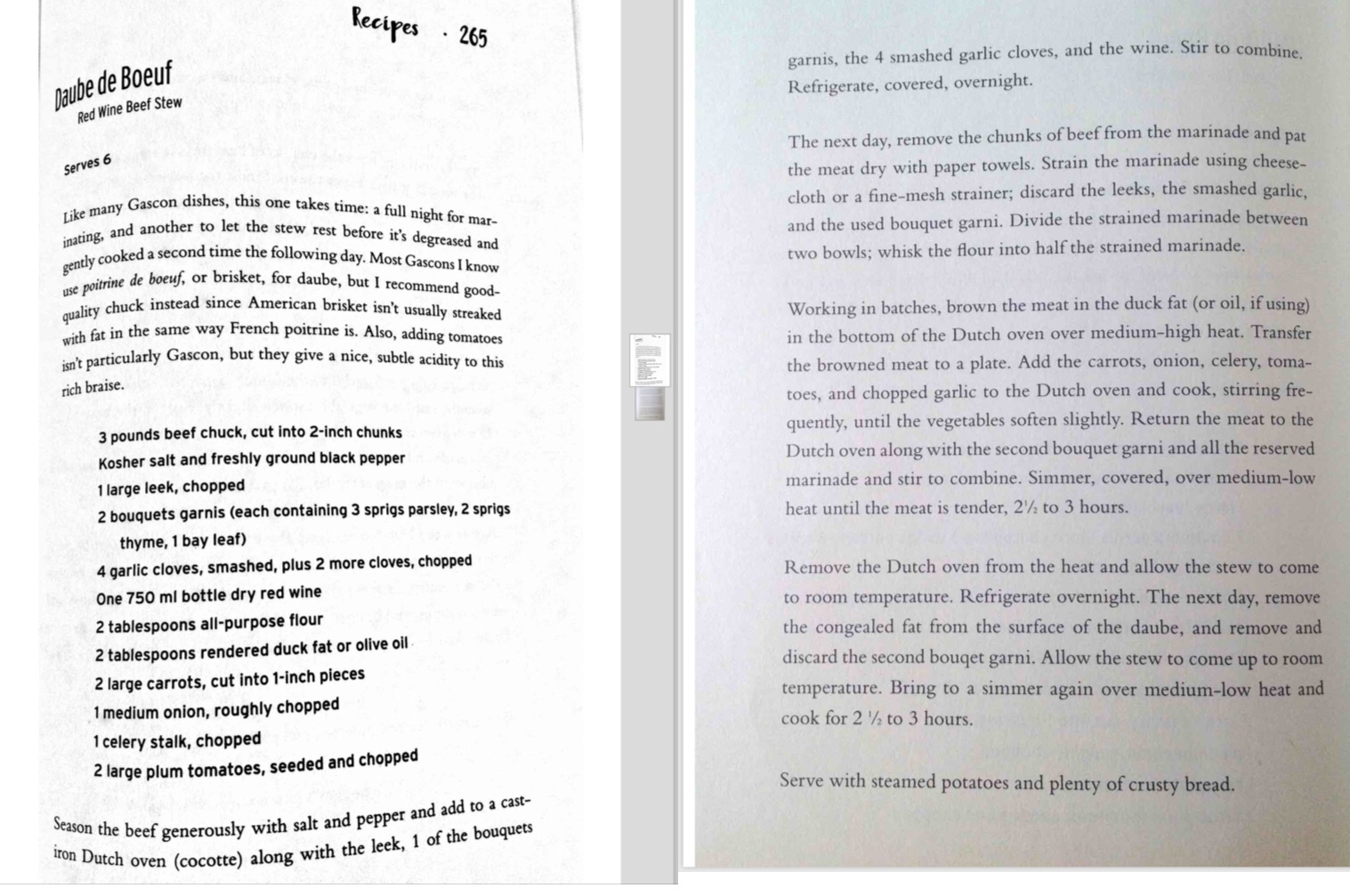
Addendum: Here’s the recipe. It’s from the book “Duck Season”, by David McAninch.