Five Years in One Page

Five Years in One Page

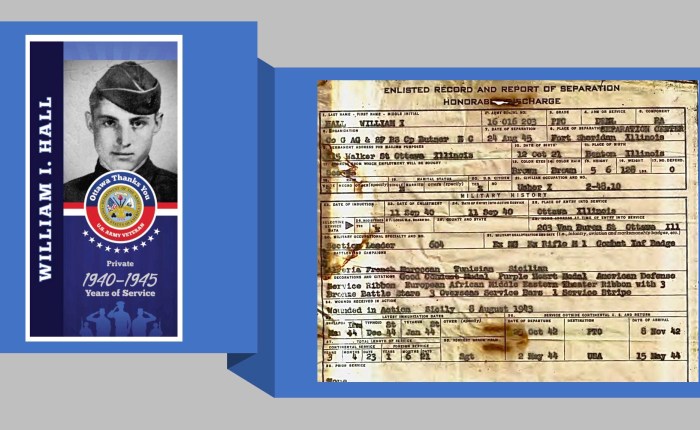
When discharged from the Army on August 24th, 1945, dad was 21 years old and had been in for nearly five years. His WWII service included time in Algeria, Tunisia, French Morocco and lastly, Sicily, where he was wounded. His discharge papers tell the intriguing story of those five years in one page.

This is the second of a two-part blog. Last week, I told the story of how I received dad’s enlistment and discharge paperwork from the National Archives. I then explored several interesting observations from his enlistment form, including the fact that he lied about his age in order to enlist. He claimed he was almost 19 years old, when in fact he was still two months shy of his 17th birthday. You will find a link to the first blog in the Addendum to this one.

Today’s blog explores his discharge paperwork, and briefly tells the story of his five years in the service. Dad was with B Company 1/60th Regimental Combat Team of the 9th Infantry Division from September 1940 until he was wounded and almost died in Sicily in August of 1943. Although his original enlistment in 1940 was for three years, when the war started all enlistments were extended for the duration.

As with his enlistment papers, dad’s discharge paperwork was discolored, creased and yellow, perhaps from the fire at the National Personnel Records Center (NPRC). A few parts were unreadable, but most of it was legible.

Dad’s Honorable Discharge Paperwork – it Suffered in the Fire at the Archives.

I’ll magnify and expand a couple sections to talk about some of the details.

At the top of the form, there are a couple of interesting items.

The Top of the Discharge Form – Magnified
  • Block 3 confirms his last duty station as Camp Butner, NC. This is where dad returned to the States in 1944 after recovering from his wounds. Camp Butner was both a troop training center, and a Prisoner of War camp. Dad told us stories later about helping train troops there (and about performing KP).
  • We see in block 4 his actual discharge date is August 24th, 1945. This was two weeks after the atom bomb was dropped on Nagasaki, Japan, and one week before the official surrender of the Japanese on September 2nd. The army was already discharging soldiers as the war was winding down, based on how many “points” they had (more on “points” later).
  • Block 7 still shows the birth date he lied about to enlist – Oct 12, 1921, as opposed to his real birth date of Oct 22, 1923. And amazingly, dad’s height, 5’ 6” and weight, 128 pounds haven’t changed at all from when he enlisted. Me thinks, someone was probably just copying from other forms to put this info in.
  • Block 21 shows his civilian employment as “Usher”, so maybe not everything was copied over. His enlistment paperwork showed him as a “Laborer”.

Now we move on to the Middle section of his discharge paper, dad’s “Military History”. This is the meat of the discharge, and paints the real story of his time in the service. I’ve again magnified the view so you can better read the form. In order to tell dad’s history in a linear fashion, I will sometimes go out of order in discussing what is in the blocks in this section.
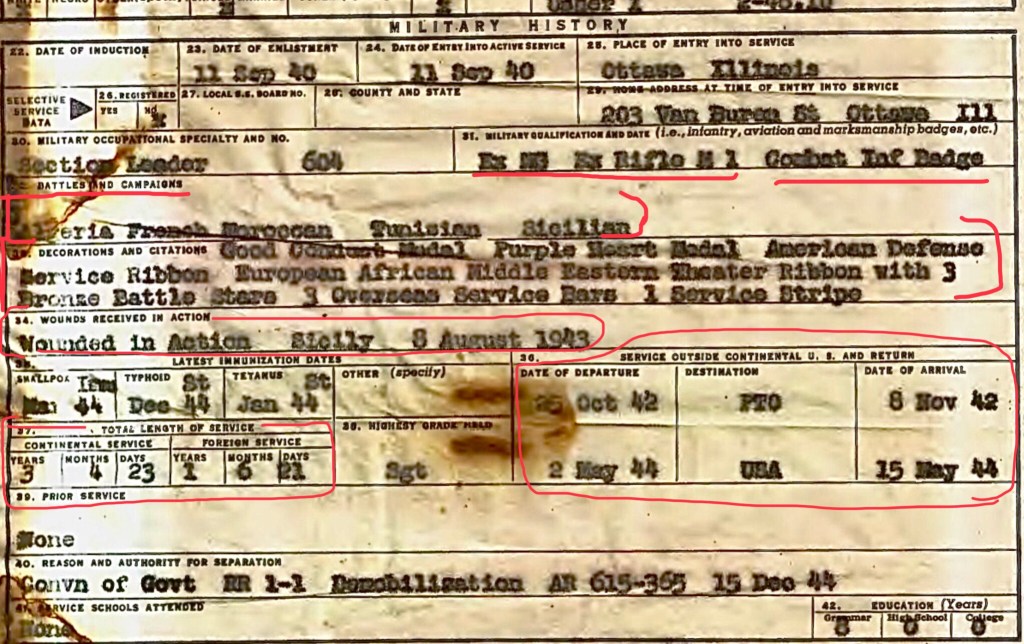
Dad’s “Military History” in His Discharge Paperwork.
  • Block 31 shows dad qualified as an expert both on the Machine Gun, and the M1 Garand rifle. It also notes he was awarded the Combat Infantryman Badge. You could only earn the CIB if you were in the Infantry (not in Field Artillery, or Armor, or Signal Corps etc), AND you were in actual active combat with the enemy.
  • I’m going to skip to block 36 – “Service Outside the Continental United State” for just a minute . Note here that he arrived overseas on November 8th, 1942. What it doesn’t say is he arrived with the 60th Regimental Combat Team of the 9th Infantry Division at around 5AM under gunfire on the beach near Port-Lyautey, French Morocco. This was as a part of Operation Torch, the invasion of North Africa. Torch was (next to D-Day) the second largest amphibious assault ever attempted.
  • Now back to block 32, where we see in addition to French Morocco, dad also took part in battles in Algeria and Tunisia in North Africa where they defeated Rommel and the Africa Korps. Those battles took place between November 8th of 1942 and May 10th of 1943. Then in July of 1943, dad participated in the invasion of Sicily.
  • Skipping back down to block 34, we learn dad was wounded on August 8th, 1943. What it doesn’t mention is he was shot three times by the Germans in the mountains of Sicily and it took over a day to evacuate him by hand to an aid station. It also doesn’t say he almost died due to the combination of his wounds and the Malaria he contracted. His time with the 9th Infantry Division ended here.
  • Returning to block 36, we see dad arrived back in the States on May 15th, 1944, three weeks before D-Day. This was after he recovered from his wounds (he was evacuated to North Africa to fully recover). Due to the severity of those wounds, he didn’t return to combat – the war was over for him, although he remained in the service for another 15 months.
  • Block 37 “Foreign Service”, shows that of dad’s almost five years in the service, one year, six months and twenty-one days were spent overseas. Approximately eight of those months were in near continuous combat.
  • Finally, we return to block 33, “Decorations and Citations”. In addition to his Good Conduct Medal and Purple Heart (for being wounded), he was awarded: the American Defense Service Ribbon (awarded to troops on active duty prior to Pearl Harbor); the European African Middle Eastern Theatre Ribbon with three bronze stars (this was for participating in the campaign in French Morocco, and the subsequent campaigns in Algeria, Tunisia and Sicily); three Overseas Service Bars (one for each six month period in a theater of war) and finally a Service Stripe (one for each three year period of service). It’s worth noting dad also earned a Bronze Star (for exemplary conduct in ground combat against an armed enemy), which didn’t catch up with him until after he was already discharged, and is not reflected in this paperwork.

Finally we come to the bottom of the discharge paperwork and block 55. There are three items noted here, although not all are readable.

Block 55 – Points and Other Things
  • First, dad, along with all other honorably discharged service members, was issued a lapel button to be worn on civilian clothing. At the end of the war, it was particularly useful for those traveling home so they were quickly identified as service members and received priority for buses and trains.
  • Next we see dad’s ASR score was 95. ASR stood for Adjusted Service Rating and is what was used to determine the priority for discharging soldiers at the end of the war. The rules were simple in principle: “Those who had fought longest and hardest should be returned home and discharged first.” Points were given for length of time in the service, length of time overseas, combat campaigns, combat awards, being wounded and so on. At the time, “the points” required for discharge were 85. Dad, with his nearly five years of service, his 1 1/2 years overseas, his Purple Heart, and his four campaigns was at, or near the top of the heap. His 95 points reflect that, and was why he was discharged so quickly as the war was winding down. If you have ever watched the show “Band of Brothers” there is a great section in the last show focusing on this. Points were on everyone’s mind.
  • Finally, there’s the cryptic last line “xx days lost under AW 107”. What the hell is that? AW 107 stood for Articles of War (the forerunner of today’s Uniform Code of Military Justice). Article 107 refers to docking the soldier credit for days of active duty that they didn’t earn. Typical examples were for going AWOL, being too drunk to report for duty, or getting in trouble for other minor offenses and confined to the barracks. Since the service member was not performing his or her duties during those periods, they didn’t receive time in grade or retirement credit for those periods. It turns out many/most enlisted soldiers during WWII had AW107 scores higher than zero. During my research, I’ve found cases with numbers from 1 to over 200. I’ve tried like hell to read the smudged number here but can’t quite make it out. It might be a 5? It might be a 3? I don’t think we’ll ever know. What I do know is dad was busted from Sergeant to Private in June of 1943 for getting caught in, and subsequently kicked out of, a walled city twice in one night after missing the last truck back to his unit. Perhaps he was confined for some period of time in conjunction with this “incident”.

After his discharge, dad returned to Ottawa, Illinois in September and lived there for the next 65 years. In Ottawa he met mom, and had us three kids, six grandchildren and 13 great grandchildren. He retired from the railroad in 1985, and passed away in 2010.

For those of you who know me, or who have followed this blog for any length of time, I’m pretty sure you are aware of how much I admired my father. An embodiment of “The Greatest Generation”, dad was always one of my heroes. This was true certainly for his actions during WWII, but also for how he lived his life, and how he took care of our family.

A Banner Honoring Dad in Ottawa, Illinois on Veteran’s Day Last Year.

I’ve probably written more blogs about him than any other subject. The blog last week about his enlistment and this one about his discharge file are special to me. It’s somehow reassuring that his enlistment and discharge paperwork confirm the outline of the oral histories we heard from dad growing up. I wish I had discovered this paperwork while he was still alive, just so we could have one more conversation about it over a coffee or a beer. “Dad, tell me again about the time …”, or “Dad, about those lost AW 107 days…”.

I love him and miss him.

Addendum:

  • I apologize for the length of this and last week’s blogs, but I was trying to give some context to the cold and straightforward words in the paperwork.

– Here are a selection of other WWII blogs that I’ve alluded to in this blog. There may be some minor discrepancies in them, based on the availability of the new information in his paperwork:

Lying to Enlist in 1940

Lying to Enlist in 1940

On the 11th day of September, 1940, just over 14 months before Pearl Harbor, my dad, William Iber Hall, enlisted in the United States Army for a 3 year stint. His enlistment paperwork showed him to be 18 years and 11 months of age. In reality, he was 16 years and 11 months old.

Our family history always said dad lied about his age when he joined the Army. Still, it was pretty cool to receive some official corroboration.

A couple of years ago in the middle of COVID, I was doing some research and learned I could access dad’s military records. The only catch? On July 12th of 1973, a fire occurred at the National Personnel Records Center (NPRC) and destroyed between 16 and 18 million Official Military Personnel Files, including 80% of those who were discharged between 1912 and 1960. I said a prayer, held my breath, and sent a letter to the National Archives, and more specifically, the NPRC, asking for dad’s service and medical records.

Months passed. A year passed. A second year passed, and then I finally received an email from the NPRC. Dad’s records existed, but were located in the area where the worst part of the fire was. They were damaged and incomplete. They did have his enlistment and separation paperwork, but nothing else. Nothing from his medical records, and nothing else about his time in the service. They did forward copies of the enlistment and separation papers.

The NPRC’s Response to My Request for Information About Dad.

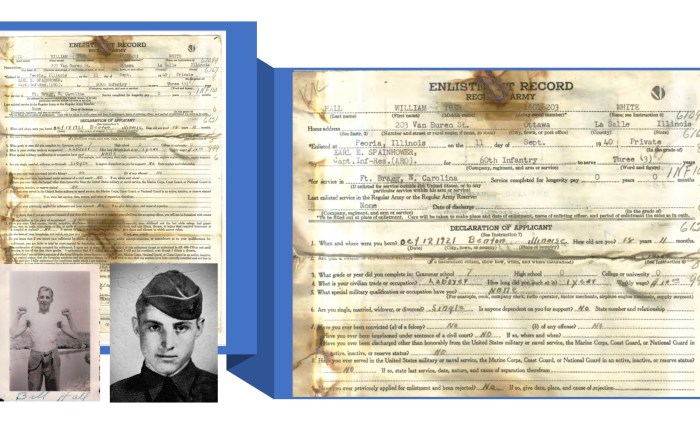
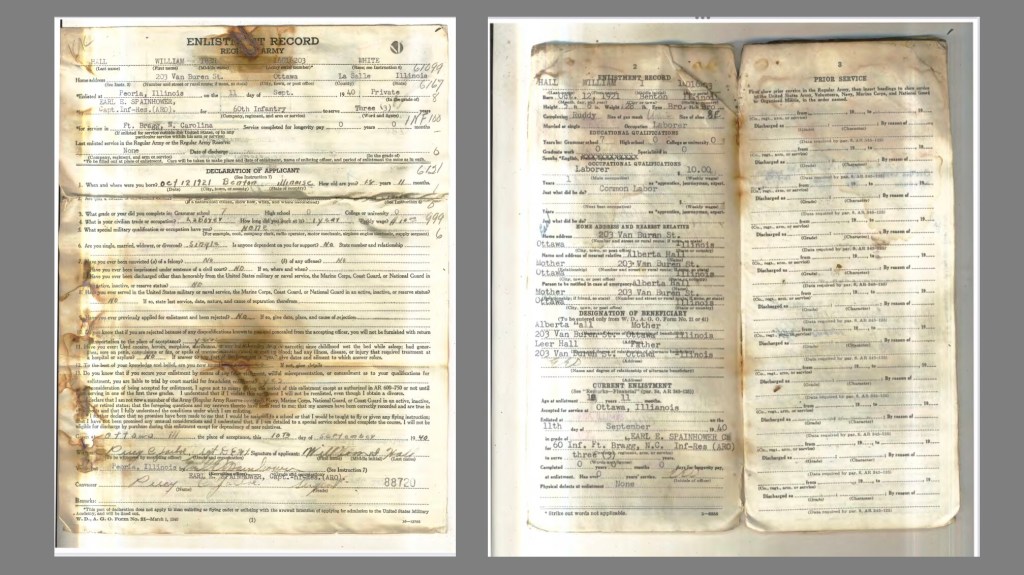
I looked at both documents. They are discolored, scarred and blurry in places. There are brown marks, including outlines of paper clips – perhaps from the heat of the fire. Here’s a photo of the enlistment documents – note there are actually three pages.

Dad’s Enlistment Papers – Apparently Damaged some by the Fire.

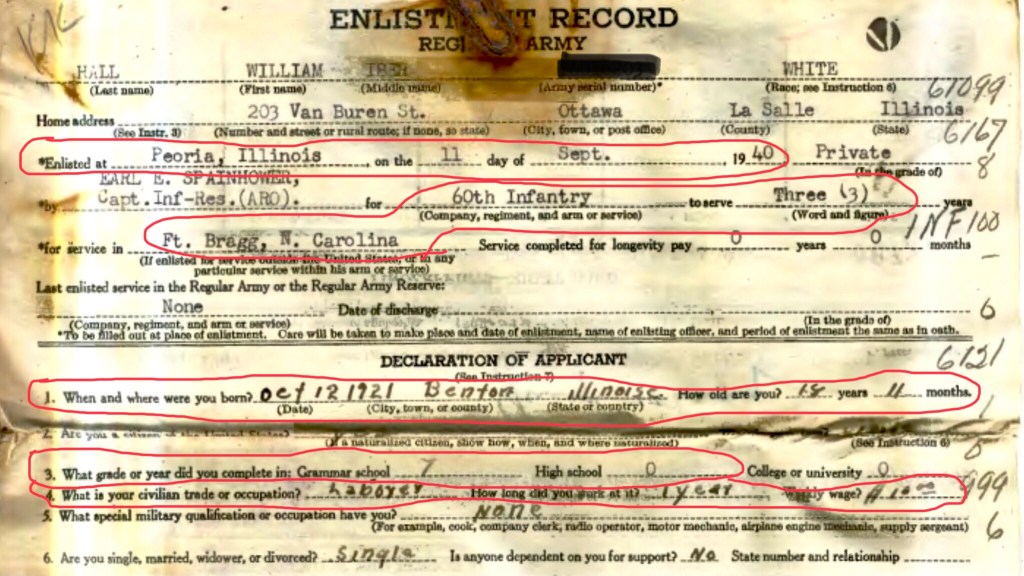
There is some fascinating information, particularly in the top half of the first page of the enlistment form. I’ve blown it up here so you can better read the form.

A Magnified View of the Top of Page One of Dad’s Enlistment, With Some Key Items Circled in Red.

Here are a few items of interest:

  • Dad enlisted in Peoria, Illinois – I’d always assumed in Ottawa, but there probably wasn’t a recruiting station there yet. His enlistment was for three years, and was directly to the 60th Infantry Regiment of the 9th Infantry Division. Three years later in September of 1943 when his enlistment was originally to end, dad was in a hospital in Sicily, recovering from being shot three times by the Germans. He was still serving with the 60th. By then, all enlistments were for the duration.
  • We see in his answer to question 1, that yes, dad did lie about his birth date – by over two years. His actual birthday was Oct 22, 1923, which means on the date of his enlistment, Sept 10, 1940, he was actually 16 years and 11 months old. You were required to be 18 years old to join and Dad lied big time, claiming a birth date of Oct 12, 1921, making himself 18 years and 11 months old.
  • His answer to question 3 shows he completed 7th Grade, and nothing more. This was interesting as well – dad always told us he graduated from 8th grade. (In a side note, Dad did graduate from high school in 2002, when he and other veterans who didn’t graduate were made honorary members and graduates of the OHS class of 2002.)
  • For question 4, he lists his work as Laborer for the past year, at $10/week. This was at least a partial lie. Dad joined the Civilian Conservation Corps (CCC) for two six month enlistments in 1939 when he was 15 years old (the legal age for the CCCs was 17). He may have worked as a laborer when he returned from the CCCs, but it certainly wasn’t for a year, as he joined the Army not long after his return. My guess is he was probably out of work at the time and didn’t want to admit it.
  • I’m betting dad didn’t know the “s” in Illinois is silent, as he spelled it Illinoise in his answer to question no. 1. ;-).
Dad in ‘39 or Early ‘40 in the CCCs, and Then Later in Early ‘41 with the 60th Infantry

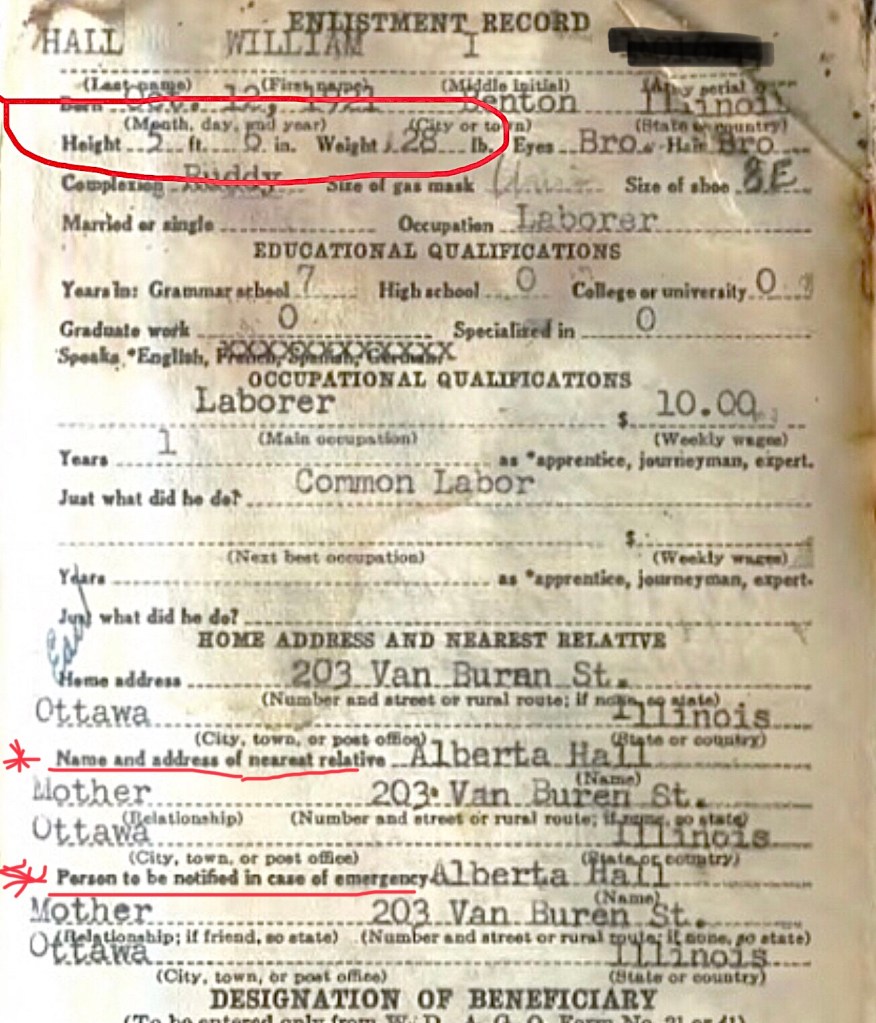
On the second page of his enlistment, there are a couple of additional parts of his life we can confirm from the information provided. First, dad is listed at 5’ 6” and 128 lbs. That corresponds pretty well with the above CCC photo of him. It’s hard to see how the recruiter actually thought he was 18.

Also of interest is that my Grandma, Alberta Hall, is listed as his nearest relative, and the person to be notified in case of emergency. This aligns with other parts of our family history that aren’t always talked about as much. My Grandpa Hall was something of a ne’r-do-well for much of his life, and probably an alcoholic. He sometimes disappeared for days or weeks at a time. Evidently Dad wasn’t taking any chances on him as his emergency point of contact and named Grandma instead. It makes sense to me now that when the telegram came to the family in 1943 informing them of dad’s wounding, it was sent to Grandma, not Grandpa.

A Magnified View of Page 2 of Dad’s Enlistment.

Receiving his enlistment papers was an amazing find to me. I never doubted dad, or any of his stories, but finding actual documents confirming his history is incredible. Knowing how lucky we are they didn’t burn along with the 18 million other military personnel records, only makes the story more fascinating. Luck is sometimes a wonderful thing.

We’d always been told that dad enlisted in 1940, and knew he had to have lied about his age. My Aunt Ellen, his older sister by several years, went to the recruiting station with him to verify his age to the recruiter. Life at that point in time, at the tail end of the depression was tough, or at least tough for the Hall family. Grandma was supporting the family with her work, and Grandpa was only a part time presence at home. There was no money, and probably not many jobs, at least not for a 16 year old. The pay in the Army was $21/month at the time, plus food and housing. I think it looked pretty good to someone who had a fairly rough life to that point.

Today, I’m thinking about 16 year old William Iber Hall going to the recruiting station in Peoria Illinois and signing up to an unknown fate. Unbeknownst to him, Pearl Harbor would happen 14 months later. Thank God for dad, and others like him, who did the right thing and stood by our country in it’s time of need.

This is the first of two blogs about the documents I received from the NPRC. Next week’s blog will cover dad’s discharge paperwork. It tells the story about his time in the service from 1940 – 1945 in just one page, and is an equally amazing document.

Addendum:

  • You can read more about dad’s and the CCCs here: It was 1939 and dad and Uncle George were on a train, bound for the CCCs in Wyoming. Growing up in Illinois during the Great Depression was tough. Their family was poor before the Depression, and things got worse […] continue here: https://mnhallblog.wordpress.com/2017/12/13/dad-uncle-george-and-the-cccs-in-1939%EF%BB%BF
  • Here’s more on the fire at the NPRC from the Archives themselves: “Shortly after midnight on July 12, 1973, a fire was reported at the NPRC’s military personnel records building in St. Louis, MO. Firefighters arrived on the scene only 4 minutes and 20 seconds after the first alarm sounded and entered the building. While they were able to reach the burning sixth floor, the heat and the smoke forced the firefighters to withdraw at 3:15am. In order to combat and contain the flames, firefighters were forced to pour great quantities of water onto the exterior of the building and inside through broken windows. The fire burned out of control for 22 hours; it took two days before firefighters were able to re-enter the building. The blaze was so intense that local Overland residents had to remain indoors, due to the heavy acrid smoke. It was not until July 16, nearly four and a half days after the first reports, that the local fire department called the fire officially out. The fire destroyed approximately 16-18 million Official Military Personnel Files (OMPF). No duplicate copies of these records were ever maintained, nor were microfilm copies produced. Neither were any indexes created prior to the fire. In addition, millions of documents had been lent to the Department of Veterans Affairs before the fire occurred. Therefore, a complete listing of the records that were lost is not available. In terms of loss to the cultural heritage of our nation, the 1973 NPRC Fire was an unparalleled disaster.”

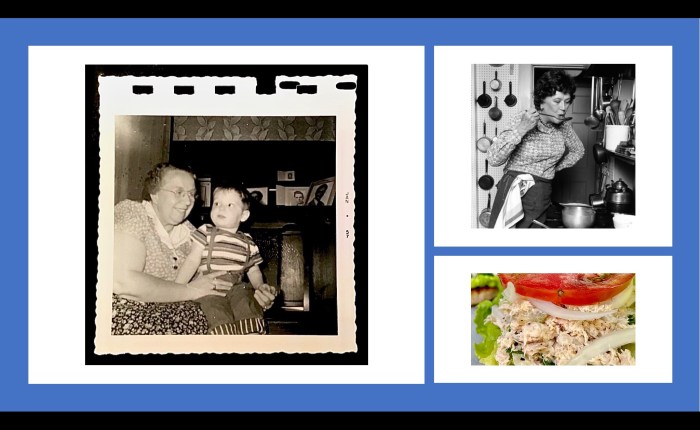
Tuna Salad with Julia and Grandma Grubaugh

Tuna Salad with Julia and Grandma Grubaugh

It was strange. It was simple. It was visceral. One moment I was taking a bite of a tuna salad sandwich made with Julia Child’s recipe. The next instant I was a little boy sitting with Grandma Grubaugh at her kitchen table having lunch. It hit me like a bolt out of the blue.

A couple of my favorite benefits of our New York Times subscription are the food and cooking articles. The columns tell great stories, and the recipes are usually pretty manageable. A while back, chef, James Beard Award winning author and former New York Times food columnist Dorie Greenspan wrote a great column “This Tuna-Salad Sandwich Is Julia Child-Approved Lunch”. She was working with Julia at the time on an upcoming book and recounted a day spent in her kitchen. Here’s a partial extract:

We were working around the kitchen table when Julia declared, “Dorie, let’s make lunch.” I saw Stephanie smile — clearly, she knew what was coming — and then I was at the counter with Julia, doing as I was told, which was cutting celery. While it might not seem like much of a job, I was cutting celery for Julia Child, and I was going to do it right: I trimmed the celery, I peeled it (because I learned to do that in Paris, I thought it was important to do it for the woman who wrote “Mastering the Art of French Cooking”) and I cut the celery into minuscule cubes that were all the same size. I’m only exaggerating a smidge when I say it took me so long that when I put down my knife, Julia had finished everything else, and we were ready to sit down to one of her favorite lunches: tuna salad on an English muffin.”

The article was about nothing and about everything. I love writing like that. I mean, how can you possibly write an entire article about a tuna salad sandwich? And yet Greenspan wrote a great one and I thoroughly enjoyed it.

Julia Childs in the Kitchen.

The list of ingredients in the actual sandwich intrigued me. We’ve all made tuna salad – tuna, mayo, celery and maybe onion and a boiled egg, but this one was a bit different. Yea, there was tuna (packed in oil), mayo (always Hellman’s), celery and onion, but it also included capers, cornichons (small French pickles) and lemon juice. Hmmmm. I was going to have to try this. Some of you know of my aversion to pickles in potato salad, but with tuna salad, why not give it a shot?

I had everything on hand, with the exception of the Cornichons. After doing a little online research, I figured the baby dills in our fridge were a suitable substitute.

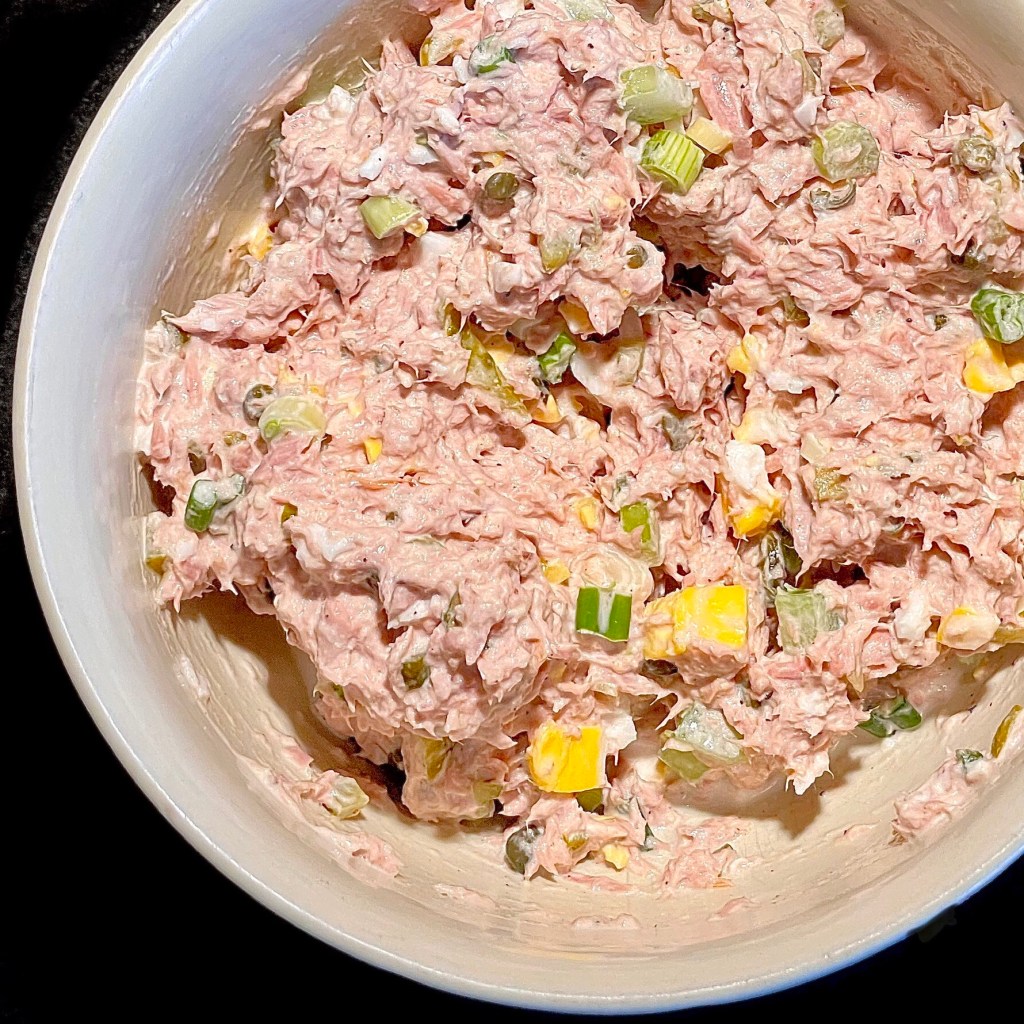
I dutifully chopped the celery (sorry, no peeling), onion, capers and pickles. After emptying the tuna in a bowl, I added all of the chopped ingredients. In went the mayo, and the parsley and I combined everything. Finally, I squeezed the lemon juice in, added salt and pepper, and combined it all again. I did a small taste, and of course because of who I am, added a bit more mayo. Another small taste, and then I put the bowl in the fridge to chill for a couple of hours.

Tuna Salad Heading to the Fridge.

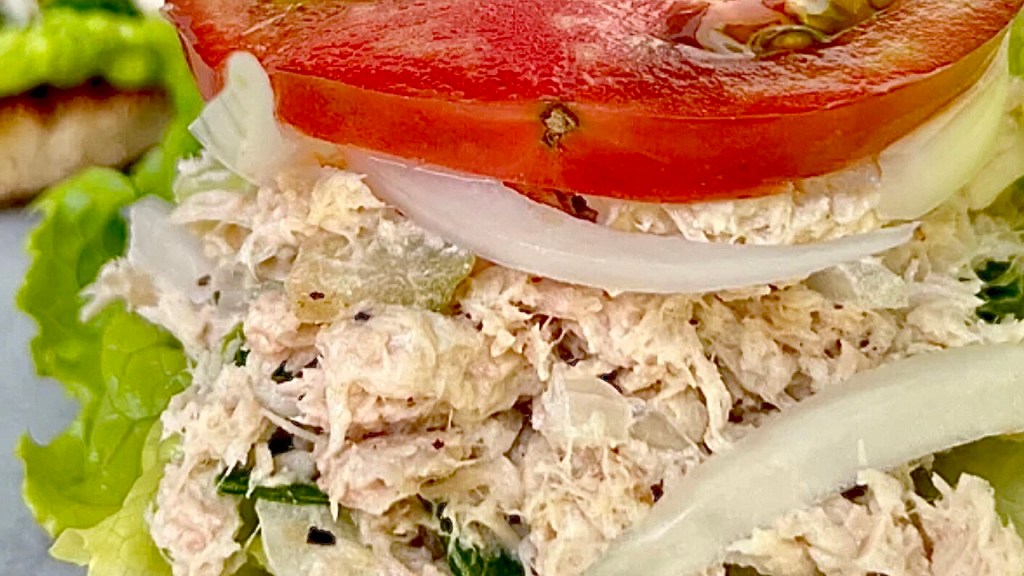
At last it was lunch time and I made my sandwich. More mayo on the bread, the tuna salad itself, some lettuce, tomato and a small slice of onion. Another slice of bread, and then I cut the whole thing in half.

Tuna Salad Sammich. It Doesn’t Get Any Better.

I took the first bite, waiting to be transformed in my mind to Julia Child’s kitchen, and … wait! What!? Was that Grandma Grubaugh sitting next to me? Where in the hell did that come from?! It was a visceral reaction – I was a young boy back in Ottawa, sitting at the kitchen table at Grandma’s house having a tuna sandwich with her.

Grandma Grubaugh and I in 1957.

After rejoining the present, I sat there eating my sandwich trying to figure out what brought on those feelings. Grandma, to my knowledge, never cooked anything from Julia Child. Besides, my flashback would have been some time in the ‘60s, well before Julia became popular in America.

I thought through the ingredients. I don’t really remember grandma keeping fresh lemons, or capers around the house, although I suppose she might have. Grandma putting either in tuna salad seemed a pure fantasy. It had to be the pickles, although I didn’t remember mom putting pickles in tuna at our house.

At this point in time, mom had already passed away. Uncle Don, her younger brother was still alive, and I gave him a call. After catching up for a few minutes, I explained why I was calling, asked about grandma’s tuna salad, and whether she put pickles in it. He immediately answered “No, there were no pickles”, and my heart sank. Then he quickly added – “No, no pickles. She used a couple big spoonfuls of pickle relish.” And it all connected.

We talked a bit more and I eventually hung up. As I thought about Grandma and her pickle relish, it made sense. The relish certainly would account for the pickle flavor and maybe some of the brightness. In a subsequent conversation with my cousin Dawn, she reminded me that while Grandma didn’t really keep fresh lemons around the house (who did in midwest America in the ‘60s?), there was always a bottle of Real Lemon Juice in the fridge – for lemon cake, lemon pie, maybe a spoonful in cobblers. Who’s to say she didn’t add a spoonful to her tuna salad? While it doesn’t all add up perfectly, it made sense to me.

Since then, I’ve continued to make my tuna salad with pickles, capers and lemon juice. I have to admit Julia’s is better than what I’d made before. It’s also a nice lunchtime bonus – remembering Grandma Grubaugh on a day when you are “only” having tuna salad is pretty special.

Addendum:

• Thanks to my sister Roberta, and cousin Dawn (one of Uncle Don’s Daughters – also a flower girl at our wedding) for their contributions to this blog – both had distinct memories of Grandma’s tuna salad and some of grandma’s habits at the time. Dawn was also quite emphatic Grandma used sweet pickle relish in her Tuna salad. We also had a great conversation about foods triggering happy family memories – Thanksgiving at mom and dad’s house (Uncle Don, Aunt Diane and family were almost always in attendance as well), potato salad, Aunt Diane’s cherry pies and cobblers, watermelon outside on the picnic table, and Grandma Grubaugh expertly spitting her seeds across the yard, to the delight of her grandchildren.

• Here’s another blog about Grandma Grubaugh and her delicious date nut bread: https://mnhallblog.wordpress.com/2019/12/04/grandmas-date-nut-bread/
• Here’s a link to the column that inspired me to try Julia Child’s Tuna salad. It’s a quick read – https://www.nytimes.com/2020/10/21/magazine/this-tuna-salad-sandwich-is-julia-child-approved-lunch.html?unlocked_article_code=a2vDZUZ1eo1yVrKAfuZxMgmll7EsQe8k7K-jTFFMqtFBjYV_jUe1I577EkeqZQNBGpaScBbP2xFhlRgEXk0W3tuhHedthiZqjAOIlq7mFMVFRXTSWUW-mugkmUlR6AtNmjBpqnBC45Dacm7NKVcjag8DPq4nW_Mk-gleZC2NfUBimTJW8wqPnaCRsC9BXBDeHOI6FVeL60bLuggz3IU80r0Op815enYRuh9uZRbZwfNBd33TI6IJNJk_1qSRqnFXzpHmKs4RRpwBBMsGROoFMHGYZ-jWFgxYd51U2M-oYm9mLIFmxsE2twHD2-Qtkx8ZSmRV-W7eCe36dnvravfZOe3UkdJOwFAHYcitmVZSPDenybPsa9HK0r6y4Pgo9YUyIA&smid=share-url

• Here’s a link to the recipe from the NYT: https://cooking.nytimes.com/recipes/1021561-tuna-salad-sandwich-julia-child-style?smid=ck-recipe-iOS-share

• And here’s the exact same recipe if the NYT won’t let you open their recipe without a subscription: https://bwtribble.com/recipe/1071

End of an Era

End of an Era

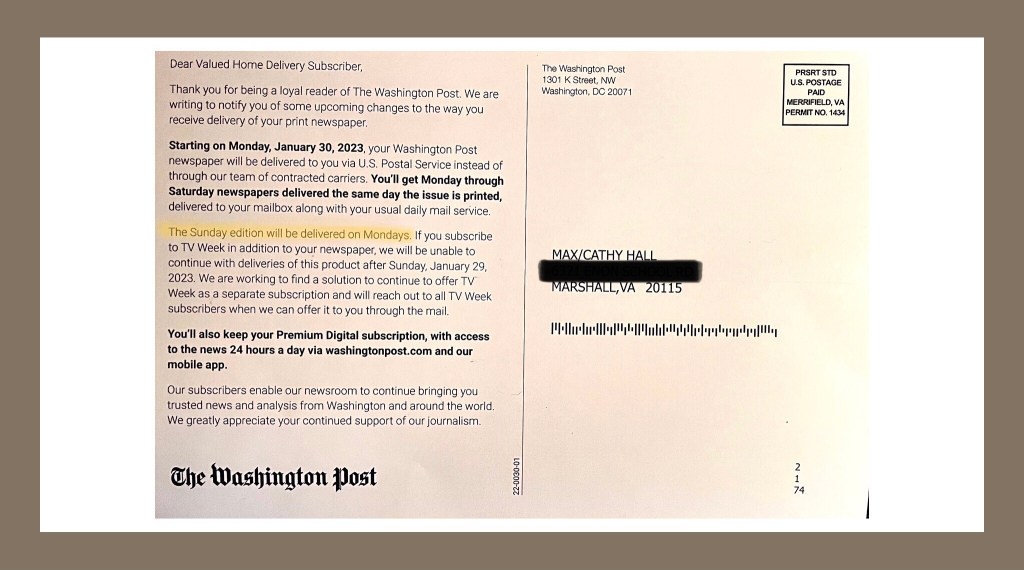
There’s a change coming to my Sundays. Starting this week and going forward, the paper copy of the Washington Post Sunday newspaper will arrive on … wait for it … Monday. Yep, it’s the end of an era for many of us here in rural Fauquier County.

I’ve always read newspapers. Growing up at home, it was the Ottawa Daily Times, and on Sundays, both the Chicago Tribune and Sun Times. At West Point, it was the New York Times (Plebes delivered hard copies to every cadet room). When we lived in Germany in the ‘80s, in addition to the Stars and Stripes, I would buy the International Herald Tribune, at the local book store or snack bar. At the time, The Tribune was a joint publishing effort between the New York Times and the Washington Post. It was a great paper and provided in depth coverage of events in the States and around the world. When Cathy and I returned to the DC area in ‘89, we began our subscription to the Washington Post and have read it ever since – thirty-four years of delivery.

At the time of course, the subscription was only hard copy and delivered daily. In 1999, when we moved to our farm in Fauquier County, our subscription moved with us. During the week, when I left for work around 5:30AM, the paper was already delivered to our home, and I’d pick it up and take it with me.

Home Delivery of the Post for Thirty Four Years

Ahhh, but Sundays were different. After getting up and starting a pot of coffee, I’d dutifully walk up the drive and retrieve the Post from the receptacle next to the mailbox. Big and fat, the Sunday edition was meant for leisurely exploration. I’d always start with the sports section, then move on to the front page. After that, Outlook (the opinion section), Art&Style, Business, Metro, Bookworld, the Comics and finally the Sunday magazine*. It was a great way to while away a couple of hours.

Times change of course. Digital subscriptions started and were included with our home subscription. I found digital great for looking at headlines, along with the updates and alerts that were posted throughout the day. Having said that, I still loved getting ink on my fingers and reading the hardcopy. Some of my younger friends laughed at me and basically told me I needed to get with the times. I’d always argue back about the corollary reading the hardcopy provided – you started reading a front page article which continued on page A15, and on page A15, you would see one or two other smaller articles that you never would have found if just reading digitally.

Then Covid hit, and as with so many things during that time, other changes happened. Remember early on, when folks still weren’t sure how it spread? Wiping down groceries before you brought them into the house? Everyone buying Clorox wipes, or other antiseptics? At the time, we’d let the hardcopy sit in the garage for a day or two before bringing it into the house. Yea, I know it all sounds foolish now, but everyone was concerned (or at least we were).

I started reading a lot more articles online, not just the headlines. “Corollary reading” was lost, but it didn’t seem so important during Covid. Eventually, we canceled our daily subscription – it wasn’t worth it anymore. We did decide to keep the Sunday hardcopy, along with the digital. I still enjoyed working my way through the Sunday paper – it was a form of leisure in it’s own right.

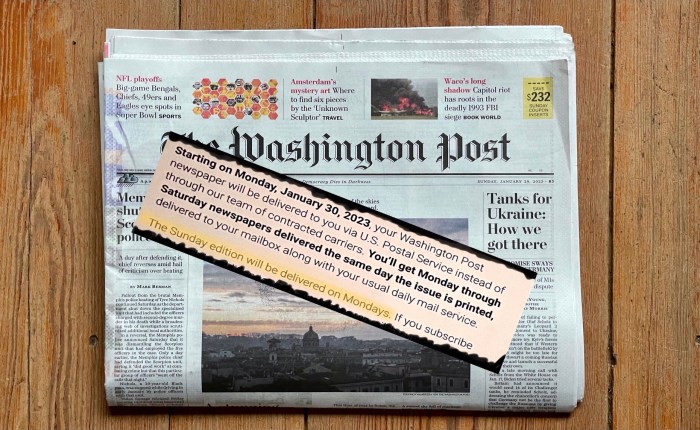
Two weeks ago, our friend Colleen who also lives in Fauquier, posted on FB that she received an email notice that on January 30th, the Post was going to start using the Postal Service to deliver the newspaper. Soooooo, your daily morning paper would now come sometime later in the day, and the Sunday paper would arrive on Mondays. What the heck?!

The Email Colleen Received

Shortly after, we received the same email and a post card via mail. We were on the hit list as well. And just like that, the world changed.

Our Post Card From the Washington Post

We are retired, so we have the time to read the Sunday edition on Monday, but it won’t be the same. For our working friends who subscribe, it actually becomes somewhat untenable. A few of their (printable) comments are here:

  • I MUCH prefer reading print over any form of electronic distrubtion, and this totaly blows my VERY long-standing Sunday routine out of the water.
  • My Sundays will never be the same… Walk the dog, make my coffee, and start reading. Now it will be walk the dog, get in the car and drive to the Exxon station, then…
  • I will miss my daily morning paper. Cut it back to digital. So sad. 😞
  • I emailed and spoke with them yesterday within minutes of having received my notice …

Of course it’s all about economics, and I understand. Home delivery is no longer feasible in rural counties such as ours. With people moving to digital, hardcopy deliveries have dropped in general and for places like Fauquier, there is too much driving for the carriers, increasing their time and cost. It’s an uncorrectable downward spiral.

I called the Post to cancel my Sunday hardcopy, although I planned on retaining the digital subscription. It turns out the cost for Sunday hard copy and digital is virtually the same as just receiving the digital subscription, and so for now, I’m keeping them both. We’ll see what happens in the near term, but my guess is on Mondays, the physical newspaper will go straight from delivery to recycling, and in a month or so, I’ll cancel the hard copy. In the meantime, the nice man I spoke to on the phone promised to convey my complaint and concern to “management”.

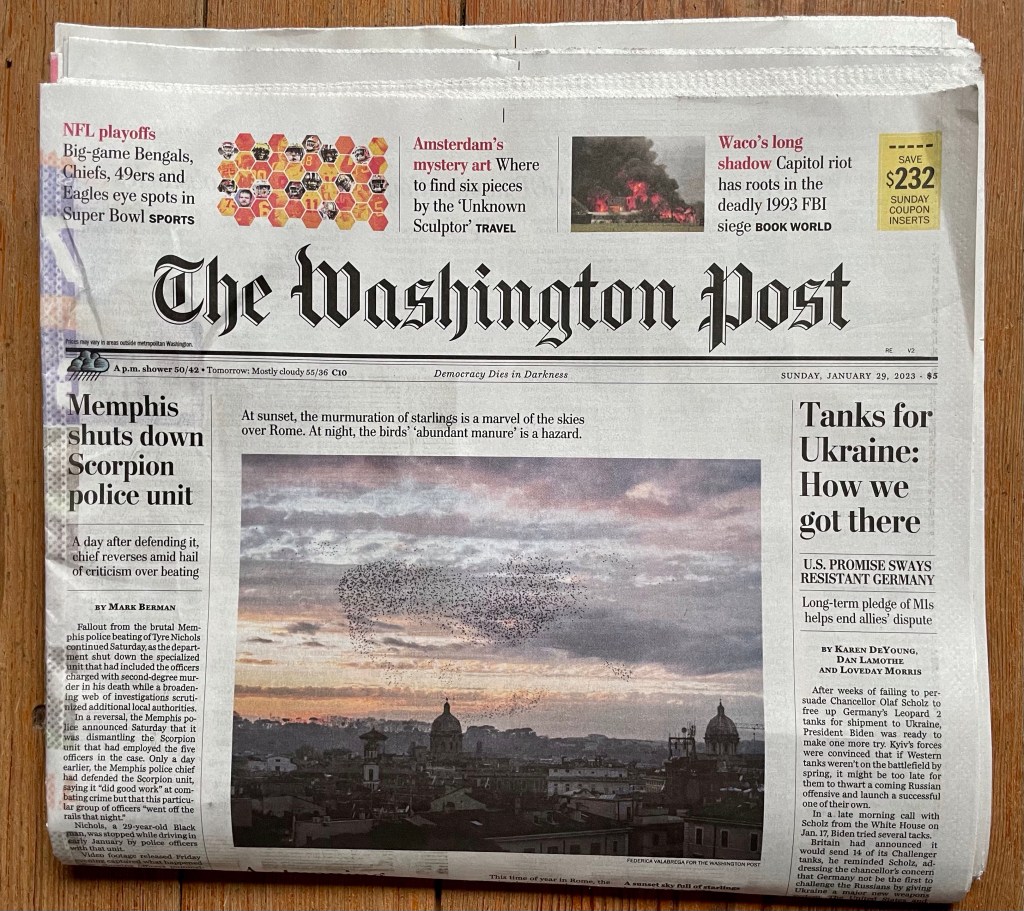
Our Last Copy of the Sunday WaPo that Actually Arrived on a Sunday.

Last week, I received a similar notice from the New York Times. We also receive their Sunday paper hardcopy and have a digital subscription. I’m probably going to cut their Sunday paper soon as well.

That will leave us with digital copies of The Post, the New York Times and the Wall Street Journal, good papers all. I appreciate the daily headlines, their alerts throughout the day and the links I have to any number of special features. Still, I know my world will grow just a little smaller and a little less broad without newspaper ink rubbing off on my fingers.

Addendum:

  • I didn’t touch on it here, but the demise of print newspapers, and local newspapers in general is a real thing, and an unfortunate one. Between 2004 and 2022, over 2,500 local papers have ceased operation, including over 360 that have disappeared just since the start of the pandemic. We are all a little poorer for their disappearance.
  • * There have been changes to the Sunday WaPo over the years. Book World disappeared and later reappeared. Outlook (The Opinion section) moved from a separate section to just a few pages at the end of the main section. And, just before Christmas last year, the Sunday Magazine disappeared all together.

A Plebe Christmas

A Plebe Christmas

I distinctly remember returning to West Point after Christmas my Plebe year. It wasn’t fun. As a matter of fact, the last couple of days at home became bittersweet as I started thinking about returning to West Point as a Beanhead* for another five months.

It wasn’t just returning to the Plebe System (Fourth Class System) that affected me. We had first semester finals two weeks after returning. Also, have you ever visited West Point in winter? In the Fall, West Point is one of the most beautiful places in the country. In the winter? Not so much, unless you have a fondness for the color grey. January to March at West Point is called “Gloom Period”**, with good reason.

If I’m honest with myself, it wasn’t Gloom Period, or finals that brought me down. It was going back as a Plebe for another five months. Before you enter the Academy, you hear all about how tough Plebe year is both mentally and physically. It’s one thing to hear about it. It’s another to experience it for six months, have a break, and then know you are going back for more of the same.

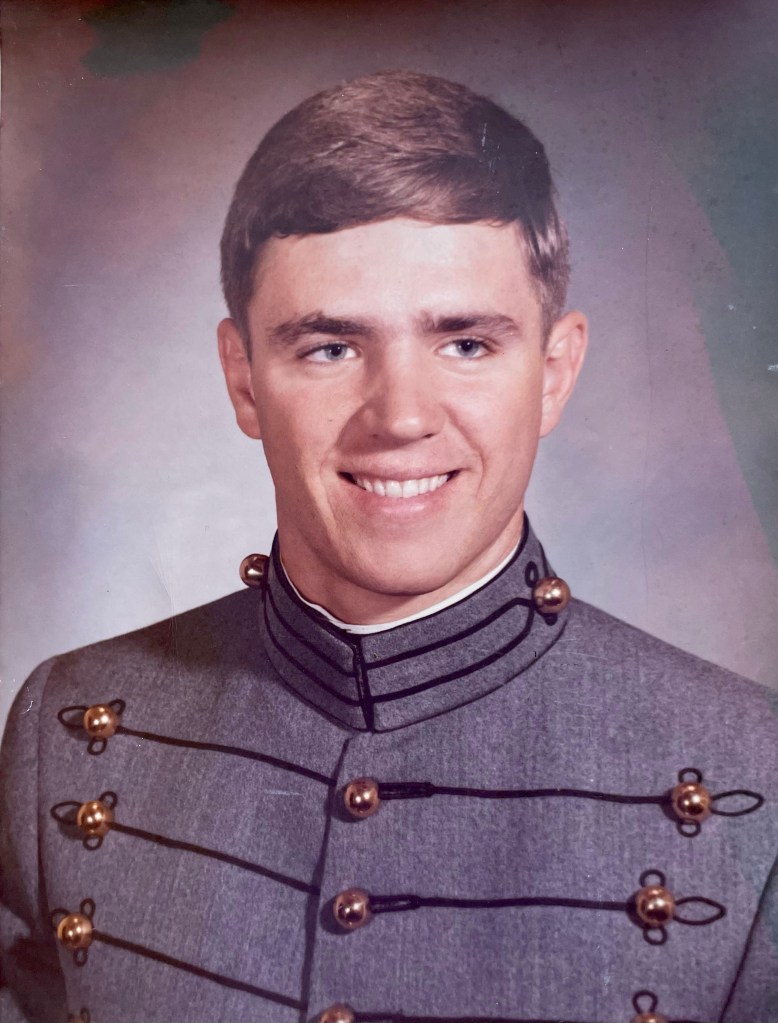
Official Plebe Photo

Coming home to Ottawa that December, Christmas break was great. Being a real person again was even better. Everyone wanted to know how West Point was, and of course I told them the good stuff, while minimizing the actuality of Plebe life. The time at home divided out between family events, dates with Cathy and partying with my friends.

During the day, I spent time at home, or went to see Grandma, various aunts and uncles, and church or family friends. I remember racing around town fitting in as many visits as I could. It was good to catch up with so many people, but also a bit exhausting.

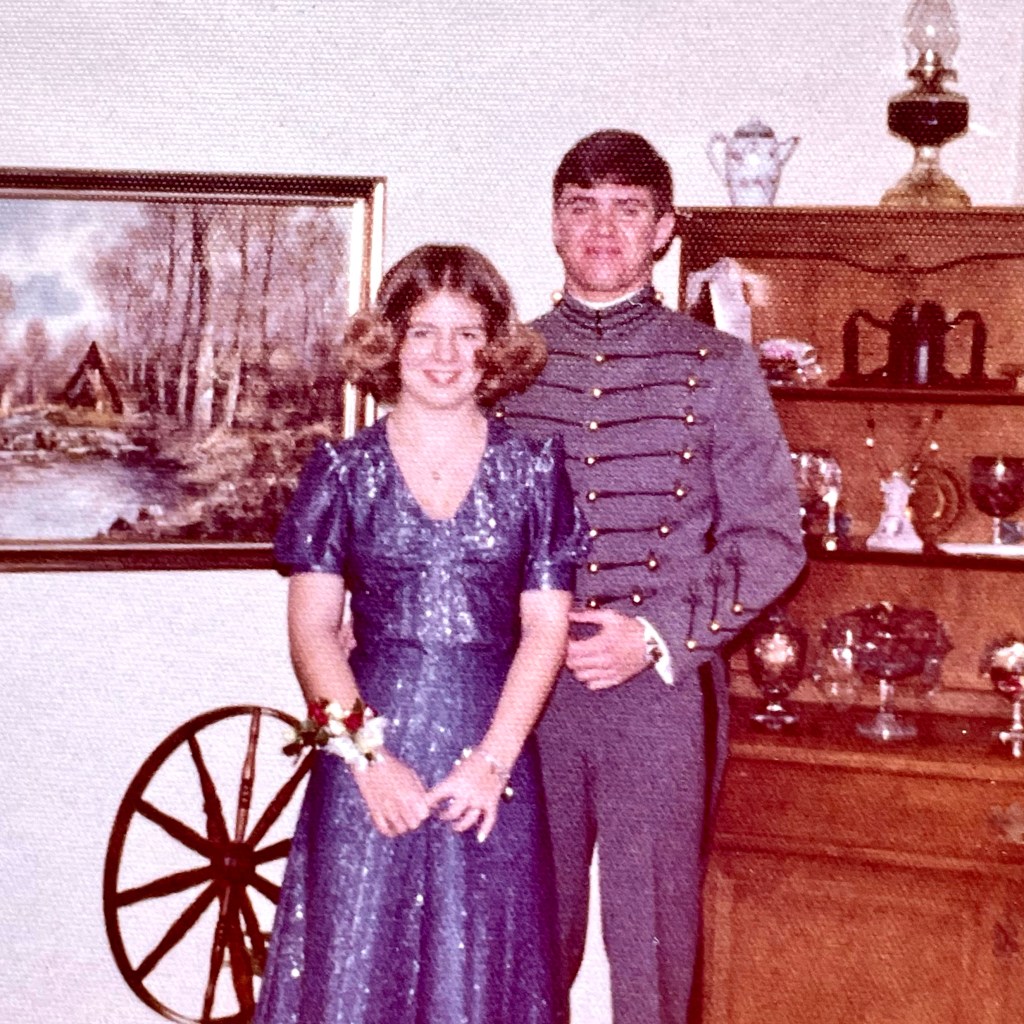
Cath and I went on dates most evenings and tried to make up for lost time. The last we’d seen each other was Labor Day Weekend, when she visited West Point with my folks. In the interim, we’d written so many letters back and forth, I lost count of the actual number. While home, there was even a formal holiday dance at Ottawa High (Cathy was still a senior in high school). I wore my dress uniform, and felt so much older than the high school “kids”, who in reality were only one or two years younger.

At Home Before Going to the OHS Winter Formal

Since she was still in school, Cathy had a curfew most nights. After our dates ended, I often linked up with my buddies Howard, Tim, Mark and others. The drinking age in Illinois was 19 at the time for beer and wine, but nobody really checked. We made the rounds at Berta’s, The Flamingo and Russell’s Tap before finally making it to bed. The next morning I’d wake up and start the cycle all over again. As I recall, sleeping in wasn’t an option.

I’d taken a couple of text books home with me to study over break, but of course I never cracked them. The days and nights raced by.

Finally it was New Year’s Eve and just a couple days before I would return to West Point. I remember going to a party with Cathy at our friend Jack’s home that night. Many of our friends were there. It was a great time, and as the clock struck midnight, there were kisses, handshakes and toasts all around. It was wonderful and things seemed almost perfect.

Maybe an hour later, it hit me. This was all going to end and I would return to the reality of Plebe life. The exhilaration from midnight rapidly disappeared. I crashed and a forlorn feeling took over. I found a quiet spot in an empty room and just sat there thinking. The dread I felt was visceral. Cathy found me a few minutes later and could tell something was wrong. She asked if I was OK and I struggled with words, then just gave up trying to explain. The thing is, she felt it too. We stood there hugging for I don’t know how long.

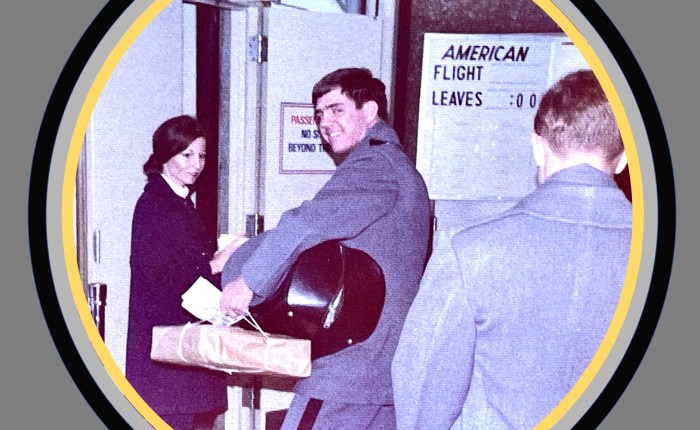
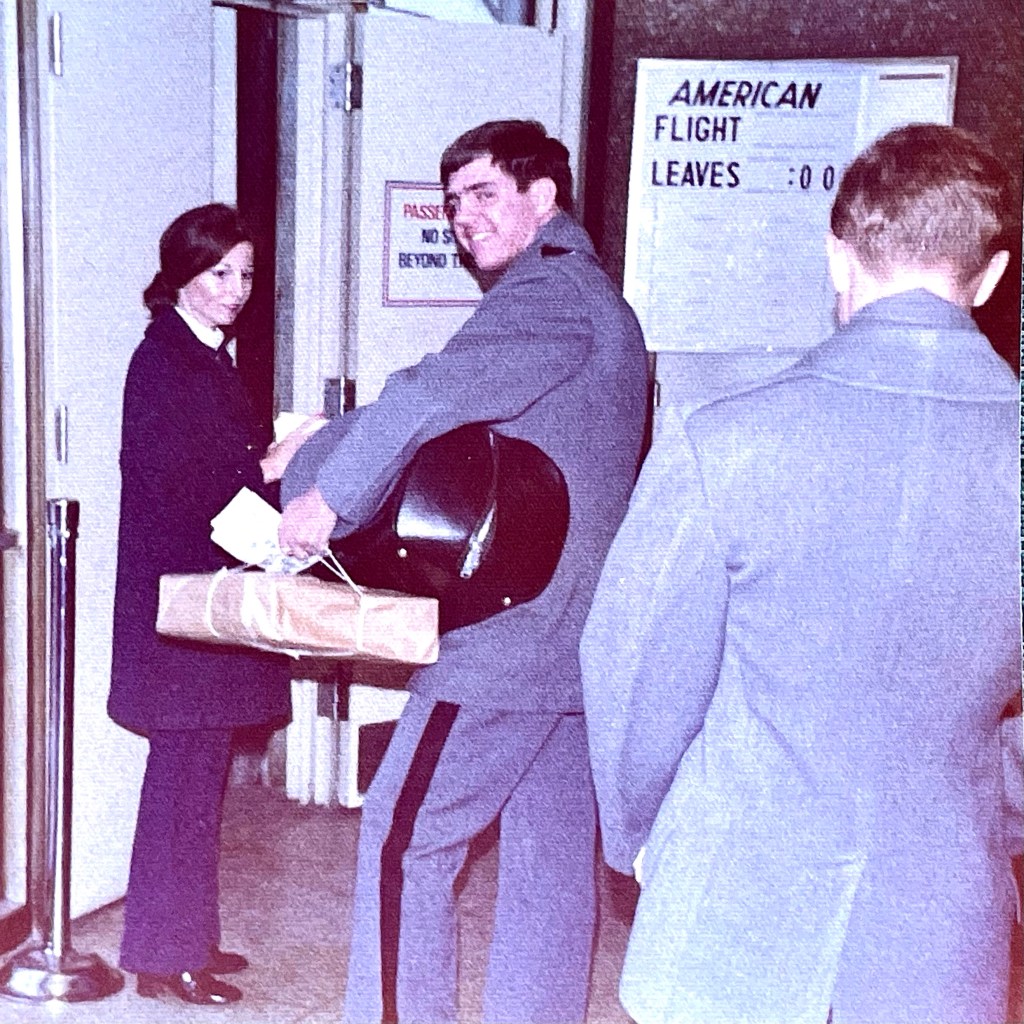
I more-or-less bounced back the next day and enjoyed my last day or two of freedom. Finally, it was time. As a Plebe, I think I was required to travel in uniform, and when Mom, Dad and Cathy drove me to O’Hare, that’s what I wore. Back then everyone could walk all the way to the gate, and that’s where we said our final goodbyes and “I love you’s”. Mom gave me a care package and with a last wave and a smile, I boarded the plane for New York.

A Smile for Mom, Dad and Cathy as I Boarded the Plane to New York.

At the airport in New York (LaGuardia I think), cadets were everywhere. Most of us made our way to buses for the final fifty miles to our Rock Bound Highland Home on the Hudson. The bus I was on was pretty quiet, with Plebes and upperclassmen alike lost in their own thoughts. By now, I’d steeled my mind for the return to school and Plebe life. I was as ready as I was going to be.

And of course it wasn’t as bad as things looked on New Year’s Eve. I made the Dean’s list that first semester, and by late March or early April, Gloom Period was lifting. As for dealing with upperclassmen and the 4th Class System, that too passed. As the Semester wore on, things became easier and and finally, in June, Recognition Day happened. We were no longer Plebes, but full fledged members of the Corps of Cadets.

To this day, I remember that New Year’s Eve and the roller coaster of emotions I felt. Speaking with Cathy, she too distinctly remembers that night. I recently told her I thought I’d write a blog about New Year’s Eve Plebe year. She immediately knew what I was talking about. I laughed a bit and said something like “I didn’t know you remembered”. She quickly answered “How could I forget?”

Addendum:

  • *Beanhead – one of the many less flattering terms upperclassman used for Plebes at the time.
  • ** Gloom Period – If you want to read more about Gloom Period, you can do so here: https://mnhallblog.wordpress.com/2018/01/21/gloom-period/
  • I’ve often thought of that New Year’s Eve over the years and the feelings I experienced that night. I’d contemplated writing a blog about it before, but couldn’t quite wrap my head around it. Then, during Christmas season this year, one of my classmates posted an email on his own feelings about the return to West Point after Christmas. Several others chimed in. Some were worried about academics and getting separated due to grades. Others, like me, thought about the return to the 4th Class System for several more months. Still others talked of the general malaise around our return, with Gloom Period settling in. A few told (now) funny stories about missing flights, late arriving girl friends, and even running into the Dallas Cowboy Cheerleaders during a stopover on the return to the Academy. It’s interesting what binds people together. My classmates and I laugh and now tell stories of those times that seemed so serious back then. Time and distance have brought perspective and a camaraderie that has lasted a lifetime. I feel lucky to be a member of the Proud and Great Class of ‘78. Thanks for the memories, and the continued friendship my brothers.

The Chili Dump

The Chili Dump

I hate missing a good party. Unfortunately, we will miss Chili Dump 2022. We made the 2016 version, which featured great chili, a band, Elvis, a bonfire tended by a front-end loader, and 200, or so, of my sister and brother-in-law’s closest friends. What’s a Chili Dump? I’m glad you asked.

My Brother-in-law Jack started his legendary Chili Dump party around 2002 with his then wife, Meg. The first party was a thank you for friends who helped clear the land they were building their home on, and then subsequently helping them build their home. It became an annual event, and as their kids grew older, their friends started attending the party as well. Sadly, Meg passed away in 2013. When my sister Roberta met Jack later, she too was introduced to The Chili Dump. In 2016, we timed our visit home to Illinois so we could attend the party.

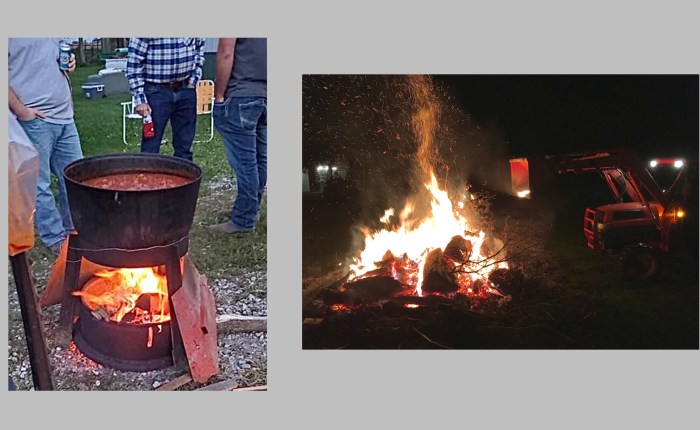
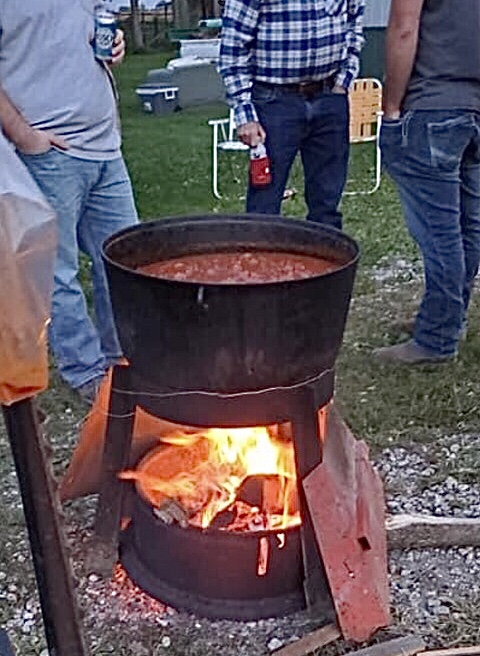
On that October ‘16 afternoon, Jack started a fire in the back yard and put a huge pot over it. The pot actually looked more like a cauldron than any pot I’d ever seen. They added the usual chili ingredients – cooked ground beef, tomatoes, tomato juice, hot peppers, beans and spices (and please, I don’t want to hear from any Texans about how beans don’t belong in chili). Soon, the chili started to cook and bubble away. By then, we may have had a beer or two.

A Cauldron of Chili….

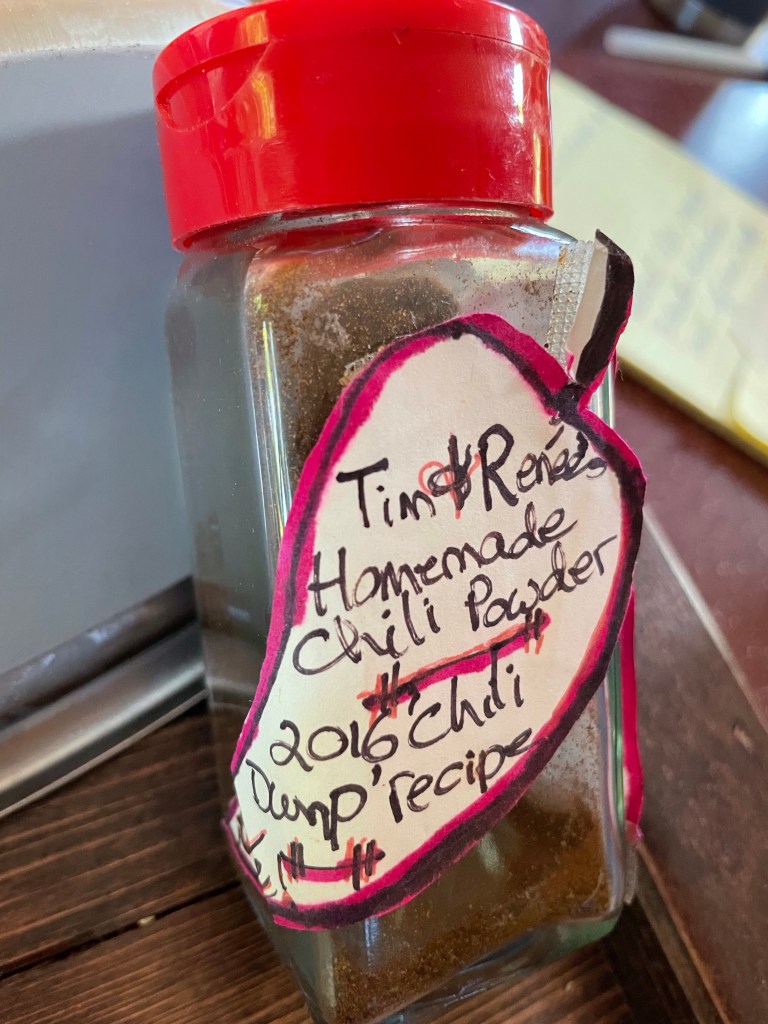
The first friends arrived by ATV, and brought more ingredients to add to the Chili – venison and jalapeños if I recall correctly. Others continued to arrive. Smoked brisket, hotdogs, sausage, bratwurst – they all went into the pot. Wood was added to the fire, to keep the chili cooking. Our friends Tim and Renee arrived from the Chicago ‘burbs with a blend of spices they specifically put together for the chili. Into the pot it went.

Tim and Renee’s Special Chili Spice for the Chili Dump!

Other folk brought toppings, including sour cream, grated cheddar cheese, sliced jalapeños and fried bacon. Someone made cornbread. There were bags of chips and Doritos added to the serving table. My sister Tanya and her husband Shawn arrived, and added more beef in the pot. Nieces and nephews arrived, and all dutifully put something in the pot. The volume of chili in the pot was definitely increasing.

The Pot was Getting Full!

Pickup trucks and cars were now lined up near the cow pasture. It started getting crowded and started getting dark. Around then, Jack lit the bonfire. It was a biiiiiig bonfire…

The Bonfire WAS Big…

Somewhere during all of this, people began sampling the chili. I have to admit, I was a bit skeptical, but then I took my first bite. Wow! This was surprisingly tasty. People kept arriving and adding to the chili. There was now also a steady stream of bowls being filled, so the volume stayed about the same, or maybe started to go down. There were probably 200 people at the farm by then.

Eventually, the Joel Limberg Band started playing. Some folks were dancing, and as at weddings, lots of little kids were hopping around on the dance floor. At some point, the band brought out a surprise guest singer – Elvis. Actually, a Philippine Elvis. Let me tell ya, you haven’t lived until you’ve heard Elvis sing Sweet Caroline, with the crowd joining in on the response – “Sweet Caroline, oh oh oh, Good times never seemed so good – So Good! So Good! So Good!” The party was going strong now!

Yes, Elvis is a bit Blurry, Much Like Parts of the Evening….

More dancing. Talking with family and old friends. Making new friends. More beer. More chili. The chili level in the pot was definitely receding. The bonfire was also going down, but Jack wasn’t ready to let that happen just yet. You know you have a big fire when you need to tend it with a tractor’s front-end loader.

Nothing Says Party, Like Fire in the Front-End Loader…

Although it was getting later, no one was leaving. Suddenly fireworks went off and exploded in the sky. We all watched, and oohed and ahhhed. The neighbors didn’t complain, because most of them were at the party.

Oooohhh! Aaaahhhh!

The band played another set, and it was time for more beer and more chili. The volume in the pot was definitively lower, but the chili was still hot, and still tasty. I noticed the crowd was starting to thin some, although I don’t think the sound volume was any lower.

Well after midnight, Cathy and I finally went to bed. It was a great party, but sometimes it’s good to know your limits.

The next morning, we woke, not feeling overly fuzzy. Jack and Berta were already up and had fed their calves and chickens. Amazingly, they didn’t seem to much worse for wear. I asked Berta how late the party went, and all she said was “Late”.

Our friends Tim and Renee also spent the night and they too woke up and joined the living. Eventually, we all went outside and started cleaning up. We may have partaken of a little “hair of the dog” during the cleanup. A couple of the youngsters also stopped by and with all of us involved, it wasn’t tooooo much work and we finished up after a couple of hours.

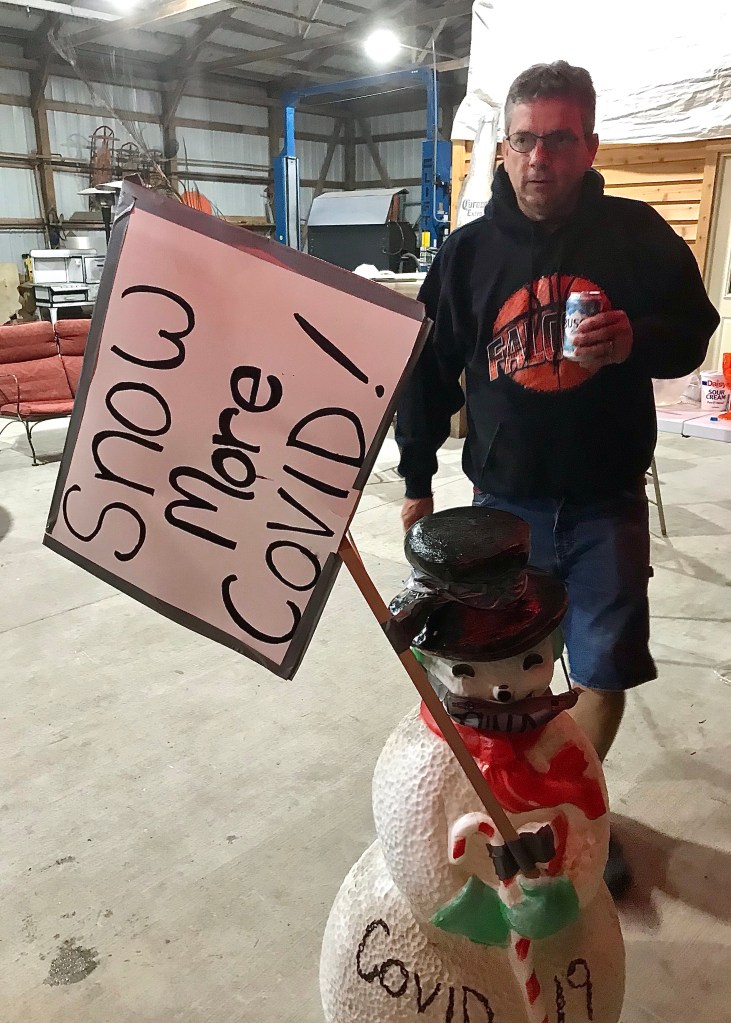
That was the 2016 party, and so far, the first and last one we attended. Since then, we’ve been out of the country for a couple of them, and of course covid slowed things down. I should mention they burned a Covid Snowman at the 2020 Chili Dump.

SnowMore Covid ‘19, was Added to the Bonfire in 2020…

I’ve both attended and hosted a number of good parties over the years, here in the States, and overseas in Germany, Austria, France, Belgium and the UK. I have to say the 2016 Chili Dump was one of the best. Anytime you combine chili, beer, Elvis, a bonfire, fireworks and fun people, it has to be pretty good, doesn’t it?

Addendum:

Thanks to my sister, Roberta, for help with this blog.

Wind Turbine Tumult

Wind Turbine Tumult

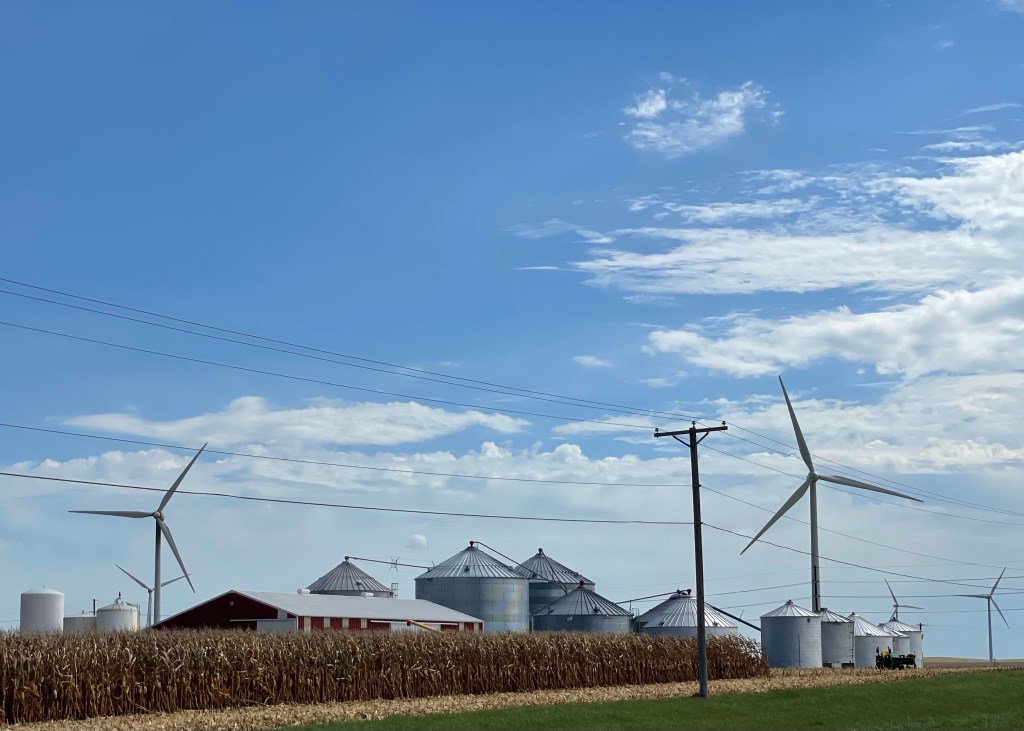
Am I going crazy? The weird feelings and nausea while driving by the wind turbines were real. I furtively look at them and yep, they were still standing there, slowly turning, nothing coordinated between turbines, some not even moving. My eyes snapped back to the road and I tried to focus.

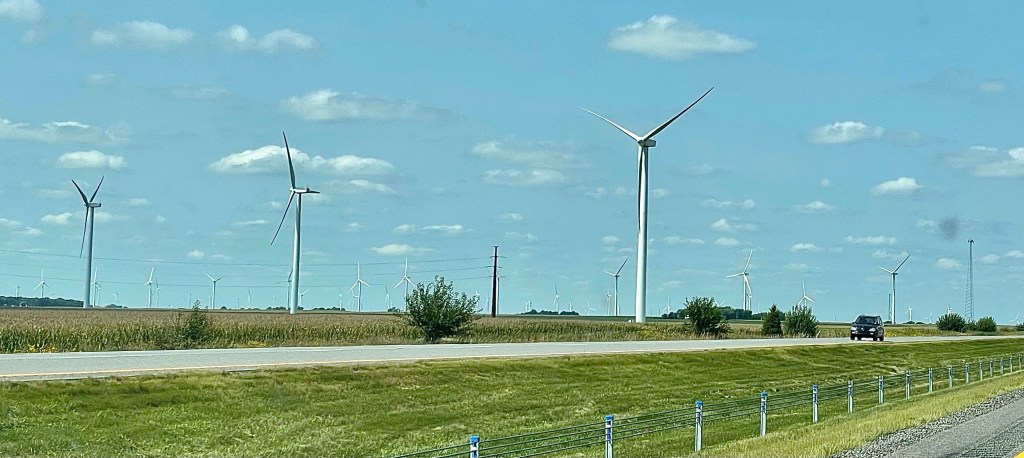
On our recent trip home to Illinois, Cath and I drove through some huge wind farms off of Interstate 65 between Indianapolis and Chicago. As I saw the wind turbines in the distance, I felt a rumble in my stomach. D@mn… With a nervous laugh, I started telling Cathy about the last time I drove through them, thinking maybe telling the story would make the rising feelings go away.

It was 2017 and I was driving home to see mom. She hadn’t been well for a while and as a result, I was probably off a little. I was going to stay at my Sister Berta and her husband Jack’s home near Pontiac, and Google Maps was taking me a different way for the last section of the trip. As I was driving north from Indianapolis, I entered a field of wind turbines. There were hundreds of them and it went on for miles. The turbines were huge, with three blades turning on each. I looked across the fields, mesmerized.

Wind Turbines… For as Far as the Eye Can See

The turbines were turning at different speeds. Some weren’t turning at all. There were lines of them. There were scattered individual ones. There was a pattern. There was no pattern. Whoosh…whoosh…whoosh…whoosh the blades continued to turn silently. I rolled down a window to hear them, but they made no discernible sound. And still they turned, independent and out of synch with each other. Whoosh…whoosh…whoosh…whoosh… I started to think of them as the evil cousins of the quaint wooden windmills in Holland.

The Evil Cousin of the Quaint Wooden Windmills in Holland

And that’s when I started to feel funny. A bit of nausea, a little out of sorts, foggy in the brain. I tried to keep my eyes on the road and ignore them, but found my eyes continually drifting to the left or right to watch them some more. Whoosh…whoosh…whoosh…whoosh… I felt myself drifting. Whoosh… whoosh…whoosh… With a start, I popped out of my reverie, saw an exit and pulled off the interstate and into a gas station.

I got out of my car and shook my body a couple of times. Inside the station, I bought a Diet Coke, and with a nervous laugh, told the clerk about the windmills and that I needed a break. He chuckled, and said something like “Yea, that happens around here sometimes. ” After about 15 minutes, I resumed driving. Ten minutes later I was past the turbines without incident.

I finished telling Cathy the story. Without commenting, she just looked at me like I was nuts.

About then, we started passing through the first wind farm and initially everything was fine. I kept up a steady chatter with Cathy, and tried to ignore the beasts outside. Unfortunately, after a bit, I found myself looking at them, standing there, extended in every direction as far as you could see. I kept talking to Cathy. “What do you think about them hon?” “They’re kind of ugly.” was all she said.

No Traffic, but Plenty of Wind Turbines

About then, nausea started creeping in. This was ridiculous. Hmmm, did I eat anything for breakfast that might cause nausea? No… I focused on the road ahead. Ten more miles and we’d exit the interstate. I furtively look left and right. Yep, they were still there, slowly turning, nothing coordinated between turbines, some not even moving. Whoosh…whoosh…whoosh…whoosh… My eyes snapped back and I focused on the road. I suggested to Cathy she take a couple of pictures of the turbines. I turned the radio up. The feeling was getting worse. Whoosh…whoosh…whoosh…whoosh… Suddenly, our exit appeared, and we left the interstate. A mile or so to the west, we were finally free of the windmills and my nausea disappeared. I didn’t tell Cathy about this second wind turbine experience, except to say I thought they were creepy.

Was I going crazy? Later, I looked around on the internet to see if I could find anything. It turns out, something DOES happen to some people, but not most. They even have a name for it – Wind Turbine Syndrome (of course).

Symptoms have been observed in some of those who live near the farms, and in people passing through them. Effects including headaches, nausea, lack of concentration, vertigo and ringing in the ears have all been documented.

The cause? They aren’t sure, but two possibilities have been suggested. First, “Infrasound”, a sound-wave just below what the ear can actually detect (I immediately thought of what has happened to some of our diplomatic folk in Cuba). It is created by the turbines disturbing wind flow. The second possibility is something called “Flicker”. Flicker is caused by the sun reflecting off turbine blades creating a strobe effect. Both can cause headaches and nausea. Apparently, I’m in a minority and most people aren’t effected by the wind turbines at all. Still, I was happy to learn I’m not totally crazy, at least not due to the wind turbines.

As I sit here typing now, I think of them silently and stoically waiting for my return. Maybe next time, they will have a bigger effect, and I won’t get off so easy. Maybe even now they are plotting something new. Maybe they will get closer to the road. Maybe they will… Maybe next time… Maybe… Whoosh…whoosh…whoosh…whoosh…

Whoosh…whoosh…whoosh…whoosh…

Going Home

Going Home

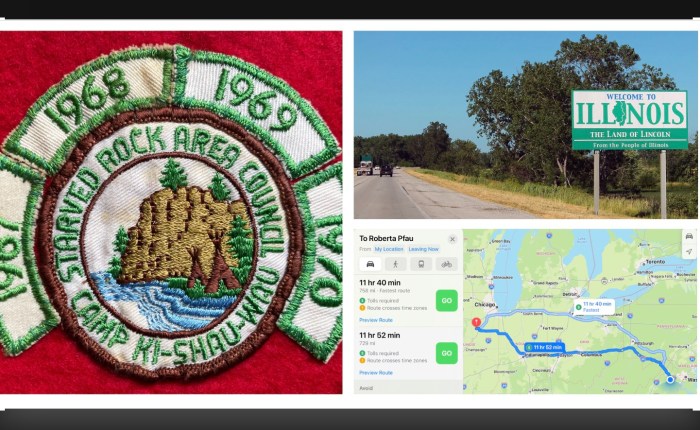
We are driving home to Illinois this week. The last time we drove to Ottawa was in 2017, and mom was dying. This time, we are going to see living family and friends, and stay at one of the touchstones of my youth.

We never get back to see folk as often as we would like. Life gets in the way, and time keeps on ticking, or depending on your perspective, racing along. We have visited a couple of times since 2017, but always flew. Our last trip was a short one a little over a year ago, and my sister Berta and her husband Jack had a great family reunion while we were there.

The Last Visit Home

This time, Cath and I are bringing our dog, Carmen, and driving. It typically takes 12 to 14 hours to cover the 750 miles, but you don’t measure progress by time or by miles. You track the States you cross. We’ll go from Virginia to West Virginia, then Maryland, back to West Virginia, then Pennsylvania, West Virginia a third time, Ohio, Indiana, and finally, Illinois. You get to see a bit of ‘Murica along the way.

The Northern Route is Shorter, but the Southern Route is an Easier Drive

Cathy is never crazy about the drive. For her, it’s a bit like Cormac McCarthy’s, “The Road” (if you haven’t read the book, you may have seen the movie with Viggo Mortensen.) Me? I always enjoy it. I watch the land transform from the Piedmont here in Virginia, to the Appalachian Mountains of West Virginia and Pennsylvania, the rolling hills of Ohio, and eventually the flatlands of Indiana and Illinois. None of it is dramatic landscape, but if you have the time, it’s a beautiful way to see and reach the heartland.

It’s funny. I started this blog with “We are driving home…”. Neither Cathy or I have lived in Ottawa since we were 18, nearly 50 years ago. We have lived in our current home here if Virginia for over 23 years. “Going home” of course isn’t always about going to a place. It can be about a time in your life as well. Some may think it’s corny, but there’s something gratifying about occasionally returning to your roots, however short the visit is.

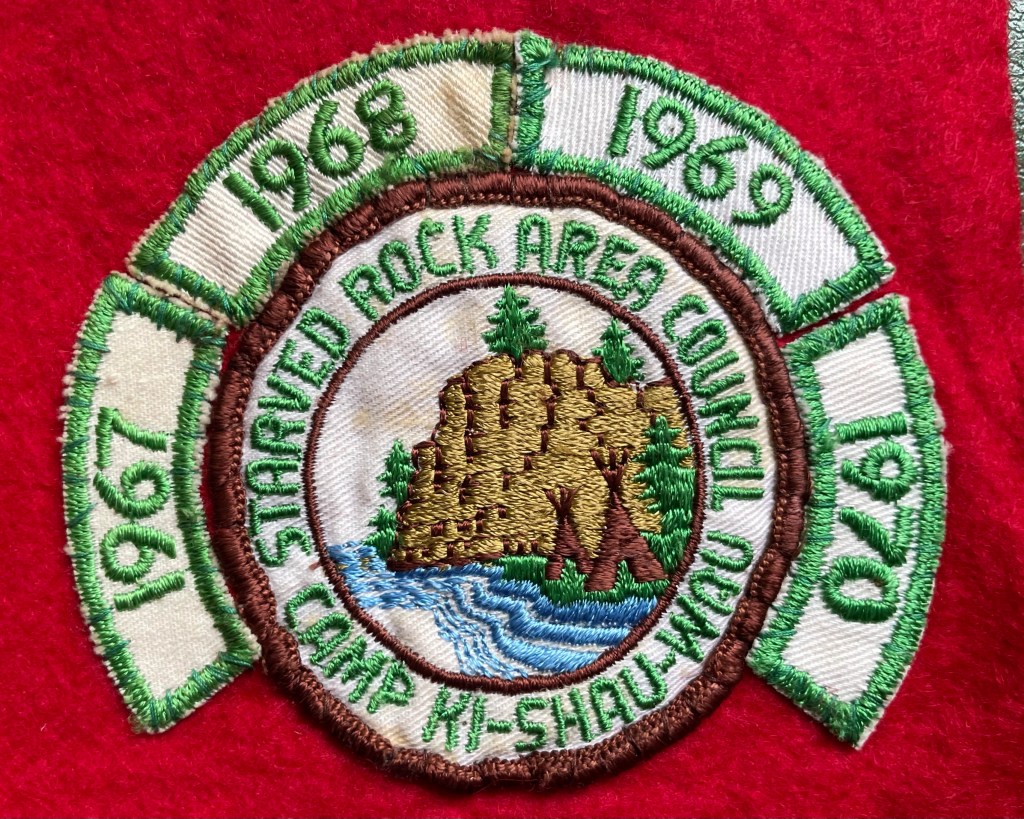
This visit is actually starting at Kishauwau Cabins, a resort we knew in our younger days as Camp Kishauwau, our local Boy Scout Camp. During our youth, my friends, Tim, Howard, Mark and I spent many a night there, either camping in tents or sleeping in one of the few run down cabins it had at the time. The Boy Scouts sold the camp decades ago, and it was turned into a getaway that attracts people from Chicago and the suburbs now. On this trip, we’ll be with our wives and girlfriends and staying in their new and remodeled cabins. My guess is our food and adult beverages will be better than the camp fare we ate and bug juice we drank during our previous stays in the ‘60s and ‘70s.

High Above Vermillion’s Waters…Camp Kishauwau

I’m sure we will tell an old story or two, but we’ll try and keep it in check. Still, I would be surprised if WrongWay LeBeau isn’t mentioned a time or two. Other subjects might come up as well – marshmallow fights, the time we started to run a fellow scout up the flagpole, or the time our troop failed to keep a proper fire-watch during summer camp, or … We’ve only told and heard these stories a few hundred times before, so there’s no reason to repeat them. And yet we probably will, at least a few times.

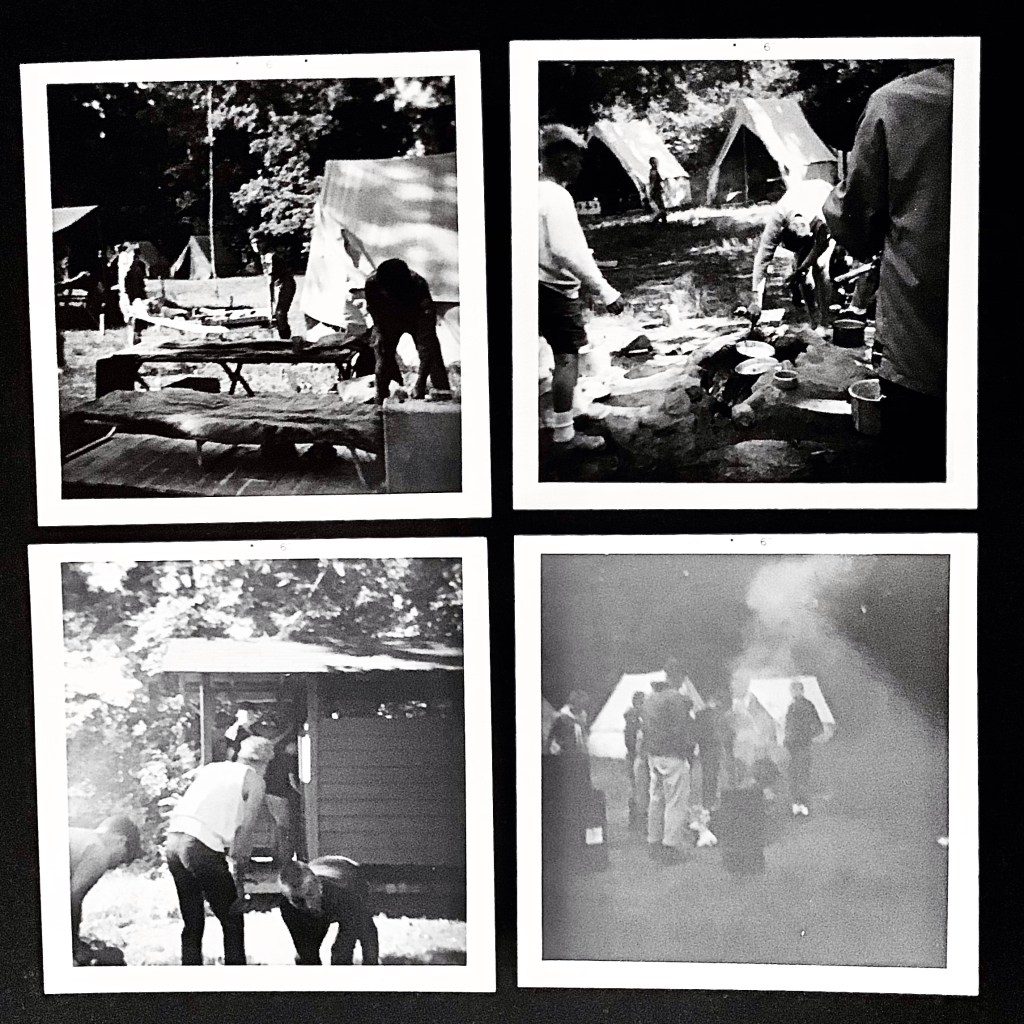
Like These Old Photos From Camp, our Memories may be a bit Blurry.

Later, we’ll spend a few nights at Berta and Jack’s beautiful home and see them, along with my other sister, Tanya and husband Shawn. The trip is short enough that it’s doubtful we’ll have time to see all of the nieces, nephews, grand-nieces and grand-nephews. Sadly, that’s just how life is sometimes, especially when you live six states away.

Over the course of the week, we will probably have a pizza from Sam’s or Bianchi’s, and maybe a pork tenderloin sandwich somewhere. I’m sure we will visit Allen Park as well. There are some things you just “have to do” when back in Ottawa, no matter the length of the trip.

Eventually, the visit will end and we will return to our home in Virginia. The departure, not money, is always the real price of a trip back home. Knowing time is fleeting and we are growing older, departing is always a little bittersweet for me. The hugs, the handshakes, the I love you’s … the thought of “When will we gather together again?”

Memories are nice. Keeping friendships and family love alive are even better. The best trips make new memories, and I know it will happen this time as well. Still, there is always a question in the back of my mind – “Where does the time go, and when will we gather together again?

Addendum:

My friend Tim is always more poetic than I am, and suggested adding the 1969 song “Who Knows Where the Time Goes” by Fairport Convention in the Addendum. It’s a nice listen and adds perspective as well – https://youtu.be/OkOB57UcYk8

Biology and Charlie Alikonis

Biology and Charlie Alikonis

In August of 1970, I started to sweat and no, it wasn’t from the summer heat. I was taking Biology my sophomore year at Ottawa High School, with Charlie Alikonis as my teacher. We were to turn in our Insect Collections in early September. In theory, I had been collecting bugs all summer, but I’d been a bit lax, and the bill was coming due.

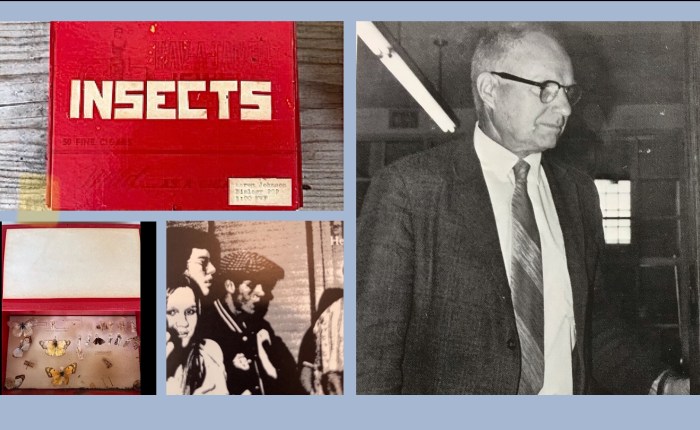
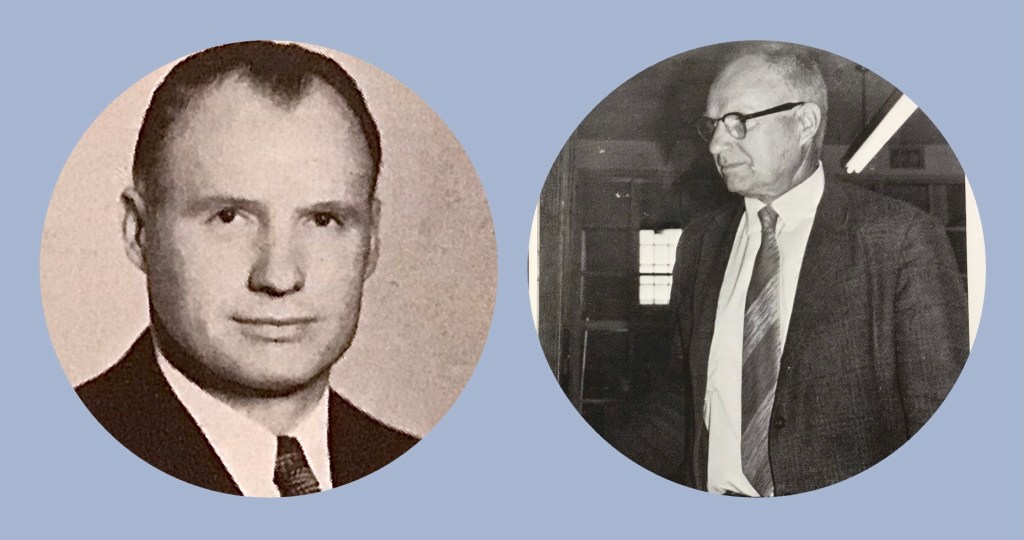
High School biology at OHS under Charlie Alikonis was something. There were other good biology teachers, including Mr Anderson and Mr Carlin, but Charlie was legendary. He had already taught at OHS for 36 years, starting in 1934. Hell, he taught my mom in ‘47. When mom had him, he was also the JV Football coach and had two undefeated teams in ‘47 and ‘48. Those of us who had him in ‘70, approached the class with a combination of awe and dread.

Charlie in the OHS Yearbooks from 1949 and 1971

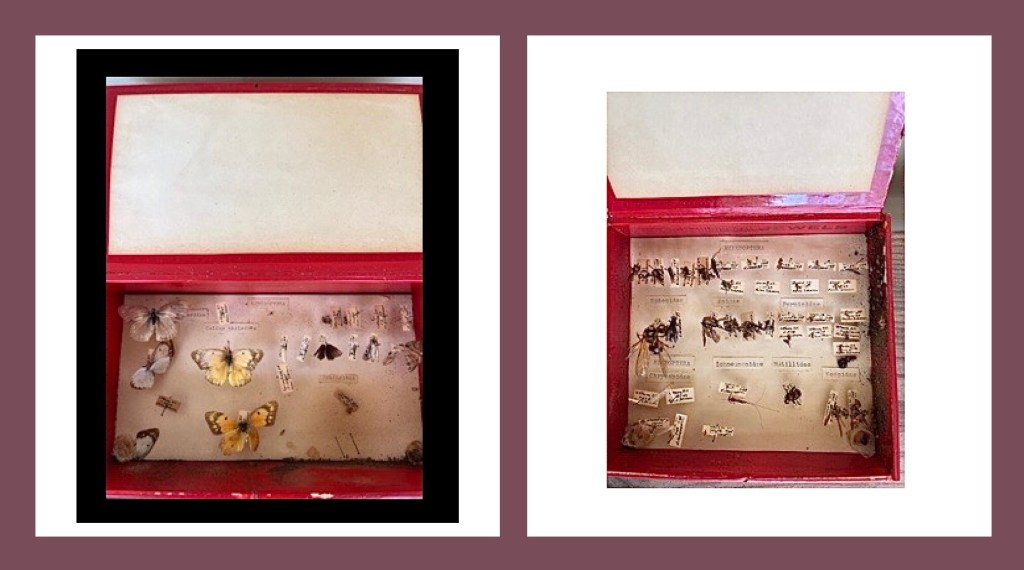
OHS biology classes had plenty of class time, lab time and tests, but what everyone really remembers is the three collections we were required to submit – Insects in the summer, Leaves in the fall, and Wildflowers in the spring. They could make or break your grade, that’s how important they were. It’s also why I was starting to sweat.

Earlier that summer, I’d made the trip to The Book Store at the corner of Main and Court Street. I bought the little pins and labels for the bugs, and most importantly, carbon tetrachloride*, or carbon tet, as we learned to call it. Soak a cotton ball in it, put the cotton ball in a jar, and drop in your bugs – good night! To box the collection, some classmates bought styrofoam boxes, or used shoe boxes. My buddy Howard and I obtained old cigar boxes from Senate Billiards, just up the block on Court Street. We’d gone to Senate Billiards for years, as it was also the best place in town to buy comic books.

I eventually kicked my bug hunting skills into high gear for those last two weeks of August and the first couple of weeks in September. The little glass jar with the carbon tet worked overtime producing specimens for my collection. The tiny labels were a pain, but everything came together. I turned in a reasonable collection, although I don’t recall my grade.

An OHS Insect Collection From Back in the Day

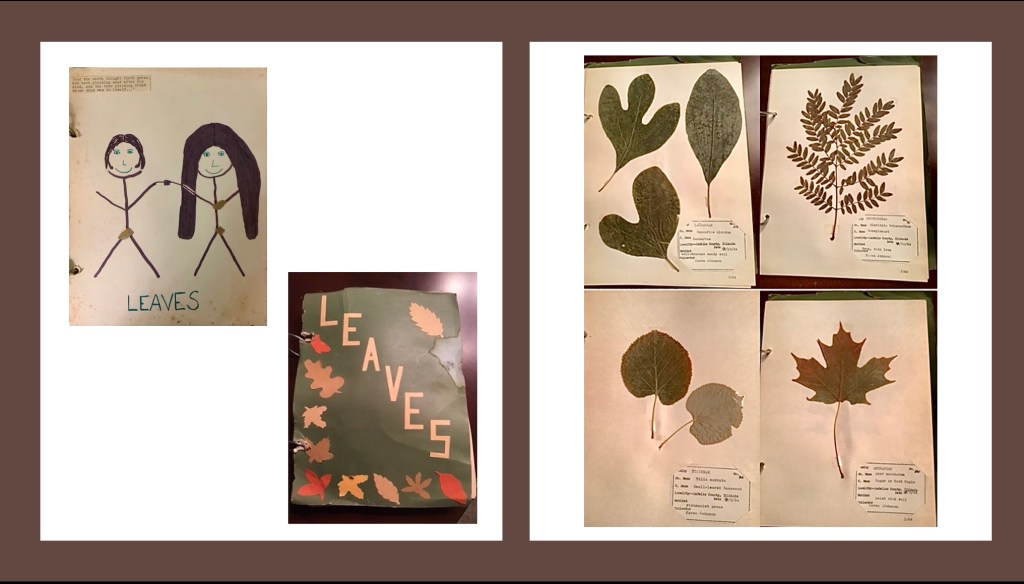
It didn’t really matter though, as we were already starting our leaf collections. We were mostly on our own to find and identify the leaves, although I seem to recall a class field trip or two on the East Side of town. I distinctly remember a Ginkgo tree there, one of only a few in town. To this day, I still recognize their unique fan-shaped leaves, with the veins radiating out into the leaf blade. There were other unique trees in town, if you knew where to look. Sally Richland recalls her family having a sassafras tree in their yard and students came from all over to pluck leaves. At the time, it was the only one in LaSalle County.

Although not as impressive as some, I did better on my leaf collection than with my insect collection. Not everyone did though. My friend Mark recalls two other buddies, Clay and Mike only starting their collections the day before they were due. They evidently spent a good part of the night outside with flashlights trying to find particular leaves. No word on what their grades were… ;-).

An OHS Leaf Collection and a Couple of Covers – I Don’t Recall being so Clever, or Typing the Info for each Leaf

By now it was late fall, or early winter, and in addition to studying bugs and leaves, Howard and I were studying Charlie Alikonis himself. We were fascinated by him. He was of Lithuanian heritage and spoke with a bit of an accent. He also had a unique way of communicating, that anyone who studied under him remembers. As he was identifying something for you to learn, he always started with a question and then answered his own question. As an example, when holding up a Ginkgo leaf he would say, “and this is a what-ah? This is a Ginkgo Leaf”. We thought it was brilliantly funny and started imitating him ourselves, while doing other things around town, as in – “and this is a what-ah? This is a pepperoni pizza…”. , or, “and this is a what-ah? This is a cheeseburger.

We didn’t stop there. At the time, Charlie mostly wore bow ties. Howard and I went to Bell’s Clothing in town and bought tie bow-ties. Charlie wore a flat cap to and from school. We returned to Bell’s, and both bought similar, if a bit more brightly colored caps, and wore them for the next couple of years. I don’t recall anyone else among the teachers, or for that matter the students, wearing flat caps at the time, and yet there we were. (I lost mine over the years, while Howard still has his).

A 1973 OHS Yearbook Photo of me with my Flat Cap, and Howard Sporting his Just a Few Months Ago

We may have started out doing all of this to have some fun at Charlie’s expense, but as time progressed, things shifted. It evolved into us paying homage to him. I can’t say when or why the transformation started, but it was real. I’d like to think we matured a bit and began to understand what a great teacher he was, but we were teenage boys at the time, so who knows.

Winter eventually turned to spring, and we were back in the woods and fields surrounding Ottawa. This time, we were looking for wildflowers. I recall Charlie leading a collection/identification trip after school one day, near his house in the country. Although he had to be in his 60s, he was nimble as a mountain goat running around pointing out different flowers. We kids had a tough time keeping up. He also pointed out a flower called a White Trillium, but warned us not to have it in our collections. It was rare, and endangered in Illinois at the time.

Second semester eventually ended and I passed biology. The next year, I would have Red Ryder for Chemistry and a year later, Mr Krabel for physics. OHS had a great science department back then, and I learned from all of them. Having said that, Charlie Alikonis and those collections are what have stayed in my memory over the years.

It turns out I wasn’t alone. In talking with friends and others from Ottawa, everyone who took biology remembers the collections. And those under Charlie? A near universal seal of approval, particularly from those going on to study science in college.

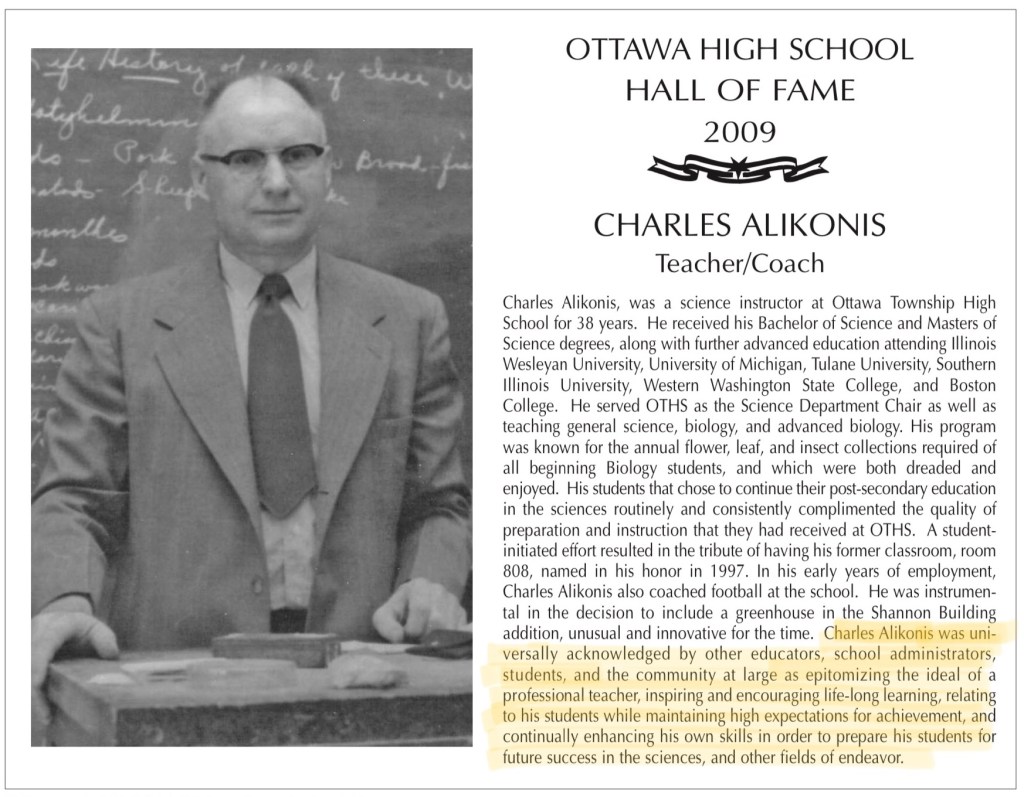
Charlie retired from OHS just a couple of years after we had him. In 2009, he was posthumously inducted into the OHS Hall of Fame. The highlighted words in the citation below say it all.

Charlie Alikonis – Preparing Students for Future Success

Addendum:

  • * Carbon tet is now a known carcinogen and no longer used. As Howard recently said, “Carbon tet and cigars—those collections were deadly…
  • I owe thanks to a number of people for contributions to this blog, including buddies Tim Stouffer, and Mark Dunavan, along with Dan Shoulders, Sally Richland, Mary Cunningham Heider, and Jeanie Cunningham Ruhland.
  • Thanks to Karen Crisler and Leslie Poole for providing photos from their insect and leaf collections – they were a perfect addition!
  • Special thanks to my old friend Howard Johnson, who I’ve known since before first grade. His memories on Charlie in particular helped round out this blog.

The Puke Bowl

The Puke Bowl

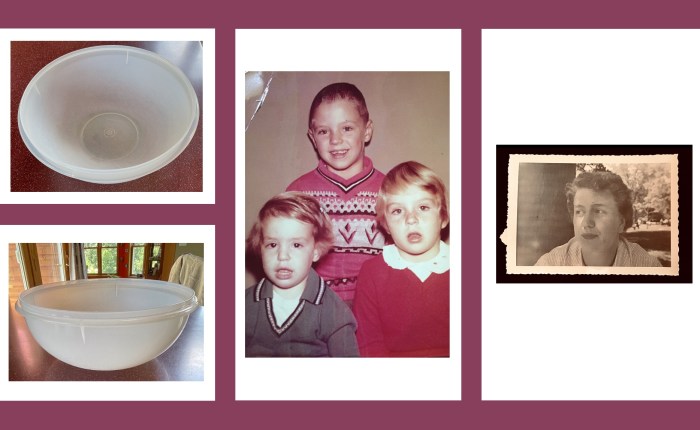
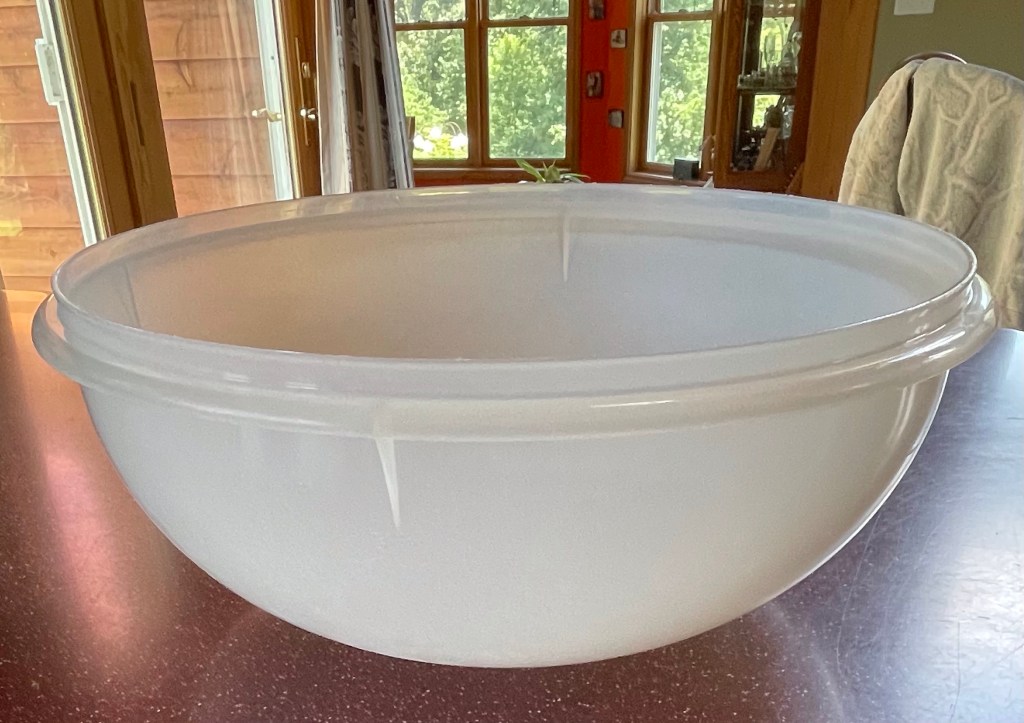
The Puke Bowl. Do all families have one? You know, the one you pull out to put next to your kid’s bed when they have an upset stomach and things are sketchy? That, and coke syrup were staples of our childhood when sick. Our family puke bowl also had a dirty little secret.

Puke… not such a pleasant word, but I suppose it’s an apt descriptor. I’m not sure it’s better or worse than vomit, upchuck, ralphing, throw-up, or barf. All get the idea across pretty graphically. As kids, when the flu or some other illness turned our stomachs, the answer was always the same – a spoonful of coke syrup from the fridge, and then off to bed with the Puke Bowl by the bed. Running to the bathroom toilet was always the first option, but the bowl was right there if you didn’t think you could make it. Mom would dutifully wash and clean the bowl through out our misery, and when we finally became better, gave the bowl a thorough double cleaning and put it away in the utility room by the kitchen.

The Puke Bowl … In all it’s Glory …

Over the years, the Puke Bowl was also used by our nieces and nephews, if they happened to get sick when visiting Grandma and Grandpa. Three generations now called that big Tupperware bowl, the Puke Bowl. All of our spouses do as well. It became it’s own family tradition.

My sister Roberta “inherited” the bowl after mom died in 2017. All three of us kids were interested in it for nostalgic reasons, but Berta was the one who claimed it. To be honest, I did not realize mom still owned it, but of course I should have. Mom didn’t throw much away, and everything had multiple uses. Back then, America wasn’t the throw-away society we are today.

Mom Never Threw Much Away…At that Time, Most Folk Didn’t

Fast forward to this year…

A couple of months ago, Roberta’s granddaughter, Lydia, was visiting, became sick and started throwing up. When her mom, Kathi, came to pick Lydia up, Berta sent the Puke Bowl home with them, in case Lydia needed it in the car. A couple of weeks later, Berta was at Kathi’s, along with Kathi’s mother-in-law, Penny. As Roberta was getting ready to leave, Kathi said, “mom, don’t forget the Puke Bowl”, and handed Berta the bowl. Penny had a strange look on her face, and evidently thought the bowl was just a regular Tupperware bowl, like those you use for cooking or food storage. She exclaimed “What?!” Berta and Kathi started laughing, and then explained the WHOLE back story of the bowl to Penny.

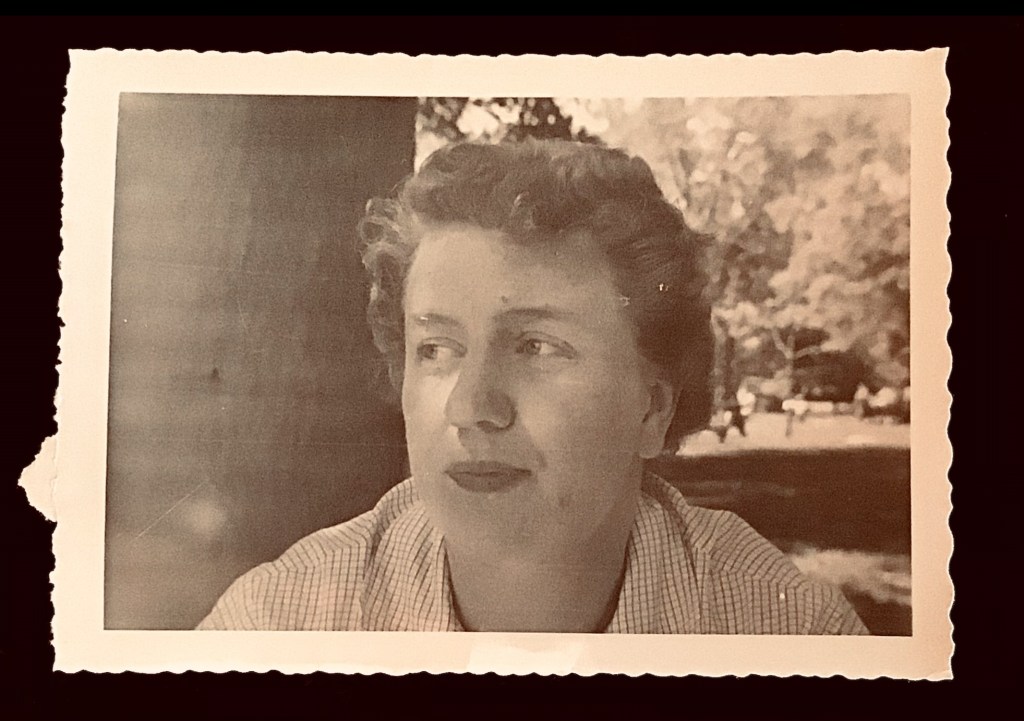
In addition to being The Puke Bowl, the bowl had a secret life. It also doubled as THE bowl in which mom made her much acclaimed Potato Salad. It made an appearance whenever there was a big gathering or picnic for the family, church, neighborhood, or where ever. It was a massive bowl and the largest she owned, and due to the popularity of her potato salad, she didn’t want to run out. I don’t recall mom ever running out of potato salad at family (or other) gatherings when growing up. Never.

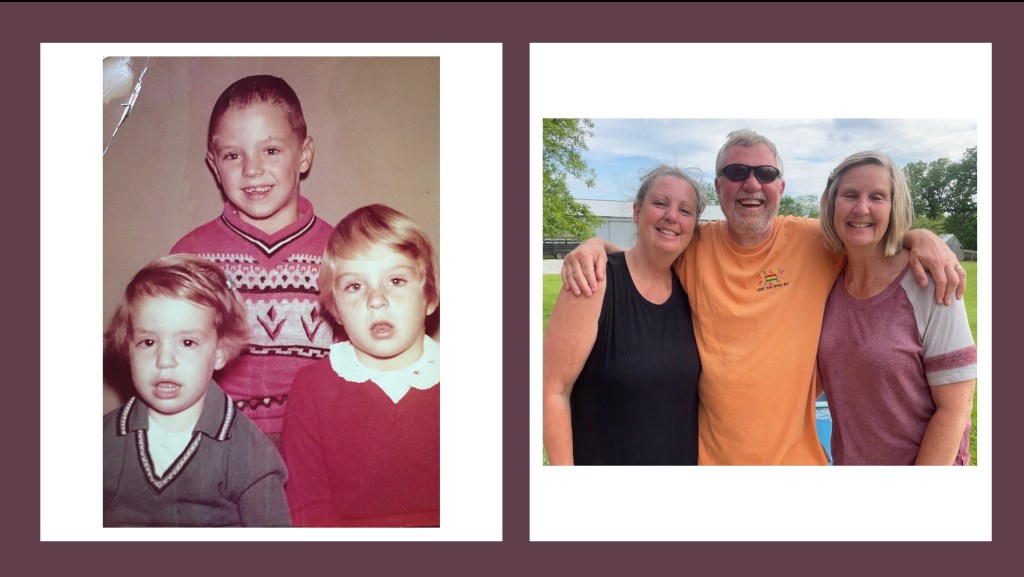
Tanya, Roberta and I Didn’t Seem to Suffer any Adverse Effects from the Puke Bowl…

The bowl is mostly retired now and lives in Berta’s basement. Lydia’s use a couple of months ago was the first time it was pulled out in quite awhile.

I should also mention Roberta’s daughter, Diane, is the official “holder” of mom’s potato salad recipe. Her version is the closest to mom’s of any I’ve tasted, which means it’s pretty d@mned good. Although Diane has her own set of bowls and Tupperware, including a large one she makes her potato salad in, when ever there’s a big family gathering, inevitably one of her sisters will laugh, and say to her, “Diane, you gonna make grandma’s potato salad in the Puke Bowl for the get together?” No, she doesn’t, but old family memories die hard… 😉

No, Diane Doesn’t use the Puke Bowl, to Make Grandma’s Potato Salad

Addendum:

– Our Niece, Tami, also remembered that the bowl almost always seemed to be the hiding place for someone’s Easter Basket each year at Grandma and Grandpa’s house… 😉

– In writing this blog, and talking with friends, two items became clear.

  • First, most all families had some version of a “puke bowl” or bucket, and many of them were multi-use products, particularly for holding popcorn.
  • And second, many lamented the throw-away society we have become. As Americans, we retain very little – Of course diapers, cups, plastic silverware and paper plates are all disposable. These days, so are phones, computers, mixers, coffee pots, stereo equipment, and a great deal of furniture. Washing machines, dryers and dish washers fit the same mode, unless they break down in the first few years of use.

⁃ Special Thanks to Cathy, and my sister Roberta for all of their help on this blog.

⁃ Thanks to sister Tanya, along with nephew Casey, and nieces Diane, Tami, Bre, Kathi and Jordan for their memories as well.

– Thanks and photo credit of the picture of Diane about to make potato salad, to her four year old daughter, Riley! Roberta took the pics of the bowl itself.

⁃ As always, MAJOR thanks to my old friend and editor, Colleen (who didn’t own a Puke Bowl growing up.) She always keeps me straight and on track.