The Importance of Being Lucky

The Importance of Being Lucky

Cathy was thrown from her horse two months ago. While she has some lingering pain, overall, she was pretty lucky. It reminded me of the story my friend Bob Bishop told of being thrown by a horse, but unfortunately not clear, as the horse galloped away. He too was lucky as you’ll soon find out.

This is Bob’s story and it’s a good read. All I’ve added is a bit of editing.

In 1952 Crested Butte, Colorado was a bucolic place in the summer, with blue skies, white clouds and mountains surrounding the area. At the time, Crested Butte was a little town of maybe fifteen frame houses, a general store, and a post office/sheriff’s office. All were two stories high, and each had a door on the second floor. Crested Butte typically received twelve to fifteen feet of snow in the winter, and with drifts, that door became the only way people could exit their house. They would chop stairs in the snow and ice down to the street. As spring approached and the likelihood of more snow lessened, they tunneled through the snow to the front door and used that as access as the snow started to melt.

Needless to say, it was not the multimillion-dollar ski area it is today.

My father and mother were asked by our friends, the Dorsetts, if mom could help them out at the boy’s camp they had founded a few years earlier. This was mid-May, two weeks before the camp was to open for the summer, and the camp cook had just quit. The Dorsetts knew that mother was schooled as a dietician, and also knew she was a good cook. Coincidently, father had just accepted a new job with Aetna Life Insurance Company, which required him to attend a four-week school in Hartford, Connecticut. Mother and father agreed they could help the Dorsetts out and a little extra money would be welcome. My brother and I could go to the camp for free, and they waived the requirement that a camper must be at least twelve years old, for nine-year-old me.
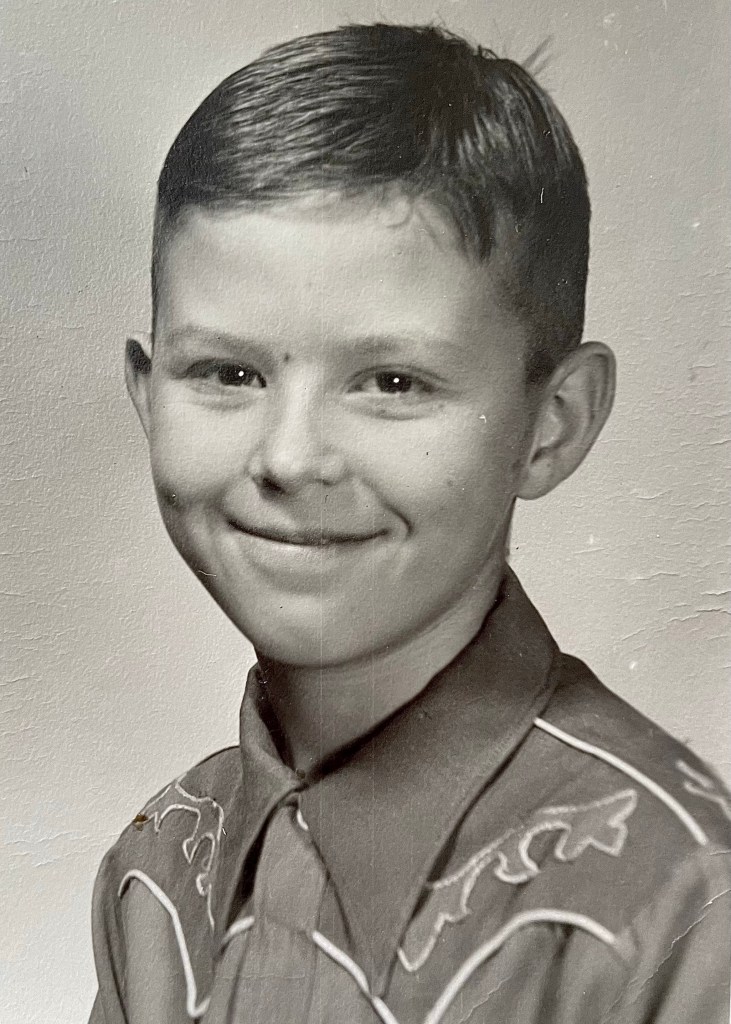
Bob, About the Time of the Incident

The camp was three miles down a dirt road from the town of Crested Butte, at the base of Mt. Crested Butte, which rose almost three thousand feet straight up from the meadow. We kids slept in Conestoga wagons – not replicas, but real ones left there by those who rode in them to seek their fortunes in the west decades earlier. Inside the canvas covered wagons were four sets of bunk beds, two on each side. Light came from three kerosene lanterns hanging in the middle. There were six wagons with eight boys to a wagon, for a total of forty-eight campers. The only electricity in the camp was in the kitchen, the residence “hall” for the staff and counselors, and the dining hall.
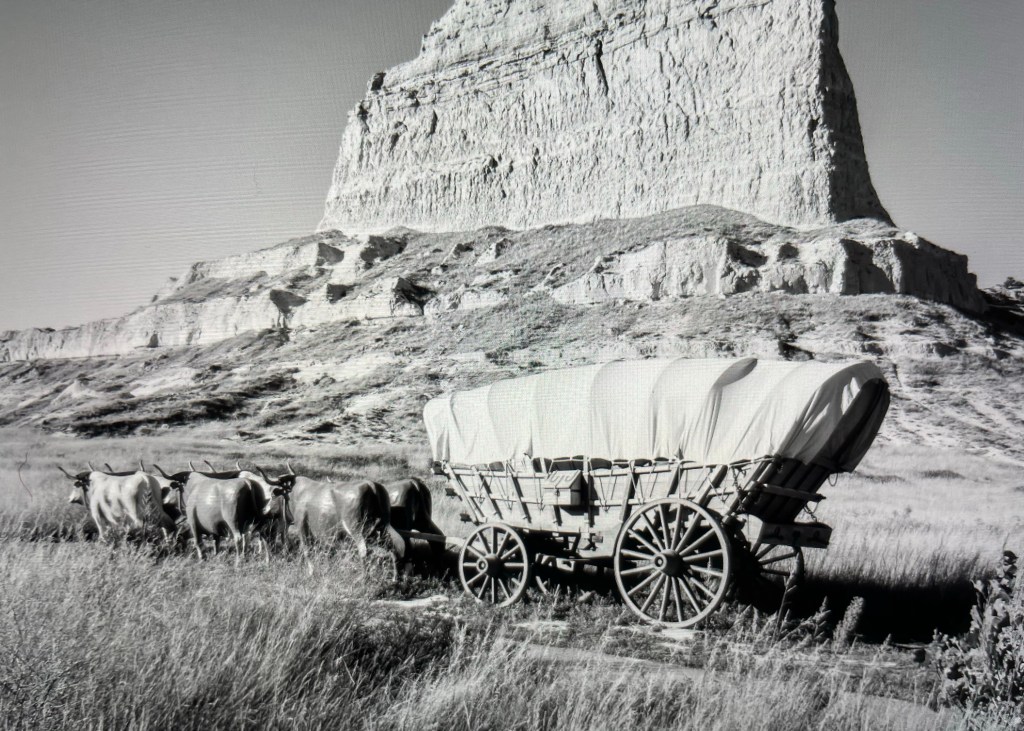
One of the Conestoga Wagons They Were Using.

It was pretty idyllic, for a young lad of nine. Other than the mandatory arts and crafts sessions, we were free to go fishing, hiking, or horseback riding, or to just play. I generally chose horseback riding, and off we rode to the meadows beyond the camp for romping around, and frequently to play flag football on horseback.

Great fun, until …

One fateful day, my horse saw something. A snake? A gopher hole? I’ll never know. She reared up – I was just moseying along, reins held loosely, and then I was airborne. Spooked by whatever she had seen, the horse took off at a gallop. I was thrown off, but unfortunately, not completely. My left foot caught in the stirrup, and I was just tall enough that my head almost reached the ground. I remember fervently hoping I didn’t hit a rock with my head, although it was clearly beyond my control. My journey across the meadow continued with me hanging upside down, bouncing off the ground in synch with the horse’s gallop. The direction I faced changed with each bounce – seeing the meadow stretching endlessly behind at one moment, and next peering at the blue sky from under the horse’s belly. Although I have no exact recollection, I was later told the whole journey lasted less than a couple of minutes before my horse was pulled to a stop by one of the counselors.

The next thing I remembered was lying in my bed in our Conestoga wagon, just staring up at the canvas top. I could talk and move my arms, but I had no sensation below my waist. In time, the “local” doctor (from Gunnison, 30 miles away, the last 15 on a dirt road) came in to evaluate my condition. He reminded me of a shorter, thinner Santa Claus, with white hair and a beard. After an eternity of poking, prodding and sticking pins into me everywhere, he drew a deep breath, turned to my mother and said, “He’s paralyzed, and it’s either temporary or permanent. Either way, the only thing you can do is make him comfortable.” He said if I could ever wiggle my toes, the paralysis was probably temporary, a traumatic inflammation of the spinal cord, and I would likely become fully functional. If not, well …

What’s a nine-year-old to think? Honestly, not much. I had no idea what “permanently paralyzed” meant. It never occurred to me I wouldn’t be able to walk, bike, play baseball, or go horseback riding again. My brother and some of my wagon-mates kept me supplied with comic books, Archie and Jughead, which helped while away the time. I was not in pain, but ached all over. I slept a lot.

As time passed, I kept looking down at my toes. I concentrated as hard as I could on wiggling them, but nothing happened. Until, on the third day, I stared at my toes, willing them to move. And then I swear, my right big toe did. I swear. I saw it move just a little. Didn’t it? I thought it did. I concentrated even harder, and, sure enough, I could actually see it move. Not much, but it actually moved. Yippee!!!

A couple of hours later, Mom came in with my lunch, and I said, “Mom?! Watch this!” And I wiggled my right big toe. She looked at me and said, “What, Bobby? What do you want me to watch?” I yelled, “Mom! LOOK! Look at my right foot!” She turned to look down at my feet, I wiggled my toe, and her eyes glistened as she turned back and looked at me. She broke into a huge smile, leaned down, and gave me a BIG hug.

In a couple more days, I could wiggle all of my toes. The doctor came back to check on me a week after the accident. I recognized him as he pulled the canvas flap aside and climbed into the wagon. I said, “Hi. Watch this.” He started smiling as I performed my new trick (wiggling my toes), and said, “You sure are one lucky little boy.” Pause. “I think you’re going to be just fine.” Then he left.

A couple more days passed, and I was up and walking, although I needed help to keep my balance. Another week, and I was fine, walking and running around – just as if it never happened.

Later in life, I learned there is real value in being as good as you can be, but it is really good if you’re also very lucky.

Bob in 1952, and Again in 2020.

Postscript: I started having back problems in 2017. It began with tingling in both quadriceps, but two months later, I had a pinched nerve in my neck. The MRI showed “severe” narrowing of where the nerves go from the spinal cord out to my left at L2-3 and to my right at L3-4 (aka “spinal stenosis”). Oh, also some scoliosis, having lost 4” of height in the last twenty years. I mentioned the horse escapade to my orthopedist and asked whether it might have some bearing on the condition of my back. He looked at me over the top of his horned-rim glasses and said, “It can’t a-helped” and smiled. And so did I.

Addendum:

I should mention Bob later attended the Naval Academy at Annapolis, and served for several years in the Navy as a submariner. He’s a great storyteller and I’ve done a couple of previous blogs with him about his time in the Navy. If you would like to read them, you can do so here:

  • Crazy Ivan anyone? … In 1970, our sub, the USS Finback, was helping with Anti-Submarine Warfare training for NATO aircraft. An observer on the sub said “I think I understand your plan. You alternate going to port or starboard as soon as you submerge.” I responded, “Well, not actually”, and we walked over to […]. Continue at: https://mnhallblog.wordpress.com/2022/04/13/submarine-games
  • The movie, “The Hunt for Red October” is child’s play, compared to what these submariners did on a daily basis … “The Comms Officer ran in and handed the CO the decoded message. The CO read the message, took the lanyard from his neck, unlocked the firing key cabinet, and reached in for the firing key. We were about to” […] Continue at: https://mnhallblog.wordpress.com/2021/06/23/we-knew-we-were-at-war/
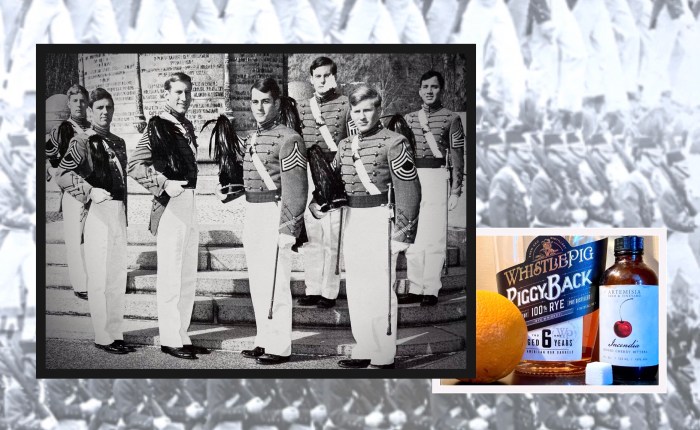
A “The Corps Has” Old Fashioned

A “The Corps Has” Old Fashioned

The Corps Has… Every West Pointer knows the phrase. When we were Cadets, we laughed at it, and thought it untrue. As Old Grads, many of us use it, and believe it is true. “The Corps Has”, short for “The Corps has gone to hell” is a grad’s way of saying “Things aren’t as tough now, as when I was a cadet.”

The academy was founded in 1802 and is the oldest of the United States’ five service academies. The phrase “The Corps Has” has no doubt been around since 1803. Every class, once they graduate, seems to think those after it have it easier.

A friend from the class of ‘64 reminds me regularly (half in jest, but only half) that as Plebes, they stayed at the Academy their whole first year, and couldn’t go home for Christmas break like we did.

Friends from my Class of ‘78 regularly bemoan the fact that current cadets no longer have meal formations three times a day like we did.

I think you get the drift. And that doesn’t even get into how the whole Plebe System has changed over the years. The Corps has gone to hell. Although for as long as it’s been going to hell, you’d think we’d logged enough miles to get to hell and back by now. ;-).

With the Passage of Time, Some of Our Memories Get a Little Hazy.

Recently, on June 26th, ‘23, the class of 2027 had their first day at West Point, more commonly known as “R” Day (Reception Day). That evening, I posted a picture of a whiskey Old Fashioned I was drinking on our class Facebook page and offered a toast to the class of ‘27. They will graduate 49 years after we did. I don’t care how much easier it may have become; one thing I know for sure is you never forget your first day at West Point. It may become blurry, but you won’t forget it. Ever.

In the comments to the post, one of my classmates, Joe Mooney, brilliantly suggested having a “The Corps Has” Old Fashioned, by using WhistlePig whiskey in it. Our Classmate, Dave Pickerel, was one of the founders and the Master Distiller at WhistlePig Distillery. I started thinking about it. How would I make/what would go into a “The Corps Has” Old Fashioned?

After some additional thought and a few practice rounds, here’s my version, with explanation, of a “The Corps Has” Old Fashioned*.

Simple Ingredients for a Good Drink

Ingredients

  • 1 Sugar cube
  • 2-3 Dashes of Smoked Cherry Bitters
  • 1 Teaspoon warm water
  • 2 ounces WhistlePig PiggyBack Rye Whiskey
  • Large ice cube or ball of ice
  • Small piece of Orange peel
  • And, you will need matches or a lighter

Instructions

1. Add a sugar cube to a rocks glass. These days, most recipes for an Old Fashioned start with a teaspoon of simple syrup. To hell with that. Since we are Old Corps, we are going to start the way the original Old Fashioned started – with a sugar cube.

2. Shake 2 or 3 dashes of the Smoked Cherry Bitters** onto the sugar cube. Why Smoked Cherry instead of the Angostura Bitters called for in the original Old Fashioned? The Smoked Cherry Bitters add just a bit of haze to the drink. Sort of like the haziness of our memories of West Point. (If you can’t find Smoked Cherry bitters, look for another smoked bitters, or use regular Angostura.)

3. Add the Teaspoon of warm water to the glass. Muddle the sugar cube until it dissolves in the bitters and water (TA-DA! No simple syrup needed. 😉 )

4. Add the Rye and stir. Why WhistlePig PiggyBack Rye? First, as I previously mentioned, our deceased Classmate, Dave Pickerel, after a stint as the master distiller at Makers Mark, was one of the founders and the master distiller at WhistlePig. Every bottle of PiggyBack actually has his birth and death years on the neck of the bottle (1956-2018). Also, it’s Rye, not bourbon. Rye is spicier than bourbon, which is generally sweeter. While there were some sweet times at West Point, I’d have to say overall the experience was more on the complex and spicy side. It certainly wasn’t for everyone.

5. Add the ice. Stir until chilled.

6. Use a lighter or a match to singe the orange peel a bit (note, I said singe, not burn). Express the orange peel over the glass and then drop it in. Stir a few more times. Why singe the orange peel? It adds a little smokiness to the peel when you express it. It doesn’t change the drink…much. But somewhere in the background it adds a touch of something you can’t quite place, but think you remember. Not unlike that first summer at Beast Barracks, the memory of which seems clear and hazy at the same time.

7. Raise your glass in remembrance of our fallen classmates and toast the Corps of Cadets.

Ah, Yes. A Very Good “The Corps Has” Old Fashioned.

The Corps Has? No, not really. Every year young men and women report to West Point at the start of summer. I suspect those four years always have been and always will be a challenge. The demands and tests evolve, but are always there. Thank God there are still those today who answer the call.

Addendum:

  • * You might ask why I selected an Old Fashioned as the starting point/base for the drink. Well, the Old Fashioned is the granddaddy of all cocktails and as with many cocktails, the history is a little muddled. Cocktails were first mentioned around 1805 and generally consisted of some combination of alcohol, bitters, sugar and water. At the time, the alcohol was probably whiskey, gin, brandy or rum. As the 19th century was coming to an end, people started adding other things to their cocktails – fruit, fruit juice, soda water, or tonic as examples. This increased the number of people drinking cocktails, but irritated some of the people who had been drinking them for for a while. They wanted the “old fashioned cocktails”, not the new fangled stuff. Sometime around 1890, the Whiskey Old Fashioned became the first named cocktail. It may or may not have been invented by Colonel James E. Pepper at the The Pendennis Club in Louisville, KY, before he allegedly brought the cocktail to the Waldorf-Astoria hotel bar in New York City. Since West Point is the senior service academy, it seemed right to use the oldest known cocktail as the base for the drink.
  • ** You can probably find smoked or spiced cherry (or smoked orange) bitters online, or at your local liquor/wine store. If you want a treat, try ordering them online from Artemisia, a local farm here in Virginia. In addition to growing vegetables, they make several unique bitters and herbal wines (similar to vermouth, but better). They are currently sold out, but should have them again in about a week. Their link is: https://www.artemisia.farm/ For those who live in Northern Virginia, you can also find them at The Whole Ox, in Marshall, Va.

  • Thanks to classmate Joe Mooney for coming up with the idea for a “The Corps Has” Old Fashioned with WhistlePig. It was a great idea.
  • Thanks to classmates Joe Mooney and Bill Moeller for reviewing this blog and suggesting some ideas.
  • Our West Point Class of ‘78 45th class reunion is coming up this fall. Here’s the story of us selecting two barrels of WhistlePig PiggyBack Whiskey for sale at the reunion (all bottles already sold out) – – – We were on a mission to the WhistlePig Distillery in Vermont. Twelve classmates gathered to taste whiskey from five barrels. We would select two for the West Point Proud and Great, Class of ‘78 45th reunion this coming fall. We didn’t […] Continue here: https://mnhallblog.wordpress.com/2023/05/09/__trashed-2/
  • There are many Old Fashioned recipes, but the basic one uses: 2 oz Bourbon or rye, a tsp of simple syrup, a couple dashes of Angostura bitters and a slice of orange peel.

Five Years in One Page

Five Years in One Page

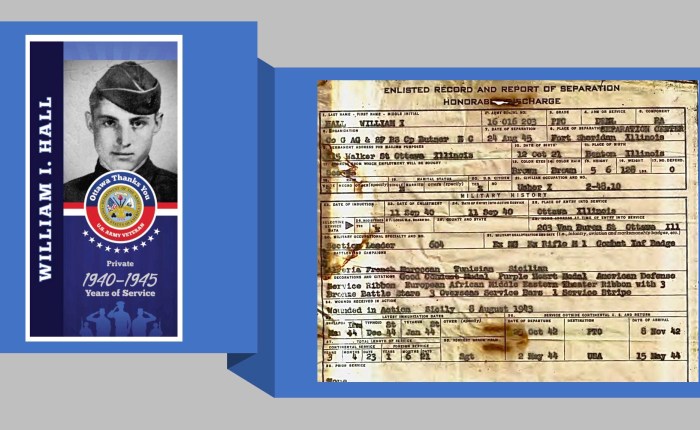
When discharged from the Army on August 24th, 1945, dad was 21 years old and had been in for nearly five years. His WWII service included time in Algeria, Tunisia, French Morocco and lastly, Sicily, where he was wounded. His discharge papers tell the intriguing story of those five years in one page.

This is the second of a two-part blog. Last week, I told the story of how I received dad’s enlistment and discharge paperwork from the National Archives. I then explored several interesting observations from his enlistment form, including the fact that he lied about his age in order to enlist. He claimed he was almost 19 years old, when in fact he was still two months shy of his 17th birthday. You will find a link to the first blog in the Addendum to this one.

Today’s blog explores his discharge paperwork, and briefly tells the story of his five years in the service. Dad was with B Company 1/60th Regimental Combat Team of the 9th Infantry Division from September 1940 until he was wounded and almost died in Sicily in August of 1943. Although his original enlistment in 1940 was for three years, when the war started all enlistments were extended for the duration.

As with his enlistment papers, dad’s discharge paperwork was discolored, creased and yellow, perhaps from the fire at the National Personnel Records Center (NPRC). A few parts were unreadable, but most of it was legible.

Dad’s Honorable Discharge Paperwork – it Suffered in the Fire at the Archives.

I’ll magnify and expand a couple sections to talk about some of the details.

At the top of the form, there are a couple of interesting items.

The Top of the Discharge Form – Magnified
  • Block 3 confirms his last duty station as Camp Butner, NC. This is where dad returned to the States in 1944 after recovering from his wounds. Camp Butner was both a troop training center, and a Prisoner of War camp. Dad told us stories later about helping train troops there (and about performing KP).
  • We see in block 4 his actual discharge date is August 24th, 1945. This was two weeks after the atom bomb was dropped on Nagasaki, Japan, and one week before the official surrender of the Japanese on September 2nd. The army was already discharging soldiers as the war was winding down, based on how many “points” they had (more on “points” later).
  • Block 7 still shows the birth date he lied about to enlist – Oct 12, 1921, as opposed to his real birth date of Oct 22, 1923. And amazingly, dad’s height, 5’ 6” and weight, 128 pounds haven’t changed at all from when he enlisted. Me thinks, someone was probably just copying from other forms to put this info in.
  • Block 21 shows his civilian employment as “Usher”, so maybe not everything was copied over. His enlistment paperwork showed him as a “Laborer”.

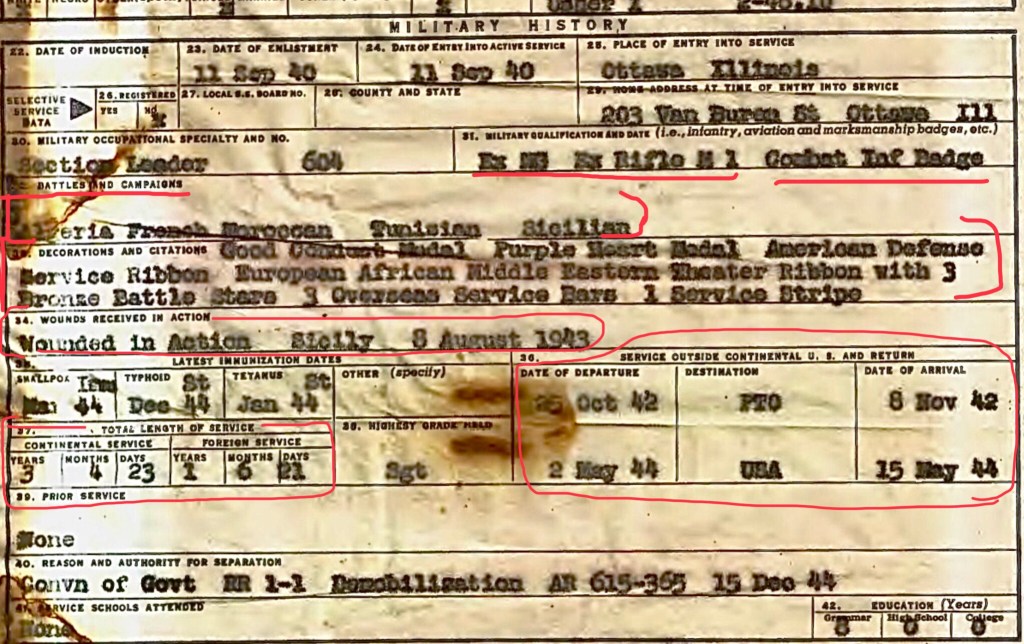
Now we move on to the Middle section of his discharge paper, dad’s “Military History”. This is the meat of the discharge, and paints the real story of his time in the service. I’ve again magnified the view so you can better read the form. In order to tell dad’s history in a linear fashion, I will sometimes go out of order in discussing what is in the blocks in this section.

Dad’s “Military History” in His Discharge Paperwork.
  • Block 31 shows dad qualified as an expert both on the Machine Gun, and the M1 Garand rifle. It also notes he was awarded the Combat Infantryman Badge. You could only earn the CIB if you were in the Infantry (not in Field Artillery, or Armor, or Signal Corps etc), AND you were in actual active combat with the enemy.
  • I’m going to skip to block 36 – “Service Outside the Continental United State” for just a minute . Note here that he arrived overseas on November 8th, 1942. What it doesn’t say is he arrived with the 60th Regimental Combat Team of the 9th Infantry Division at around 5AM under gunfire on the beach near Port-Lyautey, French Morocco. This was as a part of Operation Torch, the invasion of North Africa. Torch was (next to D-Day) the second largest amphibious assault ever attempted.
  • Now back to block 32, where we see in addition to French Morocco, dad also took part in battles in Algeria and Tunisia in North Africa where they defeated Rommel and the Africa Korps. Those battles took place between November 8th of 1942 and May 10th of 1943. Then in July of 1943, dad participated in the invasion of Sicily.
  • Skipping back down to block 34, we learn dad was wounded on August 8th, 1943. What it doesn’t mention is he was shot three times by the Germans in the mountains of Sicily and it took over a day to evacuate him by hand to an aid station. It also doesn’t say he almost died due to the combination of his wounds and the Malaria he contracted. His time with the 9th Infantry Division ended here.
  • Returning to block 36, we see dad arrived back in the States on May 15th, 1944, three weeks before D-Day. This was after he recovered from his wounds (he was evacuated to North Africa to fully recover). Due to the severity of those wounds, he didn’t return to combat – the war was over for him, although he remained in the service for another 15 months.
  • Block 37 “Foreign Service”, shows that of dad’s almost five years in the service, one year, six months and twenty-one days were spent overseas. Approximately eight of those months were in near continuous combat.
  • Finally, we return to block 33, “Decorations and Citations”. In addition to his Good Conduct Medal and Purple Heart (for being wounded), he was awarded: the American Defense Service Ribbon (awarded to troops on active duty prior to Pearl Harbor); the European African Middle Eastern Theatre Ribbon with three bronze stars (this was for participating in the campaign in French Morocco, and the subsequent campaigns in Algeria, Tunisia and Sicily); three Overseas Service Bars (one for each six month period in a theater of war) and finally a Service Stripe (one for each three year period of service). It’s worth noting dad also earned a Bronze Star (for exemplary conduct in ground combat against an armed enemy), which didn’t catch up with him until after he was already discharged, and is not reflected in this paperwork.

Finally we come to the bottom of the discharge paperwork and block 55. There are three items noted here, although not all are readable.

Block 55 – Points and Other Things
  • First, dad, along with all other honorably discharged service members, was issued a lapel button to be worn on civilian clothing. At the end of the war, it was particularly useful for those traveling home so they were quickly identified as service members and received priority for buses and trains.
  • Next we see dad’s ASR score was 95. ASR stood for Adjusted Service Rating and is what was used to determine the priority for discharging soldiers at the end of the war. The rules were simple in principle: “Those who had fought longest and hardest should be returned home and discharged first.” Points were given for length of time in the service, length of time overseas, combat campaigns, combat awards, being wounded and so on. At the time, “the points” required for discharge were 85. Dad, with his nearly five years of service, his 1 1/2 years overseas, his Purple Heart, and his four campaigns was at, or near the top of the heap. His 95 points reflect that, and was why he was discharged so quickly as the war was winding down. If you have ever watched the show “Band of Brothers” there is a great section in the last show focusing on this. Points were on everyone’s mind.
  • Finally, there’s the cryptic last line “xx days lost under AW 107”. What the hell is that? AW 107 stood for Articles of War (the forerunner of today’s Uniform Code of Military Justice). Article 107 refers to docking the soldier credit for days of active duty that they didn’t earn. Typical examples were for going AWOL, being too drunk to report for duty, or getting in trouble for other minor offenses and confined to the barracks. Since the service member was not performing his or her duties during those periods, they didn’t receive time in grade or retirement credit for those periods. It turns out many/most enlisted soldiers during WWII had AW107 scores higher than zero. During my research, I’ve found cases with numbers from 1 to over 200. I’ve tried like hell to read the smudged number here but can’t quite make it out. It might be a 5? It might be a 3? I don’t think we’ll ever know. What I do know is dad was busted from Sergeant to Private in June of 1943 for getting caught in, and subsequently kicked out of, a walled city twice in one night after missing the last truck back to his unit. Perhaps he was confined for some period of time in conjunction with this “incident”.

After his discharge, dad returned to Ottawa, Illinois in September and lived there for the next 65 years. In Ottawa he met mom, and had us three kids, six grandchildren and 13 great grandchildren. He retired from the railroad in 1985, and passed away in 2010.

For those of you who know me, or who have followed this blog for any length of time, I’m pretty sure you are aware of how much I admired my father. An embodiment of “The Greatest Generation”, dad was always one of my heroes. This was true certainly for his actions during WWII, but also for how he lived his life, and how he took care of our family.

A Banner Honoring Dad in Ottawa, Illinois on Veteran’s Day Last Year.

I’ve probably written more blogs about him than any other subject. The blog last week about his enlistment and this one about his discharge file are special to me. It’s somehow reassuring that his enlistment and discharge paperwork confirm the outline of the oral histories we heard from dad growing up. I wish I had discovered this paperwork while he was still alive, just so we could have one more conversation about it over a coffee or a beer. “Dad, tell me again about the time …”, or “Dad, about those lost AW 107 days…”.

I love him and miss him.

Addendum:

  • I apologize for the length of this and last week’s blogs, but I was trying to give some context to the cold and straightforward words in the paperwork.

– Here are a selection of other WWII blogs that I’ve alluded to in this blog. There may be some minor discrepancies in them, based on the availability of the new information in his paperwork:

Lying to Enlist in 1940

Lying to Enlist in 1940

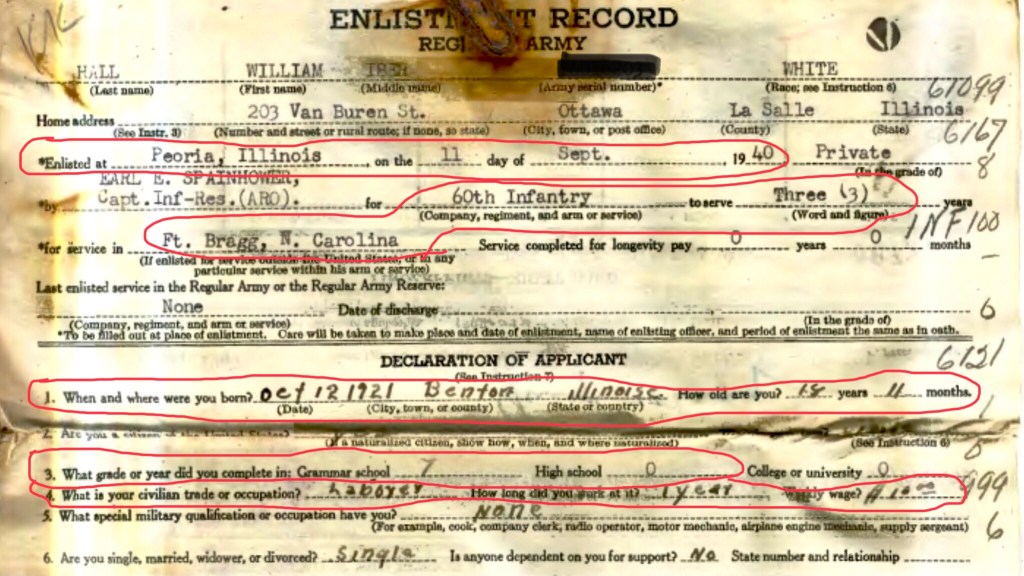
On the 11th day of September, 1940, just over 14 months before Pearl Harbor, my dad, William Iber Hall, enlisted in the United States Army for a 3 year stint. His enlistment paperwork showed him to be 18 years and 11 months of age. In reality, he was 16 years and 11 months old.

Our family history always said dad lied about his age when he joined the Army. Still, it was pretty cool to receive some official corroboration.

A couple of years ago in the middle of COVID, I was doing some research and learned I could access dad’s military records. The only catch? On July 12th of 1973, a fire occurred at the National Personnel Records Center (NPRC) and destroyed between 16 and 18 million Official Military Personnel Files, including 80% of those who were discharged between 1912 and 1960. I said a prayer, held my breath, and sent a letter to the National Archives, and more specifically, the NPRC, asking for dad’s service and medical records.

Months passed. A year passed. A second year passed, and then I finally received an email from the NPRC. Dad’s records existed, but were located in the area where the worst part of the fire was. They were damaged and incomplete. They did have his enlistment and separation paperwork, but nothing else. Nothing from his medical records, and nothing else about his time in the service. They did forward copies of the enlistment and separation papers.

The NPRC’s Response to My Request for Information About Dad.

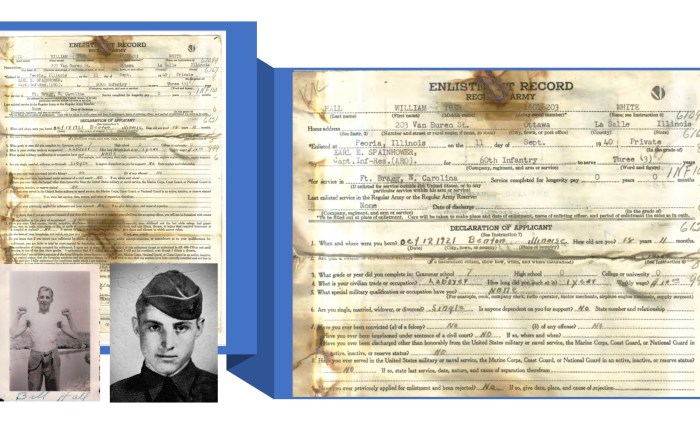
I looked at both documents. They are discolored, scarred and blurry in places. There are brown marks, including outlines of paper clips – perhaps from the heat of the fire. Here’s a photo of the enlistment documents – note there are actually three pages.

Dad’s Enlistment Papers – Apparently Damaged some by the Fire.

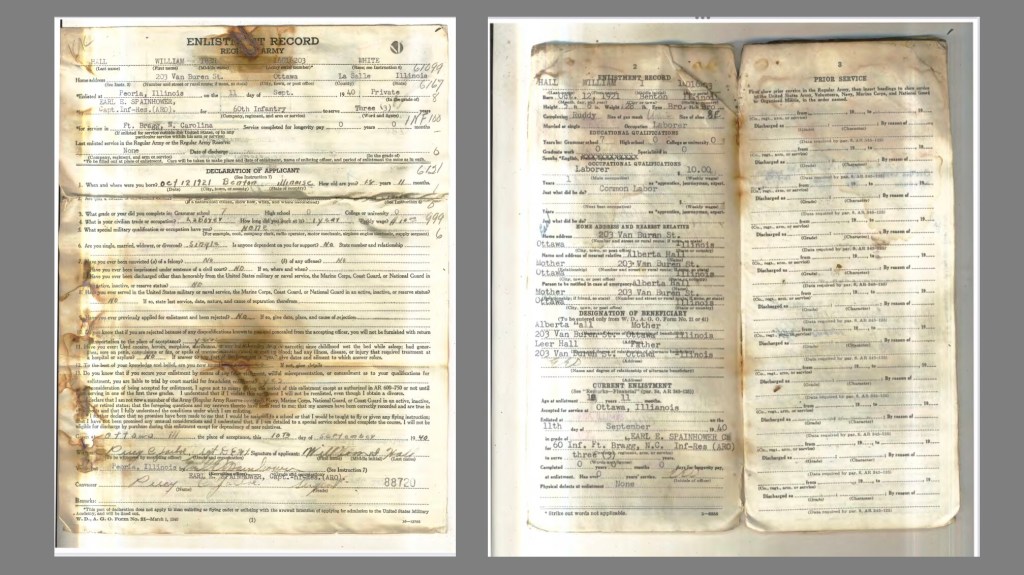
There is some fascinating information, particularly in the top half of the first page of the enlistment form. I’ve blown it up here so you can better read the form.

A Magnified View of the Top of Page One of Dad’s Enlistment, With Some Key Items Circled in Red.

Here are a few items of interest:

  • Dad enlisted in Peoria, Illinois – I’d always assumed in Ottawa, but there probably wasn’t a recruiting station there yet. His enlistment was for three years, and was directly to the 60th Infantry Regiment of the 9th Infantry Division. Three years later in September of 1943 when his enlistment was originally to end, dad was in a hospital in Sicily, recovering from being shot three times by the Germans. He was still serving with the 60th. By then, all enlistments were for the duration.
  • We see in his answer to question 1, that yes, dad did lie about his birth date – by over two years. His actual birthday was Oct 22, 1923, which means on the date of his enlistment, Sept 10, 1940, he was actually 16 years and 11 months old. You were required to be 18 years old to join and Dad lied big time, claiming a birth date of Oct 12, 1921, making himself 18 years and 11 months old.
  • His answer to question 3 shows he completed 7th Grade, and nothing more. This was interesting as well – dad always told us he graduated from 8th grade. (In a side note, Dad did graduate from high school in 2002, when he and other veterans who didn’t graduate were made honorary members and graduates of the OHS class of 2002.)
  • For question 4, he lists his work as Laborer for the past year, at $10/week. This was at least a partial lie. Dad joined the Civilian Conservation Corps (CCC) for two six month enlistments in 1939 when he was 15 years old (the legal age for the CCCs was 17). He may have worked as a laborer when he returned from the CCCs, but it certainly wasn’t for a year, as he joined the Army not long after his return. My guess is he was probably out of work at the time and didn’t want to admit it.
  • I’m betting dad didn’t know the “s” in Illinois is silent, as he spelled it Illinoise in his answer to question no. 1. ;-).
Dad in ‘39 or Early ‘40 in the CCCs, and Then Later in Early ‘41 with the 60th Infantry

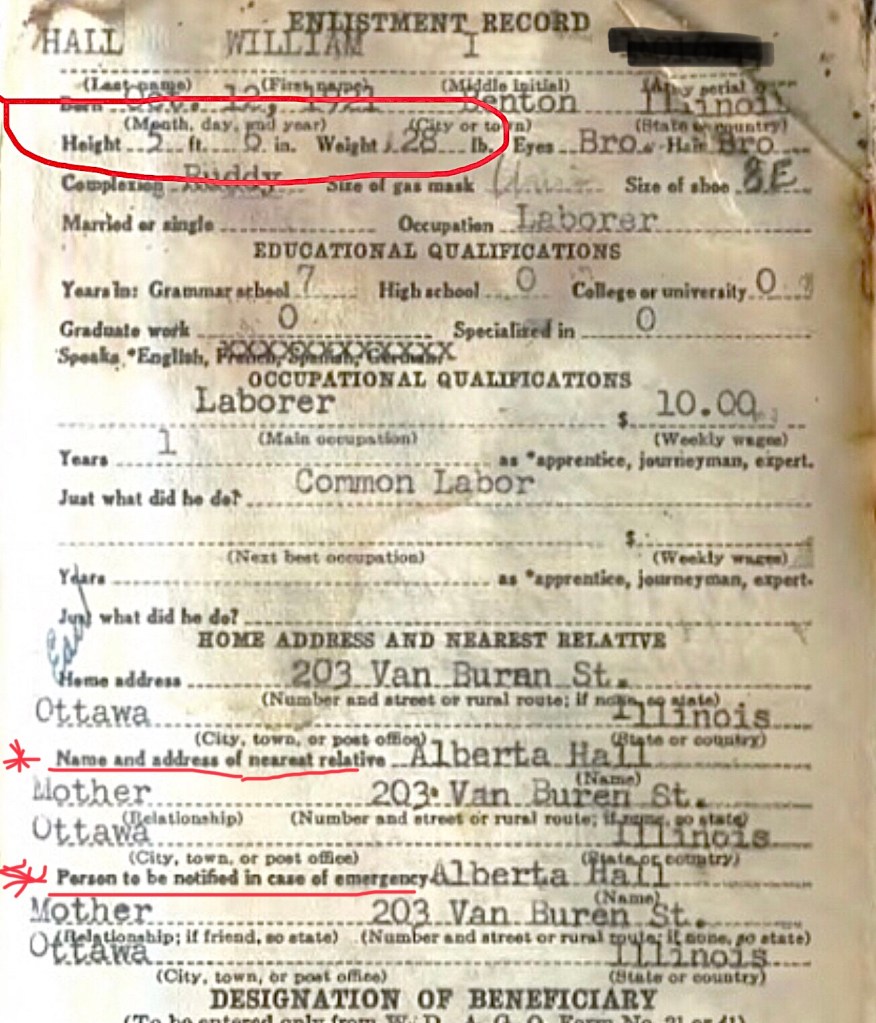
On the second page of his enlistment, there are a couple of additional parts of his life we can confirm from the information provided. First, dad is listed at 5’ 6” and 128 lbs. That corresponds pretty well with the above CCC photo of him. It’s hard to see how the recruiter actually thought he was 18.

Also of interest is that my Grandma, Alberta Hall, is listed as his nearest relative, and the person to be notified in case of emergency. This aligns with other parts of our family history that aren’t always talked about as much. My Grandpa Hall was something of a ne’r-do-well for much of his life, and probably an alcoholic. He sometimes disappeared for days or weeks at a time. Evidently Dad wasn’t taking any chances on him as his emergency point of contact and named Grandma instead. It makes sense to me now that when the telegram came to the family in 1943 informing them of dad’s wounding, it was sent to Grandma, not Grandpa.

A Magnified View of Page 2 of Dad’s Enlistment.

Receiving his enlistment papers was an amazing find to me. I never doubted dad, or any of his stories, but finding actual documents confirming his history is incredible. Knowing how lucky we are they didn’t burn along with the 18 million other military personnel records, only makes the story more fascinating. Luck is sometimes a wonderful thing.

We’d always been told that dad enlisted in 1940, and knew he had to have lied about his age. My Aunt Ellen, his older sister by several years, went to the recruiting station with him to verify his age to the recruiter. Life at that point in time, at the tail end of the depression was tough, or at least tough for the Hall family. Grandma was supporting the family with her work, and Grandpa was only a part time presence at home. There was no money, and probably not many jobs, at least not for a 16 year old. The pay in the Army was $21/month at the time, plus food and housing. I think it looked pretty good to someone who had a fairly rough life to that point.

Today, I’m thinking about 16 year old William Iber Hall going to the recruiting station in Peoria Illinois and signing up to an unknown fate. Unbeknownst to him, Pearl Harbor would happen 14 months later. Thank God for dad, and others like him, who did the right thing and stood by our country in it’s time of need.

This is the first of two blogs about the documents I received from the NPRC. Next week’s blog will cover dad’s discharge paperwork. It tells the story about his time in the service from 1940 – 1945 in just one page, and is an equally amazing document.

Addendum:

  • You can read more about dad’s and the CCCs here: It was 1939 and dad and Uncle George were on a train, bound for the CCCs in Wyoming. Growing up in Illinois during the Great Depression was tough. Their family was poor before the Depression, and things got worse […] continue here: https://mnhallblog.wordpress.com/2017/12/13/dad-uncle-george-and-the-cccs-in-1939%EF%BB%BF
  • Here’s more on the fire at the NPRC from the Archives themselves: “Shortly after midnight on July 12, 1973, a fire was reported at the NPRC’s military personnel records building in St. Louis, MO. Firefighters arrived on the scene only 4 minutes and 20 seconds after the first alarm sounded and entered the building. While they were able to reach the burning sixth floor, the heat and the smoke forced the firefighters to withdraw at 3:15am. In order to combat and contain the flames, firefighters were forced to pour great quantities of water onto the exterior of the building and inside through broken windows. The fire burned out of control for 22 hours; it took two days before firefighters were able to re-enter the building. The blaze was so intense that local Overland residents had to remain indoors, due to the heavy acrid smoke. It was not until July 16, nearly four and a half days after the first reports, that the local fire department called the fire officially out. The fire destroyed approximately 16-18 million Official Military Personnel Files (OMPF). No duplicate copies of these records were ever maintained, nor were microfilm copies produced. Neither were any indexes created prior to the fire. In addition, millions of documents had been lent to the Department of Veterans Affairs before the fire occurred. Therefore, a complete listing of the records that were lost is not available. In terms of loss to the cultural heritage of our nation, the 1973 NPRC Fire was an unparalleled disaster.”

The Indoor Mile

The Indoor Mile

5:25 … 5:26 … 5:27 … Hall – 5:28 … 5:29 … 5:30 …” I did it! I finished the Plebe indoor mile run in under 5:30! As I slowed, my stomach suddenly double clutched and I ran to a nearby trash can, where I promptly threw up.

During my time at West Point, the Academy frequently talked about developing the “whole man” (with the admission of women in 1976, this changed to the “whole person”). We cadets were always being tested and evaluated. It was true about leadership, about academics, and was certainly true about physical fitness. For most of us, somewhere in all that testing was an Achilles Heel. With some it was a particular academic course, for others, some physical education test or class.

Plebe Year at West Point.

As Plebes, there were four required gym classes: Swimming, Wrestling, Boxing, and Gymnastics. For me, I’d been a swimmer all my life and a lifeguard for a few years, so the swimming class was easy, and I earned the equivalent of an A. Wrestling? I made West Point’s intercollegiate wrestling team as a freshman walk on, so I validated wrestling and took handball as an elective instead. Boxing was a challenge at first, but once I learned the basics, AND learned getting punched in the nose wasn’t a showstopper, I did OK. Gymnastics was a different beast.

The pommel horse, the rings, the vault, parallel bars, the trampoline, mats for tumbling … I forget what other torture devices were there, but it was like I was in a cursed land. My two sisters would tell you I wasn’t particularly coordinated as a kid. As a matter of fact, they would say I was a bit of a klutz. It all came home to roost in Gymnastics class. I was passing, but just barely.

At some point during the class, I learned we would do a timed mile run as a part of the course. Running of course has nothing to do with gymnastics, but those things happened at West Point. Just another chance to excel. Now, I had never been a runner, but since it was wrestling season, I was in great shape. Probably the best shape of my brief life up to that point. I started thinking I might be able to earn a good score on the mile run and improve my overall Gymnastics grade.

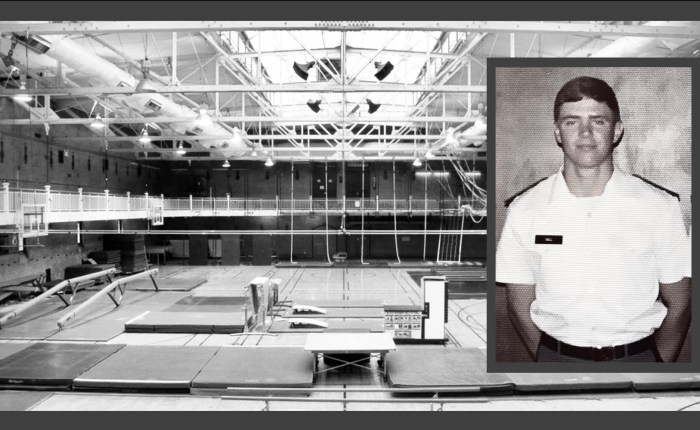
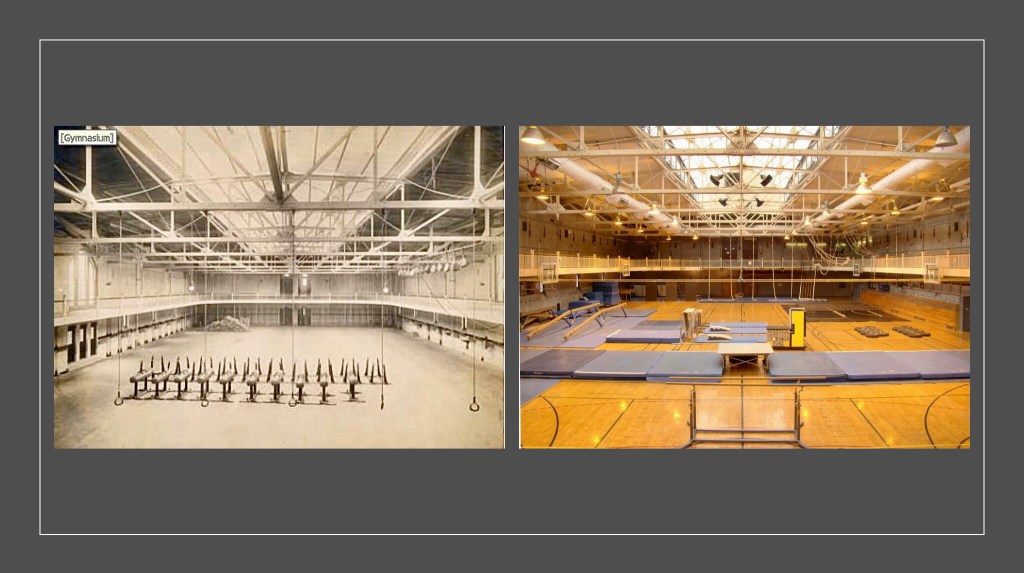
Hayes Gym* is where we practiced Gymnastics. It was “a large open gym with a vaulted ceiling and hardwood floors.” Above the gym floor, an elevated track rings the room. It takes 11.7 laps to run a mile on that track and that’s where we would complete the mile run.

Hayes Gym in 1910, the Year it was Built, and Again in 2009. Note the Elevated Track.

My personal view at the time (and that of at least a few of my classmates) was that many of the instructors in the Department of Physical Education (DPE) had a bit of a sadistic streak in them. One of our instructors was Army’s gymnastic coach, Ned Crossley and some classmates recall his scoring as particularly brutal. Looking back now, I’m pretty sure it wasn’t true. Having said that, all of the DPE instructors had ways of questioning you, challenging you, or prodding you that often seemed to taunt you a bit as well.

The instructor who spoke with us about the mile run was a little like that. To receive a max score, you needed to run under 5:30. The instructor explained what we needed to do to run a 5:30 mile. At 11.7 laps per mile, “all” you needed was to run each lap at a 28 seconds per lap pace, and then run like hell for the last half lap. Simple. Easy Peasy. Any cadet could do it. And so on. Of course the vast majority of us could run no where near that fast.

At the time, I don’t believe I’d ever run a mile (or any other distance) for time. I’d certainly run laps in High School sports, run in formation at West Point for Company morning runs during Beast, and we ran our asses off in wrestling practice. But none of this was ever done for time. That was about to change.

My pea brain went to work. 28 seconds was two seconds less than 30 seconds for each lap. 28 seconds for the first lap… 56 seconds for two laps … 1:24 for three laps … 1:52 for four laps and so on. I’d do the math in my head on the run. As long as I could keep the pace going, I had a shot.

A couple days later, it was my turn to do the run. As I recall, there were a few of us running it at the same time, although I don’t recall exactly how many. What I do remember was taking off when “go” was called. The first lap – 27 seconds! The next couple of laps I was under the pace. After that, I was a bit erratic, with some over and some under, but the average was OK and at the half mile mark, I was on pace. The final few laps? I’m not sure I was really paying attention any longer. The air was stale. The air was acrid. 3/4 of a mile and still on pace. My lungs were burning. I was sucking in as much oxygen as I could. 11 laps done. My legs were lead. It was down to just over half a lap left. I didn’t see anything other than the track in front of me. I don’t know if the other Plebes were in front of me, or behind me. All I know is I ran as hard as could. I rounded the final curve.

5:25 … 5:26 … 5:27 … Hall – 5:28 … 5:29 … 5:30 …” I did it! I beat 5:30. I slowed down and suddenly my stomach double clutched and I ran to a nearby trash can, where I promptly threw up.

Recovery took me a while. I may have heaved a second time, and certainly had the dry heaves. Eventually I made my way to the shower, and then to whatever my next class was that day.

A couple weeks later, I passed gymnastics with some room to spare.

In my remaining years at West Point, I never ran that fast again. Not even close. We had PT tests on an annual basis with a two mile run next to the Hudson River. I never approached anything close to that time, even when adjusted for a slower time due to the extra distance. The two miler was always a challenge for me and I was always nervous about failing it. The thought of maxing out my run score never entered my head.

Years later, I took up running on my own for fun and to stay in shape. I became a decent runner, and clocked several personal bests – an 11:44 two mile ( a sub six minute/mile pace); a 39:58 10K (a sub 6:30/mile pace) and a 68 minute and change 10 mile race (a sub 7 min/mile pace). I remember all of those. The one I still marvel at? The 5:28 mile on the indoor track at West Point. I had no business running that fast. How the hell did I ever do it?

Addendum:

  • * Some info on Hayes Gym from the Academy itself: Hayes Gym was built in 1910. The second level of Hayes is what most cadets and USMA graduates think of as “Hayes Gym”. It is a large open gym with a vaulted ceiling, hardwood floor, and elevated track (11.7 laps to a mile) that rings the room. The Department of Physical Education (DPE), teaches applied gymnastics (now called “Military Movement”) in Hayes, taking advantage of its historical and unusual support structures. The gym has eighteen 21′ vertical ropes and two 60′ horizontal ropes (suspended 12′ from the floor). There are also 10 pull-up bars that are each 5′ wide and are suspended from the ceiling with vertical supports in such a manner that they can be “run across” (with proper technique), as is done during the Indoor Obstacle Course. The gym’s floor space is filled with gymnastic’s apparatus and pads, such as vaults, bars, and rings as well as 1″ and 4″ tumbling mats. Nowadays, the military movement equipment remains in place year-round.
  • The Indoor Obstacle Course is another “fond” memory of Hayes Gym for most West Point Grads, as it was also known to induce retching at it’s completion. I may do a blog on it in the future, but it’s hard to describe to those who haven’t experienced it. To get a flavor for it, here’s a YouTube video of Cadet Elizabeth Bradley completing it just a couple of years ago and breaking the female record while doing so. For all my macho buddies out there, I would love to see you try to beat her time. Good luck on that unlikely event. GO ARMY! https://youtu.be/Dw5rR1yqyp8 .
  • Thanks to classmates Gus Hellzen and Jerome Butler for their contributions to this blog.

Tuna Salad with Julia and Grandma Grubaugh

Tuna Salad with Julia and Grandma Grubaugh

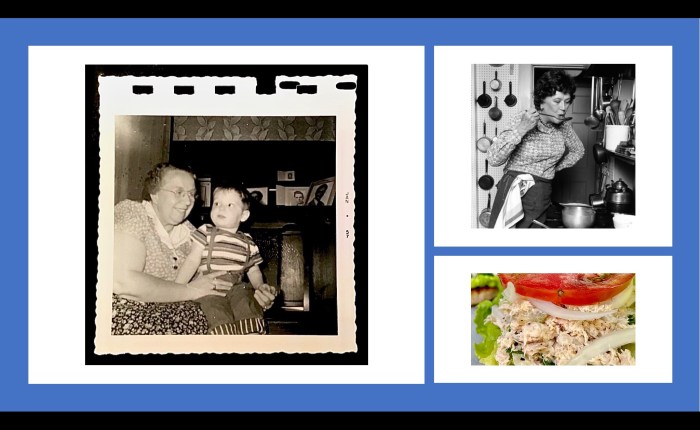
It was strange. It was simple. It was visceral. One moment I was taking a bite of a tuna salad sandwich made with Julia Child’s recipe. The next instant I was a little boy sitting with Grandma Grubaugh at her kitchen table having lunch. It hit me like a bolt out of the blue.

A couple of my favorite benefits of our New York Times subscription are the food and cooking articles. The columns tell great stories, and the recipes are usually pretty manageable. A while back, chef, James Beard Award winning author and former New York Times food columnist Dorie Greenspan wrote a great column “This Tuna-Salad Sandwich Is Julia Child-Approved Lunch”. She was working with Julia at the time on an upcoming book and recounted a day spent in her kitchen. Here’s a partial extract:

We were working around the kitchen table when Julia declared, “Dorie, let’s make lunch.” I saw Stephanie smile — clearly, she knew what was coming — and then I was at the counter with Julia, doing as I was told, which was cutting celery. While it might not seem like much of a job, I was cutting celery for Julia Child, and I was going to do it right: I trimmed the celery, I peeled it (because I learned to do that in Paris, I thought it was important to do it for the woman who wrote “Mastering the Art of French Cooking”) and I cut the celery into minuscule cubes that were all the same size. I’m only exaggerating a smidge when I say it took me so long that when I put down my knife, Julia had finished everything else, and we were ready to sit down to one of her favorite lunches: tuna salad on an English muffin.”

The article was about nothing and about everything. I love writing like that. I mean, how can you possibly write an entire article about a tuna salad sandwich? And yet Greenspan wrote a great one and I thoroughly enjoyed it.

Julia Childs in the Kitchen.

The list of ingredients in the actual sandwich intrigued me. We’ve all made tuna salad – tuna, mayo, celery and maybe onion and a boiled egg, but this one was a bit different. Yea, there was tuna (packed in oil), mayo (always Hellman’s), celery and onion, but it also included capers, cornichons (small French pickles) and lemon juice. Hmmmm. I was going to have to try this. Some of you know of my aversion to pickles in potato salad, but with tuna salad, why not give it a shot?

I had everything on hand, with the exception of the Cornichons. After doing a little online research, I figured the baby dills in our fridge were a suitable substitute.

I dutifully chopped the celery (sorry, no peeling), onion, capers and pickles. After emptying the tuna in a bowl, I added all of the chopped ingredients. In went the mayo, and the parsley and I combined everything. Finally, I squeezed the lemon juice in, added salt and pepper, and combined it all again. I did a small taste, and of course because of who I am, added a bit more mayo. Another small taste, and then I put the bowl in the fridge to chill for a couple of hours.

Tuna Salad Heading to the Fridge.

At last it was lunch time and I made my sandwich. More mayo on the bread, the tuna salad itself, some lettuce, tomato and a small slice of onion. Another slice of bread, and then I cut the whole thing in half.

Tuna Salad Sammich. It Doesn’t Get Any Better.

I took the first bite, waiting to be transformed in my mind to Julia Child’s kitchen, and … wait! What!? Was that Grandma Grubaugh sitting next to me? Where in the hell did that come from?! It was a visceral reaction – I was a young boy back in Ottawa, sitting at the kitchen table at Grandma’s house having a tuna sandwich with her.

Grandma Grubaugh and I in 1957.

After rejoining the present, I sat there eating my sandwich trying to figure out what brought on those feelings. Grandma, to my knowledge, never cooked anything from Julia Child. Besides, my flashback would have been some time in the ‘60s, well before Julia became popular in America.

I thought through the ingredients. I don’t really remember grandma keeping fresh lemons, or capers around the house, although I suppose she might have. Grandma putting either in tuna salad seemed a pure fantasy. It had to be the pickles, although I didn’t remember mom putting pickles in tuna at our house.

At this point in time, mom had already passed away. Uncle Don, her younger brother was still alive, and I gave him a call. After catching up for a few minutes, I explained why I was calling, asked about grandma’s tuna salad, and whether she put pickles in it. He immediately answered “No, there were no pickles”, and my heart sank. Then he quickly added – “No, no pickles. She used a couple big spoonfuls of pickle relish.” And it all connected.

We talked a bit more and I eventually hung up. As I thought about Grandma and her pickle relish, it made sense. The relish certainly would account for the pickle flavor and maybe some of the brightness. In a subsequent conversation with my cousin Dawn, she reminded me that while Grandma didn’t really keep fresh lemons around the house (who did in midwest America in the ‘60s?), there was always a bottle of Real Lemon Juice in the fridge – for lemon cake, lemon pie, maybe a spoonful in cobblers. Who’s to say she didn’t add a spoonful to her tuna salad? While it doesn’t all add up perfectly, it made sense to me.

Since then, I’ve continued to make my tuna salad with pickles, capers and lemon juice. I have to admit Julia’s is better than what I’d made before. It’s also a nice lunchtime bonus – remembering Grandma Grubaugh on a day when you are “only” having tuna salad is pretty special.

Addendum:

• Thanks to my sister Roberta, and cousin Dawn (one of Uncle Don’s Daughters – also a flower girl at our wedding) for their contributions to this blog – both had distinct memories of Grandma’s tuna salad and some of grandma’s habits at the time. Dawn was also quite emphatic Grandma used sweet pickle relish in her Tuna salad. We also had a great conversation about foods triggering happy family memories – Thanksgiving at mom and dad’s house (Uncle Don, Aunt Diane and family were almost always in attendance as well), potato salad, Aunt Diane’s cherry pies and cobblers, watermelon outside on the picnic table, and Grandma Grubaugh expertly spitting her seeds across the yard, to the delight of her grandchildren.

• Here’s another blog about Grandma Grubaugh and her delicious date nut bread: https://mnhallblog.wordpress.com/2019/12/04/grandmas-date-nut-bread/

• Here’s a link to the column that inspired me to try Julia Child’s Tuna salad. It’s a quick read – https://www.nytimes.com/2020/10/21/magazine/this-tuna-salad-sandwich-is-julia-child-approved-lunch.html?unlocked_article_code=a2vDZUZ1eo1yVrKAfuZxMgmll7EsQe8k7K-jTFFMqtFBjYV_jUe1I577EkeqZQNBGpaScBbP2xFhlRgEXk0W3tuhHedthiZqjAOIlq7mFMVFRXTSWUW-mugkmUlR6AtNmjBpqnBC45Dacm7NKVcjag8DPq4nW_Mk-gleZC2NfUBimTJW8wqPnaCRsC9BXBDeHOI6FVeL60bLuggz3IU80r0Op815enYRuh9uZRbZwfNBd33TI6IJNJk_1qSRqnFXzpHmKs4RRpwBBMsGROoFMHGYZ-jWFgxYd51U2M-oYm9mLIFmxsE2twHD2-Qtkx8ZSmRV-W7eCe36dnvravfZOe3UkdJOwFAHYcitmVZSPDenybPsa9HK0r6y4Pgo9YUyIA&smid=share-url

• Here’s a link to the recipe from the NYT: https://cooking.nytimes.com/recipes/1021561-tuna-salad-sandwich-julia-child-style?smid=ck-recipe-iOS-share

• And here’s the exact same recipe if the NYT won’t let you open their recipe without a subscription: https://bwtribble.com/recipe/1071

Orion, My Old Friend

Orion, My Old Friend

It’s nice to have constants in your life, even when they are little ones. Something you can count on. Something that gives you comfort. Something you can look at and say, “Yep, it’s still there.” For me, one of those constants is my old friend Orion in the winter night sky.

I suppose my interest in space and the constellations started with Mrs Finkeldey, my first grade teacher. On February 20th, 1962, a little over halfway through our school year, astronaut John Glenn became the first American to orbit the Earth. Mrs Finkeldey talked about Glenn, and taught us about the solar system and the (then nine) planets. Combining current events and science for first graders – who knew?

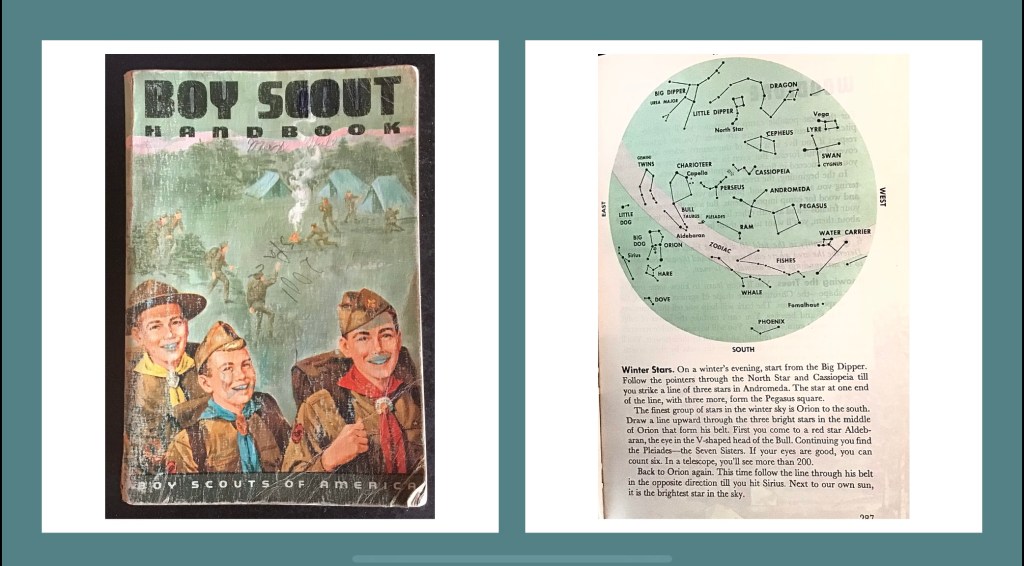
Later, in Boy Scouts, I began learning about the constellations. It started with the Big Dipper pointing to the North Star in the Little Dipper. Suddenly, and amazingly, you always knew what direction north was (unless it was a cloudy night). That was just the beginning. With my Boy Scout Handbook, I began to learn how to identify and locate the constellations – Cepheus and Cassiopeia; Canis Major, along with Sirius, the brightest star in the sky; Gemini the Twins; Taurus the Bull; the Pleiades (the Seven Sisters) and many others.

Knowledge of the Constellations in My Old Boy Scout Handbook

I’m not sure why, but my favorite was always Orion, The Hunter. Orion is one of the more identifiable constellations and has been mentioned by Homer and Virgil, and is even in the Bible*. According to Mythology, Orion was a great hunter and the son of Poseidon. He was killed by the sting of a large scorpion after possible misdeeds. Later, Zeus put both Orion and the Scorpion (Scorpius) in the sky as constellations.

Orion, The Hunter.

Orion is easy to see and easy to recognize, but here in the Northern Hemisphere, only viewable in winter. Starting in November, I watch him traverse the sky. Every night when I take Carmen out for her last walk, there he is overhead. If I take binoculars with me, or bring out my telescope, I can see the the Orion Nebula in his sword with greater detail. It’s no matter though. Knowing he, and it, are there are comfort enough.

Photo of Orion Taken With My iPhone 12 at Home in Virginia

I’ll observe him until March or so, and then he disappears from the night sky. The good news is he will reappear in late Fall, as he always does. He’s a bit more reliable than many of the unstable things in our lives.

Photo of the Orion Nebula,Below Orion’s Belt. Taken With My iPhone 12.

It’s not just here at home where I see him. Because of his location in the sky, he is visible in both the Northern and Southern Hemispheres. He was with us when we lived in Germany in the ‘80s. Over the years, I’ve seen him on vacations around the world, including this week in Grand Cayman. He has been a reliable travel companion.

iPhone 12 Picture of Orion With his Shield From Grand Cayman This Week.

Take a look one of these nights around 10PM. This time of year, he is high overhead, and slightly south of the center of the sky. You will find him easily enough. Look for his belt, and the rest will come with it. Know that I will probably be gazing on him around that time of night as well. I spend a few quiet moments with him almost every evening.

It is perhaps strange to think of a constellation as a touchstone, but that is what Orion has become for me. He is a constant I can count on and my eyes are drawn to him on starry winter nights. For me, he provides calmness and serenity, if only for a few moments. For most of us, there aren’t many things that do so. When you find one, it’s good to hold onto it.

… Silently, one by one,
in the infinite meadows of heaven,
blossomed the lovely stars,
the forget-me-nots of the angels…

Henry Wadsworth Longfellow.

Addendum:

I fondly remember my First Grade teacher, Mrs Thelma Finkeldey, and her purple hair. She was a great teacher. You can read more about her here: https://mnhallblog.wordpress.com/2020/06/04/mrs-thelma-finkeldey/

* Here are the Bible verses which mention Orion:

  • Job 9:9. Who makes the Bear, Orion and the Pleiades, And the chambers of the south;
  • Job 38:31. Can you bind the chains of the Pleiades, Or loose the cords of Orion?
  • Amos 5:8. He who made the Pleiades and Orion And changes deep darkness into morning, Who also darkens day into night, Who calls for the waters of the sea And pours them out on the surface of the earth, The Lord is His name.

A Plebe Christmas

A Plebe Christmas

I distinctly remember returning to West Point after Christmas my Plebe year. It wasn’t fun. As a matter of fact, the last couple of days at home became bittersweet as I started thinking about returning to West Point as a Beanhead* for another five months.

It wasn’t just returning to the Plebe System (Fourth Class System) that affected me. We had first semester finals two weeks after returning. Also, have you ever visited West Point in winter? In the Fall, West Point is one of the most beautiful places in the country. In the winter? Not so much, unless you have a fondness for the color grey. January to March at West Point is called “Gloom Period”**, with good reason.

If I’m honest with myself, it wasn’t Gloom Period, or finals that brought me down. It was going back as a Plebe for another five months. Before you enter the Academy, you hear all about how tough Plebe year is both mentally and physically. It’s one thing to hear about it. It’s another to experience it for six months, have a break, and then know you are going back for more of the same.

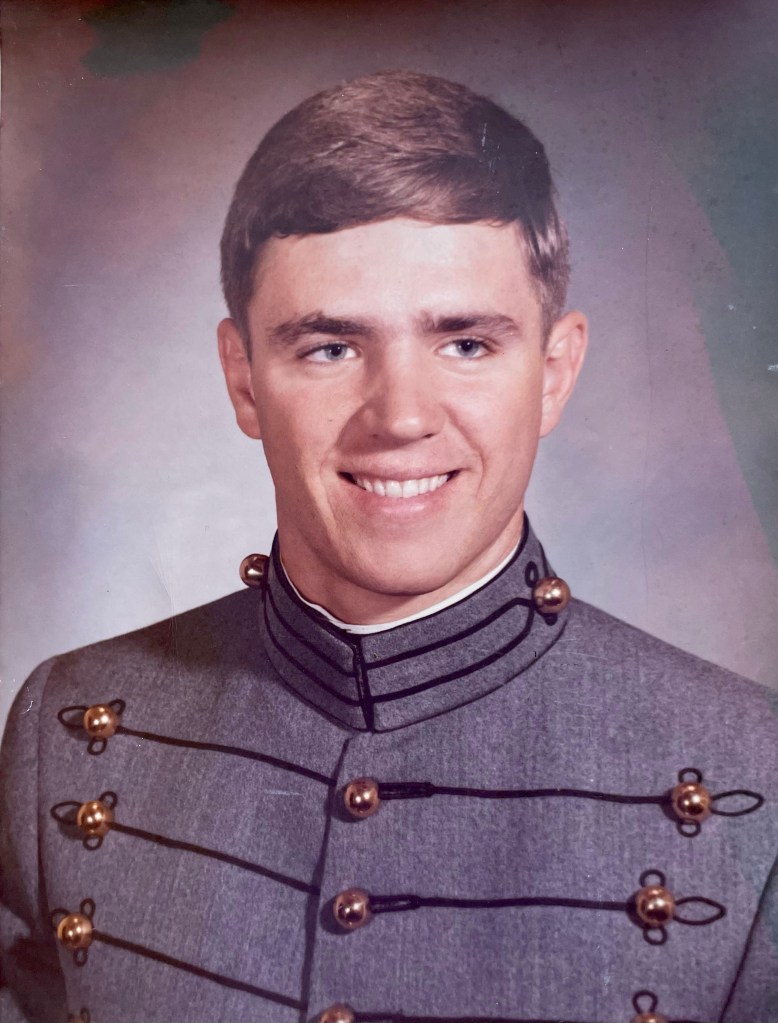
Official Plebe Photo

Coming home to Ottawa that December, Christmas break was great. Being a real person again was even better. Everyone wanted to know how West Point was, and of course I told them the good stuff, while minimizing the actuality of Plebe life. The time at home divided out between family events, dates with Cathy and partying with my friends.

During the day, I spent time at home, or went to see Grandma, various aunts and uncles, and church or family friends. I remember racing around town fitting in as many visits as I could. It was good to catch up with so many people, but also a bit exhausting.

Cath and I went on dates most evenings and tried to make up for lost time. The last we’d seen each other was Labor Day Weekend, when she visited West Point with my folks. In the interim, we’d written so many letters back and forth, I lost count of the actual number. While home, there was even a formal holiday dance at Ottawa High (Cathy was still a senior in high school). I wore my dress uniform, and felt so much older than the high school “kids”, who in reality were only one or two years younger.

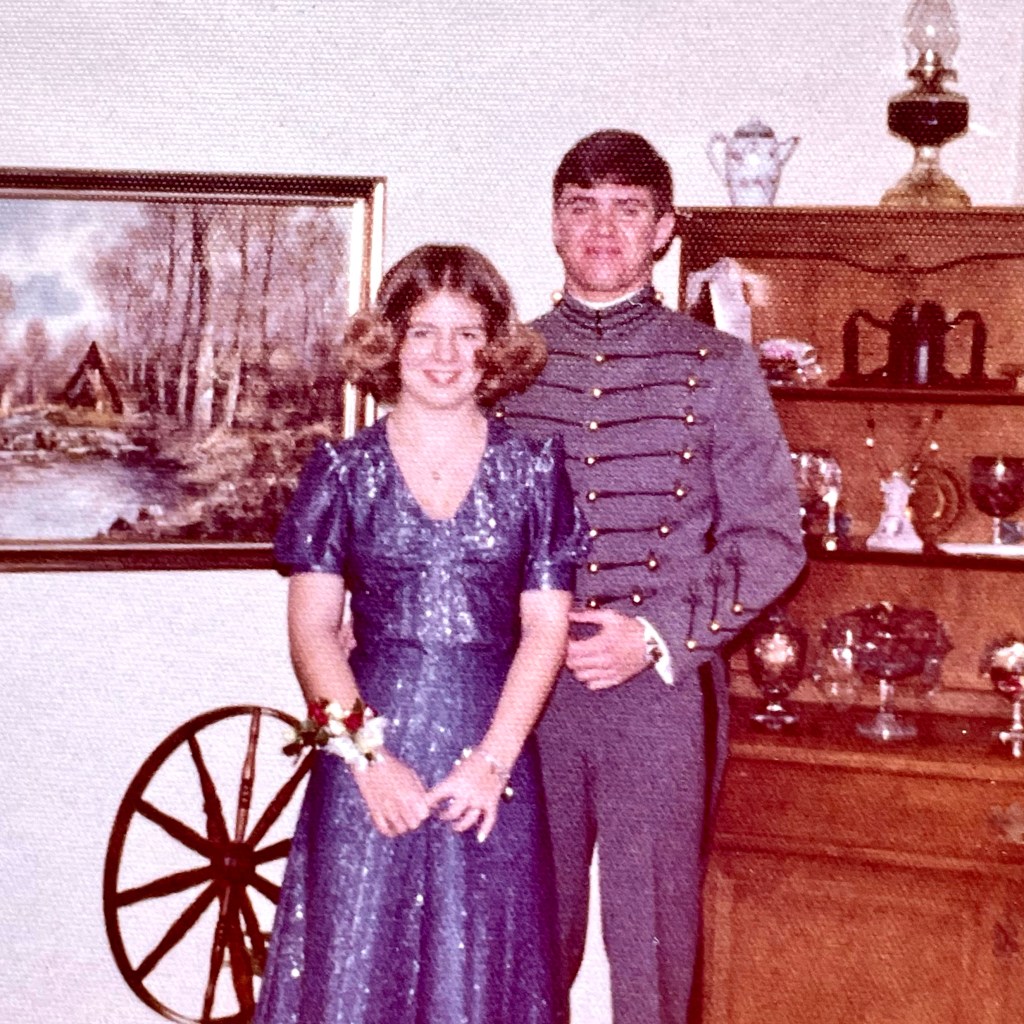
At Home Before Going to the OHS Winter Formal

Since she was still in school, Cathy had a curfew most nights. After our dates ended, I often linked up with my buddies Howard, Tim, Mark and others. The drinking age in Illinois was 19 at the time for beer and wine, but nobody really checked. We made the rounds at Berta’s, The Flamingo and Russell’s Tap before finally making it to bed. The next morning I’d wake up and start the cycle all over again. As I recall, sleeping in wasn’t an option.

I’d taken a couple of text books home with me to study over break, but of course I never cracked them. The days and nights raced by.

Finally it was New Year’s Eve and just a couple days before I would return to West Point. I remember going to a party with Cathy at our friend Jack’s home that night. Many of our friends were there. It was a great time, and as the clock struck midnight, there were kisses, handshakes and toasts all around. It was wonderful and things seemed almost perfect.

Maybe an hour later, it hit me. This was all going to end and I would return to the reality of Plebe life. The exhilaration from midnight rapidly disappeared. I crashed and a forlorn feeling took over. I found a quiet spot in an empty room and just sat there thinking. The dread I felt was visceral. Cathy found me a few minutes later and could tell something was wrong. She asked if I was OK and I struggled with words, then just gave up trying to explain. The thing is, she felt it too. We stood there hugging for I don’t know how long.

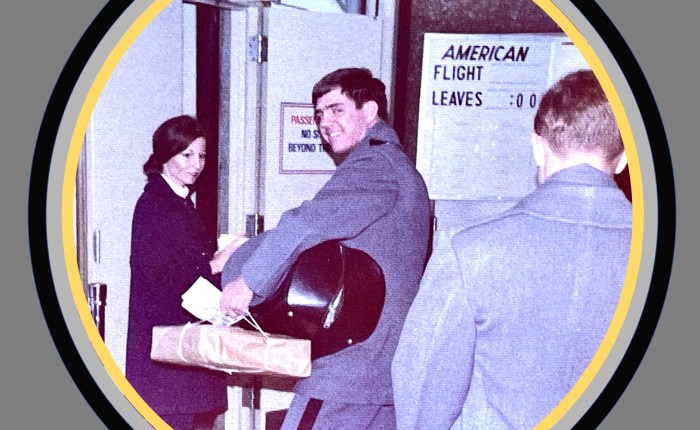
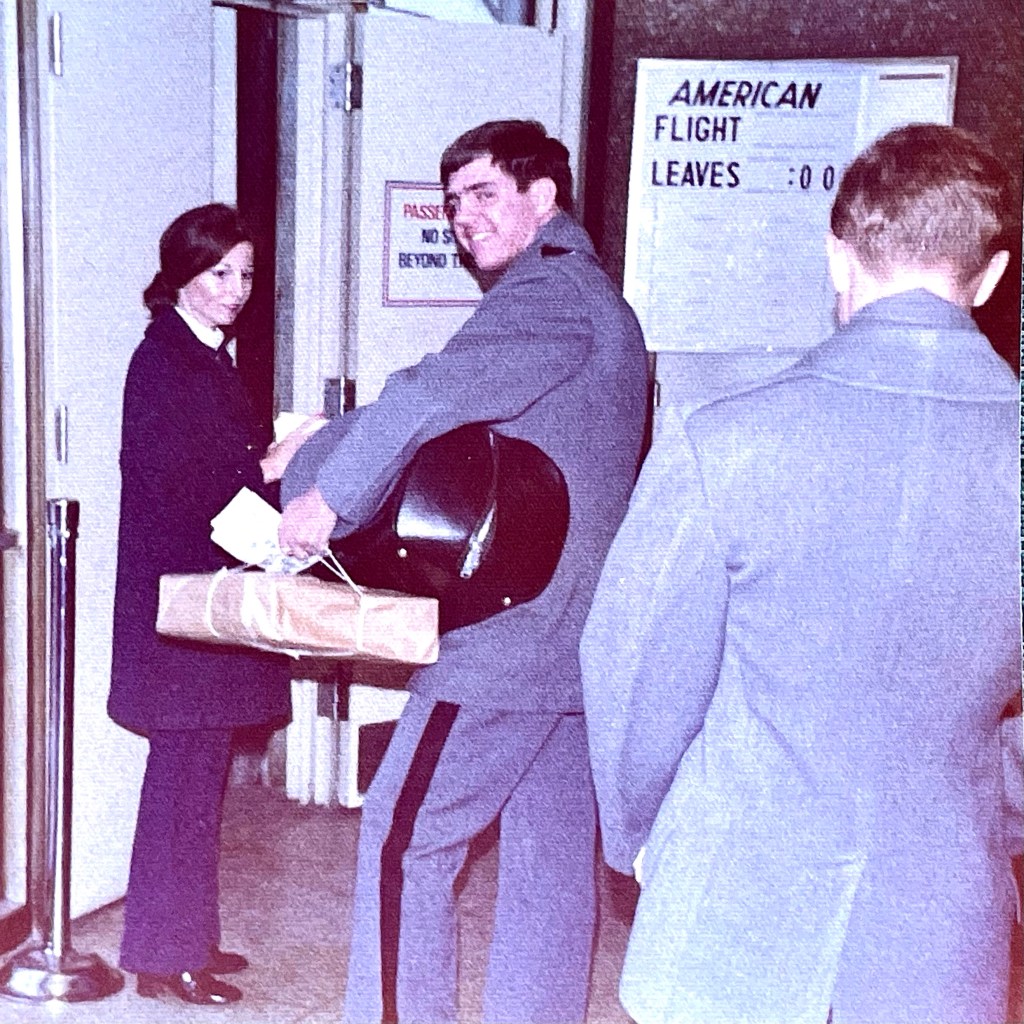
I more-or-less bounced back the next day and enjoyed my last day or two of freedom. Finally, it was time. As a Plebe, I think I was required to travel in uniform, and when Mom, Dad and Cathy drove me to O’Hare, that’s what I wore. Back then everyone could walk all the way to the gate, and that’s where we said our final goodbyes and “I love you’s”. Mom gave me a care package and with a last wave and a smile, I boarded the plane for New York.

A Smile for Mom, Dad and Cathy as I Boarded the Plane to New York.

At the airport in New York (LaGuardia I think), cadets were everywhere. Most of us made our way to buses for the final fifty miles to our Rock Bound Highland Home on the Hudson. The bus I was on was pretty quiet, with Plebes and upperclassmen alike lost in their own thoughts. By now, I’d steeled my mind for the return to school and Plebe life. I was as ready as I was going to be.

And of course it wasn’t as bad as things looked on New Year’s Eve. I made the Dean’s list that first semester, and by late March or early April, Gloom Period was lifting. As for dealing with upperclassmen and the 4th Class System, that too passed. As the Semester wore on, things became easier and and finally, in June, Recognition Day happened. We were no longer Plebes, but full fledged members of the Corps of Cadets.

To this day, I remember that New Year’s Eve and the roller coaster of emotions I felt. Speaking with Cathy, she too distinctly remembers that night. I recently told her I thought I’d write a blog about New Year’s Eve Plebe year. She immediately knew what I was talking about. I laughed a bit and said something like “I didn’t know you remembered”. She quickly answered “How could I forget?”

Addendum:

  • *Beanhead – one of the many less flattering terms upperclassman used for Plebes at the time.
  • ** Gloom Period – If you want to read more about Gloom Period, you can do so here: https://mnhallblog.wordpress.com/2018/01/21/gloom-period/
  • I’ve often thought of that New Year’s Eve over the years and the feelings I experienced that night. I’d contemplated writing a blog about it before, but couldn’t quite wrap my head around it. Then, during Christmas season this year, one of my classmates posted an email on his own feelings about the return to West Point after Christmas. Several others chimed in. Some were worried about academics and getting separated due to grades. Others, like me, thought about the return to the 4th Class System for several more months. Still others talked of the general malaise around our return, with Gloom Period settling in. A few told (now) funny stories about missing flights, late arriving girl friends, and even running into the Dallas Cowboy Cheerleaders during a stopover on the return to the Academy. It’s interesting what binds people together. My classmates and I laugh and now tell stories of those times that seemed so serious back then. Time and distance have brought perspective and a camaraderie that has lasted a lifetime. I feel lucky to be a member of the Proud and Great Class of ‘78. Thanks for the memories, and the continued friendship my brothers.

Davie

Davie

Davie was the gentlest soul I have ever known. He also had a memorable lust for life. When he died last week, the world became colder, less kind, and a little less forgiving. I mourn his passing, and there is a weight on me.

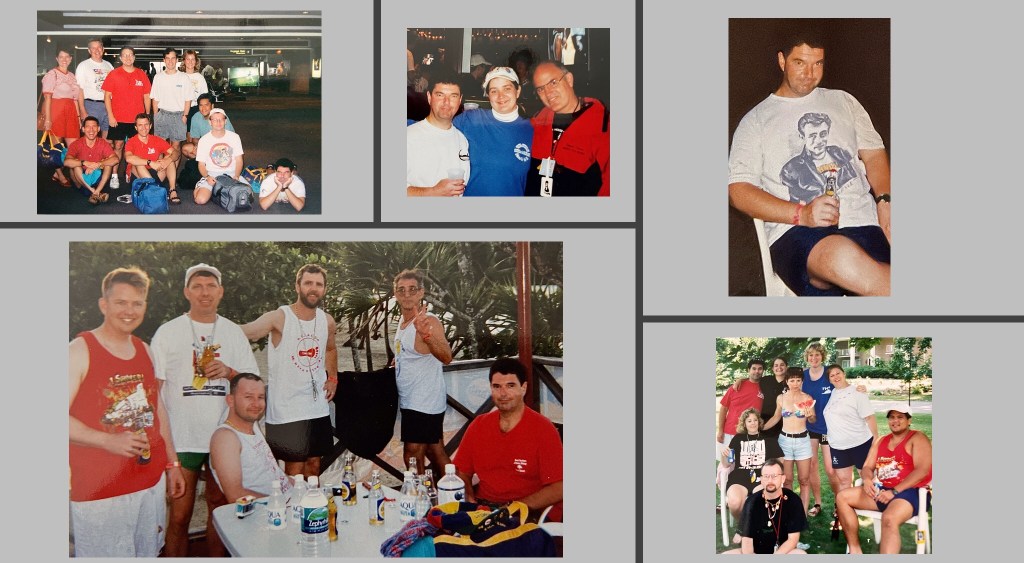
Davie and I first met through our running group, The Mount Vernon Hash House Harriers* (MVH3), in ‘90 or ‘91. Back then, we were all in decent shape, and could both run for miles and drink copious amounts of beer, sometimes at the same time. There were lots of good times running around different parts of Northern Virginia. We’d run, eat and drink, and then maybe party some more. At the time, Cath and I only lived about 1/2 mile from Davie, and frequently found ourselves in his hot tub on Saturday afternoons, some time after The Hash finished.

Random Hash Photos from DC, Orlando and Trinidad

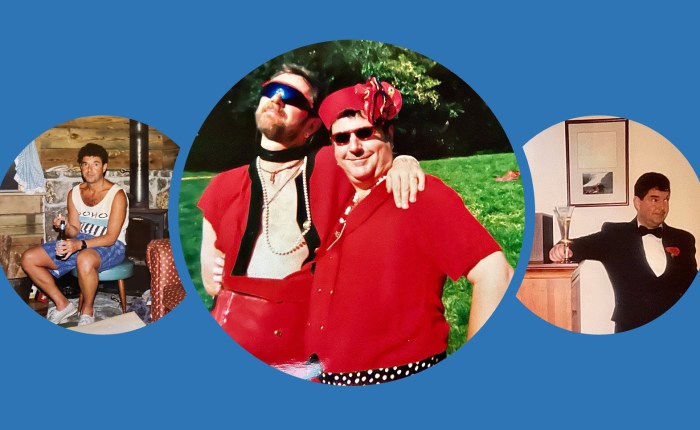
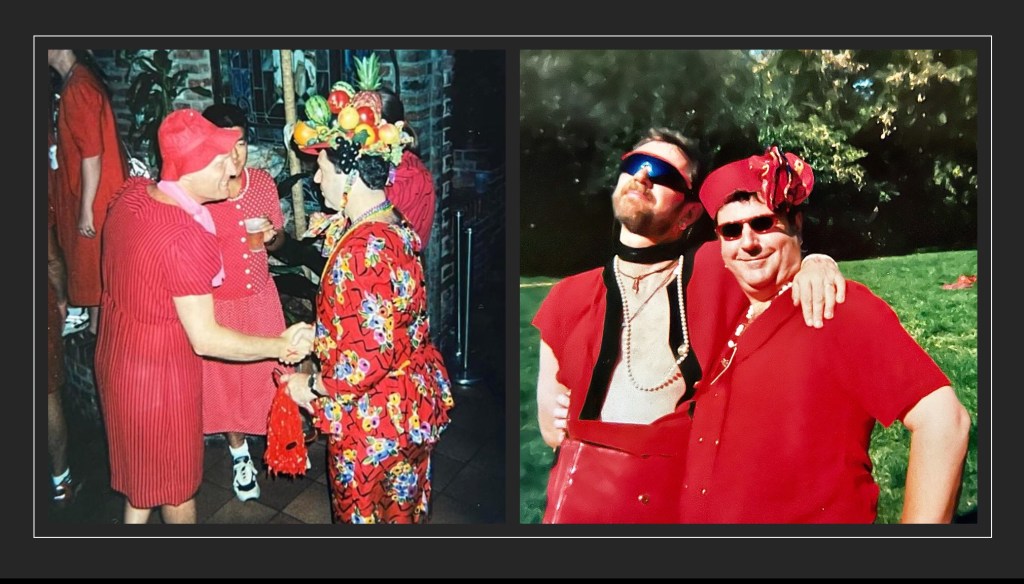
Later, when The Hash started hosting it’s annual Red Dress Run (yes, all members were required to wear red dresses on the run), some of Davie’s outfits were legendary. Wearing his Carmen Miranda fruit plate hat still draws chuckles from those who were there.

At the Red Dress Run – Davie with his Carmen Miranda Hat, and the two of us a Different Year

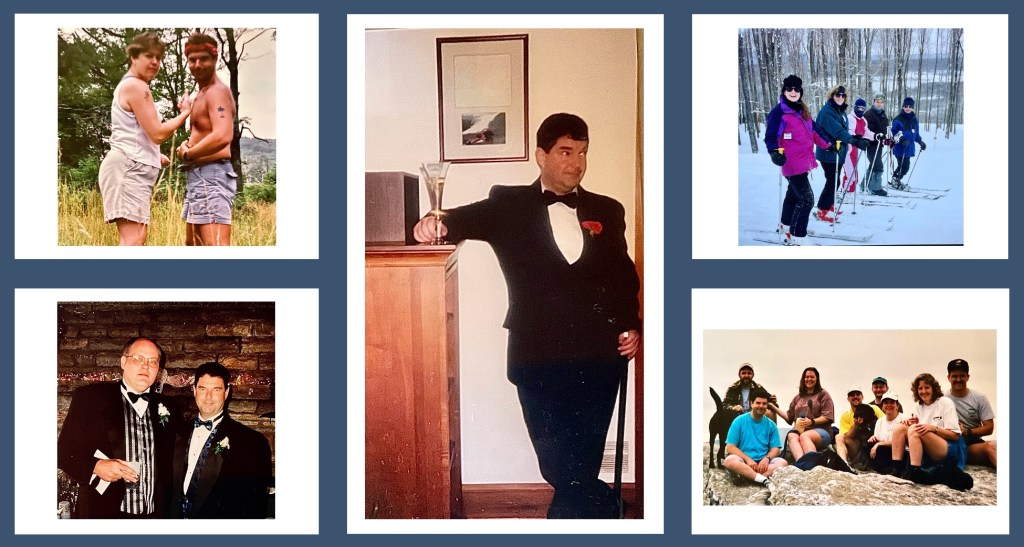
Our friendship grew to be much more than just The Hash. We started doing other activities together, including dinners out, hikes in the woods or up Old Rag, and visits to our then cabin in West Virginia. Sometime in the mid ‘90s Davie organized an annual ski trip for 8 or 10 of us to the wilds of West Virginia. He’d rent a big group house, where we’d ski during the day, and take turns cooking dinners at night. There was more hottubbing, beer drinking and partying in general, but what I remember most was the fellowship we all had with each other. It was the best of times and something we looked forward to every year.

Hikes, Ski Trips, and Parties – Alway a Fun Time

In the late ‘90s, Davie came out to us. We always suspected, although we weren’t sure. It was very different then, than it is today, and coming out was a real act of bravery. It took him over half an hour and some tears before he finally came to the point he was gay. Cathy and I told him we loved him, and it didn’t matter, we still loved him. We shared hugs and tears all around at that point. It’s also what made me realize no one chooses to be gay – no one would want to willingly go through the pain and fear of potentially being an outcast of society. God, or genetics, or some combination of the two made Davie gay, and also made him the wonderful person he was.

We eventually moved to the country, a little over an hour from our old home. We saw Davie less frequently, but still had great times.

For his part, Davie, who always loved to travel, was traveling even more. He was a recognized expert on waterways for the Army Corps of Engineers and frequently flew around the country and the world for conferences, and to speak at some of those conferences. He also travelled on his personal time and loved to bicycle. I remember one trip when he went to Vietnam and rode by bike from Hanoi to Ho Chi Minh City (Saigon). He told great stories of that trip and one he biked in South Africa.

When covid hit, we didn’t see each other for a couple of years. We texted and had a few random phone calls, but that was it. One of the unfortunate realities of covid was the year or two it robbed from all of us. It’s easier to recover from the loss of a year or two when you are in your twenties. When you are in your sixties, you may still think death isn’t imminent, but you notice it hanging around out there on the horizon.

We saw Davie three times this year, including twice at Nats’ games. The final time we shared together was at our home during our annual Oktoberfest Hash, just two weeks before his death. Davie arrived early and we hugged as always. He didn’t do the trail that day, instead, hanging around the house drinking beer and eating brats. It was a fine autumn day and we spent time talking about nothing. They were the kind of conversations you have when you don’t yet know one of you is going to die in two weeks. It was wonderful.

Davie at the Oktoberfest Hash this Year

The day we found out Davie died was a grey, misty day. His death was sudden and unexpected. Calls followed to others. When you call someone in the middle of the day that you normally never call in the middle of the day, they know something is up. Still, there is the shock of the specific news.

It stayed grey, misty and rainy for two days before the sun finally re-emerged. It certainly fit our mood. The depression felt like a weighted blanket on my forehead and temples. It was a visceral, oppressive feeling. The opening stanza of W.H. Auden’s melancholy poem, “Stop all the clocks, cut off the telephone” came to mind –

“Stop all the clocks, cut off the telephone,
Prevent the dog from barking with a juicy bone,
Silence the pianos and with muffled drum
Bring out the coffin, let the mourners come.

Yes, the sun is out now, and certainly life goes on. I always think we who are living have a duty to keep the memories of those who have died alive. For my part, I will remember Davie’s smile and the twinkle in his eyes. I will recall his gentleness, and his lust for life. And I will chuckle at his fruit-plated hat, and the many other stories I haven’t shared here.

When I think of Davie, his personality, and how he enjoyed life, I often think of the opening lines of the great Joan Armatrading song, “Everyday Boy”

Well I’ve never met anyone
With your courage,
And the way your enjoy life
Puts me to shame.
Just an hour with you,
And I understand
Why we had to meet…

Davie was our friend, whom we loved. We will miss him always.

Addendum:

  • * MVH3 is a part of a world wide group known as the Hash House Harriers, which started in Kuala Lumpur, Malaysia in 1938. Hash, in this case refers to bad food, not pot. The runs are hare and hound in nature, with a marked trail. Typically, beer and food are served after the run. Hashers have the playful motto of “we are a drinking club with a running problem”. You can find out more about The Hash here: https://en.m.wikipedia.org/wiki/Hash_House_Harriers
  • If you haven’t heard the Joan Armatrading song, “Everyday Boy”, give it a listen. It’s worth it. Ditto on the WH Auden poem “Stop all the clocks, cut off the telephone” – find it online and give it a read.
  • Special thanks to my wife Cathy, and our friend Tia Perry who both contributed thoughts and ideas to this blog.
  • Thanks to Sharon Gustafson Schoen for the pic of Davie with the Carmen Miranda hat. The hat was actually made by our old friend Renee Ayer, who wore it at a previous Red Dress Run. Thanks also go out to Ann Simon for the last photo of Davie at Oktoberfest.

In-A-Gadda-Da-Vida

In-A-Gadda-Da-Vida

I was in Warrenton between stops at the dry cleaners and the UPS store when Iron Butterfly’s “In-A-Gadda-Da-Vida” came on the radio. Talk about flashbacks. I don’t think I’d heard it in decades. When I came out of the UPS store several minutes later, it was still playing and my mind drifted back to Plebe year at West Point.

As Plebes (Freshmen), we weren’t allowed to have stereo equipment in our rooms during the first semester. I suppose some sort of depravation challenge for us. Second semester, the restriction was lifted, and many of us went to the Cadet Store to dutifully buy audio equipment of varying quality.

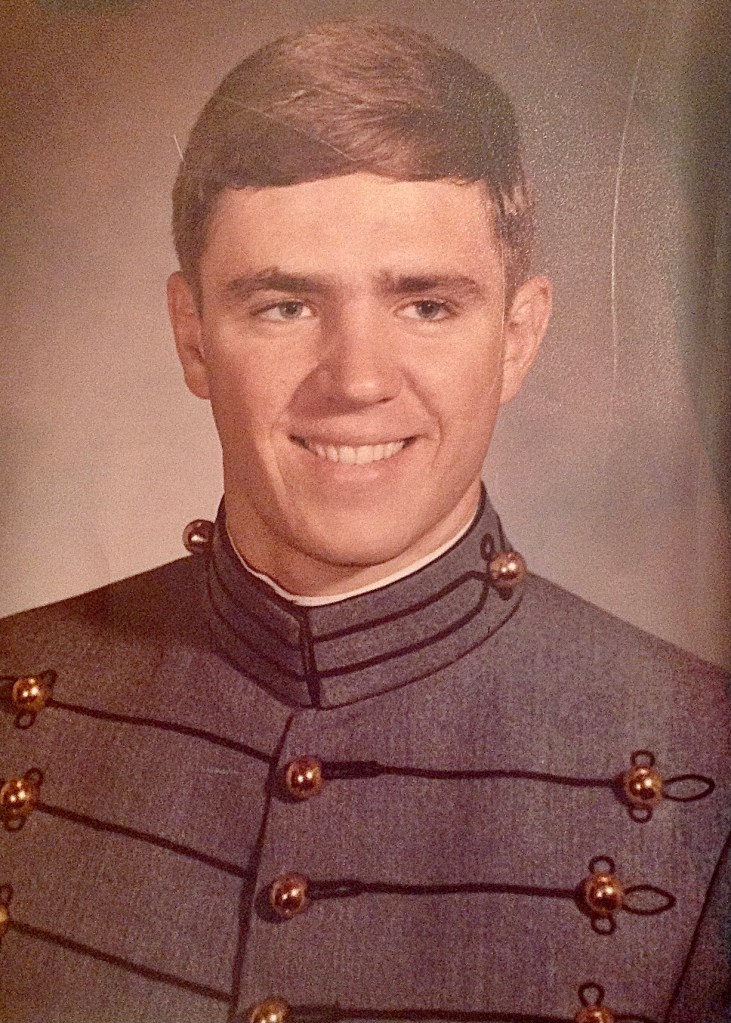
Me, as a Plebe at West Point

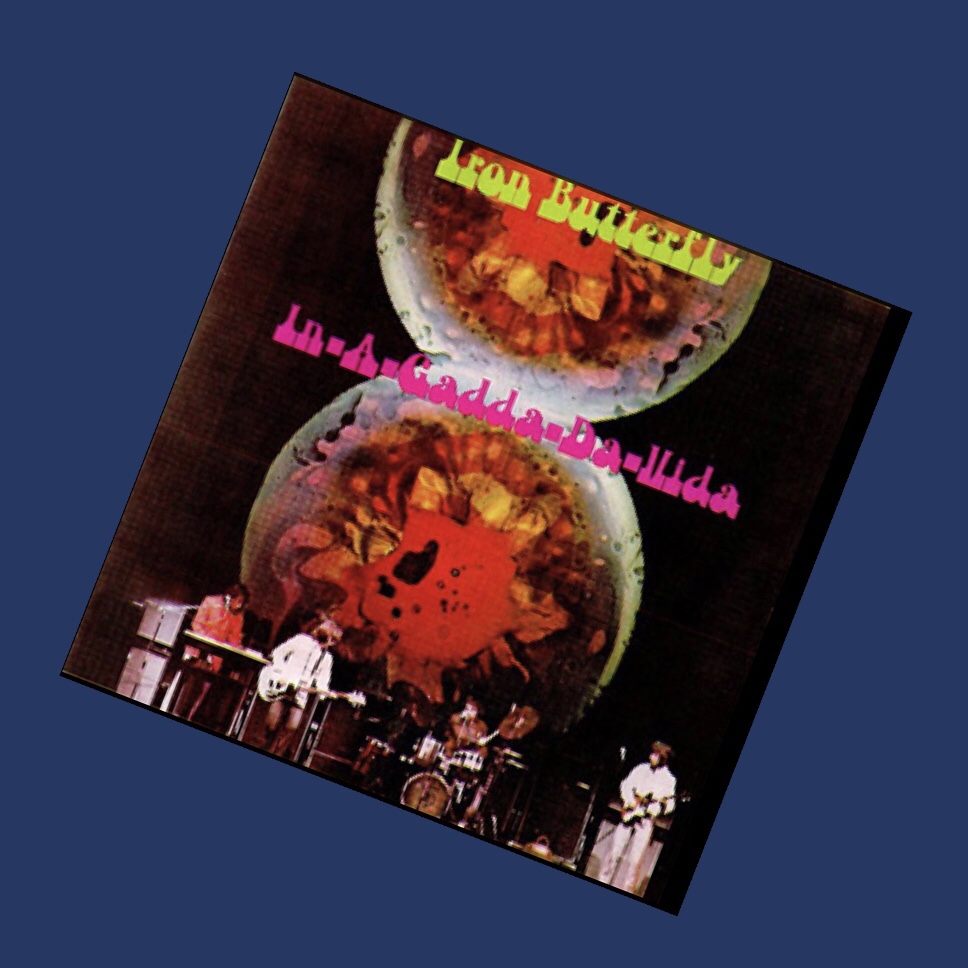
Of course I started buying albums of various types as well. Sometime in the middle of the semester, a friend dropped by and said something like “Have you listened to Iron Butterfly’s In-A-Gadda-Da-Vida?” Now the album was actually released in 1968. Not only had I never heard it, I’d never heard of it. I looked at the album and said “Hey, there’s only one song on this side.” My friend looked at me like I was stupid, and put the album on the turntable.

Full On 1968…

I was blown away. Seventeen minutes for one song. It went on and on and on. The lyrics were simple and repeated. And then somewhere in the middle is that incredible drum solo. I was hooked and bought a copy. For the next month, I hardly played anything else.

The Lyrics were … Simple … and Repeated Over and Over

Eventually, my infatuation faded a bit and it moved into a normal musical rotation. By Firstie (Senior) year, it moved to the back of the albums and was rarely played.

….

Back in my car, the drum solo was pounding and I cranked the volume. I was lost somewhere between nostalgia and thinking to myself “Hmmm, this is still pretty good.”

The drum solo eventually finished, and so too did the song about half way home. When I arrived at our house, I looked through my old albums for Iron Butterfly. It wasn’t there. Somewhere along the way, it evidently didn’t make the cut for our next move. Or maybe someone borrowed it and it never came home.

I know in today’s world, I can call it up online and listen to it anytime I want, and now that I’ve remembered it, maybe I will. Or I could pay Apple and downline the single. I don’t know that I’ll do either, but yesterday was a pretty cool drive home and I enjoyed the trip back in time.

Addendum:

In-A-Gadda-Da-Vida actually started as “In the Garden of Eden” and a reference to Adam and Eve. When one of the band members first wrote down the words from a band mate’s recording that was slurred (due to alcohol consumption), In a gadda da vida is what he heard, and what was written down. The rest is rock history.

Here are two YouTube videos of the song. First one contains a video of the band (very blurry and very ‘60s). Second one is just the album cover, but I think the audio is better.