Snow Satisfaction

Snow Satisfaction

In 1988, Cath and I enjoyed a ski vacation in the village of Ischgl, Austria, known for both its skiing, and its Après-ski activities. It also presented the opportunity to ski from Austria to Switzerland, as long as we brought our passports. As is usual, Cathy had the last word after we completed the run.

While stationed in Germany in the ‘80s, we took many ski vacations to Austria, sometimes for a long weekend, sometimes for a week. We often went with our friends Jim and Res to the Austrian town of Nauders on the Italian border. The skiing was great there and we enjoyed many fun trips with them.
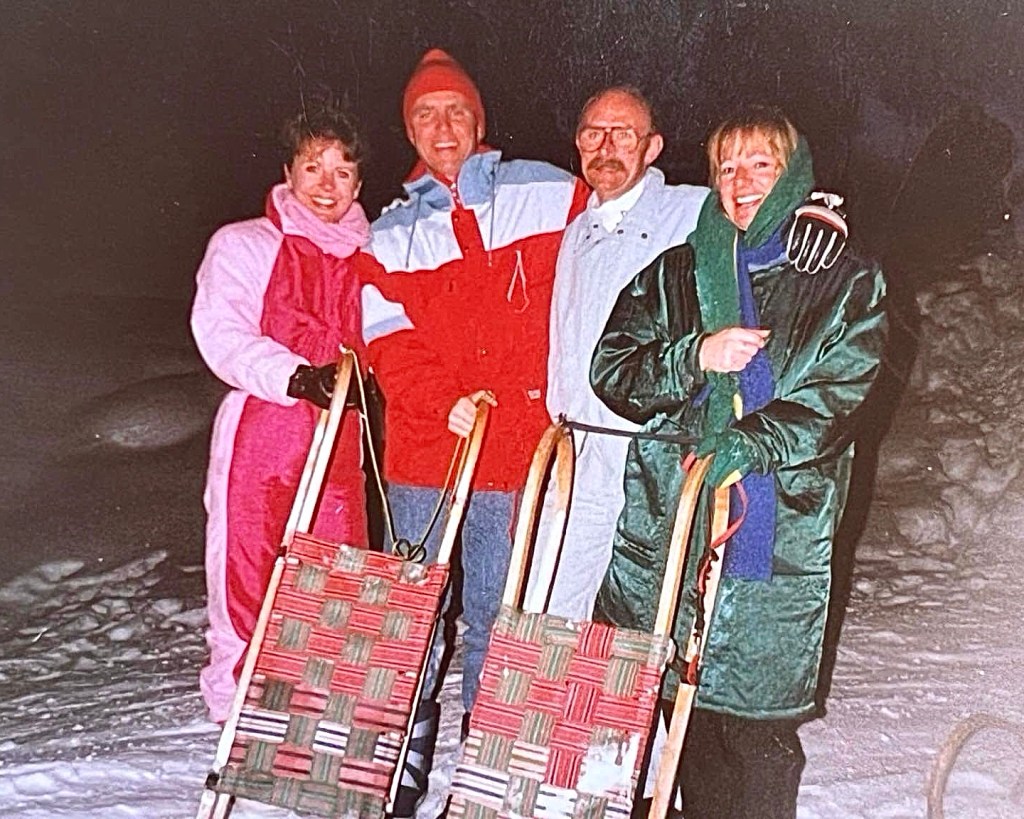
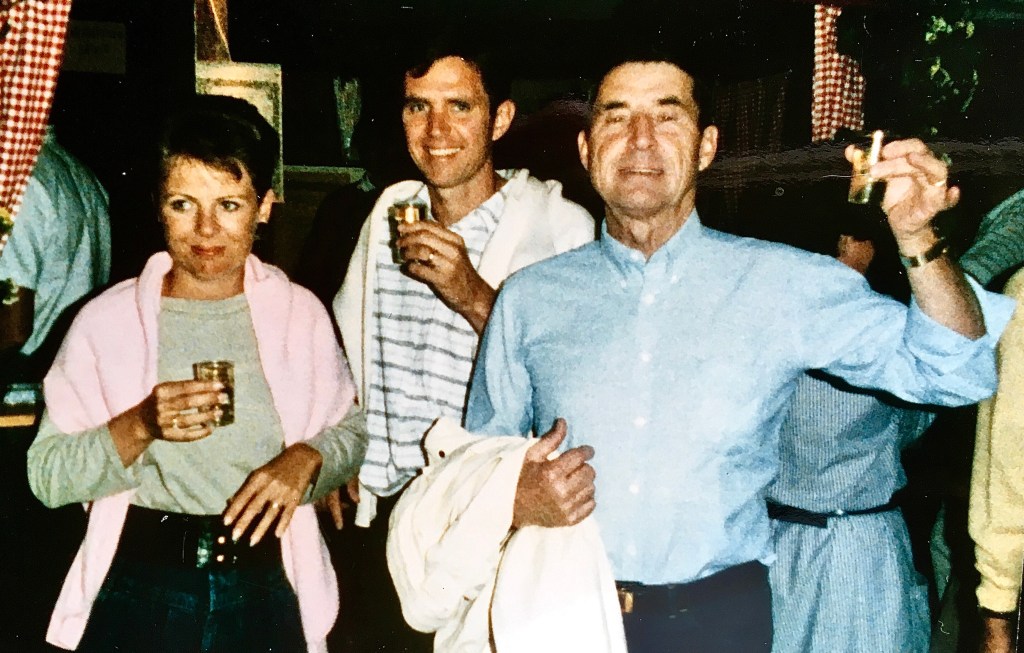
Good Times With Jim and Res on One of Our Ski Trips.

In ‘88, Jim and Res couldn’t get away, so we decided to go on our own and try a new location. We eventually settled on Ischgl, a village in Austria’s Paznaun Valley with nearly 150 miles of groomed downhill trails. It’s also known as something of a party town with a multitude of Après-ski bars, clubs and restaurants.

We had a great time that week and the town lived up to both its ski and Après reputation. We would ski in the morning, have lunch and a bier at a restaurant on the mountainside, and then ski all afternoon. Eventually, we skied our way back to town and stopped at different places for a drink. Afterwards, we walked to our Gasthaus, cleaned up and went out for dinner, and maybe dancing later. Finally, we’d make it to bed, sleep like the dead, and then do the same thing the next day. It was wonderful, and an easy thing to do when in your early thirties.
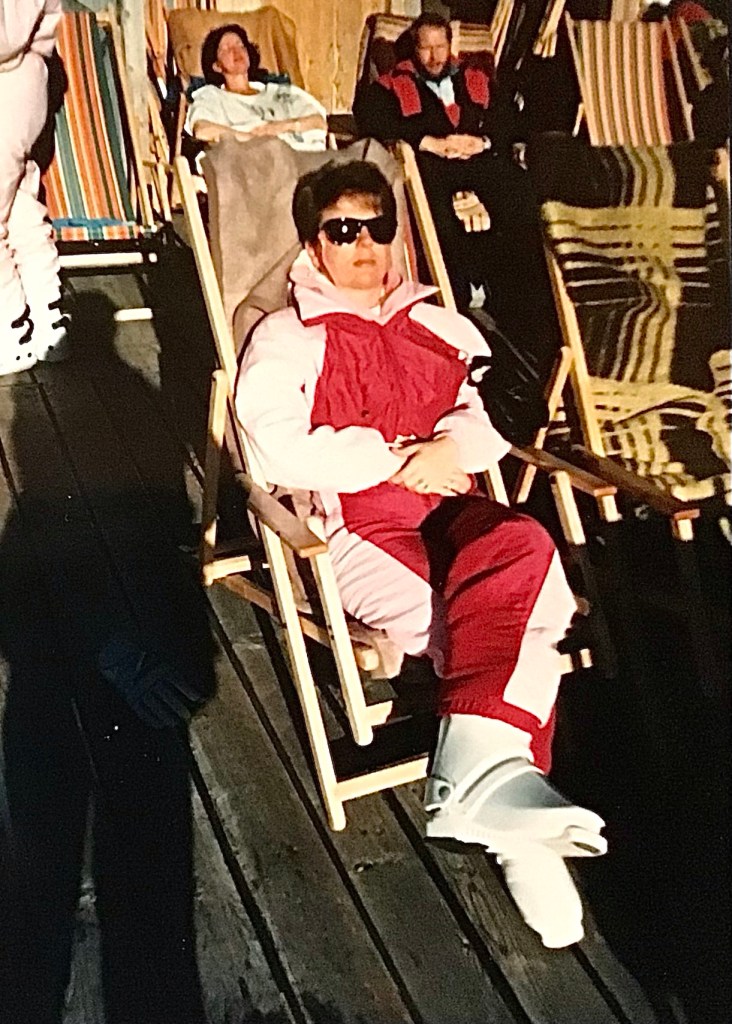
Cathy Catching Some Rays on the Slope at Lunch One Day

We learned we could ski from Ischgl, across the border and into the duty-free town of Samnaun, Switzerland. As the crow flies, about 10 kilometers separate the two towns, but It’s farther when skiing. Looking at the map, the route was a combination of ski lifts and Blue and Red trails. (in Europe, Blue are considered easy and Red are intermediate trails). Although we didn’t need passports to enter Switzerland, we would need them to re-enter Austria. We decided to give it a go the next day and have lunch in Samnaun, before returning to Austria.
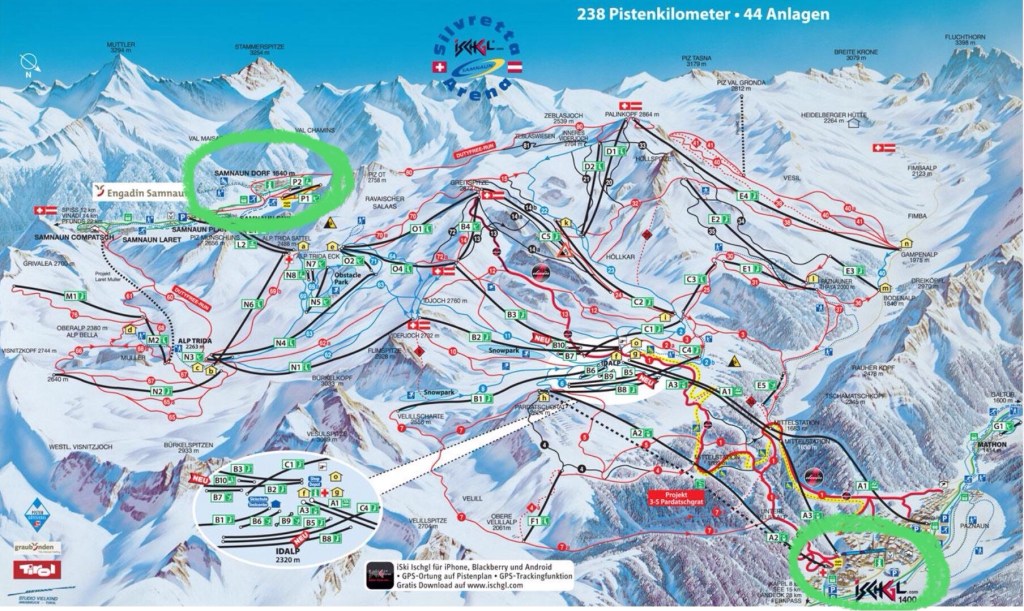
Ischgl on the Right. Samnaun on the Left.

It was a perfect day with a blue sky as we started towards Samnaun. Through a combination of skiing and a couple of chairlifts, we arrived at the red trail heading into Switzerland. As we descended, it was nice skiing, but then we came upon an icy, relatively steep cat-track, connecting on its far side to a steep descent to the village of Samnaun. Several people stopped there gathering their breath, before continuing. The mountain was on the right side of the track. On the left side, the ground dropped rapidly away into an unskiable valley. As we were watching, many people had problems on the ice and were falling, so some caution was warranted. We were about ready to go when someone came zooming down the slope from above, cut his skis into the snow and ice to turn onto the cat-track and… the skis didn’t grab the ice. Instead of turning, he shot off the side of the mountain, traveled through the air for about 40 feet, and then landed 20 feet below the trail in the snow. Hmmmm.

That caught our attention, particularly Cathy’s. The guy was OK, but now needed to find one of his skis and then climb back up the side of the valley to reach the trail. He couldn’t ski out from where he was.

We watched awhile longer, and then I said to Cath it was time to go. She disagreed and wanted to wait a little longer. More time went by and Cathy still wasn’t quite ready. Finally, I said something like “We can’t stay here, and we can’t go back up. The only way out is down the cat-track.” Eventually we started and slowly made our way. Cathy reverted to snow-plowing and her edges grabbed on the ice. After what seemed like forever, but in reality was probably two or three minutes, we made it past the cat-track. A few people were crashing and burning around us, but we had nary a fall. All that was left was the final descent.

We stood there congratulating ourselves and I pulled out my flask for us to share a short shot of brandy. I filled the cap about half full and handed it to Cathy. She looked in the cap and said, “Really? Do you think I could have a double?!” We both laughed and I filled the cap to the brim. She shot it down, handed it back, and took off on the final descent into Samnaun. After pouring myself a short one, I put away the flask and tore after her, eventually catching up. While the slope was a little steep, the snow was good and we arrived in town without mishap.
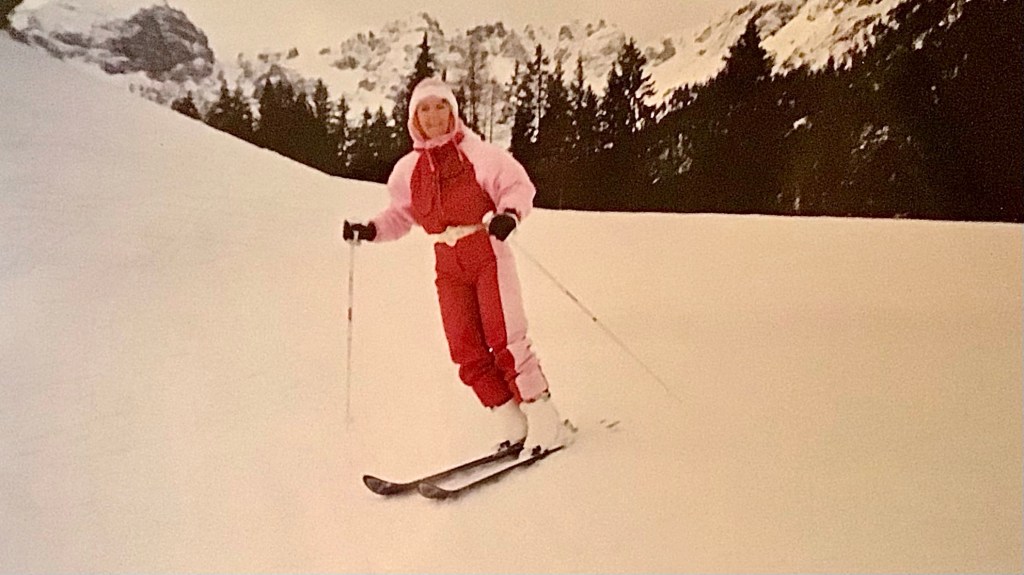
Cathy on the Slope.

We took off our skis and found a nice looking Gasthaus. I don’t remember what we ate, but the bier we drank with lunch tasted awfully good. After lingering a while and doing a little shopping, we took a cable car back up the mountain. Following a short ski, and then an additional chairlift ride further up, we arrived at the border crossing into Austria, where we dutifully presented our passports.

Once through customs, we skied down the slope into Austria. We made a couple more runs, and decided to call it quits. It had been a tiring day.

We skied into town to a bar/restaurant we discovered earlier in the week, and after stacking our skis outside, walked in. The place was quite crowded. We found a small table, settled in, and ordered biers along with a couple of Poire Williams*, a French eau de vie (we called them Poor Willies).

As we sipped our biers, the band began playing and their first song was The Stones’ “Satisfaction”. We, along with half the crowd, jumped on the dance floor and started dancing in our ski boots. As we were dancing, the crowd, a mishmash of Austrians, Germans, French, Dutch, Italians and others from who knows where, were all singing at the top of their lungs “I CAN’T GET SNOW… SATISFACTION!” It was one of those perfect moments you can never replicate, but forever remains clear as a bell in your mind’s eye. To this day, I feel my boots hitting the floor in time with the music, hear the crowd singing to “Satisfaction” and see the look of laughter and love in Cathy’s eyes.

Eventually it was time to leave. We went outside to find our skis and make our way home. As we were standing there, Cathy grabbed her crotch with one hand and started pulling at her clothes. I burst out laughing and said, “What the hell are you doing?!” She looked me straight in the eye and answered, “I am adjusting my balls. I kicked that slope’s ass today!” With that, my wife threw her skis over her shoulder and started walking home.

Addendum:

  • Poire Williams is the name of a French eau de vie (literal translation – “water of life”), a clear brandy made from pears. Poire is the French word for pear, while Williams is the type of pear. In Germany and Austria, they make an equivalent bottling called Williams Birne Schnaps. Both are strong, and nothing like the peppermint schnapps we know here in America. Depending on the quality, you might either sip or shoot it.
Dad and Pearl Harbor

Dad and Pearl Harbor

It was December 6th, 1941. Dad, Noble and other men from B Company, 60th Regimental Combat Team of the 9th Infantry Division had weekend passes. They left Fort Bragg, North Carolina that Saturday for nearby Fayetteville. They didn’t know it yet, but the next day their world would change forever.

That weekend, Dad was a little over 18 years old and had been in the Army for about fifteen months. The 9th Infantry Division reactivated in August of 1940, and Dad joined the unit in September of that year, at the age of 16.

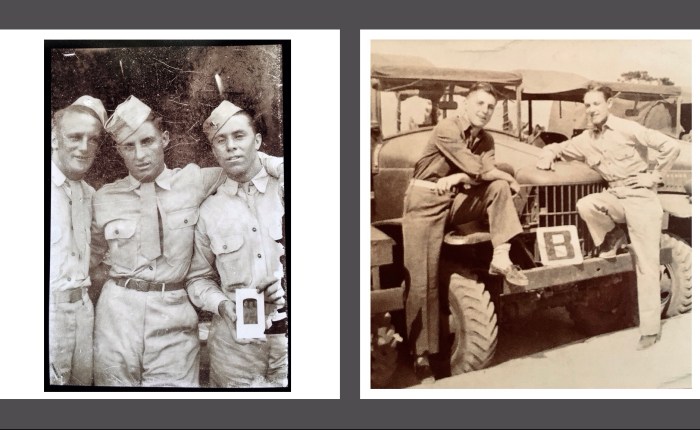
Dad (on the left) in 1941 in the Bravo Company Motor Pool.

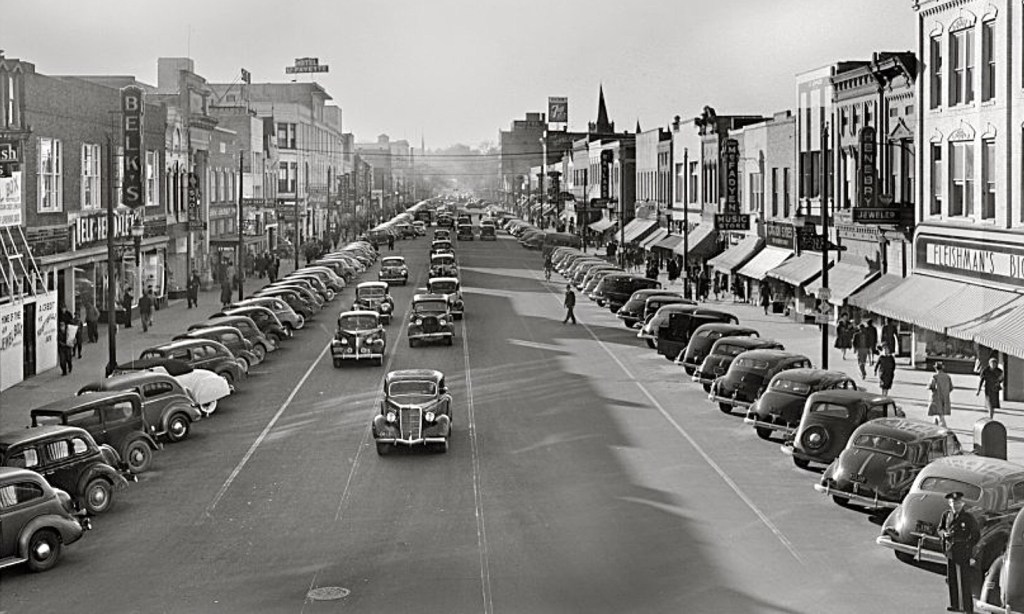
In 1940, the population of Fort Bragg was 5,400. One year later, there were 67,000 troops at Bragg and Fayetteville was on the way to becoming a military town, with bars, clubs, restaurants and everything needed to “entertain” the troops, for better or worse.

Fayetteville, 1941.

Dad and the other boys of Company B received their weekend passes that fateful weekend and probably left Bragg around noon. Typical weekend passes went from noon on Saturday to 6PM on Sunday. They usually rented a room or two to use as a base for their partying. Over the years, he told me about some of those weekend passes. Real food, beer, clubs, blues, jazz, dancing and trying to link up with girls. They’d party into the night, and then the next day, after a big breakfast, party some more until they eventually returned to Post. I heard stories about fun times in North Carolina (Fayetteville and Charlotte) in Tunisia and Algeria, and late in the war back in Washington DC. Let’s just say, Dad knew how to party.

For this particular weekend, he didn’t tell me about any of that. What he talked about was the return to Fort Bragg late Sunday afternoon on December 7th.

Dad and several others were returning to the Post in a cab. I think he said there was a formation at 6PM for accountability purposes, but maybe they just had to sign back in. He and his friend, Noble, had partied it up pretty good and were a bit hungover. As they neared Fort Bragg, two things happened. First, traffic was backed up to drive onto the Post – they were checking IDs or checking IDs more closely than normal. Second – the cab driver turned on the car radio.

By 1940, AM radios were considered a standard feature in automobiles. The stations carried news, some radio shows and music. There weren’t lots of stations, and the programming wasn’t all that varied. This time however, the boys of Company B heard the words that would change their lives. An NBC announcer read the following statement, relayed earlier from station KGU in Hawaii:

  • BULLETIN: We have witnessed this morning the attack of Pearl Harbor and the severe bombing of Pearl Harbor by army planes that are undoubtedly Japanese. The city of Honolulu has also been attacked and considerable damage done. This battle has been going on for nearly three hours. One of the bombers dropped within fifty feet of Tanti Towers. It’s no joke -it’s a real war. The public of Honolulu has been advised to keep in their homes and away from the army and navy. There has been severe fighting going on in the air and on the sea …(There then was an interruption, followed by this) . . . We have no statement as to how much damage has been done but it has been a very severe attack. The army and the navy, it appears, now has the air and sea under control.

There is a five-hour time difference between Honolulu and the East Coast. The attack on Pearl Harbor started at 8AM and lasted about 90 minutes (not the three hours in the news bulletin). That means the attack ended about 9:30AM Honolulu time, or 2:30PM East Coast time. The Honolulu station was somewhat delayed in reporting the news, and then of course, in the pre-internet age, it took longer for stations in the Continental US to pick up the bulletin and rebroadcast it. My guess is Dad, Noble and the other guys were hearing this news around 4:30PM or so that afternoon.
What did they do at this point? Wait in the cab to drive onto Fort Bragg? Get out of the cab and run onto Fort Bragg? Leave the cab and start talking with the other gathering soldiers? None of those things happened.

Instead, they directed the cabbie to make a U-Turn and drive back to Fayetteville. They were going to hit the bars again, even though they would be Absent Without Leave (AWOL) and miss the evening formation. They knew instantly this was going to be a shooting war, training was going to get tougher and opportunities to leave Post become slimmer. They weren’t going to miss this chance for a last shebang.

Dad and Noble in ‘41 or Early ‘42 on a Different Weekend Pass.

And of course, when they returned to Fayetteville, they weren’t alone. Soldiers were everywhere drinking and partying. I think Dad said he thought half his battalion was in town. They joined the crowd and partied into the evening. There was a great deal of talk about when and where they would deploy.

Eventually, they returned to Bragg late that night. According to Dad lots of guys had hangovers at morning formation on Monday, December 8th, but nothing was really done about them missing the evening formation. There was too much work to do.

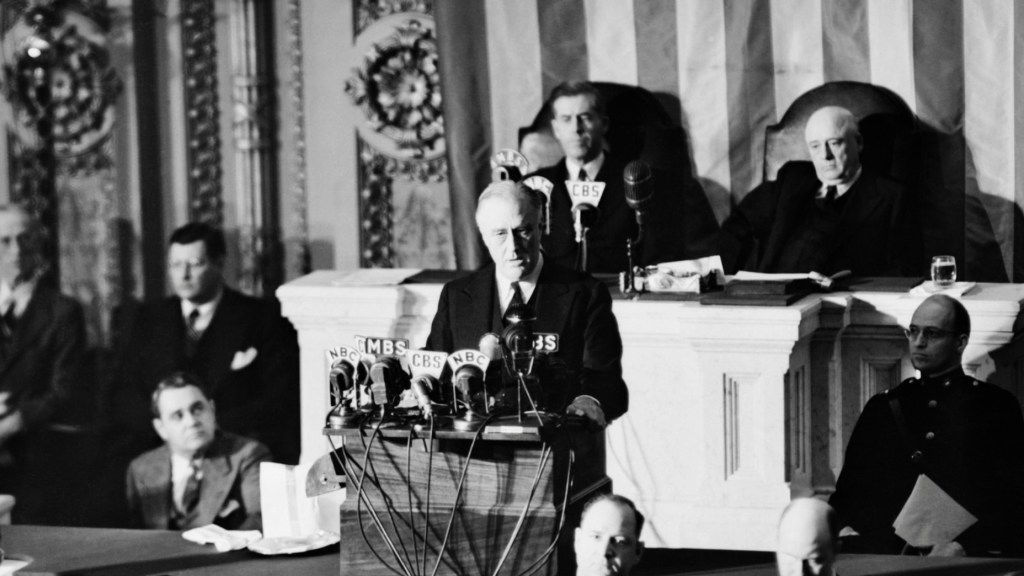
On the evening of the 8th, President Roosevelt gave his famous “A Day which will live in Infamy” speech to a joint session of Congress. The speech was broadcast live by radio and attracted the largest audience in American radio history, with over 80% of Americans allegedly tuning in to hear it.

President Roosevelt Speaking to Congress on Dec 8, 1941.

Eleven months to the day later, on November 8th, 1943, the men of the 60th Regimental Combat Team, including Dad and Noble, landed on the beach under fire in North Africa at Port Lyautey, Morocco as a part of Operation Torch. The counteroffensive had started against the Axis powers in the European Theater of Operations.

When dad joined the Army in 1940, it was for a three-year hitch. It would be 5 years before he was honorably discharged in August of 1945. He took part in the invasions of North Africa and Sicily, where he was wounded and almost died. I think partying several extra hours on the evening of December 7th was probably justified.

Never Forget

Addendum:

  • In 1940, the population of Fort Bragg was 5,400. By the following year, it reached 67,000. Various units trained at Fort Bragg during World War II, including the 9th Infantry Division, the 82D Airborne Division, the 100th Infantry Division, the 2nd Armored Division and various field artillery groups. The population reached a peak of 159,000 during the war years. This past year, Fort Bragg was renamed Fort Liberty.
  • Here is one other Pearl Harbor blog I’ve done: The plaque is only a small one, over in front of The South Ottawa Town-Hall on 1st Avenue. The Hall is still used for occasional meetings, but 1st Avenue is pretty sleepy in that area, so I don’t know how many people actually ever see the plaque. When I walk by, the words always compel me to stop. And think. And remember … Herman Koeppe was 19 the day he died […] https://mnhallblog.wordpress.com/2016/11/30/never-forget/

Cranberries à la Dad

Cranberries à la Dad

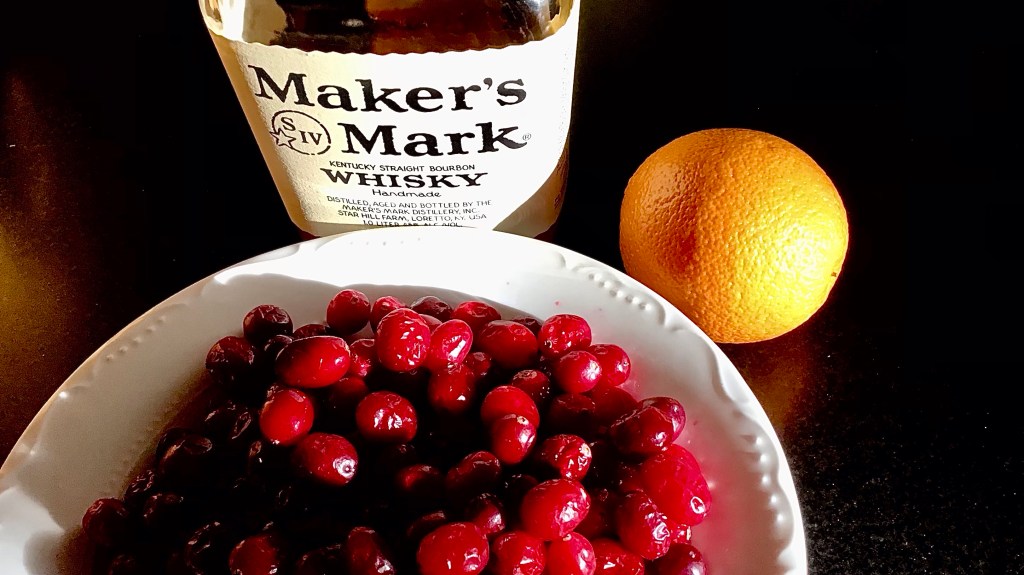
Thanksgiving, that truly American holiday, is approaching and started me to thinking about Dad and his Cranberry Sauce. It’s a great recipe filled with bourbon, cranberries, shallots, orange zest and memories. I love the fact that I get to spend a little time with Dad whenever I make it.

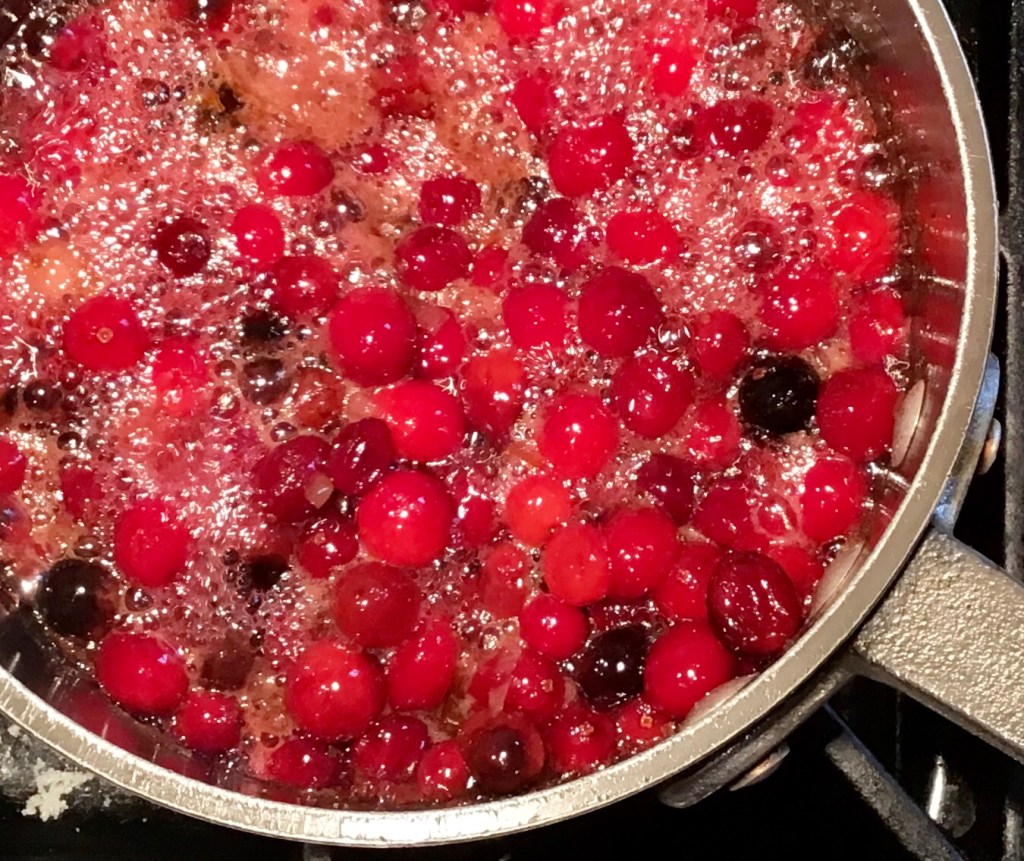
Cranberries, Bourbon, Orange Zest and Shallots…

Growing up in the Hall house in Ottawa, Illinois, Thanksgiving and Christmas were nearly identical meals – turkey, dressing, oyster dressing, mashed potatoes, candied sweet potatoes, corn and green bean casserole. The desserts – pumpkin pie, mincemeat pie and if we were lucky, strawberry-rhubarb pie, were all made by my Aunt Marge, a wonderful baker. Sometimes we would have a cherry pie from Aunt Diane – the cherries were from a tree in her yard. For snacks ahead of time, there were black olives and pickles (when young, my sisters put the olives on the ends of their fingers and then ate them off). There was cranberry sauce served as well – sliced out of the can.

I remember both meals as large loud affairs – Grandma, uncle Don and aunt Diane and their kids would be there. Various uncles or aunts stopping by for a slice of pie and cup of coffee after their own meals. Roberta and Tanya’s friend Marsali would inevitably stop over. Later when we were older my buddies Howard and Tim stopped in for a drink (to settle the stomach) after their own dinners.

Both meals were delicious and mostly made by mom. The kitchen was her domain. She often joked she actually spent more money on the oysters for the oyster dressing than she did on the turkey, and that’s saying something. I never thought to ask why we had exactly the same meal for both occasions and was somewhat shocked when I later learned other families served steaks or some other non-turkey meal for Christmas.

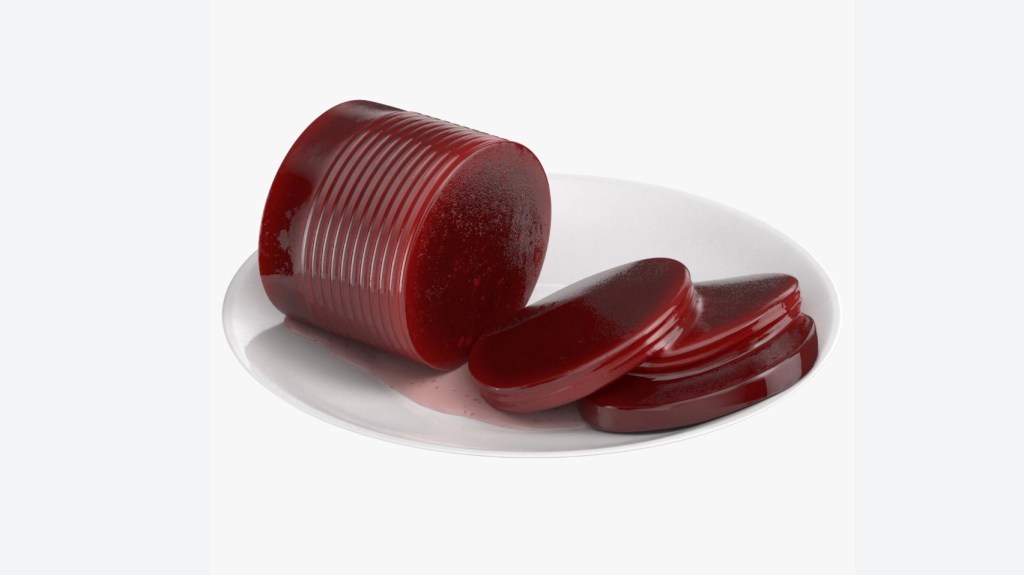
Everything for both Thanksgiving and Christmas dinner was homemade – except for the cranberry sauce. Growing up in the midwest, I think that was fairly typical – canned cranberry sauce, sliced into equal, perfectly round slices.

Sliced Cranberry Sauce. Please, No Judgement.

That changed one year, probably around 1984 or so when Dad retired from work. After he retired from the railroad, mom continued to work another seven years until she reached retirement age. As a result, Dad took over much of the cooking at home.

Cath and I were home for Christmas that year and dad had a surprise for us – homemade cranberry sauce! We all oohed and ahhhed over those cranberries and how good they were. Now mind you, mom was still making the entire rest of the meal (with help from my sisters by this point in time), but Dad now had his contribution as well. I think it came from a Bon Appétit recipe he tweaked slightly.

And so, Cranberries à la Dad became a part of the tradition for both Christmas and Thanksgiving.

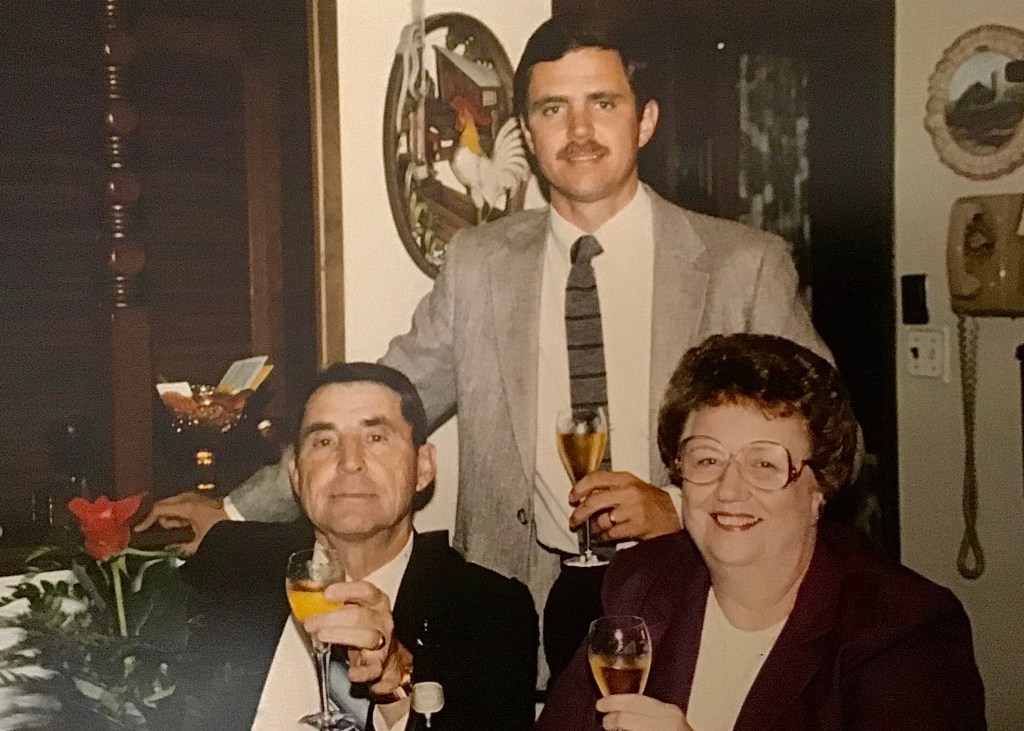
Mom, Dad and I around the Time He Started Making his Cranberry Sauce Recipe.

It’s carried on at Cath’s and my home for Thanksgiving as well, although these days, we are having Thanksgiving with friends at their homes as often as not. The recipe is easy to follow, and cooks quickly. Still, I enjoy the few minutes it allows me to spend with Dad. As I smell the bourbon reducing and hear the snapping and popping sound of the cranberries opening, I reminisce and think about the good times we enjoyed with Dad over the years. It’s not a bad way to spend a half hour or 45 minutes.

You can Hear the Cranberries as They Sizzle and Pop While Opening.

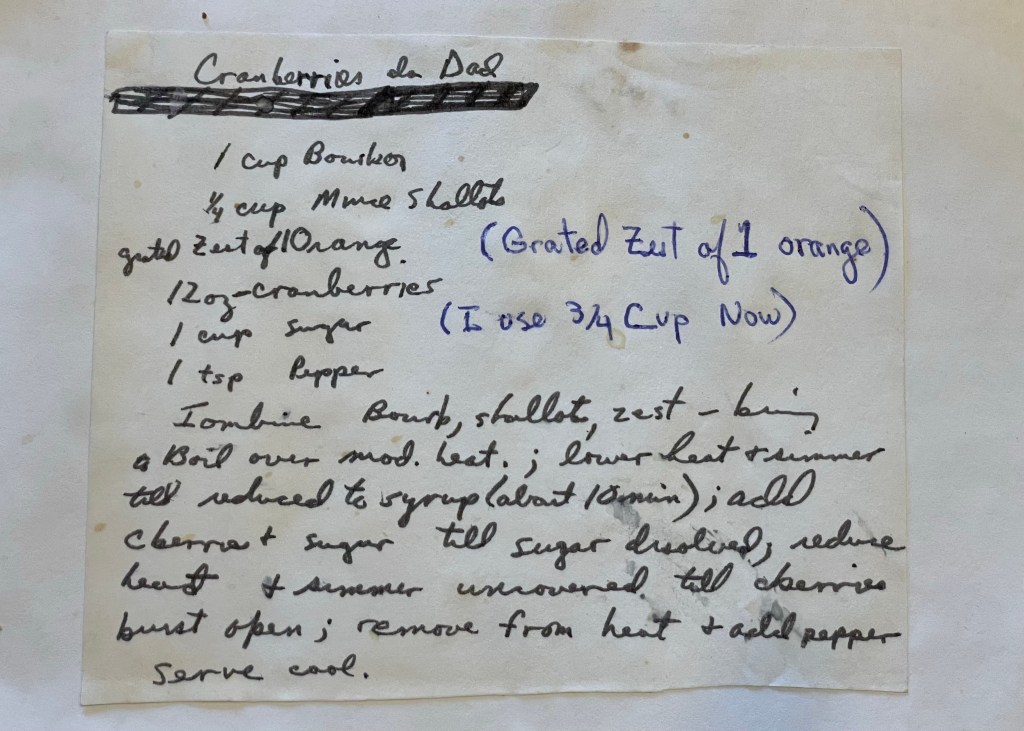
Here’s the recipe. You have plenty of time before the big day to buy the ingredients. I usually make it the day before Thanksgiving while sipping on a small glass of bourbon, but the morning of works as well, if there’s room for you in the kitchen. For a chunkier look, don’t let all of the cranberries burst. Cranberries, bourbon, shallots, orange zest and memories – it’s a recipe that works.

Enjoy!

Addendum:

  • Thanks to my sisters, Roberta and Tanya, for their input to this blog. It’s always great to share memories with those you love.

Developing A Wine Palate

Developing A Wine Palate

Do you know the best way to develop your wine palate? Drink more wine. I believe Cath and I have that covered. We began drinking wine together (legally) in 1974 when she started working for the FBI in DC. Seriously. We’ve had more than a couple of bottles together in the past fifty years.

After Cathy moved to DC in 1974 to work for the FBI, I’d visit from West Point for the weekend. If we were doing a “special” night out, we’d always order a bottle of wine. I think we felt more like adults. Now mind you, neither of us owned a car, and metro wasn’t here yet. We’d take a bus from her apartment to Old Town Alexandria and usually go to The Wharf, one of the nicer restaurants in town. After a seafood dinner and bottle of wine, we’d dutifully wait for the bus and take it back to her apartment. ;-). A taxi was out of our price range.

Our real wine education came after we married and were stationed in Germany in the ‘80s. Yea, we drank a lot of good German bier, but we drank our fair share of wine as well. Not only dry German and Austrian whites, but also French, Spanish or Italian reds when we traveled to those countries. Spending nine years in Europe significantly broadened our exposure to what wine could be.

Cath, Dad and I at a Weinfest in Germany around 1987.

Returning to the States in ‘89, we discovered California wines, which we’d pretty well ignored before then. Cabs, Merlots, Zins and eventually Pinot Noir’s – Our taste buds grew once again and sometime in the ‘90s we installed our first wine rack, which held about 110 bottles.

After moving to the farm in ‘99, we renovated the kitchen around 2005 and put in a wine cooler – we could store 250 bottles in it, which seemed like a pretty reasonable number. Except it wasn’t. And so…

In 2011 we discussed putting in a wine room with a separate chiller. To be honest, I think Cathy was feeling a bit guilty about the money we were spending on her horses and she readily agreed we needed a cellar. Of course, she would benefit from the cellar as well. And so, we bit the bullet and installed it.

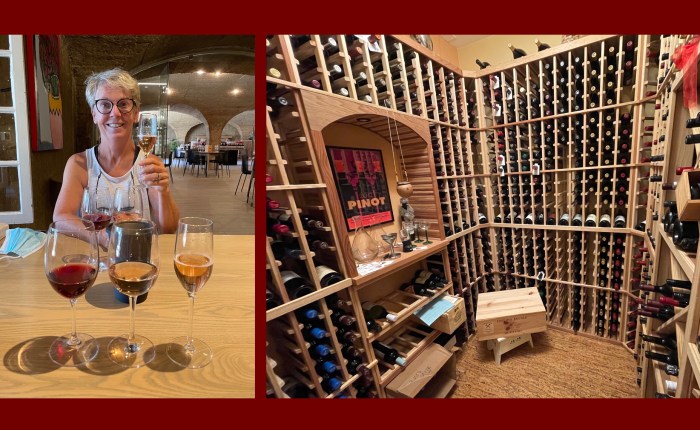
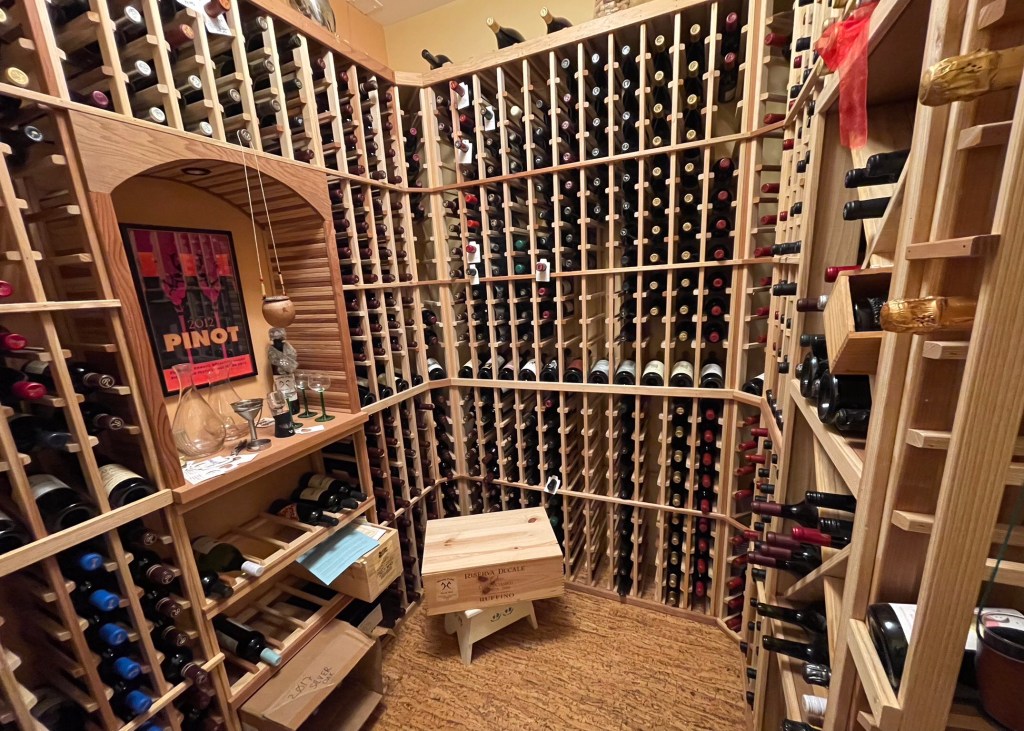
The Wine Cellar – Not quite at Capacity.

Our cellar holds around 950 bottles, although if you wanted to stack cases on the floor, you could add another 200 or so. I’d point out this is a drinking cellar. This isn’t a cellar for storing trophy wines. Everything in the cellar is meant to be consumed … over time. It’s stocked to our tastes. You’ll find sparkling wines, Virginia wines from a couple of our favorite vineyards (Linden and Glen Manor); California Pinots, Merlots, Cabs, and Zins; French, Italian, Sicilian, Spanish, South African and Portuguese reds; whites from a number of locations in the States and France; and some dessert wines. There’s a bottle of Georgian wine in there somewhere (the country, not the state). There are a couple of bottles from the late ‘90s, and then probably just about every year from 2000 to the present. We like the cellar and we like the inventory. We enjoy putting a dent in it with friends.

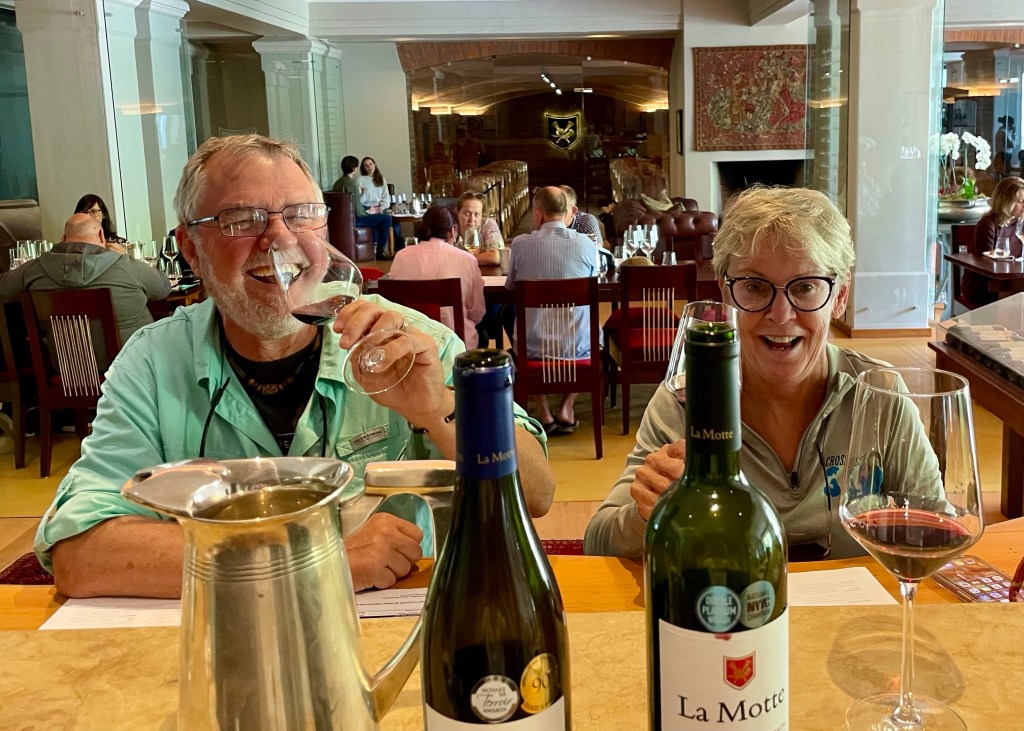
Wine Tasting in South Africa.

Now here’s the funny part. Although the cellar is ostensibly mine, Cathy has a palate that blows mine away. She’s much better in blind tastings at guessing the grape and where the wine is from. She recognizes the flavors and can talk about them. And if a wine has turned bad or is corked? She can tell just by smelling the wine before she’s even taken a sip. These days, when we go out to dinner and order a bottle of wine, I usually just tell the waiter or sommelier to let her taste the wine. She’s really good.

I suppose we’ve consumed thousands of bottles of wine over the last fifty years – at home or in restaurants; on picnics and vacations; at wineries; and of course with friends and family. There are lots of good memories associated with those bottles and gatherings.

Good Memories. Always.

In vino veritas”, is a Latin phrase that means “In wine, there is truth”. The truth is we are still improving our palates, one bottle at a time.

Cathy says life is too short to drink bad wine. I think I agree.

Two Answers for Bruce

Two Answers for Bruce

After first hearing the questions asked in 1976, I have two answers for Mr Springsteen – Yes, love is wild, and yes, love is real. September 29th of this year, Bruce was to play here in DC at Nats Park. Although I’ve previously seen him four times, we couldn’t make this show.

When I was a cadet at West Point, there was a group called the Dialectic Society that brought numerous acts to perform at Eisenhower Hall, which had an intimate setting and great acoustics. Peter Frampton, Seals & Croft, Linda Ronstadt, The Pointer Sisters, KC & the Sunshine Band, Kenny Loggins, America, James Taylor (actually substituting for Carly Simon), The J Geils Band, Kool and the Gang, Mountain, Sha Na Na, Tommy James and the Shondells, the Nitty Gritty Dirt Band – they and many others all appeared there.

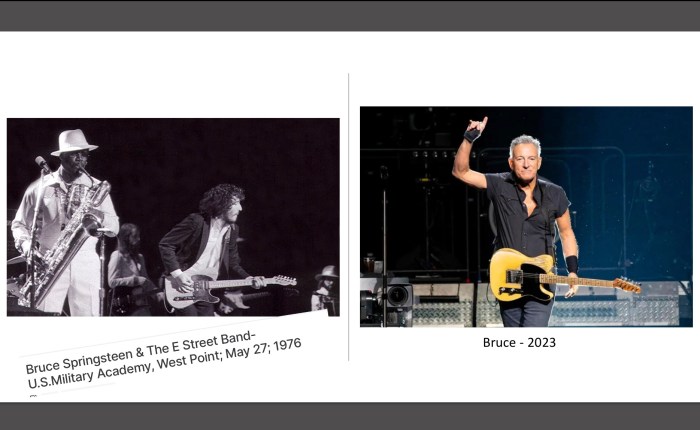
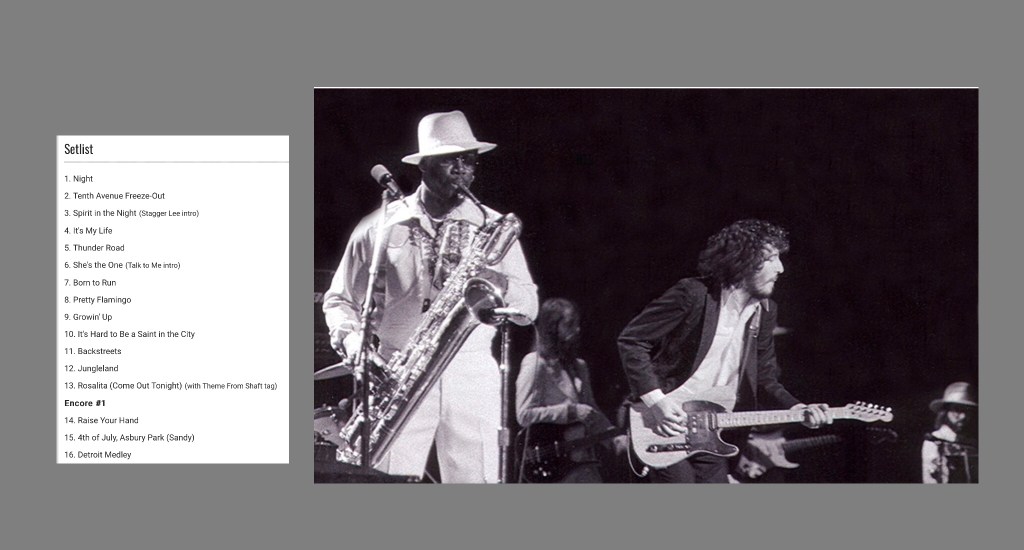
Bruce Springsteen appeared on May 27th, 1976 at West Point. This was during a mini–East Coast tour, after the Born to Run tour in 1975/76. It’s funny, I remember the show, but don’t remember being blown away by him. The music was good, and of course the “Born to Run” album was great, but hey, it was only one album. No one knew at the time he would still be around almost 50 years later.

Bruce at West Point, Along with the Set List.

Years went by and I bought the albums “Nebraska” and “Born in the USA” when they came out, but that was probably the extent of my Springsteen fix at the time. That changed on July 12th, 1988 in Frankfort, Germany. Cath and I, along with several others, took the train from Worms to Frankfort for the show. He was doing the “Tunnel of Love” tour at the time.

Unlike the show at West Point, this time I was blown away. He played for hours – 3 1/2 I think. The show was amazing and went on forever. New songs, classics and everything in between. The show went so long we actually had to leave during the second encore in order to catch the last train to Worms for the night. I remember hearing “Thunder Road” OUTSIDE the stadium as we were walking to the train station.

After returning to the States, Cath and I saw him two more times. Once in ‘92 at the Cap Center for the Human Touch tour, and another time in downtown DC in the late ‘90s. Both shows, as with Frankfort were long – again over 3 hours. NOBODY did three hour shows.

Springsteen’s music is great of course, but what draws me to him are his lyrics. He’s a wordsmith and knows how to tell a story. “Born to Run”, “The River” (Maybe my favorite Springsteen song), “Born in the USA”, “One Step Up”, “Dancing in the Dark”, “Glory Days”… you really need to listen to the words to see the pictures they paint. While the music may sound cheerful, the words often aren’t. I always chuckle at the people who love “Born in the USA”, but don’t really understand the story the lyrics are telling.

Bruce and John Mellencamp a Couple of Years ago. Note Bruce Sporting a West Point Athletic T-Shirt From his Performance at West Point.*

Years after the original version of “Born to Run”, Bruce did an acoustic interpretation. Slowing it down gave the song a whole new meaning. You can feel the weariness settling in. Maybe at that point he too knew the answer to the questions about love and whether it was wild or real for himself, but didn’t really like the answers.

The tour this year generated controversy with ticket policies and pricing. Springsteen’s comments at the time didn’t really help him. Having said that, it’s not why we are missing this show. We have too much going on these days, AND it’s been a while since I’ve seen any stadium rock concert. Sometime in the future? Maybe. In the meantime, I’ll continue to listen to his music at home and ponder the stories he tells, and the questions he asks.

Addendum:

  • * My friend, Donna Matturro McALeer, West Point class of 1987, first noticed the photo of Springsteen in the West Point athletic shirt. It was a couple of years ago when he was working with John Mellencamp. She did some research and it turns out there were two Bozeks (brothers) in the class of ‘79. It would have been the end of their Plebe year when Bruce played West Point. She checked in with Greg Bozek in Sept ‘21 when the photo first appeared. He had no idea how Bruce may have ended up with the shirt. Interestingly, Greg and the boss share the same birthday.
  • Note: In September, Bruce Springsteen and The E Street Band postponed all performances scheduled for the remainder of the year. He is being treated for symptoms of peptic ulcer disease and the decision of his medical advisors is that out of caution, he should postpone the remainder of his shows this year.

Illinois Militia – 1984

Illinois Militia – 1984

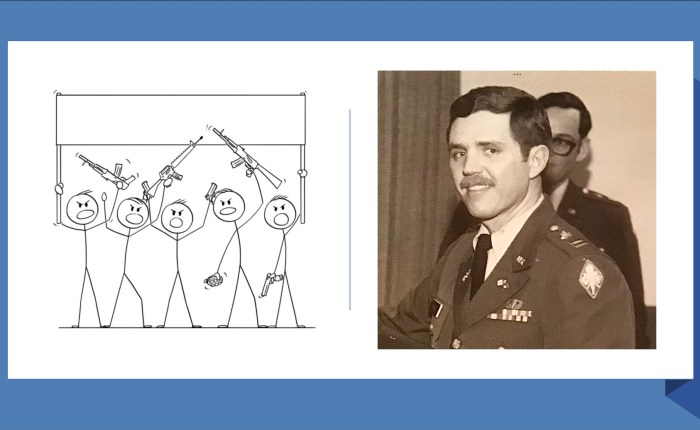
In 1984, Cath and I were back home in Ottawa for her 10-year high school reunion. I was waiting in line for a drink when a guy approached me. “Hey, aren’t you Max Hall? Didn’t you go to West Point?” I answered, “I am and I did. Why do you ask?” “I’m Joe xxx. We would love to have you come talk with our local militia.” What?

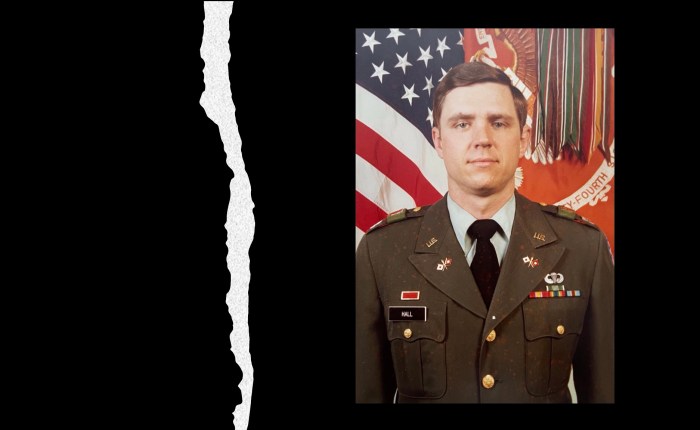
I was a Captain in the Army at the time and had recently returned from four and a half years in Germany with 3ID and VII Corps. Cath and I were stationed in Ohio and returned to Ottawa for the weekend of the reunion.

Me, About the Time of the Encounter 1984 or ‘85.

Me: “Sure. Where’s the National Guard meeting these days, and what kind of unit is it?”

Joe: “Oh no. We aren’t with the National Guard. We started a private group as a militia. We fire our guns on weekends and do some tactical training. We want to be ready to fight the communists.”

Me:

Joe: “It would be great if you came out to meet with us and give us a talk. I think you could provide some real inspiration!”

Me: “Really?! Where do you all meet?”

He gives me a location south of town in the country.

Me: “Hmmmm. That’s great, but rather than meet there, I think we should meet on LaSalle Street, not far from Bianchi’s Pizza.”

Joe: “Really? Why there?”

Me: “We could go the Army recruiter’s office on LaSalle Street and get you guys signed up. We are always looking for a few good men!”

Joe: “What?!”

Me: “We could meet at the Army recruiter’s office. We are always looking for a few good men to enlist. If you really want to fight the communists, we could use you. I’ll be deploying back to Germany in a year. We could probably even work it out for you to join my unit!

Joe:

Me: “That’s what I thought. See you later and quit bothering me… Bartender – I’ll have a gin and tonic please.

Yep. Those militia toy-soldiers who always say they are going to defend our country were around 40 years ago as well. They are still eager to play soldier these days, as long as they don’t have to do anything to, you know, actually defend our country as a soldier.

*** Feel free to share this blog. ***

Addendum:

  • I don’t recall Joe’s actual name. I just remember that he was in Cathy’s class and I knew him some from high school.

Tim and Bobby’s Visit

Tim and Bobby’s Visit

In the ‘80s when we lived in Germany, several family members and friends visited us. To “help” them overcome jet lag, we made sure the first couple of days were action packed with eating, drinking and activities to keep them occupied. It almost proved one friend’s undoing in 1987.

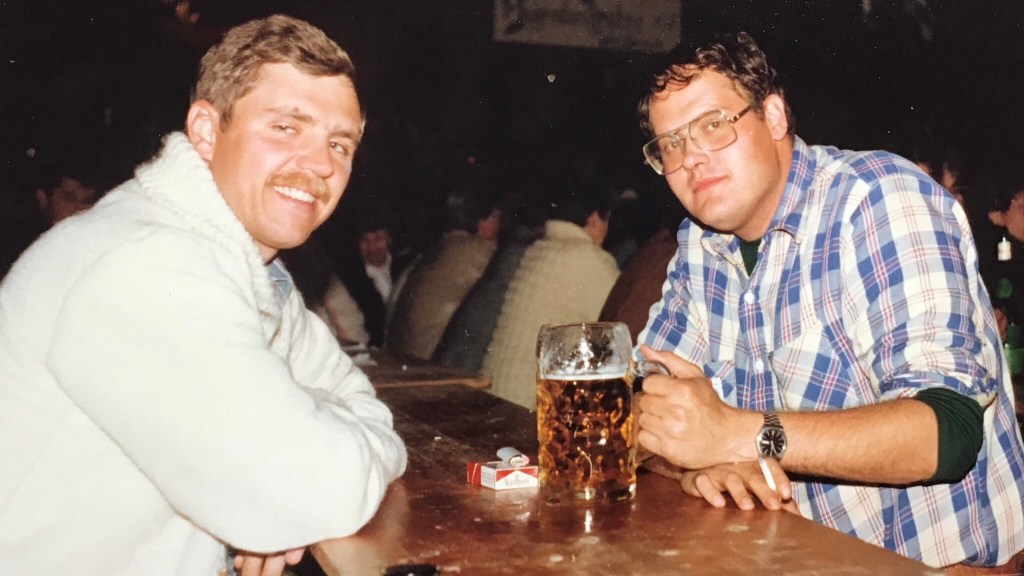
Our old friend Tim visited us several times while we were stationed in Germany. In 1987, he asked if he could visit and bring his friend/work buddy Bobby along. They planned to visit us, and then tour parts of Germany, Austria and Northern Italy, eventually arriving back in Germany for Oktoberfest in Munich. We of course said yes and looked forward to their arrival.

Tim and I at a Bierfest during a different visit.

They flew to Dusseldorf one morning in September and then took the train to Worms where we picked them up. Tim recently recalled the train paralleling the Rhein River for part of the trip, when all of a sudden the train shook a bit. He looked out the window and saw two F15s flying low, following the path of the Rhein as well.

After arriving at our home in Rheindürkheim, we ate lunch. Tim and Bobby may have slept for a couple of hours, although I don’t remember for sure. Later, we gave them a tour of town and walked along the Rhein River. That night, we went out for dinner at a local Gasthaus (pub) called Sportheim. We knew the owners, Vroni and Wolfgang well, and Tim knew them from a previous visit. It’s safe to say they greeted Tim like a long lost relative. It was a great evening and Bobby joined right in. We spent several hours at Sportheim and after many biers and wines, eventually made our way home. We may have drunk a brandy or schnapps, before making our way to bed and a good night’s sleep.

The next day, amazingly, none of us were the worse for wear. After a hearty breakfast with some good German bread, sausages and cheese, we drove around to show Bobby the area. We went into Worms, the city where Martin Luther made his famous statement “Heir stehe ich” (here I stand) before the Imperial Diet in 1521. Basically, it’s where and when Protestantism started.

That evening, we had a special treat in store for the guys. The Rheindürkheim Feuerwehrfest (Fire Department Festival) was going on in town. There were about 1,000 residents in Rheindürkheim and a majority of the adults would be at the Fest. It was a classic German wein festival with a huge tent, oompah band, dance floor and lots of adult beverage.

We made our way to the fest, found some local friends and settled in. Of course we drank our share, and ate brats and other German food, such as curry wurst or roast chicken. We also listened to the music and took turns dancing with Cathy and some of the other ladies in our group. It was a great time. Eventually it was getting late, and the fest was coming to an end. We were going to head home when one of our German friends, Michael, told me several people were going to an after party at the Zenit, basically a local Navy VFW club and wanted to know if we wished to join them. I’d been to Zenit several times and immediately said yes. For Tim and Bobby, it’d be an even greater look at the local culture. Cathy, always the wisest of us two, declined and said she was going home. We left the fest and after dropping Cath at home, walked to Zenit.

Now Zenit was actually a dry-docked ship that was turned into a club. Rheindürkheim, was on the Rhein River and traditionally, most young men of the town served in the Navy instead of the Army. That’s why their “VFW” club-equivalent was in a ship.

The Zenit in Rheindürkheim

As we arrived, we made our way to the bar and bought a couple of biers. I nudged Tim and pointed out a picture hanging in Zenit. Tim’s a history major and I thought his eyes were going to bug our when he saw who it was – Admiral Karl Dönitz*, supreme commander of the German Navy during WWII. Dönitz also took over the German government after Hitler killed himself and it was he was who actually surrendered to the Allies in May of ‘45.

We had a good time at Zenit. The party was eventually winding down when our friend Hans approached me. He and his wife Inge were having an after-after party at their home and wanted to know if we wanted to stop by. Their home was actually on the way back to our house and I again immediately said yes. We joined a group of 15 or 20 people and dutifully walked or stumbled to Hans and Inge’s house.

At Hans and Inge’s there was no oompah music. What was playing on the stereo was the soundtrack from the movie “Dirty Dancing”, released earlier that year. I remember chuckling about it at the time.

I believe they served coffee and dessert for those who wanted it. I also distinctly remember Inge walking around with a bottle of homemade schnapps and pouring people small glasses/shots. Schnapps in Germany is nothing like the sweet stuff we think of as schnapps here in the States. It’s similar to Italian grappa or French marc and can definitely have a rough edge to it. She asked if we wanted some and of course we all said yes. Bobby didn’t yet know about real schnapps. We all toasted with a “Prost”. Bobby took a small sip and may have actually turned green. He looked around and saw a nearby plant, where he discretely poured the remainder of his schnapps.

A bit later, Inge came back by, saw Bobby’s empty glass and refilled. It. At that point Bobby looked at the glass and then leaned into Tim and said, “Tim, I don’t know that I can do this for the whole two weeks.” ;-).

We left a short time later and walked the 3 or 4 blocks home and immediately went to bed.

The next morning, everyone was moving a little slowly and there were probably a couple of hangovers among us, or at least there should have been. I also know this – Tim and Bobby were no longer suffering from jet lag. ;-).

They would leave us a day or two later and head south by train. We linked up with them in Munich for Oktoberfest about ten days later and they told us tales of their travels and the good times they enjoyed. At Oktoberfest itself, other than Cathy throwing her shoulder out on a rollercoaster ride with Bobby (another story, and no, alcohol wasn’t involved), we had a grand time.

Addendum:

  • * Dönitz was the architect of the German U-boat campaign during WWII. He was by his own admission, a dedicated Nazi and supporter of Hitler. Following the war, he was indicted as a major war criminal at the Nuremberg trials on three counts: conspiracy to commit crimes against peace, war crimes and crimes against humanity; planning, initiating, and waging wars of aggression; and crimes against the laws of war. He was found not guilty of committing crimes against humanity, but guilty of committing crimes against peace and war crimes against the laws of war. He was sentenced to ten years’ imprisonment. After his release, he lived near Hamburg until his death in 1980.
  • Here’s another story involving Tim and Germany – In 1986, we found a way to ship a Keg of German bier from a Monastery, home in a transport plane: https://mnhallblog.wordpress.com/2019/10/09/shipping-bier-from-germany/

Returning Home from Germany

Returning Home from Germany

In June of ‘83, I returned to America after serving 4 1/2 years with the Army in Germany. At the time, the Post-Vietnam dislike of soldiers was still alive, a decade after the war. Returning to the States, I had a good experience at the airport that still gives me shivers today.

Captain Hall in Early 1983. Commander, HHC, 34th Signal Battalion.

It’s different now and we as a country, or at least most of us, have learned to separate politics from the people serving in uniform. Back then? Post-Vietnam? We weren’t so great about how we treated our soldiers. I remember someone spitting at me as a cadet while walking in New York City in the mid-‘70s. In 1979, right before we first deployed to Germany, a woman from our church commented to my mom about how terrible it was that they as taxpayers had to pay for Cathy to go to Germany with me, and for us to be able to take some of our belongings with us. AND this was a woman from our church I’d know since I was a child.

Of course most family friends, and our close friends were great with us, but past that? Things were often ambiguous. None of this was as bad as soldiers put up with during Vietnam, but it would be years later before we (as a country) really learned to separate politics and our respect for our soldiers.

In June of ‘83, I turned over my Company Command in Stuttgart, Germany. I had a couple of weeks of additional work I needed to do, so Cathy flew back ahead of me. Finally it was time for me to go home and I flew on a commercial flight wearing civies. We landed at Dulles and I made my way to customs where the line seemed about a mile long. Several flights arrived at the same time, and the line wasn’t moving.

As I stood there, I noticed a young lady walking down the line looking at people in the line. Eventually she arrived in front of me and said “Are you in the Armed Forces?” I’m sure my short haircut and bearing probably gave me away.

I answered “Yes ma’am, the Army.” and she said “Follow me.”

I walked with her for quite awhile and we finally arrived at the front of the customs line. One of the stations opened up and she walked me over to it. The guy behind the counter looked at me and asked for my passport, or my military ID and orders, which I produced for him. He took a quick look, handed my papers back to me and then said, “Thank you for your service. Welcome home to the United States of America.

I still get a shiver typing those words today. It was the first time someone went out of their way to thank me for what I was doing, and then welcomed me home to boot. It was such a little thing, but plainly had a huge impact on me. I remember it clear as a bell forty years later.

I’ve thought about this story lately. Probably since Panama in ‘89, and certainly since the First Gulf War, we’ve thanked our soldiers and shown respect for them. Unfortunately, an annual poll conducted last November by the Reagan Institute shows respect for the military dropping from 70% in 2017 to 48% in 2022. Much of the drop was attributed to people (from both sides) trying to politicize the military, or what the military was doing.

To be quite frank, most people today have no connection with our armed forces. Their sons and daughters aren’t in our military. If fact, over 70% of American youth today aren’t qualified for the military. They are overweight, or are doing illegal drugs, or are doing legal drugs that make them ineligible for military service. I fear that for many, saying thank-you is a cheap and easy way to feel good, while not really caring about our troops. Maybe I have that wrong, but I’m not so sure.

As time progresses, I’m hoping we as a nation can adult enough to remember to mentally separate politics and the soldiers serving in the military. I hope that we can take a couple of minutes to genuinely thank our troops. Not pro forma, but really thank them. We continue to owe them that much.

Addendum:

  • in a side note, in the 4 1/2 years we were gone on that tour, I only made it back to the States once. That was to attend my sister Tanya’s wedding. When Roberta married the next year, we couldn’t afford another trip home. It was one of the many family events we would miss over the course of our almost 9 years overseas.
  • Thanks to my wife Cathy for input to parts of this blog. As an Army wife, she too remembers those days. Like me, she is also concerned about the lack of connectivity between our society and our military today.

The Rickover Interview

The Rickover Interview

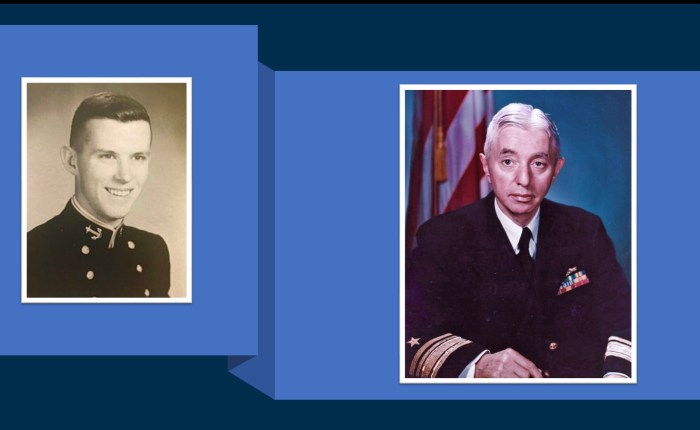
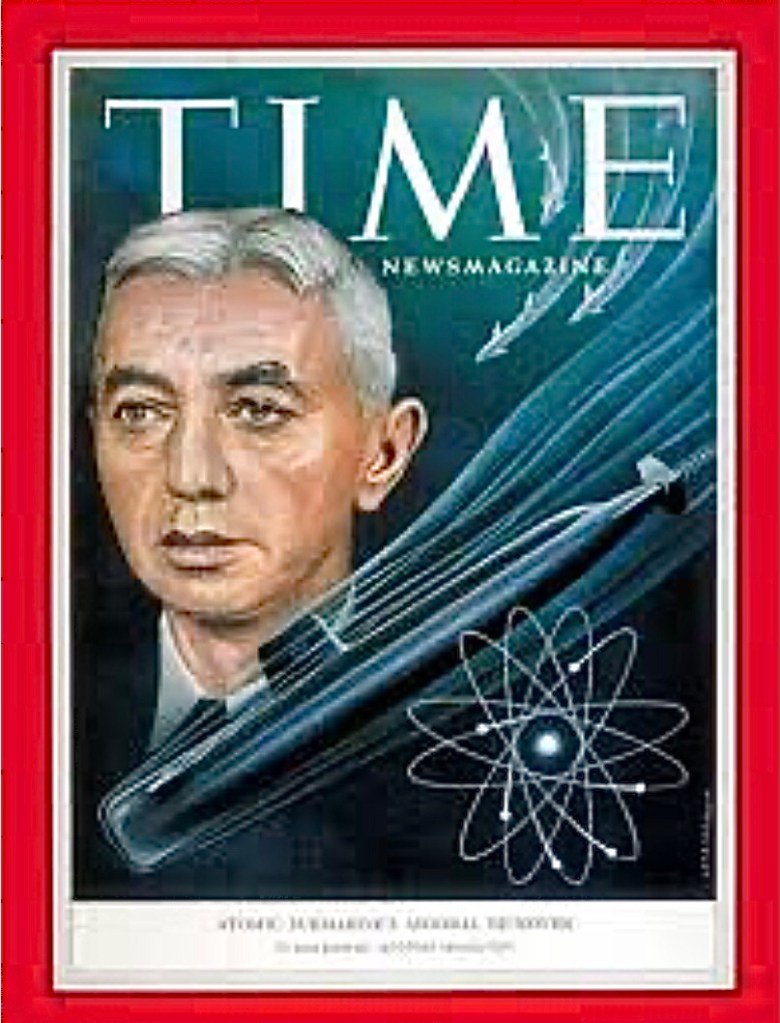
My friend Bob Bishop, straight out of the US Naval Academy, was interviewed by Admiral Hyman Rickover in 1964 for admission to the Navy’s Nuclear Power Program. Rickover, known as the “Father of the Nuclear Navy”, served in a flag (General Officer) rank for nearly 30 years (1953 to 1982), ending his career as a four-star admiral. His total of 63 years of active duty service make him the longest-serving naval officer, as well as the longest-serving member of the U.S armed forces, in history. In 1954, with the launch of the first nuclear submarine, the USS Nautilus, he appeared on the cover of Time Magazine.

Admiral Rickover on the Cover of Time in 1954

There were those who loved him and those who hated him. He exercised tight control for three decades over the ships, technology, and personnel of the nuclear Navy. He interviewed every single prospective officer considered for service in a nuclear ship in the US Navy until his retirement in 1982 at the age of 82.

According to Wikipedia, “over the course of Rickover’s career, these personal interviews numbered in the tens of thousands; over 14,000 interviews were with recent college-graduates alone.” Many of those interviews are now lost to history. Here is the story of Bob’s interview in his own words.

Bob in 1964 at the Naval Academy.

***********

Much has been written regarding the harshness of his interviews, but none can criticize the results. Certainly none of those who successfully emerged from the crucible would do so.

On Friday, January 21, 1964, I was a First Classman (senior) at the Naval Academy and joined 34 other classmates on a bus to DC to be interviewed for the nuclear power program. At the time, many offices of the Navy were still located in “temporary buildings” built on the Mall during the Second World War – and were still in use twenty years later.

There were lots of tidbits floating around about the interviews with Admiral Rickover, aka “The Kindly Old Gentleman,” (abbreviated KOG), although never called that to his face. One such rumor was that the chair you sat in was rigged so it rocked if you were nervous. Most importantly, you should answer any question quickly and decisively.

Needless to say, I was apprehensive. We (there were also a couple of busloads of Midshipmen from Navy ROTC schools) were herded into a large semi-circular room with simple folding chairs, arranged in rows facing the center of the room. There were four passageways leading out from that central hub like spokes on a wheel. There were a couple of vending machines and we were told a head (bathroom) was just down one of the passageways. We were told not to talk to one another. We were also told to remain in the room until your name was called, and that was all. To be honest, we were afraid to even go to the head, because what happened if your name was called and you weren’t there? So, there we sat. Soon, someone would come down one of the hallways and call out a Midshipman’s name. He (there were no women at the Naval Academy for another 13 years) would rise and go with him, and sometime later come back and sit down. The scuttlebutt was that each person would have three interviews before potentially meeting with the Admiral, although some had four and a few had five. Some of those interviews were short (5-10 minutes) and some were long (an hour plus). Also, you had no idea if the person interviewing you was a chief petty officer, a prospective commanding officer, a member of the Nuclear Reactors division or somebody else – they were all in their 40s-50s and all in civilian clothes.

I had three interviews and what we discussed became a blur – I was so focused on answering the questions, I really couldn’t remember the questions even immediately after they were asked. I was thinking on how I did, was I sitting up straight enough, remembering to be decisive, etc. The one question I remember most clearly was being asked about the window air-conditioning unit. I started into a description of the freon cycle when I was stopped. The questioner wanted to know why it didn’t fall out of the window. I started postulating about ways it could have been installed so it wouldn’t fall either in or out. I also remember being asked the value of studying naval history (pro and con), why I decided to go to the Naval Academy, what was Bernoulli’s equation, and why did I want to go into nuclear submarines.

Each time I went back into the central room, there were more and more empty seats. With no one to ask, I merely presumed they had finished the process. I worried and wondered if it was good news or bad that I was still there. As I sat there, morning became afternoon and afternoon night. Eventually, there were maybe three or four of us left. It was 8 something PM, and my name was called. I was led down a narrow corridor, lit only by bare light bulbs hanging down periodically the length of the corridor and into the distance. Light showed in the hallway from only one office, at the end of the corridor on the right. As we approached, my escort told me the Admiral’s yeoman (Navy admin) was gone and I should just walk past her desk and into the Admiral’s office and sit down in the empty seat.

I did and sat down in the Navy issue aluminum square channel chair, with a naugahyde seat. The room was a little dark. The scuttlebutt was right – the two front legs were shorter than the back legs, and one of the front legs was shorter than the other so that, if you were the least bit nervous, you would slide off the seat or rock sideways. I sat with my butt firmly implanted up to the back of the chair, giving thanks to the many hours I spent plebe year on “The Green Bench” (envision sitting in a chair against a wall, with your knees/lower legs at a 90° angle and your thighs/lower back also at a 90° angle – now take the chair away).

His office was a mess. It was about 10’ wide and 15’ deep. There was a bookcase behind me, another on the wall to my left, bookcases down each wall, and a big old wooden desk directly ahead. Each of the horizontal surfaces, including his desk, were piled high with a hodgepodge of varying heights of stacks of books, interspersed with folders. The door I came in was on my right, behind me. I was focused straight ahead (the Navy term was “keeping your eyes in the boat”), but my peripheral vision, and attention, was focused to my right so I could immediately rise as soon as he came in.

Three or four minutes passed when all of a sudden, I heard a loud voice say, “Why the f**k have you been wasting all your goddam time?” I immediately focused straight ahead and there he was, and had been the whole time, obviously just watching me. I never met an Admiral before and certainly never expected one to curse. Notwithstanding the advice to respond quickly and cogently, what do you suppose came out of my mouth? “Umm, er. . .” “What?!” he said. “I have been working hard, sir.” “Don’t give me that shit,” he replied. Our “discussion” did not go much better, although I don’t remember much of it, just the feeling it was going a lot less than well.

Things I remember vividly – At one point, I said something along the lines of “I think there is more to education than just book-learning.” Big mistake. Unfortunately, not the last. Our discussion circled back around to my grades (I thought afterwards he must have those in a folder on his desk). He asked what my class standing was going to be when I graduated. I knew I was doing pretty well but I had no idea what the current number was, so I said “55.” He replied, loudly, “WHAT?” I said “50?” a little plaintively. He said, “DO YOU MEAN . . . ?“ I quickly interrupted and said “45?” He roared “GET THE F**K OUT OF MY OFFICE!”, which I rapidly did.

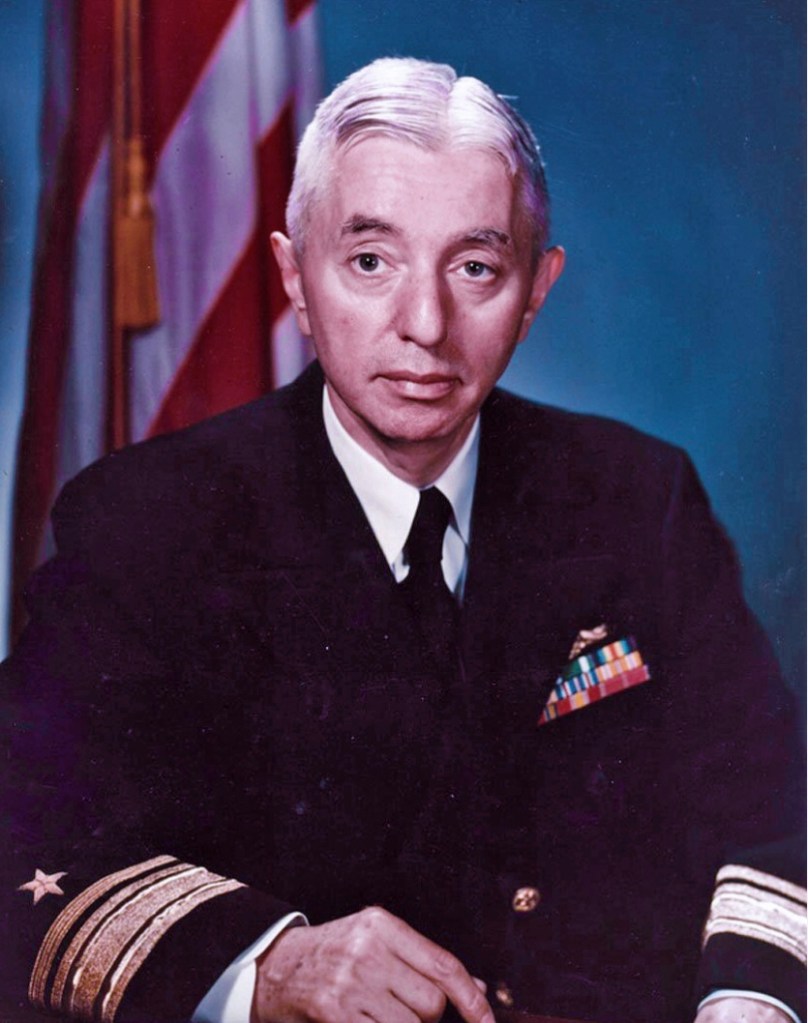
Admiral Rickover – the “KOG“

What felt like a three-hour-long crucible under intense heat, actually lasted around twenty-two minutes. It took me a couple of hours, and a couple of scotches, to get my resting heart rate down. I also started thinking of what I wanted to do in the Navy, other than nuclear submarines, when I graduated. Plainly, I wasn’t going to be selected.

A couple of months later, a list was posted at each of the twenty-four company offices at the Academy. The word quickly spread so each of us Firsties (seniors) who had applied hurried down the corridor. If your name was on the list, you were in. I read the list, haltingly, three times to make sure that was really my name.

Postscript – I had three other interactions with the KOG during my six-plus year career in nuclear submarines. Not bad for a mere lieutenant, but those are stories for another time.

Bob Enjoying Life Last Week

Addendum:

  • if you have the time, it’s worth reading up on Admiral Rickover’s career. It was pretty amazing, although he actually only commanded one ship. Some of his detractors compared his hold on the Navy, and particularly the Nuclear Navy, to Hoover’s hold on the FBI for all of those decades. He was a brilliant man, and there’s no doubt our Nuclear Navy would not be where it is without him.
  • Bob is a wonderful storyteller. Here are two other blogs from his time in the Navy on a Nuclear Submarine:
  • The movie, “The Hunt for Red October” is child’s play, compared to what these submariners did on a daily basis … “The Comms Officer ran in and handed the CO the decoded message. The CO read the message, took the lanyard from his neck, unlocked the firing key cabinet, and reached in for the firing key. We were about to” […] Continue at: https://mnhallblog.wordpress.com/2021/06/23/we-knew-we-were-at-war/
  • Crazy Ivan anyone? … In 1970, our sub, the USS Finback, was helping with Anti-Submarine Warfare training for NATO aircraft. An observer on the sub said “I think I understand your plan. You alternate going to port or starboard as soon as you submerge.” I responded, “Well, not actually”, and we walked over to […]. Continue at: https://mnhallblog.wordpress.com/2022/04/13/submarine-games

Rohan Farm

Rohan Farm

We have lived in our current home for 24 years. When we started looking here in Fauquier County, since I was the one who would be doing the long commute, I told Cathy the only way I would move out this far is if we found the house we were going to die in. Cath, of course, took on the challenge.

In last week’s blog I spoke about a 750+ unit housing development happening about 15 minutes from us in nearby Culpeper County. (A link to the blog is in the Addendum). It consists of cookie-cutter homes starting north of $500K, with some as high as $800K+. All are on small lots. I’m sure they are someone’s dream home, but not mine.

It did get me to thinking about our journey to Fauquier back in 1999 and our own dream home.

When Cathy and I returned from Germany in 1989, a couple things happened: first, We bought a townhome in Fairfax, Va; second, I started working a classified job with the military; and third, Cath got a job in Crystal City, AND bought a horse she was to own for the next 15 years – Arthur. After I decided to get out of the Army in ‘92, we stayed in Fairfax. I started a great job with a company called SRA and had about a 30 minute commute to work.

Our townhouse was nice, but by ‘98 we’d decided to look for a house. More specifically, a property with enough room to keep a couple of horses on it, which meant at least five acres of land. By then Cathy had her own business and was working from home, while I was still working for SRA. We looked in Fairfax County and found a few properties we liked in the Clifton and Fairfax Station areas and even put an offer on one, narrowly losing out to another couple. It was frustrating to lose out on the house, but we were also frustrated as there weren’t many properties for sale in the area that met our requirements and were in our price range.

That’s when Cathy suggested moving out farther to Fauquier County, a beautiful area. We’d spent time there over the years for various horseshows, weekend trips to B&Bs, going to a few Sunday brunches and of course visiting a couple of our favorite wineries. We loved Fauquier.

I immediately said no. Not only no, but hell no. It was not open to discussion. There was no way I was going to do that commute on a daily basis. At the time I was working in Arlington and the commute would take an hour and fifteen or twenty minutes each way.

We circled around that “discussion” for quite some time and a few weeks probably passed. I then made a mistake.

We were discussing Fauquier again, and in a weak moment I said, “I tell you what. If we find the house we are going to die in, I’ll move there.” Cathy nodded and said OK.

In the coming week or two, Cath found three country places online to look at, and with our agent, we scheduled visits to all three on the same day in February of 1999. It snowed an inch or two the evening before our visit but was sunny as we drove to view the properties.

The first place didn’t really look as it did in the photos and we spent no time there. The second place was nice, new and had a barn to die for. Some of the rooms in the home were a bit odd, but overall, we liked it. We weren’t blown away by it but might give it further consideration. We left, and then proceeded to house number three, also the farthest away.

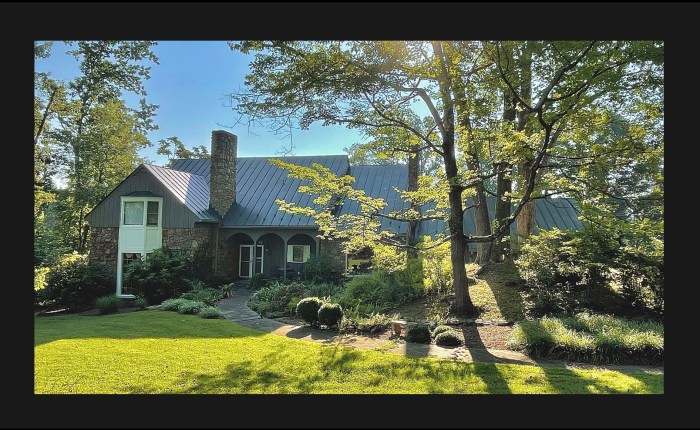
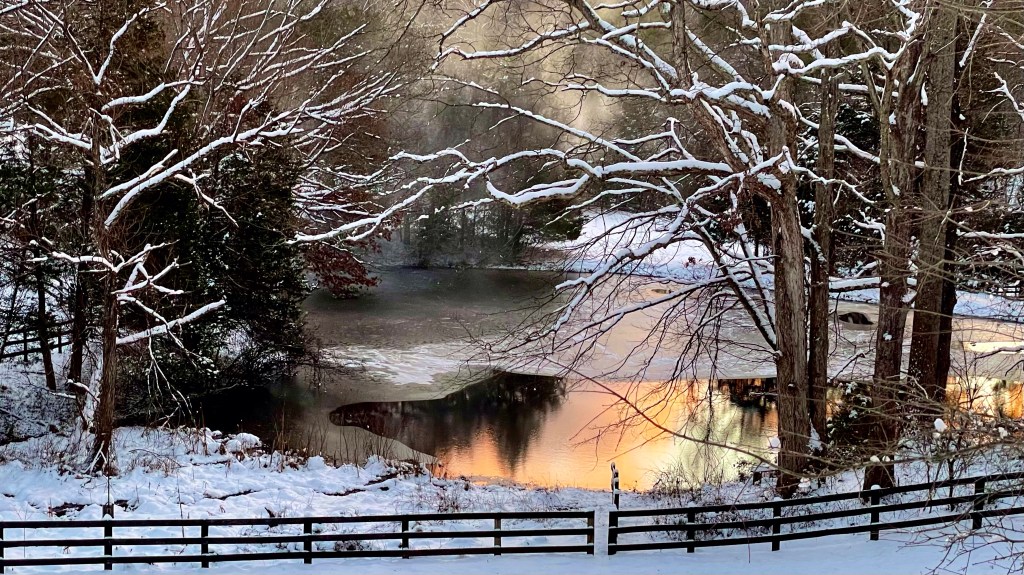
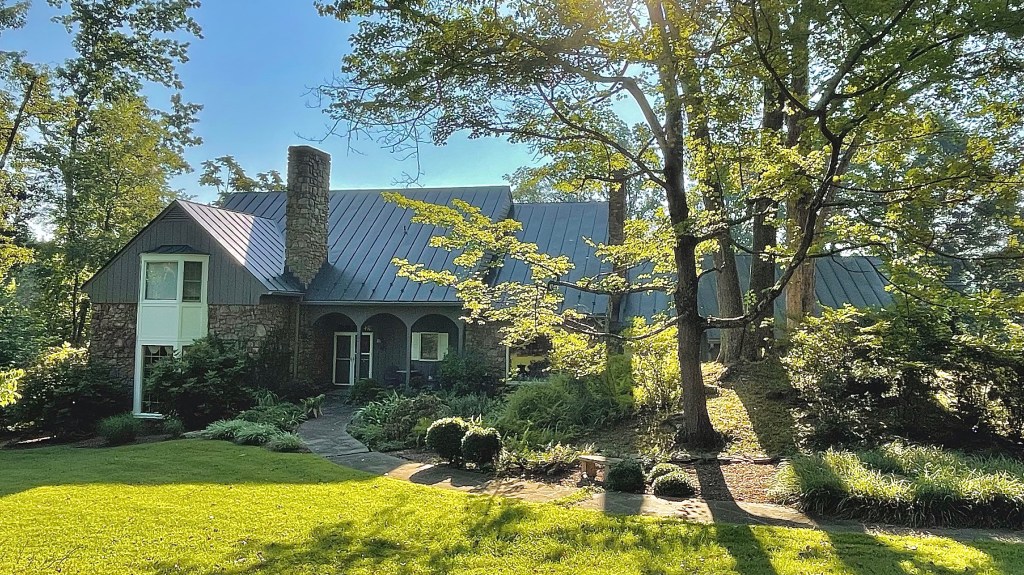
We drove down the long driveway with snow in the field to the left and the woods to the right. It was a nice setting. You couldn’t yet see the house and then we crested a small hill for our first view. It had stone and cedar siding with two chimneys and a cedar shingled roof. How pretty in the snow! We parked outside the garage and walked to the stone porch in the back of the house. As we stood there looking at the pond and fields, three horses trotted by in the paddock between the house and the pond. I mean it was so perfect, it was almost as if they were holding the horses out of sight, and as we arrived, someone called and said, “Cue the horses.

The Pond, on Another Winter Morning

Cathy and I didn’t say a word but looked at each other. It was one of those looks married couples have where an entire conversation takes place and no one says a word. We hadn’t entered the house yet, but pretty much knew this was our next home.

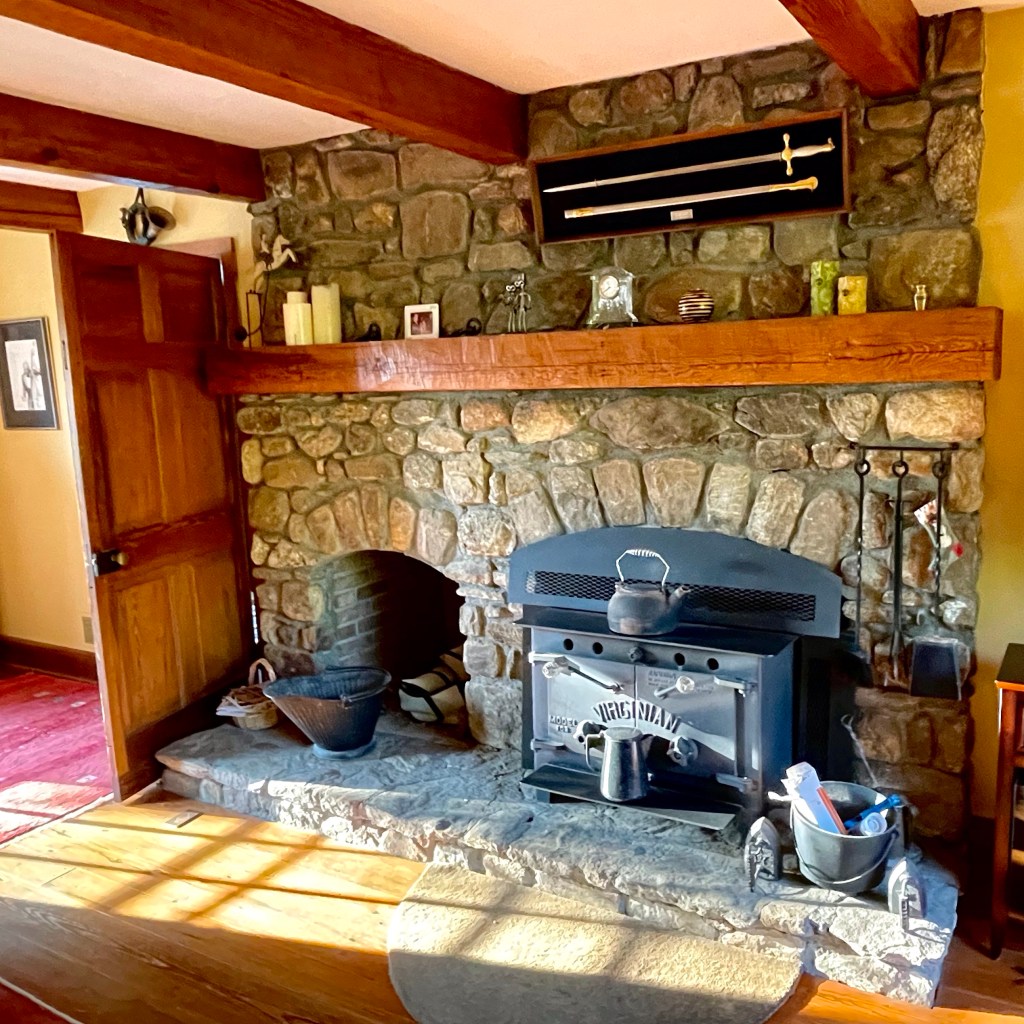
This house wasn’t new. It was about 20 years old, but built in a way to make it look much older. In the family room there was flooring and beams from a pre-Civil War warehouse near Petersburg, Virginia. One of the doors was antique and made entirely by hand with no nails involved. Most of one side of the home was glass or glass doors so there were constant views of the pond and fields. The fireplace in the family room was made with stone from the property and installed by an old stone mason who lived just up the road (and is now deceased).

The Morning Sun Streaming in on the Family Room’s Stone Fireplace.

There were things that needed updating of course. Some of the colors were straight out of the 70s. The peacock wallpaper in the dining room would have to go. Most of the carpet was old – probably from the late ‘70s as well.

We also did a tour of the barn. It was functional, although nothing special. The barn at house number two kind of blew it away, but this one was perfectly functional with 6 stalls, instead of the 4 at the previous place.

We left and drove back home with our agent. The distance didn’t seem quite so far to me now.

A few days later we called the owner directly and asked if she would give us a tour of the property itself, which she was more than happy to do. We spent a few hours walking the twenty acres and helped her feed her horses that night. As we passed by the pond, she said “I’ll even throw in the rowboat, if you decide to buy.” When our agents (both ours and hers) found out we’d met without them, they were, ummm, a bit upset, but there wasn’t anything they could do about it.

The next day we put our offer in, and after some back and forth, we signed the contract. We couldn’t actually close until the end of May, as the owner had a couple of pregnant mares and didn’t want to move them until the foals were born and old enough to travel. It made perfect sense to us.

We closed on the appointed day in May and a few days later, with our pickup truck, horse trailer and a U-Haul truck, our friends helped us move. The house was christened with a party that afternoon and evening, and on its way to becoming a home. We named it Rohan Farm*.

Our Home, Rohan Farm

Although the house was already nice, we spent a decade getting everything just the way we wanted it – repainting and recarpeting; the ‘70s look went, as did the outdated kitchen; ultimately, a wine room was added. There was lots of work outside as well – redoing things in the barn; clearing brush off of fencing and replacing the fencing; adding an outdoor riding ring; adding new paddocks; putting in automatic waterers; adding multiple gardens; and of course an endless list of smaller items.

In June it will be 25 years here. We love this place. It doesn’t have all the bells and whistles, but it’s warm and comfortable. It looks like it belongs here in Virginia and has been here forever. We love it and hope to remain here forever as well.

Addendum:

  • * Rohan Farm – Yes, this is from Lord of the Rings. Rohan was the land of the horse people, so it seemed to fit. We’ve both been big fans since the ‘70s, well before the movies ever came out.
  • You can find a link to last week’s blog on the housing development here – The new housing development sits in the middle of nowhere, 6 miles west of Warrenton and 12 miles north of Culpeper. Some thought it might provide “affordable housing” for the area, but with homes starting “in the low $500s”, I don’t think so. Or maybe my definition of affordable housing is […] Continue here: https://mnhallblog.wordpress.com/2023/08/08/paving-paradise/