In Ukraine

In Ukraine

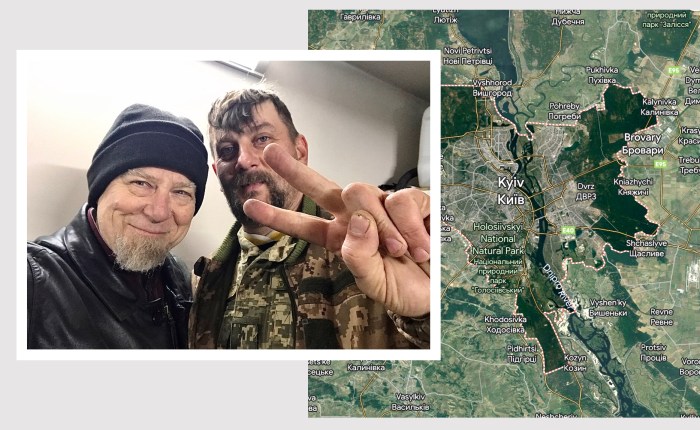
It was 6:20PM on May 8th DC time, or 1:20AM on May 9th in Kyiv, Ukraine when Bob called. He was in his study, expecting to have to go to their bomb shelter soon. May 9th is a big celebration in Russia for their victory over Nazi Germany in 1945 and there was sure to be an attack. We talked for perhaps twenty minutes, the first time in a couple of years. Things were OK, but it was still tough in Ukraine.

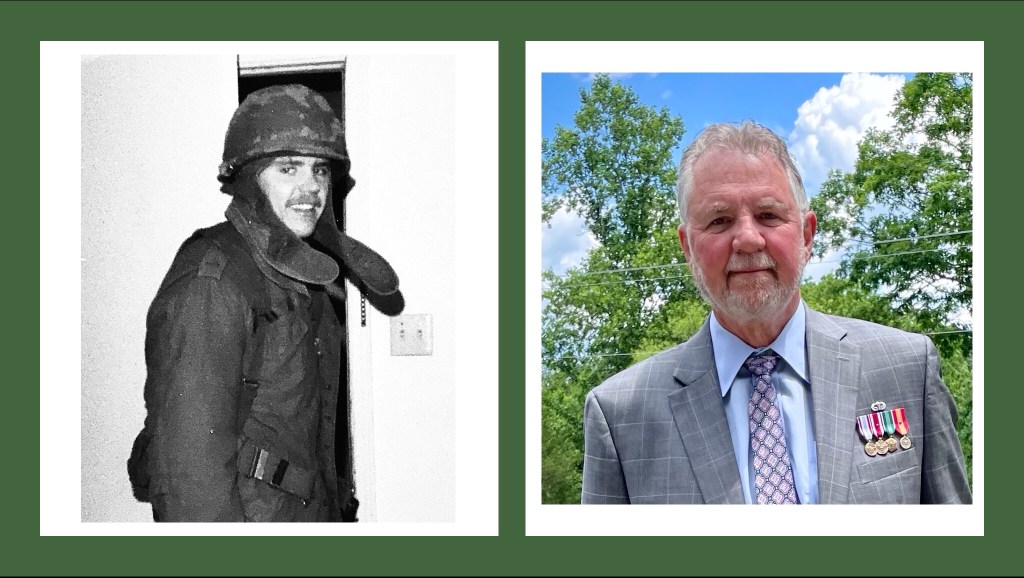
Bob and I worked together at a company called SRA for several years, got along well and were friends. Around twenty years ago, Bob met Vita, the woman who would eventually become his wife. She is Ukrainian by background and still has family there. Over the years, and particularly once Bob retired, they spent time both here in the US and also in Ukraine. They have currently lived in Ukraine for the past two years.

Bob and Vita

He recently sent a text updating me on what has been going on in his life:

“Last year, we decided that we simply couldn’t leave all our family and friends here in Ukraine. So we decided come hell or high water – this was what we needed to do.

We live in a bedroom community of the capital called Brovary. Brovary was in the news a few times at the beginning of the war because they tried to come through here on the major highways to get to Kyiv. We did have some scary times those first few weeks. I never thought I would see the day that I stood in my front yard and could hear (and even feel sometimes) tank and artillery battles. The front came to within about 5 miles of us before the good guys beat them back and they retreated.

These days the front is a couple hundred miles south of us. We continue to have regular missile and drone attacks. These were WAY bad early on, but now the best defense umbrella is over Kyiv and we are in that protected zone. Still, we have a lot of attacks and the air raid sirens go off at 2 and 3 in the morning and we all have to run to the basement/shelter in the barn. That hasn’t been fun and there is a lot of lost sleep that makes everything more difficult. My neighbors and I joke (only partially) that if there is a direct hit on any of our barns, the other neighbors will come and dig us out.

We do all we can to help the army. Donations – we’ve bought uniforms, boots, tents, food and chainsaws, you name it. I even helped my neighbor, Dima, who is a long range mortar specialist to replace the windows in his car that were shot out when he was coming home on leave. The war has gone on so long, they are rotating some of these guys out and giving them a break.

Things are still very bad in some of the smaller towns where the defenses are not as robust. The stories of what has happened to innocent civilians is more than I can say here. There have been real, no bullshit war crimes…”

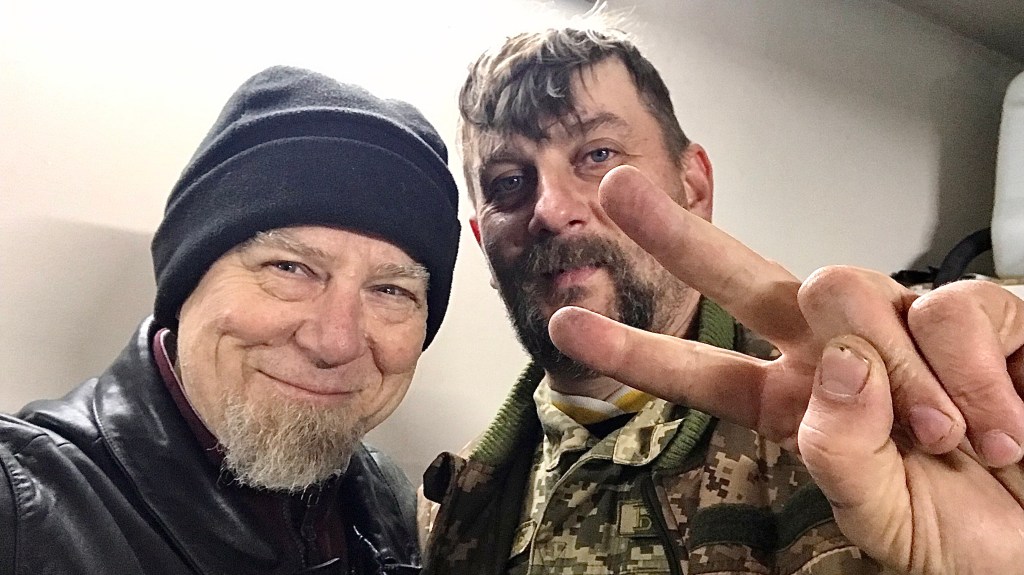
Bob and Dima, While Dima was on Leave

Bob has written a book about Ukraine called UKRAINE: THE AWAKENING: My 20 years of witnessing Ukrainians rediscover their nationhood. He worked over this past winter in Brovary to capture the points he believes are important for westerners to know. When the war began, he became concerned about how little westerners, especially Americans, understand about Ukraine, its people, its history and how the relationship with Russia is badly misinterpreted in Western news media coverage.

The book is intended to give readers a view into Ukrainian culture and the beauty of the people. There is also a bit of the history of Russian relations that is helpful to understand the conflict and to dispel some of the propaganda narratives the Kremlin has been using.

I’ve posted a link to the book in the Addendum. In the meantime, I’ve purchased a copy myself, and promise to give an update on Bob, and the book after I finish reading it.

Bob’s Book – Ukraine, The Awakening.

I asked Bob about posting this info, and whether he was concerned about retaliation. Here was his comment back to me: “ Max, I would fully support your using the material in your blog. My reasoning on writing the book is to get the word out, so this would help a lot I think. As far as security goes – to hell with Putin and his goons. I think he has bigger fish to fry than me, but I am not running or hiding from that son of a bitch.”

On the morning of the 9th, I woke up, and after feeding the horses, made my coffee as usual. When I opened my iPad, this message was waiting for me from Bob: “It was really good speaking with you last night Max. We are all good here after the attacks – they started around 4am. We destroyed 23 out of 25 cruise missiles in the air”.

—I will continue to report on Bob’s story in a couple of future blogs. —

Addendum:

  • Here is a link to the book at Amazon if you are interested in purchasing it: https://a.co/d/6qUppBU
  • And, Here is a recent Zoom interview Bob did with Cortney Evans at WMBB 13 ABC in Panama City, Florida: https://youtu.be/GuJoxO8Qi8s
  • I’ve written one previous blog about Ukraine. You can read it here: Command and Control (C2), along with Command Centers, are phrases you hear concerning the Russians in Ukraine. In my military career, I worked all levels of C2 from Infantry Brigade to Presidential, and I can see the Russians are shockingly missing, or ignoring some C2 fundamentals. […] Continue here: https://mnhallblog.wordpress.com/2022/06/14/russian-command-and-control/
  • Euromaidan Press (seen at the end of the blog) is a daily English language summation of Ukrainian news and information. If interested, look online and you can subscribe here: https://euromaidanpress.com

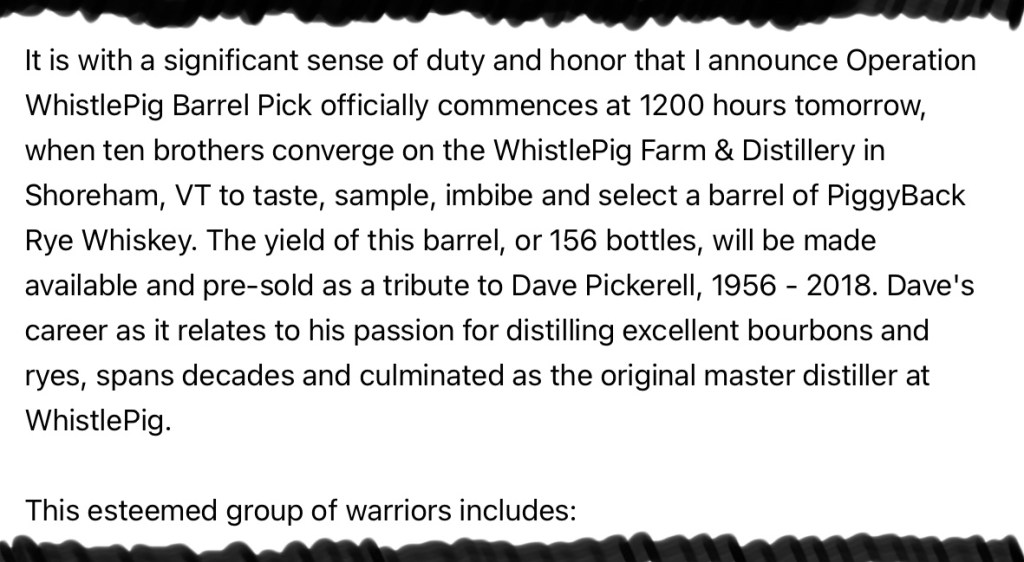
Operation WhistlePig

Operation WhistlePig

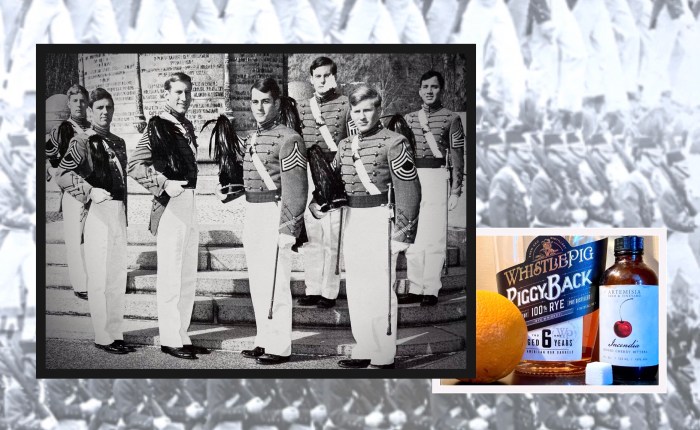
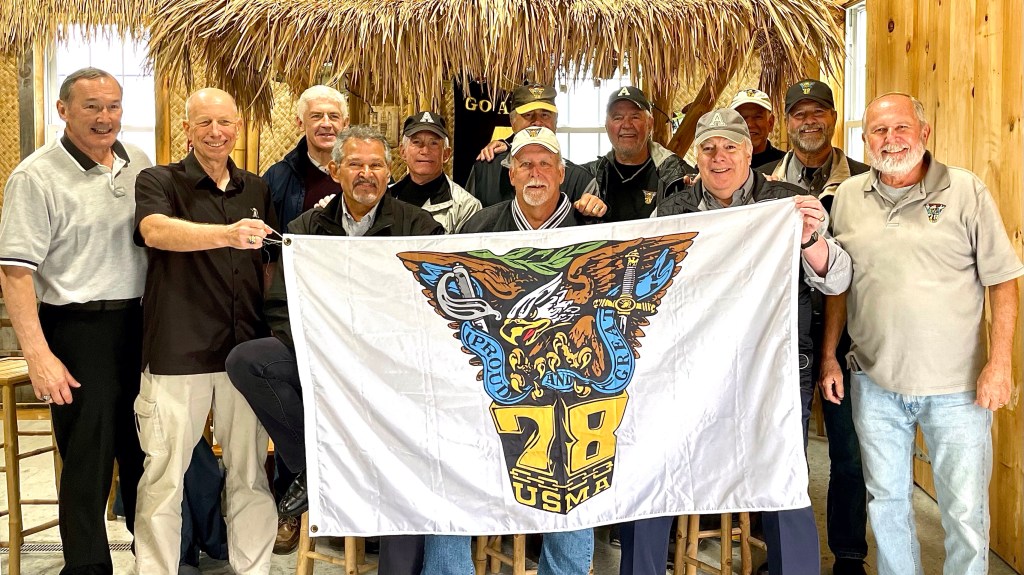
We were on a mission to the WhistlePig Distillery in Vermont. Twelve classmates gathered to taste whiskey from five barrels. We would select two for the West Point Proud and Great, Class of ‘78 45th reunion this coming fall. We didn’t want to let any of our classmates down.

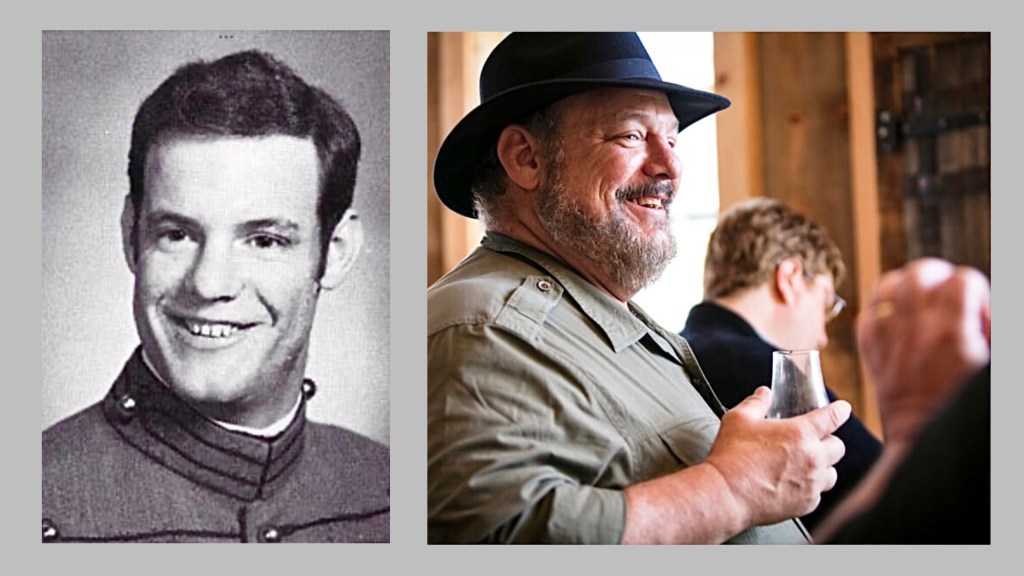
I’ve recounted the history of our classmate Dave Pickerell in a blog before*, but will briefly summarize it here, as it is fundamental to this story. The Army, in its infinite wisdom, sent Dave to grad school for a master’s degree in chemical engineering. Later, after teaching at West Point, Dave left the Army and joined Makers Mark Distillery, where he was the master distiller for 14 years. He then struck out on his own and became known as the “Johnny Appleseed” of craft distilleries, and helped many, many distilleries start-up. Eventually, he also became a founder and the master distiller for WhistlePig Whiskey, which makes some of the best rye whiskeys in the world. Dave passed away a few years ago, but his legacy lives on at nearly 100 distilleries across the country.

Dave Pickerell as a Cadet, and Then Later in Life.

A little over a year ago, our West Point Class held a mini-reunion at the Biltmore in North Carolina. On one of the evenings there, we did a whiskey tasting of several whiskeys Dave had an impact on*. The tasting was to honor Dave, and our other departed classmates. Everyone had such a good time at that event, it became the genesis of Operation WhistlePig.

We originally talked about doing a class tasting for our 45th reunion in the Fall of ‘23, but the logistics at West Point became a bit difficult. Bill Moeller then came up with the idea of purchasing a barrel of WhistlePig for the reunion. Classmate Tony Matos, who lives in New Hampshire not far from the WhistlePig Farm Distillery, became point man and started working with Mark Kanya of WhistlePig to understand the dynamics of a barrel purchase. In the meantime initial funding was lined up through classmate Jeff Manley, and a survey of classmates was completed to gauge interest. 206 classmates responded saying they were interested. A barrel of whiskey holds 156 bottles. We were on.

Of course, you don’t just buy a barrel of whiskey. Each barrel is different depending on multiple factors. WhistlePig invited “around ten of us” to a barrel tasting at the farm. We were to select “our barrel” from three different barrels we would taste from. It would then be bottled in a special release, with a small label honoring our class, and our fallen classmates. The team grew from four to six, then eventually to ten of us. In addition to Tony, Bill, Rob Grubbs and I (Rob, Bill and I organized the Biltmore tasting), José Morales, Al Aycock, Gus Hellzen, Jim Steiner, Jack Cronin and Rusty Roberts were added. Our number was set, as was our date, the 3rd of May. Reservations were made at a nearby Airbnb for May 2-4, and then it was just a matter of waiting for the big day.

Tony, who did a great job coordinating the event overall, sent an email to the Class on May 1st announcing Operation WhistlePig was about to commence. He was flooded with responses from classmates with good wishes, others wanting to immediately order a bottle, and some wanting to join us and help select the barrel. Tony graciously explained to folk why it wasn’t possible, although after checking with WhistlePig, three folk who were relatively local at the time were added for the tasting itself – Bob Rush and his wife Erica, and Ron Hall. They joined us for the tasting, but not the entire three days.

Tony’s Announcement to the Class About Operation WhistlePig.

On the second of May, we gathered. Classmates flew in or drove from Texas, Virginia, Maryland, North Carolina and Georgia. Others arrived from Vermont, New Hampshire and Maine. We included a retired Two Star, guys who departed the military not long after our initial five-year obligation, and everything in between. There were handshakes and hugs all around. Not all of us knew each other, but we were all brothers and it didn’t matter. This was going to be good.

That first evening passed in a blur, aided by some liquid lubrication. I and a couple of other guys cooked dinner the first night – Steak Tips, a New England specialty. Preparing the meal in the main house, I have to admit I felt a bit like Clemenza in the Movie “The Godfather” cooking away, with guys standing around talking and drinking. Over dinner, we didn’t solve the world’s problems, but we took a stab at a couple of them. José asked a couple of questions for which there were of course no correct answers but made us all think.

We also discussed whether we should consider buying two barrels of whiskey instead of one, in anticipation of additional sales based on Tony’s email from the 1st. Rusty immediately volunteered to lead the financing of the second barrel, and Tony quickly notified WhistlePig we were now looking at purchasing two barrels.

Dinner the First Night.

As is always the case for me at these gatherings, I’m humbled when I listen to many of the stories told – from time in the Army, in government, or in business. Stories from hotspots around the world over the years, and as I’ve said before, war stories both figuratively and literally. Beer, a couple bottles of WhistlePig, several bottles of wine and a few cigars later, most of us made our way to bed.

The next morning, Jim and crew fixed breakfast – bacon, toast and eggs to order. People were feeling surprisingly good, considering the damage we had, perhaps, done the night before. I’m sure the anticipation of the trip to WhistlePig later that morning had something to do with it. We eventually climbed into two vehicles and arrived at the WhistlePig Farm just before 11AM.

Arriving at WhistlePig.

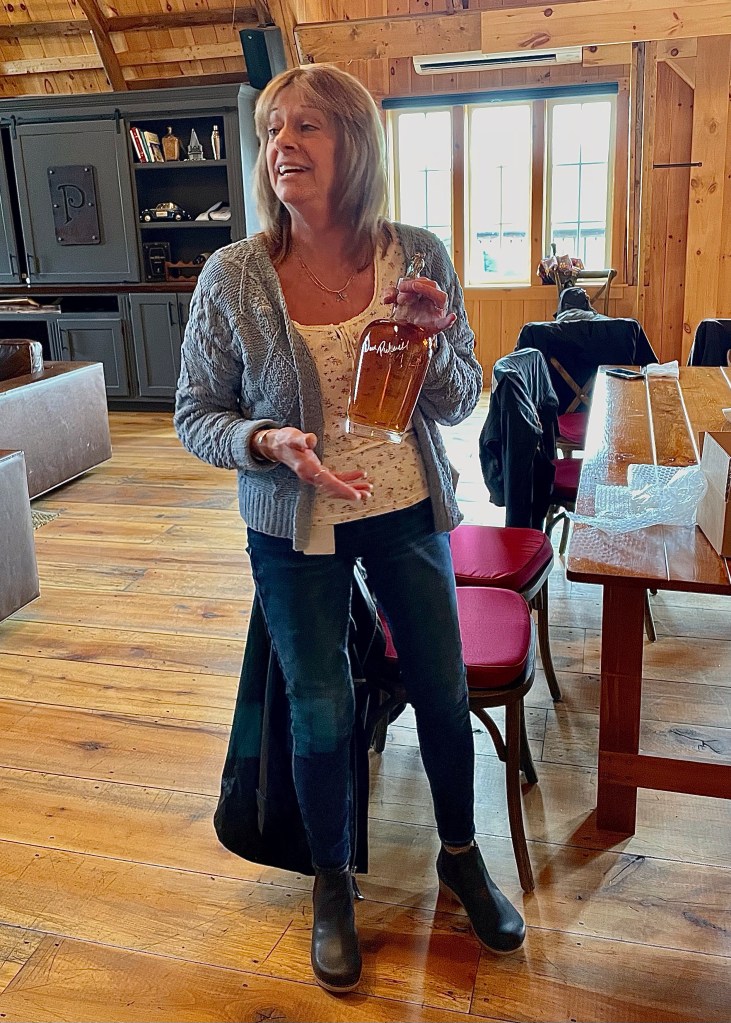
At the farm, we were joined by Ron, Bob and Bob’s wife Erica and began a tour. Jesse Ray, accompanied by our contact Pam Spaulding, showed us key parts of the farm and distillery. Of course there were some tastings involved at various stops, including Maple Spirit (distilled maple syrup – a bit of a rum flavor), Piggyback (the 6 year old Rye that our barrel selections would also come from) and a wonderful WhistlePig 15 year old rye. I noticed that we, as a group, had become a bit louder. We grabbed a picture of us after trying the Maple Spirit – I think you can see we were off to a good start.

Smiling Classmates After the Distilled Maple Syrup Tasting

We returned to the tasting room and a wonderful lunch. The WhistlePig crew told us some great stories about Dave, some of his work, and some of his sayings. My favorite saying from Dave – “One of the great things about working at a distillery is you get to drink your mistakes.”

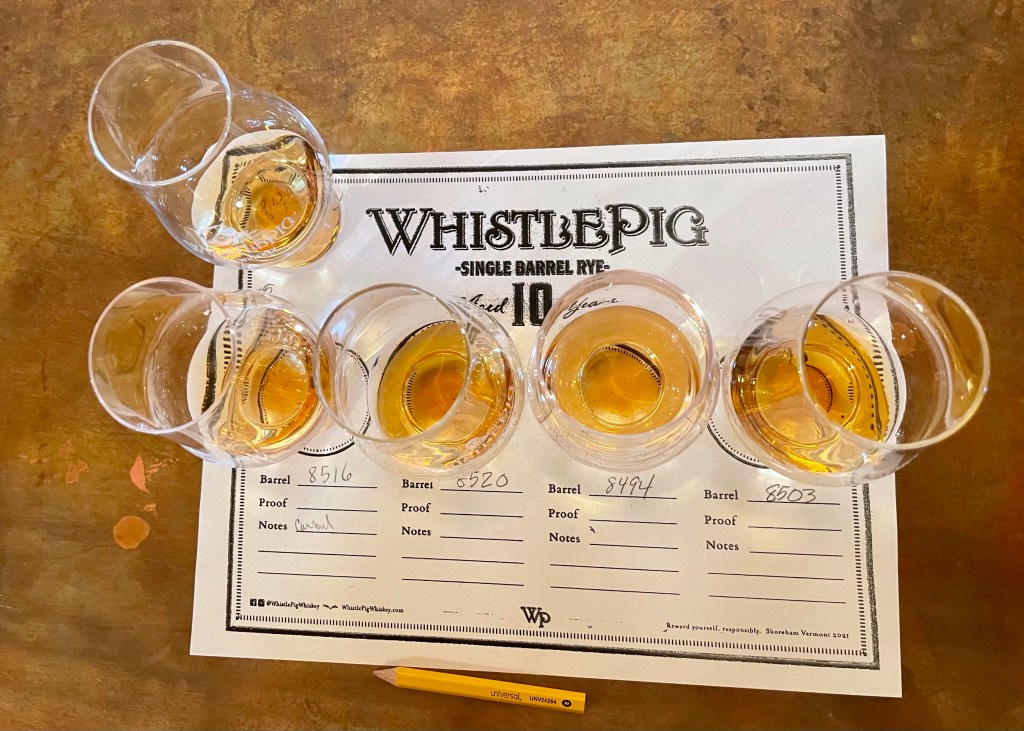
After lunch, we were ready to start the business at hand. First though, WhistlePig revealed a nice surprise. Since we were now considering two barrels instead of one, we would taste five samples instead of three. I believe that elicited a “Hooah!!” from the class. Mark Kanya walked us through the barrels, but didn’t reveal their proof numbers, as he didn’t want to prejudice us. Finally, it was time to taste.

Five Barrels to Taste!

What followed was a minor dose of reverence and a major dose of fun. We tasted, and tasted again. Conversations sprang up and died away. Comparisons were made by those sitting next to each other, sometimes with concurrence and sometimes with “What, are you crazy?!” Now remember there were five barrels. All were 6 years old. All came from the same rick-house. All were 100% rye. All were good. And yet, we had no problem finding differences.

Whiskey Tasting – Maybe Serious Business, or Not…

Finally, it was time to make our selections and Rob Grubbs took charge with a chalk board. Each of us came forward and wrote down our top two choices. We anticipated going a couple of rounds, but it turns out it wasn’t even close. Barrels 8516 and 8494 won, hands down.

Barrels 8516 (2) and 8494 (4) Were the Easy Winners at the Tasting!

After the official tasting, they opened the bar and we tried other WhistlePig products at our leisure. Some of us returned to the winning bottles for another taste and confirmation we’d made the right choices. A few went to the museum, while others of us stayed at the bar. There, Mark’s assistant, Amber Star, who also happens to be an opera singer, entertained us with stories and after some prodding, an amazing a cappella version of Ava Maria – it was beautiful and somehow fit the afternoon.

As we gathered together again shortly before departing, Pam read us a tribute to Dave another friend, Savannah Burnett, sent her. It was wonderful of her to share it with us. She also gave us a WhistlePig bottle signed by Dave and filled with a bit of each of the products Dave was associated with over the years. A whiskey, or spirit connoisseur, would call it an “Infinity Bottle” due to the blending of so many different whiskeys – we plan to auction it off at our 45th reunion. It should also be noted that a West Point Coin was presented by José to Mark for his excellent organization of the tasting. As a side note, should he ever be challenged by one of us in the future and he doesn’t have the coin with him, he will be required to buy a round ;-).

Pam Presenting the Class with the Dave Pickerell Signed “Infinity Bottle”.

We finally said our goodbyes to WhistlePig, and to Ron, Bob and Erica and drove back to our Airbnb. Bill cooked a salmon dinner for us and the ten of us again gathered at the table.

We were mellower than the night before but had great conversations. Yes, we told and laughed at old stories again, but we also talked about the present and the future. Over more wine, whiskey and cigars, we discussed our Class and the impact we may have had on the Army and on our country. Eventually we drifted off to our individual rooms and the night ended.

When I woke up the next morning, a couple of guys were already gone. Rob made breakfast for us and then Tony and Jim drove the rest of us to the airport. More hugs and handshakes at the airport and we parted ways. Operation WhistlePig was over … For this year.

I’ve thought about the wonderful times we had at this whiskey tasting, and at other reunions. The camaraderie, the brotherhood, the love for each other. Although we are not yet in our “twilight”, I think General Douglas McArthur summed it up pretty well at the end of his West Point Farewell Address in 1962:

The shadows are lengthening for me. The twilight is here. My days of old have vanished — tone and tint. They have gone glimmering through the dreams of things that were. Their memory is one of wondrous beauty, watered by tears and coaxed and caressed by the smiles of yesterday. I listen then, but with thirsty ear, for the witching melody of faint bugles blowing reveille, of far drums beating the long roll. In my dreams I hear again the crash of guns, the rattle of musketry, the strange, mournful mutter of the battlefield. But in the evening of my memory always I come back to West Point. Always there echoes and re-echoes: Duty, Honor, Country…”

For this whiskey tasting get-together, maybe the echoes and re-echoes were: Duty, Honor, Country and WhistlePig as well. For my classmates who may be reading this blog, I’ll add this – Standby! A Warning Order is about to come out on how to purchase a bottle.

Addendum:

  • The staff at WhistlePig was wonderful. Pam Spaulding, Jesse Ray, Mark Kenya and Amber Star took amazing care of us.
  • * You can read the blog about Dave and the whiskey tasting our class did about a year ago here: When Rob asked if I would help host the whiskey tasting for the West Point Class of ‘78 mini-reunion at The Biltmore, I immediately said yes. We honored classmate Dave Pickerell, later known as The “Johnny Appleseed” of Craft Whiskey, and all of our departed classmates […] Continue at: https://mnhallblog.wordpress.com/2022/04/19/pickerell-the-biltmore-and-the-whiskey-tasting/
  • Arriving at WhistlePig” photo courtesy of Gus Hellzen.

A Bayonet Attack and Life Lessons

A Bayonet Attack and Life Lessons

80 years ago on May 6th, 1943, Dad and the other men of 1st Battalion, 60th Regimental Combat Team were given the order to fix bayonets. They were about to attack Djebel Cheniti in Tunisia by direct assault with a bayonet charge. I’ve thought quite a bit about how that attack may have affected Dad and his outlook on life.

A year ago, I was doing research for another blog about dad and the closing days of the North African Campaign in 1943. I was shocked to learn about a battle that dad never mentioned. At the time, his unit had been in continuous combat for two months.

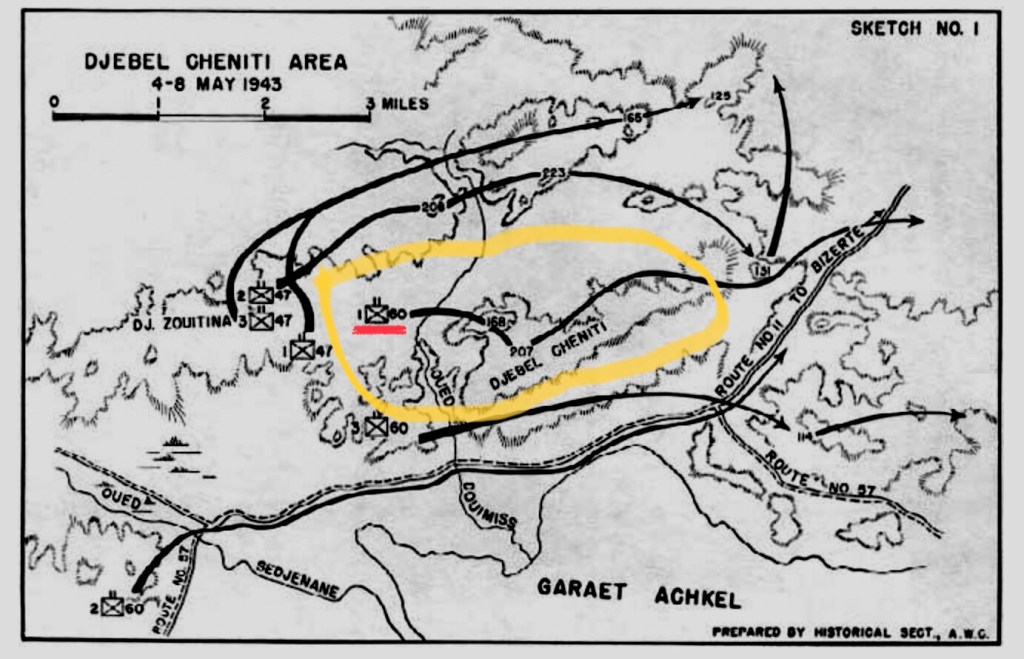
From the history books:One last ring of rugged hills now remained between the Ninth Infantry Division and Bizerte. The German troops on Djebel Cheniti, the highest point on the 8 mile wide area of the Bizerte Isthmus, halted the advance. To break this bottleneck, General Manton S. Eddy (Commander of the 9th Infantry Division), devised a plan with two parts. The division would mount a flanking maneuver around the hills, while the 1st Battalion of the 60th Regimental Combat Team (dad’s unit – about 500 men) would attack Djebel Cheniti by direct assault with fixed bayonets. They would follow artillery fire that pounded the slopes at 100-yard intervals.

The 9th Infantry Division Plan of Attack as it Unfolded.

Let’s take a pause in the story for a second. Fix Bayonets is a command that probably goes back as far as the introduction of muskets. What the command literally means is you are attaching your bayonet to the end of your rifle. What it actually means is one of two things – 1) you are preparing to charge the enemy in close-quarters or 2) getting ready to defend yourself from an imminent enemy assault. Either way, it is close-in fighting. With a rifle and a bayonet, you are perhaps three feet away from your enemy. There is no hiding. There is no ducking away. Army Field Manual 23-25 captures it succinctly: “The will to meet and destroy the enemy in hand-to-hand combat is the spirit of the bayonet. It springs from the fighter’s confidence, courage, and grim determination.” In my own bayonet training nearly 50 years ago at West Point, they were even more to the point: “What is the spirit of the bayonet?” “To Kill!”

At that distance, it is kill or be killed. There is no middle ground.

… … …

May 6th 1943 was a slippery, muddy and rainy day. The order was given to fix bayonets around 1PM and behind rolling artillery, the battalion attacked. They moved forward quickly and only 100 yards behind the falling artillery barrage. On the map, it looks like the total distance they needed to cover was a little over a mile. After three hours they took Hill 168. Moving on to Hill 207 they met stronger resistance. An artillery concentration disorganized the enemy and the battalion attacked again before the German troops could recover. By nightfall, they had taken the summit of Hill 207, although there were still Germans on the southeastern slopes. In a war that lasted years, there were only brief mentions of the battle in the history books, but all of them mentioned the fixed bayonets.

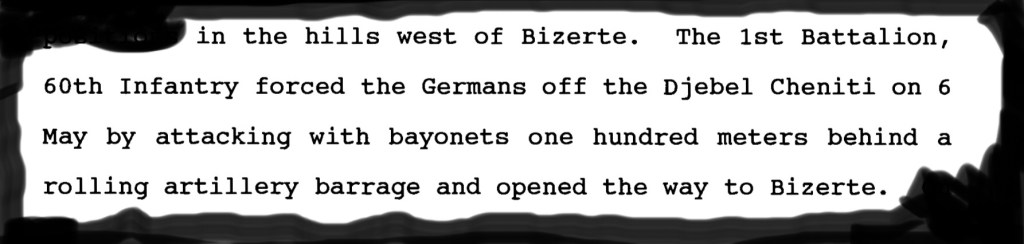
Only a Brief Mention in the History Books

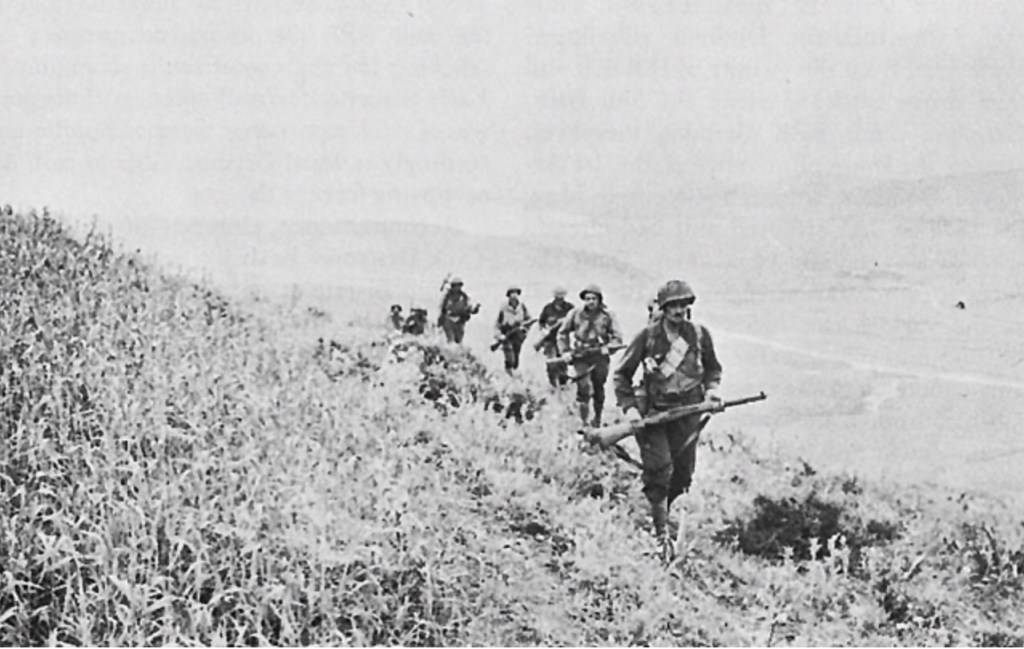
The next morning, May 7th, German machine gun crews began taking off for Bizerte as the division advanced. The 60th moved to cut off the Bizerte road and On May 8th, Bizerte fell. The war in North Africa was over and their immediate mission accomplished.

Men of the 60th Outside Bizerte on May 7th, 1943.

In the words of the 9th Infantry Division Record, “Djebel Cheniti was a brilliant demonstration of Infantry “leaning up against” artillery preparation. One of the strongest positions in the final Axis defense was assaulted by one battalion of Infantry with fixed bayonets, with artillery blasting a shell-strewn pathway for its advance. Another story in the annals of foot soldiers, who do the dirty tasks of warfare”.

Why am I blogging about this now? The story has haunted me since first learning about it. I’ve thought about it quite a bit over the past year. I never heard dad say anything about Djebel Cheniti. I never heard dad say anything about a bayonet charge. Not one damned word. The more I thought about it, the more I thought about how it must have influenced his life.

I have to figure after you’ve been in a bayonet charge, everything else in your life, maybe for the rest of your life, must seem easier. When you are that close to death, and you survive, what else in your life is really going to be a threat to you? Money issues? Work Issues? Mortgage issues? Sickness? Wouldn’t just about everything pale in comparison?

It would explain a lot about dad. His lust for life. His enjoyment of life. His ability to keep everything in perspective, even when things were going badly. His gentleness and tolerance. His quiet firmness in facing down jerks and bullies. Perhaps he already had all of those traits and would have developed into the same man, but I’m not so sure. I think a bayonet charge at the age of 19 might make everything else in life just a wee bit easier to contemplate and to handle. Maybe every day after May 6th, 1943 was a gift not to be squandered. Dad’s gone now. How I wish we had time for one more conversation.

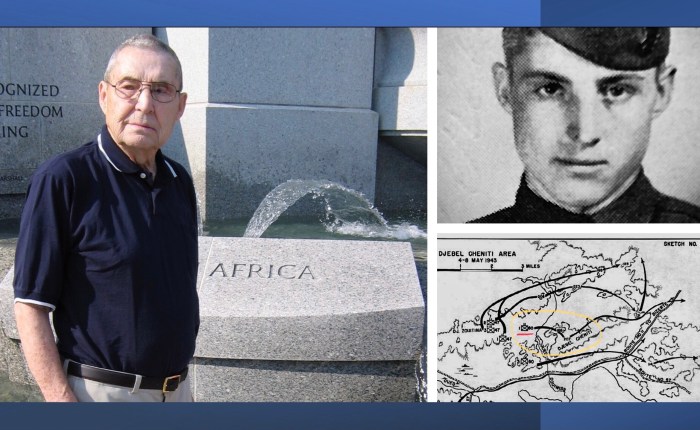
Dad at the WWII Memorial, Two or Three Years Before he Passed Away.

Addendum:

  • The last major American bayonet charge occurred during the Korean War in 1951. You can read a bit about it here: https://www.army.mil/article/30673/hero_who_led_last_major_u_s_bayonet_charge_dies
  • Dad was in almost continual combat from November of ‘42 to August of ‘43 when he was wounded in Sicily. I’m sure all of that combat, and his wounding affected him and changed him, but the bayonet attack is what has stuck in my mind as a singular event, maybe even more than his wounding. He told bits and pieces of different battles over those months, and mostly they involved funny incidents. He even eventually told me the story of how he was wounded, when he was recovering from the stroke he suffered in the ‘90s. The bayonet attack? Not a single word.
  • The blog I was working on when I found out about the bayonet charge was a funny story about dad and “Al Capone” – “My Dad, then Twenty year old Sergeant Willie I. Hall, looked at the German soldier and said “Chicago”. The German answered “Chicago?” Dad stared back. “Chicago … Al Capone”. Now the German’s eyes’ widened. Everyone knew who” […] continue at: https://mnhallblog.wordpress.com/2022/05/08/dad-and-al-capone/
  • Historical parts of this blog were derived from these sources: The 9th Division History; Center of Military History: TO BIZERTE WITH THE II CORPS 23 April – 13 May 1943; The US Army in WWII by George Howe; and The Development of Combat Effective Divisions in the United States Army During WWII, a thesis by Peter R. Mansoor.
  • Thanks to my sister, Roberta, and niece, Tami, for their thoughts and inputs. And of course thanks as always to Colleen for her editing support.

Breakfast and Doctors

Breakfast and Doctors

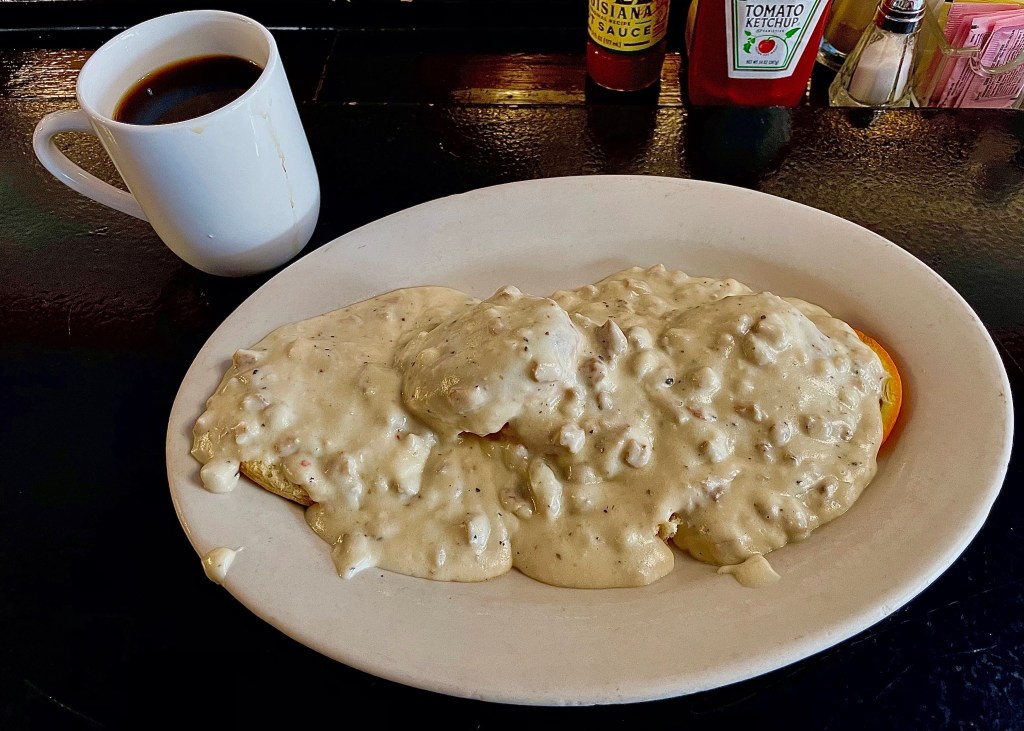
As I sat there eating, I was a bit unsettled. I’d left the doctor’s office and as is my tradition after a physical, was having a breakfast of biscuits and gravy at a local diner. The physical went fine, but the news that my doctor was departing was something else. We’ve been together for nearly 20 years.

When I left the Army in ‘92, one of my goals was to find a doctor’s office that was small, local and where I would consistently see the same doctor. In the military, that was never the case. Between large clinics and moving every couple of years, there was never any consistency in the doctors I saw.

Remember this was all pre-internet, pre-Facebook, pre- any way of really checking out a practice other than talking with friends. I started with a one-man doctor’s office that lasted about a year. He was old and didn’t seem quite interested in me. Someone then recommended a small practice with three or four doctors, and I gave them a try. They were good, and I generally saw the same doctor each time I visited. I liked them so much that even when we moved from Fairfax to Marshall, I stayed with them.

Sometime in the early 2000s, DR H___ joined the practice and I was “assigned” to her. I wasn’t sure what to think at first, as I’d never had a female doctor before. Silly me. Of course, it worked out fine. In fact, it was more than fine and we got along great.

Doctor H____

A few years later, I was at the doctor’s and DR H___ informed me she would soon leave the practice and start her own office. This would be my last checkup with her. What!? She couldn’t do this to me! Although of course, she could. I asked where her new office was, and could I move with her. She was prohibited from taking any clients with her, but she informed me if I kept an eye online, I might see a new doctor’s office opening in the Gainesville area with her name attached.

Soon enough, I saw the posting and became a “new” patient of hers. I’ve been with her for 14 years at this location.

Why do I like her so much? DR H___ takes a more holistic approach to healing. She doesn’t rush during the appointment. Prescribing a pill isn’t her first choice. Education of me, the patient, is a part of her approach. Looking for root causes is a part of her approach. Discussions together instead of her talking at me is a part of her approach. And … she is the only doctor at the practice. I feel like we know each other.

In her own words, “A healthy lifestyle is key to wellness. If you are in need of a doctor who listens and genuinely wants to help you feel better and stay healthy, then I would be humbled to have you call me your doctor.

It’s been a great partnership. While I’ve always eaten reasonably well, I eat more healthily now due to her influence. When diet along wouldn’t solve my cholesterol issues, she eventually prescribed a statin. She was there for my copperhead bite and for the subsequent AFIB. Our discussions on vitamin D results, prostate results, blood test results were always exactly that. Discussions. Not lectures. We worked our way through COVID together. She knows I drink, smoke a cigar once in a while, drink a cup or two of coffee every day and enjoy an occasional steak. I feel comfortable enough to generally be open with her about my “vices”. Maybe all doctors are this way, but in listening to some of my friends, it doesn’t appear to be the case.

So what has happened? DR H___, while staying local, is moving on from her practice and opening a “Functional Medicine Practice” which “shifts the traditional disease-centered focus of medical practice to a more patient-centered approach. Functional Medicine addresses the whole person, not just an isolated set of symptoms.” There was more, as you can see from this screen shot from her website:

Changes on the Way

While at my physical, DR H___ explained all of this to me. She talked about an increased focus on a better, healthier lifestyle so you would better enjoy your senior years. I asked if better senior years included the occasional manhattan or martini and she just smiled at me.

She also informed me that if I were to come with her to the new practice, I would still need a new GP doctor. She would not be addressing typical “family practice” issues. We shook hands as I departed her office that morning. I’m not sure why, but our handshake had a feeling of finality in it. That handshake, and the look in her eyes, have stayed with me.

I mulled all of this over while eating my biscuits and gravy. It was a lot to digest, and to be honest, I didn’t enjoy my breakfast as much as I usually do. It took a bit of the typical joy I felt while eating “something bad for me” as a celebration after my physical. I may have even left a couple of bites of biscuit on my plate, which is something I never do.

My Biscuits and Gravy Weren’t as Tasty as Usual.

Since then, I’ve continued to think about it. I don’t yet know whether I will go with her and her new practice, but I know in the meantime, I need to identify a new doctor. It’s not something I’m looking forward to. I know there are many good doctors, but it feels like starting over from scratch. Who in your life, outside of family and close friends, is more important than your doctor, and your relationship with her? Your dentist? Eye Doctor? Lawyer? Financial Advisor? A Teacher? Mentor? Life will go on, but it won’t be the same.

Life will Go on, but it Won’t be the Same.

Versatile Velveeta

Versatile Velveeta

I see that look you are giving me. A slight sneer? A touch of disappointment? Or maybe from a few of you, with a knowing smile, “Ah yes, you too.” OK. I admit it. There is almost always a block of Velveeta Cheese in our fridge and it’s the secret ingredient for a couple of Cathy’s key recipes.

Yes, There is Almost Always a Block of Velveeta in our Fridge.

I love cheese. And there are so many good ones available. As a kid, we were a bit limited, but I remember eating Swiss, cheddar and of course American. My sisters and I agreed a block of Velveeta was kept around the house – possibly for mac ‘n cheese, or the occasional grilled cheese sandwich. Memories are a bit fuzzy on the subject.

When Cath and I moved to Germany, my cheese world expanded. Brie. Camembert. Quark. Limburger. Obazda. Roquefort. Stilton. Gorgonzola. Pecorino Romano. Asiago. Gruyère and Raclette. Mascarpone and Tiramisu. And many, many more. It was seventh heaven for me. I literally didn’t know such a world existed.

Eventually we moved back to the States, and I learned that across the US, not just in the state of Wisconsin, wonderful cheeses were being made. Maytag Blue from Iowa. Humboldt Fog from Cypress Grove in California. Grayson from Meadow Creek Dairy here in Virginia. And maybe my favorite, Mount Tam from Cowgirl Creamery in Point Reyes, California. Oh. My. God. It doesn’t get any better.

But … Sometimes, you crave comfort. Sometimes, you want a gooey, melty cheese that makes everything around it better. Sometimes, a cheese that isn’t technically a cheese, is exactly what you need. Enter Velveeta.

Velveeta actually started in the 1920s. You may be surprised to learn in the 1930s, Velveeta became the first cheese product to gain the American Medical Association’s seal of approval. Since then, Velveeta continued to evolve and at various times was called a cheese, a cheese spread, a pasturized processed cheese spread, and since 2002, a “pasteurized prepared cheese product”, a term for which the FDA does not maintain a standard of identity. It is currently sold only in the United States, Canada, Panama, Hong Kong, the Philippines and South Korea.

If it’s not really cheese, why use it at all? The answer is simple – it’s ability to melt and almost become “velvety” (hence the name). It’s consistency when melted is better than most real cheeses. The reason? It contains the emulsifiers, sodium citrate and sodium alginate, which allow the cheese to melt without becoming greasy by stopping the fats from separating. Those emulsifiers provide the magic that is Velveeta.

I doubt there is anyone in America who hasn’t eaten chili con queso, or queso dip made with Velveeta. It’s been a staple at Super Bowl (and other) parties and gatherings for decades. At its most basic, you combine a slab of Velveeta and a can of Rotel tomatoes in a crock pot. You can jazz it up with other tomatoes, real hot peppers, ground sausage and any number of other items, but the base remains Velveeta. And of course, Mac ‘n cheese with Velveeta has made an appearance in many a household here in the US. It became so popular, they started selling it as a combined product – “Velveeta Shells and Cheese” so you didn’t have to buy the macaroni and cheese separate.

Is There Anyone who HASN’T Eaten Chili con Queso with Velveeta at a Super Bowl Party!?!

We don’t have children, so never went down the Velveeta Mac n’ cheese route. We also haven’t made chili con queso in years, so why is the box of Velveeta in our fridge? Two dishes. First, there’s Cathy’s meatloaf. She dots the inside of the entire meatloaf with little pieces of Velveeta. It is delicious.

The second dish? The best scalloped potatoes in the world. Yep, Cathy’s “secret ingredient” is Velveeta. Over the years, she, and we, have made several versions of au gratin potatoes, hasselback potatoes, scalloped potatoes and cheesy potatoes. The one that’s the best? The one people always ask for the recipe? Her scalloped potatoes with Velveeta. When she tells people what’s in it, or perhaps it’s just people not from the midwest, they are always a bit shocked. Some then decide they don’t really want the recipe. Go figure.

As I’ve grown older, I’ve needed to reduce the amount of dairy in my diet. That means cheese is not around the house as much as it was previously. We still buy some, and if having guests over for dinner, will often offer cheese as an appetizer, or as a separate cheese course later in the meal. I think my life would be pretty meager with no cheese at all. I also know my life would be poor indeed if I could never have Cath’s scalloped potatoes with Velveeta again.

Addendum:

– There will be no scalloped potatoes recipe published with the blog. It is secreted away in Cathy’s head, and as with her Lasagna recipe, will not be publicly published. ;-).

Five Years in One Page

Five Years in One Page

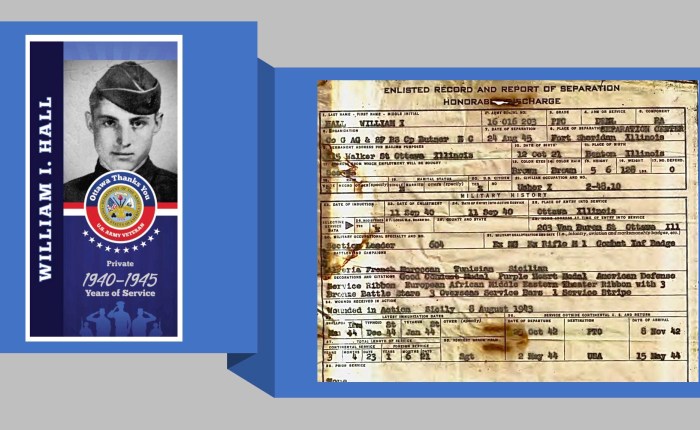
When discharged from the Army on August 24th, 1945, dad was 21 years old and had been in for nearly five years. His WWII service included time in Algeria, Tunisia, French Morocco and lastly, Sicily, where he was wounded. His discharge papers tell the intriguing story of those five years in one page.

This is the second of a two-part blog. Last week, I told the story of how I received dad’s enlistment and discharge paperwork from the National Archives. I then explored several interesting observations from his enlistment form, including the fact that he lied about his age in order to enlist. He claimed he was almost 19 years old, when in fact he was still two months shy of his 17th birthday. You will find a link to the first blog in the Addendum to this one.

Today’s blog explores his discharge paperwork, and briefly tells the story of his five years in the service. Dad was with B Company 1/60th Regimental Combat Team of the 9th Infantry Division from September 1940 until he was wounded and almost died in Sicily in August of 1943. Although his original enlistment in 1940 was for three years, when the war started all enlistments were extended for the duration.

As with his enlistment papers, dad’s discharge paperwork was discolored, creased and yellow, perhaps from the fire at the National Personnel Records Center (NPRC). A few parts were unreadable, but most of it was legible.

Dad’s Honorable Discharge Paperwork – it Suffered in the Fire at the Archives.

I’ll magnify and expand a couple sections to talk about some of the details.

At the top of the form, there are a couple of interesting items.

The Top of the Discharge Form – Magnified
  • Block 3 confirms his last duty station as Camp Butner, NC. This is where dad returned to the States in 1944 after recovering from his wounds. Camp Butner was both a troop training center, and a Prisoner of War camp. Dad told us stories later about helping train troops there (and about performing KP).
  • We see in block 4 his actual discharge date is August 24th, 1945. This was two weeks after the atom bomb was dropped on Nagasaki, Japan, and one week before the official surrender of the Japanese on September 2nd. The army was already discharging soldiers as the war was winding down, based on how many “points” they had (more on “points” later).
  • Block 7 still shows the birth date he lied about to enlist – Oct 12, 1921, as opposed to his real birth date of Oct 22, 1923. And amazingly, dad’s height, 5’ 6” and weight, 128 pounds haven’t changed at all from when he enlisted. Me thinks, someone was probably just copying from other forms to put this info in.
  • Block 21 shows his civilian employment as “Usher”, so maybe not everything was copied over. His enlistment paperwork showed him as a “Laborer”.

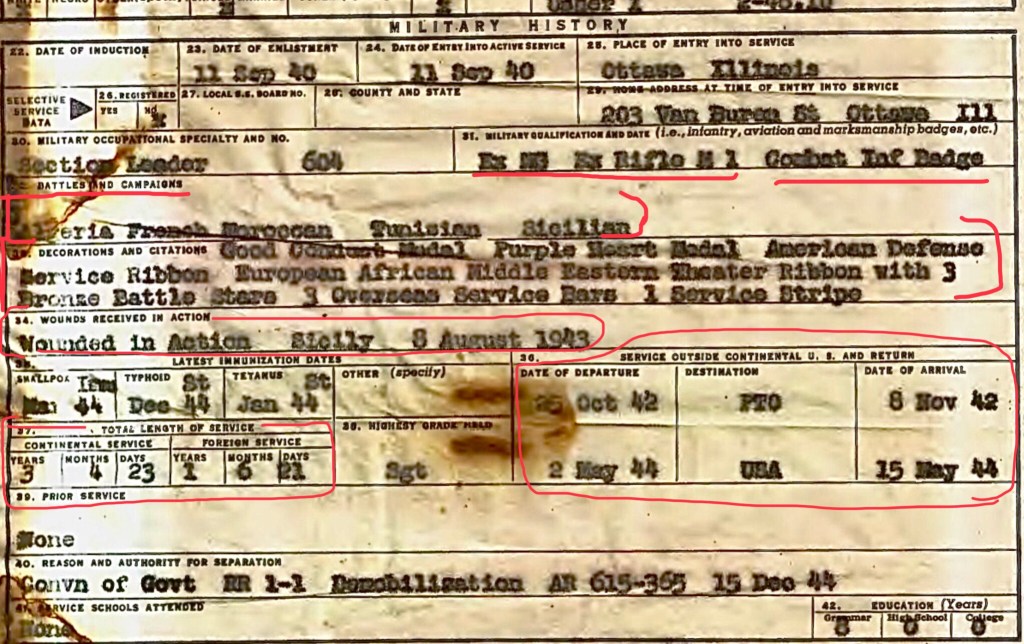
Now we move on to the Middle section of his discharge paper, dad’s “Military History”. This is the meat of the discharge, and paints the real story of his time in the service. I’ve again magnified the view so you can better read the form. In order to tell dad’s history in a linear fashion, I will sometimes go out of order in discussing what is in the blocks in this section.

Dad’s “Military History” in His Discharge Paperwork.
  • Block 31 shows dad qualified as an expert both on the Machine Gun, and the M1 Garand rifle. It also notes he was awarded the Combat Infantryman Badge. You could only earn the CIB if you were in the Infantry (not in Field Artillery, or Armor, or Signal Corps etc), AND you were in actual active combat with the enemy.
  • I’m going to skip to block 36 – “Service Outside the Continental United State” for just a minute . Note here that he arrived overseas on November 8th, 1942. What it doesn’t say is he arrived with the 60th Regimental Combat Team of the 9th Infantry Division at around 5AM under gunfire on the beach near Port-Lyautey, French Morocco. This was as a part of Operation Torch, the invasion of North Africa. Torch was (next to D-Day) the second largest amphibious assault ever attempted.
  • Now back to block 32, where we see in addition to French Morocco, dad also took part in battles in Algeria and Tunisia in North Africa where they defeated Rommel and the Africa Korps. Those battles took place between November 8th of 1942 and May 10th of 1943. Then in July of 1943, dad participated in the invasion of Sicily.
  • Skipping back down to block 34, we learn dad was wounded on August 8th, 1943. What it doesn’t mention is he was shot three times by the Germans in the mountains of Sicily and it took over a day to evacuate him by hand to an aid station. It also doesn’t say he almost died due to the combination of his wounds and the Malaria he contracted. His time with the 9th Infantry Division ended here.
  • Returning to block 36, we see dad arrived back in the States on May 15th, 1944, three weeks before D-Day. This was after he recovered from his wounds (he was evacuated to North Africa to fully recover). Due to the severity of those wounds, he didn’t return to combat – the war was over for him, although he remained in the service for another 15 months.
  • Block 37 “Foreign Service”, shows that of dad’s almost five years in the service, one year, six months and twenty-one days were spent overseas. Approximately eight of those months were in near continuous combat.
  • Finally, we return to block 33, “Decorations and Citations”. In addition to his Good Conduct Medal and Purple Heart (for being wounded), he was awarded: the American Defense Service Ribbon (awarded to troops on active duty prior to Pearl Harbor); the European African Middle Eastern Theatre Ribbon with three bronze stars (this was for participating in the campaign in French Morocco, and the subsequent campaigns in Algeria, Tunisia and Sicily); three Overseas Service Bars (one for each six month period in a theater of war) and finally a Service Stripe (one for each three year period of service). It’s worth noting dad also earned a Bronze Star (for exemplary conduct in ground combat against an armed enemy), which didn’t catch up with him until after he was already discharged, and is not reflected in this paperwork.

Finally we come to the bottom of the discharge paperwork and block 55. There are three items noted here, although not all are readable.

Block 55 – Points and Other Things
  • First, dad, along with all other honorably discharged service members, was issued a lapel button to be worn on civilian clothing. At the end of the war, it was particularly useful for those traveling home so they were quickly identified as service members and received priority for buses and trains.
  • Next we see dad’s ASR score was 95. ASR stood for Adjusted Service Rating and is what was used to determine the priority for discharging soldiers at the end of the war. The rules were simple in principle: “Those who had fought longest and hardest should be returned home and discharged first.” Points were given for length of time in the service, length of time overseas, combat campaigns, combat awards, being wounded and so on. At the time, “the points” required for discharge were 85. Dad, with his nearly five years of service, his 1 1/2 years overseas, his Purple Heart, and his four campaigns was at, or near the top of the heap. His 95 points reflect that, and was why he was discharged so quickly as the war was winding down. If you have ever watched the show “Band of Brothers” there is a great section in the last show focusing on this. Points were on everyone’s mind.
  • Finally, there’s the cryptic last line “xx days lost under AW 107”. What the hell is that? AW 107 stood for Articles of War (the forerunner of today’s Uniform Code of Military Justice). Article 107 refers to docking the soldier credit for days of active duty that they didn’t earn. Typical examples were for going AWOL, being too drunk to report for duty, or getting in trouble for other minor offenses and confined to the barracks. Since the service member was not performing his or her duties during those periods, they didn’t receive time in grade or retirement credit for those periods. It turns out many/most enlisted soldiers during WWII had AW107 scores higher than zero. During my research, I’ve found cases with numbers from 1 to over 200. I’ve tried like hell to read the smudged number here but can’t quite make it out. It might be a 5? It might be a 3? I don’t think we’ll ever know. What I do know is dad was busted from Sergeant to Private in June of 1943 for getting caught in, and subsequently kicked out of, a walled city twice in one night after missing the last truck back to his unit. Perhaps he was confined for some period of time in conjunction with this “incident”.

After his discharge, dad returned to Ottawa, Illinois in September and lived there for the next 65 years. In Ottawa he met mom, and had us three kids, six grandchildren and 13 great grandchildren. He retired from the railroad in 1985, and passed away in 2010.

For those of you who know me, or who have followed this blog for any length of time, I’m pretty sure you are aware of how much I admired my father. An embodiment of “The Greatest Generation”, dad was always one of my heroes. This was true certainly for his actions during WWII, but also for how he lived his life, and how he took care of our family.

A Banner Honoring Dad in Ottawa, Illinois on Veteran’s Day Last Year.

I’ve probably written more blogs about him than any other subject. The blog last week about his enlistment and this one about his discharge file are special to me. It’s somehow reassuring that his enlistment and discharge paperwork confirm the outline of the oral histories we heard from dad growing up. I wish I had discovered this paperwork while he was still alive, just so we could have one more conversation about it over a coffee or a beer. “Dad, tell me again about the time …”, or “Dad, about those lost AW 107 days…”.

I love him and miss him.

Addendum:

  • I apologize for the length of this and last week’s blogs, but I was trying to give some context to the cold and straightforward words in the paperwork.

– Here are a selection of other WWII blogs that I’ve alluded to in this blog. There may be some minor discrepancies in them, based on the availability of the new information in his paperwork:

Lying to Enlist in 1940

Lying to Enlist in 1940

On the 11th day of September, 1940, just over 14 months before Pearl Harbor, my dad, William Iber Hall, enlisted in the United States Army for a 3 year stint. His enlistment paperwork showed him to be 18 years and 11 months of age. In reality, he was 16 years and 11 months old.

Our family history always said dad lied about his age when he joined the Army. Still, it was pretty cool to receive some official corroboration.

A couple of years ago in the middle of COVID, I was doing some research and learned I could access dad’s military records. The only catch? On July 12th of 1973, a fire occurred at the National Personnel Records Center (NPRC) and destroyed between 16 and 18 million Official Military Personnel Files, including 80% of those who were discharged between 1912 and 1960. I said a prayer, held my breath, and sent a letter to the National Archives, and more specifically, the NPRC, asking for dad’s service and medical records.

Months passed. A year passed. A second year passed, and then I finally received an email from the NPRC. Dad’s records existed, but were located in the area where the worst part of the fire was. They were damaged and incomplete. They did have his enlistment and separation paperwork, but nothing else. Nothing from his medical records, and nothing else about his time in the service. They did forward copies of the enlistment and separation papers.

The NPRC’s Response to My Request for Information About Dad.

I looked at both documents. They are discolored, scarred and blurry in places. There are brown marks, including outlines of paper clips – perhaps from the heat of the fire. Here’s a photo of the enlistment documents – note there are actually three pages.

Dad’s Enlistment Papers – Apparently Damaged some by the Fire.

There is some fascinating information, particularly in the top half of the first page of the enlistment form. I’ve blown it up here so you can better read the form.

A Magnified View of the Top of Page One of Dad’s Enlistment, With Some Key Items Circled in Red.

Here are a few items of interest:

  • Dad enlisted in Peoria, Illinois – I’d always assumed in Ottawa, but there probably wasn’t a recruiting station there yet. His enlistment was for three years, and was directly to the 60th Infantry Regiment of the 9th Infantry Division. Three years later in September of 1943 when his enlistment was originally to end, dad was in a hospital in Sicily, recovering from being shot three times by the Germans. He was still serving with the 60th. By then, all enlistments were for the duration.
  • We see in his answer to question 1, that yes, dad did lie about his birth date – by over two years. His actual birthday was Oct 22, 1923, which means on the date of his enlistment, Sept 10, 1940, he was actually 16 years and 11 months old. You were required to be 18 years old to join and Dad lied big time, claiming a birth date of Oct 12, 1921, making himself 18 years and 11 months old.
  • His answer to question 3 shows he completed 7th Grade, and nothing more. This was interesting as well – dad always told us he graduated from 8th grade. (In a side note, Dad did graduate from high school in 2002, when he and other veterans who didn’t graduate were made honorary members and graduates of the OHS class of 2002.)
  • For question 4, he lists his work as Laborer for the past year, at $10/week. This was at least a partial lie. Dad joined the Civilian Conservation Corps (CCC) for two six month enlistments in 1939 when he was 15 years old (the legal age for the CCCs was 17). He may have worked as a laborer when he returned from the CCCs, but it certainly wasn’t for a year, as he joined the Army not long after his return. My guess is he was probably out of work at the time and didn’t want to admit it.
  • I’m betting dad didn’t know the “s” in Illinois is silent, as he spelled it Illinoise in his answer to question no. 1. ;-).
Dad in ‘39 or Early ‘40 in the CCCs, and Then Later in Early ‘41 with the 60th Infantry

On the second page of his enlistment, there are a couple of additional parts of his life we can confirm from the information provided. First, dad is listed at 5’ 6” and 128 lbs. That corresponds pretty well with the above CCC photo of him. It’s hard to see how the recruiter actually thought he was 18.

Also of interest is that my Grandma, Alberta Hall, is listed as his nearest relative, and the person to be notified in case of emergency. This aligns with other parts of our family history that aren’t always talked about as much. My Grandpa Hall was something of a ne’r-do-well for much of his life, and probably an alcoholic. He sometimes disappeared for days or weeks at a time. Evidently Dad wasn’t taking any chances on him as his emergency point of contact and named Grandma instead. It makes sense to me now that when the telegram came to the family in 1943 informing them of dad’s wounding, it was sent to Grandma, not Grandpa.

A Magnified View of Page 2 of Dad’s Enlistment.

Receiving his enlistment papers was an amazing find to me. I never doubted dad, or any of his stories, but finding actual documents confirming his history is incredible. Knowing how lucky we are they didn’t burn along with the 18 million other military personnel records, only makes the story more fascinating. Luck is sometimes a wonderful thing.

We’d always been told that dad enlisted in 1940, and knew he had to have lied about his age. My Aunt Ellen, his older sister by several years, went to the recruiting station with him to verify his age to the recruiter. Life at that point in time, at the tail end of the depression was tough, or at least tough for the Hall family. Grandma was supporting the family with her work, and Grandpa was only a part time presence at home. There was no money, and probably not many jobs, at least not for a 16 year old. The pay in the Army was $21/month at the time, plus food and housing. I think it looked pretty good to someone who had a fairly rough life to that point.

Today, I’m thinking about 16 year old William Iber Hall going to the recruiting station in Peoria Illinois and signing up to an unknown fate. Unbeknownst to him, Pearl Harbor would happen 14 months later. Thank God for dad, and others like him, who did the right thing and stood by our country in it’s time of need.

This is the first of two blogs about the documents I received from the NPRC. Next week’s blog will cover dad’s discharge paperwork. It tells the story about his time in the service from 1940 – 1945 in just one page, and is an equally amazing document.

Addendum:

  • You can read more about dad’s and the CCCs here: It was 1939 and dad and Uncle George were on a train, bound for the CCCs in Wyoming. Growing up in Illinois during the Great Depression was tough. Their family was poor before the Depression, and things got worse […] continue here: https://mnhallblog.wordpress.com/2017/12/13/dad-uncle-george-and-the-cccs-in-1939%EF%BB%BF
  • Here’s more on the fire at the NPRC from the Archives themselves: “Shortly after midnight on July 12, 1973, a fire was reported at the NPRC’s military personnel records building in St. Louis, MO. Firefighters arrived on the scene only 4 minutes and 20 seconds after the first alarm sounded and entered the building. While they were able to reach the burning sixth floor, the heat and the smoke forced the firefighters to withdraw at 3:15am. In order to combat and contain the flames, firefighters were forced to pour great quantities of water onto the exterior of the building and inside through broken windows. The fire burned out of control for 22 hours; it took two days before firefighters were able to re-enter the building. The blaze was so intense that local Overland residents had to remain indoors, due to the heavy acrid smoke. It was not until July 16, nearly four and a half days after the first reports, that the local fire department called the fire officially out. The fire destroyed approximately 16-18 million Official Military Personnel Files (OMPF). No duplicate copies of these records were ever maintained, nor were microfilm copies produced. Neither were any indexes created prior to the fire. In addition, millions of documents had been lent to the Department of Veterans Affairs before the fire occurred. Therefore, a complete listing of the records that were lost is not available. In terms of loss to the cultural heritage of our nation, the 1973 NPRC Fire was an unparalleled disaster.”

The Indoor Mile

The Indoor Mile

5:25 … 5:26 … 5:27 … Hall – 5:28 … 5:29 … 5:30 …” I did it! I finished the Plebe indoor mile run in under 5:30! As I slowed, my stomach suddenly double clutched and I ran to a nearby trash can, where I promptly threw up.

During my time at West Point, the Academy frequently talked about developing the “whole man” (with the admission of women in 1976, this changed to the “whole person”). We cadets were always being tested and evaluated. It was true about leadership, about academics, and was certainly true about physical fitness. For most of us, somewhere in all that testing was an Achilles Heel. With some it was a particular academic course, for others, some physical education test or class.

Plebe Year at West Point.

As Plebes, there were four required gym classes: Swimming, Wrestling, Boxing, and Gymnastics. For me, I’d been a swimmer all my life and a lifeguard for a few years, so the swimming class was easy, and I earned the equivalent of an A. Wrestling? I made West Point’s intercollegiate wrestling team as a freshman walk on, so I validated wrestling and took handball as an elective instead. Boxing was a challenge at first, but once I learned the basics, AND learned getting punched in the nose wasn’t a showstopper, I did OK. Gymnastics was a different beast.

The pommel horse, the rings, the vault, parallel bars, the trampoline, mats for tumbling … I forget what other torture devices were there, but it was like I was in a cursed land. My two sisters would tell you I wasn’t particularly coordinated as a kid. As a matter of fact, they would say I was a bit of a klutz. It all came home to roost in Gymnastics class. I was passing, but just barely.

At some point during the class, I learned we would do a timed mile run as a part of the course. Running of course has nothing to do with gymnastics, but those things happened at West Point. Just another chance to excel. Now, I had never been a runner, but since it was wrestling season, I was in great shape. Probably the best shape of my brief life up to that point. I started thinking I might be able to earn a good score on the mile run and improve my overall Gymnastics grade.

Hayes Gym* is where we practiced Gymnastics. It was “a large open gym with a vaulted ceiling and hardwood floors.” Above the gym floor, an elevated track rings the room. It takes 11.7 laps to run a mile on that track and that’s where we would complete the mile run.

Hayes Gym in 1910, the Year it was Built, and Again in 2009. Note the Elevated Track.

My personal view at the time (and that of at least a few of my classmates) was that many of the instructors in the Department of Physical Education (DPE) had a bit of a sadistic streak in them. One of our instructors was Army’s gymnastic coach, Ned Crossley and some classmates recall his scoring as particularly brutal. Looking back now, I’m pretty sure it wasn’t true. Having said that, all of the DPE instructors had ways of questioning you, challenging you, or prodding you that often seemed to taunt you a bit as well.

The instructor who spoke with us about the mile run was a little like that. To receive a max score, you needed to run under 5:30. The instructor explained what we needed to do to run a 5:30 mile. At 11.7 laps per mile, “all” you needed was to run each lap at a 28 seconds per lap pace, and then run like hell for the last half lap. Simple. Easy Peasy. Any cadet could do it. And so on. Of course the vast majority of us could run no where near that fast.

At the time, I don’t believe I’d ever run a mile (or any other distance) for time. I’d certainly run laps in High School sports, run in formation at West Point for Company morning runs during Beast, and we ran our asses off in wrestling practice. But none of this was ever done for time. That was about to change.

My pea brain went to work. 28 seconds was two seconds less than 30 seconds for each lap. 28 seconds for the first lap… 56 seconds for two laps … 1:24 for three laps … 1:52 for four laps and so on. I’d do the math in my head on the run. As long as I could keep the pace going, I had a shot.

A couple days later, it was my turn to do the run. As I recall, there were a few of us running it at the same time, although I don’t recall exactly how many. What I do remember was taking off when “go” was called. The first lap – 27 seconds! The next couple of laps I was under the pace. After that, I was a bit erratic, with some over and some under, but the average was OK and at the half mile mark, I was on pace. The final few laps? I’m not sure I was really paying attention any longer. The air was stale. The air was acrid. 3/4 of a mile and still on pace. My lungs were burning. I was sucking in as much oxygen as I could. 11 laps done. My legs were lead. It was down to just over half a lap left. I didn’t see anything other than the track in front of me. I don’t know if the other Plebes were in front of me, or behind me. All I know is I ran as hard as could. I rounded the final curve.

5:25 … 5:26 … 5:27 … Hall – 5:28 … 5:29 … 5:30 …” I did it! I beat 5:30. I slowed down and suddenly my stomach double clutched and I ran to a nearby trash can, where I promptly threw up.

Recovery took me a while. I may have heaved a second time, and certainly had the dry heaves. Eventually I made my way to the shower, and then to whatever my next class was that day.

A couple weeks later, I passed gymnastics with some room to spare.

In my remaining years at West Point, I never ran that fast again. Not even close. We had PT tests on an annual basis with a two mile run next to the Hudson River. I never approached anything close to that time, even when adjusted for a slower time due to the extra distance. The two miler was always a challenge for me and I was always nervous about failing it. The thought of maxing out my run score never entered my head.

Years later, I took up running on my own for fun and to stay in shape. I became a decent runner, and clocked several personal bests – an 11:44 two mile ( a sub six minute/mile pace); a 39:58 10K (a sub 6:30/mile pace) and a 68 minute and change 10 mile race (a sub 7 min/mile pace). I remember all of those. The one I still marvel at? The 5:28 mile on the indoor track at West Point. I had no business running that fast. How the hell did I ever do it?

Addendum:

  • * Some info on Hayes Gym from the Academy itself: Hayes Gym was built in 1910. The second level of Hayes is what most cadets and USMA graduates think of as “Hayes Gym”. It is a large open gym with a vaulted ceiling, hardwood floor, and elevated track (11.7 laps to a mile) that rings the room. The Department of Physical Education (DPE), teaches applied gymnastics (now called “Military Movement”) in Hayes, taking advantage of its historical and unusual support structures. The gym has eighteen 21′ vertical ropes and two 60′ horizontal ropes (suspended 12′ from the floor). There are also 10 pull-up bars that are each 5′ wide and are suspended from the ceiling with vertical supports in such a manner that they can be “run across” (with proper technique), as is done during the Indoor Obstacle Course. The gym’s floor space is filled with gymnastic’s apparatus and pads, such as vaults, bars, and rings as well as 1″ and 4″ tumbling mats. Nowadays, the military movement equipment remains in place year-round.
  • The Indoor Obstacle Course is another “fond” memory of Hayes Gym for most West Point Grads, as it was also known to induce retching at it’s completion. I may do a blog on it in the future, but it’s hard to describe to those who haven’t experienced it. To get a flavor for it, here’s a YouTube video of Cadet Elizabeth Bradley completing it just a couple of years ago and breaking the female record while doing so. For all my macho buddies out there, I would love to see you try to beat her time. Good luck on that unlikely event. GO ARMY! https://youtu.be/Dw5rR1yqyp8 .
  • Thanks to classmates Gus Hellzen and Jerome Butler for their contributions to this blog.

Guests at the Pond

Guests at the Pond

This February, we had visitors on the farm. While it took a bit of time to confirm their identity, we eventually did. Two river otters took up residence at our pond and provided great entertainment, along with both joy and sadness.

Cathy was the first to see them. She saw something moving across the pond and then disappear below the surface for a period of time. At first she thought it was a turtle, as we do have snappers in the pond, but this was moving too fast. Then she saw a second fast moving object. It came towards her, and suddenly “stood up”* in the water and looked at her! What?!

She told me about it later that evening and we discussed the possibilities. Beavers are what first came to mind, although it seemed strange they would establish a home in a pond – I’d presumed they needed more moving water than our small streams. We did some research online and three other options popped up – muskrats, mink and river otters.

Cath saw them again the next day, and then I did too. They were definitely not beavers – their tails were wrong. And then due to size, we eliminated mink and muskrats. They were probably somewhere between 15-25 pounds, much larger than mink or muskrat. Plus they were definitely staying in the water for long periods, which eliminated the mink, and were eating fish, which pretty much eliminated the muskrat. River otters had taken up residence in the pond.

One of the River Otters at Our Pond.

We started watching for them on a daily basis. Cathy would see them while crossing the berm at one end of the pond to go horse riding. I’d see them in the morning while putting the horses out. Swimming, diving, eating fish, appearing, disappearing and reappearing. Ripples on the pond when there was no wind. They were quite entertaining.

Ripples With No Wind.

It looked as if they set up a dwelling under a fallen tree on the pond’s edge. It was one of several large trees we lost last June during a major wind storm that passed through the area.** I marveled at Mother Nature taking away several large trees and an unknown number of bird nests last summer, only to give the otters a home with one of those trees this winter.

The Fallen Tree that is Probably Their Home.

Cathy talks about our pond acting as the center of life on the farm and she’s right. There are of course fish, turtles, frogs and snakes in the pond but it attracts so much more. We’ve seen deer and raccoon on the banks, and a bear stopping in for a drink, before meandering on it’s way. There is amazing bird life – in addition to small birds, we have observed a couple types of duck, geese, owls, hawks and even an eagle. Often, there are blue heron standing silently in the water while fishing. If you watch for even a few quiet minutes you are likely to see some gift from Mother Nature. The pond is certainly what brought the gift of the otters to us.

After they arrived, I was blessed early one morning with a memory I won’t forget. I had already fed the horses, and was back in the kitchen drinking my coffee. Using a pair of binoculars, I tracked the otters moving around the pond, diving and resurfacing. As I watched, a pair of geese were swimming in the shallows closest to me. Two heron were flying back and forth overhead, possibly irritated by the presence of the otters. I sat mesmerized for five or ten minutes, taking in all of the activity on our pond. It wasn’t yet 8AM.

Cath and I developed a daily habit of asking each other if we’d seen the otters and what they were doing. It was fun and also renewing. These two small creatures brought wonder and marvel to Rohan Farm.

Perhaps seven or ten days after they first arrived, the otters disappeared. We didn’t think too much about it the first day. Then a second day passed with no sightings. After a week with no viewings, we assumed they were gone.

We didn’t know what happened, but had so many questions. Where did they come from to begin with? Were they just passing through and stopping to eat for a few days? Did they start to make a home, and then with us, the horses and the dog in the area, decide there was too much activity here? Did they fish the pond for a while and decide there wasn’t enough food to support them long term? Did something kill them? We didn’t know.

Eight or nine days after their departure, I happened to look out the bedroom window in the morning, as I was preparing to start the day. There was no wind and there were no geese in sight, but there were ripples on the pond. I hurriedly finished dressing and went to feed the horses. I didn’t want to break my routine, rush straight to the pond and scare any potential visitors.

I fed the cats and then walked from the barn to the feed room to get the horse’s grain. I could see part of the pond, but trees blocked a total view. Finally, as I was carrying hay from the barn to the paddock, I saw a head above the water moving quickly, and creating ripples in it’s wake. I watched for a couple of seconds, and then it must have seen me as well – it “stood up” in the water, looked at me, and then continued about it’s business. The otters were back.

Now of course there were a whole new set of questions. Were they here the whole time, but becoming more nocturnal? Were they moving between the several ponds in our area? How long would they stay? How do we not waste this wonderful opportunity to watch them?

We’ve lived here for almost twenty-five years and have never before seen an otter. It never even occurred to me to look for a river otter. And then this small miracle occurred. I know this is how that strange and wonderful thing we call life works some times, but it still amazes me.

I will remember this winter and the pure joy the otters have brought us. I will also remember the sadness I felt when I thought they departed. We don’t now know their future plans and their time with us may still be fleeting. I feel lucky to have had the experience with them at all – and I am grateful for both the delight, and the sadness I have felt. I promise myself I will continue to enjoy them, and marvel at them, for as long as they allow it.

The Otters Weren’t Just a Dream.

Addendum:

  • * I later learned that what we called “standing up” in the water is referred to as periscoping. Otters “periscope,” meaning raise their necks far out of the water, to see farther. They also do this to identify each other.
  • ** I mentioned the storm from last June knocking down the tree that apparently has become the home for the otters. Here’s a blog about the storm event. Eight months later, I can still hear the sound of the crying birds in my head – “When I went outside to assess the damage after the storm passed, the first thing I thought of was the musician Prince. There were probably no doves, but as I stood on the porch, I could hear hundreds (thousands?) of birds plaintively crying out, over and over and over. This wasn’t good” […] Continue at: https://mnhallblog.wordpress.com/2022/06/23/when-birds-cry/

Judgement of Tilghman

Judgement of Tilghman

Honorable mentions went to Miller Lite and Natty Light. Second place went to Coors Light. And, drum roll please … Bud Light won First place. What – The best light beer in America? No. This was a judgment based on litter pick up at Black Walnut Point on Tilghman Island, Md. There were more Bud Light cans left among the trash than any other brand.

We are fortunate enough to own a small second home on Tilghman Island. Tilghman is in the middle of the Chesapeake Bay, about twenty minutes from Saint Michaels. The island, reached by a short draw bridge, is beautiful and remains a rural area. Working fishermen, oyster men and crabbers still practice their craft and usually depart on their boats in the early morning hours six days a week from the various harbors and docks.

The very end of Tilghman Island is known as Black Walnut Point. We live close by in the “village” of Fairbank, a collection of thirty-five or so older homes. It’s a great little community with a combination of original Tilghman Islanders, folk who have moved or retired here full time, and part timers like ourselves. Everyone is friendly and gets along. When you go for a walk, it’s more of a stroll and chat. People are always stopping, talking with others and catching up on the local news.

Tilghman Island and Black Walnut Point

Black Walnut Point itself has a small Inn at the end of the road. Before you arrive at the Inn, the road passes a quarter mile of public access to the Chesapeake. It’s a paved area, and they have reenforced this small split of land with boulders and riprap to keep it from washing away into the Bay. The area attracts folk who like to fish, or come to see a gorgeous sunset, or just hang out and take a couple of photos. The Chesapeake doesn’t have lots of public access on much of it’s shoreline, so where there is a public spot, people tend to gather.

The Afternoon View From Black Walnut Point Road.

And gather they do, at all times of the year, but particularly in the warmer months. That’s when the trash problem is the worst. While I’m sure most visitors are good people, there are a number who have evidently never heard of taking their trash with them. During summer on a busy weekend, it’s not unusual to walk the area on a Monday morning and find actual bags of trash visitors have left behind. It’s evidently too much trouble to haul it back home. And then of course there are the bottles, cans, sandwich packages, cigarette packs and cigarette butts, not to mention fishing line, hooks and weights left among the rocks. Or crammed between the rocks. Or crushed and pushed down lower in the rocks.

Tilghman Island and our Fairbank community have organized trash pick-up events over the years. During summer, neighbors would go out a couple of times as a group and pick up several large bags of trash. Gary, the unofficial “Mayor” (or ambassador) of Fairbank helped organize many of these events via email before he passed away a few years ago. As importantly, people would sometimes go out on their own to pick up trash.

After Gary passed away, our friend Darren has taken on some of the role of community organizer. As an example, just this past December around Christmas time there was a huge storm with high winds on the Bay, resulting in large amounts of trash, debris, flotsam and jetsam washing up on Black Walnut Point. Darren put out the call to help clean up and the community responded. When we arrived a few days later on Dec 29th, I made a pass and collected a couple bags of trash and recyclables, but most was already gone, thanks to our neighbors.

Last week, Cath and I were at the Bayhouse again. As I took our dog, Carmen, for a walk towards Black Walnut Point, I noticed the trash was starting to pile up. It wasn’t bad, considering we’d cleaned the area up a little over a month before, but there was enough to be noticeable, and I decided I’d do a trash-pickup-pass the next day.

The next afternoon, as I was about to start, I ran into our neighbors John and Lea out for a walk with their dog. As we were talking, John told me he’d been out the week before and picked up two bags of recyclables. That was a bit of a surprise, as it meant the trash I was seeing was just from the past week.

Later, as I finished collecting my bag and a half of trash, a few things became apparent. The majority of smokers littering the area were Marlboro fans, with a couple of Pall Mall smokers thrown in. Among the recyclables, I found a few plastic water bottles, a couple of diet Pepsi cans and two empty pints of Lord Calvert Canadian Whiskey. The rest of it? Beer cans. And not just any beer cans. There were no IPAs, no Guinness Stout, no German pils or Mexican lagers. There was no Nanticoke Nectar from RAR brewery just down the road in Cambridge. While I found a few Budweisers, most were Light cans. There were a couple of Miller Lites and a few Natty Lights, but the vast majority were Coors Light and 10 ounce cans of Bud Light.

Coors Light and Bud Light – Both are Evidently a Favorite of Litterers.

The Coors Light cans were found in just a couple of concentrated areas. You could almost see a couple of fishermen standing or sitting there, working their way through a twelve pack over the course of an afternoon. Finish one beer, throw it among the rocks and grab another one from the cooler. Did they catch any fish? We’ll never know, but it appears they enjoyed themselves.

The Bud Lights? They were scattered up and down the shoreline in ones or twos. In fact, several were also scattered in the grass and woods on the drive into the area. These brought a different vision to my head. One or two guys, maybe kids, maybe not, having a beer in their truck and chucking it onto the rocks, or as they were driving home, throwing it out the window onto the side of the road. The Bud Light drinkers also threw out the boxes those 10 ounce beers came in. No evidence was going to remain in their cars.

As I mentioned a couple of times, the Bud Lights were all 10 ounce cans. Why does that matter? 10 ounce beers are an Eastern Shore thing*. Look in your hometown store and see if you can find 10 oz Buds. The answer is probably no, unless you live on certain parts of the Eastern Shore of Maryland.

My guess on our litterers? The Coors guys were from somewhere else and came for an afternoon of fishing on the Bay. The Bud Light drinkers? I’d bet they are from somewhere nearby on the the Eastern Shore of Maryland – probably somewhere between here and Easton. Maybe they are high school kids sneaking their beers; maybe they are bored young guys; or maybe they are older guys getting away from home for awhile.

I could be wrong. Maybe they are from somewhere else, forgot to bring beer, and decided to buy some here locally. At the store they looked around saw the 10 ounce cans, and said, “Those beers are for me. I want beers in cans that are two ounces smaller than what I normally drink.” Maybe.

What I do know is whoever they are, they are trashing the area.

I can’t say this is a typical mix of trash, only that it is what I found on this particular visit. It’s unfortunate. I guarantee both the Coors and Bud Light drinkers would tell you they love this area. It has everything they want – open access to the Bay, beautiful views and occasionally good fishing. But you can’t profess to love something and trash it at the same time. All that does is make you a hypocrite. In this case, hypocrites who don’t respect Mother Nature, Tilghman Island or those around them.

Addendum:

  • * 10 Ounce cans of Bud and Bud Light are a big thing in parts of the Eastern Shore of Maryland. I particularly enjoy them on a hot summer day – you finish your beer beer before it gets warm. You find them in the counties of Caroline, Dorchester, Kent, Queen Anne’s and Talbot (our county), but not in places such as Salisbury and Ocean City. You can read more about them here: https://wtop.com/maryland/2020/09/uncanny-why-10-ounce-cans-of-budweiser-are-popular-in-parts-of-maryland/
  • The title of this blog is a word play on “Judgement of Paris”, the 1976 blind wine tasting in Paris that elevated the status of American wines. Never heard of it? You can read more here: https://en.m.wikipedia.org/wiki/Judgment_of_Paris_(wine) . The wine “Judgement of Paris” itself was a twist on The “Judgement of Paris” in Greek Mythology, which was a contest between the three most beautiful goddesses of Olympos – Aphrodite, Hera and Athena for the prize of a golden apple addressed “To the Fairest.” The original Judgement in Paris eventually led to the Trojan War and the destruction of Troy.
  • Here’s a bit of a more complete history of trash pick up on Tilghman from Darren. I shortened it a bit for the blog: Gary and Larry were the original two people who picked up trash. People saw Gary and Larry doing it and joined in. It organically became a Fairbank community effort. Gary then made it more formal through his newsletters. When The Phillips Wharf Environmental Center was under Kelly Cox, they held a trash pick-up day called “Tidy up Tilghman.” People picked up trash across the entire island on that day. Gary was on the PWEC Board of Directors, so I think they got the idea from him. The tradition has always been strong and remains in place in Fairbank. There’s another trash pick up for the entire Island taking place on April 1st of this year.
  • Thanks to friends Darren and Veronica who both took a look at this blog for accuracy and editing purposes!