The Indoor Mile

The Indoor Mile

5:25 … 5:26 … 5:27 … Hall – 5:28 … 5:29 … 5:30 …” I did it! I finished the Plebe indoor mile run in under 5:30! As I slowed, my stomach suddenly double clutched and I ran to a nearby trash can, where I promptly threw up.

During my time at West Point, the Academy frequently talked about developing the “whole man” (with the admission of women in 1976, this changed to the “whole person”). We cadets were always being tested and evaluated. It was true about leadership, about academics, and was certainly true about physical fitness. For most of us, somewhere in all that testing was an Achilles Heel. With some it was a particular academic course, for others, some physical education test or class.

Plebe Year at West Point.

As Plebes, there were four required gym classes: Swimming, Wrestling, Boxing, and Gymnastics. For me, I’d been a swimmer all my life and a lifeguard for a few years, so the swimming class was easy, and I earned the equivalent of an A. Wrestling? I made West Point’s intercollegiate wrestling team as a freshman walk on, so I validated wrestling and took handball as an elective instead. Boxing was a challenge at first, but once I learned the basics, AND learned getting punched in the nose wasn’t a showstopper, I did OK. Gymnastics was a different beast.

The pommel horse, the rings, the vault, parallel bars, the trampoline, mats for tumbling … I forget what other torture devices were there, but it was like I was in a cursed land. My two sisters would tell you I wasn’t particularly coordinated as a kid. As a matter of fact, they would say I was a bit of a klutz. It all came home to roost in Gymnastics class. I was passing, but just barely.

At some point during the class, I learned we would do a timed mile run as a part of the course. Running of course has nothing to do with gymnastics, but those things happened at West Point. Just another chance to excel. Now, I had never been a runner, but since it was wrestling season, I was in great shape. Probably the best shape of my brief life up to that point. I started thinking I might be able to earn a good score on the mile run and improve my overall Gymnastics grade.

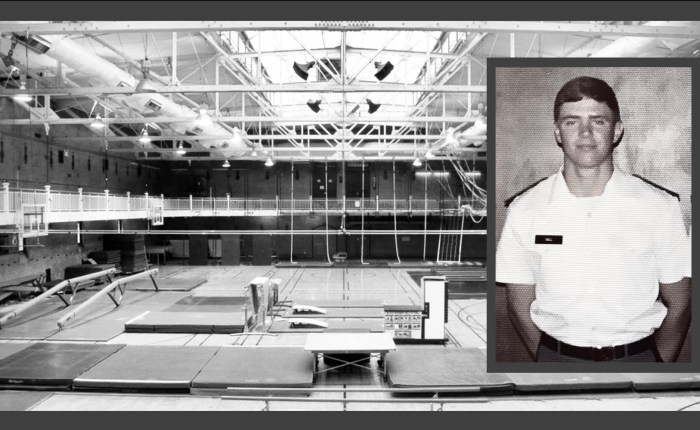
Hayes Gym* is where we practiced Gymnastics. It was “a large open gym with a vaulted ceiling and hardwood floors.” Above the gym floor, an elevated track rings the room. It takes 11.7 laps to run a mile on that track and that’s where we would complete the mile run.
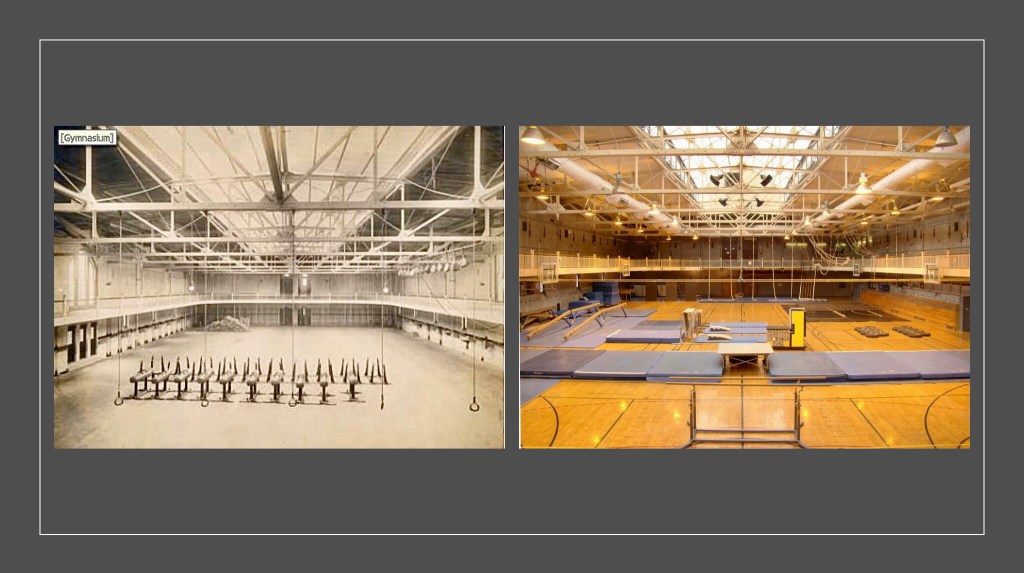
Hayes Gym in 1910, the Year it was Built, and Again in 2009. Note the Elevated Track.

My personal view at the time (and that of at least a few of my classmates) was that many of the instructors in the Department of Physical Education (DPE) had a bit of a sadistic streak in them. One of our instructors was Army’s gymnastic coach, Ned Crossley and some classmates recall his scoring as particularly brutal. Looking back now, I’m pretty sure it wasn’t true. Having said that, all of the DPE instructors had ways of questioning you, challenging you, or prodding you that often seemed to taunt you a bit as well.

The instructor who spoke with us about the mile run was a little like that. To receive a max score, you needed to run under 5:30. The instructor explained what we needed to do to run a 5:30 mile. At 11.7 laps per mile, “all” you needed was to run each lap at a 28 seconds per lap pace, and then run like hell for the last half lap. Simple. Easy Peasy. Any cadet could do it. And so on. Of course the vast majority of us could run no where near that fast.

At the time, I don’t believe I’d ever run a mile (or any other distance) for time. I’d certainly run laps in High School sports, run in formation at West Point for Company morning runs during Beast, and we ran our asses off in wrestling practice. But none of this was ever done for time. That was about to change.

My pea brain went to work. 28 seconds was two seconds less than 30 seconds for each lap. 28 seconds for the first lap… 56 seconds for two laps … 1:24 for three laps … 1:52 for four laps and so on. I’d do the math in my head on the run. As long as I could keep the pace going, I had a shot.

A couple days later, it was my turn to do the run. As I recall, there were a few of us running it at the same time, although I don’t recall exactly how many. What I do remember was taking off when “go” was called. The first lap – 27 seconds! The next couple of laps I was under the pace. After that, I was a bit erratic, with some over and some under, but the average was OK and at the half mile mark, I was on pace. The final few laps? I’m not sure I was really paying attention any longer. The air was stale. The air was acrid. 3/4 of a mile and still on pace. My lungs were burning. I was sucking in as much oxygen as I could. 11 laps done. My legs were lead. It was down to just over half a lap left. I didn’t see anything other than the track in front of me. I don’t know if the other Plebes were in front of me, or behind me. All I know is I ran as hard as could. I rounded the final curve.

5:25 … 5:26 … 5:27 … Hall – 5:28 … 5:29 … 5:30 …” I did it! I beat 5:30. I slowed down and suddenly my stomach double clutched and I ran to a nearby trash can, where I promptly threw up.

Recovery took me a while. I may have heaved a second time, and certainly had the dry heaves. Eventually I made my way to the shower, and then to whatever my next class was that day.

A couple weeks later, I passed gymnastics with some room to spare.

In my remaining years at West Point, I never ran that fast again. Not even close. We had PT tests on an annual basis with a two mile run next to the Hudson River. I never approached anything close to that time, even when adjusted for a slower time due to the extra distance. The two miler was always a challenge for me and I was always nervous about failing it. The thought of maxing out my run score never entered my head.

Years later, I took up running on my own for fun and to stay in shape. I became a decent runner, and clocked several personal bests – an 11:44 two mile ( a sub six minute/mile pace); a 39:58 10K (a sub 6:30/mile pace) and a 68 minute and change 10 mile race (a sub 7 min/mile pace). I remember all of those. The one I still marvel at? The 5:28 mile on the indoor track at West Point. I had no business running that fast. How the hell did I ever do it?

Addendum:

  • * Some info on Hayes Gym from the Academy itself: Hayes Gym was built in 1910. The second level of Hayes is what most cadets and USMA graduates think of as “Hayes Gym”. It is a large open gym with a vaulted ceiling, hardwood floor, and elevated track (11.7 laps to a mile) that rings the room. The Department of Physical Education (DPE), teaches applied gymnastics (now called “Military Movement”) in Hayes, taking advantage of its historical and unusual support structures. The gym has eighteen 21′ vertical ropes and two 60′ horizontal ropes (suspended 12′ from the floor). There are also 10 pull-up bars that are each 5′ wide and are suspended from the ceiling with vertical supports in such a manner that they can be “run across” (with proper technique), as is done during the Indoor Obstacle Course. The gym’s floor space is filled with gymnastic’s apparatus and pads, such as vaults, bars, and rings as well as 1″ and 4″ tumbling mats. Nowadays, the military movement equipment remains in place year-round.
  • The Indoor Obstacle Course is another “fond” memory of Hayes Gym for most West Point Grads, as it was also known to induce retching at it’s completion. I may do a blog on it in the future, but it’s hard to describe to those who haven’t experienced it. To get a flavor for it, here’s a YouTube video of Cadet Elizabeth Bradley completing it just a couple of years ago and breaking the female record while doing so. For all my macho buddies out there, I would love to see you try to beat her time. Good luck on that unlikely event. GO ARMY! https://youtu.be/Dw5rR1yqyp8 .
  • Thanks to classmates Gus Hellzen and Jerome Butler for their contributions to this blog.

Guests at the Pond

Guests at the Pond

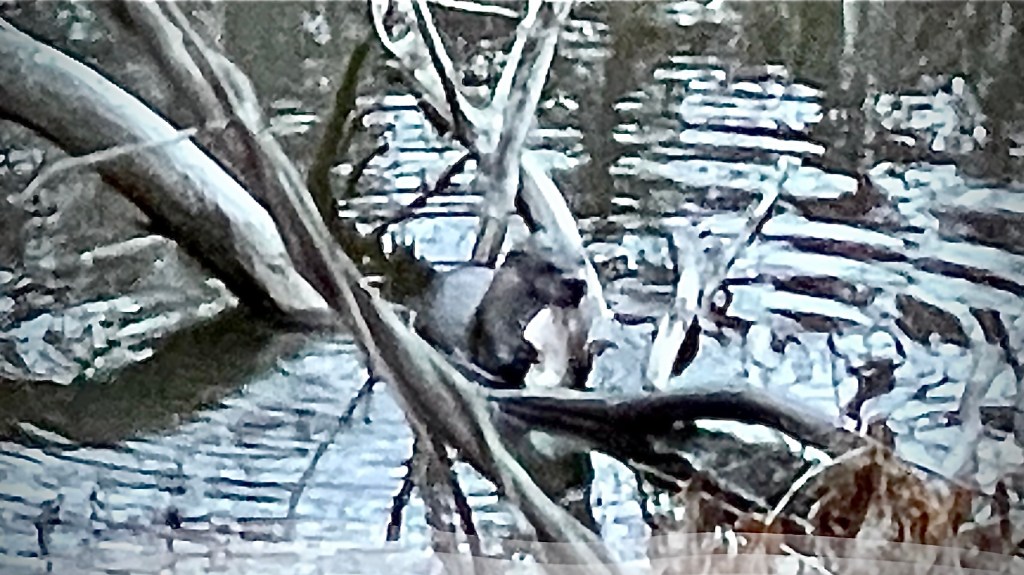
This February, we had visitors on the farm. While it took a bit of time to confirm their identity, we eventually did. Two river otters took up residence at our pond and provided great entertainment, along with both joy and sadness.

Cathy was the first to see them. She saw something moving across the pond and then disappear below the surface for a period of time. At first she thought it was a turtle, as we do have snappers in the pond, but this was moving too fast. Then she saw a second fast moving object. It came towards her, and suddenly “stood up”* in the water and looked at her! What?!

She told me about it later that evening and we discussed the possibilities. Beavers are what first came to mind, although it seemed strange they would establish a home in a pond – I’d presumed they needed more moving water than our small streams. We did some research online and three other options popped up – muskrats, mink and river otters.

Cath saw them again the next day, and then I did too. They were definitely not beavers – their tails were wrong. And then due to size, we eliminated mink and muskrats. They were probably somewhere between 15-25 pounds, much larger than mink or muskrat. Plus they were definitely staying in the water for long periods, which eliminated the mink, and were eating fish, which pretty much eliminated the muskrat. River otters had taken up residence in the pond.

One of the River Otters at Our Pond.

We started watching for them on a daily basis. Cathy would see them while crossing the berm at one end of the pond to go horse riding. I’d see them in the morning while putting the horses out. Swimming, diving, eating fish, appearing, disappearing and reappearing. Ripples on the pond when there was no wind. They were quite entertaining.

Ripples With No Wind.

It looked as if they set up a dwelling under a fallen tree on the pond’s edge. It was one of several large trees we lost last June during a major wind storm that passed through the area.** I marveled at Mother Nature taking away several large trees and an unknown number of bird nests last summer, only to give the otters a home with one of those trees this winter.

The Fallen Tree that is Probably Their Home.

Cathy talks about our pond acting as the center of life on the farm and she’s right. There are of course fish, turtles, frogs and snakes in the pond but it attracts so much more. We’ve seen deer and raccoon on the banks, and a bear stopping in for a drink, before meandering on it’s way. There is amazing bird life – in addition to small birds, we have observed a couple types of duck, geese, owls, hawks and even an eagle. Often, there are blue heron standing silently in the water while fishing. If you watch for even a few quiet minutes you are likely to see some gift from Mother Nature. The pond is certainly what brought the gift of the otters to us.

After they arrived, I was blessed early one morning with a memory I won’t forget. I had already fed the horses, and was back in the kitchen drinking my coffee. Using a pair of binoculars, I tracked the otters moving around the pond, diving and resurfacing. As I watched, a pair of geese were swimming in the shallows closest to me. Two heron were flying back and forth overhead, possibly irritated by the presence of the otters. I sat mesmerized for five or ten minutes, taking in all of the activity on our pond. It wasn’t yet 8AM.

Cath and I developed a daily habit of asking each other if we’d seen the otters and what they were doing. It was fun and also renewing. These two small creatures brought wonder and marvel to Rohan Farm.

Perhaps seven or ten days after they first arrived, the otters disappeared. We didn’t think too much about it the first day. Then a second day passed with no sightings. After a week with no viewings, we assumed they were gone.

We didn’t know what happened, but had so many questions. Where did they come from to begin with? Were they just passing through and stopping to eat for a few days? Did they start to make a home, and then with us, the horses and the dog in the area, decide there was too much activity here? Did they fish the pond for a while and decide there wasn’t enough food to support them long term? Did something kill them? We didn’t know.

Eight or nine days after their departure, I happened to look out the bedroom window in the morning, as I was preparing to start the day. There was no wind and there were no geese in sight, but there were ripples on the pond. I hurriedly finished dressing and went to feed the horses. I didn’t want to break my routine, rush straight to the pond and scare any potential visitors.

I fed the cats and then walked from the barn to the feed room to get the horse’s grain. I could see part of the pond, but trees blocked a total view. Finally, as I was carrying hay from the barn to the paddock, I saw a head above the water moving quickly, and creating ripples in it’s wake. I watched for a couple of seconds, and then it must have seen me as well – it “stood up” in the water, looked at me, and then continued about it’s business. The otters were back.

Now of course there were a whole new set of questions. Were they here the whole time, but becoming more nocturnal? Were they moving between the several ponds in our area? How long would they stay? How do we not waste this wonderful opportunity to watch them?

We’ve lived here for almost twenty-five years and have never before seen an otter. It never even occurred to me to look for a river otter. And then this small miracle occurred. I know this is how that strange and wonderful thing we call life works some times, but it still amazes me.

I will remember this winter and the pure joy the otters have brought us. I will also remember the sadness I felt when I thought they departed. We don’t now know their future plans and their time with us may still be fleeting. I feel lucky to have had the experience with them at all – and I am grateful for both the delight, and the sadness I have felt. I promise myself I will continue to enjoy them, and marvel at them, for as long as they allow it.

The Otters Weren’t Just a Dream.

Addendum:

  • * I later learned that what we called “standing up” in the water is referred to as periscoping. Otters “periscope,” meaning raise their necks far out of the water, to see farther. They also do this to identify each other.
  • ** I mentioned the storm from last June knocking down the tree that apparently has become the home for the otters. Here’s a blog about the storm event. Eight months later, I can still hear the sound of the crying birds in my head – “When I went outside to assess the damage after the storm passed, the first thing I thought of was the musician Prince. There were probably no doves, but as I stood on the porch, I could hear hundreds (thousands?) of birds plaintively crying out, over and over and over. This wasn’t good” […] Continue at: https://mnhallblog.wordpress.com/2022/06/23/when-birds-cry/

Judgement of Tilghman

Judgement of Tilghman

Honorable mentions went to Miller Lite and Natty Light. Second place went to Coors Light. And, drum roll please … Bud Light won First place. What – The best light beer in America? No. This was a judgment based on litter pick up at Black Walnut Point on Tilghman Island, Md. There were more Bud Light cans left among the trash than any other brand.

We are fortunate enough to own a small second home on Tilghman Island. Tilghman is in the middle of the Chesapeake Bay, about twenty minutes from Saint Michaels. The island, reached by a short draw bridge, is beautiful and remains a rural area. Working fishermen, oyster men and crabbers still practice their craft and usually depart on their boats in the early morning hours six days a week from the various harbors and docks.

The very end of Tilghman Island is known as Black Walnut Point. We live close by in the “village” of Fairbank, a collection of thirty-five or so older homes. It’s a great little community with a combination of original Tilghman Islanders, folk who have moved or retired here full time, and part timers like ourselves. Everyone is friendly and gets along. When you go for a walk, it’s more of a stroll and chat. People are always stopping, talking with others and catching up on the local news.

Tilghman Island and Black Walnut Point

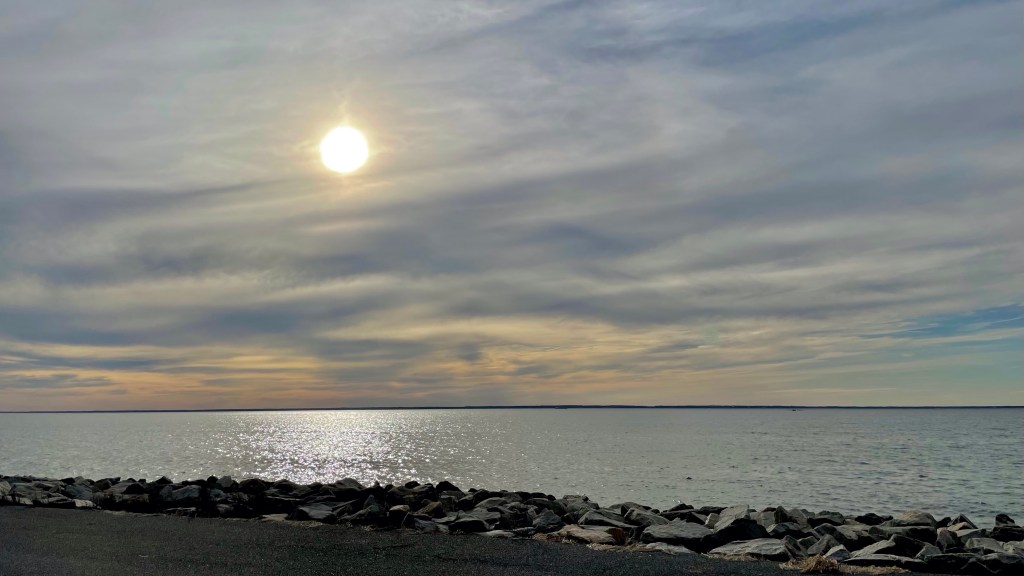
Black Walnut Point itself has a small Inn at the end of the road. Before you arrive at the Inn, the road passes a quarter mile of public access to the Chesapeake. It’s a paved area, and they have reenforced this small split of land with boulders and riprap to keep it from washing away into the Bay. The area attracts folk who like to fish, or come to see a gorgeous sunset, or just hang out and take a couple of photos. The Chesapeake doesn’t have lots of public access on much of it’s shoreline, so where there is a public spot, people tend to gather.

The Afternoon View From Black Walnut Point Road.

And gather they do, at all times of the year, but particularly in the warmer months. That’s when the trash problem is the worst. While I’m sure most visitors are good people, there are a number who have evidently never heard of taking their trash with them. During summer on a busy weekend, it’s not unusual to walk the area on a Monday morning and find actual bags of trash visitors have left behind. It’s evidently too much trouble to haul it back home. And then of course there are the bottles, cans, sandwich packages, cigarette packs and cigarette butts, not to mention fishing line, hooks and weights left among the rocks. Or crammed between the rocks. Or crushed and pushed down lower in the rocks.

Tilghman Island and our Fairbank community have organized trash pick-up events over the years. During summer, neighbors would go out a couple of times as a group and pick up several large bags of trash. Gary, the unofficial “Mayor” (or ambassador) of Fairbank helped organize many of these events via email before he passed away a few years ago. As importantly, people would sometimes go out on their own to pick up trash.

After Gary passed away, our friend Darren has taken on some of the role of community organizer. As an example, just this past December around Christmas time there was a huge storm with high winds on the Bay, resulting in large amounts of trash, debris, flotsam and jetsam washing up on Black Walnut Point. Darren put out the call to help clean up and the community responded. When we arrived a few days later on Dec 29th, I made a pass and collected a couple bags of trash and recyclables, but most was already gone, thanks to our neighbors.

Last week, Cath and I were at the Bayhouse again. As I took our dog, Carmen, for a walk towards Black Walnut Point, I noticed the trash was starting to pile up. It wasn’t bad, considering we’d cleaned the area up a little over a month before, but there was enough to be noticeable, and I decided I’d do a trash-pickup-pass the next day.

The next afternoon, as I was about to start, I ran into our neighbors John and Lea out for a walk with their dog. As we were talking, John told me he’d been out the week before and picked up two bags of recyclables. That was a bit of a surprise, as it meant the trash I was seeing was just from the past week.

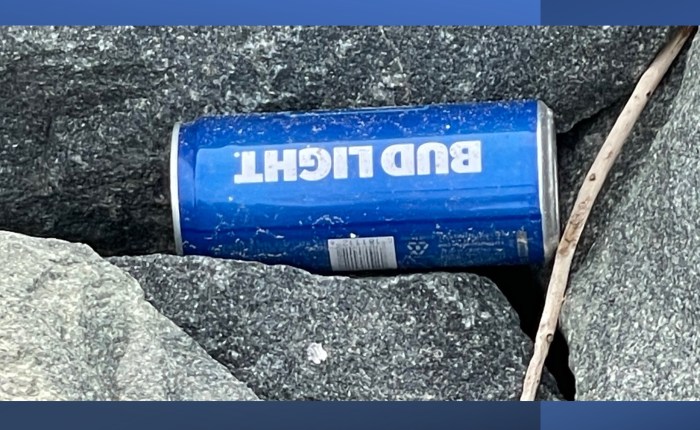
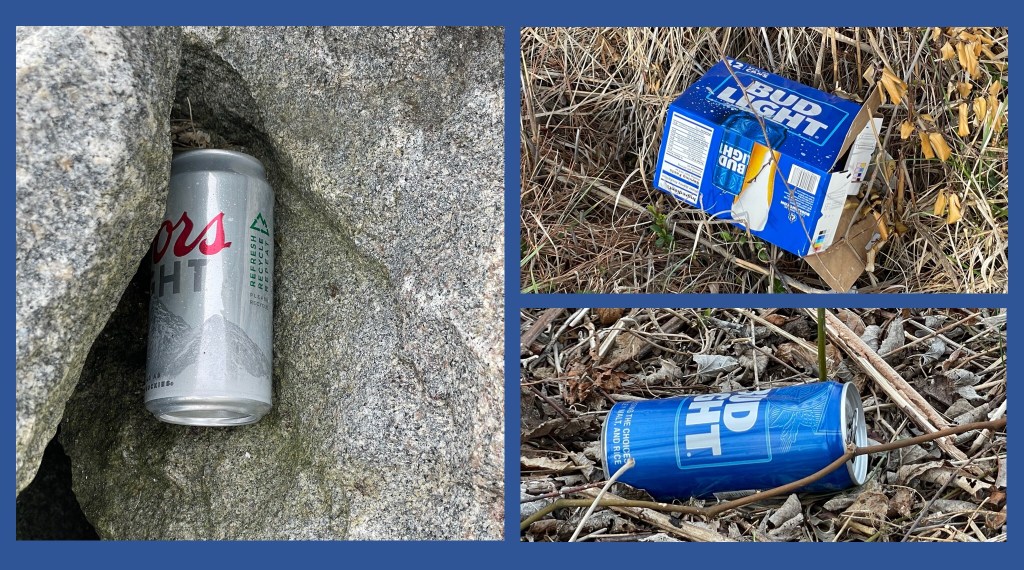
Later, as I finished collecting my bag and a half of trash, a few things became apparent. The majority of smokers littering the area were Marlboro fans, with a couple of Pall Mall smokers thrown in. Among the recyclables, I found a few plastic water bottles, a couple of diet Pepsi cans and two empty pints of Lord Calvert Canadian Whiskey. The rest of it? Beer cans. And not just any beer cans. There were no IPAs, no Guinness Stout, no German pils or Mexican lagers. There was no Nanticoke Nectar from RAR brewery just down the road in Cambridge. While I found a few Budweisers, most were Light cans. There were a couple of Miller Lites and a few Natty Lights, but the vast majority were Coors Light and 10 ounce cans of Bud Light.

Coors Light and Bud Light – Both are Evidently a Favorite of Litterers.

The Coors Light cans were found in just a couple of concentrated areas. You could almost see a couple of fishermen standing or sitting there, working their way through a twelve pack over the course of an afternoon. Finish one beer, throw it among the rocks and grab another one from the cooler. Did they catch any fish? We’ll never know, but it appears they enjoyed themselves.

The Bud Lights? They were scattered up and down the shoreline in ones or twos. In fact, several were also scattered in the grass and woods on the drive into the area. These brought a different vision to my head. One or two guys, maybe kids, maybe not, having a beer in their truck and chucking it onto the rocks, or as they were driving home, throwing it out the window onto the side of the road. The Bud Light drinkers also threw out the boxes those 10 ounce beers came in. No evidence was going to remain in their cars.

As I mentioned a couple of times, the Bud Lights were all 10 ounce cans. Why does that matter? 10 ounce beers are an Eastern Shore thing*. Look in your hometown store and see if you can find 10 oz Buds. The answer is probably no, unless you live on certain parts of the Eastern Shore of Maryland.

My guess on our litterers? The Coors guys were from somewhere else and came for an afternoon of fishing on the Bay. The Bud Light drinkers? I’d bet they are from somewhere nearby on the the Eastern Shore of Maryland – probably somewhere between here and Easton. Maybe they are high school kids sneaking their beers; maybe they are bored young guys; or maybe they are older guys getting away from home for awhile.

I could be wrong. Maybe they are from somewhere else, forgot to bring beer, and decided to buy some here locally. At the store they looked around saw the 10 ounce cans, and said, “Those beers are for me. I want beers in cans that are two ounces smaller than what I normally drink.” Maybe.

What I do know is whoever they are, they are trashing the area.

I can’t say this is a typical mix of trash, only that it is what I found on this particular visit. It’s unfortunate. I guarantee both the Coors and Bud Light drinkers would tell you they love this area. It has everything they want – open access to the Bay, beautiful views and occasionally good fishing. But you can’t profess to love something and trash it at the same time. All that does is make you a hypocrite. In this case, hypocrites who don’t respect Mother Nature, Tilghman Island or those around them.

Addendum:

  • * 10 Ounce cans of Bud and Bud Light are a big thing in parts of the Eastern Shore of Maryland. I particularly enjoy them on a hot summer day – you finish your beer beer before it gets warm. You find them in the counties of Caroline, Dorchester, Kent, Queen Anne’s and Talbot (our county), but not in places such as Salisbury and Ocean City. You can read more about them here: https://wtop.com/maryland/2020/09/uncanny-why-10-ounce-cans-of-budweiser-are-popular-in-parts-of-maryland/
  • The title of this blog is a word play on “Judgement of Paris”, the 1976 blind wine tasting in Paris that elevated the status of American wines. Never heard of it? You can read more here: https://en.m.wikipedia.org/wiki/Judgment_of_Paris_(wine) . The wine “Judgement of Paris” itself was a twist on The “Judgement of Paris” in Greek Mythology, which was a contest between the three most beautiful goddesses of Olympos – Aphrodite, Hera and Athena for the prize of a golden apple addressed “To the Fairest.” The original Judgement in Paris eventually led to the Trojan War and the destruction of Troy.
  • Here’s a bit of a more complete history of trash pick up on Tilghman from Darren. I shortened it a bit for the blog: Gary and Larry were the original two people who picked up trash. People saw Gary and Larry doing it and joined in. It organically became a Fairbank community effort. Gary then made it more formal through his newsletters. When The Phillips Wharf Environmental Center was under Kelly Cox, they held a trash pick-up day called “Tidy up Tilghman.” People picked up trash across the entire island on that day. Gary was on the PWEC Board of Directors, so I think they got the idea from him. The tradition has always been strong and remains in place in Fairbank. There’s another trash pick up for the entire Island taking place on April 1st of this year.
  • Thanks to friends Darren and Veronica who both took a look at this blog for accuracy and editing purposes!

A Celebration of Life and Celebrating Life

A Celebration of Life and Celebrating Life

A few weeks ago Cathy and I spent a Saturday seeing the full circle of life. The day started at a brewery, attending a Celebration of Life for a friend who passed away three months ago. It ended at a winery where another friend was celebrating her seventieth birthday. The two events were surprisingly similar.

Our old friend Davie passed away last October at the age of 67. His death was unexpected and hit many of us hard. We were a part of the same running group since the early ‘90s and became good friends over the years. Another friend, Tia, and I talked and decided to host a Celebration of Life for Davie, but after some time went by – time enough for the rawness of his death to pass. We eventually decided on a Saturday in mid-January.

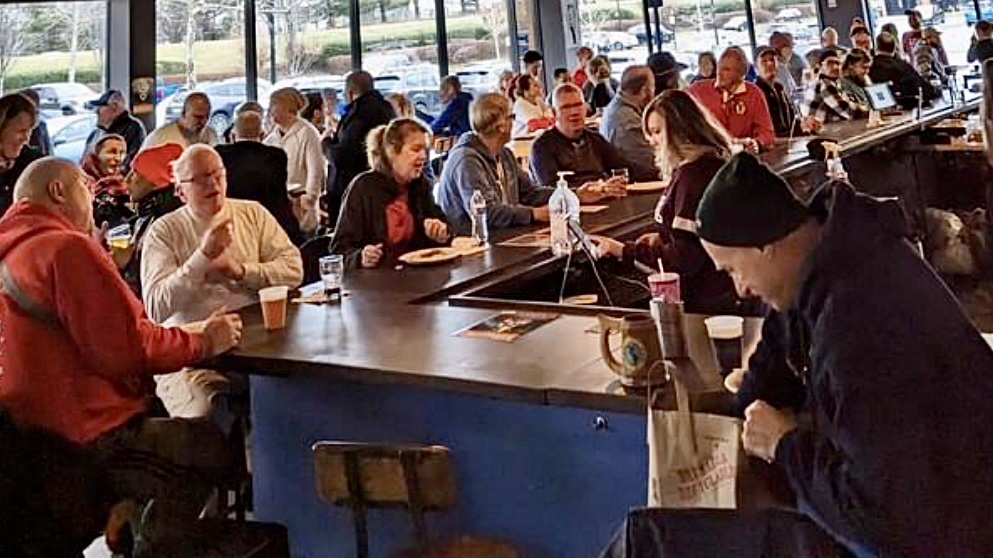
On the appointed day, a wonderful and diverse crowd of seventy five or so came together and after a short run, gathered at a local brewery. Five of us brought in homemade food for a buffet lunch with BBQ, coleslaw, mac n’ cheese and other goodies. Beer and other beverages were flowing. The crowd was loud and in a good mood. The decision Tia and I made to delay for three months was a good one. Friends ate and drank and laughed. Stories of Davie were told – some poignant, some bawdy. At the end of the “formal” part of the Celebration, we sang the old spiritual “Swing Low, Sweet Chariot” as a final send off (an off-color version of the song is usually sung at the end of our weekly runs).

Friends at Davie’s Celebration of Life at the Brewery

We left the brewery while the party was still roaring, to make our way to our friend Kathy’s 70th birthday party. We arrived at home, let Carmen out and changed clothes. From there, we drove the twenty minutes to the winery where Kathy’s birthday party was being held.

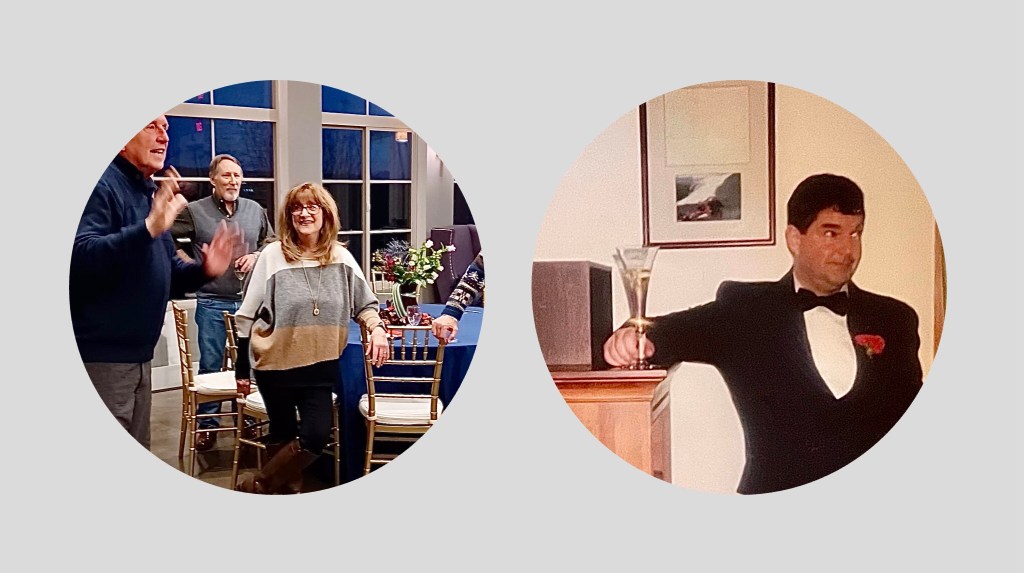
Upon arriving, we found the party and joined in with the other 20 or 25 guests. A friend of Kathy’s made delicious homemade appetizers. Wine and other beverages were flowing. The crowd was loud and in a good mood. Friends ate and drank and laughed. Stories and jokes were told and Kathy’s husband mentioned a couple of times that he was lucky to have married an older woman (I should point out he is only 18 months younger than Kathy). At the end of the “formal” part of the celebration, we sang “Happy Birthday ” to Kathy as a final tribute.

Friends at Kathy’s Birthday Party at the Winery.

Speaking with Kathy later, she mentioned she wanted to celebrate her life while she was “still vertical”. The guests represented different aspects of her life and what held meaning for her — old friendships formed in her youth, friendships from her days in community theater, friendships formed in pursuit of change in our social and political systems and those she partnered with while strengthening her health and fitness levels. It was a diverse and wonderful group of people. After the party, she and Steve stayed up late into the night talking about how lucky they were. Her comment to me – “Why wait to gather together and celebrate life?

I’ve spent the last month or so thinking about the juxtaposition of those two gatherings. They were sooooo similar to each other. Friends gathered. Good homemade food was served at both. Excellent local adult beverages were available for consumption. There was lots of laughter, with jokes and stories being told. Even a song was sung at both to end the formal part of the festivities. The only real difference between the two events was the guest of honor attended one in person, but not the other.

Kathy being Roasted at her Birthday Celebration. I Like to Think Davie Attended his Celebration of Life in Spirit.

Yes, there’s a fine edge between life and death, between living and dying, between celebrating a life, and a Celebration of Life. That Saturday and those two gatherings brought it home to me.

Celebrating life, and Celebrations of Life are both important. None of us knows how much time we, our family, or our friends have left and we should take advantage of celebrating not just birthdays, but every part of life we can, while we are alive.

I’m glad we were able to celebrate Davie’s life. He wasn’t physically with us, but I know he would have enjoyed the party. I like to think he was looking on us from somewhere on high with a glass of champagne or a mimosa in his hand.

I’m even happier we were able to celebrate Kathy’s 70th with her in the room, and I’m pretty sure she did enjoy the party. As Fitzgerald stated in The Great Gatsby,Let us learn to show our friendship for a man when he is alive and not after he is dead.

Celebrating life while living, seems an important part of having a good Celebration of Life later. At my Celebration of Life, I hope there will be jokes and stories and snorts of laughter. In a corner of the room, maybe loud guffaws and then someone will say, “What a great story! I didn’t know that about Max. Did I ever tell you about the time he and I…

When I started thinking about this blog, I thought the song “The Circle of Life” from The Lion KIng might be nice for an ending with it’s lyrics about despair and hope, and faith and love. It’s a fine song, and I suppose makes people feel warm and fuzzy. Personally, I think Iggy Pop’s “Lust for Life” is more relevant for me, and has a better take on all of it:

Well, I'm just a modern guy
Of course, I've had it in the ear before*
And I've a lust for life (lust for life)
'Cause I've a lust for life (lust for life)
Got a lust for life
Yeah, a lust for life…

I’m going to continue to honor and celebrate those around me, both alive and dead. I think about that Saturday and those two events. Like my friends Davie and Kathy, a lust for life is what I have. I’m taking Iggy’s advice, and plan to continue to live life exuberantly. I’m going to celebrate life and all it throws at me. If you happen to make my Celebration of Life down the road, eat some fine food, have a drink, laugh and tell a good story about the times we shared together. Hopefully, it starts out something like this, “There Max and I were. It was crazy, but…

Addendum:

  • I encourage you to listen to Elton John’s “Circle of Life”, and then Iggy Pop’s “Lust for Life”. Both of them are fine songs. One of them will get you up, moving, and ready to engage life to the utmost.
  • Circle of Life with Elton John can be found at: https://youtu.be/IwH9YvhPN7c
  • Lust for Life with Iggy Pop and David Bowie can be found at: https://youtu.be/HuBU3pzy7is ; or try this version to go with the Movie Trainspotting: https://youtu.be/jQvUBf5l7Vw
  • Thanks to our friend Tia Perry for leading the effort on Davie’s Celebration of Life – It was a great event. Special thanks to our friend Kathy Kadilak for allowing me to talk about her milestone birthday and the impact it had on me. Both Tia and Kathy were a part of writing this blog.
  • * The phrase “I’ve had it in the ear before” isn’t sexual and it’s not drug related. It means someone’s given you a hard time or screwed you over.

Tuna Salad with Julia and Grandma Grubaugh

Tuna Salad with Julia and Grandma Grubaugh

It was strange. It was simple. It was visceral. One moment I was taking a bite of a tuna salad sandwich made with Julia Child’s recipe. The next instant I was a little boy sitting with Grandma Grubaugh at her kitchen table having lunch. It hit me like a bolt out of the blue.

A couple of my favorite benefits of our New York Times subscription are the food and cooking articles. The columns tell great stories, and the recipes are usually pretty manageable. A while back, chef, James Beard Award winning author and former New York Times food columnist Dorie Greenspan wrote a great column “This Tuna-Salad Sandwich Is Julia Child-Approved Lunch”. She was working with Julia at the time on an upcoming book and recounted a day spent in her kitchen. Here’s a partial extract:

We were working around the kitchen table when Julia declared, “Dorie, let’s make lunch.” I saw Stephanie smile — clearly, she knew what was coming — and then I was at the counter with Julia, doing as I was told, which was cutting celery. While it might not seem like much of a job, I was cutting celery for Julia Child, and I was going to do it right: I trimmed the celery, I peeled it (because I learned to do that in Paris, I thought it was important to do it for the woman who wrote “Mastering the Art of French Cooking”) and I cut the celery into minuscule cubes that were all the same size. I’m only exaggerating a smidge when I say it took me so long that when I put down my knife, Julia had finished everything else, and we were ready to sit down to one of her favorite lunches: tuna salad on an English muffin.”

The article was about nothing and about everything. I love writing like that. I mean, how can you possibly write an entire article about a tuna salad sandwich? And yet Greenspan wrote a great one and I thoroughly enjoyed it.

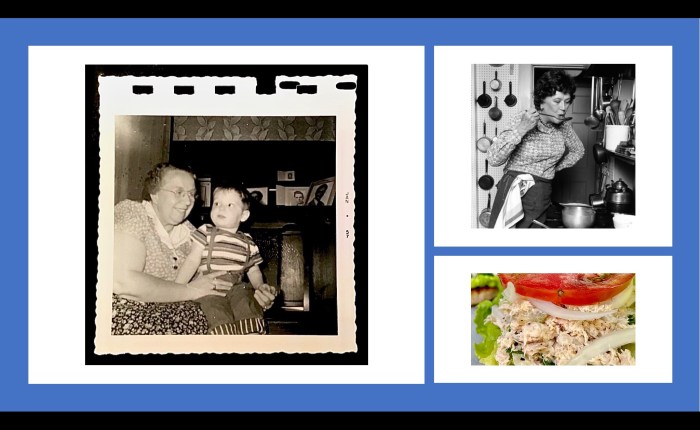
Julia Childs in the Kitchen.

The list of ingredients in the actual sandwich intrigued me. We’ve all made tuna salad – tuna, mayo, celery and maybe onion and a boiled egg, but this one was a bit different. Yea, there was tuna (packed in oil), mayo (always Hellman’s), celery and onion, but it also included capers, cornichons (small French pickles) and lemon juice. Hmmmm. I was going to have to try this. Some of you know of my aversion to pickles in potato salad, but with tuna salad, why not give it a shot?

I had everything on hand, with the exception of the Cornichons. After doing a little online research, I figured the baby dills in our fridge were a suitable substitute.

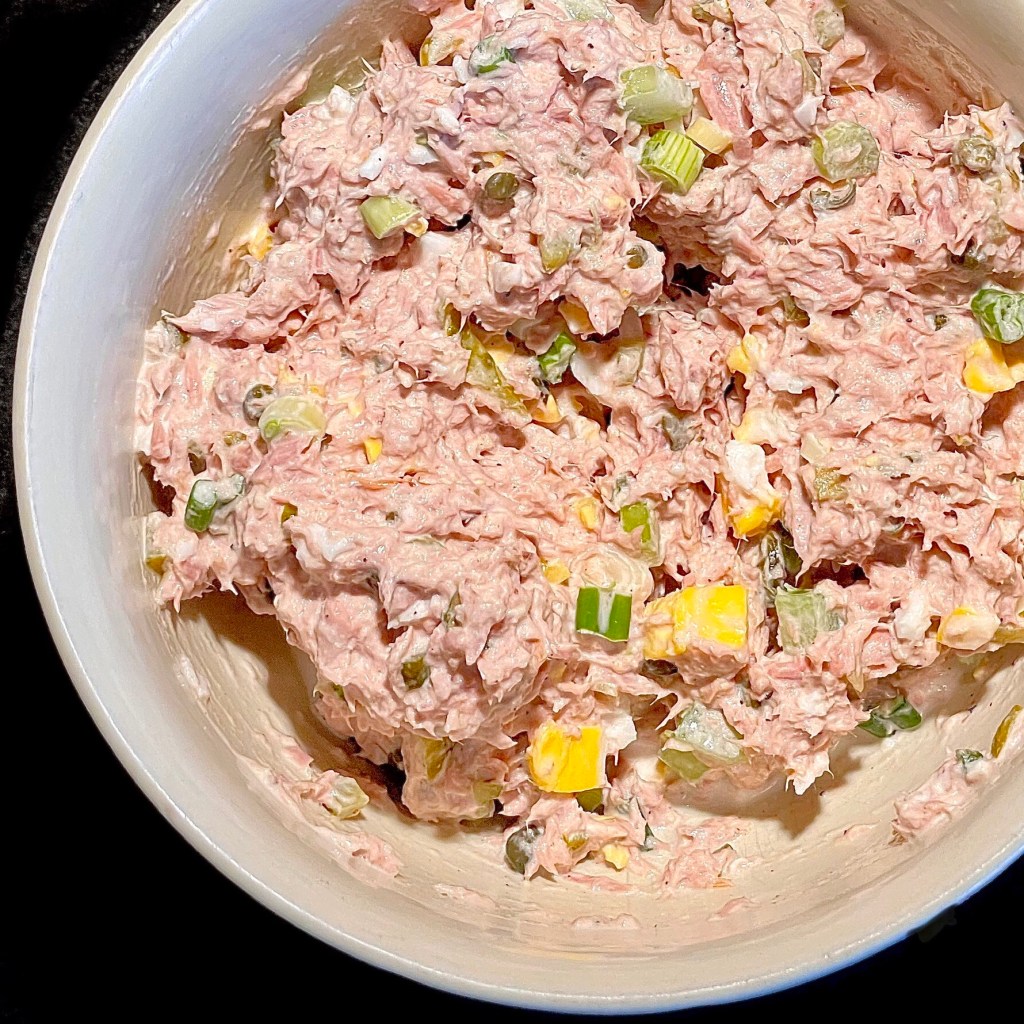
I dutifully chopped the celery (sorry, no peeling), onion, capers and pickles. After emptying the tuna in a bowl, I added all of the chopped ingredients. In went the mayo, and the parsley and I combined everything. Finally, I squeezed the lemon juice in, added salt and pepper, and combined it all again. I did a small taste, and of course because of who I am, added a bit more mayo. Another small taste, and then I put the bowl in the fridge to chill for a couple of hours.

Tuna Salad Heading to the Fridge.

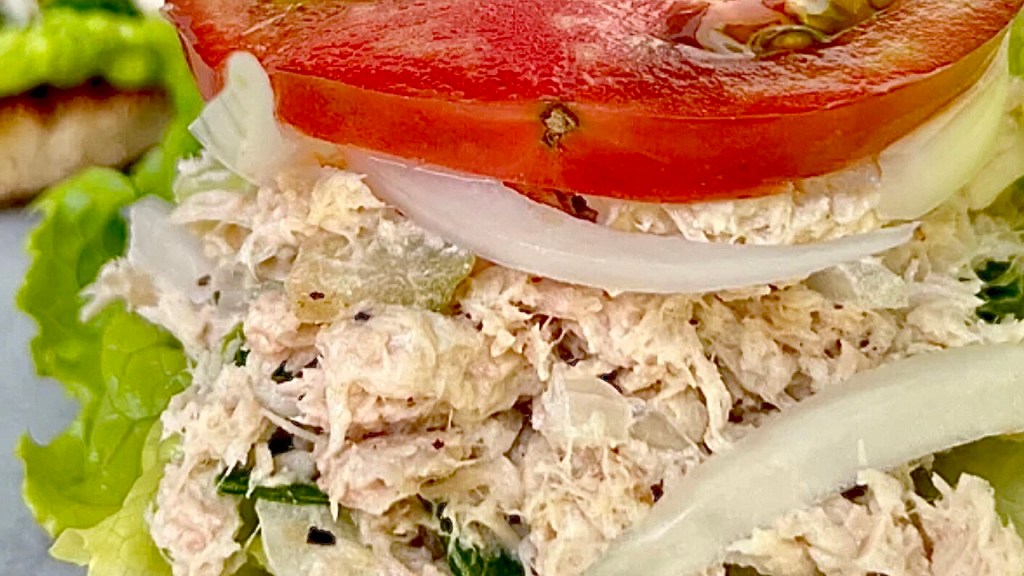
At last it was lunch time and I made my sandwich. More mayo on the bread, the tuna salad itself, some lettuce, tomato and a small slice of onion. Another slice of bread, and then I cut the whole thing in half.

Tuna Salad Sammich. It Doesn’t Get Any Better.

I took the first bite, waiting to be transformed in my mind to Julia Child’s kitchen, and … wait! What!? Was that Grandma Grubaugh sitting next to me? Where in the hell did that come from?! It was a visceral reaction – I was a young boy back in Ottawa, sitting at the kitchen table at Grandma’s house having a tuna sandwich with her.

Grandma Grubaugh and I in 1957.

After rejoining the present, I sat there eating my sandwich trying to figure out what brought on those feelings. Grandma, to my knowledge, never cooked anything from Julia Child. Besides, my flashback would have been some time in the ‘60s, well before Julia became popular in America.

I thought through the ingredients. I don’t really remember grandma keeping fresh lemons, or capers around the house, although I suppose she might have. Grandma putting either in tuna salad seemed a pure fantasy. It had to be the pickles, although I didn’t remember mom putting pickles in tuna at our house.

At this point in time, mom had already passed away. Uncle Don, her younger brother was still alive, and I gave him a call. After catching up for a few minutes, I explained why I was calling, asked about grandma’s tuna salad, and whether she put pickles in it. He immediately answered “No, there were no pickles”, and my heart sank. Then he quickly added – “No, no pickles. She used a couple big spoonfuls of pickle relish.” And it all connected.

We talked a bit more and I eventually hung up. As I thought about Grandma and her pickle relish, it made sense. The relish certainly would account for the pickle flavor and maybe some of the brightness. In a subsequent conversation with my cousin Dawn, she reminded me that while Grandma didn’t really keep fresh lemons around the house (who did in midwest America in the ‘60s?), there was always a bottle of Real Lemon Juice in the fridge – for lemon cake, lemon pie, maybe a spoonful in cobblers. Who’s to say she didn’t add a spoonful to her tuna salad? While it doesn’t all add up perfectly, it made sense to me.

Since then, I’ve continued to make my tuna salad with pickles, capers and lemon juice. I have to admit Julia’s is better than what I’d made before. It’s also a nice lunchtime bonus – remembering Grandma Grubaugh on a day when you are “only” having tuna salad is pretty special.

Addendum:

• Thanks to my sister Roberta, and cousin Dawn (one of Uncle Don’s Daughters – also a flower girl at our wedding) for their contributions to this blog – both had distinct memories of Grandma’s tuna salad and some of grandma’s habits at the time. Dawn was also quite emphatic Grandma used sweet pickle relish in her Tuna salad. We also had a great conversation about foods triggering happy family memories – Thanksgiving at mom and dad’s house (Uncle Don, Aunt Diane and family were almost always in attendance as well), potato salad, Aunt Diane’s cherry pies and cobblers, watermelon outside on the picnic table, and Grandma Grubaugh expertly spitting her seeds across the yard, to the delight of her grandchildren.

• Here’s another blog about Grandma Grubaugh and her delicious date nut bread: https://mnhallblog.wordpress.com/2019/12/04/grandmas-date-nut-bread/

• Here’s a link to the column that inspired me to try Julia Child’s Tuna salad. It’s a quick read – https://www.nytimes.com/2020/10/21/magazine/this-tuna-salad-sandwich-is-julia-child-approved-lunch.html?unlocked_article_code=a2vDZUZ1eo1yVrKAfuZxMgmll7EsQe8k7K-jTFFMqtFBjYV_jUe1I577EkeqZQNBGpaScBbP2xFhlRgEXk0W3tuhHedthiZqjAOIlq7mFMVFRXTSWUW-mugkmUlR6AtNmjBpqnBC45Dacm7NKVcjag8DPq4nW_Mk-gleZC2NfUBimTJW8wqPnaCRsC9BXBDeHOI6FVeL60bLuggz3IU80r0Op815enYRuh9uZRbZwfNBd33TI6IJNJk_1qSRqnFXzpHmKs4RRpwBBMsGROoFMHGYZ-jWFgxYd51U2M-oYm9mLIFmxsE2twHD2-Qtkx8ZSmRV-W7eCe36dnvravfZOe3UkdJOwFAHYcitmVZSPDenybPsa9HK0r6y4Pgo9YUyIA&smid=share-url

• Here’s a link to the recipe from the NYT: https://cooking.nytimes.com/recipes/1021561-tuna-salad-sandwich-julia-child-style?smid=ck-recipe-iOS-share

• And here’s the exact same recipe if the NYT won’t let you open their recipe without a subscription: https://bwtribble.com/recipe/1071

End of an Era

End of an Era

There’s a change coming to my Sundays. Starting this week and going forward, the paper copy of the Washington Post Sunday newspaper will arrive on … wait for it … Monday. Yep, it’s the end of an era for many of us here in rural Fauquier County.

I’ve always read newspapers. Growing up at home, it was the Ottawa Daily Times, and on Sundays, both the Chicago Tribune and Sun Times. At West Point, it was the New York Times (Plebes delivered hard copies to every cadet room). When we lived in Germany in the ‘80s, in addition to the Stars and Stripes, I would buy the International Herald Tribune, at the local book store or snack bar. At the time, The Tribune was a joint publishing effort between the New York Times and the Washington Post. It was a great paper and provided in depth coverage of events in the States and around the world. When Cathy and I returned to the DC area in ‘89, we began our subscription to the Washington Post and have read it ever since – thirty-four years of delivery.

At the time of course, the subscription was only hard copy and delivered daily. In 1999, when we moved to our farm in Fauquier County, our subscription moved with us. During the week, when I left for work around 5:30AM, the paper was already delivered to our home, and I’d pick it up and take it with me.

Home Delivery of the Post for Thirty Four Years

Ahhh, but Sundays were different. After getting up and starting a pot of coffee, I’d dutifully walk up the drive and retrieve the Post from the receptacle next to the mailbox. Big and fat, the Sunday edition was meant for leisurely exploration. I’d always start with the sports section, then move on to the front page. After that, Outlook (the opinion section), Art&Style, Business, Metro, Bookworld, the Comics and finally the Sunday magazine*. It was a great way to while away a couple of hours.

Times change of course. Digital subscriptions started and were included with our home subscription. I found digital great for looking at headlines, along with the updates and alerts that were posted throughout the day. Having said that, I still loved getting ink on my fingers and reading the hardcopy. Some of my younger friends laughed at me and basically told me I needed to get with the times. I’d always argue back about the corollary reading the hardcopy provided – you started reading a front page article which continued on page A15, and on page A15, you would see one or two other smaller articles that you never would have found if just reading digitally.

Then Covid hit, and as with so many things during that time, other changes happened. Remember early on, when folks still weren’t sure how it spread? Wiping down groceries before you brought them into the house? Everyone buying Clorox wipes, or other antiseptics? At the time, we’d let the hardcopy sit in the garage for a day or two before bringing it into the house. Yea, I know it all sounds foolish now, but everyone was concerned (or at least we were).

I started reading a lot more articles online, not just the headlines. “Corollary reading” was lost, but it didn’t seem so important during Covid. Eventually, we canceled our daily subscription – it wasn’t worth it anymore. We did decide to keep the Sunday hardcopy, along with the digital. I still enjoyed working my way through the Sunday paper – it was a form of leisure in it’s own right.

Two weeks ago, our friend Colleen who also lives in Fauquier, posted on FB that she received an email notice that on January 30th, the Post was going to start using the Postal Service to deliver the newspaper. Soooooo, your daily morning paper would now come sometime later in the day, and the Sunday paper would arrive on Mondays. What the heck?!

The Email Colleen Received

Shortly after, we received the same email and a post card via mail. We were on the hit list as well. And just like that, the world changed.

Our Post Card From the Washington Post

We are retired, so we have the time to read the Sunday edition on Monday, but it won’t be the same. For our working friends who subscribe, it actually becomes somewhat untenable. A few of their (printable) comments are here:

  • I MUCH prefer reading print over any form of electronic distrubtion, and this totaly blows my VERY long-standing Sunday routine out of the water.
  • My Sundays will never be the same… Walk the dog, make my coffee, and start reading. Now it will be walk the dog, get in the car and drive to the Exxon station, then…
  • I will miss my daily morning paper. Cut it back to digital. So sad. 😞
  • I emailed and spoke with them yesterday within minutes of having received my notice …

Of course it’s all about economics, and I understand. Home delivery is no longer feasible in rural counties such as ours. With people moving to digital, hardcopy deliveries have dropped in general and for places like Fauquier, there is too much driving for the carriers, increasing their time and cost. It’s an uncorrectable downward spiral.

I called the Post to cancel my Sunday hardcopy, although I planned on retaining the digital subscription. It turns out the cost for Sunday hard copy and digital is virtually the same as just receiving the digital subscription, and so for now, I’m keeping them both. We’ll see what happens in the near term, but my guess is on Mondays, the physical newspaper will go straight from delivery to recycling, and in a month or so, I’ll cancel the hard copy. In the meantime, the nice man I spoke to on the phone promised to convey my complaint and concern to “management”.

Our Last Copy of the Sunday WaPo that Actually Arrived on a Sunday.

Last week, I received a similar notice from the New York Times. We also receive their Sunday paper hardcopy and have a digital subscription. I’m probably going to cut their Sunday paper soon as well.

That will leave us with digital copies of The Post, the New York Times and the Wall Street Journal, good papers all. I appreciate the daily headlines, their alerts throughout the day and the links I have to any number of special features. Still, I know my world will grow just a little smaller and a little less broad without newspaper ink rubbing off on my fingers.

Addendum:

  • I didn’t touch on it here, but the demise of print newspapers, and local newspapers in general is a real thing, and an unfortunate one. Between 2004 and 2022, over 2,500 local papers have ceased operation, including over 360 that have disappeared just since the start of the pandemic. We are all a little poorer for their disappearance.
  • * There have been changes to the Sunday WaPo over the years. Book World disappeared and later reappeared. Outlook (The Opinion section) moved from a separate section to just a few pages at the end of the main section. And, just before Christmas last year, the Sunday Magazine disappeared all together.

Orion, My Old Friend

Orion, My Old Friend

It’s nice to have constants in your life, even when they are little ones. Something you can count on. Something that gives you comfort. Something you can look at and say, “Yep, it’s still there.” For me, one of those constants is my old friend Orion in the winter night sky.

I suppose my interest in space and the constellations started with Mrs Finkeldey, my first grade teacher. On February 20th, 1962, a little over halfway through our school year, astronaut John Glenn became the first American to orbit the Earth. Mrs Finkeldey talked about Glenn, and taught us about the solar system and the (then nine) planets. Combining current events and science for first graders – who knew?

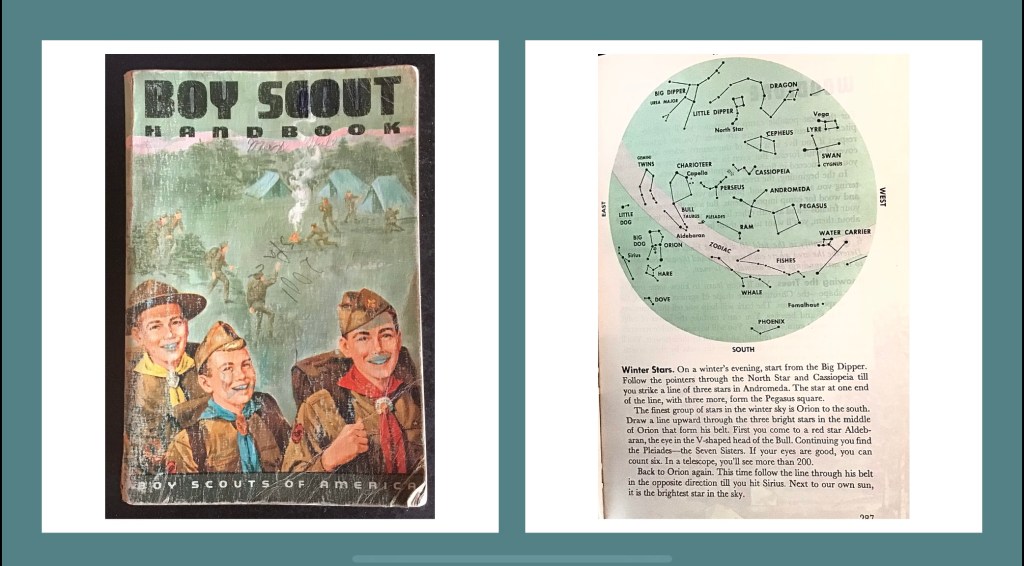
Later, in Boy Scouts, I began learning about the constellations. It started with the Big Dipper pointing to the North Star in the Little Dipper. Suddenly, and amazingly, you always knew what direction north was (unless it was a cloudy night). That was just the beginning. With my Boy Scout Handbook, I began to learn how to identify and locate the constellations – Cepheus and Cassiopeia; Canis Major, along with Sirius, the brightest star in the sky; Gemini the Twins; Taurus the Bull; the Pleiades (the Seven Sisters) and many others.

Knowledge of the Constellations in My Old Boy Scout Handbook

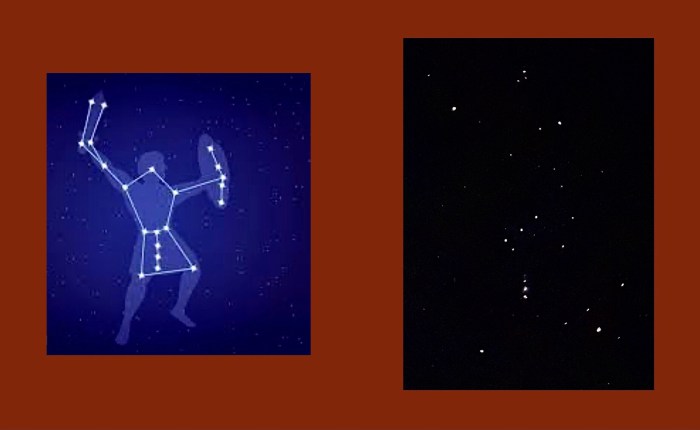
I’m not sure why, but my favorite was always Orion, The Hunter. Orion is one of the more identifiable constellations and has been mentioned by Homer and Virgil, and is even in the Bible*. According to Mythology, Orion was a great hunter and the son of Poseidon. He was killed by the sting of a large scorpion after possible misdeeds. Later, Zeus put both Orion and the Scorpion (Scorpius) in the sky as constellations.

Orion, The Hunter.

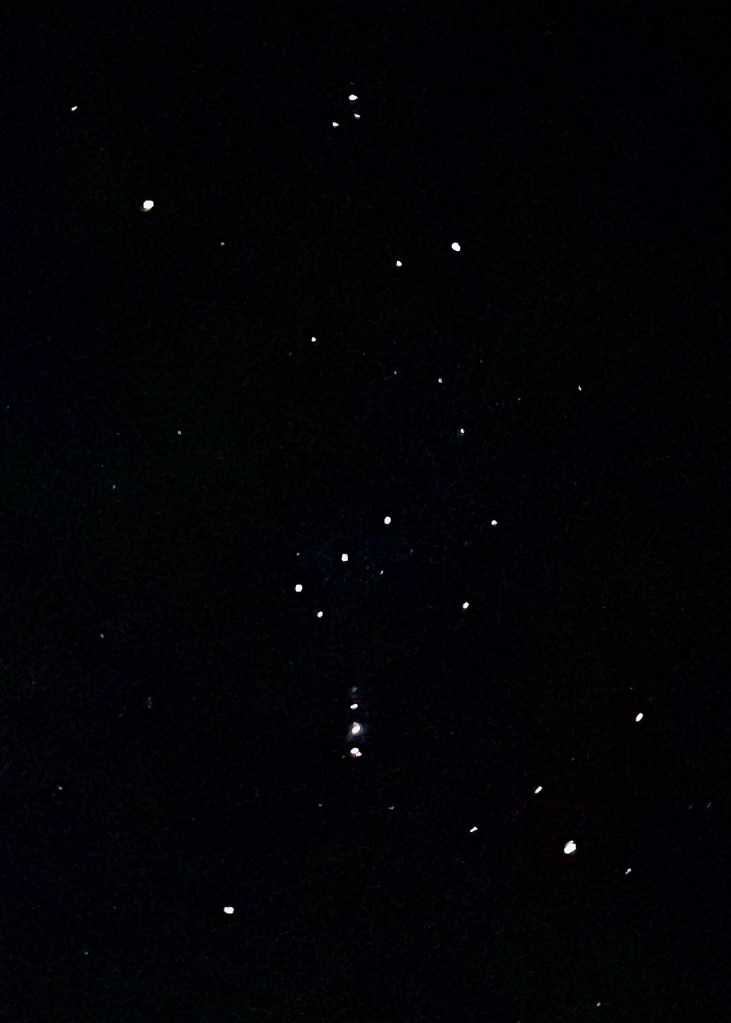
Orion is easy to see and easy to recognize, but here in the Northern Hemisphere, only viewable in winter. Starting in November, I watch him traverse the sky. Every night when I take Carmen out for her last walk, there he is overhead. If I take binoculars with me, or bring out my telescope, I can see the the Orion Nebula in his sword with greater detail. It’s no matter though. Knowing he, and it, are there are comfort enough.

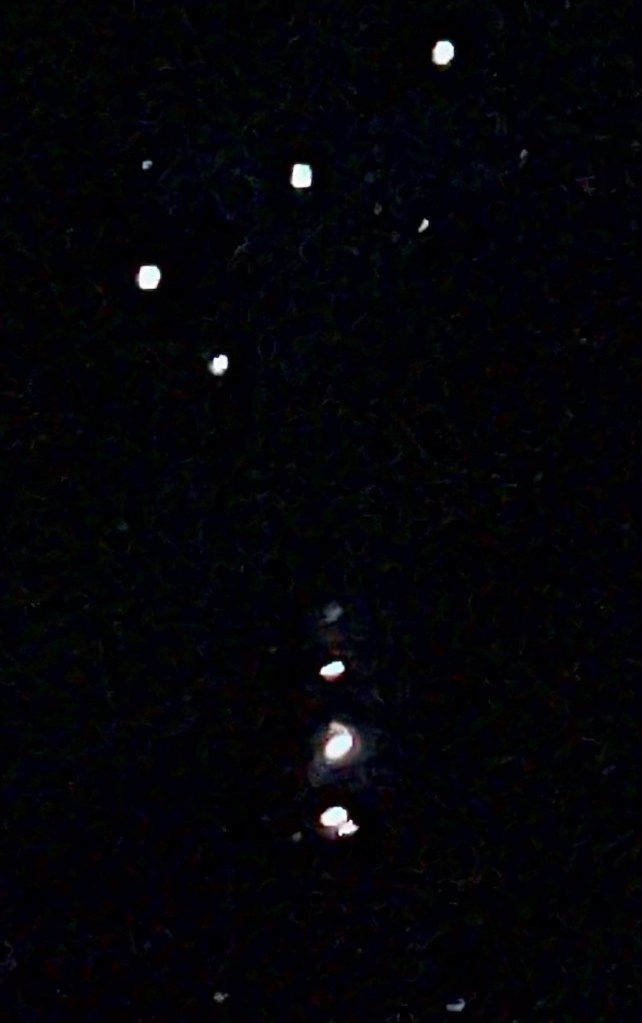
Photo of Orion Taken With My iPhone 12 at Home in Virginia

I’ll observe him until March or so, and then he disappears from the night sky. The good news is he will reappear in late Fall, as he always does. He’s a bit more reliable than many of the unstable things in our lives.

Photo of the Orion Nebula,Below Orion’s Belt. Taken With My iPhone 12.

It’s not just here at home where I see him. Because of his location in the sky, he is visible in both the Northern and Southern Hemispheres. He was with us when we lived in Germany in the ‘80s. Over the years, I’ve seen him on vacations around the world, including this week in Grand Cayman. He has been a reliable travel companion.

iPhone 12 Picture of Orion With his Shield From Grand Cayman This Week.

Take a look one of these nights around 10PM. This time of year, he is high overhead, and slightly south of the center of the sky. You will find him easily enough. Look for his belt, and the rest will come with it. Know that I will probably be gazing on him around that time of night as well. I spend a few quiet moments with him almost every evening.

It is perhaps strange to think of a constellation as a touchstone, but that is what Orion has become for me. He is a constant I can count on and my eyes are drawn to him on starry winter nights. For me, he provides calmness and serenity, if only for a few moments. For most of us, there aren’t many things that do so. When you find one, it’s good to hold onto it.

… Silently, one by one,
in the infinite meadows of heaven,
blossomed the lovely stars,
the forget-me-nots of the angels…

Henry Wadsworth Longfellow.

Addendum:

I fondly remember my First Grade teacher, Mrs Thelma Finkeldey, and her purple hair. She was a great teacher. You can read more about her here: https://mnhallblog.wordpress.com/2020/06/04/mrs-thelma-finkeldey/

* Here are the Bible verses which mention Orion:

  • Job 9:9. Who makes the Bear, Orion and the Pleiades, And the chambers of the south;
  • Job 38:31. Can you bind the chains of the Pleiades, Or loose the cords of Orion?
  • Amos 5:8. He who made the Pleiades and Orion And changes deep darkness into morning, Who also darkens day into night, Who calls for the waters of the sea And pours them out on the surface of the earth, The Lord is His name.

Max

Max

I always suspected it might be true. Still, it was a bit jarring to find out it actually was true. Here in America, there are more dogs named Max, than people named Max. A lot more. In fact, there are about 8 times as many dogs as people named Max. I’m honored … I think.

Growing up in Ottawa, Illinois in the ‘60s, Max was a unique name. I believe I was the only Max at McKinley Grade School and it caused a bit of a problem. When filling out forms or headers for formal tests, teachers never believed my name was just “Max”. They were convinced it must be Maximillian, or Maxwell. I’d dutifully tell them no, it was just Max. I know at least a couple of them called mom, as I obviously didn’t know what I was talking about. Mom would let them know I DID know my own name, thank you very much.

Of course Maxwell Smart in the ‘60s, Mel Gibson as Mad Max and Russell Crowe as Maximus in Gladiator spread the name a bit more. And, Cathy’s Dad was named Max (I believe he was the first Max I personally knew). Over time, it wasn’t quite as unique among us humans.

As I grew older, one of the things many people said when they first met me was “Oh! I know a dog named Max!” We would of course have a chuckle. Sometimes they would ask if I could sit, or stay, and I’d do a reasonable dog imitation. I drew the line at rolling over.

Time passed. People became more inventive, or more sharing. I learned of several horses named Max, a Cat named Max and even a Guinea Pig named Max. And then of course there was the occasional person with a mother or daughter named Max. Years ago, friends in Germany wanted to name their beagle Max (pronounced Machs in German), but checked with me first to make sure I didn’t mind. I didn’t mind and thought it was cool, although they also pointed out they weren’t actually naming him after me ;-).

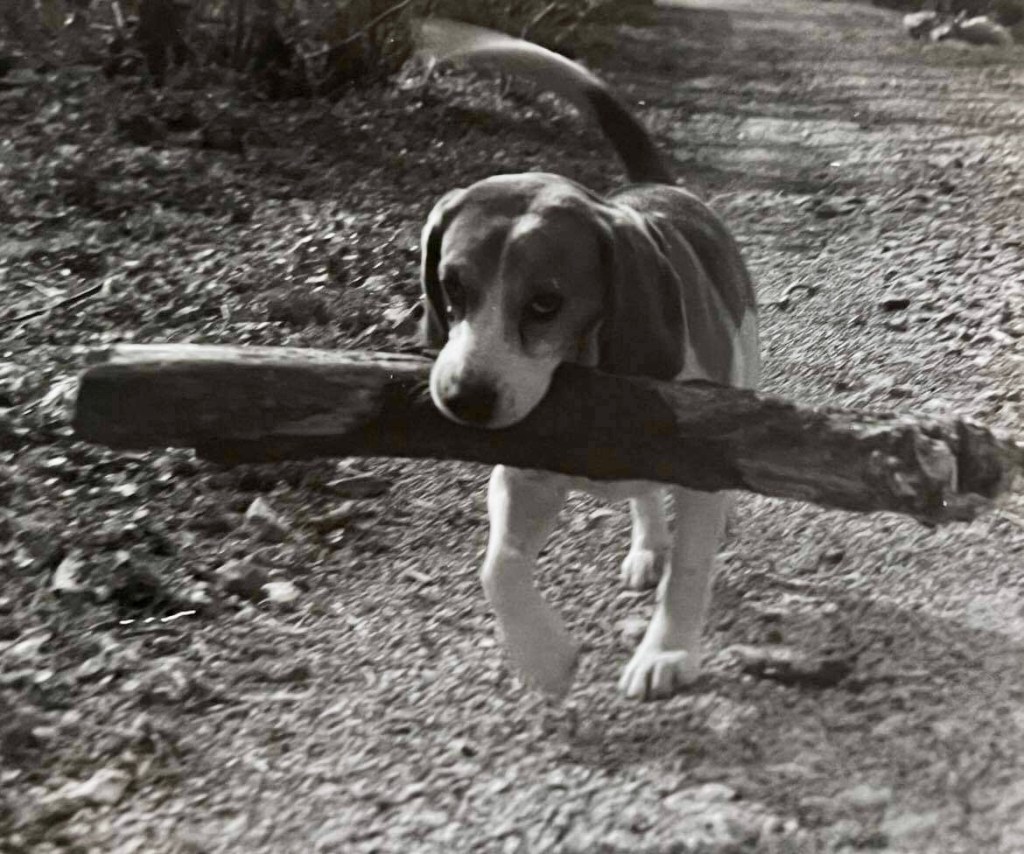
Max, the Beagle.

Which brings us to the present.

The Washington Post recently ran an article about dog and people names and the overlap between them. It turns out Max is the second most popular dog name in America right now. Only Bella (of Twilight Saga fame) is a more popular name for dogs.

Max is Pretty Popular as a Dog Name.

So how popular is Max? If you gathered 100,000 people and 100,000 dogs together in a park, 351 dogs would be named Max, while only 44 people would be named Max (for Bella, it’s 357 dogs and 20 people). At the other end of the spectrum, only 80 dogs, but 411 people would be named George.

Outnumbered a Bit on the Human Side.

Yep, if you know a “Max” (other than me), he’s more likely a dog than a human.

What’s in a name? Max means “The Greatest” and I agree it’s a great name for either a man or his best friend. The Baby Center, (an online site with a wealth of knowledge about babies, including names) had this to say – “Max is undoubtedly a cool name, but if you’re considering it, keep in mind it’s also a common pet name. In fact, Max is the most popular name for dogs in the United States, right up there with Toby, Bella, Riley, and Molly.

We should all be so honored and appreciated.

Addendum:

  • Thanks to our old friend Steven Buxton for sending us a picture of Max the beagle. We had so much fun with Steven and his folks Jim and Res back in the ‘80s.
  • It turns out this is my 300th blog. I started this effort in October of 2015 and it’s evolved over time. Back then, I’d push something out every couple of weeks, or when I could get to it. The last couple of years, it’s been more or less weekly. For better or worse, my topics have remained as diverse as ever. I’m still small scale, but 300 blogs and 7 plus years of continuity – I’ll take it. I think Live Life Exuberantly remains a valid title for the blog, and one of my ongoing life goals. Thanks to all who continue reading my wandering posts.
  • If you want to read the full WaPo article about dog and human names, you can find it here. (And check out how popular your name is as a dog name). You may need a subscription to read it, I’m not sure – https://www.washingtonpost.com/business/interactive/2022/people-names-for-dogs/

A Plebe Christmas

A Plebe Christmas

I distinctly remember returning to West Point after Christmas my Plebe year. It wasn’t fun. As a matter of fact, the last couple of days at home became bittersweet as I started thinking about returning to West Point as a Beanhead* for another five months.

It wasn’t just returning to the Plebe System (Fourth Class System) that affected me. We had first semester finals two weeks after returning. Also, have you ever visited West Point in winter? In the Fall, West Point is one of the most beautiful places in the country. In the winter? Not so much, unless you have a fondness for the color grey. January to March at West Point is called “Gloom Period”**, with good reason.

If I’m honest with myself, it wasn’t Gloom Period, or finals that brought me down. It was going back as a Plebe for another five months. Before you enter the Academy, you hear all about how tough Plebe year is both mentally and physically. It’s one thing to hear about it. It’s another to experience it for six months, have a break, and then know you are going back for more of the same.

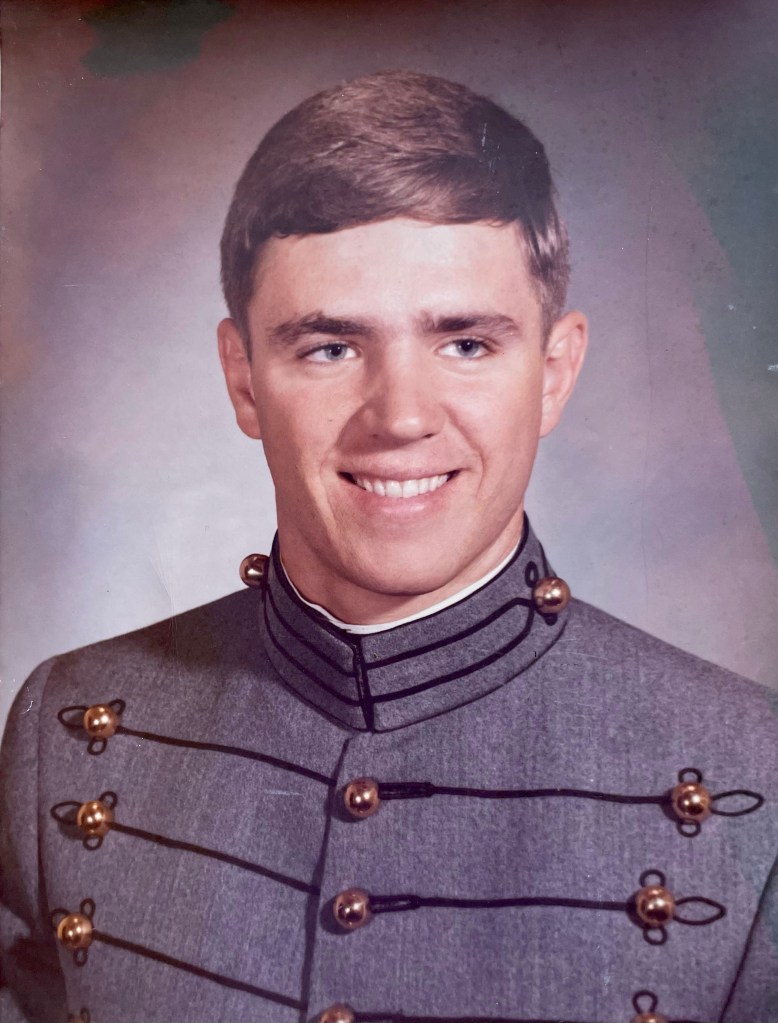
Official Plebe Photo

Coming home to Ottawa that December, Christmas break was great. Being a real person again was even better. Everyone wanted to know how West Point was, and of course I told them the good stuff, while minimizing the actuality of Plebe life. The time at home divided out between family events, dates with Cathy and partying with my friends.

During the day, I spent time at home, or went to see Grandma, various aunts and uncles, and church or family friends. I remember racing around town fitting in as many visits as I could. It was good to catch up with so many people, but also a bit exhausting.

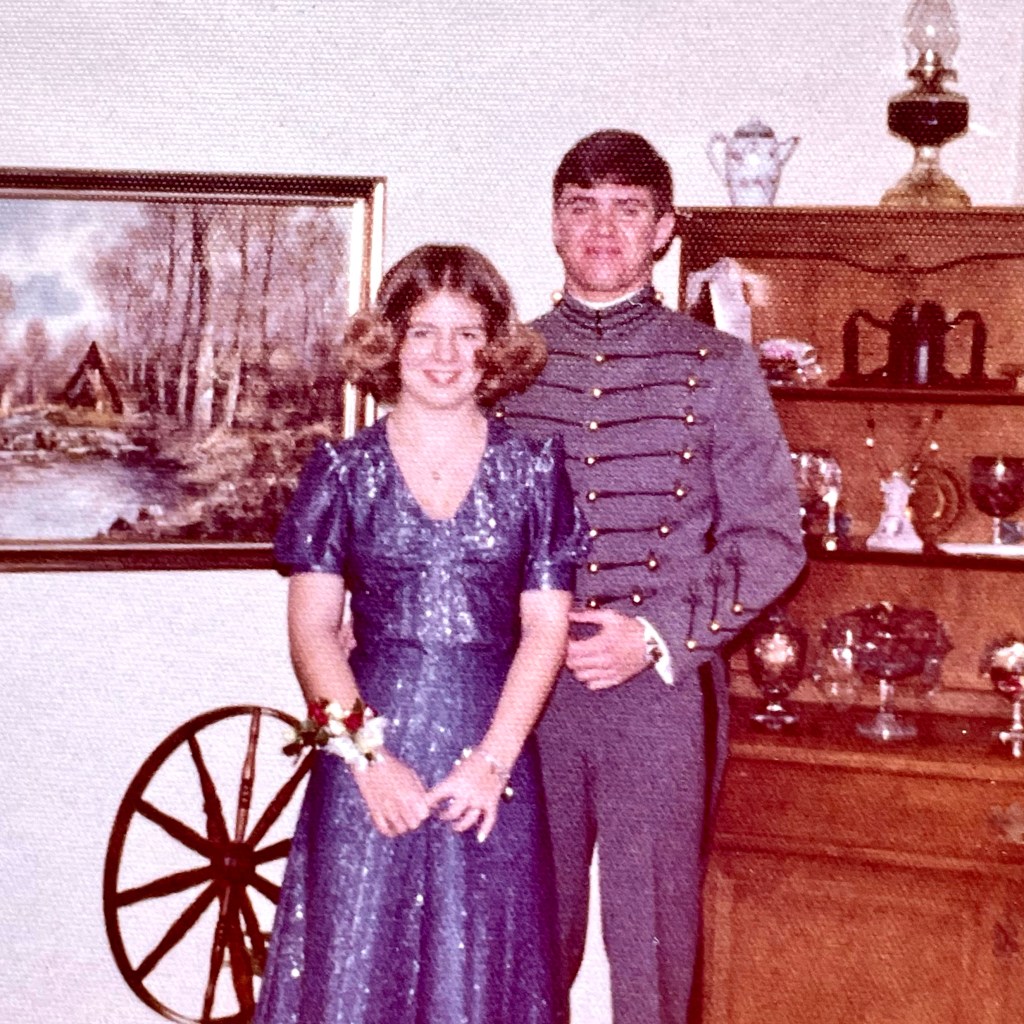
Cath and I went on dates most evenings and tried to make up for lost time. The last we’d seen each other was Labor Day Weekend, when she visited West Point with my folks. In the interim, we’d written so many letters back and forth, I lost count of the actual number. While home, there was even a formal holiday dance at Ottawa High (Cathy was still a senior in high school). I wore my dress uniform, and felt so much older than the high school “kids”, who in reality were only one or two years younger.

At Home Before Going to the OHS Winter Formal

Since she was still in school, Cathy had a curfew most nights. After our dates ended, I often linked up with my buddies Howard, Tim, Mark and others. The drinking age in Illinois was 19 at the time for beer and wine, but nobody really checked. We made the rounds at Berta’s, The Flamingo and Russell’s Tap before finally making it to bed. The next morning I’d wake up and start the cycle all over again. As I recall, sleeping in wasn’t an option.

I’d taken a couple of text books home with me to study over break, but of course I never cracked them. The days and nights raced by.

Finally it was New Year’s Eve and just a couple days before I would return to West Point. I remember going to a party with Cathy at our friend Jack’s home that night. Many of our friends were there. It was a great time, and as the clock struck midnight, there were kisses, handshakes and toasts all around. It was wonderful and things seemed almost perfect.

Maybe an hour later, it hit me. This was all going to end and I would return to the reality of Plebe life. The exhilaration from midnight rapidly disappeared. I crashed and a forlorn feeling took over. I found a quiet spot in an empty room and just sat there thinking. The dread I felt was visceral. Cathy found me a few minutes later and could tell something was wrong. She asked if I was OK and I struggled with words, then just gave up trying to explain. The thing is, she felt it too. We stood there hugging for I don’t know how long.

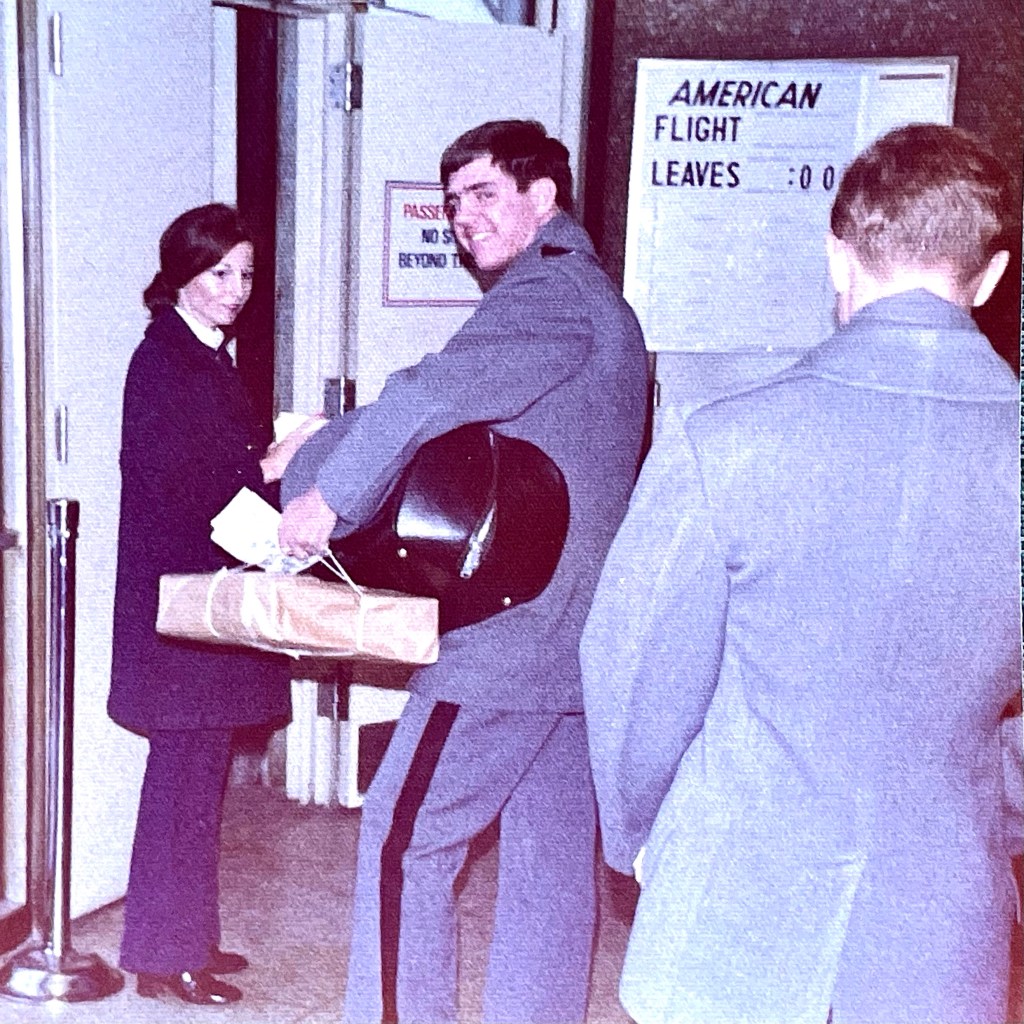
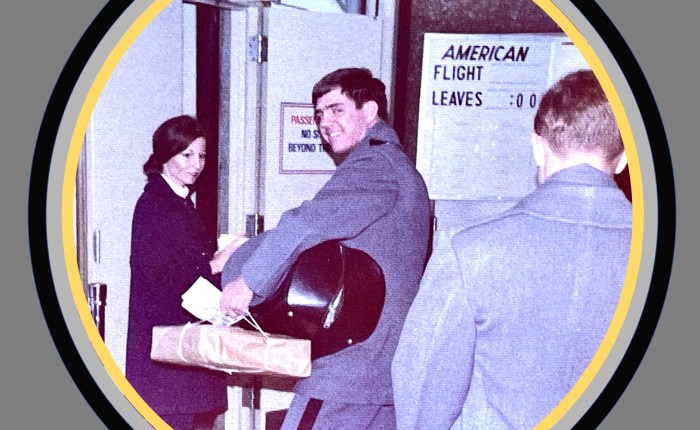
I more-or-less bounced back the next day and enjoyed my last day or two of freedom. Finally, it was time. As a Plebe, I think I was required to travel in uniform, and when Mom, Dad and Cathy drove me to O’Hare, that’s what I wore. Back then everyone could walk all the way to the gate, and that’s where we said our final goodbyes and “I love you’s”. Mom gave me a care package and with a last wave and a smile, I boarded the plane for New York.

A Smile for Mom, Dad and Cathy as I Boarded the Plane to New York.

At the airport in New York (LaGuardia I think), cadets were everywhere. Most of us made our way to buses for the final fifty miles to our Rock Bound Highland Home on the Hudson. The bus I was on was pretty quiet, with Plebes and upperclassmen alike lost in their own thoughts. By now, I’d steeled my mind for the return to school and Plebe life. I was as ready as I was going to be.

And of course it wasn’t as bad as things looked on New Year’s Eve. I made the Dean’s list that first semester, and by late March or early April, Gloom Period was lifting. As for dealing with upperclassmen and the 4th Class System, that too passed. As the Semester wore on, things became easier and and finally, in June, Recognition Day happened. We were no longer Plebes, but full fledged members of the Corps of Cadets.

To this day, I remember that New Year’s Eve and the roller coaster of emotions I felt. Speaking with Cathy, she too distinctly remembers that night. I recently told her I thought I’d write a blog about New Year’s Eve Plebe year. She immediately knew what I was talking about. I laughed a bit and said something like “I didn’t know you remembered”. She quickly answered “How could I forget?”

Addendum:

  • *Beanhead – one of the many less flattering terms upperclassman used for Plebes at the time.
  • ** Gloom Period – If you want to read more about Gloom Period, you can do so here: https://mnhallblog.wordpress.com/2018/01/21/gloom-period/
  • I’ve often thought of that New Year’s Eve over the years and the feelings I experienced that night. I’d contemplated writing a blog about it before, but couldn’t quite wrap my head around it. Then, during Christmas season this year, one of my classmates posted an email on his own feelings about the return to West Point after Christmas. Several others chimed in. Some were worried about academics and getting separated due to grades. Others, like me, thought about the return to the 4th Class System for several more months. Still others talked of the general malaise around our return, with Gloom Period settling in. A few told (now) funny stories about missing flights, late arriving girl friends, and even running into the Dallas Cowboy Cheerleaders during a stopover on the return to the Academy. It’s interesting what binds people together. My classmates and I laugh and now tell stories of those times that seemed so serious back then. Time and distance have brought perspective and a camaraderie that has lasted a lifetime. I feel lucky to be a member of the Proud and Great Class of ‘78. Thanks for the memories, and the continued friendship my brothers.

Cathy and MS

Cathy and MS

My wife, Cathy, has had Multiple Sclerosis (MS) since 1976 when she was 20 years old. It’s been almost 47 years since that first diagnosis. The MS is always there, lurking in the background, but Cath refuses to give in to it. It’s a special strength she has, and I love her for it.

Cathy Around the Time of her Diagnosis, and Just a Few Weeks Ago

MS is called the snowflake disease; no two people have exactly the same symptoms, or frequency of occurrence. MS symptoms can include: trouble walking, fatigue, vision problems, numbness, muscle spasms, weakness, mobility issues, and bladder or bowel issues, among other problems. Not all symptoms are visible.

Cathy’s symptoms have varied over the years, but fortunately for her (and us), she has been relatively stable for the last few decades, with only some minor issues. Compared to many with the disease, we are extremely lucky.

We both belong to a Facebook MS support group called We’re not drunk, we have MS. The name is a bit of an inside joke. Many people who have MS but can still walk, sometimes have an unsteady looking gait or trip easily, not unlike someone who’s had a few too many drinks.

Recently someone put a query out to the group: “If you were to wake up tomorrow MS free, what is the first thing you would do?” There were many responses. Reading through them, I thought they expressed how the disease effects so many people much better than anything I’d ever read or watched on TV about MS. It’s the straightforwardness and simplicity of the answers that is their strength. People were just asking for the basic things in life that so many of us take for granted.

Here are some of their answers to the question “If you were to wake up tomorrow MS free, what is the first thing you would do?”

  • Walk normal
  • Stand
  • Run
  • Walk
  • Dance
  • Stand up, embrace my husband, and not let go for a long time
  • Go Skiing
  • Ride my horse
  • Go for a hike in the woods
  • Dance with my husband
  • Wear heels again
  • Jump out of bed
  • Go for a run – maybe like Forest Gump
  • Ride a bike
  • Hike in the mountains
  • Shoot hoops again
  • Walk on the beach
  • Go horseback riding and then dance
  • Get a full night’s sleep
  • Play tennis again
  • Walk through my neighborhood
  • Chase my grandchildren
  • Go skateboarding again
  • Run with my kids
  • Stay at a hotel
  • Go up and down stairs
  • Walk, run, dance
  • Drive my car
  • Learn to belly dance
  • Dance in rhythm again
  • Get on the floor and play with my grandchildren
  • Eat out and enjoy every meal
  • Start quilting again
  • Go skating, then dancing
  • Go to my daughter’s home and go up the stairs to see my grandchildren’s room
  • Work in the flower bed
  • Ride a motorcycle again
  • Carry my grandchildren around
  • Rake the leaves in my yard
  • Go back to work
  • Just to consider this is overwhelming
  • Buy a lottery ticket because it would be a miracle
  • Jump in the ocean
  • Walk on the beach with my husband
  • Get on my knees and thank God.

They have newer medicines these days to address the symptoms of MS, and sometimes lessen the progression of the disease, but there is still no cure. In the meantime, these MS Warriors soldier on.

As for Cath and I, we count ourselves pretty lucky in the big scheme of things. She has some issues, and occasional flare ups, but continues to live her life. Every day is something to be enjoyed, and lived to the fullest.

Cathy and I in ‘77, a Year After her Diagnosis, and Last Summer