In the summer of ‘87, my folks visited us in Germany. We had a grand time touring Germany, Austria, Northern Italy and Switzerland. One of the highlights was Glacier Skiing at Sölden, Austria and then afterwards, hanging at the Lodge drinking bier, while Cathy worked on her tan.
On our first tour in Germany from ‘79-83, Mom and Dad visited once for a vacation in the summer of 1982. I was a Company Commander in the 34th Signal Battalion at the time and the day we were to leave on vacation with them, the phone rang about 4AM. Cath said, “Don’t Answer it”. I said, “I have to.” She answered back, “Don’t answer it.” I answered the phone.
The call came from Battalion Headquarters and we deployed on an alert for the next three days. While I was in the field, Cath showed Mom and Dad around Southern Germany and the Black Forest. When I returned from the alert, we travelled the next ten days together. Dad understood what happened with the alert and why I had to go, but I’m not sure Mom did.
When we moved back to Germany in ‘85, we didn’t think Mom and Dad could afford another visit. Airline travel was expensive, as was the trip itself. Then, fate intervened. Dad hit 5 out of 6 numbers on a lottery ticket and won several thousand dollars. Never ones to let extra money go to waste, they scheduled a visit with us in Worms in the summer of 1987.
When they arrived, we spent the first few days near Worms and the village of Rheindurkheim, where we lived. In addition to introducing them to local friends, we spent an evening at one of our favorite Weinfests. Everyone enjoyed themselves, or at least that’s what the photos seemed to indicate.
Prost!
Eventually, we left Rheindurkheim and headed South for the main part of the vacation. I’m not sure why, but Cath and I decided to take our skis along and get some Glacier skiing in, something we’d never done before. Looking back now, it seems an odd decision. Mom and Dad wouldn’t ski, but I’m sure we talked with them about it. In any case, off we went down the Autobahn with the skis strapped on the roof rack of our Saab.
After visiting good friends Jim and Res in Stuttgart for a night, we made our way to the Alps. We planned a drive through Austria, Northern Italy and Switzerland, but started with Sölden, Austria where we would ski. In the 1980s, you could still ski Sölden virtually all year long*.
Glacier skiing is a bit different from regular skiing. You have to hit the slopes early, and most people only ski in the AM. By late morning, the sun has warmed the slope and the glacier starts turning to slush. Also, as the morning wears on, the snow/ice on the glacier tends to become gravelly, not quite ice and not quite snow.
That first night at Sölden, we ate dinner in the little Gasthaus where we were staying. We discussed skiing the following morning. Cathy was thinking about skiing in her bikini and I was up for wearing a pair of shorts. Ultimately, we decided to ski in sweats and jeans. If we fell, the gravelly snow would scrape us up pretty good.
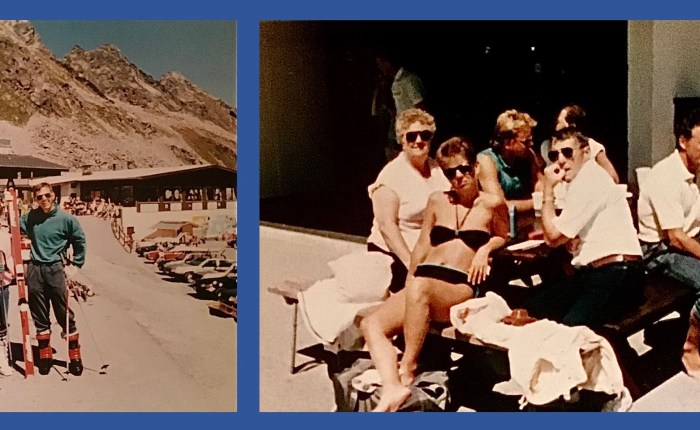
The next day, after an early breakfast of Kaffee, Brotchen, Wurst und Käse (Coffee, rolls, sausage and cheese) we made our way to the slope and were skiing by 7:30AM. We’d told Mom and Dad they could hang at the Gasthaus, but they insisted on coming with us to the ski lodge. Dad took a photo as we headed to the lift.
Cath and I spent the next three hours skiing the glacier and it was wonderful. The piste (ski trail) wasn’t crowded, the snow was in great shape and we were skiing well. Occasionally, we’d check on Mom and Dad who were drinking Kaffee on a picnic table outside the lodge. Dad snapped some pics of us skiing, but for the life of me, I can’t find them. Around 10:30 the snow started getting slushy. By 11, we were through. We started getting wet from the knees down and were tired from the morning’s activities. In the additional good news department, we hadn’t fallen all morning.
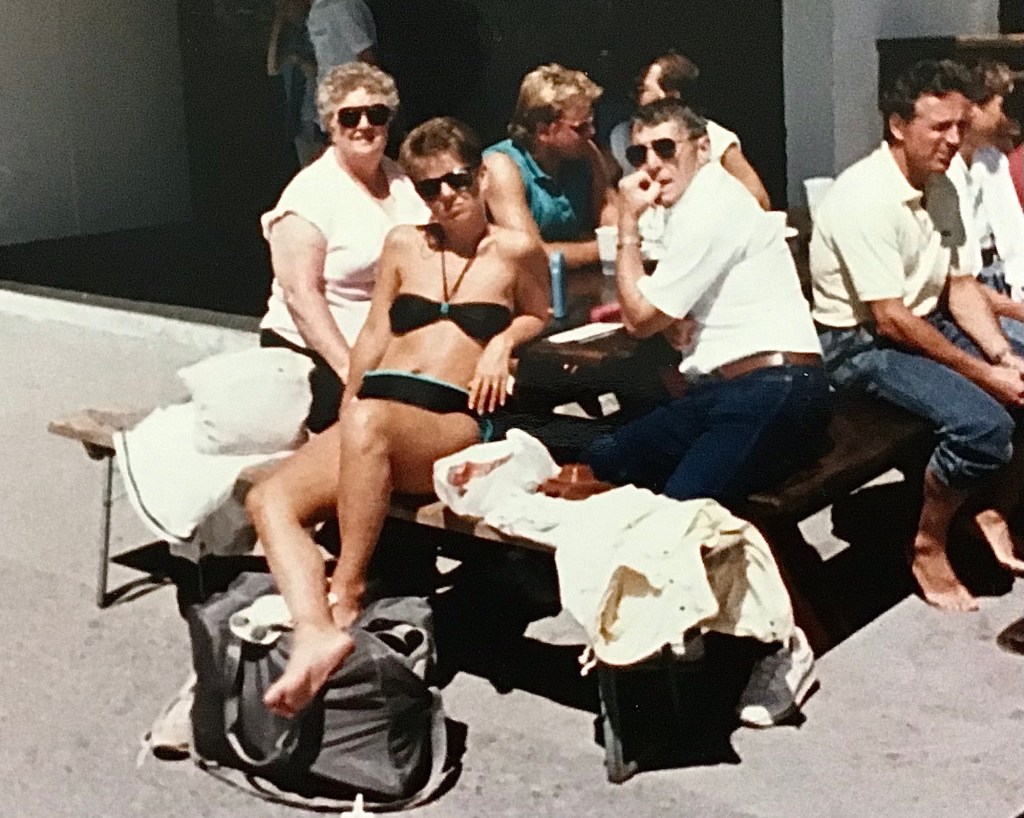
We stacked our skis in a rack, joined Mom and Dad and ordered some biers. Cathy stripped off her sweater and jeans, revealing the bikini she wore underneath. In the photo I took of Cath with Mom and Dad, I love the bored/sullen Euro look she adopted. Just another ho-hum day skiing the Alps and catching rays.
Cathy Working on Her Tan after Skiing in the Morning.
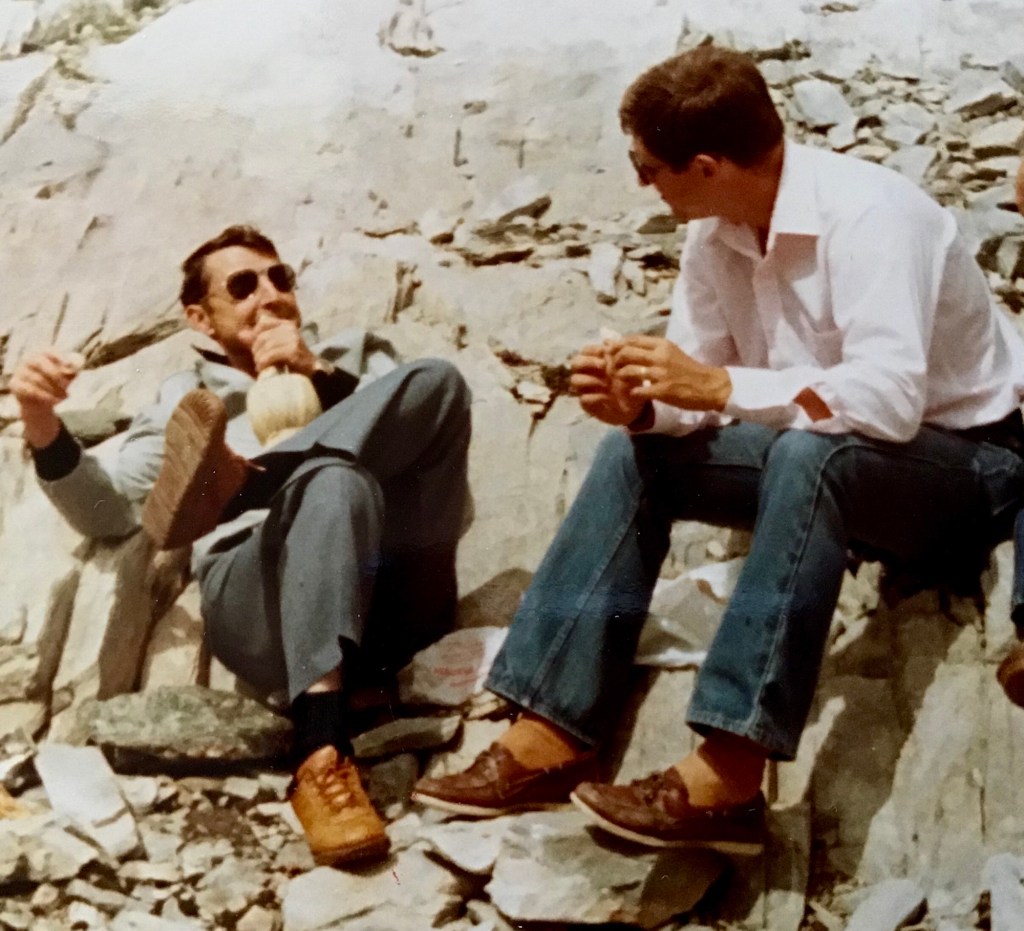
We spent one more night in Sölden, before heading for Nauders, Austria right on the Italian border. We’d previously skied a couple of winters there. After a couple of days seeing friends, we eventually crossed into Italy and then Switzerland, having an occasional roadside lunch of bread, cheese and wine. One day we forgot glasses, but that didn’t stop us. ;-).
No Glass? No Problem!
We worked our way to Davos, where we enjoyed a multi-course 5-Star meal at a restaurant just outside of town. At our hotel that night, we saw fireworks going off in the mountains across the valley. It was the celebration of the Swiss National Day, their equivalent to our 4th of July and pretty amazing. At the time, we had no clue about the importance of Davos or the World Economic Forum. All we knew was that we ate a great meal that evening and then saw a cool light show in the Alps.
Eventually, we returned to Rheindurkheim and other adventures, before Mom and Dad flew home.
It’s funny, I remember many parts of that vacation**, but for some reason skiing the glacier at Sölden stands out. It was only a small part of the trip, but remains firmly in my mind. Maybe it was the fun of the day. Maybe it was the skiing. Maybe it was just the remembrance of my wife soaking up sunshine in a bikini at the ski lodge after a morning of good play. All our days should be so happy.
Addendum:
I should point out that there were MANY women sunbathing in bikinis, not just Cathy. She’s the only one I took a picture of ;-).
* These days at Sölden, due to Global Warming the glacier is receding. Skiing stops sometime in May, and picks back up in September.
**When people visited us in Germany, we gave them atypical tours of Germany and Europe. We weren’t big on Churches and Museums, and instead, focused on local activities off the beaten path. On this particular vacation with Mom and Dad, we really wanted to show them parts of the Alps we’d grown to love in both the winter and summer months. I doubt we saw another American the entire time.
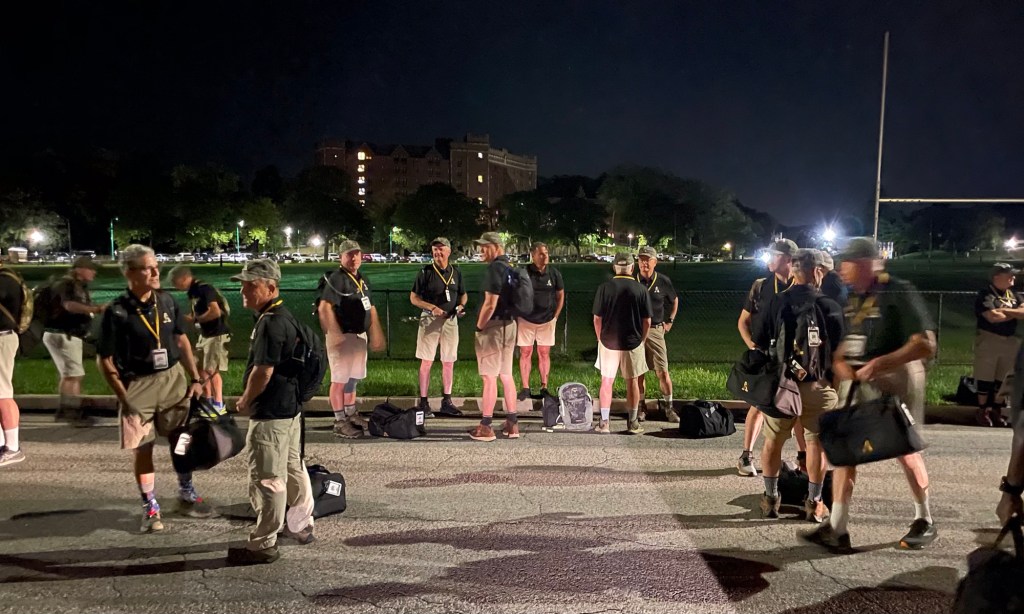
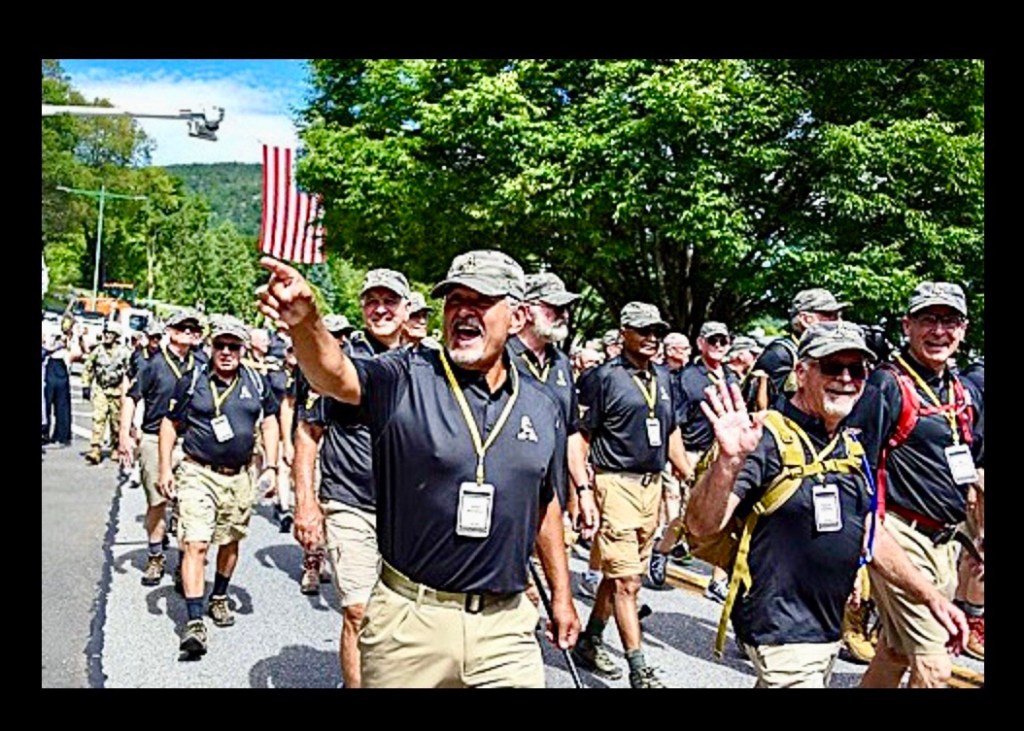
We started gathering around 0130 at Buffalo Soldier Field. Soon, buses would drive us to Lake Frederick. There we would link up with the West Point Class of 2028 and join them for their 14-mile March Back to West Point, which culminates with the end of New Cadet Summer Training, aka Beast Barracks. The Class of ‘28 will graduate exactly 50 years after we graduated in ‘78.
Just about everyone is aware that West Point Graduates are known for being a part of “The Long Gray Line.” The phrase “The Long Gray Line” in its simplest definition is the continuum of all graduates and cadets of the United States Military Academy at West Point, from 1802 to the present. In an effort to strengthen the concept of “The Long Gray Line”, the West Point Association of Graduates (AOG) started a 50 Year Affiliation Program (YAP). It’s an absolutely brilliant idea. The 50 YAP started 25 years ago in 1999, with the class of ’49 supporting ’99.
To bring some perspective, IF the program had existed when I was at West Point, our Affiliation Class would have been the Class of 1928. Classmate Frank Arduni pulled together some facts about that class:
The class graduated 261 new Lieutenants on June 9, 1928. By the time the last member of their class passed away in October 2010 at the age of 104, the class produced 78 General officers. They became pioneers of Army Aviation, and within four years of graduation at least 6 members of the class died as 2LTs in air accidents. Eventually 73 served in the Army Air Corps, two long enough to see it become the Air Force.
28 lost their lives in the Second World War, and at least eight of those as prisoners of war. Six members of the class were “participants” in the Bataan Death March, of whom only one would survive the ordeal.
One member of the class, Robert Albert Howard, was the grandfather of our 1978 classmate, Eric Franks (RIP).
Over the course of the next four years, various members of our class will attend significant events during the Class of 2028’s time at West Point. Some of those events include: their First Day at West Point and the Start of Beast Barracks; Affirmation Day at the start of Cow (Junior) year when they have officially committed to serving in the military; Ring Weekend; Branch Night Firstie (Senior) year, when they select their military branch; and of course, Graduation.
The event that caught my eye was “March Back”. At the end of Beast Barracks, the New Cadets do a forced march of 14 miles from Lake Frederick where they have been for some of their training, back to West Point. A few days later, they transition from “New Cadets” to full fledged members of the Corps of Cadets. Each year a number of graduates (Old Grads) participate in the March Back and interact with the cadets. The 50-year affiliation class is guaranteed 50 of those slots.
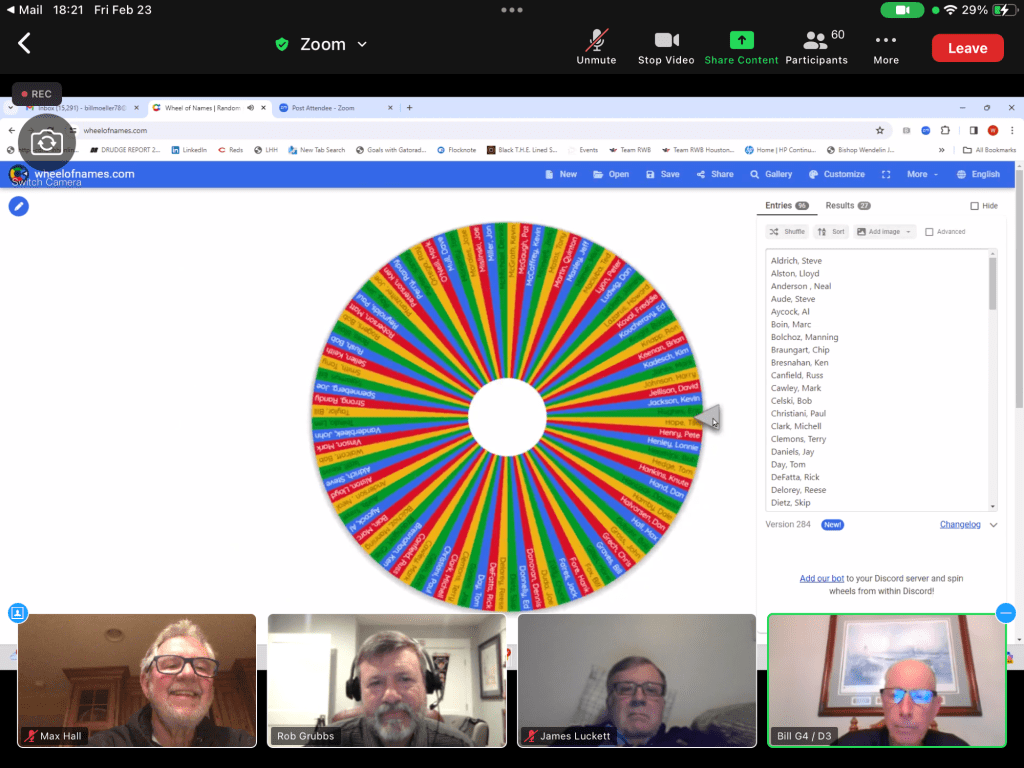
Last winter, our class announced the upcoming events. 118 of us said we wanted to do the March Back. In February, we held an online lottery via Zoom for the guaranteed 50 slots. I was number 76. D@mn. I now needed to rely on some luck and try and sign up for one of the additional slots available to all graduates later in the spring.
The Lottery
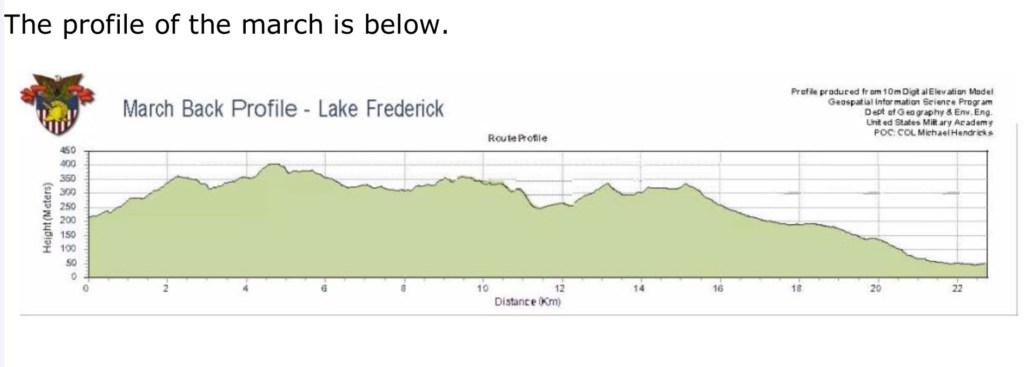
In the meantime, I increased the mileage of my daily walks and started going both farther and faster. The March Back itself is 14 miles long, with the first three miles entirely uphill. The pace was to be at 20 minutes/mile, but we were warned the first three uphill miles could go faster.
Route Elevation. The First 5 km Are All Uphill.
In June, I lucked out, signed up early enough online and was selected to participate in the March Back. Ultimately 73 members of the class of ‘78 would make the 14 mile March Back, with another 42 joining us for the final two miles.
Over the next month and a half, I increased my workouts again. I didn’t want to let myself, my classmates or the Class of 2028 down. In addition to daily 5-6 mile walks, I added several 8, 10 and 12 mile hikes over the hills here in Virginia. The longer hikes were at an 18 to 18:40 min pace. I was as ready as I was going to be.
On Saturday, the 10th of August, I made the six-hour drive to West Point. As always when returning to the Academy, my mind filled with a mishmash of thoughts – the March Back of course, but also my own time at West Point, and its impact on my life. It’s 46 years since I graduated, but I still remember reporting to The Man in the Red Sash on my first day as if it was yesterday.
That first night was great and I had the chance to see a number of classmates who were also staying at the Thayer Hotel. We had drinks and dinner while telling stories and catching up on the activities in our lives. Our hair was grayer and we were, perhaps, heavier, but our love for life remained.
The next day, the AOG bused us ‘78ers out to Lake Frederick to interact with the class of ‘28 prior to the march later that night. At lunch we talked with the New Cadets over hotdogs and hamburgers. It was the start of an amazing 24-hour period. I probably spoke with 7 or 8 different groups during the next three hours and came away universally impressed. You hear stories about kids being unmotivated these days – nothing was further from the truth for these young men and women. They were sharp, motivated, inquisitive and fired up. They had marched 9 miles to Lake Frederick three or four days before in the remnants of Hurricane Debby. It rained during the march and for the next two nights when they slept outside without tents. You’d have thought they would be depressed or unmotivated, but the exact opposite was true. They were charged up and attentive. I was inspired by all of those I met and spoke with.
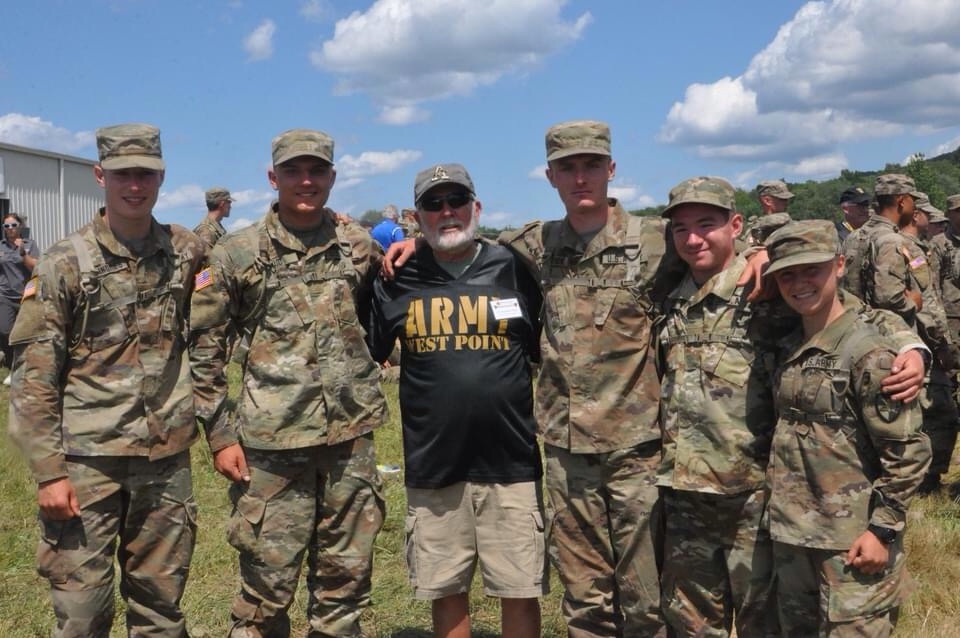
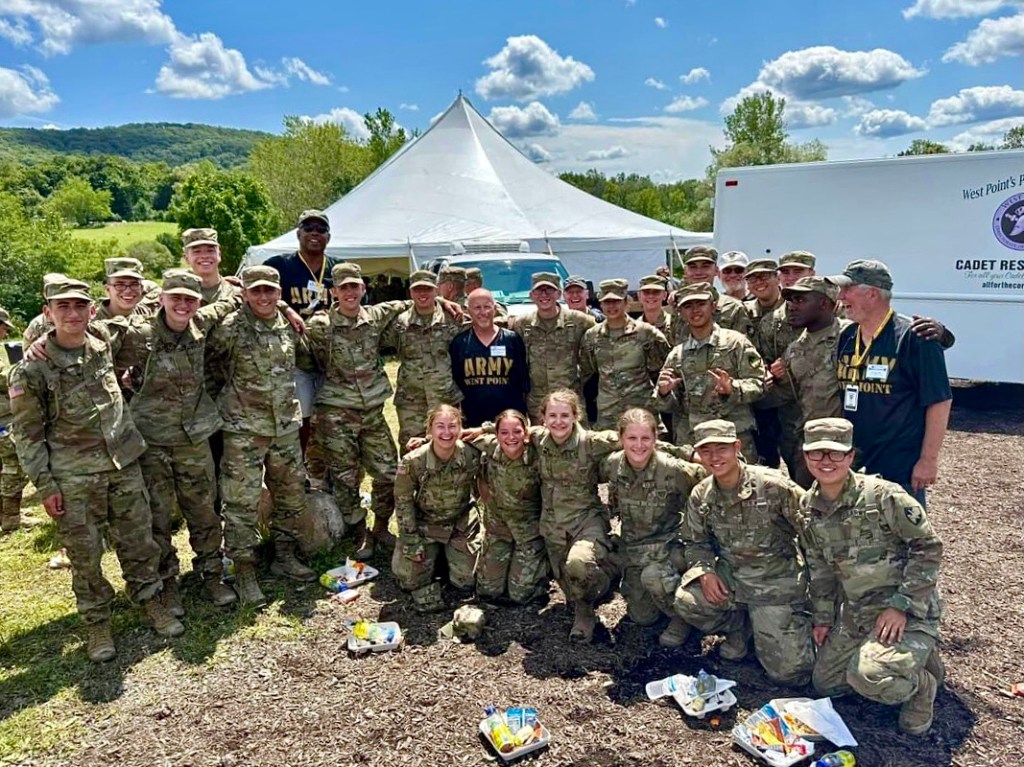
Classmate Bob Rush with Members of the Class of ‘28Some of the Class of ‘28 with a Couple of us Old Grads
We eventually boarded our buses for the trip back to West Point. My mind kept playing and replaying the time with the New Cadets. Yes, we were there to help them understand the concept of The Long Gray Line, and hopefully we were doing that. What I hadn’t understood earlier was how motivating these young people would be for me. Their enthusiasm had increased my own. They also brought home the fact that The Long Gray Line extends both into the past AND into the future.
I went to bed around 2100 that night, but didn’t sleep much. Three hours and forty-five minutes later, my alarm went off at 0045. I hopped out of bed and got ready. I left the Thayer and walked the quarter mile to our Assembly Point at Buffalo Soldier Field. When I arrived around 0130, many Grads were already there, milling around.
“Hurry up and Wait”
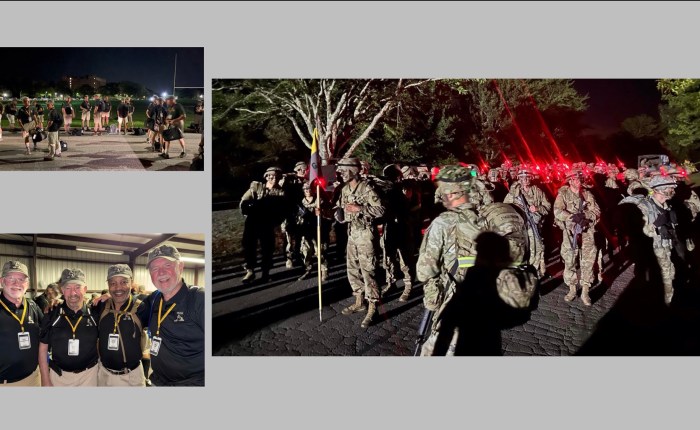
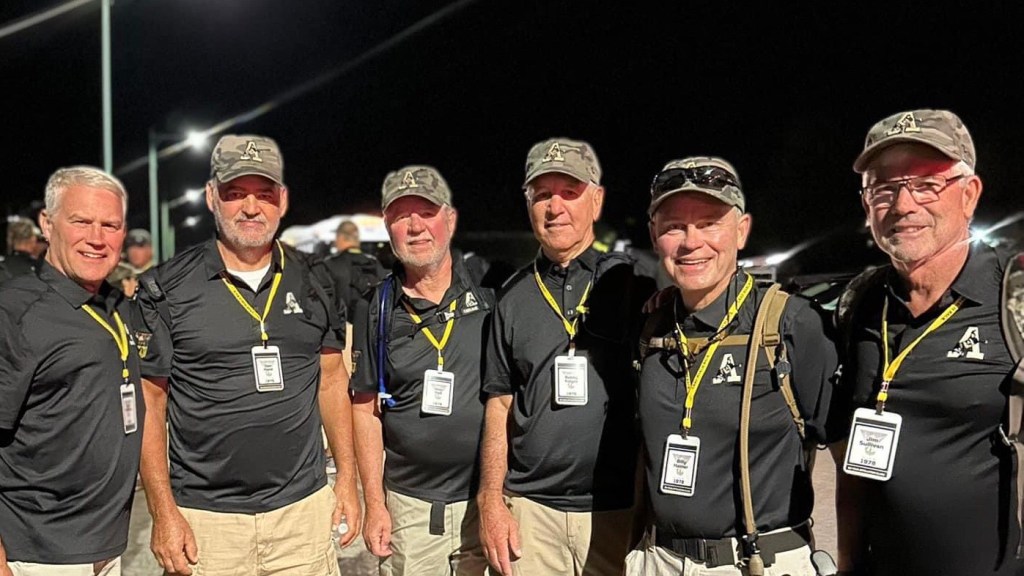
The crowd grew and in the dark we started linking up with friends and classmates. Six of us ‘78ers were marching with Gulf Company and we snapped a pic.
Proud and Great ‘78
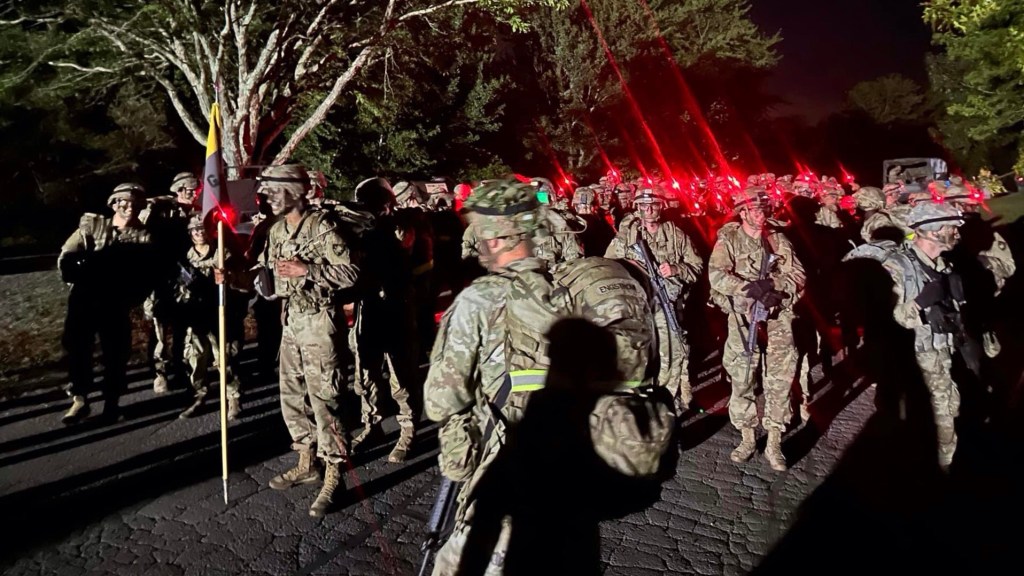
Soon, the buses arrived. We left a little after 0200 and drove to Lake Frederick. After a quick breakfast, they started linking us Old Grads with the companies and platoons we would each march with. I and several others would walk with G-4, the 4th platoon of Gulf Company and they linked us with them around 0415. We grads were only carrying small Camelbak packs with water and maybe a snack, bandaids and a pair of dry socks. The New Cadets? Full uniforms, helmets, 30-40 pound ruck sacks and their M4 rifles. Yep, men and women alike, they were doing a full combat march back to the Academy to start the academic phase of their Plebe year.
Gulf Company, Ready to Roll.
At 0430, right on time, Gulf Company started its return to West Point.
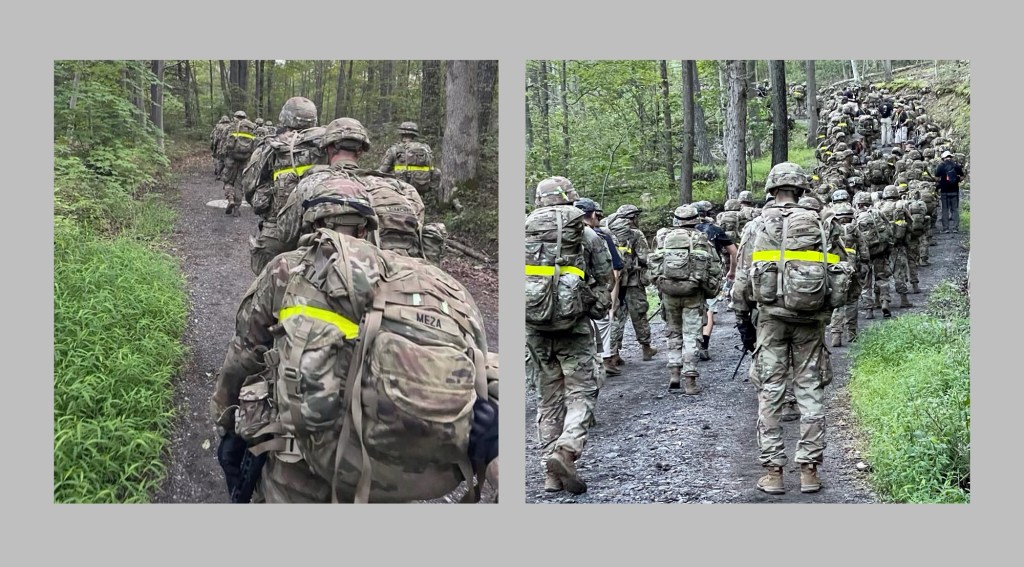
We did the first three miles uphill in the dark. The trail was gravelly and rock strewn but honestly, I didn’t really notice the dark, the climb or the rocks. I was having too much fun talking with the New Cadets and a couple of the Cadet Cadre. The New Cadets were supposed to march in silence, unless they were talking with one of us Old Grads and that’s what they did. But when you started talking with them – man did they open up. They asked me as many questions as I asked them and the time passed quickly. We arrived at the three-mile mark around 0525. True to what they’d warned us about ahead of time, we went out at a spirited 18 Minute/mile pace, but I hadn’t noticed.
After a short break, we continued marching as daylight approached. The New Cadets were in two columns, one on each side of the road, with the cadre and us Old Grads marching in the center between the columns. For the next three hours, I spoke with perhaps 15 or 20 New Cadets. We talked about West Point, Beast Barracks, Plebe Year, the Army, how long I stayed in and where I was stationed, Women at West Point, Women in the Army, Airborne School, the rain from Hurricane Debby, wet boots, what drew them to West Point, why they chose West Point, why I chose West Point, the best part of Beast, the worst part of Beast, square meals, and a whole host of other topics, including the Green Bay Packers and their chances this year. The conversations were full grown adult conversations, not the monosyllabic answers you sometimes receive from youth these days. The next nine miles passed in a blur.
The Class of 2028 on the March
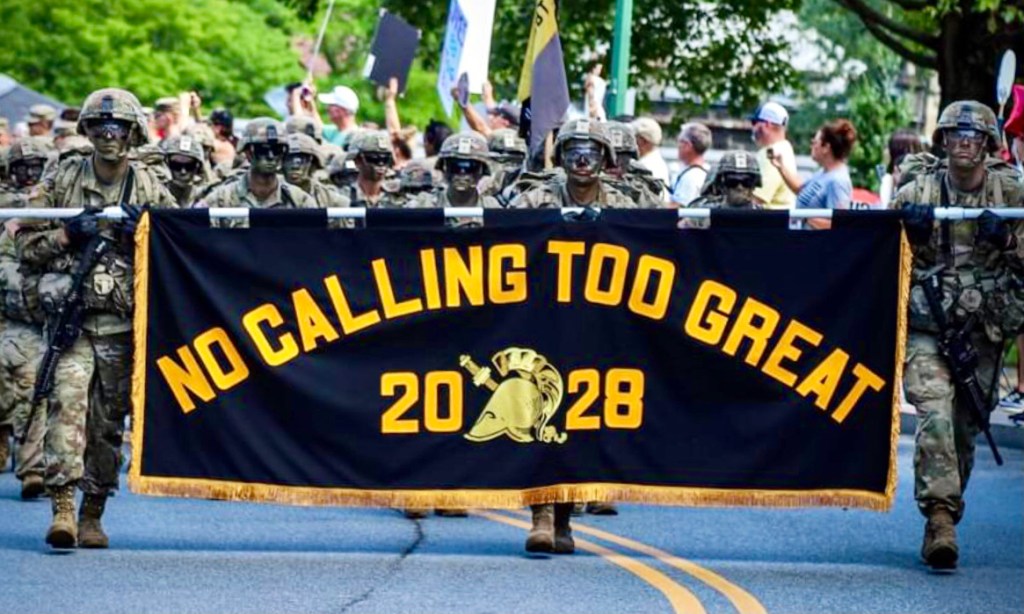
At the 12-mile mark, we arrived at the West Point Ski Slope. We Old Grads said our goodbyes and left the New Cadets. We joined our classmates who were only marching the last two miles into West Point proper. After a break the Class of ‘78 formed up. The Class of 2028 passed in front of us in company formation and unfurled their new motto, “No Calling Too Great – 2028” for the first time. We members of the Proud and Great Class of ‘78 saluted them as they passed.
After the Class of ‘28 marched by, the class of ’78 fell in behind them, leading the Old Grad contingent of nearly 400 marchers. We picked up the cadence of the drum, and as one of my classmates mentioned, even at our age we were still marching better than the Naval Academy does. ;-).
José Morales and the Class of ‘78 on the Parade Route
Much of the route for the final two miles was lined with people watching the parade. They too were inspiring with their claps and cheers. I think the last time I marched in a parade was around 1982 in Germany. Eventually we reached main campus and Passed in Review at the Superintendent’s house. We (‘78) chanted “Beat. Navy! Beat. Navy! Beat. Navy!” in time with the drum for the Supe and he laughed.
And then the March Back was over. The Class of ‘28 went to clean their weapons. We ‘78ers walked across The Plain for the rededication of a Statue of Civil War General, John Sedgwick, that the Class of ‘78 had funded a restoration of (stay tuned for a future blog about Sedgwick’s Spurs.) We followed that with a short Memorial Service for our 93 classmates who have passed away and ended with classmate Harry Johnson leading us in singing The Corps. The words to The Corps always ring true, particularly with its references to The Long Gray Line. On this day, it was perhaps a double punch with both the Memorial Service for our departed Classmates and the March Back with the future of the Corps.
The Class gathered one last time a couple hours later for a cookout and a few drinks. We all remarked about what a great time we’d had over the last 24 hours and how impressed we were with the Class of ‘28. We were still enthused, but a bit quieter by now. As evening approached, with hugs and handshakes, we went our separate ways
On my drive home Tuesday morning, my legs were only a little sore. As I drove,I thought about the Class of ‘28 and my interactions with them. My friend and classmate Tony Matos called the weekend magical and I agree. I spoke with young men and women of all colors and ethnicities. I’d spent time with New Cadets from California, Washington, Oregon and Idaho; Oklahoma, Illinois, Indiana, Wisconsin and Minnesota; Georgia, North Carolina, Virginia, New Jersey, New York, and Connecticut. It was as if the melting pot of America was on display for those two days. I’d made the trip to West Point to show and give them a view of the continuity of The Long Gray Line. They gave me so much more – a demonstration of grit and fortitude; a view of encouraging teamwork; a promise of both mental and physical strength; and a look at the future. From my time with the Class of 2028, I felt encouraged. I believe that both now and in the future, West Point, our Army and our Country will be in good hands as the Class of ‘28 answers the call of Duty, Honor, Country.
No Calling Too Great, 2028
Addendum:
Thanks to classmate Frank Arduni for his ongoing research about the class of 1928.
Thanks to classmates Bill Moeller and Tony Matos for their editing support on this blog. Both had great ideas to add.
Thanks to classmates Bill, Tony and Billy Harner, along with the AOG for organizing the March Back activities and making it such a wonderful event for all of us.
The pictures in this blog are from a number of sources, including classmates, the AOG, and my own photos.
Thanks to my wife, Cathy, and friend, Colleen, for their continuing editorial support. I’d be lost without them.
My friend John told me a story about once taking on a high-level job after his predecessor was fired. He knew the guy (Sandy) he was replacing and asked him if he had any advice. Sandy gave him the usual pablum, and then said “I’ve left you three letters in the top drawer of the desk. If you get in trouble, open each of the letters in turn.”
John took on the job and it was quite a challenge. After about three or four months, things weren’t going very well and he decided to open the first of the letters. He opened it and inside was a single sheet of paper. On it, Sandy had written “Blame your predecessor (me) for the issues. That will give you some more time.”
John thought about it some. He didn’t want to throw Sandy under the bus, but then thought, hell the advice came from Sandy himself and he decided to do it.
At the next board meeting he explained he had uncovered some new issues and they were directly caused by Sandy and his time with the company. The board nodded in agreement and told him to proceed and fix things.
Six months later, things hadn’t improved much. John was getting a bit desperate again and opened the second letter. For the second time, there was a single sheet of paper inside and on it, Sandy had written, “Reorganize.”
John thought to himself, “Of course! Brilliant idea!” And so, at the next board meeting John explained he was reorganizing and this would bring greater efficiency and increased profits. The chairman nodded in agreement and said, “That sounds good John, but let’s get on with it. We’ve put our faith in you.”
Another six months went by and things didn’t get any better. As a matter of fact, they might have become worse. Reluctantly, John decided he needed to open the last letter from Sandy.
For the third time, there was a single sheet of paper inside. On this one, Sandy had written, “Write three letters!”
__ 😉 __
No, not a true story, but I think a funny one. And while not a true story, there is some truth to what people try and do to improve an organization. As a SR VP in a publicly traded company, a COO for a private company, and the Chairman of a small IT Services company, I’ve seen all types of leaders and managers. I’ve never thought the blame game helped anyone and I’ve never been a believer in change for changes sake. Some “leaders” seem to do both.
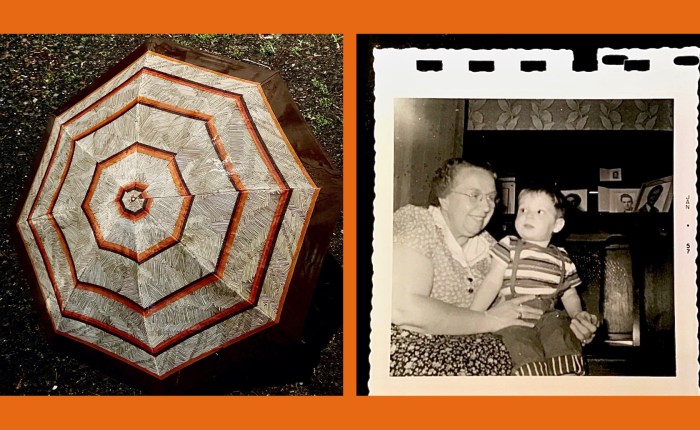
Last week it rained pretty heavily one day. Late at night I took Carmen out to do her business and it was still raining. I grabbed one of our umbrellas and as I opened it, thought of Grandma Grubaugh. We’d given her the umbrella as a young man. It returned to Cath and me when she passed away.
I remember as a child, we kids would give Grandma and Grandpa Grubaugh some sort of homemade Christmas gift, or Mom would buy something and put a tag on it, saying it was from the three of us. When Grandpa died in 1968, it transferred over to just getting something for Grandma.
At some point in time, maybe in High School, or when I left for West Point, I started buying Christmas gifts for Grandma on my own. I don’t really remember much about what I bought her. I mean, what do you buy for a woman who pretty much had everything she needed or wanted? Inevitably it was some knick-knack or something else she didn’t really need. When at West Point, it might have been a pin or brooch related to West Point. Of course she always acted as if it was the most precious thing in the world when she opened the gift on Christmas Day.
Grandma and I at my West Point Graduation.
Later, when Cathy and I married and were living in Germany, we typically sent her some German chocolates or something similar. Or, would have Mom and Dad pick up some steaks for her. We’d learned over the years it was better to give her food she could actually enjoy rather than yet another gift she didn’t really need.
Eventually Grandma passed away in 1996. It fell to Mom and my Aunt Pauline to go through her things and get her house ready for sale. Most of it was straight forward. The aunts and uncles claimed the items they wanted to remember Grandma by, and then we grandkids were offered a choice of remaining items. That’s how I ended up with the pink monkey and blue elephant glasses. I always remembered them from my childhood – drinking milk at Grandma’s kitchen table while eating her homemade date-nut bread.
Blue Monkeys and Pink Elephants
One day during all of this, I received a call from mom. They’d come across a chest and when they opened it, they were a bit shocked. It was full of Christmas and Birthday presents Grandma had received over the years and never used. Each item had a tag saying who gave her the present. There were plates and bowls, and even unopened packages of brassieres (Grandma would never have used the word bra).
Among the items was an umbrella, with mine and Cathy’s name on it. The plastic box was still unopened. Mom gave it to us the next time we were home visiting.
I have to say, it’s a bit of an ugly umbrella. I suppose sometime back in the ‘70s the color combo might have been considered the height of good taste. No plain black or blue or red – it’s an in-your-face design with shades of brown and orange. Color-wise, it’s a perfect match for our 1970s era crockpot. It also turns out it is an incredibly durable product. Made in the ‘70s and first used in the late ‘90s, it’s still functional and going strong in 2024.
‘70s Colors in Full Bloom.
It currently resides in a storage stand in the mudroom, along with a basic black umbrella, a couple of walking sticks and some snowshoes. It’s only used a few times a year – usually late at night when I’m taking Carmen out to do her business and there’s a driving rain. Still, it never fails to make me smile and think of Grandma Grubaugh, a truly treasured gift.
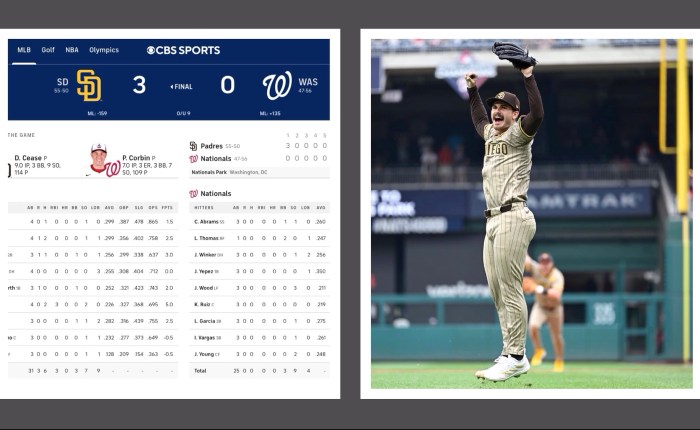
Last Thursday, I checked something off my bucket list – for the first time ever, I saw a no-hitter at Nats Park. Of course God had the last laugh. The Nats were no-hit by San Diego’s Dylan Cease. I guess beggars can’t be choosers when it comes to bucket list items.
No-hitters are a rarity. There might be one or three in any given baseball season. That’s one or three no-hitters, out of the 2,430 games the 30 teams play each year, not counting the playoffs. I’ve seen many grand slam home runs over the years. I’ve seen walk-off homers. I even checked off another bucket list item when I made a Nats World Series game in 2019 (they lost the game, but won the series). But a no-hitter? That’s a big no-no never. Until July 26th, 2024.
The game started at noon and at 12:15, there was a rain delay of 76 minutes. The first half inning wasn’t even over. When the game resumed around 1:30, Nat’s pitcher Corbin gave up three runs. Ugghhh. After that, he settled down and both Corbin and Cease were pitching well.
Waiting Out the Rain Delay.
At the top of the 6th, I looked at my watch. Holy Cow! It was only 2:30. 4 1/2 innings were covered in one hour. THAT is some fast and effective pitching. It was also about then I noticed the Nats didn’t yet have a hit. Still plenty of time for that.
Our Group Caught on Nats-Cam Early in the Game
By the 7th, we were talking about the possibility amongst ourselves. The Nats went no-where that inning. You could feel the tension mounting in the park.
The 8th – the same thing. Cease got the side out on 9 pitches total. We were all talking. Could this/would this really happen?
And then it was the 9th. Vargas made him work for an eight-pitch groundout. Young ground out on the next pitch, and a yell went up inside the park. Abrams came up with two outs. He hit a low liner that looked like it might drop, and NO! The right fielder caught it!
The San Diego fans in the stadium let out a roar. And then the Nats fans stood up and the vast majority of us also started clapping. Not for the Padres winning, but the superb effort Cease had given. You can honor effort and history without disrespecting your team and that’s what we were doing. Against the Nats, I wouldn’t have said he was dominant, but he was d@mned efficient.
It turns out Cease has only given up two hits in the last 22 innings he has pitched. The man is currently on fire. It’s also worth pointing out he played for the White Sox before this season. Jerry Reinsdorf traded him away at the start of this season. Did I mention no one in Chicago cares much for Reinsdorf these days?
And the Nats? Since baseball returned to Washington in 2005, it’s only the second time they’ve been no-hit in the last 14 years.
I’ve thought about my emotions at the end of the game. Through the 8th, I was hoping for a hit and a rally from the Nats. In the 9th? I was holding my breath, and to be honest, I’m not quite sure what I hoped. For the Nats to win? Certainly. But on that last at bat? Two outs? Yea, maybe I was holding my breath, waiting to see if history would be made. I know after the right fielder caught the line drive, I too rose, and softly clapped. You can honor effort and history without disrespecting your team.
We arrived at the ranger Station in Wrangell-St Elias National Park, Alaska. As we checked in for our backpacking trip to Dixie Pass, an older looking ranger eyed me. After a brief conversation, he asked, “Do you know what grizzly bear scat looks like?” I shook my head no.
Six months before meeting that ranger, Cathy turned 40 years old. We decided to celebrate her milestone birthday in Alaska the next summer and do some backpacking while there. Coincidentally, Cath’s sister Bonnie was marrying Don that June and they asked about coming with us for their honeymoon. We quickly said yes and started outlining the trip.
While we planned to visit several places, the highlight would be a four-day backpacking trip in Wrangell-St Elias National Park (WSNP). It is a vast national park that is the same size as Yellowstone National Park, Yosemite National Park, and Switzerland combined. Only Denali, also in Alaska, is a larger Park.
We specifically chose WSNP because of its remoteness. Unlike Denali, which has buses circling the park and regulates when and how people can enter the park, WSNP is a wilderness area with one 60-mile gravel road dead-ending at the town of McCarthy. I should mention that while McCarthy’s summertime population was 200, its winter population was just 13.
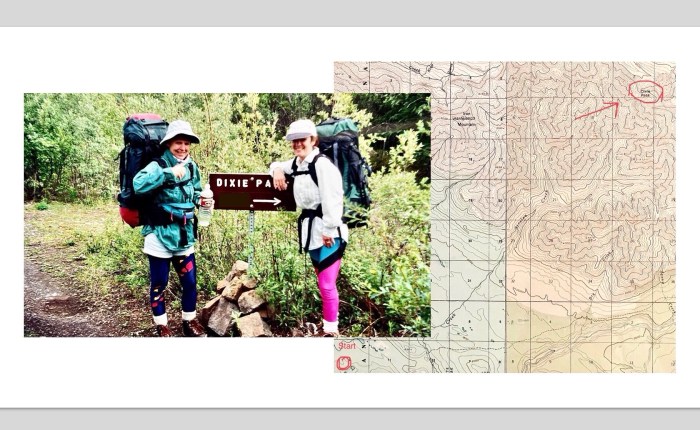
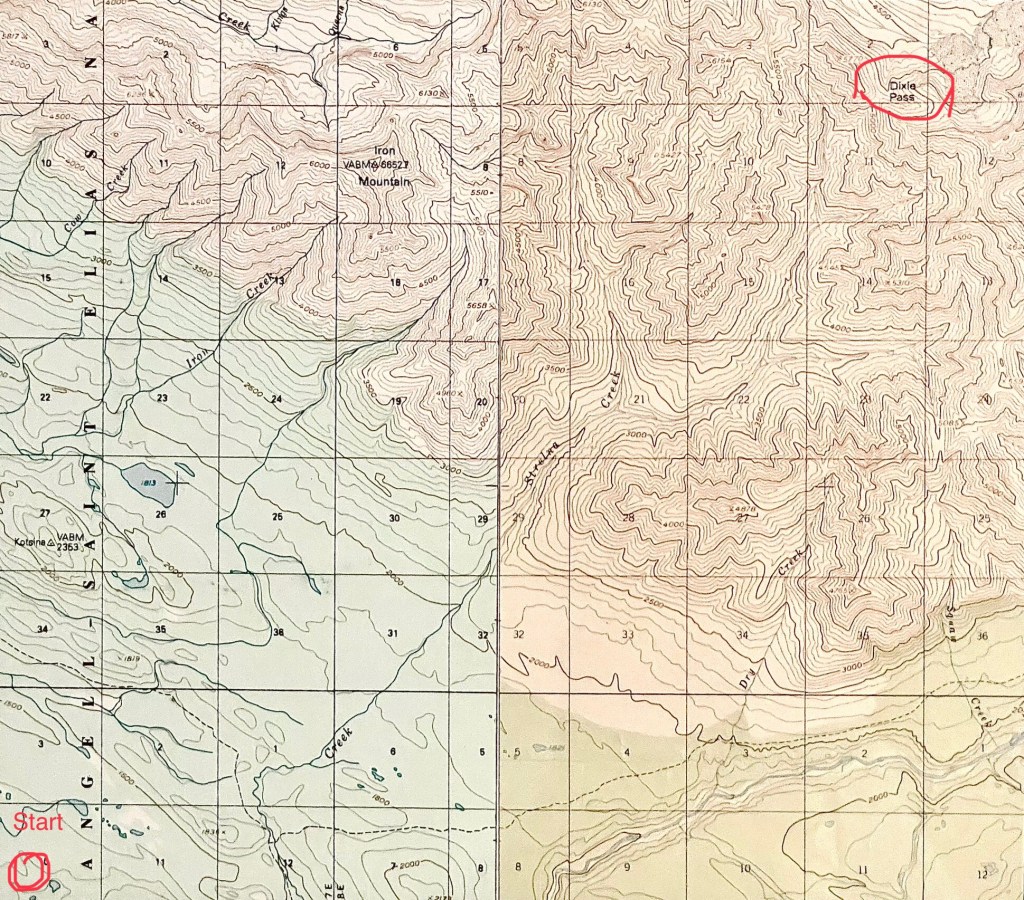
In the WSNP there were no trails, only suggested routes requiring map and compass skills. We eventually settled on a hike to Dixie Pass – a four-day, 28-mile round trip hike with 5,400 feet of elevation gain. The country was remote and about half the hike was above the tree line. It was also mosquito infested until you were above the tree line. Guidebooks suggested checking in and out with the Ranger Station at the entrance of the park for safety reasons.
Part of Our Map for the Hike to Dixie Pass
After Bonnie and Don’s wedding in June of ‘96, the four of us flew to Anchorage. We spent a few days seeing some sites and getting acclimated to the near continuous sunlight. Eventually we made our way to WSNP and checked in at the Ranger Station.
We signed in and spoke with one of the two rangers working that day and told him of our planned hike to Dixie Pass. He gave us a few safety tips and talked about the fact there were both black bears and brown bears (also known as grizzly bears) in the park. While black bears are usually more timid and less confrontational, the grizzly bear was totally different. They could attack even when unprovoked.
The ranger pointedly looked at us and then asked, “Have you bought any jingle-bells for attaching to your pack to make noise, so the bear know you are coming?” I answered, “No, we planned to attach our drinking cups to the outside of our packs so they would make noise.”
“Ahhhhhh. Did you bring any pepper spray with you?” – “Ummm, no. Should we have?”
“Hmmmmmmm. Do you know the difference between black bear skat (poo) and grizzly bear skat?” – “No, we don’t. Could you fill us in?”
He kind of smiled, and then said, “Sure. Black bear scat is sort of brownish and fibrous. You’ll often see berries in it as well. And grizzly bear scat? Well, it’s similar to black bear scat, but it also has jingle bells in it and smells like pepper!”
A half second passed and then all of us, including the ranger, burst out laughing. He’d reeled me in like a bluegill in a pond.
After the laughter ended, he did share that in WSNP, unlike Denali, there generally were no bear problems. There were so few people in the park that when the bear smelled or saw humans, they generally turned around or went in a different direction. They didn’t really know what we were and would probably avoid us. If we did come across a bear, stay still or slowly back away, don’t run, and things would probably turn out fine.
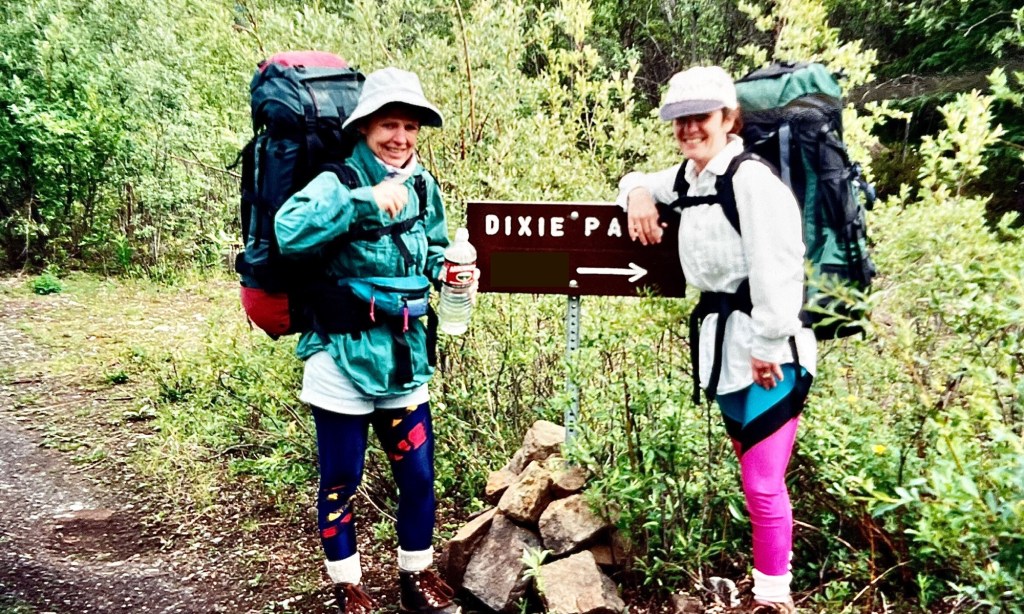
We thanked him for his help and then drove down the gravel road awhile before turning onto a dirt trail for a bit. Eventually, we arrived at a small, cleared area. We saw a small sign pointing towards Dixie Pass. There were no other cars.
Cathy and Bonnie at the Start of the Hike.
The hike itself was wonderful and everything we hoped for – beauty, silence, wilderness – Mother Nature at her best.
We definitely needed a map and compass to guide us, so both Boy Scout and Army skills came in handy. Mountains, valleys, creeks, draws, outcroppings … they all became important in identifying our route.
The mosquitos were horrible until we climbed above the tree line. A half mile into the hike, we needed our head nets and sprayed ourselves with 90% Deet. We used so much Deet, Cath’s running tights basically disintegrated when we returned home and she washed them.
Cathy and Bonnie in Their Mosquito Netting, While Holding a Moose Antler.
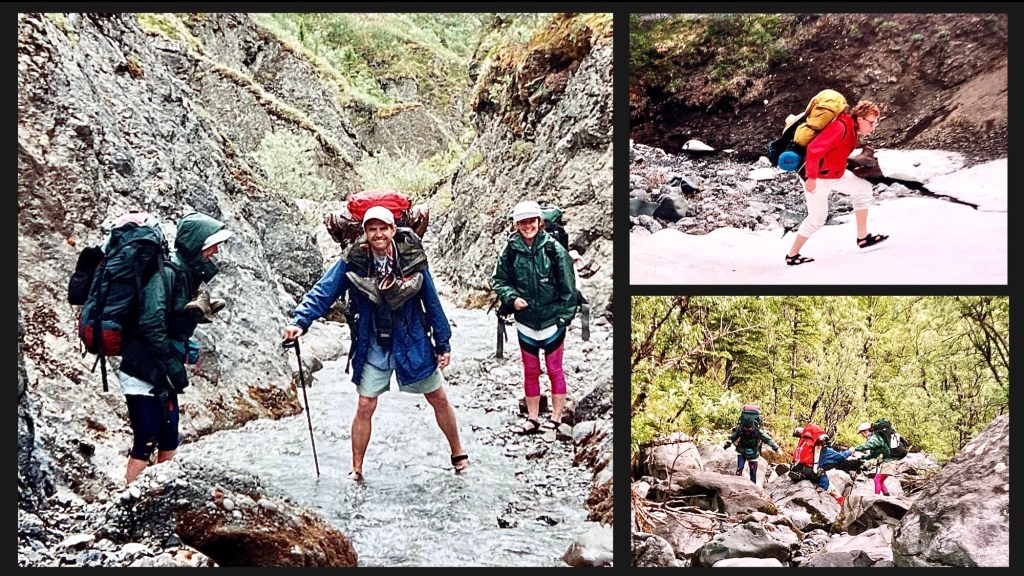
The route challenged us. There were multiple creek crossings, some two feet deep, and places where we hiked over snowpack. We switched to Tevas or sandles several times each day to keep our boots dry. There was also plenty of rock hopping where you were using both legs and arms to scramble over the boulders. While not really dangerous, the trail wasn’t for the faint of heart.
Creeks and Snow and Boulders, Oh My!
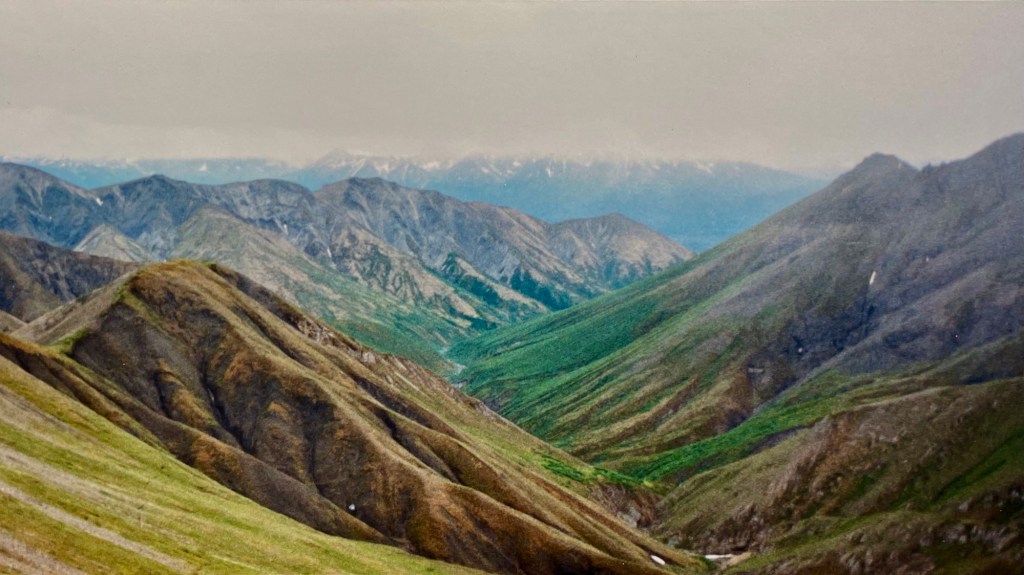
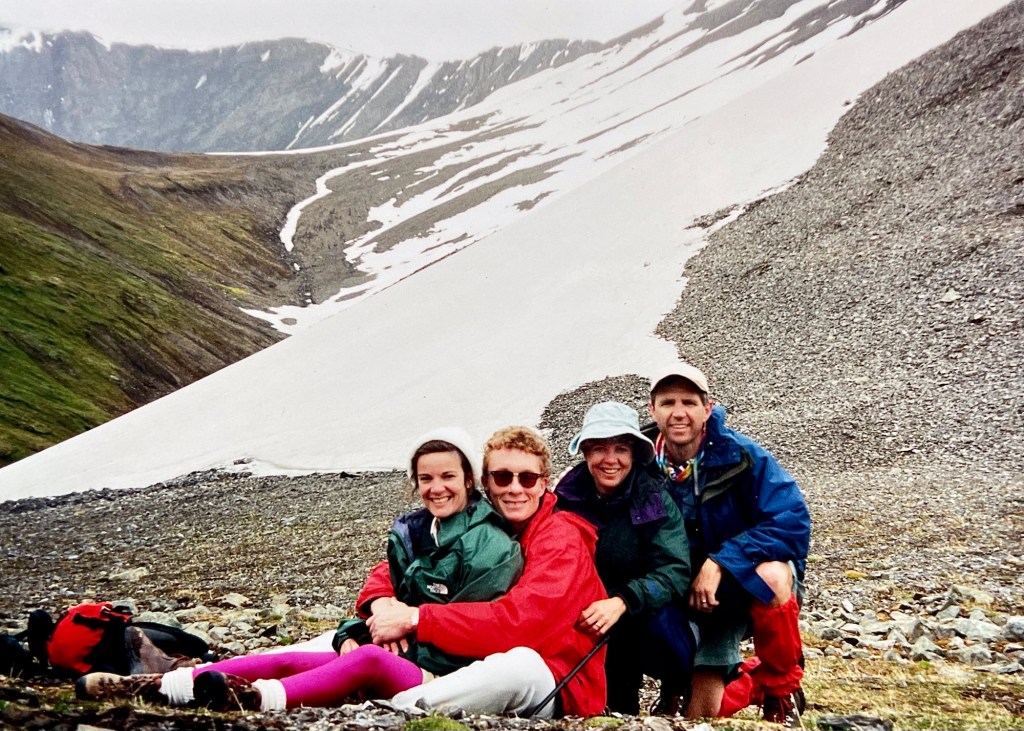
We finally arrived at Dixie Pass where there were gorgeous views in all directions. We lounged around, ate lunch and took some photos. Although it was June 30th, we were snowed on while hiking back down from the pass.
View From Dixie Pass Looking Back at our Approach Route.
On the 3rd morning around breakfast time, we did have a distant encounter with a brown bear, but the ranger was right. When the grizzly smelled us, he turned in another direction and gave us a wide berth. We were probably 75 yards or so away and watched him from a hillside. Still, I have to say it elevated my pulse.
Eventually, we finished the hike and our grand adventure ended. It was both a beautiful and challenging hike – one of those life events you never forget. For me, the story is never complete without also talking about the ranger, the jingle bells and the pepper spray. I laugh to this day when I tell the tale, and it always gets a chuckle.
A while back, a friend talked about her son, who was either prepubescent or a new teen. In the screed, she spoke about “stinky boy stuff” or something similar. It reminded me of a lecture I received from my mom upon returning home from a week at Boy Scout camp in the summer of ‘66.
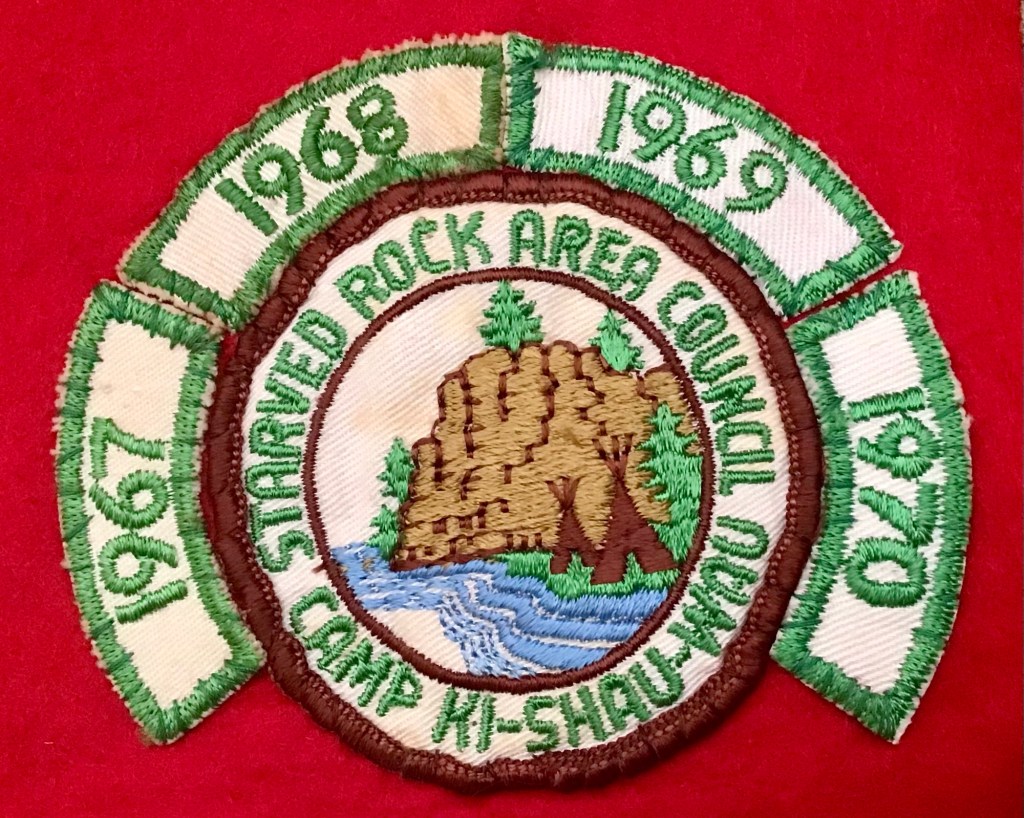
I was all of 11 years old. I’d joined Boy Scout Troop 45 that spring and was going to my first ever summer camp at Camp Kishauwau. To say I was excited was a huge understatement – a week away from home, sleeping in tents, having fun with your buddies – what could possibly be better?!
Mom of course helped me pack. In addition to scout uniforms, a swimsuit, a windbreaker, jeans and shorts, she dutifully packed six pairs of underwear, six white T-shirts and six pairs of sox. Of course, also a towel, wash cloth, soap, toothbrush, toothpaste, shampoo, bandaids, mosquito repellent, and who knows what else.
Mom and Dad dropped me off at Kishauwau on Sunday morning and I had a great week. We went swimming everyday, took canoes out on the Vermillion River, ate great meals at the mess hall, cooked our own food a couple of times, and learned all kinds of new skills. The week passed by in a flash.
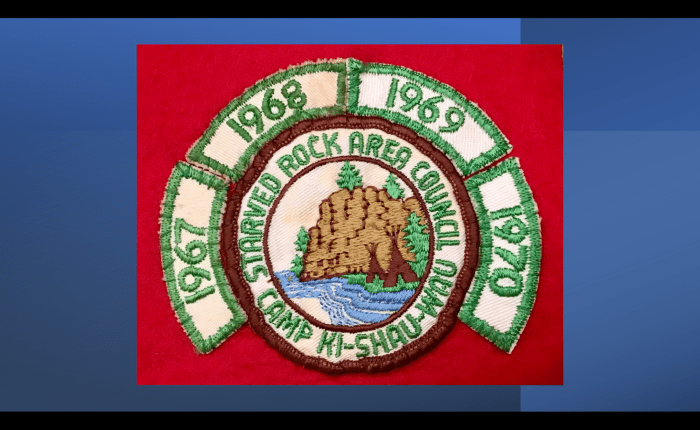
I Attended Camp Kishauwau from ‘66 to ‘70
Mom and dad picked me up on Saturday and we returned home. That day or the next, mom was doing my laundry from camp and I heard my name called/yelled. I dutifully came to the washing machine.
Mom: “What is this!?” Pointing at my underwear. “What is what?” I answered. “This!” and held up my underwear. My six pairs of clean underwear. My six pairs of clean underwear I hadn’t touched or changed all week long. I proceeded to receive a lecture from mom about cleanliness, hygiene, what the hell did I think I was doing, how could I go a whole week without changing my underwear and on and on and on… I had no defense and took it as best I could. I probably looked like a young puppy just caught peeing on the floor. Finally, she wound down and let me go. – whew! –
Fast forward a year. It’s time for summer camp again and I’m looking forward to going just as much as the previous year. Mom helps pack again and in go the six pairs of underwear, the six white T-shirts and the six pairs of sox. Of course along with the packing, I also receive another lecture about health and good hygiene. “Yes mom! I get it!”
Camp was a great time once again – water sports, learning how to track animals, bonfires, learning knots and lashings, building a bridge. It was awesome.
Random Bad Photos (With my Then New Camera) From Kishauwau in ‘67.
Friday night came and I was getting my stuff ready to go back home the next day. To my horror, I came across my six pairs of underwear, again unused. OH NO! What to do?! I was sure to be in real trouble this year. I thought about it and then had an idea. I would make the underwear look dirty! I quickly threw them on the ground and then proceeded to move them around in the dirt and walk on them in my hiking boots. They looked dirty for sure and I slept peacefully that night.
The next day Mom and Dad brought me home. I went out to play and then heard my name called loudly by Mom. Uh-Oh.
Mom: “What is this!?” Pointing at my underwear. “What is what?” I answered. “This!” And proceeded to hold up my underwear. My six pairs of underwear with boot prints on them. “Ummm, my dirty underwear.” “WITH BOOTPRINTS?! WHAT IS GOING ON??”
As I looked at her, my brain feverishly worked, trying to find an answer. What could I say!? What possible excuse could I give!? I had nothing.
“Ummm, I forgot to change my underwear again and thought I could make them look dirty.”
Mom stared at me. Finally with a look only a mom could give, she said “Go to your room.”
Now I’d done it. I sat in the bedroom thinking. She was sure to tell Dad, and then what? How much trouble was I actually in? Why the heck hadn’t I remembered to change my underwear? Why hadn’t I been smarter about how to make them dirty?
Time passed. Finally, I was called to dinner. Evidently it was going to be a public execution.
Except it wasn’t. Mom didn’t say anything. Dad didn’t say anything. In my memory, I seem to remember a small smile from him, but that may just be a trick of my mind 57 years later. And that was it. I didn’t hear anything more about it. By the next year, I actually did remember to change my underwear, although probably not as often as mom would have wished.
I’ve thought about the conversation I’m guessing took place between Mom and Dad. Mom laying out the case. Dad maybe hesitating a bit – remembering his own childhood during the depression. Or maybe thinking about being in North Africa during WWII, when he wouldn’t have had the opportunity to change his clothes for several weeks. And who knows, maybe Mom never said anything to Dad – maybe she had her own chuckle over the whole thing after sending me to my room.
Addendum:
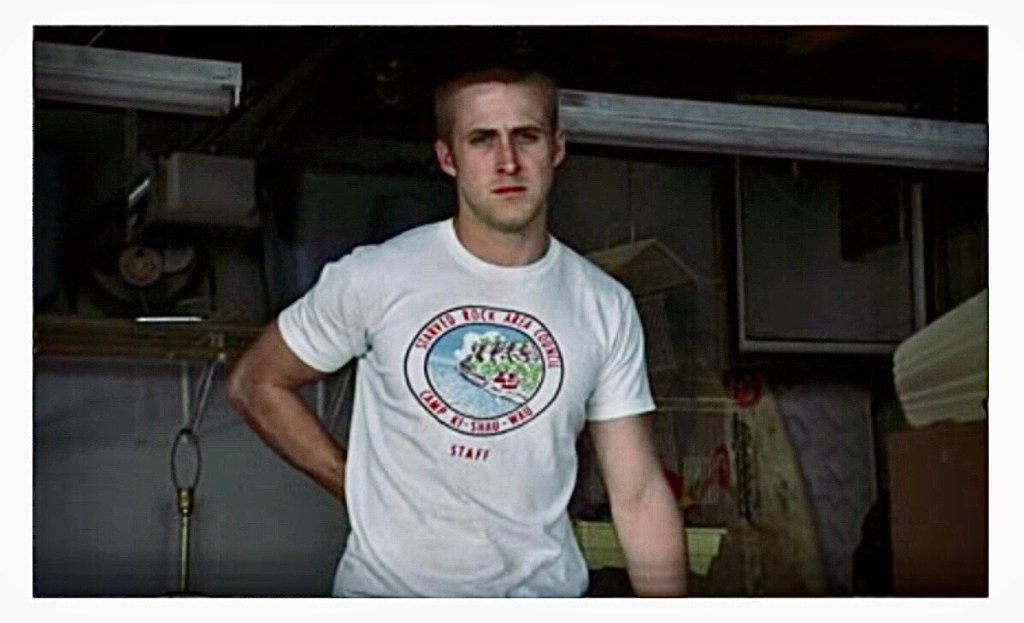
– Fun Camp Kishauwau Fact: Ryan Gosling wore a Camp Kishauwau T-Shirt in the 2007 movie, Fracture, which also starred Anthony Hopkins.
Fun Camp Kishauwau Fact: Ryan Gosling Wore a Kishauwau T-Shirt in the 2007 Movie “Fracture”.
– Here are two previous blogs about my time in the Boy Scouts:
50 years ago in June of 1969, I was awarded the Boy Scout’s highest rank, Eagle Scout. I was thinking about this recently when Cath and I were attending the Eagle Court of Honor for Mark, the son of good friends of ours. I also thought about Farrell and Don, who were great Scoutmasters and mentors: https://mnhallblog.wordpress.com/2019/07/11/farrell-and-don/
On Mother’s Day, May 12th, 1968, Howard and Tim, my two best friends, and I were awarded the Boy Scout God and Country award. I recently came across a photo and newspaper article about the award. That minor event took place during one of the most tumultuous years in United States history: https://mnhallblog.wordpress.com/2018/09/12/god-and-country
Is July 4th, our Independence Day, a holiday we all still celebrate together as Americans? Or is it now just a fairy tale with fireworks as entertainment for the young, and no longer any unifying meaning? Some days, I’m not sure I want to know the answer.
I remember the celebrations of my youth in Ottawa, Illinois. On the evening of the 4th, Mom and dad loaded my sisters and me into the car and drove us to the high school parking lot. We kids ran around looking for friends until it grew dark and we rejoined Mom and Dad for the fireworks. They would launch out over the river and put on quite a show. Ottawa, Illinois had only 18,000 people then, but the show was always first class. We’d “Oooohhh!” And “Ahhhh!” with each launch. The grand finale was always amazing, at least to us little kids.
Ottawa Still has Great Fireworks, as Seen in These Photos from 2023.
Overseas in the Army in the ‘80s, there was usually a cookout at someone’s house. A bit of America in Germany – no fireworks, but a gathering of fellowship and celebration. We shared the common cause of defending America and that seemed enough.
In the ensuing decades, Cathy and I celebrated the 4th with cookouts, visits with friends, and the occasional firework display. It was always a good time.
Over the past decade, things have devolved.
Six years ago, in 2018 I published a blog about celebrating the 4th of July in 1976, our country’s 200th anniversary (you can find a link to the blog in the Addendum). Here’s a partial extraction from the end of the blog:
“I’ve been thinking about that evening in 1976 as our Independence Day celebration approaches this year (2018). The country went through a rough patch in the early 1970s leading up to our 200th birthday. Vietnam, anti war protests, Kent State, Nixon and Watergate, race issues, the assassination attempts on Ford, and multiple drug overdoses, to name just a few of the issues of the day. And yet, to me on that Fourth of July, it felt like we were all in one boat pulling together. We weren’t Republicans or Democrats, liberals or conservatives, young or old, black or white. We were just Americans, and it seemed our differences were set aside, at least for that night.
Which brings me back to this year’s Fourth of July. It appears we are less united now and I sometimes wonder if we can bridge our differences any more. We have a seventeen-year war, a drug crisis, race issues, and politicians, some more than others, who divide us. Hatred grows. I know we have gone through similar periods in our nation’s history, but online media accelerates and exasperates the situation. I try and think what the future might hold for this great country of ours, and the answer isn’t always clear.”
If anything, our divisions are worse now than they were only six years ago. 1976 itself seems positively quaint. We have divided into our camps with the extremists pulling us further apart. Democrats are evidently communists, while Republicans are fascists. It appears we have little or no room for compromise.
I texted back and forth with my old friends Howard and Mark about this. We are all at various places on the political spectrum and often argue/discuss politics. The conversation was wide-ranging and we talked about many things, including our imperfect union:
The fact that if you were a black slave at the founding of the country you were worth only 3/5 of a person with no rights at all. Given that, why wouldn’t Juneteenth be an important holiday?
Our Constitution doesn’t mention God at all and yet many Christian Nationalists are trying to make this country a “Christian Nation”.
Is there any holiday this diverse country can universally celebrate? More than a small number of citizens have adopted a mindset of victimhood and embrace presentism.
We came to no conclusions. Howard made the comment “I think July 4th is, on the surface, a very uncontroversial holiday, because everyone looks at it through the filter of their own politics. If you want to barbecue, it’s a great holiday. If you want to look at the deeper meaning of the day, I think we have a lot of work ahead of us.” Mark had a great suggestion – “I think we should adopt an entirely new holiday on a specific date not associated with anything, where we gather with people of opposite political persuasions to discuss potential areas of compromise and agreement.” A brilliant idea, but of course it will never happen.
At times, I do see small signs of hope. My buddy Dave has a condo just above the Iwo Jima memorial. Every year he hosts a 4th of July party. The view from his balcony is one of the very best in the entire Metro DC area to watch the fireworks. At the party are Republicans and Democrats, political true-believers and agnostics. It’s a great party and a helluva view of the fireworks. People have a good time, enjoy the food, libation and of course the fireworks. Politics aren’t discussed. The view of the fireworks over the monuments is so beautiful, it could almost convince you by itself that all is well with America.
4th of July View From Dave’s.
I think both Republicans and Democrats love America, or think they do. They also often believe the other side must hate America, otherwise, why would they adopt the positions they have?
I have no answers for these questions.
I was originally going to end the blog with the following paragraph:
If we can’t figure it out, I believe we will soon see the Grand Finale of America. Like the end of our fireworks display on the 4th, there will be a brilliant final scene, followed by darkness. Only in our case, the darkness won’t lift with the coming of dawn.
But, it felt too dark to me and I sat on it for a couple of days. I also talked with other friends.
We’ve had other tumultuous times in our history – the Civil War, the depression, McCarthyism, the 60s with Vietnam and racial strife to name a few. America has always managed to make it through. There have also been great moments of unity – World War II after Pearl Harbor, landing on the moon, our 200th birthday as a country, and the immediate aftermath of the 9-11 attack are a few examples in the last 100 years.
Those of you who know me, know I’m an optimist. I tend to see the good in situations and in people. In my heart, I think that optimism is also true for my view of our country. Whether Kennedy’s “City on a Hill”*, or George Bush’s “1,000 points of light”, America has largely been a beacon of hope for the world. Even today, with all of our issues people want to come to America, the land of opportunity.
Will we get through our current struggles? I hope and pray so. Maybe my “Grand Finale” mentioned previously is just one of a multitude of paths this country could take, and a low probability one at that. Still, I think it behooves all of us to do our part to ensure a better America, now and in the future.
I hope you enjoy your hotdogs and hamburgers this year, or whatever you are having to eat. If you can, take in the fireworks. Spend a few minutes thinking of our history and how we came to where we are as a country. Maybe also spend a few minutes thinking what you could do to elevate America for all of us. As Woodie Guthrie so aptly sang, “This land was made for you and me.”
Addendum:
Here’s the blog from six years ago: Good Morning America, How Are You?It was dusk turning to dark on July 4th, 1976 and Washington DC’s Bicentennial fireworks would start at any moment. Cathy and I were stuck in traffic on the 14th Street Bridge over the Potomac. It looked like we weren’t going […] Continue here: https://mnhallblog.wordpress.com/2018/06/30/good-morning-america-how-are-you/
Thanks as always to my old friends Mark and Howard for their friendship and thoughts. Maybe because we are all thinking people and have been friends since grade school, we can have more free-wheeling political conversations.
Thanks to our niece, Ann McCambridge for supplying the photos of the 4th of July celebration in Ottawa from 2023.
Thanks to my friends Janis Johnson and Jim Overdahl for the photos from Dave’s balcony at a previous 4th of July. Thanks also to Jim for his thoughts and input to this blog.
* In JFK’s use of a shining city on a hill, he was talking about the new government he was forming in 1961 and said, “We must always consider that we shall be as a city upon a hill – the eyes of all people are upon us.” He reworked the phrase from John Winthrop, who In a famous 1630 sermon, used “shining city on a hill” in a reference to Boston
80 years ago this week, my “Uncle” Noble and the 9th Infantry Division sealed off the Cherbourg Peninsula eleven days after D-Day during WWII. I was thinking about him while watching the Band of Brothers on TV. When Easy Company jumped into Normandy for their first wartime engagement, Noble and the 9th had already been in combat for over 1 1/2 years.
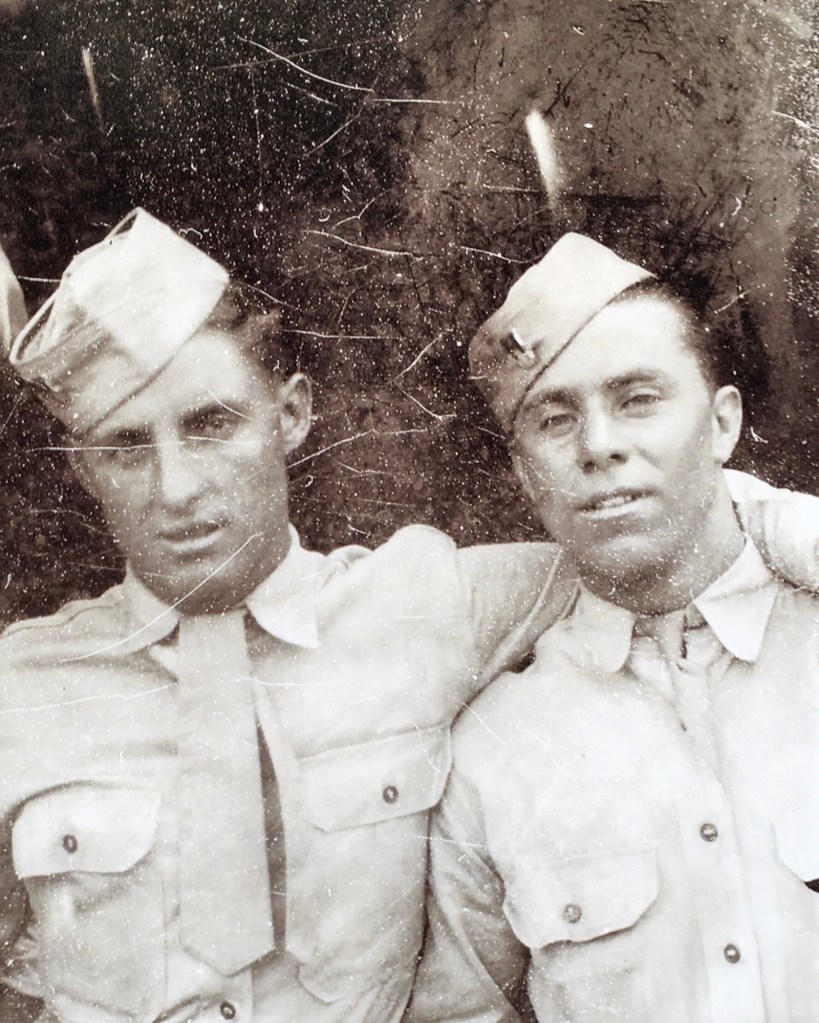
Noble was Dad’s best friend, after his brothers, Mick and George. Both he and Dad joined the Army when underage in 1940, over a year before WWII started. They were in B Company, 60th Regimental Combat Team (RCT), of the storied 9th Infantry Division.
Dad and Noble in ‘41 or early ‘42.
Mom, Dad, “Uncle” Noble and “Aunt” Myra were great friends through the years and got together several times a year. The four of them had a close friendship that lasted a lifetime. I learned a lot about life, and about enjoying life from all of them, but particularly Dad and Noble. They told stories from their time in the Army – almost always funny stories of things that happened. The serious stuff? The stories of death and destruction? Those didn’t make it to the kitchen table where folks gathered, drinking coffee and listening, as these two combat veterans told their tales.
Noble’s actual WWII story is interesting. It’s one you can’t really tell without also telling the story of the 9th.
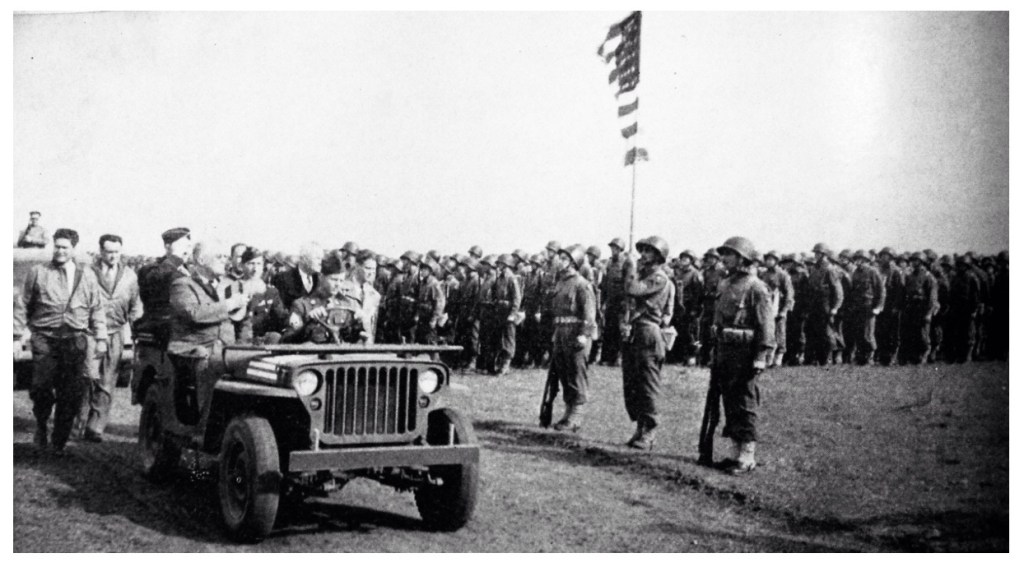
Dad and Noble’s wartime experience started on November 8th, 1942, when the 9th took part in the Invasion of North Africa. Until D-Day happened, it was the largest wartime amphibious assault ever. After three days of battle, they took Port Lyautey, Morocco and the Vichy French surrendered. After some downtime, in January of ‘43, the 60th RCT was the only unit selected to take part in a review for President Roosevelt who was at the Casablanca Conference. Dad and Noble were both there and told us funny stories of the comments in the ranks as Roosevelt passed their unit in a jeep for the review. “Hey Rosie – who’s leading the country while you’re over here?” “Hey Rosie – Who’s keeping Mamie warm while you’re over here?”
Roosevelt Reviewing the 60th RCT During the Casablanca Conference
Things got tough again after that. Starting in February, they fought their way across Algeria and then Tunisia. Station de Sened, Maknassy, Bizerte – forgotten names now, but deadly locations in the spring of ‘43. The Germans eventually surrendered at Bizerte, on May 9th, 1943, just over a year before D-Day.
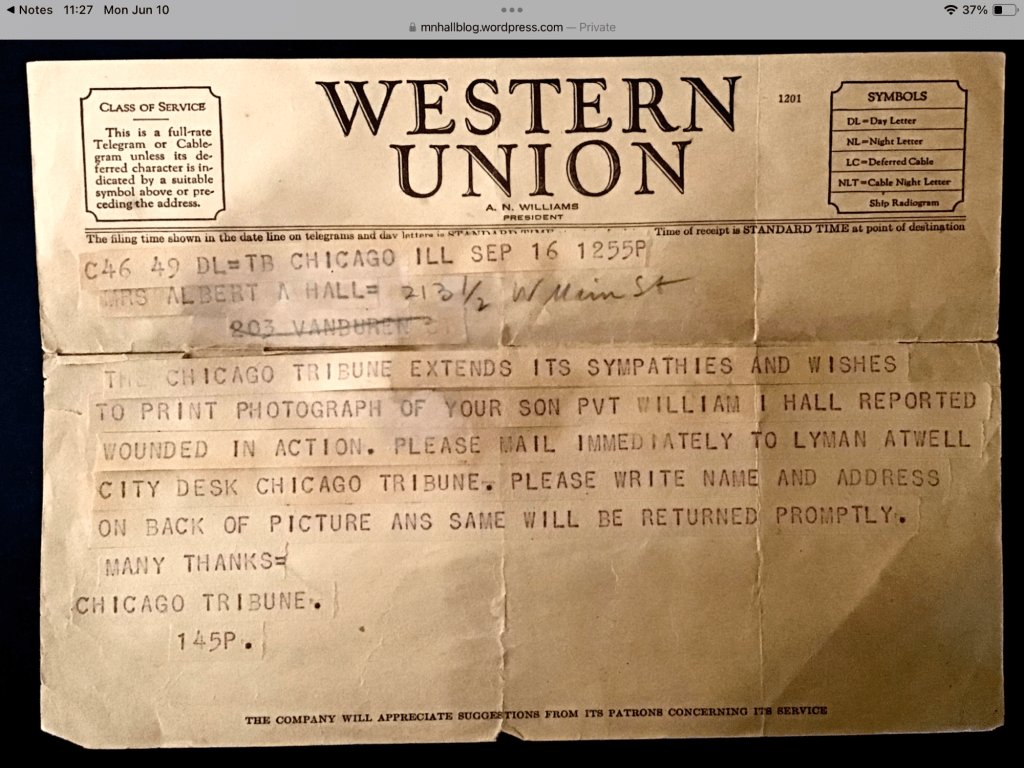
The 9th wasn’t finished though. A little over two months later, in July of ‘43 they took part in the invasion of Sicily. The 60th conducted the famous “Ghost March” through the mountains of Sicily, which the Germans originally thought were impenetrable. Dad was shot three times there, and almost died. It took them a few days to evacuate Dad to an aid station, and then a hospital. The war was over for him and they eventually sent him back to the States.
Chicago Tribune Asking for a Picture After Dad was Wounded.
In fact Dad’s wounds were so severe, Noble thought he had died, or would die shortly. As they evacuated him, Noble and the 60th continued the fight. 38 days after the invasion began, Sicily fell on August 20th. Noble was there when Patton addressed the Division on August 26th, congratulating them for their efforts.
In September of ‘43, the 9th deployed to England for rest and refitting. With just over nine months until D-Day, the 60th had already fought in four countries on two continents.
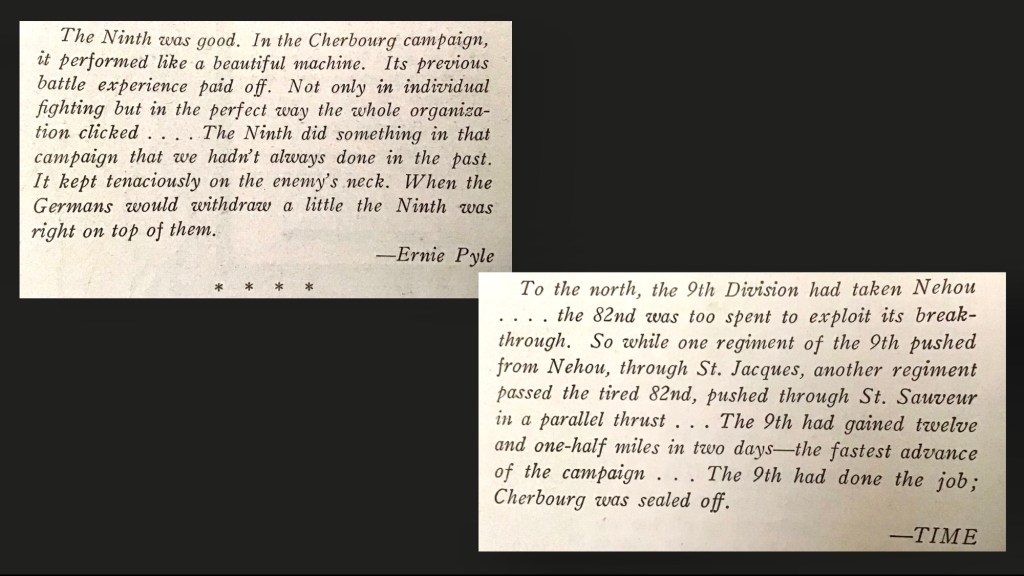
On June 10th, D-Day plus 4, Noble and the 9th landed on Utah Beach. Their mission? Attack towards Cherbourg and cut off the peninsula. This they did and on the 17th of June, reached the ocean on the other side of the peninsula, and eventually, captured the port of Cherbourg itself. If you’ve forgotten your history, Cherbourg was critical for the allies to establish a port on the Atlantic Seaboard. Back home, the news singled out the 9th for their efforts.
Ernie Pyle and Time Magazine Talking About the 9th on the Peninsula
From there, they started on the great chase across France. The 9th advanced over 600 miles by the end of September thru France and into Belgium. In 3 1/2 months they were engaged in three major campaigns and were only out of action for a total of five days.
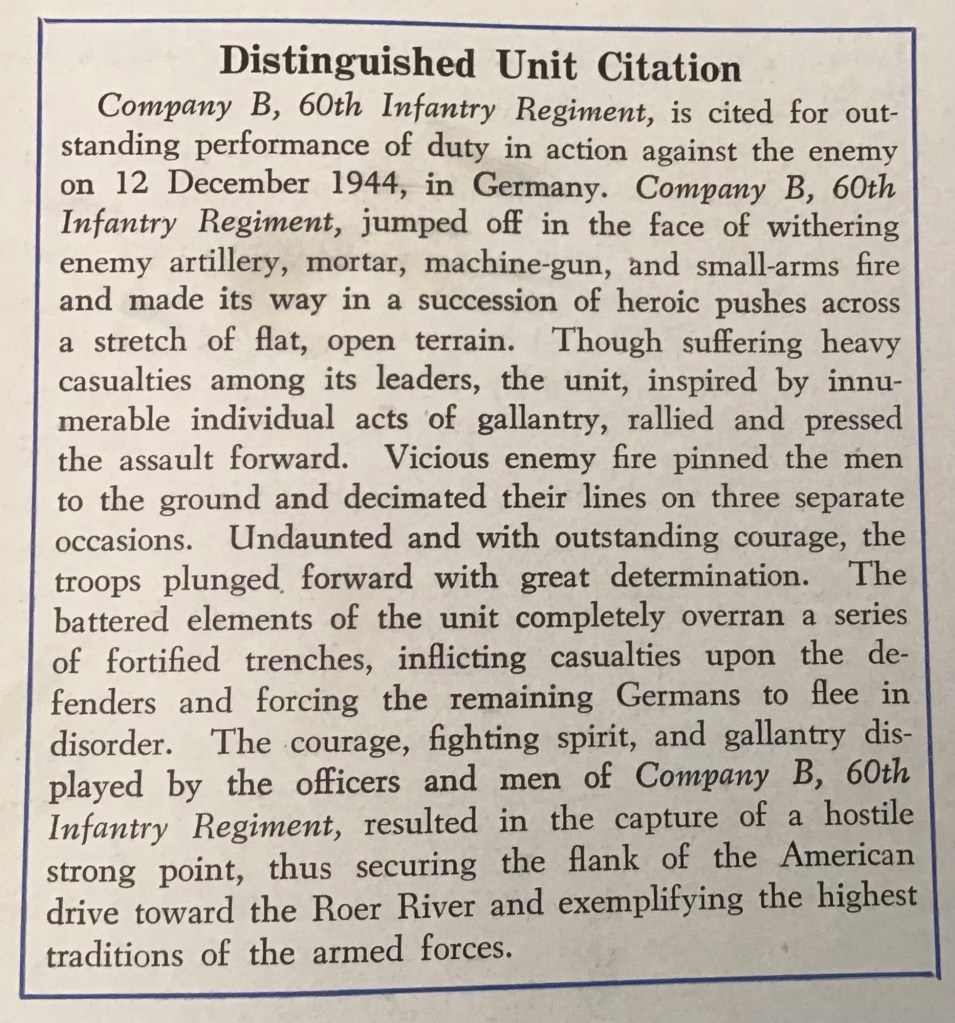
The 9th was among the first units entering Germany itself. For actions on December 12th in the Hurtgen Forest area of Germany, Noble’s unit, B company 60th RCT, received a Distinguished Unit Citation for combat actions in Germany. At the time, the company probably had around 80 or so men.
Noble and B Company, in Action Just Before the Bulge
Just after the 12th, The 9th was pulled out of the line due to the heavy casualties they had sustained. It was “resting” in the Monschau Forest area of Belgium, when on December 16th, 1944, the German winter offensive, the “Battle of the Bulge” started. Thrown back into combat, the Division beat back the enemy at the northern edge of “The Bulge”.
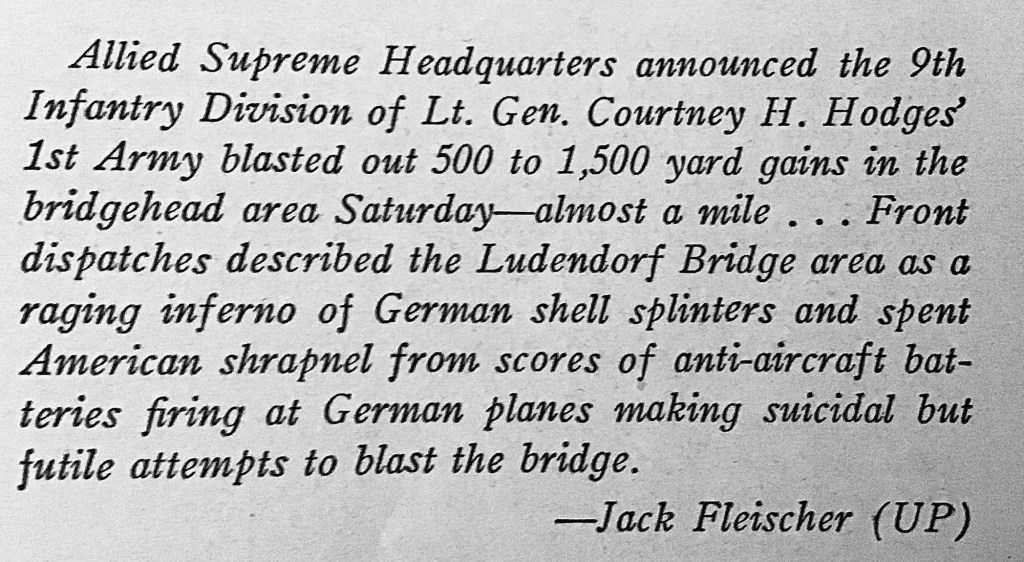
The Battle of the Bulge, The Ardennes, the fight across Germany to the Rhine River – Noble saw all of that. On 7 March, when the American 9th Armored Division captured the bridge across the Rhine River at Remagen, Noble and the 60th RCT were among the first Infantry units to cross under heavy fire and defend the bridgehead from the East side of the Rhine.
The 9th at Remagen
On across Germany – The Ruhr, The Hartz Mountains… On April 26th, 1945, a patrol from the 60th RCT linked up with the Russians at the Elbe River. The war in Europe officially ended on May 7th.
Noble spent 2 1/2 years in combat, fought in seven countries and survived without a scratch. Miracles do happen.
In 1950, a minor miracle also happened.
In July of that year, a knock came at my parent’s door and Mom answered. A young couple was standing there and wanted to know if William Hall lived there. Mom said yes and called Dad. All of a sudden there was yelling, and exclamations, and hugging, and dancing and back pounding – it was Noble, and his new wife Myra.
It turned out Noble and Myra were traveling from a vacation in Wisconsin back to Southern Illinois where they lived, when they passed our hometown – Ottawa. Noble thought Dad had died in Sicily, and then remembering he was from Ottawa, decided to stop in and see if he could find Dad’s parents and offer his condolences. He looked the name William Hall up in the phone book, and stopped off at the local VFW to see if anyone knew of Dad or his relations. They then drove to the address from the phone book, assuming it was my grandfather’s home. Instead, he and Dad saw each other for the first time since August of 1943 in Sicily.
I was born in ’55 and named Max Noble Hall in honor of Noble. I always enjoyed seeing him and Myra over the years during their visits. Later, at West Point, and then while spending my own time in the Army, I often asked myself if I was measuring up to these men from B Company of the 60th RCT.
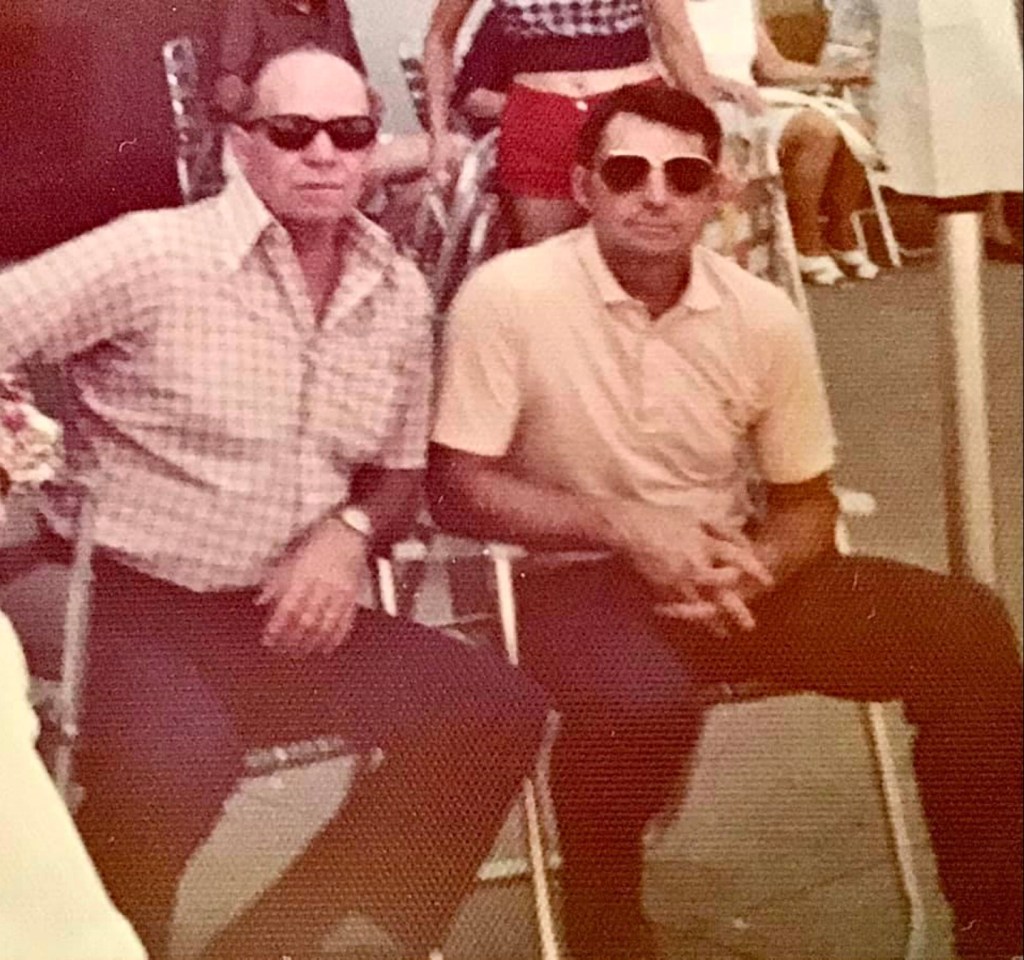
Noble and Dad in the Mid-‘70s in Ottawa. Still Ready to Kick Ass.
I feel so lucky having known them and having heard the stories Noble and Dad told. It’s only in the last decade I’ve matched those stories up to the details in history books. I can tell you they greatly underplayed what they did for America and the free world. What I wouldn’t give for another day with Noble and Dad – listening to the stories, and this time, asking more questions.
The “Greatest Generation” is mostly gone now. I think it’s important we not let them, or their stories be forgotten.
Here’s to you Uncle Noble. Thanks for everything you did for this country and being an influence in my life. It’s a debt I can never repay.
I relied on the book, “Eight Stars to Victory, A History of the Veteran Ninth U.S. Infantry Division”, published in 1948, as background for much of the factual information in this blog.
Cath and I bought our first home 35 years ago in June of 1989. It was a townhouse in Fairfax, VA and we were excited. It turned out our townhouse was in a Homeowner Association (HOA), a term I’d never heard before, but grew to hate. Our skirmishes with them lasted a decade.
After living in Germany for most of the ‘80s, we returned to the DC area for our next assignment with the Army. We also decided it was time to take the plunge and buy a home.
After looking at numerous townhouses (we couldn’t afford a house at that point), we finally found one we liked in Fairfax – four years old, with only one previous owner. Going through the paperwork, we learned our townhouse was in an HOA, a term we’d never heard. Our agent explained we would pay dues to the HOA and they did things like maintaining common grounds, pay for children’s playgrounds, and “help maintain the standards of the community.”
Now I’m not saying our agent acted dishonestly, but she didn’t quite go into the details of what “maintain the standards of the community” meant. She more or less explained it as making sure people kept their houses painted and looking nice, as how the neighborhood looked affected our property values. I suppose we should have/could have done our own research, but we were eager to buy, and that made sense. We didn’t think anything more about it, signed away our lives and bought the home.
We moved in and all was going well. As we’d done since we owned our first horse in 1983, we hung a horseshoe over the door for good luck. We’d done so at our apartment in Augusta, Georgia, our rented townhome in Dayton, Ohio and both houses we rented in Rheindurkheim, Germany. Couldn’t we all use a little extra luck?
About a month after we moved in, the HOA sent out a notice. They were having elections for all positions and we were encouraged to attend. The night of the election, we showed up, and I was impressed. There were a couple of speeches, printed ballots and then the actual elections themselves. Wow! We were watching democracy in action! This was amazingly cool. Little did I know, or really understand.
Another month passed and Cath and I received a notice in the mail. We were in violation of HOA rules. What!? The letter informed us that in accordance with section II, paragraph B, sub paragraph 3), nothing was allowed on the door or over the door. Our horseshoe was in violation.
This couldn’t be! I called the number in the letter and the person picked up. I said I didn’t understand. What rules? How could a good luck horseshoe hanging over the door violate anything? The gentlemen referred to the HOA code. I said, “What code? We just moved in and never received any code.” He answered, “Yes you did. Check your closing documents when you bought the house. You’ll find a copy there.”
I pulled out our folder from closing, and sure enough, found the HOA document. I turned to section II, paragraph B, sub paragraph 3), and he was right – nothing was allowed on or above the door, except during the Christmas holidays when a suitable wreath or garland could be hung.
D@mn.
With a great deal of complaining, I took down the horseshoe. I think that’s when my unofficial war with the HOA began.
I went back to the rule book and read through it in its entirety. There were, to put it mildly, a lot of rules and regulations. More than you would think possible.
I spent a fair amount of time over the next several weeks reading those rules, when all of a sudden, I noticed something. While they said nothing could hang on or over the door, it didn’t say anything about the window frame, three feet left of the door. I read and reread the rules and could find nothing prohibiting hanging something on the window frame. I immediately hung our horseshoe by the window.
About a month later we received another notice saying we were in violation of section II, paragraph B, sub paragraph 3), just like before. I called the number again, spoke with the same gentleman and asked what the problem was. He said, “One of our inspectors told us you’ve put the horseshoe back up.” I answered, “Not above the door.” He answered, “nothing is allowed on the front of the house.” I paused slightly and said “That’s not what section II, paragraph B, sub paragraph 3) says. It only talks about the door.” He answered, “It means the front of the house.” I answered, “That’s not what it says.”
—Silence—
Then, from his end “I am referring this to the board. I’d advise you to take the horseshoe down.”
I left the horseshoe up. Surprisingly, I never heard back from the HOA or received another letter about it. Score a small victory for the Halls, along with justice and the American Way.
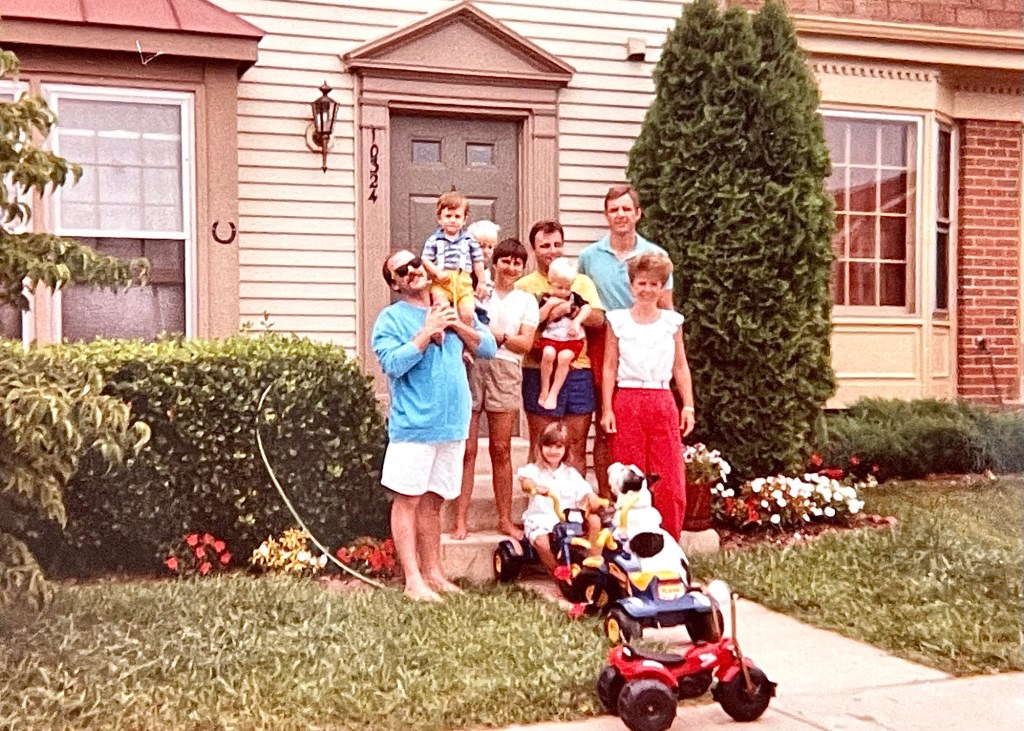
On Our Front Porch With Some Neighbors. Note the Horseshoe on the Window Framing. 😉
Other letters arrived over the years. I won a couple and lost a couple. My trim paint was off a shade in color one year and I lost that one. A year later, I found out the fence around our back yard was actually inset 3 feet from the community property line and decided to move the fence back to the line itself. If you live in a townhouse, three feet is a big deal.
The HOA dutifully sent us another letter saying we had illegally moved our fence and needed to restore it to its original location. I asked where it said in the HOA rules that a setback was required. I already knew the answer, but waited for them to find it as well – it didn’t say anything about a setback anywhere. Score another one for the Halls. Two of my neighbors subsequently moved their fences back in the coming months.
Our last victory, though probably illegal, provided great joy. It was in ‘97 or ‘98.
Parking is usually tight in townhouse communities and regularly managed. In our community, people were parking, usually temporarily, in places where they shouldn’t, including at the end of the pipe-stem we lived on. The HOA dutifully painted the curb in front our house yellow and wrote “NO PARKING” in black letters on the curb. This was fine. As I said, no one really parked there anyway, unless they were packing up or unloading a car.
Of course, the HOA couldn’t let it end with the painting. They also put up two “NO PARKING” signs at either end of the yellow paint. One of the signs was literally right in front of our door. I was, needless to say, pissed. It looked ugly setting right in front of our front door, and if approaching our home from the street, you needed to walk around the sign to reach our house. Note, the HOA put the signs up, not the town or county. As a result, they didn’t use any concrete, they just put the sign in the ground, something that turned out to be important.
Each day when I came home from work, I rocked the sign back and forth just a little bit. And then a little bit more. And then a little bit more. It became looser in the ground.
A couple months later, we were having a small party. Our neighbors, Laura and Jason, were moving to Texas and we were saying goodbye. A U-Haul truck was parked in front of their house and they were loading it, with some of our help. Suddenly, a genius idea came to me.
“Hey Jason. Just curious, will you have any spare room in the back of the truck? I may have something I’d like to ship to Texas.” He answered, “I think a little bit. How much do you need?”
I said, “ENOUGH FOR A NO PARKING SIGN!.” and smiled. He smiled back and replied, “I think we could fit in one of those.”
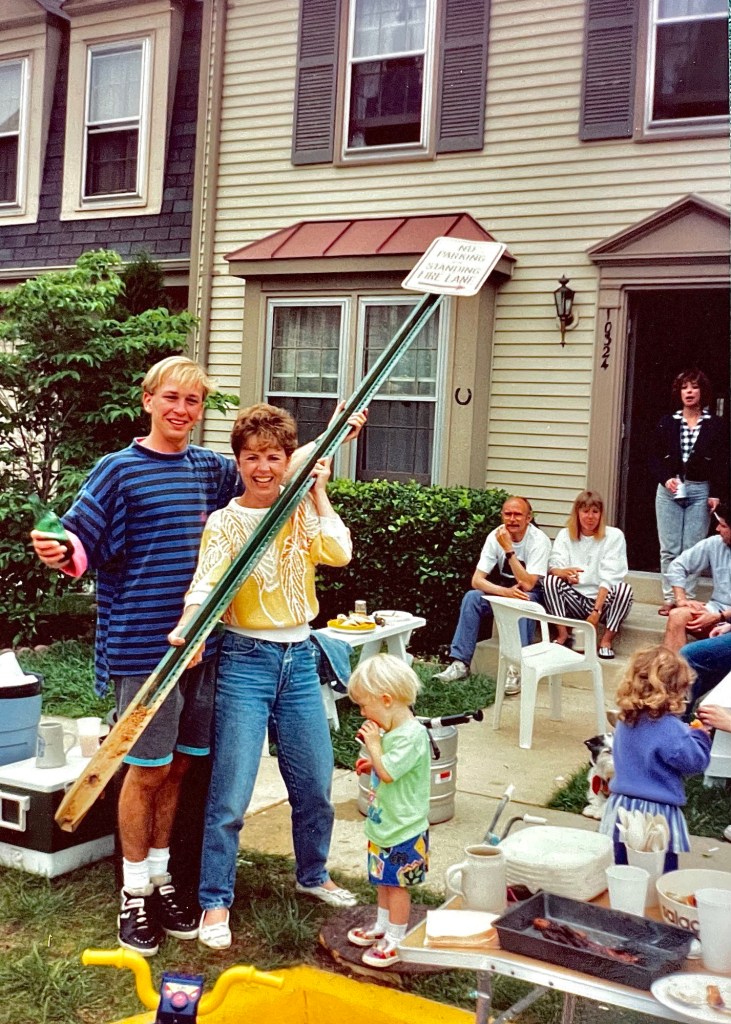
And so, over the next hour or so, we worked on the sign. Cathy had the honor of pulling it out of the ground. ;-). Jason and I loaded it into his truck sometime after dark.
Cathy Triumphantly Holding up the “No Parking Sign”!
We never did hear anything from the HOA about the incident, which seemed a bit strange given the number of people at the party. Maybe everyone else was fed up as well.
I do understand the need at one level for HOAs, particularly in something like a townhouse community, or with a Condo Association. There are some central costs, and you do want your neighborhood looking good. Still, I’ve always wondered what kind of junior fascist signs up as an inspector for their neighborhood. Do they think they are doing good, or are they just addicted to control?
In ’99, we left Fairfax and moved to our present home in the country. One of the requirements for the new property? It couldn’t be in an HOA. ;-).
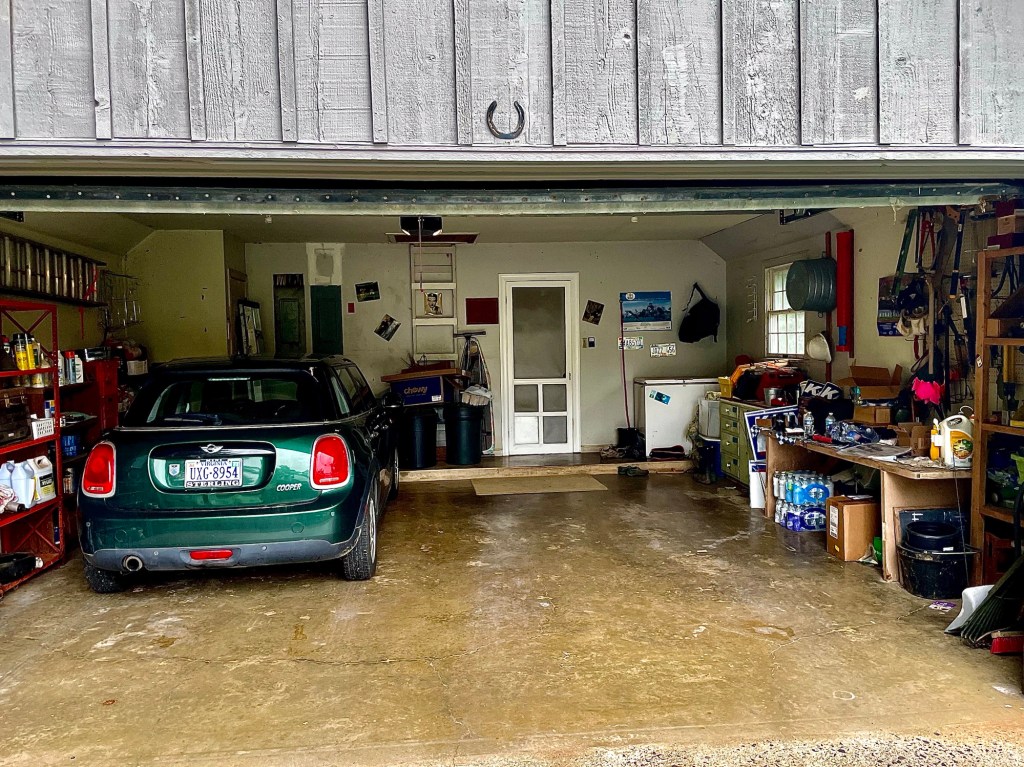
At Rohan farm, our horseshoe proudly hangs over the garage door.
The Horseshoe’s Still Hanging, Even After All These Years.
Addendum:
I don’t really remember that it was section II, paragraph B, sub paragraph 3), but it was referenced similarly.














 Live Life Exuberantly