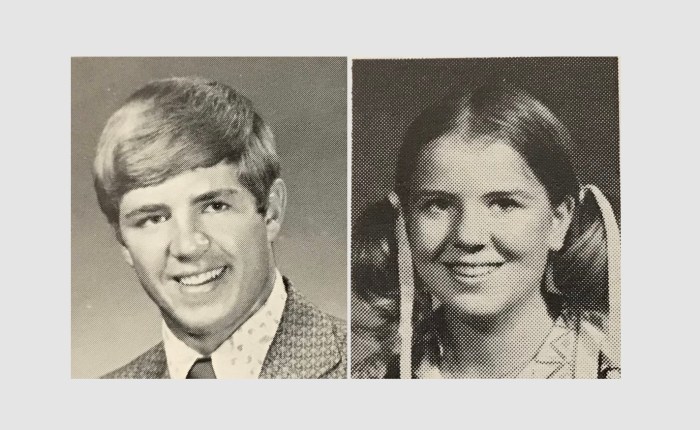
Young Love

Young Love

Next week on the 16th of June, Cath and I will celebrate our 43d wedding anniversary. In an interesting twist, the 15th of June is the 49th anniversary of our first date in 1972. Cathy was all of 16 years old, and I was the older man at 17. To tell the whole story though, you need to go a couple months before then, when I turned her down for a Sadie Hawkins dance at our high school.

Every year in the spring, Ottawa Township High School (OTHS) held a Spring Formal which was also a Sadie Hawkins Dance. That is, the girl asks the boy to the event. (Do they still have those? Maybe it doesn’t matter anymore. For that matter, does anyone remember Li’l Abner or Dogpatch, where Sadie Hawkins Day* originated? ). In 1972, I was a junior and Cathy Snow was a sophomore. We knew each other a bit from Student Council. Well, one evening in March, I received a call at home. The young Miss Snow was on the line, and after a bit of small talk, asked me if I would go to the Spring Formal with her. Alas, I had to turn her down, as two days before, I’d been asked by a girl in my class named Gail. The call ended pretty quickly after that.
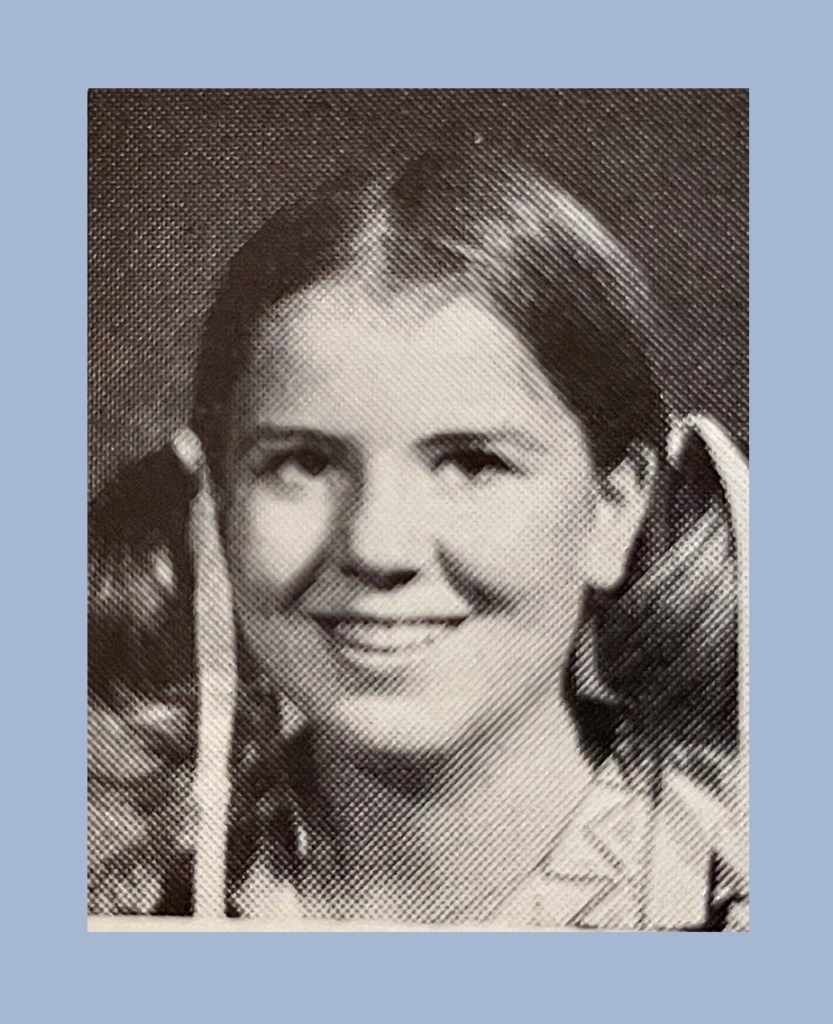
Cathy Snow at 16…

Fast forward two months. My friend Howard and I were at Pitsticks, a local swimming place with a beach, and ran into Cathy and our mutual friend, Lori Lyle. We made small talk back and forth and at some point Cathy asked if I wanted to swim out to the diving platform and off we went. Of course I had to exhibit my prowess as a swimmer and did a one and a half off the high dive. (I wasn’t going to waste the opportunity to try and impress a prospective date.) Cathy played her part and said to me “Great Dive! You looked like a knife going through soft butter when you entered the water!” My strategy appeared to be working… ;-). In later conversations, she mentioned she and Lori might be out and about riding their bikes that night. I answered back that I’d thought about going for a bike ride that night as well, and maybe I’d run into them. With that, we said our goodbyes and went back to our respective spots on the beach.

That evening after dinner, I grabbed my bike and started riding around the south side of town looking for Cathy and Lori, but didn’t see them anywhere. Eventually I stopped at a store and went inside to buy a pop. While inside, Cathy and Lori rode by, saw my bike outside the store, stopped and came inside.

Everyone seemed pretty happy to connect. We talked a bit and then went back outside and the three of us rode around town together. Eventually, we ended up back at Cathy’s house at 305 Houston Street and had some ice tea on the back porch.
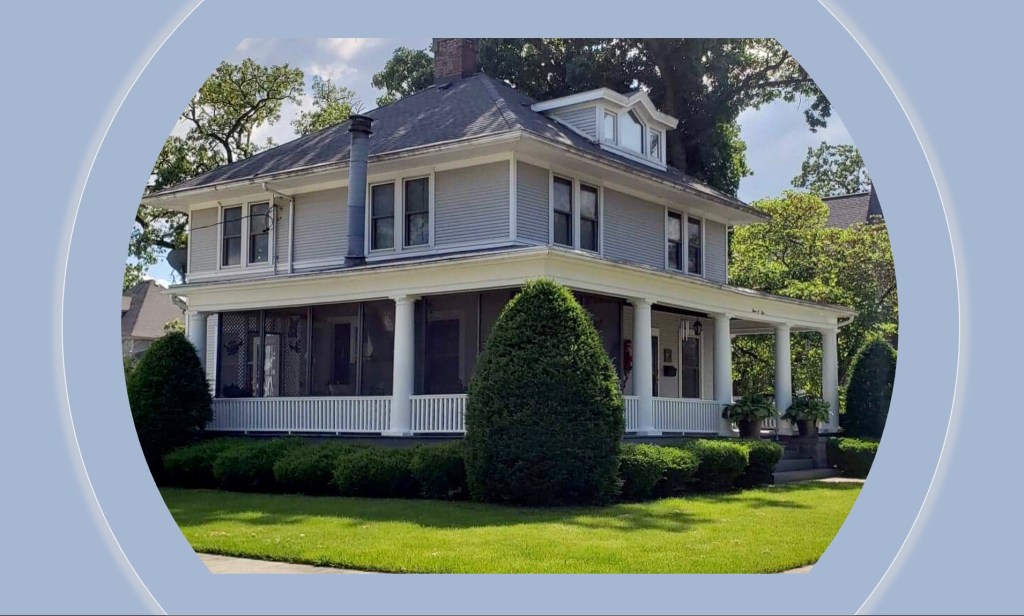
305 Houston Street. The back porch is on the left side of the house.

Unbeknownst to me, Cath and Lori weren’t sure which of the two of them I might be interested in. Cath had asked me to the dance, however, Lori and I had known each other from church for quite a while. They had a plan. After a bit of time, Lori would say she had to head home. They figured if I said I had to leave as well and rode off with Lori, I was interested in her. If I stayed there when she left, I was interested in Cathy.

Dusk arrived and Lori said she was going to ride home. I wished her a good night and stayed at Cathy’s… 😉

As it grew dark, we talked, and then talked some more. Finally, around 1030PM or so, I said I ought to go home. We walked to the steps leading off the porch, and while I was trying to work up the courage to kiss her goodnight, proceeded to talk another half hour or so. Suddenly, about 11PM, her mom, Faye, appeared at the inside door to the porch in a black nightgown and said “Ina Catherine, I think it’s time to come to bed.” Family history reports I was on my bike and riding away before she finished the sentence (in retrospect, we should have found a more private place to say our goodbyes. Her parent’s bedroom was directly above the porch.)

Two nights later, on June 15th, we had our first official date. I picked Cath up with my folk’s car and we went to the Perky Putt golf course (miniature golf) on the north side of town. While I have no clear recollection of the results, Cathy remembers soundly beating me. Afterwards, we went to a small drive-in restaurant on the Illinois River called the Sanicula Marina. We both ordered Black Cows and proceeded to walk along the river. I did kiss her goodnight that evening, but it was on the front porch, not the side porch under her parent’s windows…
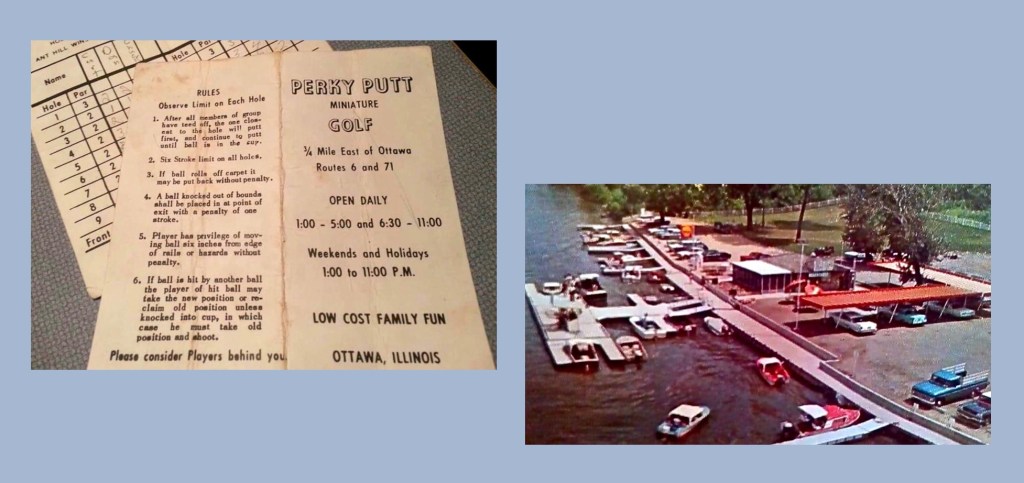
Miniature Golf at Perky Putt and Black Cows at Sanicula Marina – it doesn’t get much more romantic… 😉

As they say, the rest is history. We dated all summer, and then into the school year. And the next spring when she asked me to the Sadie Hawkins dance again? I quickly said yes that time around.

Spring Formal (The Sadie Hawkins Dance) in 1973 – I said yes, the second time around.

We have almost five decades together as a couple now, and it’s definitely true – Time flies when you’re having fun.

Addendum:

  • * From Wikipedia – “Sadie Hawkins Day is an American folk event and pseudo-holiday originated by Al Capp’s classic hillbilly comic strip Li’l Abner (1934–1978). This inspired real-world Sadie Hawkins events, the premise of which is that women ask men for a date or dancing. “Sadie Hawkins Day” was introduced in the comic strip on November 15, 1937.”
  • Thanks to my lovely wife, Cathy for her contributions to this blog. In particular, her memories of the day at Pitsticks are more specific than mine, including the comment that my dive “looked like a knife cutting through soft butter”.
  • Thanks to Debi Hillyer for the photo of Sanicula and Curtis Wasilewski for the picture of the Perky Putt score card. A special thanks to Mike Peabody for the photo of Cathy’s old home at 305 Houston Street. In a strange twist of fate, Cathy babysat Mike and his sister Michelle when they were young children living across the street. Mike moved out of Illinois for years and only recently returned to Ottawa. When the home became available, he and his wife bought it.
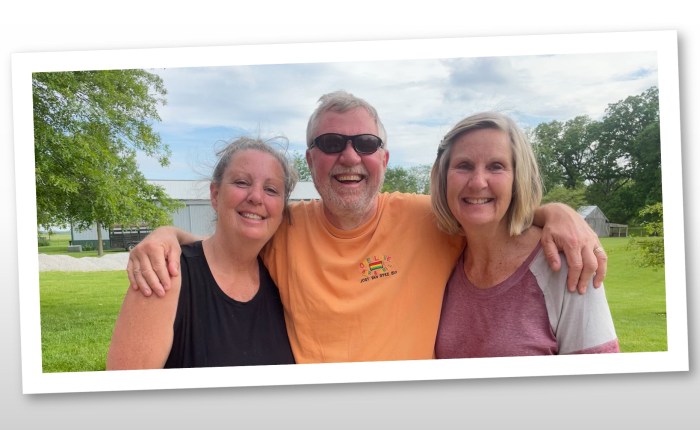
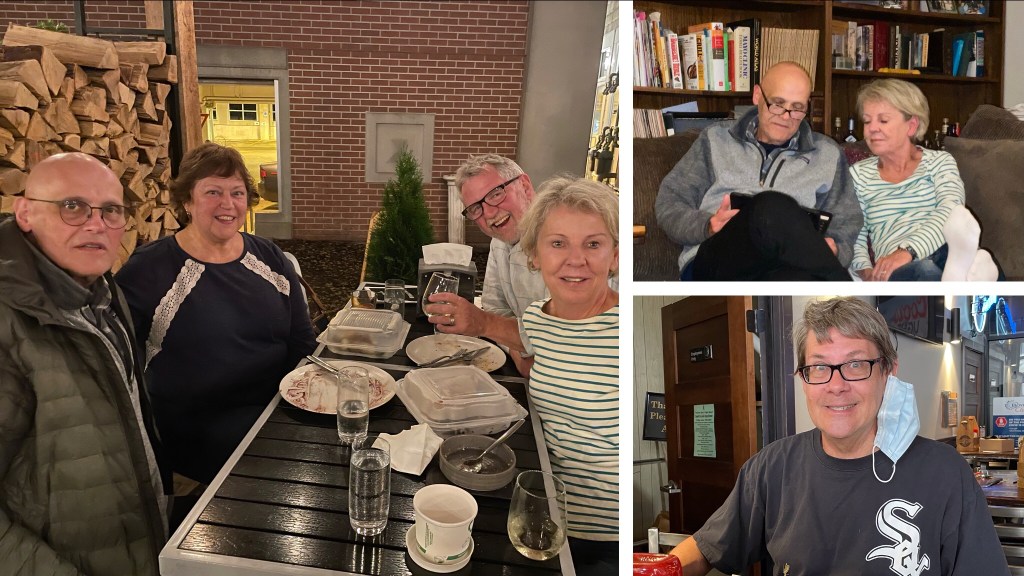
Visiting Home

Visiting Home

It had been a long time. Too long, to be honest. Life, “stuff” and Covid all managed to intervene. Finally, after a couple of years away, we were making a trip back to Illinois to see family and friends. The feelings of anticipation were palpable.

We started with visits to old friends – dinner out one night, ribs on the grill another; laughter and tears; telling old stories and making new memories. From there, it was lunch, beer and tenderloin sandwiches with another old buddy. Finally, it was on to family time and staying with each of my sisters, Tanya and Roberta. Again, more laughter, tears, dinners out, favorite foods* and stories from our youth.

Old Friends…

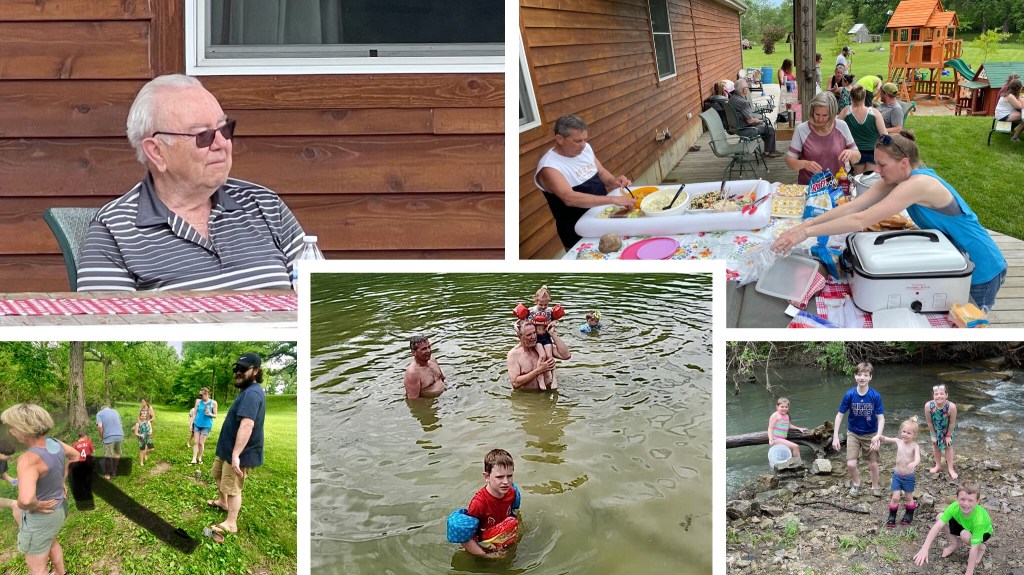
Everything led up to the last day, and a family picnic at my sister Roberta’s home. Counting my Uncle Don, mom’s last surviving brother, we were four generations strong – Uncle Don and his friend Diane; Roberta, Tanya and I and our husbands and wives; our nieces and nephews and their spouses; and of course their children. The oldest person was 80, the youngest about 14 months old. There were perhaps 30 or 35 of us.

As folks arrived, we greeted each other with smiles and hugs. We hadn’t seen some of our nieces and nephews in four years. There were also great nieces and nephews we’d never before met. There was much laughter and love with each new greeting.

It was a great day – we were talking with everyone, telling stories and catching up… There was a huge potluck lunch, and I ate way too much. Our niece Diane is the curator of mom’s potato salad recipe, so I had to have two helpings of that. After lunch, we followed the kids to the creek and had water balloon fights. Then, it was on to the raft at the pond, where swimming, sliding down a slide, jumping in and diving off the raft all ensued. I managed a backflip off the dock, and to laughter from the grand nieces and nephews, only slightly smacked my face on the water. It was a fun and wet afternoon… 😉

Clockwise from upper left: Uncle Don, Laying out the picnic, At the Creek, In the Pond, and Cathy about to be hit with a water balloon…

We all know all good things come to an end, and people eventually loaded their cars back up with kids, coolers and leftovers. Another set of hugs and kisses, and promises to try and see each other more often. Eventually, the only ones left were Berta and her husband Jack, along with Cathy and I. We finished cleaning up and bringing things into the house. We were, perhaps, a bit quieter than we’d been just an hour or two before. Jack had to go to work early in the morning, so we said our goodbyes to him that night.

The next morning, after coffee, Cath and I hugged Roberta goodbye and departed. I’m not one for long goodbyes, so we left a bit earlier than planned. After a quick stop to briefly visit our parent’s graves, it was on to O’Hare Airport and home.

One of the prices Cath and I paid by joining the Army and moving away all those years ago, is we have missed so much of our friends’ and families’ lives back home. That is a part of what makes these trips precious. We didn’t really get to see our nieces and nephew grow up, except for scattered visits, and history is of course repeating with the grand nieces and nephews. This is true for Cathy’s side of the family as well. We love our lives and have no regrets about the choices we’ve made over the past 40 plus years, and yet…

As I’ve become older, I often have a certain sense of bitter-sweetness about these get togethers with friends and family. The time goes by so quickly, the highs of the greetings and the lows of the departures blend together in a strange set of feelings that don’t easily mesh. There are shades of love, along with the happiness and sadness that accompany love. The passage of time in our lives continues to speed up.

I know (and pray) we will have many more wonderful times together in the years ahead. For me, along with the joy, there will also always be a bit of wistfulness.

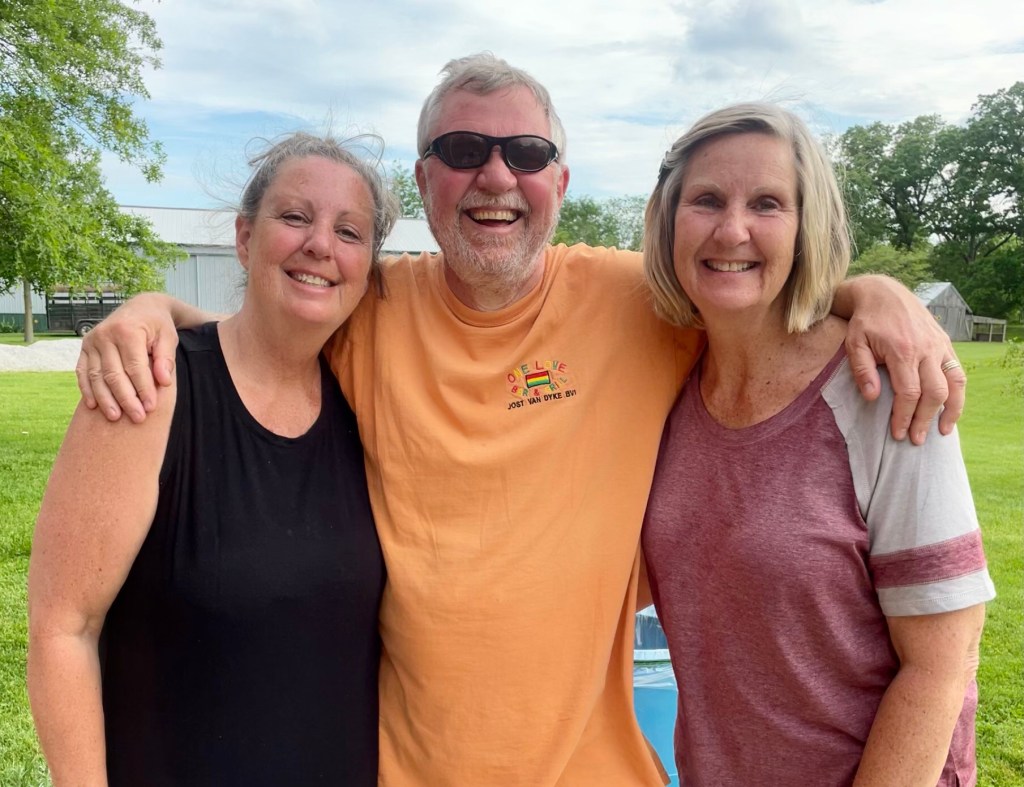
Good times … Tanya, me, and Roberta…

Addendum:

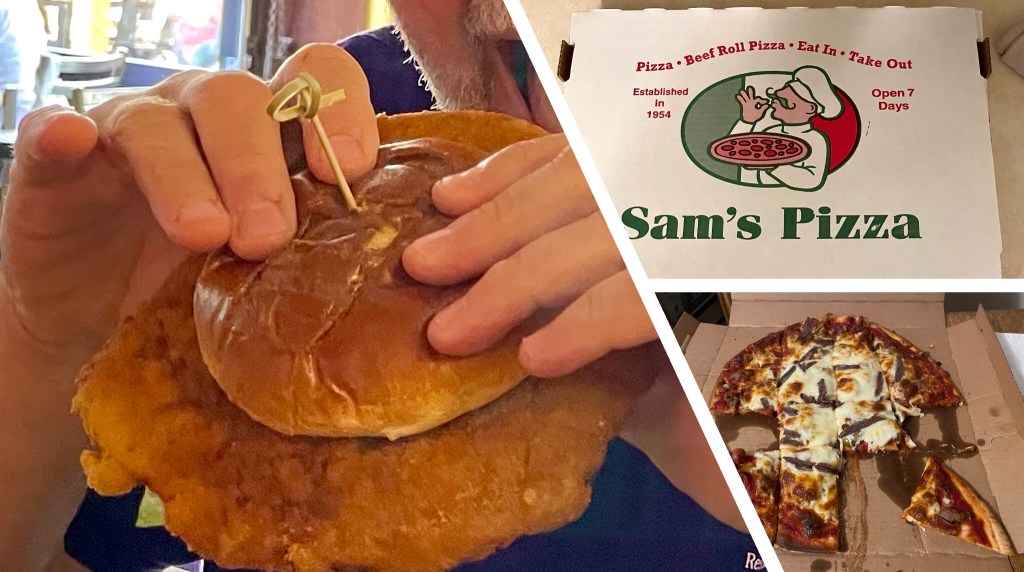
* Favorite foods are always an interesting topic. A couple of the things that remind me of home are Tenderloin sandwiches and Sam’s Pizza. You can’t find the sandwiches outside of Iowa, Indiana or Illinois and they are killer good. And Sam’s? Well, it’s Sam’s. GREAT pizzas there…. both make me (and many others) nostalgic for our home town of Ottawa.

Comfort food for sure….

– Thanks to my niece Diane Schott, along with sisters Roberta Gourley and Tanya McCambridge for supplying several of the photographs included here!

The Stone House in the Woods

The Stone House in the Woods

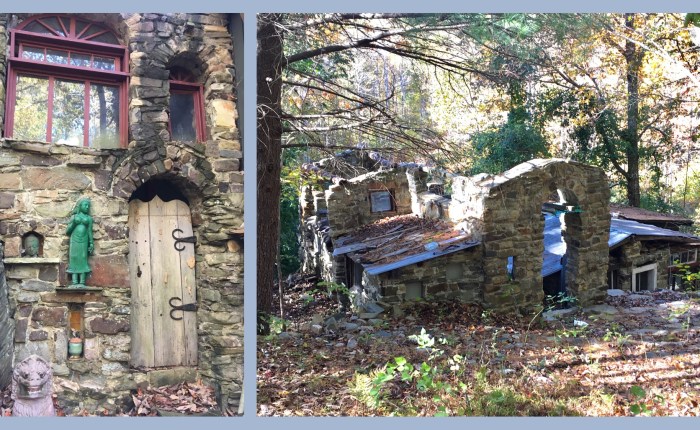
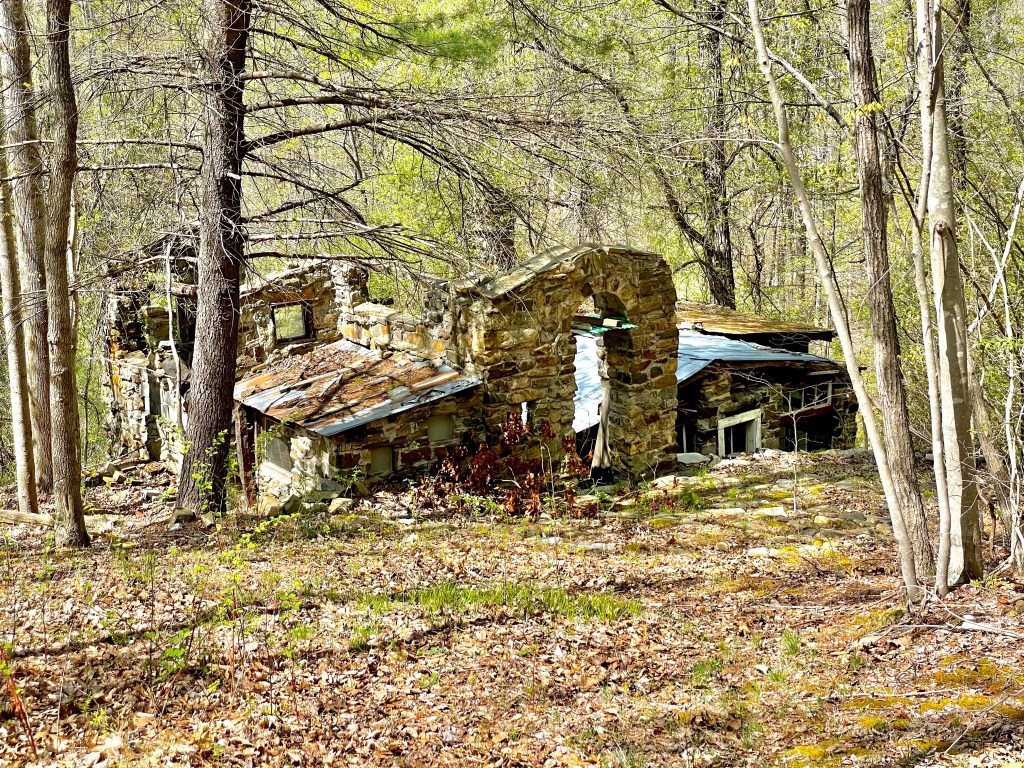
There is an old house/cabin in the woods about a half mile from where we live. It was never in great shape, but the owner, Bill Harben, passed away a few years ago, and now the house is slowly sliding back to nature. He built the mostly stone house by hand when he was in the States and not stationed overseas.

It remained a work in progress until the year he died.

Both Bill, and the house, have an interesting history. Bill worked for the State Department as a Foreign Service Officer from the 50s through the 70s. He started on the house during the 60s, between overseas assignments. After he retired in the seventies, he moved permanently to the DC area, and then worked on the place on weekends or other off times. It was slow going, and to be honest, I think he thought of the project mostly as mental therapy. He wasn’t in any particular hurry to finish it and wasn’t ever going to live there. It was merely a getaway.

The First View of the Cabin When Approaching Through the Woods

We first met Bill around 2001. I’d see him driving down the gravel road past our place, or run across him while hiking in the woods. He was probably in his late seventies at the time and still adding stone work to the house.

We became friends of sorts and had him to our home for a few dinners or parties, and were guests at his cabin several times during the summer months. He would have friends (usually ladies) out from “the city” for a cookout. He was an incredibly charming and urbane man, and I think he enjoyed the shock his guests almost always showed on first seeing the roughness of his retreat.

The Front Door

The house was unique, with no apparent master plan. Bill did all of the work entirely by hand. There was no access to the property except for a narrow dirt and grass road and then a trail. It was impossible for big equipment to access and help with the construction. The stonewalls? All the stones were from the property and Bill moved them with a wheelbarrow to the house location. He then put them in place by hand, slowly building the walls up. The floor was made from stone on the property as well. The timbered parts of the home? The logs were from the surrounding woods – Bill cut the trees, and hand hewed them to fit together.

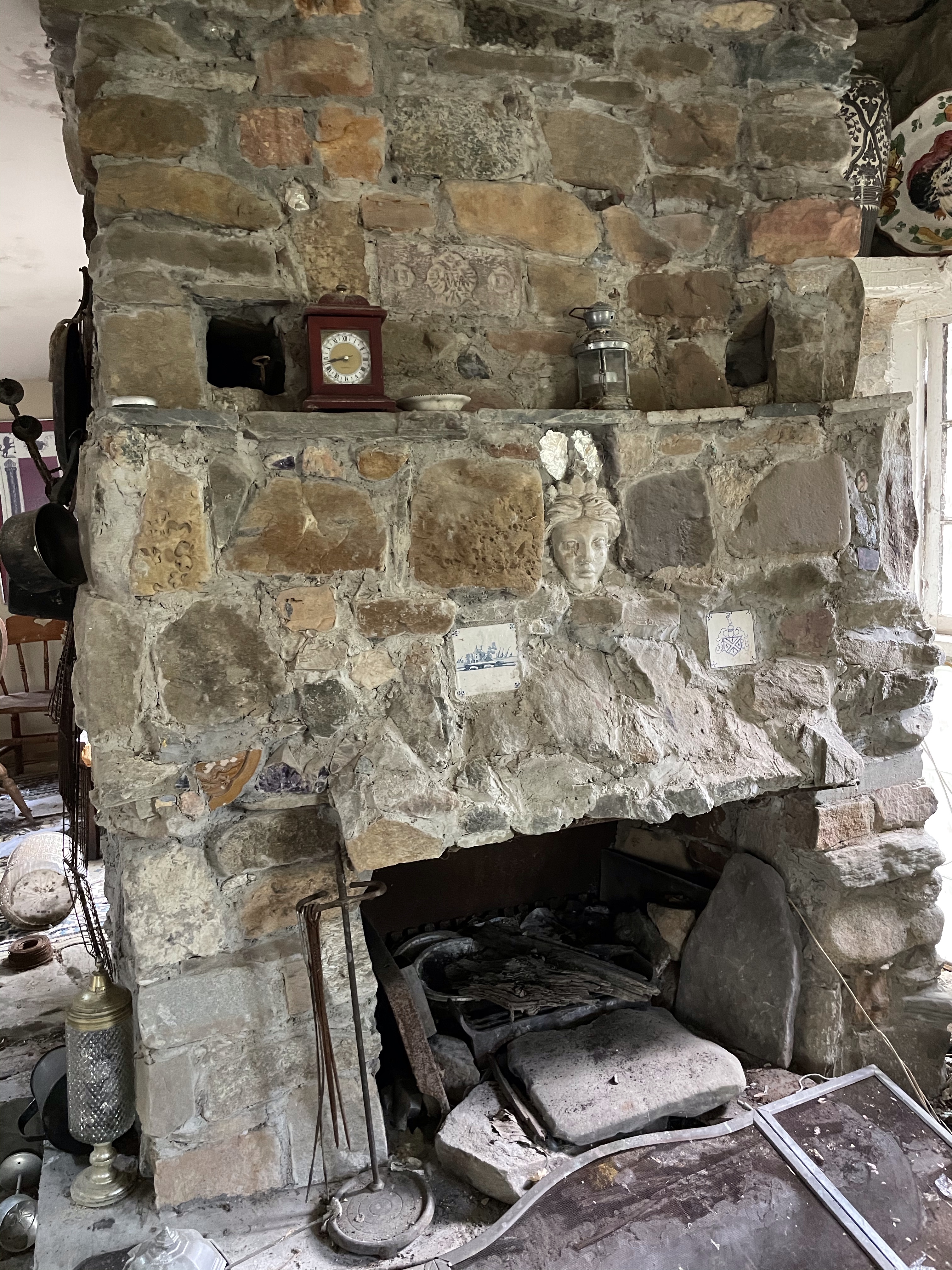
it was a rough house, with no electricity. His water came from a small spring on the property. He did have an indoor toilet, and there was actually a small septic field. A huge stone fireplace heated the “great room”, but nothing else. Light was by candle or lantern.

Bill added many artifacts and mementos to the house from his time overseas. Some were classic, others just odd. There were statues, tiles, old lamps, even a huge antique German Bible. He also imbedded some of the items in the walls. It was quite the eclectic place.

A Few of the Items at the House or Mounted in the Walls

When having cookouts at his place, stories would inevitably come out from his time overseas, and as with many storytellers, they were usually about some funny incident with a twist. With postings in Germany, Austria, Cambodia, Russia, Rawanda and Mexico he had plenty of good source material.

I remember two stories he treated a bit more seriously. He spoke about the time he escorted “Mrs Kennedy” (that would be Jacqueline Kennedy) around Mexico when she visited the country. He didn’t share details, and instead spoke about what a wonderful lady she was. The other story involved how and why his career in the Foreign Service derailed. In the early ‘70s, he and Henry Kissinger had “a falling out” over the conduct of the war in Indochina. Bill was head of the Embassy’s Political Section in Cambodia at the time and Kissinger was Secretary of State under Nixon. Bill ended up on the short end of the stick for that one.

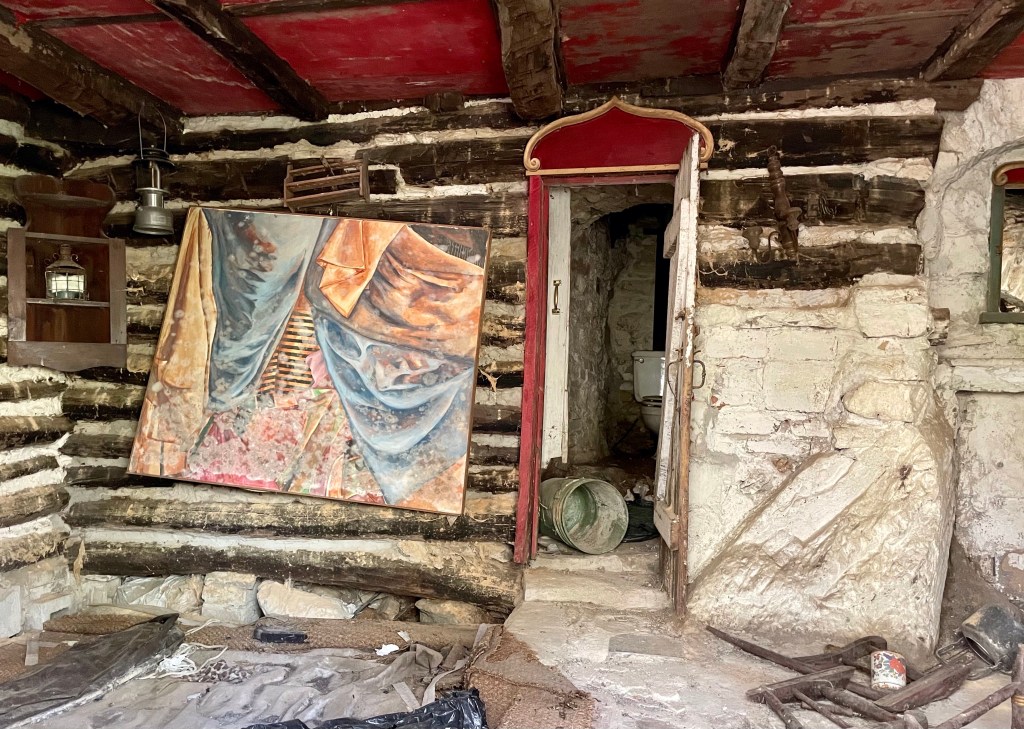
Once when we were visiting, I asked if I could use the bathroom. You needed to walk through his “bedroom” to reach the bathroom. There was a really strange mural in the room, and I also noticed a small painting of Confederate General Robert E. Lee hanging over the bed. It struck me as odd at the time, so when I rejoined Bill and his guests out by the grill, I said “Bill, I have to ask. What’s with the picture of Lee over the bed? You never struck me as a “Lost Cause” type of guy.”

Bill chuckled, and then explained “Years ago, when I was first building the cabin, I would sometimes be gone for months or years in between visits. At the time, there weren’t many homes in this area, it was all woods and fields. Some “good ol’ boys” would be out hunting, and come across the cabin. Inevitably, they’d break in, drink beer and trash the place. I thought about it for awhile, and then decided to hang up the picture of Lee. I knew they’d probably still break in, but once they saw the picture of “Bobby Lee” they’d be more respectful and wouldn’t destroy the place.” He laughed, and then said “It turned out I was right….”

The Mural Still Hangs in the Bedroom, but the Picture of “Bobby Lee” has Disappeared.

Bill passed away a few years ago. He was in his late 80s or early 90s at the time. We probably hadn’t seen him for a couple of years, and I knew he had health issues. I heard later that he moved from his condo in Crystal City to assisted living somewhere else.

My wife, Cathy, talks about how every time an older person dies, it’s like a library burning down. All the knowledge and stories are just gone. I’m glad I was able to spend some time with the Harben Branch Library before it disappeared.

Addendum:

If you want to read an oral version of Bill Harben’s career, you can find it at the link here. It’s a pretty interesting read of one man’s upfront view as a Foreign Service Officer during the Cold War: https://www.adst.org/OH%20TOCs/Harben,%20William%20N.toc.pdf

Spring, Covid, The Nats and Renewal

Spring, Covid, The Nats and Renewal

I’m not going to lie. This Spring, I feel how a bear must feel coming out of hibernation – A bit groggy, and damned hungry. Yes, I’m hungry, hungry for life. While spring is always a time of hope and renewal, this year I’m optimistic about life for a couple of other reasons as well: covid vaccines are happening, and the Nats are going to play baseball in front of live fans again.

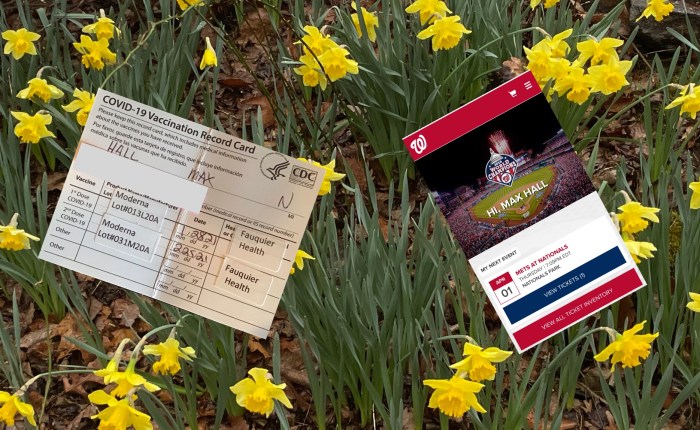
Cathy and I have our vaccines now. As of today, two weeks have passed since her second Pfizer shot, so we are both good to go. Although 47+ million Americans are now fully vaccinated, that is actually only about 15% of the US population. Biden declared a goal of 200 million vaccinations by the end of his first 100 days and I think we will make it. You can see the momentum building in the vaccination programs and soon everyone who wants a shot will be able to get one. America is opening up again, slowly, but surely.

I feel doubly lucky right now – My buddy Bill has been a Nats season ticket holder since they returned to DC in 2005, and as a result, he was able to buy 4 of the Covid-limited 5,000 tickets available for opening day (in a 41,500 seat ballpark). Have I mentioned Bill is one of my favorite people in the whole world? I’ll be one of the 5,000 fans attending Opening Day. I should also mention that our group of four are all vaccinated.

Opening Day is on April 1st against the Mets! It’s on my Calendar.

Seeing baseball in the park, with a beer and a brat in my hands, yea, I’m ready for that. After losing live baseball for the entire 2020 season due to Covid, I’m almost giddy about going to Opening Day. Hopefully the Nats win, but for right now, I’m just happy to see a baseball game in person. I can’t wait for the roar of the crowd, as the announcer calls “Play Ball!

It’s the simple things. The other evening, we went out to dinner with our neighbors. Mike drove the four of us. In his convertible. With the top down. We dined at Field and Main in a cabana with the doors open, letting the evening breeze gently blow in. It was a wonderful night with good friends. It was the kind of night we all took for granted a couple of years ago. Now? It’s silly, but I know I’m going to remember that dinner for a long time.

While I can’t speak for other people, or other locations, here in Virginia, the feeling of renewal is visceral. It’s grown warm, flowers are in bloom, trees are budding out and it’s staying light longer. The Daffodils are everywhere. These things happen every year in the spring, but this year, I’m noticing them more. From comments I’m hearing, others are as well.

The Daffy’s are Everywhere this Spring and seem Especially Bright.

Maybe one of the good things that will come out of this past “Year of Covid” is a renewed appreciation for the little things in life. The things we all took for granted for so long. Whether seeing blooming flowers, attending a baseball game, or having a nice dinner out with friends on a spring evening, I hope I can keep this feeling of renewal alive for awhile. If no where else, I’ll at least keep it in my heart.

Addendum:

Writing this addendum update on the afternoon of April 1st, Opening Day. Silly me. I forgot this was still the year of Covid and today is April Fool’s Day. A Nats player was Covid Positive. Four other players were in proximity and are also in quarantine. The Nats Opening Day has been postponed… for at least two days. It won’t be today, and it won’t be tomorrow (“Out of an abundance of caution”). —sigh— Cathy is laughing at me and saying I’m acting pretty pitiful right now…. ;-).

This too shall pass and is but a small bump on the journey. The arrival of spring, and our overall renewal is inevitable.

Moules, Pernod and the Brussels Seafood Market

Moules, Pernod and the Brussels Seafood Market

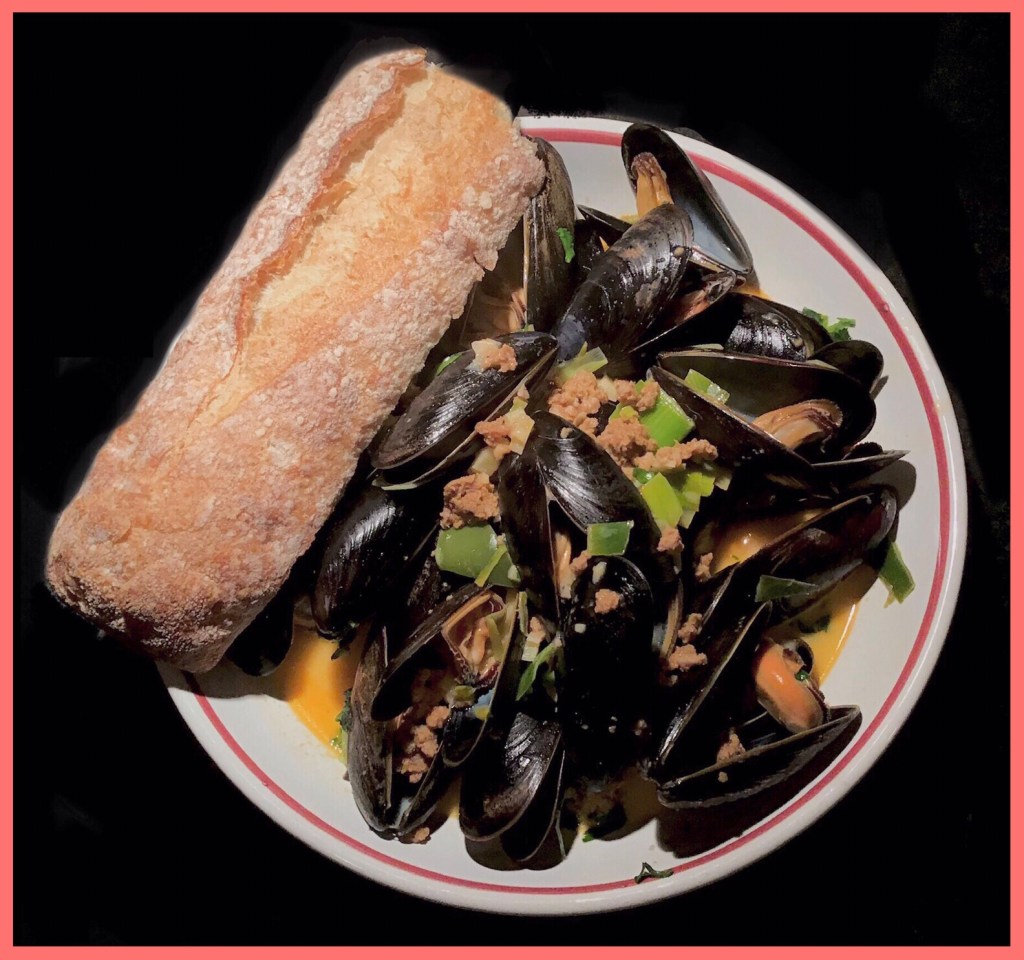
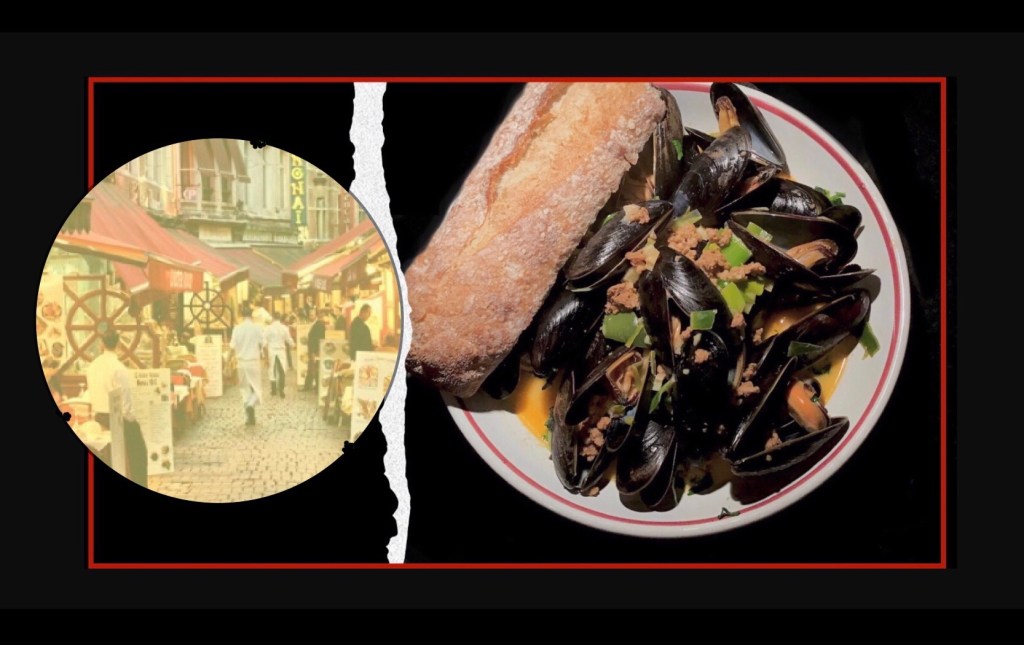
The other evening, Cathy and I made some Mussels Pastis (Mussels with Pernod) at home. It was delicious. It was a new recipe with plenty of Pernod in it, which made it quite good and strongly flavored. The strong flavor caused me to reminisce about Brussels, Belgium and an early morning trip to the seafood market there.

Mussels Pastis – the Wonderful Dish that Brought Back the Memory

It was early in 1988. Although stationed in Germany, I was spending chunks of time in Mons, Belgium. We were upgrading the communications systems at the Supreme Headquarters Allied Powers, Europe (SHAPE), also known as the Headquarters for NATO. My boss, Rich, was there almost full time, while I was dividing time between Germany, Mons, and another HQ in High Wycomb, England.

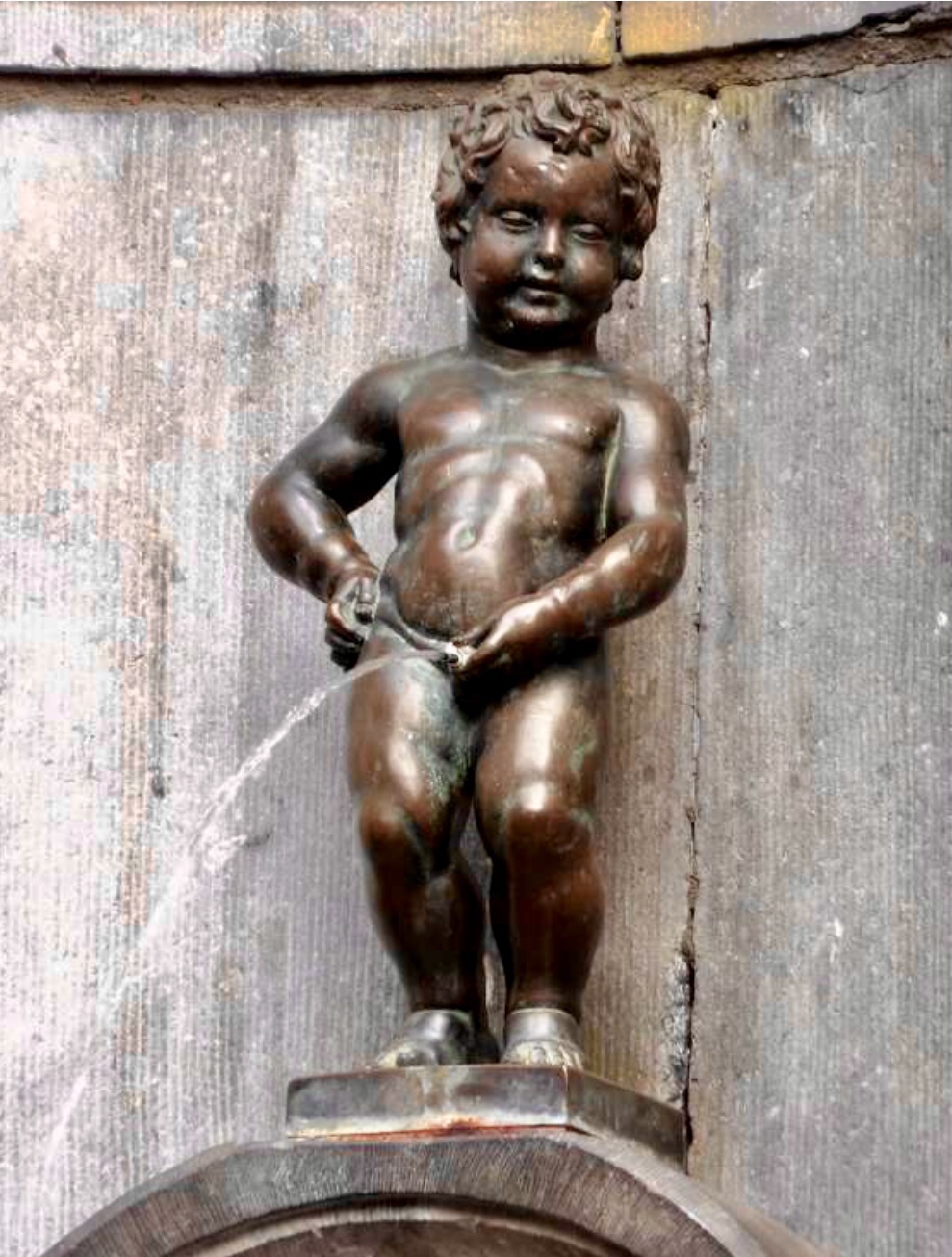
When in Mons, if there over the weekend, we often made a day trip to Brussels, which was only about an hour away. The city has a great history to it, and it was fun to see the sites, including the Grand Canal, and the famous Manneken Pis, which is only about two feet high. There was also of course the famous (infamous?) Red Light District of Brussels, with women on display in storefronts. I suppose it gave a whole different meaning to the term window shopping.

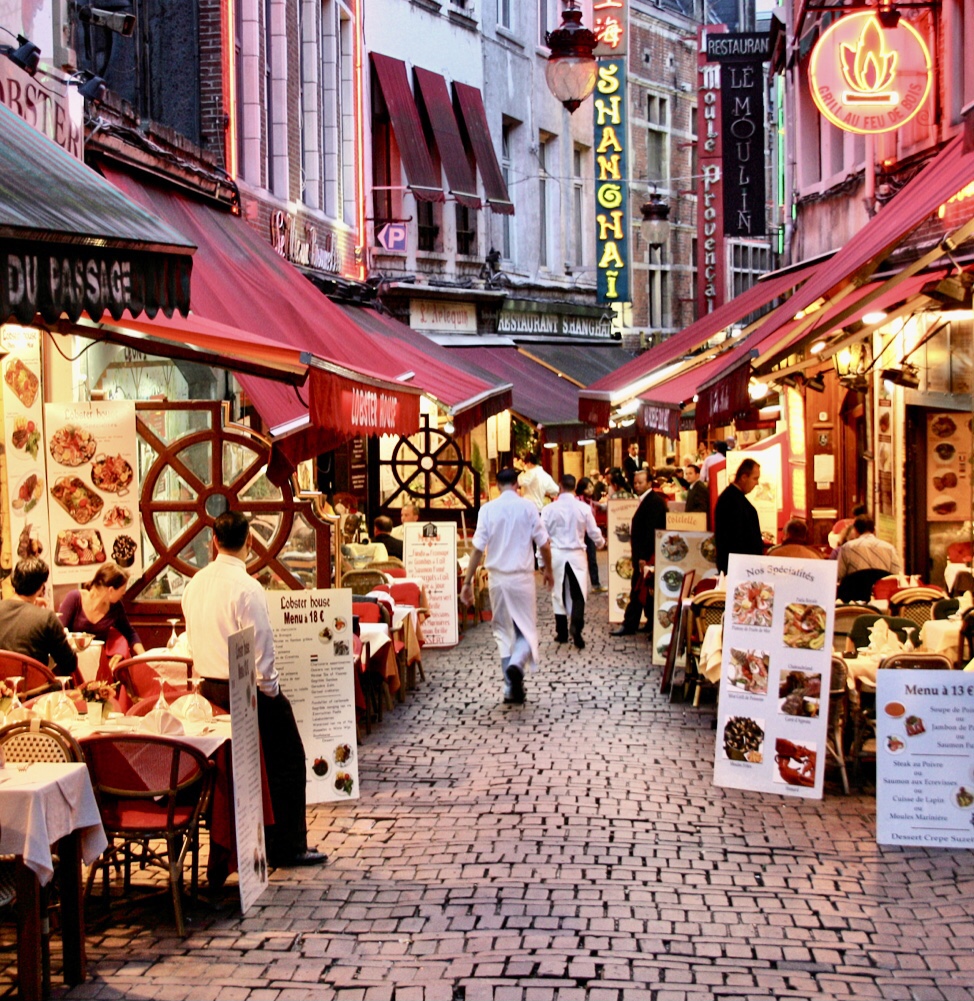
What we really enjoyed was wandering the Rue des Bouchers in the Quays District in the early evening. Here, there were numerous restaurants with outdoor seating, and they also set up temporary wooden “bars” where you could buy a drink, or something lite to eat. We’d walk from place to place having a Belgian beer or French wine, along with some oysters, mussels or shrimp croquettes. Several of the places also served frites (french fries) to die for. Usually, we never sat down at a table for dinner – we’d fill ourselves at the little bars as we ambled along.

Rue des Bouchers

The mussels (Moules) were particularly awesome, and I think Brussels is where I really developed a taste for them. There were soooo many ways they served them: Moules Frites (mussels with those famous Belgian fries), Moules Marinière (mussels in a white wine sauce), Moules à la crème (mussels in a cream sauce) and Moules Pastis (mussels with a Pastis, such as Pernod the anise flavored spirit) were probably the main ones we ate.

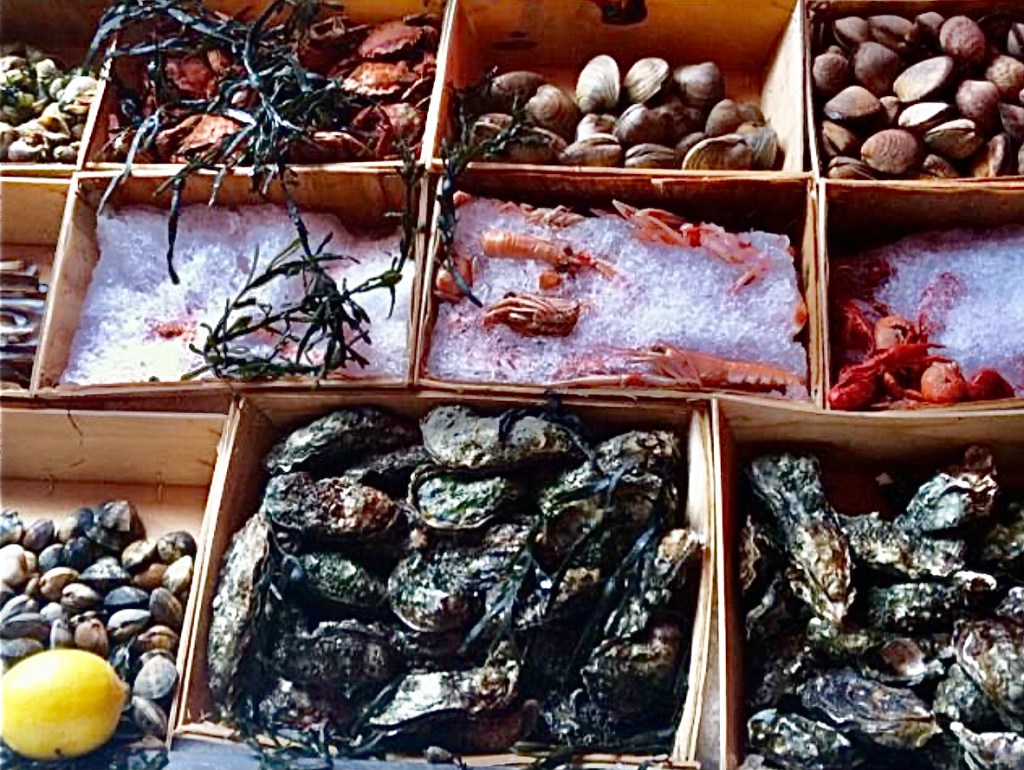
There was one place we went to a couple of times and came to know the guy working the “bar”. We were talking with him about seafood one night, and how good and fresh it was in Brussels. We asked where was a good place to buy fresh seafood, if we wanted to take some back to Germany with us. He told us our best chance was at the wholesale seafood market that ran every day from 5AM to about 10AM, but you needed to arrive early, as the vendors ran out of their prime seafood early. The other catch was, it was a wholesale market, so you had to find fishmongers willing to sell in smaller amounts to individuals. Rich, our coworker Steve, and I talked about it and decided we’d try and take a haul of seafood back to Germany when we could.

The next time I went to Mons, I took our cooler and stopped by Rich’s house to pick up his. About a week later, we were finishing up the current portion of the project and all of us were returning home. We made the plan to pick up the seafood early on a Thursday morning, and have a big seafood dinner/party on Friday night, at Rich’s home.

Allowing ourselves plenty of time, we woke about 2:30AM and were on the road by 3:15. We arrived in Brussels an hour later, but the seafood market wouldn’t open until 5. We locates an open bistro and went in, where we joined some late night partiers, ending their evening; a few men having breakfast before going to work; and several “Ladies of the Night” who were apparently finished for the night and having coffees and brandy. We sat at an open table and ordered some coffee and fresh croissants.

Just after 5AM, we left the pub and walked over to the market. It was huge, and already quite crowded. We wandered among the stalls and trucks for a while looking to see what was available. To be honest, there were so many choices, it was a bit overwhelming. We started talking to a couple of vendors, however when they found out the small amounts (by wholesale standards) we wanted to buy, they quickly ignored us. Eventually, we found a guy willing to deal with us, and we bought everything from him – a couple kinds of fish, some lobster, and of course, plenty of oysters and mussels. Someone went back to our car for the coolers and we loaded them up. The guy was nice enough to put plenty of ice in the coolers as well.

At the Market

We arrived back at our hotel in Mons around 7:30AM and caught a couple hours of sleep, before driving back to Germany later that day. You have to remember this was pre-Internet and pre-cell phone, so it wasn’t until we returned, when we started calling people for the seafood dinner planned for the next night.

Friday night came and we all met at Rich’s house. In addition to Rich and his girlfriend Lynn, there were Cath and I, Steve and his wife Sabine, a few coworkers and Rich’s boss, Ray Sauer and his wife. It was quite the event, with grilled fish and lobster, Moules Pastis, oysters on the half shell, and fried oysters. We washed it all down with plenty of good German Pils, and some of our local dry white wines. A bottle of Sambuca, along with multiple cups of espresso may have made appearances later in the evening as well.

I hadn’t thought about that market trip, or the subsequent party for years. The Mussels with Pernod meal Cathy and I cooked, brought the memory flooding back. For me, good food has never been just about the taste of the food itself. It has always been defined as much by the place and time, and those who we are sharing the meal with. Our taste buds learn to recognize sweet, sour, salty, bitter and umami. Our minds and memories complete and complement our sense of taste. If you are lucky, years later out of nowhere, the taste of a new meal suddenly blesses you with a remembrance from your past.

For me, Good Food is Never Just About Taste

Addendum:

• Cathy and I had another memory from late ‘88 or early ‘89. I was back in Brussels to present a paper at a conference, and Cathy came with me. We were staying at a nice hotel downtown. We went out for a dinner at a nearby bistro and had Moules Frites. On the way back to the hotel, we stopped at a small bar for a nightcap. While having our drink, several “Working Girls” came in and sat at another table. They ordered wine and champagne, seemed to be enjoying themselves and were in a good mood. As it was earlier in the evening, we speculated they might be on break, or getting ready to go work.

• Pastis is an anise-flavored spirit and apéritif traditionally from France. Two of the best known are Pernod and Ricard. If you are looking for a substitute, Ouzo, Sambuca, Herbsaint and Absinthe are other anise flavored liquors, all with different flavor profiles.

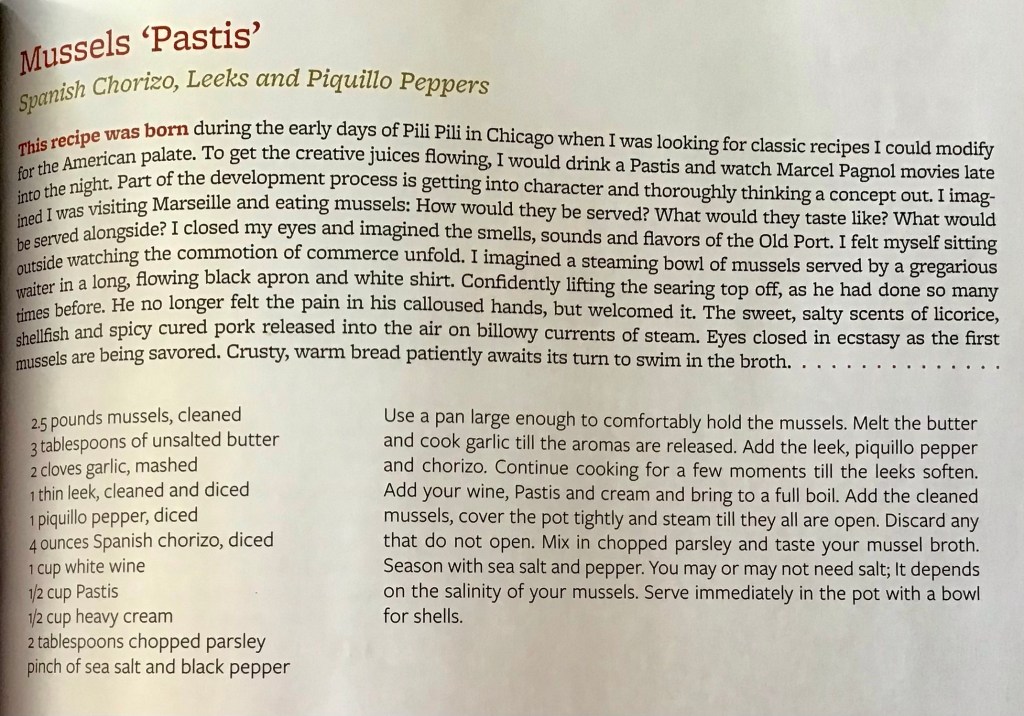
• We’ve made Moules with Pernod at home before, but I never had the same flashback. The previous recipe only had a bit of Pernod in it. This one used a full half of a cup. I think it was the stronger flavor that triggered the memory. The recipe is from a wonderful little cookbook we have called “Cuisine of the Sun”, by François de Mélogue. I like the recipe just the way it is, but if not familiar with Pernod, you may want to cut it just a bit. Here’s a copy of the recipe:

____

Mrs Ahrens – Den 1 and Pack 50

Mrs Ahrens – Den 1 and Pack 50

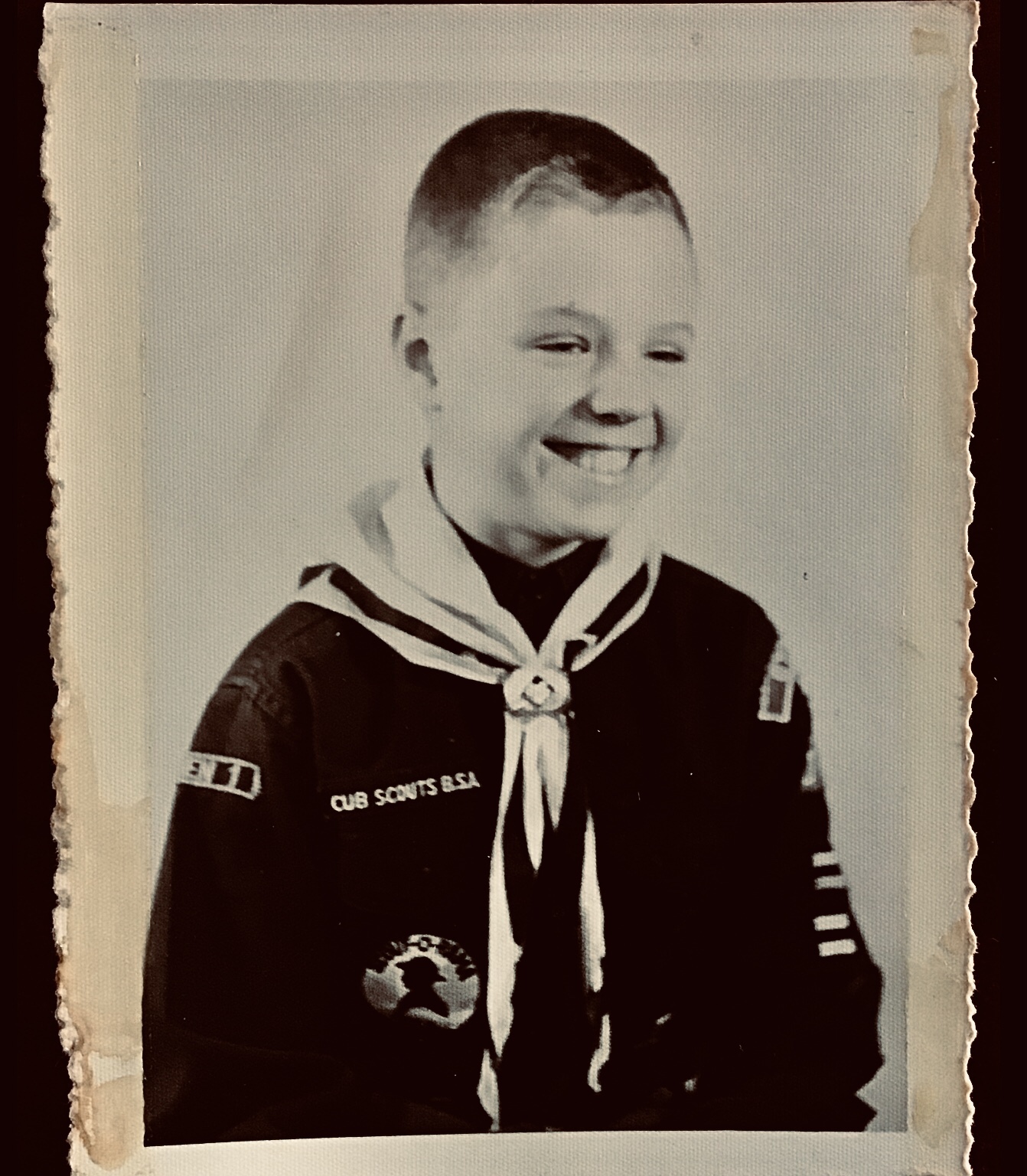
Another part of my childhood is gone forever. Mrs Lois Ahrens, my Cub Scout Den Mother from 1963-65, passed away on March 14th at the age of 92. On hearing the news, I was transported back in time to the joy of Tuesday afternoons, and Den meetings in her home. I also thought about the lessons we learned.

Mrs Ahrens, our Den Mother for Den 1

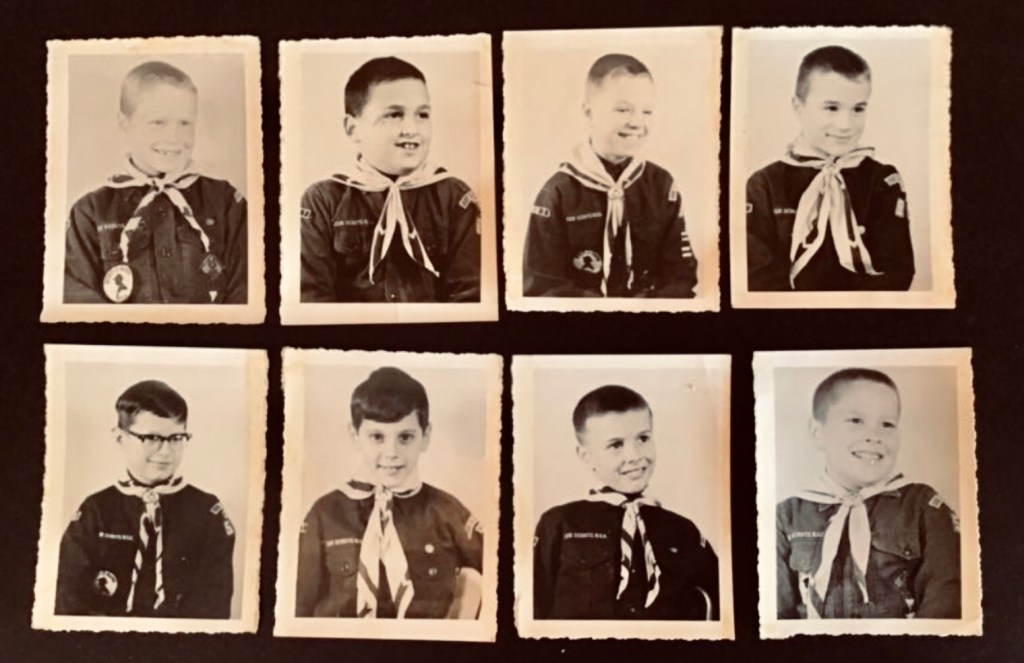
On Tuesday afternoons, the teachers at McKinley School in Ottawa, Illinois had conferences and as a result, we kids were released early. At eight years old, for me and many of my buddies, that meant heading to a Cub Scout Den meeting. I was a member of Pack 50 and belonged to Den 1, under Mrs Ahrens.

Those meetings are mostly a blur now, but I do have a few distinct memories. Many of the meetings were in her basement, where we engaged in some sort of craft project – maybe making a birdhouse out of popsicle sticks, or something similar. I also remember “field trips” to places of interest around town. At various times we were led on tours of the local newspaper, “The Daily Republican Times”, and a local bread bakery. I think there was also a trip to the grave of WD Boyce, the founder of the Boy Scouts. He is buried in Ottawa.

Den 1 of Pack 50 in 1964. Top row: Kenny Ahrens, Terry Johnson, Max Hall, and Dave Engel. Bottom row: Brian Eastman, Dion Sartorio, Pat Hale and Joey McGinnis.

We also had early teachings about honesty, doing our best and being prepared. I don’t suppose we thought of them as lessons at the time, but they helped lay a foundation for my life. We didn’t know what mentors were then, but looking back, that’s what Mrs Ahrens was, and a very good one at that.

Eventually, I moved on from Cub Scouts to Webelos, and then Boy Scouts. Mrs Ahrens and her family moved away from Ottawa a few years later, but I never forgot her, or the lessons she imparted to us. After fifty-some years, I still remember her, and the fun times we had in Den 1. The flood of good memories have somewhat offset the sadness I felt, upon learning of her death.

Those days were long ago, and now with her passing, the Scout Leaders of my youth are all gone. Not only Mrs Ahrens, but Harry Mayberry, our Pack 50 leader, Harry Nangle the local Police Chief and our Webelos leader, and Don Willy and Farrell Brooks, my Boy Scout Leaders. Collectively, they formed a part of who Max Hall became as an adult – an important part. I remember all of their names and the impact they had on me as a child and young man. I’m lucky to have known them, and had them in my life.

Mrs Ahren’s obituary stated in part:

  • “ Lois Rita Ahrens, affectionately known by all as ‘Honey’, born January 13. 1929, was called home to our Heavenly Father … on March 14, 2021… Honey, who was a wonderful and caring mother, grandmother and great grandmother and as sweet and kind as her nick-name suggests, leaves behind many family members and friends who will long remember her heartwarming smile, contagious good will, and joyful laughter … In lieu of sending flowers, the family invites you to honor Honey’s life by sharing a laugh and smile with a friend, hugging those you love, and remembering all the lives so tragically effected by the pandemic.”

I do remember her smile, good will, and laughter. You may not have known Mrs Ahrens, but I’m sure many of you knew someone like her, whether in Cub Scouts, Brownies, or another youth group. I ask you to join me in honoring their memories “by sharing a laugh and smile with a friend, and hugging those you love…” I think she, and they, deserve that much.

Addendum:

• Mr Ken Ahrens, Lois’s husband, was my Little League coach a couple of years later. Our team, The Yanks, won the City Championship under him in the summer of 1966 or ‘67. His son, Kenny, seen in the group picture above, was one of our pitchers and had a helluva pitching arm…

• Thanks as always to Tim Stouffer, Howard Johnson and Mark Dunavan for their thoughts and inputs to this blog. Tim and Howard were both four months younger than I, and as a result, they didn’t join Cub Scouts until four months later. They were both in Den 2, under Mrs Stouffer, but remember Mrs Ahrens as well. Mark went to a different grade school, but had memories of trying to hit pitches by Kenny Ahrens in Little League Baseball…. 😉

• The Boy Scouts played a big part in my youth. Here’s a Blog I did about Farrell Brooks and Don Willy, our Scoutmasters at the time. They were both important men in my life: https://mnhallblog.wordpress.com/2019/07/11/farrell-and-don/

Soft Shell Crabs

Soft Shell Crabs

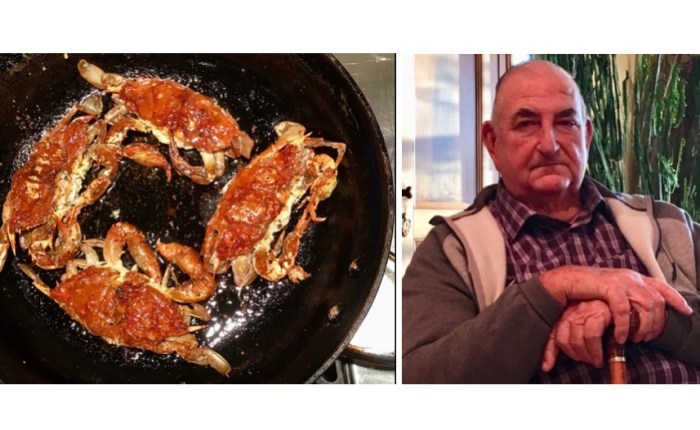
We invited our neighbor Bill over for dinner last night. We were looking forward to catching up, and hearing about his recent travels. The menu? Soft shell crabs and sweet corn. It’s summer and we are on the Eastern Shore of Mary’s Land. What could be more perfect for July?

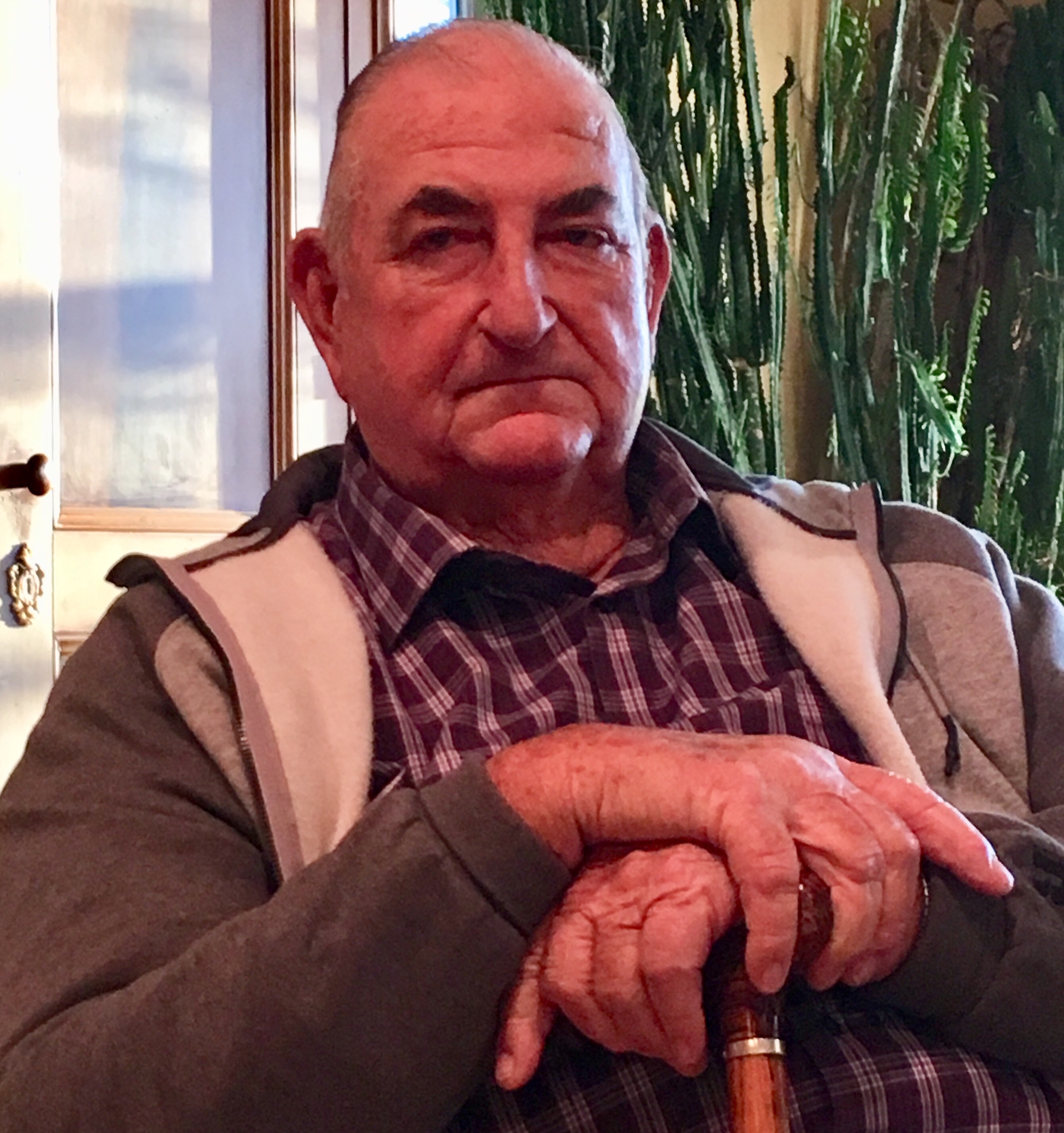
The recipe is from our neighbor on Tilghman, Captain Stanley, who was a skipjack captain. If a skipjack captain gives you a seafood recipe, you damned well better pay attention and write it down. Captain Stanley is in his 80s. He’s spent the better part of his life as a waterman on the Bay, crabbing, and oystering. The recipe is totally minimalist, but that makes perfect sense. As Captain Stanley says, “why add anything else and take away from the flavor?” He worked on the Bay for over 60 years and knows a thing or two about crabs. I’m going to listen.

Captain Stanley Larrimore

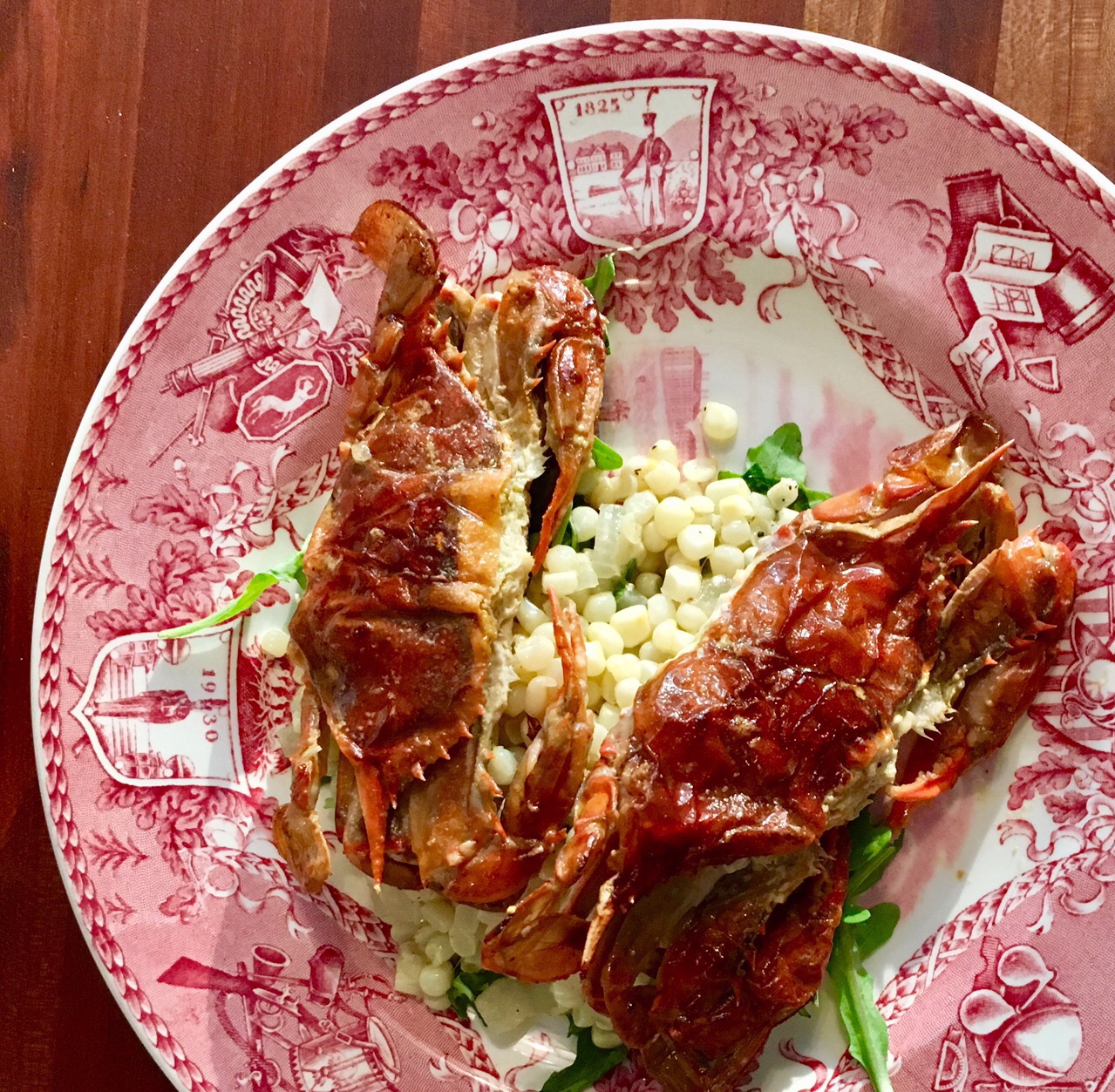
Cathy added to the meal by sautéing the sweet corn in butter and olive oil with some onion and jalapeño. The final dish? A spread of arugula topped with the sweet corn sauté. Put the soft shells on the top of the corn, with a bit of tarter sauce on the side. We served them with a Pinot, but beer would also go with the dish pretty well.

Soft shells sitting on a bed of sweet corn and arugula

Captain Stanley’s Soft Shell Crabs:

Cleaning the soft shells:

1. Cut off face

2. Take off apron (male or female) (and any inner extension that comes with it).

3. Turn over. Lift top edge and scrape out the “dead men” on each side (the lungs). Put edge back down

4. If female, flip back over. Make slits on the two sides of the crab and take out the two white, dime sized objects (the ovaries). Some people (including me) leave the ovaries in.

To cook:

1. After cleaning, salt and pepper them.

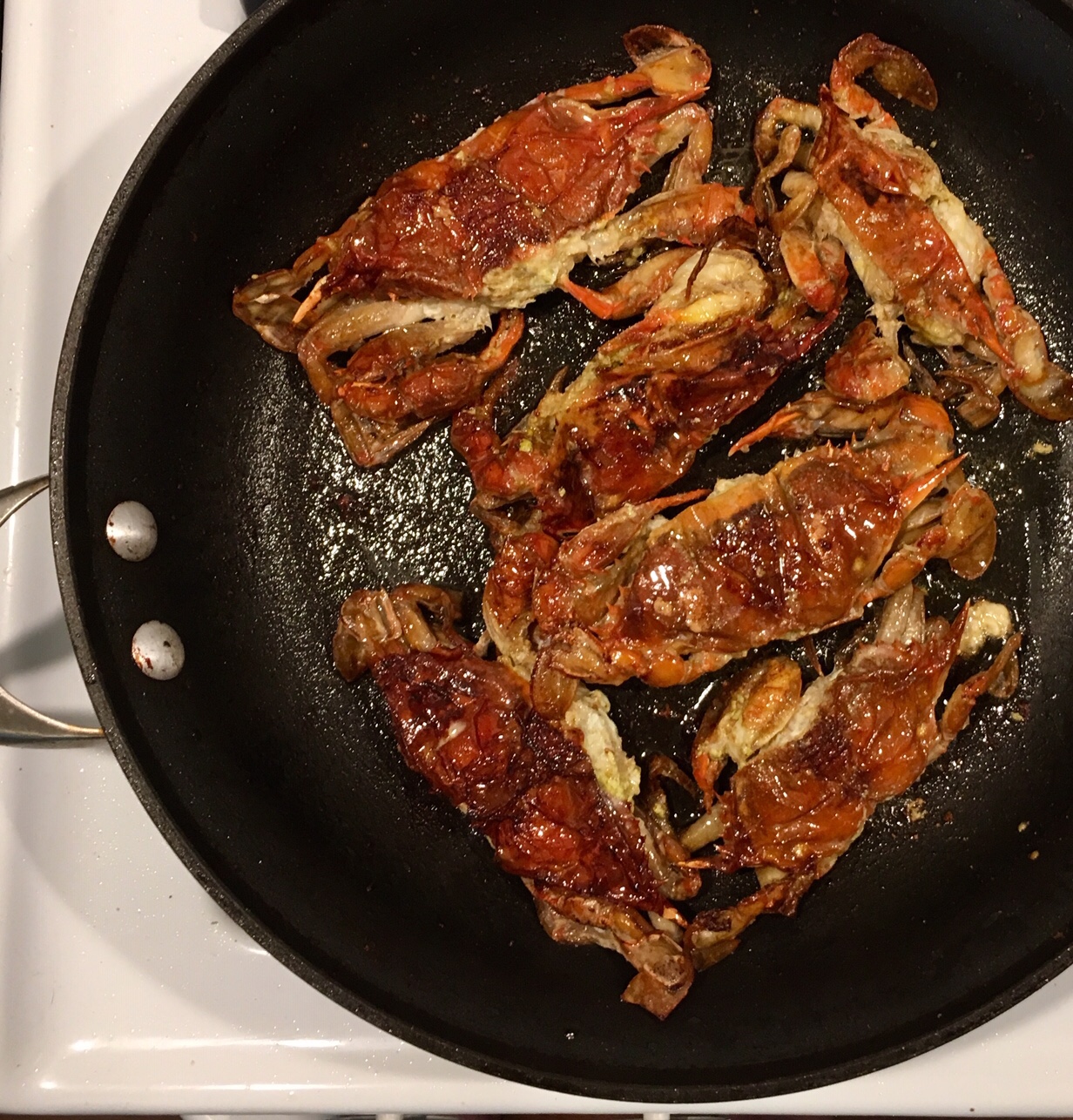
2. Sauté in butter (use ghee or clarified butter if you can; if not, combination of oil and butter) about 3, 3 1/2 min per side.

3. Pull off and eat.

4. Have a little tartar sauce if you want.

Sautéing soft shells

Addendum:

I borrowed the phrase “Mary’s Land” from Mary Chapin Carpenter, who wrote a song about Maryland with that same title. It’s a great tribute to the state of Maryland.

If you want to learn more about Captain Stanley, or watermen in general, I highly recommend the Book Skipjack by Christopher White. It’s a wonderful book about a lifestyle that is slowly dying away here on the Eastern Shore of Maryland.

The Twenty Days of Maknassy

The Twenty Days of Maknassy

“Maknassy” – I can still hear Dad say the word, although he died in 2010. It wasn’t quite a snarl, but it was close. The battle, in March and April of 1943, was vicious. The Germans were slowly getting backed into a corner in Tunisia, and they knew it was either kill or be killed.

General Patton took over II Corps on March 6th, after the debacle at Kaserine Pass. On the 12th of March, Patton detached the 60th Combat Team, Dad’s unit, from the 9th Infantry Division and attached it to the First Armored Division. As a part of his upcoming operation at El Guettar, and the British Army actions under Montgomery to the south, the First was assigned a series of missions aimed at Maknassy Pass. Patton never liked to deploy armor without supporting infantry, and the 60th was given the task. Dad was a 19 year-old Sergeant, with 2 1/2 years in the army.

March 17th was the beginning of what became known in history books as the “Twenty Days of Maknassy”. According to Dad, the rain had poured for days turning the ground and roads into deep mire and mud. The Tanks were ineffective and couldn’t move. It would be up to the Infantry to get the battle started. They were directed to attack a small junction town, Station de Sened “The place everybody fought for, and nobody wanted”.

Dad explained “we started in the grass and mud to the front of the German positions. You couldn’t raise your head without getting shot, plus there were minefields in front of us. After darkness came, we moved”.

Move indeed. The 60th circled the town and climbed the backside of a steep hill, Djebel Goussa, that was to the side of Sened. Djebel Goussa was 600 feet above the valley floor and looked directly down onto Sened. They attacked on the night of the 19th. It was a brutal fight, with individuals, squads and platoons moving slowly up the hill until, by the afternoon of the 20th, they had displaced the Germans. As they now held the high ground, this also forced the enemy to evacuate Station de Sened.

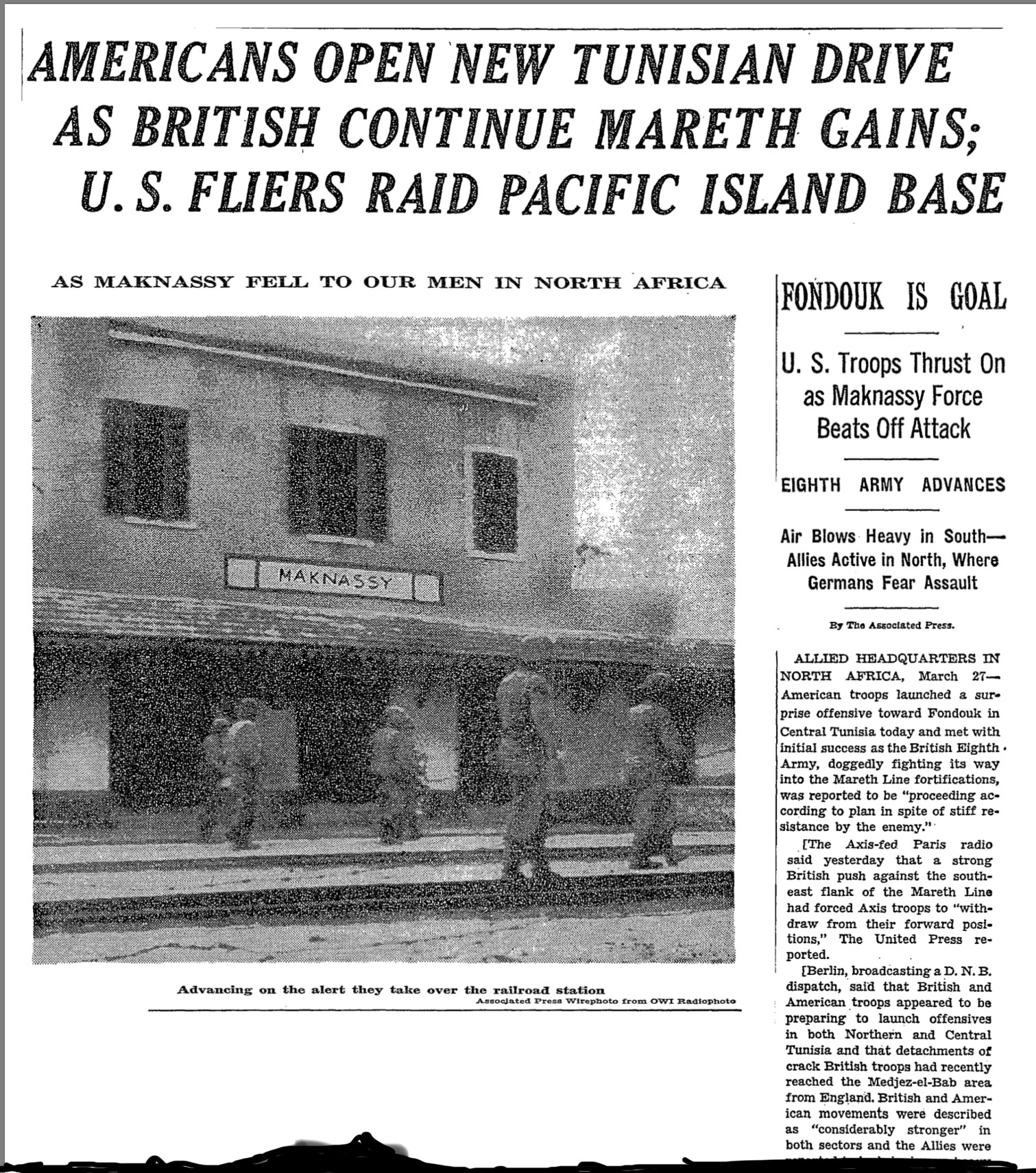
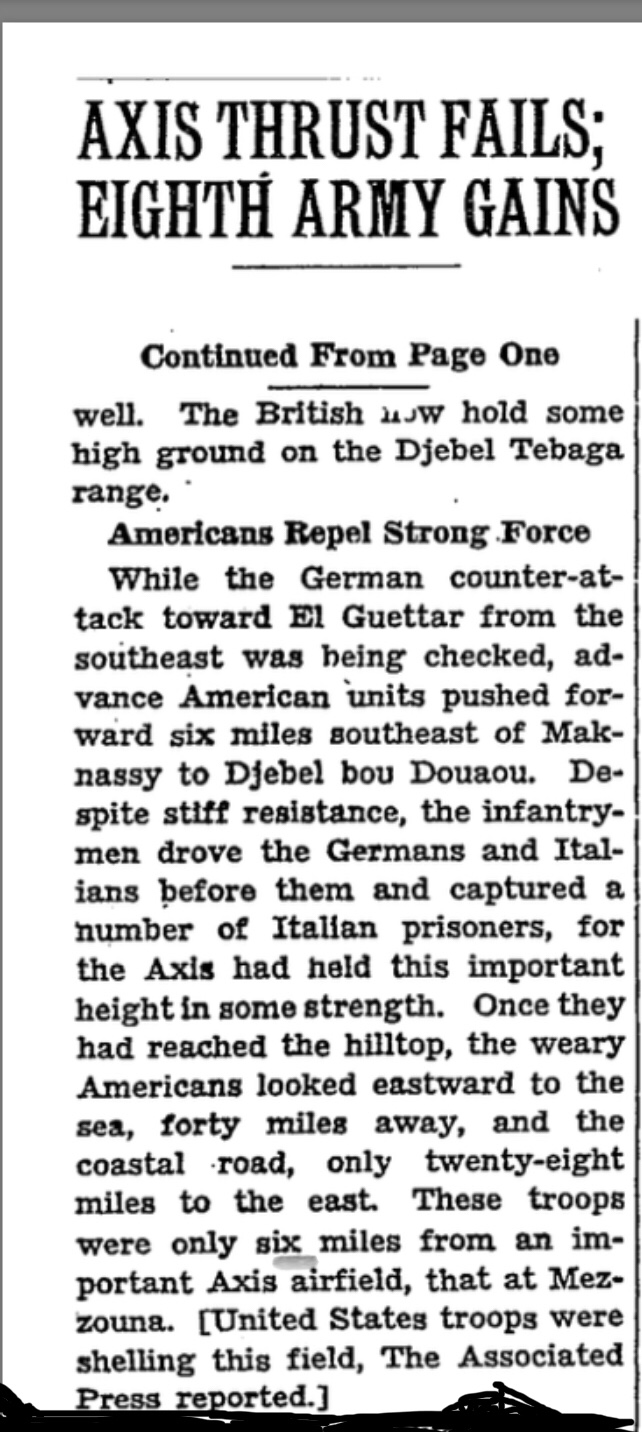
The Germans retaliated with heavy shelling. Undaunted, the 60th moved and attacked again a day later, entering the town of Maknassy itself on the morning of the 22d. The Germans left sometime during the night, and the 60th entered without firing a shot. The New York Times headline back home featured a picture of the unit entering the town near the Railway Station. The easy part was over.

The 60th Combat Team enters Maknassy

They now moved on Maknassy Pass, 5 miles past Maknassy, their ultimate objective. The Germans were dug in on hills in the pass, including Hill 322, which was guarded by Rommel’s personal Guard. The tanks couldn’t go through the pass with the Germans controlling the heights, so naturally, the task again fell to the Infantry.

The 60th attacked a series of hills on the nights of the 22d and 23d with mixed success. As dad explained “we always attacked at night, but the Germans were well dug in. And they had mines on many of the approaches. The Germans used mines everywhere. The going was very slow.” They did take several of the hills, particularly on the north side of the pass, but the Germans still controlled the south side. Hill 322 was attacked many times but never taken. The advance bogged down, but the US Forces acted forcefully enough to cause the Germans to deploy reserve units, keeping them from engaging with Montgomery and the British, further to the south. Dad said that from where they were, they could actually see the open land on the other side of the pass, even though the Germans still controlled the south side of the pass. That open ground was what the tanks needed.
The history books tell us that the battle fell into a stalemate, with the Germans occupying some of the hills, and the US the others for the next several days. On 31 March, the commander of the 1st Armored Division ordered the 60th into another attack. According to one source, “Most of the unit (the 60th), had defended their limited gains east and north of Maknassy against unremitting pressure from the Germans, for the last four days. They had little relief or rest, and many casualties, and their performance during the attack reflected their poor condition.” The attack failed.

Dad talked with me about those days as well. They were dug in on the side of mountains with deep foxholes. Deep because of the continual shelling from German artillery. You didn’t show yourself during the daytime because of snipers. The same went for the Germans, and they also generally stayed undercover. One day Dad was looking across the valley with binoculars and saw a German outside his foxhole improving his positions. Dad said “You son of a bitch…” and took aim and fired. The bullet hit a rock about 6 inches behind the German, and he jumped back in his foxhole. One of Dad’s buddies in a neighboring foxhole called out “You missed him, Bill….”

On the 2nd and 3rd of April, the 60th received over 240 replacements for the men who had been killed or wounded. This translates to roughly a 25-30% casualty rate over the preceding 2 weeks. The new recruits arrived none too soon, as the Germans mounted a massive attack on the night of the 4th. The attack lasted all night, but the 60th held and the Germans retreated in the early dawn hours.

On April 7th, although the men of the 60th didn’t know it yet, the enemy had withdrawn. It was quiet all day and then something happened. Dad and his foxhole mate, Boggs, saw something just outside the valley. It was a vehicle approaching from the south. Suddenly, the vehicle stopped. As dad watched through binoculars, two guys got out of the vehicle and…..started making tea. It was a British scout vehicle. The Brits, along with the rest of the US forces attacking at El Guettar had broken through and were driving north. Dad and Boggs came down from the hills and approached the Brits. They spoke together for a while and traded some cigarettes for biscuits. The Brits then packed up their kit, and headed north. It’s not recorded in any history book, but I believe that was the first link up between Montgomery’s Eighth Army coming from the south, and the US 1st Armored Division driving East from Maknassy. The Twenty Days of Maknassy were over.

I love it when small history is a part of big history. Dad told these stories of Maknassy, with the mud, the minefields, and the night attacks in piecemeal fashion. The stories of the “missed shot” and the Brits having tea were always shared with a laugh. I remember listening to Dad as a kid. He never told stories of either the heroics, or the butchery, of war. It was always more about the humor of the situation, or some particular hardship they went through. It was only later when I read the details of some of the battles, that I was able to overlay dad’s stories onto the actual events of the battle. Greatest Generation indeed.

Addendum:

1. If you ever watched the movie, “Patton”, the tank battle shown in Africa is at El Guettar, of which the actions at Maknassy were a part of. The movie projects it as a single day battle, but the actual events took place over nearly three weeks, and was in support of Montgomery’s attack coming from the south.

2. In addition to my conversations with Dad, I was able to piece together many of the larger details of the battle from three other sources: The New York Times (editions from March and April of 1943); the book “Eight Stars to Victory, a History of the Veterans Ninth U.S. Infantry Division” (published in 1948); and this site on line: https://www.ibiblio.org/hyperwar/USA/USA-MTO-NWA/USA-MTO-NWA-28.html – “Northwest Africa, Seizing the Initiative in the West”, by George F Howe.

3. Over the past couple of years, I’ve written several blogs about Dad’s time in the Army. They were never posted in any particular order. If you are interested in reading more about dad’s life during WWII, you can get some glimpses in the following blogs, listed here in chronological order:

Oct 1942. Last leave before shipping out to invade Africa. https://mnhallblog.wordpress.com/2017/12/04/the-%EF%BB%BFlast-big-weekend-before-the-invasion/

Jan 1943. Dad, Roosevelt, and a Brush with History. https://mnhallblog.wordpress.com/2016/05/27/247/

Mar 1943. The Twenty Days of Maknassy (This blog)

June 1943. Kicked out of a Walled City Twice. https://mnhallblog.wordpress.com/2016/06/05/kicked-out-of-a-walled-city-twice/

August 1943. Wounded in Sicily. https://mnhallblog.wordpress.com/2016/05/14/wounded-in-sicily/

June 1944. Dad and Pooch on D-Day. https://mnhallblog.wordpress.com/2016/08/19/dad-and-pooch/

Late 1944. Dad, Deason, Boggs and Noble. https://mnhallblog.wordpress.com/2016/06/17/dad-deason-boggs-and-noble/

…And this one in regard to Veterans Day…..

Aug 1942. A last visit home. https://mnhallblog.wordpress.com/2015/11/10/veterans-day-a-blue-star-a-flag-and-a-letter/

Making a Three Day Beef Daube

Making a Three Day Beef Daube

The weather had finally turned cold(er) here in the Virginia Piedmont and they were calling for snow over the next two days. This was the perfect time to make a Beef Daube and I was on a mission.

Daube is a French word that translates to stew. All daubes are stews, but not all stews are daubes. To me, daubes are thicker and richer, and are almost like a stew “sauce”, if that makes sense. I loved my mom’s beef stew, but this beef daube is something else.

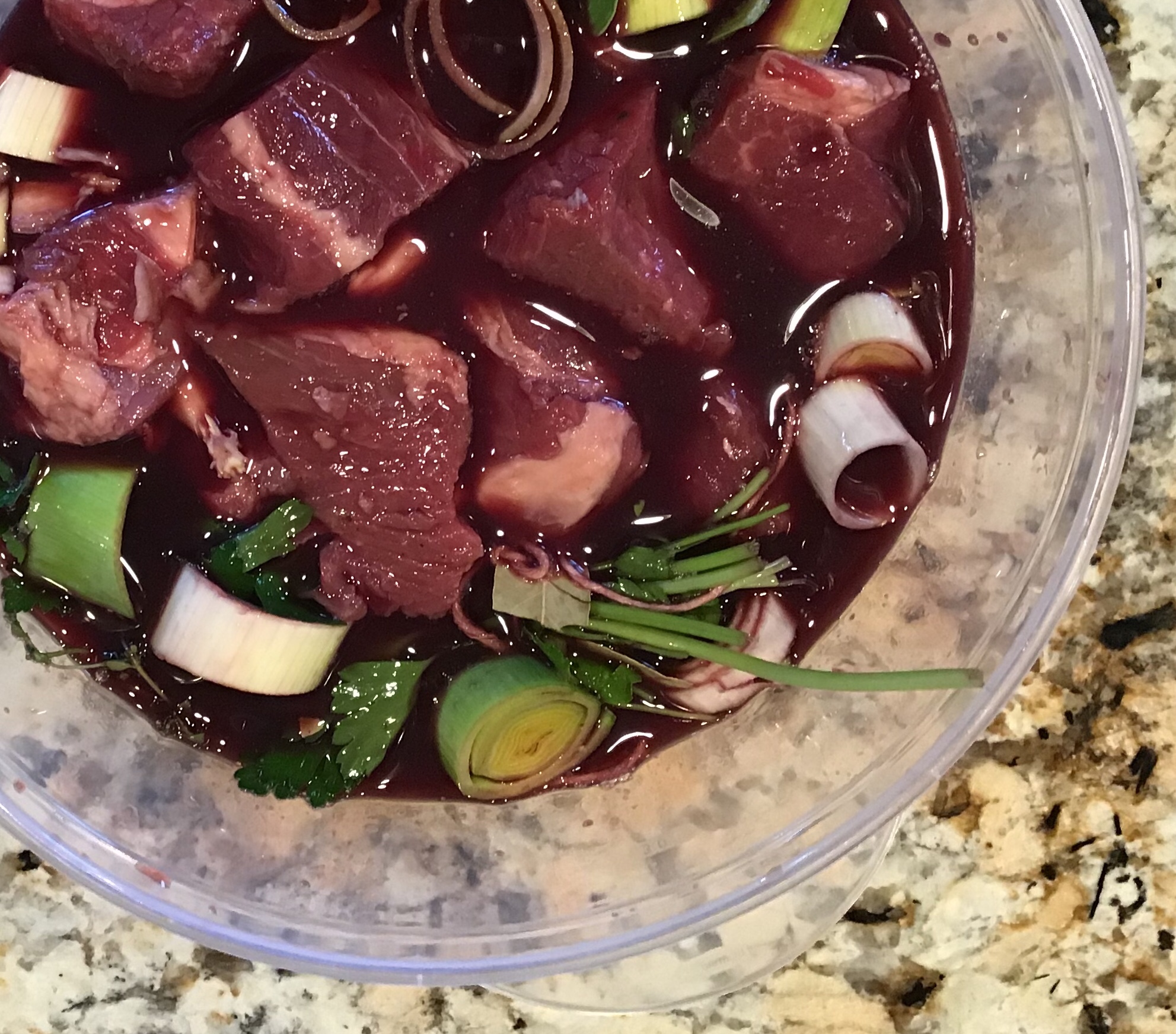
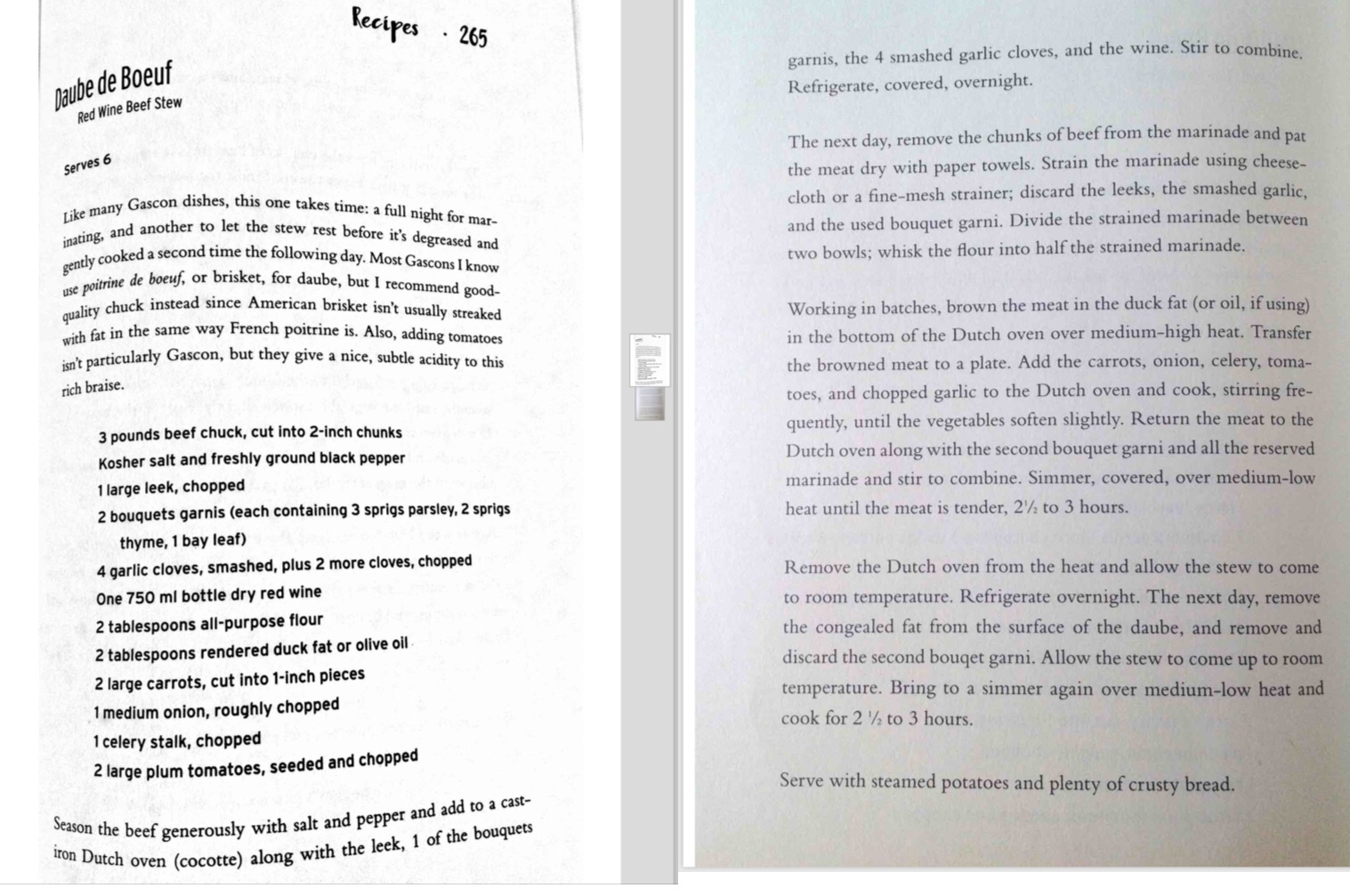
This particular recipe is for a Three Day Beef Daube. It’s from a book my old friend Tim lent me called “Duck Season”. The book is about the Gascony region of France, and if you enjoy reading about other countries, particularly their food, drink and culture, I highly recommend it. The dish takes three days to make, although the steps are pretty easy. Day one – marinate the beef; day two – make and cook the daube for 2-3 hours and let it rest over night; and day three – gently simmer the daube for a couple of hours and then eat. That’s all there is to it.

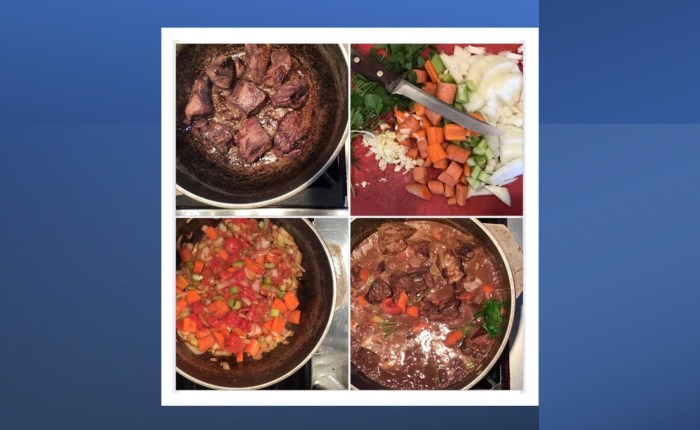
Last Thursday, I pulled the chuck roast out of the freezer to thaw, and made up my shopping list. On Friday morning, I went shopping for the few things I still needed – a leek, some parsley and thyme. We had everything else at home. After a quick lunch, I cut up the beef and added it to a bowl which already included smashed garlic, sliced leak, a bouquet garni, and a bottle of red wine. Day one was done, with plenty of time left to take our dog Carmen for a walk, and in anticipation of the snow, to bring more firewood into the house.
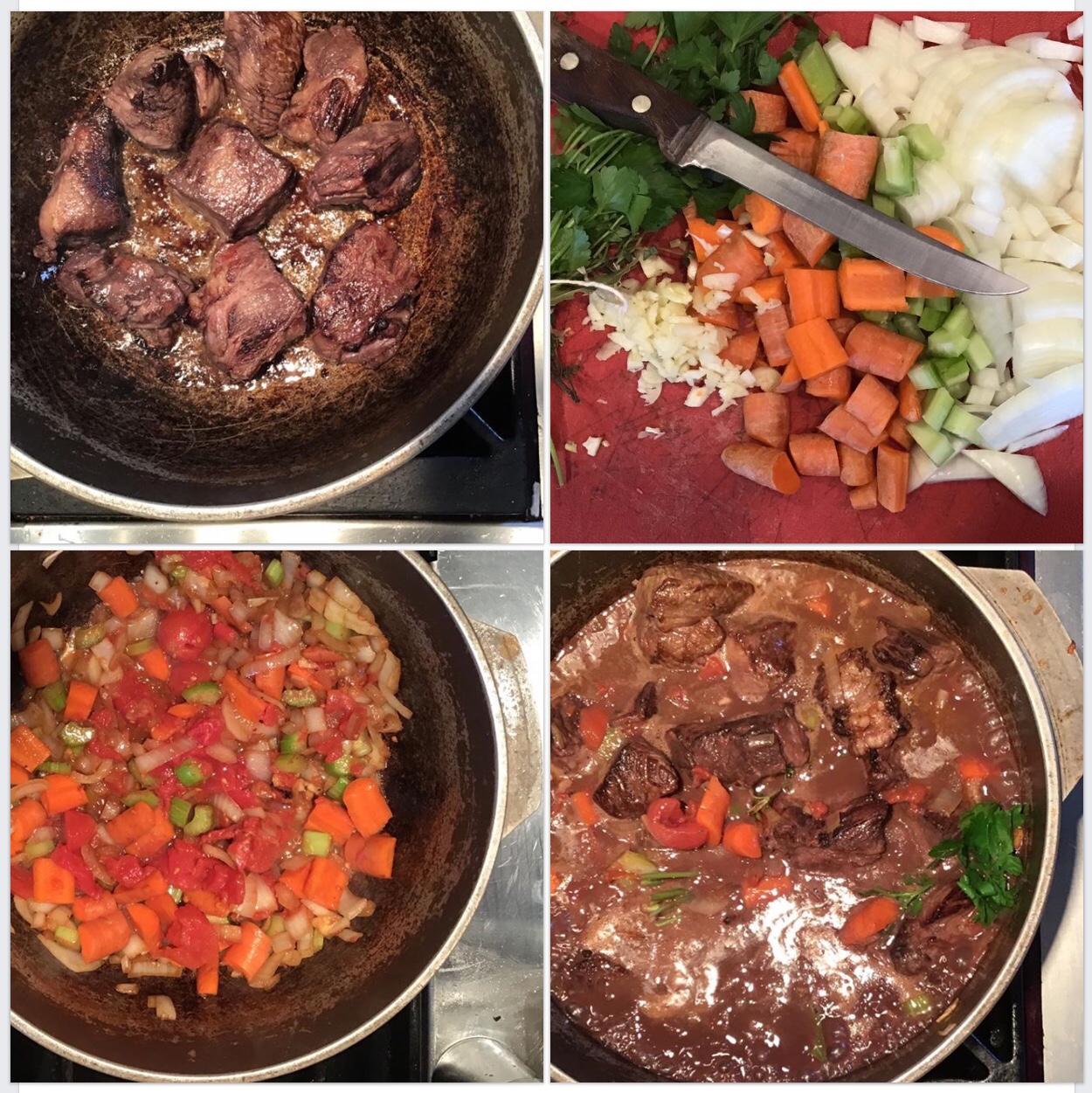
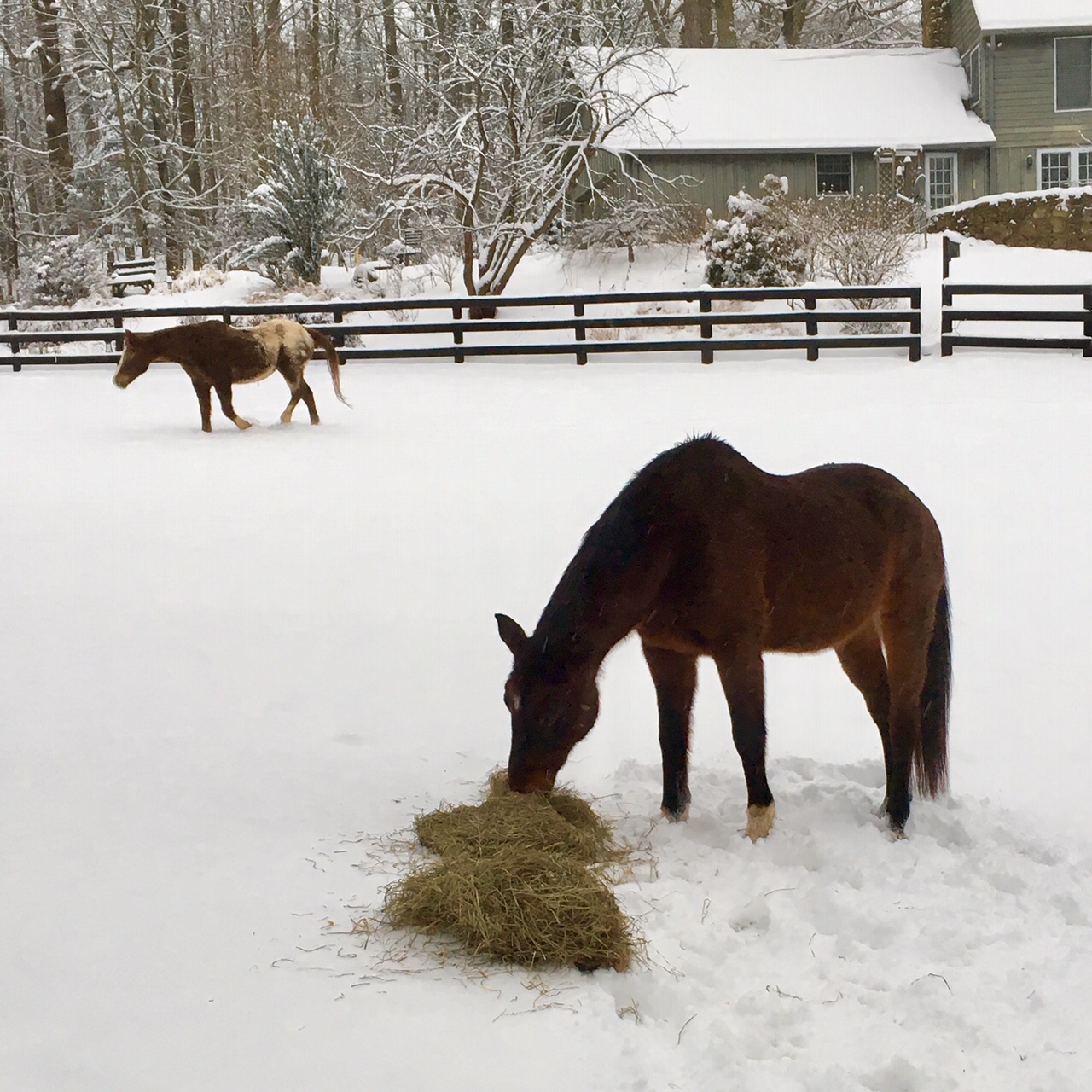
Day two started grey and cold. When I went to the barn in the morning to feed the horses, there was a skim of ice on the pond and the air had that “pregnant with snow” feeling you sometimes get right before a storm. Predictions for snow amounts rose from 2-4” to 3-7”.

I continued with the daube around noon and day 2 was only a bit more work than day 1. I browned the beef; chopped up and sauté garlic, onions, celery, carrots and tomato; added the beef back to the pot with the vegetables, along with a new bouquet garni; and added the strained and reserved wine marinade to the pot. Once that was done, it simmered on low heat for about 3 hours.
I’ve found it’s best to take your dog for a walk while the stew is simmering, so you don’t drive yourself mad with the wonderful smells coming from the kitchen. After returning from your walk, you are faced with the most difficult part of day 2. You don’t eat the daube on day 2, no matter how good it smells or tastes. Instead, you remove it from the heat, cool it to room temperature and let the daube rest overnight in the fridge. Remember, don’t eat the daube at this point in time.

Sunday, Day 3, greeted us with a blanket of snow. About 7 inches had fallen, with more expected over the course of the day. After feeding the horses in the morning, and then having my own breakfast, I plowed our drive and around the barn, and then plowed the drives of several elderly neighbors. I made it back inside for lunch, and then some playoff football.
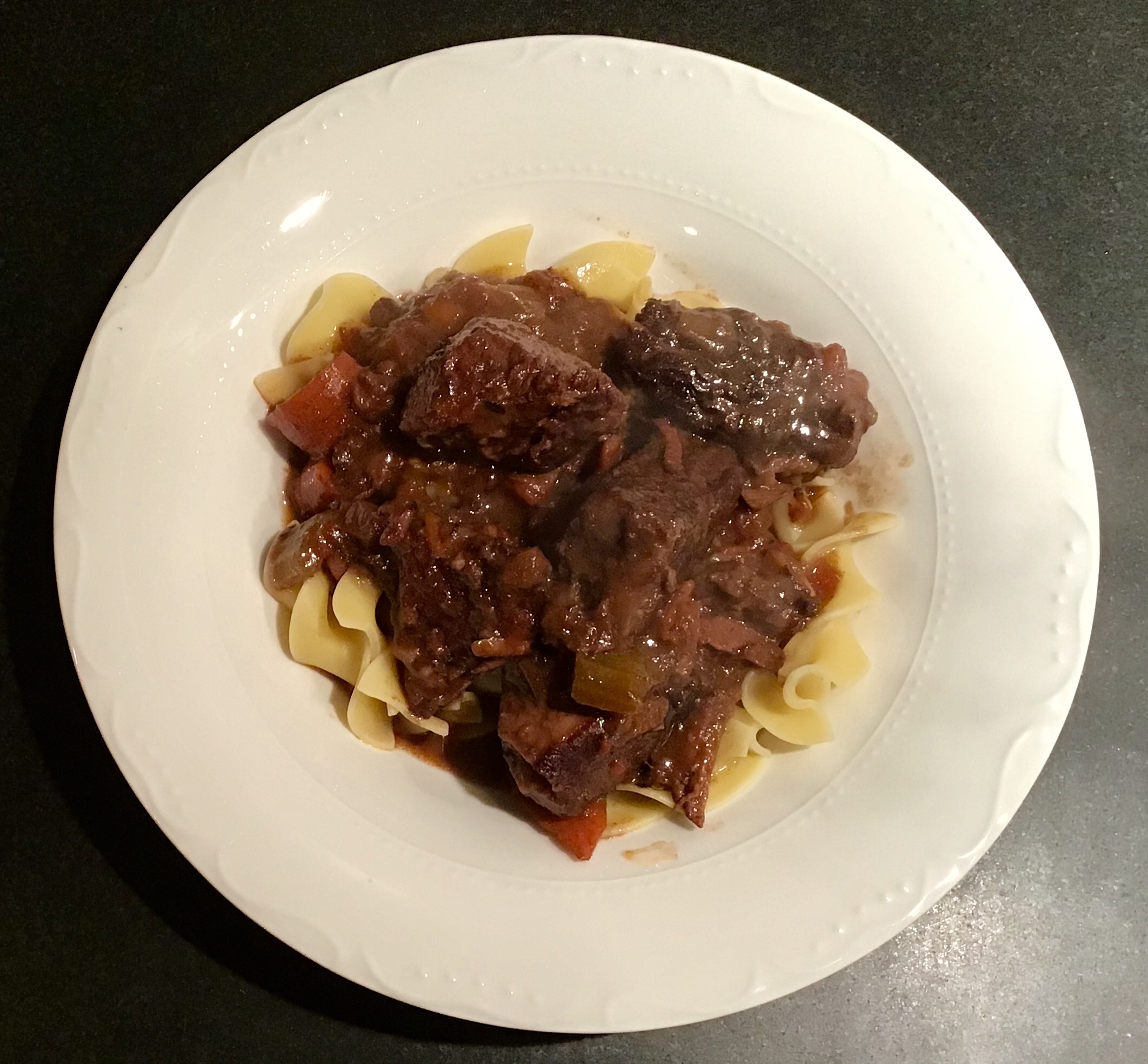
During the afternoon, I started reheating the daube. After removing the congealed fat from the top of the daube, the pot went back on the stove for a gentle three hour simmer. Now the smells were truly driving me crazy and the football was barely a distraction. I took one more walk with Carmen and could see that we had another 3-4 inches of snow today. It was still snowing at dusk as we finished our walk, and I may need to plow again tomorrow, but that will wait.

About a half hour before dinner, I threw a baguette in the oven to warm up, and finally it was time. We served the daube over egg noodles and had it with the bread and a bottle of wine. I breathed in the aroma and took my first bite. What a great ending for a snowy weekend…

_____
Addendum: Here’s the recipe. It’s from the book “Duck Season”, by David McAninch.

Kicked out of a Walled City….Twice

Kicked out of a Walled City….Twice

Not everyone can get kicked out of a walled city twice in one night, but dad found a way….

In February of ’43, after relieving the 1st Infantry Division at Kasserine Pass, the 9th Infantry Division spent the next several months in combat across Tunisia. I remember dad telling some stories of those times and the names don’t role across the tongue lightly – Maknassy, Jefna, the Sedjenane Valley, Mateur, Bizerte…. Forgotten names in history books now, but deadly important then. I think the great WWII columnist Ernie Pyle got it right in his description of the Infantry in North Africa:

         “IN THE FRONT LINES BEFORE MATEUR, MAY 2, 1943…..

       There is now a thin line of men. For four days and nights they have fought hard, eaten little, washed none, and slept hardly at all. Their nights have been violent with attack, fright, butchery, and their days sleepless and miserable with the crash of artillery…..The men are walking. Their walk is slow, for they are dead weary, as you can tell even when looking at them from behind. They are young men, but the grime and whiskers and exhaustion make them look middle-aged…..There is an agony in your heart and you almost feel ashamed to look at them. They are just guys from Broadway and Main Street, but you wouldn’t remember them. They are too far away now. They are too tired. Their world can never be known to you, but if you could see them just once, just for an instant, you would know that no matter how hard people work back home they are not keeping pace with these infantrymen in Tunisia.”

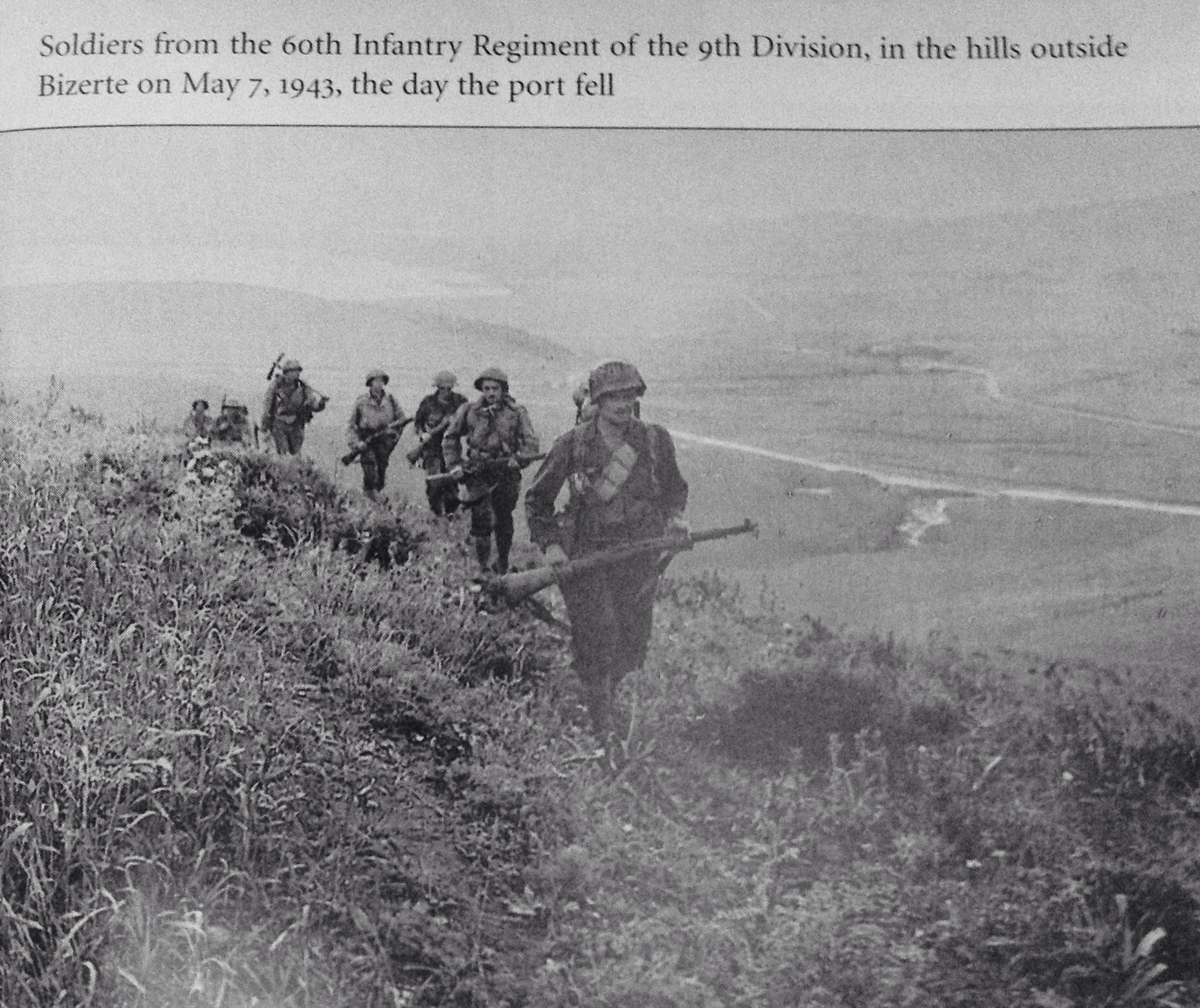
They kept at it and on May 9th, the enemy surrendered In Africa. By then, they had fought and beaten the French, Italians, and Germans and were feeling pretty good about themselves.  

Dad’s unit, on the date Bizerte fell (from “An Army at Dawn”, by Atkinson)

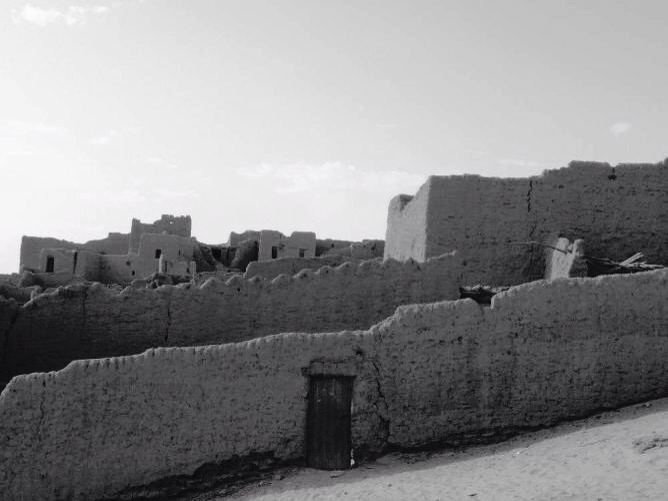
At the end of May, the division was in bivouac and had almost seven weeks of light duty and downtime. The nearest town was a walled city, Sidi bel Abbes, about 30 miles away. The Army, in it’s generosity and wisdom, was giving day passes on a quota system. They’d truck the GIs there during the day, and bring them back to the encampment at nightfall.  

Over the course of June, Dad made it there multiple times and drank wine, ate French food, and visited a couple of houses of ill repute. Not a bad way to spend time in your 19th year of life.

In any case, he eventually returned one time to often to Sidi bel Abbes. Towards the end of June, dad and a buddy got a pass and caught the truck ride to town, where they spent the day partying, drinking, and committing other questionable acts. They missed the truck back to the camp and kept partying until they were caught by the MPs who were patrolling the town. The MPs actually cut them a break and didn’t arrest them. They just kicked them out of the walled city, meaning they would have to walk the 30 miles back to camp. They knew they were already in trouble at this point, so they said the hell with it and climbed the wall and went back into the city.  

Part of the wall around Sidi bel Abbes

More partying ensued and they were trying to find a particular address they had been given. The MPs saw them again and gave chase. With the wine they had consumed, they were in no real shape to get away, and were caught a second time. This time, rather than just depositing them outside the gate to the town, the MPs drove them back to the encampment, and turned them over to the company First Sergeant.

The next day, dad reported in to the CO.
      “Sir! Sergeant Hall reporting as ordered”.

The CO looked up from his desk, then looked back down.
      “That will be all Private Hall”.

And so, dad, who entered North Africa as a Sergeant, departed as a Private. In his words, 
       “Hell, what were they going to do to you for acting up? Short of murder, Or armed robbery, no one went to the stockade, especially if you were an Infantryman.    Combat veterans at that point were of incredibly high value, so maybe you got busted, but you stayed with your unit.”

Dad left Africa on July 24th, on a ship bound for Sicily. They landed at Polermo on August 1, while being bombed by the Germans. He didn’t know it yet, but his time with the 9th Infantry Division would be over on August 8th when he was severely wounded. In fact, his buddies thought he was probably going to die. He survived, and was in the Army for two more years, but never did rejoin the 9th…