
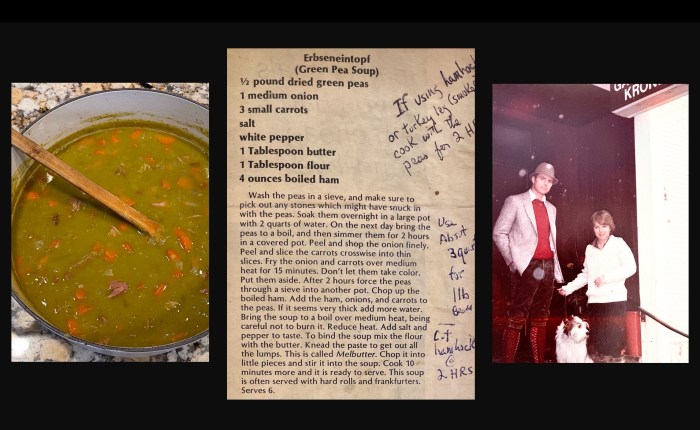
The oldest recipe in my recipe collection is for Erbseneintopf – a German Split Pea Soup. It came from The Stars and Stripes newspaper in Germany in ‘82 or ‘83, and is now a bit tattered. The first time I tasted the soup in a Gasthaus, I thought I’d died and gone to heaven. Getting the recipe was a bonus.
Erbseneintopf. The word and the soup are both a mouthful. Erbseneintopf literally translates to “Pea One-Pot”, and is really closer to a stew. Made properly, it is a thick soup with little chunks of sausage or ham hock in it. I’m not talking the puny American ham hocks, but the big German kind – meaty and smoky. The meat gives the stew a wonderful flavor. It’s a simple, hearty meal.
I believe the first time I had the dish was in a little village near Stuttgart, although I can’t remember the name of the town, or the Gasthaus, for the life of me. At the time, we often went for a walk in the woods on a Sunday afternoon, as many Germans did, and then would stop at a nearby Gasthaus for a late lunch, and a beer or two. We’d usually have some sort of simple meal – a bratwurst, or goulash soup, or some charcuterie and cheese. On one of those trips, it started snowing. Eventually we made it back to the village and the Gasthaus, where Erbseneintopf was on the menu, and despite the green color, I gave it a try. It was delicious. It became one of those dishes that stayed in my mind and I started looking for it on the menu anytime we went to a new Gasthaus – especially in winter.

There were a few other dishes that stuck in my brain back then, and I would stalk them for a while – eating the dish anytime I saw it on a new place’s menu. One of those was Cordon Bleu. I spent a couple of years looking for the perfect Cordon Bleu during our travels across Germany, France and Northern Italy, and dragged visiting friends with me on my quest. Another dish was Käsespätzle, basically a German adult version of Mac ‘n Cheese, with homemade noodles, onions and cheese – It was total comfort food and a bazillion calories.
Cordon Bleu, käsespätzle, schnitzel, wurst, certain kinds of steak, pommes frites (french fries) and a host of other dishes all became a part of our life. We loved German food, but never tried cooking it at home. I’m not sure why. Maybe we knew we couldn’t match what we were eating in the Gasthauses.
Then one day, the world changed. Around 1982, our local military newspaper, The Stars and Stripes*, started a monthly feature with recipes for different German dishes. Some were simple, some more complicated. I’d read the recipes, but didn’t really think much about them, and then one day, they published several soup recipes – Gulaschsuppe, Linseneintopf (Lentil Soup), Tomatencremesuppe (Tomato Soup), and at the bottom of the page – a recipe for Erbseneintopf! I promptly cut the recipe out of the paper.

This was most excellent. I spoke with a German friend about the recipe and she thought it looked authentic. Her one suggestion was to swap out the boiled ham called for in the recipe and replace it with chopped up ham hock, or some smoky local German sausage. It was a good suggestion.
A week or two later, we made the dish for the first time and lightning struck. We couldn’t believe how much it tasted like the restaurant version. The ham hocks provided the smokiness, while the “Melbutter” (see recipe – a mixture of flour and butter) thickened the soup. This baby was a keeper. At the time it was actually one of the very few dishes I cooked, or could cook. Yea, I did steaks, burgers and brats on the grill, but cooking something in the kitchen? I was out of my league there. This soup was probably just about it.
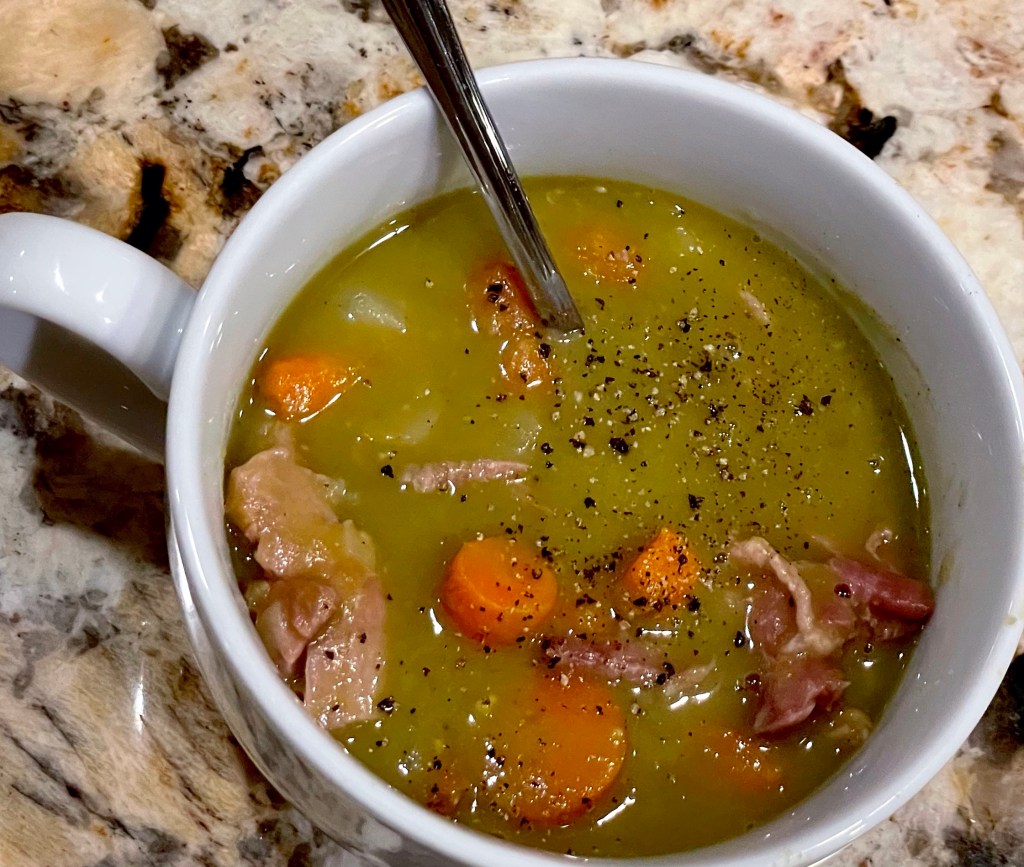
Erbseneintopf has remained a part of my winter repertoire ever since. I’ve only made one change since cooking it that first time. Here in the States, it’s sometimes hard to find good German sausage, or ham hocks with a bit more meat on them. As a result, I often substitute a smoked turkey leg for the ham hocks. It gets the job done.
Looking for a good winter soup on a cold, snowy day? Erbseneintopf might be just what you need. It’s peasant food at it’s best. As with many soups and stews, it’s even better on the second day.
Addendum:
⁃ * The Stars and Stripes newspaper was first published during the Civil war. Later, it was delivered to US forces in France during WWI, and became an overseas fixture during WWII. It continued through Korea and Vietnam, and is still published at overseas military locations to this day, although there were discussions during the Trump presidency of cancelling it (it wasn’t). It operates from inside DoD, but is editorially separate and independent from it. The newspaper has been published continuously in Europe since 1942.
⁃ I also struck pay dirt a month or two later when The Stars and Stripes published recipes for Spätzle and Käsespätzle, and our friends Jim and Res bought us a Spätzlemaker for Christmas. The Spätzlemaker is 40 years old now, and in great shape. We still use it a couple times of year.
⁃ My friend Tim Stouffer reminds me occasionally about my Cordon Bleu quest. He visited Cath and I several times throughout the ‘80s. On at least a couple of those visits, I know I inflicted my obsession with Cordon Bleu on him.



































 Live Life Exuberantly