It’s happening here in Virginia. We’ve seen the influx of more illegal and unwanted aliens. Their numbers are in the millions and growing. Trying to eliminate them by the usual methods isn’t working. Yep, the Spotted Lanternfly is causing problems and it’s going to get worse.
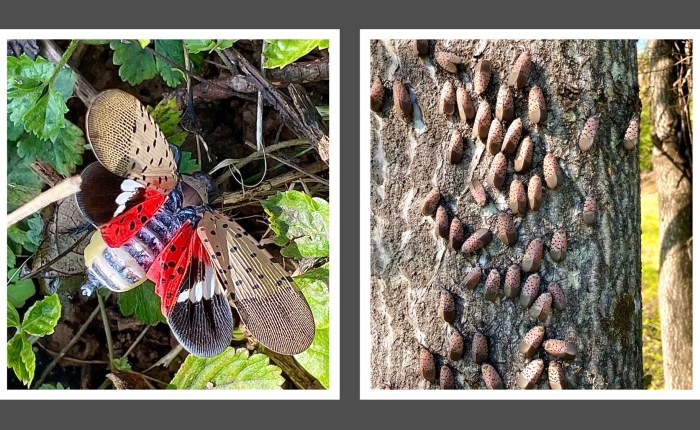
The Spotted Lanternfly is an invasive species, native to China and Vietnam. It first arrived in America in 2014 in Pennsylvania, probably via some kind of shipping container. Spreading slowly at first, it eventually arrived in Virginia a few years ago. Two years ago, there were none here at the farm. Last year we saw a few, and this year there are lots of them.
ASpotted Lanternfly in the Backyard.
The major concern is that they cause damage to some native plants, including grapes, soybeans and trees, particularly walnut and maple trees. “Nymphs and adults feed on plants, using their piercing mouthparts to suck sap from trunks and stems. This has been shown to cause stunted growth, localized damage, and reduced yields.” *. It has no known predators at this point, although some birds like to eat them. In my view, trying to kill them by hand (by smashing them) is fairly worthless at this point, as there are so many of them.
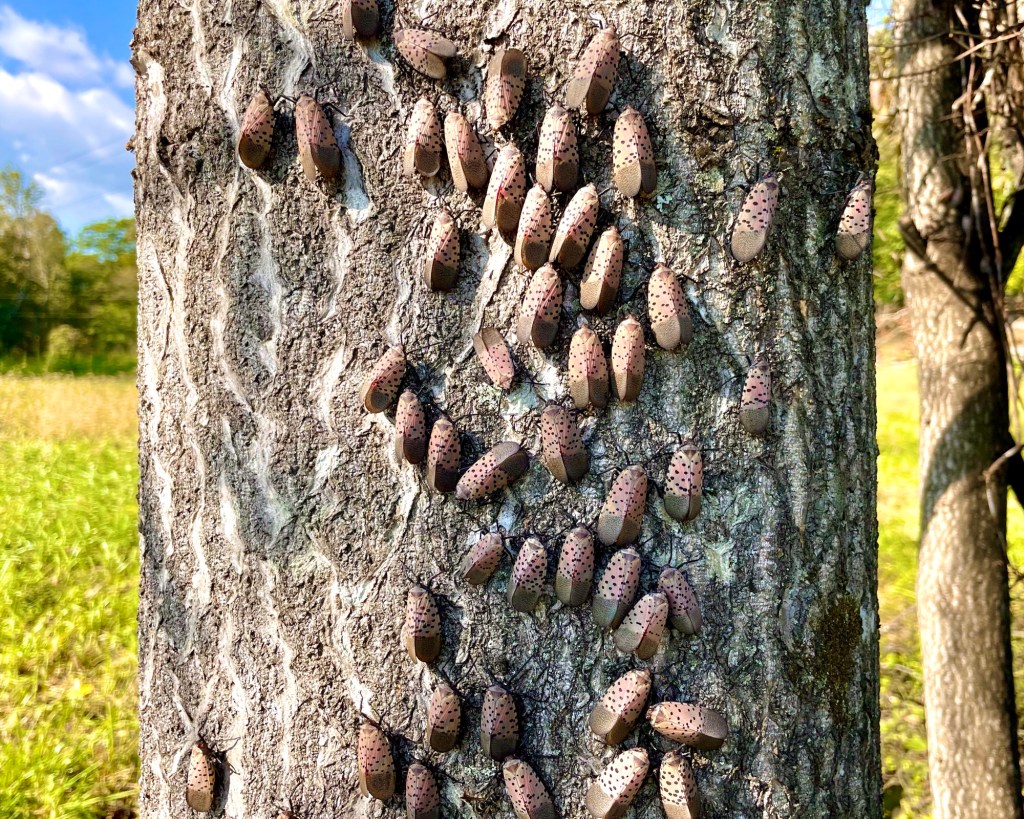
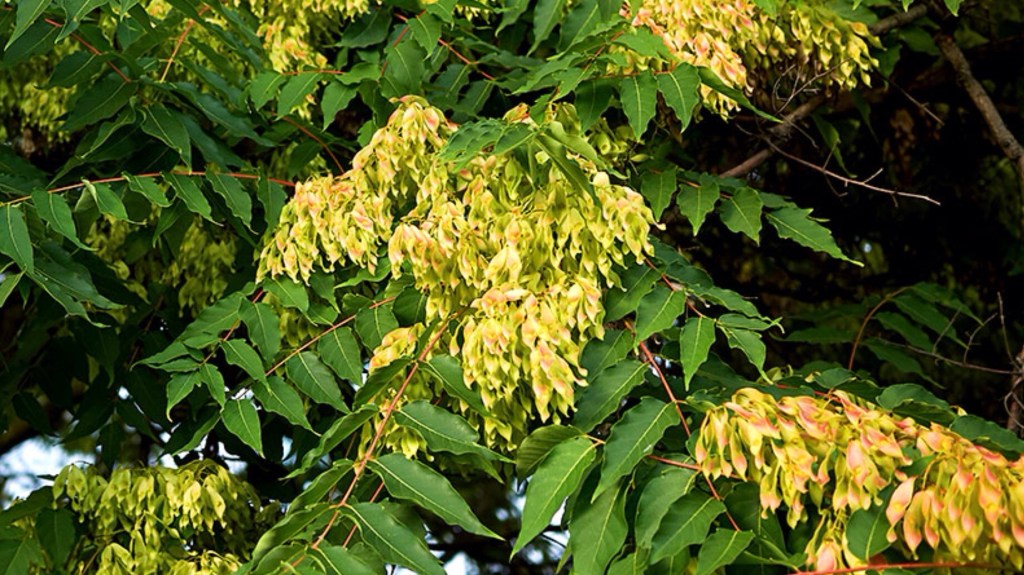
In an interesting twist, the Spotted Lanternfly’s favorite host is the “Tree of Heaven”, another invasive species! Originally from China, the Tree of Heaven was brought to America in the late 1700s as both a shade and an ornamental tree. Unfortunately, it can crowd out native species with its dense shade, AND with a toxin it spreads in the ground that inhibits other plants from growing nearby. As an added “feature”, it stinks in the Fall.
Spotted Lanterflies Feasting on a Tree of Heaven Trunk.
It’s tough to kill the Tree of Heaven. If they are small, you can pull them out. If they are bigger, you can pull them out with a tractor. If they are large trees, you can cut them down and apply poison to the stump, but its roots spread and develop shoots establishing many more trees. There are other ways to kill them, but they are more complicated and you must stay vigilant afterwards We have plenty of them here on the property and across the Virginia Piedmont. If you kill all of those on your property and your neighbor does nothing, you are going to have problems, as they produce a prolific number of seeds that spread in Autumn. Some folk call it the “Tree from Hell”, rather than the Tree of Heaven.
Tree of Heaven With Flowers
We are working on controlling both the Spotted Lanternfly and the Tree of Heaven, although it’s an ongoing battle. Maybe the Spotted Lanternfly is helping in the Tree of Heaven battle, but it’s hard to tell at this point. The Lanternfly is a beautiful insect. Unfortunately, the beauty is only skin deep.
In August of 1970, I started to sweat and no, it wasn’t from the summer heat. I was taking Biology my sophomore year at Ottawa High School, with Charlie Alikonis as my teacher. We were to turn in our Insect Collections in early September. In theory, I had been collecting bugs all summer, but I’d been a bit lax, and the bill was coming due.
High School biology at OHS under Charlie Alikonis was something. There were other good biology teachers, including Mr Anderson and Mr Carlin, but Charlie was legendary. He had already taught at OHS for 36 years, starting in 1934. Hell, he taught my mom in ‘47. When mom had him, he was also the JV Football coach and had two undefeated teams in ‘47 and ‘48. Those of us who had him in ‘70, approached the class with a combination of awe and dread.
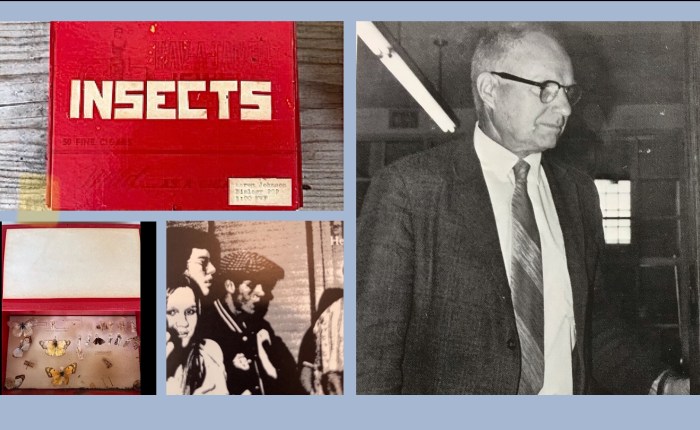
Charlie in the OHS Yearbooks from 1949 and 1971
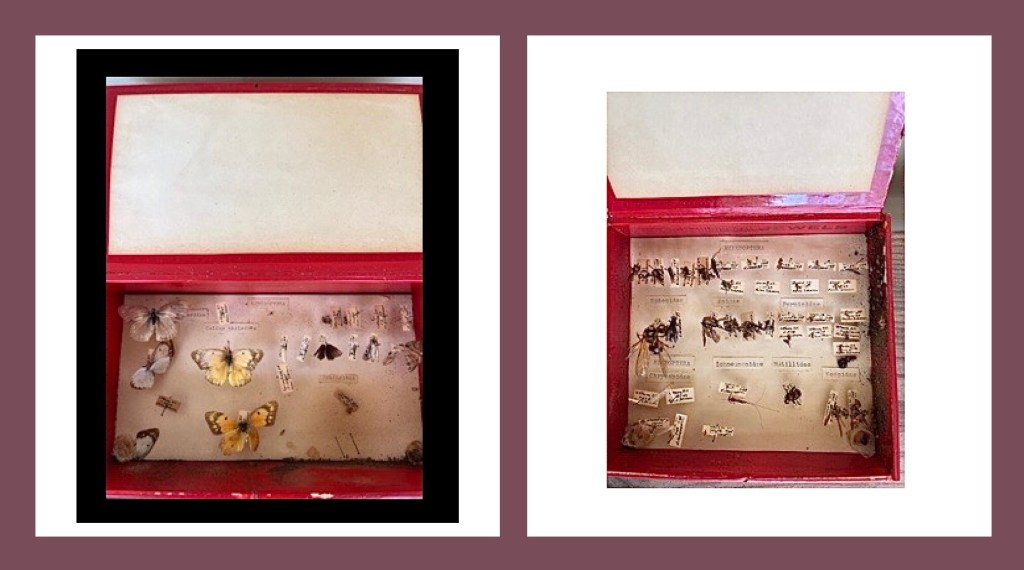
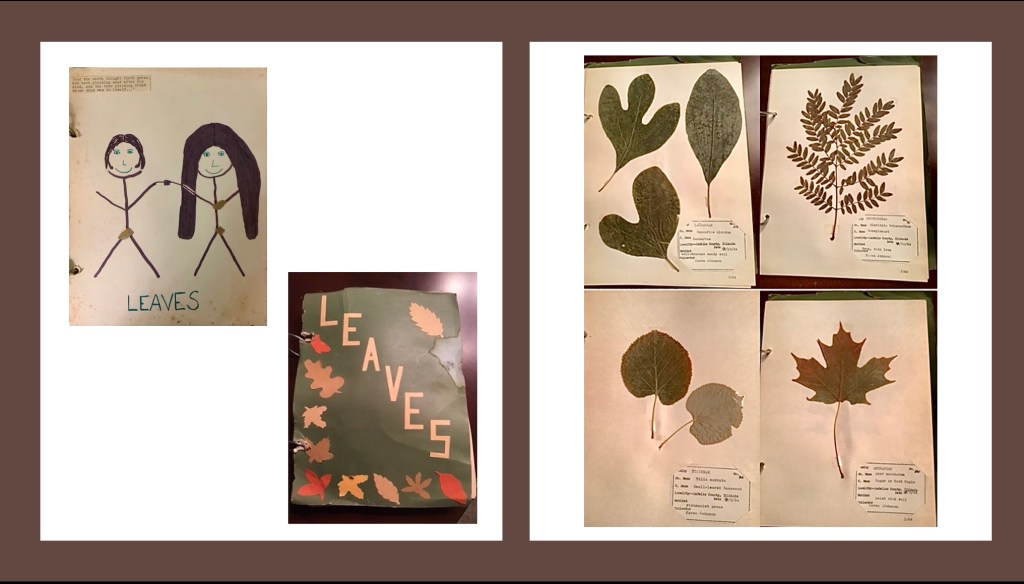
OHS biology classes had plenty of class time, lab time and tests, but what everyone really remembers is the three collections we were required to submit – Insects in the summer, Leaves in the fall, and Wildflowers in the spring. They could make or break your grade, that’s how important they were. It’s also why I was starting to sweat.
Earlier that summer, I’d made the trip to The Book Store at the corner of Main and Court Street. I bought the little pins and labels for the bugs, and most importantly, carbon tetrachloride*, or carbon tet, as we learned to call it. Soak a cotton ball in it, put the cotton ball in a jar, and drop in your bugs – good night! To box the collection, some classmates bought styrofoam boxes, or used shoe boxes. My buddy Howard and I obtained old cigar boxes from Senate Billiards, just up the block on Court Street. We’d gone to Senate Billiards for years, as it was also the best place in town to buy comic books.
I eventually kicked my bug hunting skills into high gear for those last two weeks of August and the first couple of weeks in September. The little glass jar with the carbon tet worked overtime producing specimens for my collection. The tiny labels were a pain, but everything came together. I turned in a reasonable collection, although I don’t recall my grade.
An OHS Insect Collection From Back in the Day
It didn’t really matter though, as we were already starting our leaf collections. We were mostly on our own to find and identify the leaves, although I seem to recall a class field trip or two on the East Side of town. I distinctly remember a Ginkgo tree there, one of only a few in town. To this day, I still recognize their unique fan-shaped leaves, with the veins radiating out into the leaf blade. There were other unique trees in town, if you knew where to look. Sally Richland recalls her family having a sassafras tree in their yard and students came from all over to pluck leaves. At the time, it was the only one in LaSalle County.
Although not as impressive as some, I did better on my leaf collection than with my insect collection. Not everyone did though. My friend Mark recalls two other buddies, Clay and Mike only starting their collections the day before they were due. They evidently spent a good part of the night outside with flashlights trying to find particular leaves. No word on what their grades were… ;-).
An OHS Leaf Collection and a Couple of Covers – I Don’t Recall being so Clever, or Typing the Info for each Leaf
By now it was late fall, or early winter, and in addition to studying bugs and leaves, Howard and I were studying Charlie Alikonis himself. We were fascinated by him. He was of Lithuanian heritage and spoke with a bit of an accent. He also had a unique way of communicating, that anyone who studied under him remembers. As he was identifying something for you to learn, he always started with a question and then answered his own question. As an example, when holding up a Ginkgo leaf he would say, “and this is a what-ah? This is a Ginkgo Leaf”. We thought it was brilliantly funny and started imitating him ourselves, while doing other things around town, as in – “and this is a what-ah? This is a pepperoni pizza…”. , or, “and this is a what-ah? This is a cheeseburger.”
We didn’t stop there. At the time, Charlie mostly wore bow ties. Howard and I went to Bell’s Clothing in town and bought tie bow-ties. Charlie wore a flat cap to and from school. We returned to Bell’s, and both bought similar, if a bit more brightly colored caps, and wore them for the next couple of years. I don’t recall anyone else among the teachers, or for that matter the students, wearing flat caps at the time, and yet there we were. (I lost mine over the years, while Howard still has his).
A 1973 OHS Yearbook Photo of me with my Flat Cap, and Howard Sporting his Just a Few Months Ago
We may have started out doing all of this to have some fun at Charlie’s expense, but as time progressed, things shifted. It evolved into us paying homage to him. I can’t say when or why the transformation started, but it was real. I’d like to think we matured a bit and began to understand what a great teacher he was, but we were teenage boys at the time, so who knows.
Winter eventually turned to spring, and we were back in the woods and fields surrounding Ottawa. This time, we were looking for wildflowers. I recall Charlie leading a collection/identification trip after school one day, near his house in the country. Although he had to be in his 60s, he was nimble as a mountain goat running around pointing out different flowers. We kids had a tough time keeping up. He also pointed out a flower called a White Trillium, but warned us not to have it in our collections. It was rare, and endangered in Illinois at the time.
Second semester eventually ended and I passed biology. The next year, I would have Red Ryder for Chemistry and a year later, Mr Krabel for physics. OHS had a great science department back then, and I learned from all of them. Having said that, Charlie Alikonis and those collections are what have stayed in my memory over the years.
It turns out I wasn’t alone. In talking with friends and others from Ottawa, everyone who took biology remembers the collections. And those under Charlie? A near universal seal of approval, particularly from those going on to study science in college.
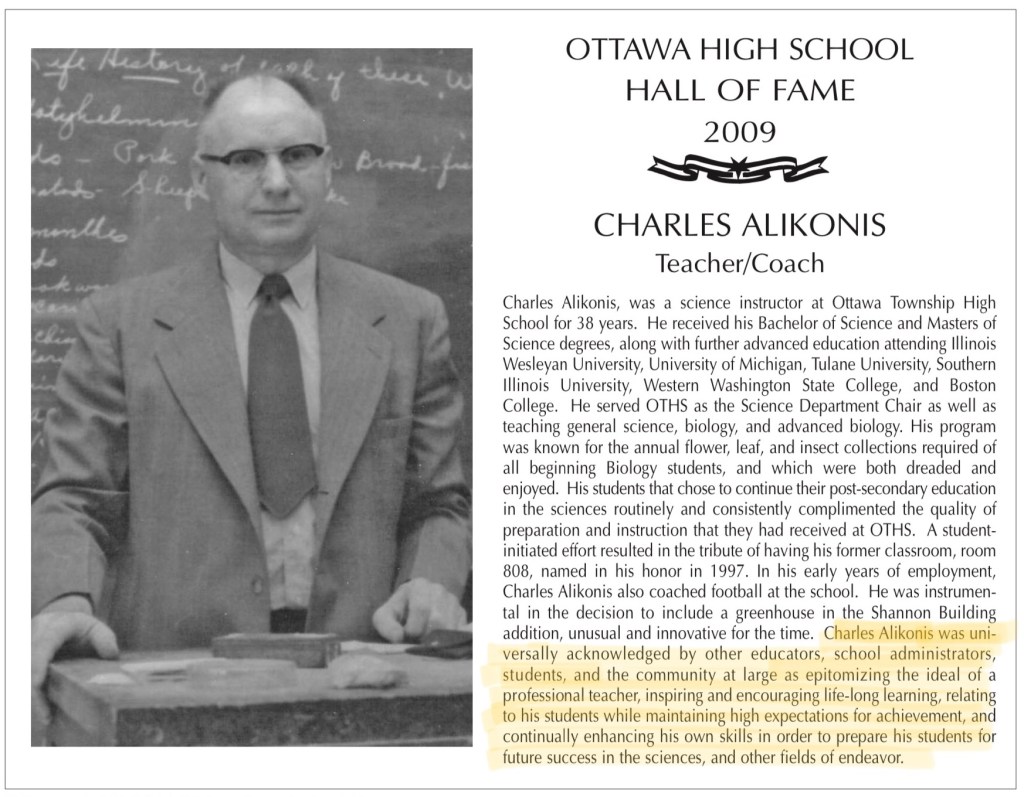
Charlie retired from OHS just a couple of years after we had him. In 2009, he was posthumously inducted into the OHS Hall of Fame. The highlighted words in the citation below say it all.
Charlie Alikonis – Preparing Students for Future Success
Addendum:
* Carbon tet is now a known carcinogen and no longer used. As Howard recently said, “Carbon tet and cigars—those collections were deadly…”
I owe thanks to a number of people for contributions to this blog, including buddies Tim Stouffer, and Mark Dunavan, along with Dan Shoulders, Sally Richland, Mary Cunningham Heider, and Jeanie Cunningham Ruhland.
Thanks to Karen Crisler and Leslie Poole for providing photos from their insect and leaf collections – they were a perfect addition!
Special thanks to my old friend Howard Johnson, who I’ve known since before first grade. His memories on Charlie in particular helped round out this blog.
Get ready. They are coming. You may have heard the seventeen year cicadas are due in our area in another month or so. From mid May to mid June we will have literally billions of singing cicadas. The goal of all that singing? Sex. That’s right, sex. After seventeen years underground, they emerge, eat a bit, the males sing in a chorus, they all have sex, the females lay eggs and everyone dies off. That’s it.
The last time they were here? 2004. I have three lasting memories of that visit, but first a bit of background.
For approximately five to six weeks, starting in mid May, the cicadas will overrun us. These particular Cicadas arrive in seventeen year cycles and each of these cycles are called “Broods”. The Broods are numbered in Roman Numerals, and Brood X (10) is about to grace us. This is one of the largest and most widespread, and encompasses Virginia, Maryland, DC, Delaware, West Virginia, North Carolina, Georgia, Kentucky, Tennessee, Illinois, Indiana, Pennsylvania, New Jersey, and parts of Michigan and New York.
Given this is the time of Covid, you might be forgiven for thinking in terms of biblical plagues and that cicadas are locusts, but they aren’t. Locusts are actually a type of grasshopper, so we are OK in that regard. The cicadas are relatively safe and do no harm, except for possibly small, young trees. We, and our gardens, are safe. In fact, the cicadas are a boon for the rest of nature. Birds and animals feast on them when they first arrive. Eventually, they’ve eaten so many, they go into the animal version of a food coma after Thanksgiving Dinner and stop munching. The cicadas however, continue to arrive.
After emerging, the male cicadas join together singing in a “chorus” to attract the females of the species. Their singing becomes incredibly loud. Scientists who study these things say the choruses can reach 100-120 decibels, the same as a rock concert. The difference? The cicadas can go on for days. That’s right. We’ll be sitting in the equivalent of about row thirty at Woodstock or Lollapalooza. The only difference is that this will go on for quite a bit more than the three or four days of those rock concerts. if you live in our area, they will be impossible to ignore.
Inevitably, you also hear about eating cicadas. DC based Naturalist, Alonso Abugattas, had this to say: “Cicadas are gluten free, low in fat, low carb, rich in protein (the same pound for pound as beef). They’ve been grilled, skewered, steamed, barbecued, blanched, boiled, and used in cocktails. My old boss would fill the empty skins with Cheez Whiz and serve them as appetizers”. Hmmmm….
I have three memories from the last time they visited us in 2004. The first is that they were loud. I don’t remember rock-concert loud, but they were loud enough you couldn’t hear anything else – no other insects, birds, or even small children at the neighbors.
The second memory involved eating them. No, it wasn’t me eating them. It was our dog, Holly. She loved eating them. Hundreds or thousands of them were in our front garden. Most were on plants at dog-eye level. Holly, God bless her, walked at a slow pace from plant to plant eating cicadas off the tops of the plants as she went. Night came and we called, but she didn’t come in. Bedtime came, we called again and she still refused to come. We decided the hell with it, and left her outside (she was on an underground fence and couldn’t leave the property). Morning came and we went out the back door and found Holly laying there. We opened the door and she slowly came in the house, looking a bit how a dog would look with a hangover, if there was such a thing as a dog hangover. We filled her bowl with food. She took one look at it, walked passed it and headed to bed, where she proceeded to sleep the rest of the day. She had gorged on so many cicadas, she wasn’t hungry for breakfast. I had never seen her ignore a meal before, or for that matter, afterwards.
The final memory is a bit sadder. Eventually the noise of the cicadas started dying down. It went from a roar, to a rumble, to a pleasant buzz, to silence. Total silence. Just like that, they were gone. The great 2004 cicada orgy of sex and sound was over. Except it wasn’t.
About a week later, we heard the unmistakeable sound of a single singing cicada coming from the woods by our house. While not particularly loud, you could definitely hear him. A single lonely cicada singing in the night, looking for a partner. Any partner. It might have gone on for an evening or two, and then it too was silent.
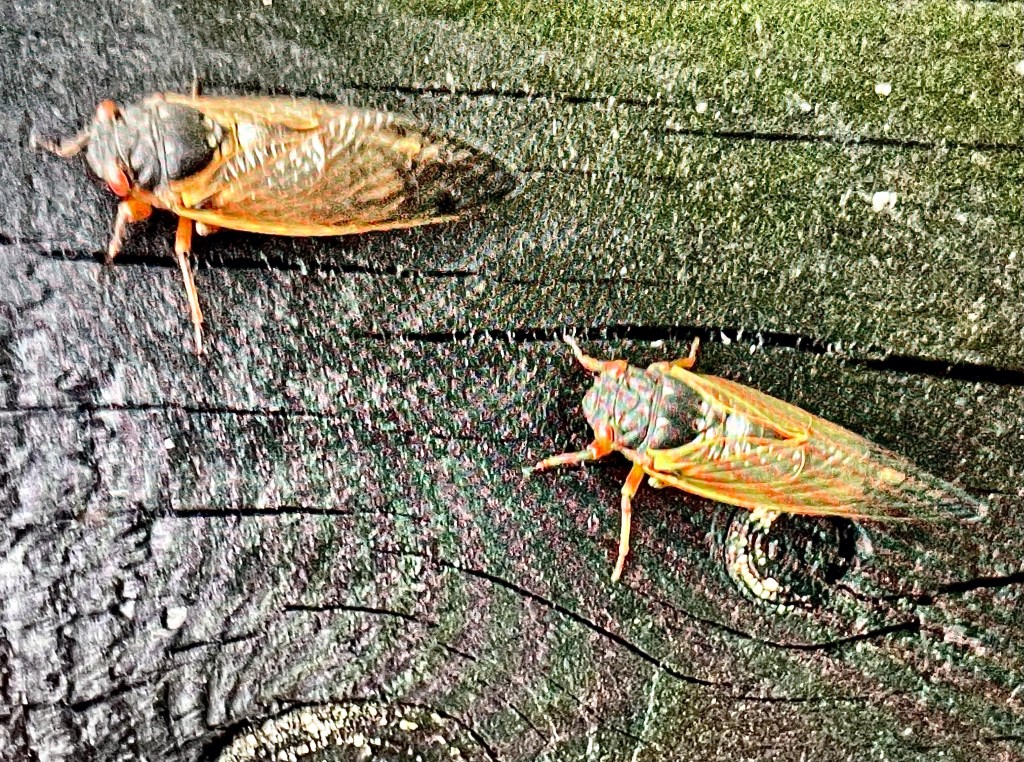
A Cidadafrom Brood X in 2004
I’ve thought about that cicada off and on over the years. I think about the cruelty of it. You’ve spent seventeen years approximately eight inches underground. A lot has gone on. Finally, it’s your day in the sun, but Mother Nature plays a cruel trick on you. Maybe you had to dig around a rock to get above ground. Maybe you were a little deeper than eight inches under ground. Or, maybe you were having a great dream, and decided to sleep in a couple of extra days. In any case, you finally emerge, ready to join the chorus and have a little sex on the side, and… nothing… nada… nobody. It’s as if you make the trip to Spring Break to party, arrive, and find nobody else is there. Spring Break ended a week before and you never got the word. Now, it’s just you, all alone on the sand with scattered empty beer bottles littering the beach. A day later, you die and don’t even make the trip back home.
OK, OK, I know I went a bit over the top, but I did feel a bit sorry for the guy. Sure lots of other cicadas were eaten by animals (including Holly) when they first emerged. At least they saw and heard some from the Brood. The last guy? All alone in this cruel world.
Anthropomorphism is the attribution of human traits or emotions to non-human entities. We all do it at one time or another, particularly with our pets. I doubt seriously the little guy felt alone, realized he was about to die, or missed out on the sex part. Still, he had to know he was singing for some reason, so maybe he did realize he was missing out on sex with some last gorgeous female cicada. Hell, for all I know, maybe there was one last female in the woods, he found her, they had sex, she laid her eggs, and they both died. I’d like to believe they died happy.
Did he ever find a mate? We’ll never know…
Addendum:
Special thanks to my Sister-in-law, Bonnie Harris. She came up with the great line “all alone on the sand with scattered empty beer bottles littering the beach”…. 😉






 Live Life Exuberantly