Perry and Della

Perry and Della

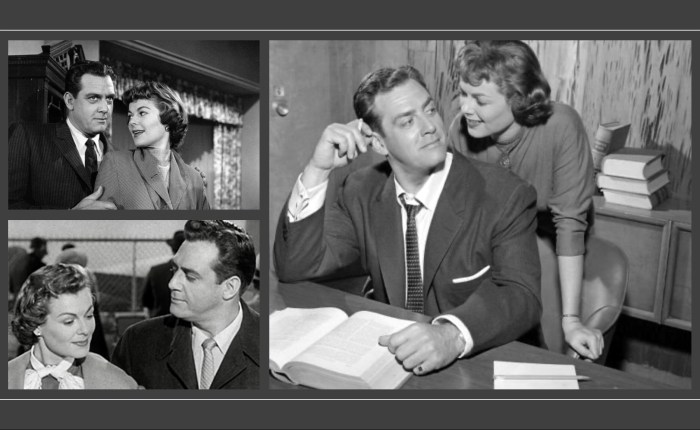
The sly glances, the casual banter, the innuendos, the back rubs… I think we all knew what was going on, but no one said it out loud. Let’s face it, Perry Mason was having an affair with Della Street, while Paul Drake, Hamilton Burger, and even super sleuth, LT Tragg, were all unaware.

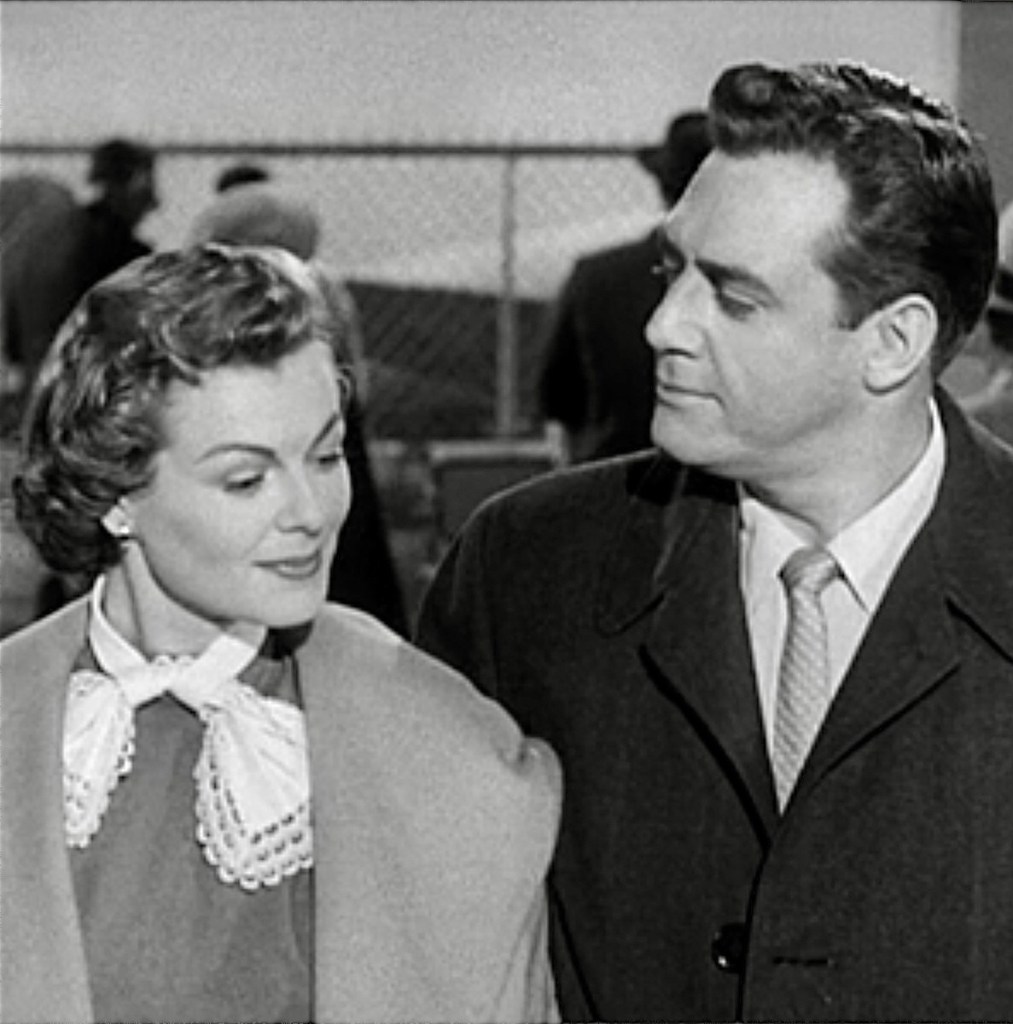
Just another sly look between the two…

This past winter, Cathy and I discovered Perry Mason reruns on TV. We chuckled as we decided to watch the first episode, but soon became addicted. Nothing else on tonight? Let’s go watch a couple episodes of Perry.

Perry Mason was on the air from ‘57-‘66, and Raymond Burr won two Emmys. I have to say the show is great entertainment, although a couple of thoughts have crept into my brain while watching.

First, was there ever a more inept District Attorney than Hamilton Burger? Over the course of nine years, Perry won 268 out of 271 cases right off the bat, and while Burger didn’t handle all of them, he was the prosecutor for the vast majority. (Note that the actor who played Burger, William Talman, was fired from the show in 1960 for about six months after being arrested on charges of marijuana possession and lewd vagrancy. During that period, there were several different prosecutors. After the charges were later dismissed, he returned to the show). How could Hamilton Burger be so bad? He is ALWAYS on the wrong side. Even the cases he won were eventually overturned on appeal. Fred Thompson, as the DA on “Law and Order”, would have had no use for him… 😉

Don’t worry, Perry won during the appeal.

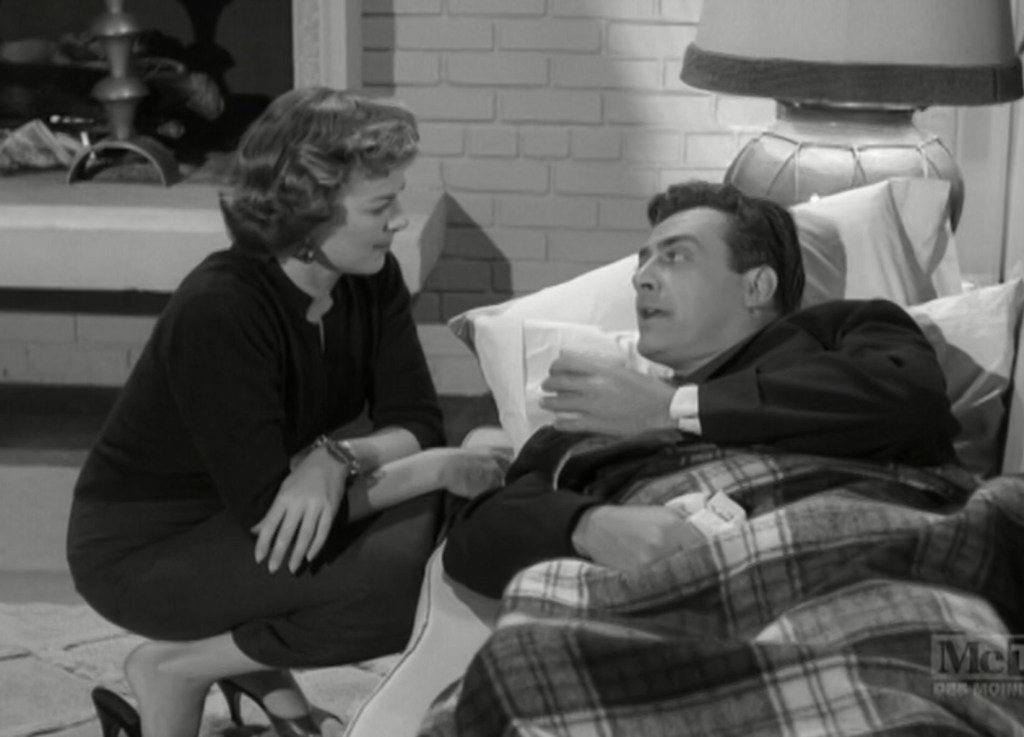
What really intrigues me is the relationship between Perry, and his Executive Assistant Della Street. I mean, hello, if these two aren’t having an affair, then nobody is. The sly, knowing looks, the continual side-by-side presence, the flirty banter back and forth… It all adds up. Plus, Della is ALWAYS there. Early morning in a diner with a client? Della’s right there with Perry sipping coffee. Midnight or 2AM in the office waiting on a call? There’s Della asleep on the couch. When Perry’s home sick with the flu, laying on his couch in pajamas, who brings him chicken soup? Della of course. Perry has a tough day at the office – who gives him a back rub? Della! And who’s walking off a vacation cruise ship with Perry to go help him solve a murder? I think you know the answer.

Who nurses Perry back to health? Why Della, of course!

We were discussing Perry and Della one evening with a friend when he exclaimed “I know! And you have that gorgeous Paul Drake right there! What is wrong with her? She’s definitely going after the older guy with the money!”

What about the “gorgeous” Paul Drake? He appears to be the ultimate catch. He drives a convertible sports car, wears sport coats or turtlenecks instead of the suits Perry is always in, has that rakish haircut, and is just hip in general. Not only was he an investigator, he acted as Perry’s tough guy, was an alleged ladies’ man, and the coolest dude on the show. And yet, he apparently has no personal life. Perry needs him in the middle of the night for a murder investigation? He’s there. Someone needed for a 24 hour stakeout? Paul’s your man. Here’s an interesting tidbit – Although he is a supposed “ladies’ man”, he never once hits on Della. Not once. If James Bond was always flirting with Miss Moneypenny, Paul, other than the occasional “Hello beautiful” to Della, was just the opposite. There was zero flirting. Was this in deference to Perry, or for some other unstated reason? We’ll never know.

Another of Paul’s evenings, about to be interrupted by Perry Mason.

We continue working our way through the episodes and are somewhere in season 5 by now. Perry continues his winning ways, Hamilton continues to snivel and lose, Paul continues looking cool, and Della? Della’s right there for Perry, anticipating his every need.

Addendum:

– This blog was written tongue in cheek, but it turns out that it is a common question among fans as to whether Perry and Della ever had an affair. The author of the Perry Mason books, Erle Stanley Gardner, wanted the answer to be, “No.” Believing that if Perry ever married Della “he would lose his sex appeal,” Gardner intended the nature of the relationship between the two to remain a mystery. In fact, he said that if they ever had a romance, he’d write about it. He never did.

Lost in Translation

Lost in Translation

Our second favorite restaurant in Rheindürkheim, Germany in the late ‘80s was Pfeffermühle (The Peppermill). Das Letzte Essen (The Last Meal) didn’t occur there, but that is where the story started.

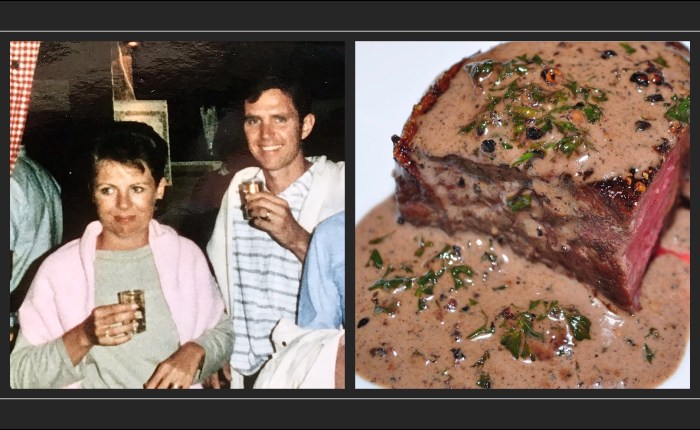
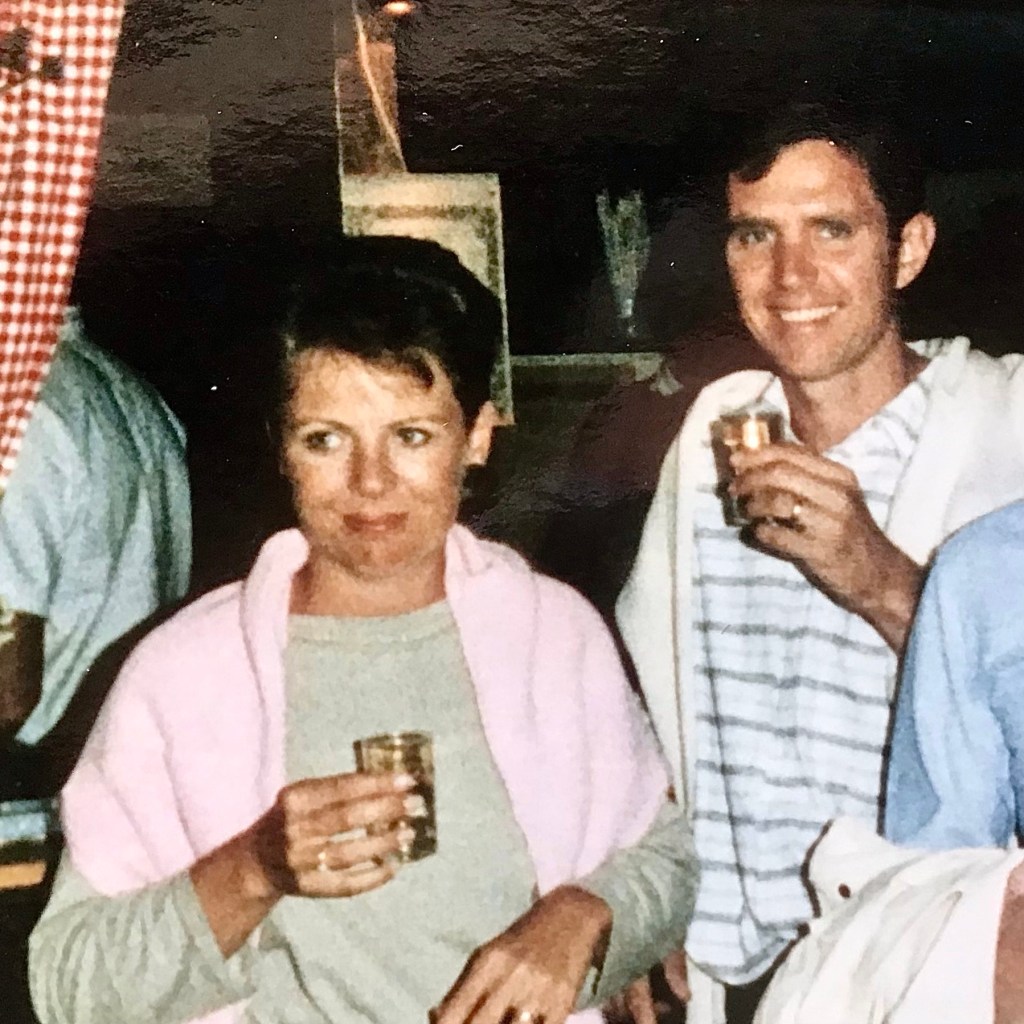
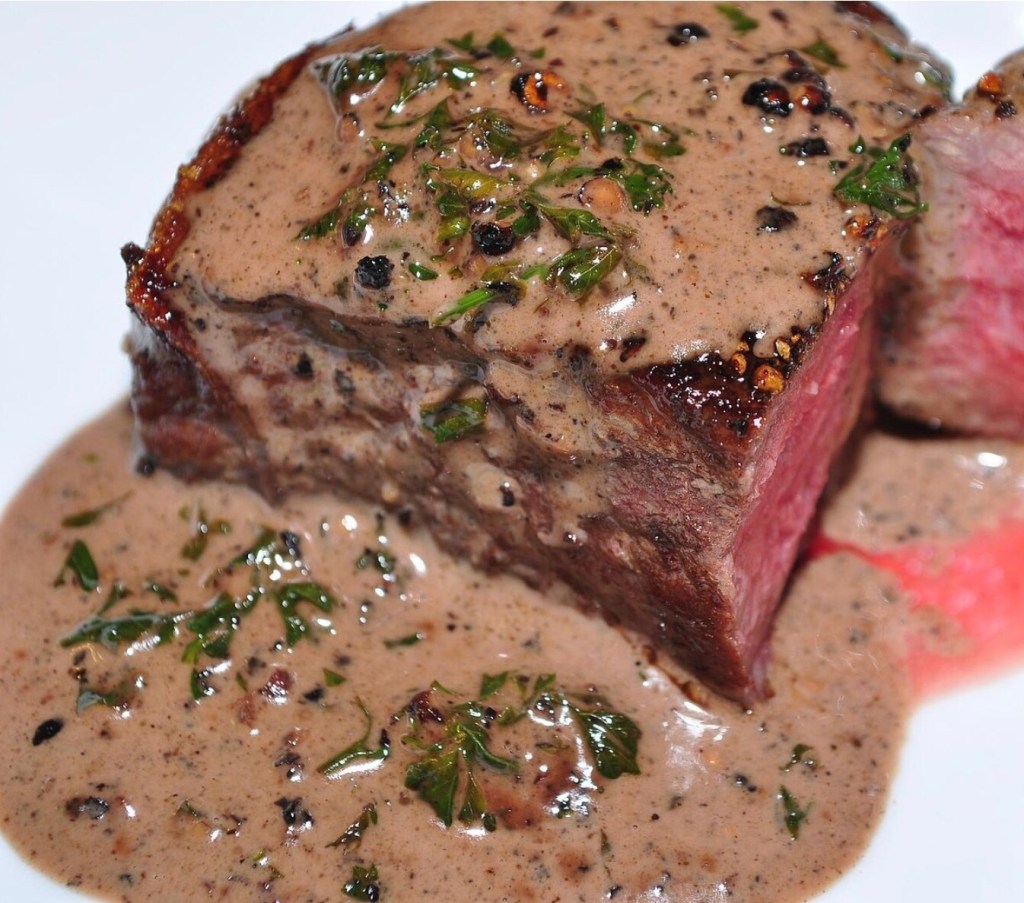
Recently, Cath and I were thinking about Pfeffermühle. I’d made Cathy a special meal one night for dinner, Steak au Poirve (Steak with Pepper Sauce). As we were eating dinner, she said “Do you remember the couple we met at…”, before she could go on, I finished her thought “…at Pfeffermühle? The ones who came to dinner?” “That’s them!”, she answered. “Do you remember her sayingDies ist das letzte Essen?”” (This is the last meal). We both started laughing…

Cathy and I About the Time of “The Last Meal”

Pfeffermühle was located just outside of Rheindürkheim, on Sommerdamm Strasse, the main road to Worms. It opened after we had already lived there for a year or so. Bruno, the owner, was from Italy and moved to Germany after spending several years in California. Although the restaurant was nondescript on the outside, once inside, the white tablecloths and napkins caught your attention.

The food made an even bigger impression. They served both pizzas and traditional Italian fare. Two great food memories that stay with me even today were their lasagna, and how good their pizzas were. One of the pizzas came with an over-easy egg in the center of it. Yea, I know it sounds strange, but it was really tasty. I’m not sure about now, but at the time, you always ate pizza with a knife and fork in Europe, so the egg was no problem.

Bruno worked the front of the restaurant, while his wife was the chef in the back. He was quite the host and spoke fluent Italian, English and German. He made everyone feel welcome when they arrived, and Pfeffermühle soon became popular. If you were there on a Friday or Saturday night, the place was always jammed.

We became regulars, and as is often the case, over time, would recognize other regulars. There weren’t really any Americans, but Germans came from several nearby towns, and we became friendly with a few couples we ran into regularly.

One evening it was turning late and only a few tables were still occupied. We recognized a couple sitting at a table near ours, and started talking with them. They invited us to their table for a nightcap, and that’s how we first met Gerhard and Hannah. We shared a drink or two, and everyone agreed we needed to get together some time in the future. With that, we all said good night and didn’t think any more about it.

Except…

We ran into them the next week, and then again two weeks later. That night, I bought the drinks. As the evening was ending, Gerhard invited us to dinner at their home in Osthofen a week later. We readily accepted.

The following Saturday, we drove the three kilometers to Osthofen, where we ate a wonderful meal. I don’t remember what we had, but I do remember he served French red wine with the meal. At the time, we didn’t know any Germans who did that, and it made an impression. The Germans make wonderful white wines, but their reds? There weren’t too many of them, and they weren’t that good at the time. Usually, you drank white wine or beer with dinner, no matter the meal.

Of course we wanted to return the favor, and invited them for dinner a couple of weeks later.

Cath and I stressed a bit about what to cook, as we wanted a nice meal. I don’t remember what we did for an appetizer, but we finally agreed the main course would be “Steak au Poirve” from a cookbook a friend had recently given us. It was a bit elegant. It was also the first time we would ever make it. For dessert, we would make a “Champaign Granita”.

Charollais is a Specific Kind of French Beef

The big night finally arrived and Gerhard and Hannah arrived at our home. We served some drinks and were bringing out appetizers when Hannah said “Dies ist das letzte Abendmahl”. What? Did we hear correctly? “This is the Last Supper”?** Was today some German religious holiday we were unaware of?

Was hast du gesagt?” (“What did you say?”)

Heute ist das letzte Abendmahl. Das letzte Essen.” (“Today is the Last Supper. The last meal.”)

Oh man, we must have screwed something up. Today must be some important holiday of which we were unaware. Either that, or she was going away somewhere and this was her last real meal. What were we going to do? And then she explained…

…The next day, she was starting a diet. Tonight’s dinner was her last meal before going on the diet…

Cathy and I started laughing, and they gave us a look. We then explained our lost in translation problem with “The Last Supper” and the religious connotations, and they started laughing as well.

The dinner went well, and the “Steak au Poirve” served with potatoes turned out to be a fine last meal before starting a diet. I followed Gerhard’s lead from the previous dinner and we drank some kind of red California Cab I’d bought at the military Class 6 store. The dessert wasn’t perfect, but we served it with Sekt (German sparkling wine) and no one seemed to mind. Over dinner, we all made a couple of jokes about the last supper, and whether this was worthy. Eventually, after coffee and schnapps at the end of the meal, they left and drove home.

Steak au Poirve

We saw them occasionally after that at Pfeffermühle and had a late evening drink with them a time or two. Perhaps six months later, we returned to the States and lost track of them. Pre-Internet, there was of course no exchange of email addresses or cell phone numbers.

This story is really about just a bit of nothing, but we still remembered the evening, and chuckled about The Last Supper, although it’s 44 years later. Even small old memories can be good for the soul, especially when they come out of no where.

Addendum:

** – For those who may not be aware, The Last Supper is the final meal that Jesus shared with his apostles before his crucifixion. It became the basis for the holy communion. In the Gospel of Matthew, Jesus prays thanks for bread, divides it, and hands the pieces of bread to his disciples, saying “Take, eat, this is my body.” Later in the meal Jesus takes a cup of wine, offers another prayer, and gives it to those present, saying “Drink from it, all of you; for this is my blood of the covenant, which is poured out for many for the forgiveness of sins.” It is immortalized in DaVinci’s famous painting. Our dinner wasn’t anywhere near Easter, but the Germans have A LOT of religious holidays, which is why we thought we may have been unaware of some other holiday.

Submarine Games

Submarine Games

Crazy Ivan* anyone? Another Submarine story from my buddy, Bob Bishop**… It was mid-September, 1970. Our submarine, the USS Finback, had been commissioned way back in February, but we were still doing a number of exercises and independent operations to get additional sea time under our belt. On this particular exercise, we were to provide “services” to anti-submarine warfare (ASW) configured Navy patrol aircraft, to give them an idea of how to use their ASW gear and try to find a real live nuclear submarine. This exercise was to involve every ASW patrol plane on the US east coast, NATO members in western Europe, and one reserve squadron from Chicago (don’t ask me why there is an ASW squadron in Chicago).

The USS Finback (SSN 670)

In the Atlantic Ocean, that meant a complex organizational challenge for a lot of people. For each exercise, using radar and radio communications, we would vector a Navy Lockheed P-2 Neptune or P-3 Orion aircraft on top of our location so they could mark where we were. We would then submerge and maneuver. If they didn’t find us in 50 minutes (marking our location by dropping a transmitting sonar buoy), we would broach or surface, show them where we were, and they would then clear the area for the next plane to arrive at the top of the hour. We did this for 18-20 hours a day most days, for 4½ weeks.

During the exercise, we also did occasional helo transfers of a CO/XO from an aircraft squadron to our ship, so they could get a sense of what it was like to be on a submarine and how we operated during these exercises. I particularly remember one squadron XO, a Commander (I was a lowly Lieutenant, but was pretty comfortable with what I knew and no longer frightened by a senior officer), who came in the Control Room after midnight one night. I was the Officer of the Deck (OOD) – the officer on duty responsible for driving the ship, responding to emergencies and so on, unless the Commanding Officer came on deck to relieve me. I had the 0000 to 0600 watch and we were in the middle of conducting the ASW exercises.

We talked over a number of things he was curious about, and he watched as I/we went through a couple of the exercise cycles. Chatting after the third one, he observed “I think I understand your plan. You alternate going to port or starboard as soon as you submerge.” I responded, “Well, not actually”, and we walked over to the chart table. A piece of paper was taped on top of the glass top of the chart table. A mechanical device under the glass receives inputs of the ship’s speed and direction and moves a little light accordingly. Every minute the quartermaster puts a pencil dot where the “bug” (the light) was. As a result, you could see where the ship had been.

I quickly explained how “the bug” worked and showed him where we started the last run and where we ended up 50 minutes later. I then explained that the Captain gave the OOD the latitude to do whatever he wanted, so I decided to spell the Helmsman’s (the person actually steering the ship) name in cursive each watch. I think the letter I was on for that particular run was a “b.” The Lt Commander looked at me, aghast. “You mean, you don’t have a pattern, a routine?” “Nope,” I said, “It all depends on when I am on watch and who the Helmsman is. Although sometimes I use the name of the Stern Planesman or the Diving Officer.”

He walked quietly away, mumbling to himself.

During the 4 1/2 weeks of the exercise, not a single plane ever found us, even though they knew where we started each time. A discussion about the capabilities of ASW aircraft is a subject for another day, but I’ll leave it at this – ASW aircraft (including helicopters) vs. a US Navy nuclear submarine? Bet on the submarine, every time.

Bob in 1964, and then about 50 years later

Addendum:

– * Crazy Ivan references a maneuver sometimes performed by Russian submarines, and made famous in the movie. The Hunt For Red October.

⁃ ** My friend Bob Bishop graduated from the United States Naval Academy in 1964 and had several tours on Nuclear Submarines during the Cold War. At the time, Admiral Hyman G. Rickover, the founder of the modern nuclear Navy, personally interviewed and approved or denied every prospective officer being considered for a nuclear ship. The selection rate was not very high.

– This story is pretty much all Bob’s. All I did was add some editing assistance and publish it.

⁃ The USS Finback (SSN-670) was a nuclear-powered fast attack submarine. Bob was a “plankowner” – a member of the initial crew. He was the third officer to report on board.

⁃ You can read another of Bob’s submarine adventures here. It’s a compelling Cold War story. The movie, The Hunt for Red October, is child’s play, compared to what these sailors did on a daily basis. …The Comms Officer ran in and handed the CO the decoded message. The CO read the message, took the lanyard from his neck, unlocked the firing key cabinet, and reached in for the firing key. We were about to […] Continue at: https://mnhallblog.wordpress.com/2021/06/23/we-knew-we-were-at-war/
The Black Death

The Black Death

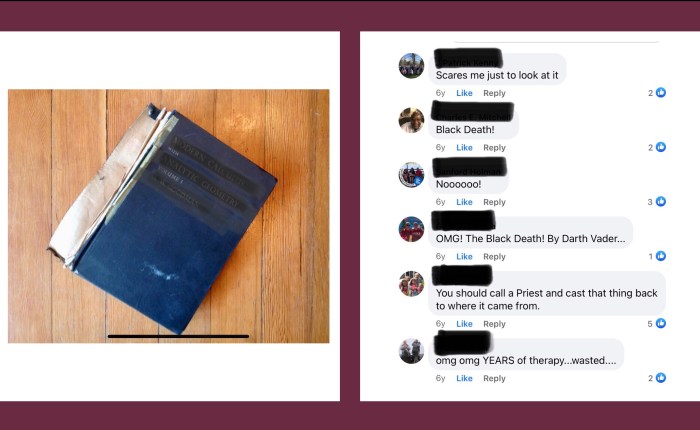
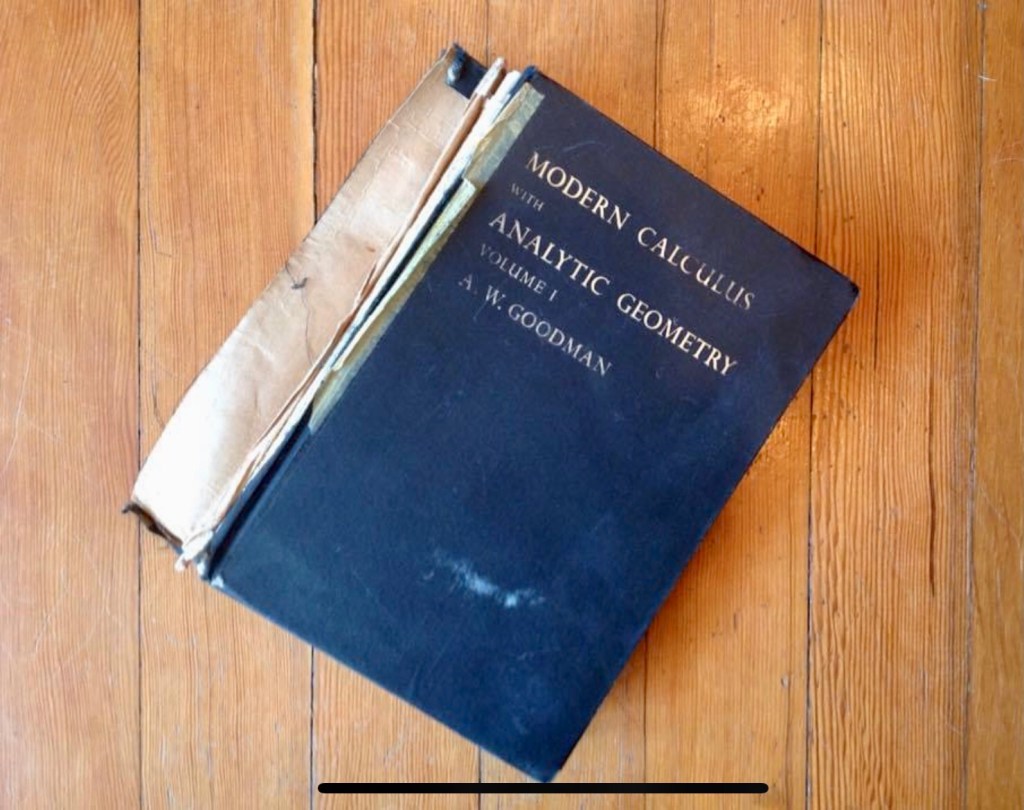
The Black Death. That’s what we called it. Among us Plebes at West Point, feelings were strong, and universal. To this day, grown men shudder when they see a picture of The Black Death. How could a single book leave such a strong impression? What devilry was this? What book of spells could cause such consternation?

Yes, Grown Men Still Shudder when they See a Photo of The Black Death

Of course it wasn’t just any book. This book was “Modern Calculus With Analytic Geometry (Volume 1)” by A.W. Goodman. We never called it that though. We called it The Black Death, or sometimes The Black Plague. The book was black, but I suppose our title referred to the entire experience of Plebe (Freshman) math at West Point as much as anything.

The Black Death, in all it’s Glory

After Beast Barracks our first summer at West Point, it was a relief to get to the academic year. Unfortunately, we didn’t quite know was waiting for us. In addition to the normal Plebe challenges, Calculus was a required course for all, and provided our introduction to The Black Death.

This wasn’t just any old math course. There were several “attributes” that put the class  into the category of those things you never forget.  My classmates and I laugh about it now, but it’s still a bit of a nervous laugh.

First off, the class of ‘78 went to Plebe math five days a week, including Saturdays, with 90 minutes for each class. Prior classes attended Calculus class six days a week for 75 minutes per class and thought ‘78 was getting over, since it was only five days a week ;-).

In the class itself, we had normal homework, quizzes and tests. In addition, we suffered a unique form of torture called “The Boards”, also known as “Recitations”. A couple of days a week, the professor would call out “Take Boards.” We cadets stood up and each of us went to one of the blackboards that covered the walls in the classroom. The professor then asked us to work through a calculus problem on the board. It might have been one of the previous night’s homework problems, or it might have been the proof of some theorem. After several minutes, he called “Cease Work!” and then called on one of the students to walk through, or recite, their problem solution. Sometimes it was a cadet who had the solution mapped out perfectly. Other times? Well, other times it might be a cadet whose answer wasn’t correct. It could make for some tense/fumbling moments. Recitations had taken place at the Academy since at least 1869.

Somethings Never Change – Cadets “Taking Boards” in 1900

Of course that sly b@stard Goodman contributed to our pain. While there were often theorems in the book that provided the mathematical proof for the result, it wasn’t always the case. If there was ever a theorem in the book where it said “The proof is intuitively obvious to the casual observer”, you knew it would be a problem for the boards, or a quiz, or a test. For most of us, the solution was never “intuitively obvious”.

At the time, West Point was on a 3.0 grading scale. 3.0 was a perfect score. 2.0 was the lowest passing grade. If you scored a 2.5 on a quiz, you built up five “tenths”. If you scored a 1.7 on a quiz, that was the equivalent of an F and you were down three “tenths”. For those near the bottom of the class in math (or any course), the phrase “2.0 (pronounced “Two OH”) and go” became common. Basically it meant over the course of the semester (and year) you needed to finish with a 2.0 average. Any tenths over that were wasted.

We were quizzed and tested on a regular basis and over time, each of us fell somewhere on the spectrum between 3.0 and less than 2.0. Every few weeks, the math department reordered us cadets by current math class grade ranking. That is, those with the highest grade average, migrated to the “top” sections, while those with the lowest scores would migrate to the “bottom” sections. Each section had about 15 or 17 students. The theory was those in the top sections could cover more material, while those in the lower sections could receive the extra help needed. This reordering of the class on a regular basis was first implemented in the 1820s and was unencumbered by progress for the next 160 years.

The lowest section also earned the nickname “the ejection section” and the guy with the very lowest grade was in the ejection seat. My classmate Rick Steinke, was in the ejection section and ejection seat at various times. At the end of the semester and year, some number of cadets weren’t going to have a grade over 2.0 and one of three things would happen. Rick’s recollection – “That is where I was at the end of first semester, plebe year. Of the bottom 30, as I recall: 1/3 of us did not make it to the next semester (they were booted from the academy); another 1/3 were turned back a year; and another 1/3 went to summer school. I believe I was the only plebe who escaped unscathed, with just a couple of tenths to spare. Thanks to Captain Art Bonifas*, my first semester Professor, and Major Bachman my second semester P, I made it through. Also, Marty Vozzo, my roommate (and several years later, a math professor back at West Point), told me which theorems and equations I needed to memorize. Divine intervention, my brother.”

Rick DID survive the Ejection Section, and the Ejection Seat

Time passed, and we moved on. Obviously lots of Plebes did quite well in Calculus. Many excelled at it.

My classmate Joe Spenneberg, returned to teach math at West Point a decade later, from ‘88-‘91. By the time he returned, Goodman was gone, as were The Boards. The cadets still attended math five days a week, but only for an hour at a time. Also, classes were no longer “reordered” on a regular basis. The course work changed some as well – instruction started with “discrete math”, before migrating to integrals and “continuous math”. In Joe’s words, “The jump between discrete and continuous was key. We told them to imagine that the discrete step is infinitesimally small, which introduces the concept of the limit which is essential to being able to define a derivative …” as Joe was recently explaining this to me, I fogged over about then ;-).

Joe also told me a total of nine or ten of our classmates DID return and teach math at West Point.  To the best of my knowledge, as a class we never ostracized them. 

I’m sure Mr. Adolph Winkler Goodman, who died in 1989, had no idea about his effect on Plebes at West Point. I don’t think it mattered if you were a star man (top 5% of the class) or a goat (bottom of the class), everyone called it The Black Death. Yea, we laugh about it now, but it was pretty serious stuff then. Looking back, it was one of those commonalities that united all of us. You don’t think about a math class uniting people, but I sure think The Black Death did so for us. The only other class with a similar effect was boxing, but that’s another story for another time.

As I was working on this blog last week, I had a dream one night.  I was back at West Point, and you guessed it, in math class.  It was finals and I was in the classroom with several classmates.  Time was passing and for some reason, while I had a copy of the test, I couldn’t find my paper to write my answers down.  I knew the answers, but I couldn’t find the piece of paper to write them on. Classmates started finishing the test and leaving the classroom AND I still hadn’t started.  I was trying to ask the teacher for help, and getting no response…  

I woke up in a sweat.  Looking around, I was in my own bed, with Cathy sound asleep next to me.  I settled back to sleep and chalked it up to one last gift from Mr Goodman and The Black Death. 

Addendum:

⁃ * The name Captain Art Bonifas might sound familiar to you. After leaving West Point, Captain Bonifas was stationed in Korea. In what came to be known as “The Korean Axe Murder incident ”, Bonifas was bludgeoned to death by North Korean soldiers in an international border incident in August of 1976. The world was pretty tense for a couple of weeks after his death. You can learn more about the incident here: https://en.m.wikipedia.org/wiki/Korean_axe_murder_incident

⁃ Special thanks to classmates Rick Steinke, Joe Spenneberg and David Fitzpatrick, who contributed both content and editing to this blog. All three were involved in teaching and Higher Education after their time at West Point. Rick is a former Harvard National Security Fellow, and later served as the Associate Dean at the George C. Marshall European Center for Security Studies. Joe and David both returned to teach at the Academy, and Dave continues to teach History at Washtenaw Community College in Ann Arbor, MI.

– If interested, here’s a blog about my first two hours at West Point: https://mnhallblog.wordpress.com/2017/03/18/first-two-hours-at-west-point/

⁃ For some additional history about West Point and Math, you can try this article – Mathematics Education at West Point: The First Hundred Years: https://www.maa.org/book/export/html/116851. Founded in 1802, West Point was the first engineering school in the United States, and had a uniquely technical curriculum for its time. The first two years of the curriculum was dominated by mathematics. The information in this blog on the history of “Taking Boards”, and the reordering of the class on a regular basis were both documented in this article.

⁃ You can learn more about the restructuring of math instruction at West Point in the late 1980s and early 1990s here: https://www.westpoint.edu/sites/default/files/inline-images/academics/academic_departments/mathematical_sciences/Math/v04_issue1.pdf

Talking to the Animals

Talking to the Animals

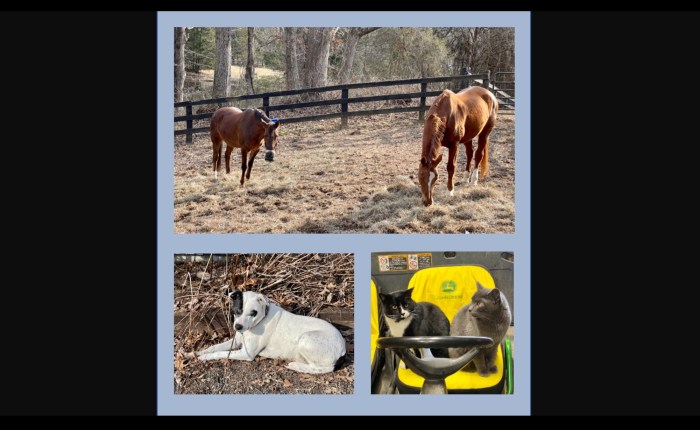
I’m no Doctor Dolittle, but I do “Talk to the Animals” here at Rohan Farm, and do so on a pretty regular basis. Most mornings, we have conversations, although they tend to be a trifle one sided, at least in a verbal sense. Still, I think we have a pretty good understanding of each other.

It starts when I wake up in the morning. Carmen, our dog, will stir and I’ll ask her if she had a good night sleep. She doesn’t answer, and instead does a couple of “downward dog” yoga stretches while waking up and looking at me. Eventually, we are both awake and go downstairs and out the door.

At the barn, I greet our horses, Katy and Stella, with a good morning, and ask them if they had a restful night, and whether there were any visitors to the barn. They tend to just look at me, and the look says “Where were you? It’s time for our breakfast!” On cold mornings, when there’s some ice in their buckets, I’ll also ask if they were warm enough during the night. Of course they were, but it seems a friendly thing to ask. While getting their food, I keep a bit of chatter going about the beautiful sunrise outside the barn, or the new snow on the ground, and aren’t they going to be surprised when they are turned out. They respond by stomping their hooves, or scraping the bars on the stall doors with their teeth, wanting to know where the hell breakfast is. Eventually, I give it to them, and things quiet down, while they munch away.

Katie and Stella – “Where’s my breakfast!?”

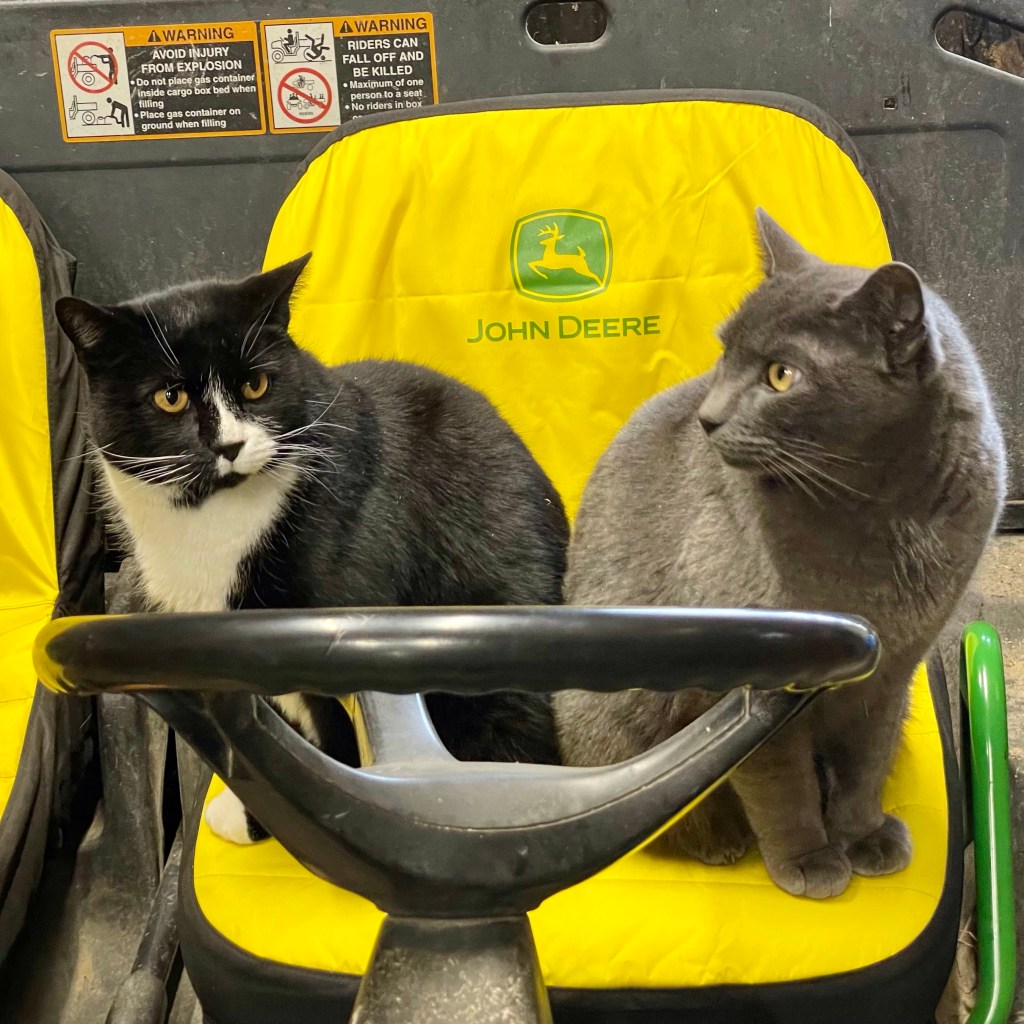
Now, it’s time to feed our cats, Stan and Ollie, and I again greet them with a hello and ask how their night was. Lately, it’s been fairly cold, so we’ve allowed them to sleep in the heated tack room, rather than the barn itself. They purr and wrap around my legs, or rub up against Carmen as they wait for breakfast. I’ll ask them if they heard Momma Cat out in the barn last night. Momma is a cat whose owner moved away, and we have seemingly adopted. Cathy frequently sees her, but she is quite shy around Carmen and me and we rarely do. As I leave the barn, I call out a loud hello to Momma Cat, and noisily put some food in a bowl in the hay area for her. Of course, she is nowhere to be seen.

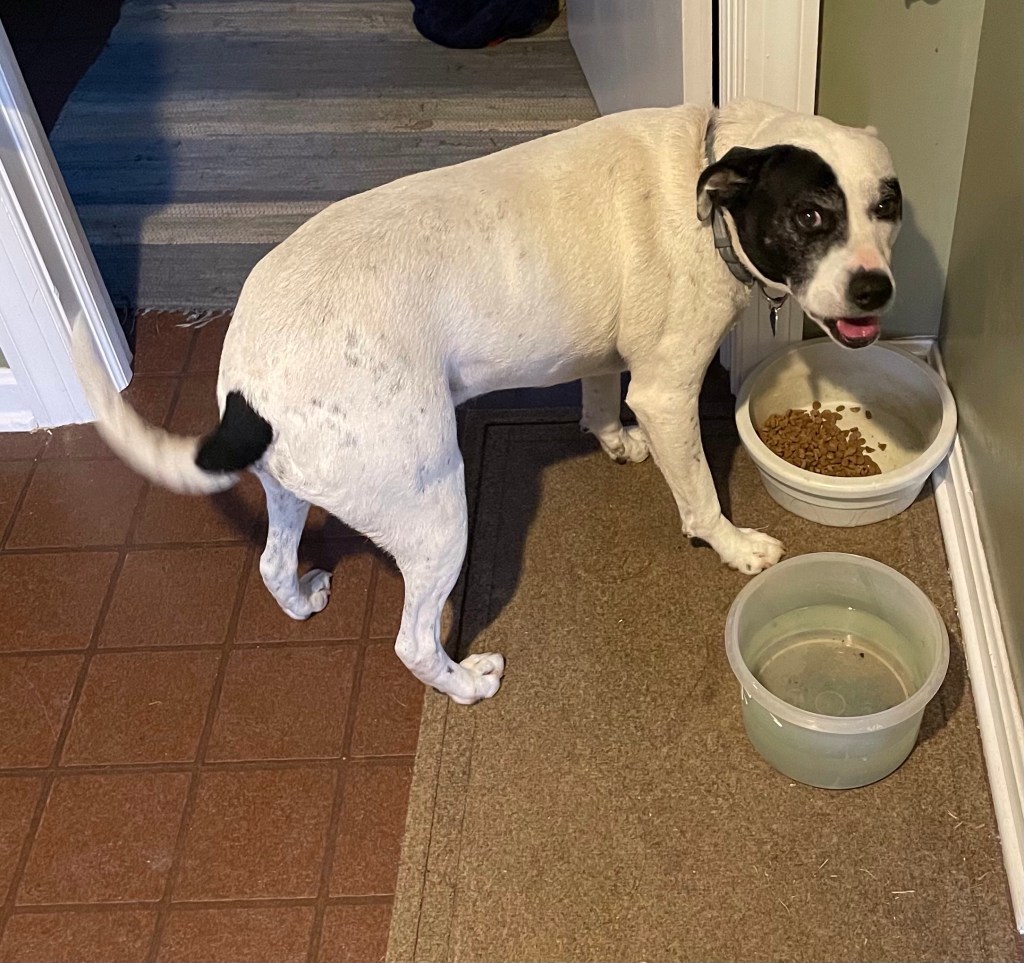
Carmen and I then return to the house for our own breakfasts. As we enter the mudroom, Carmen immediately sits in front of her dog bowl. She hasn’t barked, or said anything verbally, but she might as well have said “OK – you fed everyone else, now it’s my turn. And don’t even think about making your coffee before feeding me.

Tail wagging, Carmen’s ready to eat…

After a couple cups of coffee and small breakfast, it’s time to go back to the barn and let everyone out.

The cats go first, and I remind them to come back at dinner time, if they want to sleep in the tack room. Otherwise, they are on their own. I tell Stan to watch out for our other neighbor’s un-neutered male cat that sometimes comes slinking around the barn looking for a handout. Stan and he have a history, so I figure a word of caution can’t hurt. I also remind Stan doing a walk-about for a week or more in winter is probably not a smart thing to do, but he ignores me whenever I tell him this.

Ollie and Stan after breakfast on a recent morning

Finally, it’s time to put the horses out and I take a few flakes of hay to the nearby paddock. While in the hay area, I note that Momma Cat has already eaten most of her food, and disappeared back into the hay. I say hello again, and call “Here kitty, kitty, kitty…” a few times, but get no response

As i put Katy’s grazing muzzle on, I tell her I’m sorry she has to wear it, however, it’s for her own good, and as a pony, we don’t want her developing health issues from overeating. After taking her out, I return for Stella, who has waited patiently. Leading her to the paddock, I usually just tell her to enjoy the day, and remind her not to pick on Katy.

Katie (in the grazing muzzle) and Stella

With that, it’s back to the house, and the rest of my day.

The thing is, I think Dr Dolittle had it slightly wrong when he said “Oh, if I could talk to the animals, just imagine it …” Talking “to” the Animals is easy. I mean, I do it every morning. It’s talking “with” the animals that is harder. While “Talking to” and “Talking with” are often used interchangeably, they aren’t quite the same, are they? “Talking with” implies a conversation between two or more. “Talking to” can imply a one way, or one sided conversation, or perhaps even a lecture.

I guess it’s not that different from people in that regard. Talking to people is easy. Talking with people is what’s hard, and these days, with the fences everyone puts up, getting harder. We all know people that are great talking to, or at you, but maybe aren’t so good at the listening and understanding part.

Upon further consideration, I think it is easier to communicate with the animals. I may do most of the verbal talking, but the interchange and understanding that goes back and forth is pretty good, at least in comparison to some people I know.

Addendum:

⁃ While I do the morning feeding at the barn, I would be remiss if I didn’t mention Cathy does 90% of the animal care on the farm. Afternoon feedings, stall cleanings, horse healthcare and a myriad of other horse and animal maintenance chores are all under Cath’s purview. While I can’t say whether she talks more or less than I do with them, her understanding of their wants and needs is infinitely greater than mine.

⁃ Carmen is the smartest dog we’ve ever had and a GREAT communicator. Here’s a blog she wrote about a year ago: My name is Carmen. I’m about 44 years old now, and in my prime. Some guy named Shakespeare once said every “dog will have his day.” I think every day is my day, and I […] Continue at: https://mnhallblog.wordpress.com/2021/04/07/whosagooddog-carmen/

Planes, Buses and Automobiles

Planes, Buses and Automobiles

A Day in the Life. (Or, How I spent Fourteen Hours I Will Never Get Back.)

Ever think about the things you do, in order to do the things you want to do? After a wonderful vacation in California over New Years, payback, in the form of a long as hell travel day, happened on the return trip to DC. I freely admit this might be a boring blog, but something compelled me to write it.

The day started around 5:30AM with a wake up alarm. I didn’t fall out of bed, or drag a comb across my head, but I did find my way downstairs and drink a cup (of coffee). I finished packing and then loaded the luggage into Bonnie’s car. I grabbed my day bag and jacket, and climbed in the backseat, leaving the front seat for Cath. By 6:15AM, we were on the road.

Anderson Valley looks a bit different when it’s still pitch black. You don’t see the vineyards, wineries or scenic hills. Instead, all of our eyes were glued to the road ahead, following the twists and turns. There was also a slight fog reducing visibility. The hilly, winding trip out of the Valley to Highway 101 usually takes 45 minutes, but with the darkness and fog, it was 7:15 before we made the highway.

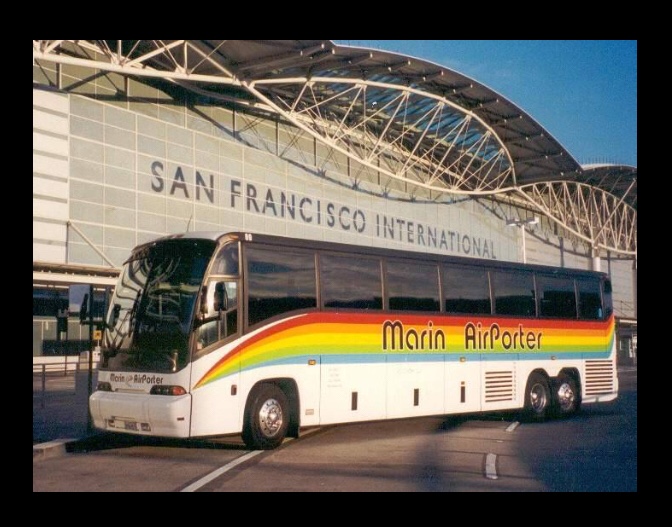
Bonnie had a 9:00AM appointment in Marin County that morning, so she was happy we were along, allowing her to take the HOV lane. In any case, she was a good driver, or we were lucky and traffic was light, or both. We made the Larkspur bus terminal for the Marin AirPorter about 8:35. Hugs and “I love you”s all around, and then Bonnie departed for her appointment. We had the joy of sitting, masked, in a small terminal by ourselves for 40 minutes. In fact, we would be masked for most of the next ten hours.

Masks, masks, everywhere a mask

The AirPorter bus runs directly from Marin County to the San Francisco Airport (SFO). At 9:15AM the bus arrived right on time, and at 9:20 we pulled out. The bus was about 1/3 full, and everyone was masked (required). Traffic remained relatively light, and I’ll be d@mned, we pulled into the United Terminal at SFO right on schedule at 10:30AM. Outside the bus, we took our masks off briefly while collecting our luggage. Then, masks back on, we entered the terminal.

The Marin AirPorter is actually a good way to travel

With Covid going on, United recommends people arrive three hours early at the airport, due to security concerns, longer check in times, and general complications with masking and so on. I figured two hours was enough time, but you never know. Arriving at 10:30, there were two hours and forty five minutes till our flight. Plenty of time. Almost tooooo much time.

Although we already had our electronic boarding passes, we still needed to check one bag. Baggage “self check” was something of a cluster, but 15 minutes later, the bag was gone and we were walking to security.

At security, no one was in line! The checking of tickets and IDs went quickly, but there was a back-up at the final Security screening point. Only one line was open, and it appeared either the gear was malfunctioning, or a new crew was working the line. We just stood in place for several minutes, with no one advancing. Eventually, there was some movement, we were X-rayed, and finally on our way to the gate around 11:15AM. We hadn’t eaten anything yet, and stopped at the first restaurant we came to.

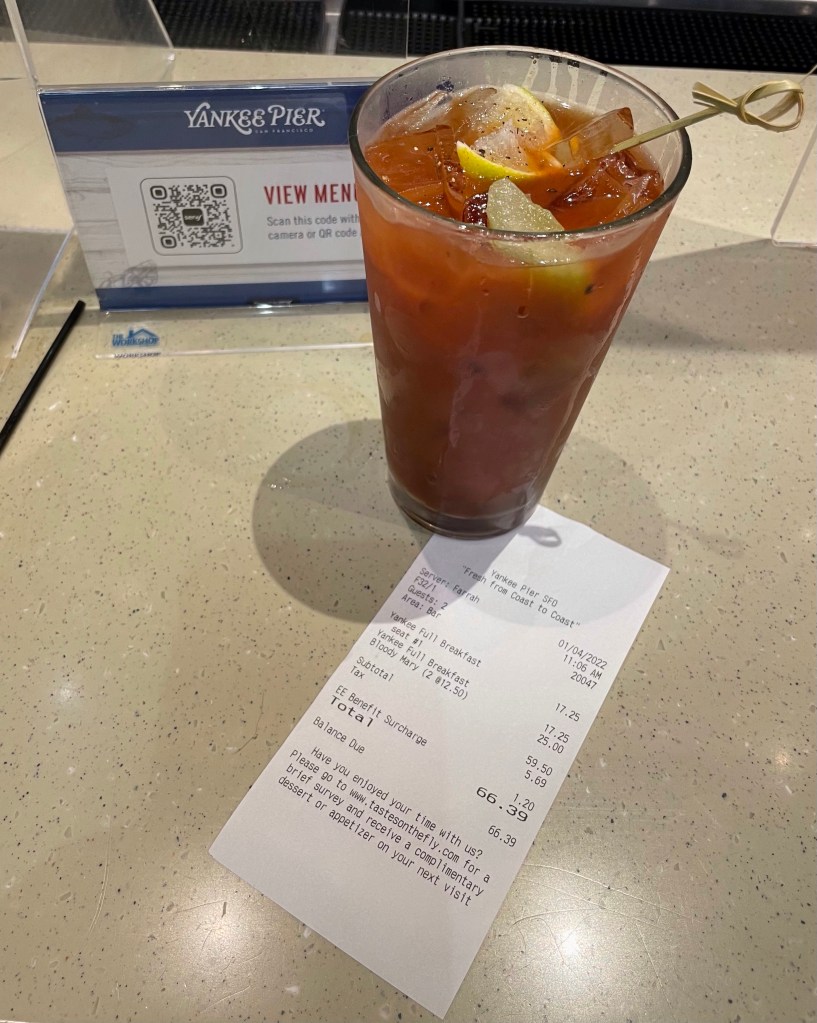
Miraculously, two seats were open at the bar and we grabbed them. A plexiglass divider separated us from the kitchen crew and waitstaff, along with little plexiglass dividers for every couple of barstools. The waitress slid us menus under the plexiglass, we removed our masks and took a look. It was the airport after all, so nothing was cheap, and you knew it wasn’t going to be great. Still, at $17.25 the Yankee Breakfast (bacon and eggs, hash browns, and toast) was a better deal than the bagel and lox at $19.50, so we both became Yankees for the morning. And since it was the last day of vacation, what the hell, we ordered Bloody Marys as well. At $12.50 each, they were practically a bargain. The Bloodies tasted pretty good, and the breakfast itself wasn’t half bad – for an airport, it was actually pretty good. We contemplated a second Bloody Mary, vetoed the idea, and asked for the check. $66, plus $15 tip later, we remasked, and resumed our walk to the gate.

A brief (and expensive) stop at the airport restaurant

It was now about 12:30PM. Fifteen minutes later, they started boarding the plane. For some unknown reason, we had a small bit of luck and had been moved from boarding group 4 to boarding group 2. We boarded early, and settled in for the flight to DC.

Waiting for takeoff…

The plane took off only about fifteen minutes late and the pilot was pretty confident we would make the time up somewhere over the Midwest. I stayed masked for the entire flight, except when sipping on a club soda. Everyone else on the plane stayed masked as well, and no crazies were yelling at the flight attendants about their rights. I did some reading, some writing, but no ‘rithmetic, and then watched Matt Damon in “Stillwater” (which I recommend, if you haven’t seen it). A bit more writing, and we were finally descending. It turns out the pilot was right, and we landed about 8:45PM, 15 minutes early. Amazing!

Let’s all crowd together to get off the plane!

We walked to baggage claim, where a large, crowded mob was waiting for their luggage. All were masked, but there was zero distancing. One guy actually knocked me out of the way, with no “excuse me” or any other words, to retrieve his bag. Then it turned out it wasn’t his bag, and he knocked a couple more people out of the way putting the bag back on the conveyer belt. The serenity prayer* briefly flashed through my brain. Eventually, our bags arrived. We gathered them up, and proceeded to Section A of Parking Garage 1 and our Subaru. Once outside, and in the garage, masks came off.

The drive home was pretty easy, even though a raging snow storm occurred the day before. Major highways were clear, but the local roads, although plowed, still had some snow and slickness to them. We arrived at the Farm at about 10:40PM, approximately fourteen hours after we woke up in Philo that morning. Carmen, our dog, greeted us with a wagging tail, and little yelps of pleasure. We stayed up another hour to relax a bit, and finally went to bed around midnight.

Here’s the thing. It was a looooong day, but it wasn’t a bad day. That is, no bad things happened. The bus arrived on time and didn’t break down on the way to the airport. Our flight wasn’t one of the 20,000 flights that have been cancelled since Christmas Eve. Since we were on a direct flight, we didn’t miss some connection at O’Hare airport in Chicago due to weather. Our flight arrived arrived on Tuesday, January 4th, the day after some people were trapped in their cars for over 26 hours in the DC area, due to a snowstorm. Despite Omicron racing around America, we didn’t catch Covid.

No, it wasn’t a bad day. Still, it was fourteen hours, approximately ten of them masked, we’ll never get back. The trip to California at the start of vacation was of similar duration. It too happened flawlessly. So the price of a wonderful ten day vacation in California? In addition to the dollar cost for the plane and bus tickets, two of those ten days were consumed entirely by travel. In the big scheme of things, a pretty cheap price to see loved ones.

Addendum:

– Yes, Planes, Buses and Automobiles is a play on the John Candy/Steve Martin movie “Planes, Trains and Automobiles”.

– And yes, the opening title, “A Day in the Life” and the line “I didn’t fall out of bed, or drag a comb across my head, but I did find my way downstairs and drink a cup” were inspired by the Beatles song, “A Day in the Life”.

* The Serenity Prayer is a prayer written by theologian Reinhold Niebuhr. It is usually quoted as: “God, grant me the serenity to accept the things I cannot change, courage to change the things I can, and wisdom to know the difference.”

The Tribe – Together Again

The Tribe – Together Again

It’s good to keep memories alive, and laugh and cry for those we have lost. It’s also good to remember that life is for the living – to try and savor each and every day, and the time we have with those we love.

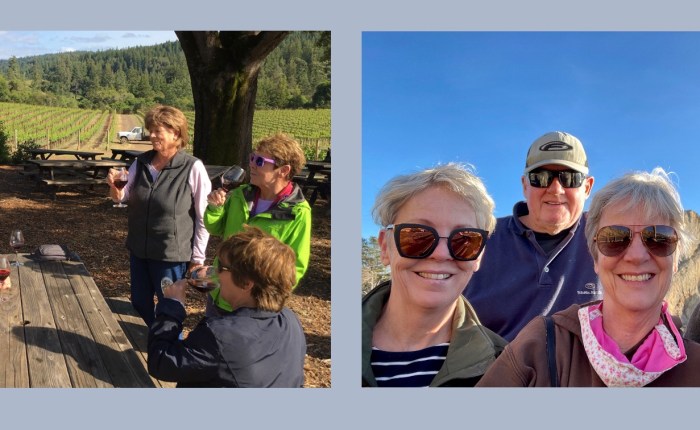
Before New Year’s Eve 2021, the last time we were all together was almost three years ago at the 2019 Anderson Valley (California) Pinot Festival. The difference was there were six of us then, and only four of us now. Don passed away in October of 2019, and Kim in August of 2021. I like to think Kim and Don were with us in spirit this year. We certainly ate and drank enough to cover them. 😉

Don and Kim at the 2019 Anderson Valley Pinot Festival

Cathy’s sister Bonnie married Don in ‘96 and the four of us were great friends from then on. They introduced us to their friends Kim and John, perhaps ten or fifteen years ago. Over the ensuing years, we saw Kim and John just about every time we visited California. Inevitably they would spend a couple of days at Bonnie and Don’s when we were in town. Often it was for either the annual Anderson Valley Pinot Festival, or perhaps the winter white wine Alsace Festival, but there were also a couple of Christmases or New Year’s Eves in the mix.

In 2018, the Californians all came to Virginia for a vacation over New Years and we again enjoyed fun times. It’s always wonderful when you find people you get along with in multiple locations and over time – you realize you are a part of the same tribe. At the time, we talked about the six of us linking up at Kim and John’s vacation place in Hawaii, “sometime in the future.”

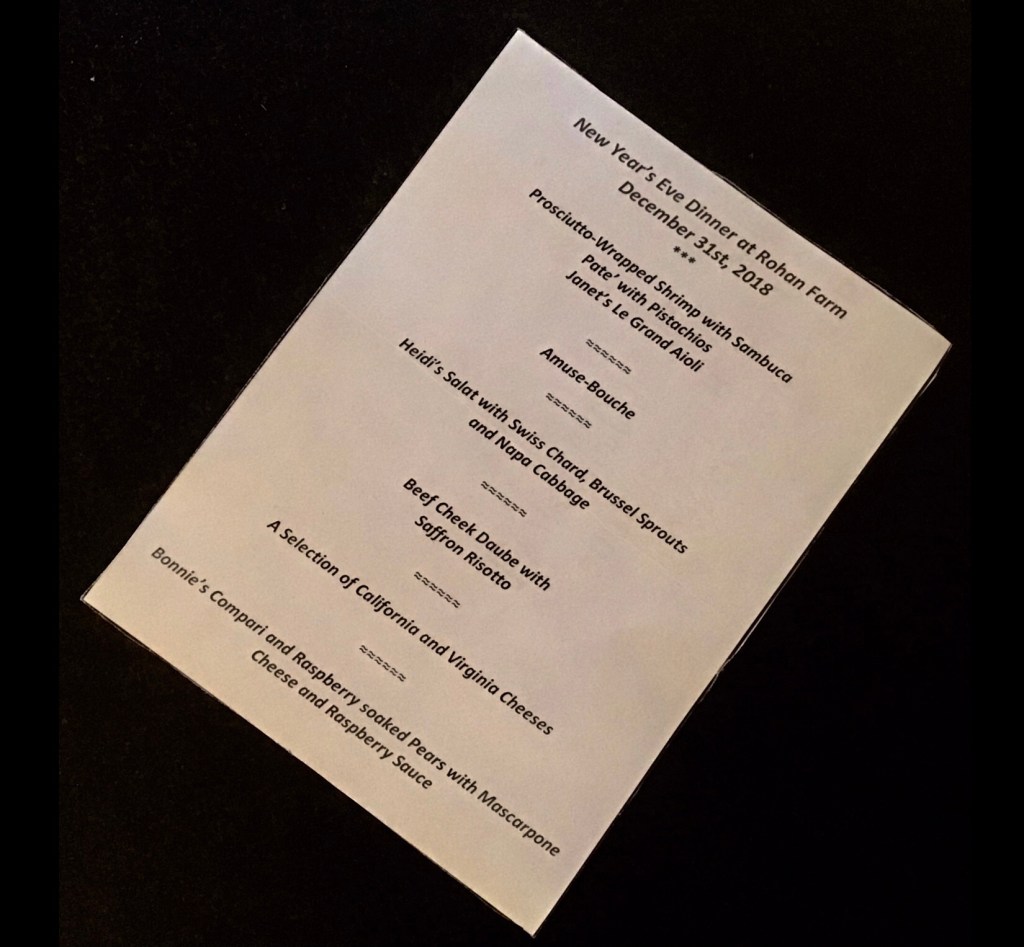
New Year’s Eve Menu at Rohan Farm in 2018

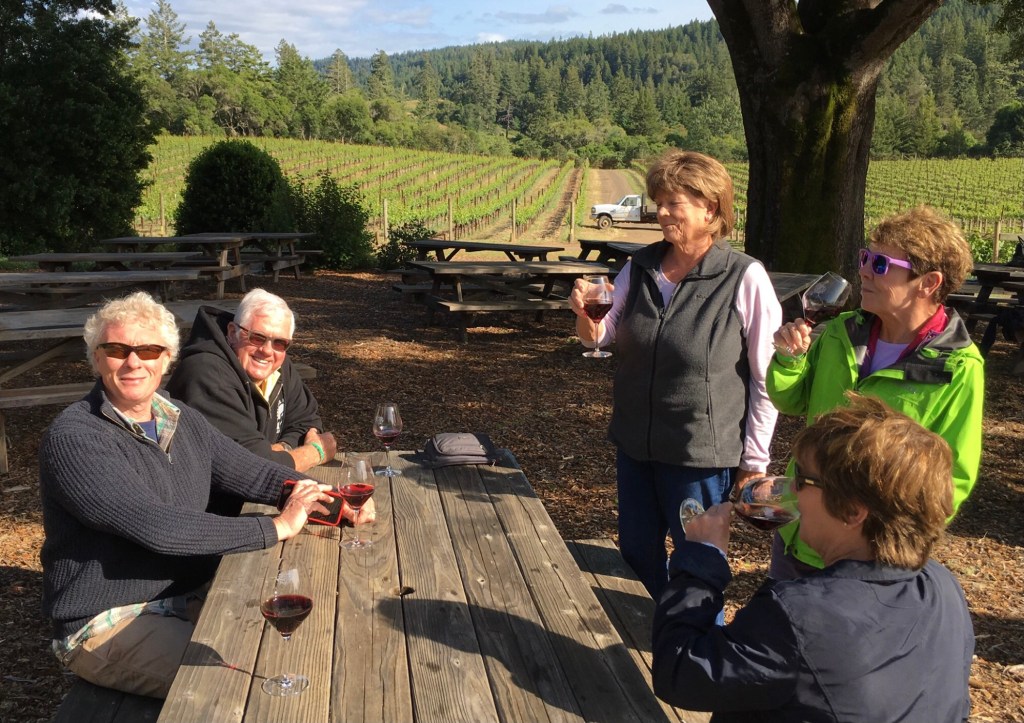
The following May, we were all together again at Bonnie and Don’s for the 2019 Pinot Festival. Kim was dealing with cancer, but it didn’t slow her, or us, down. At the time, we of course didn’t realize it was the last time all six of us would be together.

Pinot Festival 2019! From the left – Don, John, Kim, Cathy and Bonnie.

Don passed away five months after that Pinot Festival and Kim a little over two years later in August of ‘21. Covid provided an overlay for all of that time. We had reservations for Pinot Festival in May of ‘20 and ‘21, but it was cancelled both years due to Covid.

Time Passed.

We came to California this year for Bonnie’s birthday and to celebrate New Year’s Eve, and were delighted to find out that John would join us for both of those events.

We arrived first, and John drove up from Santa Cruz a couple of days later. The time passed in a whirlwind of fun, food, wine, poker games, walks and talks. We of course remembered and talked about Don and Kim throughout our time together. For John, it had only been 4 months or so since Kim passed away – they were married for 53 years. Bonnie and Don had 23 years together. As she noted, it’s not easy, and everything takes time. On New Year’s Eve, we toasted Kim with one of her favorite wines. On New Year’s Day, we went to Point Arena for a hike and toasted Don with beers and some tasty pizza.

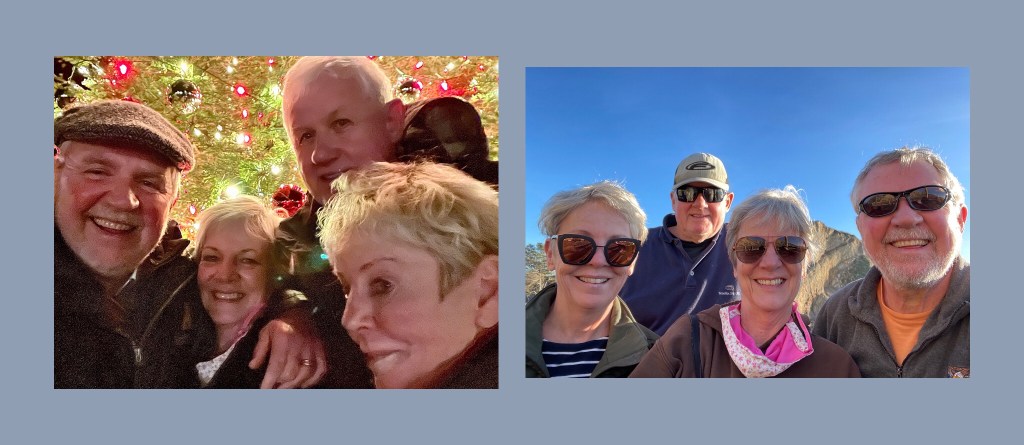
Good Times Celebrating Bonnie’s Birthday on Dec 29th in Healdsburg, and later on New Year’s Day at Point Arena

We also spoke about many other things and didn’t forget to enjoy life and the time we were having together. John invited Cathy and I to Hawaii again. There was laughter and joking, smiles and stories. We kept old memories alive, while also making new ones. It was good to be with the tribe again. We consumed our fair share of food and al’ahol over the five days we spent together.

John eventually left for the drive back to Santa Cruz. There were hugs all around and promises to see each other sooner rather than later. John made sure to invite us to Hawaii again and we readily agreed to give serious consideration for a trip there.

It’s good to keep memories alive, and laugh and cry for those we have lost. It’s also good to remember that life is for the living – to try and savor each and every day, and the time we have with those we love. As the days fly by, I want to race with the wind and also stop and smell the roses. Can you do both? I want to keep trying.

—-

Ecclesiastes 5:18-20 – Even so, I have noticed one thing that is good. It is good for people to eat well, drink a good glass of wine and enjoy their work – whatever they do under the sun – for however long God lets them live. To enjoy your work and accept your life, that is indeed a gift from God. People who do this rarely look with sorrow on the past, for God has given them reason for joy.

Punk Turns Sixty

Punk Turns Sixty

Punk turns sixty this week. Yep, that’s correct. Punk, also known as Bonnie, Bon, Bonswa, Lana’s mom, Don’s wife, and one half of ‘The Sisters of no Mercy’ turns sixty this week. For Cathy and I, she is the youngest of all of our sisters and we are happy to finally welcome her to middle age – ;-). Come on in Bonnie, the water is fine…

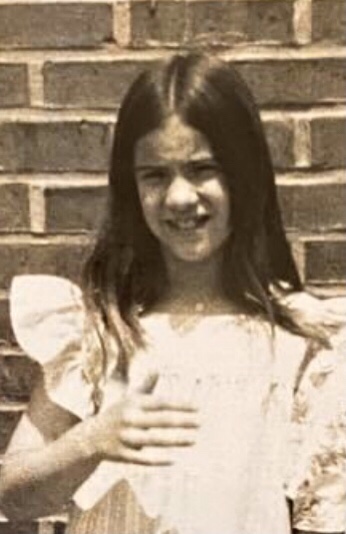
Truth be told, I’ve known Bonnie for most of my life, and hers. When Cathy and I started dating in ‘72, Bonnie was ten years old, and known in their family as “Punk”. I don’t think anyone has called her that in a long time.

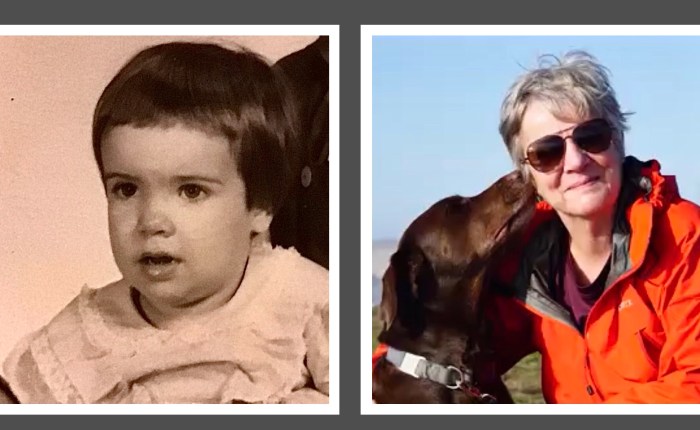
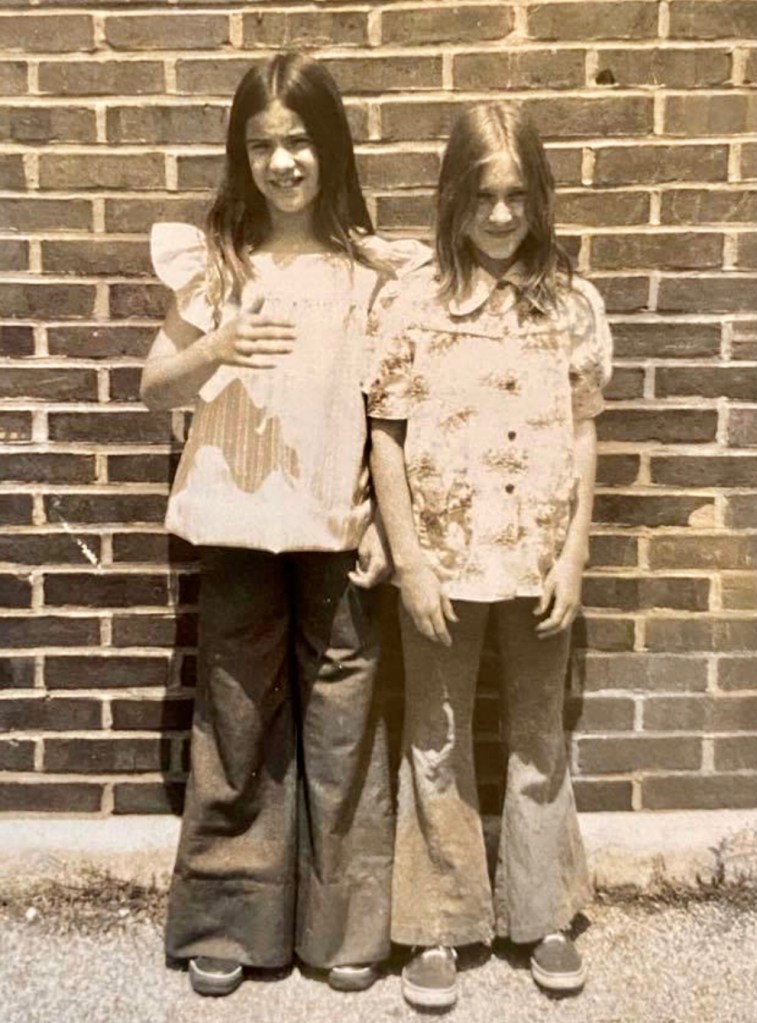
Bonnie, around the time we first met

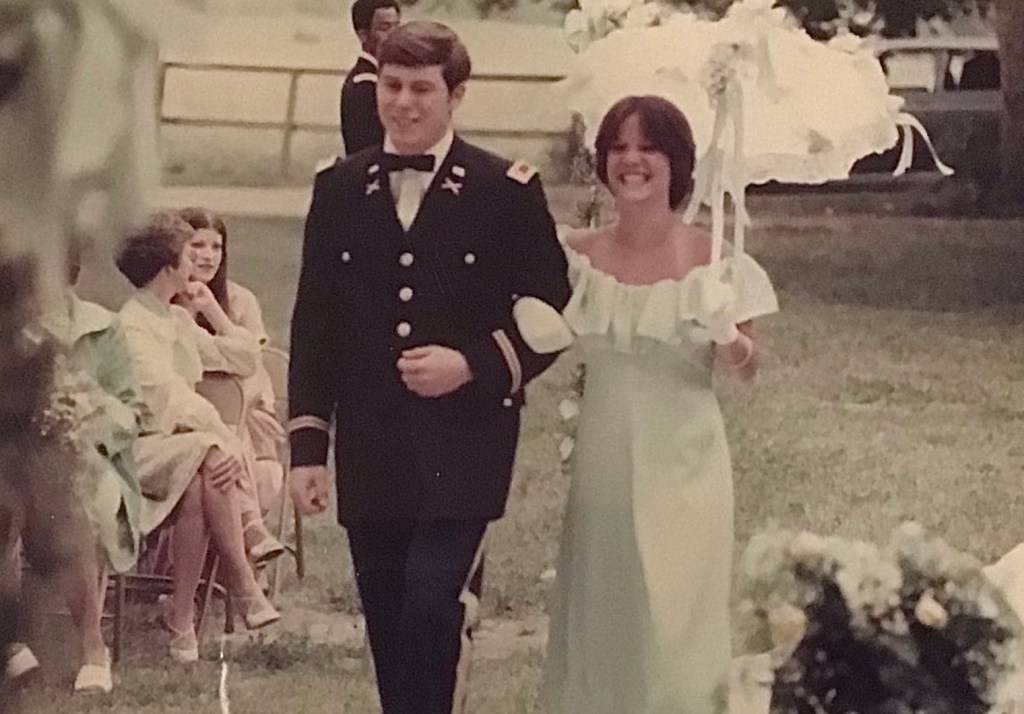
When we married in ‘78, Bonnie was all of sixteen and at the wedding, held her own with the newly commissioned officers in attendance, and all of our long time friends. In ‘83, when we returned after almost five years in Germany, she was of legal age – twenty-one, living near Washington DC and was married. That’s when I remember our relationship starting to change. She was no longer just Cath’s punk sister – she had become an adult in her own right. It was really the start of an adult friendship between us, something I’ve treasured ever since.

Bonnie at our wedding in ‘78, with my classmate Tom Guthrie

In our second tour of Germany, Bonnie enjoyed Multiple trips to Europe and even a Christmas. She was present and an integral participant at the initial Hare-of-the-Dog New Year’s Day party. When we returned to the States in ‘89, Bonnie was still in her twenties. Two years later, we attended the combined party for her thirtieth birthday and her graduation from the University of Maryland. That was a fun night – I seem to remember a bottle of Dom Perignon at some point.

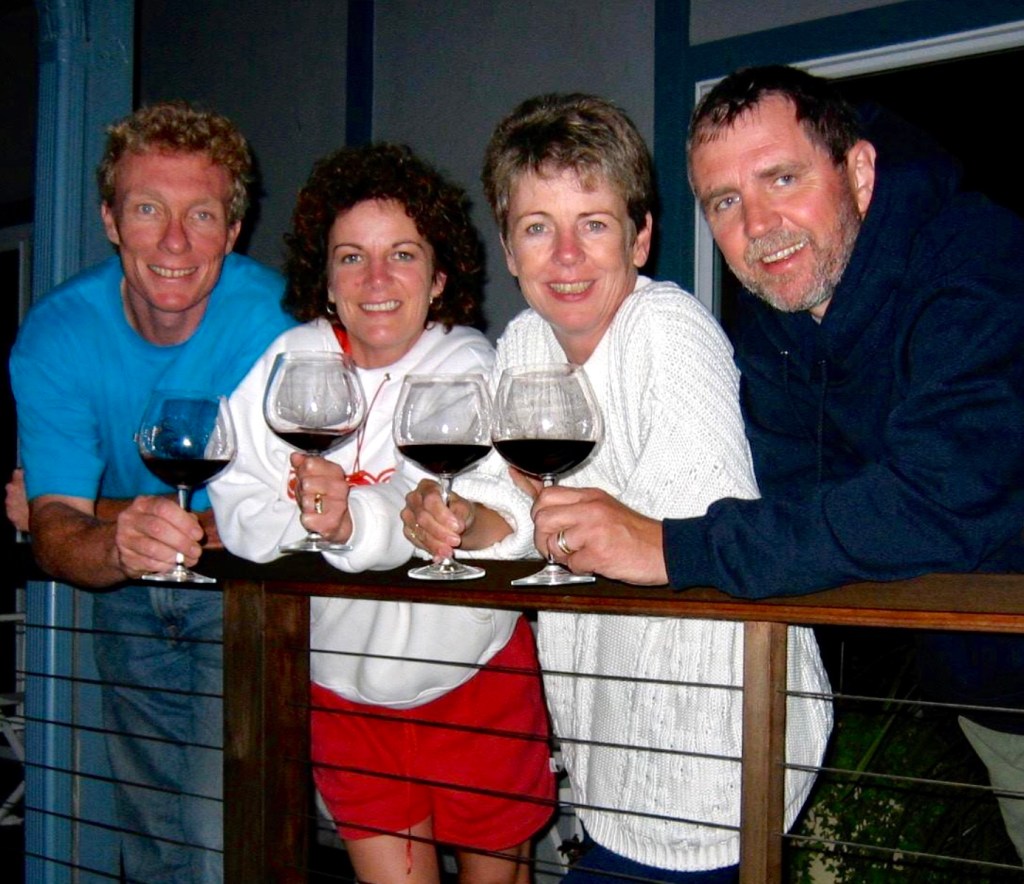
Never one to let the grass grow under her feet, Bonnie moved to California a year or two later. There, she really launched her marketing career, her firm, B3 Communications, was established and she met the love of her life, Don. For the next almost twenty five years, the four of us were the best of friends. We named ourselves the 4-H club and had “meetings” on the East Coast, West Coast, and places in between. Those good times still bring a smile to my face.

Good times with the 4H Club

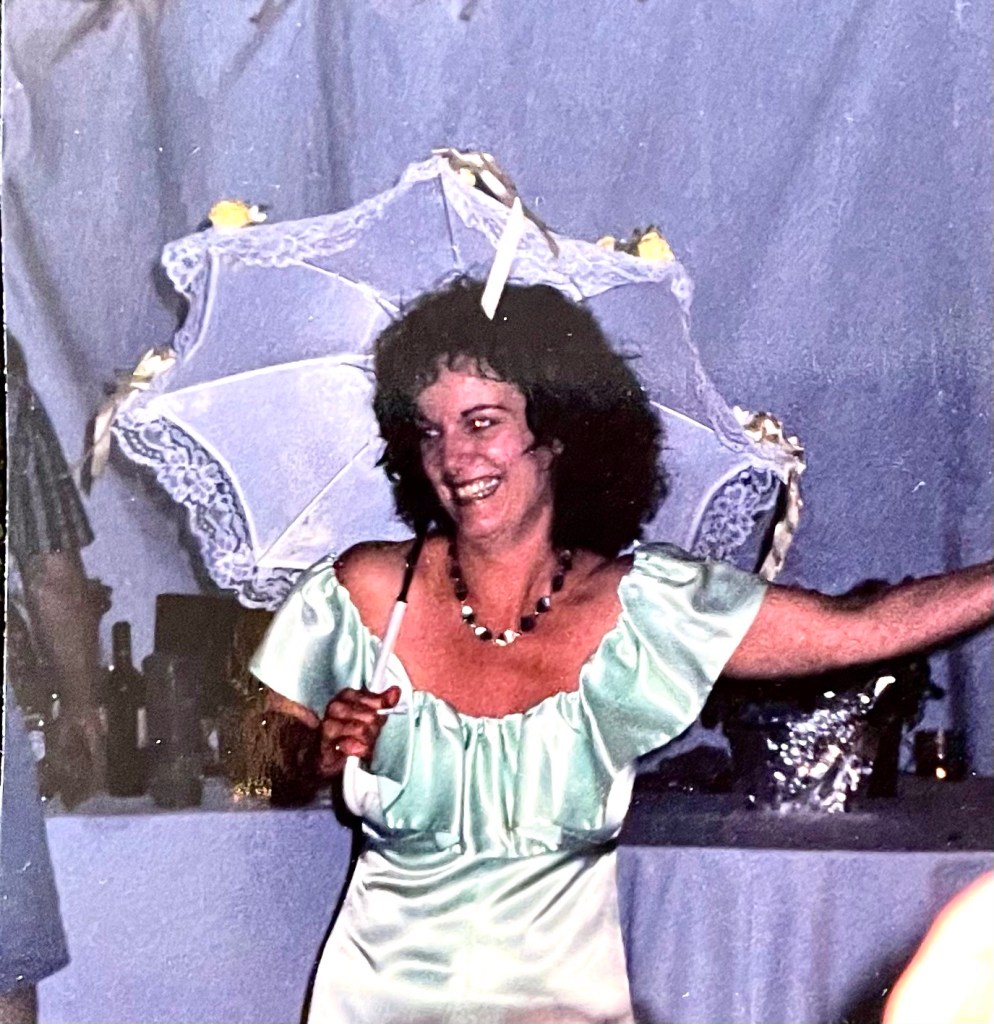
In 2003, Cathy and I celebrated our twenty-fifth wedding anniversary with a large party, which Bonnie and Don attended. During the evening’s festivities, Bonnie disappeared for a bit. When she reappeared later to make a speech congratulating us, she was wearing her Bridesmaid’s dress, and carrying her parasol from our wedding twenty-five years before. At the age of forty-two, she was happy to inform anyone who would listen that, “Yes, the dress still fits; I didn’t have to alter it!” 😉

Yes, the dress still fit, 25 years later.

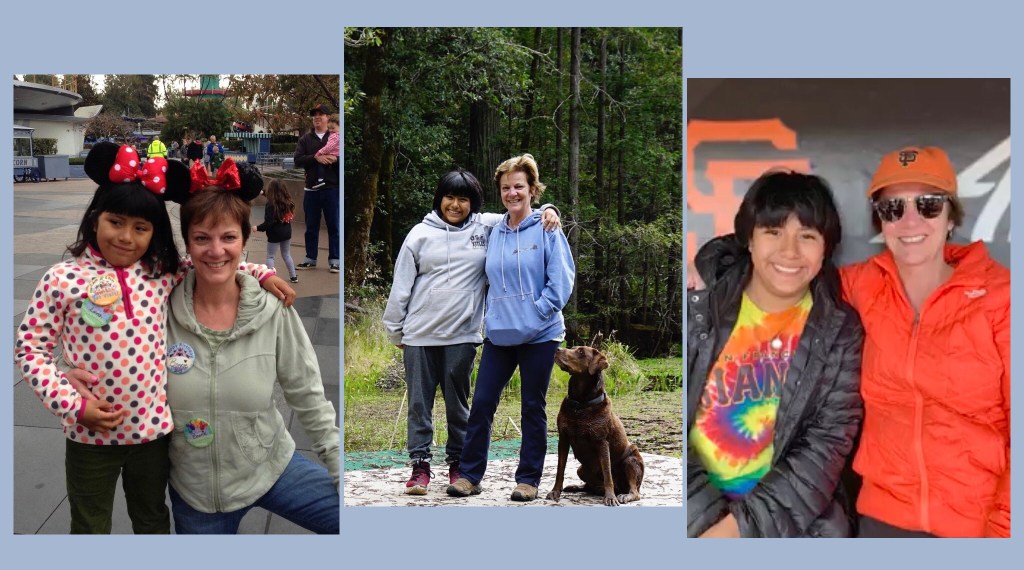
Of course Lana joined Bonnie and Don along the way in 2005 and we changed from the 4-H Club to the 5-H Club.

Bonnie and Lana

I now chuckle slightly at the fact that as Bonnie turns sixty, Lana is sixteen – the same age Bonnie was when Cathy and I married. How is it even possible? Seriously, how is that even possible? Where did the time go?

So, yea, Punk turns sixty this week. We look forward to celebrating the big day with her out in California. Good food, great wine, loving family and friends – It’s going to be wonderful.

Happy Birthday Punk!

Happy Birthday Punk! I love you as if you are one of my own sisters, and also one of my best friends. On the last day of your 59th year, I want to welcome you to the start of your seventh decade – jump on in, the water is just fine.

Addendum:

Thanks to Lana Harris for the use of the picture of Bonnie and their Dog, Ruby for the cover photo.

Thanks to Paula Johnson Hamley for the picture of Bonnie in the 5th Grade, around the time we met. I clipped the picture to just get Bonnie, but the whole picture (below) is too cute to pass up. They had just been selected as the 5th Grade Students of the Month in Mr. Herman’s class at Shabbona Grade School in Ottawa Illinois.

Bonnie Snow and Paula Johnson Hamley in 5th Grade

Christmas is Coming

Christmas is Coming

It’s funny what sparks a memory. For me, the Christmas song Up on the Housetop, with it’s chorus of “Ho ho ho, who wouldn’t go, Up on the housetop, click, click, click, down through the chimney with good Saint Nick…”, instantly floods me with holiday memories from my youth. I fondly remember McKinley Grade School in Ottawa, and our Principal, Mr Powell.

‘Tis the season. Don’t we all really remember the Christmases from our childhood? I know I do. The Christmases at McKinley, on the southside of Ottawa, Illinois were special. We ALL remember them.

McKinley was originally a small two story wooden school house. Eventually, in the late fifties, it was replaced with a large, one story brick building. The new school included an indoor gymnasium, with a small elevated stage on one side. Both would figure prominently in the school’s Christmas celebrations.

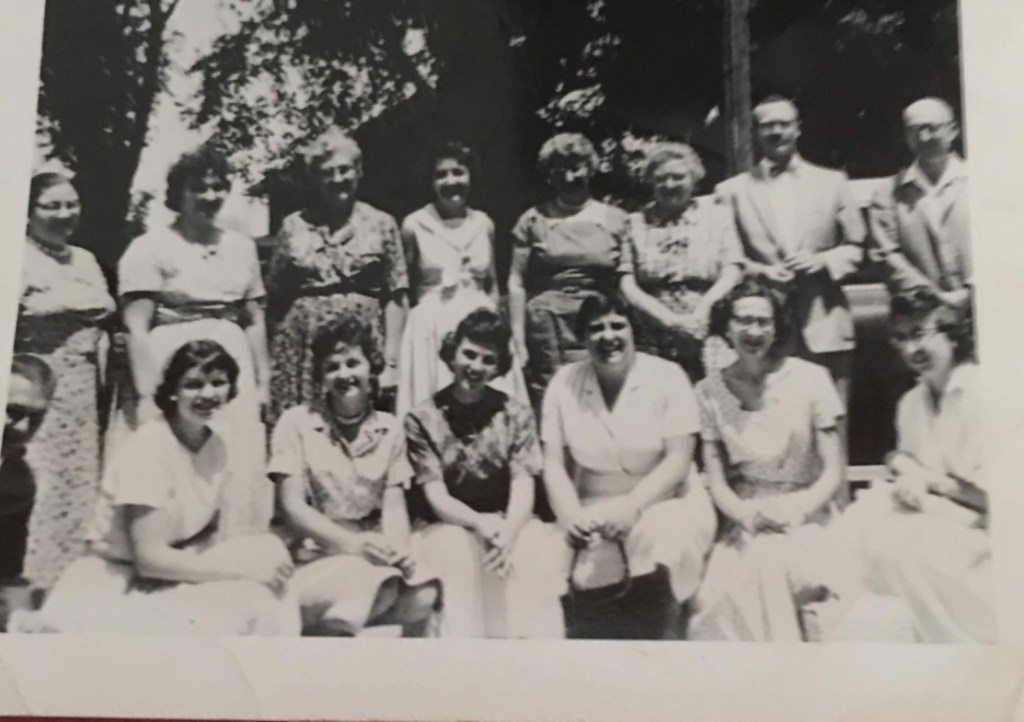
McKinley School Teachers for 1959/60. Mr Powell is second from the right in the second row. The photo is probably from about two years after the new school building opened.

Our excitement started sometime in early December. Christmas was approaching, which of course meant an upcoming break, and if we were lucky, the chance to go sledding, or maybe skating on the pond at Varland’s pasture. Almost as exciting was the Christmas Show the school presented, just before the break. The teachers told us about the upcoming show, and each class was assigned a song to sing. We stared practicing on a daily basis.

A large evergreen tree eventually arrived at the school and was placed prominently on one side of the gym. Of course, it needed decorating. Where did the ornaments come from? They were handmade by the students. Yes, there were the obligatory construction paper chains from the younger classes, but another source of ornaments proved a favorite memory for many. Milk, in individual glass bottles was delivered to school each day. Those bottles had blue or silver foil caps. We collected the caps and then made stars, ornaments, or strings of ornaments from them. Oh how they shined and sparkled in the reflected light on the tree.

Foil milk bottle caps similar to these made perfect tree ornaments

The excitement grew, and a few days before our break, there were gift exchanges in each of the classrooms. The gifts weren’t big of course, but it was still fun and increased our anticipation.

As the date of the show approached, we kids practiced our songs. The week of the show, the entire school gathered in the gym a few times to practice, and also to sing “songs of the season” together. Those daytime sessions were great fun. All of the kids marched by class to the gymnasium, and then we’d sit on the floor facing the stage. Everyone was in a giddy mood with much laughter, yelling and barely contained excitement. Each class practiced their songs, but in between, Mr. Powell would lead the entire school in Christmas and Holiday songs. He stood in front of us near the tree, wearing a holiday bow tie. I think he was as excited as we were.

When leading the songs, he also acted some of them out. One example several friends remember was singing the song Up on the Housetop*. As the chorus was sung, Mr. Powell would stick his belly out and while placing both hands over his stomach, sing in his deep baritone “Ho ho ho, who wouldn’t go, ho ho ho, who wouldn’t go…”. When the next line “Up on the housetop, click, click, click, Down through the chimney with good Saint Nick” was sung, he clicked his fingers three times instead of actually singing “click, click, click.” Of course, all of us kids quickly caught on, and did the same thing – imagine a couple hundred kids all clicking in time with the chorus, and you get the picture.

The songs we sang at the time included both religious and secular Christmas songs. One student who is Jewish, remembered feeling special because we would inevitably sing one or two Hannukah songs. It was a simpler time.

Eventually, it was time to return to our classrooms, but the singing wasn’t quite over. Mr. Powell would start us singing an old English folk song Christmas is Coming, with the opening line “Christmas is coming, the geese are getting fat…” The song is meant to be sung as a round, which is exactly what we did. I believe we were divided into thirds, with each group starting one line after the previous group started. Once we had sung “around” a couple of times, the classes were dismissed, one grade at a time, with each class singing the song all the way back to their classroom.

For the younger kids, there was often a bit of confusion on the lyrics. Instead of “…if you haven’t got a ha’penny, God bless you…”, they heard “if you haven’t got a hay penny God Bless a shoe…” What was a Hay Penny? Why were we blessing shoes? It could all be a bit confusing, but the fun and good spirits made up for it.

Finally it was the big day of the Christmas Show. It was also the day before Christmas break started. Excitement was at a fevered pitch.

The evening program was a bit more formal than our daytime singalongs. It wasn’t quite the Christmas Show from the movie Love Actually – McKinley School was a bit more primitive, but we did have a stage, and the adults sat on folding chairs set up on the gym floor itself. As kids, we dressed in our “good clothes” for the big night. Our parents brought treats and cookies for the classrooms.

While the adults found their seats in the gymnasium, we kids walked to our classrooms, waiting for our turn to sing. My friend Joy remembers sitting at her desk eating cookies and coloring (after smelling) the newly mimeographed Christmas pictures. For the younger grades, there were also games that some of the parents (moms) helped with in the classrooms. Everyone wanted to make sure we kids were entertained, focused and staying out of trouble.

Finally the show started, with the Kindergarten classes singing first. My friend Lynn remembers “The big curtain opening was our cue to start singing. It was quite intimidating to see all the people “out there” sitting on folding chairs looking at us. We sang Away in a Manger and the little stage seemed huge.”

One of the classes always sang Oh Christmas Tree, Oh Christmas Tree in German (Oh Tannenbaum, Oh Tannenbaum…). How cool was that? Singing a Christmas song from another country!

The show eventually ended and parents picked up their children from the classrooms. Cookies were finished, and newly colored Christmas pictures served as visual reminders of the fun that night. During the short drive home, we were still animated. I suppose the stimulation from doing the show, along with the sugar rush of the cookies combined and kept us amped up for awhile.

As with all things, time passed and the world changed – not for better or worse, but changed none-the-less. Mr Powell retired. The huge tree was replaced with two smaller artificial trees for fire safety. Eventually, the festivities changed from a secular Christmas celebration to a Holiday celebration, which was the right thing to do.

One teacher later reminisced “We teachers loved the singing almost more than you kids! We continued the tradition after Mr. Powell retired, but it was never quite the same.”

I’ve been gone from Ottawa for many years now, and to be honest, I don’t know if they have the Holiday celebration in the gym anymore. What I do know is I have wonderful memories from my youth that I wouldn’t trade for anything.

I’ll be home for Christmas, if only in my dreams… Christmas is coming, the geese are getting fat, Please put a penny in the old man’s hat…

Addendum:

  • There is some question/controversy among my friends about whether the title of the song is Up on the Housetop or Up on the Rooftop. Folk seemingly remember singing it both ways. For what it’s worth, the song is referenced in Wikipedia as Up on Housetop. It was written in 1864 and is the second-oldest secular Christmas song after Jingle Bells, which was written in 1857.
  • I had some memories from those special times at McKinley, but of course forgot lots too, until reminded by others about some of the activities. My thanks to the many who contributed memories to this blog, including: students Lisa Palmer Braley, Brenda Brown, Karen Williams Miller, Robert Cavanaugh, Linda Baker, Dorey Renee, Glenda Boettcher, Laurie Sargent Kinken, Mary Cunningham Heider, Kelly Nagle Shanley, Barbara Charlier Houston, LeeAnn Slack Niemann, Lynne Galley Robinson, Becky Ann, Roberta Sherman Schwandner. Jan Butler, Robert Cross, Linda Gerding Bergman, Joy Starjak Algate, Jessica Burress, Roberta Gourley, Tanya McCambridge, Tim Stouffer, and Howard Johnson, along with teachers Charlean Grobe and Sylvia Eichelkraut.
  • Thanks to Mrs Charlean Grobe for the photo of the McKinley School Teachers in 59-60! Charlean was my Kindergarten Teacher, one year later! She is second from the left in the second row in the picture.

Life and the Ritual of Risotto

Life and the Ritual of Risotto

I made Risotto last week. Due to some changes in diet, it was the first time in over a year and it was wonderful. Risotto isn’t hard to make, and it doesn’t take long, but it does require patience and attention. You can’t rush risotto, and to me, that is why making it is both relaxing and a bit zen like.

I’ve been making risotto for years, and have several different recipes. It was a staple part of our dinner rotation. And then about a year ago, I had a couple of blood tests that caused some concern. After engaging in bilateral discussions with my doctor* (… 😉 … ) , I made significant diet changes, and drastically reduced dairy and carbs. Some things were easy, like changing from regular milk to oat milk. Unfortunately, cheese was practically it’s own food group for me, so that required a fair amount of mental adjustment. Pasta, potatoes, white rice, and bread? All eliminated, or severely reduced. I went cold turkey, and just did it. The good news was that after three months, the test results were back to normal, and six months later, they remained normal. As a side benefit, I lost about fifteen pounds.

Over the past six months, we’ve reintroduced small amounts of dairy and carbs into our diet. They’ve become “special” as opposed to every day, and it’s worked out fine. It turns out, sometimes, you can teach an old dog new tricks.

Last Thursday I had a series of follow-up fasting blood tests. I wouldn’t receive the results for a day or two, but decided to celebrate early and chose to make risotto for dinner that night. On the way home, I picked up some cream for the sauce, along with fresh bread from a local bakery. I mean what the hell, in for a penny, in for a pound. While I have several risotto recipes, there was no doubt in my mind about which one I would make – Ben’s Cognac Risotto – a favorite of ours, with mushrooms, shallots, cream, butter, and plenty of Parmesan cheese.

From start to finish, Ben’s Cognac Risotto takes about forty five minutes to an hour to make. As with most risottos, it’s not complicated, however, once you start cooking, you can’t walk away from the stove. You need to be present, both mentally and physically.

That evening , I started heating up the required chicken broth, chopped up the needed shallots and mushrooms, separately measured out the cognac and cream for the sauce, and then grated the Parmesan cheese necessary for the finish.

Shallots and Mushrooms – the Key to Ben’s Cognac Risotto…

The next step is an optional one, but I find it adds to the relaxing nature of making risotto. I walked over to the bar and made myself a martini. In what may be a strange coincidence, I’ve learned that the time it takes to drink a martini, is almost exactly the same length of time it takes to make risotto. Not a martini fan? A Manhattan or Negroni will do, or even a glass of the red wine you opened to serve later with the risotto. Trust me on this. It works.

I made the mushroom sauce first and the kitchen filled with that heavenly smell only sautéed mushrooms can bring. After 5 minutes or so, I added the cognac and reduced it, and then added the cream and slowly reduced it some more. I set the sauce aside, and then started to work on the risotto itself. I also let Cathy know dinner would be ready in about twenty minutes, so she could finish setting the table, and pour some wine in our glasses.

Mushrooms, Cognac and Cream – What’s not to like?

After sautéing the shallots, I added the rice to the pan and stirred a bit. I started adding the broth, about a half a cup at a time, to the rice. Next? The ritual – Keep stirring the rice every few seconds; take a sip of martini; let the rice sit a little, then stir, and add the next portion of broth. And, repeat – Stir the broth into the rice, take a sip of martini, let the rice sit a bit, then stir, and add more broth. And repeat. And repeat. And repeat. A bit of zen zone settles in, or at least it does for me. It’s just me, the spoon, and the rice.

In the Zen Zone – Just me, the Spoon, and the Rice…

As I neared the last of the broth, I tasted the rice, checking for chewiness. You still have the mushroom sauce to add, so a little chewiness is OK. I know that if there’s a bit of broth left, it’s not a big deal.

Finally, It was time. I stirred the mushroom sauce into the rice, and let it thicken a bit. I then added the Parmesan and stirred some more. Cathy brought our bowls over, and I put some risotto into each of them, with another dusting of Parmesan on top of each. I took the last sip of my martini, grabbed the bread warming in the oven and crossed to the table. We clinked glasses and then settled into the wonderfulness that is Ben’s Cognac Risotto.

The Wonderfulness that is Ben’s Cognac Risotto…

Cathy asked me if we were maybe celebrating too early, since I hadn’t yet received my test results. I answered I felt good about the tests and wasn’t worried. Besides, it’s a good thing to occasionally celebrate life.

Late the next afternoon, although I hadn’t received a call from the doctor, I logged into my account at her office. The four test results were there – I quickly opened and scanned each of them. Everything was fine, and in fact a couple of tests showed further improvement from last June. The low dairy, low carb diet was working. It also appeared the occasional piece of cheese, serving of roasted potatoes, or bowl of risotto wasn’t having an overly adverse effect on me. I could live with this.

Live is the key word. I’ve reached the age where something is always breaking down, or going a bit haywire in my body. There is always some new thing I need to be aware of for my future health. While healthy over all, Cath and I both have issues that crop up. And of course we have friends who are dealing with greater issues – cancer, loss of eyesight, early onset dementia… getting older isn’t for the faint of heart. But you also have to live, and enjoy life in all of the ways you can. For me, the ritual of risotto is one of those ways, and I’m not ready to give up on it yet. We may not have it as often, but trust me, it’s still going to appear on the menu.

Otherwise, what’s the point?

Addendum:

– * As a side note, I love my doctor, Doctor Emman Hussny, and have been with her for a long time – around twenty years. When she left one practice to start her own, I moved with her. She has a great bedside manner, and encourages leading a healthier lifestyle, without being draconian about it. During checkups, we certainly have discussions about my health, but also discuss other topics of the day. I feel like she genuinely cares about me, and I’m not just another patient flowing through her office.

– Here’s the recipe for Ben’s Cognac Risotto – enjoy! If you want to tone it down a bit, you can substitute milk, or even 2% milk for the cream.