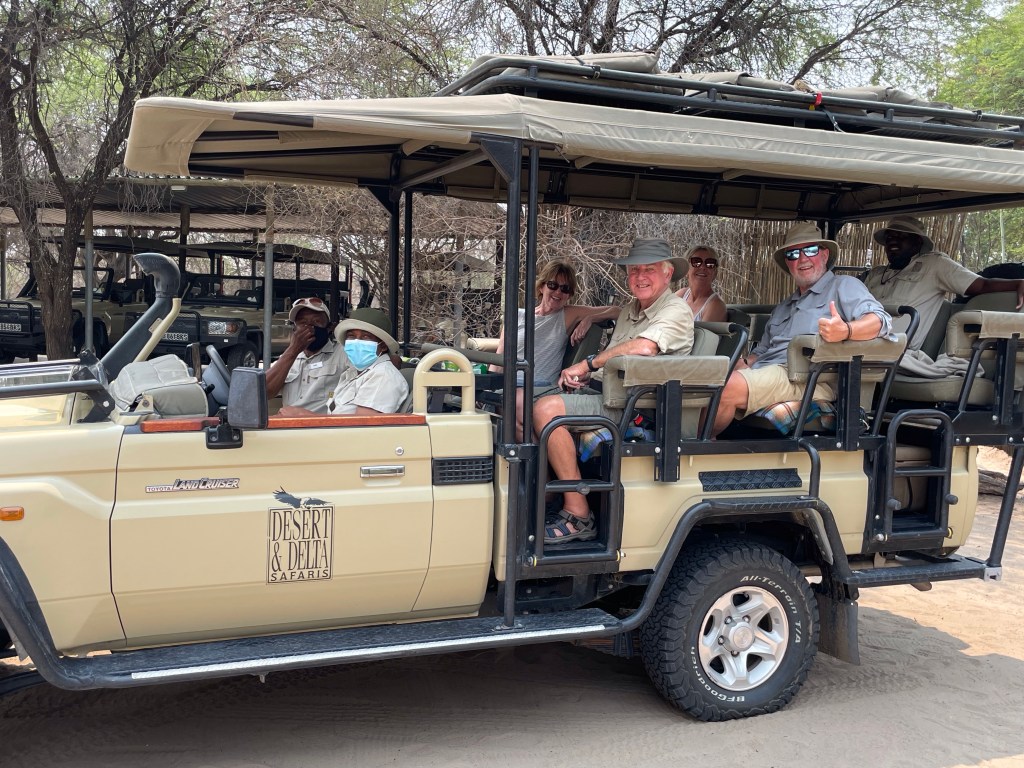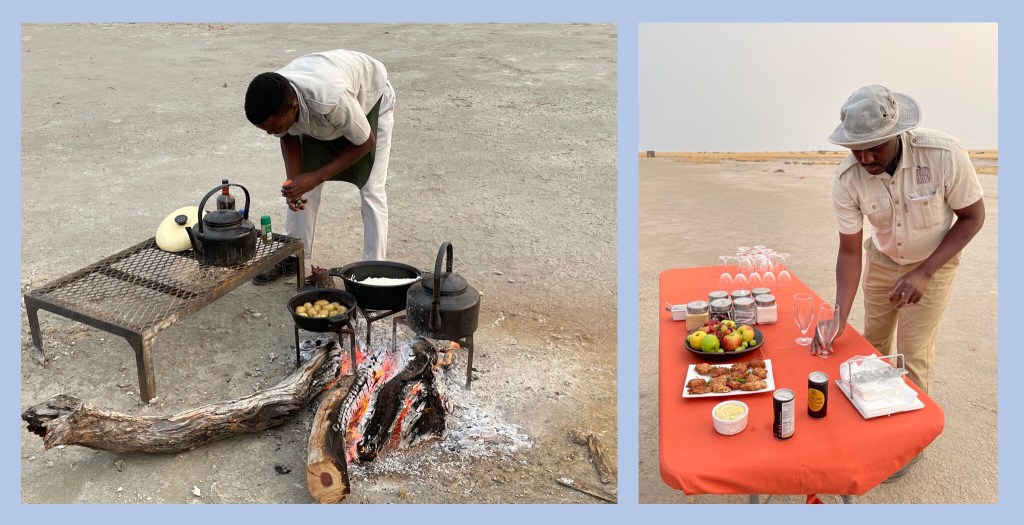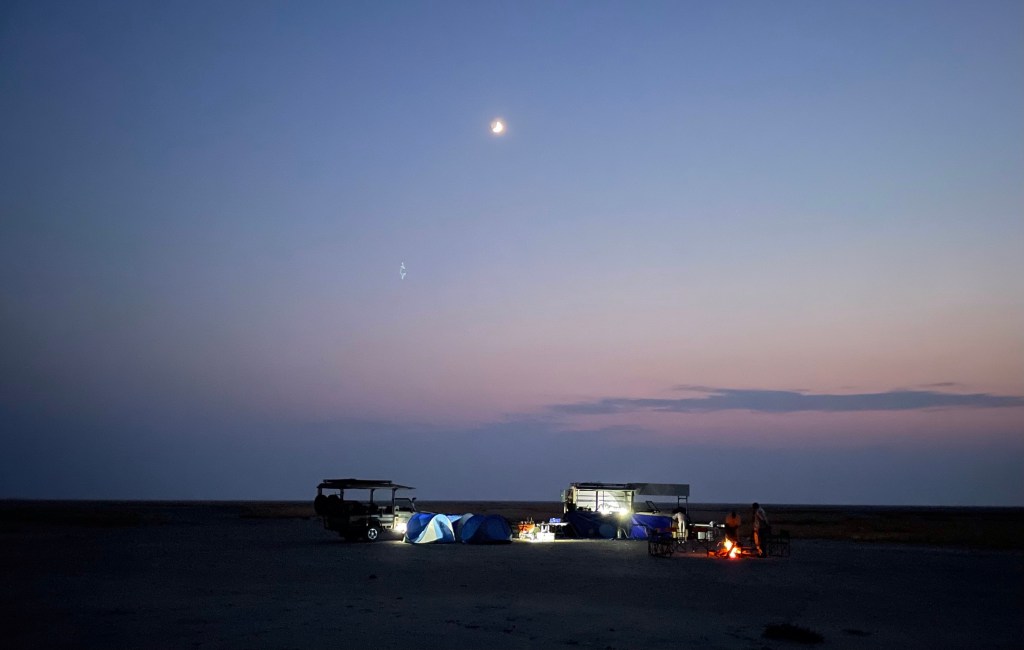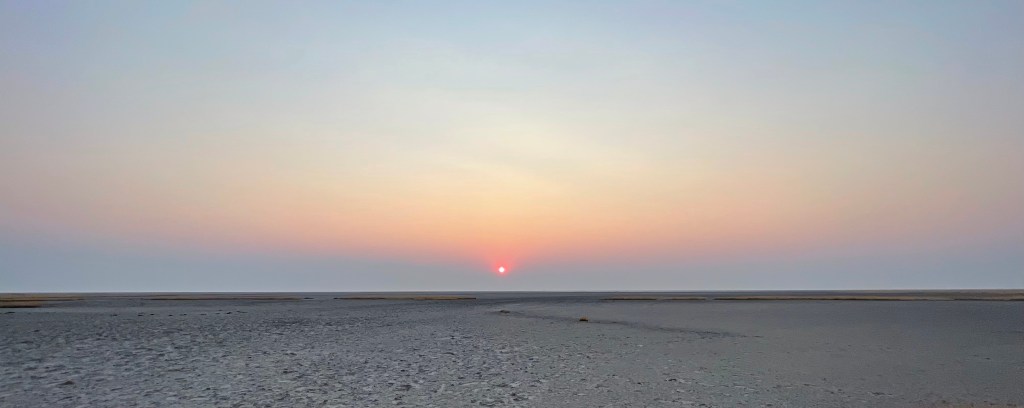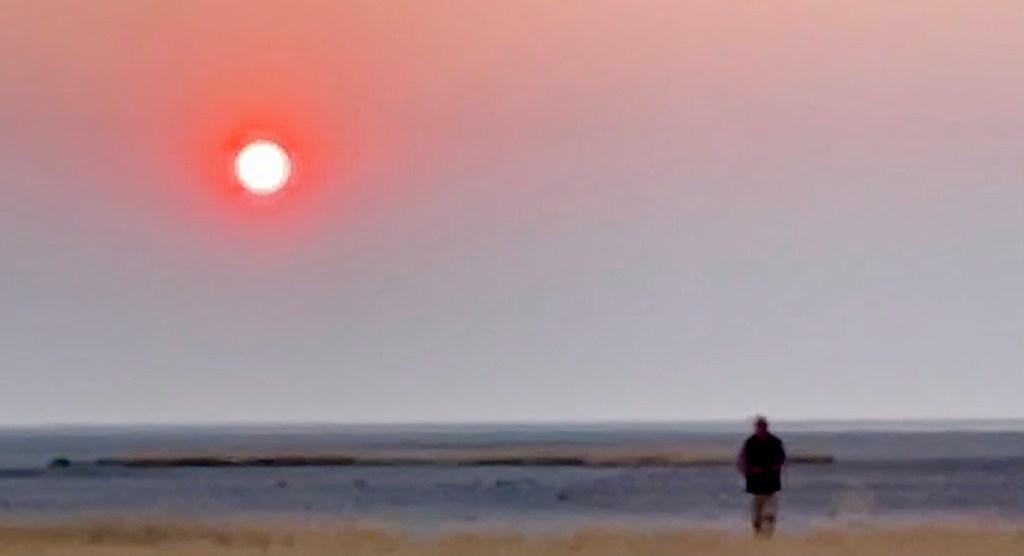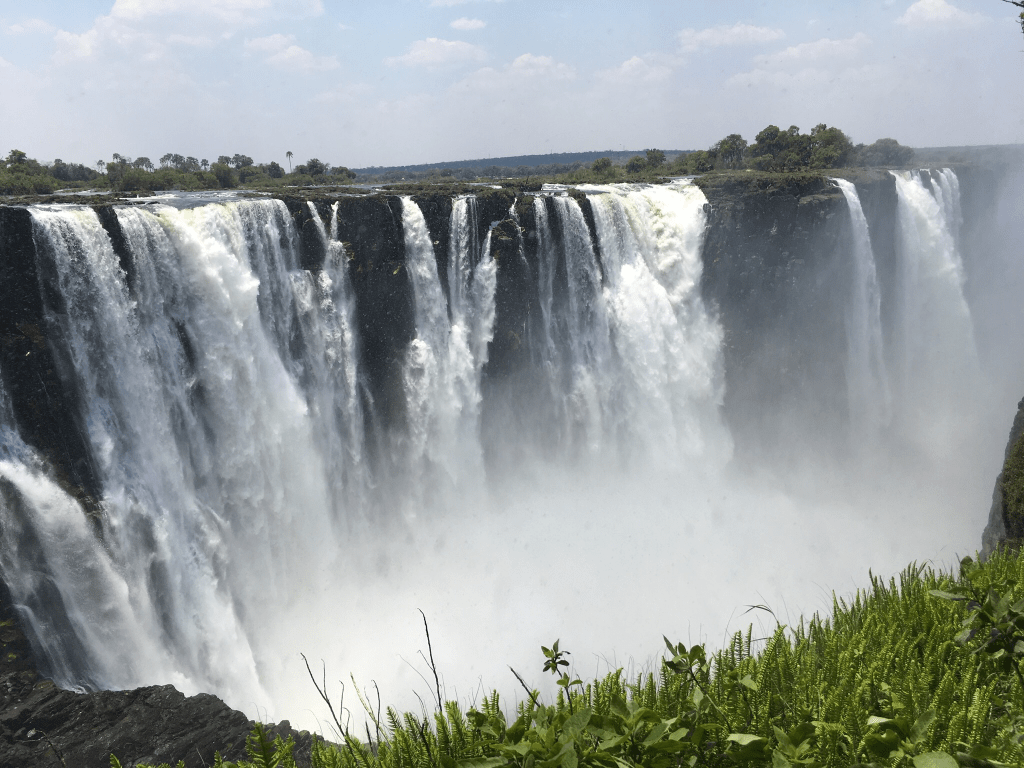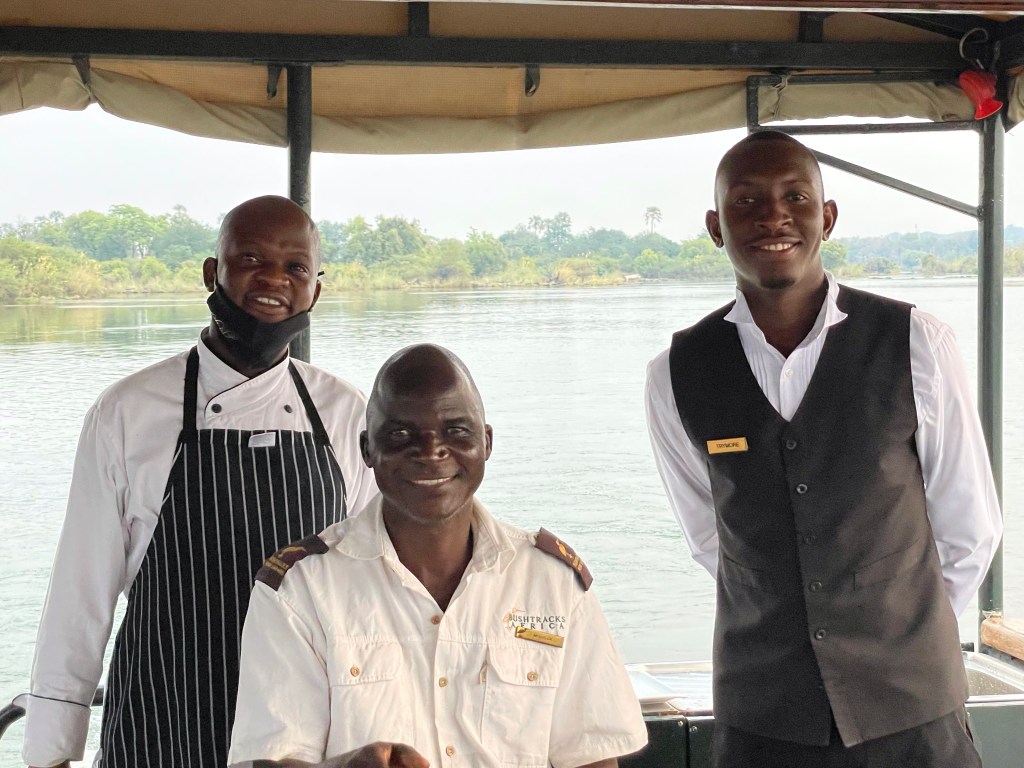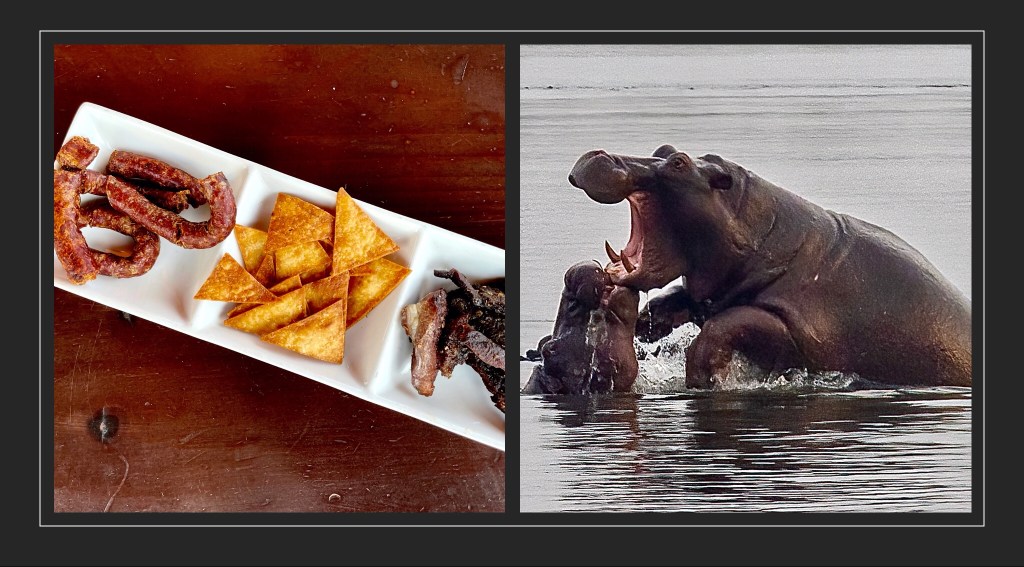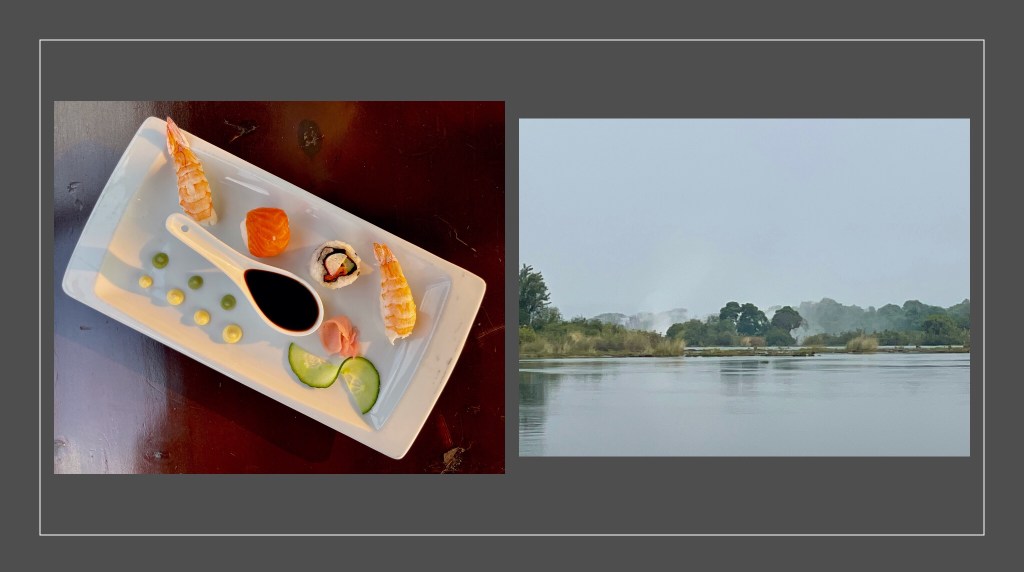
The Hide was the one Safari Camp we rebooked from our last trip to Africa in 2018. We knew we wanted our friends, Sharon and Bill to experience it as well. As our buddy Dave said in 2018 “The Hide never fails to deliver.” He was right.
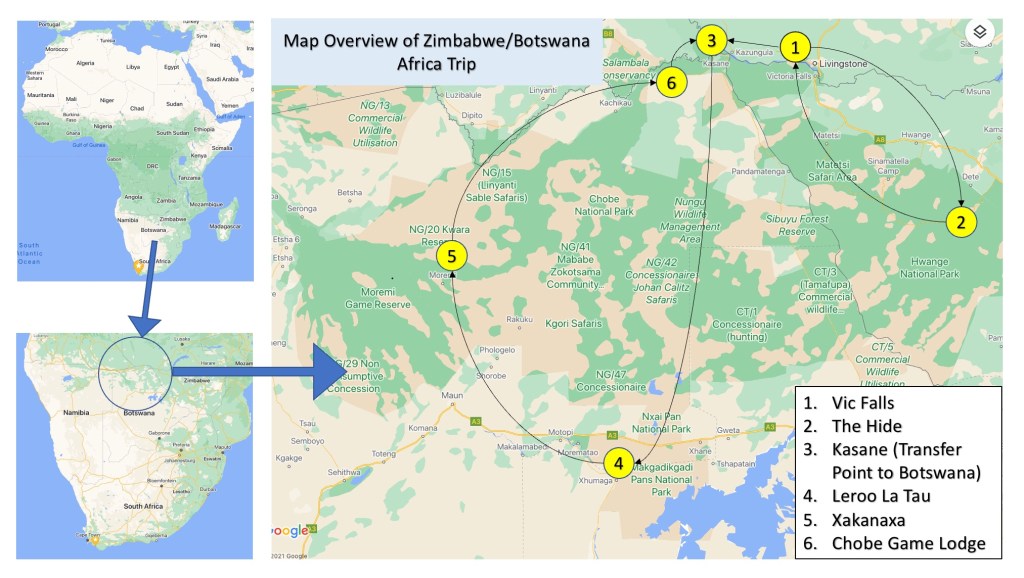
It took two and a half days to travel to The Hide Safari Camp in northern Zimbabwe. We left the States on a Tuesday evening, arrived in Jo’burg, South Africa Wednesday evening and spent the night. The Next morning we flew to Victoria Falls, Zimbabwe and spent another evening there. On Friday morning, we made the three hour drive to Main Camp in Hwange National Park, where our guide, Sean Hind, picked us up and then spent another hour driving on “roads” of dirt and sand to finally arrive at The Hide.
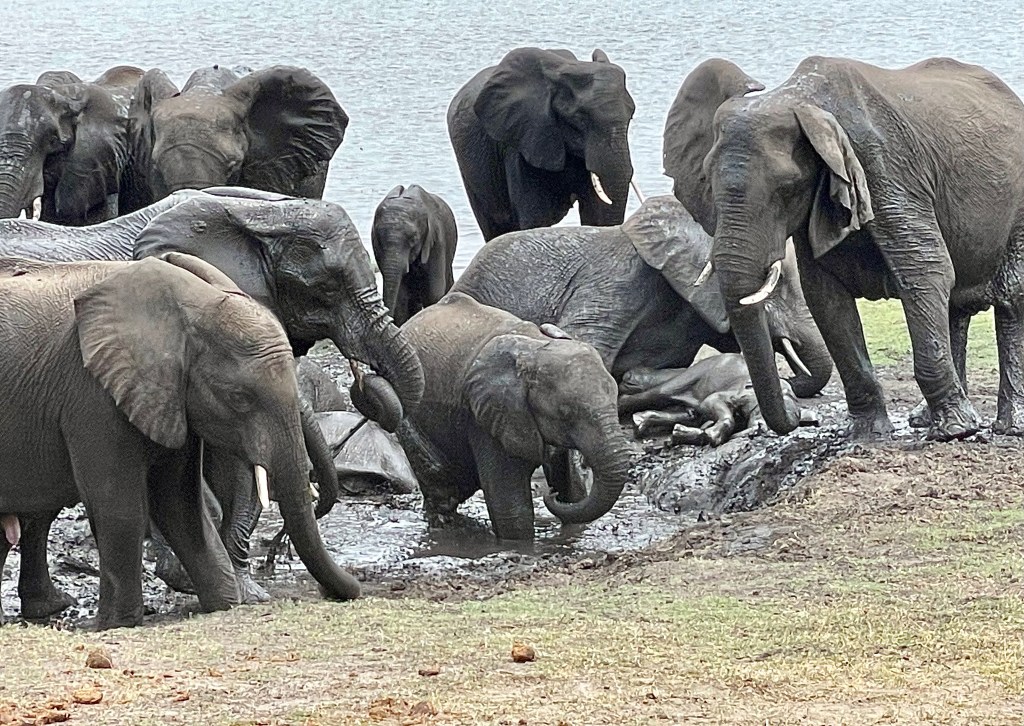
Our guide, Sean was excellent. On the very first afternoon, as we were leaving for our first Safari, we passed a large elephant pack (also called a memory of elephants) heading to the watering hole back at The Hide. Sean stopped for a second, and then said “If you are up for it, let’s head back to The Hide and watch the elephants approach – we could be in for a show.” We turned around and made our way back, not realizing what a treat we were in for. There wasn’t just one herd of elephants, but five or six that paraded in front of us for the next hour and a half. Each memory came in from the sunset in the west, drank water, played in the mud bath, and then exited to the east. We sat there mesmerized, drinking our sundowners and watching them pass. We saw, perhaps, 100-200 Ellies in total.
Ellies in the Mud Bath…
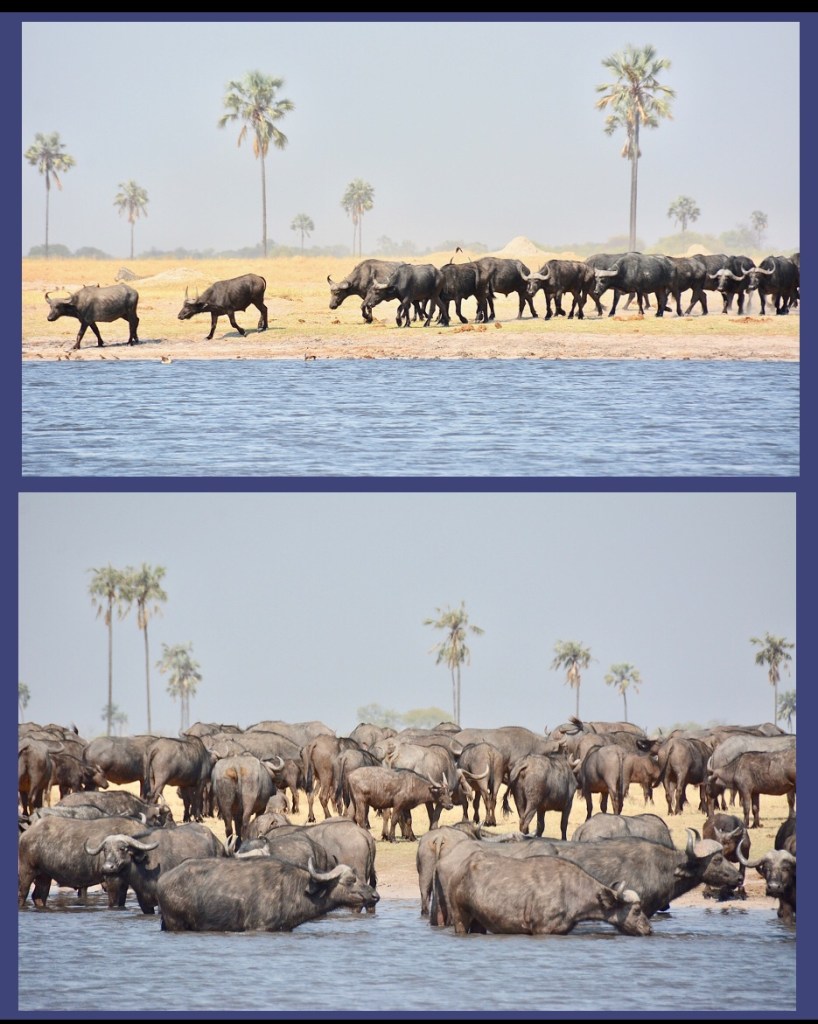
On another day in the morning, Sean drove us over an hour to the pan (water hole) called Mbiza, where we sat and waited to see what might appear. There were baboons, zebras, and warthogs, some ostrich in the distance and many beautiful birds. While sitting there, all of a sudden a dark line appeared on the horizon. It then became a dark line with dust in the air over it. A large herd of Cape Buffalo was approaching. We watched for fifteen minutes as they slowly made their way to the pan. They were in no hurry, and it was more of a march. Finally they arrived and crowded the bank of the pan on the opposite side from where we sat. We were perhaps 40 yards away from the massive herd. Sean said there were over 600 of them. When we asked how he knew how many there were, he answered straight faced “Oh it’s easy. I just count the legs and divide by four.” We all burst out laughing.
Some of the Cape Buffalo at the Mbiza Pan
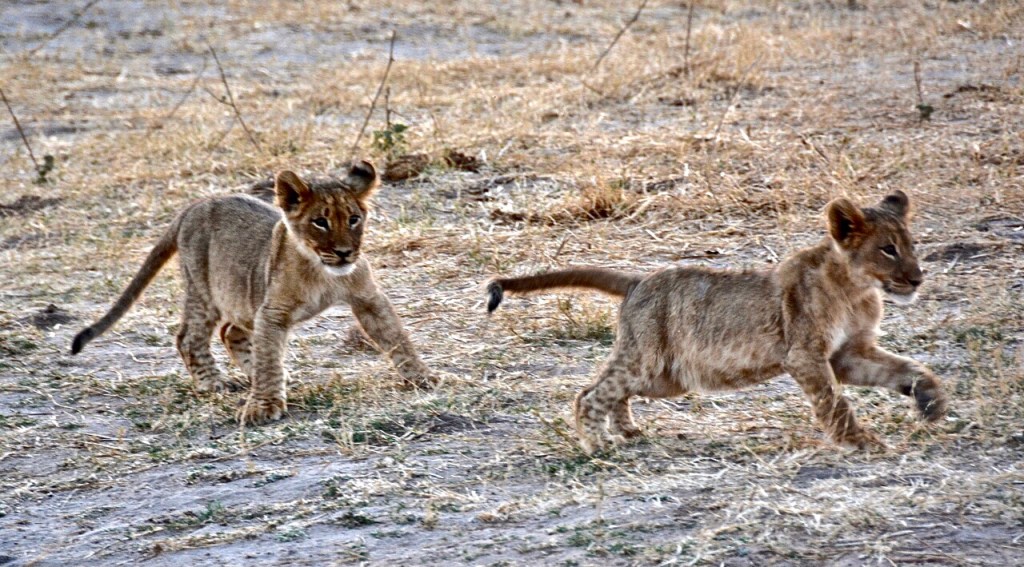
The last thing I’ll mention is the number of lions we were able to see. On our last trip to The Hide, we “only” saw two lions sleeping. This time? On the first two days, we saw two different prides, including one with cubs only three or four month old. For the pride with the cubs we were only about 5 yards away from them. It was amazing.
The Three Month Old Cubs
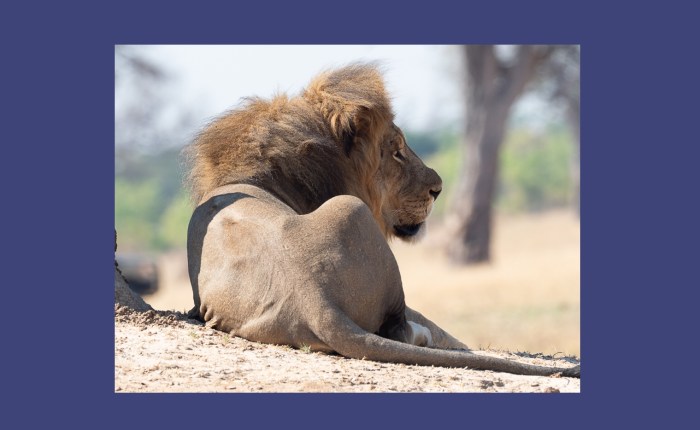
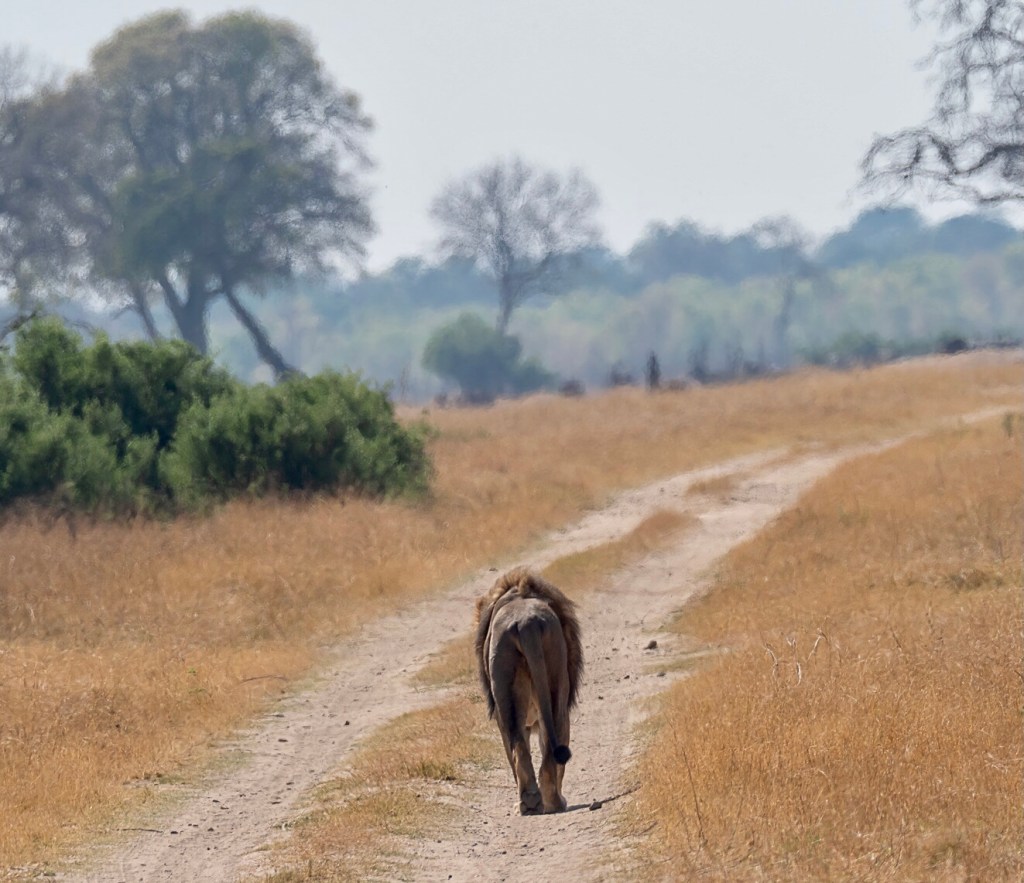
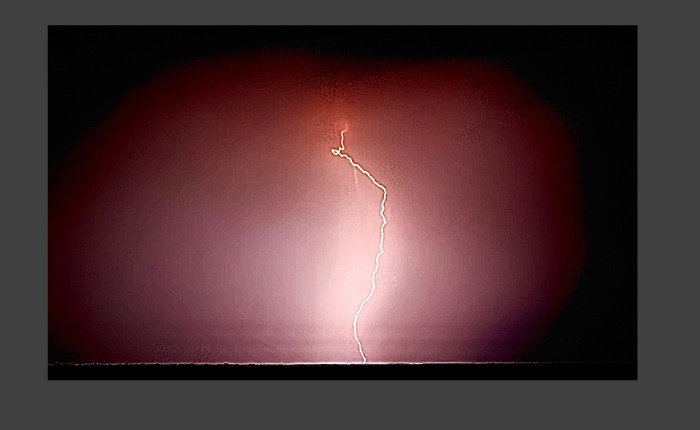
Later we were on our way to the Pan at Ngweshla when Sean received a call over the radio. After a conversation back and forth, he turned to us and said “If you need to use the loo, you’d better find a bush now. There’s a lion on the road between us and the next bathroom at Ngweshla!” We drove on and then saw another safari vehicle going slowly in front of us. Sure enough, in front of the vehicle was a single male lion ambling along. He was zigzagging back and forth across the road so the vehicle could not pass. It turned out they had followed him for over a kilometer. He showed himself to not only be king of the jungle, but King of the Road (Where’s Roger Miller when you need him? 😉 …)
King of the Jungle, AND King of the Road…
The thing about safaris, is you never know what you will see. It’s not a zoo or a Disney Theme park. It’s nature, in the wild and unscripted. The sightings on this trip were different from three years ago in 2018. Not better, not worse, but different. Our buddy Dave was correct though – The Hide never fails to deliver. Thanks to our guide, Sean, for helping us see so much.
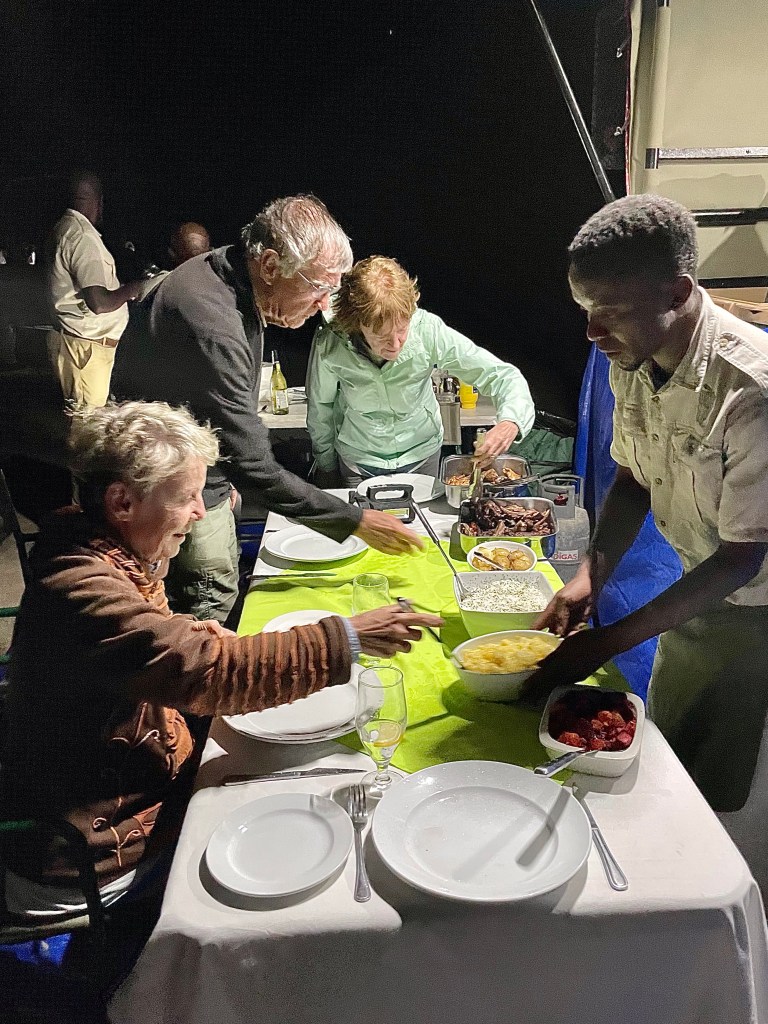
Dinner with Sean on our Last Night at The Hide
Addendum:
⁃ Special thanks to our friend Bill Reichhardt for the title picture of the lion and of the lion strolling down the road. The photos are both of the same lion, about 1/2 hour apart. After following the lion on the road for a while, he eventually veered to the side, and rested by a termite mound.
⁃ Many thanks to our guide, Sean Hind, at the Hide. Sean works at The Hide, but also has his own guiding company. You can read more about him and his company here: http://www.safarisicansee.co.zw
– This is the second time we have used Karen Dewhurst, of Sikeleli Travel & Expeditions as our travel consultant. After working with her in 2018, there was no doubt we would use her and Sikeleli again. All accommodations were amazing, the food and wine excellent, the logistics and travel arrangements perfect and the animal viewing exceeded all expectations. If you are coming to this part of the world, I highly recommend her and them. You can reach Karen at: karen@sikelelitravel.com | (+27) 81 067 1094 (South Africa). Their overall website is at: https://sikelelitravel.com/ .
All our bags are packed, We’re ready to go. Africa holds us, and won’t let go… Yea, we’re leaving, on a jet plane, Didn’t know that we’d go back again…
After three years, we are once again Africa bound. We took our Covid tests on Sunday afternoon and received the negative results back Monday. We start the journey at 4PM later today (Tuesday) flying from Dulles to Newark, and then board a direct flight to Johannesburg, South Africa. We arrive 15 hours later at 5PM local time (11AM DC time) on Wednesday. We’ll have a good night’s sleep and then take a flight to Vic Falls the next morning (Thursday), where the fun really begins. With a bit of luck, we’ll see ellies than evening while having sundowners.
The Safari Camps
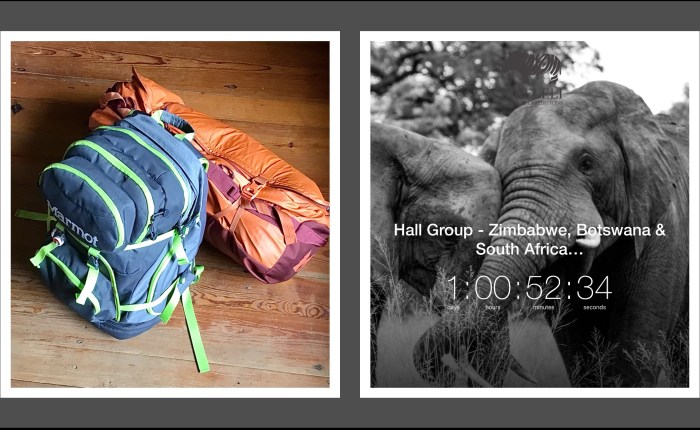
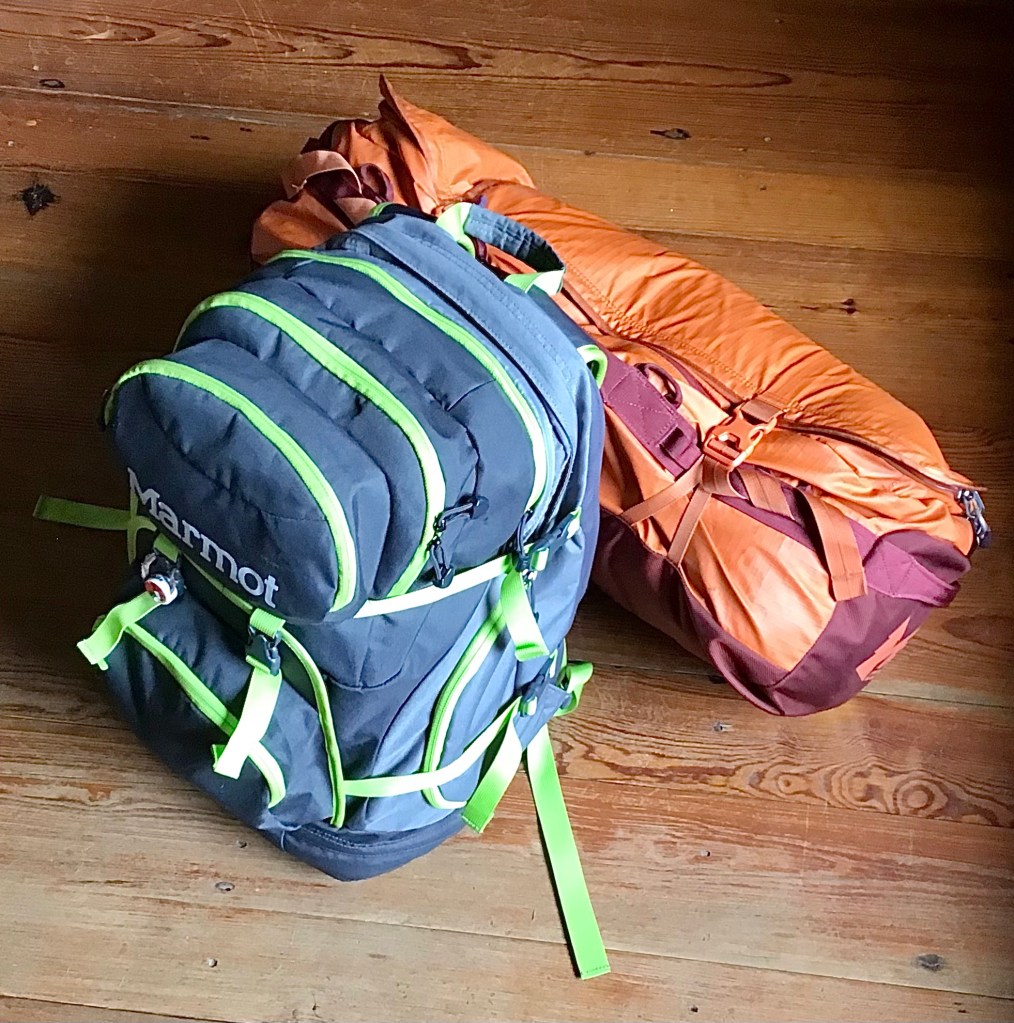
We’ll be on this adventure for about 3 1/2 weeks, with most of the time on safaris in Zimbabwe and Botswana. Our first Safari camp, The Hide, is in Zim and a several hour drive from Vic Falls. This is the one part of the trip we are repeating from our last visit. After The Hide, the other three camps are all in Botswana and are fly-in camps. Those flights all set a limit of two small, soft bags and no more than 44 pounds per person. My two bags weigh 40 pounds together. It’s amazing how light you can pack when you need to.
Two Small Bags and 40 Pounds, for 24 Days
Cathy and I, along with our friends Bill and Sharon, started planning this vacation in January of 2020. After a one year Covid delay, it’s finally here. I feel like a kid on Christmas Eve and can’t wait for this trip to begin.
Addendum:
I’ve written two other blogs about this upcoming 2021 trip to Africa.
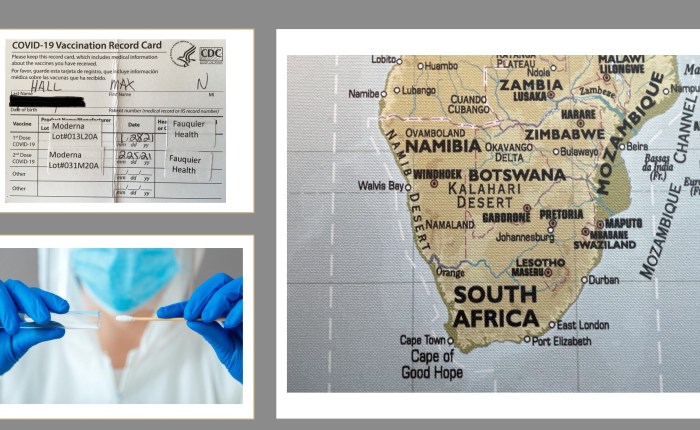
The Second blog is about the extensive Covid testing required throughout this upcoming trip, along with some stats showing Africa is actually safer (for covid) than several of the States here in the USA. You can read it at this link: https://mnhallblog.wordpress.com/2021/09/01/africa-and-covid-testing/ .
In three weeks, we depart for Africa. We’ll have our first (but not last) Covid PCR* test 48 hours prior to departure. In fact, it will be the first of four Covid tests during the vacation. Although the State Department says we shouldn’t travel to South Africa, Zimbabwe, or Botswana due to Covid, it turns out all are much safer than traveling to Florida.
When we board our plane here in the States bound for Johannesburg, South Africa, we need to show the result of a test taken not more than 72 hours prior to our departure. When we enter Zimbabwe, a day after arriving in South Africa, the TEST RESULTS themselves can’t be older than 48 hours PRIOR to the beginning of our travels. Given that it takes at least 16 hours here locally to receive test results back (for a PCR test, not the rapid test), the logistics are doable, but a bit … challenging.
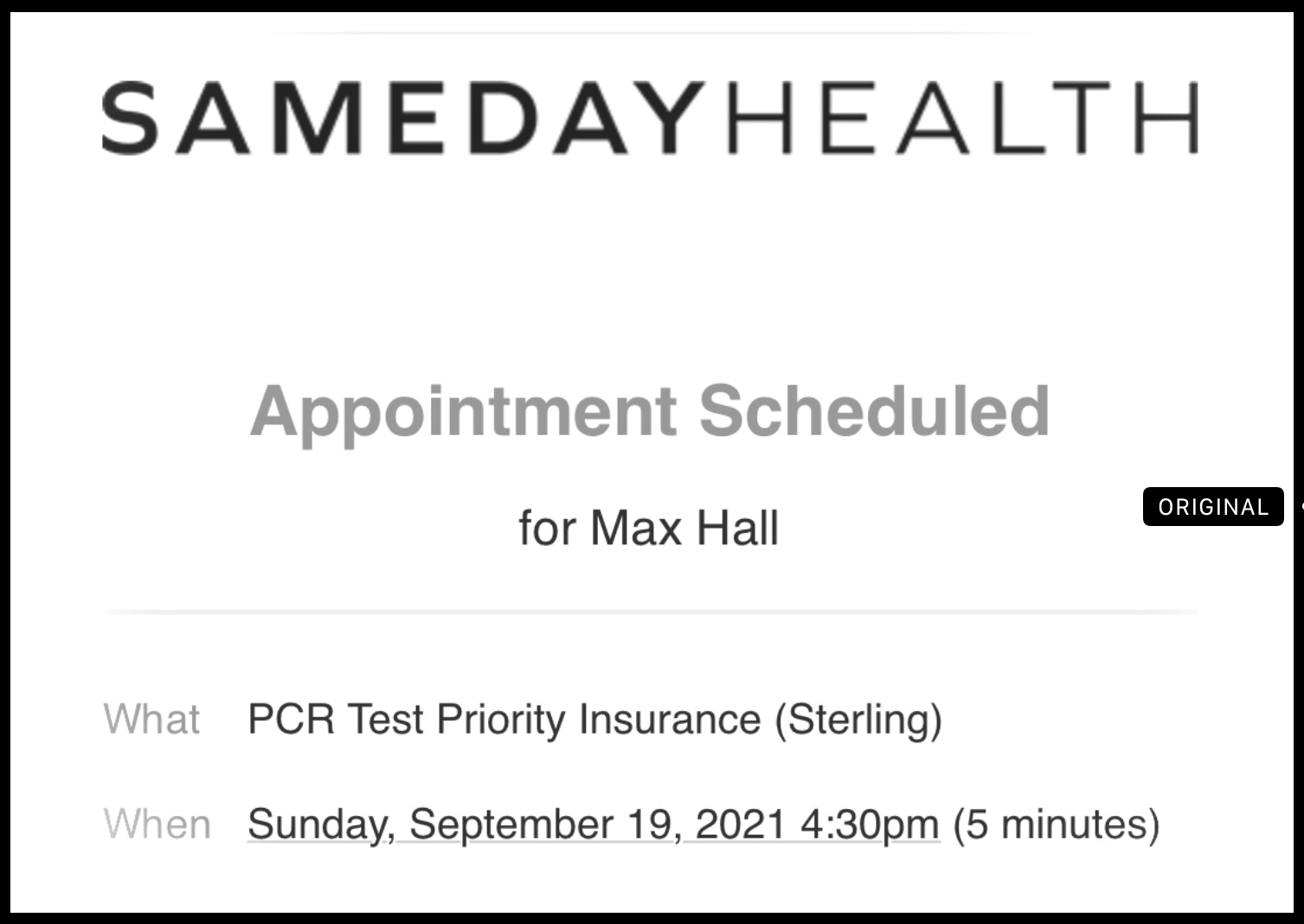
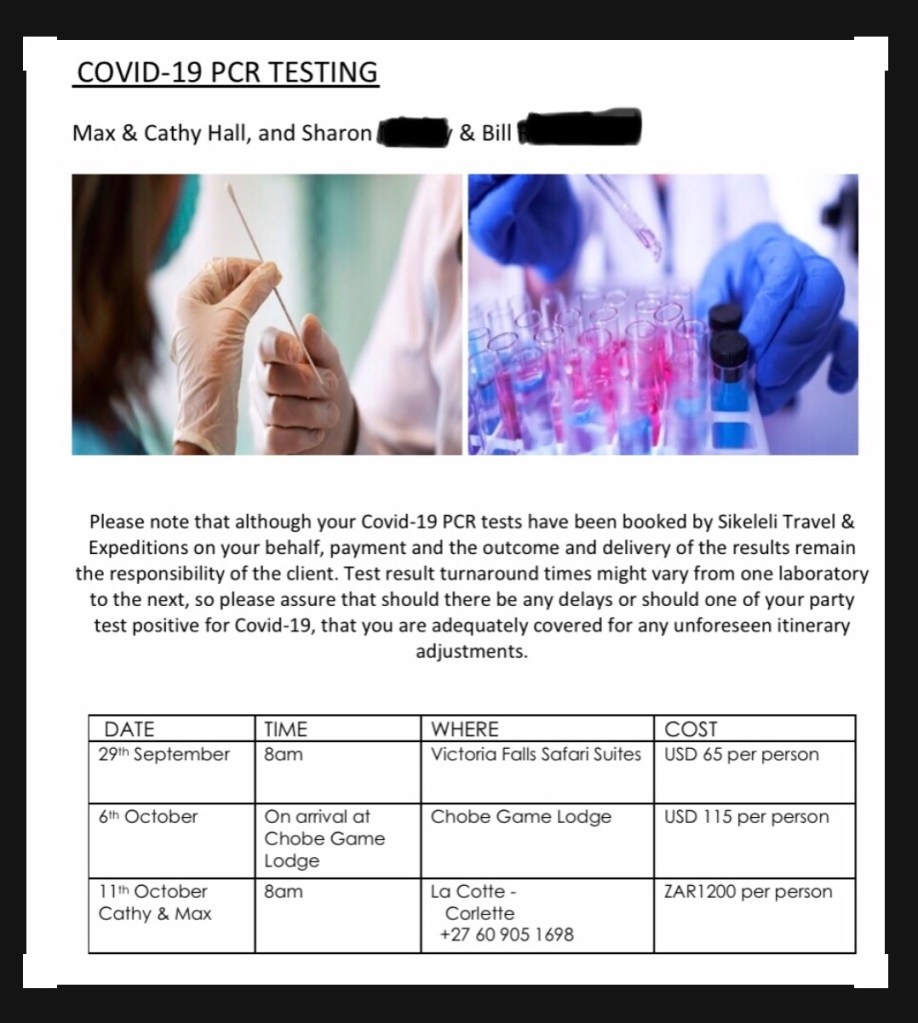
A week later, when we travel from Zimbabwe to Botswana, we’ll need another PCR test. Eight days after that, when we return from Botswana to South Africa, we will receive our third PCR Test. Finally, when we return from South Africa to the States, we will have our fourth Covid PCR test. None of the tests can be older than 48 or 72 hours, depending on each country’s requirements, hence, the number of tests required. Karen, our travel agent, has already scheduled the tests in Africa for us.
Our Covid PCR Tests are Already Scheduled in Africa
The Department of State is currently warning against travel to Zimbabwe, Botswana and South Africa due to the increase in Covid cases in all three countries. Here’s the interesting part. The current number of weekly Covid infections per 100,000 people in each of these countries is:
Zimbabwe – 13 infections per 100,000 people
Botswana – 318 infections per 100,000 people
South Africa – 136 infections per 100,000 people
Guess what Covid weekly infection rates are per 100,000 people in Florida, Louisiana, Texas, and Mississippi?
Florida – 691 infections per 100,000 people
Louisiana – 720 infections per 100,000 people
Texas – 397 infections per 100,000 people
Mississippi – 753 infections per 100,000 people
The United States over all – 306 infections per 100,000 people
Seriously. And they are worried about us traveling to South Africa, Botswana and Zim.
In Africa, the precautions don’t stop with the tests. We will fill out health questionnaires at border crossings and hotels. At the Safari Camps where we are staying, the staff are all 100% vaccinated. If they depart the camp, they are retested upon return, and all staff are temperature tested twice daily. They will also temperature test us once per day. All staff members are masked. They will clean and sanitize all public and private areas as they are used.
Is there risk in going on this trip? Sure. There’s always risk. In addition to Covid, there is also the chance of malaria, typhoid fever, cholera, hepatitis, tetanus, stomach distress, and assorted other diseases.
Cath and I, along with our friends Bill and Sharon have discussed the risks and received continual updates from Karen. For Covid, we will mask as needed, distance from others as required, and wash our hands frequently. Although the vaccination rate is not as high in these countries as it is in the US (due to vaccine access), they are doing the right things to minimize the risks.
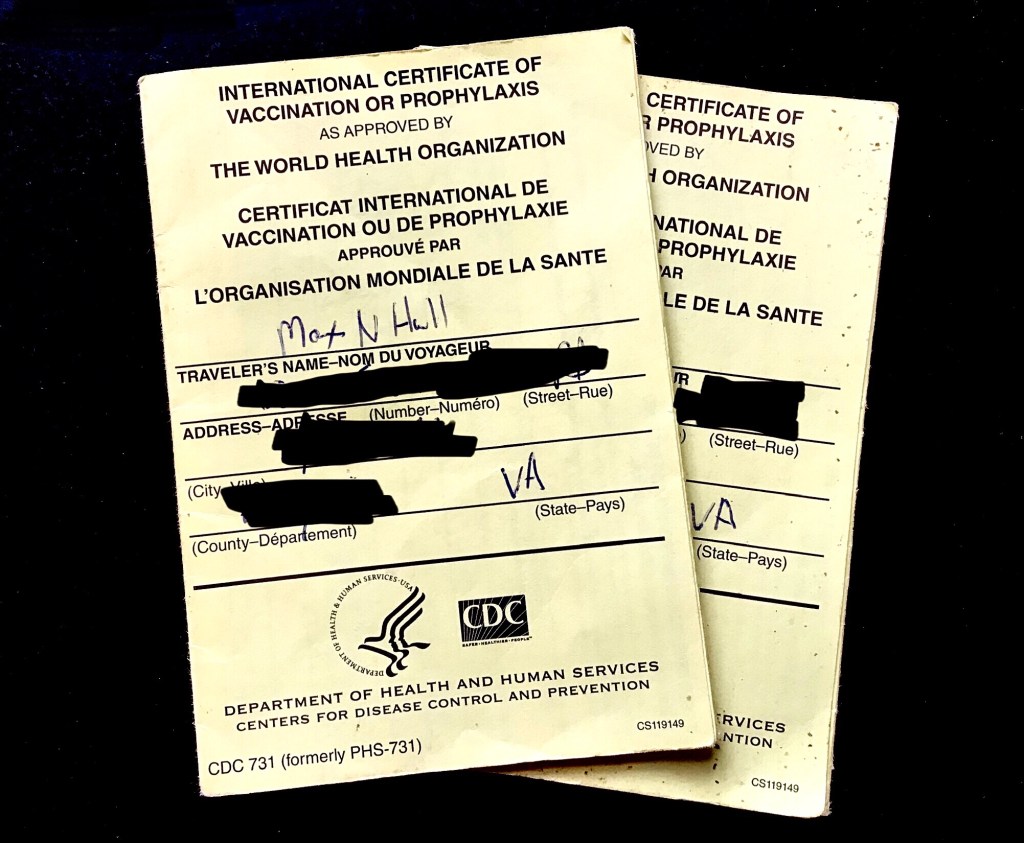
As to the other diseases, it’s amazing. They have these wonderful things called vaccines and vaccine boosters now that take care of several of the diseases. For the rest, good hygiene and drinking water only from known sources solves most potential issues. As a side note, Cathy and I have had our International Vaccination cards for decades – they are a great way to keep track of the current status of all of our vaccines, boosters and shots. It’s unclear to me whether owning these card makes us a part of some International Communist conspiracy or not :-).
International Vaccination Certificates are a Great Thing to Have.
All four of us are unbelievably excited about the trip. Originally scheduled for September of 2020, we postponed a year, due to covid overall. Now? We are ready to go.
Risks? Yes, we are ready to take some risks, and travel to Africa. Just don’t ask us to go to Florida, Louisiana, Mississippi or Texas. There are some risks we just won’t entertain.
Addendum:
• For international travel, you must have a PCR test, not the rapid test. It is considered more reliable. Unfortunately, it takes longer to receive the results.
A couple of months after Grandma Grubaugh died in 1996, I received a call from mom. She wanted to know if there was anything I might like from Grandma’s things. I immediately answered “The Pink Elephant and Blue Monkey glasses.” She Said “What?! Nothing else?” “No, those are how I best remember Grandma.”
Grandma and I Just Shy of my Second Birthday
Lillian Henrietta Grubaugh was born on the 2nd of January, 1905 and died on the 4th of December, 1996 at the age of 91. When Grandma died, my Uncle Don was executor of the will and divided the major assets equally out among Aunt Pauline, Aunt Cecilia, mom, Uncle Sonny and himself.
As to the belongings in the house, they took turns picking things each of them wanted, starting with Aunt Pauline, the oldest, and then reversing the order for the next pick. When they finished this up, there were of course many things still left in the house. It fell to mom and my Aunt Pauline to go through the remainder of the stuff in the house, sort it, and give it away or otherwise dispose of it. I think it was around then I received the call from mom, asking if there was anything I might want.
So why did I want those glasses of pink elephants and blue monkeys? Why did I remember them and why did they call to me? I’ve thought about that for awhile.
Sometime around 5th or 6th grade, I started a business of mowing lawns. Or I suppose my dad encouraged me to start the business. One of my first customers was of course Grandma and Grandpa. I think my cousin Joey had the job before, but he’d grown older and moved on to real work of some sort, and the opportunity fell to me.
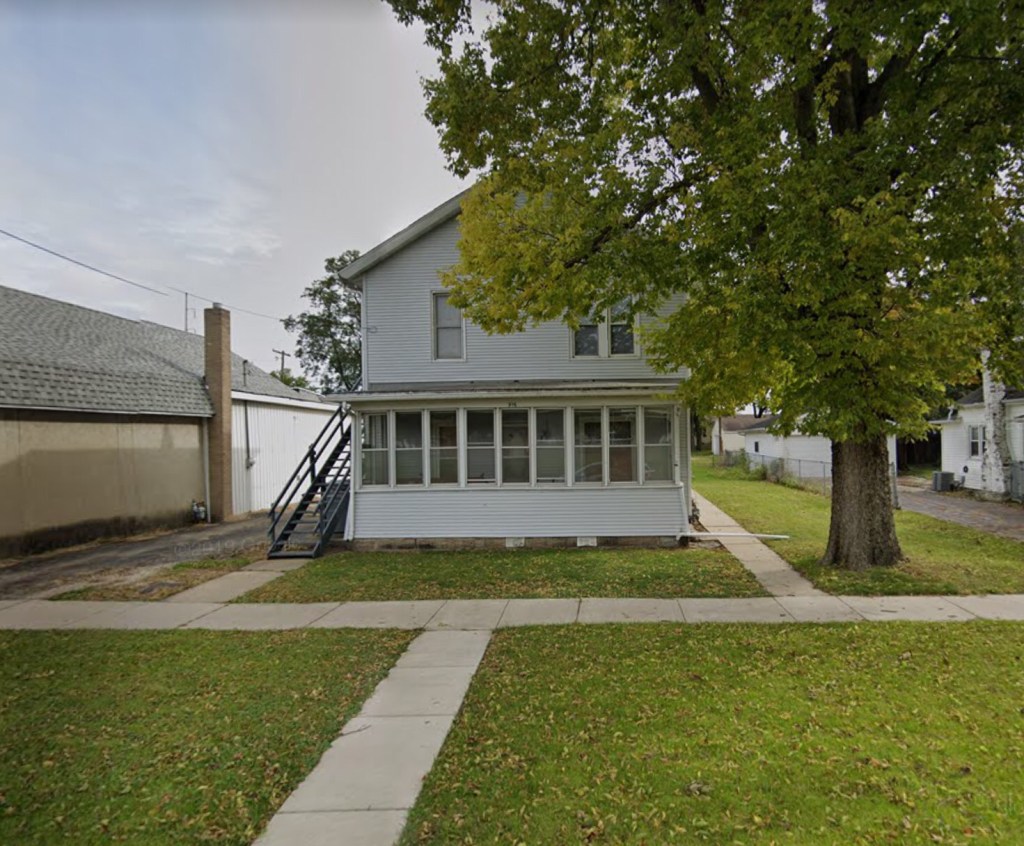
On mowing day, dad and I loaded the mower in the back of his car and drove across town to 916 Chestnut street, where Grandma and Grandpa lived. He helped me take the mower out of the car and then drive home, with instructions to call him when I finished up.
916 Chestnut Street – The Yard Seemed Bigger Back Then
I’d mow the lawn for the next half hour or 45 minutes. The yard wasn’t big, but there were lots of things to mow around – the old swing set, the low metal fence with posts, a couple of big trees, the vegetable garden, including grandma’s rhubarb plants, and the ancient garage out back. After I finished mowing, I’d do a quick trim of the hard-to-get spots with some manual clippers.
Eventually, I’d finish everything up and head to the house, ready to call Dad. Inevitably Grandma would greet me and have me sit down at the kitchen table. She’d bring out a piece of spice cake, or unwrap some of her date nut bread, or pull some of her rhubarb sauce out of the fridge if the season was right. No matter what she served, she also poured me a big glass of milk in one of those elephant or monkey glasses and the two of us sat and talked.
I don’t remember much of what we talked about. I do remember us having those conversations – maybe about school, or summer camp, or Little League or whatever. It was just the two of us in our own little world.
Eventually we finished up and I’d call dad. He’d drive the 5 or 10 minutes across town and pick me up. Grandma and I would say goodbye, she’d give me a hug, and I’d wave goodbye from the car.
Wonderful Memories Involving Pink Elephants and Blue Monkeys
I cut their lawn for three or four years and the ritual was almost always the same. Around 8th grade, I started a “real job” working at the local pool as a locker room attendant, eventually graduating to lifeguard. I think my cousin Jimmy, Joey’s younger brother may have taken over the lawn mowing at Grandma and Grandpa’s home. Grandma and I stayed close, even after I left for West Point, but those regular private times together disappeared. I’d see her on breaks from school, or when we returned on vacation from an overseas assignment, but of course it was never the same. There was still spice cake or date nut bread, and a glass of milk or cup of coffee. We had wonderful conversations, but they were obviously more grown up. The innocence of those previous times was gone.
Grandma and I at my Graduation from West Point in 1978
I’ve thought back to those younger years and sitting at the table eating one of Grandma’s treats and drinking milk out of those glasses. It’s a warm memory, and I always smile when I see the glasses sitting on a shelf at our home now. Grandma and I having a summer conversation at her kitchen table, wrapped up in our own little world…
Addendum:
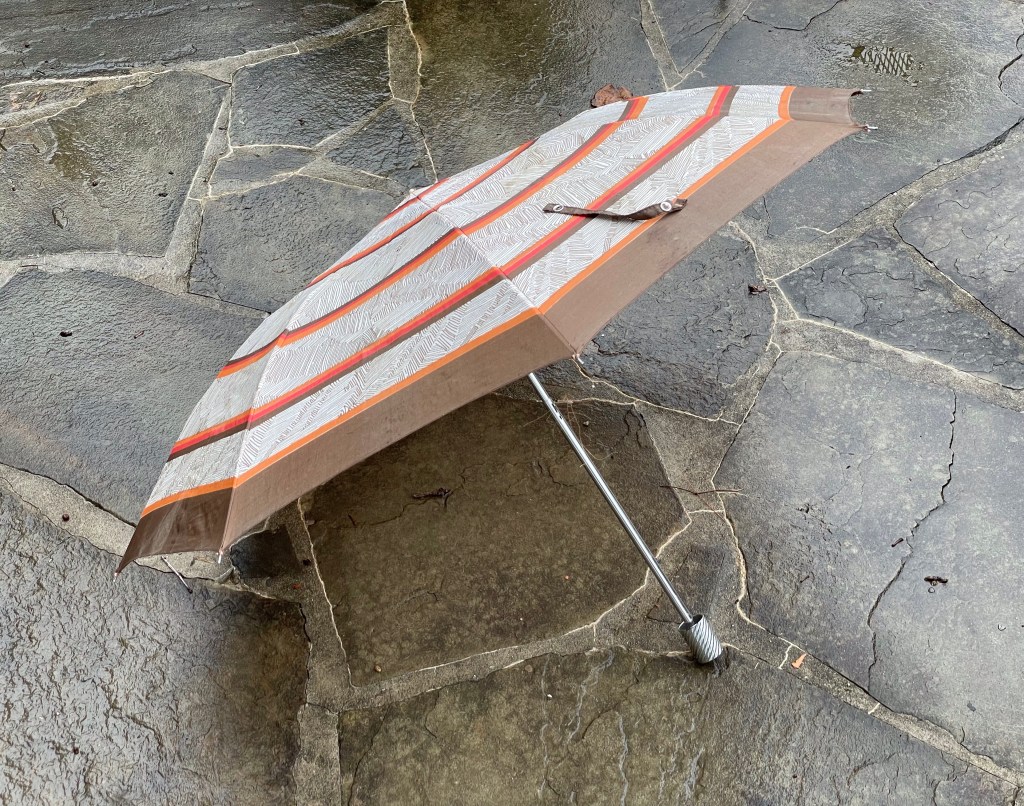
Something we also found out from mom and Aunt Pauline was that Grandma often times didn’t use the Christmas gifts we gave her. Instead, she tagged them with our names and put them away in a chest. The tagged items went back to the giver after she passed away. One of the tagged items was an umbrella of questionable fashion I’d given her one Christmas. it still sits by our back door here in Virginia, in case it’s needed.
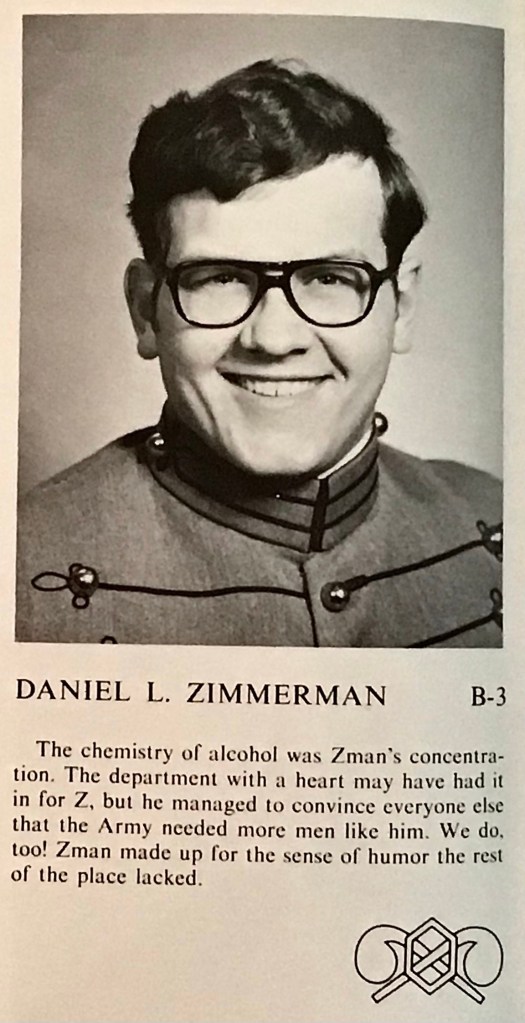
It’s always tough when a West Point brother dies, but this one hit me harder than most. Zman is gone. I’ve lost other classmates over the years, but Zman was the first from my company, and I felt a great sadness on hearing the news. I suppose it was sadness both for his passing, and the passing of our youth.
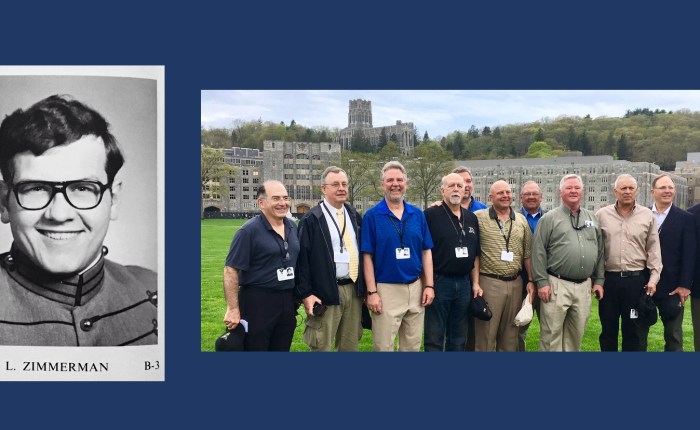
Dan Zimmermann was a big guy with a big personality. The kind of guy whose good mood was infectious. We had some good times at WooPoo U (West Point) our Firstie (Senior) year, although I also remember him studying a lot – he was taking P Chem, a class not for the faint of heart. Still, I remember an evening or two (or three) of partying.
Dan’s Graduation Picture
After graduation in 1978, we reunited several months later in Wurzburg, Germany. I was stationed with the 123d Signal Bn (3ID) at Hindenburg Kaserne, and he was across town with a Chemical unit. I can’t remember now if he was a part of 3ID or some other unit. Over the next three years, we managed to hit more than a few Bier and Wien Fests together in the surrounding area.
I remember one evening in ‘80 or ‘81 when the town he lived in held something called a “Heckenwirtschaft.” In Franconia, a part of Bavaria, small towns would occasionally allow the small wine growers to open their homes as limited seating “pubs” – an event called a “Heckenwirtschaft”. Dan’s landlord was one of the people who opened their homes. We spent the night wandering from house to house, and in their cellars or kitchens sampled some good white wines and wonderful homemade foods. It was a great time – one of those evenings when it’s just you and the locals, and because of Dan’s landlord, we were treated like locals as well. Nights like that don’t come around all that often and I remember it to this day. We may have overserved ourselves a bit that evening.
We lost track of each other after our next assignments and didn’t see each other for a couple of decades. In 2015, Cath and I held a mini-reunion for my West Point Company, B-3. There were about eighteen of us here for the weekend and Dan joined up at the last minute for the two nights of festivities. It’s funny, but the whole group of us clicked back together, as if it was Firstie year in 1978. There were stories told, both old and new. The bonds we’d forged decades before on the banks of the Hudson River still held strong.
We saw each other for what turned out to be the last time at our 40th reunion at West Point in 2018. He had become the National Sergeant at Arms for the American Legion, and told us about escorting both candidates, Secretary Clinton and Mr. Trump, to the stage in 2016, when each spoke at the Legion’s National Meeting prior to the election.
B-3 Classmates at the 40th Reunion in 2018. Dan is in the Center in the Back.
In 2020, Cathy and I were going to hold another mini B-3 reunion in May here in Warrenton, Virginia. Dan and I traded emails and spoke, and he was planning to come. Unfortunately, in April, we cancelled the get-together due to Covid. Dan called me after that and we talked for about 10 or 15 minutes about Covid, along with this and that. It was the last time we spoke with each other. He didn’t mention the lung cancer he already knew he was dying of.
It’s Forty-some years since our graduation from West Point in 1978 and those years have passed much too quickly. I think of Dan, and my other classmates, both living and dead. Our class will still have plenty of good times together, and many more reunions. Having said that, the chapel service honoring our departed classmates at those reunions becomes just a little sadder each time.
I’ve also been thinking about the great Dire Straits/Mark Knopfler song, “Brothers in Arms” and it’s refrain,
“You did not desert me
My brothers in arms…”
Whenever I hear the song, I think of both West Point and my time in the Army. The song is bittersweet, and also a testament to those who have served, and the brotherhood that exists between them. Released in 1985, it also reminds me of my 8 1/2 years with the Army in Germany that decade.
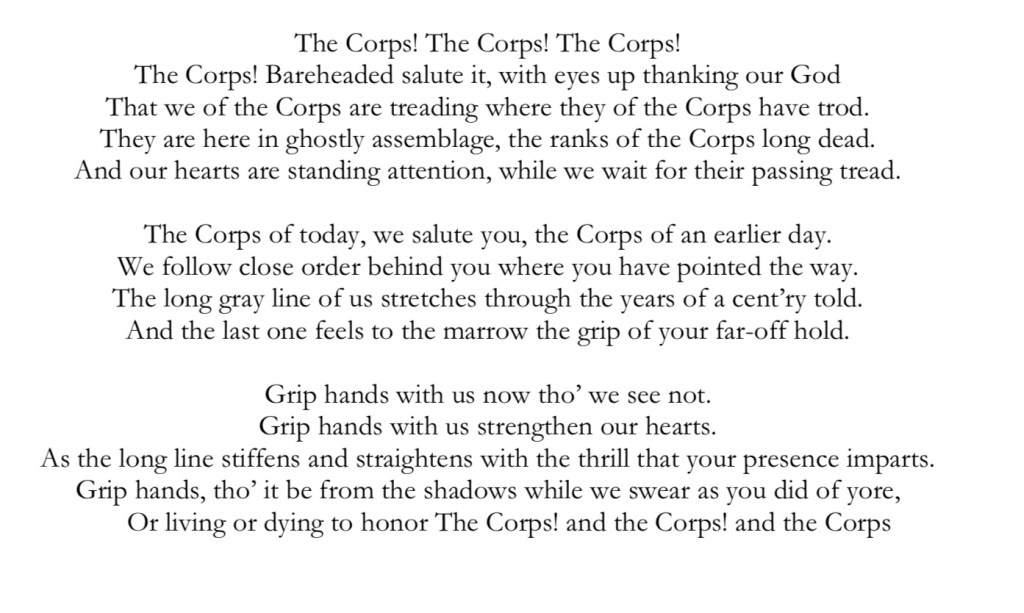
And of course, I can’t help but remember the song “The Corps” from West Point. It celebrates the continuity of The Long Gray Line, past, present and future.
Grip hands with us now tho’ we see not. Grip hands with us strengthen our hearts … Grip hands, tho’ it be from the shadows…
Rest In Peace Zman, Rest in Peace. You are gone, but not forgotten.
– Thanks as always to my friend Colleen for her super editorial assistance. I’m alway thankful for her corrections to my poor English. I’m better than when I started this blog 5 years ago, but still have room for improvement. Thanks Colleen!
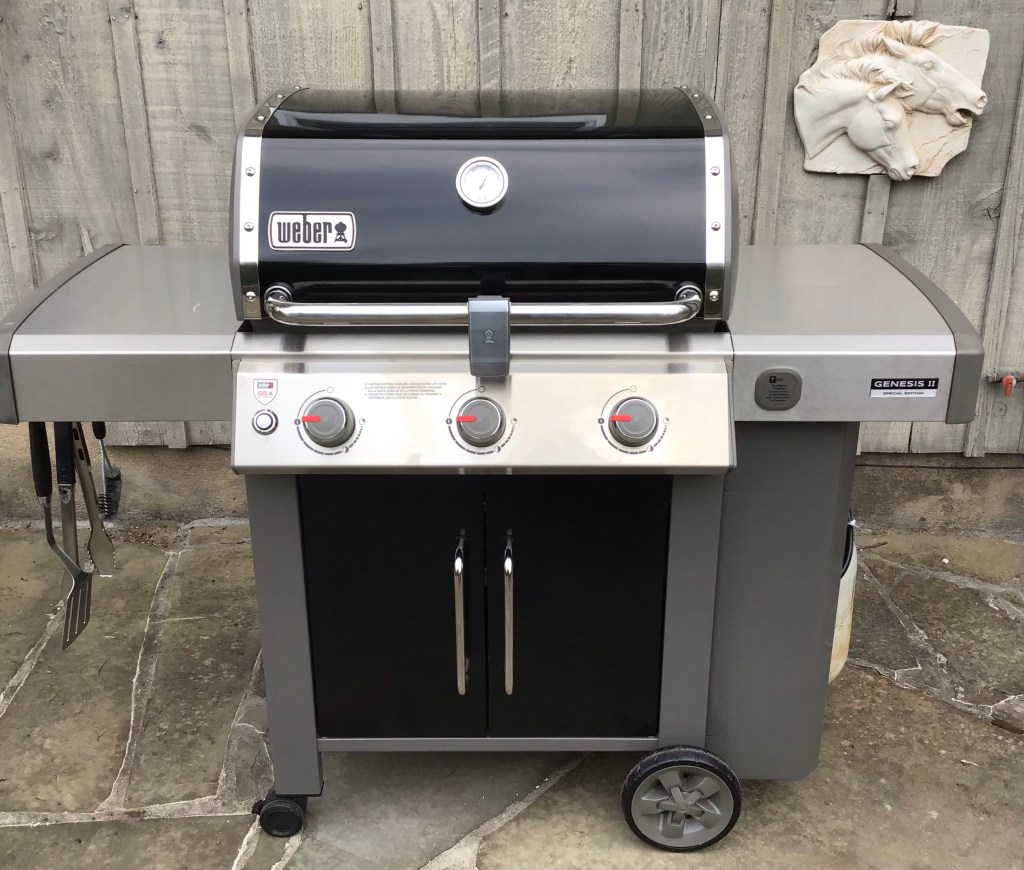
We recently bought a new gas grill. I’ve always been a charcoal guy, but decided to add a gas grill as well. So – what would be the first meal to come off the grill – Steaks? Brats? Burgers? Chicken? A Pork Tenderloin? It turned out to be a Pizza Margherita. Yep. Seriously. What the hell!?! Well, there’s a bit of a story to go with the decision.
For the last 40 years, I’ve cooked on (mostly) Weber Kettle charcoal grills. The smoke, the flame, the flavor, it all just worked for me. Yea, I always knew there was a bit of inconvenience to it, but that was no big deal, and I’d argue with “gas guys” about why charcoal was superior.
When Cathy’s mom passed away in 2010, we inherited her gas grill. It took me a bit of time to cook on it, but I made the adjustment. I still mostly cooked with charcoal, but if I was in a hurry, or occasionally had something that just needed a quick sear, like shrimp, I’d use mom’s grill. It was also put to use when we did our annual Oktoberfest Run at the farm – When you need to cook 125 Brats and warm up 100 soft pretzels, all available cooking surfaces are pressed into service.
Last week, two independent events happened that changed my outlook.
First, the New York Times cooking section had an article about making your own pizza. I’d always shied away from making my own pizzas in the past. Making the dough seemed like more effort than it was worth. The Time’s recipe? Easy. You just needed a bit of time. It also had a simple recipe for the sauce. Still, it seemed that, while you could make a good pizza in your oven, the oven still wasn’t Pizzeria-oven hot, not even close. I know lots of people make great pizza at home, but it gave me pause.
The second event? Cathy and I talked and decided to buy a new gas grill to supplement our charcoal grill. Mom’s old grill was toast. Maybe I’m getting old. Maybe I’m getting soft. In any case, I bit the bullet, and bought a new gas Weber grill. Now with the Weber, as I was reading through the manual, they recommend heating the grill to it’s highest temperature for 20 or 30 minutes before you ever use it. I’m not sure why, maybe to help season everything.
In any case, the day the grill arrived, I heated that puppy up for about half an hour. I went out later to shut it down and glanced at the temperature. Whoa! Over 600 degrees!
A Pizza Oven of a Different Sort
That got me to thinking. 600 degrees still isn’t the 1,000 degrees of a wood pizza oven, or as hot as a commercial pizza oven. But, it’s hotter than most home ovens.
A wood oven, at 1,000 degrees takes about 60 seconds to cook the perfect pie. What could I do at 600 degrees? I decided to find out.
I kept it simple for my first try and just went with a traditional Pizza Margherita. On Saturday afternoon I made the dough and let it rise. While that was happening, I made the sauce they recommended, which was really simple – blended crushed tomatoes, a bit of salt and a swirl of olive oil. I added some garlic and oregano.
The Two Dough Balls for the Crusts
About an hour before dinner time, I put my baking-stone on the grill and started heating it up.
Next? I had a cocktail, got a bottle of Zin out of the cellar and relaxed a bit. Finally it was time to assemble the pizza.
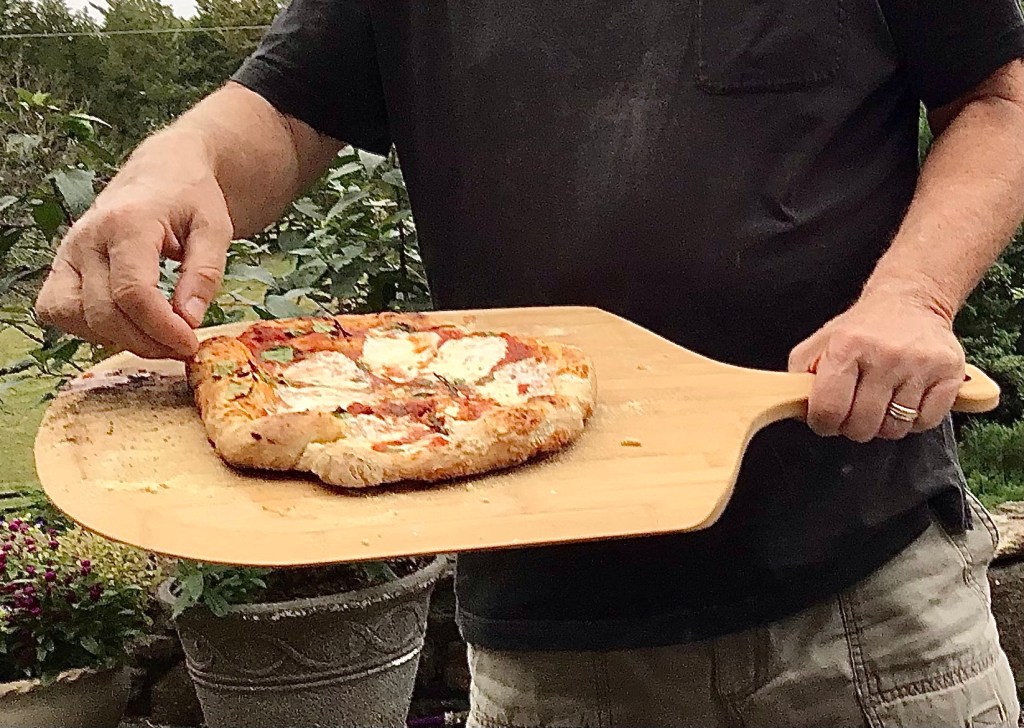
I formed the pie, added some sauce, then placed mozzarella cheese on it, and scattered some basil leaves. I added a quick swirl of olive oil and a grating of pepper. I kept the second round of dough handy, in case I screwed up the first pizza. Into the Weber the pizza went. Six minutes later, I took it out.
Homemade Pizza – Yea Baby!
It looked delicious. I let it cool for a minute or two. Yes, I still remember burning the roof of my mouth on occasion with pizzas straight from the oven… 😉
Finally, it was taste test time, and – Whoa! This was pretty damned good. Was it the best pizza I ever had? No. But it was much better than many pizzas I’ve had. It had a nice crust and a good sauce. The cheese was melted and stringy. This was something I could easily enjoy again and again.
We devoured the first pizza and I quickly made the second one. I added a bit more cheese and basil this time and slid it onto the baking stone. A little under six minutes later, I pulled it out. I’d say Cathy liked the pizza as well, as the second one was also quickly gone.
The Second Pizza was as Good as the First.
I realize I’m late to the “make your own pizza party”, but I’m on board now. The grill made me a believer. I’ve got a few topping ideas for the next pizzas, and some thoughts on how I could improve just a bit. Practice makes perfect, or so they say.
So…I bought this Weber Grill that makes good pizzas. I hear it’s not bad with steaks either. We’ll see sometime in the future.
Addendum:
– I love pizza, although we don’t eat it as much these days (that may change now). I think that’s partly because we have to drive 15 or 20 minutes to the nearest pizza places. It sounds foolish, but growing up in Ottawa, Illinois, we had several great pizza places, and I think it spoiled me a bit. Foremost among the places in Ottawa was Sam’s and Bianchi’s. They are legendary back home. Anyone returning for a visit almost always stops at one of those two places for a pie. If you want to read about me having pizza 116 times at Sam’s in 1972, you can do so here: https://mnhallblog.wordpress.com/2017/04/14/sams-pizza-in-1972/
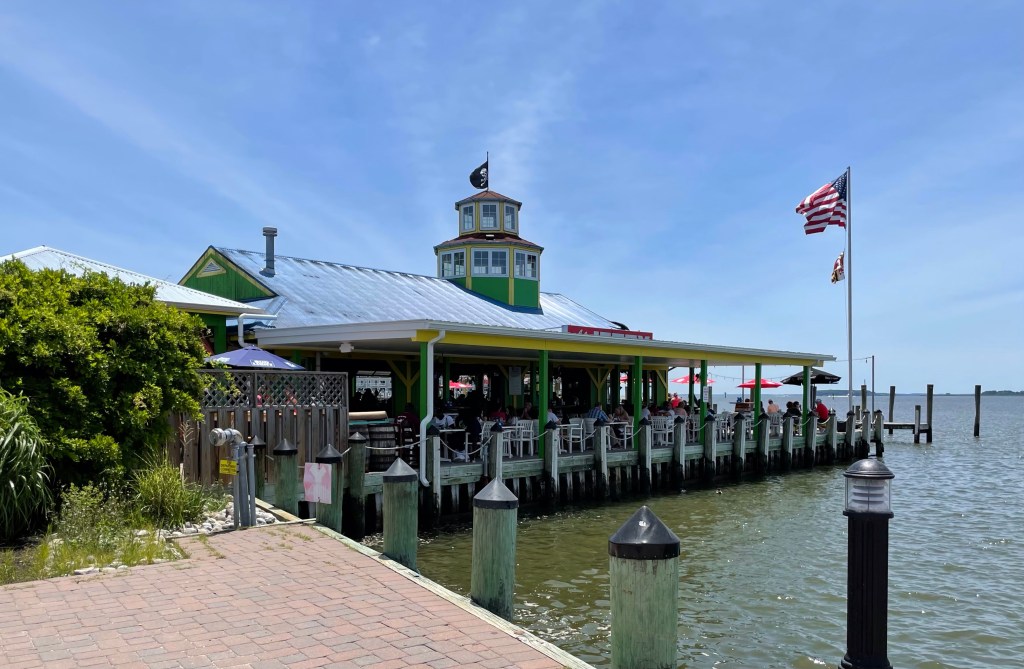
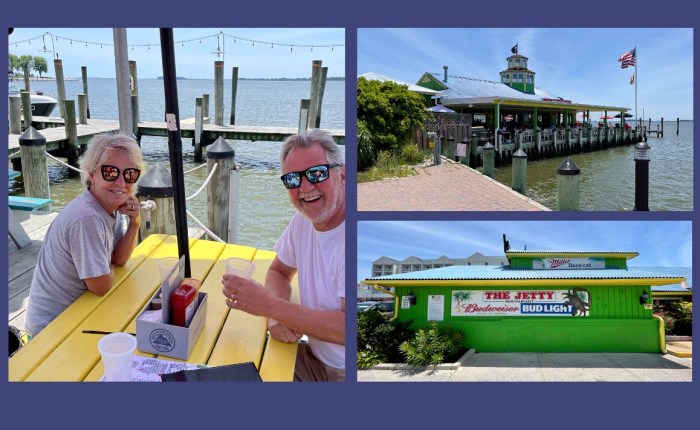
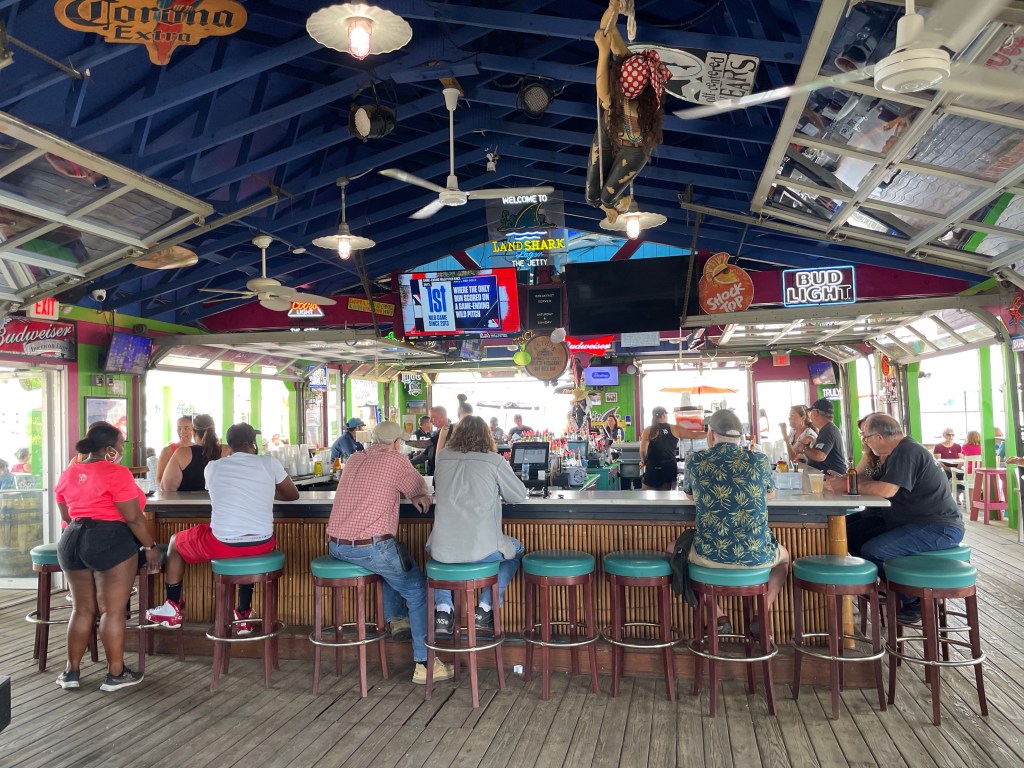
I’ve never ever heard someone say “Man, I can’t stand The Jetty”. In fact, it’s just the opposite. It’s one of those places that has found a way to appeal to old locals, new locals, people passing by, and tourists. As a bonus, dogs are allowed on the outdoor deck, which makes it one of Carmen’s favorite places as well. Every town should have a place like The Jetty Restaurant and Dockbar, but many don’t.
Cathy and I have been stopping at the Jetty for the last ten years. It’s on the way to our house at the Bay, and a great place for lunch. Two hours from home (and about 45 min from The Bayhouse), it’s the perfect stopping point.
The first time we went to The Jetty was with friends Pat and Bob, and Becky and Jim. Cathy mentioned to her girlfriends we were going to the Bay, and maybe we could meet them for a drink along the way. Becky said to Cathy “What about meeting at the jetty?” Cath answered “Becky – which jetty? There must be ten jetties in that stretch along the water.” Becky answered “Not a jetty, THE Jetty – it’s a bar”. And so we were introduced to this wonderful beach bar.
The Jetty has a great location on Kent Narrows.
Located in Maryland, just over the Bay Bridge on the Eastern Shore, the bar has a great view overlooking Kent Narrows. In the spring, summer and fall, the outdoor tables on the deck stay full, while in the wintertime, the indoor bar and restaurant fill up. With all of the glass “garage type doors” for the bar, the view from inside is almost as good as sitting outside.
With all of the roll-up windows, The view from inside the deck bar, is almost as good as from outside.
When stopping for lunch, we know a nice selection of cold beers, excellent Bloody Marys or tasty Crushes are there waiting for us. The food is decent, and this being the Eastern Shore, the crabs in the summertime and oysters in the winter are always excellent. Good burgers, fish sandwiches or tacos, a great Crab Cake, and excellent salads are all on the menu. This is bar food at it’s best… If you are looking for something more substantial, there’s always several wonderful seafood dinners on the menu as well… As a bonus, dogs are allowed on the outdoor deck, which also makes it one of Carmen’s favorite places. They always bring her a bowl of water, and if you are inclined, you can order special doggie “meals” off the menu for your fourlegged companion (we don’t). She always enjoys barking “hi” to the other dogs on the deck.
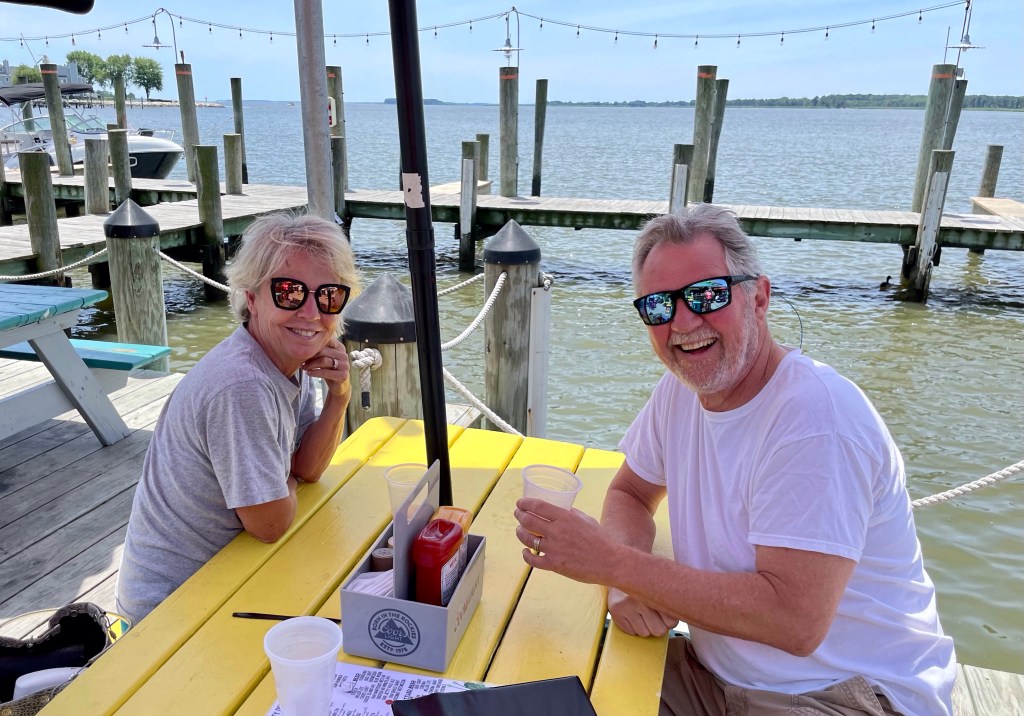
The mental transition to vacation mode starts pretty quickly when sitting on the deck, looking at the water and relaxing with a drink. A beer, or two, along with a sandwich makes that last 45 minutes of driving time to Tilghman pass pretty quickly.
Getting in vacation mode….
I’ve seen bikes, motorcycles, cars, trucks, and one year on St Paddy’s Day, a bus parked outside. Many folk also arrive by boat, docking in one of the slips.
We’ve also met friends there for drinks, or for dinner. It’s not a bad way to while away a few hours on a sunny afternoon. On weekends, they often have a band. Our friends, Pat and Bob live just three or four miles from The Jetty – in Pat’s words – “The Jetty is practically our every Friday happy hour go-to bar. Such a beautiful setting, especially the gorgeous sunsets.“
Every town should have a place like The Jetty, but many don’t. The water and view certainly help, but the way they appeal to everyone, local or not, is what makes the difference for me. I’m glad it’s on our list of local watering holes and places for a meal. If you happen to cross the Bay Bridge on Route 50 heading to the Eastern Shore or the Atlantic Ocean, make sure and give The Jetty a try. If you’ve been making the trip for awhile, you probably already knew that.
Addendum:
– Thanks to our friend Pat for reviewing and providing input for this blog.
– Note – this isn’t an advertisement for the Jetty and I was provided no money (or drink) in exchange for writing this blog! It’s a local bar/restaurant we just really like.
The night wasn’t supposed to happen. As a matter of fact, in today’s post 9-11 world, it couldn’t happen. They never would have made it through security. But in 1991? Yea, my buddies Howard and June sprung me from O’Hare Airport during a layover, and we had an unexpected night in Chicago.
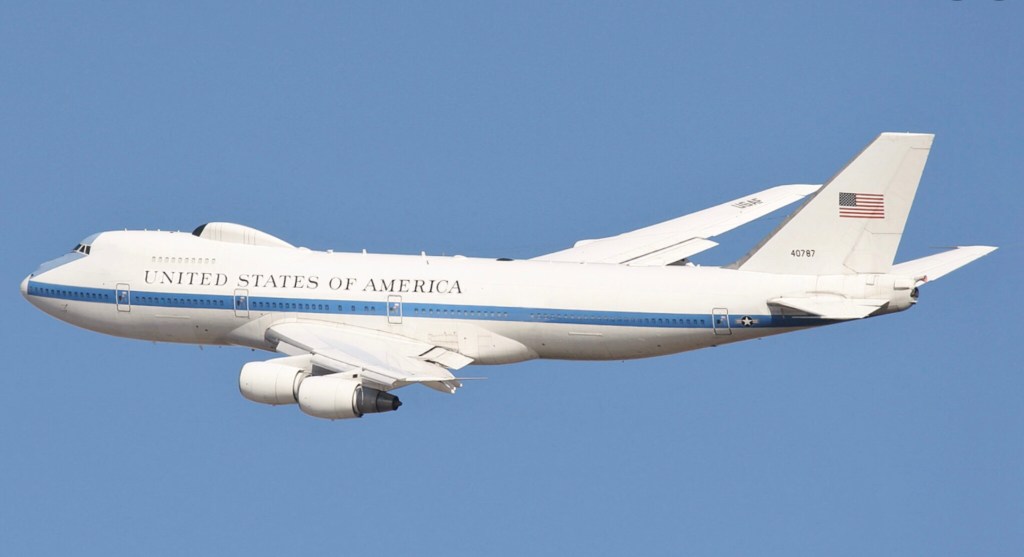
It was July 2nd, 1991 and I’d been in Omaha, Nebraska for a week. We were running communications tests on the President’s “other plane” – the National Emergency Airborne Command Post (NEACP – pronounced Kneecap). NEACP is the plane the president uses in the event of a nuclear attack. The tests went well and ended quicker than expected. As a result, I was racing to the airport to try and catch a flight home that evening, rather than my scheduled flight the next day.
NEACP – The President’s Other Plane
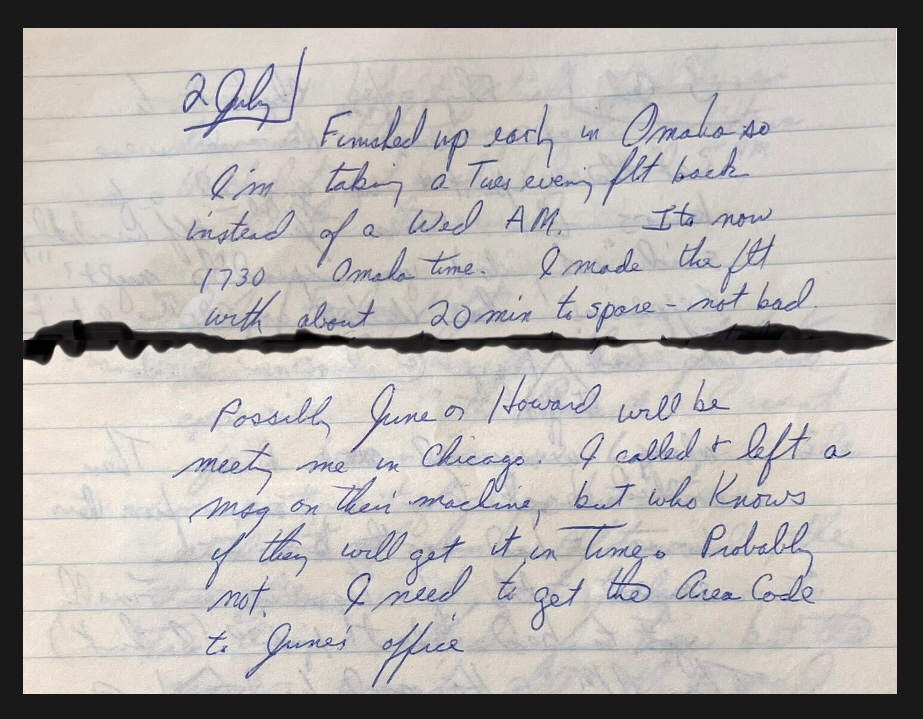
I made the airport with twenty minutes to spare and was able to get a ticket. At the time, there were no direct flights from DC to Omaha and I would need to connect through Chicago with a two hour layover. At the airport, I found a pay phone (don’t forget this was the pre-cellphone age) and called my buddies June and Howard in Chicago to see if they could meet me at the airport for a beer (remember pre 9-11 times at the airport? Anyone could walk out to the plane gates, and in fact, many people did. Usually not for a beer, but to meet loved ones when their plane arrived). Neither Howard or June were home so I left them a message on their answering machine. I figured the odds of them receiving the message AND making it to the airport on time were between slim and none. I ran to the plane and boarded.
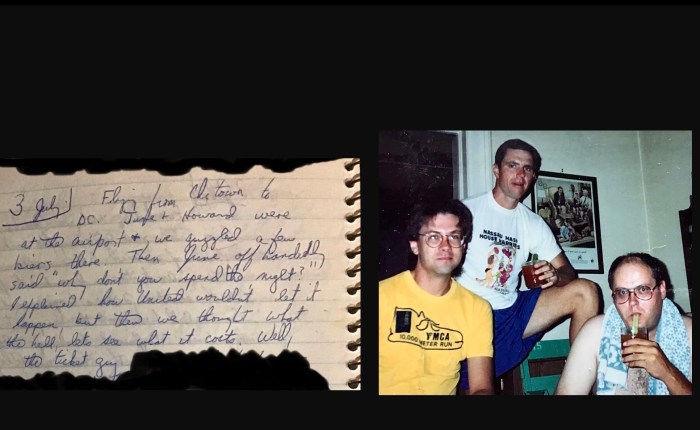
An Entry From my Journal About the Weekend in Question*
An hour and a half later we landed in Chicago and I left the plane. I’ll be damned – both June and Howard were there at the gate to meet me! Handshakes all around and we found a bar near the gate I would fly out of two hours later.
We drank a couple of beers and June offhandedly said “Why don’t you spend the night?” I told him United wouldn’t let it happen, and how I was lucky to be on this flight at all. Then we thought, what the hell, let’s give it a shot. I walked over to the ticket agent at the gate and talked with him about changing my connecting flight to the next day. We went back and forth about it, but he gave me about fifteen reasons why he couldn’t do it. I walked back to the bar, which was within site of the agent and reported to the boys that it was no dice.
The Chances of Spending the Night in Chicago Didn’t Look Good*
Howard wasn’t going to take no for an answer. He set his beer down and marched over to the agent. He proceeded to berate the agent and said something like this to him – “What kind of American are you? Here’s my friend, a soldier doing his duty protecting our country while here you are, sitting on your ass and not doing anything to help out. My friend puts his life on the line every day – don’t you think he’s worth that small gesture?” (Or words to that effect. Howard was pretty animated – as he related to me recently, he was performing on stage regularly then including at the Improv Olympic in Chicago. That gave him some of the confidence to pull off the role of “irate friend”). They talked a bit more and Howard came back to the table with a smile – It was on! The agent gave me a return ticket for the next day and we left O’Hare.
We were starving by now, and headed to a new Giordano’s Pizzaria. At the time, Giordano’s had only two or three locations in Chicago, and no where else. We ordered a couple of stuffed pizzas along with a few more beers. The night progressed. From there, it was on to another bar, and then to a bar across the street from their apartment for a final beer and a tequila (or two). We finally made it to bed around 1:30AM.
The next morning, I was moving a bit slowly. When I woke up, Howard was already gone, as he had to be at work early. June and I cleaned up and went out for a quick breakfast, before he drove me back to the airport. We arrived at 10:15, just in time to catch my 11:10 flight – it was my original flight, before I rescheduled everything the day before… ;-).
It was an unexpected night in Chicago with my oldest friends. What could possibly be better?
Howard, Me and June, Two Months Later in September of 1991. I was Back in Illinois for a Couple More Days. Bloodies were Evidently on the Menu this Particular Day.
Addendum:
⁃ * I’ve kept a journal for decades. I’ve rarely used it for any of my blogs, because I’m usually sporadic about what I write. When I was younger, it seems I wrote in it most often while traveling. The “writing” pictures you see in this blog are extracts from the journal. I’ve told this particular story several times before, but never looked in my journal to see if I recorded it. I was looking for something else, and came across these entries. My memory was pretty close to what I had written, although I didn’t specifically remember going to Giordano’s, drinking tequila that night, or the breakfast the next day. Those recollections are straight from the journal.
⁃ Thanks to June (Tim Stouffer) and Howard (Kim Johnson) for contributing to this blog. Thanks even more for being lifelong friends.
⁃ The job I had in the Army at the time was pretty interesting, and involved Nuclear Command and Control (C2) systems, among other things. A week after this trip on NEACP, I went to Norfolk for a week and was on the USS Nassau, a Tarawa Class Amphibious Assault ship. We were again testing Nuclear C2 systems.
Bob Bishop is a friend of mine and shared this story with me from his time aboard a Ballistic Missile Submarine. It’s a compelling story from the Cold War and I hope you will give it a read. The movie, “The Hunt for Red October” is a bit of child’s play, compared to what these guys did on a daily basis. My only contribution here is a bit of editing.
My first real duty station was the USS Nathanael Greene (SSBN-636), Blue Crew*. She had just completed her fourth patrol (two Blue, two Gold) when I reported aboard in April 1966 in Charleston, South Carolina. She was about as seasoned as I was and commissioned the same year I graduated from the Academy. We were in the middle of the Cold War, and Russia was building submarines as fast as we were. Vietnam was still just a little country somewhere over there, on the other side of the Pacific.
Bob, at Graduation from The Naval Academy in 1964
Every day on patrol on a Fleet Ballistic Missile submarine (FBM) is, in many ways, just like the day before or the day after. You have watches to stand, duties to perform, qualifications to train for and, at random times, all-hands drills (such as, “FIRE IN THE TORPEDO ROOM,” or “FLOODING IN THE MISSILE COMPARTMENT”) to wake you if you are off-watch or to interrupt the routine of your duties if you are on watch.
While on patrol, all FBMs, like the Nathanael Greene, must remain in constant radio contact to receive any and all incoming traffic all day, every day. However, a FBM only broke radio silence to send a message in a dire emergency, as sending a message would risk giving away the ship’s position to any nearby enemy ship or aircraft.
Because any change in the volume of message traffic from the sender (i.e., the Pentagon) could have some intelligence value, the radio schedule is purposefully full 24 hours a day.
The most important messages are the operational orders — to change a submarine’s patrol area and thus its missile target package. The Navy filled the remaining time with national news, sports scores and stories, all of it in coded 5-character groups. Every ship received the same radio broadcast, but you only really paid attention to messages sent for your ship. All of the news, sports scores, etc. were printed out and attached to a clipboard in the Radio Shack for anyone to read.
The Navy used the same radio system to conduct simultaneous tests of the combat readiness of all FBMs on patrol through a periodic WSRT (Weapons System Readiness Test). The WSRT begins (and the clock starts counting) with the receipt of a special message which begins, exactly as a real launch message would, with the heading “Top Secret — Cryptographic.” The text that follows, even though still in five-character groupings, is in a code that can only be deciphered through use of a special code book.
When such a message was received, the radioman immediately alerts the Captain (CO) and Executive Officer (XO) a potential Launch message has been received, and the Officer of the Deck instantly sounds “BATTLE STATIONS – MISSILE.” Every member of the crew has an assigned battle station, in addition to their regular job, and moves there at a dead run.
Meanwhile, the Communications Officer hustles to the Radio Shack, as does another officer designated at the start of the patrol by the CO to fulfill the required Two-Man rule. The Communications Officer opens the first safe, and the other officer opens the inner safe where the code book is kept. They extract the code book and break the text into English. They then rush to the Control Room to give the CO the plain-text message. Based on the message, the CO unlocks a cabinet in the overhead just forward of the #1 periscope shear, and pulls out the appropriate firing key – black if it is a drill and red if it is Launch. It’s a little cabinet, maybe 3 inches high by 14 inches wide and 8 inches deep, but within it is the key to launch 16 ICBMs towards their targets thousands of miles away.
WSRTs occurred about every eight to ten days. The time and day chosen were “random.” The experience of the “Old Salts” suggested the frequency was selected by somebody in the Pentagon seemingly based on a roll of the dice – it was never sooner than 2 days after the previous drill, and always within 12 days. It also never occurred on a Sunday morning (i.e., between Saturday midnight and Sunday noon) – to give the crew a break from the chaotic 24/7 pace of shipboard life and to allow an opportunity for anyone who wanted to worship (as a result, Jewish services were also held on Sunday mornings).
The USS Nathanael Greene (SSBN-636) at Sea
Fast forward two years…
The world had become a much more dangerous place. The summer of 1968 was a time of great turmoil, both nationally and internationally. Vietnam was raging. The USSR invaded Czechoslovakia and crushed the Prague uprising. North Korea had captured the USS Pueblo. France was in turmoil – as student protests turned into riots, workers joined them striking across the nation and Charles de Gaulle dissolved the National Assembly. At home, LBJ decided not to run, due to the Vietnam War. Rev. Martin Luther King, Jr., was assassinated in April, resulting in race riots across the country. Whole blocks of cities were ablaze. Bobby Kennedy’s assassination in June added still another dimension to the generally bleak outlook. It was a time of high unemployment in the U.S, strained race relations, unprecedented heat waves, and scattered power outages. The tone and tenor of the news we received in those coded messages was alarming.
You couldn’t help but be affected by thinking about where your loved ones were, how they were, and what was going on around them. I had married a scant 3 months before, between patrols, and Suzan was in DC. The turmoil there was frequently mentioned in the news reports, both as local news and as a setting for reporting on what the Federal government was doing to respond.
I was a Lieutenant now, in charge of the largest Division in the Engineering Department, and on my fifth patrol. I was the only junior officer qualified both to operate the ship and to run the nuclear plant (the only other officers qualified both “forward” and “aft” were the XO and the Engineer). As a result, instead of a typical watch rotation of one in three (six hours on and twelve hours off), I was standing a watch aft as Engineering Officer of Watch, in charge of the nuclear plant et al., then a watch forward as Officer of the Deck, in charge of driving the ship (so my schedule was twelve hours on and six hours off, repeated every 18 hours).
It was late on a Saturday afternoon, and we had just finished a WSRT. My Battle Station was, with Chief Blackmon, to oversee the operation of the Torpedo Fire Control System, which was on the starboard side of the Control Room. Once we launched our sixteen ICBMs, we would immediately leave the launch area and become an attack submarine, to seek out, track and sink any hostile ships. During Battle Stations, my boss, Bill Fernow, the Engineer, was aft, watching over the nuclear plant and other engineering systems.
As we stood down from Battle Stations, there was a palpable tension in the ship because of what seemed to be the deteriorating situation in the U.S. and the world. More than one of us was thinking “Someday this could be real.”
I was dog-tired, but the WSRT had occurred while I was Engineering Officer of the Watch, so after we secured from Battle Stations, I went aft to relieve my boss. He looked at me, and then at his watch, looked up and smiled and said, “I’ll take it from here. You look like you could use some sack time.”
I didn’t argue. I went forward to Officer’s Quarters, and leapt into my rack. Forty minutes later, I was woken for my next watch, the 1800 to 2400 shift.
After a quick bite in the Wardroom, I went up to the Control Room to assume the Conn.
I was relieved at 11:45 p.m. after a thankfully routine watch, sat down in the Wardroom for a quick sandwich, and was asleep within seconds of hitting my rack. Exhaustion does that to you. (When the patrol was over, I found I had logged just a bit over 5 hours of sleep per 24-hour period – for 72 days.)
At 3:42 a.m., the klaxon sounded and the cry “BATTLE STATIONS – MISSILE” came over the 1MC. The advantage of being so tired was that you wore your jumpsuit to bed so you didn’t have to waste precious seconds getting your clothes off, or on. I was at my station at the Fire Control panel in the Control Room within 20 seconds, probably the last 10 seconds of which I became cognizant of the situation we were going into.
The last WSRT was just hours ago and never – never – had there been another WSRT so close to the previous one. And it was early morning on a Sunday.
Battle Stations is always a time of pressure – to do your job as well as possible and to hope your systems performed as designed. This time, however, there was a unique quiet. Everyone knew this was the real thing.
There was no emotion, only a deathly quiet. Given my Battle Station location in the Control Room, I was standing about six feet from the XO, and the CO was about eight feet to my left, standing on the raised platform of the Conn. I could hear each of the stations reporting “Battle Stations manned and ready” to the XO’s sound-powered phone-talker. When the last of the stations had reported in, I watched the XO turn to the CO and report formally “Battle Stations are manned, Captain.”
Although everyone was tightly focused on making sure they did what they were supposed to do exactly right, part of each of our brains was recognizing the inevitability that we would never again see everything we knew and loved. Our families, our country, were surely gone. Our future was the ship, and our sole mission was to launch our missiles, seek the solace of the deep, and then seek revenge.
At that moment, the Communications Officer ran into the Control Room and handed the CO the decoded message. The CO read the message, took the lanyard from his neck, unlocked the firing key cabinet, and reached in for the firing key. We were about to launch… And then, he took out the black key, the WSRT drill key, NOT the red firing key.
Among those of us who could see what had just occurred, there was a moment of disbelief, the sure knowledge that you couldn’t believe your eyes. A double-take, and then the realization it really was a drill after all. The sense of relief was palpable, almost as if everyone, at the same time, slowly exhaled the breath they had been holding since Battle Stations had been called what seemed like hours ago, but was in reality, only a few minutes.
We knew we were at war. And then, suddenly, not. Just as there had been no sobbing or other shows of emotion when we each realized we were at war, there were also no cheers or high-fives to find that we weren’t. Instead, there was only a somber reflection that we were, to a man, trained and ready, but fortunately had not been called upon.
Bob Enjoying Life a Couple of Years Ago
Addendum:
– * Submarines have two separate identical crews, called Blue and Gold, which alternate manning the boat. While one crew is deployed, the other is in port for leave, refresher training, and preparation for their next patrol. This maximizes the amount of time the submarine itself is deployed. At the time, a typical deployment was 72 days – the complete cycle, taking over from the other crew, making needed repairs, installing new equipment, and a short sea trial to test everything out, meant nearly 100 days away from home, twice a year.
– Special thanks to my friend Bob Bishop for sharing this story. Bob graduated from the United States Naval Academy in 1964. At the time, Admiral Hyman G. Rickover, the founder of the modern nuclear Navy, personally interviewed and approved or denied every prospective officer being considered for a nuclear ship. The selection rate was not very high.
We recently attended our friend Mark’s high school graduation party. As we were talking, the first thing he said to me was “Remember the weekend we went snake hunting at your house? It was one of the early influences on my interest in snakes and Herpetology.“
I remembered the weekend well, although I was a bit surprised he did. It was in July of 2008 and he was just shy of six years old. His folks, Steve and Jessica, offered us the opportunity to have Mark stay with us for the weekend, and we readily agreed. We picked him up on a Friday morning and he stayed with us until Sunday afternoon.
That weekend was great all around. Not having children, I’m always amazed at kid’s capacity for life and willingness to try different things. With Mark, we went fishing and cooked the fish we caught for dinner. Cathy took him on a horseback ride. He drove our tractor. We did a hike to a “haunted house” looking for ghosts. We also just goofed off and floated around in the pond. They were all wonderful summer activities.
Summertime Fun
One accidental activity was “snake hunting”. On Saturday, as we were walking from the house to the barn, we spied a snakeskin in our sawdust pile (the sawdust is used as bedding for the horses). I mentioned to Mark “Maybe the snake is still around and we should see if we can find it.” He readily agreed. In actuality, the snakeskin was dried out, so I assumed the snake was long gone and we were safe. We retrieved a couple of rakes and started raking through the sawdust. I’ll be damned if we didn’t find another snakeskin. Mark’s eye’s lit up and we resumed raking, but more slowly. Then, we hit pay dirt. No, not a snake, but snake eggs* buried in the sawdust!
Snake Skins and Snake Eggs
Holy hell, this WAS cool. We looked at the eggs awhile, took some pictures, and then covered them back up with sawdust. We continued our search, but never did find any live snakes.
We had more adventures that night and the next day, and then met up for pizza with Steve and Jess Sunday afternoon to return Mark. I think both he and we were a little sad the weekend was over.
Mark’s interest in nature and animals had started before the visit to our small farm, and continued afterwards. He watched Steve Irwin’s wildlife TV show regularly. Although Irwin had died in 2006, when stabbed in the heart by a stingray, his TV show lived on in syndication. Mark remained fascinated by animals, reptiles and snakes. Steve and Jess joined Friends Of the National Zoo (FONZ). As Jess remembers, they spent a lot of time in the reptile house. Mark also loved the books about animals and snakes at school. Later, he joined the Boy Scouts, and went on to become an Eagle Scout.
Life goes on and time accelerates. Suddenly, your five year old visitor is an eighteen year old man, graduating from High School…
At the party last week, Mark told me “I’ve always been interested in animals and snakes, but the weekend at your farm was the first encounter with them ‘in the wild’, and not at the zoo or in a book.” He has continued to search out snakes in their natural habitat. He’s developed his own equipment for handling snakes, should he want or need a closer look.
Snake handling and handling with tools
This summer, Mark will work at a Boy Scout camp near Goshen, VA. While there, he will help with a study on the Pine Snake (of course). He also let me know that starting this fall, he will major in Wildlife Conservation at GMU, and has already been selected to attend the Smithsonian Mason School of Conservation as a part of his studies. It’s a highly selective program that takes place at the Smithsonian Museum’s Campus in nearby Front Royal, Va. He’ll also take courses in Herpetology, the study of reptiles and amphibians. Down the road? Mark would like to spend some post graduate time studying the Variable Bush Viper, or the Spiny Bush Viper, both venomous snakes in Africa.
It’s not always easy to see or understand the effects of simple actions from your life. Sometimes it takes a decade or longer for them to surface. I think this might be the case with our friend Mark. I don’t know the exact role his visit to our farm played in his interest in snakes and Herpetology, but it appears it may have contributed. The ripples of the actions in our lives never cease to amaze me. Such small events can have such large effects. Would things have turned out different for Mark if we’d never seen that snakeskin? Probably not … but I guess we’ll never know.
Cathy and I both wish Mark well in his studies, and hope he’s able to follow his dreams in the future. Maybe, just maybe, it will involve snakes.
****
Addendum:
⁃ *I’ve since learned that Copperheads and Rattlesnakes lay live snakes, not eggs. The eggs we saw were possibly blacksnake or rat snake eggs. It turns out many snakes love to lay their eggs in old wood piles, decayed wood, or SAWDUST if available.
⁃ Yes, I took a flip of the Harrison Ford/Indiana Jones’ comment “Why’d it have to be snakes!?” For the title to this blog.
⁃ Thanks to Mark Stoops and Dorothy Schwetz for the use of some of the photos in this blog.
– Thanks as always to my friend Colleen Conroy for her editing assistance. She has a great way of suggesting corrections, without making me feel like an English illiterate. 😉