Grip Hands

Grip Hands

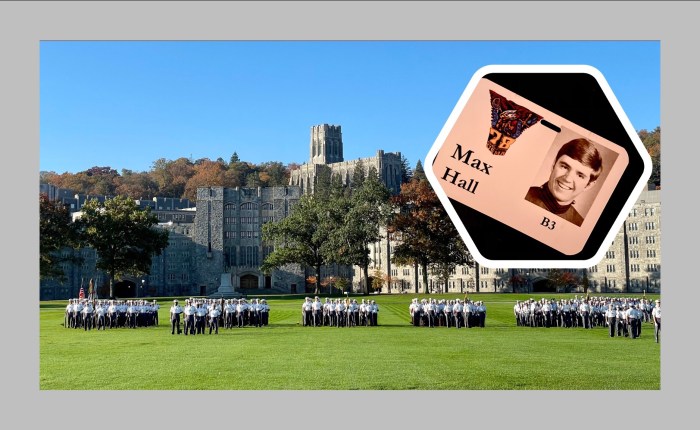
It was raining as I left our West Point 45th reunion last Sunday. I took the longer, slower route home to Virginia rather than drive Interstate 95. Tired and emotionally spent, I didn’t trust myself on a route that would have more traffic. I knew I would be thinking about West Point, the reunion and my classmates.

And of course, that’s what happened. The reunion, mixed with memories of West Point and my time in the Army cycled through my brain. Was it really 45 years since we graduated? It turned out the answer was yes.

Due to health issues, Cathy didn’t make the trip (she’s OK). It was a tough choice for her not to go to this reunion, but it was the right decision. Having dated since high school, and marrying each other right after my graduation from West Point, she too made the journey through my time at the Academy and in the Army. We’ve known many of these folk for nearly fifty years and together we have attended every reunion since the fifteenth. If I were to pass away, she would be welcomed with open arms by my classmates at any event, and they would help her in any way they could.

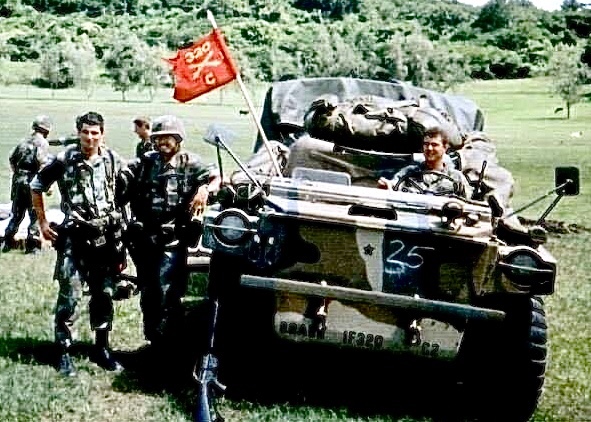
On October 25th, the day before the official start of our reunion, someone noted online the conditions were a bit nicer than 40 years previously on the same date. That was the day Operation Urgent Fury, the United States intervention in Grenada began at dawn. Several members of our class* were in the 82D Airborne Division and a part of the operation. It was a reminder that although we were “Cold Warriors” against the Russians, many of our classmates spent time in combat around the globe.

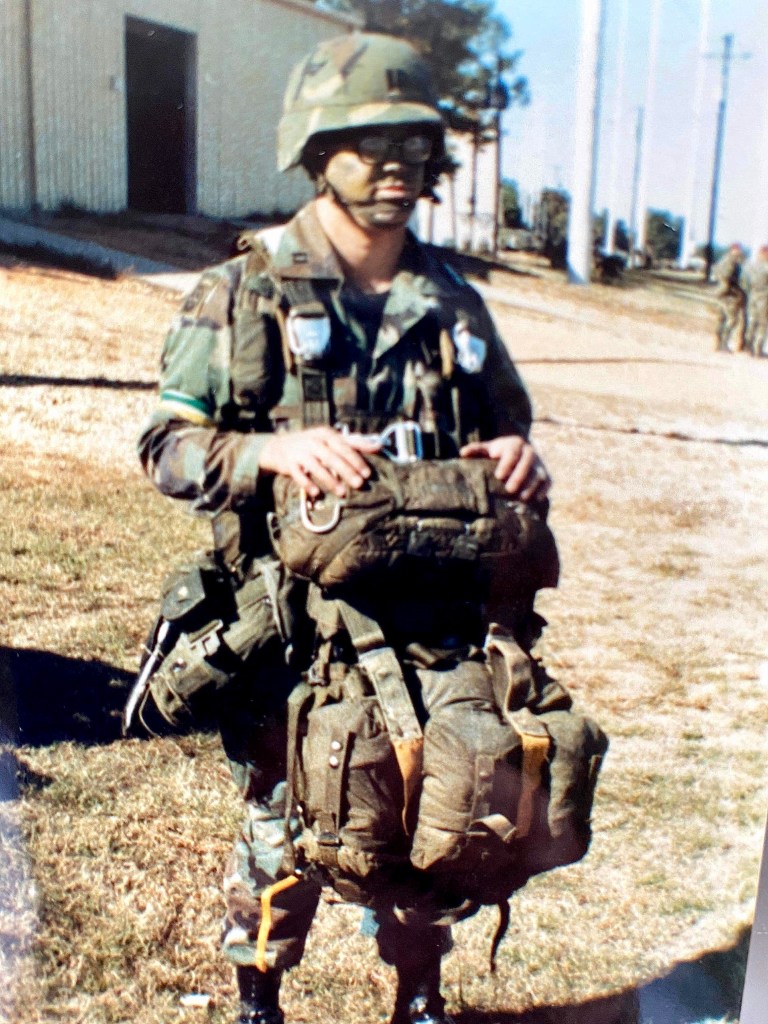
CPT Marion Seaton in Grenada. “We Were Soldiers Once, and Young”.

I arrived early Thursday afternoon and the weekend passed in a blur. The reunion hotel was a little over an hour from West Point. With 500+ attendees, there are no hotels at West Point or in the immediate vicinity large enough to host a gathering of our class. As is always the case at these five year reunions, not unlike our days at West Point, they are jammed with activities. We joke about it of course, but it’s true. I’m doubtful many other college reunions have days starting at 6:45AM. ;-).

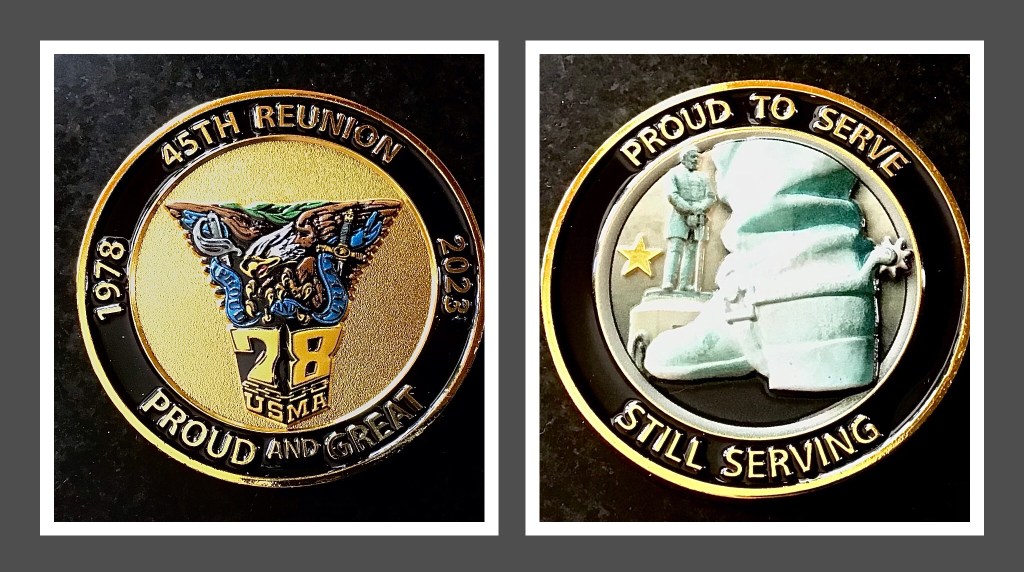
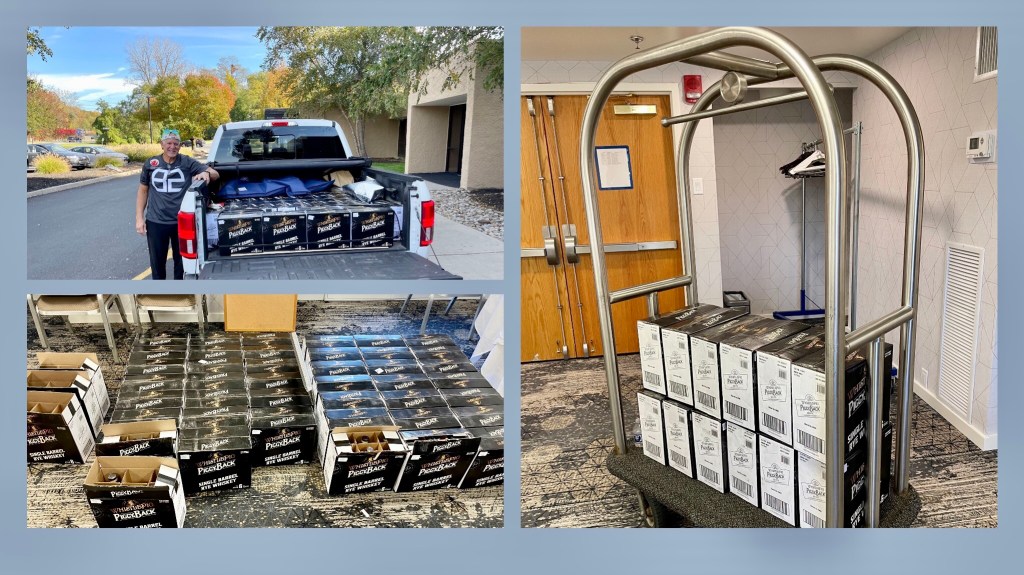
After arriving, I found Tony Matos, who had just arrived from New Hampshire. As importantly, Tony brought the 312 bottles of WhistlePig Whiskey we were going to distribute to classmates. Regular readers of this blog will recall that a group of us did a tasting at WhistlePig in Vermont last spring and bought two barrels (you can read about that tasting and why we did it at the link in the addendum). We dutifully transported the cases of whiskey to our distribution room and classmates started picking up their bottles. All were gone by Sunday morning.

The Successful Conclusion of Operation WhistlePig.

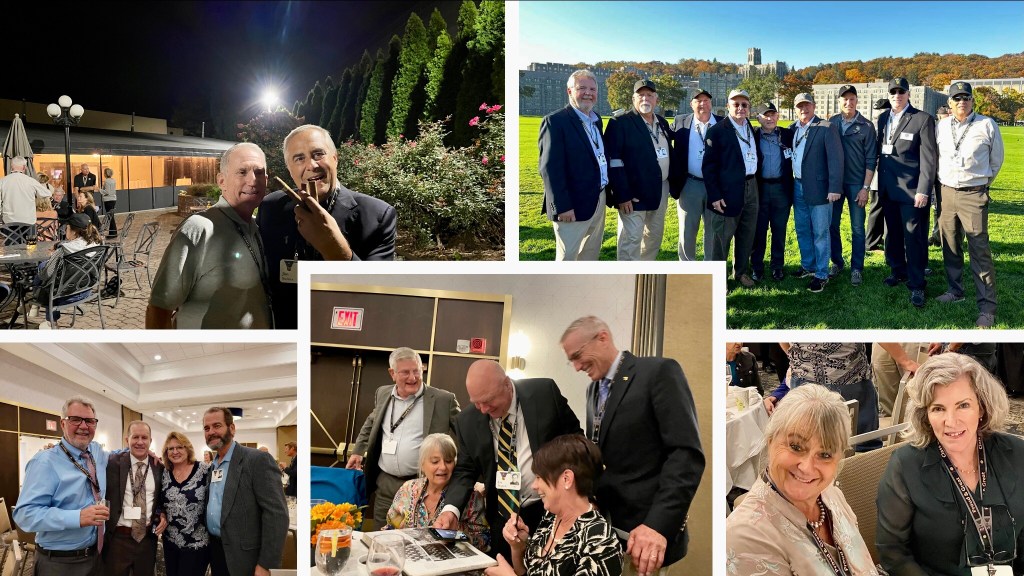
By Thursday night, things were in full swing. Around 300 classmates (about one third of our living class members) along with 250+ spouses, partners and family members were there. Dinner, drinks, and for some of us, cigars ensued. My time was divided between dinner with several of my company mates and then circling the rooms seeking out other old friends. Handshakes, hugs and toasts, along with conversations occurred several times – How are you? … Where’s Cathy – is she OK? … Do you remember … whatever happened to … where are you now … we have to do better at staying in touch … Eventually I made my way to bed and a restless night’s sleep.

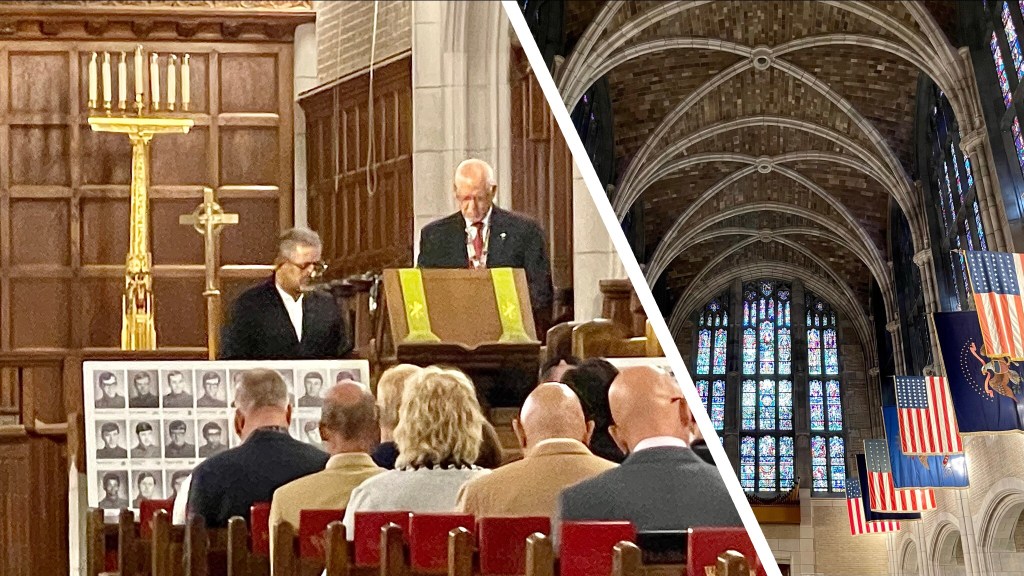
On Friday morning, we boarded buses for West Point. Our destination was the Cadet Chapel. Our first event, and for me one that has grown increasingly important, was a memorial service honoring classmates who have passed away. At our fortieth reunion, 50 classmates were so honored. This time the number was 82, including my company mate Dan Zimmerman. At the fortieth reunion, Dan sat with Cathy and I at the memorial service. This time, his name was one of the 82 called out loud. I thought a lot about Z-Man during the service. I have to say, the meaning of “The Long Grey Line” has changed, grown and become more real with the passage of time.

Memorial Service at the Chapel.

After the service, my buddies Jay, Steve and I, along with many of our classmates, walked the half mile from the Chapel to Ike Hall, although I also noticed there were more classmates taking the provided buses. Age catches up with all of us at some point. At Ike Hall we had lunch, along with a class meeting and a presentation by the Supe (Superintendent), before eventually busing back to the hotel.

At the hotel, Tony, Gus, Bob, Bill and I resumed distributing the remaining WhistlePig bottles. Classmate Al Aycock was distributing bags of coffee – the beans spent time in one of our empty whiskey barrels before bagging. We repeatedly received thanks from classmates for the arduous journey we’d made to Vermont for the WhistlePig tasting the previous spring. ;-).

After a short fifteen minute nap, it was time to get ready for the formal dinner that evening. More good food, drinking, talking and dancing. Perhaps because this was day two, things were slightly slower than the night before. It wasn’t as rushed and more faces were familiar now.

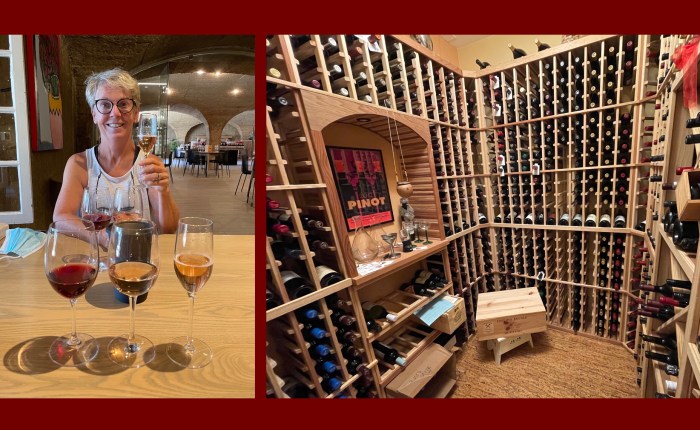
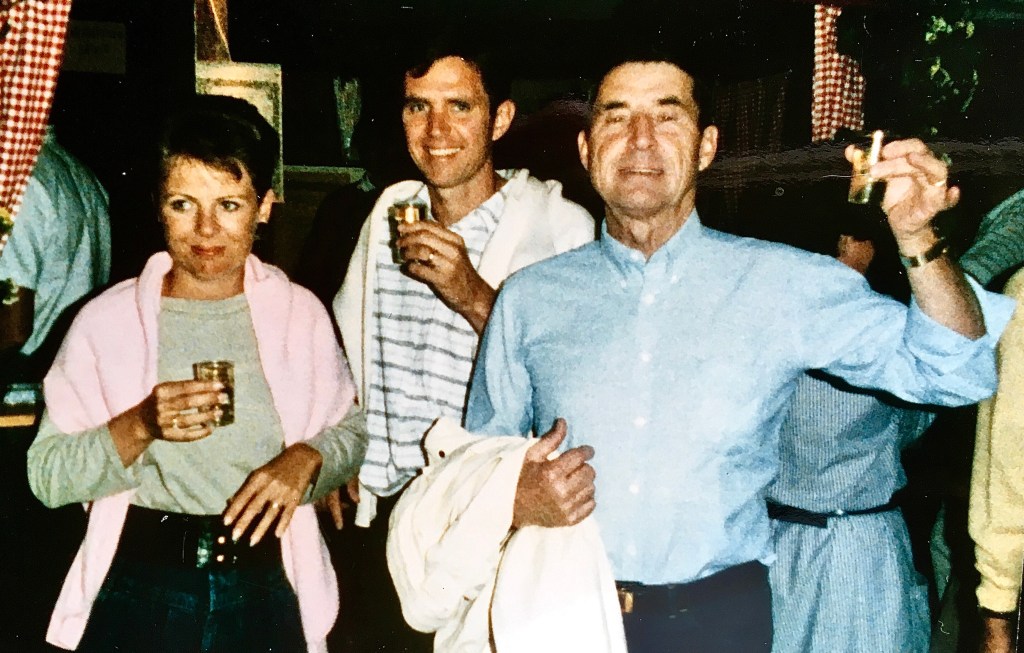
Random Pictures From the Weekend.

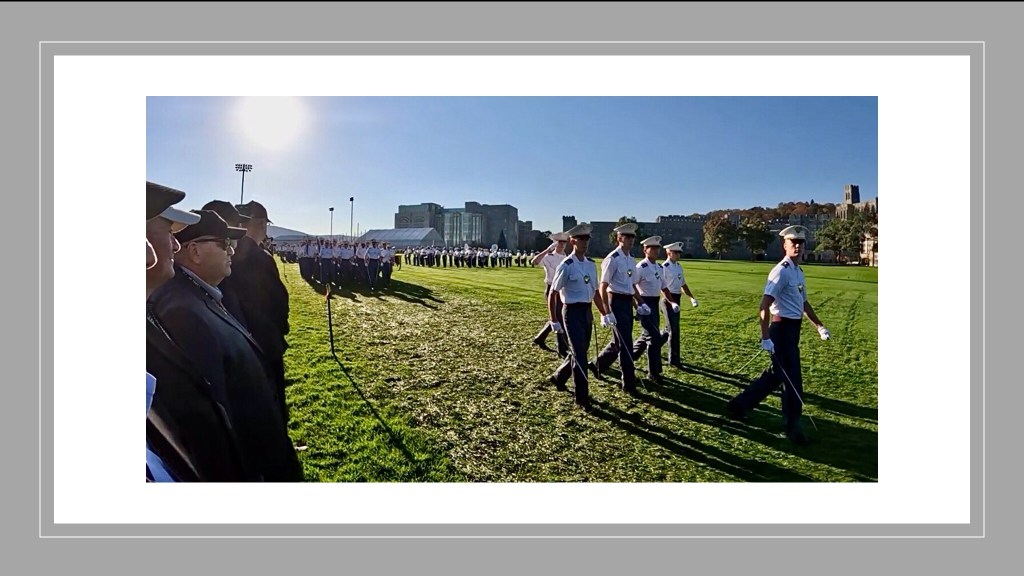
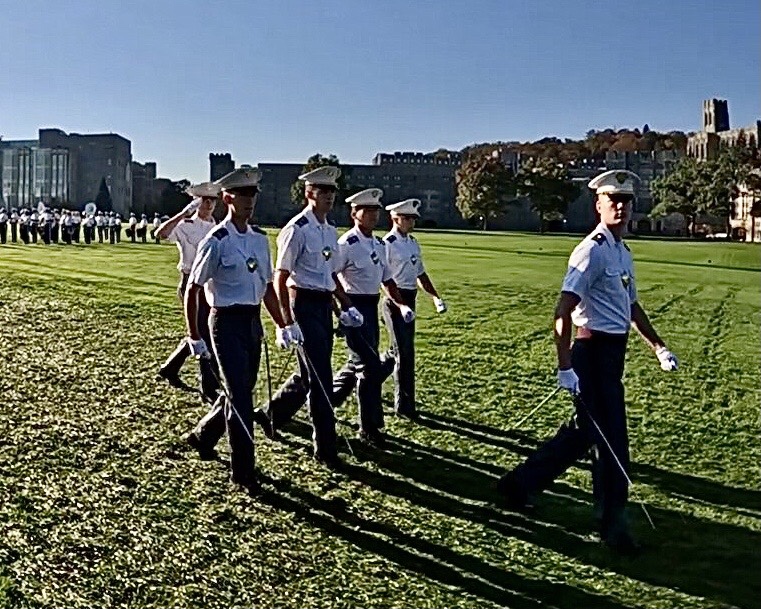
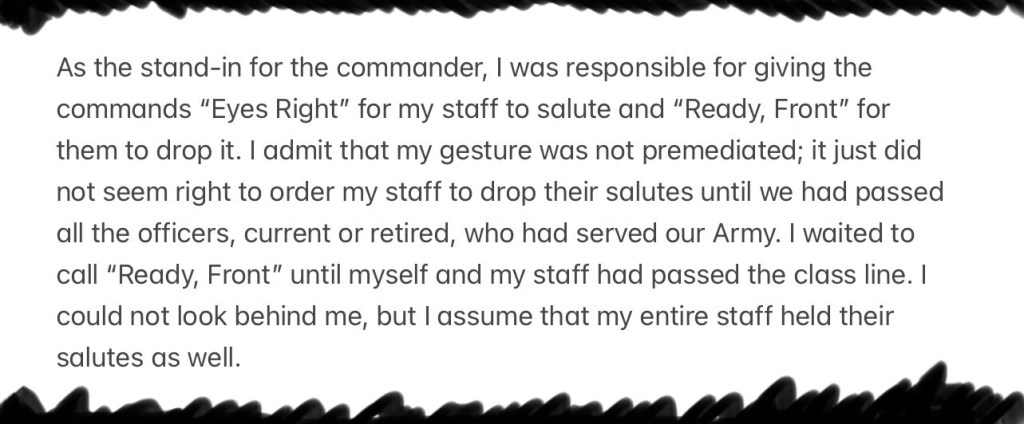
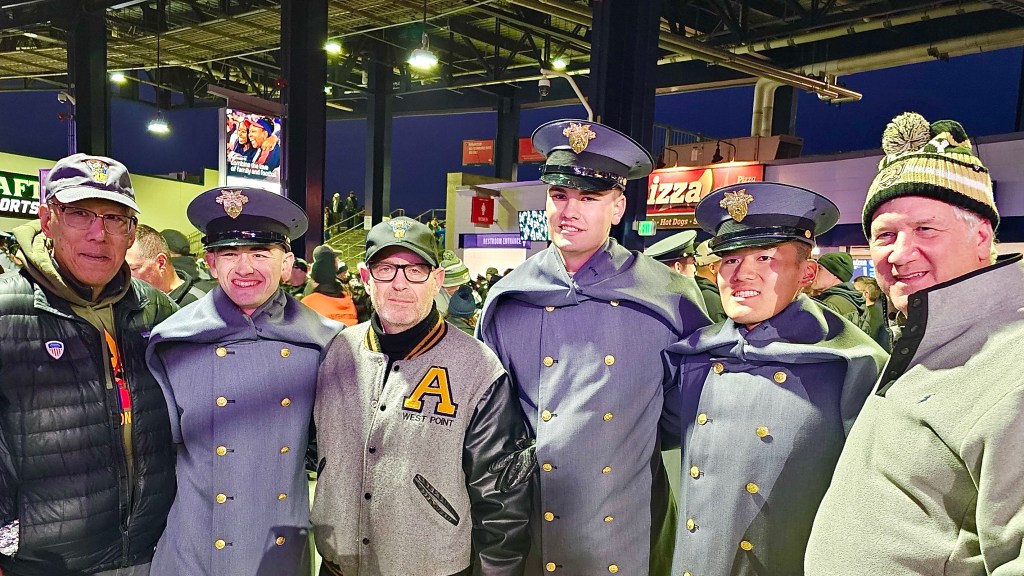
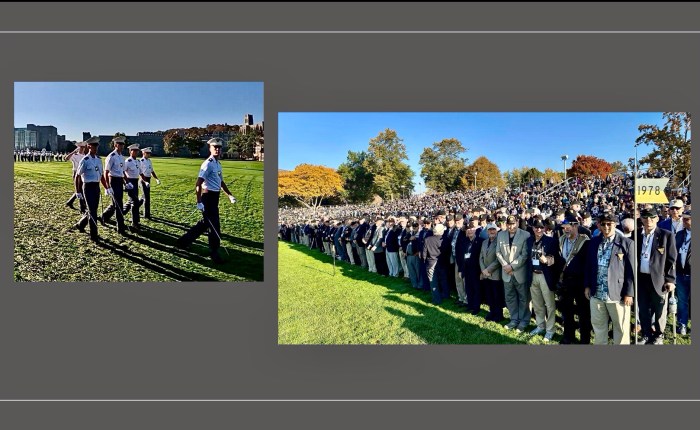
Saturday morning came early. We boarded buses for West Point at, wait for it … 6:45AM. Yes, you read that right, 6:45 in the morning. It was for a good reason – Two regiments of the Corps of Cadets were having a parade at 9:00AM, and our entire class was a part of the reviewing party. I remember as a cadet having parades and passing in review for old grads during their reunions. To put things in perspective, in the fall of 1977 our Firstie (Senior) year, the class celebrating their 45th reunion was the Class of 1932. Yikes! Back then, while waiting to pass in review, we made jokes about the OLD GRADS and of course could never see ourselves on the other side of the parade ground in the future. I’m sure the same thing was happening on this Saturday, but I have to say they looked squared away when they marched past us.

The Corps of Cadets, Passing in Review.

The Army football game that afternoon was a forgettable loss, but something happened later that left a strong impression on me. After the game, Clem, one of my company mates and his wife Nancy hosted a post-game tailgate and several of us B3ers stopped by for a beer. Three Yearling (Sophomore) cadets were there as well – members of the Class of 2026. Talking with them and listening to them made me feel good about our future, and the future of this country. If they are any indication of the quality of current West Point cadets, we have nothing to worry about. The United States Army, and our Officer Corps are in good hands.

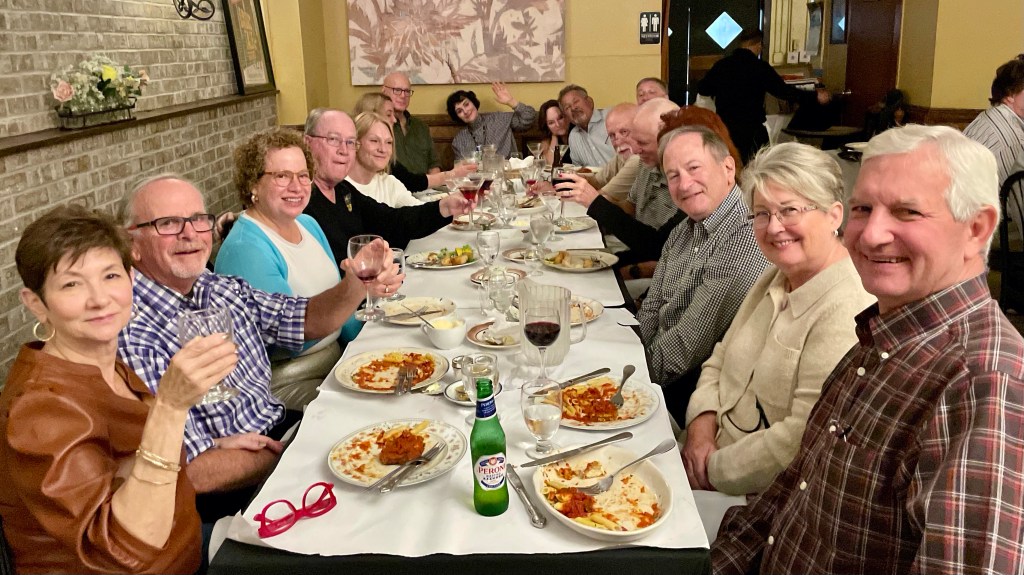
The last evening was special. There was no official event that night, and I was invited out to dinner by Jose Morales, one of the alumni from the Whistle Pig tasting in the spring. There were perhaps 18 of us at the dinner . Some I knew, some I didn’t. It didn’t matter. We were all one big happy family, talking, laughing, telling stories, eating and drinking.

One Big Happy Family at Saturday Night’s Dinner.

The next morning, I left for the drive home around 8AM. I’m not big on long goodbyes and wanted to hit the road. I spent the next six hours driving in the rain and thinking about the weekend. I wasn’t just thinking about the details of the weekend itself, as I recounted here. I was also thinking about this special brotherhood I have the great good fortune to be a member of. As time goes by, I cherish it more and more. I think we all do. It’s hard to explain to others who haven’t been a part of it.

We members of the West Point class of 1978 share a special bond that has only grown stronger with the passing of time. Yes, we still tell the old stories from cadet days, or our time in the Army, but it’s more than that. Those stories only represent the surface of our commonality. We rose to the call of Duty, Honor, Country as cadets and during our time defending this nation. Most of us have found ways to contribute to the greater good, even after our time in service to our nation ended.

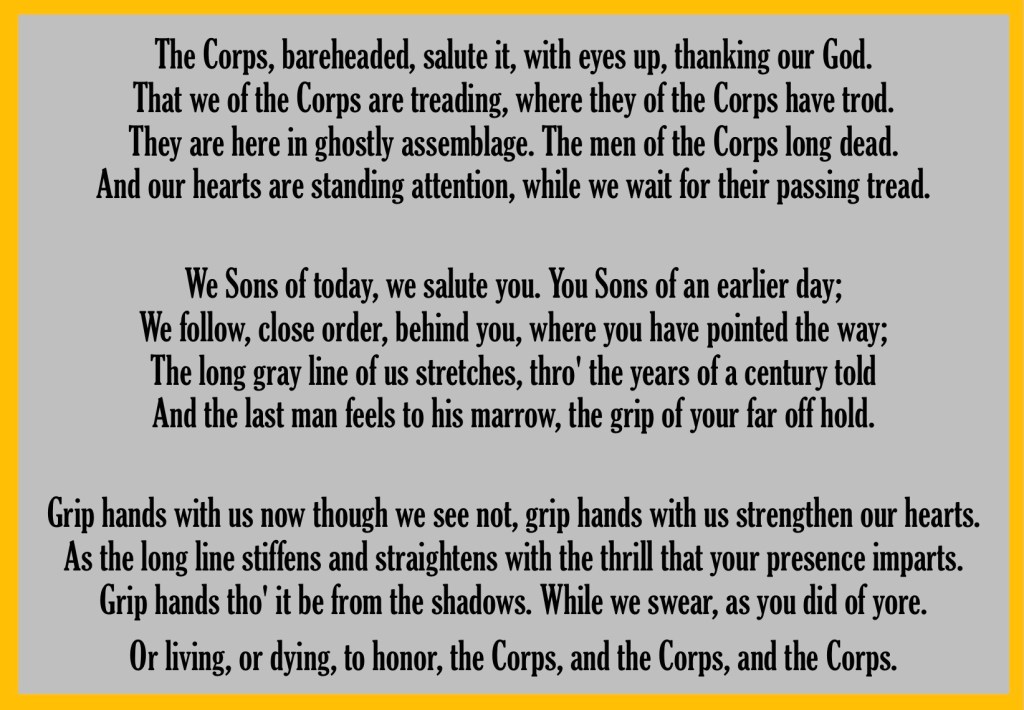
As Plebes, we were required to memorize many things. Some mundane, some of no apparent use, and some that were important. One of those requirements was the song “The Corps”. As I grow older, the song’s lyrics speak to me more directly than when I was a cadet and first memorized them. We all know our time here on Earth is limited and we all need to make the most of the time we have. Grip hands indeed.

The Corps

Addendum:

  • * Classmate Marion Seaton provided the photo from Grenada. In his words, “Chuck Jacoby, Brent Holmes, Dale Tatarek and I were having the time of our lives on a little spice island 40 years ago this week. We were all part of the 82nd Airborne’s mission to secure the Island of Grenada. I was the C Battery 1/320 (Airborne) Artillery Commander. We were chuted up to parachute with our equipment into Grenada. Our original plan was for the 105 howitzers to be dropped from the C141B on the first pass and we would jump on the second pass over the Drop Zone. The jump would’ve been dangerous, certainly due to the hostile fire, but more importantly, because of the dispersion of the equipment and troops onto the ground. There was a huge body of water to our left and the Ocean to our right. We would’ve lost a lot of jumpers and equipment. Lucky for us, The Rangers jumped the day before from C130s below 400 feet. They secured the Drop Zone, so we were able to fly in rather than jump. Over the course of the battle, Charlie Battery fired 152 rounds in support of the Division and Rangers.”
Marion, A Bit Before his Unit’s Jump into Grenada was Cancelled.
  • Dale and Jan Hamby were in charge of this reunion overall and did a great job. While a host of people worked with and for them, our class owes them a debt for the wonderful time we enjoyed. Dale’s comments after the reunion were pretty spot on: “Personally, we are determined to do a better job staying in touch with those we were able to reconnect with this weekend. We hope you will too. The reunion reminded us how important these connections are, and life is just too short not to make them a priority. Besides that, it was so great to relive cherished memories that our kids don’t want to hear about for the 50th time!
  • Here’s the blog from our whiskey tasting at WhistlePig: “We were on a mission to the WhistlePig Distillery in Vermont. Twelve classmates gathered to taste whiskey from five barrels. We would select two for the West Point Proud and Great, Class of ‘78 45th reunion this coming fall. We didn’t want to let our classmates down” […] Continue here: https://mnhallblog.wordpress.com/2023/05/09/__trashed-2/
Autumn Walks

Autumn Walks

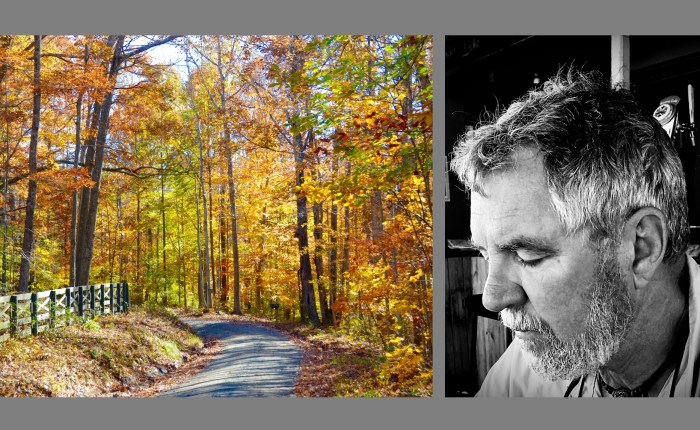
As I walk and wander through the nearby woods this fall, I find my mind wandering as well. It is autumn in the autumn of my life and I feel the passage of time. Death and decline are both more evident, and not quite the strangers they once were.

A Walk in the Woods on an Autumn Day.

It is not my own death I contemplate or fear. I have made peace with who I am, what I am, and where I am. I’ve had a good and lucky life with little to complain about. When my time comes, I hope I have the courage to accept my blessings and be thankful for the life I’ve lived.

Rather, it is the death and decline of others that I’ve been dwelling on during my walks. I think of friends or family members taken too soon and though they are now at peace, those of us left behind in this world feel the sadness and emptiness of their passing. What we wouldn’t give for one more hug, one more smile, one more drink together, or one more conversation.

For some, death has come suddenly and unexpectedly. For others, we have marked their decline, whether from old age, cancer, or some other disease. Fighters all, they eventually succumb, whether after months, or a decade. And for some lucky few, they live a good life into old age before peacefully slipping away.

I’ve thought about that last paragraph a bit. How do we measure time’s passing, and how do we measure time passing in our relationships with others?

If I do die suddenly, whether tomorrow or in five years, I would tell my friends and family do not mourn me. Instead, keep my memory alive, tell stories about me or drink a toast to me. I’ve had a good life. Don’t be sad at my passing, but rejoice at the life I was able to live.

If I fall into decline, for whatever reason, I pray I have the grace to continue to love and treasure those around me, no matter my fears of what is coming, or the pain I am in. I know that caregivers often suffer as much, or more than the person they are giving care to. I hope that I am able to continue to love and appreciate those doing their best to help me. I know that is sometimes a difficult thing to do.

And if I’m one of the lucky few who live well to a ripe old age before peacefully slipping away? If my old friends, my wife, my family were to precede me in death, I would want to honor each of them and keep their memory alive. I also know I would want to continue to live, and grow, and celebrate each day. To go for walks, talk with other friends, stay active, and challenge my mind and body to the best of my abilities. I think that is how I could best honor them, until my own time here on earth ends.

Walking in the woods on an autumn day – it’s funny where your mind sometimes goes. Two thousand years ago, the Roman Emperor Marcus Aurelius* said, “Accept the things to which fate binds you, and love the people with whom fate brings you together, but do so with all your heart”. I think his words still ring true.

Addendum:

⁃ *Marcus Aurelius in current times may be best known as the Emperor in the Movie Gladiator who is killed early in the film and gives Rome to Maximus, played by Russell Crowe. If you want to know the real Marcus Aurelius, I suggest you pick up his book, Meditations. It is a short read and filled with wisdom.

The Bears Den

The Bears Den

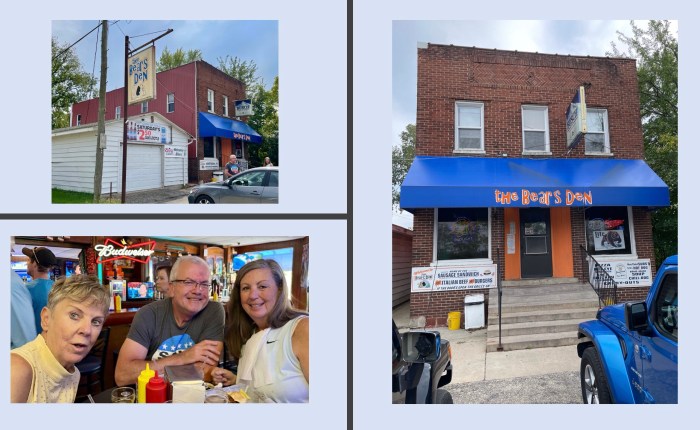
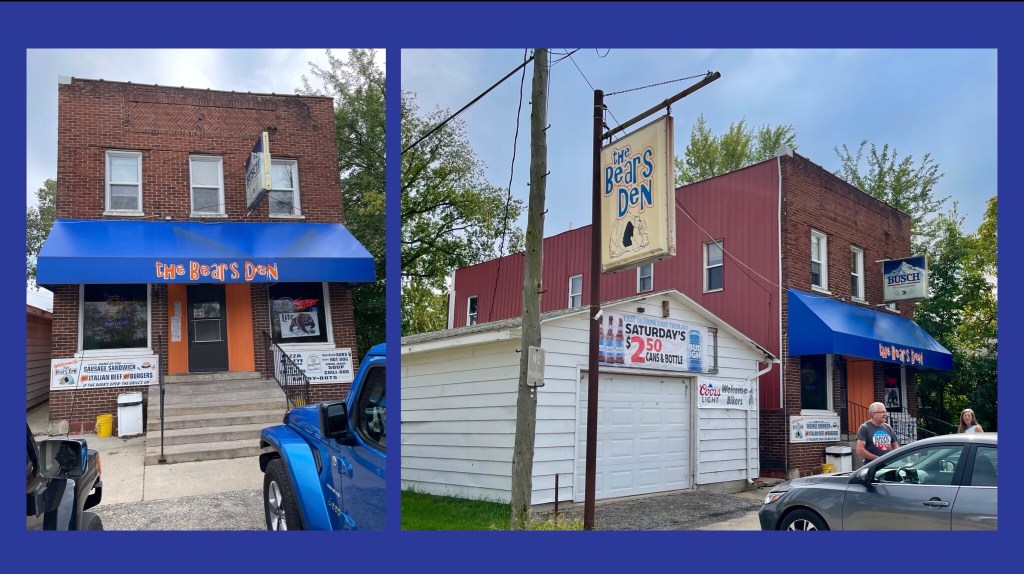
The Bears Den in Naplate, Illinois is a great little dive bar. I mean that in the best sense of the word. It’s an older place and hasn’t been updated in years. On a recent trip back home to Ottawa, we stopped in on a Sunday afternoon for lunch and Bloody Marys. We all should have such a good local place.

Naplate, a town of just over 400 people, probably has more restaurants and bars per capita than any town in America*. They are all small local places. Some more bar oriented, and some more food oriented. All have their devoted fans and regulars from Naplate, or the surrounding area. Over the years we’ve enjoyed several of them, including Casa Mia, Annie’s Hideaway, and of course, The Bears Den.

The Bears Den – It’s Been Around Awhile.

A few years ago, a really bad tornado ripped through Naplate and parts of Ottawa and Naplate were destroyed. Although Naplate restaurants were ordered closed in the immediate aftermath, The Bears Den stayed open providing food for the folk doing the cleanup and damage control. They were giving back to the community in a big way.

A couple of weeks ago we were back in Ottawa to see family and go to a reunion. We spent Saturday night with my sister Tanya and Brother-in-Law Shawn and on Sunday morning were discussing what to do. Cath previously mentioned possibly going to The Bears Den for Bloodies, and we all quickly agreed that was a great idea. It had been a few years since we were able to stop in there and we were looking forward to a good time. Shawn, the smart one among us, checked to see what time the Bears were playing that day. When they are on TV, it’s standing room only at the Den, and we wanted to avoid that. Fortunately, the game didn’t start until 3PM.

We arrived just after noon and easily grabbed a table. Several people were there, but it wasn’t crowded. The Packers were on TV, so there were both cheers and catcalls, depending on what was going on. The waitress came over and we ordered our Bloodies with sidecars. In Illinois (and maybe across the Midwest) a sidecar is a small beer, typically 7 ounces, to go with your Bloody Mary. At the Bears Den, they brought you a can of beer, and a 7 ounce glass. On Sundays, they have “build your own Bloody Mary” for $3, but we opted for the bartender to make ours.

Lunch at The Bears Den with Tanya and Shawn.

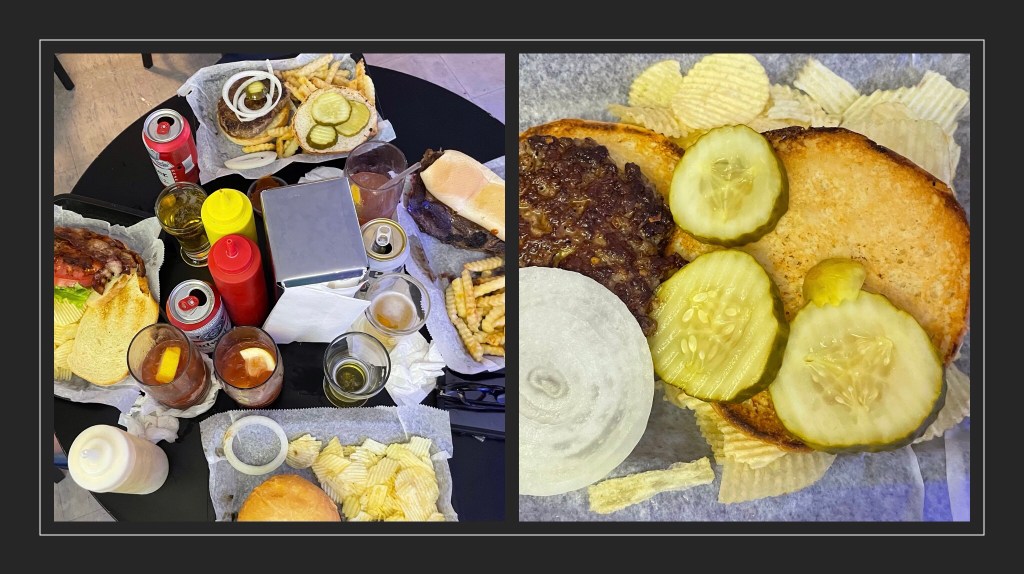
Drinks arrived and the Bloodies were as good as we remembered. Our waitress asked what we would like to eat. For me, there was only one thing to order – their Sausage Sandwich. You can have it with peppers, or cheese, or any number of other combinations, but I just ordered it with pickles and onions. It’s like a burger, but made with 1/2 pound of sausage instead. As my buddy Howard says “It rivals the pork tenderloin**as the best area sandwich. The difference? You can order the tenderloin at lots of places, but only The Bears Den has the sausage sandwich.” Shawn also ordered one, while the ladies opted for a BLT and a ribeye sandwich. One of the great things about The Bears Den is they have a decent menu, especially considering the small size of the place and the size of the kitchen.

The food came, and all I can say is, man, I love that sandwich. It was sooooo good. Yea, it didn’t help my cholesterol any, but that’s OK. In fact everyone’s sandwich was good. I think Cath’s BLT was the biggest I’d ever seen, and Tanya’s Ribeye sandwich was great. The table grew quiet for a while as we concentrated on our food. Eventually, we ordered a second round of Bloodies and Shawn had another beer.

Good Food All Around, but Man That Sausage Sandwich!

At some point, our nephew and niece Casey and Ann stopped by with their kids and we were able to catch up with them for a bit, but eventually, it was time to go. Hugs all around in the parking lot, lots of I love you’s, and we headed south to my sister Berta and her husband Jack’s place.

I know it’s a bit crazy to write about a dive bar in the middle of Illinois, when we don’t even live there anymore. Still, it’s good to have things and places you know you can count on. The Bears Den is one of those places. If you are ever near Naplate, I highly recommend it.

Addendum:

  • The “Bears Den” has no apostrophe in it, and I have written it that way throughout this blog.
  • * My friend Howard Johnson notes that Naplate was a factory town (the former Libby Owens Ford, now Pilkington,). The shift workers all converged on the Naplate bars when their shifts ended, keeping them busy 24 hours a day back in the day. That’s a big reason such a tiny village has so many bars.
  • ** One of the great meals you can find in the corn-belt of Indiana, Illinois and parts of Iowa is a breaded pork tenderloin sandwich. They are crazy good and something that many people who move away from the area crave, and always have when they return to Ottawa. If you are closer to Chicago, or in Wisconsin, an Italian Beef Sandwich is just as loved.
Pork Tenderloin Sandwich at The Court Street Pub in Ottawa.
  • The Bears are having a rough stretch in football lately and lost 14 straight games before beating the hapless Commanders last week. The Bears Den remains crowded for their games. In general, the fans are still loyal, but getting restless. One of my buddies, Mark, a diehard Bears fan, sent me this meme after I mentioned we were at The Bears Den for lunch:
Heeheeheehee

Mama Cat

Mama Cat

We inherited Mama Cat about four years ago. Our neighbor had to move to a small apartment and had two other cats she was taking with her, but couldn’t take three. Mama roamed the neighborhood at will and was a frequent overnight guest at our barn, so Cathy said we’d look out for her.

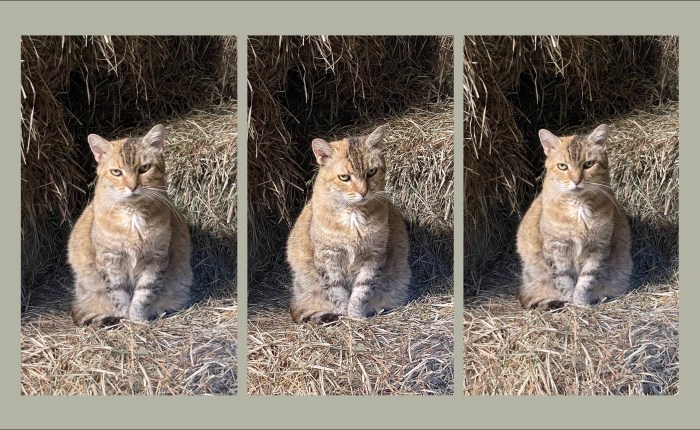
Mama Cat, real name “Nutmeg”, roamed the neighborhood for years. Several people around the area knew her. Early on, she was always shy. You might catch a glimpse of her, and then she was gone. While she was “indoor/outdoor”, I think she was really more of an outdoor cat, who went home to eat occasionally. Of course, she also stopped at several barns/homes in the neighborhood for snacks. Cats, like raccoons, seem to inherently know where there’s a free meal.

When Laura, her owner, had to move, I think she was relieved that Cath said she would keep an eye out for her. Laura’s life had become complicated, and this was one less thing she needed to worry about. After Laura left, we started seeing Nutmeg a bit more, although she was still shy and evasive.

Mama Cat – Also Known as Nutmeg.

At the time, we had two barn cats of our own – Stan and Ollie. Nutmeg started hanging out and generally got along with our two. Then another neighbor’s “Indoor/outdoor” black cat started coming by the barn. He was an unfixed male and wasn’t quite as nice and started chasing our cats away. We didn’t see Mama as much over that time. After about a year the black cat disappeared and we didn’t see him again. We always assumed a fox or coyote caught him at some point.

Cathy followed through on her promise to Laura and we did keep an eye out for Nutmeg. Cath is something of an animal soothsayer and slowly gained Mama’s trust. She was eventually able to pet her and take her to the vet’s office for annual shots. Mama also warmed to me and I too was lucky enough to occasionally pet her. More importantly, for the past couple of years when it turned frigid, we were able to put her in the feed room at night and provided her some heat in a small space. We kept Stan and Ollie in the tack room on those same nights. It’s funny – they were all outdoor barn cats but smart enough to know/learn there was an advantage to being scooped up in the evening and put in a room. They learned to wait around for it, although they were always eager to get out the next morning.

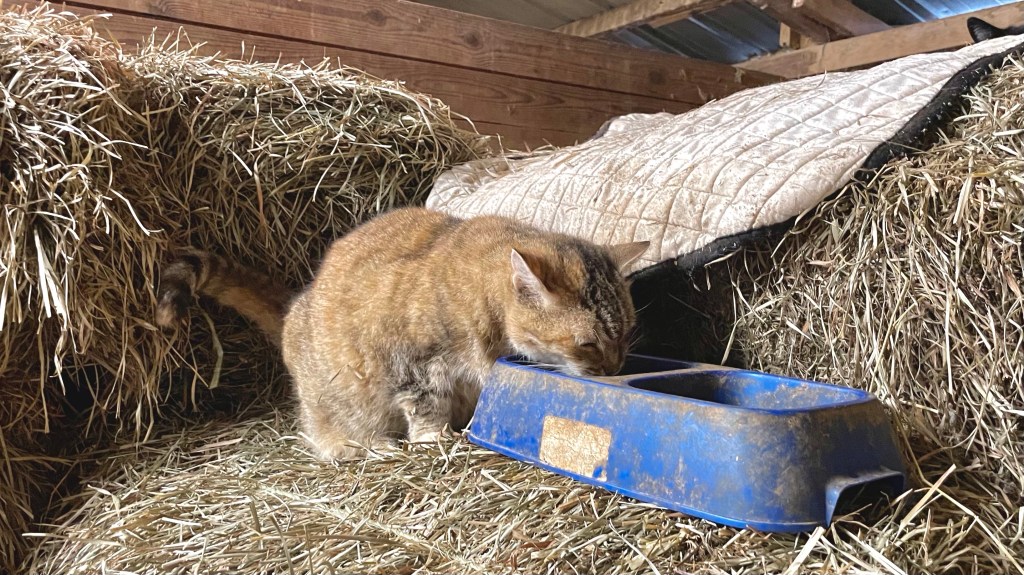
Mama became a regular at the barn and started showing up routinely at mealtimes in the morning and evening over the past year. She’d bound out of wherever she was sleeping in the hay, and report promptly for her meals. She had her own bowl by now, so the cats could all eat at the same time, with no one waiting in line. You would think they were starving with as much as they all ate, but when you picked them up, it was obvious none of them missed many meals.

Mama Cat Doesn’t Miss Many Meals.

Over the past couple of months, Cathy noticed a growing red spot on one of her toes. At first, she thought it was an abscess. Mama wouldn’t let us touch it or examine it closely. Eventually we took her to the vet a couple of weeks ago to have it treated. Unfortunately, it turned out to be an auto-immune disease, and while treatable, there is no cure. It’s not fatal, but puts her at greater risk and she will probably die sooner rather than later. The doctor treated it some and we obtained medicine and brought her home.

Since then, Mama Cat has been extra friendly. She waits to be petted and gives an occasional headbutt. Her purrs are noticeably louder as you scratch her, or she rubs up against you. She doesn’t leave the hay much, and you see her throughout the day if you are at the barn. I’ll be honest, I don’t know if she is thankful we took her to the vet, or her end is approaching and she’s just more comfortable hanging out in the hay. I suspect the latter, although I have no real reason to say it.

I feel lucky Mama Cat is a part of our life here at Rohan Farm. She’s been a project, there’s no doubt about it. At eleven years old, she’s also lived life on her terms. Her friendliness over the past couple of years warms me and I look forward to seeing her every morning when I go to the barn to feed the horses. It may be my imagination, but I think she looks forward to seeing me as well.

Tim and Bobby’s Visit

Tim and Bobby’s Visit

In the ‘80s when we lived in Germany, several family members and friends visited us. To “help” them overcome jet lag, we made sure the first couple of days were action packed with eating, drinking and activities to keep them occupied. It almost proved one friend’s undoing in 1987.

Our old friend Tim visited us several times while we were stationed in Germany. In 1987, he asked if he could visit and bring his friend/work buddy Bobby along. They planned to visit us, and then tour parts of Germany, Austria and Northern Italy, eventually arriving back in Germany for Oktoberfest in Munich. We of course said yes and looked forward to their arrival.

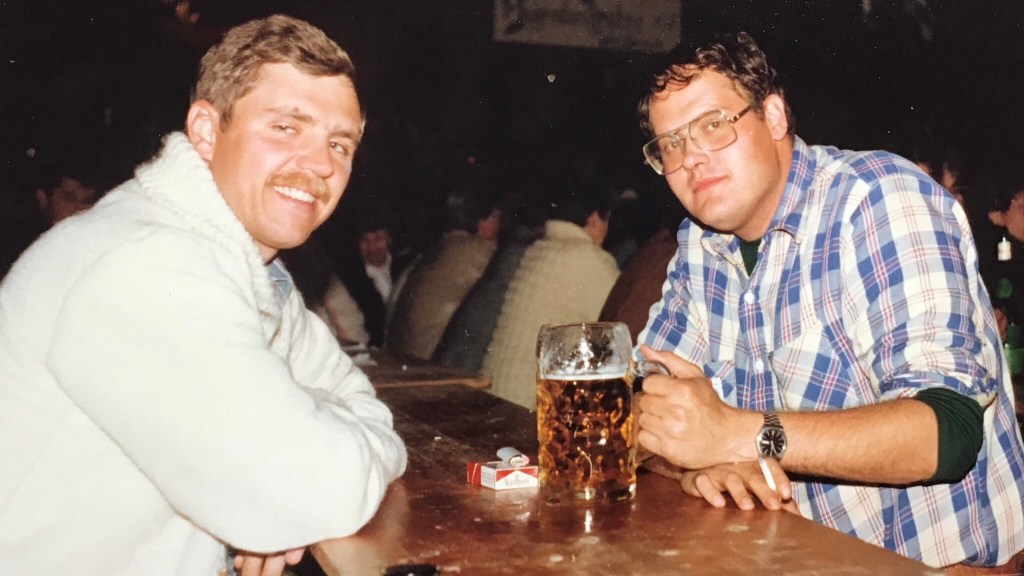
Tim and I at a Bierfest during a different visit.

They flew to Dusseldorf one morning in September and then took the train to Worms where we picked them up. Tim recently recalled the train paralleling the Rhein River for part of the trip, when all of a sudden the train shook a bit. He looked out the window and saw two F15s flying low, following the path of the Rhein as well.

After arriving at our home in Rheindürkheim, we ate lunch. Tim and Bobby may have slept for a couple of hours, although I don’t remember for sure. Later, we gave them a tour of town and walked along the Rhein River. That night, we went out for dinner at a local Gasthaus (pub) called Sportheim. We knew the owners, Vroni and Wolfgang well, and Tim knew them from a previous visit. It’s safe to say they greeted Tim like a long lost relative. It was a great evening and Bobby joined right in. We spent several hours at Sportheim and after many biers and wines, eventually made our way home. We may have drunk a brandy or schnapps, before making our way to bed and a good night’s sleep.

The next day, amazingly, none of us were the worse for wear. After a hearty breakfast with some good German bread, sausages and cheese, we drove around to show Bobby the area. We went into Worms, the city where Martin Luther made his famous statement “Heir stehe ich” (here I stand) before the Imperial Diet in 1521. Basically, it’s where and when Protestantism started.

That evening, we had a special treat in store for the guys. The Rheindürkheim Feuerwehrfest (Fire Department Festival) was going on in town. There were about 1,000 residents in Rheindürkheim and a majority of the adults would be at the Fest. It was a classic German wein festival with a huge tent, oompah band, dance floor and lots of adult beverage.

We made our way to the fest, found some local friends and settled in. Of course we drank our share, and ate brats and other German food, such as curry wurst or roast chicken. We also listened to the music and took turns dancing with Cathy and some of the other ladies in our group. It was a great time. Eventually it was getting late, and the fest was coming to an end. We were going to head home when one of our German friends, Michael, told me several people were going to an after party at the Zenit, basically a local Navy VFW club and wanted to know if we wished to join them. I’d been to Zenit several times and immediately said yes. For Tim and Bobby, it’d be an even greater look at the local culture. Cathy, always the wisest of us two, declined and said she was going home. We left the fest and after dropping Cath at home, walked to Zenit.

Now Zenit was actually a dry-docked ship that was turned into a club. Rheindürkheim, was on the Rhein River and traditionally, most young men of the town served in the Navy instead of the Army. That’s why their “VFW” club-equivalent was in a ship.

The Zenit in Rheindürkheim

As we arrived, we made our way to the bar and bought a couple of biers. I nudged Tim and pointed out a picture hanging in Zenit. Tim’s a history major and I thought his eyes were going to bug our when he saw who it was – Admiral Karl Dönitz*, supreme commander of the German Navy during WWII. Dönitz also took over the German government after Hitler killed himself and it was he was who actually surrendered to the Allies in May of ‘45.

We had a good time at Zenit. The party was eventually winding down when our friend Hans approached me. He and his wife Inge were having an after-after party at their home and wanted to know if we wanted to stop by. Their home was actually on the way back to our house and I again immediately said yes. We joined a group of 15 or 20 people and dutifully walked or stumbled to Hans and Inge’s house.

At Hans and Inge’s there was no oompah music. What was playing on the stereo was the soundtrack from the movie “Dirty Dancing”, released earlier that year. I remember chuckling about it at the time.

I believe they served coffee and dessert for those who wanted it. I also distinctly remember Inge walking around with a bottle of homemade schnapps and pouring people small glasses/shots. Schnapps in Germany is nothing like the sweet stuff we think of as schnapps here in the States. It’s similar to Italian grappa or French marc and can definitely have a rough edge to it. She asked if we wanted some and of course we all said yes. Bobby didn’t yet know about real schnapps. We all toasted with a “Prost”. Bobby took a small sip and may have actually turned green. He looked around and saw a nearby plant, where he discretely poured the remainder of his schnapps.

A bit later, Inge came back by, saw Bobby’s empty glass and refilled. It. At that point Bobby looked at the glass and then leaned into Tim and said, “Tim, I don’t know that I can do this for the whole two weeks.” ;-).

We left a short time later and walked the 3 or 4 blocks home and immediately went to bed.

The next morning, everyone was moving a little slowly and there were probably a couple of hangovers among us, or at least there should have been. I also know this – Tim and Bobby were no longer suffering from jet lag. ;-).

They would leave us a day or two later and head south by train. We linked up with them in Munich for Oktoberfest about ten days later and they told us tales of their travels and the good times they enjoyed. At Oktoberfest itself, other than Cathy throwing her shoulder out on a rollercoaster ride with Bobby (another story, and no, alcohol wasn’t involved), we had a grand time.

Addendum:

  • * Dönitz was the architect of the German U-boat campaign during WWII. He was by his own admission, a dedicated Nazi and supporter of Hitler. Following the war, he was indicted as a major war criminal at the Nuremberg trials on three counts: conspiracy to commit crimes against peace, war crimes and crimes against humanity; planning, initiating, and waging wars of aggression; and crimes against the laws of war. He was found not guilty of committing crimes against humanity, but guilty of committing crimes against peace and war crimes against the laws of war. He was sentenced to ten years’ imprisonment. After his release, he lived near Hamburg until his death in 1980.
  • Here’s another story involving Tim and Germany – In 1986, we found a way to ship a Keg of German bier from a Monastery, home in a transport plane: https://mnhallblog.wordpress.com/2019/10/09/shipping-bier-from-germany/

The Rickover Interview

The Rickover Interview

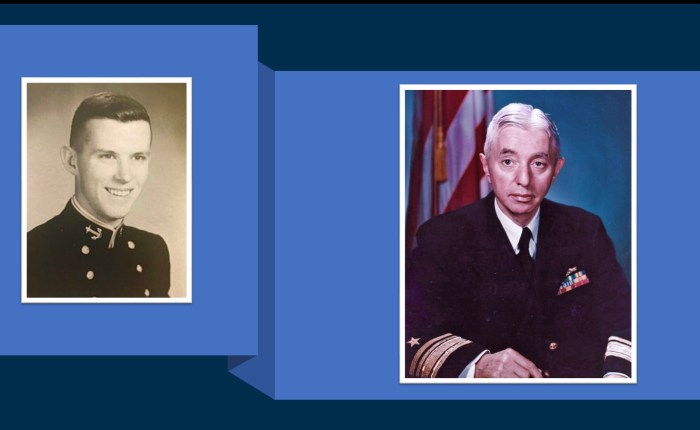
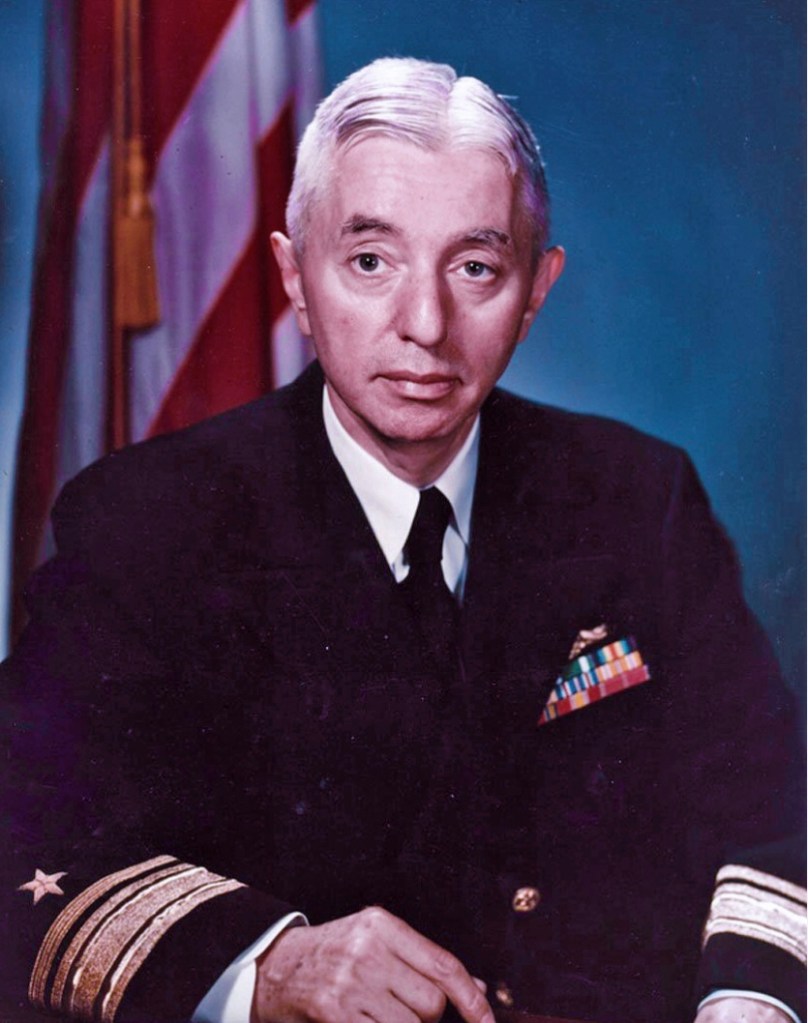
My friend Bob Bishop, straight out of the US Naval Academy, was interviewed by Admiral Hyman Rickover in 1964 for admission to the Navy’s Nuclear Power Program. Rickover, known as the “Father of the Nuclear Navy”, served in a flag (General Officer) rank for nearly 30 years (1953 to 1982), ending his career as a four-star admiral. His total of 63 years of active duty service make him the longest-serving naval officer, as well as the longest-serving member of the U.S armed forces, in history. In 1954, with the launch of the first nuclear submarine, the USS Nautilus, he appeared on the cover of Time Magazine.

Admiral Rickover on the Cover of Time in 1954

There were those who loved him and those who hated him. He exercised tight control for three decades over the ships, technology, and personnel of the nuclear Navy. He interviewed every single prospective officer considered for service in a nuclear ship in the US Navy until his retirement in 1982 at the age of 82.

According to Wikipedia, “over the course of Rickover’s career, these personal interviews numbered in the tens of thousands; over 14,000 interviews were with recent college-graduates alone.” Many of those interviews are now lost to history. Here is the story of Bob’s interview in his own words.

Bob in 1964 at the Naval Academy.

***********

Much has been written regarding the harshness of his interviews, but none can criticize the results. Certainly none of those who successfully emerged from the crucible would do so.

On Friday, January 21, 1964, I was a First Classman (senior) at the Naval Academy and joined 34 other classmates on a bus to DC to be interviewed for the nuclear power program. At the time, many offices of the Navy were still located in “temporary buildings” built on the Mall during the Second World War – and were still in use twenty years later.

There were lots of tidbits floating around about the interviews with Admiral Rickover, aka “The Kindly Old Gentleman,” (abbreviated KOG), although never called that to his face. One such rumor was that the chair you sat in was rigged so it rocked if you were nervous. Most importantly, you should answer any question quickly and decisively.

Needless to say, I was apprehensive. We (there were also a couple of busloads of Midshipmen from Navy ROTC schools) were herded into a large semi-circular room with simple folding chairs, arranged in rows facing the center of the room. There were four passageways leading out from that central hub like spokes on a wheel. There were a couple of vending machines and we were told a head (bathroom) was just down one of the passageways. We were told not to talk to one another. We were also told to remain in the room until your name was called, and that was all. To be honest, we were afraid to even go to the head, because what happened if your name was called and you weren’t there? So, there we sat. Soon, someone would come down one of the hallways and call out a Midshipman’s name. He (there were no women at the Naval Academy for another 13 years) would rise and go with him, and sometime later come back and sit down. The scuttlebutt was that each person would have three interviews before potentially meeting with the Admiral, although some had four and a few had five. Some of those interviews were short (5-10 minutes) and some were long (an hour plus). Also, you had no idea if the person interviewing you was a chief petty officer, a prospective commanding officer, a member of the Nuclear Reactors division or somebody else – they were all in their 40s-50s and all in civilian clothes.

I had three interviews and what we discussed became a blur – I was so focused on answering the questions, I really couldn’t remember the questions even immediately after they were asked. I was thinking on how I did, was I sitting up straight enough, remembering to be decisive, etc. The one question I remember most clearly was being asked about the window air-conditioning unit. I started into a description of the freon cycle when I was stopped. The questioner wanted to know why it didn’t fall out of the window. I started postulating about ways it could have been installed so it wouldn’t fall either in or out. I also remember being asked the value of studying naval history (pro and con), why I decided to go to the Naval Academy, what was Bernoulli’s equation, and why did I want to go into nuclear submarines.

Each time I went back into the central room, there were more and more empty seats. With no one to ask, I merely presumed they had finished the process. I worried and wondered if it was good news or bad that I was still there. As I sat there, morning became afternoon and afternoon night. Eventually, there were maybe three or four of us left. It was 8 something PM, and my name was called. I was led down a narrow corridor, lit only by bare light bulbs hanging down periodically the length of the corridor and into the distance. Light showed in the hallway from only one office, at the end of the corridor on the right. As we approached, my escort told me the Admiral’s yeoman (Navy admin) was gone and I should just walk past her desk and into the Admiral’s office and sit down in the empty seat.

I did and sat down in the Navy issue aluminum square channel chair, with a naugahyde seat. The room was a little dark. The scuttlebutt was right – the two front legs were shorter than the back legs, and one of the front legs was shorter than the other so that, if you were the least bit nervous, you would slide off the seat or rock sideways. I sat with my butt firmly implanted up to the back of the chair, giving thanks to the many hours I spent plebe year on “The Green Bench” (envision sitting in a chair against a wall, with your knees/lower legs at a 90° angle and your thighs/lower back also at a 90° angle – now take the chair away).

His office was a mess. It was about 10’ wide and 15’ deep. There was a bookcase behind me, another on the wall to my left, bookcases down each wall, and a big old wooden desk directly ahead. Each of the horizontal surfaces, including his desk, were piled high with a hodgepodge of varying heights of stacks of books, interspersed with folders. The door I came in was on my right, behind me. I was focused straight ahead (the Navy term was “keeping your eyes in the boat”), but my peripheral vision, and attention, was focused to my right so I could immediately rise as soon as he came in.

Three or four minutes passed when all of a sudden, I heard a loud voice say, “Why the f**k have you been wasting all your goddam time?” I immediately focused straight ahead and there he was, and had been the whole time, obviously just watching me. I never met an Admiral before and certainly never expected one to curse. Notwithstanding the advice to respond quickly and cogently, what do you suppose came out of my mouth? “Umm, er. . .” “What?!” he said. “I have been working hard, sir.” “Don’t give me that shit,” he replied. Our “discussion” did not go much better, although I don’t remember much of it, just the feeling it was going a lot less than well.

Things I remember vividly – At one point, I said something along the lines of “I think there is more to education than just book-learning.” Big mistake. Unfortunately, not the last. Our discussion circled back around to my grades (I thought afterwards he must have those in a folder on his desk). He asked what my class standing was going to be when I graduated. I knew I was doing pretty well but I had no idea what the current number was, so I said “55.” He replied, loudly, “WHAT?” I said “50?” a little plaintively. He said, “DO YOU MEAN . . . ?“ I quickly interrupted and said “45?” He roared “GET THE F**K OUT OF MY OFFICE!”, which I rapidly did.

Admiral Rickover – the “KOG“

What felt like a three-hour-long crucible under intense heat, actually lasted around twenty-two minutes. It took me a couple of hours, and a couple of scotches, to get my resting heart rate down. I also started thinking of what I wanted to do in the Navy, other than nuclear submarines, when I graduated. Plainly, I wasn’t going to be selected.

A couple of months later, a list was posted at each of the twenty-four company offices at the Academy. The word quickly spread so each of us Firsties (seniors) who had applied hurried down the corridor. If your name was on the list, you were in. I read the list, haltingly, three times to make sure that was really my name.

Postscript – I had three other interactions with the KOG during my six-plus year career in nuclear submarines. Not bad for a mere lieutenant, but those are stories for another time.

Bob Enjoying Life Last Week

Addendum:

  • if you have the time, it’s worth reading up on Admiral Rickover’s career. It was pretty amazing, although he actually only commanded one ship. Some of his detractors compared his hold on the Navy, and particularly the Nuclear Navy, to Hoover’s hold on the FBI for all of those decades. He was a brilliant man, and there’s no doubt our Nuclear Navy would not be where it is without him.
  • Bob is a wonderful storyteller. Here are two other blogs from his time in the Navy on a Nuclear Submarine:
  • The movie, “The Hunt for Red October” is child’s play, compared to what these submariners did on a daily basis … “The Comms Officer ran in and handed the CO the decoded message. The CO read the message, took the lanyard from his neck, unlocked the firing key cabinet, and reached in for the firing key. We were about to” […] Continue at: https://mnhallblog.wordpress.com/2021/06/23/we-knew-we-were-at-war/
  • Crazy Ivan anyone? … In 1970, our sub, the USS Finback, was helping with Anti-Submarine Warfare training for NATO aircraft. An observer on the sub said “I think I understand your plan. You alternate going to port or starboard as soon as you submerge.” I responded, “Well, not actually”, and we walked over to […]. Continue at: https://mnhallblog.wordpress.com/2022/04/13/submarine-games

Rohan Farm

Rohan Farm

We have lived in our current home for 24 years. When we started looking here in Fauquier County, since I was the one who would be doing the long commute, I told Cathy the only way I would move out this far is if we found the house we were going to die in. Cath, of course, took on the challenge.

In last week’s blog I spoke about a 750+ unit housing development happening about 15 minutes from us in nearby Culpeper County. (A link to the blog is in the Addendum). It consists of cookie-cutter homes starting north of $500K, with some as high as $800K+. All are on small lots. I’m sure they are someone’s dream home, but not mine.

It did get me to thinking about our journey to Fauquier back in 1999 and our own dream home.

When Cathy and I returned from Germany in 1989, a couple things happened: first, We bought a townhome in Fairfax, Va; second, I started working a classified job with the military; and third, Cath got a job in Crystal City, AND bought a horse she was to own for the next 15 years – Arthur. After I decided to get out of the Army in ‘92, we stayed in Fairfax. I started a great job with a company called SRA and had about a 30 minute commute to work.

Our townhouse was nice, but by ‘98 we’d decided to look for a house. More specifically, a property with enough room to keep a couple of horses on it, which meant at least five acres of land. By then Cathy had her own business and was working from home, while I was still working for SRA. We looked in Fairfax County and found a few properties we liked in the Clifton and Fairfax Station areas and even put an offer on one, narrowly losing out to another couple. It was frustrating to lose out on the house, but we were also frustrated as there weren’t many properties for sale in the area that met our requirements and were in our price range.

That’s when Cathy suggested moving out farther to Fauquier County, a beautiful area. We’d spent time there over the years for various horseshows, weekend trips to B&Bs, going to a few Sunday brunches and of course visiting a couple of our favorite wineries. We loved Fauquier.

I immediately said no. Not only no, but hell no. It was not open to discussion. There was no way I was going to do that commute on a daily basis. At the time I was working in Arlington and the commute would take an hour and fifteen or twenty minutes each way.

We circled around that “discussion” for quite some time and a few weeks probably passed. I then made a mistake.

We were discussing Fauquier again, and in a weak moment I said, “I tell you what. If we find the house we are going to die in, I’ll move there.” Cathy nodded and said OK.

In the coming week or two, Cath found three country places online to look at, and with our agent, we scheduled visits to all three on the same day in February of 1999. It snowed an inch or two the evening before our visit but was sunny as we drove to view the properties.

The first place didn’t really look as it did in the photos and we spent no time there. The second place was nice, new and had a barn to die for. Some of the rooms in the home were a bit odd, but overall, we liked it. We weren’t blown away by it but might give it further consideration. We left, and then proceeded to house number three, also the farthest away.

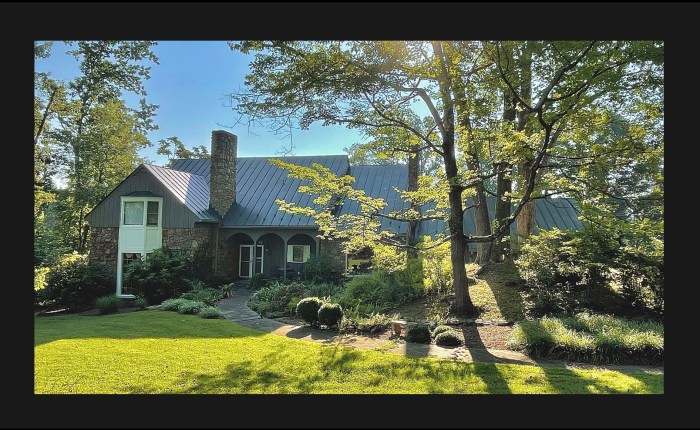
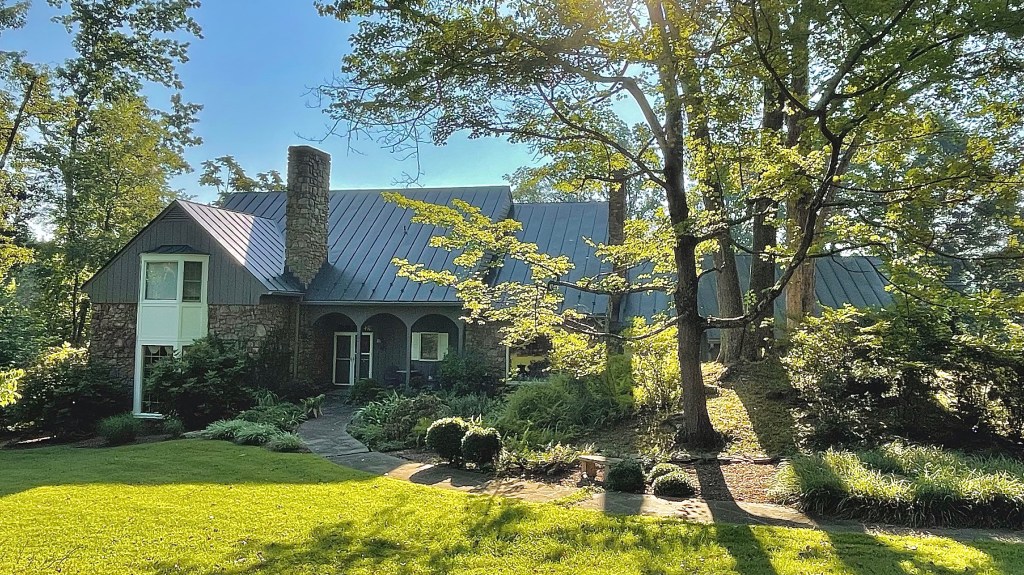
We drove down the long driveway with snow in the field to the left and the woods to the right. It was a nice setting. You couldn’t yet see the house and then we crested a small hill for our first view. It had stone and cedar siding with two chimneys and a cedar shingled roof. How pretty in the snow! We parked outside the garage and walked to the stone porch in the back of the house. As we stood there looking at the pond and fields, three horses trotted by in the paddock between the house and the pond. I mean it was so perfect, it was almost as if they were holding the horses out of sight, and as we arrived, someone called and said, “Cue the horses.

The Pond, on Another Winter Morning

Cathy and I didn’t say a word but looked at each other. It was one of those looks married couples have where an entire conversation takes place and no one says a word. We hadn’t entered the house yet, but pretty much knew this was our next home.

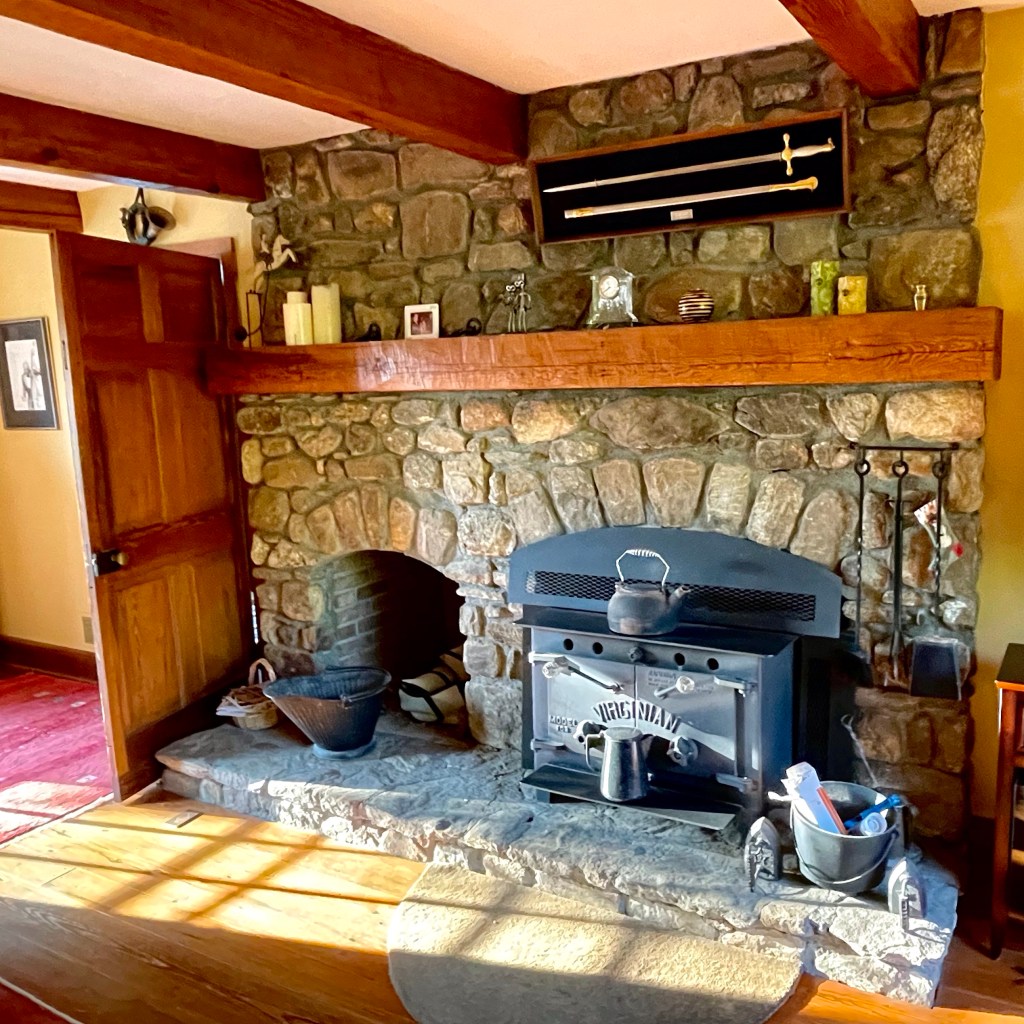
This house wasn’t new. It was about 20 years old, but built in a way to make it look much older. In the family room there was flooring and beams from a pre-Civil War warehouse near Petersburg, Virginia. One of the doors was antique and made entirely by hand with no nails involved. Most of one side of the home was glass or glass doors so there were constant views of the pond and fields. The fireplace in the family room was made with stone from the property and installed by an old stone mason who lived just up the road (and is now deceased).

The Morning Sun Streaming in on the Family Room’s Stone Fireplace.

There were things that needed updating of course. Some of the colors were straight out of the 70s. The peacock wallpaper in the dining room would have to go. Most of the carpet was old – probably from the late ‘70s as well.

We also did a tour of the barn. It was functional, although nothing special. The barn at house number two kind of blew it away, but this one was perfectly functional with 6 stalls, instead of the 4 at the previous place.

We left and drove back home with our agent. The distance didn’t seem quite so far to me now.

A few days later we called the owner directly and asked if she would give us a tour of the property itself, which she was more than happy to do. We spent a few hours walking the twenty acres and helped her feed her horses that night. As we passed by the pond, she said “I’ll even throw in the rowboat, if you decide to buy.” When our agents (both ours and hers) found out we’d met without them, they were, ummm, a bit upset, but there wasn’t anything they could do about it.

The next day we put our offer in, and after some back and forth, we signed the contract. We couldn’t actually close until the end of May, as the owner had a couple of pregnant mares and didn’t want to move them until the foals were born and old enough to travel. It made perfect sense to us.

We closed on the appointed day in May and a few days later, with our pickup truck, horse trailer and a U-Haul truck, our friends helped us move. The house was christened with a party that afternoon and evening, and on its way to becoming a home. We named it Rohan Farm*.

Our Home, Rohan Farm

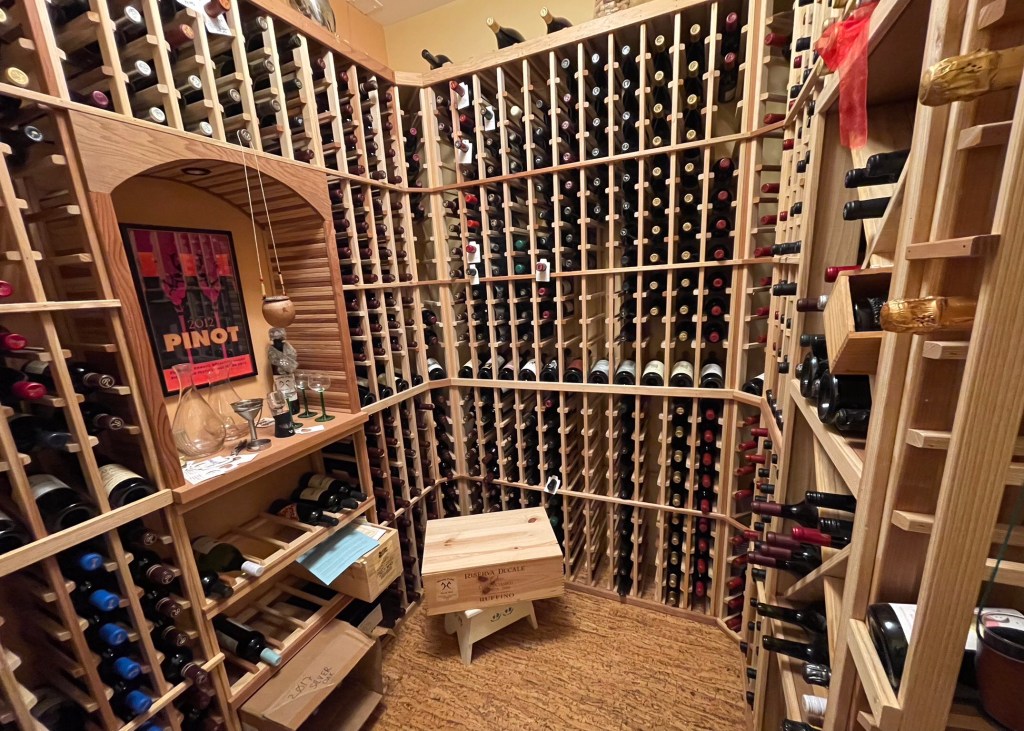
Although the house was already nice, we spent a decade getting everything just the way we wanted it – repainting and recarpeting; the ‘70s look went, as did the outdated kitchen; ultimately, a wine room was added. There was lots of work outside as well – redoing things in the barn; clearing brush off of fencing and replacing the fencing; adding an outdoor riding ring; adding new paddocks; putting in automatic waterers; adding multiple gardens; and of course an endless list of smaller items.

In June it will be 25 years here. We love this place. It doesn’t have all the bells and whistles, but it’s warm and comfortable. It looks like it belongs here in Virginia and has been here forever. We love it and hope to remain here forever as well.

Addendum:

  • * Rohan Farm – Yes, this is from Lord of the Rings. Rohan was the land of the horse people, so it seemed to fit. We’ve both been big fans since the ‘70s, well before the movies ever came out.
  • You can find a link to last week’s blog on the housing development here – The new housing development sits in the middle of nowhere, 6 miles west of Warrenton and 12 miles north of Culpeper. Some thought it might provide “affordable housing” for the area, but with homes starting “in the low $500s”, I don’t think so. Or maybe my definition of affordable housing is […] Continue here: https://mnhallblog.wordpress.com/2023/08/08/paving-paradise/

The Importance of Being Lucky

The Importance of Being Lucky

Cathy was thrown from her horse two months ago. While she has some lingering pain, overall, she was pretty lucky. It reminded me of the story my friend Bob Bishop told of being thrown by a horse, but unfortunately not clear, as the horse galloped away. He too was lucky as you’ll soon find out.

This is Bob’s story and it’s a good read. All I’ve added is a bit of editing.

In 1952 Crested Butte, Colorado was a bucolic place in the summer, with blue skies, white clouds and mountains surrounding the area. At the time, Crested Butte was a little town of maybe fifteen frame houses, a general store, and a post office/sheriff’s office. All were two stories high, and each had a door on the second floor. Crested Butte typically received twelve to fifteen feet of snow in the winter, and with drifts, that door became the only way people could exit their house. They would chop stairs in the snow and ice down to the street. As spring approached and the likelihood of more snow lessened, they tunneled through the snow to the front door and used that as access as the snow started to melt.

Needless to say, it was not the multimillion-dollar ski area it is today.

My father and mother were asked by our friends, the Dorsetts, if mom could help them out at the boy’s camp they had founded a few years earlier. This was mid-May, two weeks before the camp was to open for the summer, and the camp cook had just quit. The Dorsetts knew that mother was schooled as a dietician, and also knew she was a good cook. Coincidently, father had just accepted a new job with Aetna Life Insurance Company, which required him to attend a four-week school in Hartford, Connecticut. Mother and father agreed they could help the Dorsetts out and a little extra money would be welcome. My brother and I could go to the camp for free, and they waived the requirement that a camper must be at least twelve years old, for nine-year-old me.

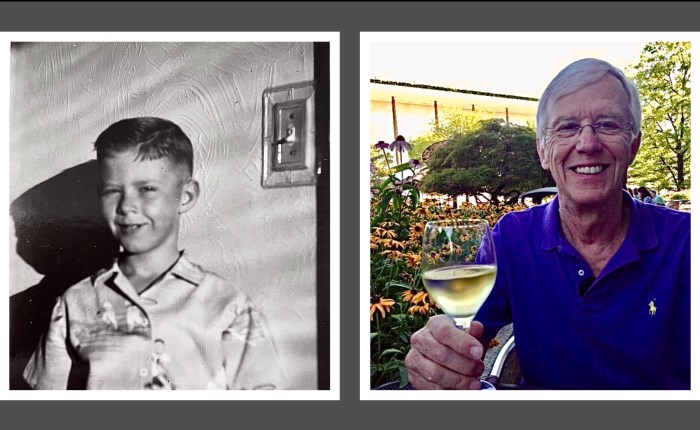
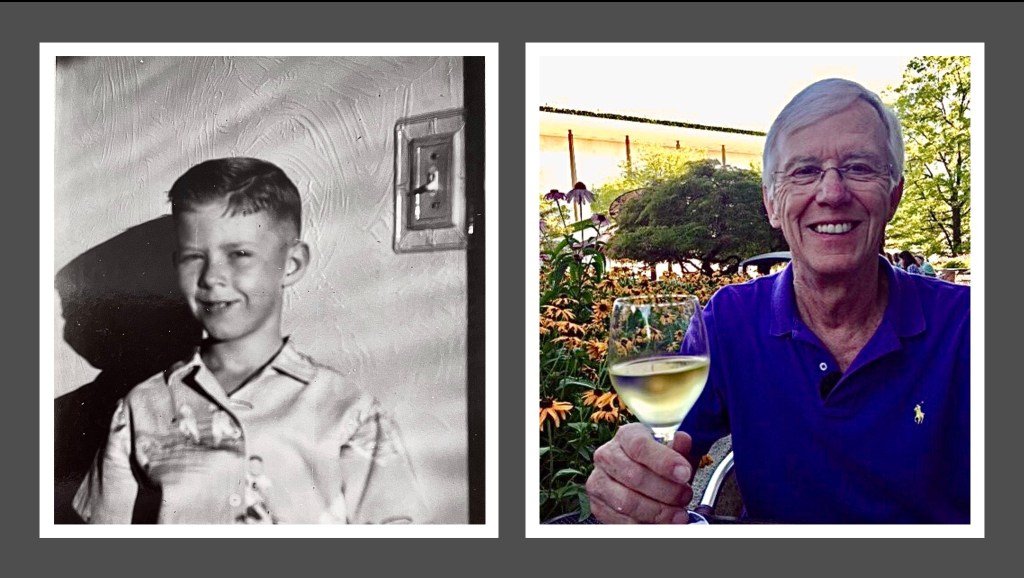
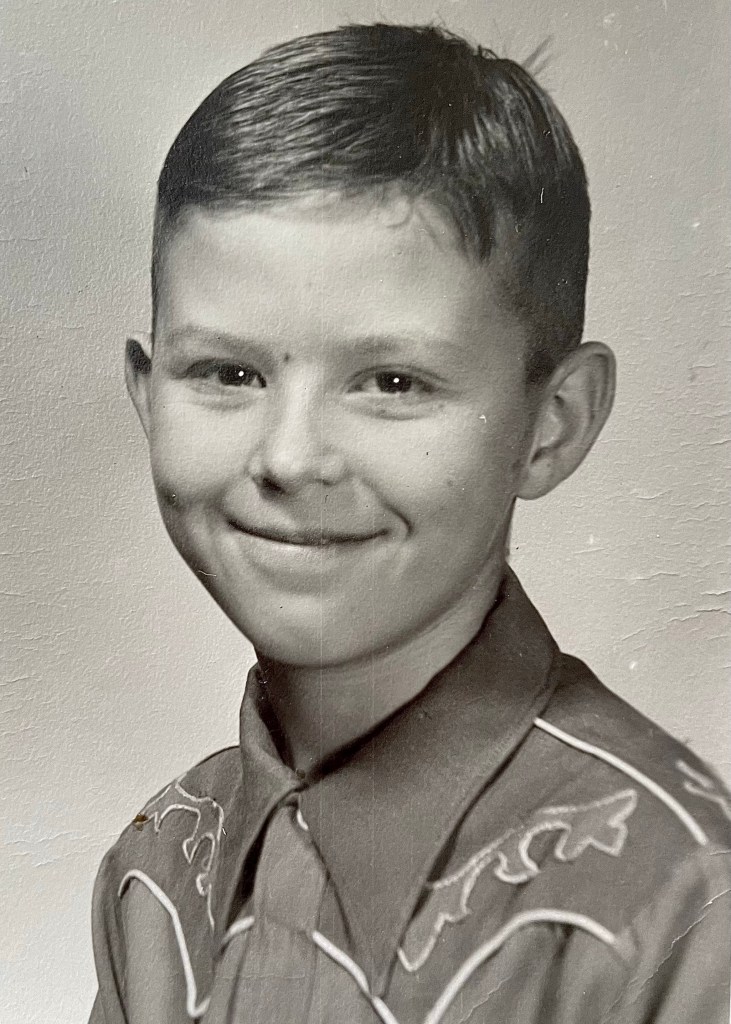
Bob, About the Time of the Incident

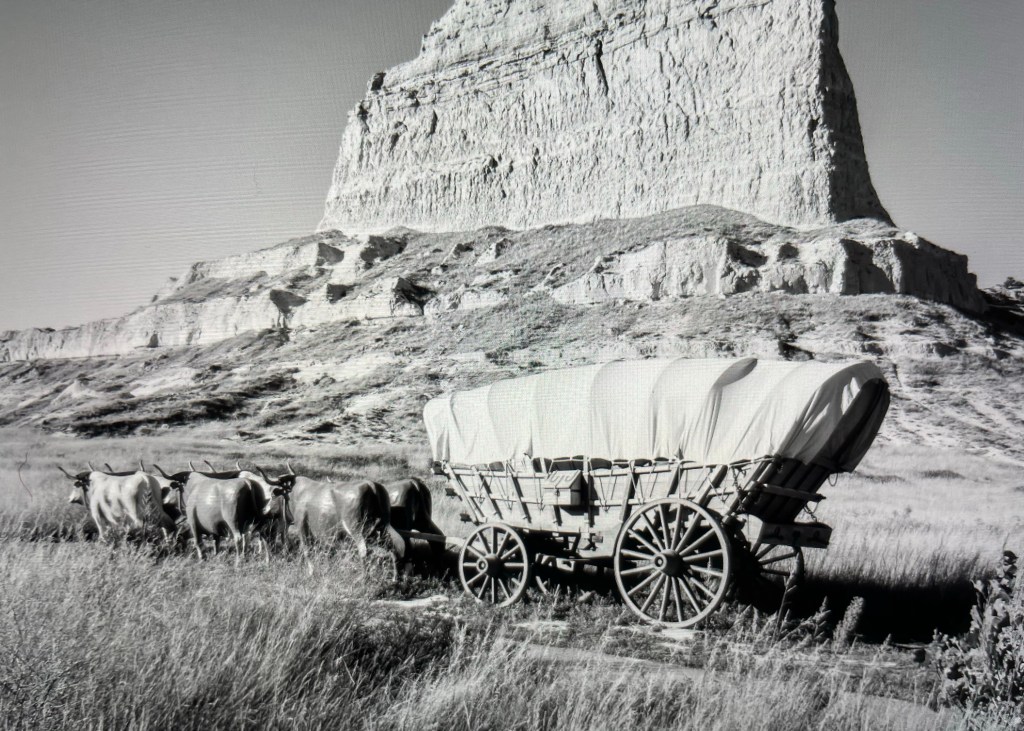
The camp was three miles down a dirt road from the town of Crested Butte, at the base of Mt. Crested Butte, which rose almost three thousand feet straight up from the meadow. We kids slept in Conestoga wagons – not replicas, but real ones left there by those who rode in them to seek their fortunes in the west decades earlier. Inside the canvas covered wagons were four sets of bunk beds, two on each side. Light came from three kerosene lanterns hanging in the middle. There were six wagons with eight boys to a wagon, for a total of forty-eight campers. The only electricity in the camp was in the kitchen, the residence “hall” for the staff and counselors, and the dining hall.

One of the Conestoga Wagons They Were Using.

It was pretty idyllic, for a young lad of nine. Other than the mandatory arts and crafts sessions, we were free to go fishing, hiking, or horseback riding, or to just play. I generally chose horseback riding, and off we rode to the meadows beyond the camp for romping around, and frequently to play flag football on horseback.

Great fun, until …

One fateful day, my horse saw something. A snake? A gopher hole? I’ll never know. She reared up – I was just moseying along, reins held loosely, and then I was airborne. Spooked by whatever she had seen, the horse took off at a gallop. I was thrown off, but unfortunately, not completely. My left foot caught in the stirrup, and I was just tall enough that my head almost reached the ground. I remember fervently hoping I didn’t hit a rock with my head, although it was clearly beyond my control. My journey across the meadow continued with me hanging upside down, bouncing off the ground in synch with the horse’s gallop. The direction I faced changed with each bounce – seeing the meadow stretching endlessly behind at one moment, and next peering at the blue sky from under the horse’s belly. Although I have no exact recollection, I was later told the whole journey lasted less than a couple of minutes before my horse was pulled to a stop by one of the counselors.

The next thing I remembered was lying in my bed in our Conestoga wagon, just staring up at the canvas top. I could talk and move my arms, but I had no sensation below my waist. In time, the “local” doctor (from Gunnison, 30 miles away, the last 15 on a dirt road) came in to evaluate my condition. He reminded me of a shorter, thinner Santa Claus, with white hair and a beard. After an eternity of poking, prodding and sticking pins into me everywhere, he drew a deep breath, turned to my mother and said, “He’s paralyzed, and it’s either temporary or permanent. Either way, the only thing you can do is make him comfortable.” He said if I could ever wiggle my toes, the paralysis was probably temporary, a traumatic inflammation of the spinal cord, and I would likely become fully functional. If not, well …

What’s a nine-year-old to think? Honestly, not much. I had no idea what “permanently paralyzed” meant. It never occurred to me I wouldn’t be able to walk, bike, play baseball, or go horseback riding again. My brother and some of my wagon-mates kept me supplied with comic books, Archie and Jughead, which helped while away the time. I was not in pain, but ached all over. I slept a lot.

As time passed, I kept looking down at my toes. I concentrated as hard as I could on wiggling them, but nothing happened. Until, on the third day, I stared at my toes, willing them to move. And then I swear, my right big toe did. I swear. I saw it move just a little. Didn’t it? I thought it did. I concentrated even harder, and, sure enough, I could actually see it move. Not much, but it actually moved. Yippee!!!

A couple of hours later, Mom came in with my lunch, and I said, “Mom?! Watch this!” And I wiggled my right big toe. She looked at me and said, “What, Bobby? What do you want me to watch?” I yelled, “Mom! LOOK! Look at my right foot!” She turned to look down at my feet, I wiggled my toe, and her eyes glistened as she turned back and looked at me. She broke into a huge smile, leaned down, and gave me a BIG hug.

In a couple more days, I could wiggle all of my toes. The doctor came back to check on me a week after the accident. I recognized him as he pulled the canvas flap aside and climbed into the wagon. I said, “Hi. Watch this.” He started smiling as I performed my new trick (wiggling my toes), and said, “You sure are one lucky little boy.” Pause. “I think you’re going to be just fine.” Then he left.

A couple more days passed, and I was up and walking, although I needed help to keep my balance. Another week, and I was fine, walking and running around – just as if it never happened.

Later in life, I learned there is real value in being as good as you can be, but it is really good if you’re also very lucky.

Bob in 1952, and Again in 2020.

Postscript: I started having back problems in 2017. It began with tingling in both quadriceps, but two months later, I had a pinched nerve in my neck. The MRI showed “severe” narrowing of where the nerves go from the spinal cord out to my left at L2-3 and to my right at L3-4 (aka “spinal stenosis”). Oh, also some scoliosis, having lost 4” of height in the last twenty years. I mentioned the horse escapade to my orthopedist and asked whether it might have some bearing on the condition of my back. He looked at me over the top of his horned-rim glasses and said, “It can’t a-helped” and smiled. And so did I.

Addendum:

I should mention Bob later attended the Naval Academy at Annapolis, and served for several years in the Navy as a submariner. He’s a great storyteller and I’ve done a couple of previous blogs with him about his time in the Navy. If you would like to read them, you can do so here:

  • Crazy Ivan anyone? … In 1970, our sub, the USS Finback, was helping with Anti-Submarine Warfare training for NATO aircraft. An observer on the sub said “I think I understand your plan. You alternate going to port or starboard as soon as you submerge.” I responded, “Well, not actually”, and we walked over to […]. Continue at: https://mnhallblog.wordpress.com/2022/04/13/submarine-games
  • The movie, “The Hunt for Red October” is child’s play, compared to what these submariners did on a daily basis … “The Comms Officer ran in and handed the CO the decoded message. The CO read the message, took the lanyard from his neck, unlocked the firing key cabinet, and reached in for the firing key. We were about to” […] Continue at: https://mnhallblog.wordpress.com/2021/06/23/we-knew-we-were-at-war/

A “The Corps Has” Old Fashioned

A “The Corps Has” Old Fashioned

The Corps Has… Every West Pointer knows the phrase. When we were Cadets, we laughed at it, and thought it untrue. As Old Grads, many of us use it, and believe it is true. “The Corps Has”, short for “The Corps has gone to hell” is a grad’s way of saying “Things aren’t as tough now, as when I was a cadet.”

The academy was founded in 1802 and is the oldest of the United States’ five service academies. The phrase “The Corps Has” has no doubt been around since 1803. Every class, once they graduate, seems to think those after it have it easier.

A friend from the class of ‘64 reminds me regularly (half in jest, but only half) that as Plebes, they stayed at the Academy their whole first year, and couldn’t go home for Christmas break like we did.

Friends from my Class of ‘78 regularly bemoan the fact that current cadets no longer have meal formations three times a day like we did.

I think you get the drift. And that doesn’t even get into how the whole Plebe System has changed over the years. The Corps has gone to hell. Although for as long as it’s been going to hell, you’d think we’d logged enough miles to get to hell and back by now. ;-).

With the Passage of Time, Some of Our Memories Get a Little Hazy.

Recently, on June 26th, ‘23, the class of 2027 had their first day at West Point, more commonly known as “R” Day (Reception Day). That evening, I posted a picture of a whiskey Old Fashioned I was drinking on our class Facebook page and offered a toast to the class of ‘27. They will graduate 49 years after we did. I don’t care how much easier it may have become; one thing I know for sure is you never forget your first day at West Point. It may become blurry, but you won’t forget it. Ever.

In the comments to the post, one of my classmates, Joe Mooney, brilliantly suggested having a “The Corps Has” Old Fashioned, by using WhistlePig whiskey in it. Our Classmate, Dave Pickerel, was one of the founders and the Master Distiller at WhistlePig Distillery. I started thinking about it. How would I make/what would go into a “The Corps Has” Old Fashioned?

After some additional thought and a few practice rounds, here’s my version, with explanation, of a “The Corps Has” Old Fashioned*.

Simple Ingredients for a Good Drink

Ingredients

  • 1 Sugar cube
  • 2-3 Dashes of Smoked Cherry Bitters
  • 1 Teaspoon warm water
  • 2 ounces WhistlePig PiggyBack Rye Whiskey
  • Large ice cube or ball of ice
  • Small piece of Orange peel
  • And, you will need matches or a lighter

Instructions

1. Add a sugar cube to a rocks glass. These days, most recipes for an Old Fashioned start with a teaspoon of simple syrup. To hell with that. Since we are Old Corps, we are going to start the way the original Old Fashioned started – with a sugar cube.

2. Shake 2 or 3 dashes of the Smoked Cherry Bitters** onto the sugar cube. Why Smoked Cherry instead of the Angostura Bitters called for in the original Old Fashioned? The Smoked Cherry Bitters add just a bit of haze to the drink. Sort of like the haziness of our memories of West Point. (If you can’t find Smoked Cherry bitters, look for another smoked bitters, or use regular Angostura.)

3. Add the Teaspoon of warm water to the glass. Muddle the sugar cube until it dissolves in the bitters and water (TA-DA! No simple syrup needed. 😉 )

4. Add the Rye and stir. Why WhistlePig PiggyBack Rye? First, as I previously mentioned, our deceased Classmate, Dave Pickerel, after a stint as the master distiller at Makers Mark, was one of the founders and the master distiller at WhistlePig. Every bottle of PiggyBack actually has his birth and death years on the neck of the bottle (1956-2018). Also, it’s Rye, not bourbon. Rye is spicier than bourbon, which is generally sweeter. While there were some sweet times at West Point, I’d have to say overall the experience was more on the complex and spicy side. It certainly wasn’t for everyone.

5. Add the ice. Stir until chilled.

6. Use a lighter or a match to singe the orange peel a bit (note, I said singe, not burn). Express the orange peel over the glass and then drop it in. Stir a few more times. Why singe the orange peel? It adds a little smokiness to the peel when you express it. It doesn’t change the drink…much. But somewhere in the background it adds a touch of something you can’t quite place, but think you remember. Not unlike that first summer at Beast Barracks, the memory of which seems clear and hazy at the same time.

7. Raise your glass in remembrance of our fallen classmates and toast the Corps of Cadets.

Ah, Yes. A Very Good “The Corps Has” Old Fashioned.

The Corps Has? No, not really. Every year young men and women report to West Point at the start of summer. I suspect those four years always have been and always will be a challenge. The demands and tests evolve, but are always there. Thank God there are still those today who answer the call.

Addendum:

  • * You might ask why I selected an Old Fashioned as the starting point/base for the drink. Well, the Old Fashioned is the granddaddy of all cocktails and as with many cocktails, the history is a little muddled. Cocktails were first mentioned around 1805 and generally consisted of some combination of alcohol, bitters, sugar and water. At the time, the alcohol was probably whiskey, gin, brandy or rum. As the 19th century was coming to an end, people started adding other things to their cocktails – fruit, fruit juice, soda water, or tonic as examples. This increased the number of people drinking cocktails, but irritated some of the people who had been drinking them for for a while. They wanted the “old fashioned cocktails”, not the new fangled stuff. Sometime around 1890, the Whiskey Old Fashioned became the first named cocktail. It may or may not have been invented by Colonel James E. Pepper at the The Pendennis Club in Louisville, KY, before he allegedly brought the cocktail to the Waldorf-Astoria hotel bar in New York City. Since West Point is the senior service academy, it seemed right to use the oldest known cocktail as the base for the drink.
  • ** You can probably find smoked or spiced cherry (or smoked orange) bitters online, or at your local liquor/wine store. If you want a treat, try ordering them online from Artemisia, a local farm here in Virginia. In addition to growing vegetables, they make several unique bitters and herbal wines (similar to vermouth, but better). They are currently sold out, but should have them again in about a week. Their link is: https://www.artemisia.farm/ For those who live in Northern Virginia, you can also find them at The Whole Ox, in Marshall, Va.
  • Thanks to classmate Joe Mooney for coming up with the idea for a “The Corps Has” Old Fashioned with WhistlePig. It was a great idea.
  • Thanks to classmates Joe Mooney and Bill Moeller for reviewing this blog and suggesting some ideas.
  • Our West Point Class of ‘78 45th class reunion is coming up this fall. Here’s the story of us selecting two barrels of WhistlePig PiggyBack Whiskey for sale at the reunion (all bottles already sold out) – – – We were on a mission to the WhistlePig Distillery in Vermont. Twelve classmates gathered to taste whiskey from five barrels. We would select two for the West Point Proud and Great, Class of ‘78 45th reunion this coming fall. We didn’t […] Continue here: https://mnhallblog.wordpress.com/2023/05/09/__trashed-2/
  • There are many Old Fashioned recipes, but the basic one uses: 2 oz Bourbon or rye, a tsp of simple syrup, a couple dashes of Angostura bitters and a slice of orange peel.

The Rich Soil of Ukraine

The Rich Soil of Ukraine

Bob made a comment to Viktor, his father-in-law, about how Ukrainian soil is “so rich and black, it stains my hands like ink!”. Viktor’s retort? “Well Robert, over the centuries, many idiots have tried to capture Ukraine, and we keep having to bury them in the ground here – that is why the soil is so rich.”

Bob and Viktor

Those lines came from my friend Bob Pitts recently published book, UKRAINE: THE AWAKENING: My 20 years of witnessing Ukrainians rediscover their nationhood. Those of you who are regular readers of this blog know that I’ve recently written a couple of articles about Bob and his current life in Ukraine. You can find links to those blogs in the Addendum. Over the past eighteen years, Bob and his wife Vita have divided their time between the USA and Ukraine, where Vita is originally from. They have lived in Ukraine continually for the last two years, and have seen up close and personal Putin’s unjust attack on, and war with, Ukraine.

When the war began, Bob became concerned about how little westerners, especially Americans, understood about Ukraine, its people, its history and how the relationship with Russia is misinterpreted in Western media coverage. As a result of that concern, he wrote UKRAINE: THE AWAKENING. The book gives readers a view into Ukrainian culture and the beauty of the people. I’ve bought and read the book and recommend it to anyone who has even a remote concern about Ukraine and world events. Here’s my quick review.

Ukraine: The Awakening

Bob is, of course, correct. Most of us Americans know little about Ukraine, or its history. That’s what makes this book so perfect. A scant 135 pages, it gives us the basics. With a combination of current events, a bit of personal and family history, a little Ukrainian and Russian History, interviews with some Ukrainian young adults and thoughts about the future, Bob achieves his goal – it not only talks about Ukraine’s Awakening over the past twenty years, it provides the reader with an awakening as well.

Bob isn’t one of the great writers America has produced like Ernest Hemingway (Fiction), or David McCullough (History/Biography). For the purposes of this book, I think he’s something better – he’s a conversationalist. Reading the book feels a bit like sitting in his family room, or at a local bar with him and he is giving you his thoughts on Ukraine. With a casual, but passionate writing style, Bob pulls you in, and then gives you some things to think about. Eminently readable, it’s an important book at the right time.

While the entire book is good, my favorite section contains interviews with three young Ukrainians, each telling their own story. These aren’t fairytales, but real stories by real people. These are dynamic, vibrant stories that give you hope for the future, not only for Ukraine, but also for young adults everywhere. As The Who sang, The Kids Are Alright.”

Artem, One of Those Interviewed by Bob.

The Ukrainian counteroffensive has been going on for a few weeks now and Ukraine will remain in the news. Additionally, the Wagner group takeover of Rostov and attack towards Moscow started and then stopped. Who knows what impact that will have. Some will pay attention. Some will not. If you are a smart and caring person, I recommend you pay attention. I also recommend you buy this book. Ukraine is too important and all of us should learn more about this country. You can find it on Amazon, and the price is right. Go ahead and buy it. What are you afraid of? That you might learn something new?

Addendum: