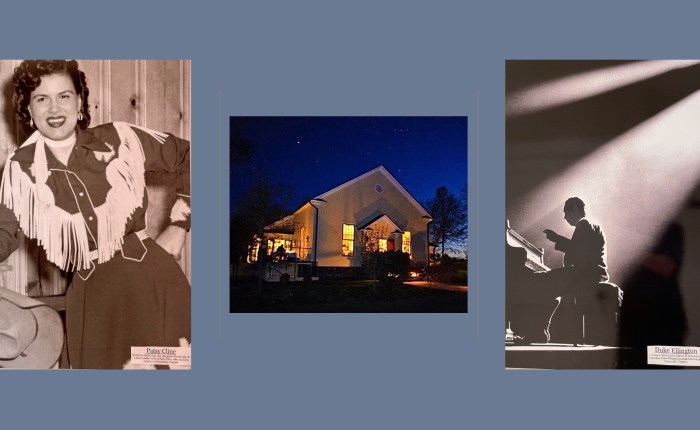
How could you not possibly like a local place, where both Patsy Cline and Duke Ellington have performed in the past? Buchanan Hall, a small venue just down the road in Upperville, VA, hosted both of those greats during it’s storied past. The best part? The Hall continues as a focus for music and good times today with their weekly Farmers Market.
Buchanan Hall has existed since the late 1920s, when General James A. Buchanan allegedly decided to build the Hall for his daughter’s wedding. Construction was completed in ‘33, in the middle of the depression. Eventually, the Hall belonged to the community, and a Board of Trustees was set up. The problem was, the Trustees may not have always had the best judgement on who could use the Hall. Some of their clients were “questionable”.
A few years ago, an undated note to the Trustees was found – “I had little problem last [night] with some guys fighting [over] girls, so the security guards put him out [he shot] in the air two or three times and I call the sheriff [but] I take care of the problem for now on… no drinks is allowed and no ins and outs. Thank you Romeo Ferguson.” … Another note from Ferguson read, in part: “To the hustlers, leave the guns at home or in your cars . . . this is a nice place to have fun at – think about it!”
As you can see, Buchanan Hall has a varied history…;-)
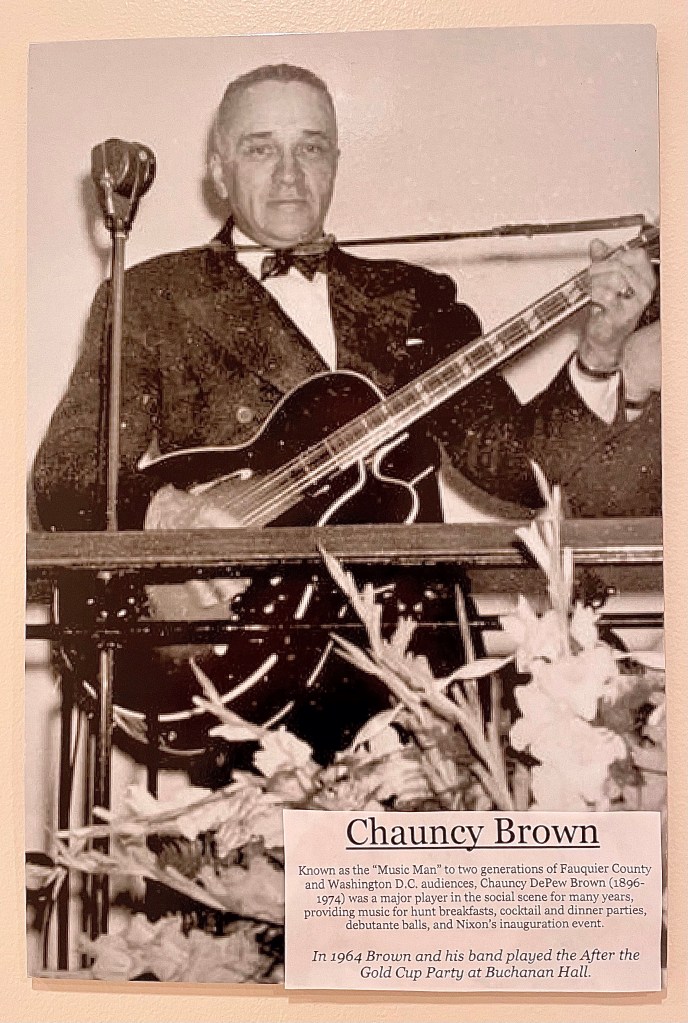
But oh, did it draw the crowds. On the local level, there was the likes of Chauncy Brown and his band for dances that drew folk from Middleburg, Warrenton, and even DC. It turns out Brown was often the drummer for Duke Ellington’s band from 1930-37.
An undated photo of Chauncy Brown
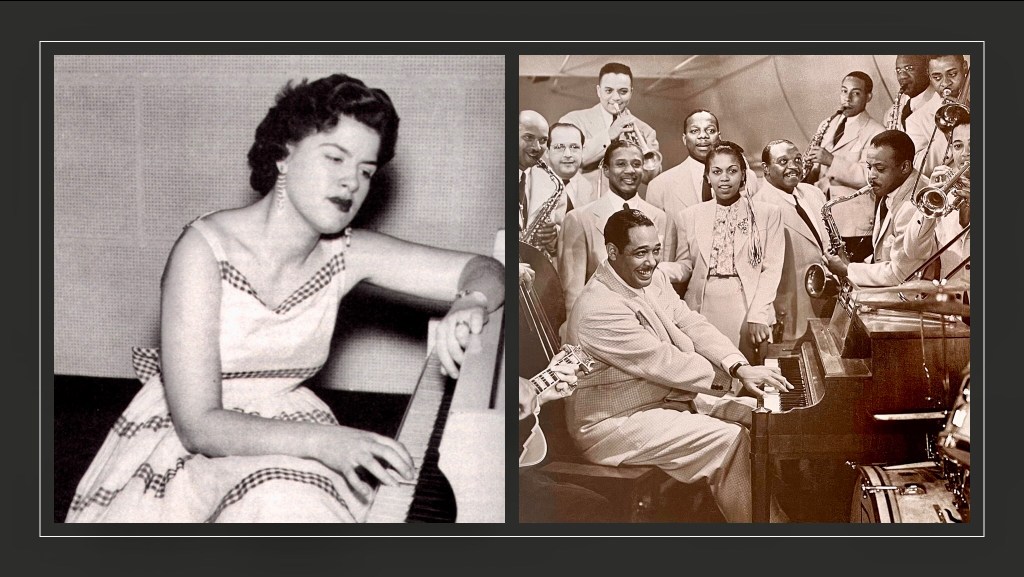
They also drew major talent over the years. Ramblin’ Jack Elliott, who was friends with Woody Guthrie, influenced Bob Dylan, The Rolling Stones, The Band and others, performed a couple of times. And then of course, you have Patsy Cline and Duke Ellington – both appeared at Buchanan Hall. Patsy was originally from nearby Winchester, Virginia, so perhaps her appearing was not such a huge surprise. She played many local venues in the early 50s before making it big and moving to Nashville. Duke on the other hand held a national reputation from the 1930s – I’ve wondered if his work with Chauncy Brown is what drew him to Upperville, however, I can find no confirmation.
Can you imagine sitting in a 200 seat theater and hearing Patsy sing “Crazy”, “I Fall to Pieces” and “Walkin’ After Midnight”, or Duke playing “In a Sentimental Mood”, “Satin Doll” and “Take the A Train”? It would have to be both sublime and amazing….
In addition to having the piano in common, Patsy and Duke both appeared at Buchanan Hall
Time passed and by 2000, Buchanan Hall was in disrepair, and locals decided it was time to renovate the structure and grounds. Through donations, the Hall was eventually restored.
Since then?
Buchanan Hall has served in a number of roles. Community Center, wedding venue and event location to name a few. As examples, it continues to host parties and happenings in conjunction with the Upperville Colt and Horse Show, the oldest such show in America. In 2018, it hosted an American Roots Music Revival that sold out over the course of several evenings. And last year, the inaugural Piedmont Pride event, including a drag cabaret brunch, was held there.
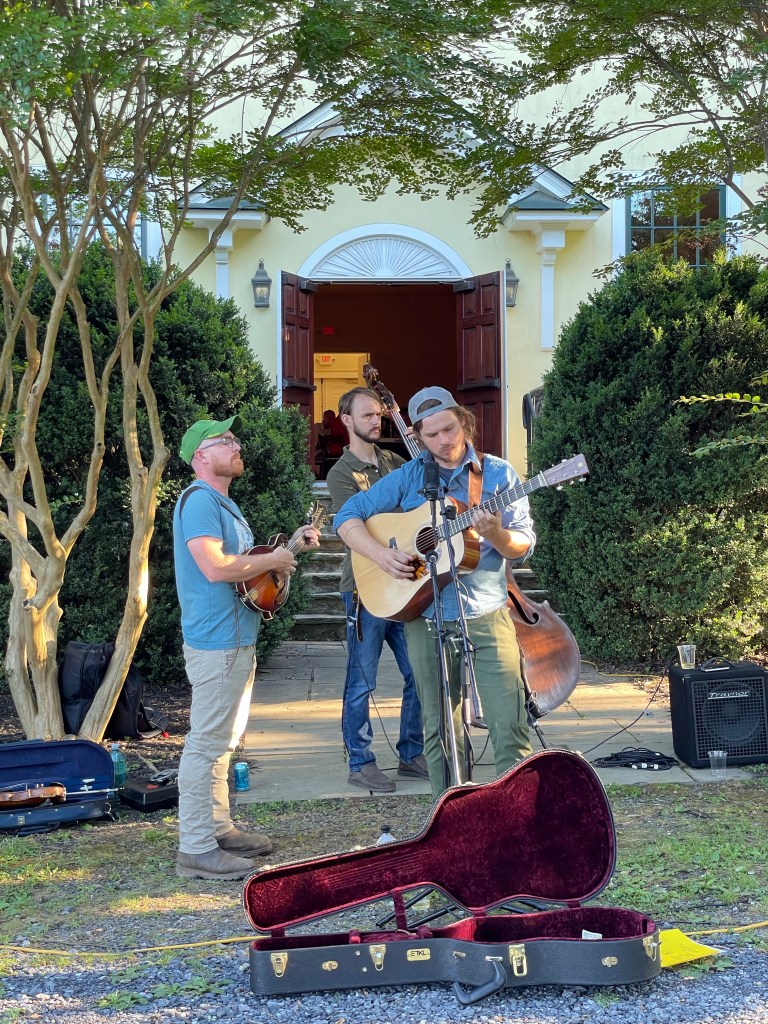
I was excited to recently learn the Buchanan Hall Farmers Market is returning again this year. The market is every Wednesday from 4-8 pm from May 18, 2022 through October 26. This isn’t just any farmer’s market. You can of course purchase farm fresh meats, produce, and artisan goods. Even better is grabbing something from one of the food trucks, buying a glass of beer or bottle of wine from one of the local producers, and then pulling up a big piece of lawn and watching a band playing outside the entrance to the Hall. They always have a live band. It’s a pretty good way to spend a Wednesday evening.
Wonderful live music can still be heard at Buchanan Hall on Wednesday evenings during the summer.
I recommend you give the Farmers Market a try this summer on a Wednesday evening or two. While there, wander inside and take a look at the pictures of Patsy, Duke, and Chauncey. Remember those days gone by, while having a wonderful evening in the present.
Addendum:
– Buchanan Hall is located at 8549 John S Mosby Hwy, Upperville, VA 20184. You can learn more about it here: https://www.buchananhall.org/ .
– Much of the history I’ve discussed in this blog came from the Buchanan Hall website itself, and a Washington Post article from a few years ago – Chauncy Brown’s Dance Party Lives On (link is above).
Our second favorite restaurant in Rheindürkheim, Germany in the late ‘80s was Pfeffermühle (The Peppermill). Das Letzte Essen (The Last Meal) didn’t occur there, but that is where the story started.
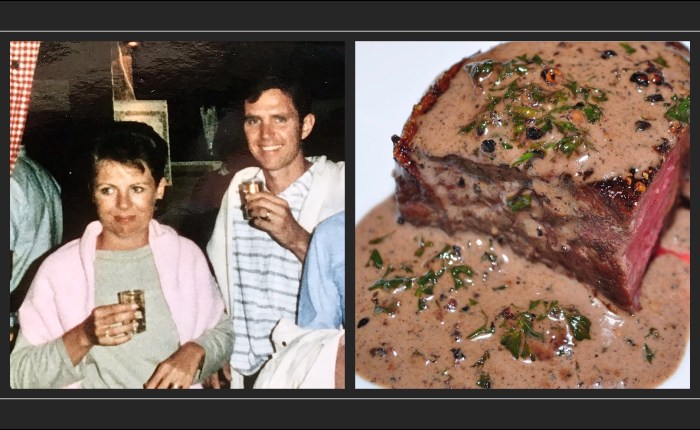
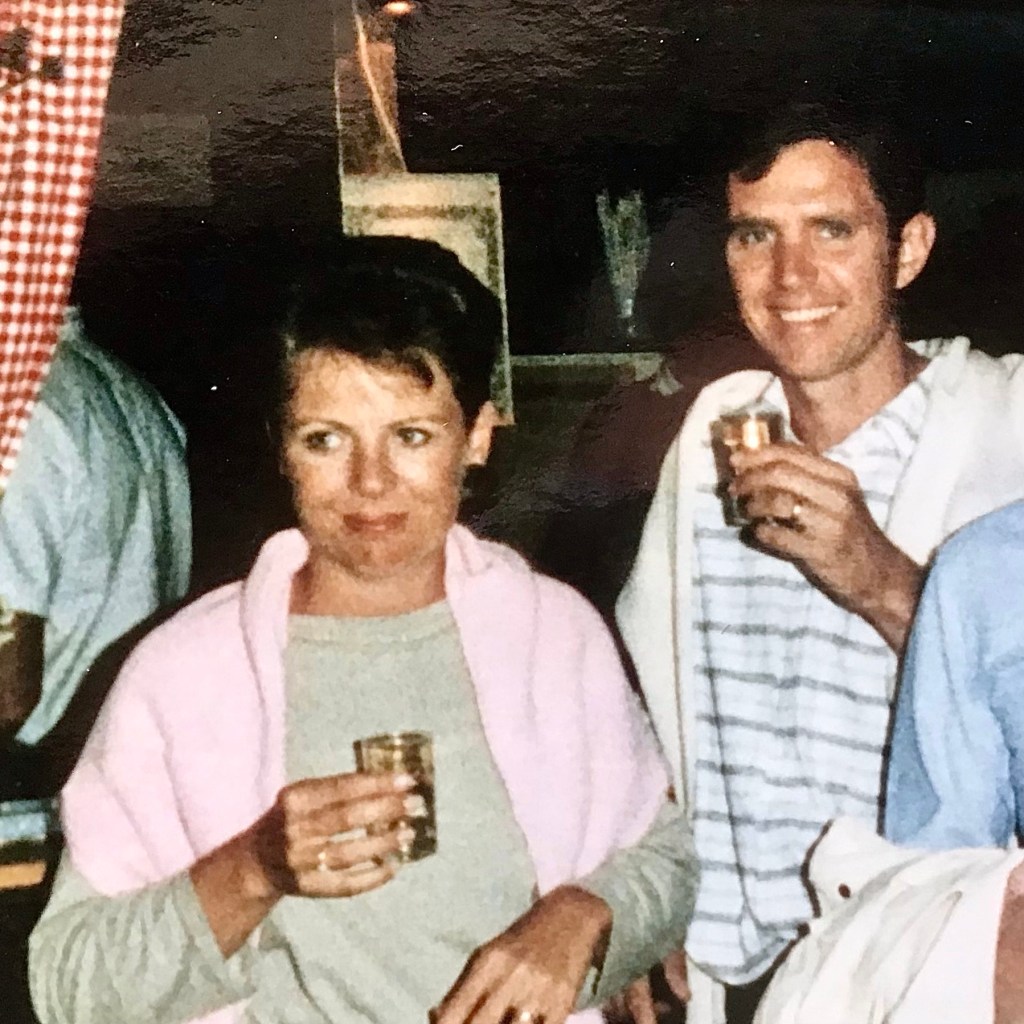
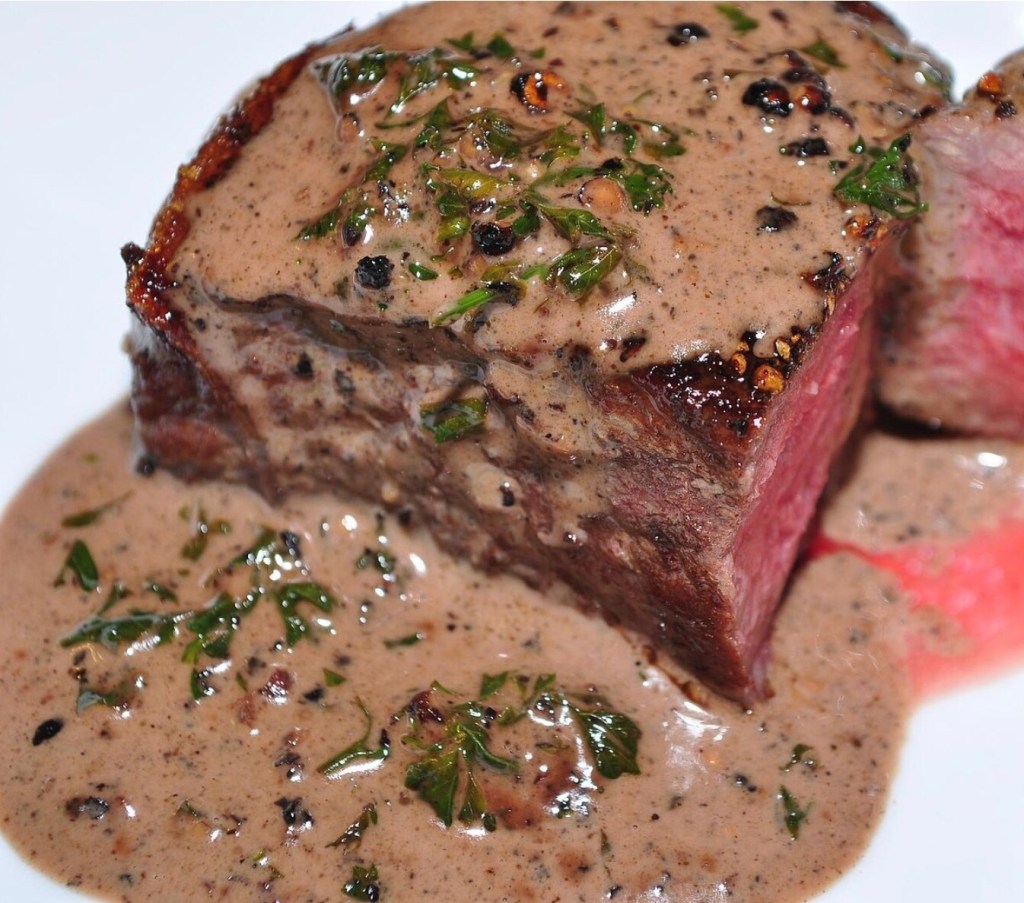
Recently, Cath and I were thinking about Pfeffermühle. I’d made Cathy a special meal one night for dinner, Steak au Poirve (Steak with Pepper Sauce). As we were eating dinner, she said “Do you remember the couple we met at…”, before she could go on, I finished her thought “…at Pfeffermühle? The ones who came to dinner?” “That’s them!”, she answered. “Do you remember her saying “Dies ist das letzte Essen?”” (This is the last meal). We both started laughing…
Cathy and I About the Time of “The Last Meal”
Pfeffermühle was located just outside of Rheindürkheim, on Sommerdamm Strasse, the main road to Worms. It opened after we had already lived there for a year or so. Bruno, the owner, was from Italy and moved to Germany after spending several years in California. Although the restaurant was nondescript on the outside, once inside, the white tablecloths and napkins caught your attention.
The food made an even bigger impression. They served both pizzas and traditional Italian fare. Two great food memories that stay with me even today were their lasagna, and how good their pizzas were. One of the pizzas came with an over-easy egg in the center of it. Yea, I know it sounds strange, but it was really tasty. I’m not sure about now, but at the time, you always ate pizza with a knife and fork in Europe, so the egg was no problem.
Bruno worked the front of the restaurant, while his wife was the chef in the back. He was quite the host and spoke fluent Italian, English and German. He made everyone feel welcome when they arrived, and Pfeffermühle soon became popular. If you were there on a Friday or Saturday night, the place was always jammed.
We became regulars, and as is often the case, over time, would recognize other regulars. There weren’t really any Americans, but Germans came from several nearby towns, and we became friendly with a few couples we ran into regularly.
One evening it was turning late and only a few tables were still occupied. We recognized a couple sitting at a table near ours, and started talking with them. They invited us to their table for a nightcap, and that’s how we first met Gerhard and Hannah. We shared a drink or two, and everyone agreed we needed to get together some time in the future. With that, we all said good night and didn’t think any more about it.
Except…
We ran into them the next week, and then again two weeks later. That night, I bought the drinks. As the evening was ending, Gerhard invited us to dinner at their home in Osthofen a week later. We readily accepted.
The following Saturday, we drove the three kilometers to Osthofen, where we ate a wonderful meal. I don’t remember what we had, but I do remember he served French red wine with the meal. At the time, we didn’t know any Germans who did that, and it made an impression. The Germans make wonderful white wines, but their reds? There weren’t too many of them, and they weren’t that good at the time. Usually, you drank white wine or beer with dinner, no matter the meal.
Of course we wanted to return the favor, and invited them for dinner a couple of weeks later.
Cath and I stressed a bit about what to cook, as we wanted a nice meal. I don’t remember what we did for an appetizer, but we finally agreed the main course would be “Steak au Poirve” from a cookbook a friend had recently given us. It was a bit elegant. It was also the first time we would ever make it. For dessert, we would make a “Champaign Granita”.
Charollais is a Specific Kind of French Beef
The big night finally arrived and Gerhard and Hannah arrived at our home. We served some drinks and were bringing out appetizers when Hannah said “Dies ist das letzte Abendmahl”. What? Did we hear correctly? “This is the Last Supper”?** Was today some German religious holiday we were unaware of?
“Was hast du gesagt?” (“What did you say?”)
“Heute ist das letzte Abendmahl. Das letzte Essen.” (“Today is the Last Supper. The last meal.”)
Oh man, we must have screwed something up. Today must be some important holiday of which we were unaware. Either that, or she was going away somewhere and this was her last real meal. What were we going to do? And then she explained…
…The next day, she was starting a diet. Tonight’s dinner was her last meal before going on the diet…
Cathy and I started laughing, and they gave us a look. We then explained our lost in translation problem with “The Last Supper” and the religious connotations, and they started laughing as well.
The dinner went well, and the “Steak au Poirve” served with potatoes turned out to be a fine last meal before starting a diet. I followed Gerhard’s lead from the previous dinner and we drank some kind of red California Cab I’d bought at the military Class 6 store. The dessert wasn’t perfect, but we served it with Sekt (German sparkling wine) and no one seemed to mind. Over dinner, we all made a couple of jokes about the last supper, and whether this was worthy. Eventually, after coffee and schnapps at the end of the meal, they left and drove home.
Steak au Poirve
We saw them occasionally after that at Pfeffermühle and had a late evening drink with them a time or two. Perhaps six months later, we returned to the States and lost track of them. Pre-Internet, there was of course no exchange of email addresses or cell phone numbers.
This story is really about just a bit of nothing, but we still remembered the evening, and chuckled about The Last Supper, although it’s 44 years later. Even small old memories can be good for the soul, especially when they come out of no where.
Addendum:
** – For those who may not be aware, TheLast Supper is the final meal that Jesus shared with his apostles before his crucifixion. It became the basis for the holy communion. In the Gospel of Matthew, Jesus prays thanks for bread, divides it, and hands the pieces of bread to his disciples, saying “Take, eat, this is my body.” Later in the meal Jesus takes a cup of wine, offers another prayer, and gives it to those present, saying “Drink from it, all of you; for this is my blood of the covenant, which is poured out for many for the forgiveness of sins.” It is immortalized in DaVinci’s famous painting. Our dinner wasn’t anywhere near Easter, but the Germans have A LOT of religious holidays, which is why we thought we may have been unaware of some other holiday.
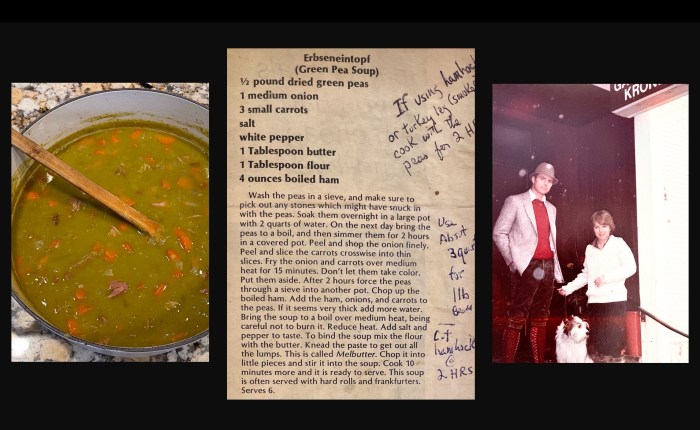
The oldest recipe in my recipe collection is for Erbseneintopf – a German Split Pea Soup. It came from TheStars and Stripes newspaper in Germany in ‘82 or ‘83, and is now a bit tattered. The first time I tasted the soup in a Gasthaus, I thought I’d died and gone to heaven. Getting the recipe was a bonus.
Erbseneintopf. The word and the soup are both a mouthful. Erbseneintopf literally translates to “Pea One-Pot”, and is really closer to a stew. Made properly, it is a thick soup with little chunks of sausage or ham hock in it. I’m not talking the puny American ham hocks, but the big German kind – meaty and smoky. The meat gives the stew a wonderful flavor. It’s a simple, hearty meal.
I believe the first time I had the dish was in a little village near Stuttgart, although I can’t remember the name of the town, or the Gasthaus, for the life of me. At the time, we often went for a walk in the woods on a Sunday afternoon, as many Germans did, and then would stop at a nearby Gasthaus for a late lunch, and a beer or two. We’d usually have some sort of simple meal – a bratwurst, or goulash soup, or some charcuterie and cheese. On one of those trips, it started snowing. Eventually we made it back to the village and the Gasthaus, where Erbseneintopf was on the menu, and despite the green color, I gave it a try. It was delicious. It became one of those dishes that stayed in my mind and I started looking for it on the menu anytime we went to a new Gasthaus – especially in winter.
Cathy, Top and I, probably in ‘82, outside a Gasthaus as it was snowing one Sunday
There were a few other dishes that stuck in my brain back then, and I would stalk them for a while – eating the dish anytime I saw it on a new place’s menu. One of those was Cordon Bleu. I spent a couple of years looking for the perfect Cordon Bleu during our travels across Germany, France and Northern Italy, and dragged visiting friends with me on my quest. Another dish was Käsespätzle, basically a German adult version of Mac ‘n Cheese, with homemade noodles, onions and cheese – It was total comfort food and a bazillion calories.
Cordon Bleu, käsespätzle, schnitzel, wurst, certain kinds of steak, pommes frites (french fries) and a host of other dishes all became a part of our life. We loved German food, but never tried cooking it at home. I’m not sure why. Maybe we knew we couldn’t match what we were eating in the Gasthauses.
Then one day, the world changed. Around 1982, our local military newspaper, The Stars and Stripes*, started a monthly feature with recipes for different German dishes. Some were simple, some more complicated. I’d read the recipes, but didn’t really think much about them, and then one day, they published several soup recipes – Gulaschsuppe, Linseneintopf (Lentil Soup), Tomatencremesuppe (Tomato Soup), and at the bottom of the page – a recipe for Erbseneintopf! I promptly cut the recipe out of the paper.
A little faded, and tattered, but the recipe works just fine.
This was most excellent. I spoke with a German friend about the recipe and she thought it looked authentic. Her one suggestion was to swap out the boiled ham called for in the recipe and replace it with chopped up ham hock, or some smoky local German sausage. It was a good suggestion.
A week or two later, we made the dish for the first time and lightning struck. We couldn’t believe how much it tasted like the restaurant version. The ham hocks provided the smokiness, while the “Melbutter” (see recipe – a mixture of flour and butter) thickened the soup. This baby was a keeper. At the time it was actually one of the very few dishes I cooked, or could cook. Yea, I did steaks, burgers and brats on the grill, but cooking something in the kitchen? I was out of my league there. This soup was probably just about it.
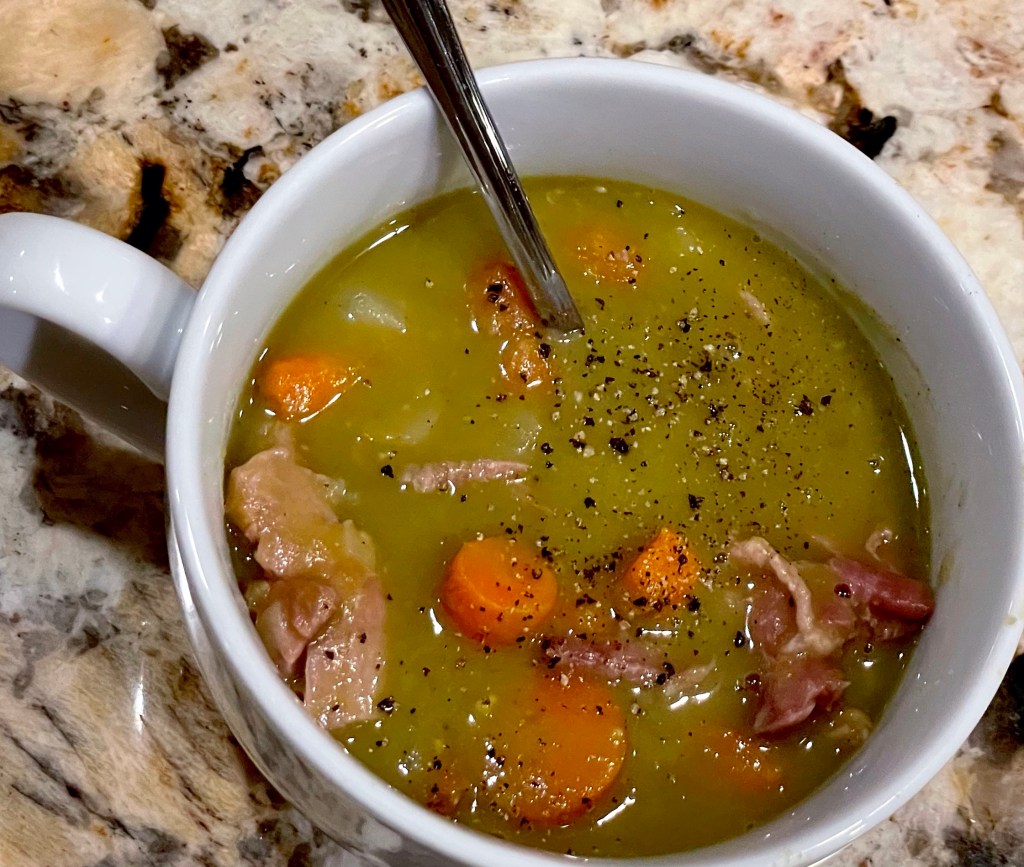
A bowl of Erbseneintopf. Still delicious, after all these years.
Erbseneintopf has remained a part of my winter repertoire ever since. I’ve only made one change since cooking it that first time. Here in the States, it’s sometimes hard to find good German sausage, or ham hocks with a bit more meat on them. As a result, I often substitute a smoked turkey leg for the ham hocks. It gets the job done.
Looking for a good winter soup on a cold, snowy day? Erbseneintopf might be just what you need. It’s peasant food at it’s best. As with many soups and stews, it’s even better on the second day.
Addendum:
⁃ * The Stars and Stripes newspaper was first published during the Civil war. Later, it was delivered to US forces in France during WWI, and became an overseas fixture during WWII. It continued through Korea and Vietnam, and is still published at overseas military locations to this day, although there were discussions during the Trump presidency of cancelling it (it wasn’t). It operates from inside DoD, but is editorially separate and independent from it. The newspaper has been published continuously in Europe since 1942.
⁃ I also struck pay dirt a month or two later when The Stars and Stripes published recipes for Spätzle and Käsespätzle, and our friends Jim and Res bought us a Spätzlemaker for Christmas. The Spätzlemaker is 40 years old now, and in great shape. We still use it a couple times of year.
⁃ My friend Tim Stouffer reminds me occasionally about my Cordon Bleu quest. He visited Cath and I several times throughout the ‘80s. On at least a couple of those visits, I know I inflicted my obsession with Cordon Bleu on him.
I needed to run into town for a couple of errands last week. As I was finishing up, it was about 11:30. I was hungry and suddenly had an urge for Mexican food. I called our favorite place, El Agave, a local family owned restaurant here in Warrenton, Virginia to see if I could pick up a couple of burritos to go, and they said sure, come by in ten minutes.
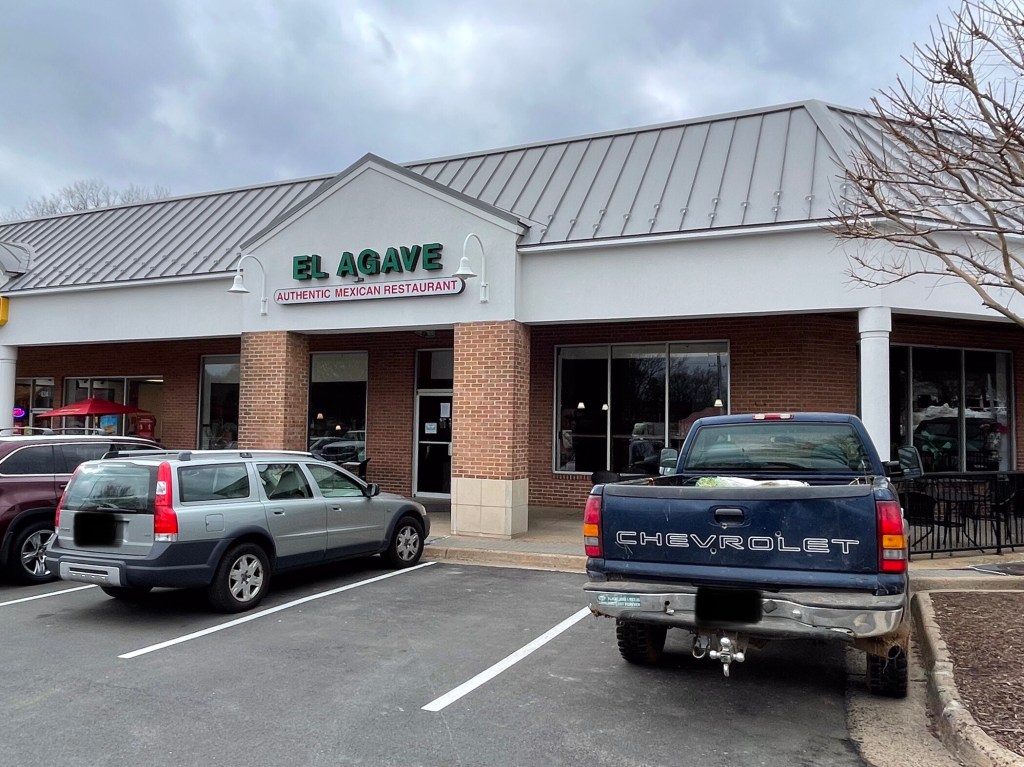
I finished up at the dry cleaners, and drove over to El Agave. It’s been here in Warrenton for years. If we are looking for “Mexican food”, or a decent margarita, it’s almost always the place we go. You know the kind of place – honest food, nice portions, good service and relatively inexpensive. Since Covid, we haven’t eaten there as much in person, but have done take out many times.
El Agave – Our Kind of Place
As I came into the restaurant, my order was just coming out of the kitchen. The owner/manager and I were making small talk as I paid, and he said, “I’m sorry, we have no plastic forks. They are coming in this afternoon.” I answered back “No problem, I’m taking it home to eat.”
We talked a bit more and then I said “Too bad on the forks, I guess between supply chain issues, and the snow storm last week, your order was backed up, eh?”
He looked at me and smiled, and then said “Or maybe I just forgot to order them on time.”
I laughed and said “Wow! An honest man!” He chuckled and answered back “People are going to believe what they want to anyway.”
I thanked him, left a tip and went outside to my truck. On the drive home, I was still thinking about our exchange, and it occurred to me. If he was this honest about a small mistake he made, it says a lot about how he runs his restaurant overall. He could have easily laughed at my supply chain comment, agreed it was causing him problems, and I wouldn’t have thought anything more about it. One little white lie that, in the big scheme of things, didn’t matter.
Instead, he told the truth.
Maybe I’m making too much of the whole incident, but it continues to echo around in my brain. I’ve always enjoyed El Agave. Now, I like it even more. It’s always great to see honesty and excellence in a local business. Thank you El Agave – I’ll be back soon.
We’ll Be Back Soon!
Addendum:
There are five local El Agave restaurants in or near Fauquier County, Virginia. I’ve only been to two of them – the one in Warrenton, and one half way between Marshall and The Plains. I highly recommend both of them. You can learn more about El Agave here: https://elagavemexrestaurant.com/
I made Risotto last week. Due to some changes in diet, it was the first time in over a year and it was wonderful. Risotto isn’t hard to make, and it doesn’t take long, but it does require patience and attention. You can’t rush risotto, and to me, that is why making it is both relaxing and a bit zen like.
I’ve been making risotto for years, and have several different recipes. It was a staple part of our dinner rotation. And then about a year ago, I had a couple of blood tests that caused some concern. After engaging in bilateral discussions with my doctor* (… 😉 … ) , I made significant diet changes, and drastically reduced dairy and carbs. Some things were easy, like changing from regular milk to oat milk. Unfortunately, cheese was practically it’s own food group for me, so that required a fair amount of mental adjustment. Pasta, potatoes, white rice, and bread? All eliminated, or severely reduced. I went cold turkey, and just did it. The good news was that after three months, the test results were back to normal, and six months later, they remained normal. As a side benefit, I lost about fifteen pounds.
Over the past six months, we’ve reintroduced small amounts of dairy and carbs into our diet. They’ve become “special” as opposed to every day, and it’s worked out fine. It turns out, sometimes, you can teach an old dog new tricks.
Last Thursday I had a series of follow-up fasting blood tests. I wouldn’t receive the results for a day or two, but decided to celebrate early and chose to make risotto for dinner that night. On the way home, I picked up some cream for the sauce, along with fresh bread from a local bakery. I mean what the hell, in for a penny, in for a pound. While I have several risotto recipes, there was no doubt in my mind about which one I would make – Ben’s Cognac Risotto – a favorite of ours, with mushrooms, shallots, cream, butter, and plenty of Parmesan cheese.
From start to finish, Ben’s Cognac Risotto takes about forty five minutes to an hour to make. As with most risottos, it’s not complicated, however, once you start cooking, you can’t walk away from the stove. You need to be present, both mentally and physically.
That evening , I started heating up the required chicken broth, chopped up the needed shallots and mushrooms, separately measured out the cognac and cream for the sauce, and then grated the Parmesan cheese necessary for the finish.
Shallots and Mushrooms – the Key to Ben’s Cognac Risotto…
The next step is an optional one, but I find it adds to the relaxing nature of making risotto. I walked over to the bar and made myself a martini. In what may be a strange coincidence, I’ve learned that the time it takes to drink a martini, is almost exactly the same length of time it takes to make risotto. Not a martini fan? A Manhattan or Negroni will do, or even a glass of the red wine you opened to serve later with the risotto. Trust me on this. It works.
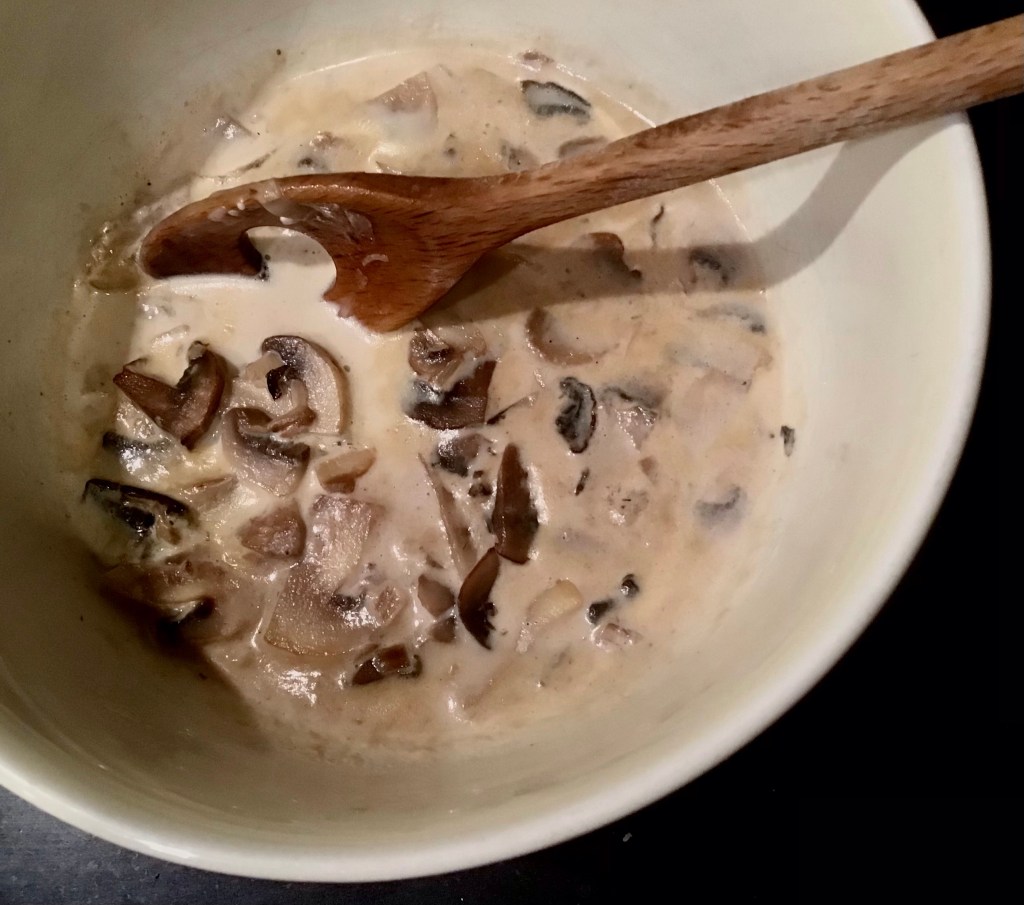
I made the mushroom sauce first and the kitchen filled with that heavenly smell only sautéed mushrooms can bring. After 5 minutes or so, I added the cognac and reduced it, and then added the cream and slowly reduced it some more. I set the sauce aside, and then started to work on the risotto itself. I also let Cathy know dinner would be ready in about twenty minutes, so she could finish setting the table, and pour some wine in our glasses.
Mushrooms, Cognac and Cream – What’s not to like?
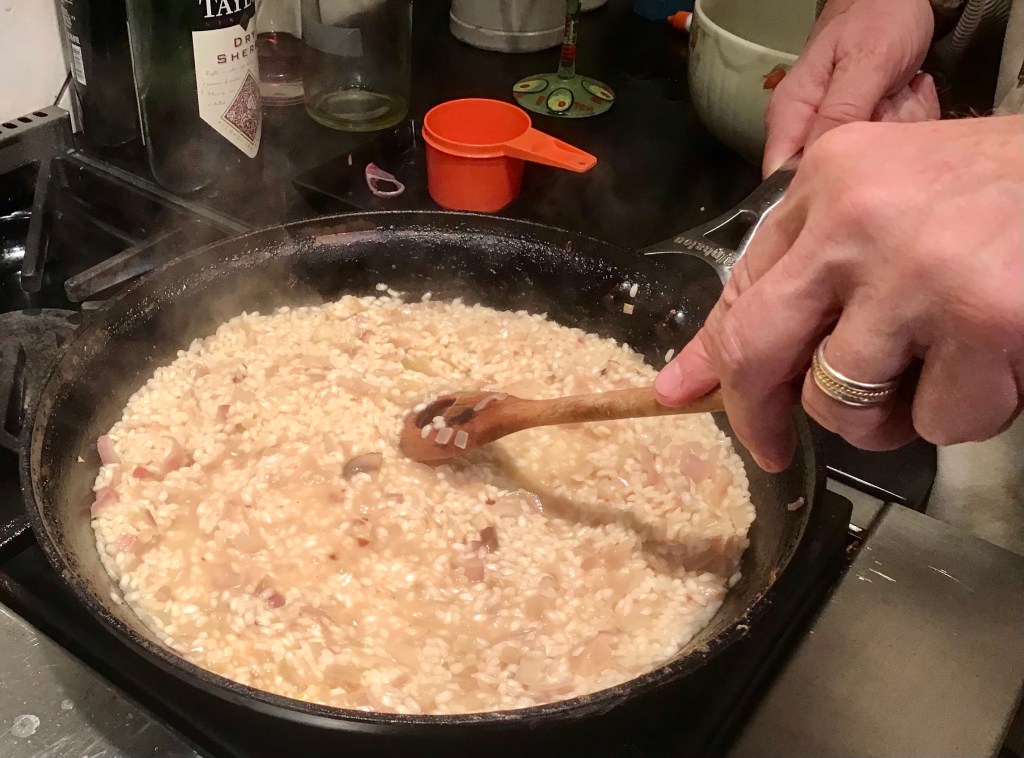
After sautéing the shallots, I added the rice to the pan and stirred a bit. I started adding the broth, about a half a cup at a time, to the rice. Next? The ritual – Keep stirring the rice every few seconds; take a sip of martini; let the rice sit a little, then stir, and add the next portion of broth. And, repeat – Stir the broth into the rice, take a sip of martini, let the rice sit a bit, then stir, and add more broth. And repeat. And repeat. And repeat. A bit of zen zone settles in, or at least it does for me. It’s just me, the spoon, and the rice.
In the Zen Zone – Just me, the Spoon, and the Rice…
As I neared the last of the broth, I tasted the rice, checking for chewiness. You still have the mushroom sauce to add, so a little chewiness is OK. I know that if there’s a bit of broth left, it’s not a big deal.
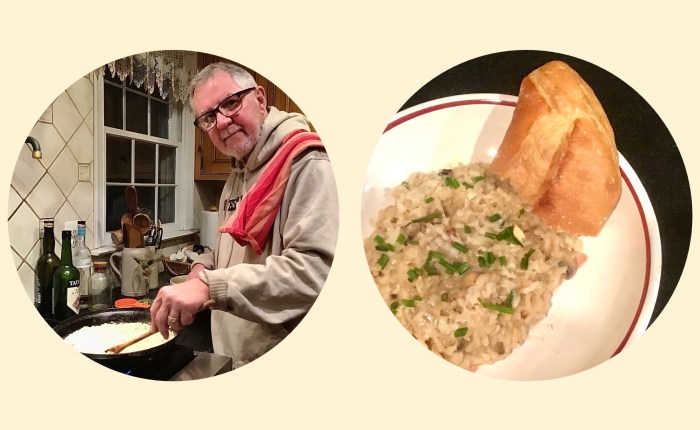
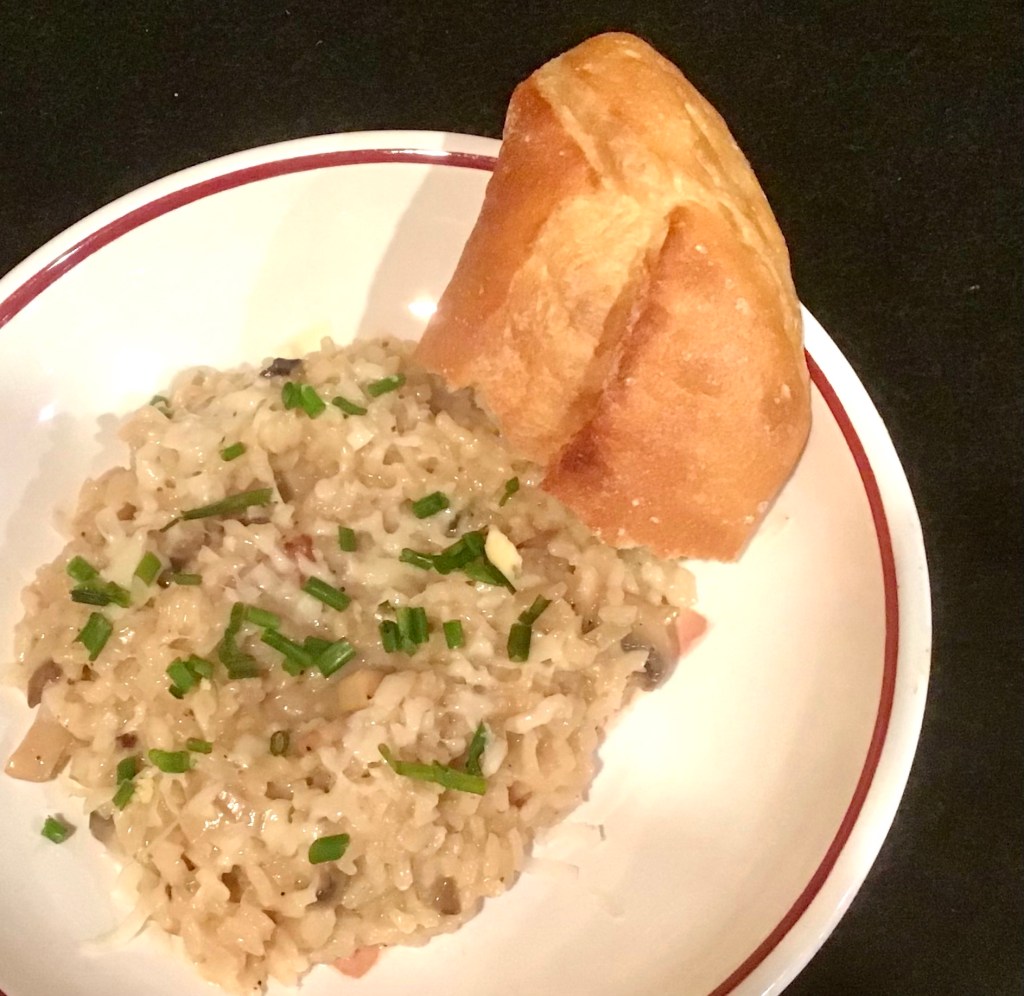
Finally, It was time. I stirred the mushroom sauce into the rice, and let it thicken a bit. I then added the Parmesan and stirred some more. Cathy brought our bowls over, and I put some risotto into each of them, with another dusting of Parmesan on top of each. I took the last sip of my martini, grabbed the bread warming in the oven and crossed to the table. We clinked glasses and then settled into the wonderfulness that is Ben’s Cognac Risotto.
The Wonderfulness that is Ben’s Cognac Risotto…
Cathy asked me if we were maybe celebrating too early, since I hadn’t yet received my test results. I answered I felt good about the tests and wasn’t worried. Besides, it’s a good thing to occasionally celebrate life.
Late the next afternoon, although I hadn’t received a call from the doctor, I logged into my account at her office. The four test results were there – I quickly opened and scanned each of them. Everything was fine, and in fact a couple of tests showed further improvement from last June. The low dairy, low carb diet was working. It also appeared the occasional piece of cheese, serving of roasted potatoes, or bowl of risotto wasn’t having an overly adverse effect on me. I could live with this.
Live is the key word. I’ve reached the age where something is always breaking down, or going a bit haywire in my body. There is always some new thing I need to be aware of for my future health. While healthy over all, Cath and I both have issues that crop up. And of course we have friends who are dealing with greater issues – cancer, loss of eyesight, early onset dementia… getting older isn’t for the faint of heart. But you also have to live, and enjoy life in all of the ways you can. For me, the ritual of risotto is one of those ways, and I’m not ready to give up on it yet. We may not have it as often, but trust me, it’s still going to appear on the menu.
Otherwise, what’s the point?
Addendum:
– * As a side note, I love my doctor, Doctor Emman Hussny, and have been with her for a long time – around twenty years. When she left one practice to start her own, I moved with her. She has a great bedside manner, and encourages leading a healthier lifestyle, without being draconian about it. During checkups, we certainly have discussions about my health, but also discuss other topics of the day. I feel like she genuinely cares about me, and I’m not just another patient flowing through her office.
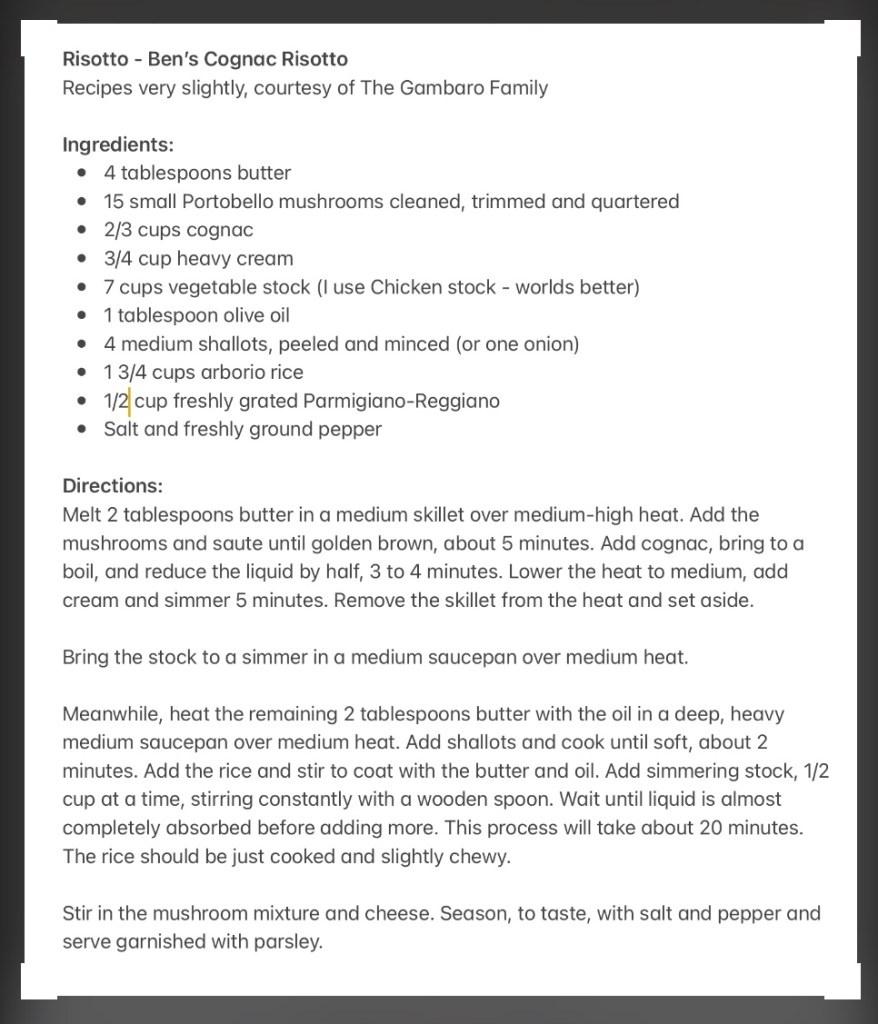
– Here’s the recipe for Ben’s Cognac Risotto – enjoy! If you want to tone it down a bit, you can substitute milk, or even 2% milk for the cream.
We were in the middle of the Kalahari Desert, on the edge of the Ntwetwe Salt Pan when it started to rain. I’d just started my second Gin and Tonic. Dinner was still a bit away, and we made a dash for shelter in the Land Cruiser…
We’d arrived at our Safari Camp, Leroo La Tau (The Lion’s Paw) the day before after a 1 1/2 hour flight on a six seater plane out of Kasane. Our camp was in a remote location along the Boteti River in the Makgadikgadi Game Reserve.
Cathy and the Plane that Flew us to the Makgadikgadi Game Reserve
One of the reasons we were excited about Leroo was that we were to spend one of our nights under the stars at the the Ntwetwe Salt Pan. We would be as remote as possible in the Kalahari Desert, with no ambient light, or connection to other humans. Literally, it would be just us, the desert and the sky – vastness and emptiness, intertwined.
By luck, or by happenstance, we arrived at Leroo on September 30th. Our hosts were celebrating the 55th anniversary of Botswana’s Independence from the British on September 30, 1966. After dinner, they served us a cake decorated in the colors of Botswana’s flag, and explained the meaning of each of the colors*. As we were eating our cake, it started to rain – not for long, perhaps only 20 minutes. We learned it rained on September 30th, 1966 as well, and as Botswana is such a dry country, rain is considered a blessing and a sign of good luck, particularly on Independence Day. We weren’t yet aware how that rain was going to impact our trip.
The next day, as we were getting ready to leave on our five hour drive for the Pan, we learned there was some concern on the part of our guide, Isaac, and the staff. It turned out not only had it rained at Leroo the night before, it probably also rained at Ntwetwe. The condition of the Pan was unknown, and we might not be able to drive on it, or even approach it without our vehicle sinking into the mud. We would not know until we arrived.
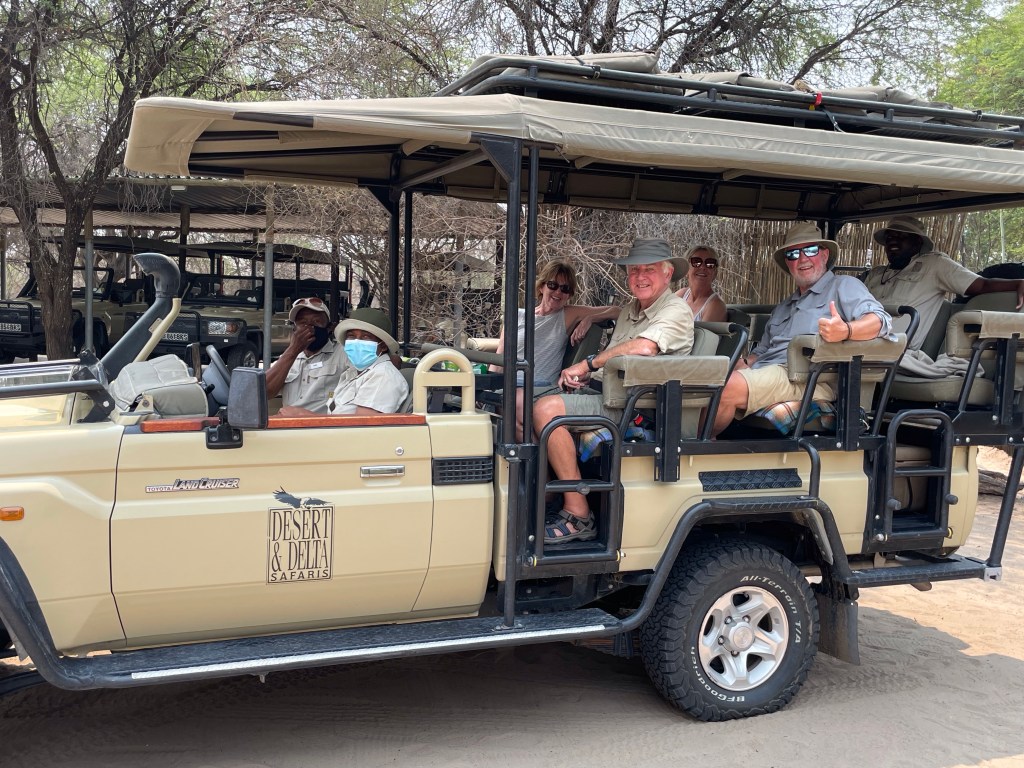
A decision was made to give it a shot and we piled into our Land Cruiser. In addition to Cathy and I, and our friends Bill and Sharon, there was a crew of three. Our guide was Isaac, who had led previous trips to the Pan (we were only the seventh group to actually do this). He was accompanied by Dabe, a Bushman (The San People) who was very familiar with the desert environment, and Kago, a manager from the camp.
Setting out for the Ntwetwe Pan in our Land Cruiser
After driving nearly 50 kilometers on a highway, we turned off into the desert. We had nearly 70 kilometers to go, which doesn’t sound far, but with no real road, we would follow a path through the grass and shifting sand. There were still several hours before we reached the Pan.
The “Road” Through the Grass and Sand
As time passed, the environment became starker and vegetation started to disappear. There were no more trees, and few bushes. We were left with a sea of grass. Animals too disappeared. Other than some birds, meerkats, and mongoose, we saw no other wild game on the trip. We were told there wasn’t any real water this far into the desert, so the big game stayed away. Interestingly, we did pass some herds of cattle.
This Meerkat is One of the Few Animals we Viewed on the Drive
Eventually, around 5PM we arrived at the Ntwetwe Pan, with sundown still about an hour away. It had definitely rained on the Pan and it would be a bad choice to drive on it. Although it appeared dry, our Land Cruiser would have soon sunk up to the hubs and been trapped. Instead, we camped on the edge of the Pan.
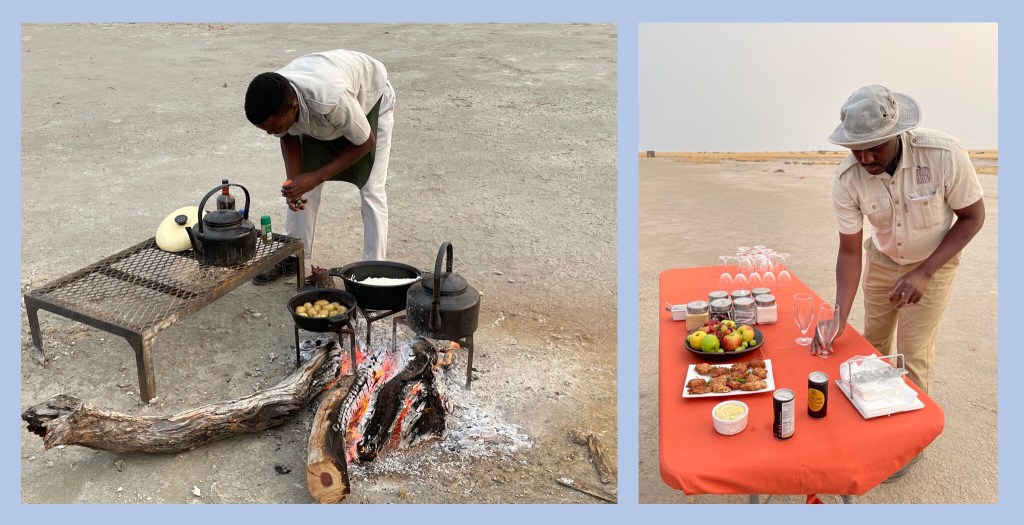
We connected with Maipa and Mash who drove “The Elephant” (a vehicle with the kitchen equipment, lights, tarps, loo, etc) to the Pan earlier in the day. It was they who set up the kitchen, and the dining area. You could already smell good things cooking on the fire and stove for our dinner. We were served sundowners, and then received a safety talk and a briefing on how to use the loo.
Our Chef, Mash, Fixing Dinner, While Isaac was Making our Sundowners…
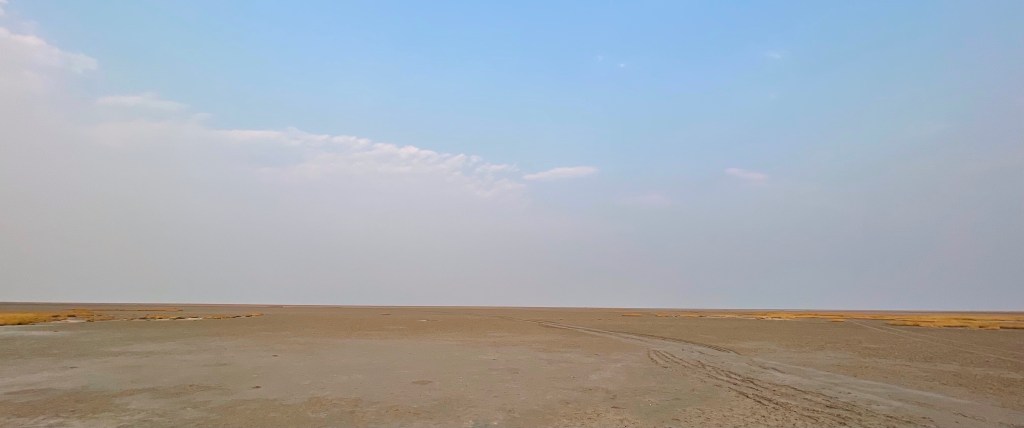
We had time before dinner and wandered around. As I took a sip of my G&T, my gaze looked to the east across the Pan. Vastness and Emptyness? Sure. The word Nothingness also came to mind. There was nothing but a line on the horizon separating the sky above from the salt pan below. Loneliness … desolation … flatness… all were also good descriptors. It was flat as far as you could see in any direction.
Nothingness…
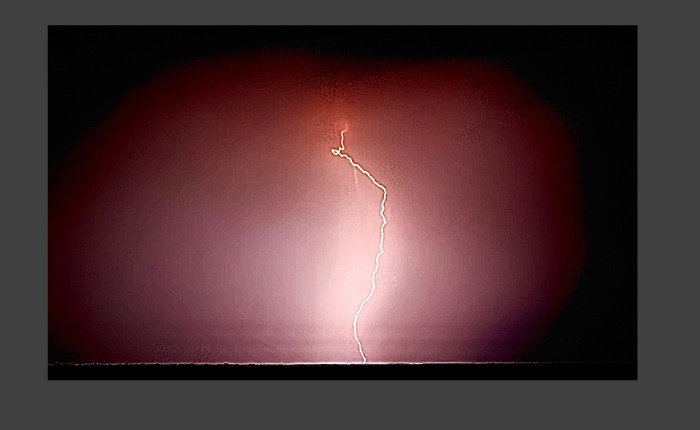
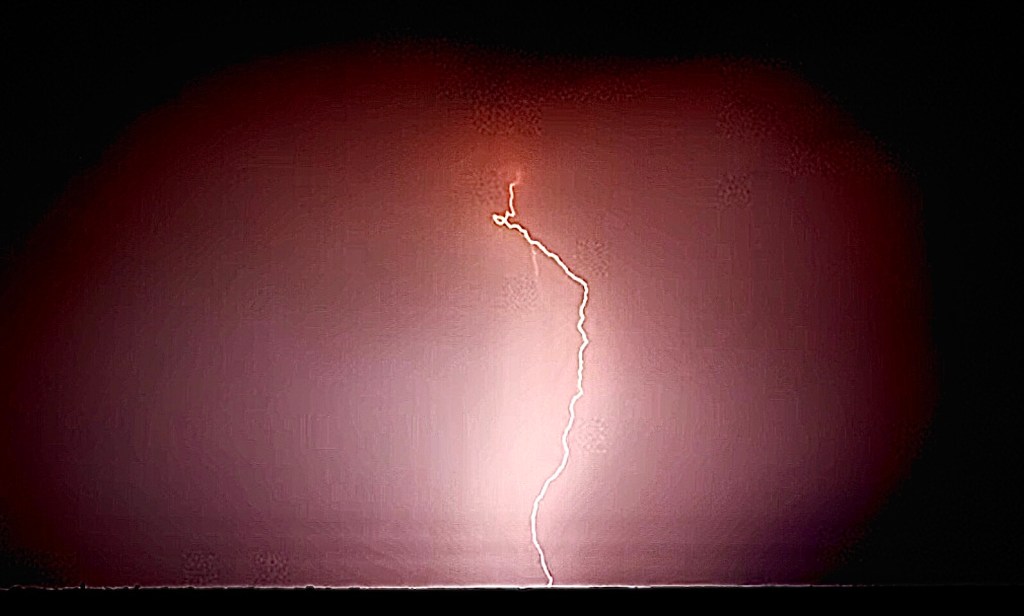
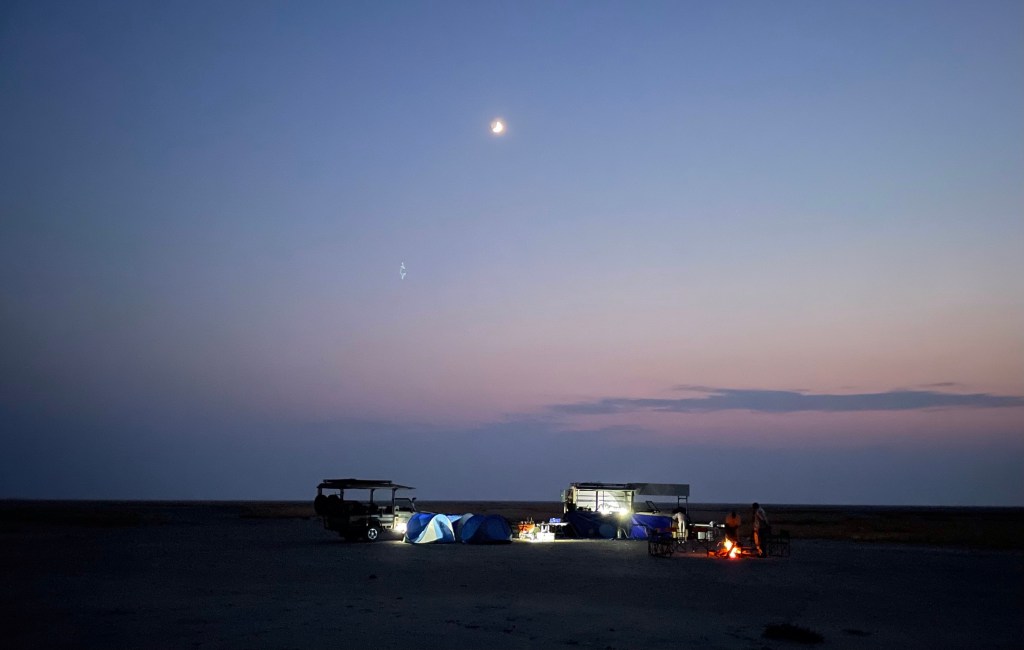
It started to get dark, and we viewed lightning storms on the horizon to the north of us. In Botswana, the weather generally flows east to west, so Isaac thought we were safe. Of course, there IS the occasional freak storm ;-)… I’d just started on my second G&T when the sky opened and it began to rain.
Lightning During the Rainstorm in the Kalahari
Three things then happened in quick succession. First, Isaac directed us to the Land Cruiser where we could stay dry and stay out of the way. Next, the staff divided into two crews. The first one quickly broke down the dinner settings and packed them away. Our table, complete with white table cloth, glassware and china was secured. The second crew grabbed our sleeping mattresses and at the same time popped open small two-person tents and put the mattresses in the tents to keep them dry. If you recall, we were to sleep under the stars. That was no longer going to happen.
It was pitch black, except for the occasional flash of lightning. We were staying pretty dry under the Land Cruiser roof, and then one of us started laughing. Pretty soon all of us were. Here we were, in the middle of the Kalahari Desert, one of the driest places on earth, getting rained on while sipping our drinks in a Land Cruiser. How could you not see the humor in that?
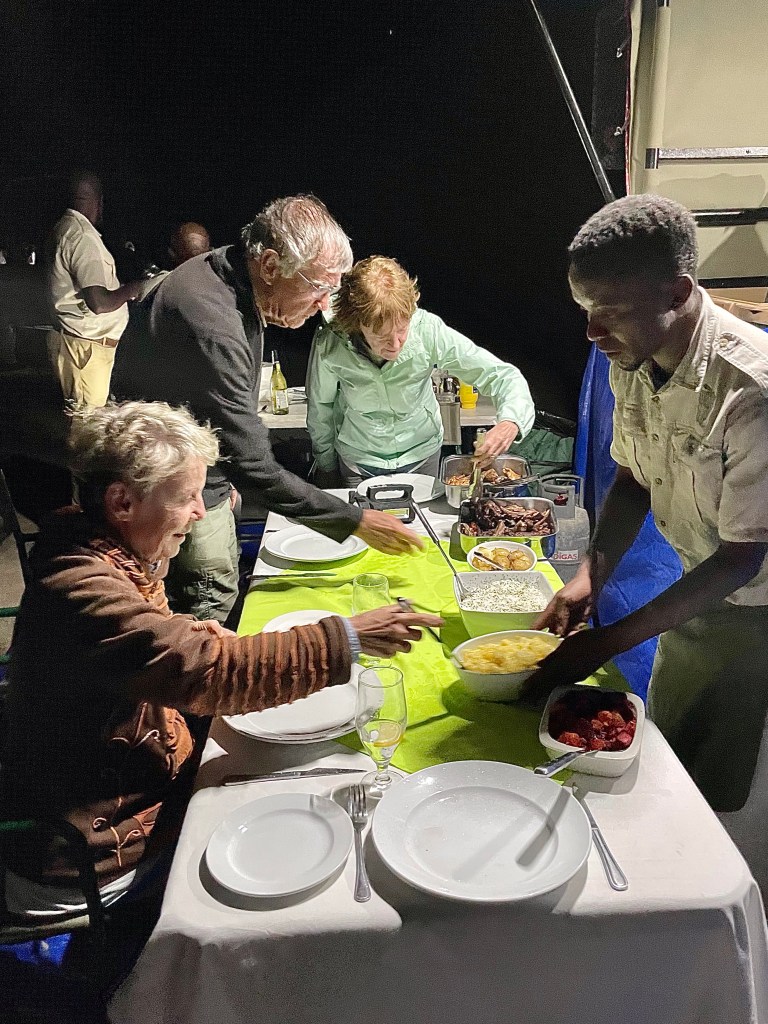
Twenty minutes later the rain stopped. The crew quickly reassembled our dining table and just before 7:30PM, we sat down to dinner. Our chef, Mash, served a feast of rolls cooked in a dutch oven, salad, beet salad, a cauliflower and cheese dish, ribs, and chicken filets in a cream sauce. White and red wines were opened. One more surprise awaited us. The tarp above our table had gathered a considerable amount of rain and while eating our first bite, some of it spilled on the table. We quickly moved the table and then we made our way through the delicious meal. We were still chuckling about the rainstorm, but it was a different chuckle as our bellies grew full.
Mash Serving Dinner After the Rain
After dinner, we joined the crew around the fire. Some stories were told and of course a few jokes. A couple of us may have drunk a Jameson. The sky kept changing from clear to cloudy and Isaac confirmed we would sleep in tents. It was a good call, as it rained twice more during the night.
I woke once in the late hours of the night to go the bathroom. The sky had cleared by then and as I looked up, I saw my old friend Orion high in the sky overhead. I smiled to myself – it’s nice to know some things never change.
The next morning while still dark, I woke to a voice softly singing. It was Kago singing her morning prayers. I listened quietly and out of nowhere, felt an immense sense of peace come over me. I can’t help but wonder if the remoteness of where we were also contributed to the feeling.
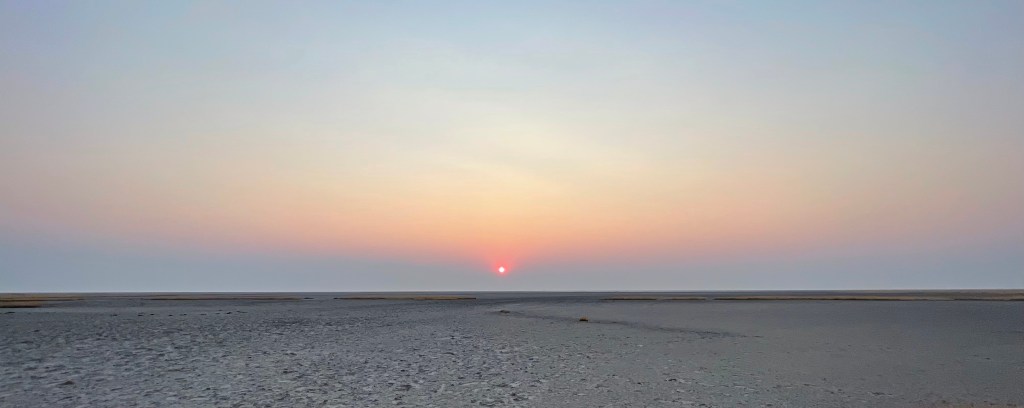
The camp started stirring and I got out of bed about 5:30. Although still dark, a fire was already going, and our morning breakfast was cooking. The eastern sky was turning gold and red, as the sun was about to appear on the horizon.
The Moon was still high in the sky as dawn approached.
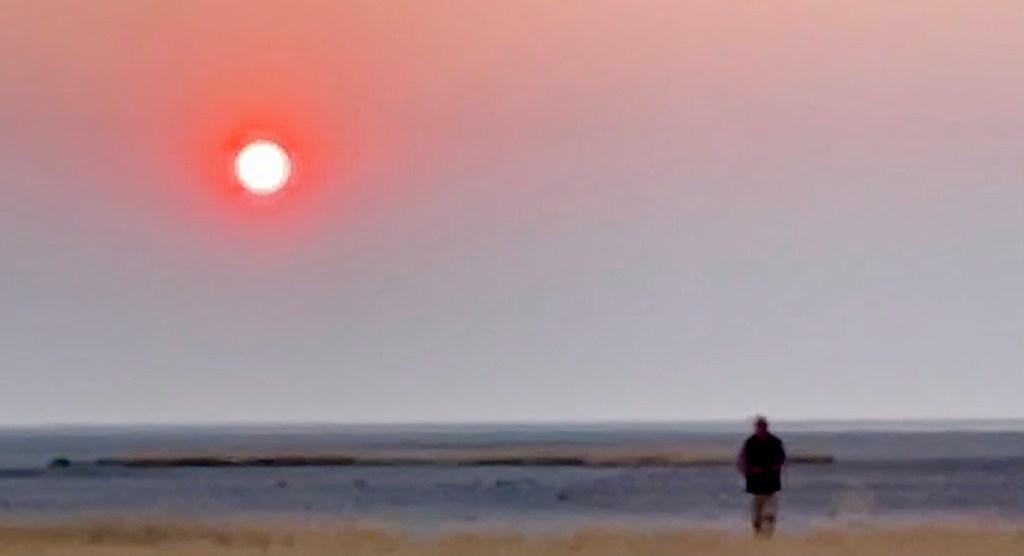
As the sun rose, I walked to edge of our camp by myself. I again saw the vastness and emptiness of the Ntwetwe Pan to the east. There was a beauty to it that provoked an ache in my heart. Even now, I find it hard to describe.
Sunrise over the Ntwetwe Pan in the Kalahari
In Botswana, the word for rain is Pula*, which also means a blessing, as rain is so scarce. Although the rain the night before and on Independence Day changed the tenor of the trip, I think it also gave me something else I can’t define. As I looked at the vastness of the Pan that morning at sunrise, I felt the presence of something larger. God? Perhaps, but I don’t think so. It was more a feeling that even though I am so small, I belonged to something much larger than myself. To me, the vast emptiness I was looking at no longer felt like nothingness or loneliness. There was a weight and depth to it, and yes, a peacefulness. I felt blessed to be in such a remote location. Maybe hearing Kago sing her prayers earlier in the dark is what changed my feelings to something more spiritual. I doubt I will ever know.
My Friend Bill Surreptitiously Snapped this Picture of me Contemplating the Pan
A bit later, I rejoined the others and soon we ate a breakfast of bacon, sausage, eggs, pancakes, yogurt, fruit and freshly made biscuits. Afterwards, we packed up, and just after 7AM, started the five hour return trip to Leroo. Later in the afternoon while on safari, our guide Ollie tracked and showed us a Cheetah and her three cubs, which was amazing. For me, even as I was viewing the cheetahs, my mind returned to the sunrise at Ntwetwe and the ethereal feelings I experienced.
Addendum:
– *Pula actually has four different meanings: rain, a blessing, “Cheers!” If toasting someone over a drink, and lastly, it is what they call their currency. It’s a pretty versatile and important word in Botswana.
⁃ I’d like to thank Isaac Mpuchane, our guide, for reading my blog and providing input. As we traded emails, he sent me a link to an article that places the Ntwetwe Pan as one of the possible locations for the start of human civilization. Maybe my spiritual feeling wasn’t as accidental as I thought. You can read the article he sent me here: https://www.bbc.com/news/science-environment-50210701 If you want to learn more about Isaac, or see some of his amazing photography, you can do so at: http://www.instagram.com/isak_naturephotography
⁃ I’d also like to thank Bill Reichhardt for the picture of me on the edge of the Pan. Bill is quite the photographer and if you would like to see more of his pictures from Africa, you can view them here: http://billreichphoto.com/
– * The colors in the flag of Botswana have the following meanings: The light blue represents water, and specifically rain, as it is such a precious resource. The black band with the white frame has two meanings. First, they symbolise the harmony and cooperation between the black and white people who live in Botswana. Furthermore, they represent the stripes of the zebra, the national animal of Botswana.
Botswana’s Flag
– This is the sixth in a series of blogs about our 2021 trip to Africa. The other blogs are listed here, in the reverse order of their publishing.
⁃ This is the second time we have used Karen Dewhurst, of Sikeleli Travel & Expeditions as our travel consultant. After working with her in 2018, there was no doubt we would use her and Sikeleli again. All accommodations were amazing, the food and wine excellent, the logistics and travel arrangements perfect and the animal viewing exceeded all expectations. If you are coming to this part of the world, I highly recommend her and them. You can reach Karen at: karen@sikelelitravel.com | (+27) 81 067 1094 (South Africa). Their overall website is at: https://sikelelitravel.com/ .
Watching an Elephant swim across the Zambezi river from Zimbabwe to Zambia was a first for us. For all the world, it looked as if he was doing the breast stroke, with his trunk and head rhythmically coming up for air. It was an amazing thing to watch.
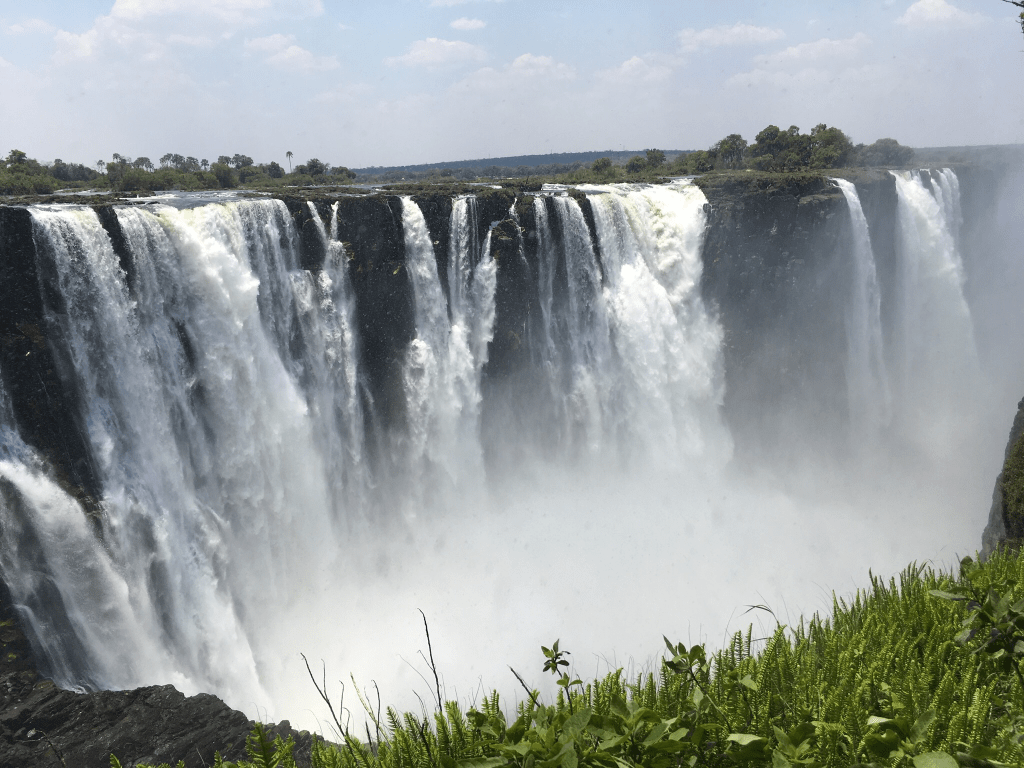
We’d arrived in Victoria Falls the night before, making the drive back from The Hide. We were only in town for two nights, so it was an active day. We started with a visit to the Falls in the morning and they didn’t disappoint. It was our second time seeing them, and the first time for our Friends Bill and Sharon. The Falls had more mist this time and it was quite evident why they are called “The Smoke that Thunders”. There were times the mist obscured the falls themselves and your only connection was the deafening sound of them crashing to the river below.
The Mist Rising Over One Part of the Falls
We ate lunch at The Lookout Cafe with it’s wonderful view of the Zambezi River and the Victoria Falls Bridge crossing from Zim to Zambia. Built in 1905, the train bridge is still used today. After lunch we made a quick stop at “the Big Tree”, a Baobab tree estimated by some to be nearly 2,000 years old, did a bit of shopping, and then went to our lodge to clean up for our Sunset Cruise on the Zambezi.
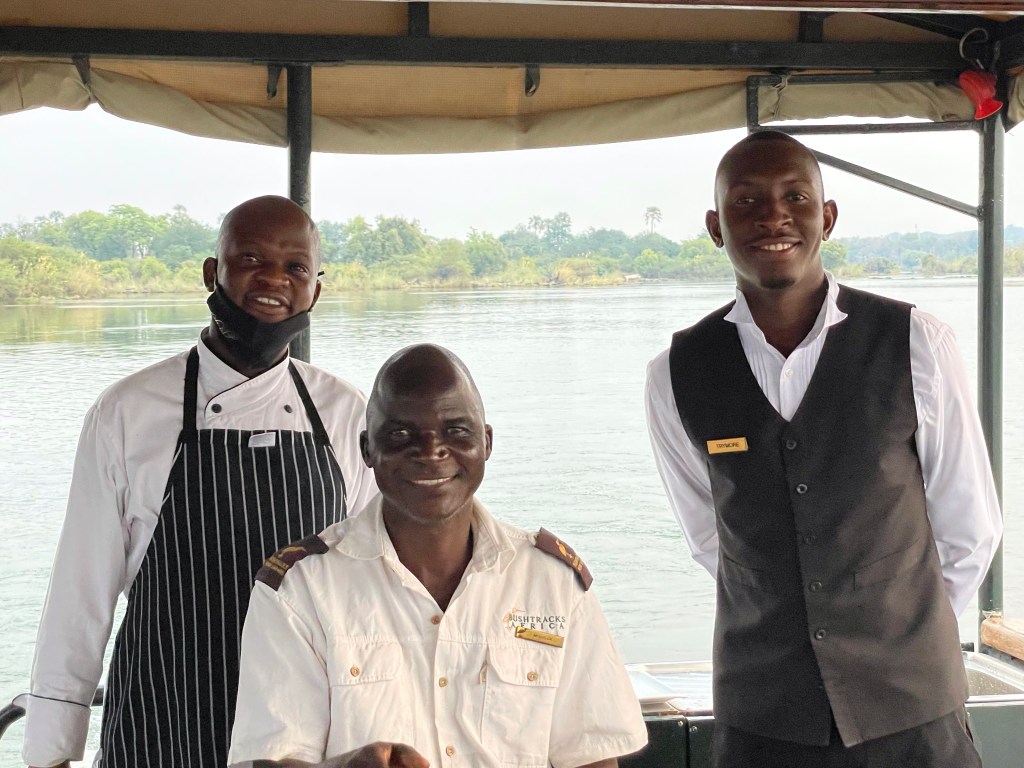
We arrived at our boat, The Victoria, around 4:15PM and were greeted by the boat’s bartender Trymore, with their version of a Pimm’s Cup. The boat pushed away and for the next two and a half hours, we cruised the Zambezi. Due to covid, the four of us were the only guests and we were treated quite well. The boat had a three person crew -Trymore, PK the chef, and our Captain, Misheck.
Captain and Crew of The Victoria
We knew the cruise included appetizers, but were surprised to discover we would have four courses. The next two hours were a surreal combination of drink, food, wildlife and scenery. Even now, I have trouble wrapping my mind around our time on The Victoria.
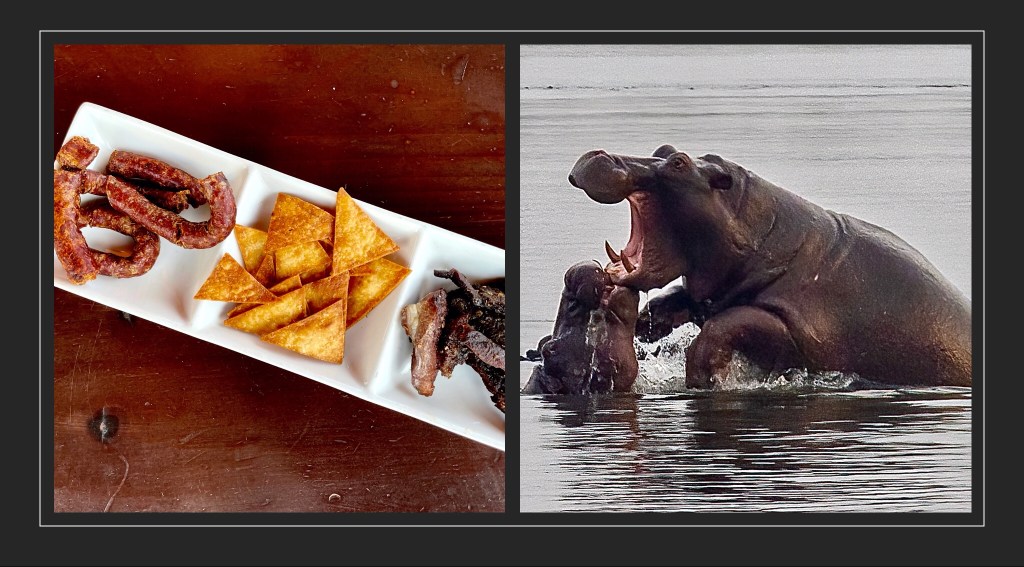
As we motored along, we switched to Gin and Tonics, or Jameson, depending on your vice, and the first course of Biltong, Beerstick and rotti was brought out. We were heading down river, and would ultimately stop about a kilometer above the falls. It was a beautiful afternoon and we were passing some ellies and a few hippos in the water. Suddenly a huge hippo actually breached the water and all thoughts of food disappeared. Our friend Bill, an excellent photographer was in the right place at the right time and grabbed a stunning shot. We all looked at each other and laughed a bit – THIS was fun, amazing and crazy all at the same time.
Biltong and a Leaping Hippo – What’s not to Like?
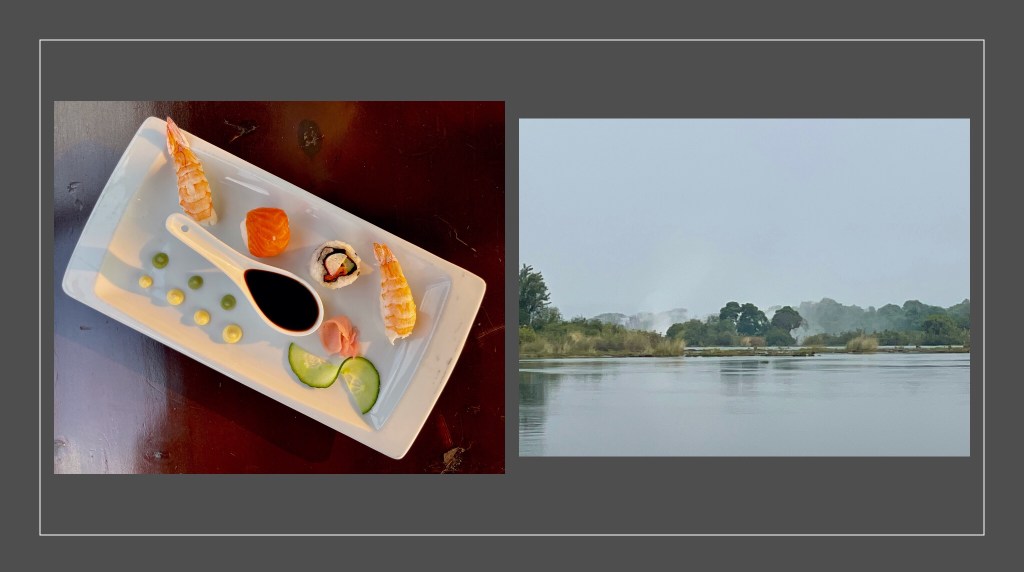
As the second course of sushi arrived, we were nearing the Falls. At about 800 meters away, we stopped for a bit. You could see the “Smoke” caused by the mist of the Falls themselves. As the Captain cut the engine, the thunder and rumble of the Falls was unmistakable. It was an incredibly peaceful scene, except for the roar emanating from the horizon.
Sushi … and “The Smoke That Thunders” Viewed from Upriver
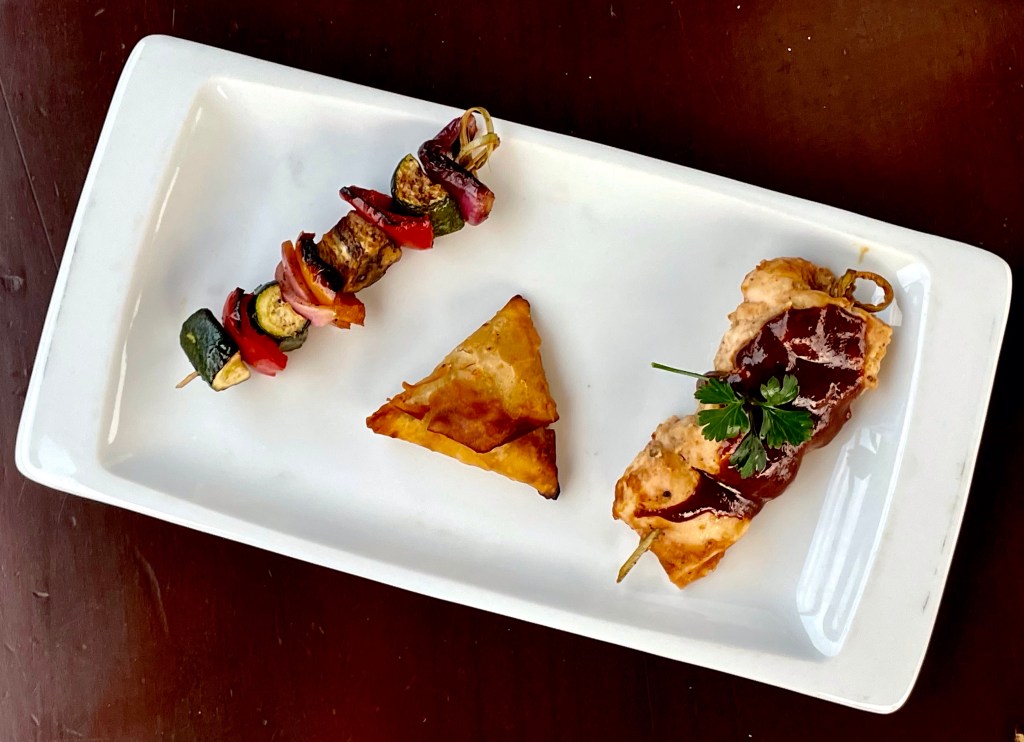
The boat turned around, and a bit further on and we saw something in the water, but couldn’t quite make it out. It was an elephant swimming across the river from Zimbabwe to Zambia! For all the world, it looked as if he was doing the breast stroke, with his trunk and head rhythmically coming up for air. As the elephant climbed out of the river and into Zambia, our third course of veggie and chicken “satay” kebabs arrived. By now we’d switched to wine and were still jabbering with each other about the swimming elephant. Although the kabobs were excellent, I have to tell you, a swimming elephant grabs your attention just a bit more… ;-).
(Click on Arrow for Swimming Elephant Video)
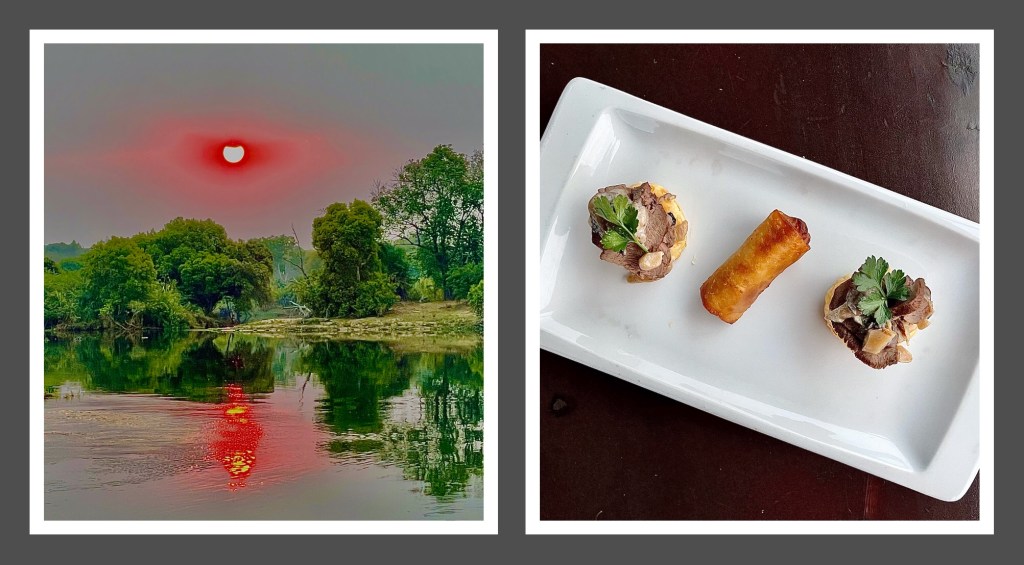
Both the river and time drifted along. It had been overcast, so we didn’t hold much hope out for a great sunset. Suddenly there was a shift of clouds in the west and the sun appeared above the horizon. We watched for several minutes, mesmerized by the colors of the sun playing across the sky and water. It was one of those moments where time froze in place. As we finally returned to our seats, the fourth and final course, “Mini beef Wellingtons” arrived, along with some red wine.
Sunset, accompanied by our Final Course
We were quieter now, basking in the glow of the evening twilight. We passed a few other boats, and more wildlife. Eventually, our dock appeared in the distance and the evening was over. Was it really only two and a half hours ago we’d started out? It felt like a lifetime had passed.
The Zambezi as Twilight Settled in
Addendum:
⁃ Thanks to Bill Reichhardt for the picture of the leaping hippo, and my wife, Cathy for the amazing sunset shot. Special thanks to Sharon Murray for providing the fascinating video of the swimming elephant.
⁃ This is the fifth in a series of blogs about our 2021 trip to Africa. The other blogs are listed here, in the reverse order of their publishing.
⁃ This is the second time we have used Karen Dewhurst, of Sikeleli Travel & Expeditions as our travel consultant. After working with her in 2018, there was no doubt we would use her and Sikeleli again. All accommodations were amazing, the food and wine excellent, the logistics and travel arrangements perfect and the animal viewing exceeded all expectations. If you are coming to this part of the world, I highly recommend her and them. You can reach Karen at: karen@sikelelitravel.com | (+27) 81 067 1094 (South Africa). Their overall website is at: https://sikelelitravel.com/ .
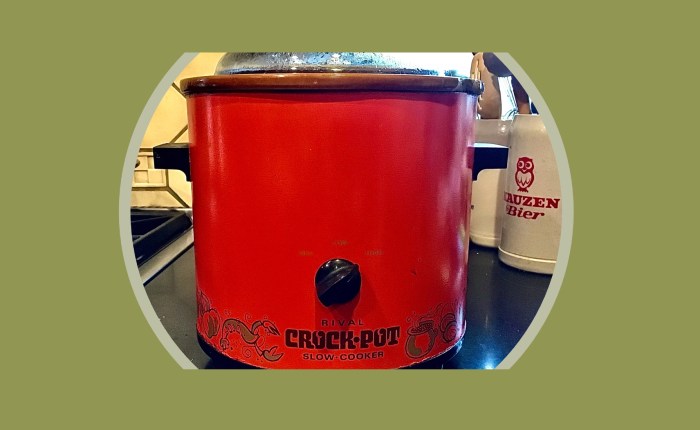
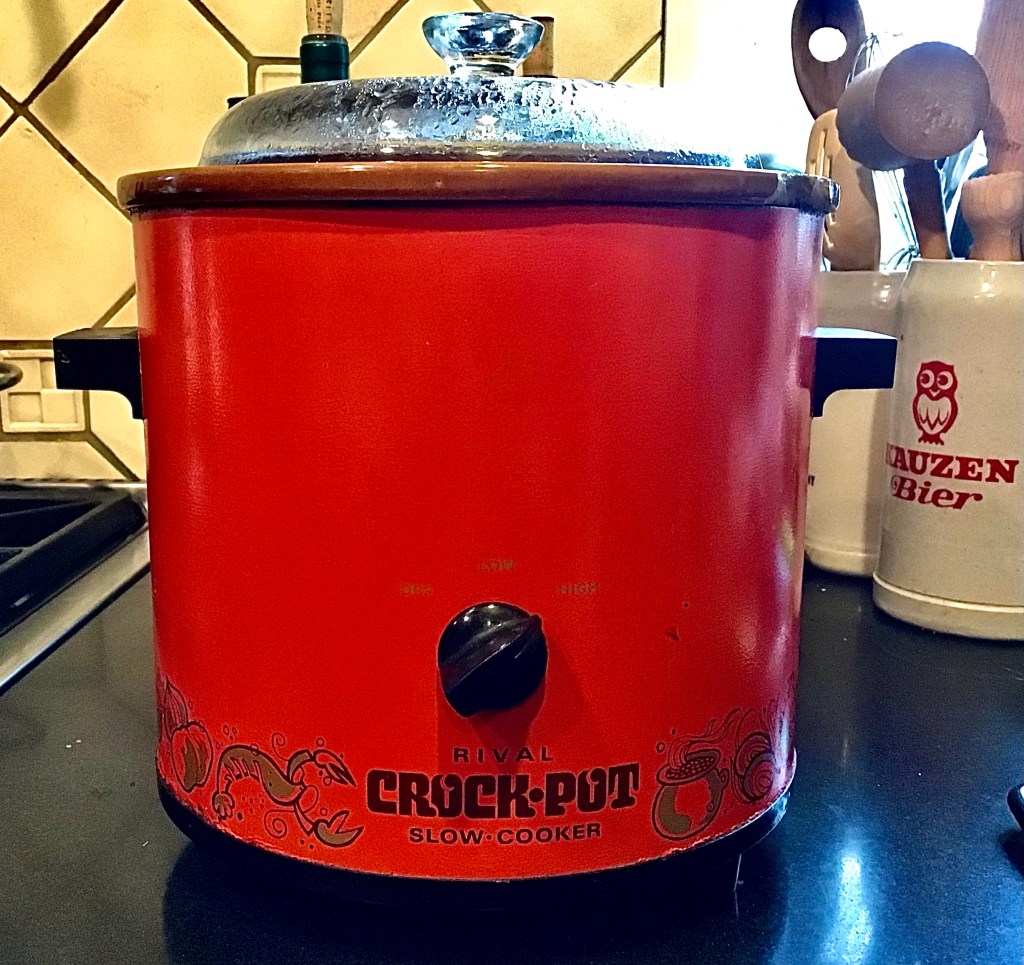
‘Fess up. Who owns, or owned, one of these beauties from the ‘70s? Long before there were Slow Cookers or Instant Pots, there were Crock-Pots. Ours is from 1974 and still chugging along. Seriously, 1974 and it still works. What else do you have that old, and still working? And, you have to love the color…
Cathy’s Crockpot from 1974 – Still Chugging Along…
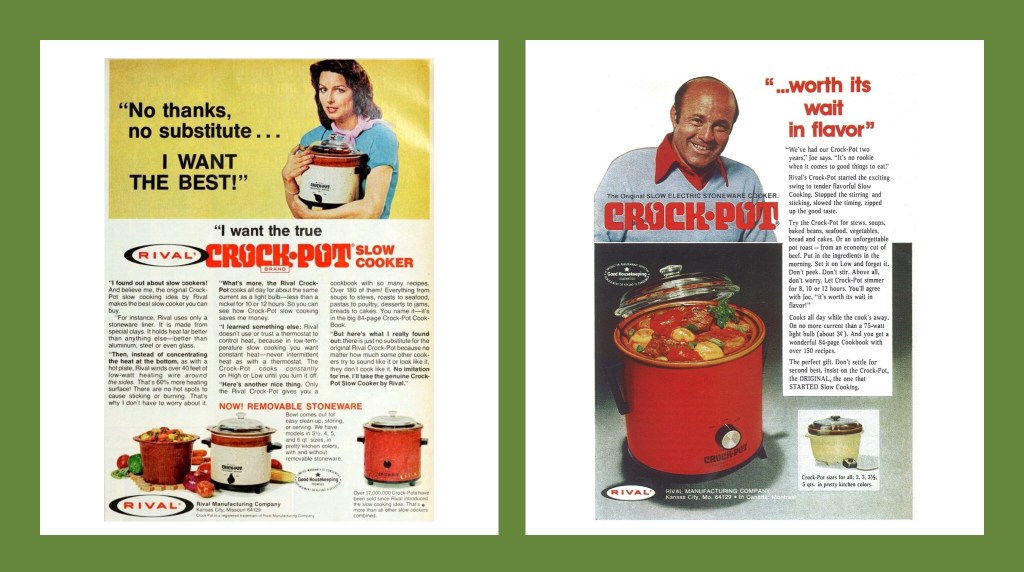
It’s the 50th anniversary of the invention of the Crock-Pot. Appliance maker Rival unveiled it in 1971 at the National Housewares Show in Chicago. Ads and commercials represented the Crock-Pot as a wonderful, time-saving device, assuring women (yes, this was the ‘70s – almost all cooking related ads focused on women) it would simplify their lives. Hell, baseball player Joe Garagiola even became a pitchman for the Crock-Pot, hawking it as “the perfect gift”. And of course, the Crock-Pot would do all of this great work in those fabulous ‘70 colors.
A Couple of Vintage Crock Pot Ads From the 70s
That color – I’m not sure if it’s called burnt orange, red orange, or just mutant orange. It’s a color you can’t forget. Quite frankly, it and the colors “Autumn Gold” and “Avocado” represent the ‘70s as much as disco, polyester and bell bottoms. If you see anything in one of those colors, you pretty much know what decade it came from.
Burnt Orange, Harvest Gold, and Avocado Green – the Holy Trinity of 70s Colors
Cathy bought this particular Crock-Pot at the age of 18 in the summer of 1974. It was just prior to moving to Washington DC and a job with the FBI. Over the past 47 years, our Crock-Pot has made countless chilis, soups, stews, roasts, and other dishes. We have cooked with it in Germany, Georgia, Oklahoma, Ohio and Virginia. It crossed the Atlantic four times. How many things do you have that have been with you your whole marriage? This pot, along with our love, is one of the few things that has survived those 43 years. It’s pretty much indestructible and part of the fabric of our lives.
Having retired, I do much of the cooking around the house these days and often braise, roast or slow cook in the oven itself. Still, there are some recipes that just call out for the Crock-Pot. I think the simplicity of the device helps – you fill it with the food you are cooking; pick one of the two heat choices, low or high; and walk away for 6, 8, or 10 hours. What’s not to like, other than perhaps the color?
Summer is ending, autumn is arriving, and winter will soon be here. This ol’ Crock-Pot will again earn it’s keep, providing us with comfort food this autumn and winter. Sure, it has a couple of chips around the rim, but the heater still works fine and the lid sits securely on top. It does it’s job. In fact, it does it’s job much better than any number of devices from this century. It just keeps ticking along and will probably be with us for another decade or two. Now that I think about it, we should list it in our Trust for one of our nieces or nephews… 😉
A couple of months after Grandma Grubaugh died in 1996, I received a call from mom. She wanted to know if there was anything I might like from Grandma’s things. I immediately answered “The Pink Elephant and Blue Monkey glasses.” She Said “What?! Nothing else?” “No, those are how I best remember Grandma.”
Grandma and I Just Shy of my Second Birthday
Lillian Henrietta Grubaugh was born on the 2nd of January, 1905 and died on the 4th of December, 1996 at the age of 91. When Grandma died, my Uncle Don was executor of the will and divided the major assets equally out among Aunt Pauline, Aunt Cecilia, mom, Uncle Sonny and himself.
As to the belongings in the house, they took turns picking things each of them wanted, starting with Aunt Pauline, the oldest, and then reversing the order for the next pick. When they finished this up, there were of course many things still left in the house. It fell to mom and my Aunt Pauline to go through the remainder of the stuff in the house, sort it, and give it away or otherwise dispose of it. I think it was around then I received the call from mom, asking if there was anything I might want.
So why did I want those glasses of pink elephants and blue monkeys? Why did I remember them and why did they call to me? I’ve thought about that for awhile.
Sometime around 5th or 6th grade, I started a business of mowing lawns. Or I suppose my dad encouraged me to start the business. One of my first customers was of course Grandma and Grandpa. I think my cousin Joey had the job before, but he’d grown older and moved on to real work of some sort, and the opportunity fell to me.
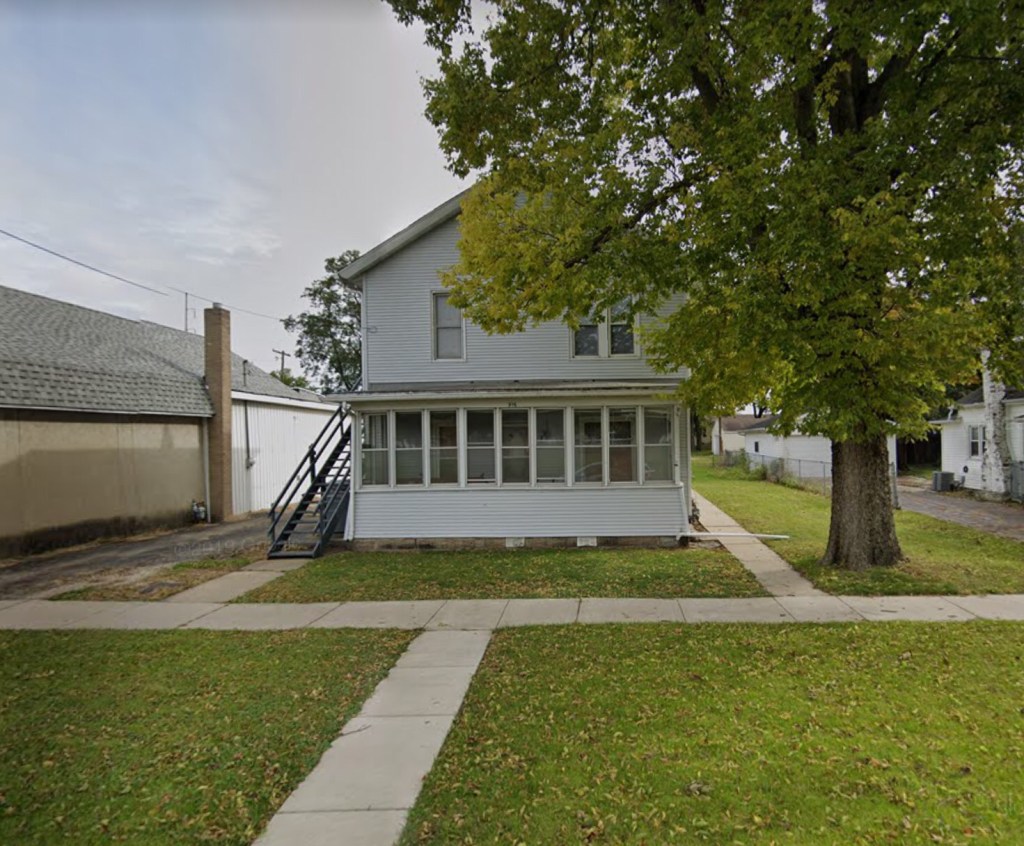
On mowing day, dad and I loaded the mower in the back of his car and drove across town to 916 Chestnut street, where Grandma and Grandpa lived. He helped me take the mower out of the car and then drive home, with instructions to call him when I finished up.
916 Chestnut Street – The Yard Seemed Bigger Back Then
I’d mow the lawn for the next half hour or 45 minutes. The yard wasn’t big, but there were lots of things to mow around – the old swing set, the low metal fence with posts, a couple of big trees, the vegetable garden, including grandma’s rhubarb plants, and the ancient garage out back. After I finished mowing, I’d do a quick trim of the hard-to-get spots with some manual clippers.
Eventually, I’d finish everything up and head to the house, ready to call Dad. Inevitably Grandma would greet me and have me sit down at the kitchen table. She’d bring out a piece of spice cake, or unwrap some of her date nut bread, or pull some of her rhubarb sauce out of the fridge if the season was right. No matter what she served, she also poured me a big glass of milk in one of those elephant or monkey glasses and the two of us sat and talked.
I don’t remember much of what we talked about. I do remember us having those conversations – maybe about school, or summer camp, or Little League or whatever. It was just the two of us in our own little world.
Eventually we finished up and I’d call dad. He’d drive the 5 or 10 minutes across town and pick me up. Grandma and I would say goodbye, she’d give me a hug, and I’d wave goodbye from the car.
Wonderful Memories Involving Pink Elephants and Blue Monkeys
I cut their lawn for three or four years and the ritual was almost always the same. Around 8th grade, I started a “real job” working at the local pool as a locker room attendant, eventually graduating to lifeguard. I think my cousin Jimmy, Joey’s younger brother may have taken over the lawn mowing at Grandma and Grandpa’s home. Grandma and I stayed close, even after I left for West Point, but those regular private times together disappeared. I’d see her on breaks from school, or when we returned on vacation from an overseas assignment, but of course it was never the same. There was still spice cake or date nut bread, and a glass of milk or cup of coffee. We had wonderful conversations, but they were obviously more grown up. The innocence of those previous times was gone.
Grandma and I at my Graduation from West Point in 1978
I’ve thought back to those younger years and sitting at the table eating one of Grandma’s treats and drinking milk out of those glasses. It’s a warm memory, and I always smile when I see the glasses sitting on a shelf at our home now. Grandma and I having a summer conversation at her kitchen table, wrapped up in our own little world…
Addendum:
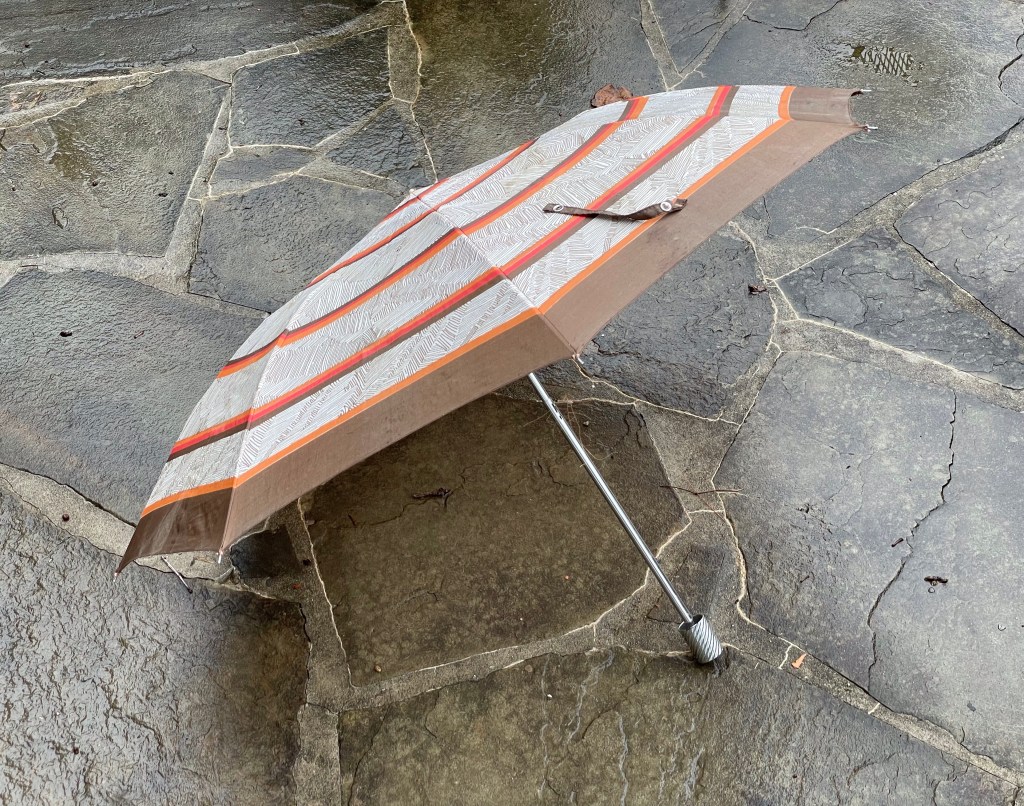
Something we also found out from mom and Aunt Pauline was that Grandma often times didn’t use the Christmas gifts we gave her. Instead, she tagged them with our names and put them away in a chest. The tagged items went back to the giver after she passed away. One of the tagged items was an umbrella of questionable fashion I’d given her one Christmas. it still sits by our back door here in Virginia, in case it’s needed.
We recently bought a new gas grill. I’ve always been a charcoal guy, but decided to add a gas grill as well. So – what would be the first meal to come off the grill – Steaks? Brats? Burgers? Chicken? A Pork Tenderloin? It turned out to be a Pizza Margherita. Yep. Seriously. What the hell!?! Well, there’s a bit of a story to go with the decision.
For the last 40 years, I’ve cooked on (mostly) Weber Kettle charcoal grills. The smoke, the flame, the flavor, it all just worked for me. Yea, I always knew there was a bit of inconvenience to it, but that was no big deal, and I’d argue with “gas guys” about why charcoal was superior.
When Cathy’s mom passed away in 2010, we inherited her gas grill. It took me a bit of time to cook on it, but I made the adjustment. I still mostly cooked with charcoal, but if I was in a hurry, or occasionally had something that just needed a quick sear, like shrimp, I’d use mom’s grill. It was also put to use when we did our annual Oktoberfest Run at the farm – When you need to cook 125 Brats and warm up 100 soft pretzels, all available cooking surfaces are pressed into service.
Last week, two independent events happened that changed my outlook.
First, the New York Times cooking section had an article about making your own pizza. I’d always shied away from making my own pizzas in the past. Making the dough seemed like more effort than it was worth. The Time’s recipe? Easy. You just needed a bit of time. It also had a simple recipe for the sauce. Still, it seemed that, while you could make a good pizza in your oven, the oven still wasn’t Pizzeria-oven hot, not even close. I know lots of people make great pizza at home, but it gave me pause.
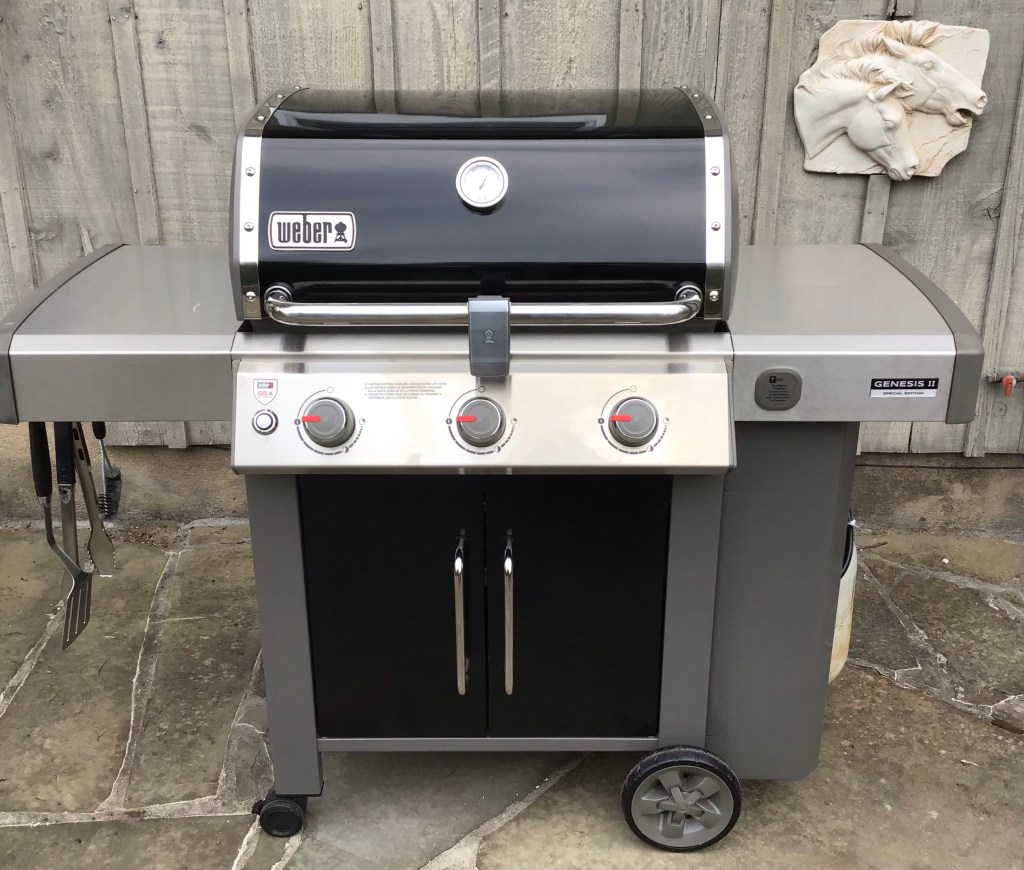
The second event? Cathy and I talked and decided to buy a new gas grill to supplement our charcoal grill. Mom’s old grill was toast. Maybe I’m getting old. Maybe I’m getting soft. In any case, I bit the bullet, and bought a new gas Weber grill. Now with the Weber, as I was reading through the manual, they recommend heating the grill to it’s highest temperature for 20 or 30 minutes before you ever use it. I’m not sure why, maybe to help season everything.
In any case, the day the grill arrived, I heated that puppy up for about half an hour. I went out later to shut it down and glanced at the temperature. Whoa! Over 600 degrees!
A Pizza Oven of a Different Sort
That got me to thinking. 600 degrees still isn’t the 1,000 degrees of a wood pizza oven, or as hot as a commercial pizza oven. But, it’s hotter than most home ovens.
A wood oven, at 1,000 degrees takes about 60 seconds to cook the perfect pie. What could I do at 600 degrees? I decided to find out.
I kept it simple for my first try and just went with a traditional Pizza Margherita. On Saturday afternoon I made the dough and let it rise. While that was happening, I made the sauce they recommended, which was really simple – blended crushed tomatoes, a bit of salt and a swirl of olive oil. I added some garlic and oregano.
The Two Dough Balls for the Crusts
About an hour before dinner time, I put my baking-stone on the grill and started heating it up.
Next? I had a cocktail, got a bottle of Zin out of the cellar and relaxed a bit. Finally it was time to assemble the pizza.
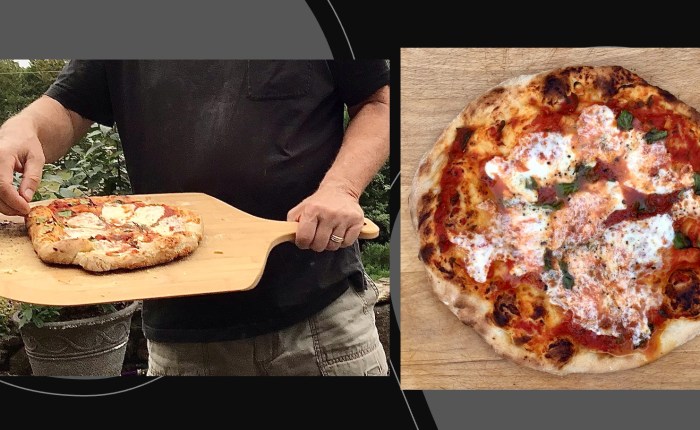
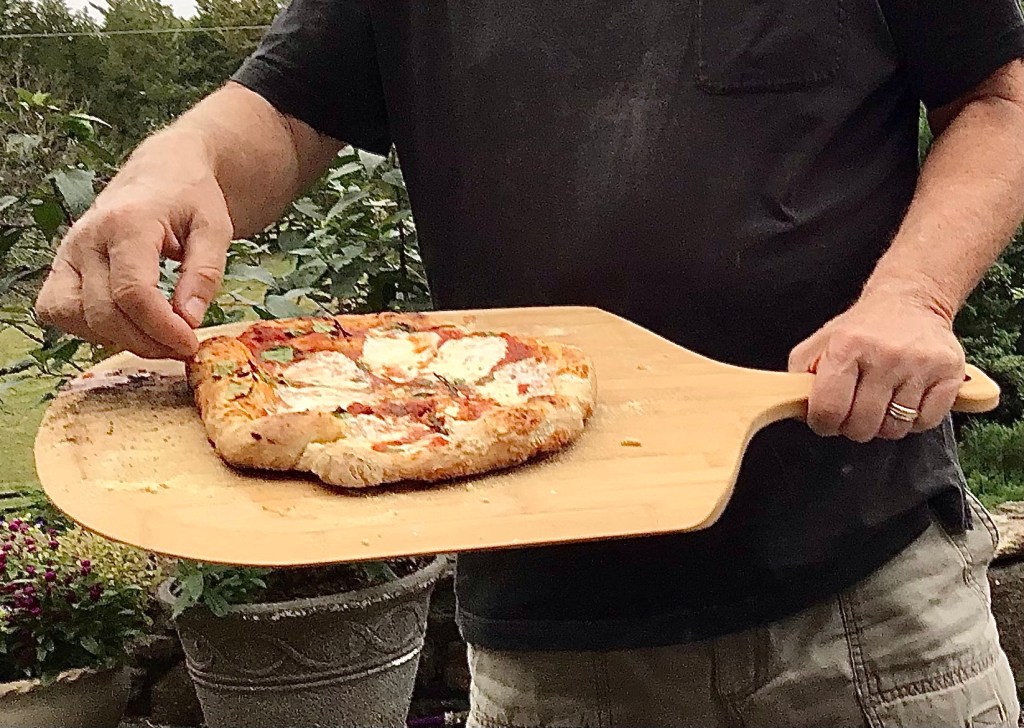
I formed the pie, added some sauce, then placed mozzarella cheese on it, and scattered some basil leaves. I added a quick swirl of olive oil and a grating of pepper. I kept the second round of dough handy, in case I screwed up the first pizza. Into the Weber the pizza went. Six minutes later, I took it out.
Homemade Pizza – Yea Baby!
It looked delicious. I let it cool for a minute or two. Yes, I still remember burning the roof of my mouth on occasion with pizzas straight from the oven… 😉
Finally, it was taste test time, and – Whoa! This was pretty damned good. Was it the best pizza I ever had? No. But it was much better than many pizzas I’ve had. It had a nice crust and a good sauce. The cheese was melted and stringy. This was something I could easily enjoy again and again.
We devoured the first pizza and I quickly made the second one. I added a bit more cheese and basil this time and slid it onto the baking stone. A little under six minutes later, I pulled it out. I’d say Cathy liked the pizza as well, as the second one was also quickly gone.
The Second Pizza was as Good as the First.
I realize I’m late to the “make your own pizza party”, but I’m on board now. The grill made me a believer. I’ve got a few topping ideas for the next pizzas, and some thoughts on how I could improve just a bit. Practice makes perfect, or so they say.
So…I bought this Weber Grill that makes good pizzas. I hear it’s not bad with steaks either. We’ll see sometime in the future.
Addendum:
– I love pizza, although we don’t eat it as much these days (that may change now). I think that’s partly because we have to drive 15 or 20 minutes to the nearest pizza places. It sounds foolish, but growing up in Ottawa, Illinois, we had several great pizza places, and I think it spoiled me a bit. Foremost among the places in Ottawa was Sam’s and Bianchi’s. They are legendary back home. Anyone returning for a visit almost always stops at one of those two places for a pie. If you want to read about me having pizza 116 times at Sam’s in 1972, you can do so here: https://mnhallblog.wordpress.com/2017/04/14/sams-pizza-in-1972/


















 Live Life Exuberantly