Operation WhistlePig

Operation WhistlePig

We were on a mission to the WhistlePig Distillery in Vermont. Twelve classmates gathered to taste whiskey from five barrels. We would select two for the West Point Proud and Great, Class of ‘78 45th reunion this coming fall. We didn’t want to let any of our classmates down.

I’ve recounted the history of our classmate Dave Pickerell in a blog before*, but will briefly summarize it here, as it is fundamental to this story. The Army, in its infinite wisdom, sent Dave to grad school for a master’s degree in chemical engineering. Later, after teaching at West Point, Dave left the Army and joined Makers Mark Distillery, where he was the master distiller for 14 years. He then struck out on his own and became known as the “Johnny Appleseed” of craft distilleries, and helped many, many distilleries start-up. Eventually, he also became a founder and the master distiller for WhistlePig Whiskey, which makes some of the best rye whiskeys in the world. Dave passed away a few years ago, but his legacy lives on at nearly 100 distilleries across the country.
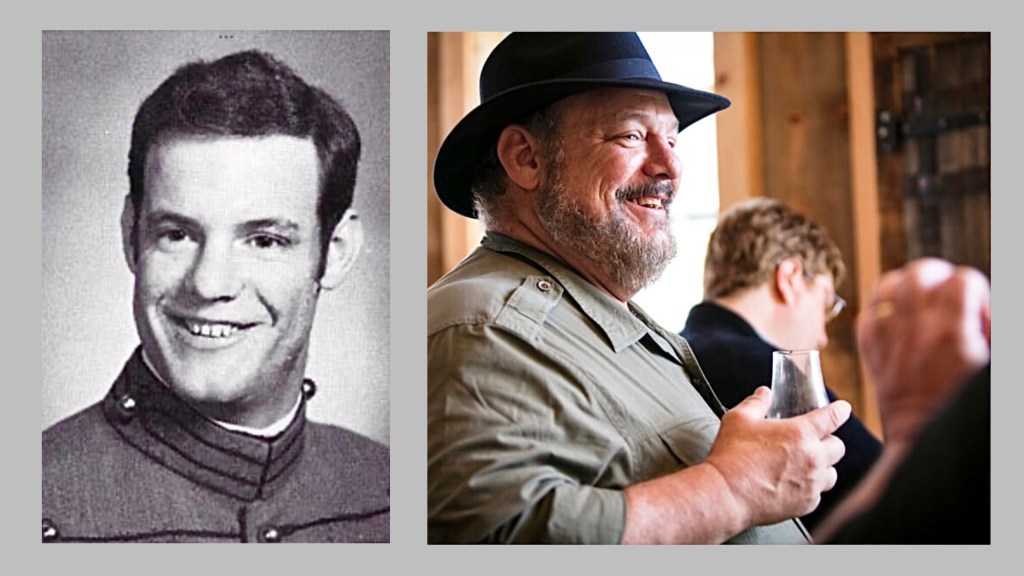
Dave Pickerell as a Cadet, and Then Later in Life.

A little over a year ago, our West Point Class held a mini-reunion at the Biltmore in North Carolina. On one of the evenings there, we did a whiskey tasting of several whiskeys Dave had an impact on*. The tasting was to honor Dave, and our other departed classmates. Everyone had such a good time at that event, it became the genesis of Operation WhistlePig.

We originally talked about doing a class tasting for our 45th reunion in the Fall of ‘23, but the logistics at West Point became a bit difficult. Bill Moeller then came up with the idea of purchasing a barrel of WhistlePig for the reunion. Classmate Tony Matos, who lives in New Hampshire not far from the WhistlePig Farm Distillery, became point man and started working with Mark Kanya of WhistlePig to understand the dynamics of a barrel purchase. In the meantime initial funding was lined up through classmate Jeff Manley, and a survey of classmates was completed to gauge interest. 206 classmates responded saying they were interested. A barrel of whiskey holds 156 bottles. We were on.

Of course, you don’t just buy a barrel of whiskey. Each barrel is different depending on multiple factors. WhistlePig invited “around ten of us” to a barrel tasting at the farm. We were to select “our barrel” from three different barrels we would taste from. It would then be bottled in a special release, with a small label honoring our class, and our fallen classmates. The team grew from four to six, then eventually to ten of us. In addition to Tony, Bill, Rob Grubbs and I (Rob, Bill and I organized the Biltmore tasting), José Morales, Al Aycock, Gus Hellzen, Jim Steiner, Jack Cronin and Rusty Roberts were added. Our number was set, as was our date, the 3rd of May. Reservations were made at a nearby Airbnb for May 2-4, and then it was just a matter of waiting for the big day.

Tony, who did a great job coordinating the event overall, sent an email to the Class on May 1st announcing Operation WhistlePig was about to commence. He was flooded with responses from classmates with good wishes, others wanting to immediately order a bottle, and some wanting to join us and help select the barrel. Tony graciously explained to folk why it wasn’t possible, although after checking with WhistlePig, three folk who were relatively local at the time were added for the tasting itself – Bob Rush and his wife Erica, and Ron Hall. They joined us for the tasting, but not the entire three days.
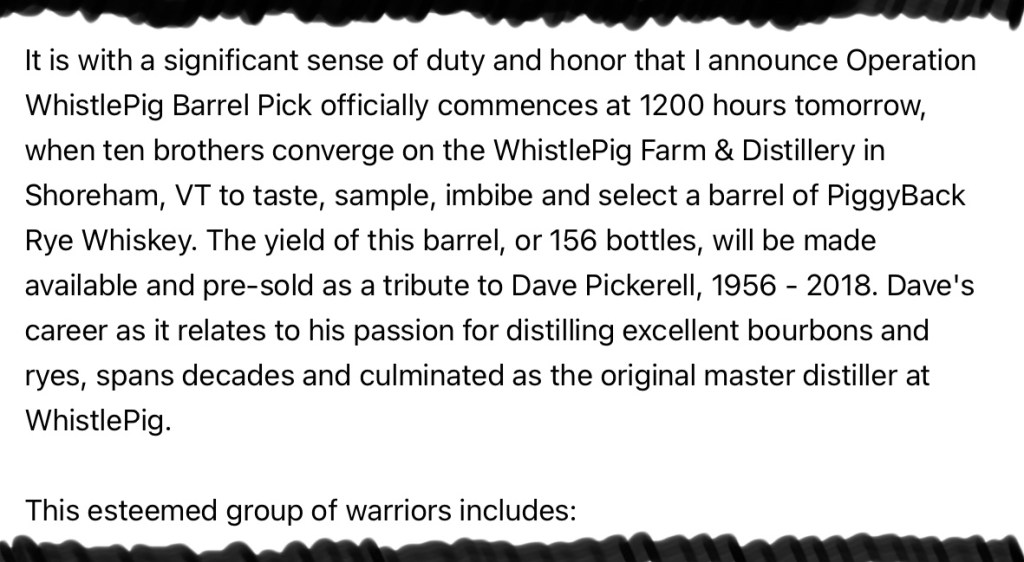
Tony’s Announcement to the Class About Operation WhistlePig.

On the second of May, we gathered. Classmates flew in or drove from Texas, Virginia, Maryland, North Carolina and Georgia. Others arrived from Vermont, New Hampshire and Maine. We included a retired Two Star, guys who departed the military not long after our initial five-year obligation, and everything in between. There were handshakes and hugs all around. Not all of us knew each other, but we were all brothers and it didn’t matter. This was going to be good.

That first evening passed in a blur, aided by some liquid lubrication. I and a couple of other guys cooked dinner the first night – Steak Tips, a New England specialty. Preparing the meal in the main house, I have to admit I felt a bit like Clemenza in the Movie “The Godfather” cooking away, with guys standing around talking and drinking. Over dinner, we didn’t solve the world’s problems, but we took a stab at a couple of them. José asked a couple of questions for which there were of course no correct answers but made us all think.

We also discussed whether we should consider buying two barrels of whiskey instead of one, in anticipation of additional sales based on Tony’s email from the 1st. Rusty immediately volunteered to lead the financing of the second barrel, and Tony quickly notified WhistlePig we were now looking at purchasing two barrels.

Dinner the First Night.

As is always the case for me at these gatherings, I’m humbled when I listen to many of the stories told – from time in the Army, in government, or in business. Stories from hotspots around the world over the years, and as I’ve said before, war stories both figuratively and literally. Beer, a couple bottles of WhistlePig, several bottles of wine and a few cigars later, most of us made our way to bed.

The next morning, Jim and crew fixed breakfast – bacon, toast and eggs to order. People were feeling surprisingly good, considering the damage we had, perhaps, done the night before. I’m sure the anticipation of the trip to WhistlePig later that morning had something to do with it. We eventually climbed into two vehicles and arrived at the WhistlePig Farm just before 11AM.
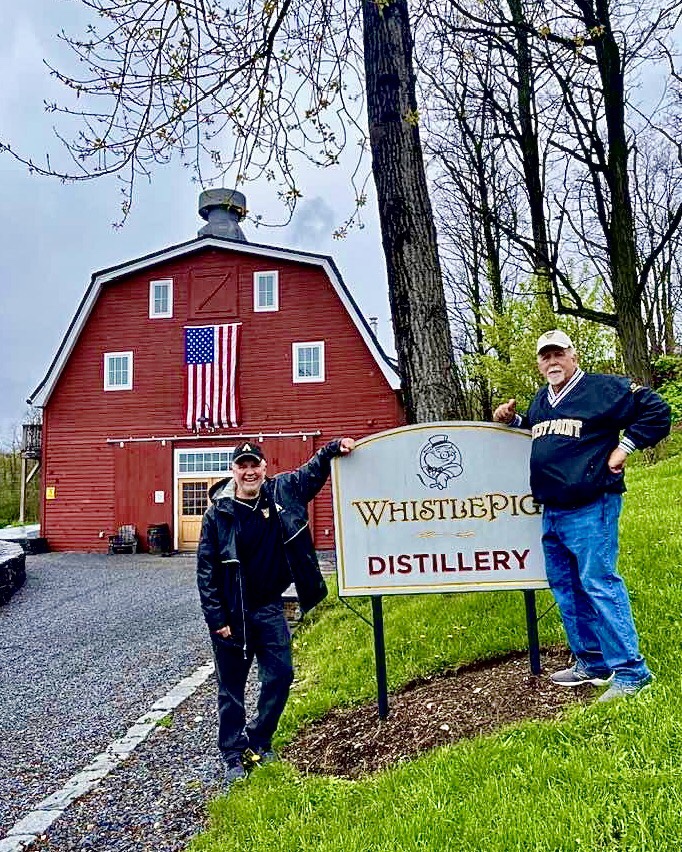
Arriving at WhistlePig.

At the farm, we were joined by Ron, Bob and Bob’s wife Erica and began a tour. Jesse Ray, accompanied by our contact Pam Spaulding, showed us key parts of the farm and distillery. Of course there were some tastings involved at various stops, including Maple Spirit (distilled maple syrup – a bit of a rum flavor), Piggyback (the 6 year old Rye that our barrel selections would also come from) and a wonderful WhistlePig 15 year old rye. I noticed that we, as a group, had become a bit louder. We grabbed a picture of us after trying the Maple Spirit – I think you can see we were off to a good start.
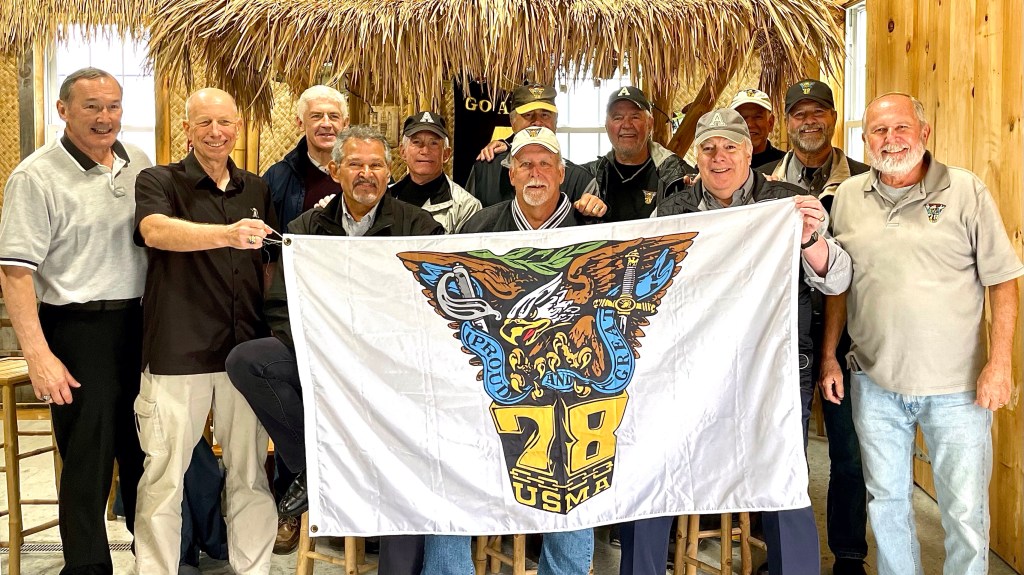
Smiling Classmates After the Distilled Maple Syrup Tasting

We returned to the tasting room and a wonderful lunch. The WhistlePig crew told us some great stories about Dave, some of his work, and some of his sayings. My favorite saying from Dave – “One of the great things about working at a distillery is you get to drink your mistakes.”

After lunch, we were ready to start the business at hand. First though, WhistlePig revealed a nice surprise. Since we were now considering two barrels instead of one, we would taste five samples instead of three. I believe that elicited a “Hooah!!” from the class. Mark Kanya walked us through the barrels, but didn’t reveal their proof numbers, as he didn’t want to prejudice us. Finally, it was time to taste.
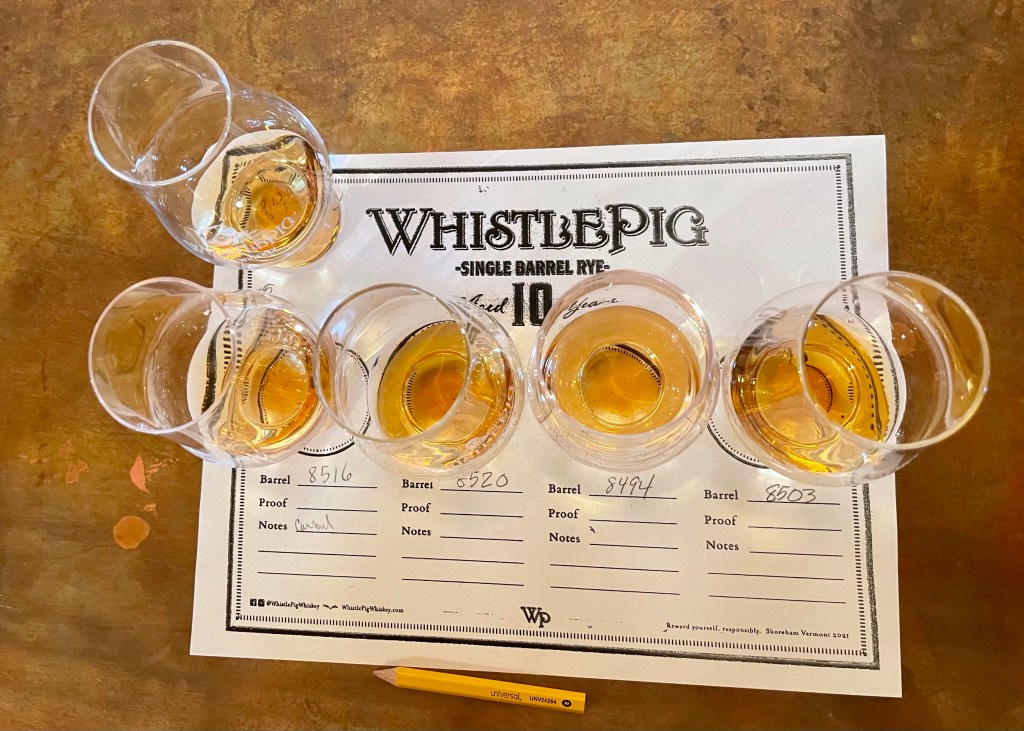
Five Barrels to Taste!

What followed was a minor dose of reverence and a major dose of fun. We tasted, and tasted again. Conversations sprang up and died away. Comparisons were made by those sitting next to each other, sometimes with concurrence and sometimes with “What, are you crazy?!” Now remember there were five barrels. All were 6 years old. All came from the same rick-house. All were 100% rye. All were good. And yet, we had no problem finding differences.

Whiskey Tasting – Maybe Serious Business, or Not…

Finally, it was time to make our selections and Rob Grubbs took charge with a chalk board. Each of us came forward and wrote down our top two choices. We anticipated going a couple of rounds, but it turns out it wasn’t even close. Barrels 8516 and 8494 won, hands down.

Barrels 8516 (2) and 8494 (4) Were the Easy Winners at the Tasting!

After the official tasting, they opened the bar and we tried other WhistlePig products at our leisure. Some of us returned to the winning bottles for another taste and confirmation we’d made the right choices. A few went to the museum, while others of us stayed at the bar. There, Mark’s assistant, Amber Star, who also happens to be an opera singer, entertained us with stories and after some prodding, an amazing a cappella version of Ava Maria – it was beautiful and somehow fit the afternoon.

As we gathered together again shortly before departing, Pam read us a tribute to Dave another friend, Savannah Burnett, sent her. It was wonderful of her to share it with us. She also gave us a WhistlePig bottle signed by Dave and filled with a bit of each of the products Dave was associated with over the years. A whiskey, or spirit connoisseur, would call it an “Infinity Bottle” due to the blending of so many different whiskeys – we plan to auction it off at our 45th reunion. It should also be noted that a West Point Coin was presented by José to Mark for his excellent organization of the tasting. As a side note, should he ever be challenged by one of us in the future and he doesn’t have the coin with him, he will be required to buy a round ;-).
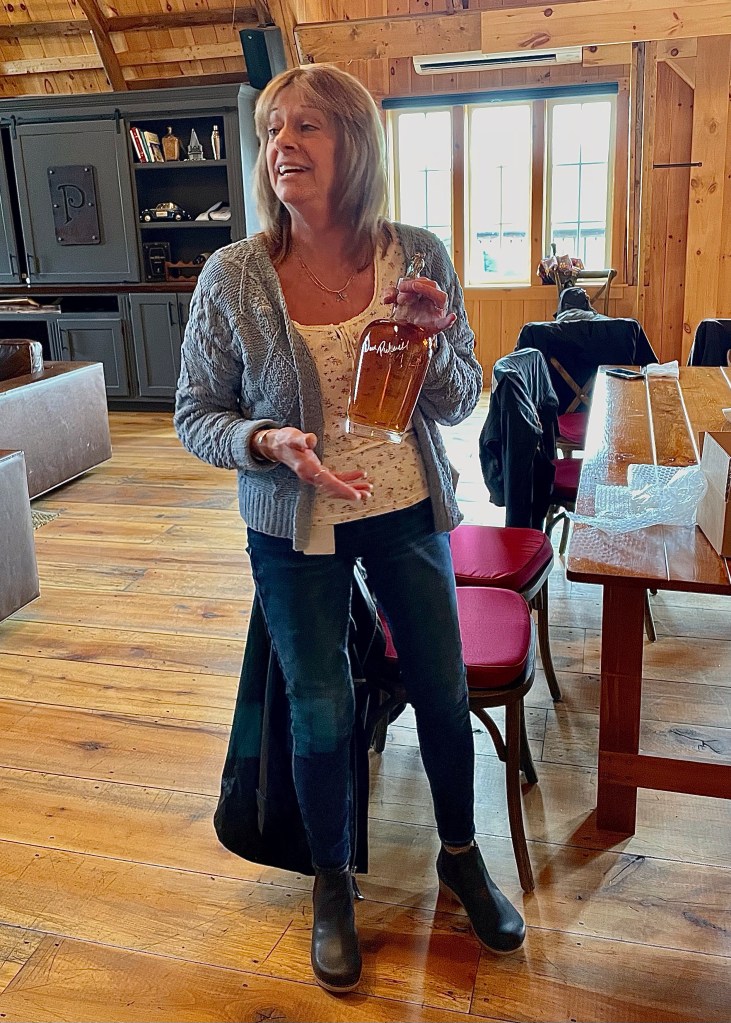
Pam Presenting the Class with the Dave Pickerell Signed “Infinity Bottle”.

We finally said our goodbyes to WhistlePig, and to Ron, Bob and Erica and drove back to our Airbnb. Bill cooked a salmon dinner for us and the ten of us again gathered at the table.

We were mellower than the night before but had great conversations. Yes, we told and laughed at old stories again, but we also talked about the present and the future. Over more wine, whiskey and cigars, we discussed our Class and the impact we may have had on the Army and on our country. Eventually we drifted off to our individual rooms and the night ended.

When I woke up the next morning, a couple of guys were already gone. Rob made breakfast for us and then Tony and Jim drove the rest of us to the airport. More hugs and handshakes at the airport and we parted ways. Operation WhistlePig was over … For this year.

I’ve thought about the wonderful times we had at this whiskey tasting, and at other reunions. The camaraderie, the brotherhood, the love for each other. Although we are not yet in our “twilight”, I think General Douglas McArthur summed it up pretty well at the end of his West Point Farewell Address in 1962:

The shadows are lengthening for me. The twilight is here. My days of old have vanished — tone and tint. They have gone glimmering through the dreams of things that were. Their memory is one of wondrous beauty, watered by tears and coaxed and caressed by the smiles of yesterday. I listen then, but with thirsty ear, for the witching melody of faint bugles blowing reveille, of far drums beating the long roll. In my dreams I hear again the crash of guns, the rattle of musketry, the strange, mournful mutter of the battlefield. But in the evening of my memory always I come back to West Point. Always there echoes and re-echoes: Duty, Honor, Country…”

For this whiskey tasting get-together, maybe the echoes and re-echoes were: Duty, Honor, Country and WhistlePig as well. For my classmates who may be reading this blog, I’ll add this – Standby! A Warning Order is about to come out on how to purchase a bottle.

Addendum:

  • The staff at WhistlePig was wonderful. Pam Spaulding, Jesse Ray, Mark Kenya and Amber Star took amazing care of us.
  • * You can read the blog about Dave and the whiskey tasting our class did about a year ago here: When Rob asked if I would help host the whiskey tasting for the West Point Class of ‘78 mini-reunion at The Biltmore, I immediately said yes. We honored classmate Dave Pickerell, later known as The “Johnny Appleseed” of Craft Whiskey, and all of our departed classmates […] Continue at: https://mnhallblog.wordpress.com/2022/04/19/pickerell-the-biltmore-and-the-whiskey-tasting/
  • Arriving at WhistlePig” photo courtesy of Gus Hellzen.
A Bayonet Attack and Life Lessons

A Bayonet Attack and Life Lessons

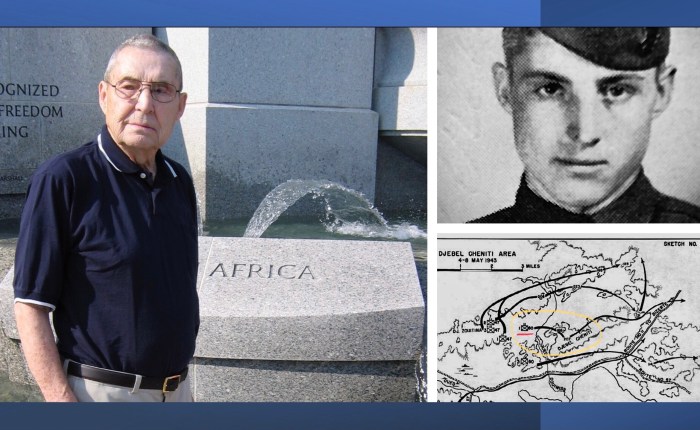
80 years ago on May 6th, 1943, Dad and the other men of 1st Battalion, 60th Regimental Combat Team were given the order to fix bayonets. They were about to attack Djebel Cheniti in Tunisia by direct assault with a bayonet charge. I’ve thought quite a bit about how that attack may have affected Dad and his outlook on life.

A year ago, I was doing research for another blog about dad and the closing days of the North African Campaign in 1943. I was shocked to learn about a battle that dad never mentioned. At the time, his unit had been in continuous combat for two months.

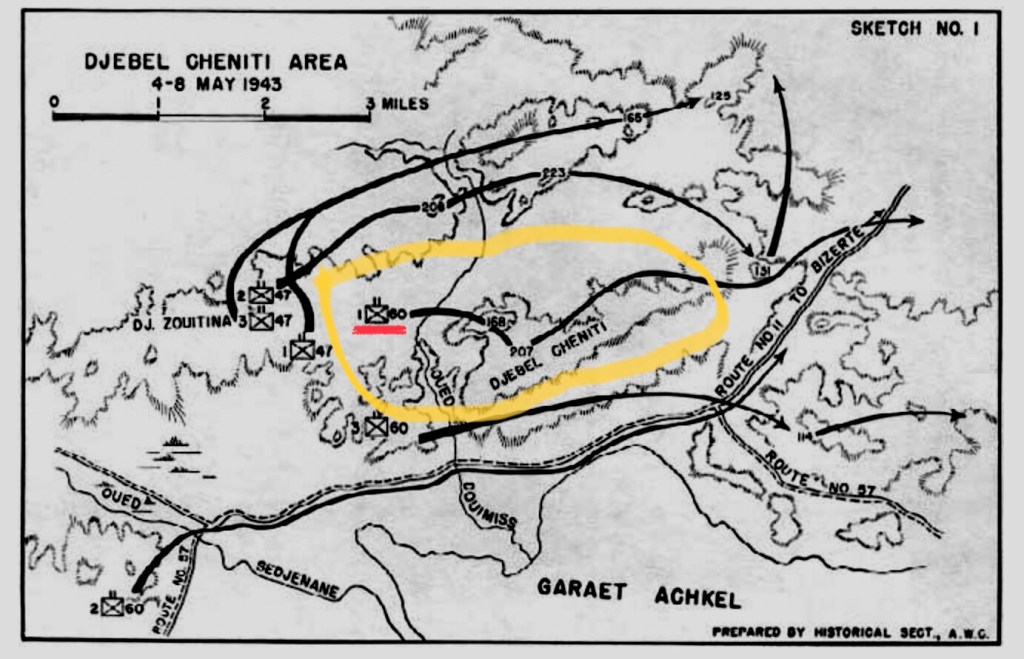
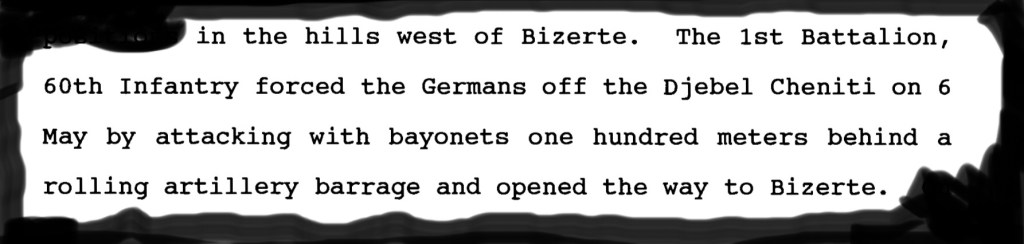
From the history books:One last ring of rugged hills now remained between the Ninth Infantry Division and Bizerte. The German troops on Djebel Cheniti, the highest point on the 8 mile wide area of the Bizerte Isthmus, halted the advance. To break this bottleneck, General Manton S. Eddy (Commander of the 9th Infantry Division), devised a plan with two parts. The division would mount a flanking maneuver around the hills, while the 1st Battalion of the 60th Regimental Combat Team (dad’s unit – about 500 men) would attack Djebel Cheniti by direct assault with fixed bayonets. They would follow artillery fire that pounded the slopes at 100-yard intervals.

The 9th Infantry Division Plan of Attack as it Unfolded.

Let’s take a pause in the story for a second. Fix Bayonets is a command that probably goes back as far as the introduction of muskets. What the command literally means is you are attaching your bayonet to the end of your rifle. What it actually means is one of two things – 1) you are preparing to charge the enemy in close-quarters or 2) getting ready to defend yourself from an imminent enemy assault. Either way, it is close-in fighting. With a rifle and a bayonet, you are perhaps three feet away from your enemy. There is no hiding. There is no ducking away. Army Field Manual 23-25 captures it succinctly: “The will to meet and destroy the enemy in hand-to-hand combat is the spirit of the bayonet. It springs from the fighter’s confidence, courage, and grim determination.” In my own bayonet training nearly 50 years ago at West Point, they were even more to the point: “What is the spirit of the bayonet?” “To Kill!”

At that distance, it is kill or be killed. There is no middle ground.

… … …

May 6th 1943 was a slippery, muddy and rainy day. The order was given to fix bayonets around 1PM and behind rolling artillery, the battalion attacked. They moved forward quickly and only 100 yards behind the falling artillery barrage. On the map, it looks like the total distance they needed to cover was a little over a mile. After three hours they took Hill 168. Moving on to Hill 207 they met stronger resistance. An artillery concentration disorganized the enemy and the battalion attacked again before the German troops could recover. By nightfall, they had taken the summit of Hill 207, although there were still Germans on the southeastern slopes. In a war that lasted years, there were only brief mentions of the battle in the history books, but all of them mentioned the fixed bayonets.

Only a Brief Mention in the History Books

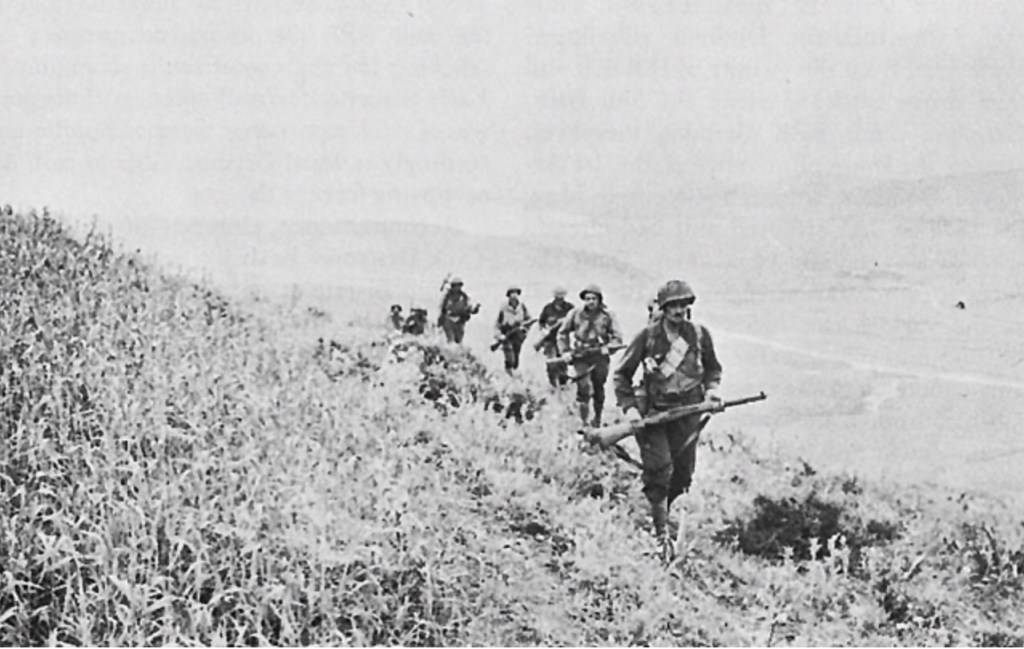
The next morning, May 7th, German machine gun crews began taking off for Bizerte as the division advanced. The 60th moved to cut off the Bizerte road and On May 8th, Bizerte fell. The war in North Africa was over and their immediate mission accomplished.

Men of the 60th Outside Bizerte on May 7th, 1943.

In the words of the 9th Infantry Division Record, “Djebel Cheniti was a brilliant demonstration of Infantry “leaning up against” artillery preparation. One of the strongest positions in the final Axis defense was assaulted by one battalion of Infantry with fixed bayonets, with artillery blasting a shell-strewn pathway for its advance. Another story in the annals of foot soldiers, who do the dirty tasks of warfare”.

Why am I blogging about this now? The story has haunted me since first learning about it. I’ve thought about it quite a bit over the past year. I never heard dad say anything about Djebel Cheniti. I never heard dad say anything about a bayonet charge. Not one damned word. The more I thought about it, the more I thought about how it must have influenced his life.

I have to figure after you’ve been in a bayonet charge, everything else in your life, maybe for the rest of your life, must seem easier. When you are that close to death, and you survive, what else in your life is really going to be a threat to you? Money issues? Work Issues? Mortgage issues? Sickness? Wouldn’t just about everything pale in comparison?

It would explain a lot about dad. His lust for life. His enjoyment of life. His ability to keep everything in perspective, even when things were going badly. His gentleness and tolerance. His quiet firmness in facing down jerks and bullies. Perhaps he already had all of those traits and would have developed into the same man, but I’m not so sure. I think a bayonet charge at the age of 19 might make everything else in life just a wee bit easier to contemplate and to handle. Maybe every day after May 6th, 1943 was a gift not to be squandered. Dad’s gone now. How I wish we had time for one more conversation.

Dad at the WWII Memorial, Two or Three Years Before he Passed Away.

Addendum:

  • The last major American bayonet charge occurred during the Korean War in 1951. You can read a bit about it here: https://www.army.mil/article/30673/hero_who_led_last_major_u_s_bayonet_charge_dies
  • Dad was in almost continual combat from November of ‘42 to August of ‘43 when he was wounded in Sicily. I’m sure all of that combat, and his wounding affected him and changed him, but the bayonet attack is what has stuck in my mind as a singular event, maybe even more than his wounding. He told bits and pieces of different battles over those months, and mostly they involved funny incidents. He even eventually told me the story of how he was wounded, when he was recovering from the stroke he suffered in the ‘90s. The bayonet attack? Not a single word.
  • The blog I was working on when I found out about the bayonet charge was a funny story about dad and “Al Capone” – “My Dad, then Twenty year old Sergeant Willie I. Hall, looked at the German soldier and said “Chicago”. The German answered “Chicago?” Dad stared back. “Chicago … Al Capone”. Now the German’s eyes’ widened. Everyone knew who” […] continue at: https://mnhallblog.wordpress.com/2022/05/08/dad-and-al-capone/
  • Historical parts of this blog were derived from these sources: The 9th Division History; Center of Military History: TO BIZERTE WITH THE II CORPS 23 April – 13 May 1943; The US Army in WWII by George Howe; and The Development of Combat Effective Divisions in the United States Army During WWII, a thesis by Peter R. Mansoor.
  • Thanks to my sister, Roberta, and niece, Tami, for their thoughts and inputs. And of course thanks as always to Colleen for her editing support.

Five Years in One Page

Five Years in One Page

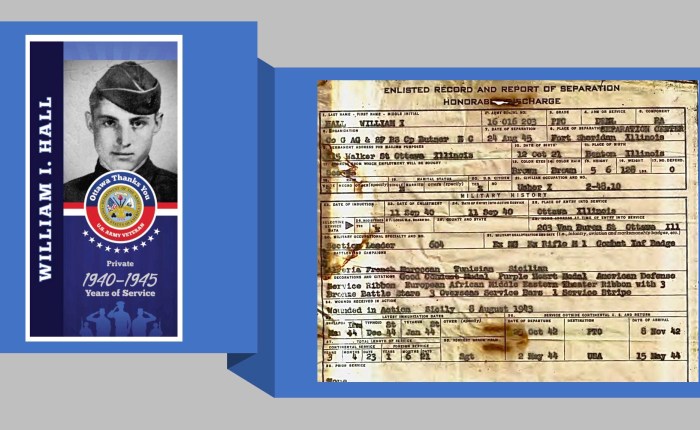
When discharged from the Army on August 24th, 1945, dad was 21 years old and had been in for nearly five years. His WWII service included time in Algeria, Tunisia, French Morocco and lastly, Sicily, where he was wounded. His discharge papers tell the intriguing story of those five years in one page.

This is the second of a two-part blog. Last week, I told the story of how I received dad’s enlistment and discharge paperwork from the National Archives. I then explored several interesting observations from his enlistment form, including the fact that he lied about his age in order to enlist. He claimed he was almost 19 years old, when in fact he was still two months shy of his 17th birthday. You will find a link to the first blog in the Addendum to this one.

Today’s blog explores his discharge paperwork, and briefly tells the story of his five years in the service. Dad was with B Company 1/60th Regimental Combat Team of the 9th Infantry Division from September 1940 until he was wounded and almost died in Sicily in August of 1943. Although his original enlistment in 1940 was for three years, when the war started all enlistments were extended for the duration.

As with his enlistment papers, dad’s discharge paperwork was discolored, creased and yellow, perhaps from the fire at the National Personnel Records Center (NPRC). A few parts were unreadable, but most of it was legible.

Dad’s Honorable Discharge Paperwork – it Suffered in the Fire at the Archives.

I’ll magnify and expand a couple sections to talk about some of the details.

At the top of the form, there are a couple of interesting items.

The Top of the Discharge Form – Magnified
  • Block 3 confirms his last duty station as Camp Butner, NC. This is where dad returned to the States in 1944 after recovering from his wounds. Camp Butner was both a troop training center, and a Prisoner of War camp. Dad told us stories later about helping train troops there (and about performing KP).
  • We see in block 4 his actual discharge date is August 24th, 1945. This was two weeks after the atom bomb was dropped on Nagasaki, Japan, and one week before the official surrender of the Japanese on September 2nd. The army was already discharging soldiers as the war was winding down, based on how many “points” they had (more on “points” later).
  • Block 7 still shows the birth date he lied about to enlist – Oct 12, 1921, as opposed to his real birth date of Oct 22, 1923. And amazingly, dad’s height, 5’ 6” and weight, 128 pounds haven’t changed at all from when he enlisted. Me thinks, someone was probably just copying from other forms to put this info in.
  • Block 21 shows his civilian employment as “Usher”, so maybe not everything was copied over. His enlistment paperwork showed him as a “Laborer”.

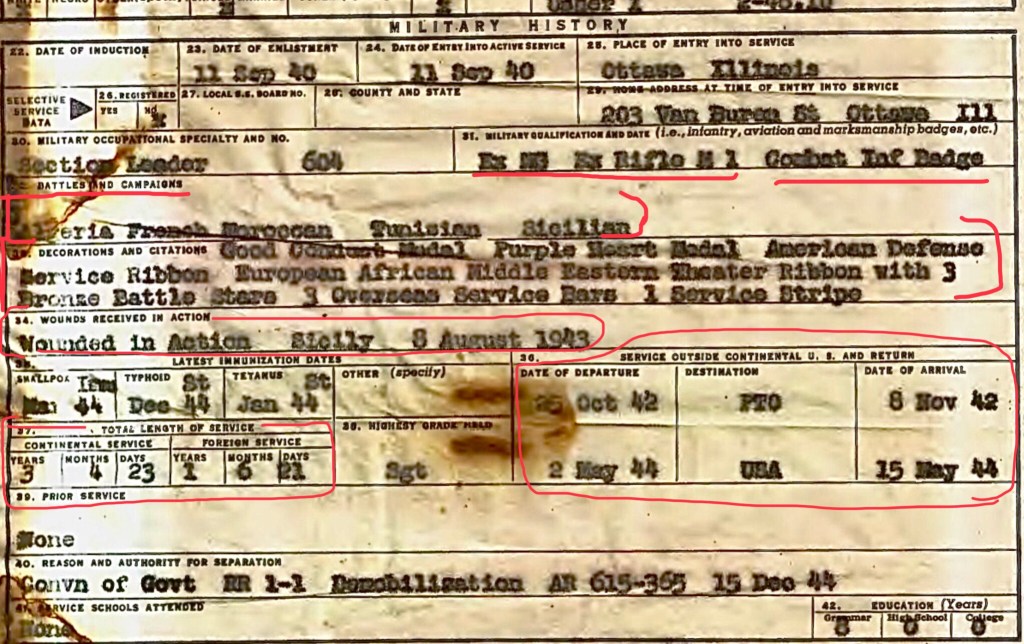
Now we move on to the Middle section of his discharge paper, dad’s “Military History”. This is the meat of the discharge, and paints the real story of his time in the service. I’ve again magnified the view so you can better read the form. In order to tell dad’s history in a linear fashion, I will sometimes go out of order in discussing what is in the blocks in this section.

Dad’s “Military History” in His Discharge Paperwork.
  • Block 31 shows dad qualified as an expert both on the Machine Gun, and the M1 Garand rifle. It also notes he was awarded the Combat Infantryman Badge. You could only earn the CIB if you were in the Infantry (not in Field Artillery, or Armor, or Signal Corps etc), AND you were in actual active combat with the enemy.
  • I’m going to skip to block 36 – “Service Outside the Continental United State” for just a minute . Note here that he arrived overseas on November 8th, 1942. What it doesn’t say is he arrived with the 60th Regimental Combat Team of the 9th Infantry Division at around 5AM under gunfire on the beach near Port-Lyautey, French Morocco. This was as a part of Operation Torch, the invasion of North Africa. Torch was (next to D-Day) the second largest amphibious assault ever attempted.
  • Now back to block 32, where we see in addition to French Morocco, dad also took part in battles in Algeria and Tunisia in North Africa where they defeated Rommel and the Africa Korps. Those battles took place between November 8th of 1942 and May 10th of 1943. Then in July of 1943, dad participated in the invasion of Sicily.
  • Skipping back down to block 34, we learn dad was wounded on August 8th, 1943. What it doesn’t mention is he was shot three times by the Germans in the mountains of Sicily and it took over a day to evacuate him by hand to an aid station. It also doesn’t say he almost died due to the combination of his wounds and the Malaria he contracted. His time with the 9th Infantry Division ended here.
  • Returning to block 36, we see dad arrived back in the States on May 15th, 1944, three weeks before D-Day. This was after he recovered from his wounds (he was evacuated to North Africa to fully recover). Due to the severity of those wounds, he didn’t return to combat – the war was over for him, although he remained in the service for another 15 months.
  • Block 37 “Foreign Service”, shows that of dad’s almost five years in the service, one year, six months and twenty-one days were spent overseas. Approximately eight of those months were in near continuous combat.
  • Finally, we return to block 33, “Decorations and Citations”. In addition to his Good Conduct Medal and Purple Heart (for being wounded), he was awarded: the American Defense Service Ribbon (awarded to troops on active duty prior to Pearl Harbor); the European African Middle Eastern Theatre Ribbon with three bronze stars (this was for participating in the campaign in French Morocco, and the subsequent campaigns in Algeria, Tunisia and Sicily); three Overseas Service Bars (one for each six month period in a theater of war) and finally a Service Stripe (one for each three year period of service). It’s worth noting dad also earned a Bronze Star (for exemplary conduct in ground combat against an armed enemy), which didn’t catch up with him until after he was already discharged, and is not reflected in this paperwork.

Finally we come to the bottom of the discharge paperwork and block 55. There are three items noted here, although not all are readable.

Block 55 – Points and Other Things
  • First, dad, along with all other honorably discharged service members, was issued a lapel button to be worn on civilian clothing. At the end of the war, it was particularly useful for those traveling home so they were quickly identified as service members and received priority for buses and trains.
  • Next we see dad’s ASR score was 95. ASR stood for Adjusted Service Rating and is what was used to determine the priority for discharging soldiers at the end of the war. The rules were simple in principle: “Those who had fought longest and hardest should be returned home and discharged first.” Points were given for length of time in the service, length of time overseas, combat campaigns, combat awards, being wounded and so on. At the time, “the points” required for discharge were 85. Dad, with his nearly five years of service, his 1 1/2 years overseas, his Purple Heart, and his four campaigns was at, or near the top of the heap. His 95 points reflect that, and was why he was discharged so quickly as the war was winding down. If you have ever watched the show “Band of Brothers” there is a great section in the last show focusing on this. Points were on everyone’s mind.
  • Finally, there’s the cryptic last line “xx days lost under AW 107”. What the hell is that? AW 107 stood for Articles of War (the forerunner of today’s Uniform Code of Military Justice). Article 107 refers to docking the soldier credit for days of active duty that they didn’t earn. Typical examples were for going AWOL, being too drunk to report for duty, or getting in trouble for other minor offenses and confined to the barracks. Since the service member was not performing his or her duties during those periods, they didn’t receive time in grade or retirement credit for those periods. It turns out many/most enlisted soldiers during WWII had AW107 scores higher than zero. During my research, I’ve found cases with numbers from 1 to over 200. I’ve tried like hell to read the smudged number here but can’t quite make it out. It might be a 5? It might be a 3? I don’t think we’ll ever know. What I do know is dad was busted from Sergeant to Private in June of 1943 for getting caught in, and subsequently kicked out of, a walled city twice in one night after missing the last truck back to his unit. Perhaps he was confined for some period of time in conjunction with this “incident”.

After his discharge, dad returned to Ottawa, Illinois in September and lived there for the next 65 years. In Ottawa he met mom, and had us three kids, six grandchildren and 13 great grandchildren. He retired from the railroad in 1985, and passed away in 2010.

For those of you who know me, or who have followed this blog for any length of time, I’m pretty sure you are aware of how much I admired my father. An embodiment of “The Greatest Generation”, dad was always one of my heroes. This was true certainly for his actions during WWII, but also for how he lived his life, and how he took care of our family.

A Banner Honoring Dad in Ottawa, Illinois on Veteran’s Day Last Year.

I’ve probably written more blogs about him than any other subject. The blog last week about his enlistment and this one about his discharge file are special to me. It’s somehow reassuring that his enlistment and discharge paperwork confirm the outline of the oral histories we heard from dad growing up. I wish I had discovered this paperwork while he was still alive, just so we could have one more conversation about it over a coffee or a beer. “Dad, tell me again about the time …”, or “Dad, about those lost AW 107 days…”.

I love him and miss him.

Addendum:

  • I apologize for the length of this and last week’s blogs, but I was trying to give some context to the cold and straightforward words in the paperwork.

– Here are a selection of other WWII blogs that I’ve alluded to in this blog. There may be some minor discrepancies in them, based on the availability of the new information in his paperwork:

Lying to Enlist in 1940

Lying to Enlist in 1940

On the 11th day of September, 1940, just over 14 months before Pearl Harbor, my dad, William Iber Hall, enlisted in the United States Army for a 3 year stint. His enlistment paperwork showed him to be 18 years and 11 months of age. In reality, he was 16 years and 11 months old.

Our family history always said dad lied about his age when he joined the Army. Still, it was pretty cool to receive some official corroboration.
A couple of years ago in the middle of COVID, I was doing some research and learned I could access dad’s military records. The only catch? On July 12th of 1973, a fire occurred at the National Personnel Records Center (NPRC) and destroyed between 16 and 18 million Official Military Personnel Files, including 80% of those who were discharged between 1912 and 1960. I said a prayer, held my breath, and sent a letter to the National Archives, and more specifically, the NPRC, asking for dad’s service and medical records.

Months passed. A year passed. A second year passed, and then I finally received an email from the NPRC. Dad’s records existed, but were located in the area where the worst part of the fire was. They were damaged and incomplete. They did have his enlistment and separation paperwork, but nothing else. Nothing from his medical records, and nothing else about his time in the service. They did forward copies of the enlistment and separation papers.

The NPRC’s Response to My Request for Information About Dad.

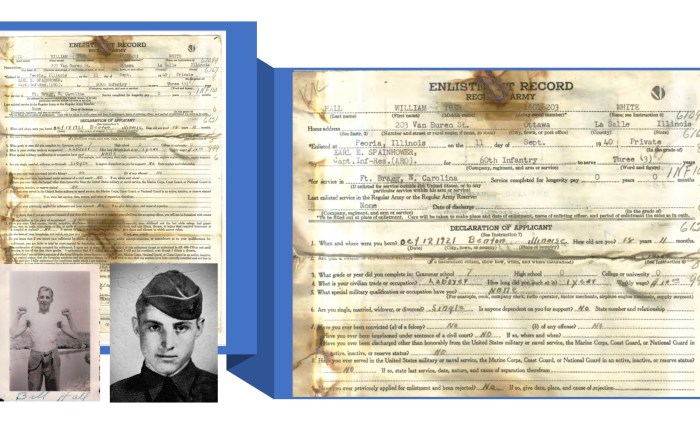
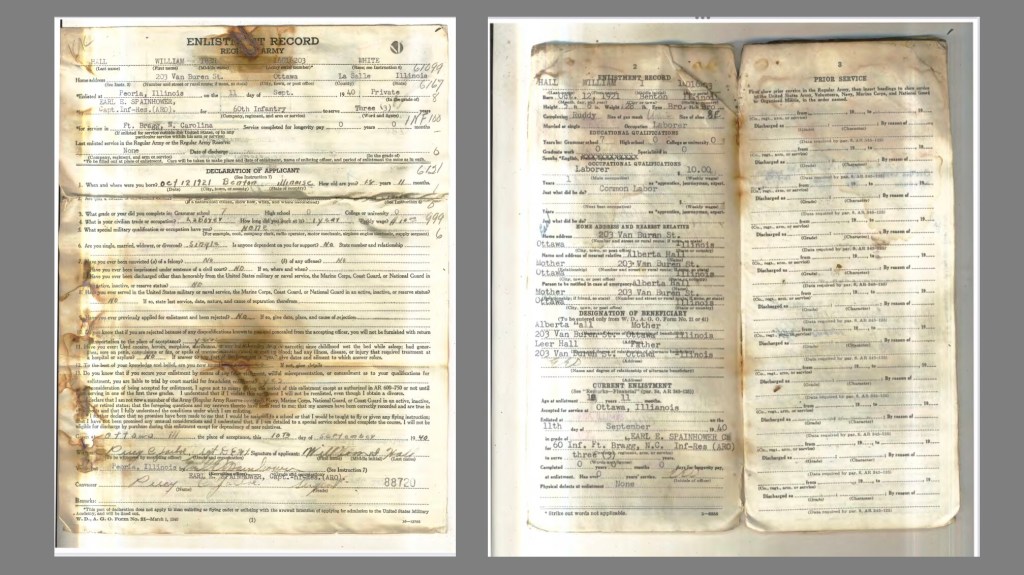
I looked at both documents. They are discolored, scarred and blurry in places. There are brown marks, including outlines of paper clips – perhaps from the heat of the fire. Here’s a photo of the enlistment documents – note there are actually three pages.

Dad’s Enlistment Papers – Apparently Damaged some by the Fire.

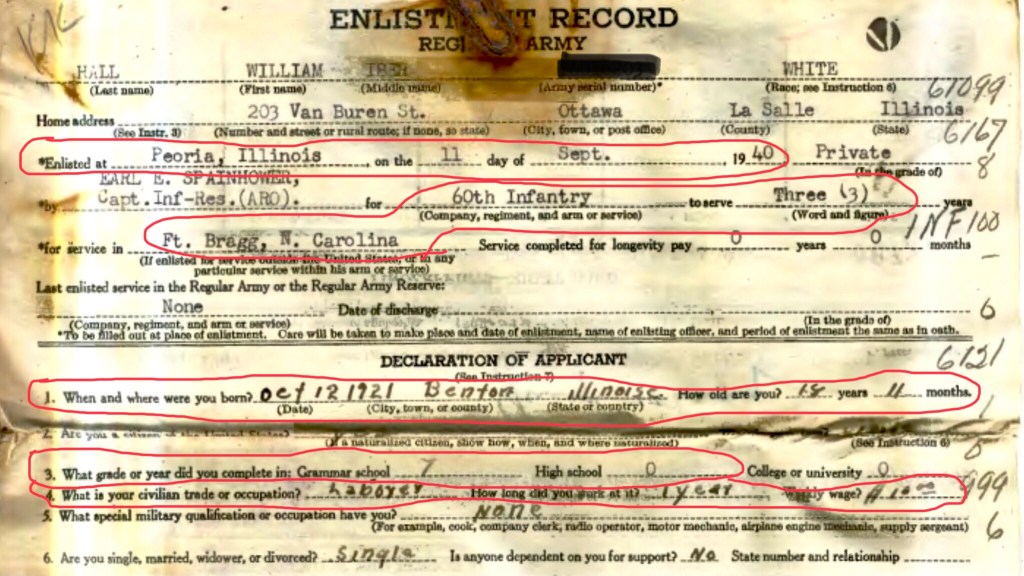
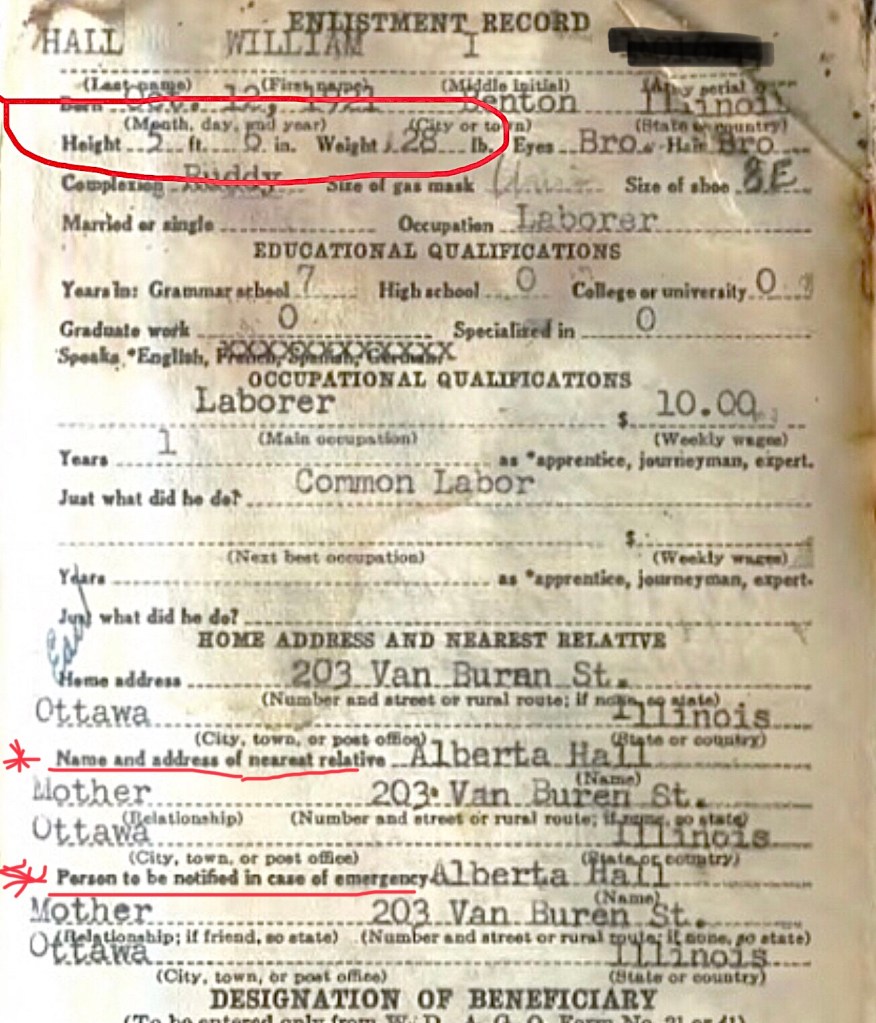
There is some fascinating information, particularly in the top half of the first page of the enlistment form. I’ve blown it up here so you can better read the form.

A Magnified View of the Top of Page One of Dad’s Enlistment, With Some Key Items Circled in Red.

Here are a few items of interest:

  • Dad enlisted in Peoria, Illinois – I’d always assumed in Ottawa, but there probably wasn’t a recruiting station there yet. His enlistment was for three years, and was directly to the 60th Infantry Regiment of the 9th Infantry Division. Three years later in September of 1943 when his enlistment was originally to end, dad was in a hospital in Sicily, recovering from being shot three times by the Germans. He was still serving with the 60th. By then, all enlistments were for the duration.
  • We see in his answer to question 1, that yes, dad did lie about his birth date – by over two years. His actual birthday was Oct 22, 1923, which means on the date of his enlistment, Sept 10, 1940, he was actually 16 years and 11 months old. You were required to be 18 years old to join and Dad lied big time, claiming a birth date of Oct 12, 1921, making himself 18 years and 11 months old.
  • His answer to question 3 shows he completed 7th Grade, and nothing more. This was interesting as well – dad always told us he graduated from 8th grade. (In a side note, Dad did graduate from high school in 2002, when he and other veterans who didn’t graduate were made honorary members and graduates of the OHS class of 2002.)
  • For question 4, he lists his work as Laborer for the past year, at $10/week. This was at least a partial lie. Dad joined the Civilian Conservation Corps (CCC) for two six month enlistments in 1939 when he was 15 years old (the legal age for the CCCs was 17). He may have worked as a laborer when he returned from the CCCs, but it certainly wasn’t for a year, as he joined the Army not long after his return. My guess is he was probably out of work at the time and didn’t want to admit it.
  • I’m betting dad didn’t know the “s” in Illinois is silent, as he spelled it Illinoise in his answer to question no. 1. ;-).
Dad in ‘39 or Early ‘40 in the CCCs, and Then Later in Early ‘41 with the 60th Infantry

On the second page of his enlistment, there are a couple of additional parts of his life we can confirm from the information provided. First, dad is listed at 5’ 6” and 128 lbs. That corresponds pretty well with the above CCC photo of him. It’s hard to see how the recruiter actually thought he was 18.

Also of interest is that my Grandma, Alberta Hall, is listed as his nearest relative, and the person to be notified in case of emergency. This aligns with other parts of our family history that aren’t always talked about as much. My Grandpa Hall was something of a ne’r-do-well for much of his life, and probably an alcoholic. He sometimes disappeared for days or weeks at a time. Evidently Dad wasn’t taking any chances on him as his emergency point of contact and named Grandma instead. It makes sense to me now that when the telegram came to the family in 1943 informing them of dad’s wounding, it was sent to Grandma, not Grandpa.

A Magnified View of Page 2 of Dad’s Enlistment.

Receiving his enlistment papers was an amazing find to me. I never doubted dad, or any of his stories, but finding actual documents confirming his history is incredible. Knowing how lucky we are they didn’t burn along with the 18 million other military personnel records, only makes the story more fascinating. Luck is sometimes a wonderful thing.

We’d always been told that dad enlisted in 1940, and knew he had to have lied about his age. My Aunt Ellen, his older sister by several years, went to the recruiting station with him to verify his age to the recruiter. Life at that point in time, at the tail end of the depression was tough, or at least tough for the Hall family. Grandma was supporting the family with her work, and Grandpa was only a part time presence at home. There was no money, and probably not many jobs, at least not for a 16 year old. The pay in the Army was $21/month at the time, plus food and housing. I think it looked pretty good to someone who had a fairly rough life to that point.

Today, I’m thinking about 16 year old William Iber Hall going to the recruiting station in Peoria Illinois and signing up to an unknown fate. Unbeknownst to him, Pearl Harbor would happen 14 months later. Thank God for dad, and others like him, who did the right thing and stood by our country in it’s time of need.

This is the first of two blogs about the documents I received from the NPRC. Next week’s blog will cover dad’s discharge paperwork. It tells the story about his time in the service from 1940 – 1945 in just one page, and is an equally amazing document.

Addendum:

  • You can read more about dad’s and the CCCs here: It was 1939 and dad and Uncle George were on a train, bound for the CCCs in Wyoming. Growing up in Illinois during the Great Depression was tough. Their family was poor before the Depression, and things got worse […] continue here: https://mnhallblog.wordpress.com/2017/12/13/dad-uncle-george-and-the-cccs-in-1939%EF%BB%BF
  • Here’s more on the fire at the NPRC from the Archives themselves: “Shortly after midnight on July 12, 1973, a fire was reported at the NPRC’s military personnel records building in St. Louis, MO. Firefighters arrived on the scene only 4 minutes and 20 seconds after the first alarm sounded and entered the building. While they were able to reach the burning sixth floor, the heat and the smoke forced the firefighters to withdraw at 3:15am. In order to combat and contain the flames, firefighters were forced to pour great quantities of water onto the exterior of the building and inside through broken windows. The fire burned out of control for 22 hours; it took two days before firefighters were able to re-enter the building. The blaze was so intense that local Overland residents had to remain indoors, due to the heavy acrid smoke. It was not until July 16, nearly four and a half days after the first reports, that the local fire department called the fire officially out. The fire destroyed approximately 16-18 million Official Military Personnel Files (OMPF). No duplicate copies of these records were ever maintained, nor were microfilm copies produced. Neither were any indexes created prior to the fire. In addition, millions of documents had been lent to the Department of Veterans Affairs before the fire occurred. Therefore, a complete listing of the records that were lost is not available. In terms of loss to the cultural heritage of our nation, the 1973 NPRC Fire was an unparalleled disaster.”

A Celebration of Life and Celebrating Life

A Celebration of Life and Celebrating Life

A few weeks ago Cathy and I spent a Saturday seeing the full circle of life. The day started at a brewery, attending a Celebration of Life for a friend who passed away three months ago. It ended at a winery where another friend was celebrating her seventieth birthday. The two events were surprisingly similar.

Our old friend Davie passed away last October at the age of 67. His death was unexpected and hit many of us hard. We were a part of the same running group since the early ‘90s and became good friends over the years. Another friend, Tia, and I talked and decided to host a Celebration of Life for Davie, but after some time went by – time enough for the rawness of his death to pass. We eventually decided on a Saturday in mid-January.

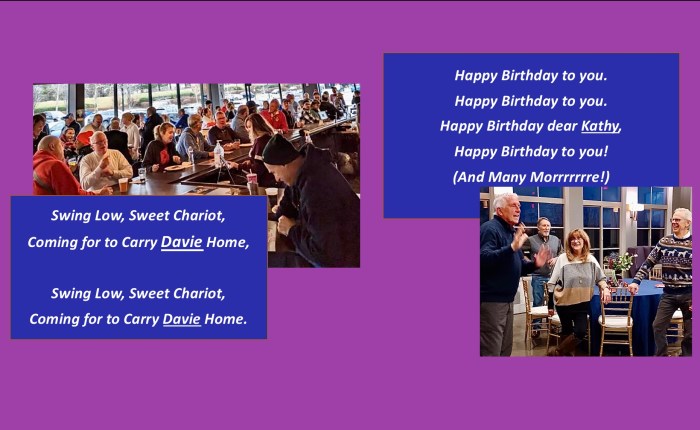
On the appointed day, a wonderful and diverse crowd of seventy five or so came together and after a short run, gathered at a local brewery. Five of us brought in homemade food for a buffet lunch with BBQ, coleslaw, mac n’ cheese and other goodies. Beer and other beverages were flowing. The crowd was loud and in a good mood. The decision Tia and I made to delay for three months was a good one. Friends ate and drank and laughed. Stories of Davie were told – some poignant, some bawdy. At the end of the “formal” part of the Celebration, we sang the old spiritual “Swing Low, Sweet Chariot” as a final send off (an off-color version of the song is usually sung at the end of our weekly runs).

Friends at Davie’s Celebration of Life at the Brewery

We left the brewery while the party was still roaring, to make our way to our friend Kathy’s 70th birthday party. We arrived at home, let Carmen out and changed clothes. From there, we drove the twenty minutes to the winery where Kathy’s birthday party was being held.

Upon arriving, we found the party and joined in with the other 20 or 25 guests. A friend of Kathy’s made delicious homemade appetizers. Wine and other beverages were flowing. The crowd was loud and in a good mood. Friends ate and drank and laughed. Stories and jokes were told and Kathy’s husband mentioned a couple of times that he was lucky to have married an older woman (I should point out he is only 18 months younger than Kathy). At the end of the “formal” part of the celebration, we sang “Happy Birthday ” to Kathy as a final tribute.

Friends at Kathy’s Birthday Party at the Winery.

Speaking with Kathy later, she mentioned she wanted to celebrate her life while she was “still vertical”. The guests represented different aspects of her life and what held meaning for her — old friendships formed in her youth, friendships from her days in community theater, friendships formed in pursuit of change in our social and political systems and those she partnered with while strengthening her health and fitness levels. It was a diverse and wonderful group of people. After the party, she and Steve stayed up late into the night talking about how lucky they were. Her comment to me – “Why wait to gather together and celebrate life?

I’ve spent the last month or so thinking about the juxtaposition of those two gatherings. They were sooooo similar to each other. Friends gathered. Good homemade food was served at both. Excellent local adult beverages were available for consumption. There was lots of laughter, with jokes and stories being told. Even a song was sung at both to end the formal part of the festivities. The only real difference between the two events was the guest of honor attended one in person, but not the other.

Kathy being Roasted at her Birthday Celebration. I Like to Think Davie Attended his Celebration of Life in Spirit.

Yes, there’s a fine edge between life and death, between living and dying, between celebrating a life, and a Celebration of Life. That Saturday and those two gatherings brought it home to me.

Celebrating life, and Celebrations of Life are both important. None of us knows how much time we, our family, or our friends have left and we should take advantage of celebrating not just birthdays, but every part of life we can, while we are alive.

I’m glad we were able to celebrate Davie’s life. He wasn’t physically with us, but I know he would have enjoyed the party. I like to think he was looking on us from somewhere on high with a glass of champagne or a mimosa in his hand.

I’m even happier we were able to celebrate Kathy’s 70th with her in the room, and I’m pretty sure she did enjoy the party. As Fitzgerald stated in The Great Gatsby,Let us learn to show our friendship for a man when he is alive and not after he is dead.

Celebrating life while living, seems an important part of having a good Celebration of Life later. At my Celebration of Life, I hope there will be jokes and stories and snorts of laughter. In a corner of the room, maybe loud guffaws and then someone will say, “What a great story! I didn’t know that about Max. Did I ever tell you about the time he and I…

When I started thinking about this blog, I thought the song “The Circle of Life” from The Lion KIng might be nice for an ending with it’s lyrics about despair and hope, and faith and love. It’s a fine song, and I suppose makes people feel warm and fuzzy. Personally, I think Iggy Pop’s “Lust for Life” is more relevant for me, and has a better take on all of it:

Well, I'm just a modern guy
Of course, I've had it in the ear before*
And I've a lust for life (lust for life)
'Cause I've a lust for life (lust for life)
Got a lust for life
Yeah, a lust for life…

I’m going to continue to honor and celebrate those around me, both alive and dead. I think about that Saturday and those two events. Like my friends Davie and Kathy, a lust for life is what I have. I’m taking Iggy’s advice, and plan to continue to live life exuberantly. I’m going to celebrate life and all it throws at me. If you happen to make my Celebration of Life down the road, eat some fine food, have a drink, laugh and tell a good story about the times we shared together. Hopefully, it starts out something like this, “There Max and I were. It was crazy, but…

Addendum:

  • I encourage you to listen to Elton John’s “Circle of Life”, and then Iggy Pop’s “Lust for Life”. Both of them are fine songs. One of them will get you up, moving, and ready to engage life to the utmost.
  • Circle of Life with Elton John can be found at: https://youtu.be/IwH9YvhPN7c
  • Lust for Life with Iggy Pop and David Bowie can be found at: https://youtu.be/HuBU3pzy7is ; or try this version to go with the Movie Trainspotting: https://youtu.be/jQvUBf5l7Vw
  • Thanks to our friend Tia Perry for leading the effort on Davie’s Celebration of Life – It was a great event. Special thanks to our friend Kathy Kadilak for allowing me to talk about her milestone birthday and the impact it had on me. Both Tia and Kathy were a part of writing this blog.
  • * The phrase “I’ve had it in the ear before” isn’t sexual and it’s not drug related. It means someone’s given you a hard time or screwed you over.

Tuna Salad with Julia and Grandma Grubaugh

Tuna Salad with Julia and Grandma Grubaugh

It was strange. It was simple. It was visceral. One moment I was taking a bite of a tuna salad sandwich made with Julia Child’s recipe. The next instant I was a little boy sitting with Grandma Grubaugh at her kitchen table having lunch. It hit me like a bolt out of the blue.

A couple of my favorite benefits of our New York Times subscription are the food and cooking articles. The columns tell great stories, and the recipes are usually pretty manageable. A while back, chef, James Beard Award winning author and former New York Times food columnist Dorie Greenspan wrote a great column “This Tuna-Salad Sandwich Is Julia Child-Approved Lunch”. She was working with Julia at the time on an upcoming book and recounted a day spent in her kitchen. Here’s a partial extract:

We were working around the kitchen table when Julia declared, “Dorie, let’s make lunch.” I saw Stephanie smile — clearly, she knew what was coming — and then I was at the counter with Julia, doing as I was told, which was cutting celery. While it might not seem like much of a job, I was cutting celery for Julia Child, and I was going to do it right: I trimmed the celery, I peeled it (because I learned to do that in Paris, I thought it was important to do it for the woman who wrote “Mastering the Art of French Cooking”) and I cut the celery into minuscule cubes that were all the same size. I’m only exaggerating a smidge when I say it took me so long that when I put down my knife, Julia had finished everything else, and we were ready to sit down to one of her favorite lunches: tuna salad on an English muffin.”

The article was about nothing and about everything. I love writing like that. I mean, how can you possibly write an entire article about a tuna salad sandwich? And yet Greenspan wrote a great one and I thoroughly enjoyed it.

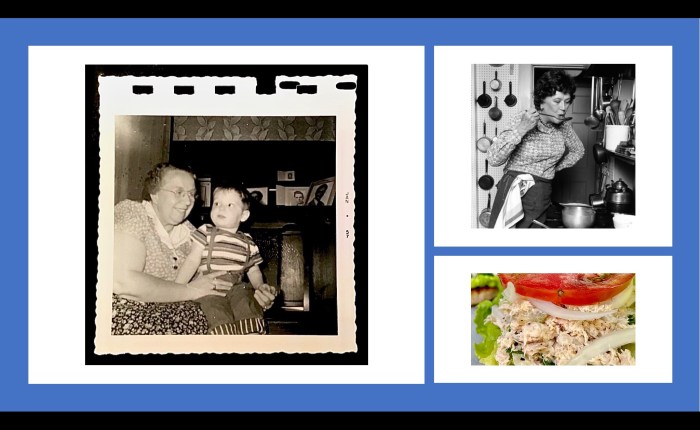
Julia Childs in the Kitchen.

The list of ingredients in the actual sandwich intrigued me. We’ve all made tuna salad – tuna, mayo, celery and maybe onion and a boiled egg, but this one was a bit different. Yea, there was tuna (packed in oil), mayo (always Hellman’s), celery and onion, but it also included capers, cornichons (small French pickles) and lemon juice. Hmmmm. I was going to have to try this. Some of you know of my aversion to pickles in potato salad, but with tuna salad, why not give it a shot?

I had everything on hand, with the exception of the Cornichons. After doing a little online research, I figured the baby dills in our fridge were a suitable substitute.

I dutifully chopped the celery (sorry, no peeling), onion, capers and pickles. After emptying the tuna in a bowl, I added all of the chopped ingredients. In went the mayo, and the parsley and I combined everything. Finally, I squeezed the lemon juice in, added salt and pepper, and combined it all again. I did a small taste, and of course because of who I am, added a bit more mayo. Another small taste, and then I put the bowl in the fridge to chill for a couple of hours.

Tuna Salad Heading to the Fridge.

At last it was lunch time and I made my sandwich. More mayo on the bread, the tuna salad itself, some lettuce, tomato and a small slice of onion. Another slice of bread, and then I cut the whole thing in half.

Tuna Salad Sammich. It Doesn’t Get Any Better.

I took the first bite, waiting to be transformed in my mind to Julia Child’s kitchen, and … wait! What!? Was that Grandma Grubaugh sitting next to me? Where in the hell did that come from?! It was a visceral reaction – I was a young boy back in Ottawa, sitting at the kitchen table at Grandma’s house having a tuna sandwich with her.

Grandma Grubaugh and I in 1957.

After rejoining the present, I sat there eating my sandwich trying to figure out what brought on those feelings. Grandma, to my knowledge, never cooked anything from Julia Child. Besides, my flashback would have been some time in the ‘60s, well before Julia became popular in America.

I thought through the ingredients. I don’t really remember grandma keeping fresh lemons, or capers around the house, although I suppose she might have. Grandma putting either in tuna salad seemed a pure fantasy. It had to be the pickles, although I didn’t remember mom putting pickles in tuna at our house.

At this point in time, mom had already passed away. Uncle Don, her younger brother was still alive, and I gave him a call. After catching up for a few minutes, I explained why I was calling, asked about grandma’s tuna salad, and whether she put pickles in it. He immediately answered “No, there were no pickles”, and my heart sank. Then he quickly added – “No, no pickles. She used a couple big spoonfuls of pickle relish.” And it all connected.

We talked a bit more and I eventually hung up. As I thought about Grandma and her pickle relish, it made sense. The relish certainly would account for the pickle flavor and maybe some of the brightness. In a subsequent conversation with my cousin Dawn, she reminded me that while Grandma didn’t really keep fresh lemons around the house (who did in midwest America in the ‘60s?), there was always a bottle of Real Lemon Juice in the fridge – for lemon cake, lemon pie, maybe a spoonful in cobblers. Who’s to say she didn’t add a spoonful to her tuna salad? While it doesn’t all add up perfectly, it made sense to me.

Since then, I’ve continued to make my tuna salad with pickles, capers and lemon juice. I have to admit Julia’s is better than what I’d made before. It’s also a nice lunchtime bonus – remembering Grandma Grubaugh on a day when you are “only” having tuna salad is pretty special.

Addendum:

• Thanks to my sister Roberta, and cousin Dawn (one of Uncle Don’s Daughters – also a flower girl at our wedding) for their contributions to this blog – both had distinct memories of Grandma’s tuna salad and some of grandma’s habits at the time. Dawn was also quite emphatic Grandma used sweet pickle relish in her Tuna salad. We also had a great conversation about foods triggering happy family memories – Thanksgiving at mom and dad’s house (Uncle Don, Aunt Diane and family were almost always in attendance as well), potato salad, Aunt Diane’s cherry pies and cobblers, watermelon outside on the picnic table, and Grandma Grubaugh expertly spitting her seeds across the yard, to the delight of her grandchildren.

• Here’s another blog about Grandma Grubaugh and her delicious date nut bread: https://mnhallblog.wordpress.com/2019/12/04/grandmas-date-nut-bread/

• Here’s a link to the column that inspired me to try Julia Child’s Tuna salad. It’s a quick read – https://www.nytimes.com/2020/10/21/magazine/this-tuna-salad-sandwich-is-julia-child-approved-lunch.html?unlocked_article_code=a2vDZUZ1eo1yVrKAfuZxMgmll7EsQe8k7K-jTFFMqtFBjYV_jUe1I577EkeqZQNBGpaScBbP2xFhlRgEXk0W3tuhHedthiZqjAOIlq7mFMVFRXTSWUW-mugkmUlR6AtNmjBpqnBC45Dacm7NKVcjag8DPq4nW_Mk-gleZC2NfUBimTJW8wqPnaCRsC9BXBDeHOI6FVeL60bLuggz3IU80r0Op815enYRuh9uZRbZwfNBd33TI6IJNJk_1qSRqnFXzpHmKs4RRpwBBMsGROoFMHGYZ-jWFgxYd51U2M-oYm9mLIFmxsE2twHD2-Qtkx8ZSmRV-W7eCe36dnvravfZOe3UkdJOwFAHYcitmVZSPDenybPsa9HK0r6y4Pgo9YUyIA&smid=share-url

• Here’s a link to the recipe from the NYT: https://cooking.nytimes.com/recipes/1021561-tuna-salad-sandwich-julia-child-style?smid=ck-recipe-iOS-share

• And here’s the exact same recipe if the NYT won’t let you open their recipe without a subscription: https://bwtribble.com/recipe/1071

Max

Max

I always suspected it might be true. Still, it was a bit jarring to find out it actually was true. Here in America, there are more dogs named Max, than people named Max. A lot more. In fact, there are about 8 times as many dogs as people named Max. I’m honored … I think.

Growing up in Ottawa, Illinois in the ‘60s, Max was a unique name. I believe I was the only Max at McKinley Grade School and it caused a bit of a problem. When filling out forms or headers for formal tests, teachers never believed my name was just “Max”. They were convinced it must be Maximillian, or Maxwell. I’d dutifully tell them no, it was just Max. I know at least a couple of them called mom, as I obviously didn’t know what I was talking about. Mom would let them know I DID know my own name, thank you very much.

Of course Maxwell Smart in the ‘60s, Mel Gibson as Mad Max and Russell Crowe as Maximus in Gladiator spread the name a bit more. And, Cathy’s Dad was named Max (I believe he was the first Max I personally knew). Over time, it wasn’t quite as unique among us humans.

As I grew older, one of the things many people said when they first met me was “Oh! I know a dog named Max!” We would of course have a chuckle. Sometimes they would ask if I could sit, or stay, and I’d do a reasonable dog imitation. I drew the line at rolling over.

Time passed. People became more inventive, or more sharing. I learned of several horses named Max, a Cat named Max and even a Guinea Pig named Max. And then of course there was the occasional person with a mother or daughter named Max. Years ago, friends in Germany wanted to name their beagle Max (pronounced Machs in German), but checked with me first to make sure I didn’t mind. I didn’t mind and thought it was cool, although they also pointed out they weren’t actually naming him after me ;-).

Max, the Beagle.

Which brings us to the present.

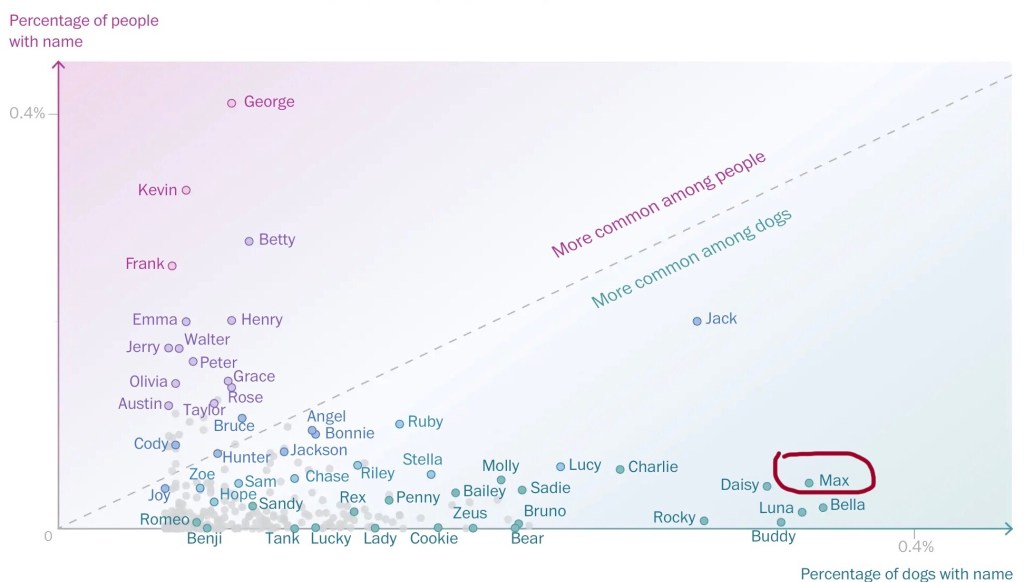
The Washington Post recently ran an article about dog and people names and the overlap between them. It turns out Max is the second most popular dog name in America right now. Only Bella (of Twilight Saga fame) is a more popular name for dogs.

Max is Pretty Popular as a Dog Name.

So how popular is Max? If you gathered 100,000 people and 100,000 dogs together in a park, 351 dogs would be named Max, while only 44 people would be named Max (for Bella, it’s 357 dogs and 20 people). At the other end of the spectrum, only 80 dogs, but 411 people would be named George.

Outnumbered a Bit on the Human Side.

Yep, if you know a “Max” (other than me), he’s more likely a dog than a human.

What’s in a name? Max means “The Greatest” and I agree it’s a great name for either a man or his best friend. The Baby Center, (an online site with a wealth of knowledge about babies, including names) had this to say – “Max is undoubtedly a cool name, but if you’re considering it, keep in mind it’s also a common pet name. In fact, Max is the most popular name for dogs in the United States, right up there with Toby, Bella, Riley, and Molly.

We should all be so honored and appreciated.

Addendum:

  • Thanks to our old friend Steven Buxton for sending us a picture of Max the beagle. We had so much fun with Steven and his folks Jim and Res back in the ‘80s.
  • It turns out this is my 300th blog. I started this effort in October of 2015 and it’s evolved over time. Back then, I’d push something out every couple of weeks, or when I could get to it. The last couple of years, it’s been more or less weekly. For better or worse, my topics have remained as diverse as ever. I’m still small scale, but 300 blogs and 7 plus years of continuity – I’ll take it. I think Live Life Exuberantly remains a valid title for the blog, and one of my ongoing life goals. Thanks to all who continue reading my wandering posts.
  • If you want to read the full WaPo article about dog and human names, you can find it here. (And check out how popular your name is as a dog name). You may need a subscription to read it, I’m not sure – https://www.washingtonpost.com/business/interactive/2022/people-names-for-dogs/

A Plebe Christmas

A Plebe Christmas

I distinctly remember returning to West Point after Christmas my Plebe year. It wasn’t fun. As a matter of fact, the last couple of days at home became bittersweet as I started thinking about returning to West Point as a Beanhead* for another five months.

It wasn’t just returning to the Plebe System (Fourth Class System) that affected me. We had first semester finals two weeks after returning. Also, have you ever visited West Point in winter? In the Fall, West Point is one of the most beautiful places in the country. In the winter? Not so much, unless you have a fondness for the color grey. January to March at West Point is called “Gloom Period”**, with good reason.

If I’m honest with myself, it wasn’t Gloom Period, or finals that brought me down. It was going back as a Plebe for another five months. Before you enter the Academy, you hear all about how tough Plebe year is both mentally and physically. It’s one thing to hear about it. It’s another to experience it for six months, have a break, and then know you are going back for more of the same.

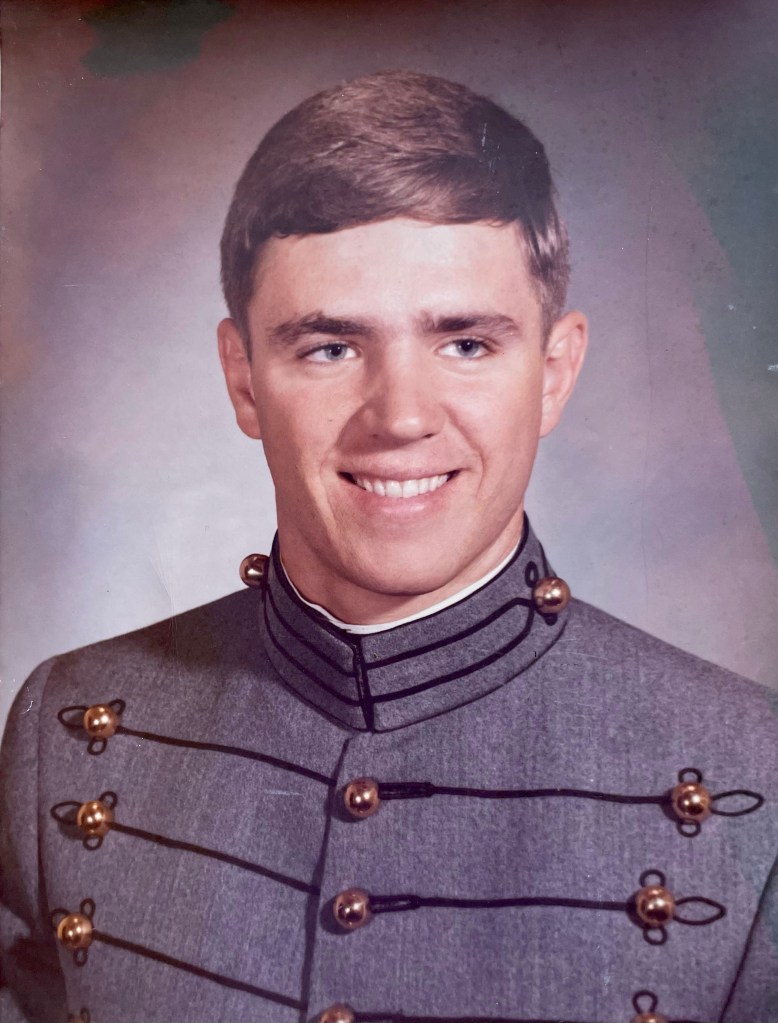
Official Plebe Photo

Coming home to Ottawa that December, Christmas break was great. Being a real person again was even better. Everyone wanted to know how West Point was, and of course I told them the good stuff, while minimizing the actuality of Plebe life. The time at home divided out between family events, dates with Cathy and partying with my friends.

During the day, I spent time at home, or went to see Grandma, various aunts and uncles, and church or family friends. I remember racing around town fitting in as many visits as I could. It was good to catch up with so many people, but also a bit exhausting.

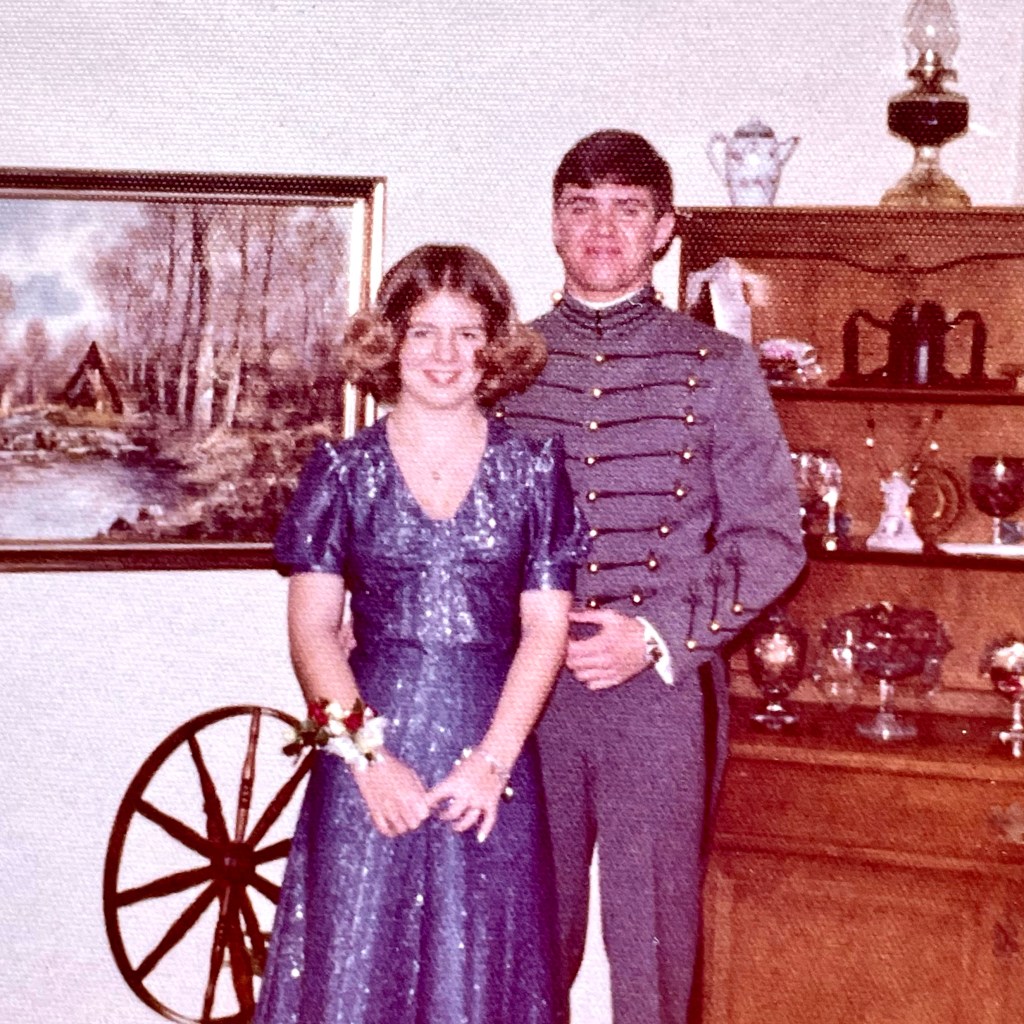
Cath and I went on dates most evenings and tried to make up for lost time. The last we’d seen each other was Labor Day Weekend, when she visited West Point with my folks. In the interim, we’d written so many letters back and forth, I lost count of the actual number. While home, there was even a formal holiday dance at Ottawa High (Cathy was still a senior in high school). I wore my dress uniform, and felt so much older than the high school “kids”, who in reality were only one or two years younger.

At Home Before Going to the OHS Winter Formal

Since she was still in school, Cathy had a curfew most nights. After our dates ended, I often linked up with my buddies Howard, Tim, Mark and others. The drinking age in Illinois was 19 at the time for beer and wine, but nobody really checked. We made the rounds at Berta’s, The Flamingo and Russell’s Tap before finally making it to bed. The next morning I’d wake up and start the cycle all over again. As I recall, sleeping in wasn’t an option.

I’d taken a couple of text books home with me to study over break, but of course I never cracked them. The days and nights raced by.

Finally it was New Year’s Eve and just a couple days before I would return to West Point. I remember going to a party with Cathy at our friend Jack’s home that night. Many of our friends were there. It was a great time, and as the clock struck midnight, there were kisses, handshakes and toasts all around. It was wonderful and things seemed almost perfect.

Maybe an hour later, it hit me. This was all going to end and I would return to the reality of Plebe life. The exhilaration from midnight rapidly disappeared. I crashed and a forlorn feeling took over. I found a quiet spot in an empty room and just sat there thinking. The dread I felt was visceral. Cathy found me a few minutes later and could tell something was wrong. She asked if I was OK and I struggled with words, then just gave up trying to explain. The thing is, she felt it too. We stood there hugging for I don’t know how long.

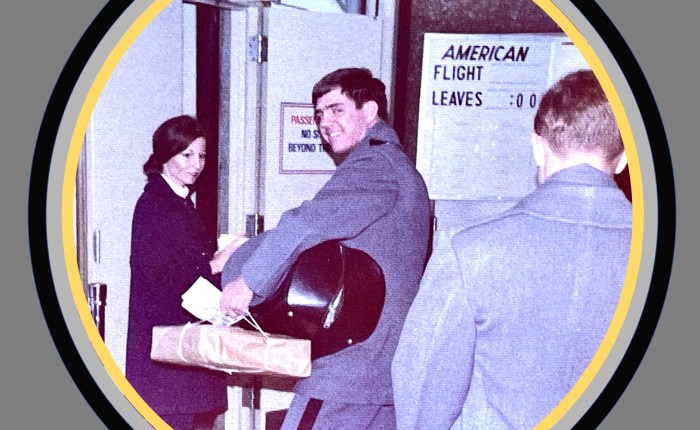
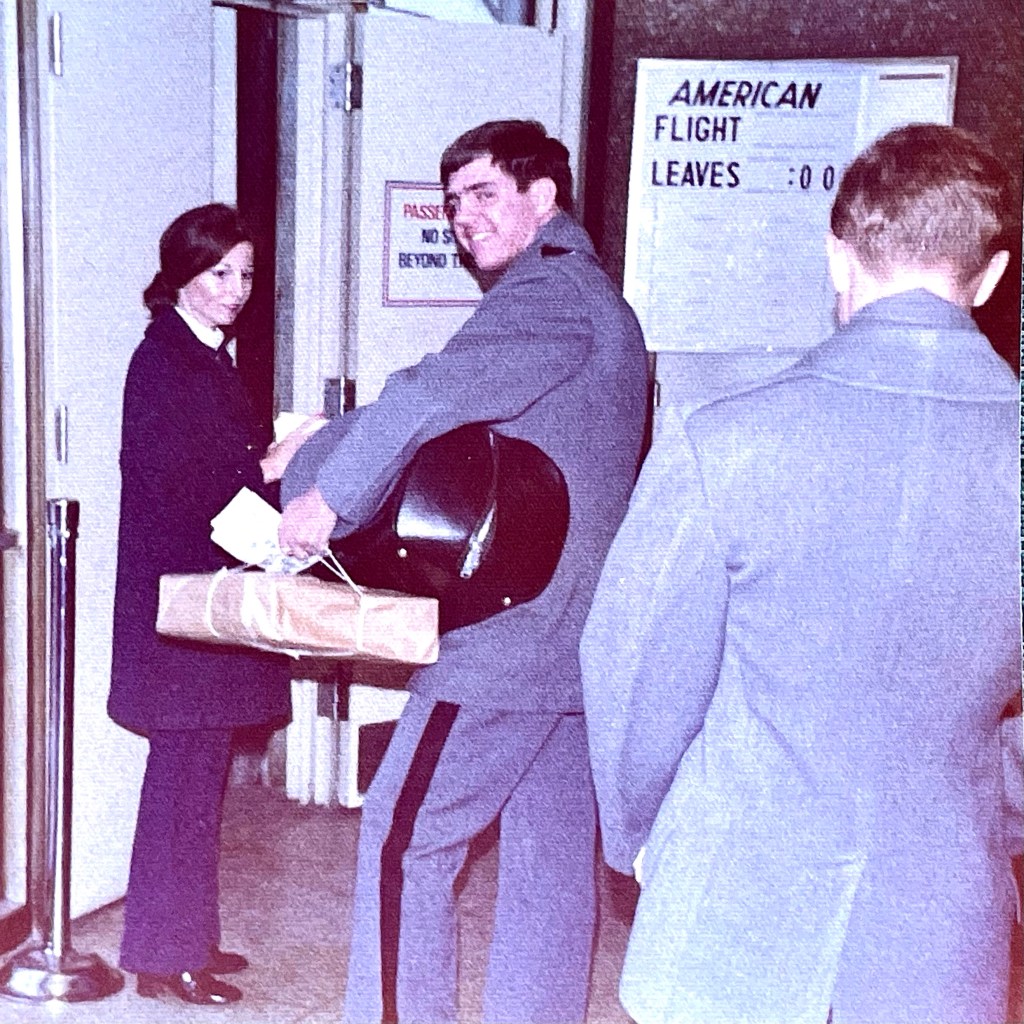
I more-or-less bounced back the next day and enjoyed my last day or two of freedom. Finally, it was time. As a Plebe, I think I was required to travel in uniform, and when Mom, Dad and Cathy drove me to O’Hare, that’s what I wore. Back then everyone could walk all the way to the gate, and that’s where we said our final goodbyes and “I love you’s”. Mom gave me a care package and with a last wave and a smile, I boarded the plane for New York.

A Smile for Mom, Dad and Cathy as I Boarded the Plane to New York.

At the airport in New York (LaGuardia I think), cadets were everywhere. Most of us made our way to buses for the final fifty miles to our Rock Bound Highland Home on the Hudson. The bus I was on was pretty quiet, with Plebes and upperclassmen alike lost in their own thoughts. By now, I’d steeled my mind for the return to school and Plebe life. I was as ready as I was going to be.

And of course it wasn’t as bad as things looked on New Year’s Eve. I made the Dean’s list that first semester, and by late March or early April, Gloom Period was lifting. As for dealing with upperclassmen and the 4th Class System, that too passed. As the Semester wore on, things became easier and and finally, in June, Recognition Day happened. We were no longer Plebes, but full fledged members of the Corps of Cadets.

To this day, I remember that New Year’s Eve and the roller coaster of emotions I felt. Speaking with Cathy, she too distinctly remembers that night. I recently told her I thought I’d write a blog about New Year’s Eve Plebe year. She immediately knew what I was talking about. I laughed a bit and said something like “I didn’t know you remembered”. She quickly answered “How could I forget?”

Addendum:

  • *Beanhead – one of the many less flattering terms upperclassman used for Plebes at the time.
  • ** Gloom Period – If you want to read more about Gloom Period, you can do so here: https://mnhallblog.wordpress.com/2018/01/21/gloom-period/
  • I’ve often thought of that New Year’s Eve over the years and the feelings I experienced that night. I’d contemplated writing a blog about it before, but couldn’t quite wrap my head around it. Then, during Christmas season this year, one of my classmates posted an email on his own feelings about the return to West Point after Christmas. Several others chimed in. Some were worried about academics and getting separated due to grades. Others, like me, thought about the return to the 4th Class System for several more months. Still others talked of the general malaise around our return, with Gloom Period settling in. A few told (now) funny stories about missing flights, late arriving girl friends, and even running into the Dallas Cowboy Cheerleaders during a stopover on the return to the Academy. It’s interesting what binds people together. My classmates and I laugh and now tell stories of those times that seemed so serious back then. Time and distance have brought perspective and a camaraderie that has lasted a lifetime. I feel lucky to be a member of the Proud and Great Class of ‘78. Thanks for the memories, and the continued friendship my brothers.

Kylie, The Shoe Thief

Kylie, The Shoe Thief

There is a thief in our rural Orlean neighborhood. We’ve discovered this over the past couple of months as some items have gone missing. The items are of low value and the intent seems mostly to show he visited us and could get away with the theft, rather than anything more devious. We even know the young thief’s name – Kylie.

Kylie is pretty good as a youngster overall and our dog Carmen likes him. If he stops by while Carmen is outside, they have fun together and to be honest, I think they wear each other out a bit. Sometimes, when Carmen is inside, I’ll see him standing forlornly on the back porch staring at the door. He won’t knock, he’ll just stare at the door. I usually relent and let Carmen outside. He gives me a friendly nod and a grunt, and off they run together.

If he’s in our physical presence, with, or without Carmen there, he’s well mannered. He’ll look me straight in the eye like the most innocent guy around. “Who me? Why no, I’d never take anything from your garage, like say a shoe for instance.

But there’s no getting around it. If we don’t see him, or don’t let Carmen out to play, that’s when the thievery occurs. We didn’t realize what was happening at first. We usually leave our garage door open and have our shoes sitting by the back door of the house inside the garage. Cathy was the first to notice something was up. One of her flip flops was missing, but she found it later in the backyard. “Hmmmm, that’s a bit strange. I wonder…”. But she didn’t finish her sentence.

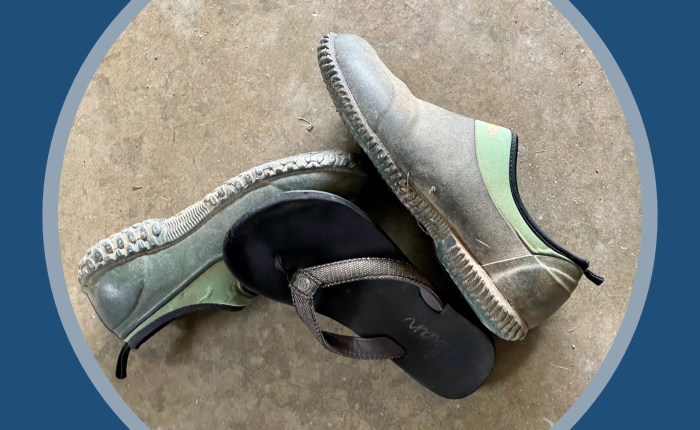
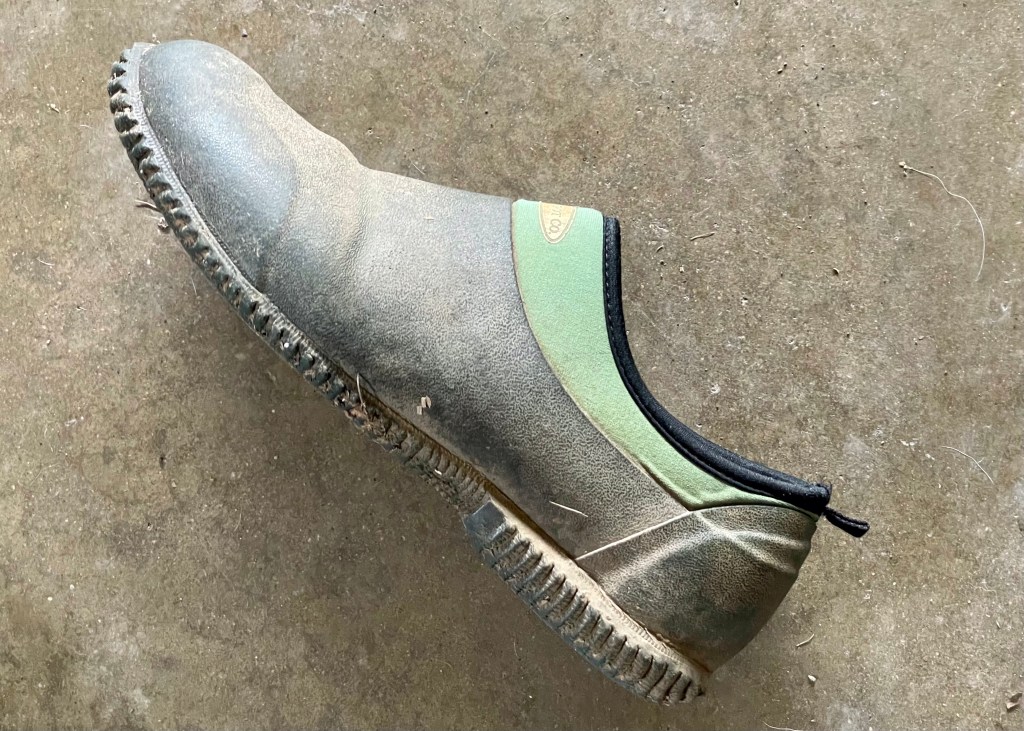
A few days later, one of her muck shoes went missing. Now, Cathy’s suspicions rose up, and she called Kevin and Julie, our neighbors. Kevin, Kylie’s dad answered the phone. “Hey Cathy” – “Hey Kevin – ummmm, is Kylie by chance a shoe thief?” “What kind of shoe are you missing?” “A muck shoe.” “Yep! I found one in the front yard – I thought it was Julie’s!” That’s when we knew Kylie was the thief for sure. Evidently he’d come to play with Carmen, and since she wasn’t there, stole the shoe as a memento of his Carmenless visit. He then took the shoe to his home, which is a quarter mile away. When Kevin returned the shoe, it was a bit strange, as there were no teeth or bite marks on it.

Yes, Kylie is our neighbor’s golden retriever.

The Face of Innocence.

I chuckled about it when it happened to Cathy, and said “There must be something about you he likes.” Then it happened to me – one of my barn shoes disappeared. We looked around the house, the barn and in our backyard. No shoe. Finally, we called Kevin and Julie and asked if they’d seen the shoe. All apologetic, they immediately searched their yard, and no shoe. Kev came to our place and looked around the yard, in the woods, and by the pond (Kylie loves going for a swim in our pond). No shoe. Kevin offered to buy me new shoes, but I said don’t worry about it. These things happen, and I probably needed new ones anyway.

Kylie continued to drop by to play with Carmen, but we started keeping our garage door closed, just to remove the temptation and that seemed to work. I bought new muck shoes and dutifully placed them in the garage by the door.

Carmen and Kylie Playing Together

A couple of days later, I was walking Carmen and we passed Kevin and Julie’s home. Kevin came running out of his garage with a shoe in his hand. He’d found the shoe! Except he hadn’t. This was one of the new muck shoes I’d recently bought! What?! It turns out we’d left the garage door open earlier that morning and Kylie saw his opportunity, and seized it, so to speak.

Safely Returned with No Teeth Marks

We continue to try and keep the garage door closed, and store our muck shoes on a shelf out of reach. It seems to be working. Kevin and Julie continue to work with Kylie to understand the boundaries of their yard. In the meantime, he still drops by to play with Carmen, which she loves. I guess like many fathers, I’m a bit suspicious of her boyfriend’s intent. He’s a great dog – other than the shoe thievery thing. 😉

Hey Mr Hall! Can Carmen Come out to Play!?

Cathy and MS

Cathy and MS

My wife, Cathy, has had Multiple Sclerosis (MS) since 1976 when she was 20 years old. It’s been almost 47 years since that first diagnosis. The MS is always there, lurking in the background, but Cath refuses to give in to it. It’s a special strength she has, and I love her for it.

Cathy Around the Time of her Diagnosis, and Just a Few Weeks Ago

MS is called the snowflake disease; no two people have exactly the same symptoms, or frequency of occurrence. MS symptoms can include: trouble walking, fatigue, vision problems, numbness, muscle spasms, weakness, mobility issues, and bladder or bowel issues, among other problems. Not all symptoms are visible.

Cathy’s symptoms have varied over the years, but fortunately for her (and us), she has been relatively stable for the last few decades, with only some minor issues. Compared to many with the disease, we are extremely lucky.

We both belong to a Facebook MS support group called We’re not drunk, we have MS. The name is a bit of an inside joke. Many people who have MS but can still walk, sometimes have an unsteady looking gait or trip easily, not unlike someone who’s had a few too many drinks.

Recently someone put a query out to the group: “If you were to wake up tomorrow MS free, what is the first thing you would do?” There were many responses. Reading through them, I thought they expressed how the disease effects so many people much better than anything I’d ever read or watched on TV about MS. It’s the straightforwardness and simplicity of the answers that is their strength. People were just asking for the basic things in life that so many of us take for granted.

Here are some of their answers to the question “If you were to wake up tomorrow MS free, what is the first thing you would do?”

  • Walk normal
  • Stand
  • Run
  • Walk
  • Dance
  • Stand up, embrace my husband, and not let go for a long time
  • Go Skiing
  • Ride my horse
  • Go for a hike in the woods
  • Dance with my husband
  • Wear heels again
  • Jump out of bed
  • Go for a run – maybe like Forest Gump
  • Ride a bike
  • Hike in the mountains
  • Shoot hoops again
  • Walk on the beach
  • Go horseback riding and then dance
  • Get a full night’s sleep
  • Play tennis again
  • Walk through my neighborhood
  • Chase my grandchildren
  • Go skateboarding again
  • Run with my kids
  • Stay at a hotel
  • Go up and down stairs
  • Walk, run, dance
  • Drive my car
  • Learn to belly dance
  • Dance in rhythm again
  • Get on the floor and play with my grandchildren
  • Eat out and enjoy every meal
  • Start quilting again
  • Go skating, then dancing
  • Go to my daughter’s home and go up the stairs to see my grandchildren’s room
  • Work in the flower bed
  • Ride a motorcycle again
  • Carry my grandchildren around
  • Rake the leaves in my yard
  • Go back to work
  • Just to consider this is overwhelming
  • Buy a lottery ticket because it would be a miracle
  • Jump in the ocean
  • Walk on the beach with my husband
  • Get on my knees and thank God.

They have newer medicines these days to address the symptoms of MS, and sometimes lessen the progression of the disease, but there is still no cure. In the meantime, these MS Warriors soldier on.

As for Cath and I, we count ourselves pretty lucky in the big scheme of things. She has some issues, and occasional flare ups, but continues to live her life. Every day is something to be enjoyed, and lived to the fullest.

Cathy and I in ‘77, a Year After her Diagnosis, and Last Summer