Dad and Pearl Harbor

Dad and Pearl Harbor

It was December 6th, 1941. Dad, Noble and other men from B Company, 60th Regimental Combat Team of the 9th Infantry Division had weekend passes. They left Fort Bragg, North Carolina that Saturday for nearby Fayetteville. They didn’t know it yet, but the next day their world would change forever.

That weekend, Dad was a little over 18 years old and had been in the Army for about fifteen months. The 9th Infantry Division reactivated in August of 1940, and Dad joined the unit in September of that year, at the age of 16.

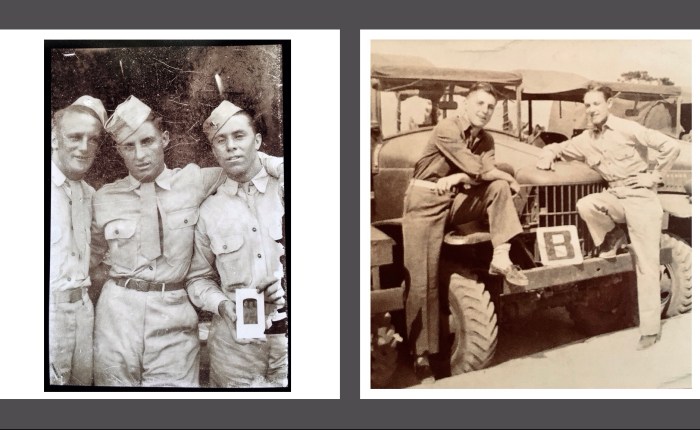
Dad (on the left) in 1941 in the Bravo Company Motor Pool.

In 1940, the population of Fort Bragg was 5,400. One year later, there were 67,000 troops at Bragg and Fayetteville was on the way to becoming a military town, with bars, clubs, restaurants and everything needed to “entertain” the troops, for better or worse.
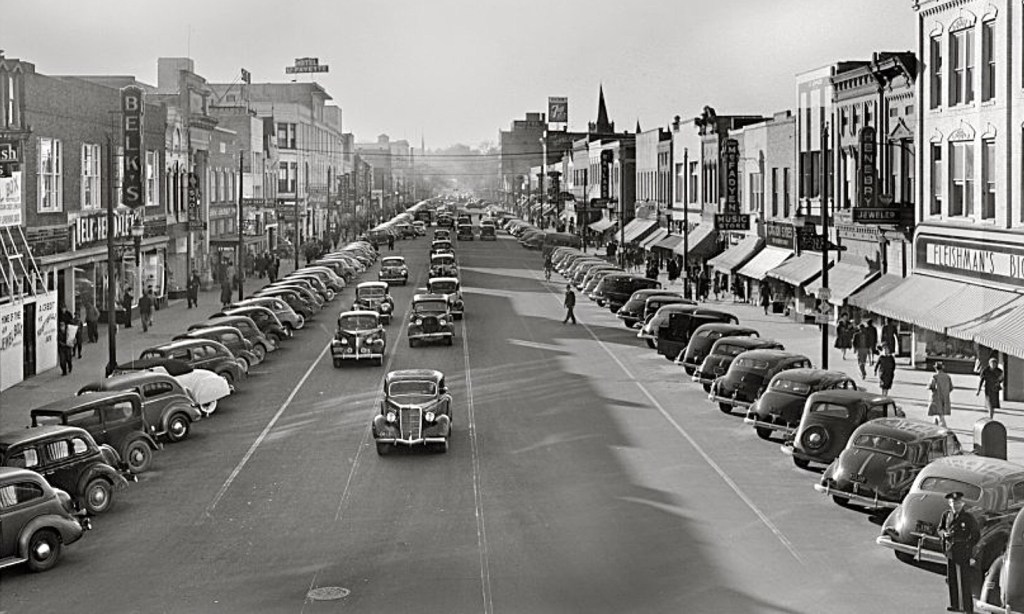
Fayetteville, 1941.

Dad and the other boys of Company B received their weekend passes that fateful weekend and probably left Bragg around noon. Typical weekend passes went from noon on Saturday to 6PM on Sunday. They usually rented a room or two to use as a base for their partying. Over the years, he told me about some of those weekend passes. Real food, beer, clubs, blues, jazz, dancing and trying to link up with girls. They’d party into the night, and then the next day, after a big breakfast, party some more until they eventually returned to Post. I heard stories about fun times in North Carolina (Fayetteville and Charlotte) in Tunisia and Algeria, and late in the war back in Washington DC. Let’s just say, Dad knew how to party.

For this particular weekend, he didn’t tell me about any of that. What he talked about was the return to Fort Bragg late Sunday afternoon on December 7th.

Dad and several others were returning to the Post in a cab. I think he said there was a formation at 6PM for accountability purposes, but maybe they just had to sign back in. He and his friend, Noble, had partied it up pretty good and were a bit hungover. As they neared Fort Bragg, two things happened. First, traffic was backed up to drive onto the Post – they were checking IDs or checking IDs more closely than normal. Second – the cab driver turned on the car radio.

By 1940, AM radios were considered a standard feature in automobiles. The stations carried news, some radio shows and music. There weren’t lots of stations, and the programming wasn’t all that varied. This time however, the boys of Company B heard the words that would change their lives. An NBC announcer read the following statement, relayed earlier from station KGU in Hawaii:

  • BULLETIN: We have witnessed this morning the attack of Pearl Harbor and the severe bombing of Pearl Harbor by army planes that are undoubtedly Japanese. The city of Honolulu has also been attacked and considerable damage done. This battle has been going on for nearly three hours. One of the bombers dropped within fifty feet of Tanti Towers. It’s no joke -it’s a real war. The public of Honolulu has been advised to keep in their homes and away from the army and navy. There has been severe fighting going on in the air and on the sea …(There then was an interruption, followed by this) . . . We have no statement as to how much damage has been done but it has been a very severe attack. The army and the navy, it appears, now has the air and sea under control.

There is a five-hour time difference between Honolulu and the East Coast. The attack on Pearl Harbor started at 8AM and lasted about 90 minutes (not the three hours in the news bulletin). That means the attack ended about 9:30AM Honolulu time, or 2:30PM East Coast time. The Honolulu station was somewhat delayed in reporting the news, and then of course, in the pre-internet age, it took longer for stations in the Continental US to pick up the bulletin and rebroadcast it. My guess is Dad, Noble and the other guys were hearing this news around 4:30PM or so that afternoon.

What did they do at this point? Wait in the cab to drive onto Fort Bragg? Get out of the cab and run onto Fort Bragg? Leave the cab and start talking with the other gathering soldiers? None of those things happened.

Instead, they directed the cabbie to make a U-Turn and drive back to Fayetteville. They were going to hit the bars again, even though they would be Absent Without Leave (AWOL) and miss the evening formation. They knew instantly this was going to be a shooting war, training was going to get tougher and opportunities to leave Post become slimmer. They weren’t going to miss this chance for a last shebang.

Dad and Noble in ‘41 or Early ‘42 on a Different Weekend Pass.

And of course, when they returned to Fayetteville, they weren’t alone. Soldiers were everywhere drinking and partying. I think Dad said he thought half his battalion was in town. They joined the crowd and partied into the evening. There was a great deal of talk about when and where they would deploy.

Eventually, they returned to Bragg late that night. According to Dad lots of guys had hangovers at morning formation on Monday, December 8th, but nothing was really done about them missing the evening formation. There was too much work to do.

On the evening of the 8th, President Roosevelt gave his famous “A Day which will live in Infamy” speech to a joint session of Congress. The speech was broadcast live by radio and attracted the largest audience in American radio history, with over 80% of Americans allegedly tuning in to hear it.
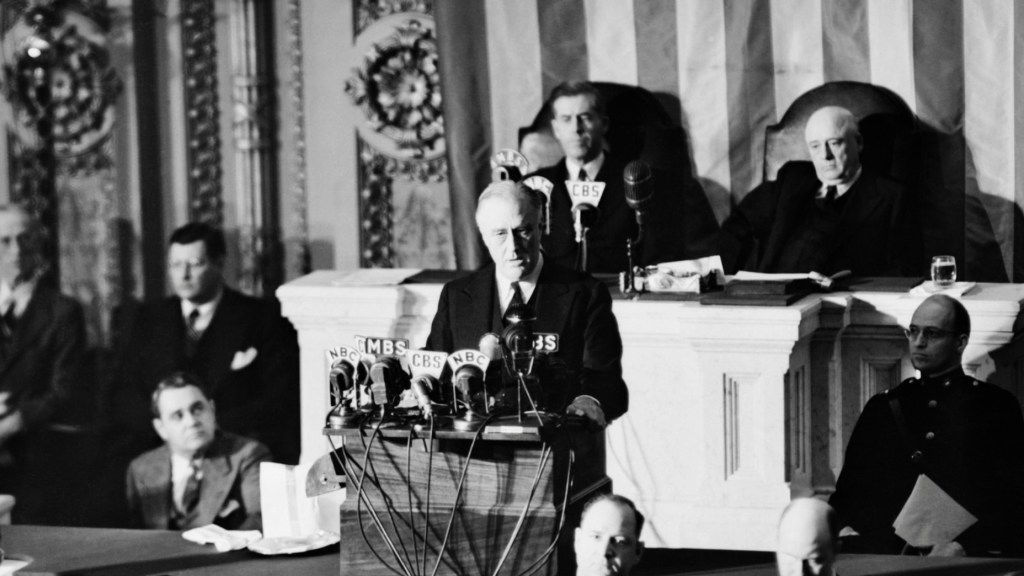
President Roosevelt Speaking to Congress on Dec 8, 1941.

Eleven months to the day later, on November 8th, 1943, the men of the 60th Regimental Combat Team, including Dad and Noble, landed on the beach under fire in North Africa at Port Lyautey, Morocco as a part of Operation Torch. The counteroffensive had started against the Axis powers in the European Theater of Operations.

When dad joined the Army in 1940, it was for a three-year hitch. It would be 5 years before he was honorably discharged in August of 1945. He took part in the invasions of North Africa and Sicily, where he was wounded and almost died. I think partying several extra hours on the evening of December 7th was probably justified.

Never Forget

Addendum:

  • In 1940, the population of Fort Bragg was 5,400. By the following year, it reached 67,000. Various units trained at Fort Bragg during World War II, including the 9th Infantry Division, the 82D Airborne Division, the 100th Infantry Division, the 2nd Armored Division and various field artillery groups. The population reached a peak of 159,000 during the war years. This past year, Fort Bragg was renamed Fort Liberty.
  • Here is one other Pearl Harbor blog I’ve done: The plaque is only a small one, over in front of The South Ottawa Town-Hall on 1st Avenue. The Hall is still used for occasional meetings, but 1st Avenue is pretty sleepy in that area, so I don’t know how many people actually ever see the plaque. When I walk by, the words always compel me to stop. And think. And remember … Herman Koeppe was 19 the day he died […] https://mnhallblog.wordpress.com/2016/11/30/never-forget/
Developing A Wine Palate

Developing A Wine Palate

Do you know the best way to develop your wine palate? Drink more wine. I believe Cath and I have that covered. We began drinking wine together (legally) in 1974 when she started working for the FBI in DC. Seriously. We’ve had more than a couple of bottles together in the past fifty years.

After Cathy moved to DC in 1974 to work for the FBI, I’d visit from West Point for the weekend. If we were doing a “special” night out, we’d always order a bottle of wine. I think we felt more like adults. Now mind you, neither of us owned a car, and metro wasn’t here yet. We’d take a bus from her apartment to Old Town Alexandria and usually go to The Wharf, one of the nicer restaurants in town. After a seafood dinner and bottle of wine, we’d dutifully wait for the bus and take it back to her apartment. ;-). A taxi was out of our price range.

Our real wine education came after we married and were stationed in Germany in the ‘80s. Yea, we drank a lot of good German bier, but we drank our fair share of wine as well. Not only dry German and Austrian whites, but also French, Spanish or Italian reds when we traveled to those countries. Spending nine years in Europe significantly broadened our exposure to what wine could be.

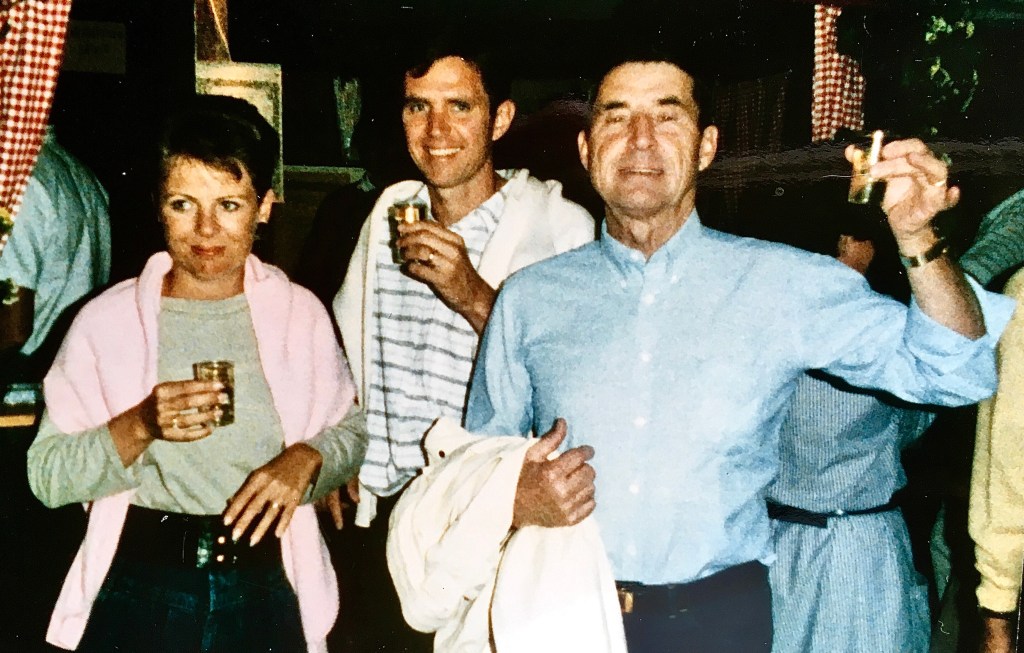
Cath, Dad and I at a Weinfest in Germany around 1987.

Returning to the States in ‘89, we discovered California wines, which we’d pretty well ignored before then. Cabs, Merlots, Zins and eventually Pinot Noir’s – Our taste buds grew once again and sometime in the ‘90s we installed our first wine rack, which held about 110 bottles.

After moving to the farm in ‘99, we renovated the kitchen around 2005 and put in a wine cooler – we could store 250 bottles in it, which seemed like a pretty reasonable number. Except it wasn’t. And so…

In 2011 we discussed putting in a wine room with a separate chiller. To be honest, I think Cathy was feeling a bit guilty about the money we were spending on her horses and she readily agreed we needed a cellar. Of course, she would benefit from the cellar as well. And so, we bit the bullet and installed it.

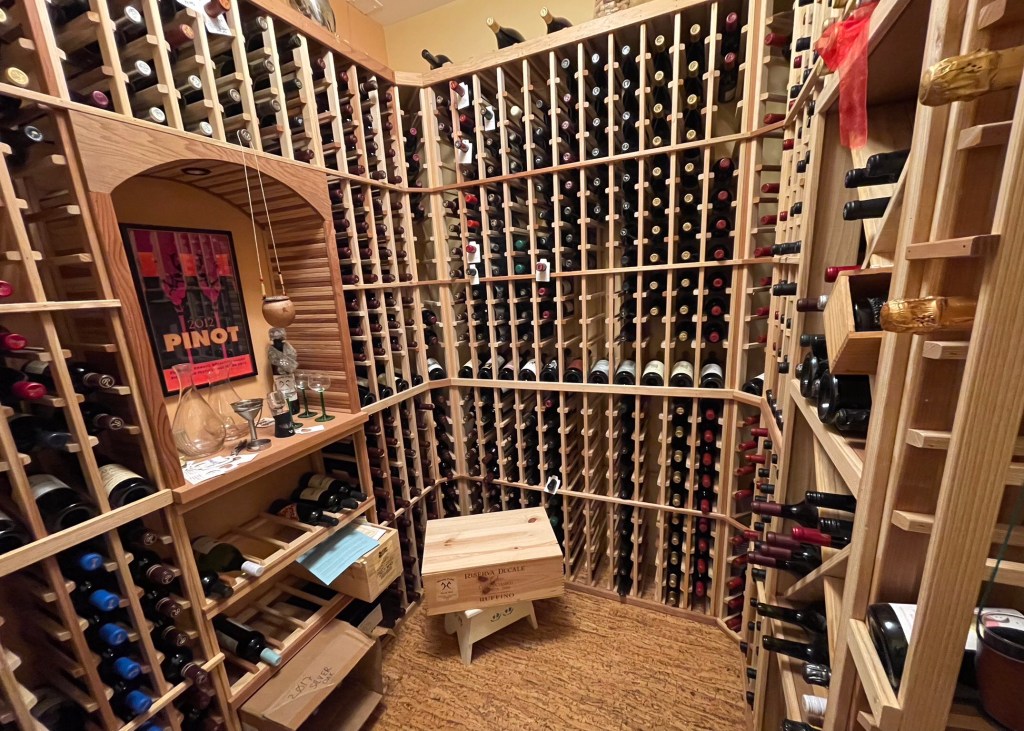
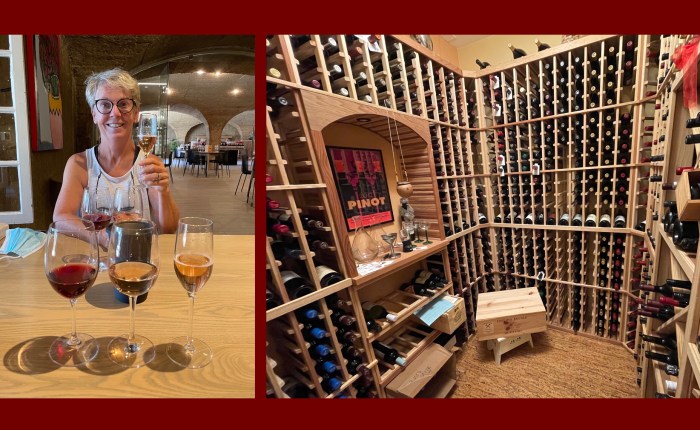
The Wine Cellar – Not quite at Capacity.

Our cellar holds around 950 bottles, although if you wanted to stack cases on the floor, you could add another 200 or so. I’d point out this is a drinking cellar. This isn’t a cellar for storing trophy wines. Everything in the cellar is meant to be consumed … over time. It’s stocked to our tastes. You’ll find sparkling wines, Virginia wines from a couple of our favorite vineyards (Linden and Glen Manor); California Pinots, Merlots, Cabs, and Zins; French, Italian, Sicilian, Spanish, South African and Portuguese reds; whites from a number of locations in the States and France; and some dessert wines. There’s a bottle of Georgian wine in there somewhere (the country, not the state). There are a couple of bottles from the late ‘90s, and then probably just about every year from 2000 to the present. We like the cellar and we like the inventory. We enjoy putting a dent in it with friends.

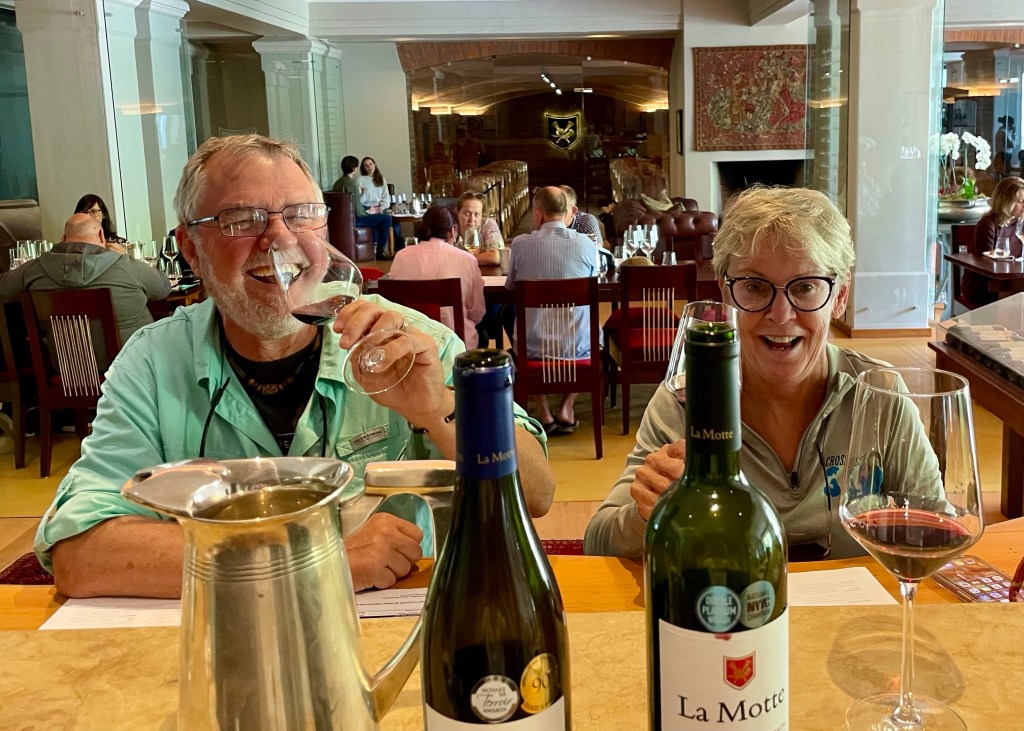
Wine Tasting in South Africa.

Now here’s the funny part. Although the cellar is ostensibly mine, Cathy has a palate that blows mine away. She’s much better in blind tastings at guessing the grape and where the wine is from. She recognizes the flavors and can talk about them. And if a wine has turned bad or is corked? She can tell just by smelling the wine before she’s even taken a sip. These days, when we go out to dinner and order a bottle of wine, I usually just tell the waiter or sommelier to let her taste the wine. She’s really good.

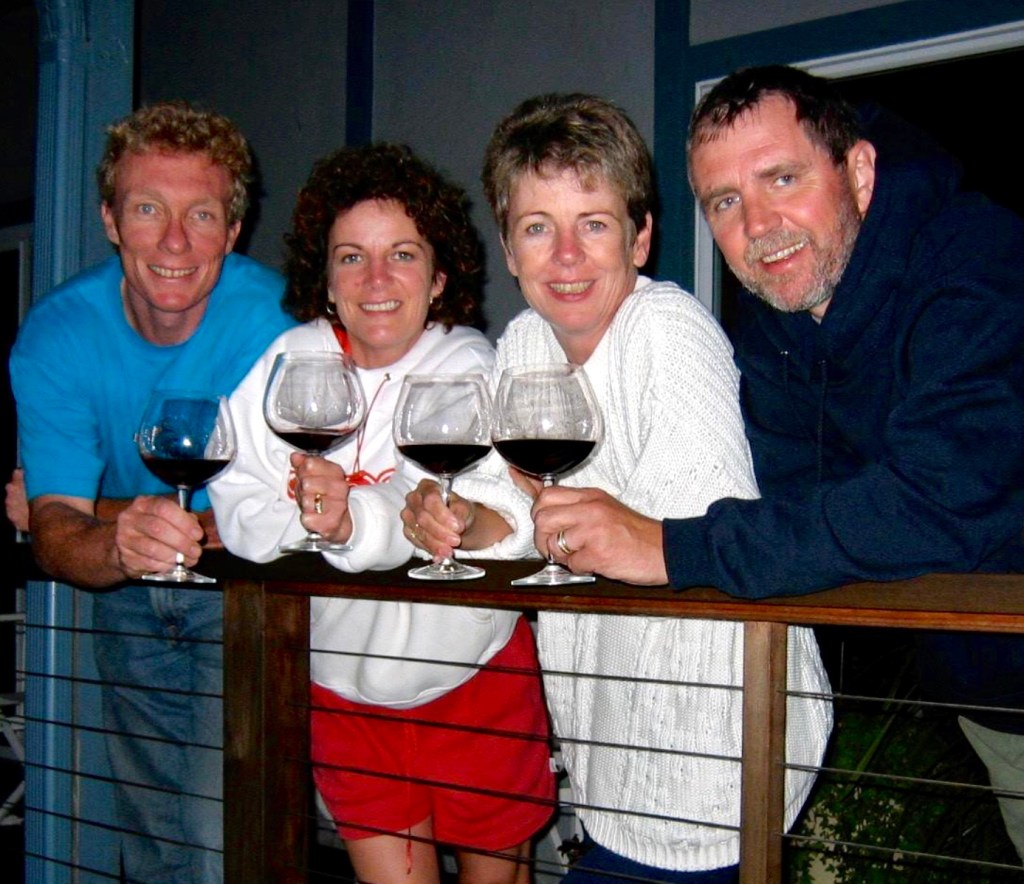
I suppose we’ve consumed thousands of bottles of wine over the last fifty years – at home or in restaurants; on picnics and vacations; at wineries; and of course with friends and family. There are lots of good memories associated with those bottles and gatherings.

Good Memories. Always.

In vino veritas”, is a Latin phrase that means “In wine, there is truth”. The truth is we are still improving our palates, one bottle at a time.

Cathy says life is too short to drink bad wine. I think I agree.

The Bears Den

The Bears Den

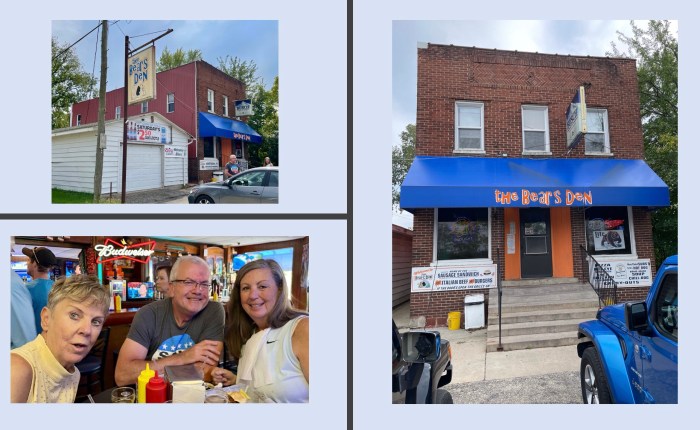
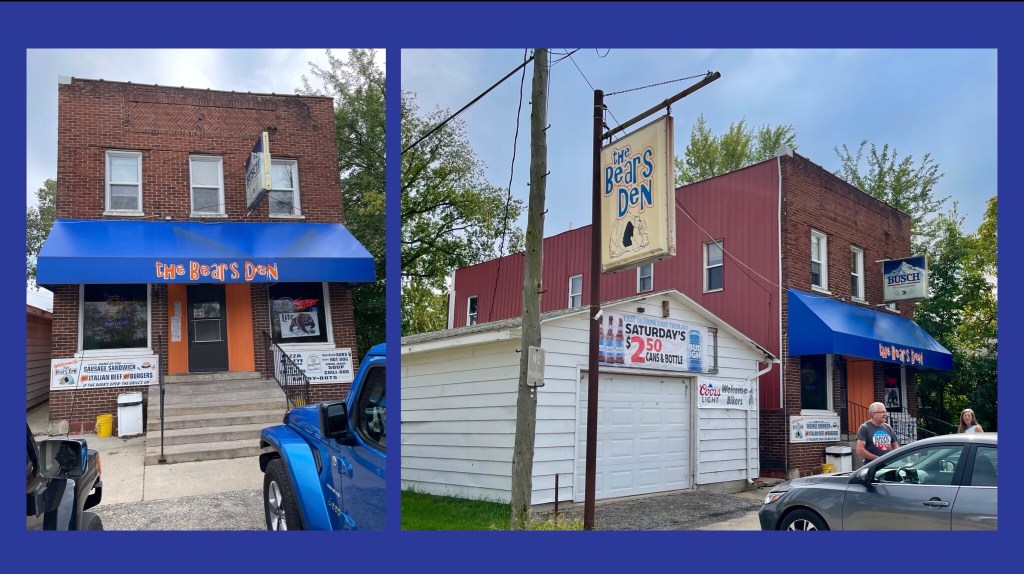
The Bears Den in Naplate, Illinois is a great little dive bar. I mean that in the best sense of the word. It’s an older place and hasn’t been updated in years. On a recent trip back home to Ottawa, we stopped in on a Sunday afternoon for lunch and Bloody Marys. We all should have such a good local place.

Naplate, a town of just over 400 people, probably has more restaurants and bars per capita than any town in America*. They are all small local places. Some more bar oriented, and some more food oriented. All have their devoted fans and regulars from Naplate, or the surrounding area. Over the years we’ve enjoyed several of them, including Casa Mia, Annie’s Hideaway, and of course, The Bears Den.

The Bears Den – It’s Been Around Awhile.

A few years ago, a really bad tornado ripped through Naplate and parts of Ottawa and Naplate were destroyed. Although Naplate restaurants were ordered closed in the immediate aftermath, The Bears Den stayed open providing food for the folk doing the cleanup and damage control. They were giving back to the community in a big way.

A couple of weeks ago we were back in Ottawa to see family and go to a reunion. We spent Saturday night with my sister Tanya and Brother-in-Law Shawn and on Sunday morning were discussing what to do. Cath previously mentioned possibly going to The Bears Den for Bloodies, and we all quickly agreed that was a great idea. It had been a few years since we were able to stop in there and we were looking forward to a good time. Shawn, the smart one among us, checked to see what time the Bears were playing that day. When they are on TV, it’s standing room only at the Den, and we wanted to avoid that. Fortunately, the game didn’t start until 3PM.

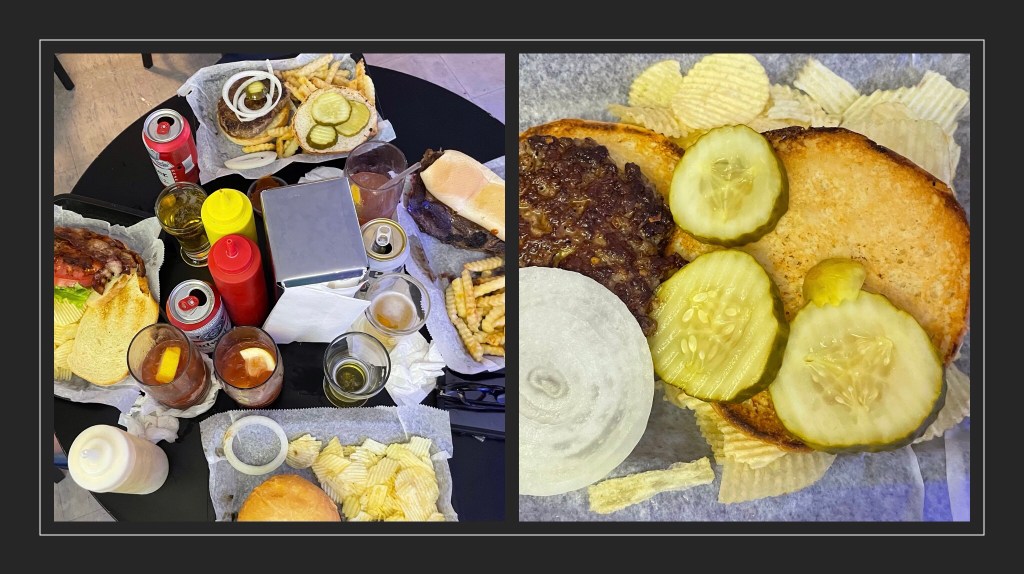
We arrived just after noon and easily grabbed a table. Several people were there, but it wasn’t crowded. The Packers were on TV, so there were both cheers and catcalls, depending on what was going on. The waitress came over and we ordered our Bloodies with sidecars. In Illinois (and maybe across the Midwest) a sidecar is a small beer, typically 7 ounces, to go with your Bloody Mary. At the Bears Den, they brought you a can of beer, and a 7 ounce glass. On Sundays, they have “build your own Bloody Mary” for $3, but we opted for the bartender to make ours.

Lunch at The Bears Den with Tanya and Shawn.

Drinks arrived and the Bloodies were as good as we remembered. Our waitress asked what we would like to eat. For me, there was only one thing to order – their Sausage Sandwich. You can have it with peppers, or cheese, or any number of other combinations, but I just ordered it with pickles and onions. It’s like a burger, but made with 1/2 pound of sausage instead. As my buddy Howard says “It rivals the pork tenderloin**as the best area sandwich. The difference? You can order the tenderloin at lots of places, but only The Bears Den has the sausage sandwich.” Shawn also ordered one, while the ladies opted for a BLT and a ribeye sandwich. One of the great things about The Bears Den is they have a decent menu, especially considering the small size of the place and the size of the kitchen.

The food came, and all I can say is, man, I love that sandwich. It was sooooo good. Yea, it didn’t help my cholesterol any, but that’s OK. In fact everyone’s sandwich was good. I think Cath’s BLT was the biggest I’d ever seen, and Tanya’s Ribeye sandwich was great. The table grew quiet for a while as we concentrated on our food. Eventually, we ordered a second round of Bloodies and Shawn had another beer.

Good Food All Around, but Man That Sausage Sandwich!

At some point, our nephew and niece Casey and Ann stopped by with their kids and we were able to catch up with them for a bit, but eventually, it was time to go. Hugs all around in the parking lot, lots of I love you’s, and we headed south to my sister Berta and her husband Jack’s place.

I know it’s a bit crazy to write about a dive bar in the middle of Illinois, when we don’t even live there anymore. Still, it’s good to have things and places you know you can count on. The Bears Den is one of those places. If you are ever near Naplate, I highly recommend it.

Addendum:

  • The “Bears Den” has no apostrophe in it, and I have written it that way throughout this blog.
  • * My friend Howard Johnson notes that Naplate was a factory town (the former Libby Owens Ford, now Pilkington,). The shift workers all converged on the Naplate bars when their shifts ended, keeping them busy 24 hours a day back in the day. That’s a big reason such a tiny village has so many bars.
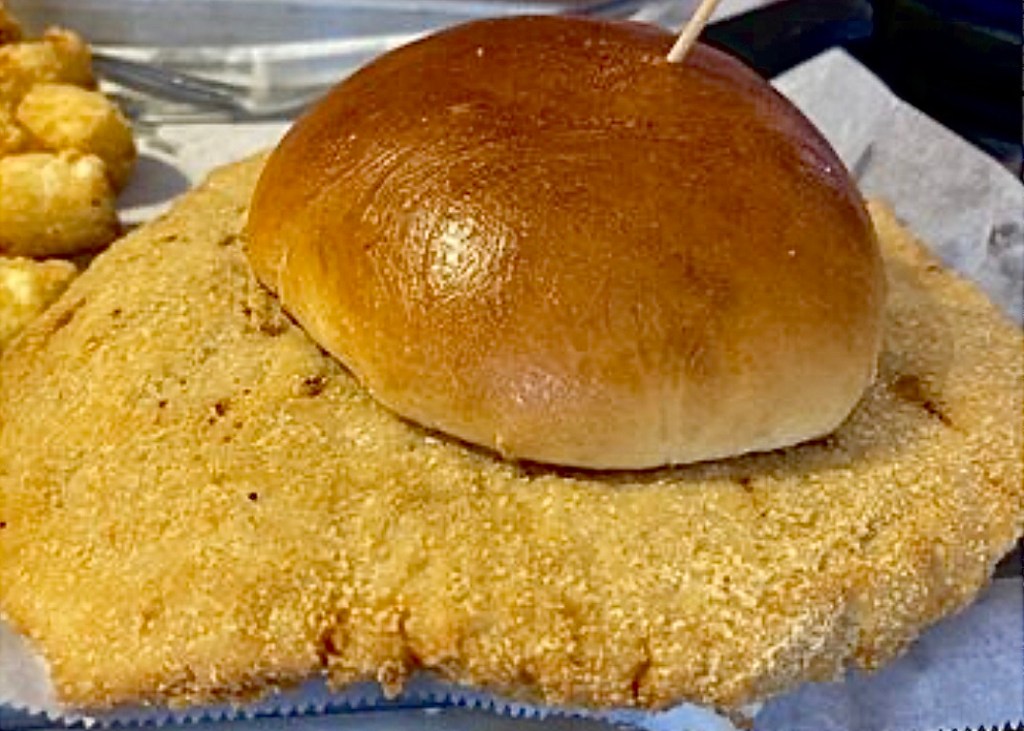
  • ** One of the great meals you can find in the corn-belt of Indiana, Illinois and parts of Iowa is a breaded pork tenderloin sandwich. They are crazy good and something that many people who move away from the area crave, and always have when they return to Ottawa. If you are closer to Chicago, or in Wisconsin, an Italian Beef Sandwich is just as loved.
Pork Tenderloin Sandwich at The Court Street Pub in Ottawa.
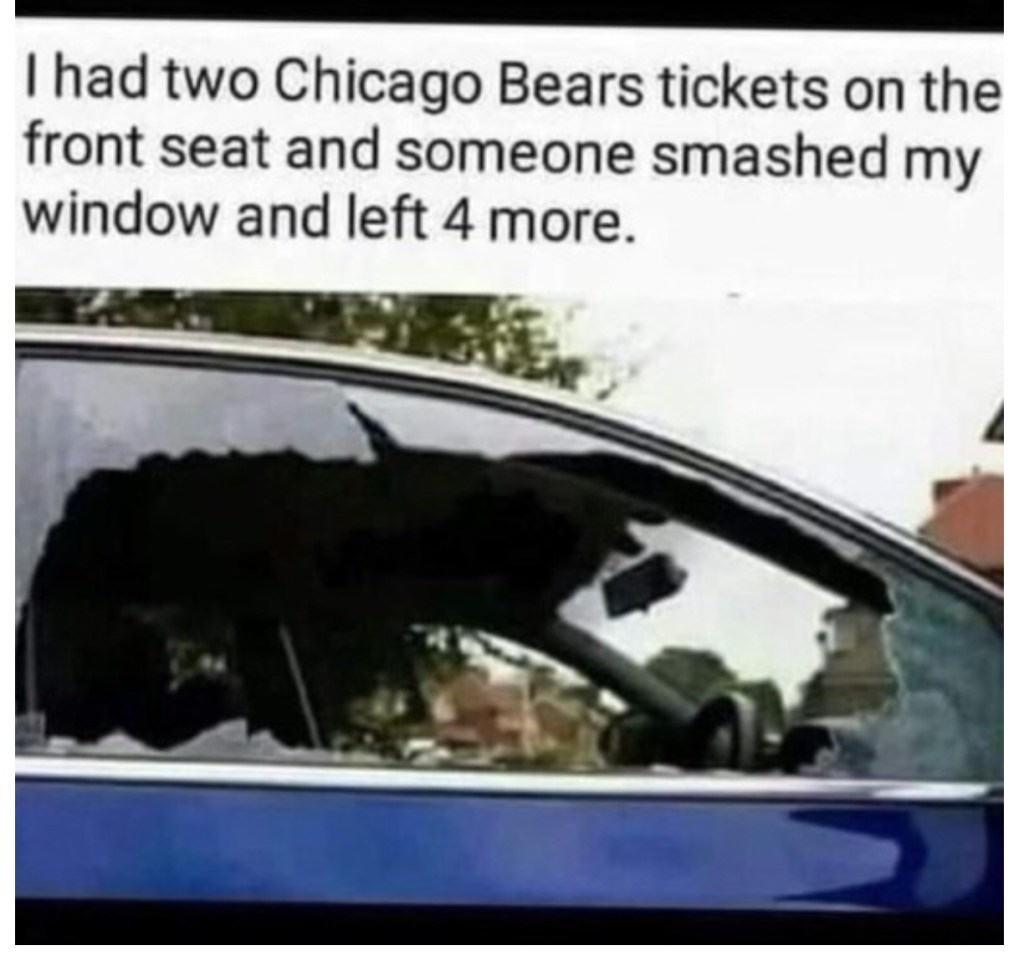
  • The Bears are having a rough stretch in football lately and lost 14 straight games before beating the hapless Commanders last week. The Bears Den remains crowded for their games. In general, the fans are still loyal, but getting restless. One of my buddies, Mark, a diehard Bears fan, sent me this meme after I mentioned we were at The Bears Den for lunch:
Heeheeheehee

Illinois Militia – 1984

Illinois Militia – 1984

In 1984, Cath and I were back home in Ottawa for her 10-year high school reunion. I was waiting in line for a drink when a guy approached me. “Hey, aren’t you Max Hall? Didn’t you go to West Point?” I answered, “I am and I did. Why do you ask?” “I’m Joe xxx. We would love to have you come talk with our local militia.” What?

I was a Captain in the Army at the time and had recently returned from four and a half years in Germany with 3ID and VII Corps. Cath and I were stationed in Ohio and returned to Ottawa for the weekend of the reunion.

Me, About the Time of the Encounter 1984 or ‘85.

Me: “Sure. Where’s the National Guard meeting these days, and what kind of unit is it?”

Joe: “Oh no. We aren’t with the National Guard. We started a private group as a militia. We fire our guns on weekends and do some tactical training. We want to be ready to fight the communists.”

Me:

Joe: “It would be great if you came out to meet with us and give us a talk. I think you could provide some real inspiration!”

Me: “Really?! Where do you all meet?”

He gives me a location south of town in the country.

Me: “Hmmmm. That’s great, but rather than meet there, I think we should meet on LaSalle Street, not far from Bianchi’s Pizza.”

Joe: “Really? Why there?”

Me: “We could go the Army recruiter’s office on LaSalle Street and get you guys signed up. We are always looking for a few good men!”

Joe: “What?!”

Me: “We could meet at the Army recruiter’s office. We are always looking for a few good men to enlist. If you really want to fight the communists, we could use you. I’ll be deploying back to Germany in a year. We could probably even work it out for you to join my unit!

Joe:

Me: “That’s what I thought. See you later and quit bothering me… Bartender – I’ll have a gin and tonic please.

Yep. Those militia toy-soldiers who always say they are going to defend our country were around 40 years ago as well. They are still eager to play soldier these days, as long as they don’t have to do anything to, you know, actually defend our country as a soldier.

*** Feel free to share this blog. ***

Addendum:

  • I don’t recall Joe’s actual name. I just remember that he was in Cathy’s class and I knew him some from high school.

Tim and Bobby’s Visit

Tim and Bobby’s Visit

In the ‘80s when we lived in Germany, several family members and friends visited us. To “help” them overcome jet lag, we made sure the first couple of days were action packed with eating, drinking and activities to keep them occupied. It almost proved one friend’s undoing in 1987.

Our old friend Tim visited us several times while we were stationed in Germany. In 1987, he asked if he could visit and bring his friend/work buddy Bobby along. They planned to visit us, and then tour parts of Germany, Austria and Northern Italy, eventually arriving back in Germany for Oktoberfest in Munich. We of course said yes and looked forward to their arrival.

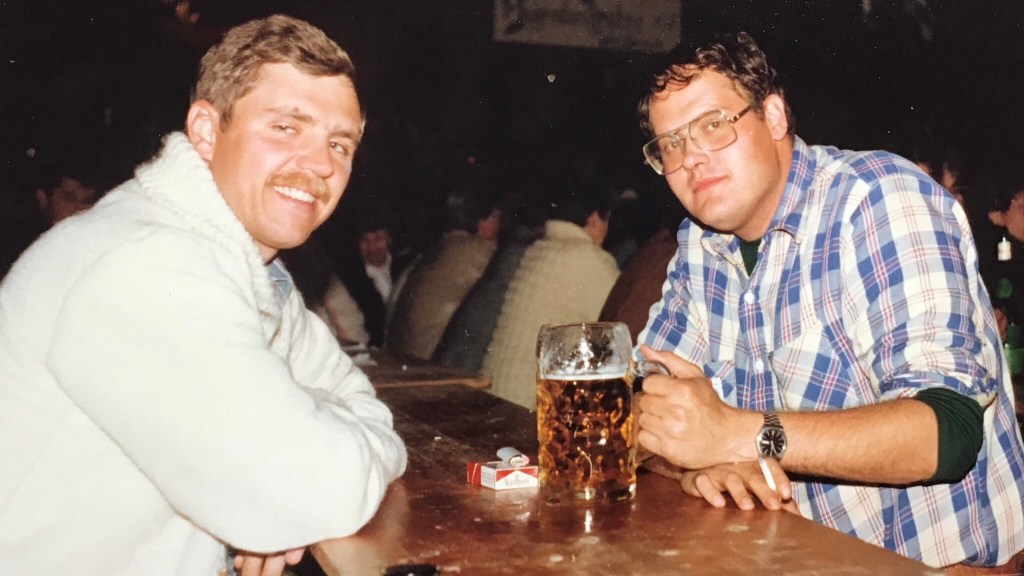
Tim and I at a Bierfest during a different visit.

They flew to Dusseldorf one morning in September and then took the train to Worms where we picked them up. Tim recently recalled the train paralleling the Rhein River for part of the trip, when all of a sudden the train shook a bit. He looked out the window and saw two F15s flying low, following the path of the Rhein as well.

After arriving at our home in Rheindürkheim, we ate lunch. Tim and Bobby may have slept for a couple of hours, although I don’t remember for sure. Later, we gave them a tour of town and walked along the Rhein River. That night, we went out for dinner at a local Gasthaus (pub) called Sportheim. We knew the owners, Vroni and Wolfgang well, and Tim knew them from a previous visit. It’s safe to say they greeted Tim like a long lost relative. It was a great evening and Bobby joined right in. We spent several hours at Sportheim and after many biers and wines, eventually made our way home. We may have drunk a brandy or schnapps, before making our way to bed and a good night’s sleep.

The next day, amazingly, none of us were the worse for wear. After a hearty breakfast with some good German bread, sausages and cheese, we drove around to show Bobby the area. We went into Worms, the city where Martin Luther made his famous statement “Heir stehe ich” (here I stand) before the Imperial Diet in 1521. Basically, it’s where and when Protestantism started.

That evening, we had a special treat in store for the guys. The Rheindürkheim Feuerwehrfest (Fire Department Festival) was going on in town. There were about 1,000 residents in Rheindürkheim and a majority of the adults would be at the Fest. It was a classic German wein festival with a huge tent, oompah band, dance floor and lots of adult beverage.

We made our way to the fest, found some local friends and settled in. Of course we drank our share, and ate brats and other German food, such as curry wurst or roast chicken. We also listened to the music and took turns dancing with Cathy and some of the other ladies in our group. It was a great time. Eventually it was getting late, and the fest was coming to an end. We were going to head home when one of our German friends, Michael, told me several people were going to an after party at the Zenit, basically a local Navy VFW club and wanted to know if we wished to join them. I’d been to Zenit several times and immediately said yes. For Tim and Bobby, it’d be an even greater look at the local culture. Cathy, always the wisest of us two, declined and said she was going home. We left the fest and after dropping Cath at home, walked to Zenit.

Now Zenit was actually a dry-docked ship that was turned into a club. Rheindürkheim, was on the Rhein River and traditionally, most young men of the town served in the Navy instead of the Army. That’s why their “VFW” club-equivalent was in a ship.

The Zenit in Rheindürkheim

As we arrived, we made our way to the bar and bought a couple of biers. I nudged Tim and pointed out a picture hanging in Zenit. Tim’s a history major and I thought his eyes were going to bug our when he saw who it was – Admiral Karl Dönitz*, supreme commander of the German Navy during WWII. Dönitz also took over the German government after Hitler killed himself and it was he was who actually surrendered to the Allies in May of ‘45.

We had a good time at Zenit. The party was eventually winding down when our friend Hans approached me. He and his wife Inge were having an after-after party at their home and wanted to know if we wanted to stop by. Their home was actually on the way back to our house and I again immediately said yes. We joined a group of 15 or 20 people and dutifully walked or stumbled to Hans and Inge’s house.

At Hans and Inge’s there was no oompah music. What was playing on the stereo was the soundtrack from the movie “Dirty Dancing”, released earlier that year. I remember chuckling about it at the time.

I believe they served coffee and dessert for those who wanted it. I also distinctly remember Inge walking around with a bottle of homemade schnapps and pouring people small glasses/shots. Schnapps in Germany is nothing like the sweet stuff we think of as schnapps here in the States. It’s similar to Italian grappa or French marc and can definitely have a rough edge to it. She asked if we wanted some and of course we all said yes. Bobby didn’t yet know about real schnapps. We all toasted with a “Prost”. Bobby took a small sip and may have actually turned green. He looked around and saw a nearby plant, where he discretely poured the remainder of his schnapps.

A bit later, Inge came back by, saw Bobby’s empty glass and refilled. It. At that point Bobby looked at the glass and then leaned into Tim and said, “Tim, I don’t know that I can do this for the whole two weeks.” ;-).

We left a short time later and walked the 3 or 4 blocks home and immediately went to bed.

The next morning, everyone was moving a little slowly and there were probably a couple of hangovers among us, or at least there should have been. I also know this – Tim and Bobby were no longer suffering from jet lag. ;-).

They would leave us a day or two later and head south by train. We linked up with them in Munich for Oktoberfest about ten days later and they told us tales of their travels and the good times they enjoyed. At Oktoberfest itself, other than Cathy throwing her shoulder out on a rollercoaster ride with Bobby (another story, and no, alcohol wasn’t involved), we had a grand time.

Addendum:

  • * Dönitz was the architect of the German U-boat campaign during WWII. He was by his own admission, a dedicated Nazi and supporter of Hitler. Following the war, he was indicted as a major war criminal at the Nuremberg trials on three counts: conspiracy to commit crimes against peace, war crimes and crimes against humanity; planning, initiating, and waging wars of aggression; and crimes against the laws of war. He was found not guilty of committing crimes against humanity, but guilty of committing crimes against peace and war crimes against the laws of war. He was sentenced to ten years’ imprisonment. After his release, he lived near Hamburg until his death in 1980.
  • Here’s another story involving Tim and Germany – In 1986, we found a way to ship a Keg of German bier from a Monastery, home in a transport plane: https://mnhallblog.wordpress.com/2019/10/09/shipping-bier-from-germany/
Losing the Landline

Losing the Landline

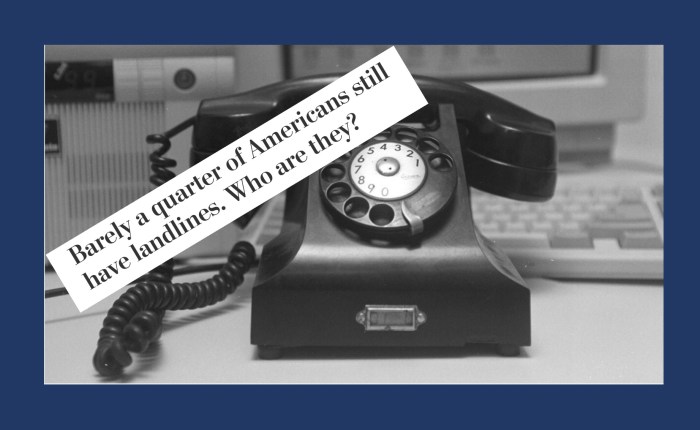
The Washington Post headline screamed out “Barely a quarter of Americans still have landlines. Who are they?” I wanted to shout back, “ME FOR ONE!” Still, I wasn’t really surprised at the numbers. So why haven’t Cath and I taken the plunge? Well, there are one or two downsides to living in the country, which I will get to in a bit.

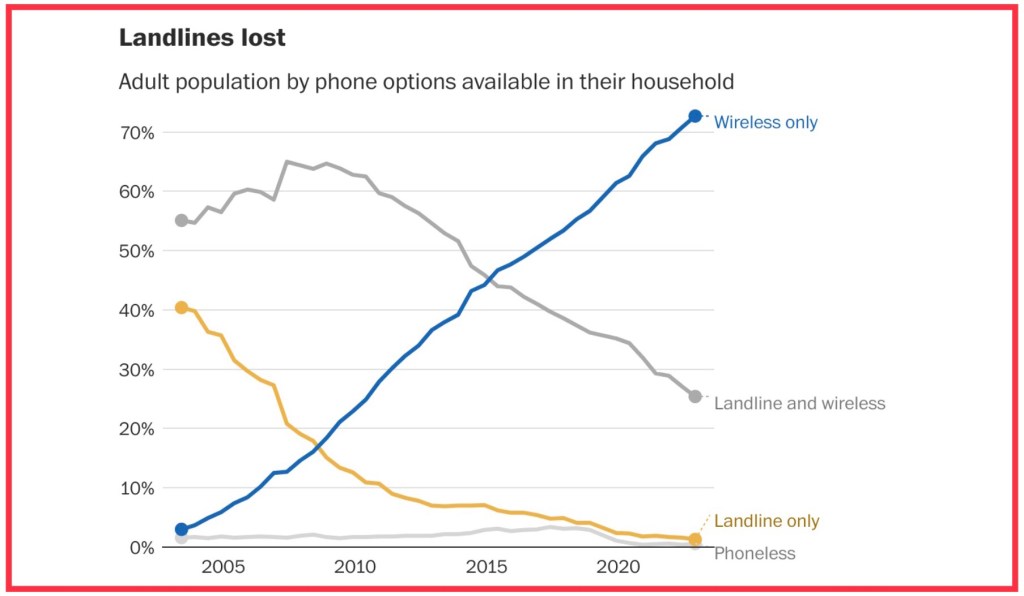
The article was actually quite interesting. It was based on analysis from the National Center for Health Statistics (NCHS) and their National Health Interview Survey (NHIS). The survey takes place on an annual reoccurring basis and covers a wide range of topics, including since 2003, cell phone usage. The change overall is pretty dramatic, as you can see from the chart.

Amazing Changes Since 2003.

Not surprisingly, more older people still maintained their landlines. There were however, a couple of other interesting statistics:

  • Homeowners are more likely than renters to have home phones.
  • Hispanics are less likely to have landlines than blacks or whites.
  • There are minimal differences between men and women on who has pulled the plug on landline service.
  • There are minimal difference based on education level on who has pulled the plug on landline service.
  • 1% of Americans have no phones at all (cell or landline)
Some Interesting Statistics.

Researchers also found that phone usage is correlated with health and health issues, often in surprising ways. From a WaPo interview with Mr Blumberg, the head of NCHS, people who abandon landlines and rely only on wireless — “are generally more likely to engage in risky behaviors. They’re more likely to binge drink, more likely to smoke and more likely to go without health insurance.” That’s true even when researchers control for age, sex, race, ethnicity and income. Yep, you read correctly. That friend of yours who smokes cigarettes and binge drinks is also more likely to have only a cell phone.

So why do Cathy and I currently still have our landline? It’s simple really. We live in the country and at our home, cell service has occasionally been sketchy in the past. There are many cell towers across the county. Unfortunately, we have lived in a bit of a semi-dead zone. A few years ago, I put in an amplifier to strengthen the signal which helps, but provides no absolute guarantees. We’ve wanted to make sure that if we have to make an emergency call, we could do so.

I should also mention that about half the time when someone calls one of our cell phones, they don’t ring. Of course some would consider that a blessing. 😉

Maybe it’s time to cut our landline service. With much better internet service now, we also do Wifi calling, which helps from a reliability perspective. Currently, we pay $103.25/month for our landline, so over the course of a year, that’s a chunk of change ($1239 to be exact).

It’s interesting. Sometimes catalysts come from the strangest sources. As I’m typing this, Cathy and I have spoken and decided it’s probably time to give the landline the Heave-Ho. We may wait a month or so to allow some transition time for a few key notifications, but that’ll be it. We may be a bit late to the party, but we’re there now. When you see me smoking more cigars and my alcohol intake increasing, you will know we’ve pulled the trigger. I guess it’s a good thing I’m now on Medicare.

This “Digital Answering System” will be Going by the Wayside.

Addendum:

  • Here’s a link to the entire WaPo article if you are interested: https://wapo.st/438278B
  • Statistical charts in the blog are from the WaPo article.

Holly and Eve

Holly and Eve

Detective Sam Sullivan looked at the woman’s body and raised an eyebrow. Something wasn’t quite right. The morgue’s Medical Examiner looked at him. “Did I miss something?” Sullivan shook his head and lowered his eye, which, by the way, was killing him from the punch he took two nights before.

No, nothing immediately, but something’s not right. Thanks.

Something Wasn’t Right.

Detective. Who was he kidding? He wasn’t a detective. He wasn’t even a cop anymore. A Private Investigator is what he was now. A PI. A dick. A shamus. Or that bullshit modern term he hated, an Inquiry Agent. Bogie as Sam Spade made it look romantic. In reality, the job was anything but romantic. In reality, all it did for him was pay the mortgage, and it didn’t do a particularly good job at that.

He left the hospital, climbed into his F250 and drove away. The F250, much like its owner, had seen better days. It was rusty and dented, but the engine still worked fine. Actually, better than fine. The truck was from 2002, the last full year Ford put the 7.3 liter V8 diesel engine in the 250 and people were constantly trying to buy it from him. At least no one had tried to steal it. As he left the parking lot, he drove the speed limit. There was lots to think about and he was in no particular hurry to get anywhere.

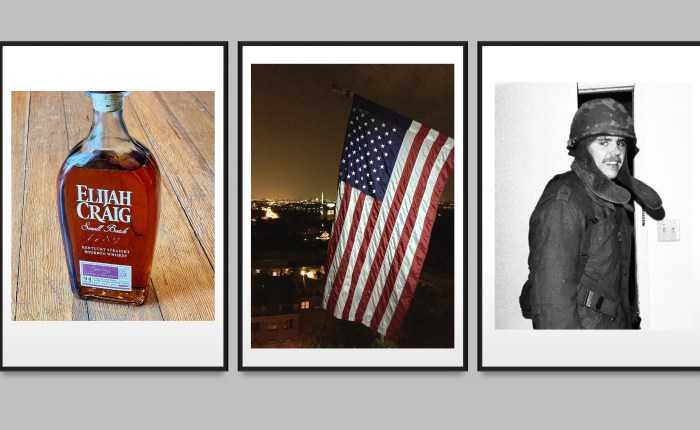
It was late afternoon by the time he reached home. He pulled out the Elijah Craig, poured himself a small glass and grabbed a Gispert. In the old days, he drank Blanton’s, but ever since bourbon had become a “thing” Blanton’s was impossible to find. Nowadays, all the idiot bourbon collectors bought it up as soon as it hit the shelves and drove the price to stupid levels. That’s OK, he thought. Me and Mr. Craig get along just fine. Eventually bourbon as a fad will fade, and we can all go back to normal. He took a sip and walked towards the door.

Out on the back porch, he took another sip and then lit the Gispert. He only smoked a cigar every couple of weeks, and like the Elijah Craig, the Gispert was decent. If you were going to smoke only an occasional cigar, why overpay for the privilege?

No, something wasn’t right, but he couldn’t figure it out. If he hadn’t taken the punch in the bar parking lot two nights ago, he would have agreed Eve’s death was indeed accidental, as the Medical Examiner had decreed. Still, the punch and something about Eve today made him think otherwise. What the hell was different about Eve?

His glass was empty, but half the cigar was still left, so he poured himself another inch and a half of bourbon. This was going to take some time.

He turned it over in his mind. Eve was laying there on the slab, looking pretty as always, but something was off. Her jewelry was missing, but that was to be expected. He started drifting off to sleep and as a dream began, the answer popped into his brain.

His phone rang and brought him out of the light sleep. With that, the answer to Eve’s appearance disappeared like morning mist on a hot day. He looked at the number and answered. “Hello?”

Mr. Sullivan?”

Yes.”

Mr. Robert Samual Sullivan?”

Yes.”

Mr. Sullivan, this is Amy with Doctor Frank’s office. I just wanted you to know your test results came in and are positive. I’m so sorry. We’ll definitely need to schedule the procedure soon.”

He didn’t say anything. Of course it came back positive. Only a fool, or someone with regular good luck would expect anything else.

Mr. Sullivan. Mr Sullivan, are you there?”

Yea. I’m here. Thanks.” He hung up the phone and went into the kitchen for a drink of water.

A voice called out from the bedroom. “Bob, who was on the phone? Is everything OK?” He shuffled into the bedroom and looked at Holly, his wife. She hadn’t been able to leave the bed under her own power since the accident. He couldn’t tell her. Or at least he couldn’t tell her right now. “Nobody. It was DirectTV trying to sell us expanded service.” Holly’s caregiver, Millie, looked at him with dead eyes but he just stared back until she looked away.

He turned around and walked to the couch where he lay down and tried to go back to sleep. No, he was no detective, and he wasn’t much of a PI. He was just one more semi-retired guy, running out of rope. He hadn’t really smoked in a decade, and under doctors orders, had mostly quit drinking the year before, but it didn’t make a difference. His condition had worsened. He’d have to deal with it at some point, just as he would have to tell Holly everything at some point. What a nightmare it had all become. Thirty years together and this is what it had all come to.

The place he mostly smoked or drank now was in his dreams. Maybe if he got back to sleep quick enough, the dream would start up again and Detective Sam Sullivan could help solve the problem of Eve’s death, while having a bourbon or two. Anything was better than dealing with the problems of real life in the real world. Anything.

Addendum:

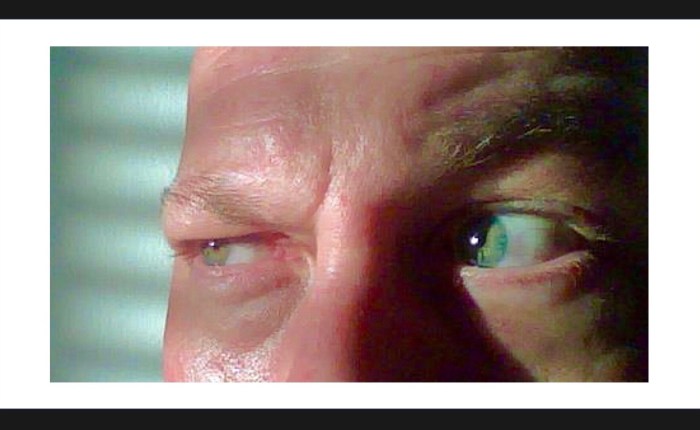
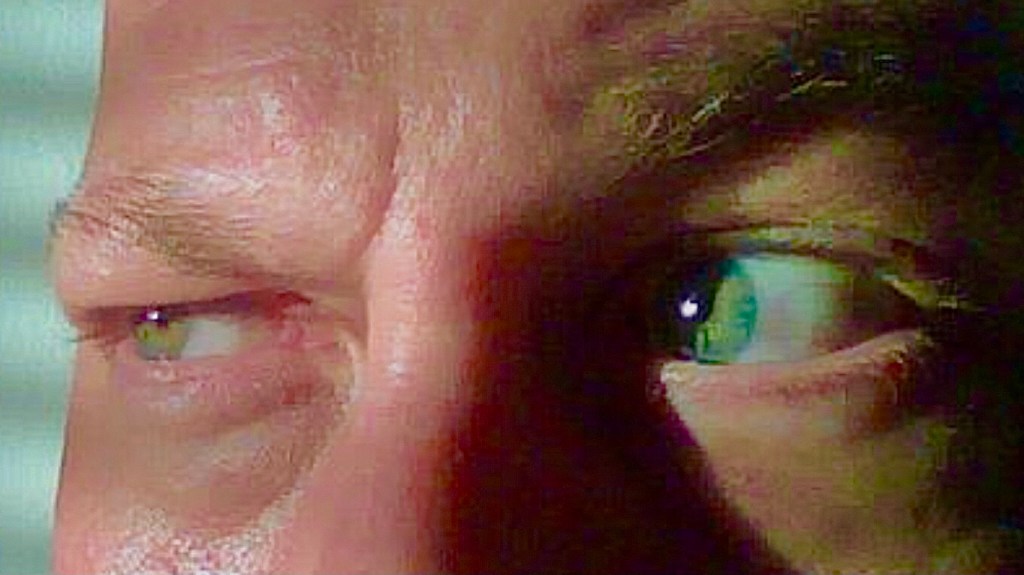
  • This is the first time I’ve written any fiction for the blog (or at all for that matter). My old friend James Sullivan posted a closeup picture of his eyes and I was enthralled by it. I asked him if I could use it for the basis of a story. He readily agreed. At the time I had no idea what the story would be about, and then after a couple of days, this one popped into my brain. Weirdly, it was all inspired by the eyes.
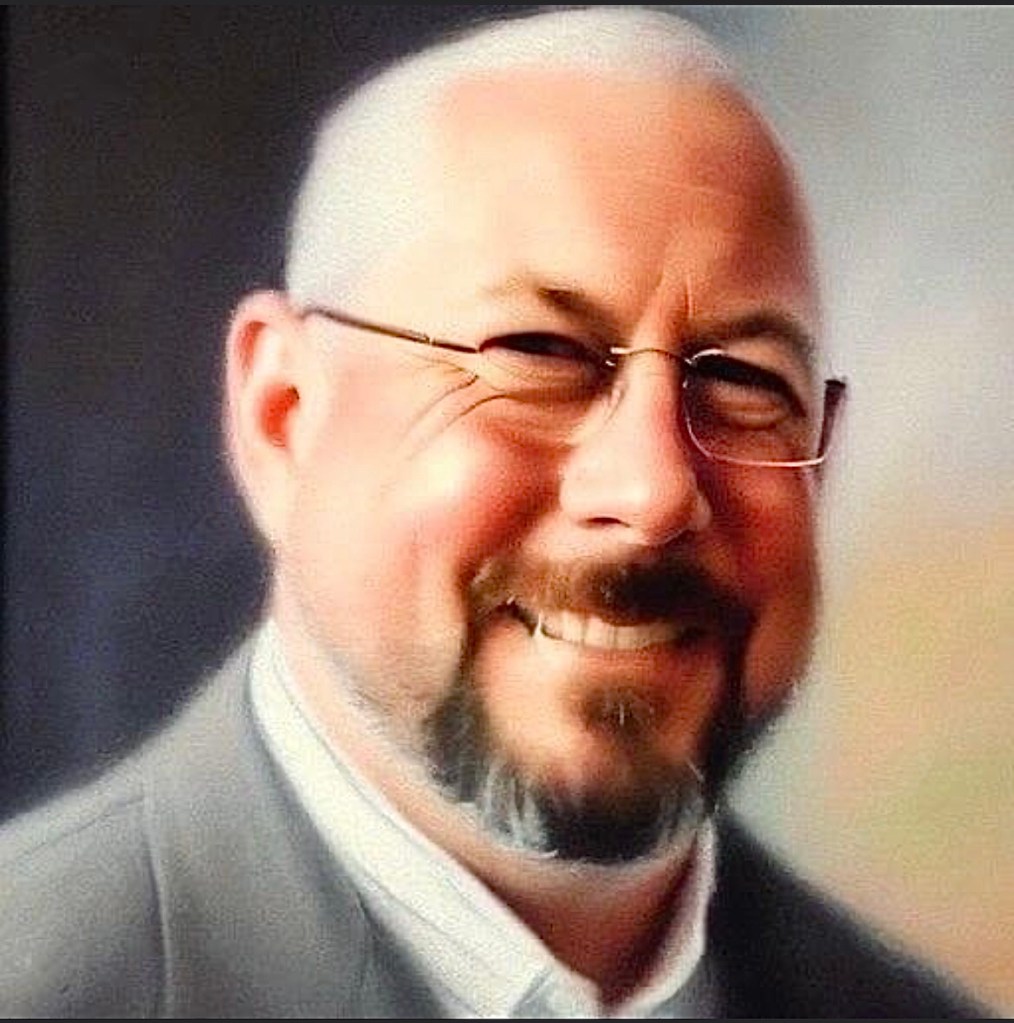
  • James and I worked together years ago at a company called SRA. He’s an Army Veteran, a great chef, works in IT and is a smart and generous person. Other than his eyes, he has nothing in common with Robert Samual Sullivan (that I am currently aware of 🙂 ). Thanks so much for use of the photo James!
James Sullivan – Owner of the Eyes
  • This “short” short story may stop here, or I may continue it. If you have any thoughts either way, leave a comment here, or shoot me an email at: mnhall@gmail.com . If even mildly interested in learning more about Robert, Holly and Eve, let me know. If I were to continue the story, it might happen with an occasional blog, or I may try a different route.

June 14, A Big Day Every Year

June 14, A Big Day Every Year

As my friend and West Point Classmate Bill Moeller noted, it is perhaps no coincidence that the Birthday of the United States Army, Flag Day and National Bourbon Day are all celebrated each year on the same Date: June 14th. It turns out all three of their stories go back to the late 1700s.

I’ve always thought that understanding our nation’s history was important. When I learned June 14th was shared by the Army, our Flag, and Bourbon, it seemed worth doing some historical digging. Here’s what I learned.

Before there was an American Flag, before there was American Bourbon, the United States Army was around to protect both.

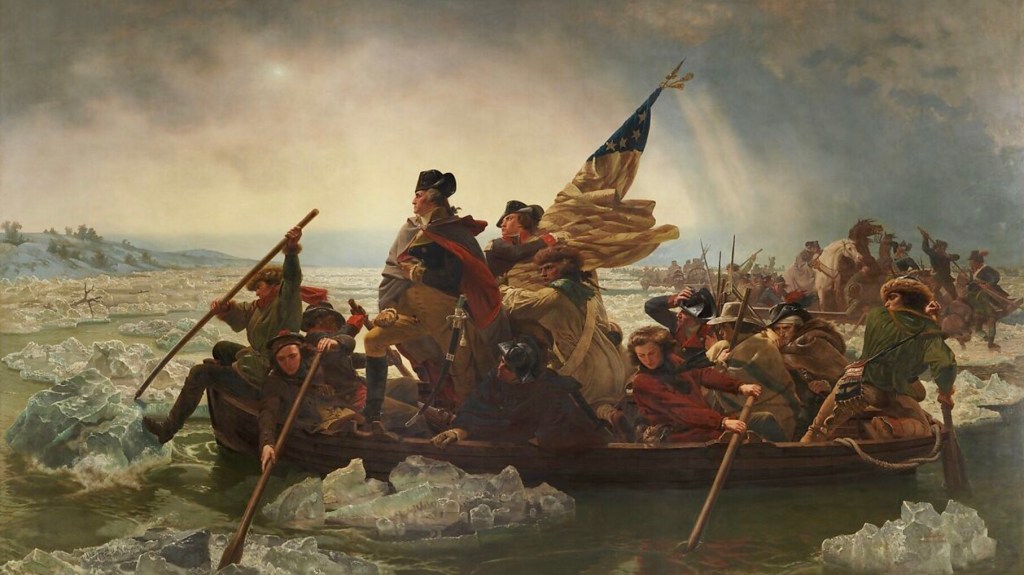
One year prior to declaring our independence from Great Britain, the Continental Congress approved the formation of the Army on 14 June 1775. On that date, they authorized the enlistment of ten companies of riflemen to serve the United Colonies for one year to form the “the American Continental Army.” The next day, Congress issued its first commission by appointing George Washington “General and Commander in chief of the Army of the United Colonies, and of all the forces now raised, or to be raised by them, and of all others who shall voluntarily offer their services, and join the Defense of American liberty, and for repelling every hostile invasion…”

Washington Crossing the Delaware with the Continental Army in December 1776.

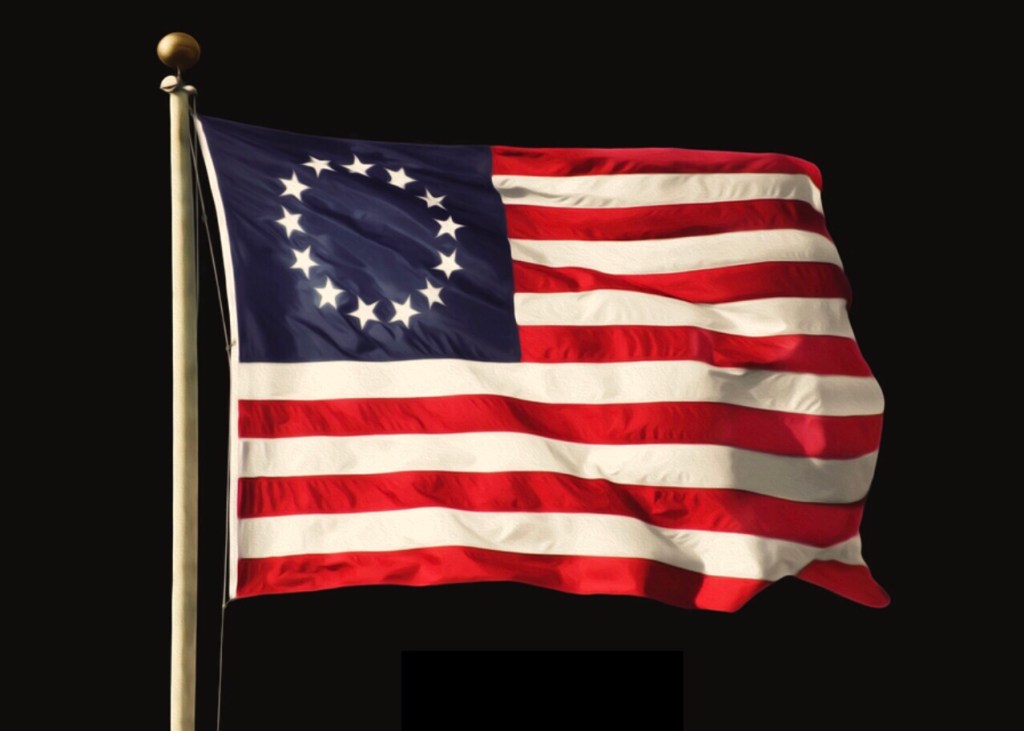
While there are some questions about whether Betsy Ross actually sewed the first American flag, there is no doubt about when Congress recognized our first flag. On June 14, 1777, two years after the formation of the Army, Congress passed the Flag Resolution, which stated, “Resolved: that the flag of the United States be made of thirteen stripes, alternate red and white; that the union be thirteen stars, white in a blue field, representing a new Constellation.” In 1916, President Woodrow Wilson issued a proclamation that officially established June 14 as Flag Day and on August 3, 1949, National Flag Day was established by an Act of Congress.

A New Constellation.

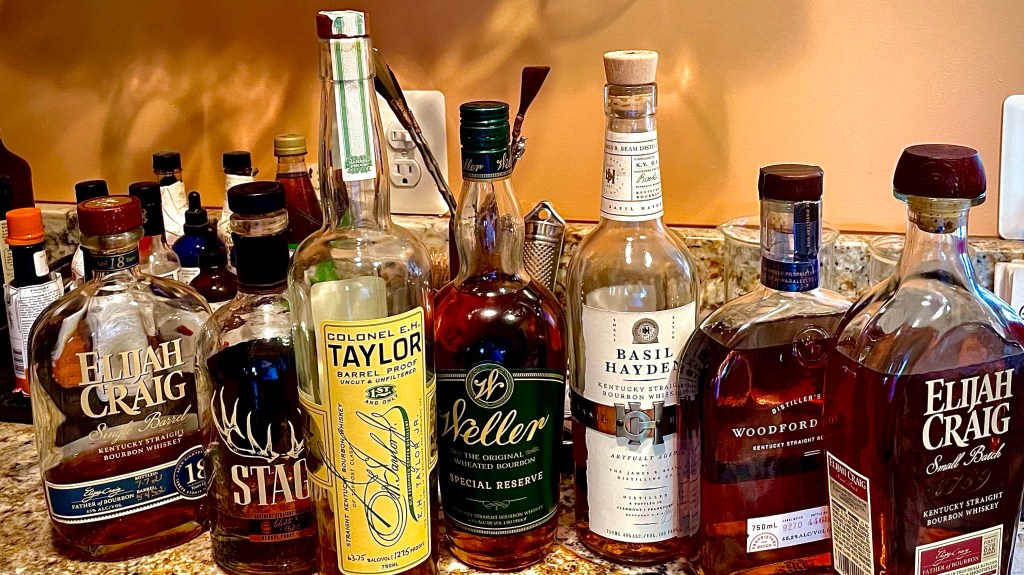
The story of National Bourbon Day is, not surprisingly, a bit murkier. One legend has it that bourbon was first produced by Reverend Elijah Craig on June 14th, 1789. In the late 1780s, Craig was allegedly using old fish barrels to store his spirits. Of course, the fish-flavored wood did not help the taste at all, so Craig started conditioning the barrels by charring the inside. He then stamped the barrels with their county of origin (Bourbon County in what was then Virginia and is now Kentucky) and sent them on a 90-day trip to New Orleans. The charred oak and three-month travel time combined to mellow the whiskey some and folks in New Orleanians requested more of “that whiskey from Bourbon.” Yes, I agree the story, or at least the date of June 14th sounds a bit fishy (pun intended), but who am I to judge? There are enough other competing stories that all trace the origin of “bourbon” to the 1780s and make that time period a credible time of origination. As a side note, in 1964, the United States Congress recognized bourbon as a “distinctive product of the United States of America”.

Bourbon Anyone?

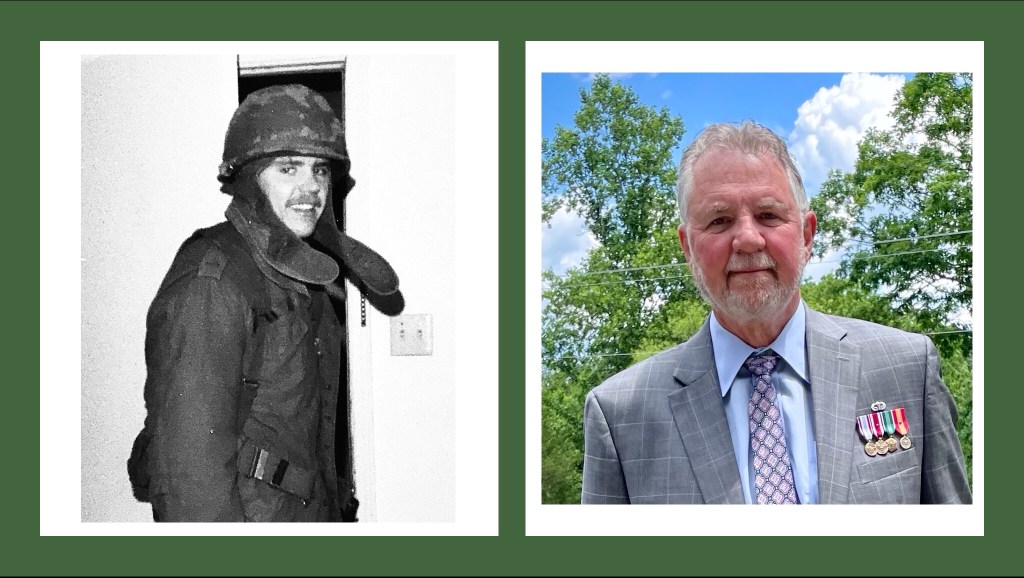
So, there you have it, a bit of distinctly American history. As an Army Vet, I know what I’ll be doing on June 14th. I’ll raise a glass of bourbon in a salute to both our Flag, and all of the Army Veterans who have served our country over the years. I hope you will join me. It seems to me the least we can do.

Cheers to All on June 14th From This Veteran…

Addendum:

– For the record, the United States Army is the senior service. The Continental Navy was established on 13 October 1775, and The Continental Marines on 10 November 1775. The Coast Guard traces it’s beginnings to 4 August 1790. The Air Force was established as an independent service on 18 September 1947, and the Space Force (ughhh) was established on 20 December 2019.

– National Bourbon Day – I searched to find out when the first National Bourbon Day occurred, but could find nothing online.

– Here are a couple of other historical facts about bourbon itself:

  • The Elijah Craig story is a nice one, but there’s no historical proof of it. There were certainly others who were shipping whiskey in barrels in the 1780s.
  • The Marker’s Mark distillery, which opened in 1805, is the oldest distillery in the country, and has been declared a National Historic Landmark.
  • In 1834 Doctor James Crow perfected the sour mash process and made what was probably the first “modern” bourbon. He employed the “Sour Mash Method” on a daily basis to give his whiskey consistency.
  • In 1840, “Bourbon”, by name, was first advertised in a newspaper.
  • In 1840 bourbon whiskey officially became known as bourbon. Before then, the product carried the name Bourbon County Whiskey or Old Bourbon County Whiskey.
  • In 1870 Old Forester became “America’s First Bottled Bourbon” when founder George Brown was the first to put Bourbon in a glass bottle. Prior to that, it was only available in barrels.

Operation WhistlePig

Operation WhistlePig

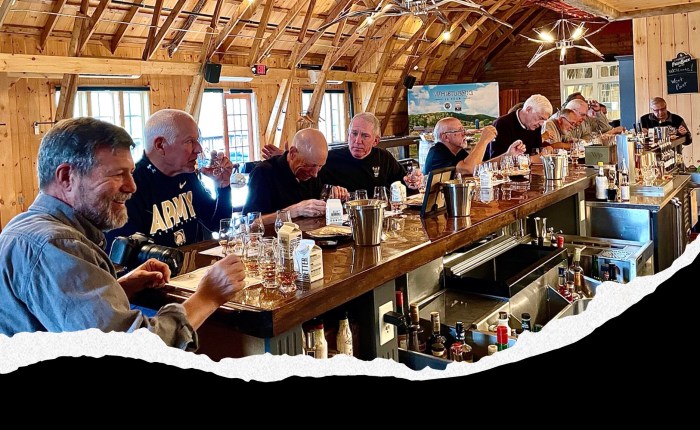
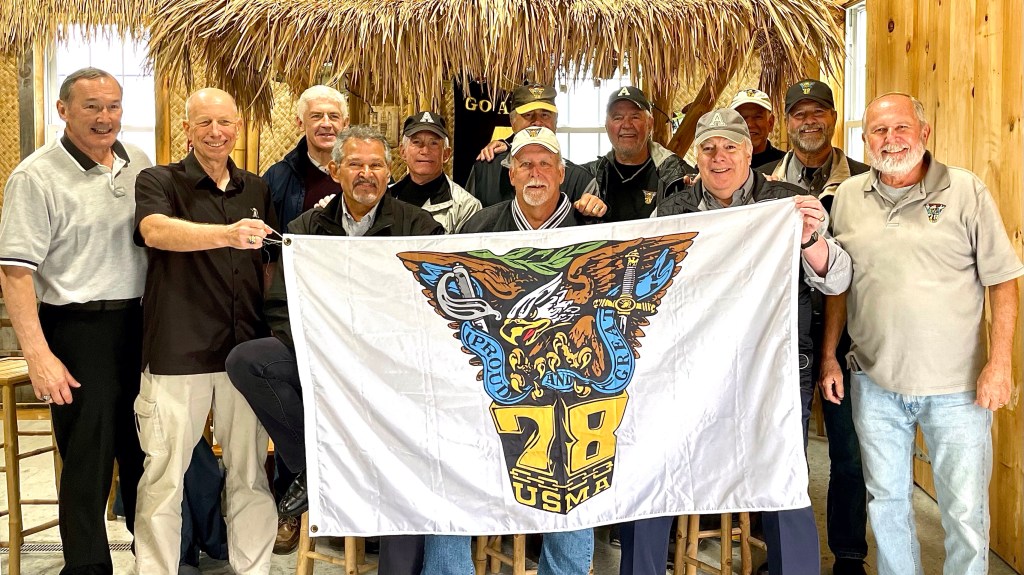
We were on a mission to the WhistlePig Distillery in Vermont. Twelve classmates gathered to taste whiskey from five barrels. We would select two for the West Point Proud and Great, Class of ‘78 45th reunion this coming fall. We didn’t want to let any of our classmates down.

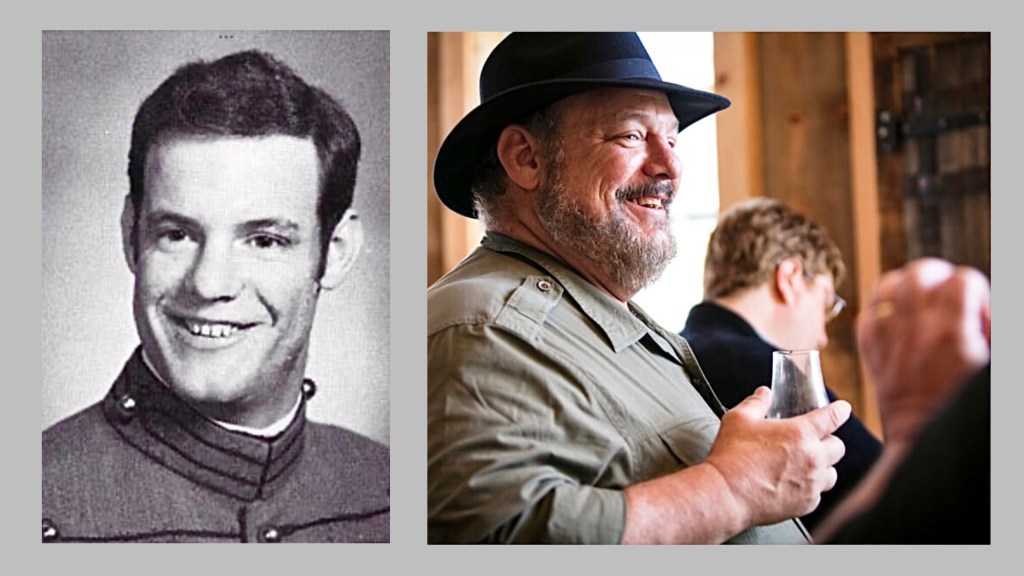
I’ve recounted the history of our classmate Dave Pickerell in a blog before*, but will briefly summarize it here, as it is fundamental to this story. The Army, in its infinite wisdom, sent Dave to grad school for a master’s degree in chemical engineering. Later, after teaching at West Point, Dave left the Army and joined Makers Mark Distillery, where he was the master distiller for 14 years. He then struck out on his own and became known as the “Johnny Appleseed” of craft distilleries, and helped many, many distilleries start-up. Eventually, he also became a founder and the master distiller for WhistlePig Whiskey, which makes some of the best rye whiskeys in the world. Dave passed away a few years ago, but his legacy lives on at nearly 100 distilleries across the country.

Dave Pickerell as a Cadet, and Then Later in Life.

A little over a year ago, our West Point Class held a mini-reunion at the Biltmore in North Carolina. On one of the evenings there, we did a whiskey tasting of several whiskeys Dave had an impact on*. The tasting was to honor Dave, and our other departed classmates. Everyone had such a good time at that event, it became the genesis of Operation WhistlePig.

We originally talked about doing a class tasting for our 45th reunion in the Fall of ‘23, but the logistics at West Point became a bit difficult. Bill Moeller then came up with the idea of purchasing a barrel of WhistlePig for the reunion. Classmate Tony Matos, who lives in New Hampshire not far from the WhistlePig Farm Distillery, became point man and started working with Mark Kanya of WhistlePig to understand the dynamics of a barrel purchase. In the meantime initial funding was lined up through classmate Jeff Manley, and a survey of classmates was completed to gauge interest. 206 classmates responded saying they were interested. A barrel of whiskey holds 156 bottles. We were on.

Of course, you don’t just buy a barrel of whiskey. Each barrel is different depending on multiple factors. WhistlePig invited “around ten of us” to a barrel tasting at the farm. We were to select “our barrel” from three different barrels we would taste from. It would then be bottled in a special release, with a small label honoring our class, and our fallen classmates. The team grew from four to six, then eventually to ten of us. In addition to Tony, Bill, Rob Grubbs and I (Rob, Bill and I organized the Biltmore tasting), José Morales, Al Aycock, Gus Hellzen, Jim Steiner, Jack Cronin and Rusty Roberts were added. Our number was set, as was our date, the 3rd of May. Reservations were made at a nearby Airbnb for May 2-4, and then it was just a matter of waiting for the big day.

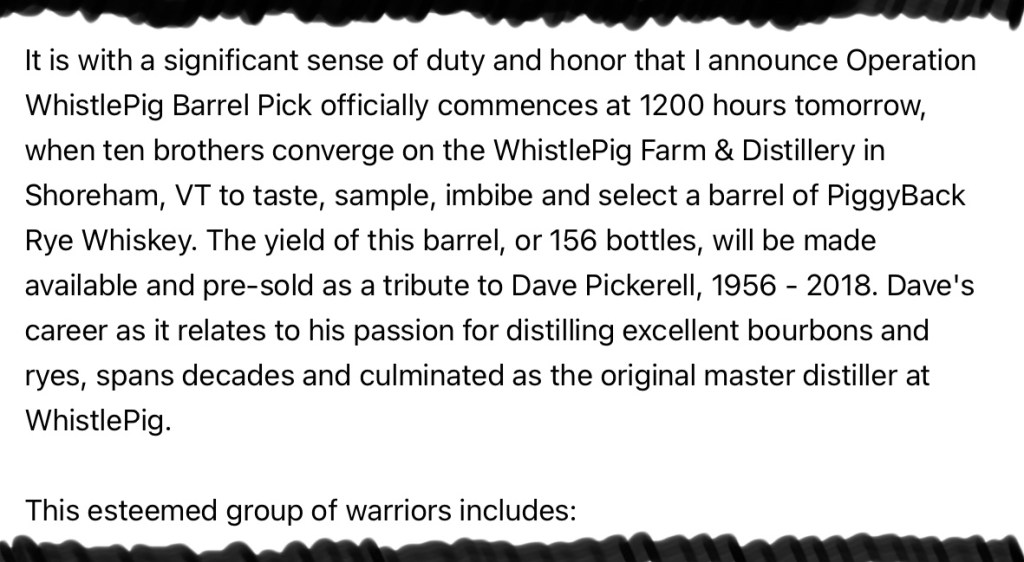
Tony, who did a great job coordinating the event overall, sent an email to the Class on May 1st announcing Operation WhistlePig was about to commence. He was flooded with responses from classmates with good wishes, others wanting to immediately order a bottle, and some wanting to join us and help select the barrel. Tony graciously explained to folk why it wasn’t possible, although after checking with WhistlePig, three folk who were relatively local at the time were added for the tasting itself – Bob Rush and his wife Erica, and Ron Hall. They joined us for the tasting, but not the entire three days.

Tony’s Announcement to the Class About Operation WhistlePig.

On the second of May, we gathered. Classmates flew in or drove from Texas, Virginia, Maryland, North Carolina and Georgia. Others arrived from Vermont, New Hampshire and Maine. We included a retired Two Star, guys who departed the military not long after our initial five-year obligation, and everything in between. There were handshakes and hugs all around. Not all of us knew each other, but we were all brothers and it didn’t matter. This was going to be good.

That first evening passed in a blur, aided by some liquid lubrication. I and a couple of other guys cooked dinner the first night – Steak Tips, a New England specialty. Preparing the meal in the main house, I have to admit I felt a bit like Clemenza in the Movie “The Godfather” cooking away, with guys standing around talking and drinking. Over dinner, we didn’t solve the world’s problems, but we took a stab at a couple of them. José asked a couple of questions for which there were of course no correct answers but made us all think.

We also discussed whether we should consider buying two barrels of whiskey instead of one, in anticipation of additional sales based on Tony’s email from the 1st. Rusty immediately volunteered to lead the financing of the second barrel, and Tony quickly notified WhistlePig we were now looking at purchasing two barrels.

Dinner the First Night.

As is always the case for me at these gatherings, I’m humbled when I listen to many of the stories told – from time in the Army, in government, or in business. Stories from hotspots around the world over the years, and as I’ve said before, war stories both figuratively and literally. Beer, a couple bottles of WhistlePig, several bottles of wine and a few cigars later, most of us made our way to bed.

The next morning, Jim and crew fixed breakfast – bacon, toast and eggs to order. People were feeling surprisingly good, considering the damage we had, perhaps, done the night before. I’m sure the anticipation of the trip to WhistlePig later that morning had something to do with it. We eventually climbed into two vehicles and arrived at the WhistlePig Farm just before 11AM.

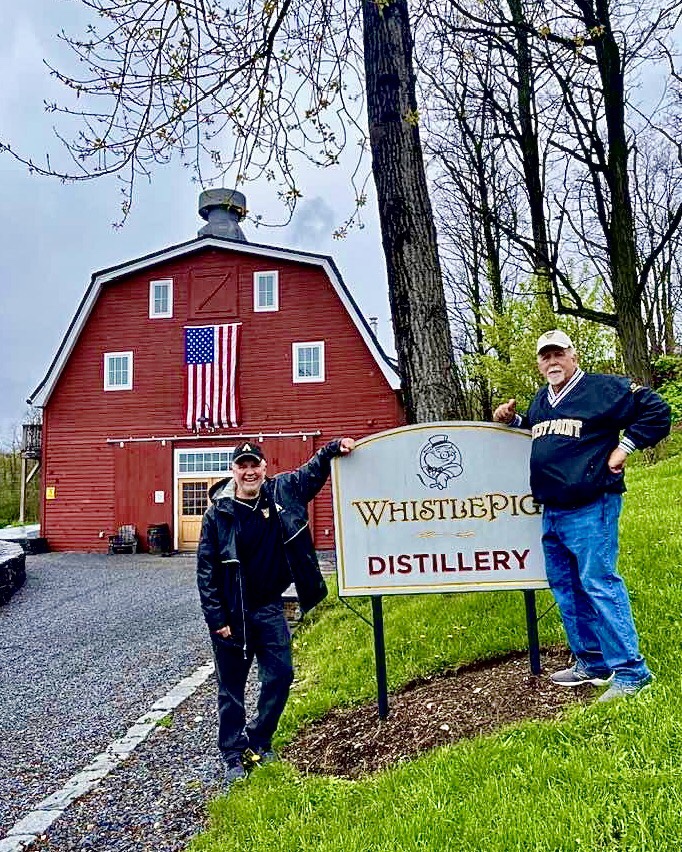
Arriving at WhistlePig.

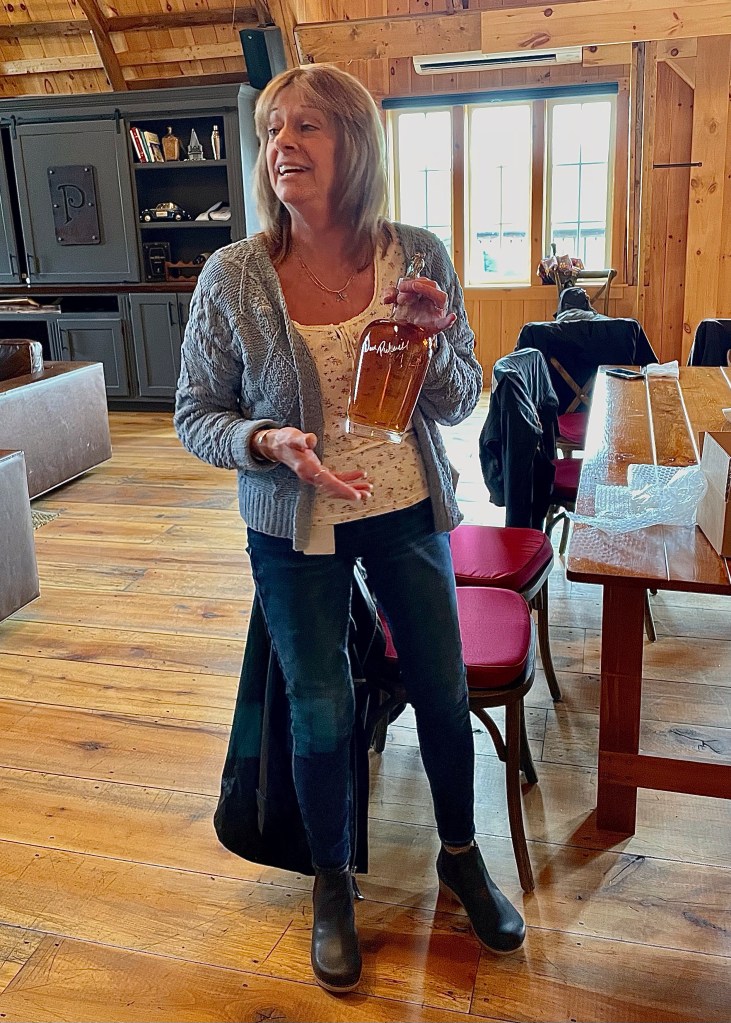
At the farm, we were joined by Ron, Bob and Bob’s wife Erica and began a tour. Jesse Ray, accompanied by our contact Pam Spaulding, showed us key parts of the farm and distillery. Of course there were some tastings involved at various stops, including Maple Spirit (distilled maple syrup – a bit of a rum flavor), Piggyback (the 6 year old Rye that our barrel selections would also come from) and a wonderful WhistlePig 15 year old rye. I noticed that we, as a group, had become a bit louder. We grabbed a picture of us after trying the Maple Spirit – I think you can see we were off to a good start.

Smiling Classmates After the Distilled Maple Syrup Tasting

We returned to the tasting room and a wonderful lunch. The WhistlePig crew told us some great stories about Dave, some of his work, and some of his sayings. My favorite saying from Dave – “One of the great things about working at a distillery is you get to drink your mistakes.”

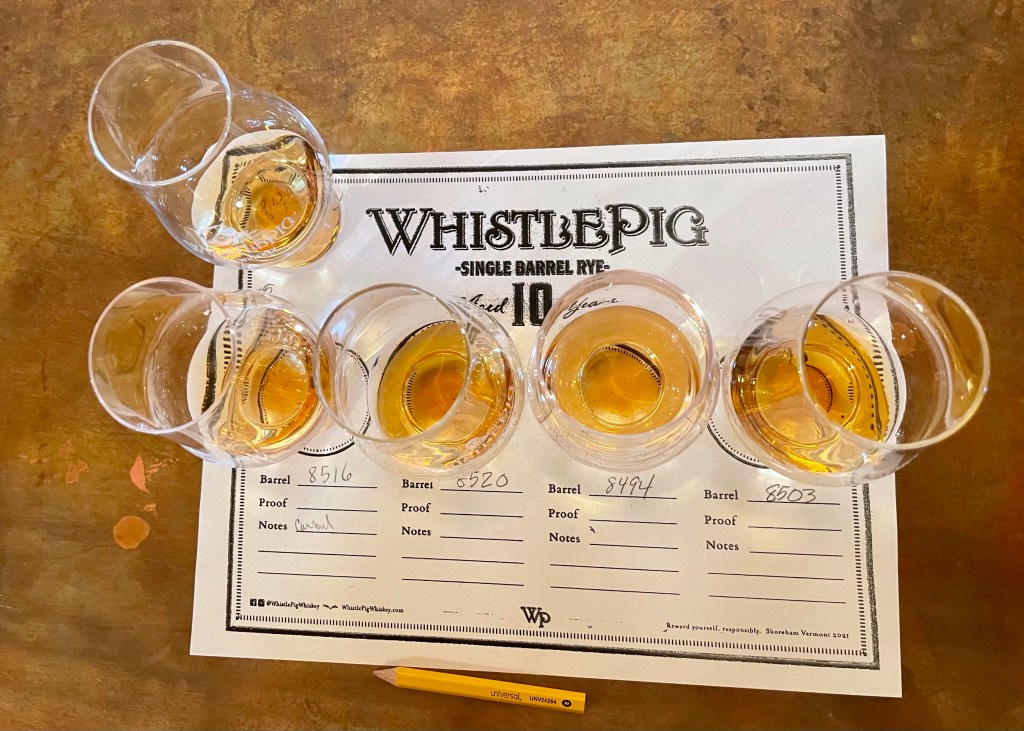
After lunch, we were ready to start the business at hand. First though, WhistlePig revealed a nice surprise. Since we were now considering two barrels instead of one, we would taste five samples instead of three. I believe that elicited a “Hooah!!” from the class. Mark Kanya walked us through the barrels, but didn’t reveal their proof numbers, as he didn’t want to prejudice us. Finally, it was time to taste.

Five Barrels to Taste!

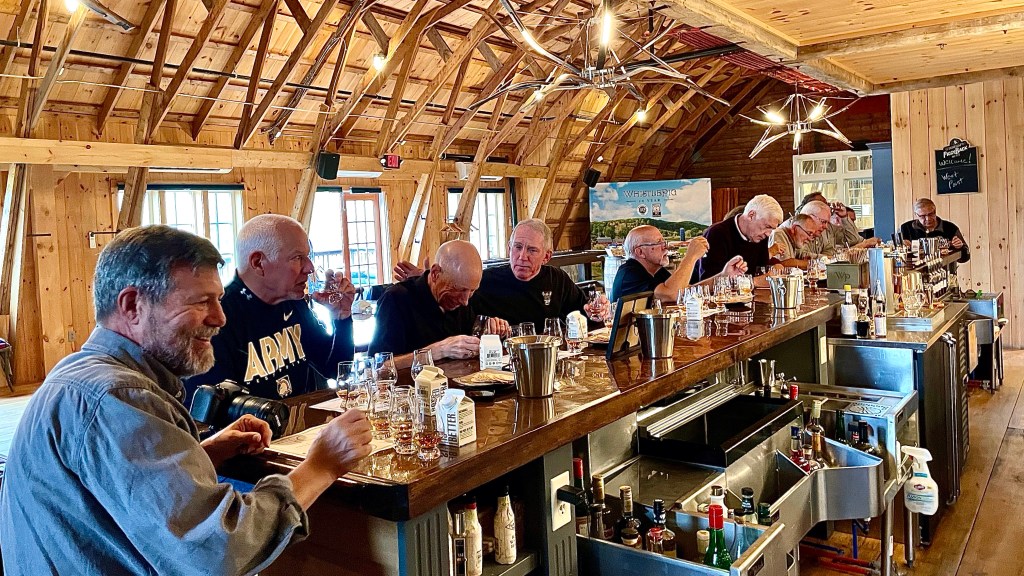
What followed was a minor dose of reverence and a major dose of fun. We tasted, and tasted again. Conversations sprang up and died away. Comparisons were made by those sitting next to each other, sometimes with concurrence and sometimes with “What, are you crazy?!” Now remember there were five barrels. All were 6 years old. All came from the same rick-house. All were 100% rye. All were good. And yet, we had no problem finding differences.

Whiskey Tasting – Maybe Serious Business, or Not…

Finally, it was time to make our selections and Rob Grubbs took charge with a chalk board. Each of us came forward and wrote down our top two choices. We anticipated going a couple of rounds, but it turns out it wasn’t even close. Barrels 8516 and 8494 won, hands down.

Barrels 8516 (2) and 8494 (4) Were the Easy Winners at the Tasting!

After the official tasting, they opened the bar and we tried other WhistlePig products at our leisure. Some of us returned to the winning bottles for another taste and confirmation we’d made the right choices. A few went to the museum, while others of us stayed at the bar. There, Mark’s assistant, Amber Star, who also happens to be an opera singer, entertained us with stories and after some prodding, an amazing a cappella version of Ava Maria – it was beautiful and somehow fit the afternoon.

As we gathered together again shortly before departing, Pam read us a tribute to Dave another friend, Savannah Burnett, sent her. It was wonderful of her to share it with us. She also gave us a WhistlePig bottle signed by Dave and filled with a bit of each of the products Dave was associated with over the years. A whiskey, or spirit connoisseur, would call it an “Infinity Bottle” due to the blending of so many different whiskeys – we plan to auction it off at our 45th reunion. It should also be noted that a West Point Coin was presented by José to Mark for his excellent organization of the tasting. As a side note, should he ever be challenged by one of us in the future and he doesn’t have the coin with him, he will be required to buy a round ;-).

Pam Presenting the Class with the Dave Pickerell Signed “Infinity Bottle”.

We finally said our goodbyes to WhistlePig, and to Ron, Bob and Erica and drove back to our Airbnb. Bill cooked a salmon dinner for us and the ten of us again gathered at the table.

We were mellower than the night before but had great conversations. Yes, we told and laughed at old stories again, but we also talked about the present and the future. Over more wine, whiskey and cigars, we discussed our Class and the impact we may have had on the Army and on our country. Eventually we drifted off to our individual rooms and the night ended.

When I woke up the next morning, a couple of guys were already gone. Rob made breakfast for us and then Tony and Jim drove the rest of us to the airport. More hugs and handshakes at the airport and we parted ways. Operation WhistlePig was over … For this year.

I’ve thought about the wonderful times we had at this whiskey tasting, and at other reunions. The camaraderie, the brotherhood, the love for each other. Although we are not yet in our “twilight”, I think General Douglas McArthur summed it up pretty well at the end of his West Point Farewell Address in 1962:

The shadows are lengthening for me. The twilight is here. My days of old have vanished — tone and tint. They have gone glimmering through the dreams of things that were. Their memory is one of wondrous beauty, watered by tears and coaxed and caressed by the smiles of yesterday. I listen then, but with thirsty ear, for the witching melody of faint bugles blowing reveille, of far drums beating the long roll. In my dreams I hear again the crash of guns, the rattle of musketry, the strange, mournful mutter of the battlefield. But in the evening of my memory always I come back to West Point. Always there echoes and re-echoes: Duty, Honor, Country…”

For this whiskey tasting get-together, maybe the echoes and re-echoes were: Duty, Honor, Country and WhistlePig as well. For my classmates who may be reading this blog, I’ll add this – Standby! A Warning Order is about to come out on how to purchase a bottle.

Addendum:

  • The staff at WhistlePig was wonderful. Pam Spaulding, Jesse Ray, Mark Kenya and Amber Star took amazing care of us.
  • * You can read the blog about Dave and the whiskey tasting our class did about a year ago here: When Rob asked if I would help host the whiskey tasting for the West Point Class of ‘78 mini-reunion at The Biltmore, I immediately said yes. We honored classmate Dave Pickerell, later known as The “Johnny Appleseed” of Craft Whiskey, and all of our departed classmates […] Continue at: https://mnhallblog.wordpress.com/2022/04/19/pickerell-the-biltmore-and-the-whiskey-tasting/
  • Arriving at WhistlePig” photo courtesy of Gus Hellzen.

Judgement of Tilghman

Judgement of Tilghman

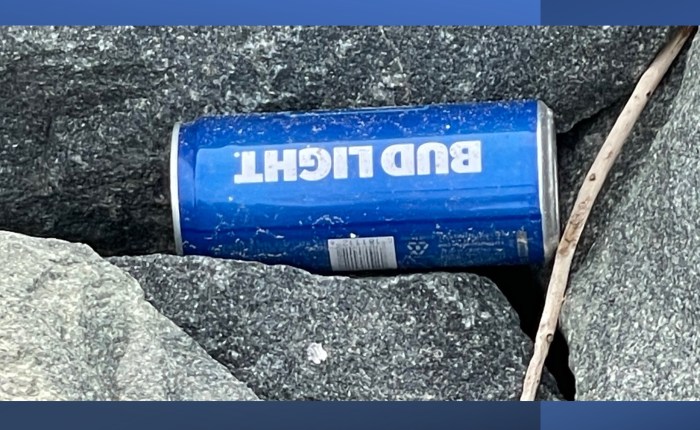
Honorable mentions went to Miller Lite and Natty Light. Second place went to Coors Light. And, drum roll please … Bud Light won First place. What – The best light beer in America? No. This was a judgment based on litter pick up at Black Walnut Point on Tilghman Island, Md. There were more Bud Light cans left among the trash than any other brand.

We are fortunate enough to own a small second home on Tilghman Island. Tilghman is in the middle of the Chesapeake Bay, about twenty minutes from Saint Michaels. The island, reached by a short draw bridge, is beautiful and remains a rural area. Working fishermen, oyster men and crabbers still practice their craft and usually depart on their boats in the early morning hours six days a week from the various harbors and docks.

The very end of Tilghman Island is known as Black Walnut Point. We live close by in the “village” of Fairbank, a collection of thirty-five or so older homes. It’s a great little community with a combination of original Tilghman Islanders, folk who have moved or retired here full time, and part timers like ourselves. Everyone is friendly and gets along. When you go for a walk, it’s more of a stroll and chat. People are always stopping, talking with others and catching up on the local news.

Tilghman Island and Black Walnut Point

Black Walnut Point itself has a small Inn at the end of the road. Before you arrive at the Inn, the road passes a quarter mile of public access to the Chesapeake. It’s a paved area, and they have reenforced this small split of land with boulders and riprap to keep it from washing away into the Bay. The area attracts folk who like to fish, or come to see a gorgeous sunset, or just hang out and take a couple of photos. The Chesapeake doesn’t have lots of public access on much of it’s shoreline, so where there is a public spot, people tend to gather.

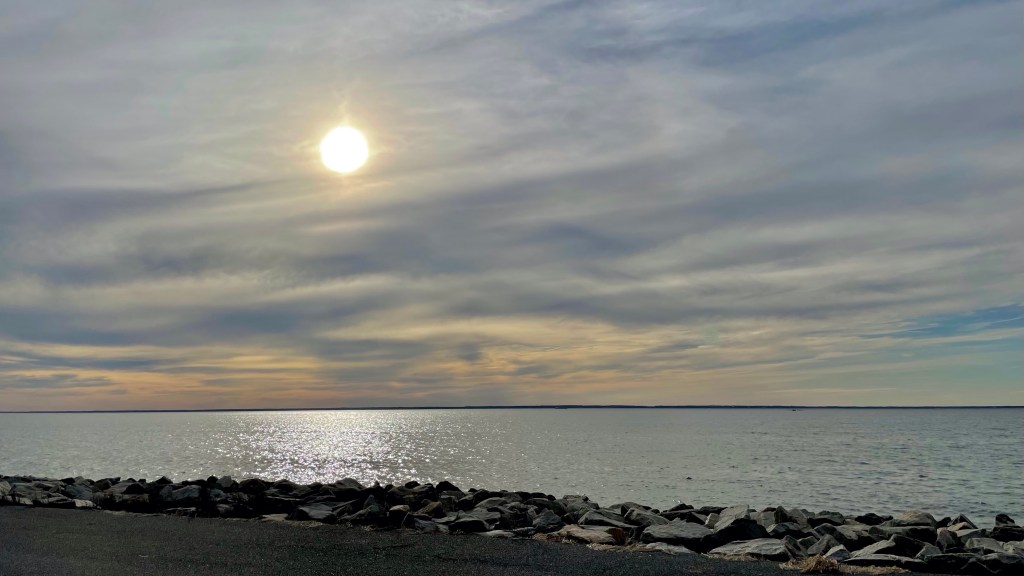
The Afternoon View From Black Walnut Point Road.

And gather they do, at all times of the year, but particularly in the warmer months. That’s when the trash problem is the worst. While I’m sure most visitors are good people, there are a number who have evidently never heard of taking their trash with them. During summer on a busy weekend, it’s not unusual to walk the area on a Monday morning and find actual bags of trash visitors have left behind. It’s evidently too much trouble to haul it back home. And then of course there are the bottles, cans, sandwich packages, cigarette packs and cigarette butts, not to mention fishing line, hooks and weights left among the rocks. Or crammed between the rocks. Or crushed and pushed down lower in the rocks.

Tilghman Island and our Fairbank community have organized trash pick-up events over the years. During summer, neighbors would go out a couple of times as a group and pick up several large bags of trash. Gary, the unofficial “Mayor” (or ambassador) of Fairbank helped organize many of these events via email before he passed away a few years ago. As importantly, people would sometimes go out on their own to pick up trash.

After Gary passed away, our friend Darren has taken on some of the role of community organizer. As an example, just this past December around Christmas time there was a huge storm with high winds on the Bay, resulting in large amounts of trash, debris, flotsam and jetsam washing up on Black Walnut Point. Darren put out the call to help clean up and the community responded. When we arrived a few days later on Dec 29th, I made a pass and collected a couple bags of trash and recyclables, but most was already gone, thanks to our neighbors.

Last week, Cath and I were at the Bayhouse again. As I took our dog, Carmen, for a walk towards Black Walnut Point, I noticed the trash was starting to pile up. It wasn’t bad, considering we’d cleaned the area up a little over a month before, but there was enough to be noticeable, and I decided I’d do a trash-pickup-pass the next day.

The next afternoon, as I was about to start, I ran into our neighbors John and Lea out for a walk with their dog. As we were talking, John told me he’d been out the week before and picked up two bags of recyclables. That was a bit of a surprise, as it meant the trash I was seeing was just from the past week.

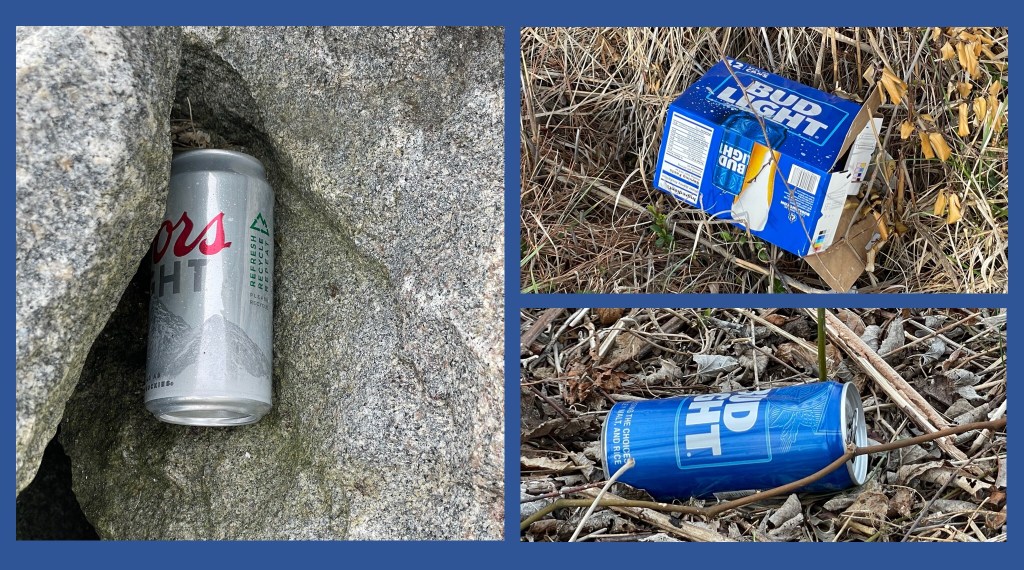
Later, as I finished collecting my bag and a half of trash, a few things became apparent. The majority of smokers littering the area were Marlboro fans, with a couple of Pall Mall smokers thrown in. Among the recyclables, I found a few plastic water bottles, a couple of diet Pepsi cans and two empty pints of Lord Calvert Canadian Whiskey. The rest of it? Beer cans. And not just any beer cans. There were no IPAs, no Guinness Stout, no German pils or Mexican lagers. There was no Nanticoke Nectar from RAR brewery just down the road in Cambridge. While I found a few Budweisers, most were Light cans. There were a couple of Miller Lites and a few Natty Lights, but the vast majority were Coors Light and 10 ounce cans of Bud Light.

Coors Light and Bud Light – Both are Evidently a Favorite of Litterers.

The Coors Light cans were found in just a couple of concentrated areas. You could almost see a couple of fishermen standing or sitting there, working their way through a twelve pack over the course of an afternoon. Finish one beer, throw it among the rocks and grab another one from the cooler. Did they catch any fish? We’ll never know, but it appears they enjoyed themselves.

The Bud Lights? They were scattered up and down the shoreline in ones or twos. In fact, several were also scattered in the grass and woods on the drive into the area. These brought a different vision to my head. One or two guys, maybe kids, maybe not, having a beer in their truck and chucking it onto the rocks, or as they were driving home, throwing it out the window onto the side of the road. The Bud Light drinkers also threw out the boxes those 10 ounce beers came in. No evidence was going to remain in their cars.

As I mentioned a couple of times, the Bud Lights were all 10 ounce cans. Why does that matter? 10 ounce beers are an Eastern Shore thing*. Look in your hometown store and see if you can find 10 oz Buds. The answer is probably no, unless you live on certain parts of the Eastern Shore of Maryland.

My guess on our litterers? The Coors guys were from somewhere else and came for an afternoon of fishing on the Bay. The Bud Light drinkers? I’d bet they are from somewhere nearby on the the Eastern Shore of Maryland – probably somewhere between here and Easton. Maybe they are high school kids sneaking their beers; maybe they are bored young guys; or maybe they are older guys getting away from home for awhile.

I could be wrong. Maybe they are from somewhere else, forgot to bring beer, and decided to buy some here locally. At the store they looked around saw the 10 ounce cans, and said, “Those beers are for me. I want beers in cans that are two ounces smaller than what I normally drink.” Maybe.

What I do know is whoever they are, they are trashing the area.

I can’t say this is a typical mix of trash, only that it is what I found on this particular visit. It’s unfortunate. I guarantee both the Coors and Bud Light drinkers would tell you they love this area. It has everything they want – open access to the Bay, beautiful views and occasionally good fishing. But you can’t profess to love something and trash it at the same time. All that does is make you a hypocrite. In this case, hypocrites who don’t respect Mother Nature, Tilghman Island or those around them.

Addendum:

  • * 10 Ounce cans of Bud and Bud Light are a big thing in parts of the Eastern Shore of Maryland. I particularly enjoy them on a hot summer day – you finish your beer beer before it gets warm. You find them in the counties of Caroline, Dorchester, Kent, Queen Anne’s and Talbot (our county), but not in places such as Salisbury and Ocean City. You can read more about them here: https://wtop.com/maryland/2020/09/uncanny-why-10-ounce-cans-of-budweiser-are-popular-in-parts-of-maryland/
  • The title of this blog is a word play on “Judgement of Paris”, the 1976 blind wine tasting in Paris that elevated the status of American wines. Never heard of it? You can read more here: https://en.m.wikipedia.org/wiki/Judgment_of_Paris_(wine) . The wine “Judgement of Paris” itself was a twist on The “Judgement of Paris” in Greek Mythology, which was a contest between the three most beautiful goddesses of Olympos – Aphrodite, Hera and Athena for the prize of a golden apple addressed “To the Fairest.” The original Judgement in Paris eventually led to the Trojan War and the destruction of Troy.
  • Here’s a bit of a more complete history of trash pick up on Tilghman from Darren. I shortened it a bit for the blog: Gary and Larry were the original two people who picked up trash. People saw Gary and Larry doing it and joined in. It organically became a Fairbank community effort. Gary then made it more formal through his newsletters. When The Phillips Wharf Environmental Center was under Kelly Cox, they held a trash pick-up day called “Tidy up Tilghman.” People picked up trash across the entire island on that day. Gary was on the PWEC Board of Directors, so I think they got the idea from him. The tradition has always been strong and remains in place in Fairbank. There’s another trash pick up for the entire Island taking place on April 1st of this year.
  • Thanks to friends Darren and Veronica who both took a look at this blog for accuracy and editing purposes!