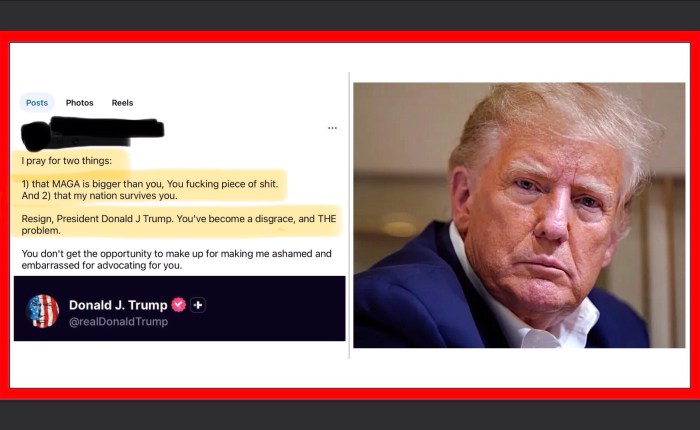
It has been a long year for many of us, and yet, I have hope. I believe we may have reached a turning point as 2025 ends. A local Fauquier County MAGA man, as MAGA as they come, has turned on Trump. When someone like him calls Trump a “f^cking piece of sh!t”, you know the world is changing.
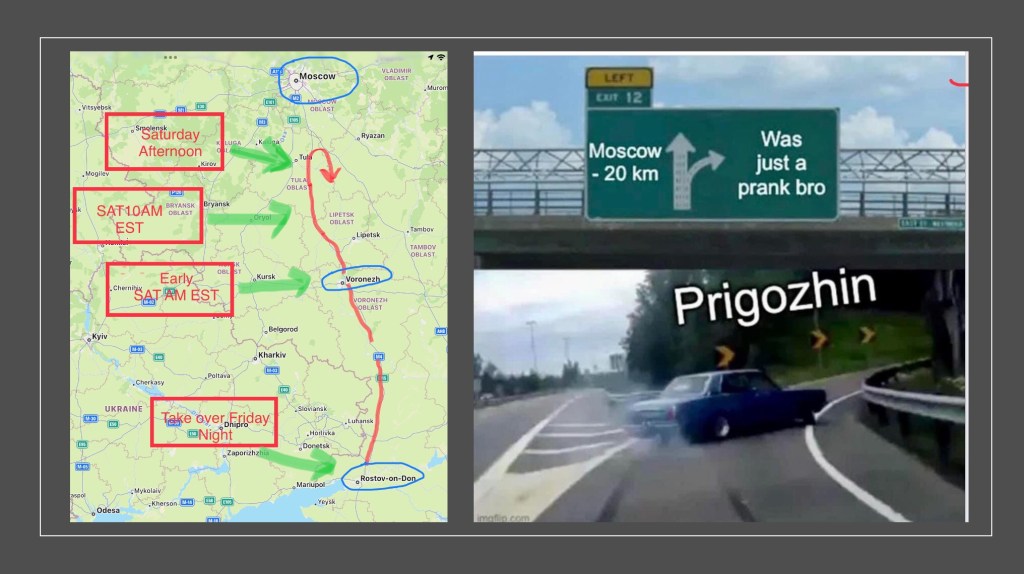
On June 24th, we woke to the news the Wagner Group rebelled against the Russian military and was marching on Moscow. Twelve hours later, it was all over. Peace at hand? More problems to come? Certainly we have ripples of instability, never a good thing in world affairs.
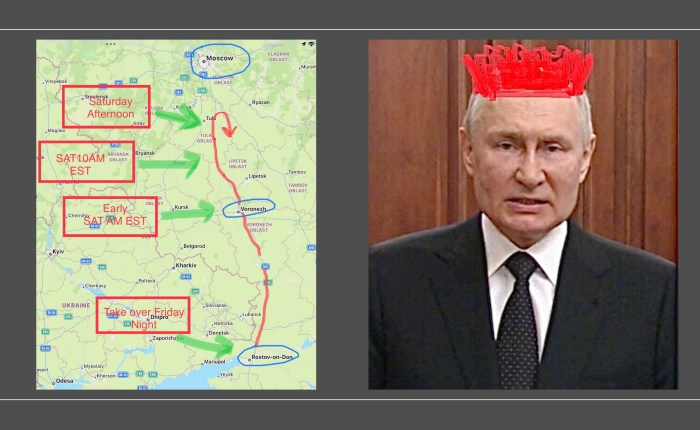
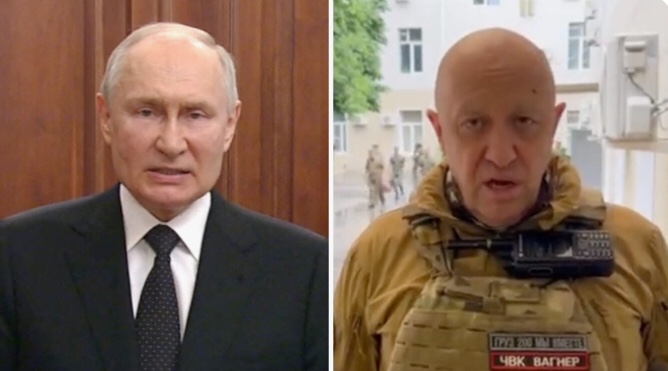
There’s nothing like a coup attempt to grab my attention before I’ve had my morning coffee. On that fateful Saturday, I watched with fascination as Prigozhin’s Wagner Group troops took over the Rostov Russian Military Headquarters and then started their march on Moscow. It appears they were within 120 miles of the capitol before the insurrection ended as suddenly as it began, and Belarus leader Lukashenko worked out a peace between Putin and Prigozhin.
Whoops…I Didn’t Really Mean It
The terms? Maybe, forgiveness for the troops, a safe passage of Prigozhin to Belarus, and no invasion of Moscow itself. Yea, a win-win for everyone – if you believe in fairytales. The “fog of war”, and the cloak around all things “Russia” makes it difficult to assess what is true, what is false, and what is somewhere in between. It will all play out over the next few months. What I know is there is now increased instability in the region, and the world. I’m not a big fan of instability. No sane person should be a fan of instability as we are now experiencing in Russia.
Will The Peace Last?
I am by no means a Russian expert, but I am a student of history. I also spent nearly a decade in the Army in Germany in the ‘80s waiting for them to attack us, and had the opportunity to learn a bit about them then as well. So, while I’m no expert, I do feel confident that I know more than about 95% of the talking heads on TV, and 99% more than all of those spouting off online.
Here are seven questions we don’t have the answers for. I waited this long after the putsch attempt to publish this blog in order for events to develop and perhaps answers become apparent to some of the questions. I don’t believe that has happened. The fog, and the world’s instability will remain until we have a better understanding of the answers. If someone on TV or online says they have the answers right now, you should immediately change your TV channel or go elsewhere online. They are probably lying.
1. Has Putin weakened? Between his failing attacks in Ukraine and this mini-coup, he looks like it, but looks can be deceiving. He is shrewd, and he is ruthless. I wouldn’t count him out just yet.
2. What WAS the agreement between Putin and Prigozhin? Is there wiggle room for both of them? Will they somehow be buddies after all is done? Or are they both out to kill each other?
3. A related question – How hard will Putin try to crush those who rose against him? Putin is not the forgiving type. In addition to settling up with Mr Prigozhin, he will certainly look at how easily the headquarters at Rostov fell. Was there complicity on the part of his generals there, or weakness? In either case, heads are likely to roll.
4. What about the Wagner troops? There are 25,000, give or take, wandering around Southwestern Russia, or in Ukraine with plenty of guns, tanks, and other weapons. They have served as the pointy end of the spear for the Russians in most of their attacks over the past year. If they are now peaceably subsumed into regular Russian units (as the Russian Army is trying to make happen), what happens to their effectiveness? What happens to the effectiveness of the units they are added to? And what happens if they don’t go quietly into the night?
5. What happens to the other Wagner Group troops scattered around the globe providing “security” and other services in places such as Sudan, Mali, Syria, the Central African Republic, Libya, Venezuela and Sri Lanka among others? Does Prigozhin continue to lead them, does someone else, or do they fade away?
6. How will this affect the war in Ukraine? If the Wagner Group is dissolved as a fighting force, what is the impact? Also, the other Russian troops in Ukraine have to know at least some of what has happened. How will they react?
7. How safe are Russia’s nuclear weapons? Are we confident they are managed and controlled in a secure fashion?
As I said, I’m not a big fan of instability, and right now, this situation provides plenty of it. Some people in this country would say ignore it, it’s not our problem. Others (I’m looking at you Majorie Taylor Greene) stupidly question whether the US was somehow behind the coup. Both of those courses are unwise. Any time there is instability in the world the ripples make their way in our direction, arriving sooner or later. The only question is whether the ripples fade away, or due to activities we can’t see below the surface, turn into a tsunami.
And don’t forget China lurking around out there as well. Their commentary was generally muted about these events. I believe they are a bigger longterm threat to us both militarily and economically. Having said that, I’m more concerned about an unstable Russia right now, than I am about a stable China.
It’s been a busy couple of weeks for our former president. It’s not every month you get to announce your candidacy for the presidency, have dinner with a couple of racist Hitler fans, and declare the Constitution should be terminated. That’s a full month, even by Trump standards.
I don’t know anyone who was surprised when Trump announced he was going to run for the presidency in 2024. It was all his handlers could do to have him wait until after the midterms to announce. He was expecting a big splash from the midterms themselves, but most of his election denier choices went quietly into the night. Yea, Vance won in Ohio, and Lake is still whining like a mini-Trump in Arizona, but the rest of them? B’bye. None of it slowed down his big announcement though. It was almost as if he was oblivious to anything else happening. And the rest of the Republicans? Perhaps Senator Rubio said it best: “We should not have a Senate GOP leadership vote until we have a clear explanation for why our 2022 campaign efforts failed…”. Ummmm, Senator, I could help you with that…
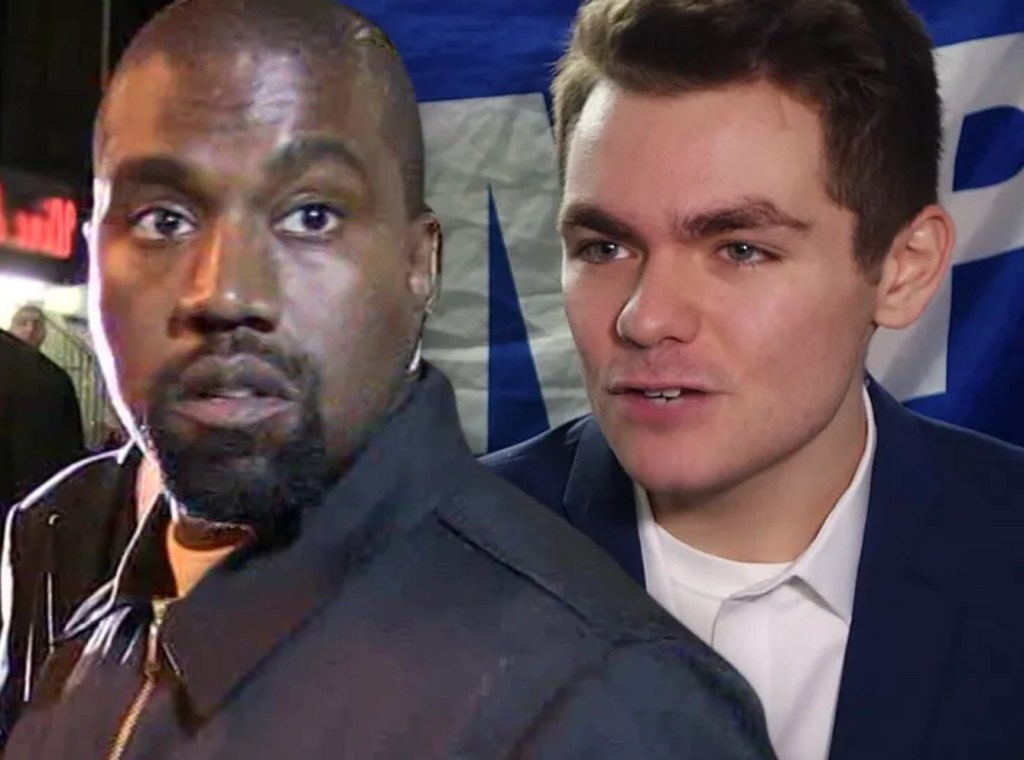
Of course Mr Trump didn’t slow down. As a matter of fact, in typical fashion, he accelerated. Are any of us surprised he ate dinner with Ye (the former Kanye West) and white nationalist Nick Fuentes? Nothing quite says “there are good people on both sides” like having dinner with a couple of Hitler loving antisemites. It’s never a good sign when Alex Jones is distancing himself from some of your dinner guest’s comments, as Jones later did during his interview with Ye. The Republican response to all of this? Again deafening silence. Senator McConnell managed to say “Let me just say that there is no room in the Republican Party for antisemitism or white supremacy. And anyone meeting with people advocating that point of view, in my judgment, are highly unlikely to ever be elected president of the United States.” The brave Senator couldn’t bring himself to utter the “T” word.
Ye and Fuentes… “I See Good Things About Hitler”
Which of course brings us to Mr Trump’s most recent episode. His blast on the Truth Social network was … interesting. He called for “the termination of all rules, regulations, and articles, even those found in the Constitution,” because he lost the last election for president. He wants to be declared the “RIGHTFUL WINNER,” or “have a NEW ELECTION.” (All CAPS are directly from the Trump quote) Wow. Wanting to terminate the Constitution finally drew some rebuttals from the right, but not from everyone.
Just as the events of Charlottesville, or January 6th, or his continuing election denial caused some people to leave the Trump orbit, another dribble of people are departing after the Ye/Fuentes dinner and the subsequent “termination of the Constitution” comments. The vast majority of his core? Like a married couple, they are there through thick and thin, for better or worse. There will be no divorce. They will follow him to the bitter end, however that turns out.
I’m not really sure why I wrote this blog. It’s not going to change any minds. Having said that, I think we all have a duty to bear witness to what is going on in this country. If we don’t continue to speak out, the future becomes a foregone conclusion. As Edmund Burke (or maybe someone else) famously said “The only thing necessary for the triumph of evil is for good men to do nothing.”
I have a couple of last questions for you. First, if Joe Biden declared he wanted to terminate the Second Amendment, what would the immediate reaction be? And second, does anyone doubt Trump would terminate the Constitution in a heartbeat if he could?
Finally, those of us who served in the military or the government swore an oath that started with these phrases: “I do solemnly swear (or affirm) that I will support and defend the Constitution of the United States against all enemies, foreign and domestic; that I will bear true faith and allegiance to the same;”. For my West Point and former military comrades who still support Mr. Trump, I guess we are finally at that point. Which do you support – Mr Trump, or the Constitution?
In light of the recent 4th of July mass shooting in Highland Park, Illinois, I’ve been rethinking Stephen Stills classic song, ‘Find the Cost of Freedom’.
“Find the cost of freedom
buried in the ground
Mother earth will swallow you
lay your body down

Find the cost of freedom
buried in the ground
Mother earth will swallow you
lay your body down”
Written at the height of the Vietnam War, it was released as the B side to ‘Ohio’ which was a direct condemnation of Kent State. ‘Find the Cost of Freedom’ was less explicit. There have been multiple suggestions as to the meaning of the song, including the student deaths at Kent State, the death of our soldiers in Vietnam, or even the cost of war to us as a people. Although simply written, with fewer words, it’s a more complicated song.
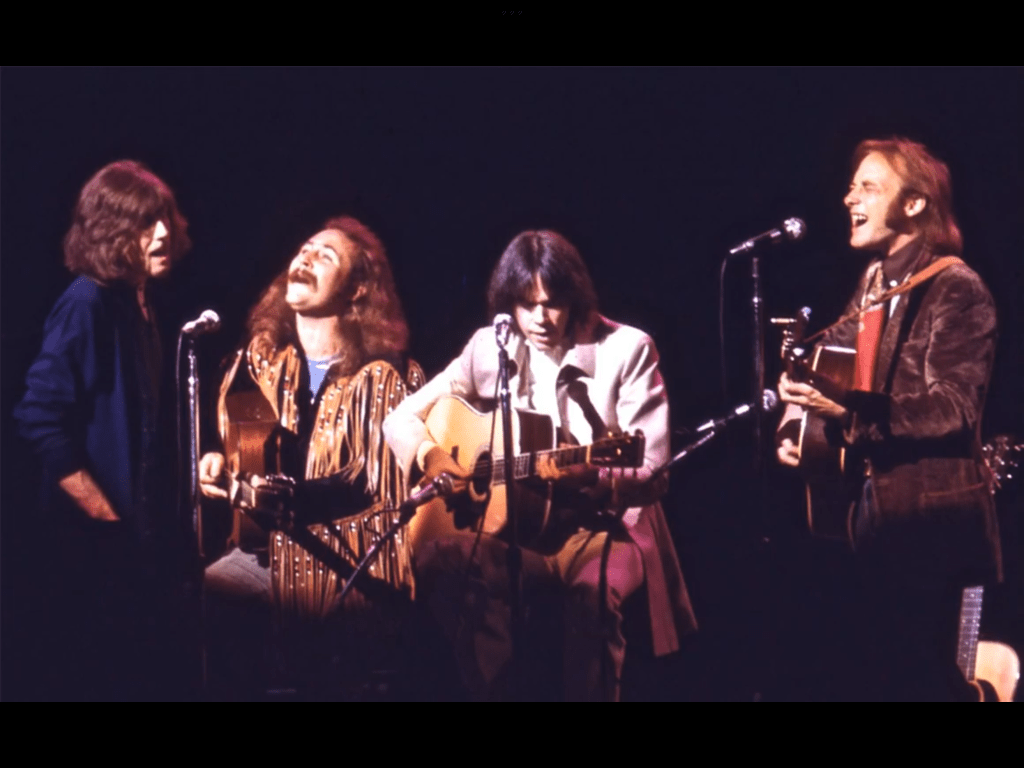
CSNY Performing ‘Find the Cost of Freedom’, Back in the Day
The song was rereleased in 1982 as ‘Daylight Again/Find the Cost Of Freedom’, with seeming references to the Civil War. The line “When everyone’s talkin’ and no one is listenin’, how can we decide?” is added right before the famous refrain and it then becomes:
“When everyone's talkin’ and no one is listenin’, How can we decide
(Do we) find the cost of freedom
Buried in the ground
Mother Earth will swallow you
Lay your body down”
To me, this version seems a perfect summation of the entire gun violence issue. No one listens to anyone on the other side. The result? We see the cost of freedom, and the results of the Second Amendment, dead and buried in the ground. People are going to die, and that is just the price we need to pay for the freedom to own guns. Any kind of guns. All guns. Just lay your body down and accept it.
We here in ‘Murica have deemed that acceptable to protect our Second Amendment freedom. Everyone has the freedom to own their guns, even if it’s at the expense of other people, who just want to celebrate their freedom by watching a parade on the Fourth of July.
God Bless America.
Find the cost of freedom
buried in the ground
Mother earth will swallow you
lay your body down

Find the cost of freedom
buried in the ground
Mother earth will swallow you
lay your body down
…
… Feel free to share this blog …
Addendum:
You can read my previous blogs on gun violence here:
There was no urgency to write this blog. I knew another mass shooting would happen sooner or later. I didn’t have to tie it to Buffalo or California. The next shooting would come along soon enough. I wasn’t disappointed. Texas happened this past […] Continue at: https://mnhallblog.wordpress.com/2022/05/29/guns-and-murica/
I will turn 67 on April 10th. That’s a little more than one quarter of the 246 year American Experiment. In January, 1790, George Washington said, “The establishment of our new government seemed to be the last great experiment for promoting human happiness by a reasonable compact in civil society.“* I’m trying to decide how well Washington’s words have held up.
To me, the Constitution and it’s amendments are still a reasonable compact. After that, things are a bit more dicey. As a country, we don’t act particularly civil, or happy these days.
If you look at history, America and Americans have always been contentious, but we seem well past that these days. Civility has gone by the wayside in government, and often in society. Our Congressmen and Senators routinely insult each other and anyone who disagrees with them. Many also have no problem insulting their constituents if he or she disagrees with them. Hate is a word that often comes to mind.
It carries over to our society as well. If there is disagreement, many folk no longer know how to act civilly, or even worse, choose to act uncivilly. Rather than discuss, or ignore something, the preferred response is often to insult or belittle, often with vulgarity. Anyone attend a school board meeting lately? And it’s not just about politics. We fight about noise pollution, light pollution, how people choose to raise their children, shopping sales and parking spots. Our ultimate “right” appears to be the right to be obnoxious.
Happiness, at a government or society level, is also in short supply. Our politicians at the national level wear a scowl much more often than a smile. How often do we see Ted Cruz or Bernie Sanders smile? As Americans, many of us are pretty much unhappy about everything – immigration, the news, the price of gas, healthcare, our neighbors with different views, Covid, not using Daylight Savings Time all the time, boomers upset with millennials, everyone upset with boomers, sports referees… No issue is too big or small to escape our ire.
What are the odds of smiles under those masks?
Some days, we appear to be Whiny America, forgetting we could be in Ukraine, or any number of troubled spots around the world.
We have had discord and conflict throughout our history, and certainly there were times worse than what we are experiencing today. The Civil War, The Depression, WWII, The McCarthy era, Vietnam and the upheaval of the ‘60s to name a few.
We have also fought over issues throughout our history. State’s Rights, Western Expansion, Slavery, Women and the Right to vote, Labor and unions, Civil Rights, Gay Rights, Individual versus societal rights, the place of Religion in America … the list goes on.
I was born in 1955. Fools long for the mirage of the “good old days” in the ‘50s, forgetting that we were fighting in Korea, the prospect of nuclear holocaust was real, Civil Rights hardly existed, and Joe McCarthy was trying to tear apart the country with outrageous lies in the US Senate. People forget Happy Days was a fictitious TV show, not American reality.
What makes today appear worse? Maybe the internet-connected-world shines a brighter light on the American Experiment, allowing us to see all of the dark holes that have always been there, but were previously hidden. Maybe it’s not worse. Maybe it’s just our time and turn to experience the tumult that is the American Experiment. Or, maybe our lives have become so otherwise comfortable, this is just the next level of angst over the American Experiment – my way, or the highway, with no room for alternatives.
Maybe, instead of looking at society, we can start by looking at ourselves first, and find some civility, some happiness and some sanity.
You would think each of us could control whether we are civil or not. We can try and take our hatred down a notch or two and find ways to engage civilly with those who are “different” from us. And if we can’t find a way to engage civilly, perhaps we shouldn’t engage at all, rather than becoming mime worthy caricatures.
And Happiness? Certainly a tougher question and each of us is somewhere different on the continuum between abject sadness and blazing joy. We all have personal issues affecting our state of happiness over time, but happiness is often found in the eye of the beholder. Indeed, some people who have the right to be upset about health issues, are happy because they have one more day upright. I think a lesson is there for all of us.
Maybe part of the question is whether we can find happiness without making someone else unhappy.
For me, as I’m about to enter my 68th year on this planet and in this country, I have two thoughts. One, I’m going to strive to maintain my civility, no matter the situation. As for happiness, while I know I won’t always be happy, I’m going to look for happiness where I can find it, in events both big and small. Whether an upcoming vacation, a negative test result, or a new flower blooming in the garden, I will seek out happiness, and let it infect me.
I have no doubt The American Experiment will continue for the foreseeable future. We are a resourceful nation and people, and our strength and good fortune have brought us to where we are today. Like many families, we Americans fight with each other. Is it too much to ask for a little more civility in our lives and fights? That might even help with our collective happiness.
Addendum:
⁃ * Washington penned these words in a letter to English historian, Catharine Macaulay, on 9 January 1790. The entire quote in that part of the letter reads: “The establishment of our new Government seemed to be the last great experiment, for promoting human happiness, by reasonable compact, in civil Society. It was to be, in the first instance, in a considerable degree, a government of accomodation as well as a government of Laws. Much was to be done by prudence, much by conciliation, much by firmness.” You can find a link to the entire letter here: https://founders.archives.gov/documents/Washington/05-04-02-0363 .
⁃ Thanks to my friends Tim Stouffer and Mark Dunavan who both provided thoughts and inputs for this blog.
– As always, thank to my friend Colleen for her editorial assistance. I remain a work in progress.
This winter sucked. We didn’t have much snow, but the three ice storms we did have, made travel treacherous, even if just walking to the barn. Of course, I’m not only talking about the weather.
A Long Cold Lonely Winter …
Covid and Covid isolation continued to hold sway over most of us. Then, as the vaccine became available, we were all scrambling to find some way, any way, to receive a shot. They even had a name for us: We were Vaccine Hunters. The slow pace of the rollout was maddening.
We also had that failed, inept insurrection thing back on January 6th. THAT didn’t cheer anybody up. In fact, it made many of us despair for our country.
To top it all off, we have several good friends dealing with serious health challenges. Some, with life and death health issues.
All of these matters combined to cast a pall over this winter. There was a hint of melancholy, at least at our house. The Winter of our Discontent, indeed.
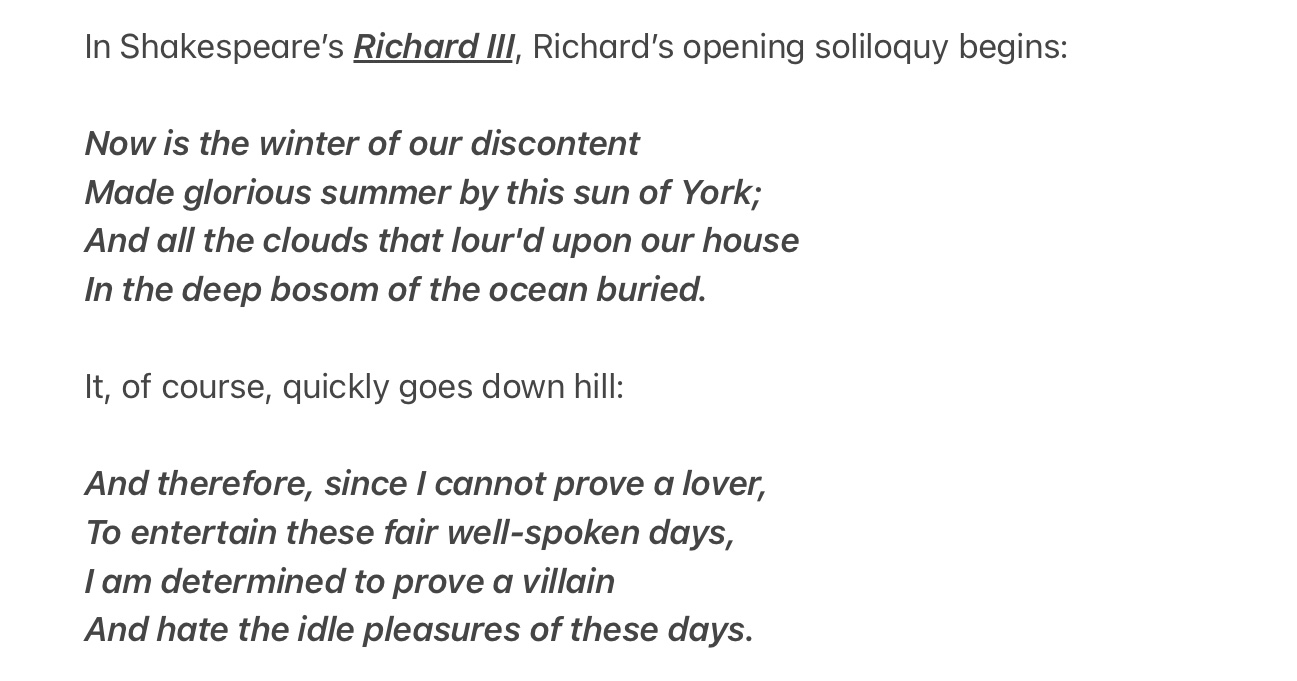
Whether the opening line of Shakespeare’s Richard III, or the title of the 1961 John Steinbeck book, the words “The Winter of our Discontent” aren’t promising. Neither the play, nor the book are particularly cheery. Richard III is of course filled with political and familial intrigue, death and murder, while Steinbeck’s book “The Winter of our Discontent”, examined moral decline in America. Both have more than a little in common with this past winter.
So, how do you fight against a winter of discontent? It could have been all too easy to just try and survive – stay cooped up, become cheerless, and drink too much.
One of the ways we fought it was with Comfort Food. And more specifically, comfort food in the form of soups and stews.
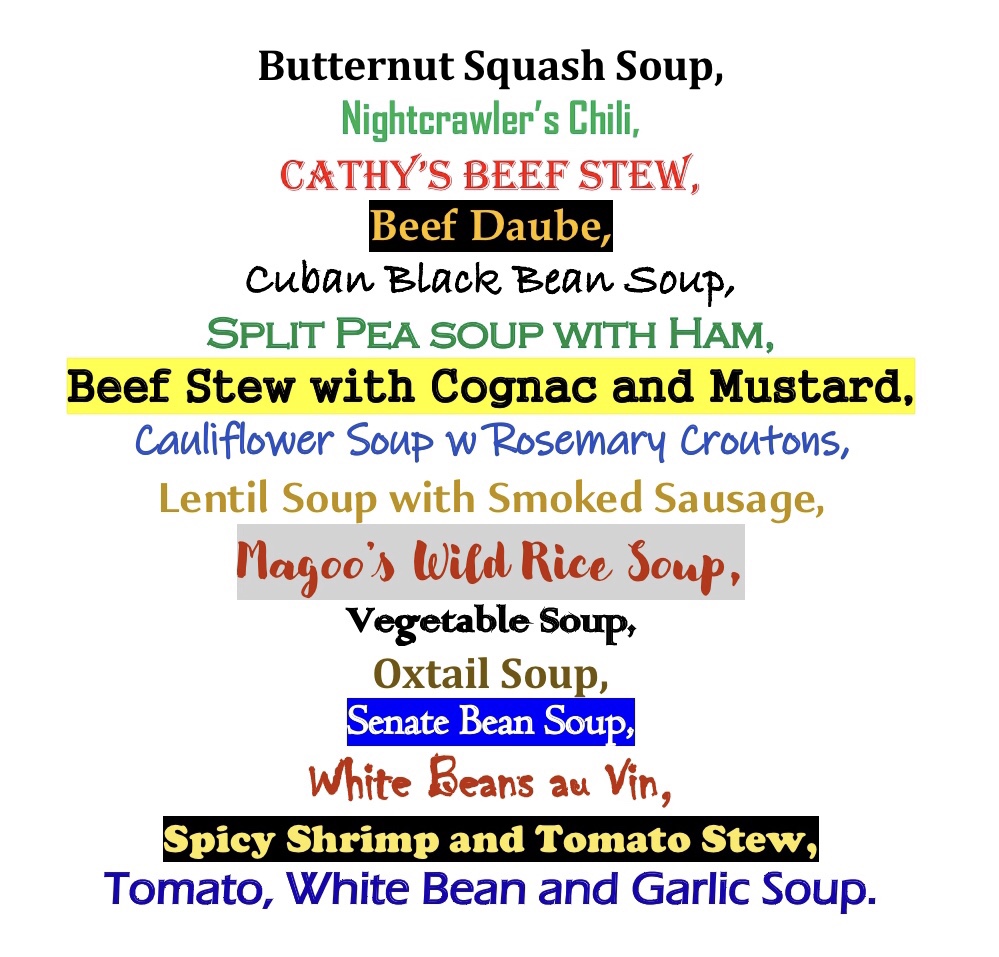
We made and ate more stews and soups than usual this past winter. Actually, I think we had them a couple times a week all season long. Several were old favorites. Others, we made for the first time, and some of those quickly became new favorites. We warmed ourselves with our meals, as much as with the wood stove in the family room. Here’s a list of the assortment we had:
Those soups and stews provided comfort in many ways. Certainly there was the warmth they gave in the bowl and the simplicity of eating a one pot meal. There was also the ritual and pleasure of making them. For me, that brought a bit of relaxation. A few hours in the kitchen, surrounded by the wonderful smells from the simmering pot, along with the warmth of the stove itself, is not a bad way to spend a cold day. I also think their bursts of flavor and color countered the grayness of the season. They furnished a bit of light in the darkness of midwinter, if you will.
Winter Warmth, Clockwise from upper left – Cuban Black Bean Soup, Butternut Squash Soup, Cauliflower Soup with Rosemary Croutons, Split Pea Soup with Ham, Beef Stew with Cognac and Mustard, and NightCrawler’s Chili
This winter, like all winters, will end. Saturday, March 20th, is the first official day of spring. Although I know we still have some cold, and possibly snowy, days ahead of us, the weather is already turning. Additionally, Cathy and I have both received our Covid shots, and it appears the distribution floodgates are finally opening for all who want the vaccine. Soon, we will all get there.
Among our friends with health issues, some have improved, and others are holding their own. They too are getting Covid vaccines and we hope to see them soon. Unfortunately, two classmates, one from West Point, and one from high school did pass away. We are “at that age” now, where death happens more frequently, but it doesn’t make it any easier.
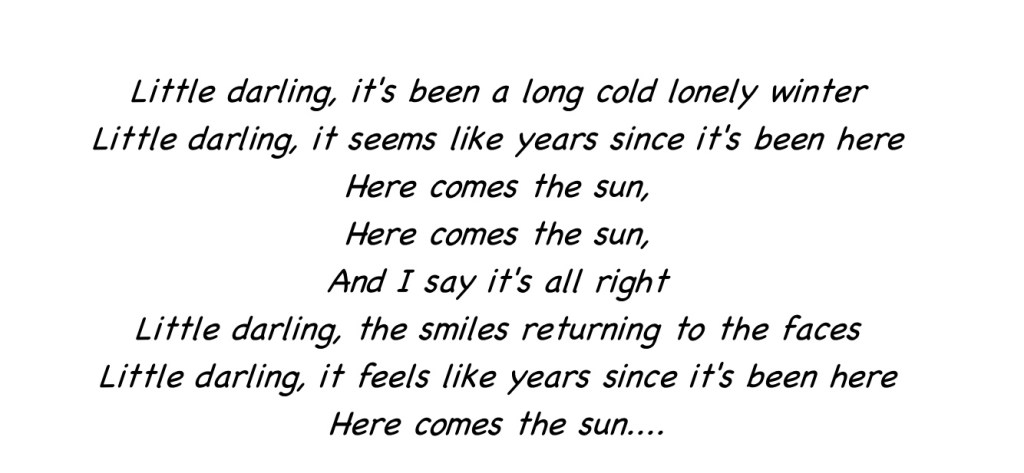
I’m sure we will have a few more warming winter soups and stews over the next several weeks. And while I’m happy for the sustenance they provided over the past four or five months, my mind is already turning to lighter dishes and meals. The days are growing longer and are not so dark. This winter of our discontent is ending. Spring, and the promise of renewal beckon and I am ready to embrace them. In the immortal words of George Harrison:
Addendum:
– Cathy and I had the good fortune to see the play several years ago at the Shakespeare Theatre here in DC. As with many Shakespeare tragedies, there was plenty of death, murder, political mayhem and family intrigue. If you get a chance to see it, I hope you do so.
– The Winter of Our Discontent was John Steinbeck’s last novel, and published in 1961. He borrowed the title from Shakespeare. It too tells the story of a family, with themes concerning the effects of social pressure, deceit, lying, corruption and death. Steinbeck stated that he wrote the novel to “address the moral degeneration of American Culture during the 1950s and 1960s.”









 Live Life Exuberantly