
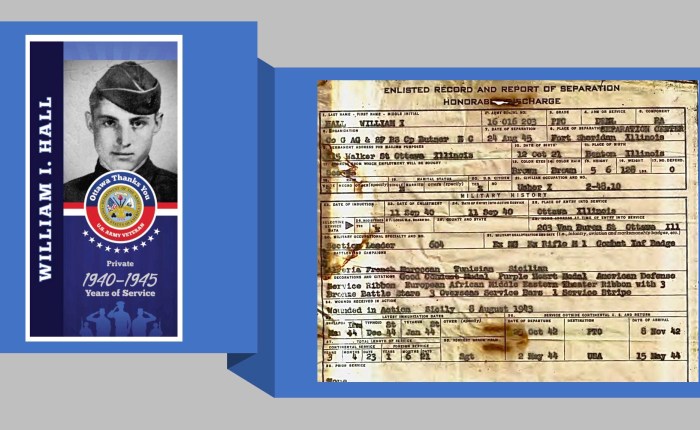
When discharged from the Army on August 24th, 1945, dad was 21 years old and had been in for nearly five years. His WWII service included time in Algeria, Tunisia, French Morocco and lastly, Sicily, where he was wounded. His discharge papers tell the intriguing story of those five years in one page.
This is the second of a two-part blog. Last week, I told the story of how I received dad’s enlistment and discharge paperwork from the National Archives. I then explored several interesting observations from his enlistment form, including the fact that he lied about his age in order to enlist. He claimed he was almost 19 years old, when in fact he was still two months shy of his 17th birthday. You will find a link to the first blog in the Addendum to this one.
Today’s blog explores his discharge paperwork, and briefly tells the story of his five years in the service. Dad was with B Company 1/60th Regimental Combat Team of the 9th Infantry Division from September 1940 until he was wounded and almost died in Sicily in August of 1943. Although his original enlistment in 1940 was for three years, when the war started all enlistments were extended for the duration.
As with his enlistment papers, dad’s discharge paperwork was discolored, creased and yellow, perhaps from the fire at the National Personnel Records Center (NPRC). A few parts were unreadable, but most of it was legible.

I’ll magnify and expand a couple sections to talk about some of the details.
At the top of the form, there are a couple of interesting items.

- Block 3 confirms his last duty station as Camp Butner, NC. This is where dad returned to the States in 1944 after recovering from his wounds. Camp Butner was both a troop training center, and a Prisoner of War camp. Dad told us stories later about helping train troops there (and about performing KP).
- We see in block 4 his actual discharge date is August 24th, 1945. This was two weeks after the atom bomb was dropped on Nagasaki, Japan, and one week before the official surrender of the Japanese on September 2nd. The army was already discharging soldiers as the war was winding down, based on how many “points” they had (more on “points” later).
- Block 7 still shows the birth date he lied about to enlist – Oct 12, 1921, as opposed to his real birth date of Oct 22, 1923. And amazingly, dad’s height, 5’ 6” and weight, 128 pounds haven’t changed at all from when he enlisted. Me thinks, someone was probably just copying from other forms to put this info in.
- Block 21 shows his civilian employment as “Usher”, so maybe not everything was copied over. His enlistment paperwork showed him as a “Laborer”.
Now we move on to the Middle section of his discharge paper, dad’s “Military History”. This is the meat of the discharge, and paints the real story of his time in the service. I’ve again magnified the view so you can better read the form. In order to tell dad’s history in a linear fashion, I will sometimes go out of order in discussing what is in the blocks in this section.
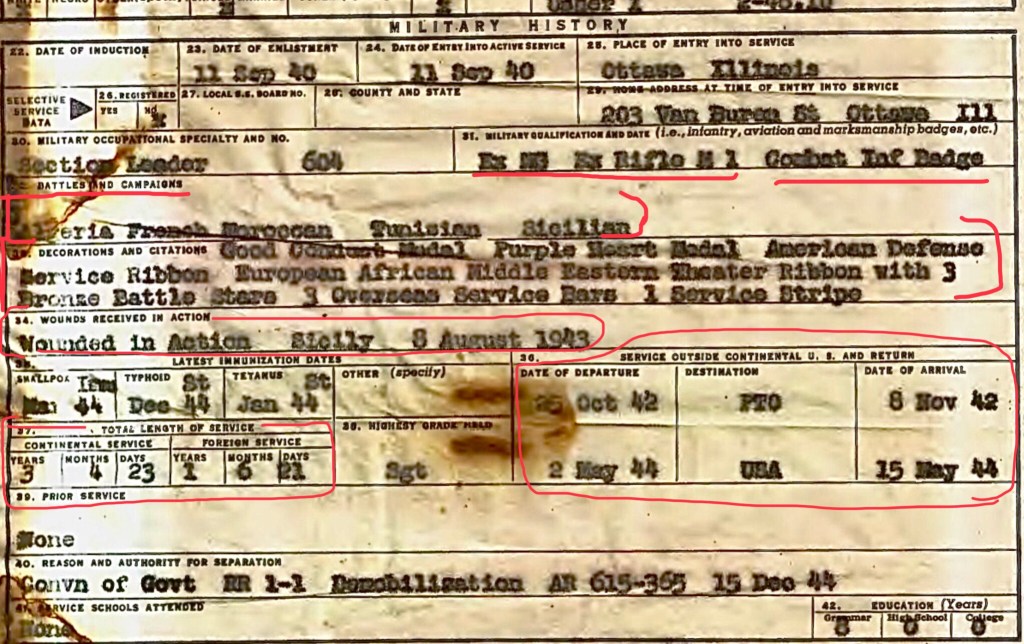
- Block 31 shows dad qualified as an expert both on the Machine Gun, and the M1 Garand rifle. It also notes he was awarded the Combat Infantryman Badge. You could only earn the CIB if you were in the Infantry (not in Field Artillery, or Armor, or Signal Corps etc), AND you were in actual active combat with the enemy.
- I’m going to skip to block 36 – “Service Outside the Continental United State” for just a minute . Note here that he arrived overseas on November 8th, 1942. What it doesn’t say is he arrived with the 60th Regimental Combat Team of the 9th Infantry Division at around 5AM under gunfire on the beach near Port-Lyautey, French Morocco. This was as a part of Operation Torch, the invasion of North Africa. Torch was (next to D-Day) the second largest amphibious assault ever attempted.
- Now back to block 32, where we see in addition to French Morocco, dad also took part in battles in Algeria and Tunisia in North Africa where they defeated Rommel and the Africa Korps. Those battles took place between November 8th of 1942 and May 10th of 1943. Then in July of 1943, dad participated in the invasion of Sicily.
- Skipping back down to block 34, we learn dad was wounded on August 8th, 1943. What it doesn’t mention is he was shot three times by the Germans in the mountains of Sicily and it took over a day to evacuate him by hand to an aid station. It also doesn’t say he almost died due to the combination of his wounds and the Malaria he contracted. His time with the 9th Infantry Division ended here.
- Returning to block 36, we see dad arrived back in the States on May 15th, 1944, three weeks before D-Day. This was after he recovered from his wounds (he was evacuated to North Africa to fully recover). Due to the severity of those wounds, he didn’t return to combat – the war was over for him, although he remained in the service for another 15 months.
- Block 37 “Foreign Service”, shows that of dad’s almost five years in the service, one year, six months and twenty-one days were spent overseas. Approximately eight of those months were in near continuous combat.
- Finally, we return to block 33, “Decorations and Citations”. In addition to his Good Conduct Medal and Purple Heart (for being wounded), he was awarded: the American Defense Service Ribbon (awarded to troops on active duty prior to Pearl Harbor); the European African Middle Eastern Theatre Ribbon with three bronze stars (this was for participating in the campaign in French Morocco, and the subsequent campaigns in Algeria, Tunisia and Sicily); three Overseas Service Bars (one for each six month period in a theater of war) and finally a Service Stripe (one for each three year period of service). It’s worth noting dad also earned a Bronze Star (for exemplary conduct in ground combat against an armed enemy), which didn’t catch up with him until after he was already discharged, and is not reflected in this paperwork.
Finally we come to the bottom of the discharge paperwork and block 55. There are three items noted here, although not all are readable.

- First, dad, along with all other honorably discharged service members, was issued a lapel button to be worn on civilian clothing. At the end of the war, it was particularly useful for those traveling home so they were quickly identified as service members and received priority for buses and trains.
- Next we see dad’s ASR score was 95. ASR stood for Adjusted Service Rating and is what was used to determine the priority for discharging soldiers at the end of the war. The rules were simple in principle: “Those who had fought longest and hardest should be returned home and discharged first.” Points were given for length of time in the service, length of time overseas, combat campaigns, combat awards, being wounded and so on. At the time, “the points” required for discharge were 85. Dad, with his nearly five years of service, his 1 1/2 years overseas, his Purple Heart, and his four campaigns was at, or near the top of the heap. His 95 points reflect that, and was why he was discharged so quickly as the war was winding down. If you have ever watched the show “Band of Brothers” there is a great section in the last show focusing on this. Points were on everyone’s mind.
- Finally, there’s the cryptic last line “xx days lost under AW 107”. What the hell is that? AW 107 stood for Articles of War (the forerunner of today’s Uniform Code of Military Justice). Article 107 refers to docking the soldier credit for days of active duty that they didn’t earn. Typical examples were for going AWOL, being too drunk to report for duty, or getting in trouble for other minor offenses and confined to the barracks. Since the service member was not performing his or her duties during those periods, they didn’t receive time in grade or retirement credit for those periods. It turns out many/most enlisted soldiers during WWII had AW107 scores higher than zero. During my research, I’ve found cases with numbers from 1 to over 200. I’ve tried like hell to read the smudged number here but can’t quite make it out. It might be a 5? It might be a 3? I don’t think we’ll ever know. What I do know is dad was busted from Sergeant to Private in June of 1943 for getting caught in, and subsequently kicked out of, a walled city twice in one night after missing the last truck back to his unit. Perhaps he was confined for some period of time in conjunction with this “incident”.
After his discharge, dad returned to Ottawa, Illinois in September and lived there for the next 65 years. In Ottawa he met mom, and had us three kids, six grandchildren and 13 great grandchildren. He retired from the railroad in 1985, and passed away in 2010.
For those of you who know me, or who have followed this blog for any length of time, I’m pretty sure you are aware of how much I admired my father. An embodiment of “The Greatest Generation”, dad was always one of my heroes. This was true certainly for his actions during WWII, but also for how he lived his life, and how he took care of our family.

I’ve probably written more blogs about him than any other subject. The blog last week about his enlistment and this one about his discharge file are special to me. It’s somehow reassuring that his enlistment and discharge paperwork confirm the outline of the oral histories we heard from dad growing up. I wish I had discovered this paperwork while he was still alive, just so we could have one more conversation about it over a coffee or a beer. “Dad, tell me again about the time …”, or “Dad, about those lost AW 107 days…”.
I love him and miss him.
Addendum:
- I apologize for the length of this and last week’s blogs, but I was trying to give some context to the cold and straightforward words in the paperwork.
- If you want to relook at the blog about dad’s enlistment paperwork, you can find it here: https://mnhallblog.wordpress.com/2023/03/14/lying-to-enlist-in-1940/
– Here are a selection of other WWII blogs that I’ve alluded to in this blog. There may be some minor discrepancies in them, based on the availability of the new information in his paperwork:
- Oct 1942. Last leave before shipping out to invade Africa. https://mnhallblog.wordpress.com/2017/12/04/the-%EF%BB%BFlast-big-weekend-before-the-invasion/
- On November 8th, 1942, Operation Torch began. Dad had turned 19 two weeks before. Here’s the story: https://mnhallblog.wordpress.com/2021/11/03/october-1942-dad-and-the-invasion-of-north-africa/
- Jan 1943. Dad, Roosevelt, and a Brush with History. https://mnhallblog.wordpress.com/2016/05/27/247/
- Mar 1943. “Maknassy” – The battle, 79 years ago in March of 1943, was vicious. On the 12th of March, as a part of operations at El Guettar, General Patton detached the 60th Combat Team, Dad’s unit, from the 9th Infantry Division and attached it to […] Continue at: https://mnhallblog.wordpress.com/2019/03/22/the-twenty-days-of-maknassy/
- May 1943. It was in May of 1943 in Tunisia, Dad looked at the German soldier and said “Chicago”. The German answered “Chicago?” Dad stared back. “Chicago … Al Capone”. Now the German’s eyes’ widened. Everyone knew who […] continue at: https://mnhallblog.wordpress.com/2022/05/08/dad-and-al-capone/
- June 1943. Busted in North Africa – Not everyone can get kicked out of a walled city twice in one night, but dad found a way […] Continue at: https://mnhallblog.wordpress.com/2016/06/05/kicked-out-of-a-walled-city-twice/
- August 1943. Wounded in Sicily. https://mnhallblog.wordpress.com/2016/05/14/wounded-in-sicily/
- August 1945 – Points and Mustering out of the Army. https://mnhallblog.wordpress.com/2019/08/09/points-and-mustering-out-in-1945/
 Live Life Exuberantly