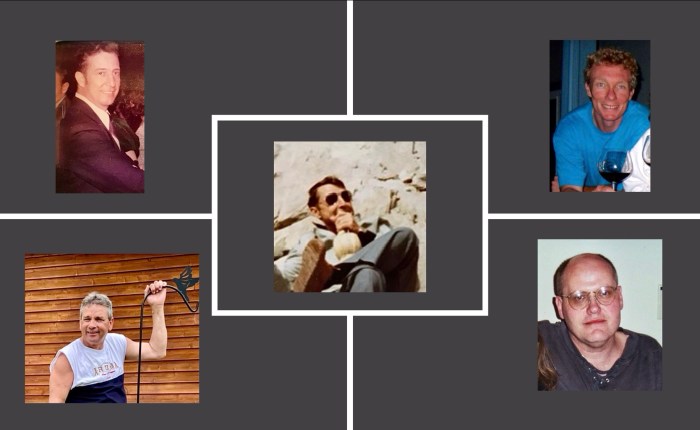
I opened the door to the room and the five of them were there. My brother-in-laws, Jack and Don, old friend Tim, Dad, and Cathy’s Dad, Max. All looked robust and in their 50s, except for Max who died at 41 and remained forever young. Tim looked up from the bar. “French 75 Maxie?” I nodded yes.
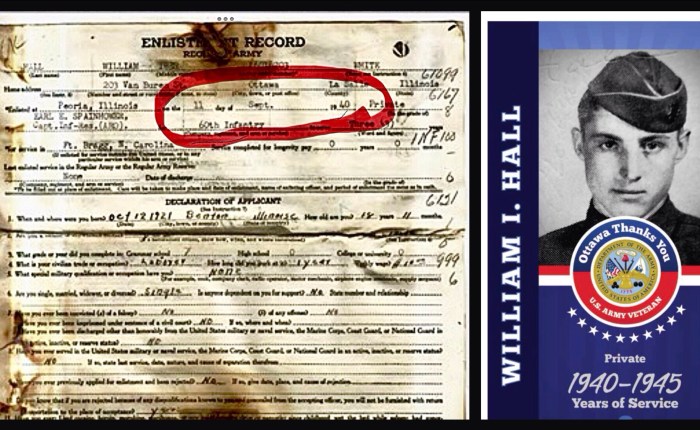
September 11th is our National Day of Remembrance. I think back to that horrific day, and also recall the unity that came to America afterwards, for a while at least. I now also have something else to think about. I recently learned my dad enlisted in the Army 85 years ago, on SEPTEMBER 11th, 1940. He was all of sixteen.
Dad passed away fifteen years ago on June 25th, 2010. I think of him often and smile at our times together, and the stories he told of his life. I am eternally grateful for the gifts he passed on to me. I could also cry, thinking of the questions I never asked him, and never thought to ask while he was alive.
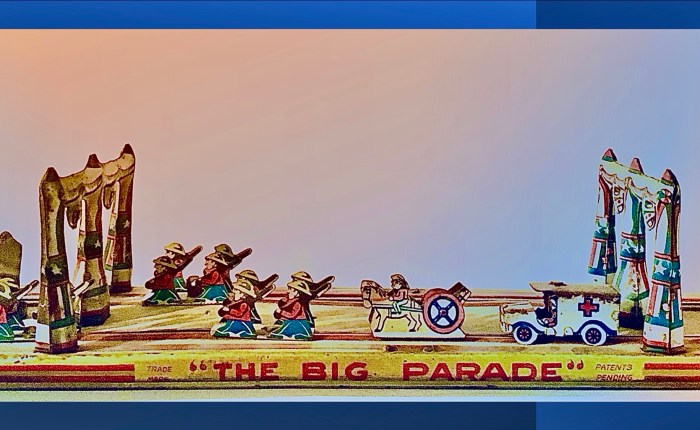
Did you hear? A Big Parade is coming! It is the 250th anniversary of the United States Army, and coincidentally, a certain someone’s birthday. Let’s celebrate! Ever since Trump saw a military parade in France in 2017, he has wanted one and he is finally getting it.
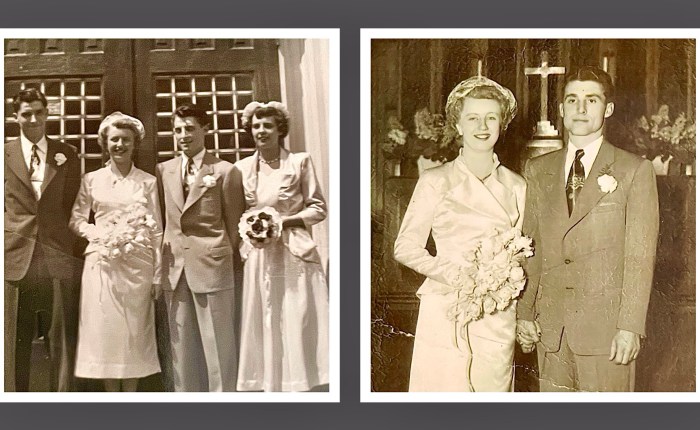
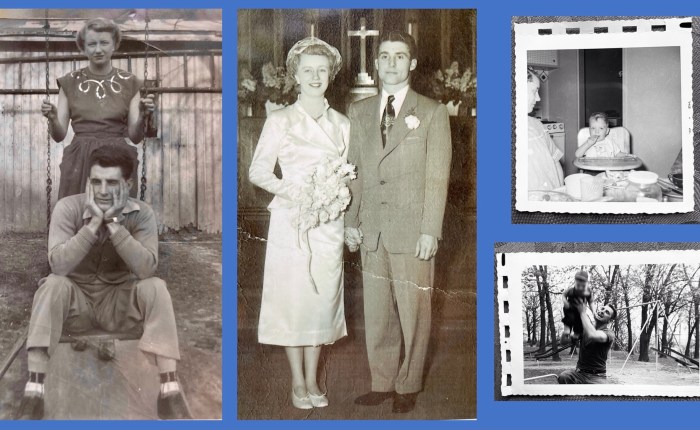
May 14th was the 75th anniversary of Mom and Dad’s wedding in 1950. They celebrated 60 of those years together, before Dad passed away in 2010. I’m grateful for the lessons about love and marriage they provided my sisters and me, or to anyone who knew them.
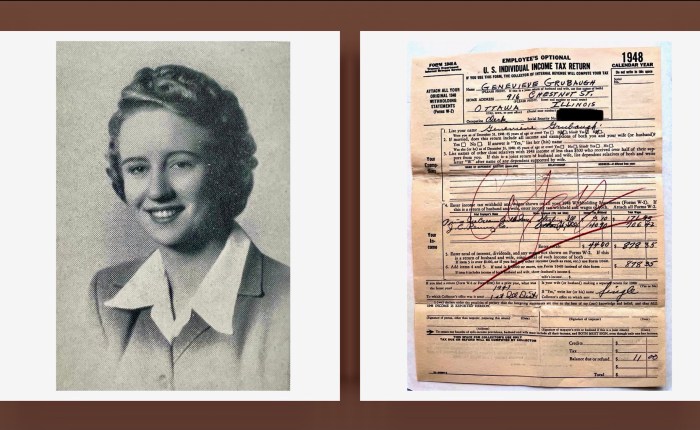
Tax Day! Mom was something of a pack rat – a neat one, but a pack rat nonetheless. My sister Roberta and I recently went through a box of old photos and papers and came across her 1948 Tax Return. She was a junior in high school at the time, and it turns out at a juncture in her life.
80 years ago this week, my “Uncle” Noble and the 9th Infantry Division sealed off the Cherbourg Peninsula eleven days after D-Day during WWII. I was thinking about him while watching the Band of Brothers on TV. When Easy Company jumped into Normandy for their first wartime engagement, Noble and the 9th had already been in combat for over 1 1/2 years.
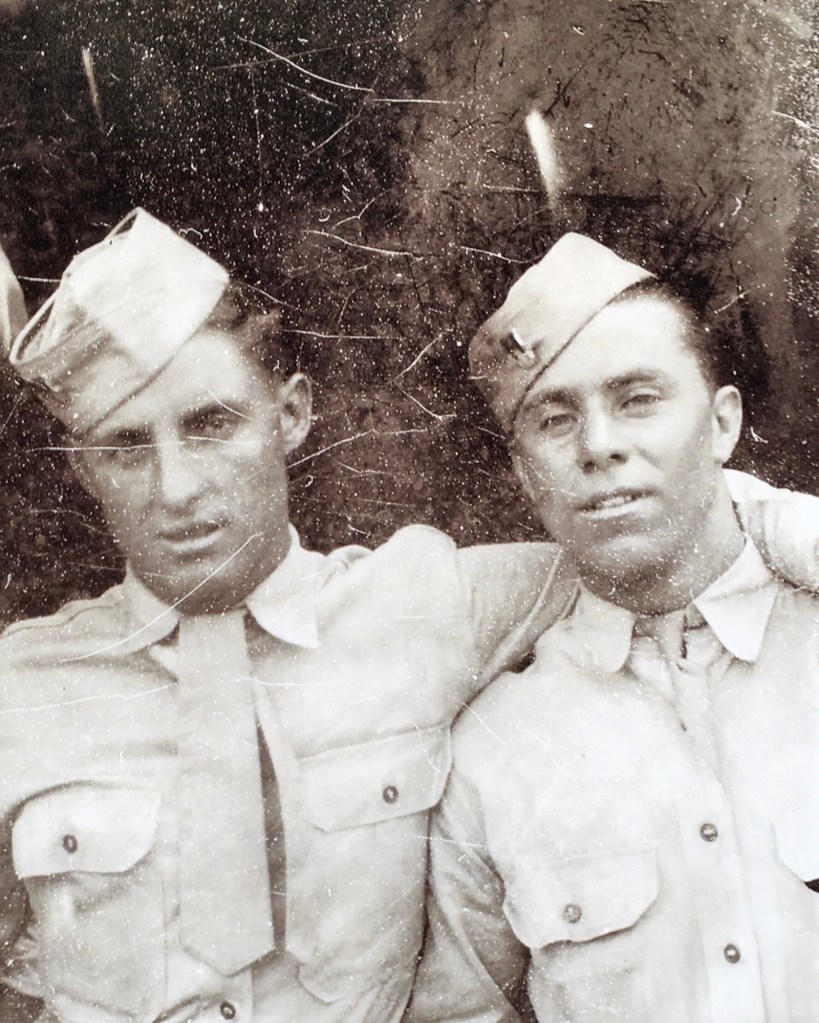
Noble was Dad’s best friend, after his brothers, Mick and George. Both he and Dad joined the Army when underage in 1940, over a year before WWII started. They were in B Company, 60th Regimental Combat Team (RCT), of the storied 9th Infantry Division.
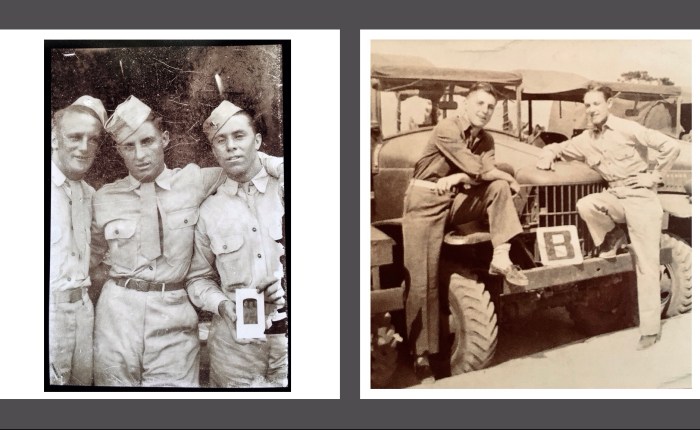
Dad and Noble in ‘41 or early ‘42.
Mom, Dad, “Uncle” Noble and “Aunt” Myra were great friends through the years and got together several times a year. The four of them had a close friendship that lasted a lifetime. I learned a lot about life, and about enjoying life from all of them, but particularly Dad and Noble. They told stories from their time in the Army – almost always funny stories of things that happened. The serious stuff? The stories of death and destruction? Those didn’t make it to the kitchen table where folks gathered, drinking coffee and listening, as these two combat veterans told their tales.
Noble’s actual WWII story is interesting. It’s one you can’t really tell without also telling the story of the 9th.
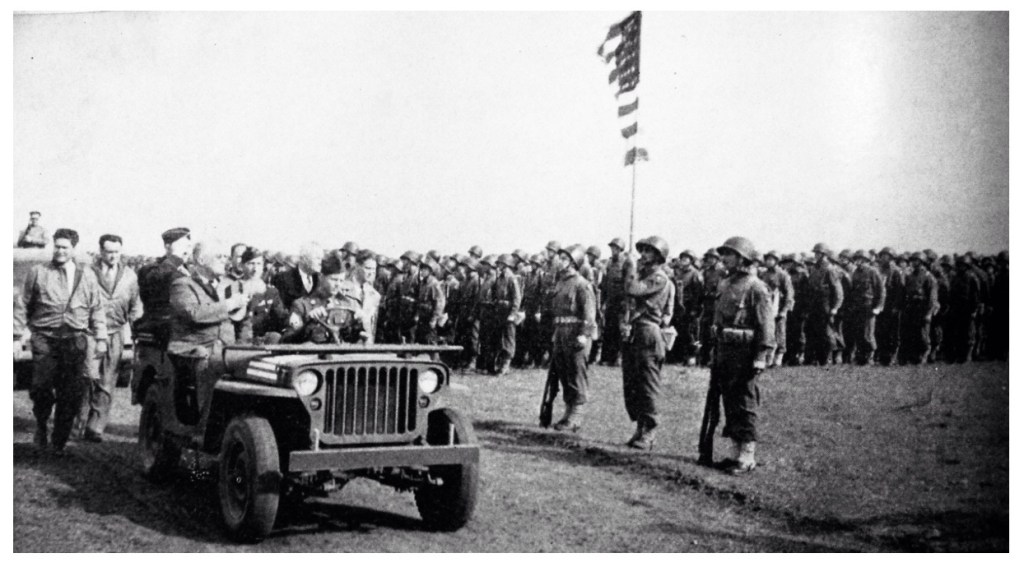
Dad and Noble’s wartime experience started on November 8th, 1942, when the 9th took part in the Invasion of North Africa. Until D-Day happened, it was the largest wartime amphibious assault ever. After three days of battle, they took Port Lyautey, Morocco and the Vichy French surrendered. After some downtime, in January of ‘43, the 60th RCT was the only unit selected to take part in a review for President Roosevelt who was at the Casablanca Conference. Dad and Noble were both there and told us funny stories of the comments in the ranks as Roosevelt passed their unit in a jeep for the review. “Hey Rosie – who’s leading the country while you’re over here?” “Hey Rosie – Who’s keeping Mamie warm while you’re over here?”
Roosevelt Reviewing the 60th RCT During the Casablanca Conference
Things got tough again after that. Starting in February, they fought their way across Algeria and then Tunisia. Station de Sened, Maknassy, Bizerte – forgotten names now, but deadly locations in the spring of ‘43. The Germans eventually surrendered at Bizerte, on May 9th, 1943, just over a year before D-Day.
The 9th wasn’t finished though. A little over two months later, in July of ‘43 they took part in the invasion of Sicily. The 60th conducted the famous “Ghost March” through the mountains of Sicily, which the Germans originally thought were impenetrable. Dad was shot three times there, and almost died. It took them a few days to evacuate Dad to an aid station, and then a hospital. The war was over for him and they eventually sent him back to the States.
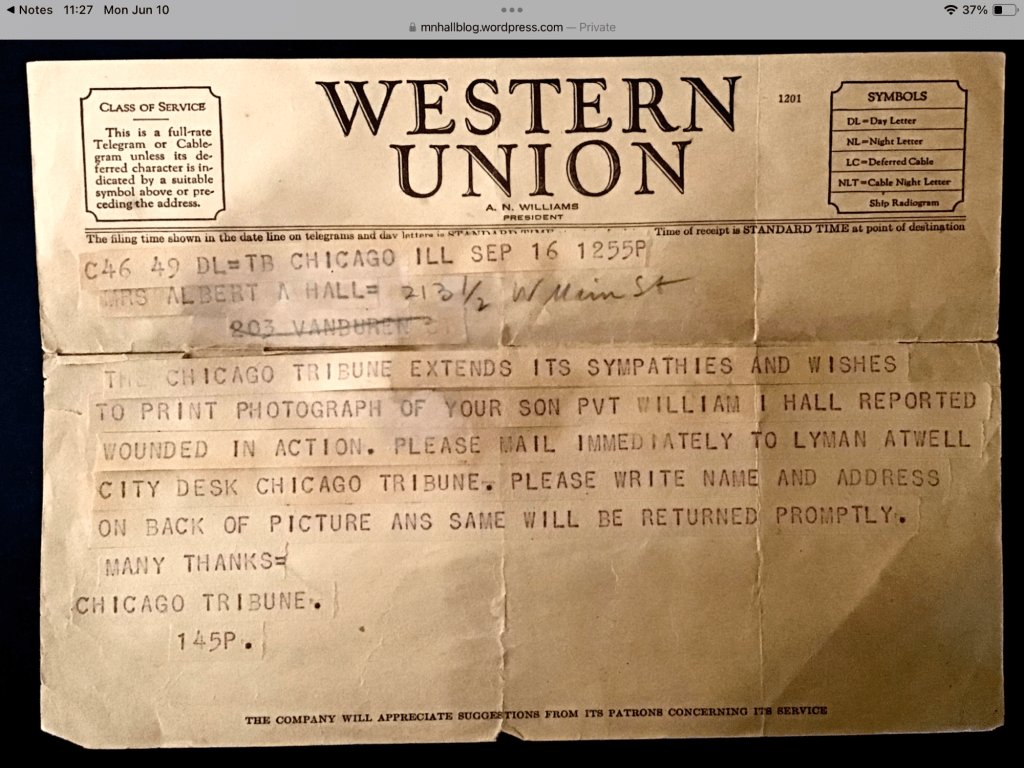
Chicago Tribune Asking for a Picture After Dad was Wounded.
In fact Dad’s wounds were so severe, Noble thought he had died, or would die shortly. As they evacuated him, Noble and the 60th continued the fight. 38 days after the invasion began, Sicily fell on August 20th. Noble was there when Patton addressed the Division on August 26th, congratulating them for their efforts.
In September of ‘43, the 9th deployed to England for rest and refitting. With just over nine months until D-Day, the 60th had already fought in four countries on two continents.
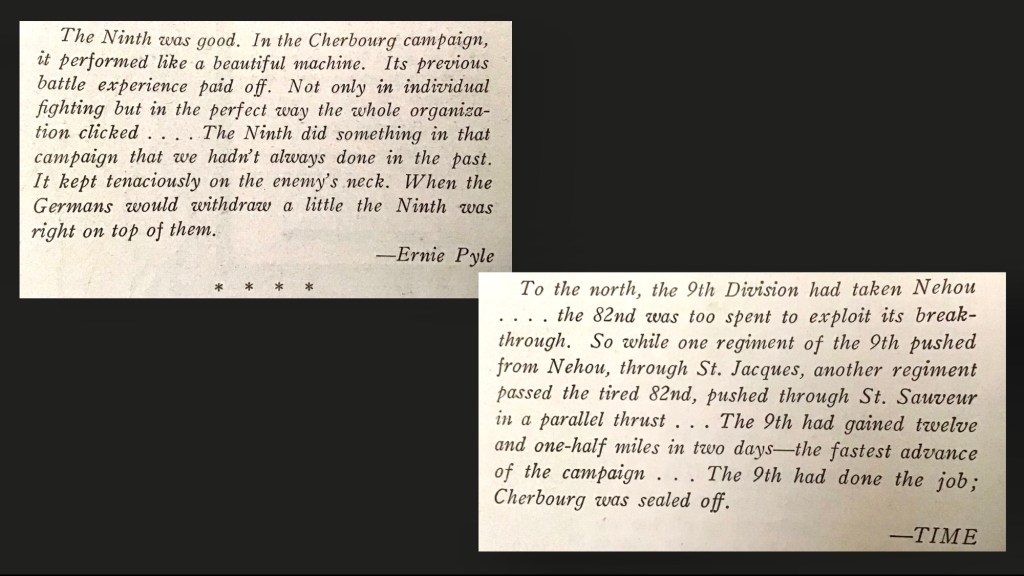
On June 10th, D-Day plus 4, Noble and the 9th landed on Utah Beach. Their mission? Attack towards Cherbourg and cut off the peninsula. This they did and on the 17th of June, reached the ocean on the other side of the peninsula, and eventually, captured the port of Cherbourg itself. If you’ve forgotten your history, Cherbourg was critical for the allies to establish a port on the Atlantic Seaboard. Back home, the news singled out the 9th for their efforts.
Ernie Pyle and Time Magazine Talking About the 9th on the Peninsula
From there, they started on the great chase across France. The 9th advanced over 600 miles by the end of September thru France and into Belgium. In 3 1/2 months they were engaged in three major campaigns and were only out of action for a total of five days.
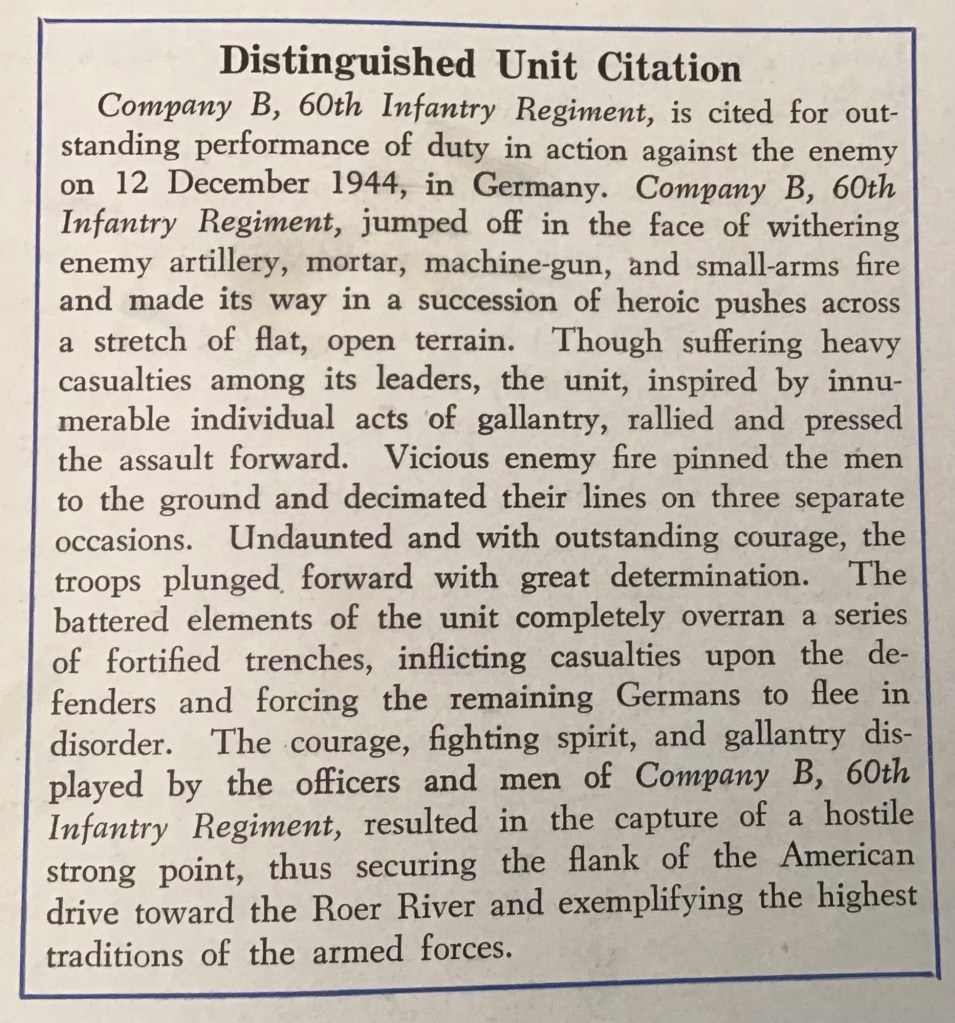
The 9th was among the first units entering Germany itself. For actions on December 12th in the Hurtgen Forest area of Germany, Noble’s unit, B company 60th RCT, received a Distinguished Unit Citation for combat actions in Germany. At the time, the company probably had around 80 or so men.
Noble and B Company, in Action Just Before the Bulge
Just after the 12th, The 9th was pulled out of the line due to the heavy casualties they had sustained. It was “resting” in the Monschau Forest area of Belgium, when on December 16th, 1944, the German winter offensive, the “Battle of the Bulge” started. Thrown back into combat, the Division beat back the enemy at the northern edge of “The Bulge”.
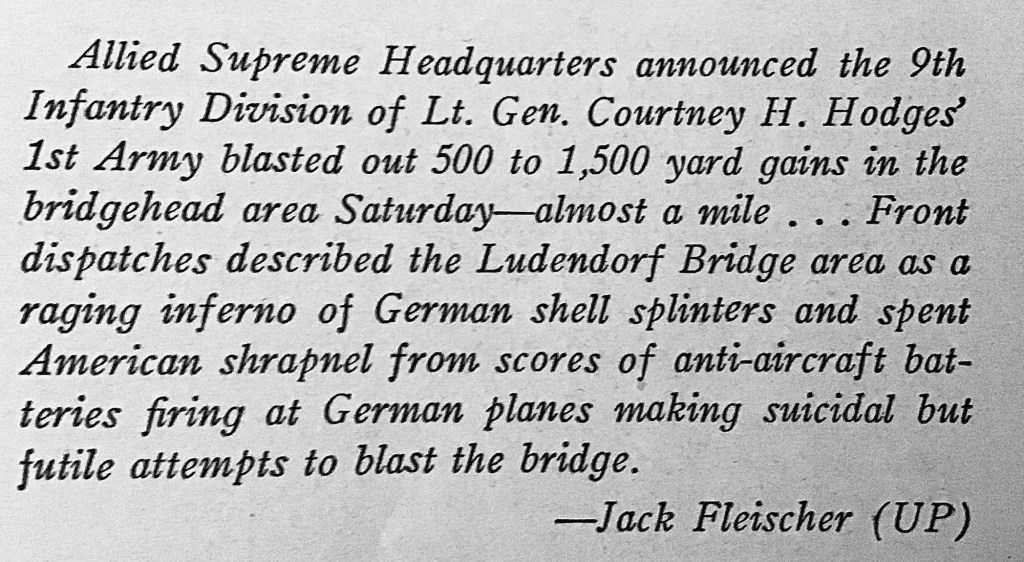
The Battle of the Bulge, The Ardennes, the fight across Germany to the Rhine River – Noble saw all of that. On 7 March, when the American 9th Armored Division captured the bridge across the Rhine River at Remagen, Noble and the 60th RCT were among the first Infantry units to cross under heavy fire and defend the bridgehead from the East side of the Rhine.
The 9th at Remagen
On across Germany – The Ruhr, The Hartz Mountains… On April 26th, 1945, a patrol from the 60th RCT linked up with the Russians at the Elbe River. The war in Europe officially ended on May 7th.
Noble spent 2 1/2 years in combat, fought in seven countries and survived without a scratch. Miracles do happen.
In 1950, a minor miracle also happened.
In July of that year, a knock came at my parent’s door and Mom answered. A young couple was standing there and wanted to know if William Hall lived there. Mom said yes and called Dad. All of a sudden there was yelling, and exclamations, and hugging, and dancing and back pounding – it was Noble, and his new wife Myra.
It turned out Noble and Myra were traveling from a vacation in Wisconsin back to Southern Illinois where they lived, when they passed our hometown – Ottawa. Noble thought Dad had died in Sicily, and then remembering he was from Ottawa, decided to stop in and see if he could find Dad’s parents and offer his condolences. He looked the name William Hall up in the phone book, and stopped off at the local VFW to see if anyone knew of Dad or his relations. They then drove to the address from the phone book, assuming it was my grandfather’s home. Instead, he and Dad saw each other for the first time since August of 1943 in Sicily.
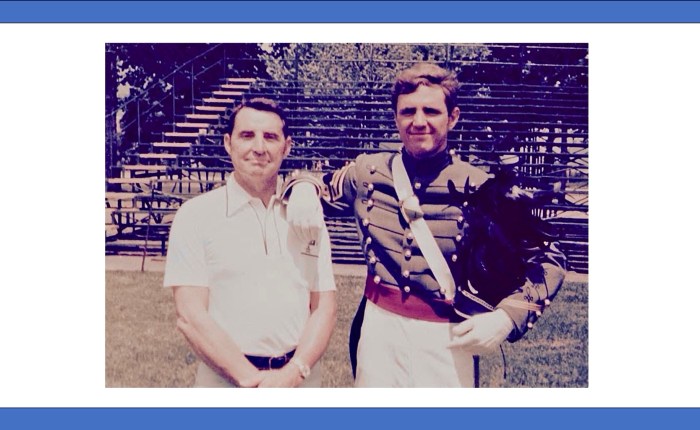
I was born in ’55 and named Max Noble Hall in honor of Noble. I always enjoyed seeing him and Myra over the years during their visits. Later, at West Point, and then while spending my own time in the Army, I often asked myself if I was measuring up to these men from B Company of the 60th RCT.
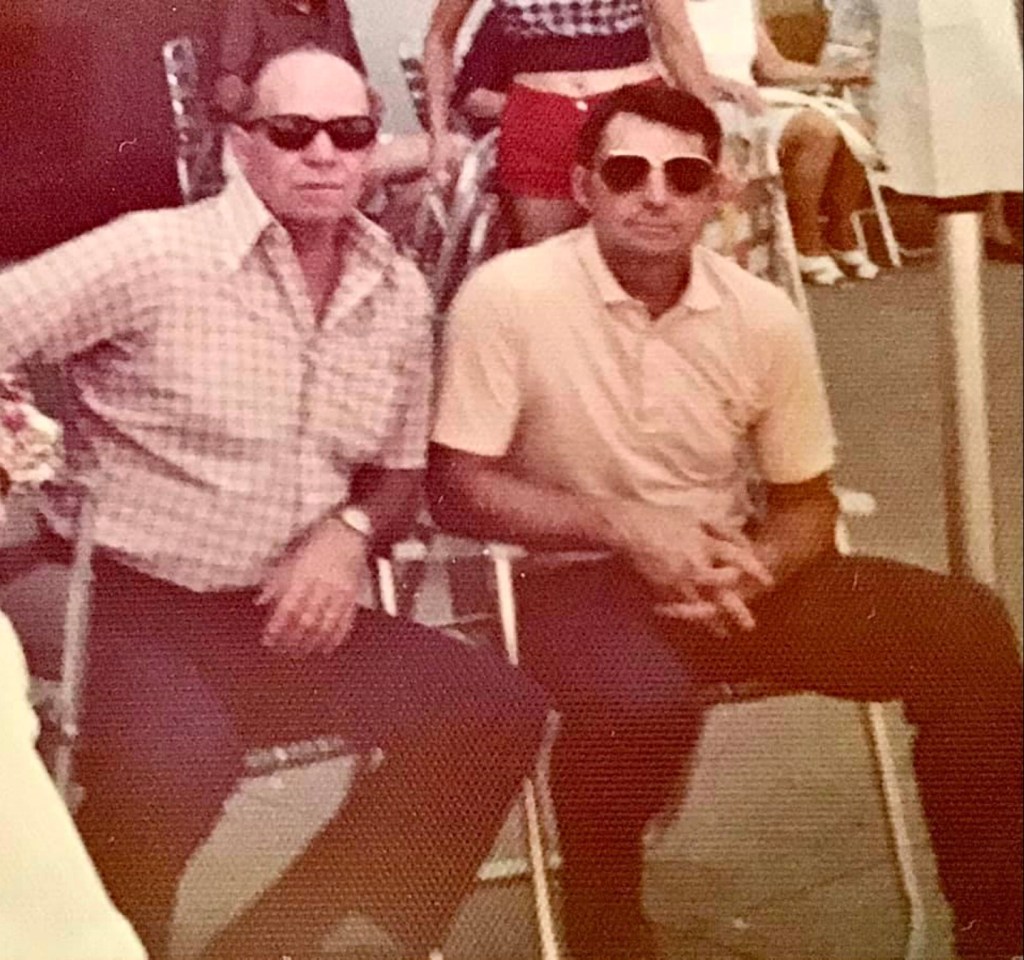
Noble and Dad in the Mid-‘70s in Ottawa. Still Ready to Kick Ass.
I feel so lucky having known them and having heard the stories Noble and Dad told. It’s only in the last decade I’ve matched those stories up to the details in history books. I can tell you they greatly underplayed what they did for America and the free world. What I wouldn’t give for another day with Noble and Dad – listening to the stories, and this time, asking more questions.
The “Greatest Generation” is mostly gone now. I think it’s important we not let them, or their stories be forgotten.
Here’s to you Uncle Noble. Thanks for everything you did for this country and being an influence in my life. It’s a debt I can never repay.
I relied on the book, “Eight Stars to Victory, A History of the Veteran Ninth U.S. Infantry Division”, published in 1948, as background for much of the factual information in this blog.
Mom and Dad’s wedding anniversary was last week. They were married 73 years ago on May 14th, 1951. I was thinking about them and how both influenced my life and the lives of others. Many people say I remind them of dad, but Cathy, my wife, says mom shines through me.
In my view, both views are right and I’m a product of the two of them. Upbringing and genetics combined, making me who I am, although not always in ways people think.
Our environment at home was a good one. They had a unified front in how to raise the three of us kids and supported and reinforced each other at home. I’m hard pressed to remember a single time with any separation between them in their views about how to raise us. Home was a good environment, but they were also strict about what we could and couldn’t do as kids. They certainly encouraged us, and gave us carrots/rewards, but they also weren’t opposed to spankings and we all received our fair share. We learned about honesty, work, fairness, friendship and love in our home on Cherokee Lane. I think that environment and those ideals prepared me for life.
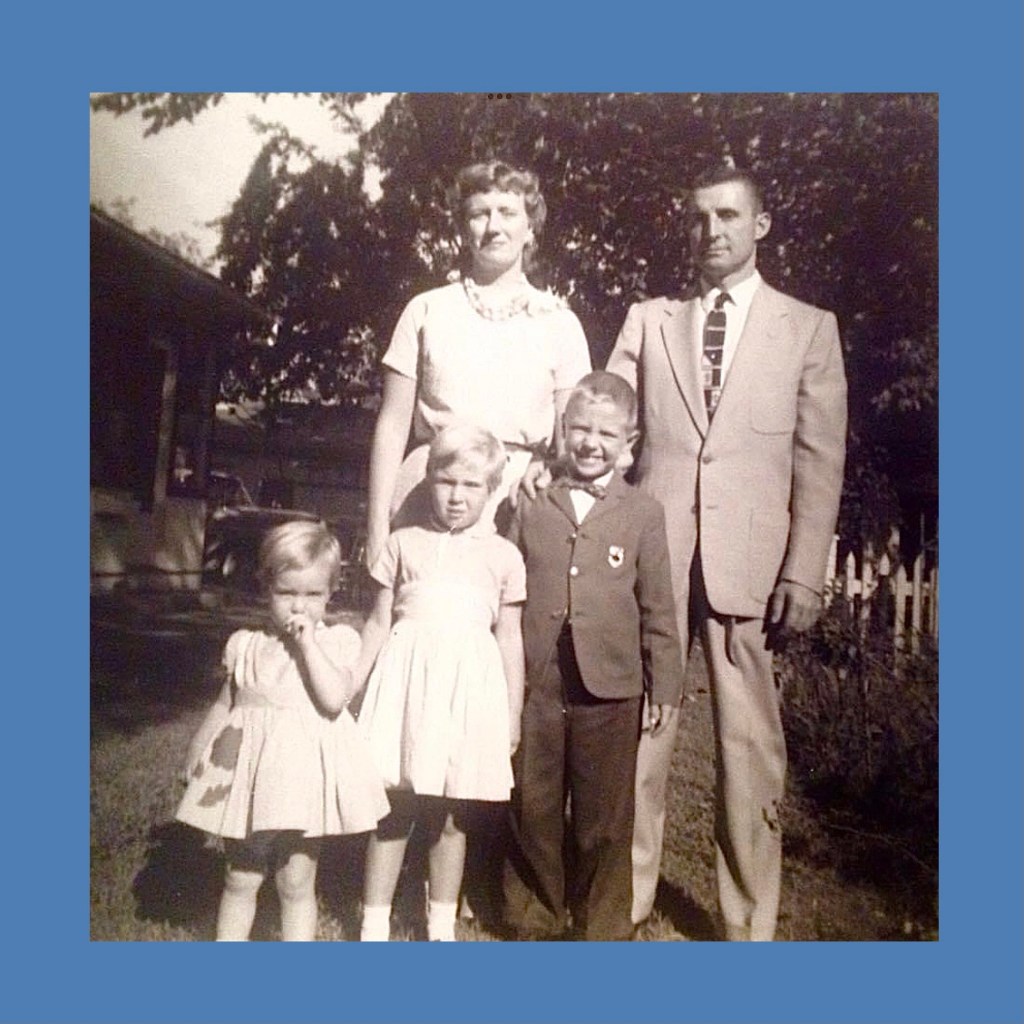
Our Family in the 60s.
There were differences in their individual personalities and how they approached life for themselves. Like many good marriages, their ways were complementary to each other and for them, it was a classic case of 1 + 1 = 3. I’ll talk about a couple of examples here and how they rubbed off on me.
Most who know me would say I’m pretty organized – some might even say anally so. I’ve been that way for much of my life. I use to-do lists, spreadsheets, outlines, plans … probably more than most. While some think I inherited that from dad, it’s actually pure mom. That’s how she attacked life, and her work. She was the secretary in the main office at our local high school. If you needed to find out something, the standard answer was “go ask Gen”. When I applied to West Point, it was mom who organized everything, making sure my packet was complete and reflected well on me.
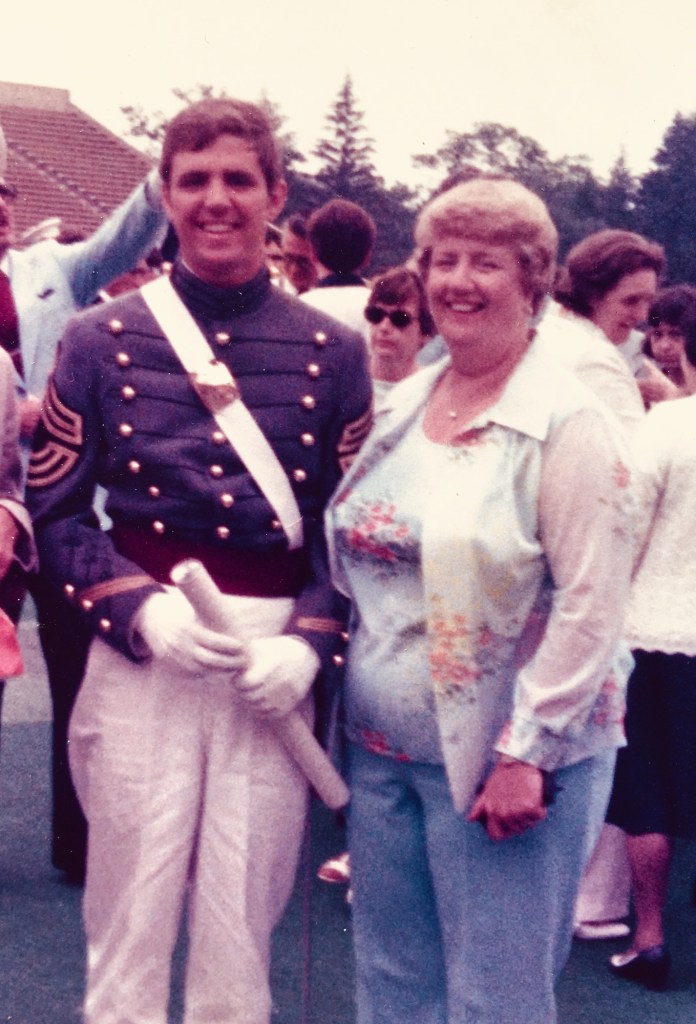
Mom and I on Graduation Day at West Point.
I’ve thought about how much of my “orderliness” was a product of her, or of my time at West Point and in the Army. Maybe over the years, they became mutually reinforcing.
Dad on the other hand, was a bit looser in his approach to life. I’m not sure how much the war influenced him, but I think quite a bit. I’m betting getting wounded and almost dying makes you approach a lot of things differently, and so it was with dad. He was a hard worker, but when work was done, he enjoyed life. Dinners out, dancing, having a few drinks. When the weekend came, he was ready to enjoy it and life. I think he approached life in general that way, and tried not to let things burden or worry him, even when there were challenges.
He was also a gifted storyteller. Telling tales about his childhood, or the war, or one of the railroads he worked for – he could tell his story and make you feel you were right there. You were living it with him while he talked. It was a special gift and over the years if you were ever with dad at our home, or somewhere else, you probably heard more than a few of his stories. Even when he repeated them, he could still make you laugh.
One other thing about Dad. He never made all that much money, but money never had a hold on him. He was always generous, with family, friends and strangers.
I certainly inherited his lust for life and try to enjoy every day. As for story telling, well, I think I have some of his ability to tell a tale, however if I’m honest with myself, I’m only a pale imitation in that department. It’s perhaps what I miss about him the most.
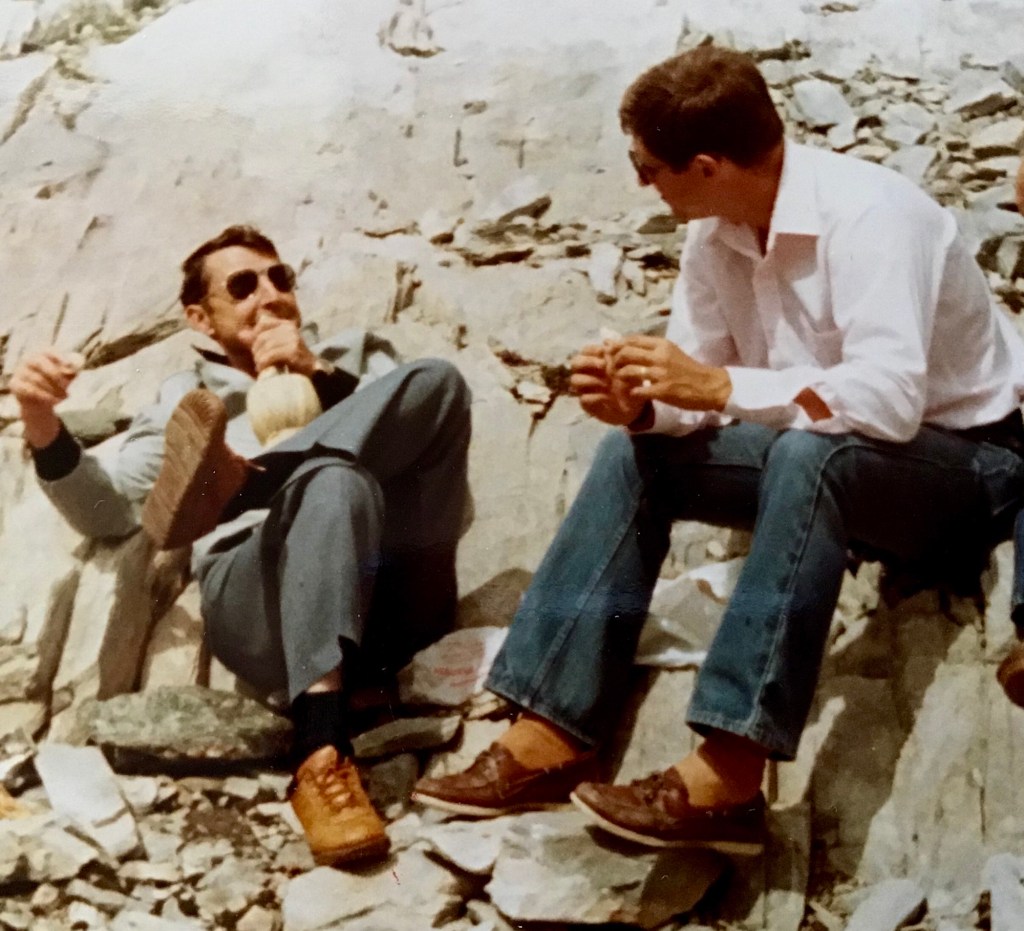
Dad and I Swapping Stories, While Drinking Some Wine in the Alps
They both were friends with people of all ages and had the ability to put people at ease. When traveling, they would inevitably make new friends.
My cousin Dawn may have given the best description of mom and dad I’ve ever heard. “Your mom was like home. Comfortable and warm. Your dad was like a spark that gets a flame going then keeps the fire dancing. They were special people. I’m smiling now thinking about it.”
Although both mom and dad have passed on, I’m wishing them a happy belated anniversary. I’m thankful for the gifts they’ve given me, and for the enrichment they brought so many others.
Happy Anniversary and Thank You for Everything.
Addendum:
Thanks to my cousin, Dawn Tedrick, for her wonderful description of my folks!
It was December 6th, 1941. Dad, Noble and other men from B Company, 60th Regimental Combat Team of the 9th Infantry Division had weekend passes. They left Fort Bragg, North Carolina that Saturday for nearby Fayetteville. They didn’t know it yet, but the next day their world would change forever.
That weekend, Dad was a little over 18 years old and had been in the Army for about fifteen months. The 9th Infantry Division reactivated in August of 1940, and Dad joined the unit in September of that year, at the age of 16.
Dad (on the left) in 1941 in the Bravo Company Motor Pool.
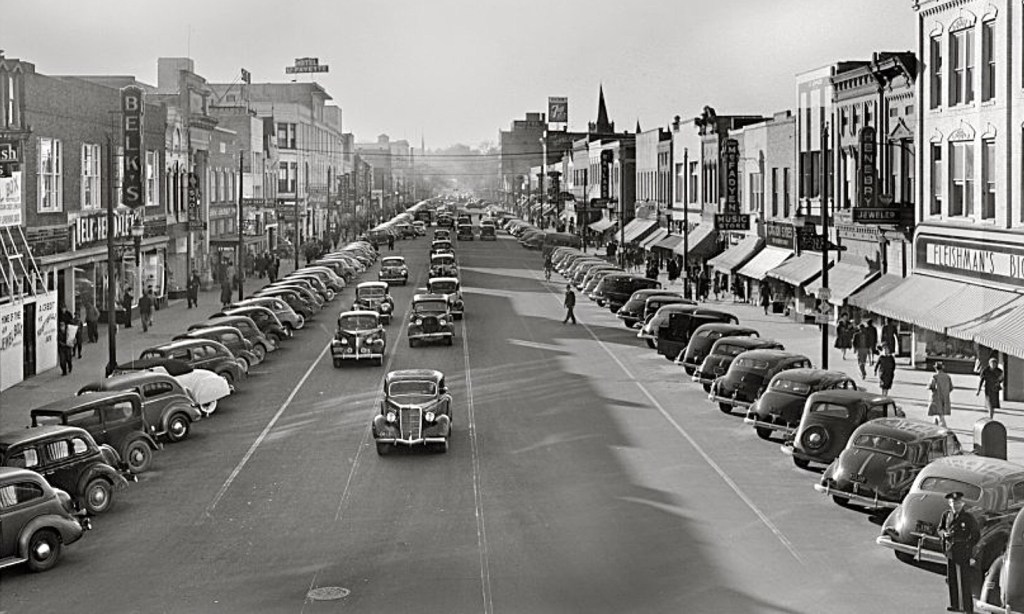
In 1940, the population of Fort Bragg was 5,400. One year later, there were 67,000 troops at Bragg and Fayetteville was on the way to becoming a military town, with bars, clubs, restaurants and everything needed to “entertain” the troops, for better or worse.
Fayetteville, 1941.
Dad and the other boys of Company B received their weekend passes that fateful weekend and probably left Bragg around noon. Typical weekend passes went from noon on Saturday to 6PM on Sunday. They usually rented a room or two to use as a base for their partying. Over the years, he told me about some of those weekend passes. Real food, beer, clubs, blues, jazz, dancing and trying to link up with girls. They’d party into the night, and then the next day, after a big breakfast, party some more until they eventually returned to Post. I heard stories about fun times in North Carolina (Fayetteville and Charlotte) in Tunisia and Algeria, and late in the war back in Washington DC. Let’s just say, Dad knew how to party.
For this particular weekend, he didn’t tell me about any of that. What he talked about was the return to Fort Bragg late Sunday afternoon on December 7th.
Dad and several others were returning to the Post in a cab. I think he said there was a formation at 6PM for accountability purposes, but maybe they just had to sign back in. He and his friend, Noble, had partied it up pretty good and were a bit hungover. As they neared Fort Bragg, two things happened. First, traffic was backed up to drive onto the Post – they were checking IDs or checking IDs more closely than normal. Second – the cab driver turned on the car radio.
By 1940, AM radios were considered a standard feature in automobiles. The stations carried news, some radio shows and music. There weren’t lots of stations, and the programming wasn’t all that varied. This time however, the boys of Company B heard the words that would change their lives. An NBC announcer read the following statement, relayed earlier from station KGU in Hawaii:
BULLETIN: We have witnessed this morning the attack of Pearl Harbor and the severe bombing of Pearl Harbor by army planes that are undoubtedly Japanese. The city of Honolulu has also been attacked and considerable damage done. This battle has been going on for nearly three hours. One of the bombers dropped within fifty feet of Tanti Towers. It’s no joke -it’s a real war. The public of Honolulu has been advised to keep in their homes and away from the army and navy. There has been severe fighting going on in the air and on the sea …(There then was an interruption, followed by this) . . . We have no statement as to how much damage has been done but it has been a very severe attack. The army and the navy, it appears, now has the air and sea under control.
There is a five-hour time difference between Honolulu and the East Coast. The attack on Pearl Harbor started at 8AM and lasted about 90 minutes (not the three hours in the news bulletin). That means the attack ended about 9:30AM Honolulu time, or 2:30PM East Coast time. The Honolulu station was somewhat delayed in reporting the news, and then of course, in the pre-internet age, it took longer for stations in the Continental US to pick up the bulletin and rebroadcast it. My guess is Dad, Noble and the other guys were hearing this news around 4:30PM or so that afternoon.
What did they do at this point? Wait in the cab to drive onto Fort Bragg? Get out of the cab and run onto Fort Bragg? Leave the cab and start talking with the other gathering soldiers? None of those things happened.
Instead, they directed the cabbie to make a U-Turn and drive back to Fayetteville. They were going to hit the bars again, even though they would be Absent Without Leave (AWOL) and miss the evening formation. They knew instantly this was going to be a shooting war, training was going to get tougher and opportunities to leave Post become slimmer. They weren’t going to miss this chance for a last shebang.
Dad and Noble in ‘41 or Early ‘42on a Different Weekend Pass.
And of course, when they returned to Fayetteville, they weren’t alone. Soldiers were everywhere drinking and partying. I think Dad said he thought half his battalion was in town. They joined the crowd and partied into the evening. There was a great deal of talk about when and where they would deploy.
Eventually, they returned to Bragg late that night. According to Dad lots of guys had hangovers at morning formation on Monday, December 8th, but nothing was really done about them missing the evening formation. There was too much work to do.
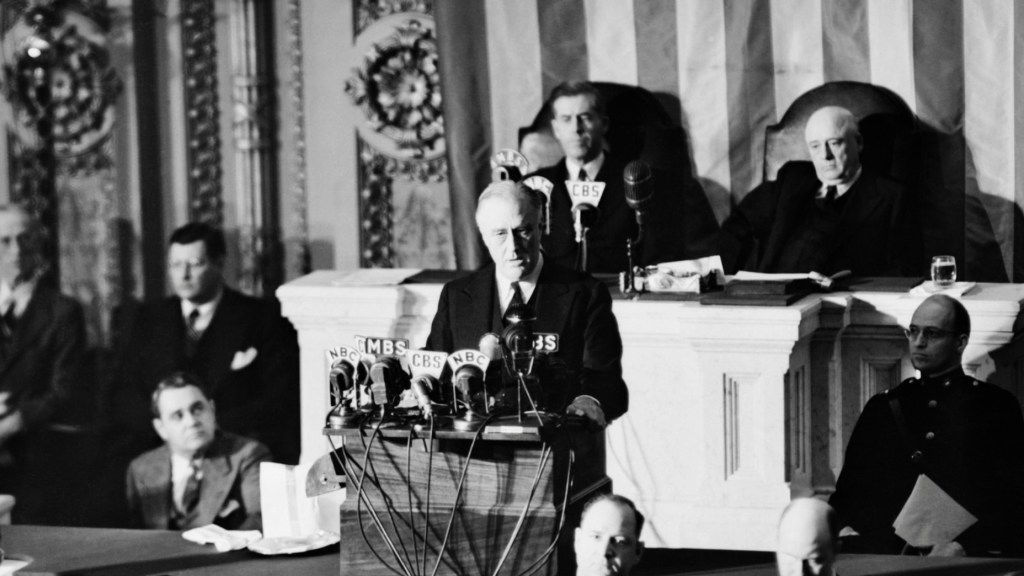
On the evening of the 8th, President Roosevelt gave his famous “A Day which will live in Infamy” speech to a joint session of Congress. The speech was broadcast live by radio and attracted the largest audience in American radio history, with over 80% of Americans allegedly tuning in to hear it.
President Roosevelt Speaking to Congress on Dec 8, 1941.
Eleven months to the day later, on November 8th, 1943, the men of the 60th Regimental Combat Team, including Dad and Noble, landed on the beach under fire in North Africa at Port Lyautey, Morocco as a part of Operation Torch. The counteroffensive had started against the Axis powers in the European Theater of Operations.
When dad joined the Army in 1940, it was for a three-year hitch. It would be 5 years before he was honorably discharged in August of 1945. He took part in the invasions of North Africa and Sicily, where he was wounded and almost died. I think partying several extra hours on the evening of December 7th was probably justified.
— Never Forget —
Addendum:
In 1940, the population of Fort Bragg was 5,400. By the following year, it reached 67,000. Various units trained at Fort Bragg during World War II, including the 9th Infantry Division, the 82D Airborne Division, the 100th Infantry Division, the 2nd Armored Division and various field artillery groups. The population reached a peak of 159,000 during the war years. This past year, Fort Bragg was renamed Fort Liberty.
Here is one other Pearl Harbor blog I’ve done: The plaque is only a small one, over in front of The South Ottawa Town-Hall on 1st Avenue. The Hall is still used for occasional meetings, but 1st Avenue is pretty sleepy in that area, so I don’t know how many people actually ever see the plaque. When I walk by, the words always compel me to stop. And think. And remember … Herman Koeppe was 19 the day he died […] https://mnhallblog.wordpress.com/2016/11/30/never-forget/
As my friend and West Point Classmate Bill Moeller noted, it is perhaps no coincidence that the Birthday of the United States Army, Flag Day and National Bourbon Day are all celebrated each year on the same Date: June 14th. It turns out all three of their stories go back to the late 1700s.
I’ve always thought that understanding our nation’s history was important. When I learned June 14th was shared by the Army, our Flag, and Bourbon, it seemed worth doing some historical digging. Here’s what I learned.
Before there was an American Flag, before there was American Bourbon, the United States Army was around to protect both.
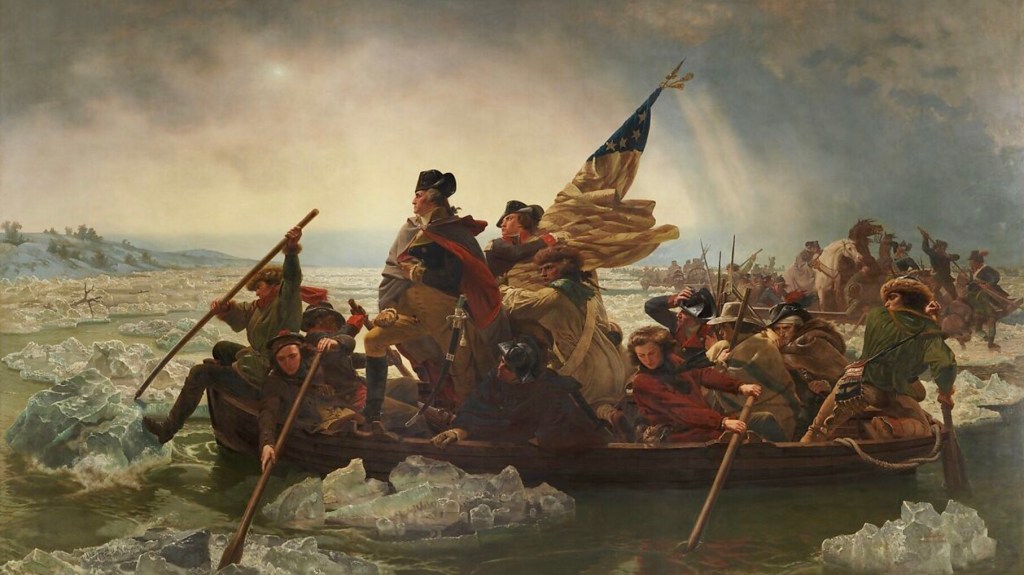
One year prior to declaring our independence from Great Britain, the Continental Congress approved the formation of the Army on 14 June 1775. On that date, they authorized the enlistment of ten companies of riflemen to serve the United Colonies for one year to form the “the American Continental Army.” The next day, Congress issued its first commission by appointing George Washington “General and Commander in chief of the Army of the United Colonies, and of all the forces now raised, or to be raised by them, and of all others who shall voluntarily offer their services, and join the Defense of American liberty, and for repelling every hostile invasion…”
Washington Crossing the Delaware with the Continental Army in December 1776.
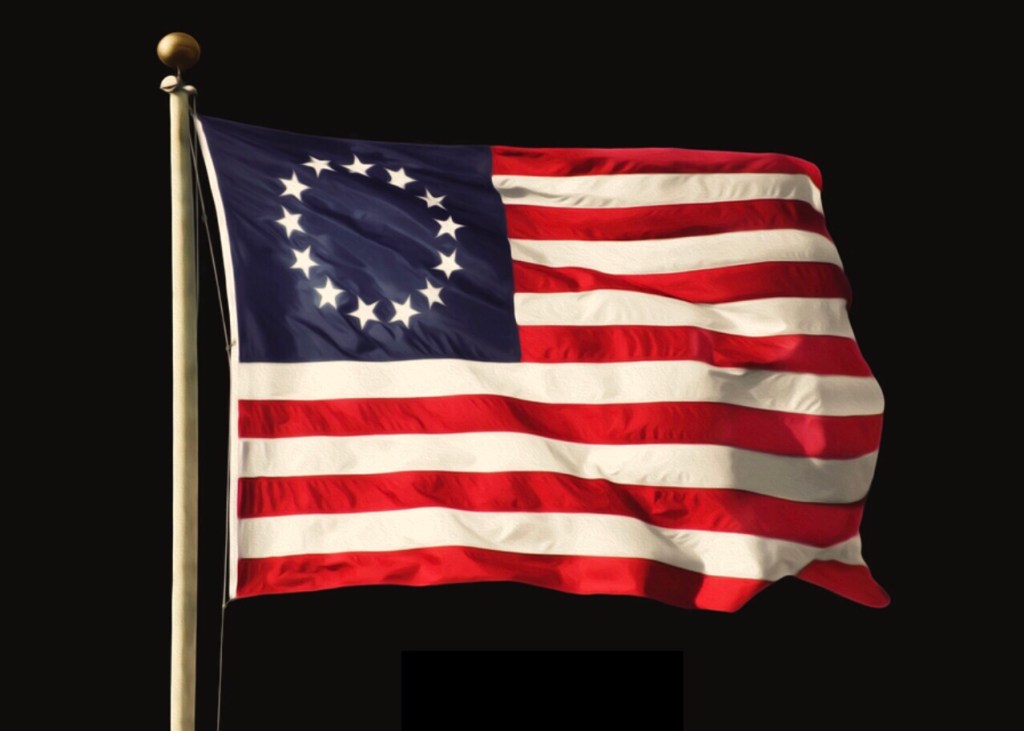
While there are some questions about whether Betsy Ross actually sewed the first American flag, there is no doubt about when Congress recognized our first flag. On June 14, 1777, two years after the formation of the Army, Congress passed the Flag Resolution, which stated, “Resolved: that the flag of the United States be made of thirteen stripes, alternate red and white; that the union be thirteen stars, white in a blue field, representing a new Constellation.” In 1916, President Woodrow Wilson issued a proclamation that officially established June 14 as Flag Day and on August 3, 1949, National Flag Day was established by an Act of Congress.
A New Constellation.
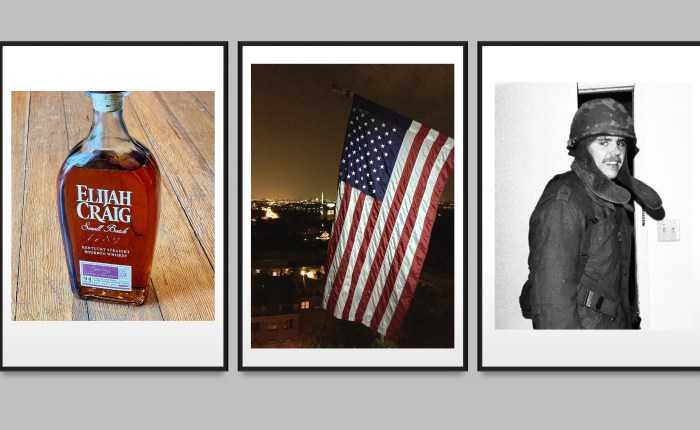
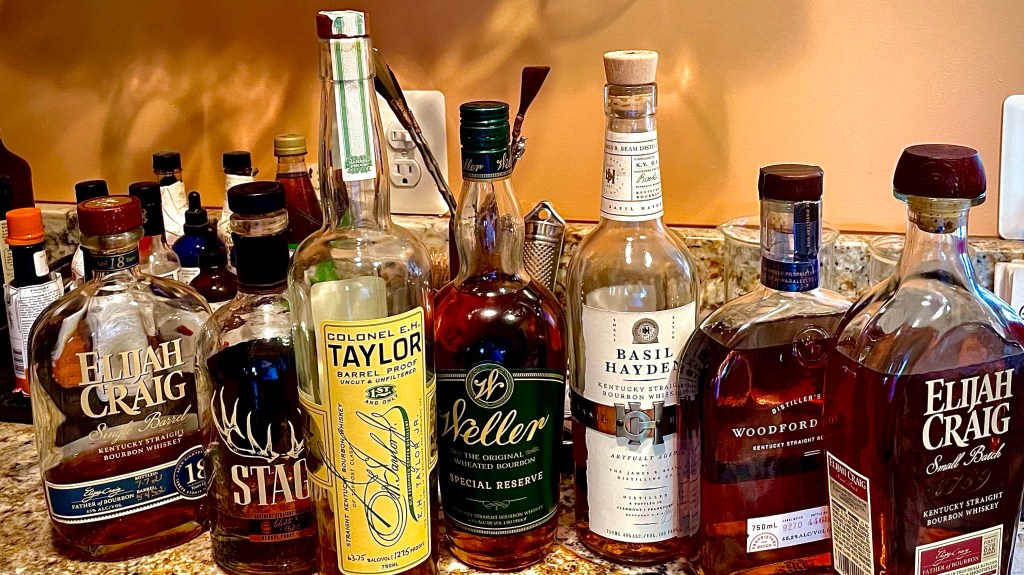
The story of National Bourbon Day is, not surprisingly, a bit murkier. One legend has it that bourbon was first produced by Reverend Elijah Craig on June 14th, 1789. In the late 1780s, Craig was allegedly using old fish barrels to store his spirits. Of course, the fish-flavored wood did not help the taste at all, so Craig started conditioning the barrels by charring the inside. He then stamped the barrels with their county of origin (Bourbon County in what was then Virginia and is now Kentucky) and sent them on a 90-day trip to New Orleans. The charred oak and three-month travel time combined to mellow the whiskey some and folks in New Orleanians requested more of “that whiskey from Bourbon.” Yes, I agree the story, or at least the date of June 14th sounds a bit fishy (pun intended), but who am I to judge? There are enough other competing stories that all trace the origin of “bourbon” to the 1780s and make that time period a credible time of origination. As a side note, in 1964, the United States Congress recognized bourbon as a “distinctive product of the United States of America”.
Bourbon Anyone?
So, there you have it, a bit of distinctly American history. As an Army Vet, I know what I’ll be doing on June 14th. I’ll raise a glass of bourbon in a salute to both our Flag, and all of the Army Veterans who have served our country over the years. I hope you will join me. It seems to me the least we can do.
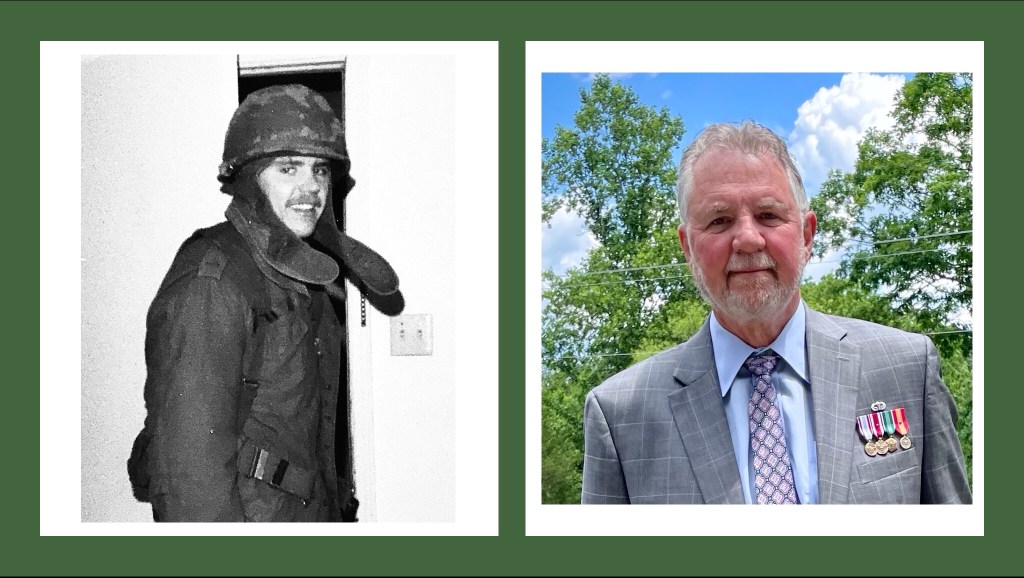
Cheers to All on June 14th From This Veteran…
Addendum:
– For the record, the United States Army is the senior service. The Continental Navy was established on 13 October 1775, and The Continental Marines on 10 November 1775. The Coast Guard traces it’s beginnings to 4 August 1790. The Air Force was established as an independent service on 18 September 1947, and the Space Force (ughhh) was established on 20 December 2019.
– National Bourbon Day – I searched to find out when the first National Bourbon Day occurred, but could find nothing online.
– Here are a couple of other historical facts about bourbon itself:
The Elijah Craig story is a nice one, but there’s no historical proof of it. There were certainly others who were shipping whiskey in barrels in the 1780s.
The Marker’s Mark distillery, which opened in 1805, is the oldest distillery in the country, and has been declared a National Historic Landmark.
In 1834 Doctor James Crow perfected the sour mash process and made what was probably the first “modern” bourbon. He employed the “Sour Mash Method” on a daily basis to give his whiskey consistency.
In 1840, “Bourbon”, by name, was first advertised in a newspaper.
In 1840 bourbon whiskey officially became known as bourbon. Before then, the product carried the name Bourbon County Whiskey or Old Bourbon County Whiskey.
In 1870 Old Forester became “America’s First Bottled Bourbon” when founder George Brown was the first to put Bourbon in a glass bottle. Prior to that, it was only available in barrels.




 Live Life Exuberantly