Recently, my wife, Cathy, and her sister Bonnie spent three weeks touring the wilderness and National Parks in Wyoming and Montana in a camper van. I’ll talk a little about that. What I really want to talk about is the people who stole their firewood at a couple of campgrounds.
My sister, Roberta, created a fun family cookbook of recipes and stories a decade ago. She recently resent her “intro” to me and I love it. She talks of how our five senses link us to those wonderful memories from our past. I urge you to give this a read and I guarantee it will make you smile.
The words are strictly Roberta’s. I’m just sharing them.
Last Christmas Eve, I was talking with our nephew Casey. He mentioned a visit to our home as a young boy, and then asked “Do you remember making cheese fondue at the cabin? That was so cool!” The memories of that weekend, and our ‘70s era burnt orange fondue pot came flooding back.
I was a cookbook junkie for a couple of decades. The last few years, I’ve kept my addiction in check. I try and take it one meal at a time, which has worked … so far. Of course, I continue collecting online recipes and recipes from friends like a fiend.
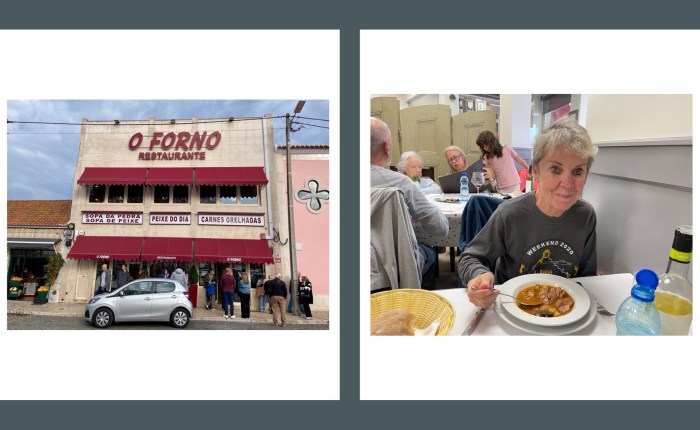
After three days in Lisbon, we were driving north to Nazaré. Big waves were coming, and by luck, we were going to be there to see them. On the way, we detoured for lunch at the restaurant O Forno in the town of Almeirim. O Forno is famous for their Sopa da Pedra (Stone Soup).
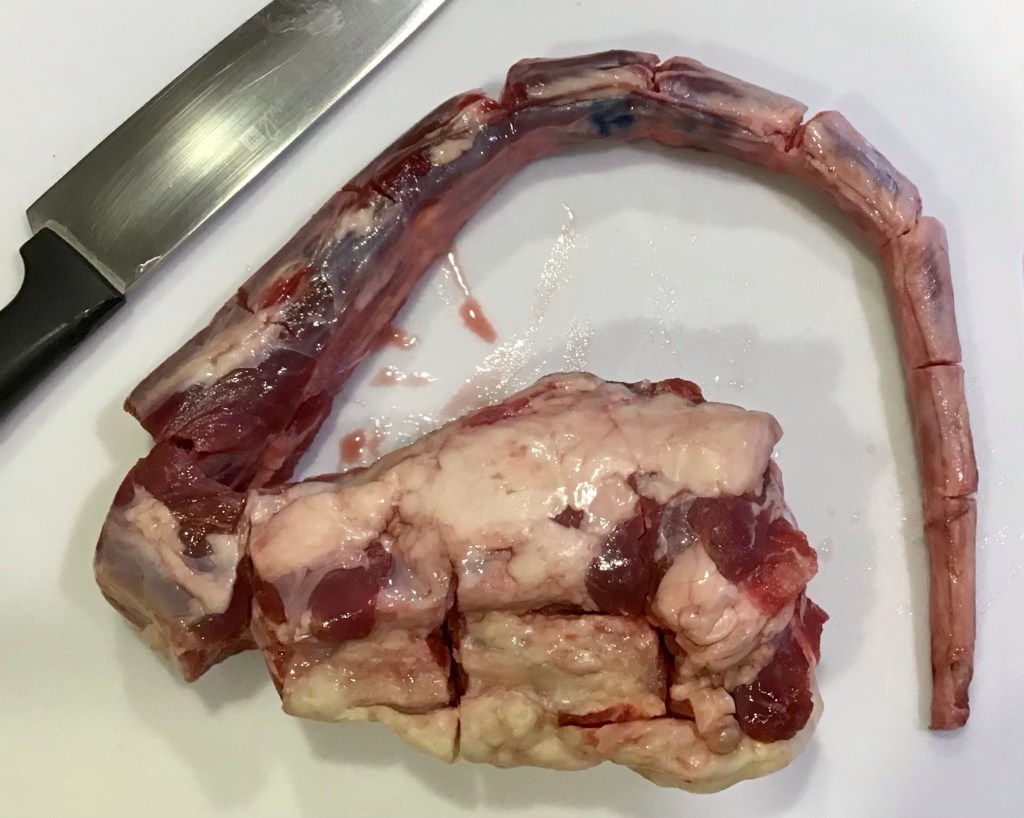
In America, we often ignore cuts of meat used to make excellent dishes elsewhere – beef cheeks and pork jowl are two examples. Oxtail is another. When we lived in Germany, Ochsenschwanzsuppe (Oxtail soup) was a classic you rarely see here. It’s an OMG wonderful dish I’ve made a couple of times now.
Of course, many hear the word Schwanz, and immediately think of the Mel Brooks film, Young Frankenstein and the scene with Inga (the great Terry Garr) using the pseudo-German word schwanzstucker*. I can assure you, there is no schwanzstucker in this Ochsenschwanzsuppe. 😉
Young Frankenstein – Worth Watching Again, Just for the Schwanzstucker Scene!
In today’s world, what we are really talking about is beef tail, but I’m going to stick with Ochsenschwanz, or oxtail, which is what it was called when we originally learned about it in Germany. Plus, it sounds cooler.
Oxtail; You Can Actually Order it in a Butcher Shop These Days.
Oxtail is high in protein, has abundant collagen and is a source of healthy fats. With the high collagen and connective tissue content, oxtail was made for long, slow cooking in dishes such as this soup. It’s a great winter dish. I’ve learned from friends who also cook that it is core to many other ethnic dishes as well. As an example, my friend Antoine Freche says, “Oxtail is the preferred bone source when creating a “silky-smooth” broth for Vietnamese Pho. Oxtails are best since they contain more collagen than a regular beef bone. The collagen is what makes the broth silky-smooth.”
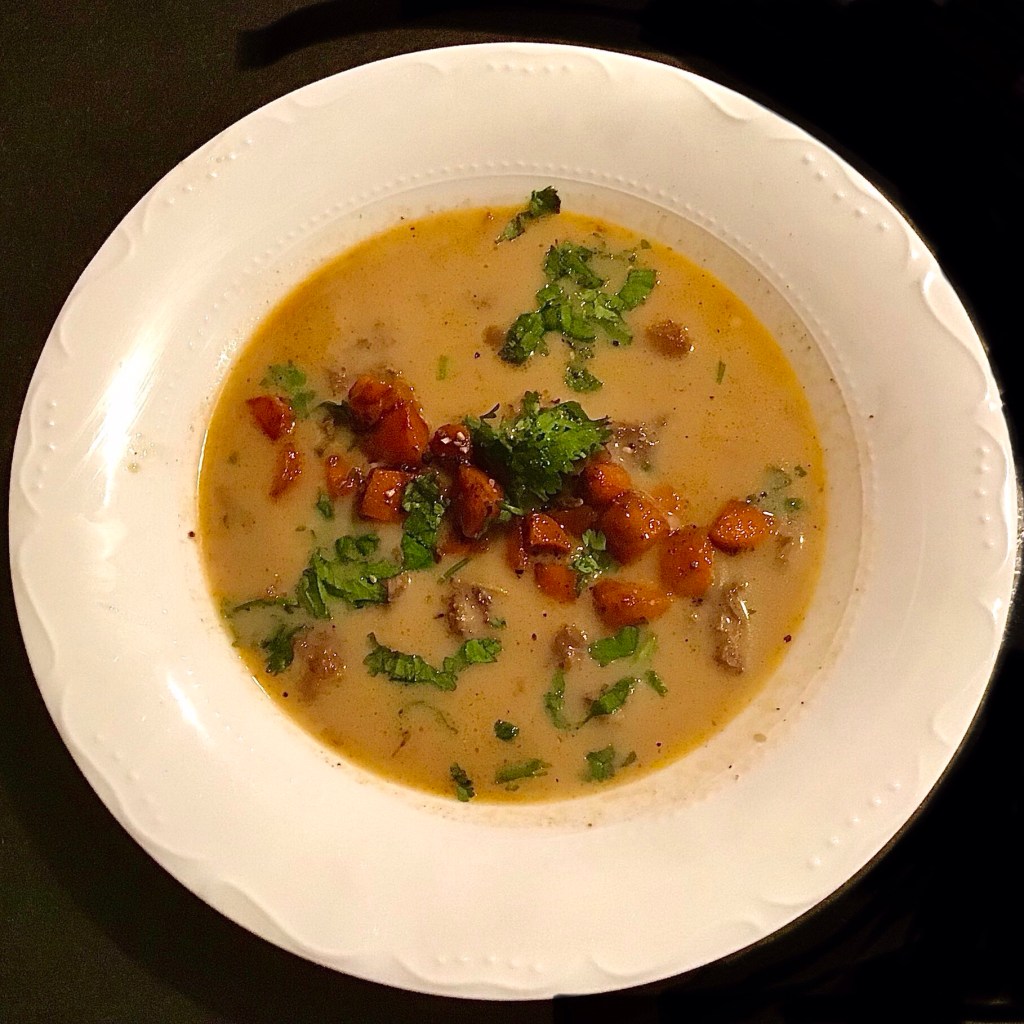
I have to agree with Antoine. The broth in this soup is wonderful. It is a different flavor than a typical beef stew and packed with umami**. Silky and smooth are both great descriptors, but so are tasty, delicious and “OMG this is so f’in good!” I’m already thinking of ways to use this broth for other dishes – it really is that outstanding.
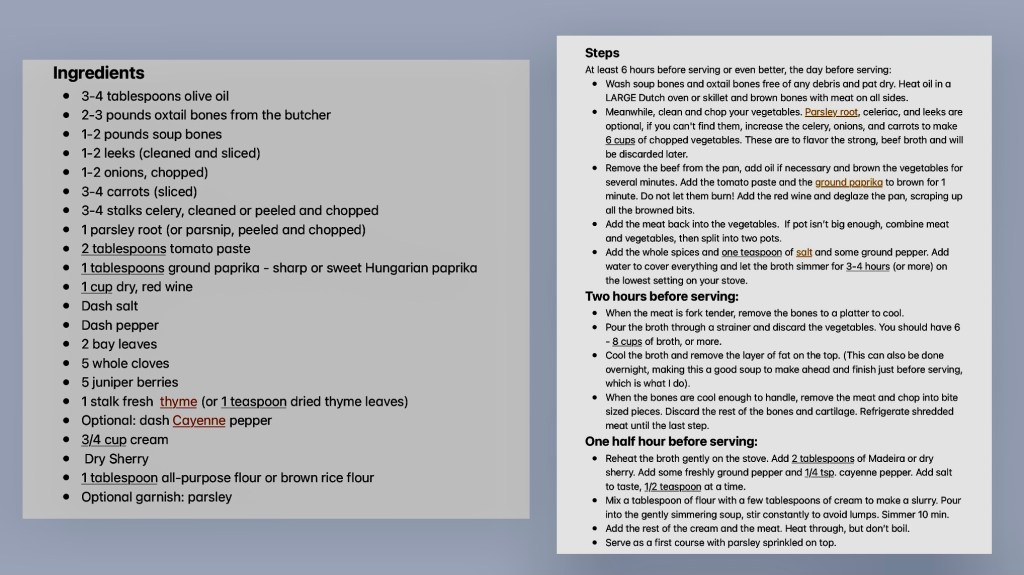
This recipe combines a rich beef and vegetable broth with paprika and pepper to add some bite, along with sherry and cream to round it out. It’s finished with a roux. It takes a while to make but is sooooo good. If you don’t have quite enough Oxtail, add some chuck steak, or some other roast to make up the difference.
Traditionally, Oxtail soup is served as a first course in Germany at restaurants or special events. They have two main versions of Oxtail Soup there – one is a clear broth with beef bits, the other is a “gebundene” (bound) version and is a little heartier. This recipe is a gebundene soup.
Ochsenschwanzsuppe – This is Soooooo Good, and Packed With Umami.
While the original version of this recipe was for a first course, Cath and I have it as a meal. With some bread and a small salad, it’s hard to beat. If you want to add a little to it for a main course, cut up a carrot or two and simmer with the sauce in the final 1/2 hour. As with most soups and stews, it’s better the day after you first cook the broth. The meal is certainly guest worthy, but I won’t judge if just you and your partner eat it by yourselves over two or three days. By the third day, it will be mostly just broth left, but that doesn’t matter. You’ll still be marveling at how tasty it is.
Ochsenschwanzsuppe Recipe.
Addendum:
* Here’s the scene from the Mel Brooks film, Young Frankenstein. It’s a great scene with Inga (Terry Garr) using the pseudo German word schwanzstucker. Gene Wilder’s reaction is classic: https://youtu.be/QuHw5ivCs1A?si=_nb9DdTWr1rlTXF1
** Umami is a fifth category of taste in food (besides sweet, sour, salt, and bitter). For me, the best description is one of savoriness, or perhaps earthiness. Umami means “essence of deliciousness” in Japanese.
Pork Jowl is sometimes considered traditional in Southern Cooking, particularly in a pairing with Black-eyed Peas for good luck on New Years Day. You don’t see it cooked that way much anymore, with folks substituting fatback, or bacon instead. It’s also used in Italy to make Guanciale, a cured meat considered essential for an authentic pasta carbonara.
I have a heavenly recipe for Beef Cheek Daube (stew) that is served over saffron risotto. Like oxtail, it is full of collagen. The first time I made the dish, two of our local grocery stores said there was no such cut of meat as beef cheeks. I ended up going to our wonderful local butcher shop, The Whole Ox, who knew immediately what I was talking about, and got the cheeks for us. The recipe is so good, we once served it on NY Eve.
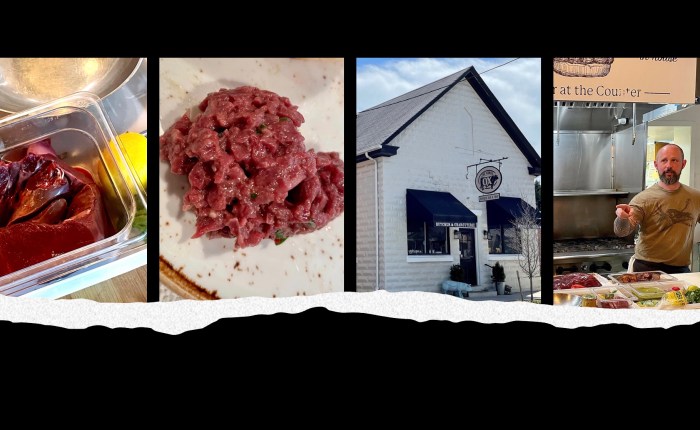
It’s not like we were Kevin Costner in Dances With Wolves, eating the raw liver from a freshly killed buffalo with our hands. No, we used forks and knives to sample the beef heart tartar we’d just made in the Offal Cookery class at The Whole Ox Butcher Shop. It was delicious and opened me to new ideas.
The Whole Ox here in Marshall is one of our local treasures. It’s a wonderful butcher shop with a great selection. Their offerings are ethically sourced, organic, and generally local. One of their mantras is “Eat better. Eat less”. When they offered a series of cooking classes this spring, I was immediately interested. The one that particularly caught my eye was “Offal Cookery”.
Expand Your Knowledge…
Offal is “the inside organs of, and parts trimmed from, an animal killed and prepared for food”. Innards is another good descriptor, though perhaps less delicate. Most of us are familiar with beef liver and chicken liver, but there’s quite a bit more. Around the world, there are multiple dishes that use offal. As examples, English Steak and Kidney Pie, Scottish Haagis (offal and vegetables stuffed in a sheep or cow’s stomach) and Mexican Menudo (made with tripe [stomach]) are three dishes many of us have tried or heard of. Intestines are of course often used for sausage casings. Liver pâté is something most have tried. Sautéed sweetbreads (thymus gland or pancreas) make an occasional appearance on a restaurant menu, and if I see them, I almost always order the dish.
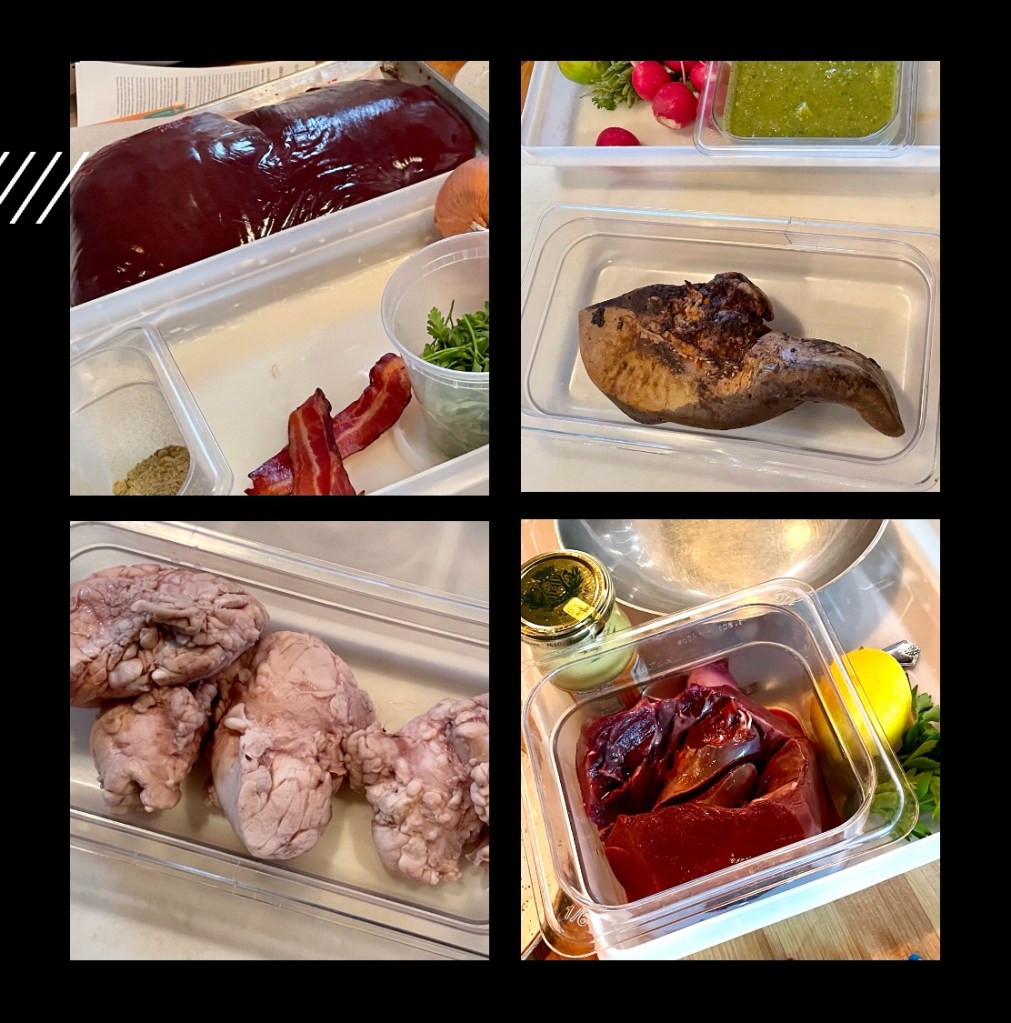
While I’ve eaten offal in restaurants, I’d never cooked anything other than liver, chicken liver or beef tongue at home. For this particular class, beef liver, tongue, heart and sweetbreads were all on the menu. I was excited.
Eight of us arrived at The Whole Ox on a Wednesday evening. Amanda and Derek, the owners, greeted us and poured glasses of wine as we gathered at the prep station. Derek, who was previously a vegetarian for ten years, talked with us about what was planned for the night, and gave us background on offal in general. We learned that historically, offal was usually eaten first by our ancestors – it is the most nutrient dense part of the animal and was prized above other cuts of meat. Organ meat is high in vitamins, and has shown the ability to help with some diseases such as MS. We also learned that like wine, terroir effects beef and how it tastes.
Derek at the Start of Class
After the brief introduction, we were divided into pairs and assigned the courses we would assist on: a classic liver and onions dish, tongue tacos, beef heart tartar and deep fried sweetbreads.
Clockwise from Upper Left: Liver, Tongue, Heart and Sweetbreads.
My partner and I were assigned the sweetbreads, and we started peeling the thin membrane from the outside. As with many deep-fried foods, the pieces went into seasoned flour, then buttermilk, then more flour. We turned them over to Derek for the actual deep frying. As the evening progressed, we were all watching each other. A few things stood out: cutting the liver a bit thicker than you normally think of, so it stays more tender and doesn’t dry out; splitting open the cooked tongue and removing the external casing to get to the tender meat; and with the heart, doing a fine dice for the tartar – if not fine, it would be too chewy, and if ground, the consistency would be too soft (not unlike Goldilocks and the three bears – the first bed was too hard, and the second bed was too soft, while the third bed was just right).
The recipes were coming together and as our wine glasses were refilled, we started receiving samples of each dish. There were a few nice surprises along the way, including bacon added to the liver, and salsa verde and finely sliced radishes added to the tongue tacos. The deep-fried sweetbreads were simple and excellent, with a consistency similar to fried oysters. And the heart tartar? I enjoy beef tartar, so I was looking forward to it. Simply prepared, there was salt and pepper, a little seasoning, parsley and a little lemon juice. It was delicious.
Liver and Onions with Bacon, Deep Fried Sweetbreads and a Tongue Taco, and Beef Heart Tartar – All were Excellent.
The evening wasn’t over, as Derek started cooking a surprise fifth dish. “Big Macs” that were fifty percent ground heart and fifty percent ground beef. We had eaten a fair amount by then, but smelling the burgers on the grill got the juices flowing again. After adding cheese to the grilling burgers, he placed them on the buns, then added lettuce, a bit of onion, pickles and their own Whole Ox “special sauce”. Watching him assemble the Big Mac sliders just about drove me mad with anticipation. I’m not sure, but I may have started drooling. Finally they arrived on our plates. WOW! Among the best burgers I’ve ever eaten. I practically inhaled mine.
Derek adding Special Sauce to our 50/50 “Big Macs”
The class wound down and folks started leaving. A few of us stayed a bit longer talking – about the shop and cooking, about Marshall, about innards. Derek revealed that one of his secrets to get people to try food out of their comfort zone is to mix it in with a familiar dish, hence the 50/50 Big Macs. It’s a brilliant idea. Eventually we finished our drinks and I drove home, already planning future meals.
As a final note, the next time you are at the farm and we are serving burgers, you may, or may not want to ask what’s in them. 😉
Addendum:
If you live in the area, or even the near-in Virginia ‘burbs, I highly recommend their classes. Out of the eight people there for our class, four were local and four were from DC suburbs about half an hour or forty minutes away.
Marshall is a great little village with several good stores, diners and coffee shops. There are three local gems among the offerings. In addition to The Whole Ox, we also have the nationally renowned Red Truck Bakery, and the excellent Field and Main Restaurant. If you are in the area, all three are worth a visit.
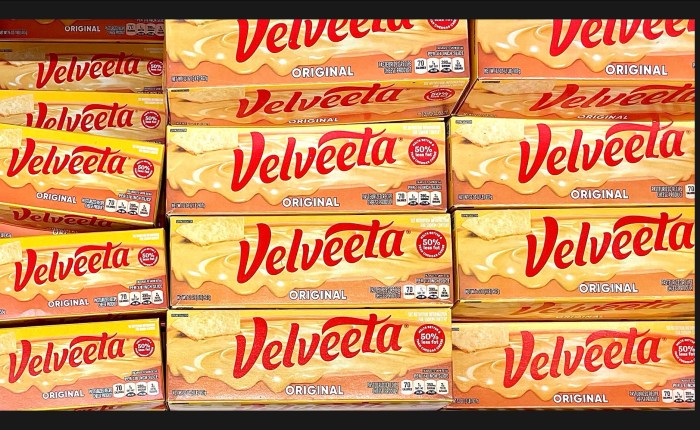
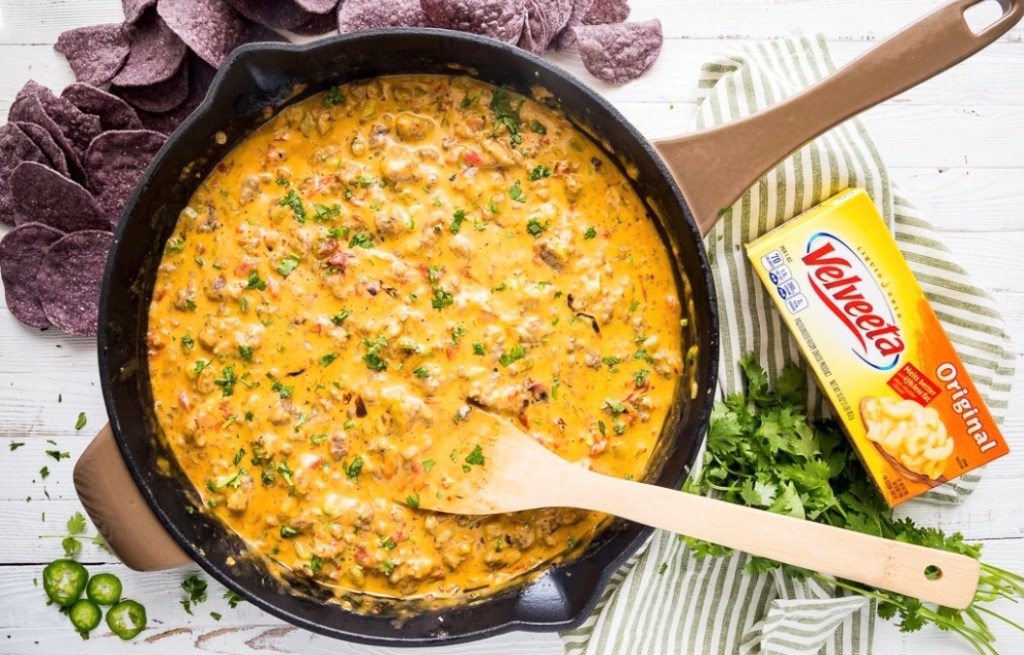
I see that look you are giving me. A slight sneer? A touch of disappointment? Or maybe from a few of you, with a knowing smile, “Ah yes, you too.” OK. I admit it. There is almost always a block of Velveeta Cheese in our fridge and it’s the secret ingredient for a couple of Cathy’s key recipes.
Yes, There is Almost Always a Block of Velveeta in our Fridge.
I love cheese. And there are so many good ones available. As a kid, we were a bit limited, but I remember eating Swiss, cheddar and of course American. My sisters and I agreed a block of Velveeta was kept around the house – possibly for mac ‘n cheese, or the occasional grilled cheese sandwich. Memories are a bit fuzzy on the subject.
When Cath and I moved to Germany, my cheese world expanded. Brie. Camembert. Quark. Limburger. Obazda. Roquefort. Stilton. Gorgonzola. Pecorino Romano. Asiago. Gruyère and Raclette. Mascarpone and Tiramisu. And many, many more. It was seventh heaven for me. I literally didn’t know such a world existed.
Eventually we moved back to the States, and I learned that across the US, not just in the state of Wisconsin, wonderful cheeses were being made. Maytag Blue from Iowa. Humboldt Fog from Cypress Grove in California. Grayson from Meadow Creek Dairy here in Virginia. And maybe my favorite, Mount Tam from Cowgirl Creamery in Point Reyes, California. Oh. My. God. It doesn’t get any better.
But … Sometimes, you crave comfort. Sometimes, you want a gooey, melty cheese that makes everything around it better. Sometimes, a cheese that isn’t technically a cheese, is exactly what you need. Enter Velveeta.
Velveeta actually started in the 1920s. You may be surprised to learn in the 1930s, Velveeta became the first cheese product to gain the American Medical Association’s seal of approval. Since then, Velveeta continued to evolve and at various times was called a cheese, a cheese spread, a pasturized processed cheese spread, and since 2002, a “pasteurized prepared cheese product”, a term for which the FDA does not maintain a standard of identity. It is currently sold only in the United States, Canada, Panama, Hong Kong, the Philippines and South Korea.
If it’s not really cheese, why use it at all? The answer is simple – it’s ability to melt and almost become “velvety” (hence the name). It’s consistency when melted is better than most real cheeses. The reason? It contains the emulsifiers, sodium citrate and sodium alginate, which allow the cheese to melt without becoming greasy by stopping the fats from separating. Those emulsifiers provide the magic that is Velveeta.
I doubt there is anyone in America who hasn’t eaten chili con queso, or queso dip made with Velveeta. It’s been a staple at Super Bowl (and other) parties and gatherings for decades. At its most basic, you combine a slab of Velveeta and a can of Rotel tomatoes in a crock pot. You can jazz it up with other tomatoes, real hot peppers, ground sausage and any number of other items, but the base remains Velveeta. And of course, Mac ‘n cheese with Velveeta has made an appearance in many a household here in the US. It became so popular, they started selling it as a combined product – “Velveeta Shells and Cheese” so you didn’t have to buy the macaroni and cheese separate.
Is There Anyone who HASN’T Eaten Chili con Queso with Velveeta at a Super Bowl Party!?!
We don’t have children, so never went down the Velveeta Mac n’ cheese route. We also haven’t made chili con queso in years, so why is the box of Velveeta in our fridge? Two dishes. First, there’s Cathy’s meatloaf. She dots the inside of the entire meatloaf with little pieces of Velveeta. It is delicious.
The second dish? The best scalloped potatoes in the world. Yep, Cathy’s “secret ingredient” is Velveeta. Over the years, she, and we, have made several versions of au gratin potatoes, hasselback potatoes, scalloped potatoes and cheesy potatoes. The one that’s the best? The one people always ask for the recipe? Her scalloped potatoes with Velveeta. When she tells people what’s in it, or perhaps it’s just people not from the midwest, they are always a bit shocked. Some then decide they don’t really want the recipe. Go figure.
As I’ve grown older, I’ve needed to reduce the amount of dairy in my diet. That means cheese is not around the house as much as it was previously. We still buy some, and if having guests over for dinner, will often offer cheese as an appetizer, or as a separate cheese course later in the meal. I think my life would be pretty meager with no cheese at all. I also know my life would be poor indeed if I could never have Cath’s scalloped potatoes with Velveeta again.
Addendum:
– There will be no scalloped potatoes recipe published with the blog. It is secreted away in Cathy’s head, and as with her Lasagna recipe, will not be publicly published. ;-).
I hate missing a good party. Unfortunately, we will miss Chili Dump 2022. We made the 2016 version, which featured great chili, a band, Elvis, a bonfire tended by a front-end loader, and 200, or so, of my sister and brother-in-law’s closest friends. What’s a Chili Dump? I’m glad you asked.
My Brother-in-law Jack started his legendary Chili Dump party around 2002 with his then wife, Meg. The first party was a thank you for friends who helped clear the land they were building their home on, and then subsequently helping them build their home. It became an annual event, and as their kids grew older, their friends started attending the party as well. Sadly, Meg passed away in 2013. When my sister Roberta met Jack later, she too was introduced to The Chili Dump. In 2016, we timed our visit home to Illinois so we could attend the party.
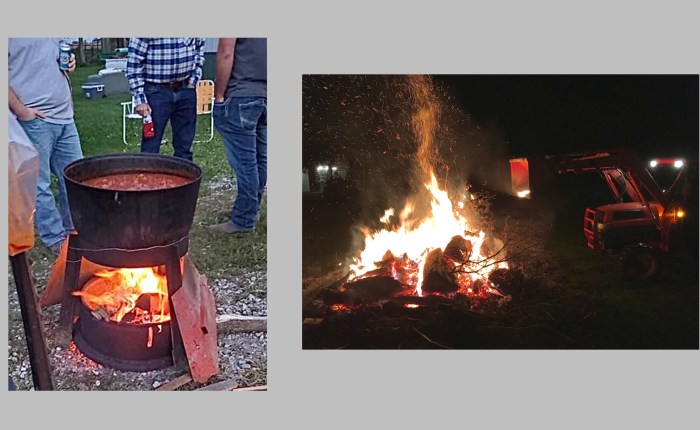
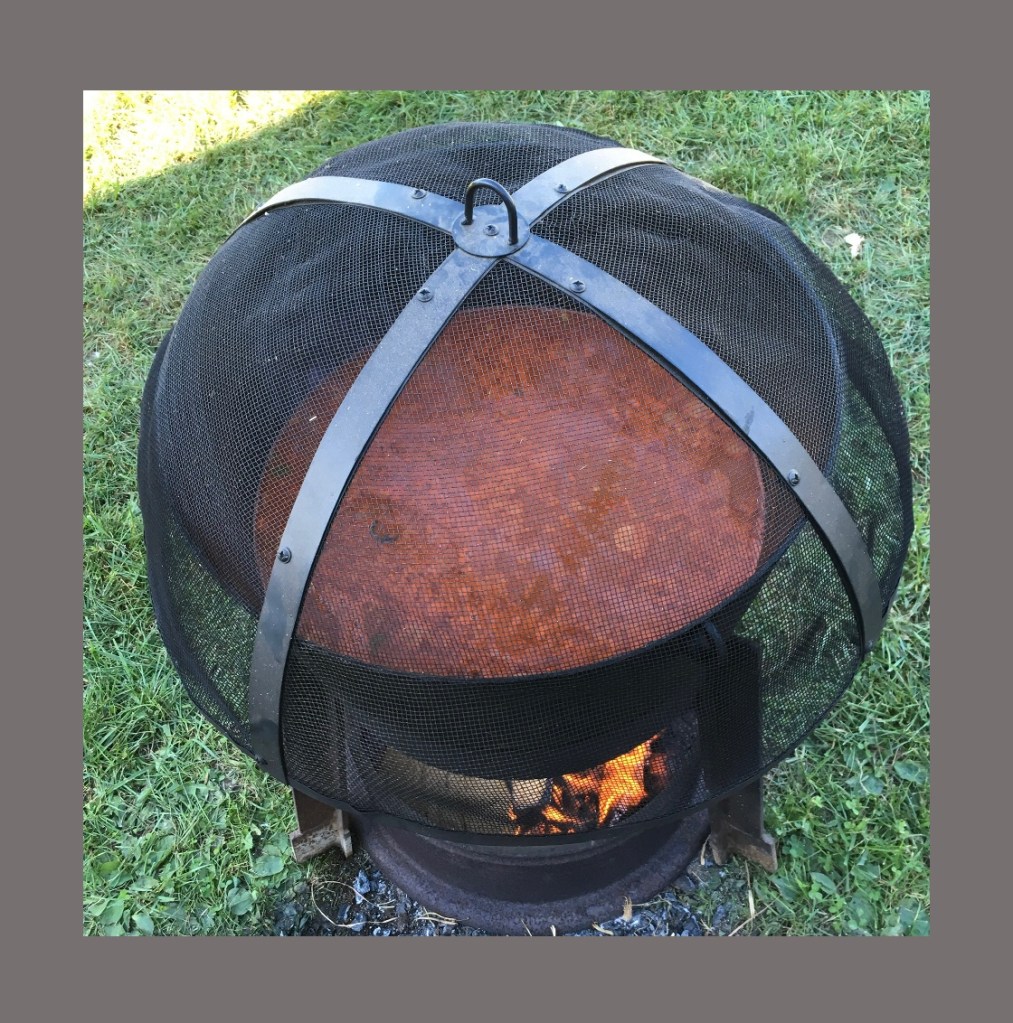
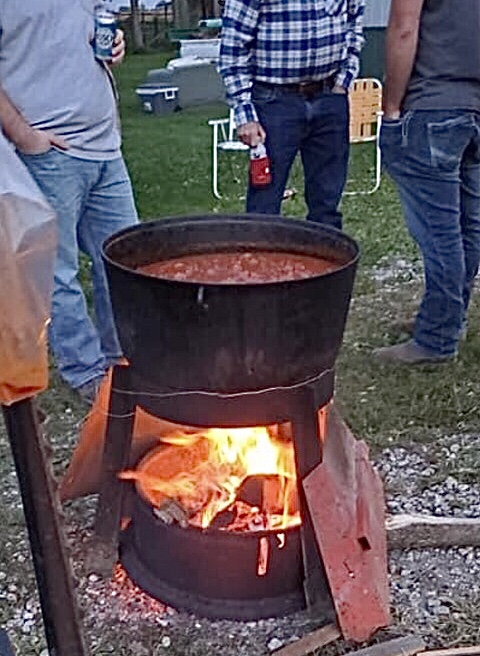
On that October ‘16 afternoon, Jack started a fire in the back yard and put a huge pot over it. The pot actually looked more like a cauldron than any pot I’d ever seen. They added the usual chili ingredients – cooked ground beef, tomatoes, tomato juice, hot peppers, beans and spices (and please, I don’t want to hear from any Texans about how beans don’t belong in chili). Soon, the chili started to cook and bubble away. By then, we may have had a beer or two.
A Cauldron of Chili….
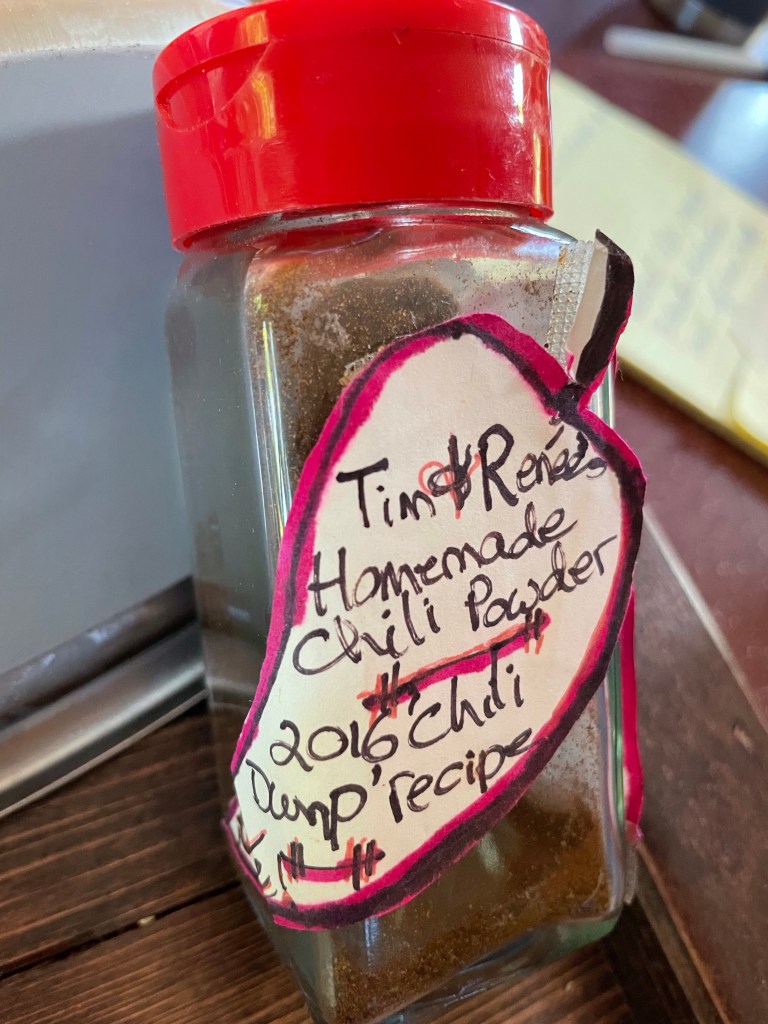
The first friends arrived by ATV, and brought more ingredients to add to the Chili – venison and jalapeños if I recall correctly. Others continued to arrive. Smoked brisket, hotdogs, sausage, bratwurst – they all went into the pot. Wood was added to the fire, to keep the chili cooking. Our friends Tim and Renee arrived from the Chicago ‘burbs with a blend of spices they specifically put together for the chili. Into the pot it went.
Tim and Renee’s Special Chili Spice for the Chili Dump!
Other folk brought toppings, including sour cream, grated cheddar cheese, sliced jalapeños and fried bacon. Someone made cornbread. There were bags of chips and Doritos added to the serving table. My sister Tanya and her husband Shawn arrived, and added more beef in the pot. Nieces and nephews arrived, and all dutifully put something in the pot. The volume of chili in the pot was definitely increasing.
The Pot was Getting Full!
Pickup trucks and cars were now lined up near the cow pasture. It started getting crowded and started getting dark. Around then, Jack lit the bonfire. It was a biiiiiig bonfire…
The Bonfire WAS Big…
Somewhere during all of this, people began sampling the chili. I have to admit, I was a bit skeptical, but then I took my first bite. Wow! This was surprisingly tasty. People kept arriving and adding to the chili. There was now also a steady stream of bowls being filled, so the volume stayed about the same, or maybe started to go down. There were probably 200 people at the farm by then.
Eventually, the Joel Limberg Band started playing. Some folks were dancing, and as at weddings, lots of little kids were hopping around on the dance floor. At some point, the band brought out a surprise guest singer – Elvis. Actually, a Philippine Elvis. Let me tell ya, you haven’t lived until you’ve heard Elvis sing Sweet Caroline, with the crowd joining in on the response – “Sweet Caroline, oh oh oh, Good times never seemed so good – So Good! So Good! So Good!” The party was going strong now!
Yes, Elvis is a bit Blurry, Much Like Parts of the Evening….
More dancing. Talking with family and old friends. Making new friends. More beer. More chili. The chili level in the pot was definitely receding. The bonfire was also going down, but Jack wasn’t ready to let that happen just yet. You know you have a big fire when you need to tend it with a tractor’s front-end loader.
Nothing Says Party, Like Fire in the Front-End Loader…
Although it was getting later, no one was leaving. Suddenly fireworks went off and exploded in the sky. We all watched, and oohed and ahhhed. The neighbors didn’t complain, because most of them were at the party.
Oooohhh! Aaaahhhh!
The band played another set, and it was time for more beer and more chili. The volume in the pot was definitively lower, but the chili was still hot, and still tasty. I noticed the crowd was starting to thin some, although I don’t think the sound volume was any lower.
Well after midnight, Cathy and I finally went to bed. It was a great party, but sometimes it’s good to know your limits.
The next morning, we woke, not feeling overly fuzzy. Jack and Berta were already up and had fed their calves and chickens. Amazingly, they didn’t seem to much worse for wear. I asked Berta how late the party went, and all she said was “Late”.
Our friends Tim and Renee also spent the night and they too woke up and joined the living. Eventually, we all went outside and started cleaning up. We may have partaken of a little “hair of the dog” during the cleanup. A couple of the youngsters also stopped by and with all of us involved, it wasn’t tooooo much work and we finished up after a couple of hours.
That was the 2016 party, and so far, the first and last one we attended. Since then, we’ve been out of the country for a couple of them, and of course covid slowed things down. I should mention they burned a Covid Snowman at the 2020 Chili Dump.
SnowMore Covid ‘19, was Added to the Bonfire in 2020…
I’ve both attended and hosted a number of good parties over the years, here in the States, and overseas in Germany, Austria, France, Belgium and the UK. I have to say the 2016 Chili Dump was one of the best. Anytime you combine chili, beer, Elvis, a bonfire, fireworks and fun people, it has to be pretty good, doesn’t it?
Addendum:
Thanks to my sister, Roberta, for help with this blog.
I recently enjoyed a fun and funny New Yorker article, by Rachel Syme. While reading, I became aware of two dichotomies simultaneously – First, she is a wonderful writer, whose prose blows mine away. Second, I know how to cook a perfect soft boiled egg, while she does not :-).
I subscribe to the New Yorker, which has great writing on a multitude of topics. One of the features of my subscription is that I receive emails a couple of times a week with reading suggestions. Last week, the email shared several food related articles, and one of them immediately caught my eye. Maybe it was the lead in … “The Ridiculous Egg Machine That Changed My Breakfast Game – It breaks all my kitchen rules, and yet, every morning, I make myself a fussy little hotel breakfast.” I’m not a kitchen gadget guy, but this sounded intriguing. I knew I was either going to love it, or hate it.
Both Reads were Good, but Syme’s Article Caught my Eye First
The article WAS good, and interesting. I enjoyed the way she wove the story of the egg machine into her own background and family history, while adding something we all crave – a little pampering while at a hotel. She talked about short getaways, and the enjoyment of coffee in bed, and wonderful little breakfasts, including soft boiled eggs.
It made me think of my own introduction to soft boiled eggs. Growing up, eggs were a family staple, particularly on weekends. Saturday mornings often saw eggs scrambled, over easy or sunny-side up, with toast and bacon on the side. Hard boiled eggs? Sure. Always at Easter, but also occasionally for a snack, and a big dose of them in mom’s potato salad. Soft boiled eggs? I don’t remember mom (or dad) ever fixing them. I believe the first time I ever ate one was while stationed in Germany in the early ‘80s. On one weekend trip, we spent the night in a small village Gasthaus. The next morning we came to the dining room for breakfast, where we were greeted with charcuterie, a cheese board, and thick slices of bread, along with something else – soft boiled eggs in small holders, with a tiny comforter over the top of the eggs to keep them warm. The presentation was funny, practical and magical all at the same time. The eggs themselves? Both simple, and delicious. I was hooked.
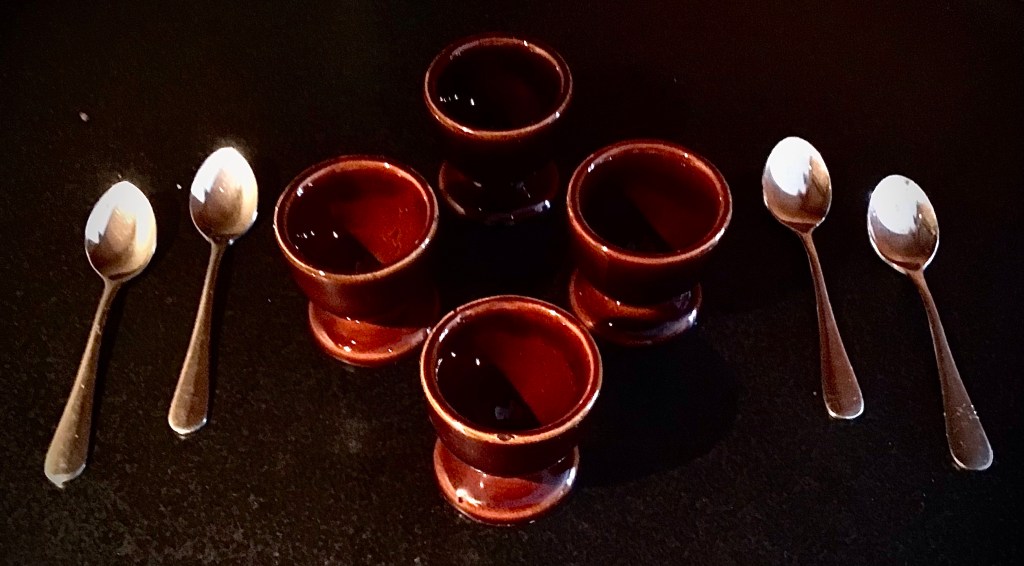
Of course, we then had to make them at home, which led to us buying the little egg cups, and the tiny spoons needed to scoop out that golden delight from the center of the egg. We made them for a year or two, usually on the weekend when guests were staying the night. Then, as is often the case, we got out of the habit, and eventually stopped making them. For thirty years.
The Egg Cups Sat Unused for Thirty Years
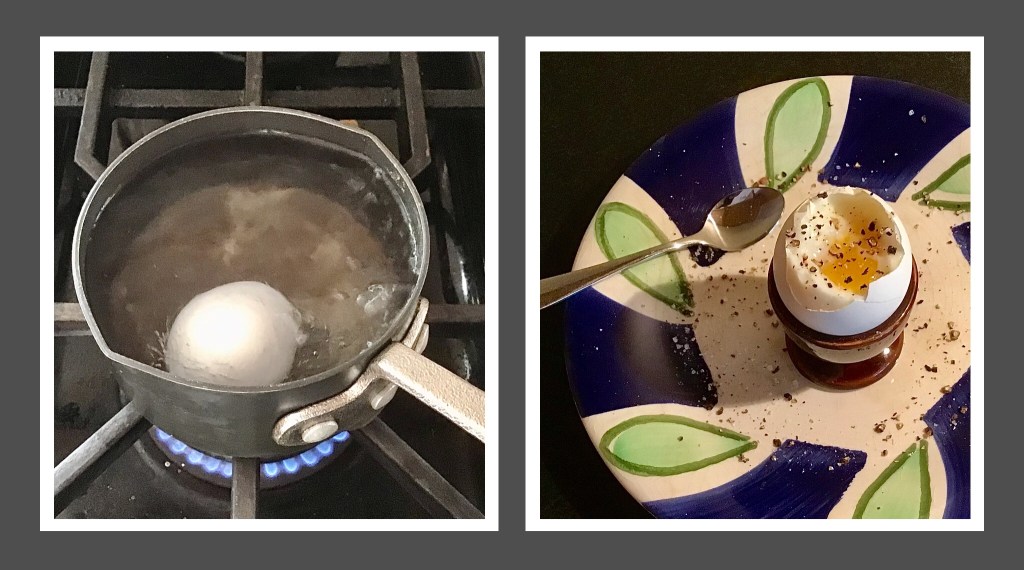
After retiring about eight years ago, I rediscovered the egg cups, and brought them back into use. I’m usually up earlier than Cathy, so we eat breakfast separately. Once about every week or two, I take the four minutes and fifty seconds needed to make a soft boiled egg. Just. The. Way. I. Like. It. A little bit of memory, delight and tastiness all in one egg.
Four Minutes and Fifty Seconds to a Nice Breakfast
Which brings me back to Rachel Syme and her article. The twin dichotomies we share are perfectly summarized in her breakfast description in the article: “Mornings at home were for English muffins with a scoop of marmalade, or muesli with a splash of almond milk. Low-risk stuff. Foolproof … What I kept fantasizing about was a perfect plate of soft-boiled eggs, with a silky, spreadable yolk the consistency of honey. I knew I wasn’t going to be able to manifest this fantasy on my own. Enter the egg machine.”
In a million years, I would never come up with the phrase “…with a silky, spreadable yolk, the consistency of honey.” I mean, that is a perfect description. It makes me hungry just reading that line. And then, she adds the kicker “ I knew I wasn’t going to be able to manifest this fantasy on my own. Enter the egg machine.” I wanted to scream out “Rachel! You too can do this. All it takes is four minutes and fifty seconds! Really!”
So there you have it. We all have our talents, we all have our fantasies, and those of us who are lucky enough, recognize the limits of the former, while trying to reach the latter. If Rachel Syme can achieve breakfast nirvana with a DASH Rapid Egg Cooker, who am I to judge? In the meantime, I look forward to reading more of her wonderful writing, and maybe learning a thing or two along the way.
Addendum:
Rachel Syme is an American Journalist living in Brooklyn. She is a 2005 Stanford grad, and in addition to The New Yorker, has written for Rolling Stone, Elle, Salon, the New York Times, Esquire, GQ and The New Republic. If you want to learn more about her, or read some of her other prose, you can find it here: http://www.rachelsyme.com/
I do note there are lots of recipes for soft boiled eggs out there. They mostly differ based on how firm you want the yolk to be. My four minute fifty second recipe is from Joy of Cooking and produces a firm white, with a thick, but still liquid yolk. If you want a firmer yolk, go up to 6 or 6 1/2 minutes, which will provide a jammy yolk. After that? It’s on the way to becoming a hard boiled egg. A couple of similarities were in all of the recipes: slowly lower the egg directly into simmering water so it doesn’t crack, and the water should only be simmering, not a rolling boil.

















 Live Life Exuberantly