Zen Zone

Zen Zone

Where is your Zen Zone? That is, what do you do, or what place do you go to that helps you relax, find peace and become accepting of what “is” in your life? Where do you go to bring balance to your life? I’m lucky, in that I have a place that works for me in today’s crazy world.

When I talk about a Zen Zone, I don’t really mean the full-on Buddhist Zen practice with meditation, aiming at enlightenment. I’m talking about finding a place of peace, contentment and balance in my life. A place that brings back some sanity to this mad world we live in these days.
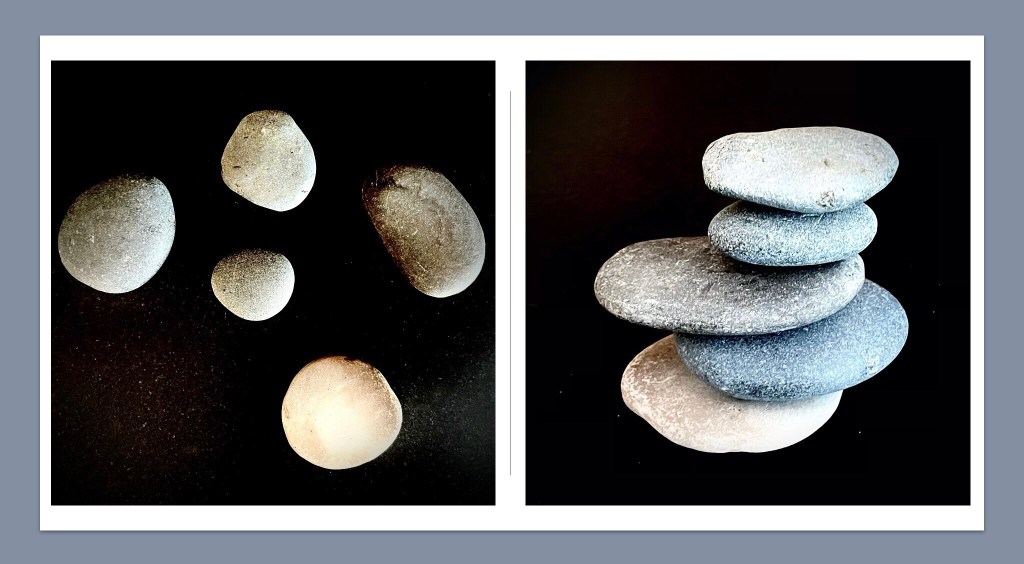
How Do You Find a Place of Peace, Contentment and Balance?

If you go to the web and look up Zen, or Zen Zone, you find a number of descriptions, some of them not very Zen like. Many look distinctly as if they are coming from someone trying to make a buck, which isn’t particularly Zen. I did however, find a couple of definitions/comments that spoke to what I’m talking about:

  • Put simply, Zen is an orientation toward life that generates a sense of peace, equanimity, acceptance, and contentment. To be Zen is to be committed to maintaining clarity and remaining grounded in the present moment, no matter how challenging it is to do so.
  • A space designed to be peaceful and calming. No matter what is happening outside this area, it allows me to have a small, predictable place in the world that was created specifically to comfort me.”
  • Making your way in the world today takes everything you’ve got. Taking a break from all your worries, sure would help a lot. Wouldn’t you like to get away? (OK, kidding on this one – these are the opening lines of the old TV show Cheers, but doesn’t it sound sort of Zen like? 😉 … )

Over the years, I’ve done meditation off and on. When I was working full time, I often took a short ten-minute break in the middle of the day to meditate and re-center myself. I think it helped some, and certainly provided some grounding and calming. I wouldn’t say it was anything to do with Zen, or a Zen Zone, just taking a few minutes to find some peace and balance.

And now? Where’s my Zen Zone? Where do I relax, find peace and “meditate”? It’s an easy answer for me – on my daily walks in the woods. With my knee issues, I don’t run anymore, but I love to walk. Most afternoons you can find me, along with our dog Carmen, in the nearby woods on a three or four mile escape. Sometimes I remain attentive to nature and my surroundings, but other times, the “Zen times”, I lose track of where I am and what I’m doing. Suddenly, I come out of it a quarter mile from home. Hello!? Where am I? Oh yea, I remember now. Be thou at peace.

It’s a wonderful trick when it happens, although it doesn’t happen all of the time. And when it doesn’t happen, it’s still time well spent – a wonderful hike and enjoying what nature has to offer: the trees, animals, plants and views; wildflowers and ferns; a small stream or two; and of course, watching Carmen enjoy the walk as much as I do.
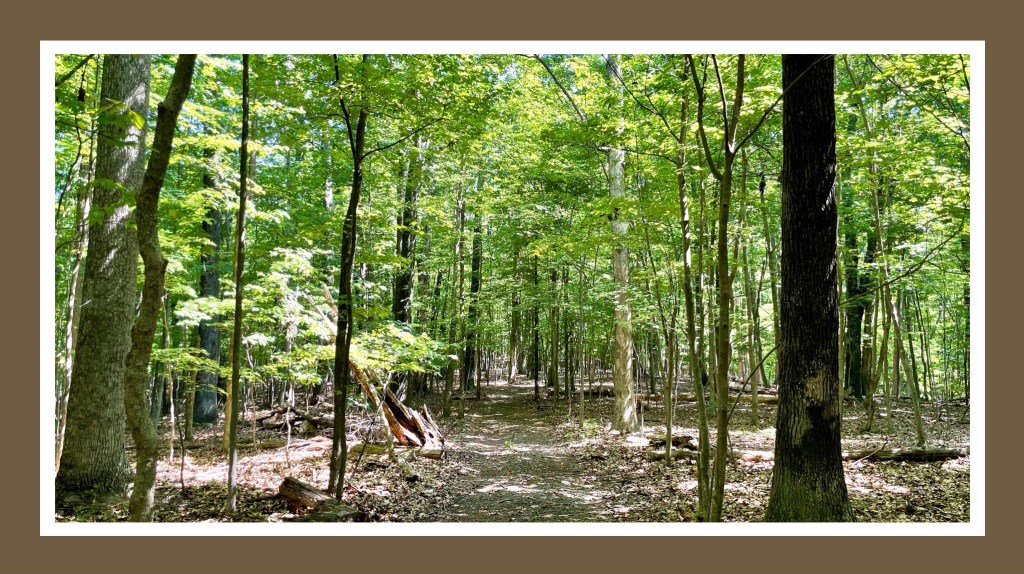
A Walk in the Woods Works for Me.

In either case, I always feel better after my walk. My mind is clearer and less stressed. Maybe I’ve solved a problem or two, or at least gained some perspective. Running and then later, walking, have always worked as exercise for me – burning off calories and trying to stay in reasonable shape. But the mental benefits aren’t to be undersold. As I become older, I am much more appreciative of those mental aspects.

What about you? Have you found such a zone? Perhaps running or walking? Working in the garden? Maybe hunting or fishing? Quilting? Yoga? Doing active meditation? What works for you? Where do you lose yourself and gain some balance in your life?

Making our way in the world today DOES take everything we’ve got. Politics, online garbage, traffic, aggressive people, health concerns, and other personal issues all raise our stress levels. Finding a Zen Zone can help make a difference, even if only for a few minutes each day. Taking a break from all our worries and reclaiming some balance and peace in our lives – I can live with that. Maybe the Cheers theme song was on to something after all.

“If you are depressed, you are living in the past. If you are anxious, you are living in the future. And, if you are at peace, you are living in the present. ~ Lao Tzu

Addendum:

  • Zen is a school of Buddhism which emphasizes the practice of meditation as the key ingredient to awakening one’s inner nature, compassion and wisdom. The practice of meditation, as a means of attaining enlightenment

Living Life in a War Zone

Living Life in a War Zone

I recently received another email from my friend Bob in Ukraine: “Last night the air raid alarms went off about 2:30 am. We were hoping the attack was only another wave of the Iranian Shaheed drones, as the defenses are normally stopping 100% of those. But when the text of the warning came to my wife Vita’s phone, it was a major missile attack. The attack was targeting Kyiv directly.”

This is the second blog I’ve written about my friend Bob Pitts who lives near Kyiv, Ukraine. A link to the first blog is in the Addendum.

Bob’s email continued: “Six Kh-47M2 “Kinzhal” missiles were launched from six MiG-31K aircraft. The Kinzhal is Putin’s hypersonic missile that he has bragged about as being unstoppable. Making statements about it as some secret Russian technology America and the West can’t match.

BUT – Every one of them was shot down in the air, so I imagine there is some serious nervousness in the Kremlin right now. Someone has to go and tell Putin his magic hypersonic missiles are no longer effective – and also tell him he just wasted many millions on this attack. (They don’t have many of these left in stock to begin with). Before last night’s attack -> no one had been able to stop the Kinzhal missiles.

In addition to the Kinzhals, 9 Kalibr cruise missiles were launched from ships in the Black Sea, and three land-based missiles (S-400, “Iskander-M”). All of them were destroyed by the air defense forces of Ukraine.

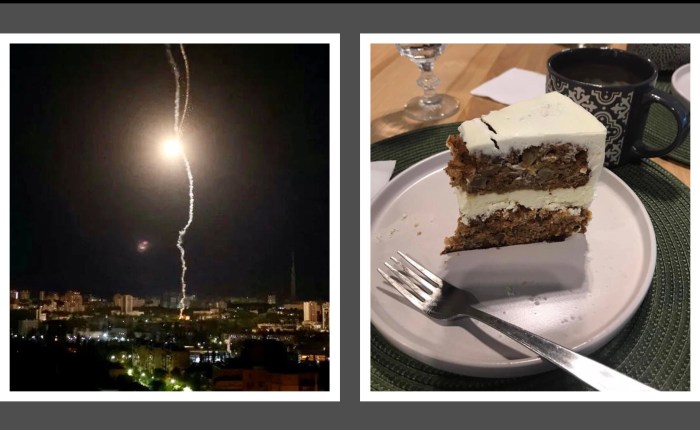
The sound of the missile being hit was deafening- our windows and doors shook. The attack came from the South and so the defenses hit them near our town. Thankfully not directly over us, as there are reports of damage from falling debris.”

Debris Falling During the Recent Missile Attack on Kyiv.

I can’t quite imagine the heart-pounding you must feel going through an attack like that. And of course, some version of this has been happening for over a year now in Ukraine.

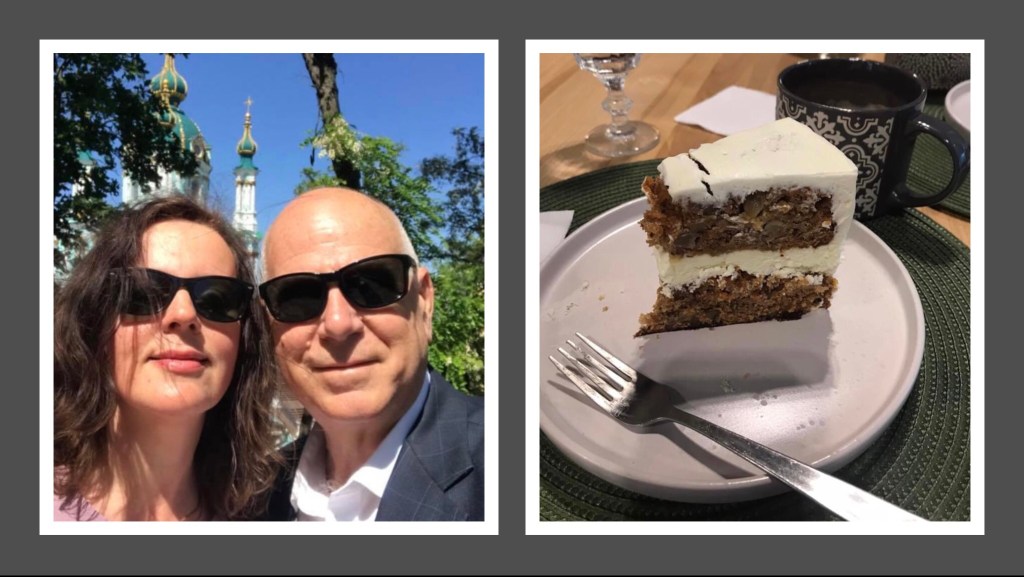
Throughout it all, we need to remember people also live their lives. In Bob and Vita’s case, that included celebrating their eighteenth wedding anniversary about a week after the big attack. They’ve lived in both America and Ukraine during those eighteen years and have been in Ukraine for the past two years.

Bob and Vita on Their Wedding Day, Eighteen Years Ago in Florida.

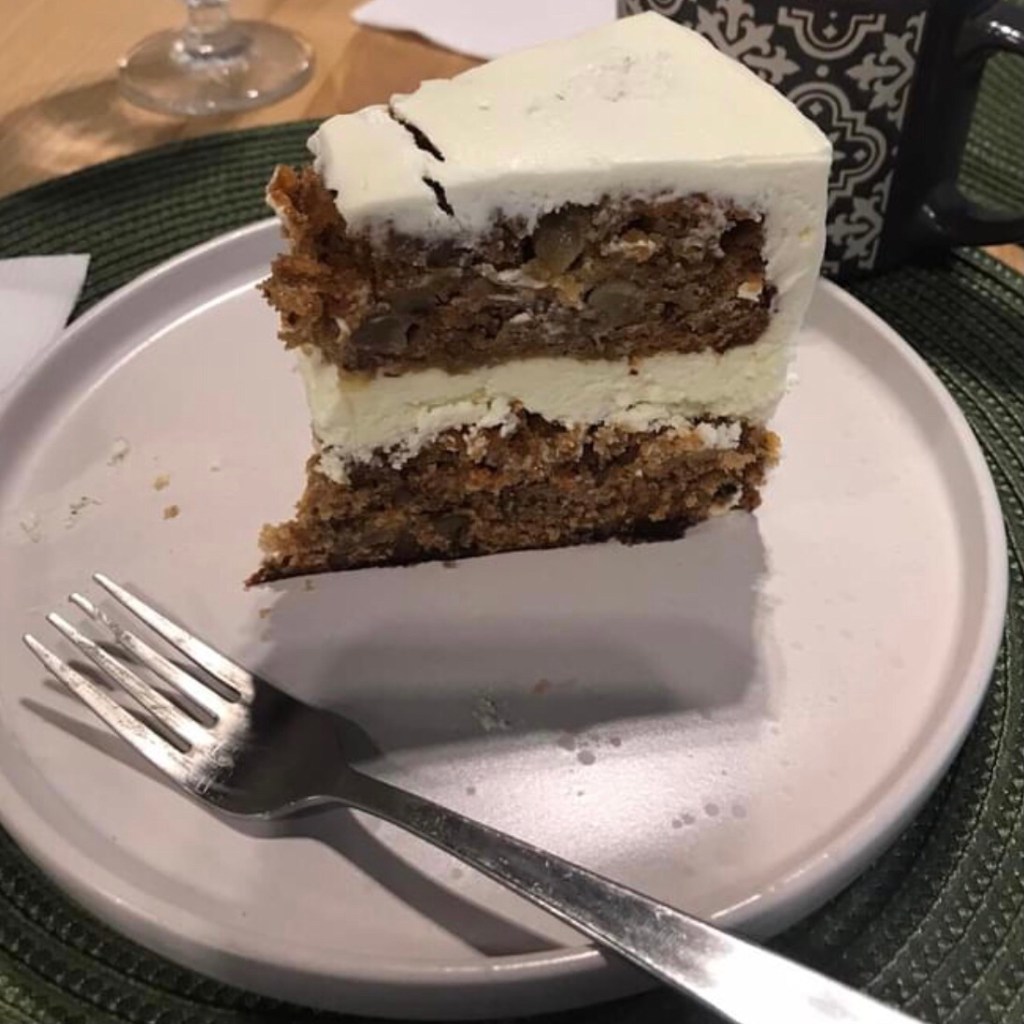
For their anniversary, they celebrated at Cafe’ Mimi in their hometown of Brovary, just outside of Kyiv. Katya, the chef/owner of Cafe’ Mimi made them an American carrot cake using Vita’s recipe – Bob says he has “had carrot cake all over the US and in many other countries and THIS one was the best I have EVER eaten -> better than my grandmother’s.” 😎

Katya’s Carrot Cake – Maybe, Better than Grandma’s?

We see stories of sharing life and love during the dangers of war over and over in both the real world and in fiction. The great novels “Doctor Zhivago” (Pasternak), “For Whom the Bell Tolls” (Hemingway), “A Time to Love and a Time to Die” (Remarque), or “From Here to Eternity” (Jones) showed us those love stories in fiction, but I like to think Bob and Vita’s story in real life gives them a good run for the money. Life goes on, even amid the struggles of wartime. Sometimes, all you really need is to be with the love of your life and enjoy a slice of carrot cake.

Sometimes, All You Really Need is The Love of Your Life, and a Slice of Carrot Cake.

We should all celebrate life as lovingly as Bob and Vita and remember to focus on what is truly important.

Addendum:

  • I received this email update from Bob yesterday after I’d already written this blog and just 12 hours before posting it: “The Russians have stepped up their missile attacks in the past few days. They appear to be in a panic that Ukraine successfully used the new British StormShadow missile to destroy a large troop and munitions hub just at the border (this had been out of range until now). Reports are that a trainload of 500+ new soldiers were destroyed along with all their armor and munitions … Last night was a massive missile attack – many of the missiles were the hypersonic ones we shot down 37 of 40 missiles and 29 of 35 drones. Then again today around noon another attack again with hypersonic / ballistic missiles. We shot down 11 of 11 … There was damage / injuries from falling debris and there were some deaths in rural areas – an elderly couple was killed when debris crushed the roof of their home … I think that the Russians know that they are in deep trouble. They know that we are about to hand them their butts on a platter very soon. That is why they are stepping up the frequency of attacks and making an all out worldwide propaganda and diplomacy push to push for the west to stop helping Ukraine.”
  • Thanks to my friend Bob for providing the material for this blog and for helping to edit. I’m so happy we have reconnected.
  • You can read my first blog about Bob from a couple of weeks ago here: https://mnhallblog.wordpress.com/2023/05/16/in-ukraine/
  • Bob has written a book about Ukraine called UKRAINE: THE AWAKENING: My 20 years of witnessing Ukrainians rediscover their nationhood. When the war began, he became concerned about how little westerners, especially Americans, understand about Ukraine, its people, its history and how the relationship with Russia is misinterpreted in Western media coverage. The book gives readers a view into Ukrainian culture and the beauty of the people. I’ve bought and read the book and recommend it – I’ll publish a short review in a future blog. Here’s a link to the book on Amazon: https://a.co/d/6qUppBU

Versatile Velveeta

Versatile Velveeta

I see that look you are giving me. A slight sneer? A touch of disappointment? Or maybe from a few of you, with a knowing smile, “Ah yes, you too.” OK. I admit it. There is almost always a block of Velveeta Cheese in our fridge and it’s the secret ingredient for a couple of Cathy’s key recipes.

Yes, There is Almost Always a Block of Velveeta in our Fridge.

I love cheese. And there are so many good ones available. As a kid, we were a bit limited, but I remember eating Swiss, cheddar and of course American. My sisters and I agreed a block of Velveeta was kept around the house – possibly for mac ‘n cheese, or the occasional grilled cheese sandwich. Memories are a bit fuzzy on the subject.

When Cath and I moved to Germany, my cheese world expanded. Brie. Camembert. Quark. Limburger. Obazda. Roquefort. Stilton. Gorgonzola. Pecorino Romano. Asiago. Gruyère and Raclette. Mascarpone and Tiramisu. And many, many more. It was seventh heaven for me. I literally didn’t know such a world existed.

Eventually we moved back to the States, and I learned that across the US, not just in the state of Wisconsin, wonderful cheeses were being made. Maytag Blue from Iowa. Humboldt Fog from Cypress Grove in California. Grayson from Meadow Creek Dairy here in Virginia. And maybe my favorite, Mount Tam from Cowgirl Creamery in Point Reyes, California. Oh. My. God. It doesn’t get any better.

But … Sometimes, you crave comfort. Sometimes, you want a gooey, melty cheese that makes everything around it better. Sometimes, a cheese that isn’t technically a cheese, is exactly what you need. Enter Velveeta.

Velveeta actually started in the 1920s. You may be surprised to learn in the 1930s, Velveeta became the first cheese product to gain the American Medical Association’s seal of approval. Since then, Velveeta continued to evolve and at various times was called a cheese, a cheese spread, a pasturized processed cheese spread, and since 2002, a “pasteurized prepared cheese product”, a term for which the FDA does not maintain a standard of identity. It is currently sold only in the United States, Canada, Panama, Hong Kong, the Philippines and South Korea.

If it’s not really cheese, why use it at all? The answer is simple – it’s ability to melt and almost become “velvety” (hence the name). It’s consistency when melted is better than most real cheeses. The reason? It contains the emulsifiers, sodium citrate and sodium alginate, which allow the cheese to melt without becoming greasy by stopping the fats from separating. Those emulsifiers provide the magic that is Velveeta.

I doubt there is anyone in America who hasn’t eaten chili con queso, or queso dip made with Velveeta. It’s been a staple at Super Bowl (and other) parties and gatherings for decades. At its most basic, you combine a slab of Velveeta and a can of Rotel tomatoes in a crock pot. You can jazz it up with other tomatoes, real hot peppers, ground sausage and any number of other items, but the base remains Velveeta. And of course, Mac ‘n cheese with Velveeta has made an appearance in many a household here in the US. It became so popular, they started selling it as a combined product – “Velveeta Shells and Cheese” so you didn’t have to buy the macaroni and cheese separate.

Is There Anyone who HASN’T Eaten Chili con Queso with Velveeta at a Super Bowl Party!?!

We don’t have children, so never went down the Velveeta Mac n’ cheese route. We also haven’t made chili con queso in years, so why is the box of Velveeta in our fridge? Two dishes. First, there’s Cathy’s meatloaf. She dots the inside of the entire meatloaf with little pieces of Velveeta. It is delicious.

The second dish? The best scalloped potatoes in the world. Yep, Cathy’s “secret ingredient” is Velveeta. Over the years, she, and we, have made several versions of au gratin potatoes, hasselback potatoes, scalloped potatoes and cheesy potatoes. The one that’s the best? The one people always ask for the recipe? Her scalloped potatoes with Velveeta. When she tells people what’s in it, or perhaps it’s just people not from the midwest, they are always a bit shocked. Some then decide they don’t really want the recipe. Go figure.

As I’ve grown older, I’ve needed to reduce the amount of dairy in my diet. That means cheese is not around the house as much as it was previously. We still buy some, and if having guests over for dinner, will often offer cheese as an appetizer, or as a separate cheese course later in the meal. I think my life would be pretty meager with no cheese at all. I also know my life would be poor indeed if I could never have Cath’s scalloped potatoes with Velveeta again.

Addendum:

– There will be no scalloped potatoes recipe published with the blog. It is secreted away in Cathy’s head, and as with her Lasagna recipe, will not be publicly published. ;-).

Tuna Salad with Julia and Grandma Grubaugh

Tuna Salad with Julia and Grandma Grubaugh

It was strange. It was simple. It was visceral. One moment I was taking a bite of a tuna salad sandwich made with Julia Child’s recipe. The next instant I was a little boy sitting with Grandma Grubaugh at her kitchen table having lunch. It hit me like a bolt out of the blue.
A couple of my favorite benefits of our New York Times subscription are the food and cooking articles. The columns tell great stories, and the recipes are usually pretty manageable. A while back, chef, James Beard Award winning author and former New York Times food columnist Dorie Greenspan wrote a great column “This Tuna-Salad Sandwich Is Julia Child-Approved Lunch”. She was working with Julia at the time on an upcoming book and recounted a day spent in her kitchen. Here’s a partial extract:
We were working around the kitchen table when Julia declared, “Dorie, let’s make lunch.” I saw Stephanie smile — clearly, she knew what was coming — and then I was at the counter with Julia, doing as I was told, which was cutting celery. While it might not seem like much of a job, I was cutting celery for Julia Child, and I was going to do it right: I trimmed the celery, I peeled it (because I learned to do that in Paris, I thought it was important to do it for the woman who wrote “Mastering the Art of French Cooking”) and I cut the celery into minuscule cubes that were all the same size. I’m only exaggerating a smidge when I say it took me so long that when I put down my knife, Julia had finished everything else, and we were ready to sit down to one of her favorite lunches: tuna salad on an English muffin.”


The article was about nothing and about everything. I love writing like that. I mean, how can you possibly write an entire article about a tuna salad sandwich? And yet Greenspan wrote a great one and I thoroughly enjoyed it.

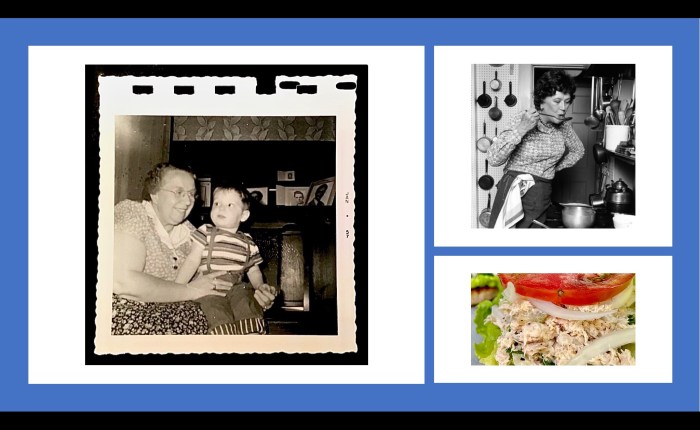
Julia Childs in the Kitchen.

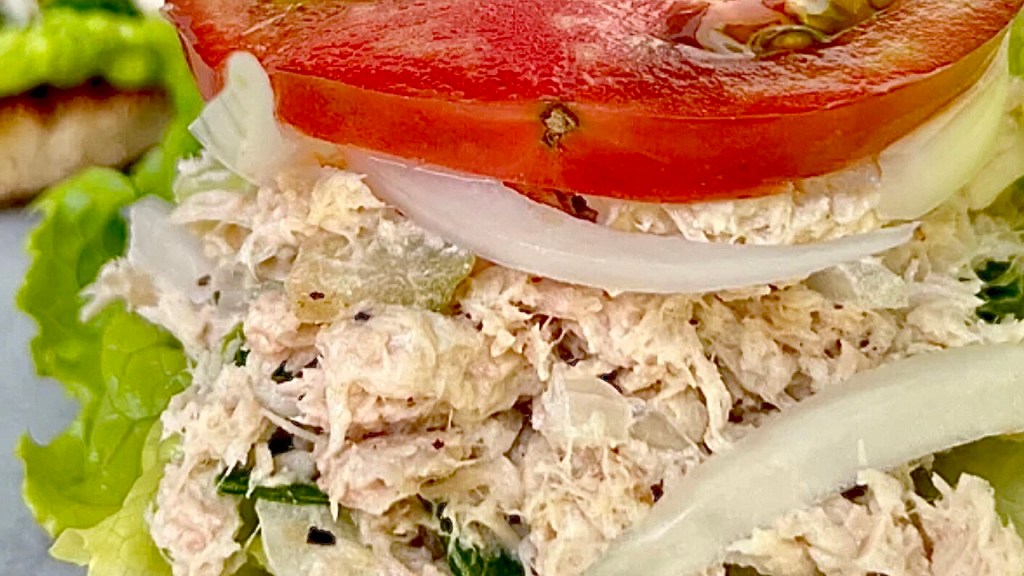
The list of ingredients in the actual sandwich intrigued me. We’ve all made tuna salad – tuna, mayo, celery and maybe onion and a boiled egg, but this one was a bit different. Yea, there was tuna (packed in oil), mayo (always Hellman’s), celery and onion, but it also included capers, cornichons (small French pickles) and lemon juice. Hmmmm. I was going to have to try this. Some of you know of my aversion to pickles in potato salad, but with tuna salad, why not give it a shot?

I had everything on hand, with the exception of the Cornichons. After doing a little online research, I figured the baby dills in our fridge were a suitable substitute.

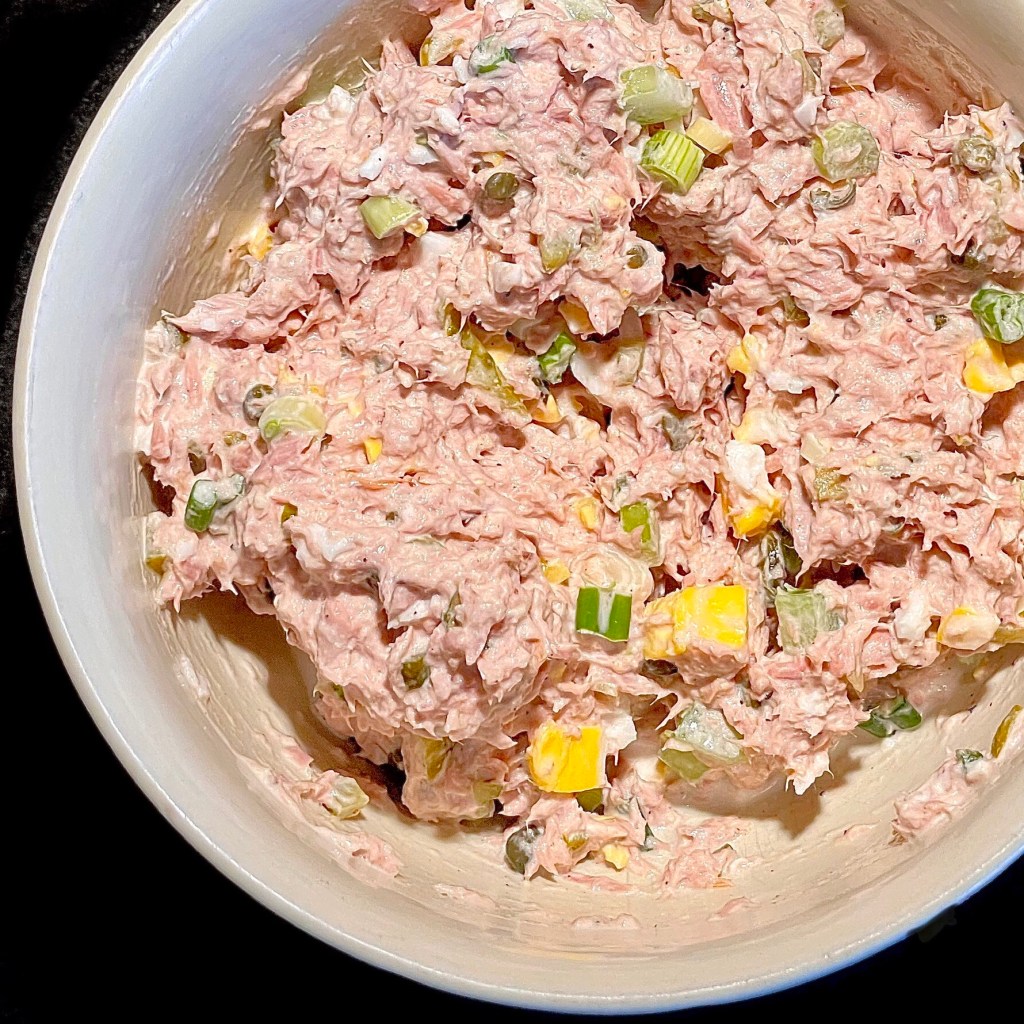
I dutifully chopped the celery (sorry, no peeling), onion, capers and pickles. After emptying the tuna in a bowl, I added all of the chopped ingredients. In went the mayo, and the parsley and I combined everything. Finally, I squeezed the lemon juice in, added salt and pepper, and combined it all again. I did a small taste, and of course because of who I am, added a bit more mayo. Another small taste, and then I put the bowl in the fridge to chill for a couple of hours.

Tuna Salad Heading to the Fridge.

At last it was lunch time and I made my sandwich. More mayo on the bread, the tuna salad itself, some lettuce, tomato and a small slice of onion. Another slice of bread, and then I cut the whole thing in half.

Tuna Salad Sammich. It Doesn’t Get Any Better.

I took the first bite, waiting to be transformed in my mind to Julia Child’s kitchen, and … wait! What!? Was that Grandma Grubaugh sitting next to me? Where in the hell did that come from?! It was a visceral reaction – I was a young boy back in Ottawa, sitting at the kitchen table at Grandma’s house having a tuna sandwich with her.

Grandma Grubaugh and I in 1957.

After rejoining the present, I sat there eating my sandwich trying to figure out what brought on those feelings. Grandma, to my knowledge, never cooked anything from Julia Child. Besides, my flashback would have been some time in the ‘60s, well before Julia became popular in America.

I thought through the ingredients. I don’t really remember grandma keeping fresh lemons, or capers around the house, although I suppose she might have. Grandma putting either in tuna salad seemed a pure fantasy. It had to be the pickles, although I didn’t remember mom putting pickles in tuna at our house.

At this point in time, mom had already passed away. Uncle Don, her younger brother was still alive, and I gave him a call. After catching up for a few minutes, I explained why I was calling, asked about grandma’s tuna salad, and whether she put pickles in it. He immediately answered “No, there were no pickles”, and my heart sank. Then he quickly added – “No, no pickles. She used a couple big spoonfuls of pickle relish.” And it all connected.

We talked a bit more and I eventually hung up. As I thought about Grandma and her pickle relish, it made sense. The relish certainly would account for the pickle flavor and maybe some of the brightness. In a subsequent conversation with my cousin Dawn, she reminded me that while Grandma didn’t really keep fresh lemons around the house (who did in midwest America in the ‘60s?), there was always a bottle of Real Lemon Juice in the fridge – for lemon cake, lemon pie, maybe a spoonful in cobblers. Who’s to say she didn’t add a spoonful to her tuna salad? While it doesn’t all add up perfectly, it made sense to me.

Since then, I’ve continued to make my tuna salad with pickles, capers and lemon juice. I have to admit Julia’s is better than what I’d made before. It’s also a nice lunchtime bonus – remembering Grandma Grubaugh on a day when you are “only” having tuna salad is pretty special.

Addendum:

• Thanks to my sister Roberta, and cousin Dawn (one of Uncle Don’s Daughters – also a flower girl at our wedding) for their contributions to this blog – both had distinct memories of Grandma’s tuna salad and some of grandma’s habits at the time. Dawn was also quite emphatic Grandma used sweet pickle relish in her Tuna salad. We also had a great conversation about foods triggering happy family memories – Thanksgiving at mom and dad’s house (Uncle Don, Aunt Diane and family were almost always in attendance as well), potato salad, Aunt Diane’s cherry pies and cobblers, watermelon outside on the picnic table, and Grandma Grubaugh expertly spitting her seeds across the yard, to the delight of her grandchildren.

• Here’s another blog about Grandma Grubaugh and her delicious date nut bread: https://mnhallblog.wordpress.com/2019/12/04/grandmas-date-nut-bread/

• Here’s a link to the column that inspired me to try Julia Child’s Tuna salad. It’s a quick read – https://www.nytimes.com/2020/10/21/magazine/this-tuna-salad-sandwich-is-julia-child-approved-lunch.html?unlocked_article_code=a2vDZUZ1eo1yVrKAfuZxMgmll7EsQe8k7K-jTFFMqtFBjYV_jUe1I577EkeqZQNBGpaScBbP2xFhlRgEXk0W3tuhHedthiZqjAOIlq7mFMVFRXTSWUW-mugkmUlR6AtNmjBpqnBC45Dacm7NKVcjag8DPq4nW_Mk-gleZC2NfUBimTJW8wqPnaCRsC9BXBDeHOI6FVeL60bLuggz3IU80r0Op815enYRuh9uZRbZwfNBd33TI6IJNJk_1qSRqnFXzpHmKs4RRpwBBMsGROoFMHGYZ-jWFgxYd51U2M-oYm9mLIFmxsE2twHD2-Qtkx8ZSmRV-W7eCe36dnvravfZOe3UkdJOwFAHYcitmVZSPDenybPsa9HK0r6y4Pgo9YUyIA&smid=share-url

• Here’s a link to the recipe from the NYT: https://cooking.nytimes.com/recipes/1021561-tuna-salad-sandwich-julia-child-style?smid=ck-recipe-iOS-share

• And here’s the exact same recipe if the NYT won’t let you open their recipe without a subscription: https://bwtribble.com/recipe/1071

Orion, My Old Friend

Orion, My Old Friend

It’s nice to have constants in your life, even when they are little ones. Something you can count on. Something that gives you comfort. Something you can look at and say, “Yep, it’s still there.” For me, one of those constants is my old friend Orion in the winter night sky.

I suppose my interest in space and the constellations started with Mrs Finkeldey, my first grade teacher. On February 20th, 1962, a little over halfway through our school year, astronaut John Glenn became the first American to orbit the Earth. Mrs Finkeldey talked about Glenn, and taught us about the solar system and the (then nine) planets. Combining current events and science for first graders – who knew?

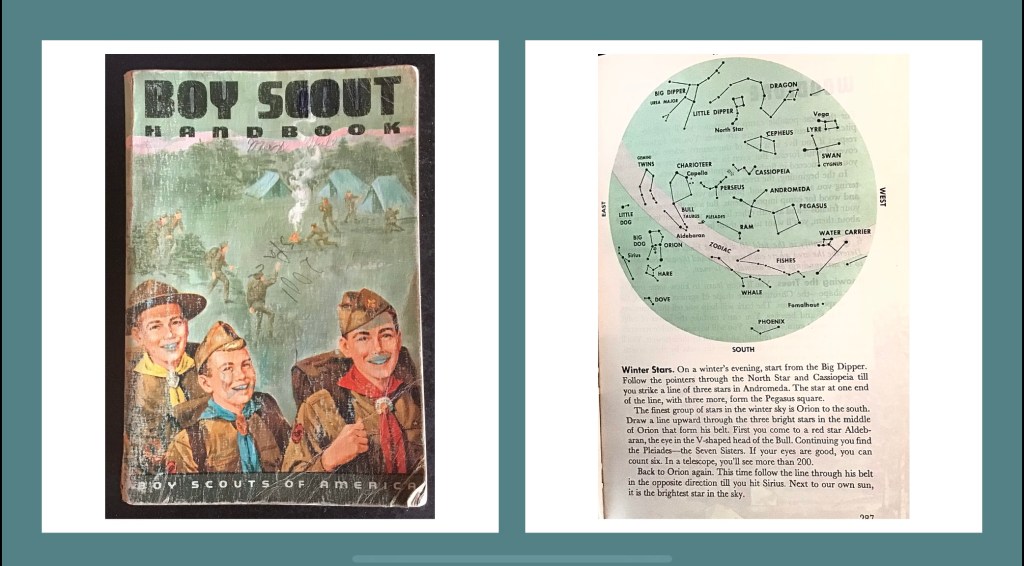
Later, in Boy Scouts, I began learning about the constellations. It started with the Big Dipper pointing to the North Star in the Little Dipper. Suddenly, and amazingly, you always knew what direction north was (unless it was a cloudy night). That was just the beginning. With my Boy Scout Handbook, I began to learn how to identify and locate the constellations – Cepheus and Cassiopeia; Canis Major, along with Sirius, the brightest star in the sky; Gemini the Twins; Taurus the Bull; the Pleiades (the Seven Sisters) and many others.

Knowledge of the Constellations in My Old Boy Scout Handbook

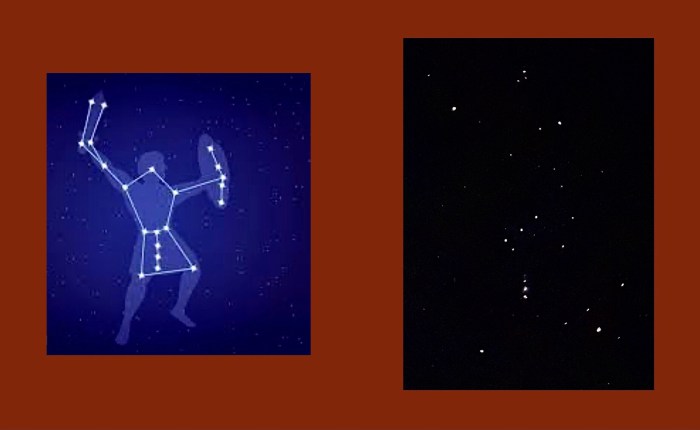
I’m not sure why, but my favorite was always Orion, The Hunter. Orion is one of the more identifiable constellations and has been mentioned by Homer and Virgil, and is even in the Bible*. According to Mythology, Orion was a great hunter and the son of Poseidon. He was killed by the sting of a large scorpion after possible misdeeds. Later, Zeus put both Orion and the Scorpion (Scorpius) in the sky as constellations.

Orion, The Hunter.

Orion is easy to see and easy to recognize, but here in the Northern Hemisphere, only viewable in winter. Starting in November, I watch him traverse the sky. Every night when I take Carmen out for her last walk, there he is overhead. If I take binoculars with me, or bring out my telescope, I can see the the Orion Nebula in his sword with greater detail. It’s no matter though. Knowing he, and it, are there are comfort enough.

Photo of Orion Taken With My iPhone 12 at Home in Virginia

I’ll observe him until March or so, and then he disappears from the night sky. The good news is he will reappear in late Fall, as he always does. He’s a bit more reliable than many of the unstable things in our lives.

Photo of the Orion Nebula,Below Orion’s Belt. Taken With My iPhone 12.

It’s not just here at home where I see him. Because of his location in the sky, he is visible in both the Northern and Southern Hemispheres. He was with us when we lived in Germany in the ‘80s. Over the years, I’ve seen him on vacations around the world, including this week in Grand Cayman. He has been a reliable travel companion.

iPhone 12 Picture of Orion With his Shield From Grand Cayman This Week.

Take a look one of these nights around 10PM. This time of year, he is high overhead, and slightly south of the center of the sky. You will find him easily enough. Look for his belt, and the rest will come with it. Know that I will probably be gazing on him around that time of night as well. I spend a few quiet moments with him almost every evening.

It is perhaps strange to think of a constellation as a touchstone, but that is what Orion has become for me. He is a constant I can count on and my eyes are drawn to him on starry winter nights. For me, he provides calmness and serenity, if only for a few moments. For most of us, there aren’t many things that do so. When you find one, it’s good to hold onto it.

… Silently, one by one,
in the infinite meadows of heaven,
blossomed the lovely stars,
the forget-me-nots of the angels…

Henry Wadsworth Longfellow.

Addendum:

I fondly remember my First Grade teacher, Mrs Thelma Finkeldey, and her purple hair. She was a great teacher. You can read more about her here: https://mnhallblog.wordpress.com/2020/06/04/mrs-thelma-finkeldey/

* Here are the Bible verses which mention Orion:

  • Job 9:9. Who makes the Bear, Orion and the Pleiades, And the chambers of the south;
  • Job 38:31. Can you bind the chains of the Pleiades, Or loose the cords of Orion?
  • Amos 5:8. He who made the Pleiades and Orion And changes deep darkness into morning, Who also darkens day into night, Who calls for the waters of the sea And pours them out on the surface of the earth, The Lord is His name.

The Chili Dump

The Chili Dump

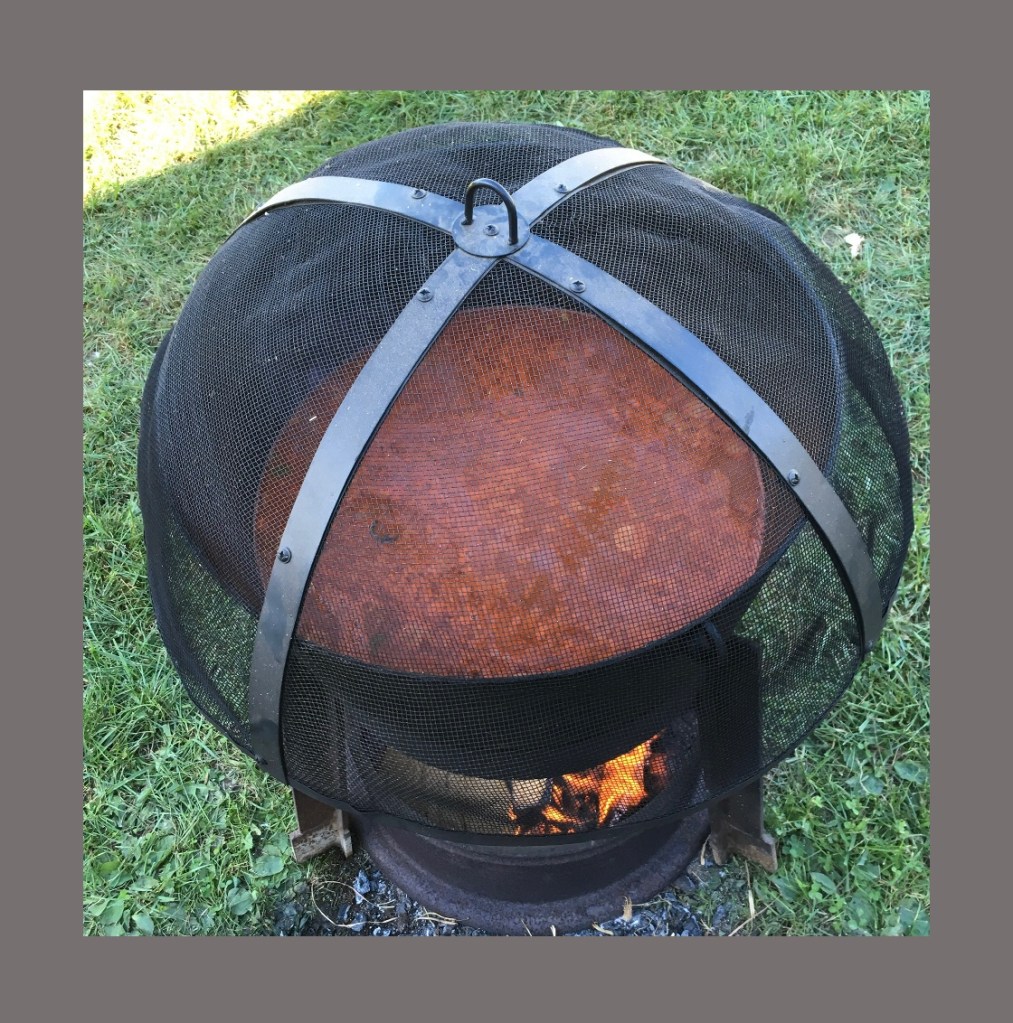
I hate missing a good party. Unfortunately, we will miss Chili Dump 2022. We made the 2016 version, which featured great chili, a band, Elvis, a bonfire tended by a front-end loader, and 200, or so, of my sister and brother-in-law’s closest friends. What’s a Chili Dump? I’m glad you asked.

My Brother-in-law Jack started his legendary Chili Dump party around 2002 with his then wife, Meg. The first party was a thank you for friends who helped clear the land they were building their home on, and then subsequently helping them build their home. It became an annual event, and as their kids grew older, their friends started attending the party as well. Sadly, Meg passed away in 2013. When my sister Roberta met Jack later, she too was introduced to The Chili Dump. In 2016, we timed our visit home to Illinois so we could attend the party.

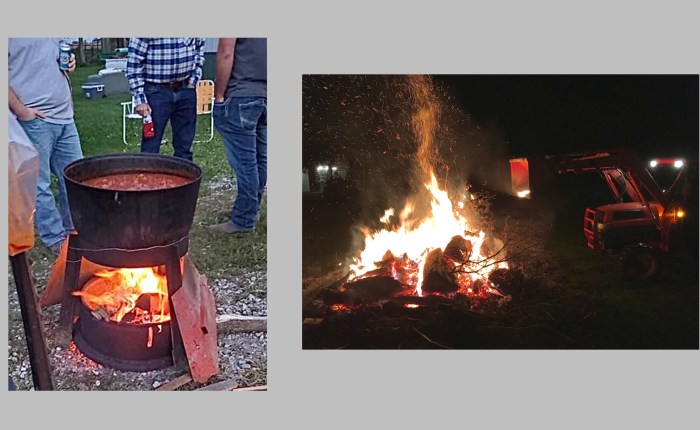
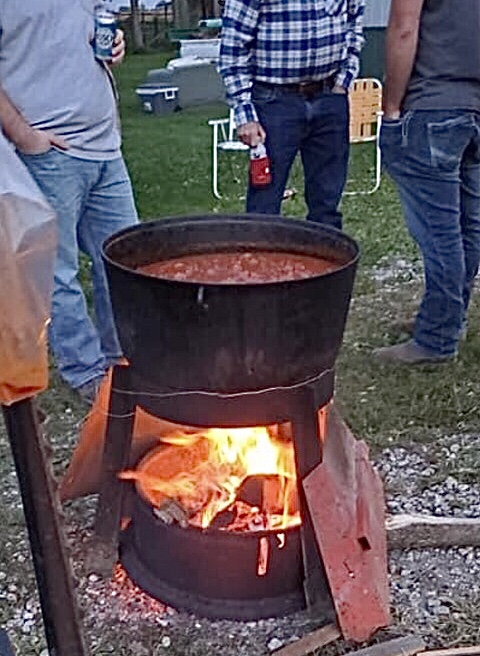
On that October ‘16 afternoon, Jack started a fire in the back yard and put a huge pot over it. The pot actually looked more like a cauldron than any pot I’d ever seen. They added the usual chili ingredients – cooked ground beef, tomatoes, tomato juice, hot peppers, beans and spices (and please, I don’t want to hear from any Texans about how beans don’t belong in chili). Soon, the chili started to cook and bubble away. By then, we may have had a beer or two.

A Cauldron of Chili….

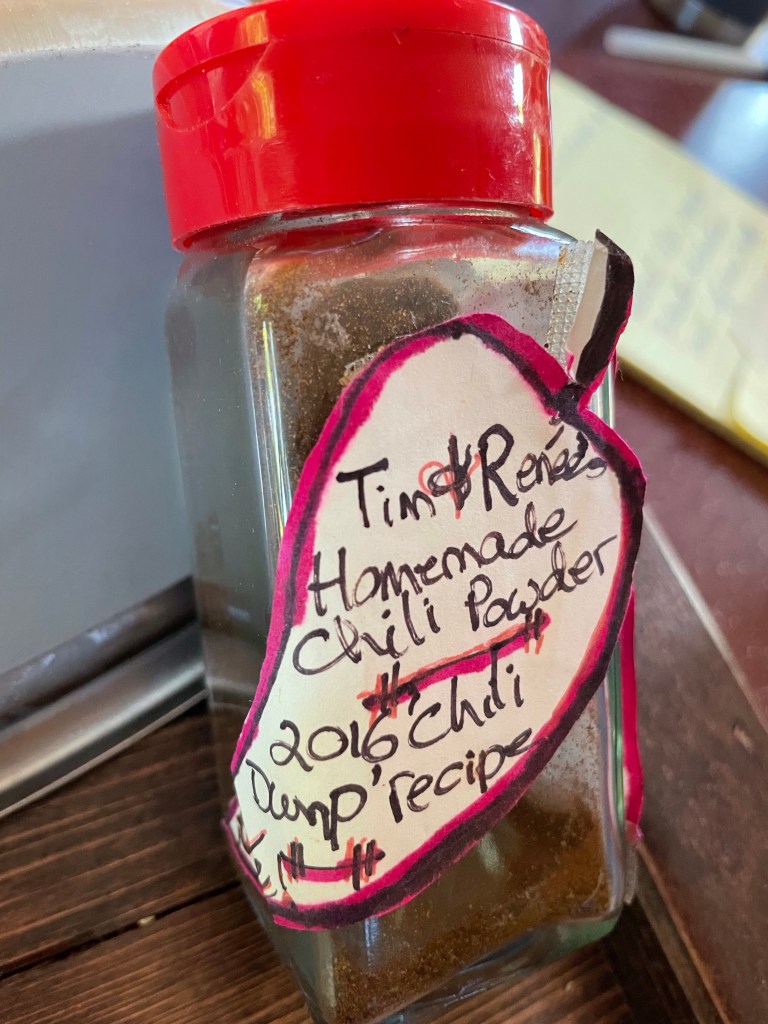
The first friends arrived by ATV, and brought more ingredients to add to the Chili – venison and jalapeños if I recall correctly. Others continued to arrive. Smoked brisket, hotdogs, sausage, bratwurst – they all went into the pot. Wood was added to the fire, to keep the chili cooking. Our friends Tim and Renee arrived from the Chicago ‘burbs with a blend of spices they specifically put together for the chili. Into the pot it went.

Tim and Renee’s Special Chili Spice for the Chili Dump!

Other folk brought toppings, including sour cream, grated cheddar cheese, sliced jalapeños and fried bacon. Someone made cornbread. There were bags of chips and Doritos added to the serving table. My sister Tanya and her husband Shawn arrived, and added more beef in the pot. Nieces and nephews arrived, and all dutifully put something in the pot. The volume of chili in the pot was definitely increasing.

The Pot was Getting Full!

Pickup trucks and cars were now lined up near the cow pasture. It started getting crowded and started getting dark. Around then, Jack lit the bonfire. It was a biiiiiig bonfire…

The Bonfire WAS Big…

Somewhere during all of this, people began sampling the chili. I have to admit, I was a bit skeptical, but then I took my first bite. Wow! This was surprisingly tasty. People kept arriving and adding to the chili. There was now also a steady stream of bowls being filled, so the volume stayed about the same, or maybe started to go down. There were probably 200 people at the farm by then.

Eventually, the Joel Limberg Band started playing. Some folks were dancing, and as at weddings, lots of little kids were hopping around on the dance floor. At some point, the band brought out a surprise guest singer – Elvis. Actually, a Philippine Elvis. Let me tell ya, you haven’t lived until you’ve heard Elvis sing Sweet Caroline, with the crowd joining in on the response – “Sweet Caroline, oh oh oh, Good times never seemed so good – So Good! So Good! So Good!” The party was going strong now!

Yes, Elvis is a bit Blurry, Much Like Parts of the Evening….

More dancing. Talking with family and old friends. Making new friends. More beer. More chili. The chili level in the pot was definitely receding. The bonfire was also going down, but Jack wasn’t ready to let that happen just yet. You know you have a big fire when you need to tend it with a tractor’s front-end loader.

Nothing Says Party, Like Fire in the Front-End Loader…

Although it was getting later, no one was leaving. Suddenly fireworks went off and exploded in the sky. We all watched, and oohed and ahhhed. The neighbors didn’t complain, because most of them were at the party.

Oooohhh! Aaaahhhh!

The band played another set, and it was time for more beer and more chili. The volume in the pot was definitively lower, but the chili was still hot, and still tasty. I noticed the crowd was starting to thin some, although I don’t think the sound volume was any lower.

Well after midnight, Cathy and I finally went to bed. It was a great party, but sometimes it’s good to know your limits.

The next morning, we woke, not feeling overly fuzzy. Jack and Berta were already up and had fed their calves and chickens. Amazingly, they didn’t seem to much worse for wear. I asked Berta how late the party went, and all she said was “Late”.

Our friends Tim and Renee also spent the night and they too woke up and joined the living. Eventually, we all went outside and started cleaning up. We may have partaken of a little “hair of the dog” during the cleanup. A couple of the youngsters also stopped by and with all of us involved, it wasn’t tooooo much work and we finished up after a couple of hours.

That was the 2016 party, and so far, the first and last one we attended. Since then, we’ve been out of the country for a couple of them, and of course covid slowed things down. I should mention they burned a Covid Snowman at the 2020 Chili Dump.

SnowMore Covid ‘19, was Added to the Bonfire in 2020…

I’ve both attended and hosted a number of good parties over the years, here in the States, and overseas in Germany, Austria, France, Belgium and the UK. I have to say the 2016 Chili Dump was one of the best. Anytime you combine chili, beer, Elvis, a bonfire, fireworks and fun people, it has to be pretty good, doesn’t it?

Addendum:

Thanks to my sister, Roberta, for help with this blog.

Granddaughter of Juda

Granddaughter of Juda

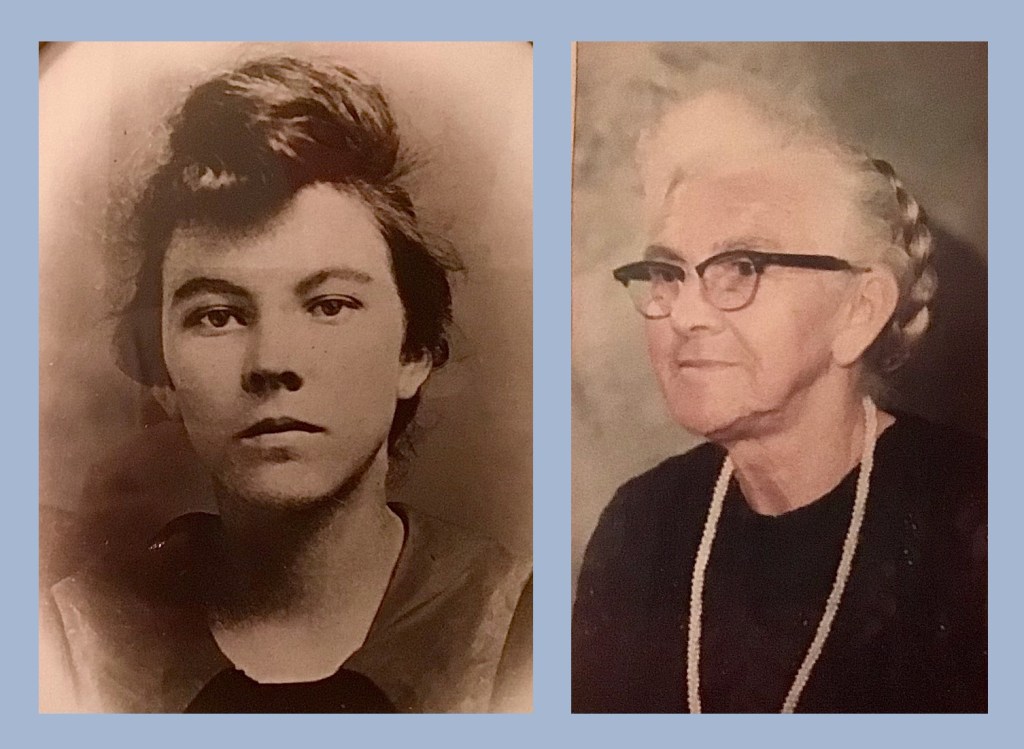
There were no gardens here at Rohan Farm 23 years ago. Now, they dominate our landscape. Cathy made this happen, through a combination of inherited knowledge, hard work and love. She is the daughter of Faye and a Granddaughter of Juda Catherine Strickland.

The hillside garden, the shade garden, the front garden, the vegetable garden, the cutting garden, Cathy designed them and created them. I provided a bit of the grunt labor for the hard scape, but the secret to all of it is Cathy. When she gardens, she is in her Zen Zone. For me, weeding is the ultimate drudgery. Not her. She spends hours each week weeding, improving and cutting in the garden. She once shared with me, “Patience is the key ingredient in gardening, and pays off when a plant reaches maturity and blooms. There’s a special excitement seeing something you have planted, nurtured, cared for and thought about finally bloom. The journey is as important as the end result.”

A Few Glimpses of the Gardens, and Cathy Peaking Around Some of her Daffodils

Cathy’s gardening talent was born long before I was on the scene. She inherited a love of gardening from her mother Faye. Mom was a wonderful gardener and always had flower gardens at the house. Cathy noticed. When her family lived in Chattanooga, Cathy persuaded her mom to let her have a flower garden of her own at age 12. Faye was fine with the idea, but Cathy had to plant it and maintain it.

Whenever mom moved to a new home, the first thing she did was start planning out the flower gardens. Her last home in Alabama was gorgeous with a combination of plants, pathways and surrounding woodland, and I could lose myself in thought while wandering through them.

Faye gained her garden skills from her mother Juda Strickland, who lived a hard life in rural Alabama. She and her husband Ernest had 11 children, 8 of them boys. Electricity and indoor plumbing didn’t come until much later in her life. Cathy remembers that when she visited as a child, they were still using an outhouse. I think two things sustained Grandma Strickland in life – her faith in God, and her gardening. For her, I think they were related.

Juda Catherine Strickland

Cathy spent years following Faye and Juda around grandma’s farm in Alabama, talking about plants and flowers the whole time. They were often joined by Jeff, Cathy’s cousin. While he did the usual “boy stuff”, he also liked to garden. They all discussed the merits of the plants, as they walked and talked. Some plant wouldn’t be doing well and they would decide if it should be replaced or maybe it needed a different spot, or just some love. Most were not exotic plants, but southern favorites like four o’clocks.

In Cathy’s telling, it was great fun walking around the farm. There was always something to see, whether plants, newly born piglets, or watching how live chickens were turned into dinner (I think there’s a whole other blog right here ;-)…). Sometimes the meanderings ended at the vegetable garden, where fresh tomatos were a tasty treat of summer – warm, fragrant and oh so juicy. Summer afternoons were spent on the porch with newspapers stretched over everyone’s laps. There were beans to string, peas to shell and corn to shuck…

Later, after Cathy and I were married, we made several trips to visit Grandma, particularly when stationed in Georgia. Grandma would lead Cathy around the house and garden showing her new, or different plants. She wasn’t quite as mobile then, having broken her hip during a fall in her sixties. She was using a wooden crutch to get around, and would point out the plants or blooms with the crutch. Cathy loved and cherished those times together.

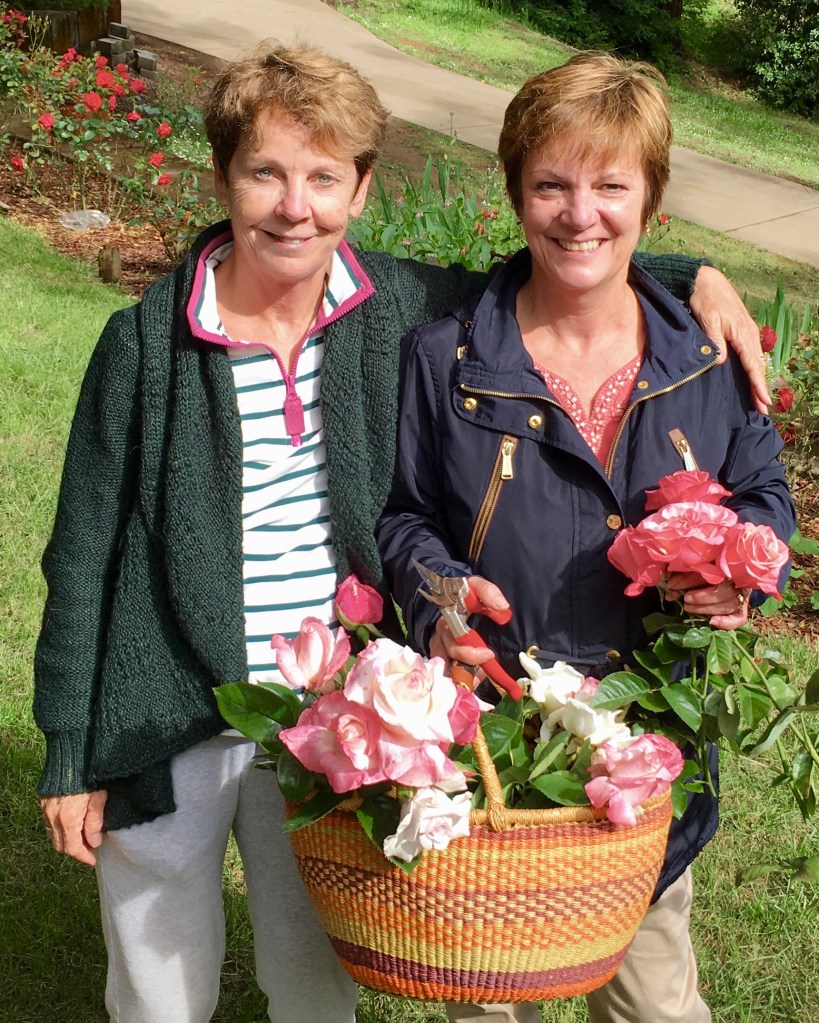
Cathy’s younger sister Bonnie also has the gardening gene. At her home near Mendocino, CA, she has roses, flower gardens, a big vegetable garden and fruit trees. It’s all beautiful and fits the Northern California setting perfectly. She has a greenhouse that many professionals would envy. Cathy and Bonnie trade cuttings and seeds back and forth, and more than a few plants have made coast to coast journeys.

Cathy and Bonnie Cutting Roses in California

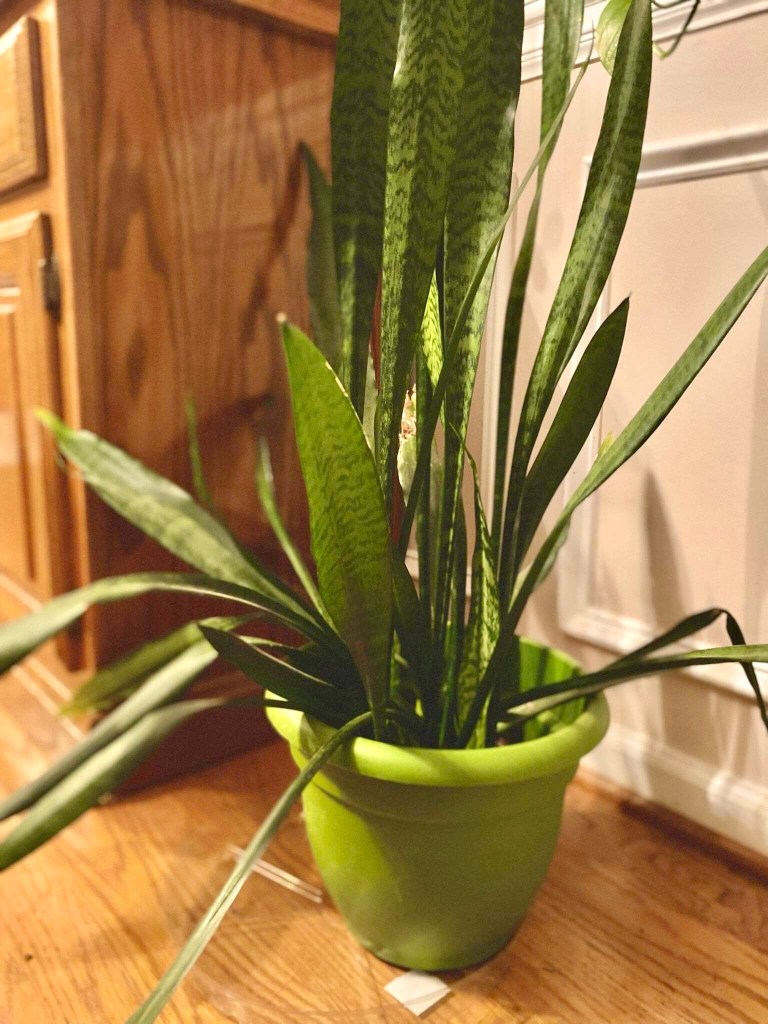
There are several other Granddaughters of Juda who inherited her green thumb. As an example, in addition to Jeff, Cathy and Bonnie’s cousin Debbie has beautiful gardens in her back yard, and will frequently post pictures that reveal she too has the touch. Other cousins such as Margaret and Dylilah have the gift, and it’s already seen in the next generation – Sasha, the daughter of their cousin Rusty is also an avid gardener. It wasn’t a universal gift though. Cindy, Cathy and Bonnie’s middle sister, was never much of a gardener. Nor was their cousin Loretta, who claims she can’t grow anything. Still, I think Juda’s spirit remains with all of them. As Loretta related, “I definitely did not inherit her green thumb. I manage to kill every plant I get EXCEPT for one. I inherited a Mother-in-Law’s Tongue from Mawmaw in the ‘90s. Believe it or not, despite my best efforts, that plant is still alive.” 😉

Loretta’s Mother-in-Law’s Tongue – Nearly Thirty Years Old, and Still Going Strong

Grandma eventually passed away in 1997, at the age of 98. She was in a nursing home for her last few years. Although she could no longer garden, her faith in God remained with her until the end. I like to think there are gardens scattered across America that are living testaments to her life and her legacy.

Addendum:

  • Special thanks to Cathy, not only for her gardens, but also for sharing memories of her youth and visiting Grandma in Alabama. She filled in missing critical pieces that I “sensed”, but didn’t specifically know.
  • Thanks to Bonnie, Loretta and Debi for sharing their own gardening backgrounds. Special thanks to Loretta for sharing the photo of her Mother-in-law’s Tongue (photo credit to Cynthia Smith).
  • I first met Grandma Strickland in 1973, when Cathy’s family went there for a vacation over spring break. Cathy and I were dating and in high school, and we somehow persuaded our parents that it would be OK for me to go with them. I think at first Grandma was a bit suspicious of this token northerner who was dating her granddaughter. The suspicion was allayed at least a bit on the second night, when she cooked fried okra. I’d never had okra before. Three helpings later, I thought I’d died and gone to heaven, and grandma started warming up to me.

Here are two other blogs I’ve written in the past about Cathy and her gardening:

  • Through Cathy, I’ve gained an appreciation for the colors that make up the palette of our life. For years, I didn’t get it, or understand it. Or perhaps even worse, I didn’t think about it. Sometimes though, you can teach an old engineer new […] continue at: https://mnhallblog.wordpress.com/2022/03/23/the-palette-of-our-life/
  • Ask Cath how she grows orchids and she’ll say “Oh, I just water them. After that, it’s tough love.” Tough love evidently works. In winter, I enjoy looking at the results. The color, the texture, the beauty of orchids and their individual parts – Sepals, Petals, Lip, and Column, make each unique… Continue at: https://mnhallblog.wordpress.com/2020/03/04/cathy-and-her-orchids/

Eggs and Dichotomies

Eggs and Dichotomies

I recently enjoyed a fun and funny New Yorker article, by Rachel Syme. While reading, I became aware of two dichotomies simultaneously – First, she is a wonderful writer, whose prose blows mine away. Second, I know how to cook a perfect soft boiled egg, while she does not :-).

I subscribe to the New Yorker, which has great writing on a multitude of topics. One of the features of my subscription is that I receive emails a couple of times a week with reading suggestions. Last week, the email shared several food related articles, and one of them immediately caught my eye. Maybe it was the lead in … “The Ridiculous Egg Machine That Changed My Breakfast Game – It breaks all my kitchen rules, and yet, every morning, I make myself a fussy little hotel breakfast.” I’m not a kitchen gadget guy, but this sounded intriguing. I knew I was either going to love it, or hate it.

Both Reads were Good, but Syme’s Article Caught my Eye First

The article WAS good, and interesting. I enjoyed the way she wove the story of the egg machine into her own background and family history, while adding something we all crave – a little pampering while at a hotel. She talked about short getaways, and the enjoyment of coffee in bed, and wonderful little breakfasts, including soft boiled eggs.

It made me think of my own introduction to soft boiled eggs. Growing up, eggs were a family staple, particularly on weekends. Saturday mornings often saw eggs scrambled, over easy or sunny-side up, with toast and bacon on the side. Hard boiled eggs? Sure. Always at Easter, but also occasionally for a snack, and a big dose of them in mom’s potato salad. Soft boiled eggs? I don’t remember mom (or dad) ever fixing them. I believe the first time I ever ate one was while stationed in Germany in the early ‘80s. On one weekend trip, we spent the night in a small village Gasthaus. The next morning we came to the dining room for breakfast, where we were greeted with charcuterie, a cheese board, and thick slices of bread, along with something else – soft boiled eggs in small holders, with a tiny comforter over the top of the eggs to keep them warm. The presentation was funny, practical and magical all at the same time. The eggs themselves? Both simple, and delicious. I was hooked.

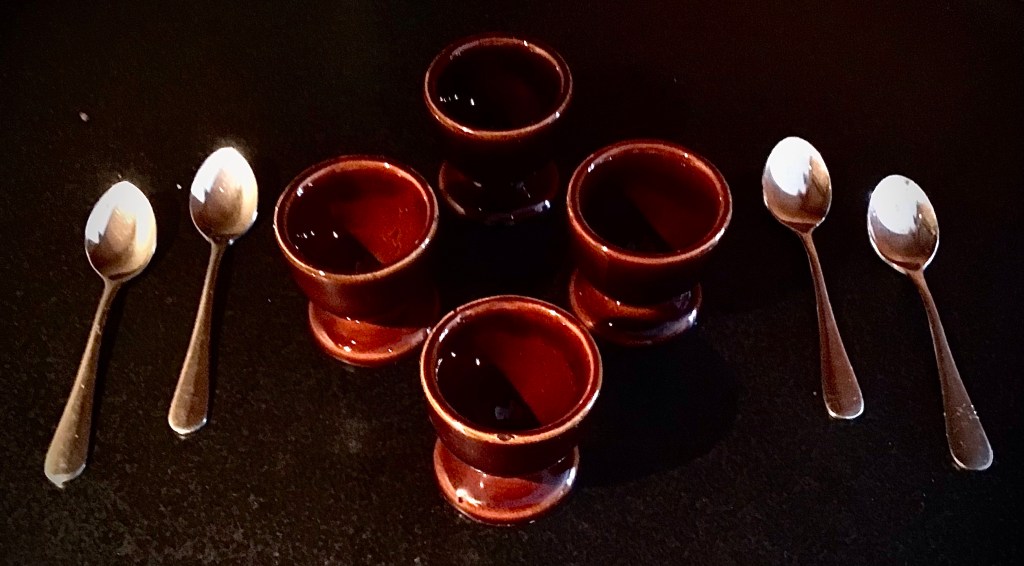
Of course, we then had to make them at home, which led to us buying the little egg cups, and the tiny spoons needed to scoop out that golden delight from the center of the egg. We made them for a year or two, usually on the weekend when guests were staying the night. Then, as is often the case, we got out of the habit, and eventually stopped making them. For thirty years.

The Egg Cups Sat Unused for Thirty Years

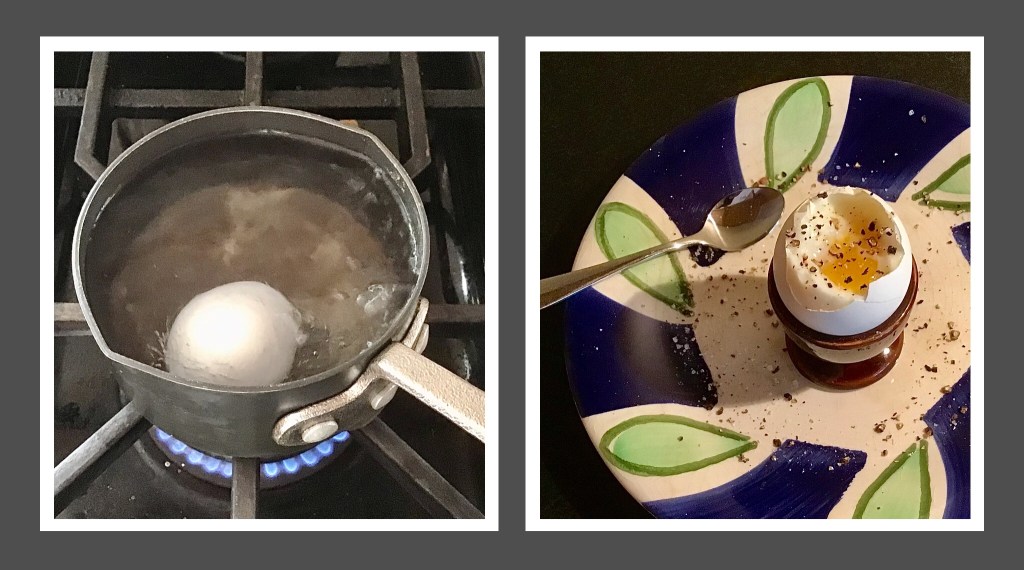
After retiring about eight years ago, I rediscovered the egg cups, and brought them back into use. I’m usually up earlier than Cathy, so we eat breakfast separately. Once about every week or two, I take the four minutes and fifty seconds needed to make a soft boiled egg. Just. The. Way. I. Like. It. A little bit of memory, delight and tastiness all in one egg.

Four Minutes and Fifty Seconds to a Nice Breakfast

Which brings me back to Rachel Syme and her article. The twin dichotomies we share are perfectly summarized in her breakfast description in the article: “Mornings at home were for English muffins with a scoop of marmalade, or muesli with a splash of almond milk. Low-risk stuff. Foolproof … What I kept fantasizing about was a perfect plate of soft-boiled eggs, with a silky, spreadable yolk the consistency of honey. I knew I wasn’t going to be able to manifest this fantasy on my own. Enter the egg machine.

In a million years, I would never come up with the phrase “…with a silky, spreadable yolk, the consistency of honey.” I mean, that is a perfect description. It makes me hungry just reading that line. And then, she adds the kicker “ I knew I wasn’t going to be able to manifest this fantasy on my own. Enter the egg machine.” I wanted to scream out “Rachel! You too can do this. All it takes is four minutes and fifty seconds! Really!”

So there you have it. We all have our talents, we all have our fantasies, and those of us who are lucky enough, recognize the limits of the former, while trying to reach the latter. If Rachel Syme can achieve breakfast nirvana with a DASH Rapid Egg Cooker, who am I to judge? In the meantime, I look forward to reading more of her wonderful writing, and maybe learning a thing or two along the way.

Addendum:

The Palette of Our Life

The Palette of Our Life

Through Cathy, I’ve gained an appreciation for the colors that make up the palette of our life. As an engineer, the journey hasn’t been a simple one. Sometimes though, you can teach an old dog new tricks.

Over the decades, the two of us have seen life through different lenses.

For me, it has usually been about form, and lines and precision. It’s hard for me to say whether I was always this way, or I became this way. Did my childhood background start me on the road to becoming a military officer, an engineer and a business leader? Or was it something that was self-reinforcing over time? Even in my hobbies, whether running, or reading, or photography, there was a certain precision… trying to reduce my times on a run, or capturing greater detail in a photo, there was a linearity to it. The gauziness of color didn’t really register in my brain.

For Cathy, her view is much more about color and the senses. This is most obvious in our gardens. While our gardens are made up hundreds of plants and flowers, and requires much hard work on her part, it is the flow of color over the seasons that defines them. There are constantly changing colors and hues. Only a fool, or an engineer, would miss them and their beauty.

A Redbud in the Garden Last Spring

For years, I didn’t get it, or understand it. Or perhaps even worse, I didn’t think about it.

And then about seven years ago, I retired. There are many great things about retirement, and most retirees will happily enumerate them to you ad nauseam. For me, the greatest gift is the luxury of time. Time to do the things you want, or time to do nothing at all and not feel guilty about it.

One of the things I started doing with my time, was taking care of the morning feeding of the horses. It was easy enough, and made me feel like I was contributing at home. There was also an unintended consequence.

After feeding the horses, while walking back to the house, I would notice little bursts of color in the garden. Why were flowers blooming in February? And then March? And then everywhere by May? Our hillside garden was awash in color, both from the flowers, and the many hues of green from the plants themselves. Now mind you, these colors and flowers were there for years, but it was as if I was seeing them for the first time. Cathy had created all of this, and I was blind to it.

Some Photos of Just a Few of the Flowers in Cathy’s Gardens

Thank God, we all have the ability to grow, even when we appear set in our ways. As spring arrives, I walk through the gardens looking at the new growth and colors peeping out. This year is different than the past. Our hellebores, crocuses and daffodils are blooming at the same time, when typically they would bloom sequentially. The engineer in me wants to understand why, but it’s not stopping me from enjoying this beautiful March we are having.

I see color now, or perhaps a better description is I see more color now. Sure, I always saw the red, yellow and orange leaves of autumn, or the red white and blue fireworks on the Fourth of July, or a multicolored string of Christmas lights. Now, I also see the purple ground cover in a field in the spring, the mixed colors in a neighbor’s garden, the infinite shades of grey in the sky and sea on a cloudy day. I’m a better person for all of it.

On a Recent Drive to the Chesapeake Bay, a Sea of Purple…

I’m still Max and keep spreadsheets, to-do lists, and can be pretty anal about time. Happily, I’ve also gained an appreciation for color. I excitedly show Cathy pictures of her flowers and of the garden and she smiles at me. Even though she has seen those colors and flowers for decades, she’s a good partner and encourages me in my growing understanding of color, and of who she is.

It makes me feel pretty lucky.

Talking to the Animals

Talking to the Animals

I’m no Doctor Dolittle, but I do “Talk to the Animals” here at Rohan Farm, and do so on a pretty regular basis. Most mornings, we have conversations, although they tend to be a trifle one sided, at least in a verbal sense. Still, I think we have a pretty good understanding of each other.

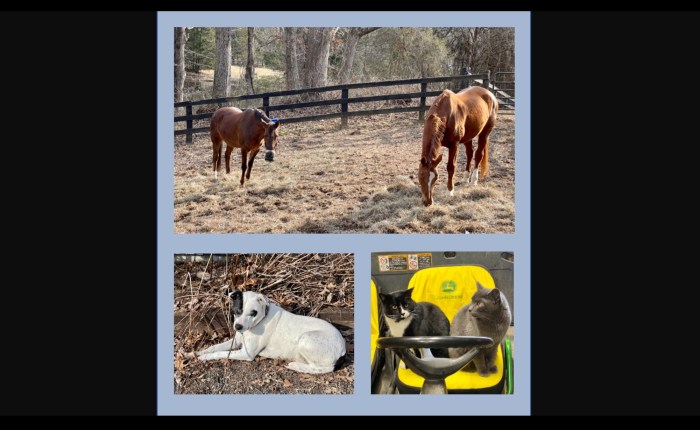
It starts when I wake up in the morning. Carmen, our dog, will stir and I’ll ask her if she had a good night sleep. She doesn’t answer, and instead does a couple of “downward dog” yoga stretches while waking up and looking at me. Eventually, we are both awake and go downstairs and out the door.

At the barn, I greet our horses, Katy and Stella, with a good morning, and ask them if they had a restful night, and whether there were any visitors to the barn. They tend to just look at me, and the look says “Where were you? It’s time for our breakfast!” On cold mornings, when there’s some ice in their buckets, I’ll also ask if they were warm enough during the night. Of course they were, but it seems a friendly thing to ask. While getting their food, I keep a bit of chatter going about the beautiful sunrise outside the barn, or the new snow on the ground, and aren’t they going to be surprised when they are turned out. They respond by stomping their hooves, or scraping the bars on the stall doors with their teeth, wanting to know where the hell breakfast is. Eventually, I give it to them, and things quiet down, while they munch away.

Katie and Stella – “Where’s my breakfast!?”

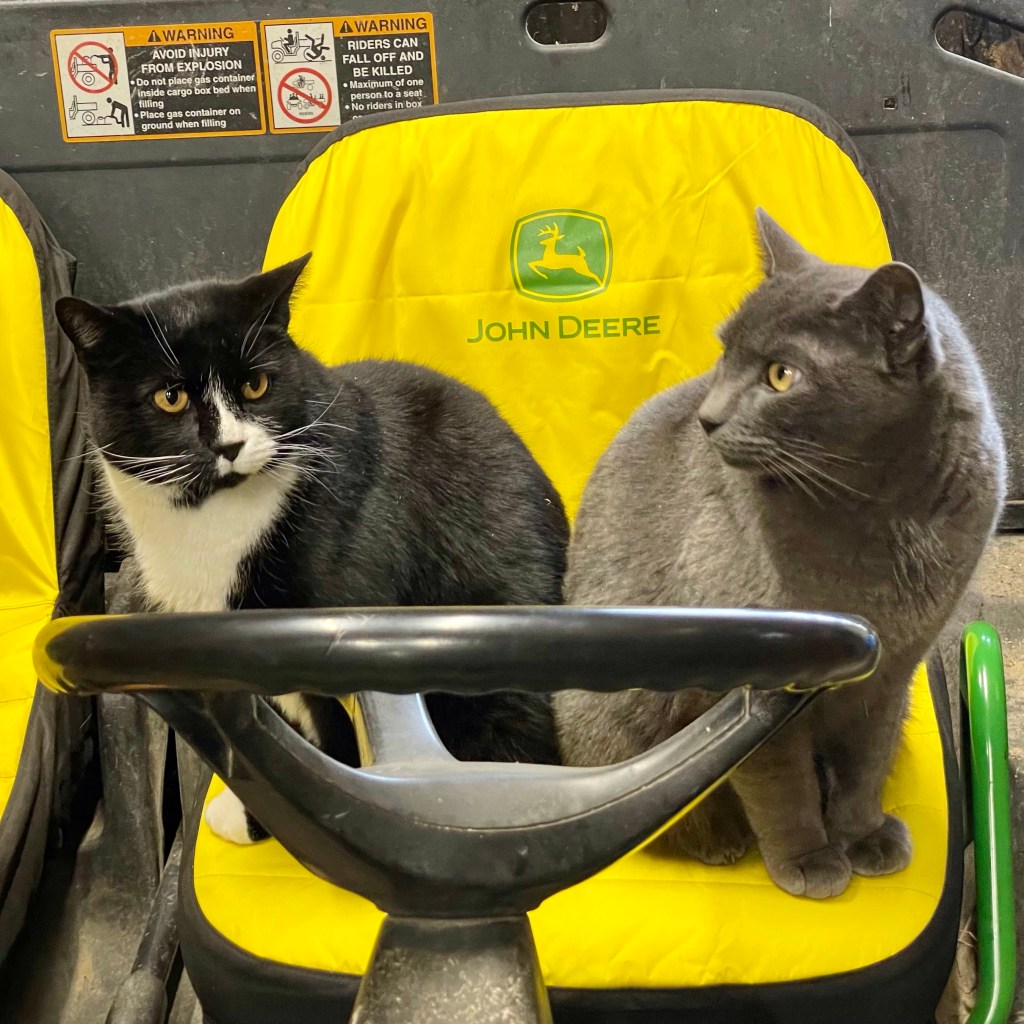
Now, it’s time to feed our cats, Stan and Ollie, and I again greet them with a hello and ask how their night was. Lately, it’s been fairly cold, so we’ve allowed them to sleep in the heated tack room, rather than the barn itself. They purr and wrap around my legs, or rub up against Carmen as they wait for breakfast. I’ll ask them if they heard Momma Cat out in the barn last night. Momma is a cat whose owner moved away, and we have seemingly adopted. Cathy frequently sees her, but she is quite shy around Carmen and me and we rarely do. As I leave the barn, I call out a loud hello to Momma Cat, and noisily put some food in a bowl in the hay area for her. Of course, she is nowhere to be seen.

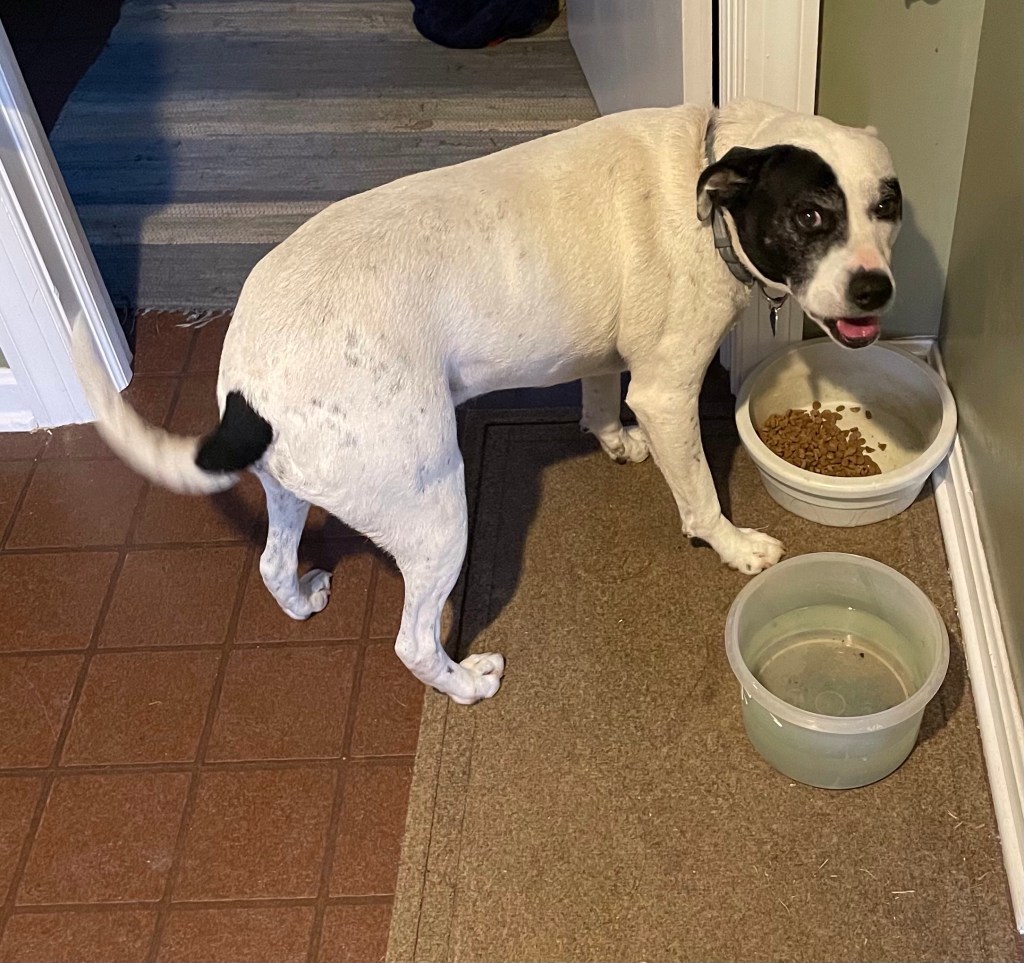
Carmen and I then return to the house for our own breakfasts. As we enter the mudroom, Carmen immediately sits in front of her dog bowl. She hasn’t barked, or said anything verbally, but she might as well have said “OK – you fed everyone else, now it’s my turn. And don’t even think about making your coffee before feeding me.

Tail wagging, Carmen’s ready to eat…

After a couple cups of coffee and small breakfast, it’s time to go back to the barn and let everyone out.

The cats go first, and I remind them to come back at dinner time, if they want to sleep in the tack room. Otherwise, they are on their own. I tell Stan to watch out for our other neighbor’s un-neutered male cat that sometimes comes slinking around the barn looking for a handout. Stan and he have a history, so I figure a word of caution can’t hurt. I also remind Stan doing a walk-about for a week or more in winter is probably not a smart thing to do, but he ignores me whenever I tell him this.

Ollie and Stan after breakfast on a recent morning

Finally, it’s time to put the horses out and I take a few flakes of hay to the nearby paddock. While in the hay area, I note that Momma Cat has already eaten most of her food, and disappeared back into the hay. I say hello again, and call “Here kitty, kitty, kitty…” a few times, but get no response

As i put Katy’s grazing muzzle on, I tell her I’m sorry she has to wear it, however, it’s for her own good, and as a pony, we don’t want her developing health issues from overeating. After taking her out, I return for Stella, who has waited patiently. Leading her to the paddock, I usually just tell her to enjoy the day, and remind her not to pick on Katy.

Katie (in the grazing muzzle) and Stella

With that, it’s back to the house, and the rest of my day.

The thing is, I think Dr Dolittle had it slightly wrong when he said “Oh, if I could talk to the animals, just imagine it …” Talking “to” the Animals is easy. I mean, I do it every morning. It’s talking “with” the animals that is harder. While “Talking to” and “Talking with” are often used interchangeably, they aren’t quite the same, are they? “Talking with” implies a conversation between two or more. “Talking to” can imply a one way, or one sided conversation, or perhaps even a lecture.

I guess it’s not that different from people in that regard. Talking to people is easy. Talking with people is what’s hard, and these days, with the fences everyone puts up, getting harder. We all know people that are great talking to, or at you, but maybe aren’t so good at the listening and understanding part.

Upon further consideration, I think it is easier to communicate with the animals. I may do most of the verbal talking, but the interchange and understanding that goes back and forth is pretty good, at least in comparison to some people I know.

Addendum:

⁃ While I do the morning feeding at the barn, I would be remiss if I didn’t mention Cathy does 90% of the animal care on the farm. Afternoon feedings, stall cleanings, horse healthcare and a myriad of other horse and animal maintenance chores are all under Cath’s purview. While I can’t say whether she talks more or less than I do with them, her understanding of their wants and needs is infinitely greater than mine.

⁃ Carmen is the smartest dog we’ve ever had and a GREAT communicator. Here’s a blog she wrote about a year ago: My name is Carmen. I’m about 44 years old now, and in my prime. Some guy named Shakespeare once said every “dog will have his day.” I think every day is my day, and I […] Continue at: https://mnhallblog.wordpress.com/2021/04/07/whosagooddog-carmen/