Around this time of year, at not quite the end of summer, there’s a sound that always says to me, “Yes, it’s still summer. Enjoy it while you can.” I’m sure you know it too. It’s the sweet summertime sound of the cicadas. It’s September now, but their music will still be with us for a little while longer. There’s a lesson for us too.
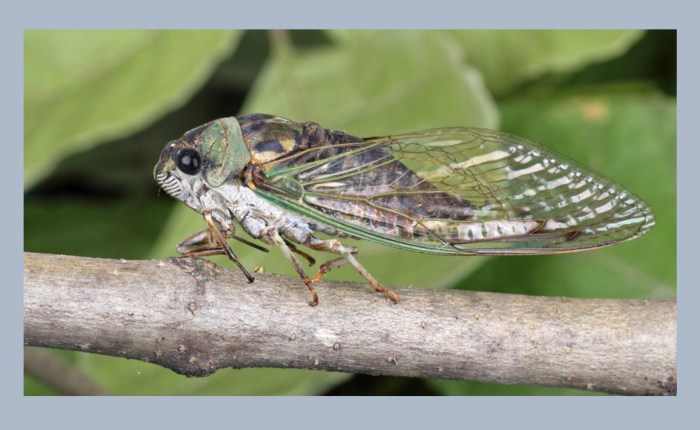
I’m not talking about the periodic thirteen or seventeen year cicadas. I’m referring to the ones known as the Dog-Day Cicadas, so named because they make their way out of the ground every year during the dog days of summer in July and August. You know them. These annual cicadas provide the background chorus for summer’s soundtrack. They are so much a part of summer’s song that sometimes you don’t notice their continual buzz at all. Until you do. Like the lightning bug, they remind me of the more carefree days of my youth.
This past Labor Day weekend, I listened to them for four straight days. The weather was gorgeous with warm days and cool nights. It was so nice, we’d turned off our AC and with the windows open, could hear the cicadas whether we were inside or out. Each day, I heard them all day long and into the evening.
That “noise” is their mating call. As with most of us, they are looking for a partner before they die. With only a few weeks above ground, they may have a greater sense of urgency than we do.
As I listened to them on Labor Day itself, I thought “There’s not much time left little buddies. Soon it will turn chilly and the leaves will fall. Like summer itself, you too will disappear. Make the most of it while you can.”
Get ready. They are coming. You may have heard the seventeen year cicadas are due in our area in another month or so. From mid May to mid June we will have literally billions of singing cicadas. The goal of all that singing? Sex. That’s right, sex. After seventeen years underground, they emerge, eat a bit, the males sing in a chorus, they all have sex, the females lay eggs and everyone dies off. That’s it.
The last time they were here? 2004. I have three lasting memories of that visit, but first a bit of background.
For approximately five to six weeks, starting in mid May, the cicadas will overrun us. These particular Cicadas arrive in seventeen year cycles and each of these cycles are called “Broods”. The Broods are numbered in Roman Numerals, and Brood X (10) is about to grace us. This is one of the largest and most widespread, and encompasses Virginia, Maryland, DC, Delaware, West Virginia, North Carolina, Georgia, Kentucky, Tennessee, Illinois, Indiana, Pennsylvania, New Jersey, and parts of Michigan and New York.
Given this is the time of Covid, you might be forgiven for thinking in terms of biblical plagues and that cicadas are locusts, but they aren’t. Locusts are actually a type of grasshopper, so we are OK in that regard. The cicadas are relatively safe and do no harm, except for possibly small, young trees. We, and our gardens, are safe. In fact, the cicadas are a boon for the rest of nature. Birds and animals feast on them when they first arrive. Eventually, they’ve eaten so many, they go into the animal version of a food coma after Thanksgiving Dinner and stop munching. The cicadas however, continue to arrive.
After emerging, the male cicadas join together singing in a “chorus” to attract the females of the species. Their singing becomes incredibly loud. Scientists who study these things say the choruses can reach 100-120 decibels, the same as a rock concert. The difference? The cicadas can go on for days. That’s right. We’ll be sitting in the equivalent of about row thirty at Woodstock or Lollapalooza. The only difference is that this will go on for quite a bit more than the three or four days of those rock concerts. if you live in our area, they will be impossible to ignore.
Inevitably, you also hear about eating cicadas. DC based Naturalist, Alonso Abugattas, had this to say: “Cicadas are gluten free, low in fat, low carb, rich in protein (the same pound for pound as beef). They’ve been grilled, skewered, steamed, barbecued, blanched, boiled, and used in cocktails. My old boss would fill the empty skins with Cheez Whiz and serve them as appetizers”. Hmmmm….
I have three memories from the last time they visited us in 2004. The first is that they were loud. I don’t remember rock-concert loud, but they were loud enough you couldn’t hear anything else – no other insects, birds, or even small children at the neighbors.
The second memory involved eating them. No, it wasn’t me eating them. It was our dog, Holly. She loved eating them. Hundreds or thousands of them were in our front garden. Most were on plants at dog-eye level. Holly, God bless her, walked at a slow pace from plant to plant eating cicadas off the tops of the plants as she went. Night came and we called, but she didn’t come in. Bedtime came, we called again and she still refused to come. We decided the hell with it, and left her outside (she was on an underground fence and couldn’t leave the property). Morning came and we went out the back door and found Holly laying there. We opened the door and she slowly came in the house, looking a bit how a dog would look with a hangover, if there was such a thing as a dog hangover. We filled her bowl with food. She took one look at it, walked passed it and headed to bed, where she proceeded to sleep the rest of the day. She had gorged on so many cicadas, she wasn’t hungry for breakfast. I had never seen her ignore a meal before, or for that matter, afterwards.
The final memory is a bit sadder. Eventually the noise of the cicadas started dying down. It went from a roar, to a rumble, to a pleasant buzz, to silence. Total silence. Just like that, they were gone. The great 2004 cicada orgy of sex and sound was over. Except it wasn’t.
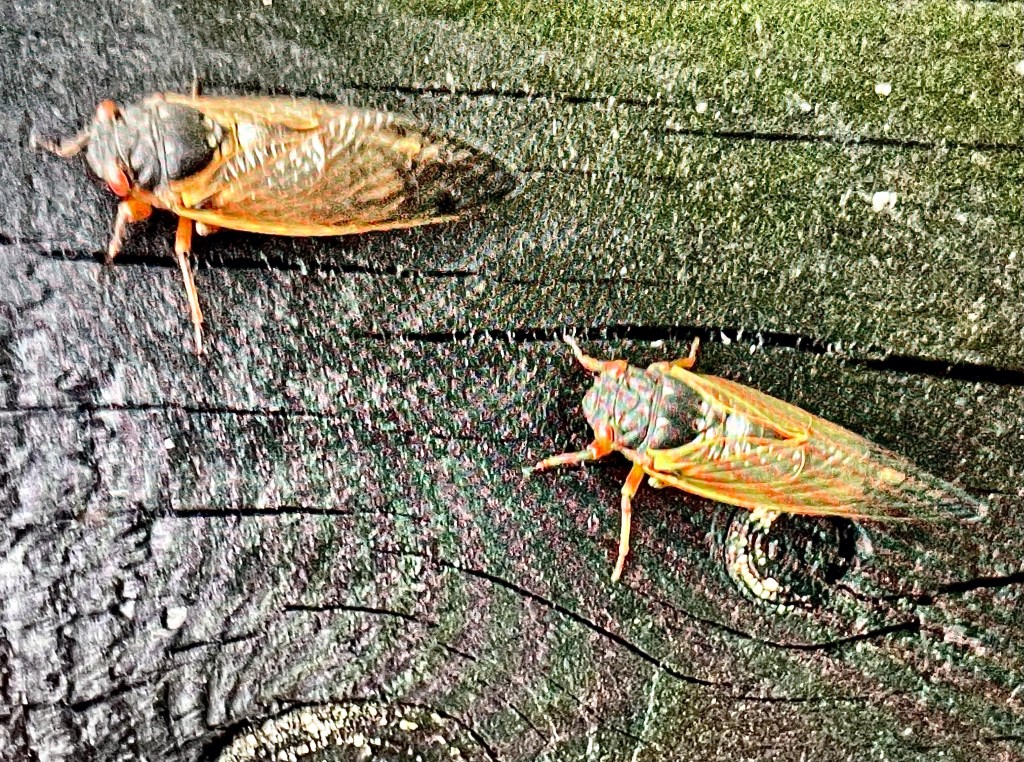
About a week later, we heard the unmistakeable sound of a single singing cicada coming from the woods by our house. While not particularly loud, you could definitely hear him. A single lonely cicada singing in the night, looking for a partner. Any partner. It might have gone on for an evening or two, and then it too was silent.
A Cidadafrom Brood X in 2004
I’ve thought about that cicada off and on over the years. I think about the cruelty of it. You’ve spent seventeen years approximately eight inches underground. A lot has gone on. Finally, it’s your day in the sun, but Mother Nature plays a cruel trick on you. Maybe you had to dig around a rock to get above ground. Maybe you were a little deeper than eight inches under ground. Or, maybe you were having a great dream, and decided to sleep in a couple of extra days. In any case, you finally emerge, ready to join the chorus and have a little sex on the side, and… nothing… nada… nobody. It’s as if you make the trip to Spring Break to party, arrive, and find nobody else is there. Spring Break ended a week before and you never got the word. Now, it’s just you, all alone on the sand with scattered empty beer bottles littering the beach. A day later, you die and don’t even make the trip back home.
OK, OK, I know I went a bit over the top, but I did feel a bit sorry for the guy. Sure lots of other cicadas were eaten by animals (including Holly) when they first emerged. At least they saw and heard some from the Brood. The last guy? All alone in this cruel world.
Anthropomorphism is the attribution of human traits or emotions to non-human entities. We all do it at one time or another, particularly with our pets. I doubt seriously the little guy felt alone, realized he was about to die, or missed out on the sex part. Still, he had to know he was singing for some reason, so maybe he did realize he was missing out on sex with some last gorgeous female cicada. Hell, for all I know, maybe there was one last female in the woods, he found her, they had sex, she laid her eggs, and they both died. I’d like to believe they died happy.
Did he ever find a mate? We’ll never know…
Addendum:
Special thanks to my Sister-in-law, Bonnie Harris. She came up with the great line “all alone on the sand with scattered empty beer bottles littering the beach”…. 😉



 Live Life Exuberantly