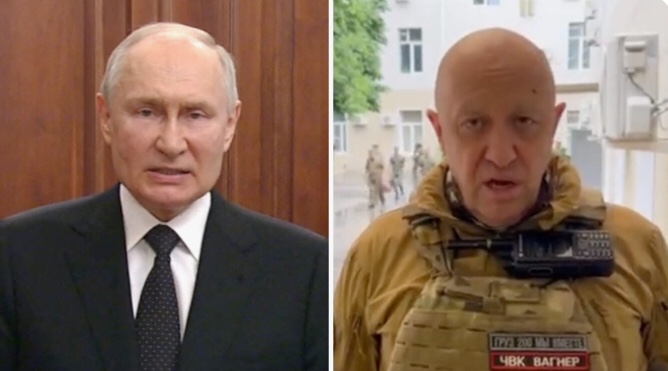
On June 24th, we woke to the news the Wagner Group rebelled against the Russian military and was marching on Moscow. Twelve hours later, it was all over. Peace at hand? More problems to come? Certainly we have ripples of instability, never a good thing in world affairs.
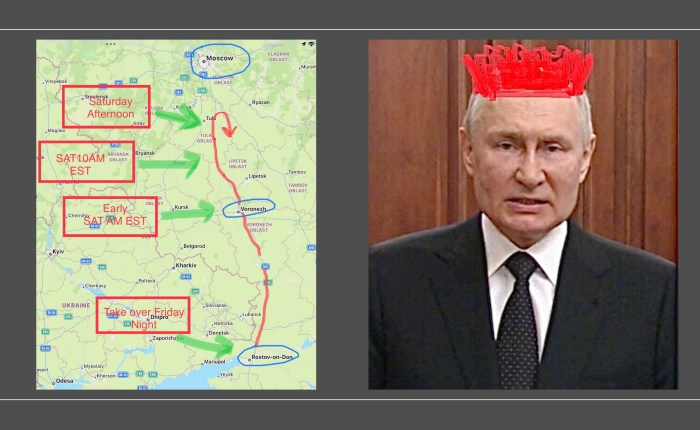
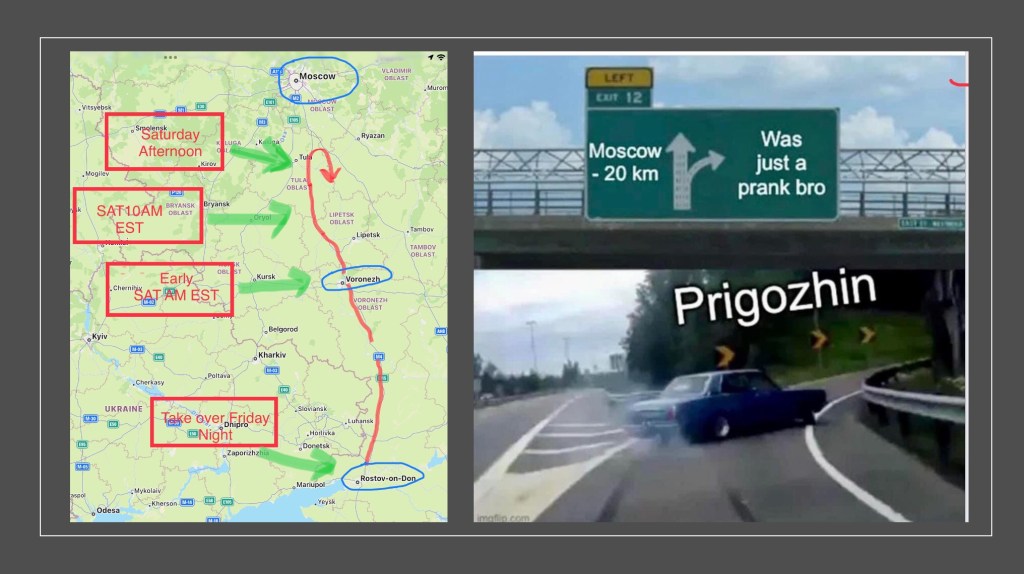
There’s nothing like a coup attempt to grab my attention before I’ve had my morning coffee. On that fateful Saturday, I watched with fascination as Prigozhin’s Wagner Group troops took over the Rostov Russian Military Headquarters and then started their march on Moscow. It appears they were within 120 miles of the capitol before the insurrection ended as suddenly as it began, and Belarus leader Lukashenko worked out a peace between Putin and Prigozhin.
Whoops…I Didn’t Really Mean It
The terms? Maybe, forgiveness for the troops, a safe passage of Prigozhin to Belarus, and no invasion of Moscow itself. Yea, a win-win for everyone – if you believe in fairytales. The “fog of war”, and the cloak around all things “Russia” makes it difficult to assess what is true, what is false, and what is somewhere in between. It will all play out over the next few months. What I know is there is now increased instability in the region, and the world. I’m not a big fan of instability. No sane person should be a fan of instability as we are now experiencing in Russia.
Will The Peace Last?
I am by no means a Russian expert, but I am a student of history. I also spent nearly a decade in the Army in Germany in the ‘80s waiting for them to attack us, and had the opportunity to learn a bit about them then as well. So, while I’m no expert, I do feel confident that I know more than about 95% of the talking heads on TV, and 99% more than all of those spouting off online.
Here are seven questions we don’t have the answers for. I waited this long after the putsch attempt to publish this blog in order for events to develop and perhaps answers become apparent to some of the questions. I don’t believe that has happened. The fog, and the world’s instability will remain until we have a better understanding of the answers. If someone on TV or online says they have the answers right now, you should immediately change your TV channel or go elsewhere online. They are probably lying.
1. Has Putin weakened? Between his failing attacks in Ukraine and this mini-coup, he looks like it, but looks can be deceiving. He is shrewd, and he is ruthless. I wouldn’t count him out just yet.
2. What WAS the agreement between Putin and Prigozhin? Is there wiggle room for both of them? Will they somehow be buddies after all is done? Or are they both out to kill each other?
3. A related question – How hard will Putin try to crush those who rose against him? Putin is not the forgiving type. In addition to settling up with Mr Prigozhin, he will certainly look at how easily the headquarters at Rostov fell. Was there complicity on the part of his generals there, or weakness? In either case, heads are likely to roll.
4. What about the Wagner troops? There are 25,000, give or take, wandering around Southwestern Russia, or in Ukraine with plenty of guns, tanks, and other weapons. They have served as the pointy end of the spear for the Russians in most of their attacks over the past year. If they are now peaceably subsumed into regular Russian units (as the Russian Army is trying to make happen), what happens to their effectiveness? What happens to the effectiveness of the units they are added to? And what happens if they don’t go quietly into the night?
5. What happens to the other Wagner Group troops scattered around the globe providing “security” and other services in places such as Sudan, Mali, Syria, the Central African Republic, Libya, Venezuela and Sri Lanka among others? Does Prigozhin continue to lead them, does someone else, or do they fade away?
6. How will this affect the war in Ukraine? If the Wagner Group is dissolved as a fighting force, what is the impact? Also, the other Russian troops in Ukraine have to know at least some of what has happened. How will they react?
7. How safe are Russia’s nuclear weapons? Are we confident they are managed and controlled in a secure fashion?
As I said, I’m not a big fan of instability, and right now, this situation provides plenty of it. Some people in this country would say ignore it, it’s not our problem. Others (I’m looking at you Majorie Taylor Greene) stupidly question whether the US was somehow behind the coup. Both of those courses are unwise. Any time there is instability in the world the ripples make their way in our direction, arriving sooner or later. The only question is whether the ripples fade away, or due to activities we can’t see below the surface, turn into a tsunami.
And don’t forget China lurking around out there as well. Their commentary was generally muted about these events. I believe they are a bigger longterm threat to us both militarily and economically. Having said that, I’m more concerned about an unstable Russia right now, than I am about a stable China.
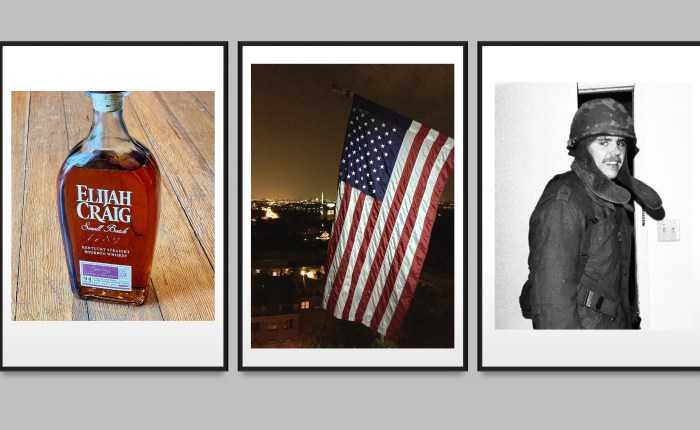
As my friend and West Point Classmate Bill Moeller noted, it is perhaps no coincidence that the Birthday of the United States Army, Flag Day and National Bourbon Day are all celebrated each year on the same Date: June 14th. It turns out all three of their stories go back to the late 1700s.
I’ve always thought that understanding our nation’s history was important. When I learned June 14th was shared by the Army, our Flag, and Bourbon, it seemed worth doing some historical digging. Here’s what I learned.
Before there was an American Flag, before there was American Bourbon, the United States Army was around to protect both.
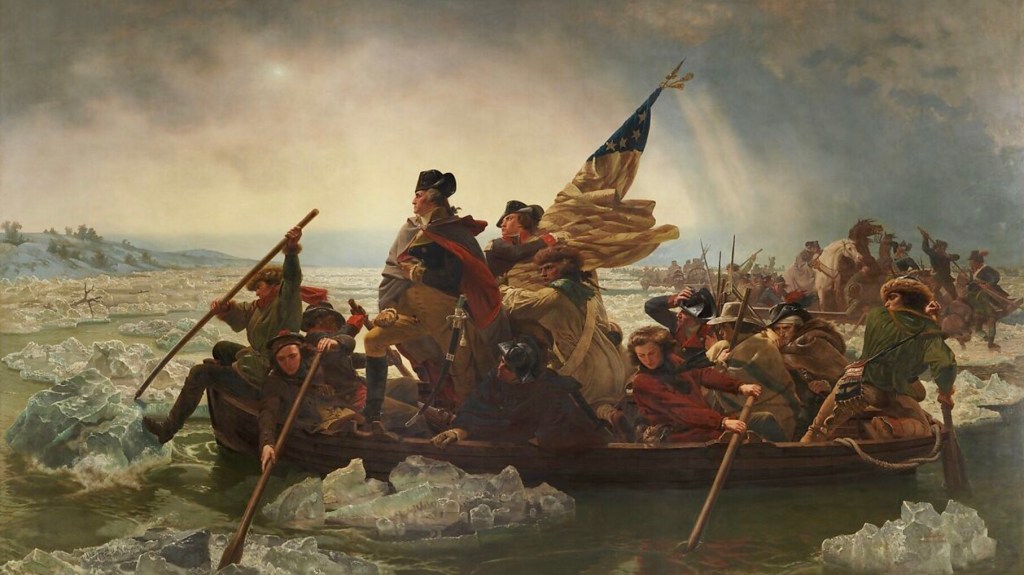
One year prior to declaring our independence from Great Britain, the Continental Congress approved the formation of the Army on 14 June 1775. On that date, they authorized the enlistment of ten companies of riflemen to serve the United Colonies for one year to form the “the American Continental Army.” The next day, Congress issued its first commission by appointing George Washington “General and Commander in chief of the Army of the United Colonies, and of all the forces now raised, or to be raised by them, and of all others who shall voluntarily offer their services, and join the Defense of American liberty, and for repelling every hostile invasion…”
Washington Crossing the Delaware with the Continental Army in December 1776.
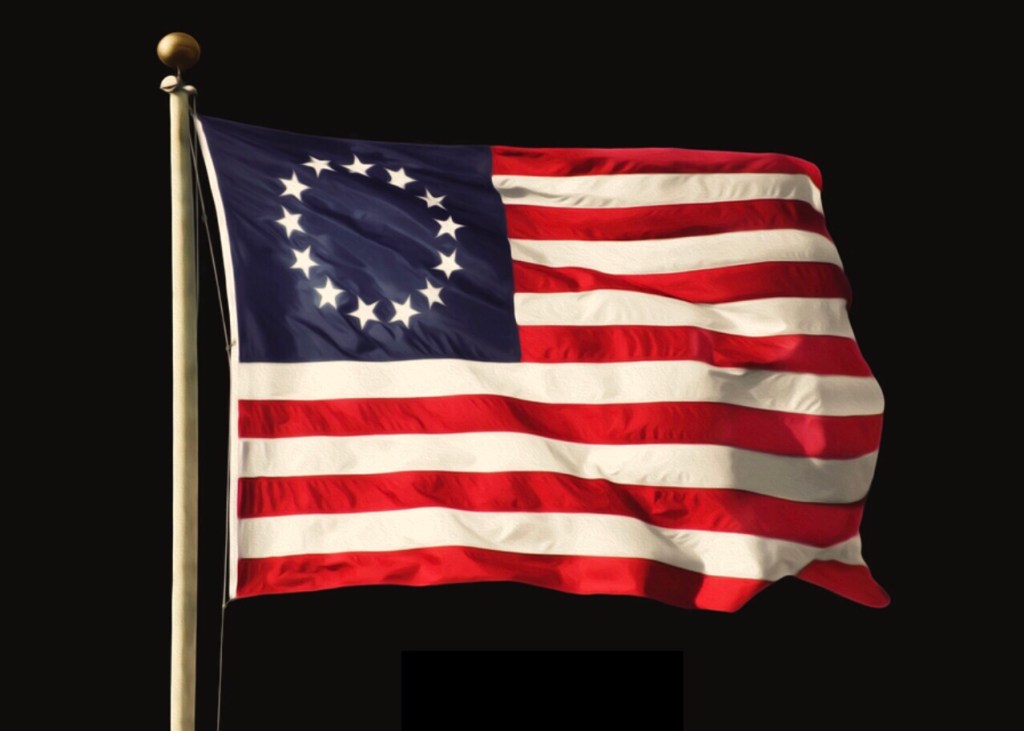
While there are some questions about whether Betsy Ross actually sewed the first American flag, there is no doubt about when Congress recognized our first flag. On June 14, 1777, two years after the formation of the Army, Congress passed the Flag Resolution, which stated, “Resolved: that the flag of the United States be made of thirteen stripes, alternate red and white; that the union be thirteen stars, white in a blue field, representing a new Constellation.” In 1916, President Woodrow Wilson issued a proclamation that officially established June 14 as Flag Day and on August 3, 1949, National Flag Day was established by an Act of Congress.
A New Constellation.
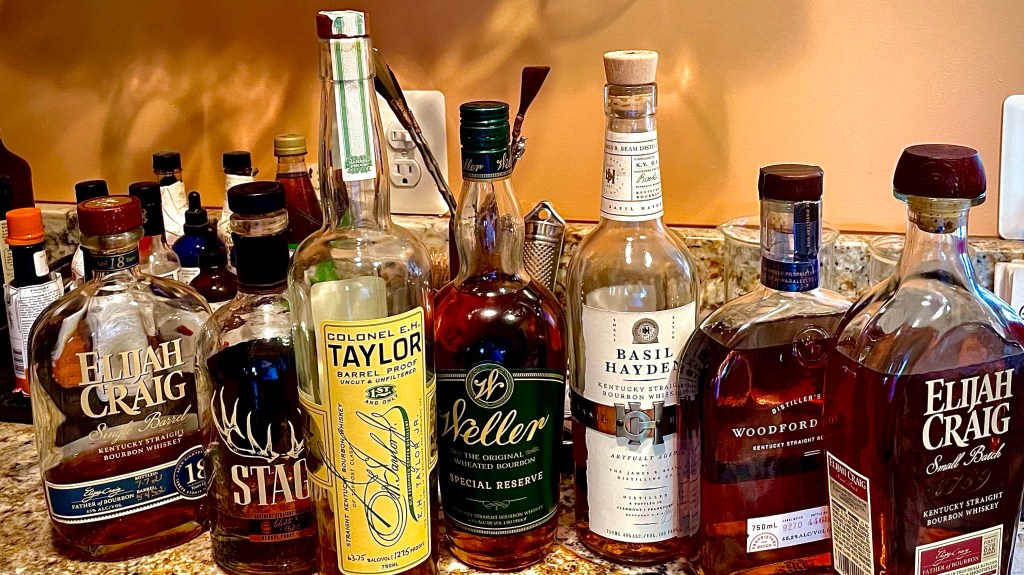
The story of National Bourbon Day is, not surprisingly, a bit murkier. One legend has it that bourbon was first produced by Reverend Elijah Craig on June 14th, 1789. In the late 1780s, Craig was allegedly using old fish barrels to store his spirits. Of course, the fish-flavored wood did not help the taste at all, so Craig started conditioning the barrels by charring the inside. He then stamped the barrels with their county of origin (Bourbon County in what was then Virginia and is now Kentucky) and sent them on a 90-day trip to New Orleans. The charred oak and three-month travel time combined to mellow the whiskey some and folks in New Orleanians requested more of “that whiskey from Bourbon.” Yes, I agree the story, or at least the date of June 14th sounds a bit fishy (pun intended), but who am I to judge? There are enough other competing stories that all trace the origin of “bourbon” to the 1780s and make that time period a credible time of origination. As a side note, in 1964, the United States Congress recognized bourbon as a “distinctive product of the United States of America”.
Bourbon Anyone?
So, there you have it, a bit of distinctly American history. As an Army Vet, I know what I’ll be doing on June 14th. I’ll raise a glass of bourbon in a salute to both our Flag, and all of the Army Veterans who have served our country over the years. I hope you will join me. It seems to me the least we can do.
Cheers to All on June 14th From This Veteran…
Addendum:
– For the record, the United States Army is the senior service. The Continental Navy was established on 13 October 1775, and The Continental Marines on 10 November 1775. The Coast Guard traces it’s beginnings to 4 August 1790. The Air Force was established as an independent service on 18 September 1947, and the Space Force (ughhh) was established on 20 December 2019.
– National Bourbon Day – I searched to find out when the first National Bourbon Day occurred, but could find nothing online.
– Here are a couple of other historical facts about bourbon itself:
The Elijah Craig story is a nice one, but there’s no historical proof of it. There were certainly others who were shipping whiskey in barrels in the 1780s.
The Marker’s Mark distillery, which opened in 1805, is the oldest distillery in the country, and has been declared a National Historic Landmark.
In 1834 Doctor James Crow perfected the sour mash process and made what was probably the first “modern” bourbon. He employed the “Sour Mash Method” on a daily basis to give his whiskey consistency.
In 1840, “Bourbon”, by name, was first advertised in a newspaper.
In 1840 bourbon whiskey officially became known as bourbon. Before then, the product carried the name Bourbon County Whiskey or Old Bourbon County Whiskey.
In 1870 Old Forester became “America’s First Bottled Bourbon” when founder George Brown was the first to put Bourbon in a glass bottle. Prior to that, it was only available in barrels.
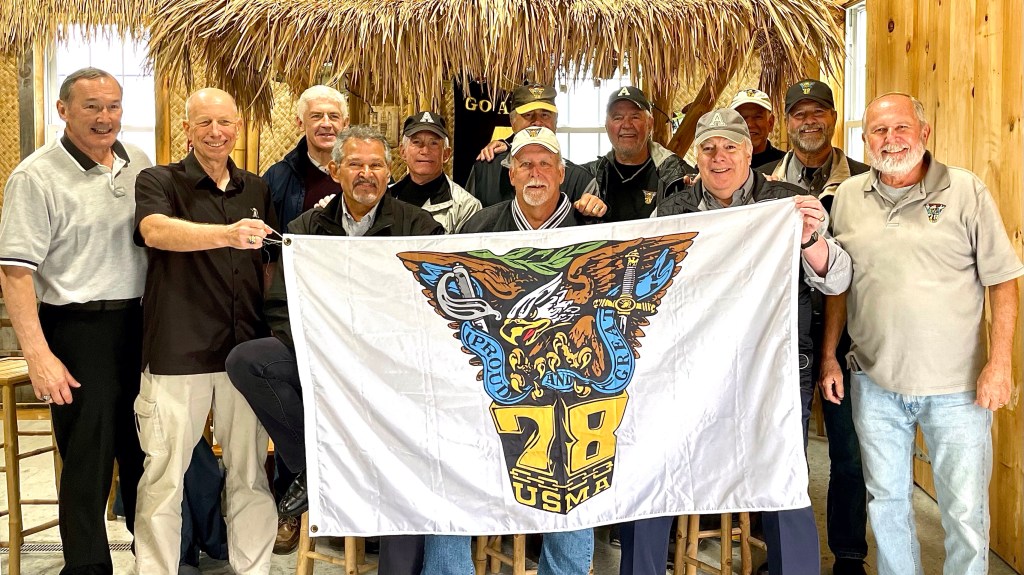
We were on a mission to the WhistlePig Distillery in Vermont. Twelve classmates gathered to taste whiskey from five barrels. We would select two for the West Point Proud and Great, Class of ‘78 45th reunion this coming fall. We didn’t want to let any of our classmates down.
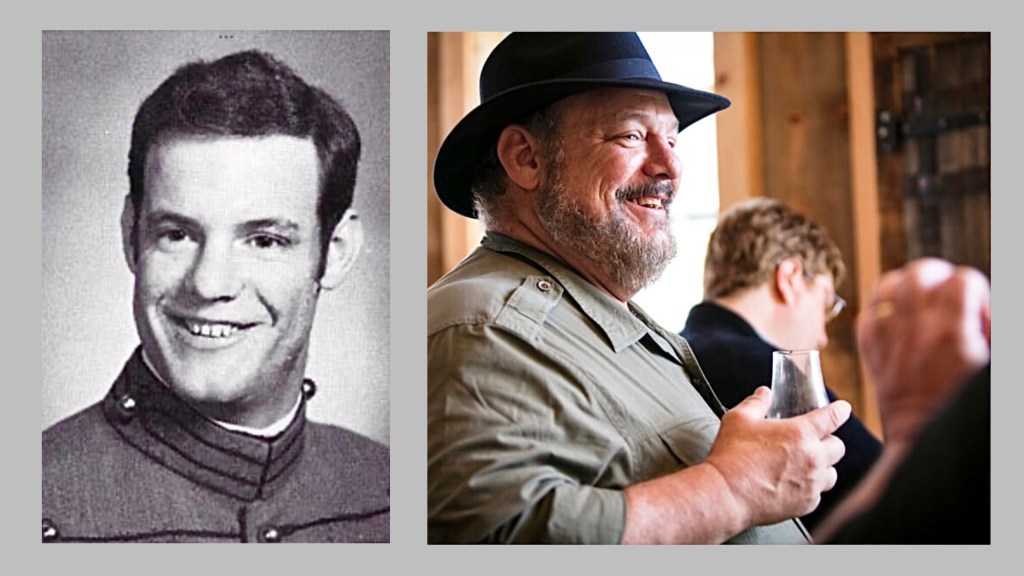
I’ve recounted the history of our classmate Dave Pickerell in a blog before*, but will briefly summarize it here, as it is fundamental to this story. The Army, in its infinite wisdom, sent Dave to grad school for a master’s degree in chemical engineering. Later, after teaching at West Point, Dave left the Army and joined Makers Mark Distillery, where he was the master distiller for 14 years. He then struck out on his own and became known as the “Johnny Appleseed” of craft distilleries, and helped many, many distilleries start-up. Eventually, he also became a founder and the master distiller for WhistlePig Whiskey, which makes some of the best rye whiskeys in the world. Dave passed away a few years ago, but his legacy lives on at nearly 100 distilleries across the country.
Dave Pickerell as a Cadet, and Then Later in Life.
A little over a year ago, our West Point Class held a mini-reunion at the Biltmore in North Carolina. On one of the evenings there, we did a whiskey tasting of several whiskeys Dave had an impact on*. The tasting was to honor Dave, and our other departed classmates. Everyone had such a good time at that event, it became the genesis of Operation WhistlePig.
We originally talked about doing a class tasting for our 45th reunion in the Fall of ‘23, but the logistics at West Point became a bit difficult. Bill Moeller then came up with the idea of purchasing a barrel of WhistlePig for the reunion. Classmate Tony Matos, who lives in New Hampshire not far from the WhistlePig Farm Distillery, became point man and started working with Mark Kanya of WhistlePig to understand the dynamics of a barrel purchase. In the meantime initial funding was lined up through classmate Jeff Manley, and a survey of classmates was completed to gauge interest. 206 classmates responded saying they were interested. A barrel of whiskey holds 156 bottles. We were on.
Of course, you don’t just buy a barrel of whiskey. Each barrel is different depending on multiple factors. WhistlePig invited “around ten of us” to a barrel tasting at the farm. We were to select “our barrel” from three different barrels we would taste from. It would then be bottled in a special release, with a small label honoring our class, and our fallen classmates. The team grew from four to six, then eventually to ten of us. In addition to Tony, Bill, Rob Grubbs and I (Rob, Bill and I organized the Biltmore tasting), José Morales, Al Aycock, Gus Hellzen, Jim Steiner, Jack Cronin and Rusty Roberts were added. Our number was set, as was our date, the 3rd of May. Reservations were made at a nearby Airbnb for May 2-4, and then it was just a matter of waiting for the big day.
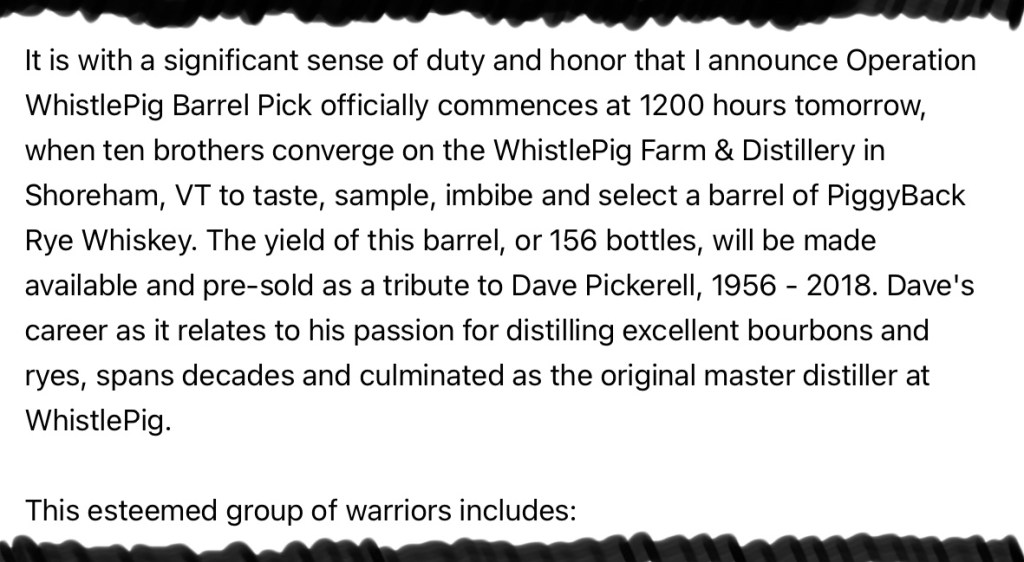
Tony, who did a great job coordinating the event overall, sent an email to the Class on May 1st announcing Operation WhistlePig was about to commence. He was flooded with responses from classmates with good wishes, others wanting to immediately order a bottle, and some wanting to join us and help select the barrel. Tony graciously explained to folk why it wasn’t possible, although after checking with WhistlePig, three folk who were relatively local at the time were added for the tasting itself – Bob Rush and his wife Erica, and Ron Hall. They joined us for the tasting, but not the entire three days.
Tony’s Announcement to the Class About Operation WhistlePig.
On the second of May, we gathered. Classmates flew in or drove from Texas, Virginia, Maryland, North Carolina and Georgia. Others arrived from Vermont, New Hampshire and Maine. We included a retired Two Star, guys who departed the military not long after our initial five-year obligation, and everything in between. There were handshakes and hugs all around. Not all of us knew each other, but we were all brothers and it didn’t matter. This was going to be good.
That first evening passed in a blur, aided by some liquid lubrication. I and a couple of other guys cooked dinner the first night – Steak Tips, a New England specialty. Preparing the meal in the main house, I have to admit I felt a bit like Clemenza in the Movie “The Godfather” cooking away, with guys standing around talking and drinking. Over dinner, we didn’t solve the world’s problems, but we took a stab at a couple of them. José asked a couple of questions for which there were of course no correct answers but made us all think.
We also discussed whether we should consider buying two barrels of whiskey instead of one, in anticipation of additional sales based on Tony’s email from the 1st. Rusty immediately volunteered to lead the financing of the second barrel, and Tony quickly notified WhistlePig we were now looking at purchasing two barrels.
Dinner the First Night.
As is always the case for me at these gatherings, I’m humbled when I listen to many of the stories told – from time in the Army, in government, or in business. Stories from hotspots around the world over the years, and as I’ve said before, war stories both figuratively and literally. Beer, a couple bottles of WhistlePig, several bottles of wine and a few cigars later, most of us made our way to bed.
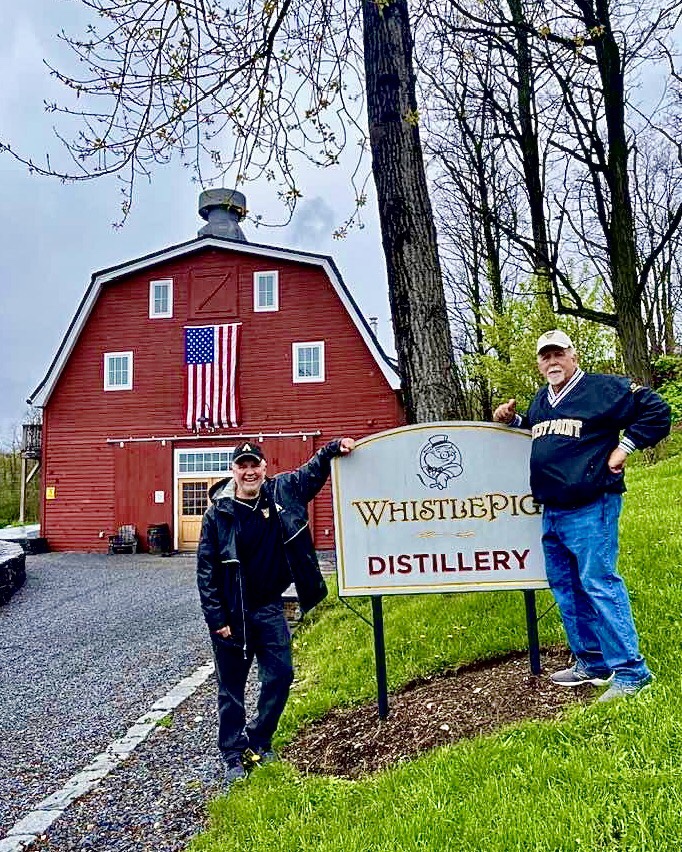
The next morning, Jim and crew fixed breakfast – bacon, toast and eggs to order. People were feeling surprisingly good, considering the damage we had, perhaps, done the night before. I’m sure the anticipation of the trip to WhistlePig later that morning had something to do with it. We eventually climbed into two vehicles and arrived at the WhistlePig Farm just before 11AM.
Arriving at WhistlePig.
At the farm, we were joined by Ron, Bob and Bob’s wife Erica and began a tour. Jesse Ray, accompanied by our contact Pam Spaulding, showed us key parts of the farm and distillery. Of course there were some tastings involved at various stops, including Maple Spirit (distilled maple syrup – a bit of a rum flavor), Piggyback (the 6 year old Rye that our barrel selections would also come from) and a wonderful WhistlePig 15 year old rye. I noticed that we, as a group, had become a bit louder. We grabbed a picture of us after trying the Maple Spirit – I think you can see we were off to a good start.
Smiling Classmates After the Distilled Maple Syrup Tasting
We returned to the tasting room and a wonderful lunch. The WhistlePig crew told us some great stories about Dave, some of his work, and some of his sayings. My favorite saying from Dave – “One of the great things about working at a distillery is you get to drink your mistakes.”
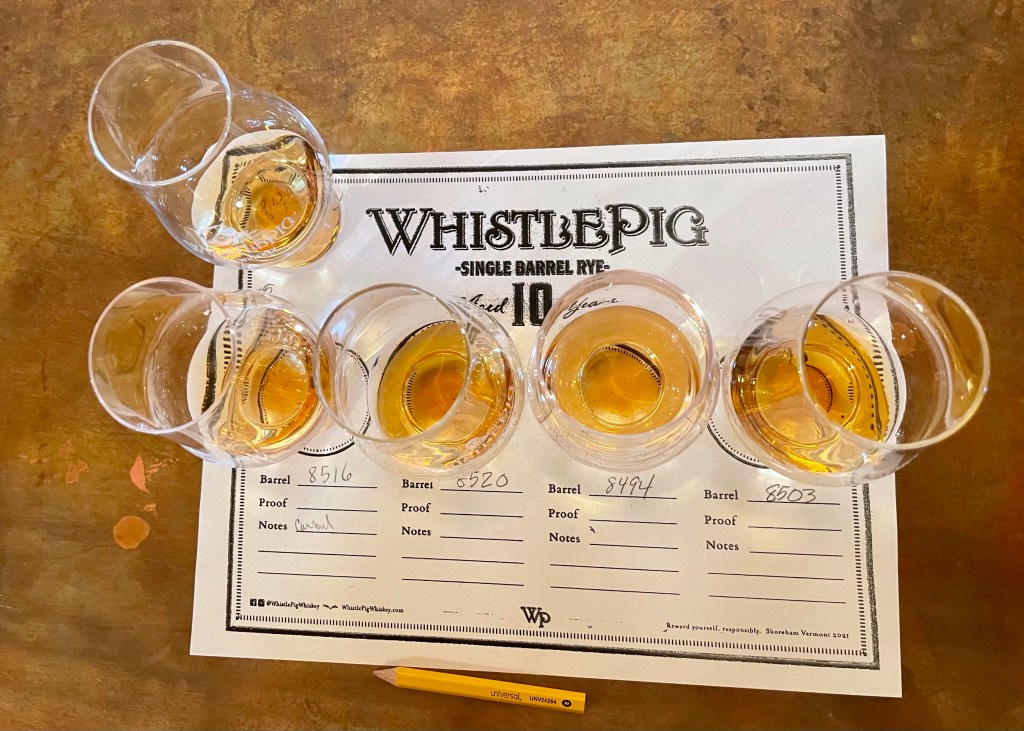
After lunch, we were ready to start the business at hand. First though, WhistlePig revealed a nice surprise. Since we were now considering two barrels instead of one, we would taste five samples instead of three. I believe that elicited a “Hooah!!” from the class. Mark Kanya walked us through the barrels, but didn’t reveal their proof numbers, as he didn’t want to prejudice us. Finally, it was time to taste.
Five Barrels to Taste!
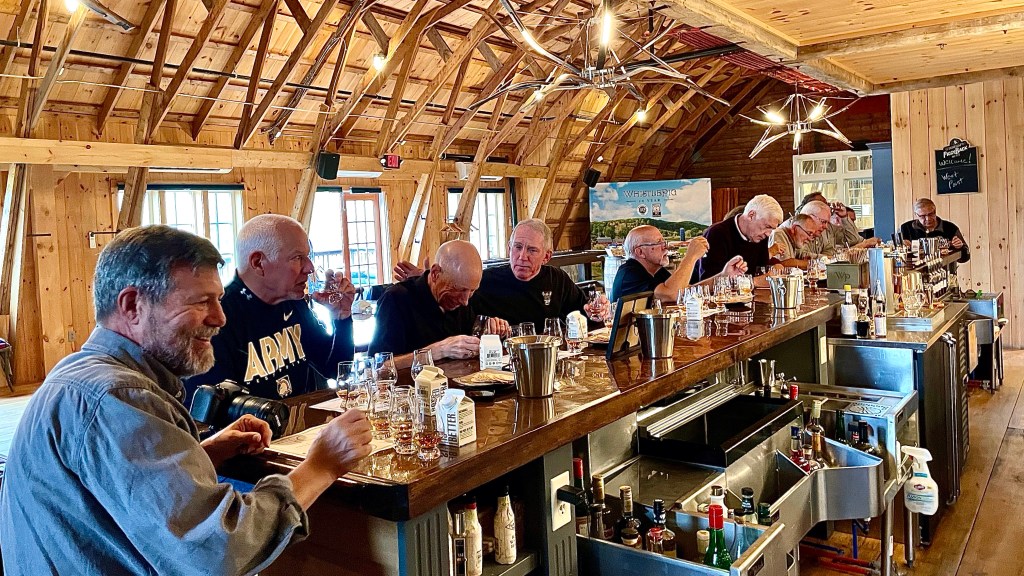
What followed was a minor dose of reverence and a major dose of fun. We tasted, and tasted again. Conversations sprang up and died away. Comparisons were made by those sitting next to each other, sometimes with concurrence and sometimes with “What, are you crazy?!” Now remember there were five barrels. All were 6 years old. All came from the same rick-house. All were 100% rye. All were good. And yet, we had no problem finding differences.
Whiskey Tasting – Maybe Serious Business, or Not…
Finally, it was time to make our selections and Rob Grubbs took charge with a chalk board. Each of us came forward and wrote down our top two choices. We anticipated going a couple of rounds, but it turns out it wasn’t even close. Barrels 8516 and 8494 won, hands down.
Barrels 8516 (2) and 8494 (4) Were the Easy Winners at the Tasting!
After the official tasting, they opened the bar and we tried other WhistlePig products at our leisure. Some of us returned to the winning bottles for another taste and confirmation we’d made the right choices. A few went to the museum, while others of us stayed at the bar. There, Mark’s assistant, Amber Star, who also happens to be an opera singer, entertained us with stories and after some prodding, an amazing a cappella version of Ava Maria – it was beautiful and somehow fit the afternoon.
As we gathered together again shortly before departing, Pam read us a tribute to Dave another friend, Savannah Burnett, sent her. It was wonderful of her to share it with us. She also gave us a WhistlePig bottle signed by Dave and filled with a bit of each of the products Dave was associated with over the years. A whiskey, or spirit connoisseur, would call it an “Infinity Bottle” due to the blending of so many different whiskeys – we plan to auction it off at our 45th reunion. It should also be noted that a West Point Coin was presented by José to Mark for his excellent organization of the tasting. As a side note, should he ever be challenged by one of us in the future and he doesn’t have the coin with him, he will be required to buy a round ;-).
Pam Presenting the Class with the Dave Pickerell Signed “Infinity Bottle”.
We finally said our goodbyes to WhistlePig, and to Ron, Bob and Erica and drove back to our Airbnb. Bill cooked a salmon dinner for us and the ten of us again gathered at the table.
We were mellower than the night before but had great conversations. Yes, we told and laughed at old stories again, but we also talked about the present and the future. Over more wine, whiskey and cigars, we discussed our Class and the impact we may have had on the Army and on our country. Eventually we drifted off to our individual rooms and the night ended.
When I woke up the next morning, a couple of guys were already gone. Rob made breakfast for us and then Tony and Jim drove the rest of us to the airport. More hugs and handshakes at the airport and we parted ways. Operation WhistlePig was over … For this year.
I’ve thought about the wonderful times we had at this whiskey tasting, and at other reunions. The camaraderie, the brotherhood, the love for each other. Although we are not yet in our “twilight”, I think General Douglas McArthur summed it up pretty well at the end of his West Point Farewell Address in 1962:
“The shadows are lengthening for me. The twilight is here. My days of old have vanished — tone and tint. They have gone glimmering through the dreams of things that were. Their memory is one of wondrous beauty, watered by tears and coaxed and caressed by the smiles of yesterday. I listen then, but with thirsty ear, for the witching melody of faint bugles blowing reveille, of far drums beating the long roll. In my dreams I hear again the crash of guns, the rattle of musketry, the strange, mournful mutter of the battlefield. But in the evening of my memory always I come back to West Point. Always there echoes and re-echoes: Duty, Honor, Country…”
For this whiskey tasting get-together, maybe the echoes and re-echoes were: Duty, Honor, Country and WhistlePig as well. For my classmates who may be reading this blog, I’ll add this – Standby! A Warning Order is about to come out on how to purchase a bottle.
Addendum:
The staff at WhistlePig was wonderful. Pam Spaulding, Jesse Ray, Mark Kenya and Amber Star took amazing care of us.
* You can read the blog about Dave and the whiskey tasting our class did about a year ago here: When Rob asked if I would help host the whiskey tasting for the West Point Class of ‘78 mini-reunion at The Biltmore, I immediately said yes. We honored classmate Dave Pickerell, later known as The “Johnny Appleseed” of Craft Whiskey, and all of our departed classmates […] Continue at: https://mnhallblog.wordpress.com/2022/04/19/pickerell-the-biltmore-and-the-whiskey-tasting/
“Arriving at WhistlePig” photo courtesy of Gus Hellzen.
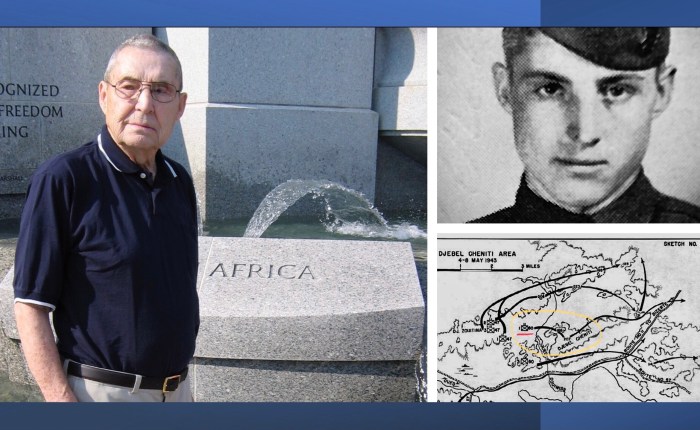
80 years ago on May 6th, 1943, Dad and the other men of 1st Battalion, 60th Regimental Combat Team were given the order to fix bayonets. They were about to attack Djebel Cheniti in Tunisia by direct assault with a bayonet charge. I’ve thought quite a bit about how that attack may have affected Dad and his outlook on life.
A year ago, I was doing research for another blog about dad and the closing days of the North African Campaign in 1943. I was shocked to learn about a battle that dad never mentioned. At the time, his unit had been in continuous combat for two months.
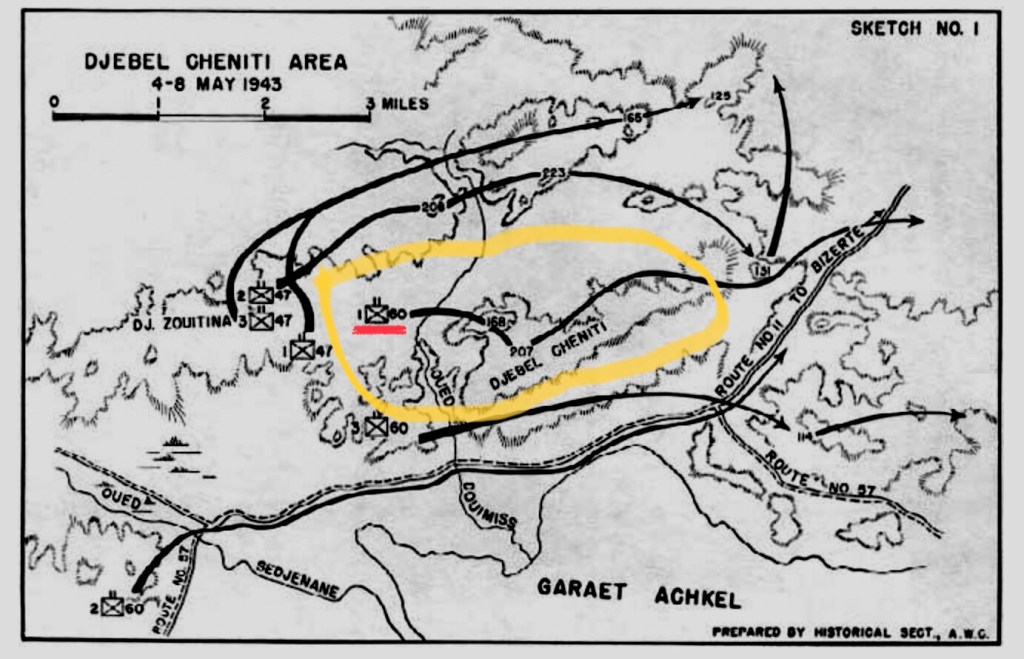
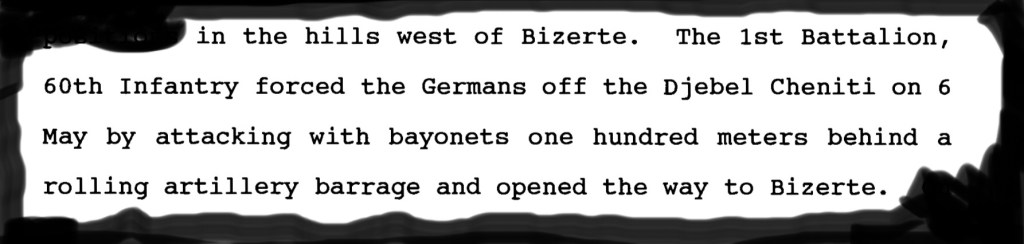
From the history books: “One last ring of rugged hills now remained between the Ninth Infantry Division and Bizerte. The German troops on Djebel Cheniti, the highest point on the 8 mile wide area of the Bizerte Isthmus, halted the advance. To break this bottleneck, General Manton S. Eddy (Commander of the 9th Infantry Division), devised a plan with two parts. The division would mount a flanking maneuver around the hills, while the 1st Battalion of the 60th Regimental Combat Team (dad’s unit – about 500 men) would attack Djebel Cheniti by direct assault with fixed bayonets. They would follow artillery fire that pounded the slopes at 100-yard intervals.”
The 9th Infantry Division Plan of Attack as it Unfolded.
Let’s take a pause in the story for a second. Fix Bayonets is a command that probably goes back as far as the introduction of muskets. What the command literally means is you are attaching your bayonet to the end of your rifle. What it actually means is one of two things – 1) you are preparing to charge the enemy in close-quarters or 2) getting ready to defend yourself from an imminent enemy assault. Either way, it is close-in fighting. With a rifle and a bayonet, you are perhaps three feet away from your enemy. There is no hiding. There is no ducking away. Army Field Manual 23-25 captures it succinctly: “The will to meet and destroy the enemy in hand-to-hand combat is the spirit of the bayonet. It springs from the fighter’s confidence, courage, and grim determination.” In my own bayonet training nearly 50 years ago at West Point, they were even more to the point: “What is the spirit of the bayonet?” “To Kill!”
At that distance, it is kill or be killed. There is no middle ground.
… … …
May 6th 1943 was a slippery, muddy and rainy day. The order was given to fix bayonets around 1PM and behind rolling artillery, the battalion attacked. They moved forward quickly and only 100 yards behind the falling artillery barrage. On the map, it looks like the total distance they needed to cover was a little over a mile. After three hours they took Hill 168. Moving on to Hill 207 they met stronger resistance. An artillery concentration disorganized the enemy and the battalion attacked again before the German troops could recover. By nightfall, they had taken the summit of Hill 207, although there were still Germans on the southeastern slopes. In a war that lasted years, there were only brief mentions of the battle in the history books, but all of them mentioned the fixed bayonets.
Only a Brief Mention in the History Books
The next morning, May 7th, German machine gun crews began taking off for Bizerte as the division advanced. The 60th moved to cut off the Bizerte road and On May 8th, Bizerte fell. The war in North Africa was over and their immediate mission accomplished.
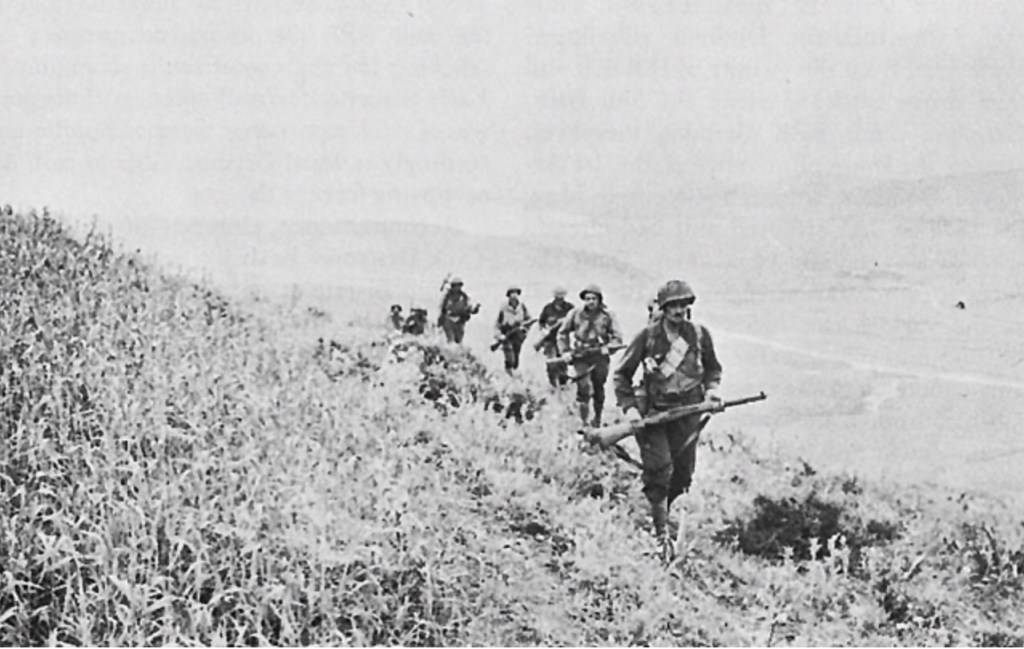
Men of the 60th Outside Bizerte on May 7th, 1943.
In the words of the 9th Infantry Division Record, “Djebel Cheniti was a brilliant demonstration of Infantry “leaning up against” artillery preparation. One of the strongest positions in the final Axis defense was assaulted by one battalion of Infantry with fixed bayonets, with artillery blasting a shell-strewn pathway for its advance. Another story in the annals of foot soldiers, who do the dirty tasks of warfare”.
Why am I blogging about this now? The story has haunted me since first learning about it. I’ve thought about it quite a bit over the past year. I never heard dad say anything about Djebel Cheniti. I never heard dad say anything about a bayonet charge. Not one damned word. The more I thought about it, the more I thought about how it must have influenced his life.
I have to figure after you’ve been in a bayonet charge, everything else in your life, maybe for the rest of your life, must seem easier. When you are that close to death, and you survive, what else in your life is really going to be a threat to you? Money issues? Work Issues? Mortgage issues? Sickness? Wouldn’t just about everything pale in comparison?
It would explain a lot about dad. His lust for life. His enjoyment of life. His ability to keep everything in perspective, even when things were going badly. His gentleness and tolerance. His quiet firmness in facing down jerks and bullies. Perhaps he already had all of those traits and would have developed into the same man, but I’m not so sure. I think a bayonet charge at the age of 19 might make everything else in life just a wee bit easier to contemplate and to handle. Maybe every day after May 6th, 1943 was a gift not to be squandered. Dad’s gone now. How I wish we had time for one more conversation.
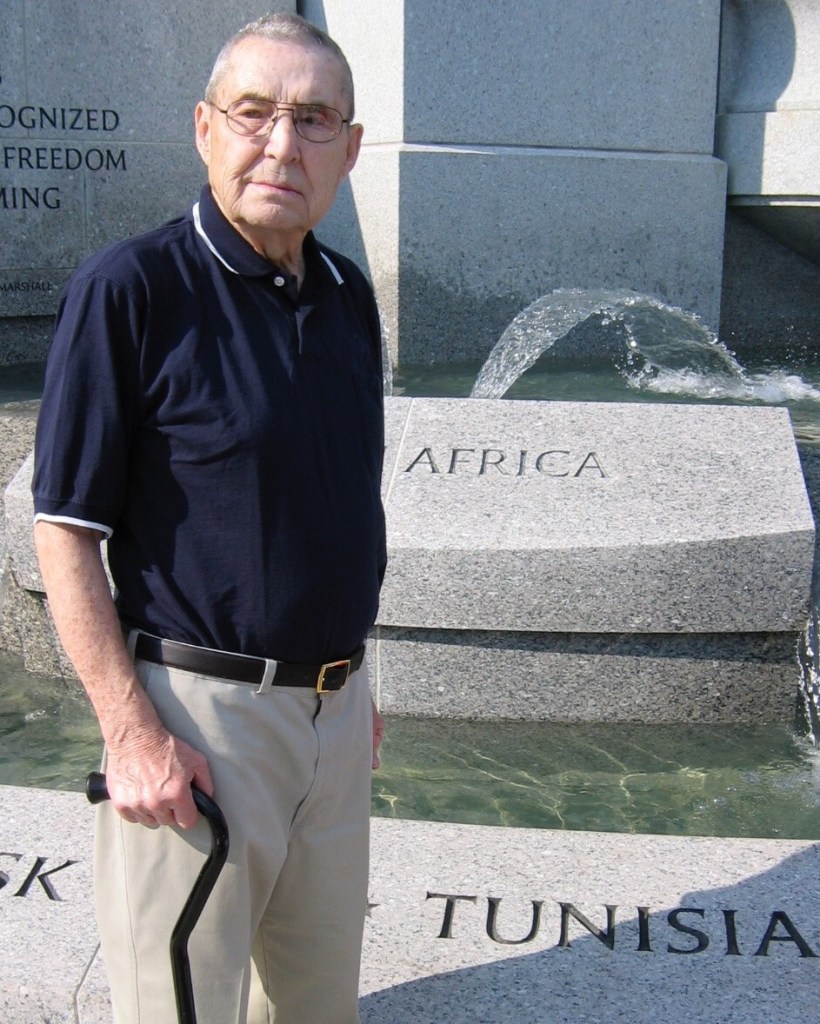
Dad at the WWII Memorial, Two or Three Years Before he Passed Away.
Dad was in almost continual combat from November of ‘42 to August of ‘43 when he was wounded in Sicily. I’m sure all of that combat, and his wounding affected him and changed him, but the bayonet attack is what has stuck in my mind as a singular event, maybe even more than his wounding. He told bits and pieces of different battles over those months, and mostly they involved funny incidents. He even eventually told me the story of how he was wounded, when he was recovering from the stroke he suffered in the ‘90s. The bayonet attack? Not a single word.
The blog I was working on when I found out about the bayonet charge was a funny story about dad and “Al Capone” – “My Dad, then Twenty year old Sergeant Willie I. Hall, looked at the German soldier and said “Chicago”. The German answered “Chicago?” Dad stared back. “Chicago … Al Capone”. Now the German’s eyes’ widened. Everyone knew who” […] continue at: https://mnhallblog.wordpress.com/2022/05/08/dad-and-al-capone/
Historical parts of this blog were derived from these sources: The 9th Division History; Center of Military History: TO BIZERTE WITH THE II CORPS 23 April – 13 May 1943; The US Army in WWIIby George Howe; and The Development of Combat Effective Divisions in the United States Army During WWII, a thesis by Peter R. Mansoor.
Thanks to my sister, Roberta, and niece, Tami, for their thoughts and inputs. And of course thanks as always to Colleen for her editing support.
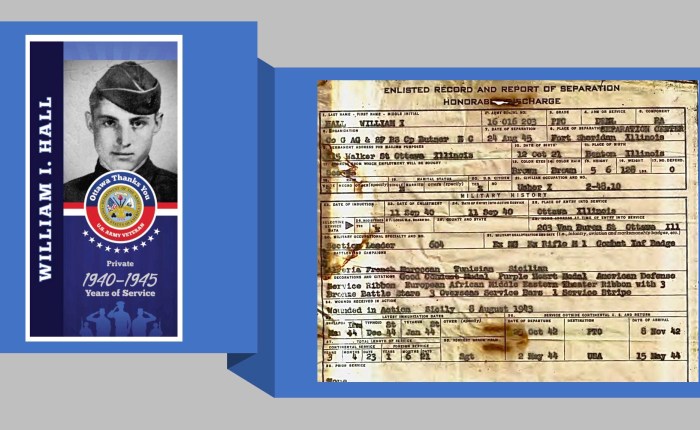
When discharged from the Army on August 24th, 1945, dad was 21 years old and had been in for nearly five years. His WWII service included time in Algeria, Tunisia, French Morocco and lastly, Sicily, where he was wounded. His discharge papers tell the intriguing story of those five years in one page.
This is the second of a two-part blog. Last week, I told the story of how I received dad’s enlistment and discharge paperwork from the National Archives. I then explored several interesting observations from his enlistment form, including the fact that he lied about his age in order to enlist. He claimed he was almost 19 years old, when in fact he was still two months shy of his 17th birthday. You will find a link to the first blog in the Addendum to this one.
Today’s blog explores his discharge paperwork, and briefly tells the story of his five years in the service. Dad was with B Company 1/60th Regimental Combat Team of the 9th Infantry Division from September 1940 until he was wounded and almost died in Sicily in August of 1943. Although his original enlistment in 1940 was for three years, when the war started all enlistments were extended for the duration.
As with his enlistment papers, dad’s discharge paperwork was discolored, creased and yellow, perhaps from the fire at the National Personnel Records Center (NPRC). A few parts were unreadable, but most of it was legible.
Dad’s Honorable Discharge Paperwork – it Suffered in the Fire at the Archives.
I’ll magnify and expand a couple sections to talk about some of the details.
At the top of the form, there are a couple of interesting items.
The Top of the Discharge Form – Magnified
Block 3 confirms his last duty station as Camp Butner, NC. This is where dad returned to the States in 1944 after recovering from his wounds. Camp Butner was both a troop training center, and a Prisoner of War camp. Dad told us stories later about helping train troops there (and about performing KP).
We see in block 4 his actual discharge date is August 24th, 1945. This was two weeks after the atom bomb was dropped on Nagasaki, Japan, and one week before the official surrender of the Japanese on September 2nd. The army was already discharging soldiers as the war was winding down, based on how many “points” they had (more on “points” later).
Block 7 still shows the birth date he lied about to enlist – Oct 12, 1921, as opposed to his real birth date of Oct 22, 1923. And amazingly, dad’s height, 5’ 6” and weight, 128 pounds haven’t changed at all from when he enlisted. Me thinks, someone was probably just copying from other forms to put this info in.
Block 21 shows his civilian employment as “Usher”, so maybe not everything was copied over. His enlistment paperwork showed him as a “Laborer”.
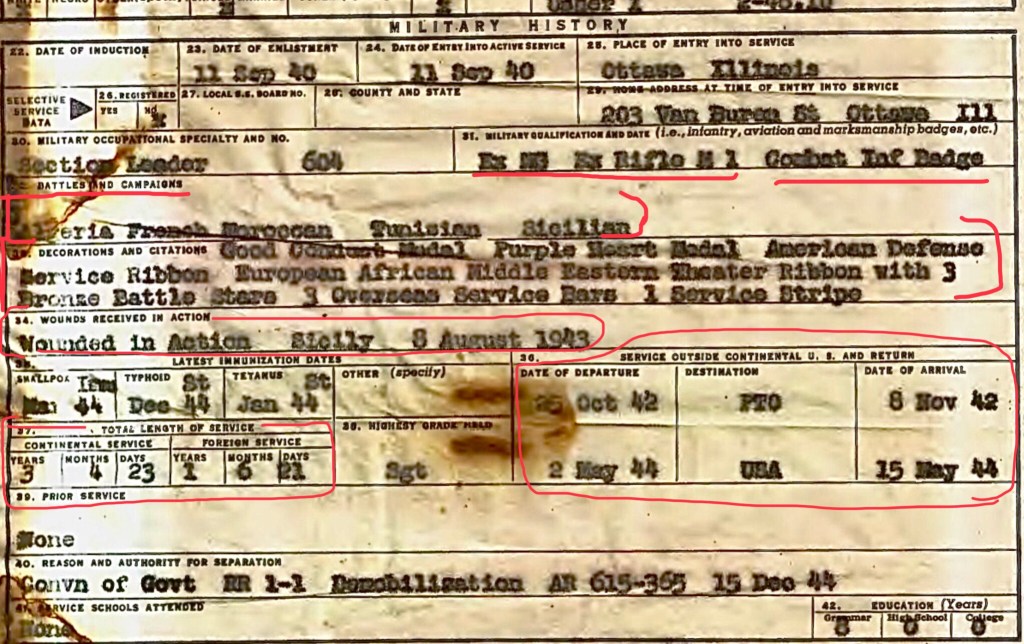
Now we move on to the Middle section of his discharge paper, dad’s “Military History”. This is the meat of the discharge, and paints the real story of his time in the service. I’ve again magnified the view so you can better read the form. In order to tell dad’s history in a linear fashion, I will sometimes go out of order in discussing what is in the blocks in this section.
Dad’s “Military History” in His Discharge Paperwork.
Block 31 shows dad qualified as an expert both on the Machine Gun, and the M1 Garand rifle. It also notes he was awarded the Combat Infantryman Badge. You could only earn the CIB if you were in the Infantry (not in Field Artillery, or Armor, or Signal Corps etc), AND you were in actual active combat with the enemy.
I’m going to skip to block 36 – “Service Outside the Continental United State” for just a minute . Note here that he arrived overseas on November 8th, 1942. What it doesn’t say is he arrived with the 60th Regimental Combat Team of the 9th Infantry Division at around 5AM under gunfire on the beach near Port-Lyautey, French Morocco. This was as a part of Operation Torch, the invasion of North Africa. Torch was (next to D-Day) the second largest amphibious assault ever attempted.
Now back to block 32, where we see in addition to French Morocco, dad also took part in battles in Algeria and Tunisia in North Africa where they defeated Rommel and the Africa Korps. Those battles took place between November 8th of 1942 and May 10th of 1943. Then in July of 1943, dad participated in the invasion of Sicily.
Skipping back down to block 34, we learn dad was wounded on August 8th, 1943. What it doesn’t mention is he was shot three times by the Germans in the mountains of Sicily and it took over a day to evacuate him by hand to an aid station. It also doesn’t say he almost died due to the combination of his wounds and the Malaria he contracted. His time with the 9th Infantry Division ended here.
Returning to block 36, we see dad arrived back in the States on May 15th, 1944, three weeks before D-Day. This was after he recovered from his wounds (he was evacuated to North Africa to fully recover). Due to the severity of those wounds, he didn’t return to combat – the war was over for him, although he remained in the service for another 15 months.
Block 37 “Foreign Service”, shows that of dad’s almost five years in the service, one year, six months and twenty-one days were spent overseas. Approximately eight of those months were in near continuous combat.
Finally, we return to block 33, “Decorations and Citations”. In addition to his Good Conduct Medal and Purple Heart (for being wounded), he was awarded: the American Defense Service Ribbon (awarded to troops on active duty prior to Pearl Harbor); the European African Middle Eastern Theatre Ribbon with three bronze stars (this was for participating in the campaign in French Morocco, and the subsequent campaigns in Algeria, Tunisia and Sicily); three Overseas Service Bars (one for each six month period in a theater of war) and finally a Service Stripe (one for each three year period of service). It’s worth noting dad also earned a Bronze Star (for exemplary conduct in ground combat against an armed enemy), which didn’t catch up with him until after he was already discharged, and is not reflected in this paperwork.
Finally we come to the bottom of the discharge paperwork and block 55. There are three items noted here, although not all are readable.
Block 55 – Points and Other Things
First, dad, along with all other honorably discharged service members, was issued a lapel button to be worn on civilian clothing. At the end of the war, it was particularly useful for those traveling home so they were quickly identified as service members and received priority for buses and trains.
Next we see dad’s ASR score was 95. ASR stood for Adjusted Service Rating and is what was used to determine the priority for discharging soldiers at the end of the war. The rules were simple in principle: “Those who had fought longest and hardest should be returned home and discharged first.” Points were given for length of time in the service, length of time overseas, combat campaigns, combat awards, being wounded and so on. At the time, “the points” required for discharge were 85. Dad, with his nearly five years of service, his 1 1/2 years overseas, his Purple Heart, and his four campaigns was at, or near the top of the heap. His 95 points reflect that, and was why he was discharged so quickly as the war was winding down. If you have ever watched the show “Band of Brothers” there is a great section in the last show focusing on this. Points were on everyone’s mind.
Finally, there’s the cryptic last line “xx days lost under AW 107”. What the hell is that? AW 107 stood for Articles of War (the forerunner of today’s Uniform Code of Military Justice). Article 107 refers to docking the soldier credit for days of active duty that they didn’t earn. Typical examples were for going AWOL, being too drunk to report for duty, or getting in trouble for other minor offenses and confined to the barracks. Since the service member was not performing his or her duties during those periods, they didn’t receive time in grade or retirement credit for those periods. It turns out many/most enlisted soldiers during WWII had AW107 scores higher than zero. During my research, I’ve found cases with numbers from 1 to over 200. I’ve tried like hell to read the smudged number here but can’t quite make it out. It might be a 5? It might be a 3? I don’t think we’ll ever know. What I do know is dad was busted from Sergeant to Private in June of 1943 for getting caught in, and subsequently kicked out of, a walled city twice in one night after missing the last truck back to his unit. Perhaps he was confined for some period of time in conjunction with this “incident”.
After his discharge, dad returned to Ottawa, Illinois in September and lived there for the next 65 years. In Ottawa he met mom, and had us three kids, six grandchildren and 13 great grandchildren. He retired from the railroad in 1985, and passed away in 2010.
For those of you who know me, or who have followed this blog for any length of time, I’m pretty sure you are aware of how much I admired my father. An embodiment of “The Greatest Generation”, dad was always one of my heroes. This was true certainly for his actions during WWII, but also for how he lived his life, and how he took care of our family.
A Banner Honoring Dad in Ottawa, Illinois on Veteran’s Day Last Year.
I’ve probably written more blogs about him than any other subject. The blog last week about his enlistment and this one about his discharge file are special to me. It’s somehow reassuring that his enlistment and discharge paperwork confirm the outline of the oral histories we heard from dad growing up. I wish I had discovered this paperwork while he was still alive, just so we could have one more conversation about it over a coffee or a beer. “Dad, tell me again about the time …”, or “Dad, about those lost AW 107 days…”.
I love him and miss him.
Addendum:
I apologize for the length of this and last week’s blogs, but I was trying to give some context to the cold and straightforward words in the paperwork.
– Here are a selection of other WWII blogs that I’ve alluded to in this blog. There may be some minor discrepancies in them, based on the availability of the new information in his paperwork:
Mar 1943. “Maknassy” – The battle, 79 years ago in March of 1943, was vicious. On the 12th of March, as a part of operations at El Guettar, General Patton detached the 60th Combat Team, Dad’s unit, from the 9th Infantry Division and attached it to […] Continue at: https://mnhallblog.wordpress.com/2019/03/22/the-twenty-days-of-maknassy/
May 1943. It was in May of 1943 in Tunisia, Dad looked at the German soldier and said “Chicago”. The German answered “Chicago?” Dad stared back. “Chicago … Al Capone”. Now the German’s eyes’ widened. Everyone knew who […] continue at: https://mnhallblog.wordpress.com/2022/05/08/dad-and-al-capone/
On the 11th day of September, 1940, just over 14 months before Pearl Harbor, my dad, William Iber Hall, enlisted in the United States Army for a 3 year stint. His enlistment paperwork showed him to be 18 years and 11 months of age. In reality, he was 16 years and 11 months old.
Our family history always said dad lied about his age when he joined the Army. Still, it was pretty cool to receive some official corroboration.
A couple of years ago in the middle of COVID, I was doing some research and learned I could access dad’s military records. The only catch? On July 12th of 1973, a fire occurred at the National Personnel Records Center (NPRC) and destroyed between 16 and 18 million Official Military Personnel Files, including 80% of those who were discharged between 1912 and 1960. I said a prayer, held my breath, and sent a letter to the National Archives, and more specifically, the NPRC, asking for dad’s service and medical records.
Months passed. A year passed. A second year passed, and then I finally received an email from the NPRC. Dad’s records existed, but were located in the area where the worst part of the fire was. They were damaged and incomplete. They did have his enlistment and separation paperwork, but nothing else. Nothing from his medical records, and nothing else about his time in the service. They did forward copies of the enlistment and separation papers.
The NPRC’s Response to My Request for Information About Dad.
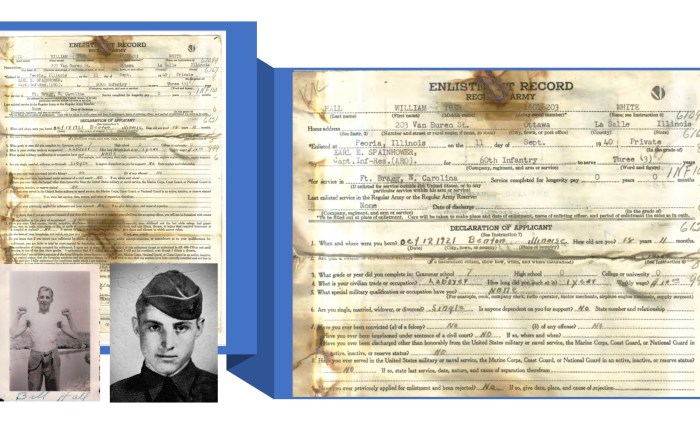
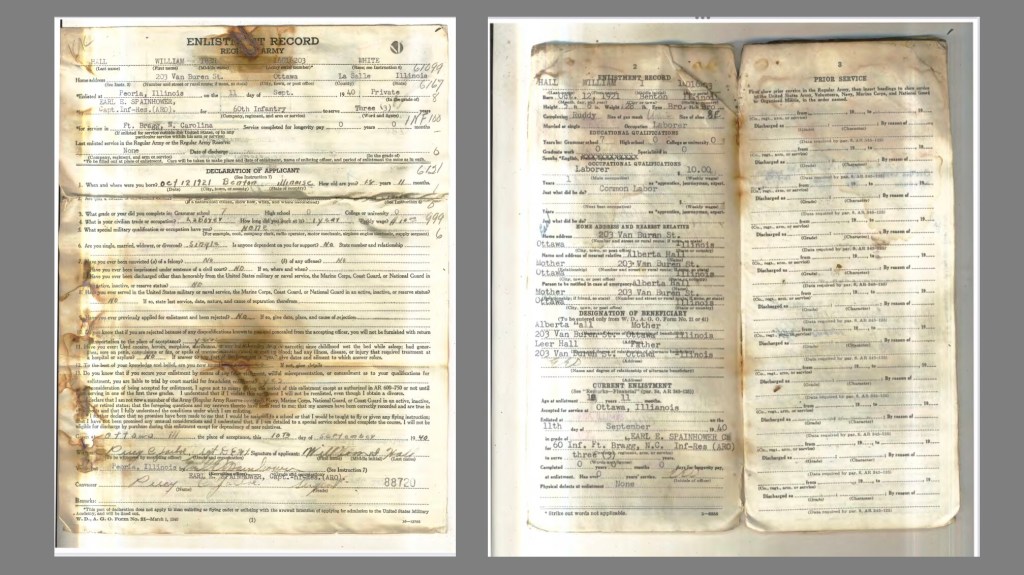
I looked at both documents. They are discolored, scarred and blurry in places. There are brown marks, including outlines of paper clips – perhaps from the heat of the fire. Here’s a photo of the enlistment documents – note there are actually three pages.
Dad’s Enlistment Papers – Apparently Damaged some by the Fire.
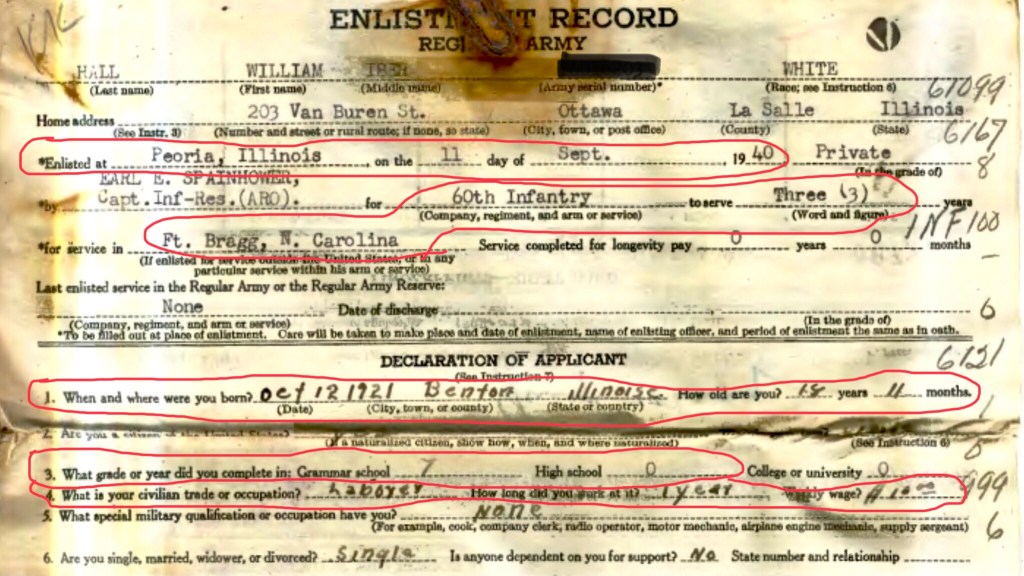
There is some fascinating information, particularly in the top half of the first page of the enlistment form. I’ve blown it up here so you can better read the form.
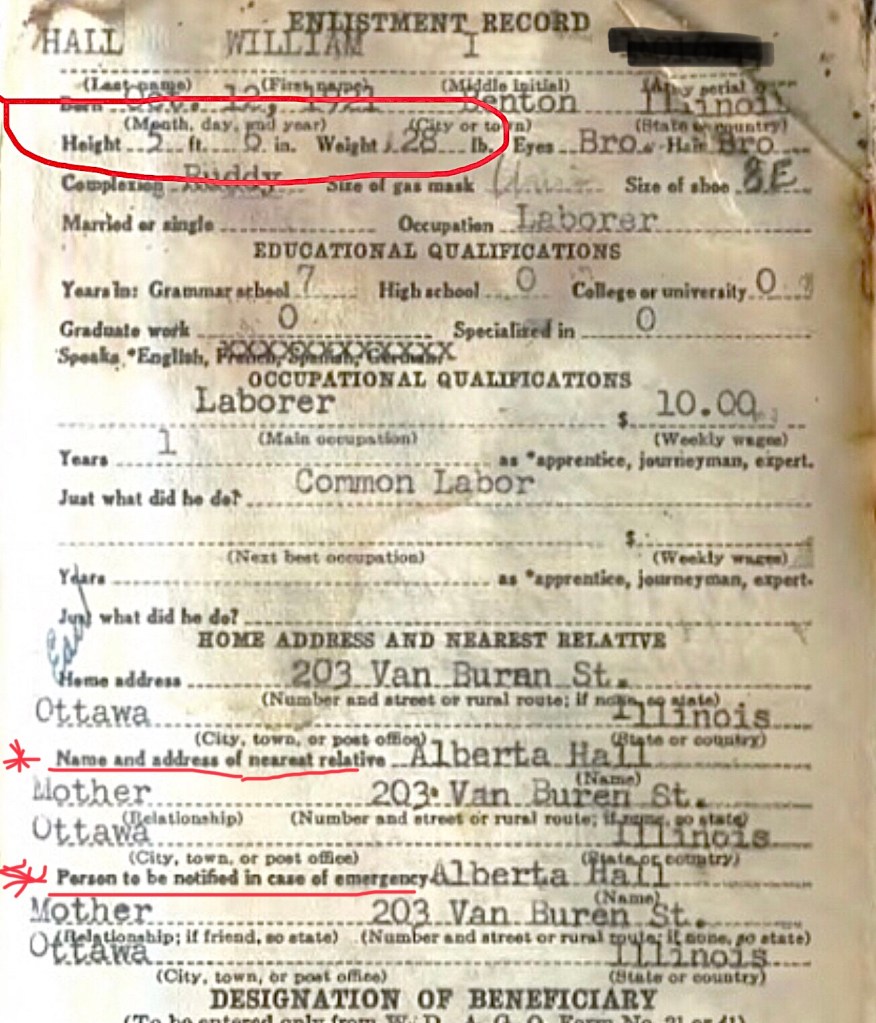
A Magnified View of the Top of Page One of Dad’s Enlistment, With Some Key Items Circled in Red.
Here are a few items of interest:
Dad enlisted in Peoria, Illinois – I’d always assumed in Ottawa, but there probably wasn’t a recruiting station there yet. His enlistment was for three years, and was directly to the 60th Infantry Regiment of the 9th Infantry Division. Three years later in September of 1943 when his enlistment was originally to end, dad was in a hospital in Sicily, recovering from being shot three times by the Germans. He was still serving with the 60th. By then, all enlistments were for the duration.
We see in his answer to question 1, that yes, dad did lie about his birth date – by over two years. His actual birthday was Oct 22, 1923, which means on the date of his enlistment, Sept 10, 1940, he was actually 16 years and 11 months old. You were required to be 18 years old to join and Dad lied big time, claiming a birth date of Oct 12, 1921, making himself 18 years and 11 months old.
His answer to question 3 shows he completed 7th Grade, and nothing more. This was interesting as well – dad always told us he graduated from 8th grade. (In a side note, Dad did graduate from high school in 2002, when he and other veterans who didn’t graduate were made honorary members and graduates of the OHS class of 2002.)
For question 4, he lists his work as Laborer for the past year, at $10/week. This was at least a partial lie. Dad joined the Civilian Conservation Corps (CCC) for two six month enlistments in 1939 when he was 15 years old (the legal age for the CCCs was 17). He may have worked as a laborer when he returned from the CCCs, but it certainly wasn’t for a year, as he joined the Army not long after his return. My guess is he was probably out of work at the time and didn’t want to admit it.
I’m betting dad didn’t know the “s” in Illinois is silent, as he spelled it Illinoise in his answer to question no. 1. ;-).
Dad in ‘39 or Early ‘40 in the CCCs, and Then Later in Early ‘41 with the 60th Infantry
On the second page of his enlistment, there are a couple of additional parts of his life we can confirm from the information provided. First, dad is listed at 5’ 6” and 128 lbs. That corresponds pretty well with the above CCC photo of him. It’s hard to see how the recruiter actually thought he was 18.
Also of interest is that my Grandma, Alberta Hall, is listed as his nearest relative, and the person to be notified in case of emergency. This aligns with other parts of our family history that aren’t always talked about as much. My Grandpa Hall was something of a ne’r-do-well for much of his life, and probably an alcoholic. He sometimes disappeared for days or weeks at a time. Evidently Dad wasn’t taking any chances on him as his emergency point of contact and named Grandma instead. It makes sense to me now that when the telegram came to the family in 1943 informing them of dad’s wounding, it was sent to Grandma, not Grandpa.
A Magnified View of Page 2 of Dad’s Enlistment.
Receiving his enlistment papers was an amazing find to me. I never doubted dad, or any of his stories, but finding actual documents confirming his history is incredible. Knowing how lucky we are they didn’t burn along with the 18 million other military personnel records, only makes the story more fascinating. Luck is sometimes a wonderful thing.
We’d always been told that dad enlisted in 1940, and knew he had to have lied about his age. My Aunt Ellen, his older sister by several years, went to the recruiting station with him to verify his age to the recruiter. Life at that point in time, at the tail end of the depression was tough, or at least tough for the Hall family. Grandma was supporting the family with her work, and Grandpa was only a part time presence at home. There was no money, and probably not many jobs, at least not for a 16 year old. The pay in the Army was $21/month at the time, plus food and housing. I think it looked pretty good to someone who had a fairly rough life to that point.
Today, I’m thinking about 16 year old William Iber Hall going to the recruiting station in Peoria Illinois and signing up to an unknown fate. Unbeknownst to him, Pearl Harbor would happen 14 months later. Thank God for dad, and others like him, who did the right thing and stood by our country in it’s time of need.
— This is the first of two blogs about the documents I received from the NPRC. Next week’s blog will cover dad’s discharge paperwork. It tells the story about his time in the service from 1940 – 1945 in just one page, and is an equally amazing document.
Addendum:
You can read more about dad’s and the CCCs here: It was 1939 and dad and Uncle George were on a train, bound for the CCCs in Wyoming. Growing up in Illinois during the Great Depression was tough. Their family was poor before the Depression, and things got worse […] continue here: https://mnhallblog.wordpress.com/2017/12/13/dad-uncle-george-and-the-cccs-in-1939%EF%BB%BF
Here’s more on the fire at the NPRC from the Archives themselves: “Shortly after midnight on July 12, 1973, a fire was reported at the NPRC’s military personnel records building in St. Louis, MO. Firefighters arrived on the scene only 4 minutes and 20 seconds after the first alarm sounded and entered the building. While they were able to reach the burning sixth floor, the heat and the smoke forced the firefighters to withdraw at 3:15am. In order to combat and contain the flames, firefighters were forced to pour great quantities of water onto the exterior of the building and inside through broken windows. The fire burned out of control for 22 hours; it took two days before firefighters were able to re-enter the building. The blaze was so intense that local Overland residents had to remain indoors, due to the heavy acrid smoke. It was not until July 16, nearly four and a half days after the first reports, that the local fire department called the fire officially out. The fire destroyed approximately 16-18 million Official Military Personnel Files (OMPF). No duplicate copies of these records were ever maintained, nor were microfilm copies produced. Neither were any indexes created prior to the fire. In addition, millions of documents had been lent to the Department of Veterans Affairs before the fire occurred. Therefore, a complete listing of the records that were lost is not available. In terms of loss to the cultural heritage of our nation, the 1973 NPRC Fire was an unparalleled disaster.”
“5:25 … 5:26 … 5:27 … Hall – 5:28 … 5:29 … 5:30 …” I did it! I finished the Plebe indoor mile run in under 5:30! As I slowed, my stomach suddenly double clutched and I ran to a nearby trash can, where I promptly threw up.
During my time at West Point, the Academy frequently talked about developing the “whole man” (with the admission of women in 1976, this changed to the “whole person”). We cadets were always being tested and evaluated. It was true about leadership, about academics, and was certainly true about physical fitness. For most of us, somewhere in all that testing was an Achilles Heel. With some it was a particular academic course, for others, some physical education test or class.
Plebe Year at West Point.
As Plebes, there were four required gym classes: Swimming, Wrestling, Boxing, and Gymnastics. For me, I’d been a swimmer all my life and a lifeguard for a few years, so the swimming class was easy, and I earned the equivalent of an A. Wrestling? I made West Point’s intercollegiate wrestling team as a freshman walk on, so I validated wrestling and took handball as an elective instead. Boxing was a challenge at first, but once I learned the basics, AND learned getting punched in the nose wasn’t a showstopper, I did OK. Gymnastics was a different beast.
The pommel horse, the rings, the vault, parallel bars, the trampoline, mats for tumbling … I forget what other torture devices were there, but it was like I was in a cursed land. My two sisters would tell you I wasn’t particularly coordinated as a kid. As a matter of fact, they would say I was a bit of a klutz. It all came home to roost in Gymnastics class. I was passing, but just barely.
At some point during the class, I learned we would do a timed mile run as a part of the course. Running of course has nothing to do with gymnastics, but those things happened at West Point. Just another chance to excel. Now, I had never been a runner, but since it was wrestling season, I was in great shape. Probably the best shape of my brief life up to that point. I started thinking I might be able to earn a good score on the mile run and improve my overall Gymnastics grade.
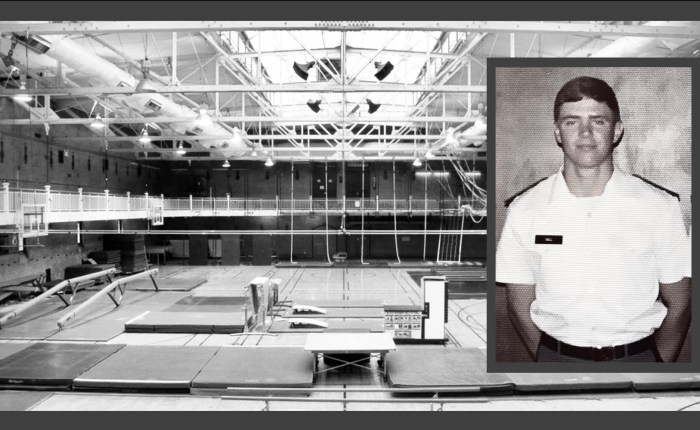
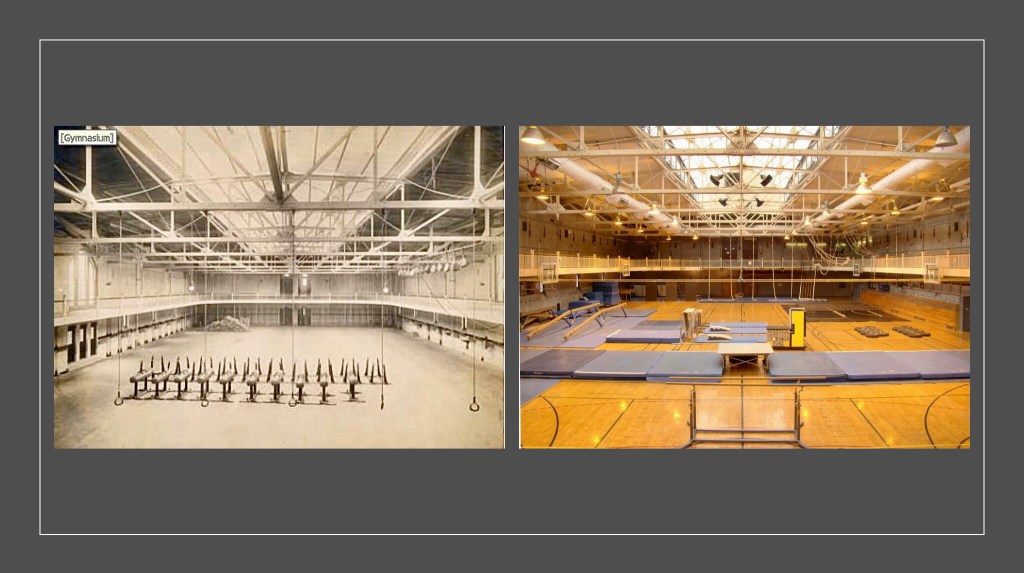
Hayes Gym* is where we practiced Gymnastics. It was “a large open gym with a vaulted ceiling and hardwood floors.” Above the gym floor, an elevated track rings the room. It takes 11.7 laps to run a mile on that track and that’s where we would complete the mile run.
Hayes Gym in 1910, the Year it was Built, and Again in 2009. Note the Elevated Track.
My personal view at the time (and that of at least a few of my classmates) was that many of the instructors in the Department of Physical Education (DPE) had a bit of a sadistic streak in them. One of our instructors was Army’s gymnastic coach, Ned Crossley and some classmates recall his scoring as particularly brutal. Looking back now, I’m pretty sure it wasn’t true. Having said that, all of the DPE instructors had ways of questioning you, challenging you, or prodding you that often seemed to taunt you a bit as well.
The instructor who spoke with us about the mile run was a little like that. To receive a max score, you needed to run under 5:30. The instructor explained what we needed to do to run a 5:30 mile. At 11.7 laps per mile, “all” you needed was to run each lap at a 28 seconds per lap pace, and then run like hell for the last half lap. Simple. Easy Peasy. Any cadet could do it. And so on. Of course the vast majority of us could run no where near that fast.
At the time, I don’t believe I’d ever run a mile (or any other distance) for time. I’d certainly run laps in High School sports, run in formation at West Point for Company morning runs during Beast, and we ran our asses off in wrestling practice. But none of this was ever done for time. That was about to change.
My pea brain went to work. 28 seconds was two seconds less than 30 seconds for each lap. 28 seconds for the first lap… 56 seconds for two laps … 1:24 for three laps … 1:52 for four laps and so on. I’d do the math in my head on the run. As long as I could keep the pace going, I had a shot.
A couple days later, it was my turn to do the run. As I recall, there were a few of us running it at the same time, although I don’t recall exactly how many. What I do remember was taking off when “go” was called. The first lap – 27 seconds! The next couple of laps I was under the pace. After that, I was a bit erratic, with some over and some under, but the average was OK and at the half mile mark, I was on pace. The final few laps? I’m not sure I was really paying attention any longer. The air was stale. The air was acrid. 3/4 of a mile and still on pace. My lungs were burning. I was sucking in as much oxygen as I could. 11 laps done. My legs were lead. It was down to just over half a lap left. I didn’t see anything other than the track in front of me. I don’t know if the other Plebes were in front of me, or behind me. All I know is I ran as hard as could. I rounded the final curve.
“5:25 … 5:26 … 5:27 … Hall – 5:28 … 5:29 … 5:30 …” I did it! I beat 5:30. I slowed down and suddenly my stomach double clutched and I ran to a nearby trash can, where I promptly threw up.
Recovery took me a while. I may have heaved a second time, and certainly had the dry heaves. Eventually I made my way to the shower, and then to whatever my next class was that day.
A couple weeks later, I passed gymnastics with some room to spare.
In my remaining years at West Point, I never ran that fast again. Not even close. We had PT tests on an annual basis with a two mile run next to the Hudson River. I never approached anything close to that time, even when adjusted for a slower time due to the extra distance. The two miler was always a challenge for me and I was always nervous about failing it. The thought of maxing out my run score never entered my head.
Years later, I took up running on my own for fun and to stay in shape. I became a decent runner, and clocked several personal bests – an 11:44 two mile ( a sub six minute/mile pace); a 39:58 10K (a sub 6:30/mile pace) and a 68 minute and change 10 mile race (a sub 7 min/mile pace). I remember all of those. The one I still marvel at? The 5:28 mile on the indoor track at West Point. I had no business running that fast. How the hell did I ever do it?
Addendum:
* Some info on Hayes Gym from the Academy itself: Hayes Gym was built in 1910. The second level of Hayes is what most cadets and USMA graduates think of as “Hayes Gym”. It is a large open gym with a vaulted ceiling, hardwood floor, and elevated track (11.7 laps to a mile) that rings the room. The Department of Physical Education (DPE), teaches applied gymnastics (now called “Military Movement”) in Hayes, taking advantage of its historical and unusual support structures. The gym has eighteen 21′ vertical ropes and two 60′ horizontal ropes (suspended 12′ from the floor). There are also 10 pull-up bars that are each 5′ wide and are suspended from the ceiling with vertical supports in such a manner that they can be “run across” (with proper technique), as is done during the Indoor Obstacle Course. The gym’s floor space is filled with gymnastic’s apparatus and pads, such as vaults, bars, and rings as well as 1″ and 4″ tumbling mats. Nowadays, the military movement equipment remains in place year-round.
The Indoor Obstacle Course is another “fond” memory of Hayes Gym for most West Point Grads, as it was also known to induce retching at it’s completion. I may do a blog on it in the future, but it’s hard to describe to those who haven’t experienced it. To get a flavor for it, here’s a YouTube video of Cadet Elizabeth Bradley completing it just a couple of years ago and breaking the female record while doing so. For all my macho buddies out there, I would love to see you try to beat her time. Good luck on that unlikely event. GO ARMY! https://youtu.be/Dw5rR1yqyp8 .
Thanks to classmates Gus Hellzen and Jerome Butler for their contributions to this blog.
It’s been a busy couple of weeks for our former president. It’s not every month you get to announce your candidacy for the presidency, have dinner with a couple of racist Hitler fans, and declare the Constitution should be terminated. That’s a full month, even by Trump standards.
I don’t know anyone who was surprised when Trump announced he was going to run for the presidency in 2024. It was all his handlers could do to have him wait until after the midterms to announce. He was expecting a big splash from the midterms themselves, but most of his election denier choices went quietly into the night. Yea, Vance won in Ohio, and Lake is still whining like a mini-Trump in Arizona, but the rest of them? B’bye. None of it slowed down his big announcement though. It was almost as if he was oblivious to anything else happening. And the rest of the Republicans? Perhaps Senator Rubio said it best: “We should not have a Senate GOP leadership vote until we have a clear explanation for why our 2022 campaign efforts failed…”. Ummmm, Senator, I could help you with that…
Of course Mr Trump didn’t slow down. As a matter of fact, in typical fashion, he accelerated. Are any of us surprised he ate dinner with Ye (the former Kanye West) and white nationalist Nick Fuentes? Nothing quite says “there are good people on both sides” like having dinner with a couple of Hitler loving antisemites. It’s never a good sign when Alex Jones is distancing himself from some of your dinner guest’s comments, as Jones later did during his interview with Ye. The Republican response to all of this? Again deafening silence. Senator McConnell managed to say “Let me just say that there is no room in the Republican Party for antisemitism or white supremacy. And anyone meeting with people advocating that point of view, in my judgment, are highly unlikely to ever be elected president of the United States.” The brave Senator couldn’t bring himself to utter the “T” word.
Ye and Fuentes… “I See Good Things About Hitler”
Which of course brings us to Mr Trump’s most recent episode. His blast on the Truth Social network was … interesting. He called for “the termination of all rules, regulations, and articles, even those found in the Constitution,” because he lost the last election for president. He wants to be declared the “RIGHTFUL WINNER,” or “have a NEW ELECTION.” (All CAPS are directly from the Trump quote) Wow. Wanting to terminate the Constitution finally drew some rebuttals from the right, but not from everyone.
Just as the events of Charlottesville, or January 6th, or his continuing election denial caused some people to leave the Trump orbit, another dribble of people are departing after the Ye/Fuentes dinner and the subsequent “termination of the Constitution” comments. The vast majority of his core? Like a married couple, they are there through thick and thin, for better or worse. There will be no divorce. They will follow him to the bitter end, however that turns out.
I’m not really sure why I wrote this blog. It’s not going to change any minds. Having said that, I think we all have a duty to bear witness to what is going on in this country. If we don’t continue to speak out, the future becomes a foregone conclusion. As Edmund Burke (or maybe someone else) famously said “The only thing necessary for the triumph of evil is for good men to do nothing.”
I have a couple of last questions for you. First, if Joe Biden declared he wanted to terminate the Second Amendment, what would the immediate reaction be? And second, does anyone doubt Trump would terminate the Constitution in a heartbeat if he could?
Finally, those of us who served in the military or the government swore an oath that started with these phrases: “I do solemnly swear (or affirm) that I will support and defend the Constitution of the United States against all enemies, foreign and domestic; that I will bear true faith and allegiance to the same;”. For my West Point and former military comrades who still support Mr. Trump, I guess we are finally at that point. Which do you support – Mr Trump, or the Constitution?
I have held various security clearances for decades in the past. I spent years working in a Special Compartmented Information Facility (SCIF), both in the military, and as a civilian. I’m not here to judge, but I’d probably be in jail if I’d done what our former President did.
One of the things we learned about classified information early on is that in order to access classified documents, or programs, there are actually two requirements. First, you need the security clearance level required for that information. Second, you must have a “need to know” the information. That is, holding a TOP SECRET* (TS) clearance isn’t a sufficient reason to see a TS document. You also must have a specific need to see the particular information.
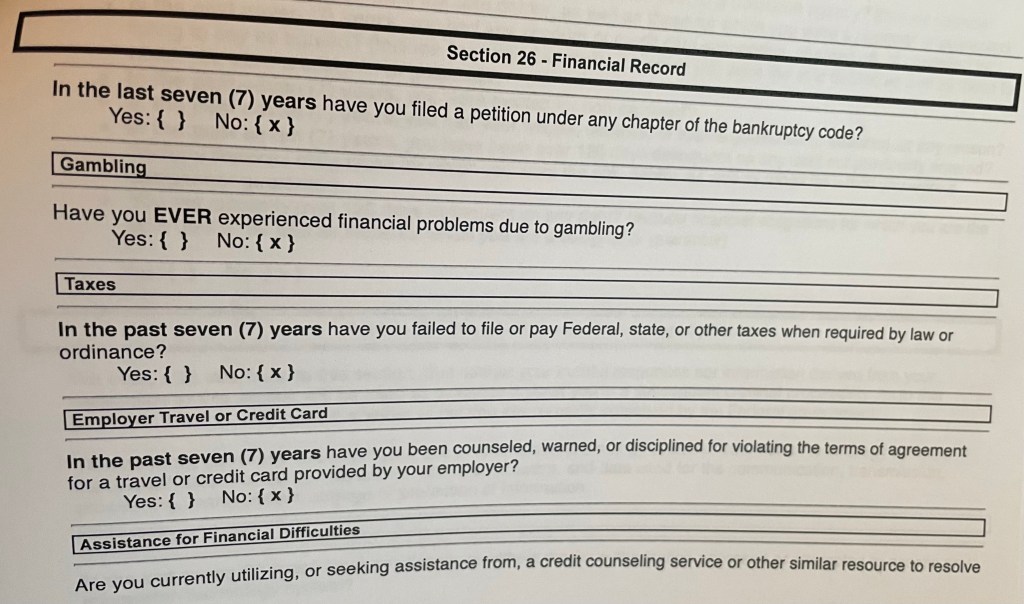
I obtained my first clearance, SECRET, while still at West Point in the seventies. They don’t just give you a SECRET clearance, or any clearance for that matter. You fill out a form answering several pages of questions, they do a background check, interview family and friends and determine whether you are “trustworthy”. The process takes a while. For most folk, unless you have done hard drugs, committed a crime, declared bankruptcy, or declared hostility to the United States, it isn’t too hard to receive a SECRET clearance.
Bankruptcy is One of the Reasons you Can be denied a Clearance.
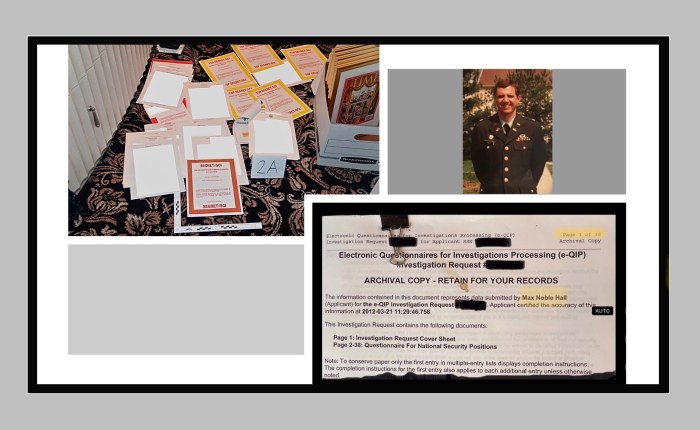
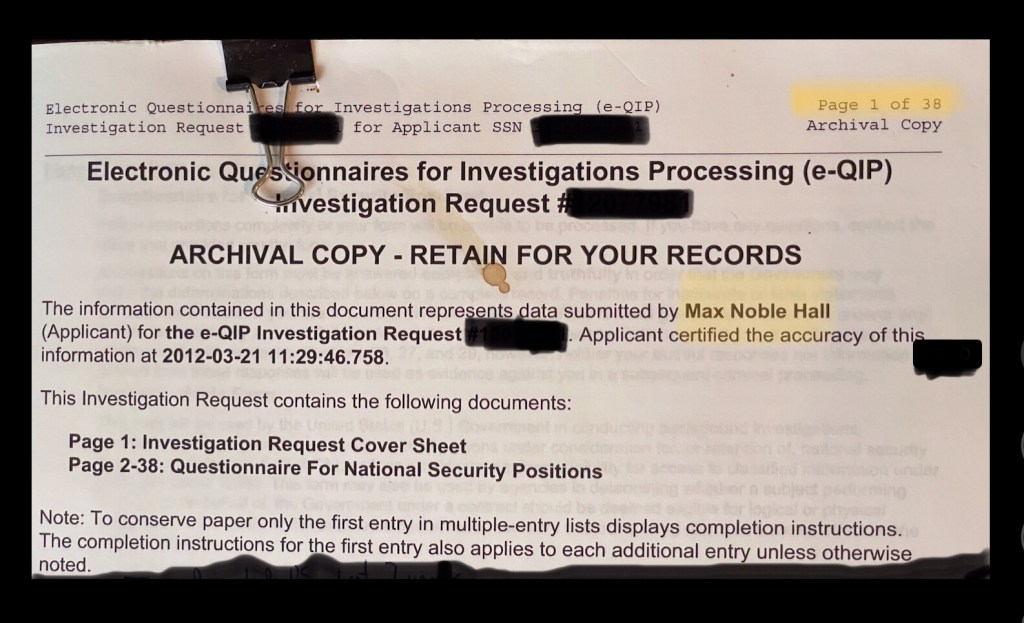
In 1989, we returned from an assignment in Germany to the States and I transferred to a job in the DC area. For that work, I underwent a Special Background Investigation (SBI) in order to receive a TS/SCI/SI/TK (TOP SECRET, Special Compartmented Information, Special Intelligence, Talent Keyhole, clearance). These are a wee bit harder to obtain. Actually, a lot harder. It took months and months for the investigations to take place and for the government to grant my clearance (today, it’s not unusual for the process to take nearly a year). I provided information on where I’d lived over the course of my life, background about my jobs and employers, info on family members and friends, and several references. I documented all overseas travel. I documented any communications I had with East Bloc or communist personnel. In addition to verifying the information I provided, and talking with my references, the government also interviewed neighbors, former bosses, coworkers and family members. They physically went to my prior homes, talked with neighbors and asked about my habits. It’s an intensive and invasive process. When I finally received my clearance, I was also eventually “read in” to a couple of highly classified Special Access Programs (SAPs) further restricting who could access the information.
My TS Renewal in 2012 – All 38 Pages of It.
Everything we did in support of those SAPs was done in a SCIF. To access the SCIF, in addition to the combination lock, there was a retina reader at the outside door, and it was only after your eye was scanned that the door would unlock. Our particular SCIF also required two person access. That is, a person was not allowed in the facility by him or herself. There was a requirement for at least two people to occupy the SCIF, whenever it was opened. This was to prevent someone taking unauthorized information or files out of the SCIF.
The SCIF had intrusion detection systems, and needed to meet a host of other requirements effecting communication systems, the size of duct work and special wiring and HVAC requirements. Cell phones, or any other personal electronic devices weren’t allowed in the SCIF. Inside the facility, all of our classified information was stored in safes which met certain requirements. When you opened the safe, you initialed a form that you opened the safe, and what day and time it was. At the end of the day, when you returned the classified documents to the safe, after locking the safe, you again initialed the form, provided the time you locked it, and the date and time were then verified by a second person.
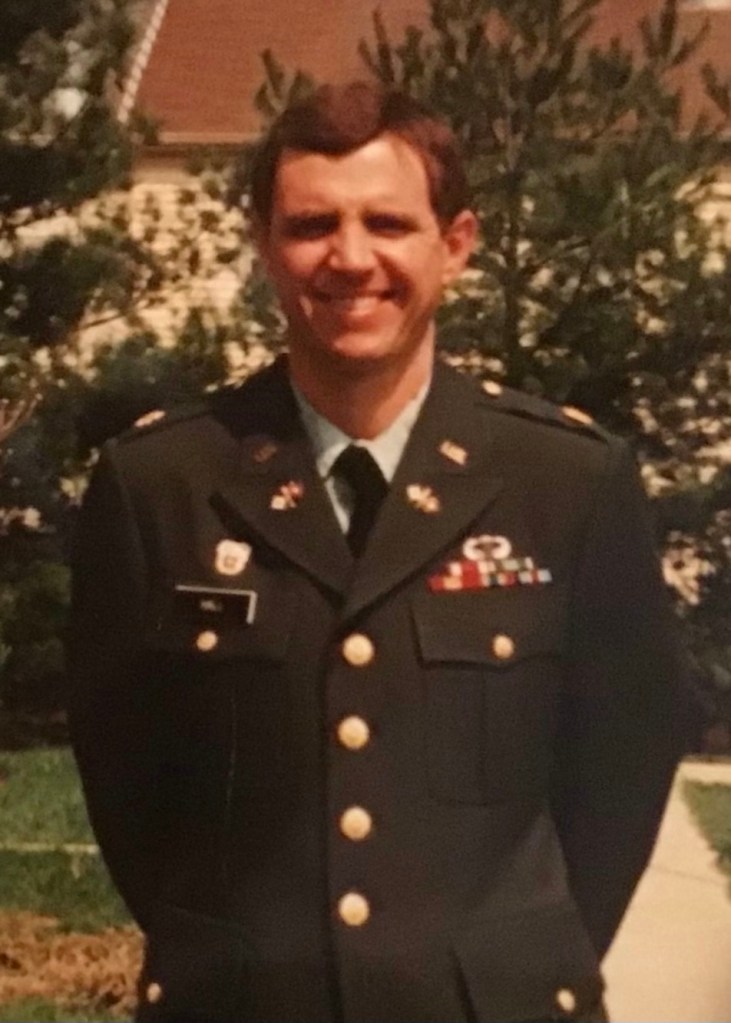
This is me, During the Time I was Working in my First SCIF
If you ever transported classified information outside the SCIF to another location, you needed a special permit. The classified info was double wrapped. You followed a schedule in delivering the information, including the expected arrival time. If there were schedule variances, you notified the authorities.
When I left those SAPs several years later, I was sworn to secrecy, and signed papers indicating I wouldn’t reveal anything about those programs for seventy years.
Honestly, it was all a pain in the ass. BUT, we all understood why it was required, and so we complied without complaining. We understood the security of the nation could be put at risk if there were security compromises, whether intentional or not.
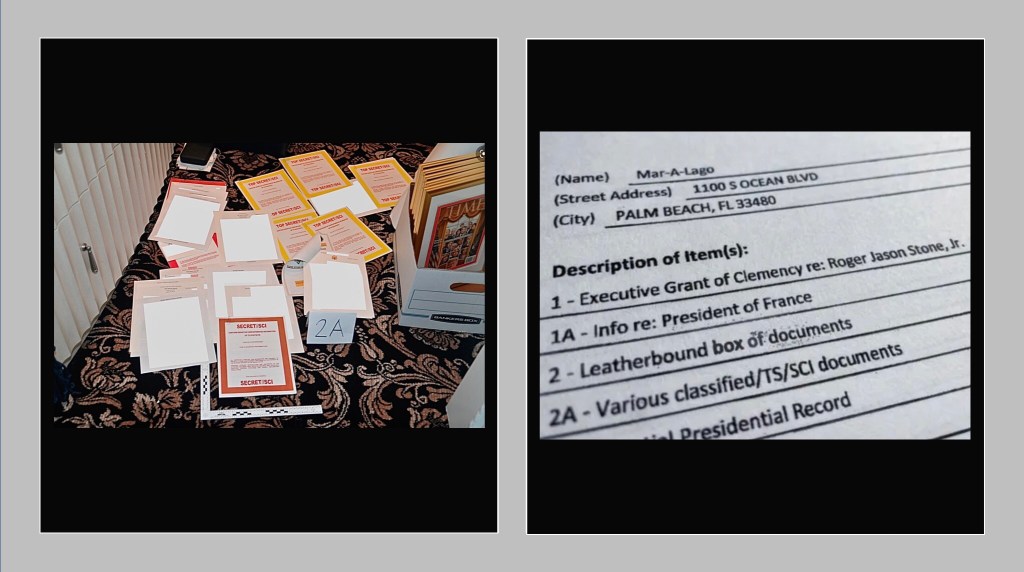
I don’t know what is in the material the former President took to Florida. I also don’t know what he intended to do with it. I doubt we ever will. Based on the covers and documents shown in the now world famous photo, there was TS/SCI material, SECRET/SCI material and other classified information. There were empty SCI folders, with the info, perhaps, stored elsewhere. None of this was stored in a SCIF. As the President was now the former President, there was no longer a “need to know”. The information should not have been at Mar-a-Lago.
Just. Totally. Unbelievable.
Was this a politically motivated search? I don’t know, but given the material found, it’s a moot point. The search was justified. What he did was wrong. Are there always two standards for everything – one for the former President, and one for everyone else? Why do citizens continue to listen to his claptrap**?
Here are some things I do know:
The government held constant dialogs with the former President, his staff, and his lawyers about returning the missing information for over a year, as required by the the Presidential Records Act (enacted after the criminal Nixon tried to destroy documents in 1974).
The former President’s lawyers apparently lied when they swore in June there was no more classified information stored in Florida.
In 2005, former National Security Advisor, Sandy Berger, was convicted of removing, and then destroying five classified documents from the National Archives. He received a $50,000 fine, two years of probation and 100 hours of community service.
In 2015, General Petraeus was convicted for mishandling classified information with his lover. He received a $100,000 fine and two years of probation.
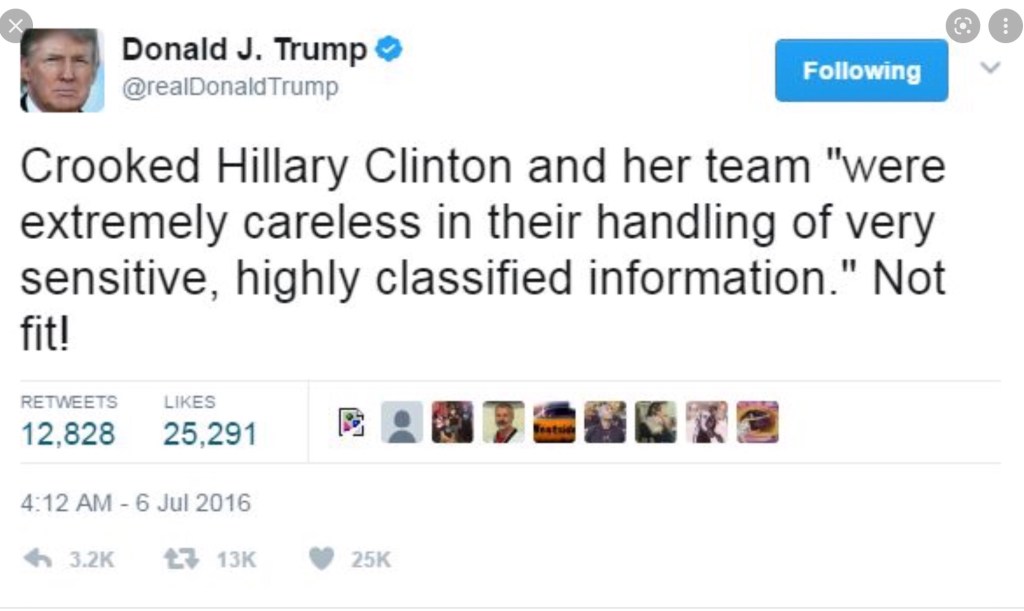
When Hilary Clinton was investigated for her server, people were calling for her prosecution and spoke of how she was unfit for office. Many of those same people are now saying what the former President has done is no big deal, and he can do what he wants.
With the former President, there are Always Two Sets of Standards. Always.
The final thing I know is that If I had done anything remotely close to this, I would have been dishonorably discharged if in the military, fired if a civilian, received a huge fine, and very possibly gone to jail. My public life would have been over.
Of course, unlike some people, I couldn’t shoot someone in the middle of 5th Avenue and get away with it either.
Addendum:
One of the reasons I published this blog is I became aware that many people have no idea what is required to get a clearance, or what is required for the correct handling of classified information. I thought it might be useful for folk to actually understand why this is a big deal, if you work with classified documents. Feel free to share the blog with others.
*TOP SECRET material is defines as something “that would cause exceptionally great damage to US national security and US persons should it reach the eyes of a foreign adversary.”
**Claptrap – noun – absurd or nonsensical talk or ideas.
The Presidential Records Act was enacted in 1978 after President Nixon sought to destroy records relating to his presidential tenure upon his resignation in 1974. The law superseded the policy in effect during Nixon’s tenure that a president’s records were considered private property, making clear that presidential records are owned by the public.
Sometimes, it’s the little things we remember. With a small assist from Burt Lancaster, I once surprised Dad with a present of WWII mess hall coffee mugs he’d been trying to find in antique shops for years. The gift brought joy to both of us at the time, and continues giving me comfort to this day.
Dad always liked his coffee. From the time we were kids, I remember the role it played in his life. On early weekday mornings, he packed the big thermos with him as he left for work on the railroad. On weekends, there was a pot available all day long on Saturdays, and half the day on Sunday. On Saturday mornings, various uncles or aunts stopped by. They all sat around the kitchen table drinking endless cups of coffee, while telling, or retelling, the stories of their youth, and the war years. We kids often listened in, laughing at the stories we came to know by heart.
I started understanding a bit more about his love for coffee when I was applying to West Point. On a couple of occasions, dad drove me to Fort Sheridan (an Army Post in Illinois that no longer exists) for a physical and a fitness test. As we were walking on the Post, he surprised me by becoming a bit nostalgic for the “good old days” in the Army, and talked about how good the coffee was. I think he may have even joked with one of the folk we interfaced with about reenlisting, if he could have a cup of coffee from the Mess Hall. It’s strange, the things you remember, but I distinctly recall the conversations about Army coffee on those trips. It was about 27 years after World War II and he was 48 at the time.
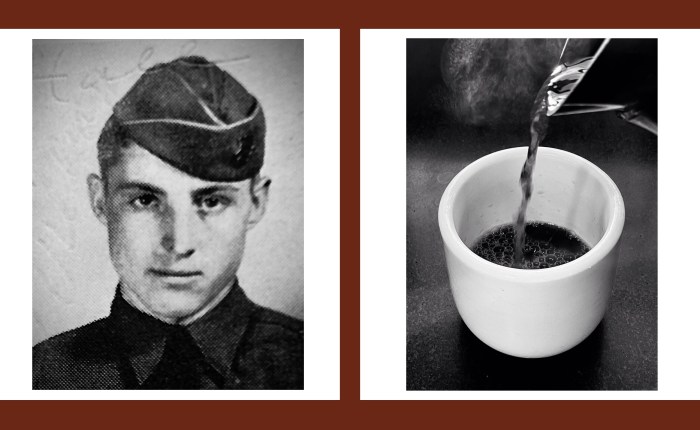
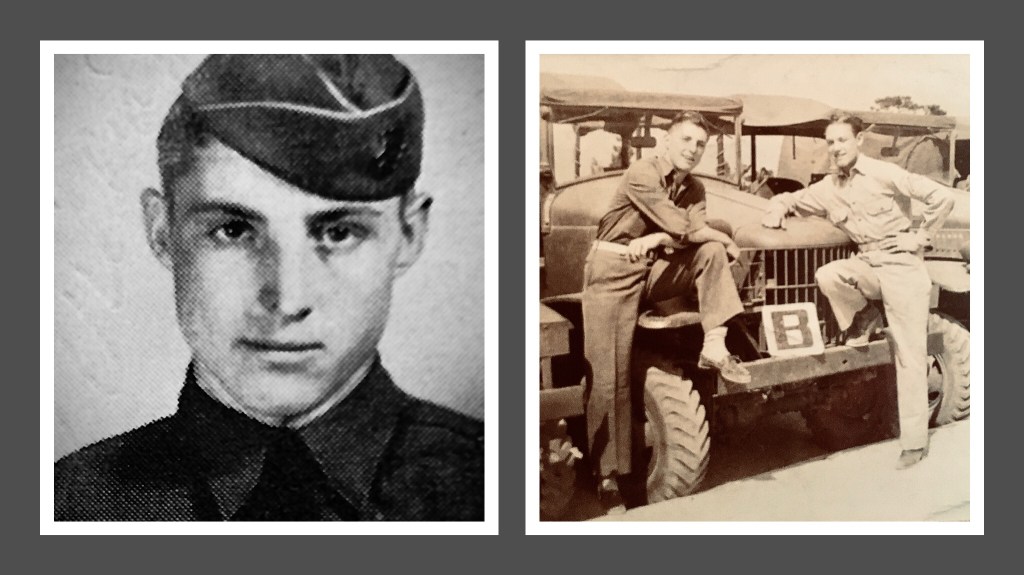
Dad in the “Good Old Days” in 1941, Sometime Before Pearl Harbor
I eventually graduated from West Point and Cath and I were deployed to Germany for most of the ‘80s. We didn’t see Mom and Dad much during our time overseas.
In ‘85, Dad retired from the railroad, and he and mom started traveling more, particularly to jazz concerts around the country. They also managed to visit us in Germany in ‘88. While there, dad talked about their travels. In a side conversation, he mentioned they also typically visited “antique” stores during their trips. He was looking for mess hall coffee mugs from WWII, but hadn’t found any. I was intrigued. What the hell do WWII mess hall coffee mugs look like, and why did he want them?
In Dad’s words, they were thick, heavy white mugs with no handle. You could put both hands around the mug when you took your first sip in the morning, and the mug warmed your hands. He’d used them throughout his time in the Army during the war. I mean, he was waxing poetic about these mugs. I still didn’t quite know what they looked like, but that was OK. During their visit, we stopped in a couple of shops with older items, and Dad would poke around. His thinking was maybe during the occupation of Germany after the war, some mugs made it into the local economy. The looking was to no avail, and no mugs were found.
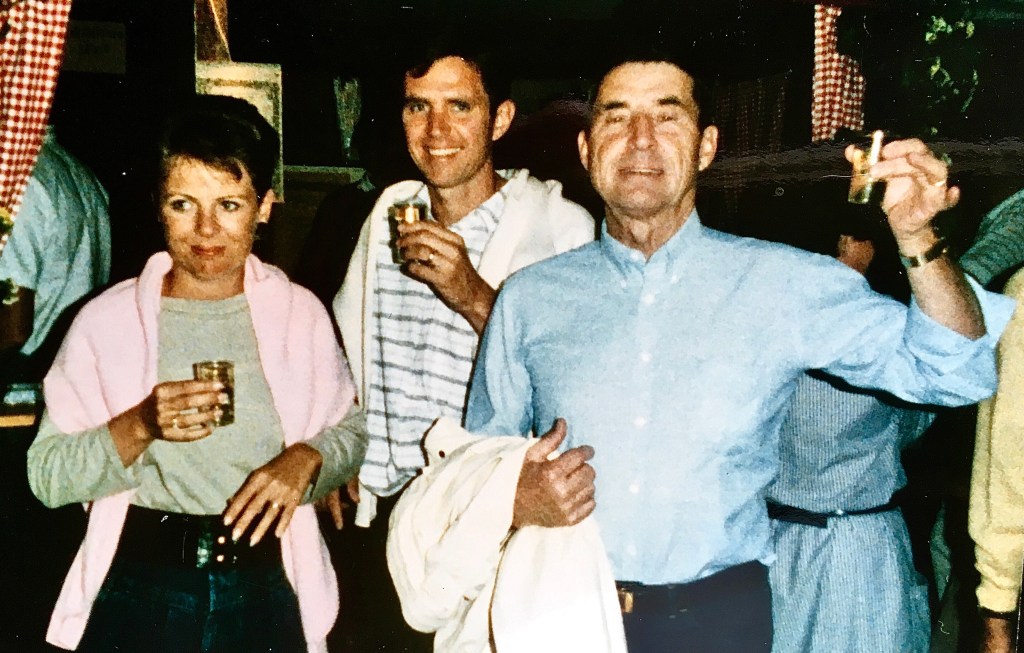
Dad, Cathy and I at a Winefest on the ‘88 Trip to Germany.
We eventually returned to the States in ‘89, and on a visit at Mom and Dad’s over Christmas, Dad and I were watching TV. The classic WWII movie, From Here to Eternity, was on. You know the movie… Burt Lancaster, Montgomery Clift, Frank Sinatra, Donna Reed, Debora Kerr and Ernest Borgnine. It has the great scene with Lancaster and Kerr kissing on the beach as the waves crash over them.
As we were watching, Dad suddenly shouted out “There’s the coffee mug! Look in Burt’s hand!” What!? I look up, and I’ll be damned. Just as the Japanese are about to attack Pearl Harbor, there’s Burt with a white, thick, handleless coffee mug… which he immediately throws on the ground to go out and confront the attacking Japanese.
Everyone Knows the Scene of Burt and Deborah Kerr on the Beach, but Dad and I Were More Interested in Burt and the Coffee Mug.
I’d completely forgotten about the mugs until Dad’s outburst. Of course I immediately asked him how the hunt was going. He’d visited a lot of shops, but never seen any, or really even met anyone who knew what he was looking for.
At the time, I was involved in a couple of classified Black programs for the military and traveling a fair amount. Cathy couldn’t know where I was going, only the approximate day of my return. On the trips, we could only use cash, and no credit cards were allowed. We often had some spare time, and now that I knew how the mugs looked, I too started poking around in the occasional store.
A couple of years went by, and I wasn’t having much luck either. That changed in the spring of ‘93. I was looking around a junk shop in the middle of no where, and there they were – Six of them! Holy hell. Were these really them? I asked the owner what he knew about them, which wasn’t much, only that they were old coffee mugs. It was enough for me. I counted out some cash, bought all six mugs, and returned home with them a week later.
Six Handleless Coffee Mugs, Bought with Cash at an Unnamed Location
Cathy and I thought about giving them to Dad for a Christmas or Birthday present, however those were still a while away. Mom and Dad were coming for a visit in July, and we decided we would give them to him then, with a twist. Rather than just hand them over, we would not say anything, serve soup in them, and see if Dad noticed.
They finally made it to Virginia and the big night arrived. It was a beautiful evening, and we ate dinner in the backyard on the picnic table. Cathy made Gazpacho for a first course, and we served it in the mugs. As she and I brought the soup out, we set a mug in front of each of us.
I could hardly contain myself, I was so excited. We started eating and both Mom and Dad complemented Cath on the soup. There was no word from Dad on the mugs. Were these not the right ones? We continued eating, and all of a sudden Dad paused, and started looking at his mug. He looked more intently, and then, “Say! I … I … I think these are the mess hall coffee mugs!”, at which point I burst out laughing.
Dad verified these were INDEED the mugs. By then, we were all laughing, and I told him the story of how I found them.
We used those mugs for coffee in the morning for the rest of their visit. Dad would use both hands, and bring it up to his mouth and nose to inhale the smell of the fresh brewed coffee, probably the same way he did back in 1940-‘45. When they left, I sent four of the mugs home with them, and kept two for us.
Nostalgia and Coffee. What’s Not to Like?
Eventually, Dad passed away in 2010. At some point in time, mom gave the four mugs back to us. Occasionally, I use one of them for my own Cuppa Joe in the morning. I feel the warmth of the mug in my hands, inhale the smell of the fresh brewed coffee, and think back to Dad – It’s a wonderful way to start the day.
Addendum:
If you want to see the scene of Burt Lancaster with the coffee mug as the Japanese are attacking Pearl Harbor, you can view it here: https://youtu.be/2UxTGH7cR5Y


















 Live Life Exuberantly