In Search of Ernie’s Nightclub

New York City was a crossroad of craziness during WWII and it appears Dad may have partied there in ‘44 or ‘45, after recovering from his war wounds. His WWII “little black book” has an entry for a place called Ernies Nightclub. After some research, I found Ernies. It was a jazz club, that also hosted the occasional burlesque dancer, comedian, or male impersonator. Mafioso Vito Genovese occasionally drank there, and oh by the way, it was a sometime lesbian hangout. Sure, why not?

Let me go back to the beginning. After dad passed away in 2010, mom found a WWII era “little black book” of dad’s. A couple of years later, she gave it to me, along with some of his other wartime mementos. The book was actually red, and contained addresses, phone numbers, and information about women, relatives, company mates in the Army, and others. It’s a fascinating look into the past.

The book has an entry for “Ernies Nightclub” with the note “Take 8th Ave Subway to 4th street. Walk 3 blocks east”. This particular entry intrigued me and I started doing some research.

Dad’s “Little Black Book” and the Entry for Ernies Nightclub

Googling “Ernies Nightclub” produced immediate hits in New York City and I became excited. There were even some photos of the place in Greenwich Village! Unfortunately, as I investigated, it turns out this was describing a fictional “Ernies Nightclub” from the book, “Catcher in the Rye”, by JD Salinger. While interesting, this was a dead end for dad’s Red Book entry.

This started me thinking though. How many cities have “8th Avenue Subways”? Surely New York is at the top of the heap. I typed in “Ernie’s Nightclub New York City 1940s”. After more “Catcher in the Rye” references, an entry for “Encyclopedia of Lesbian Histories and Cultures” appeared. What? Clicking on the link, I found a reference to “Ernie’s Three Ring Circus, a gathering place for working class lesbians in New York City in the ‘40s.” Hmmmmmm.

My next step was to search on “Ernie’s Three Ring Circus” and boom, there were several entries, including the address: 76 West Third Street, New York City. I went to Google Maps and entered the address. Bringing the map up, the location was a block below 4th Street (progress!), but nowhere near 8th Avenue. More research, and there is a 4th Street subway station the 8th Avenue Subway runs through. A bit more sleuthing, and it turns out the “south entrance” of the 4th Street Station is on…wait for it…. Third Street. If you walk three blocks to the East from that entrance, you arrive at: 76 West Third Street, exactly like the instruction in Dad’s Red Book! We’ve found Ernies Nightclub, with the real name of Ernie’s Three Ring Circus.
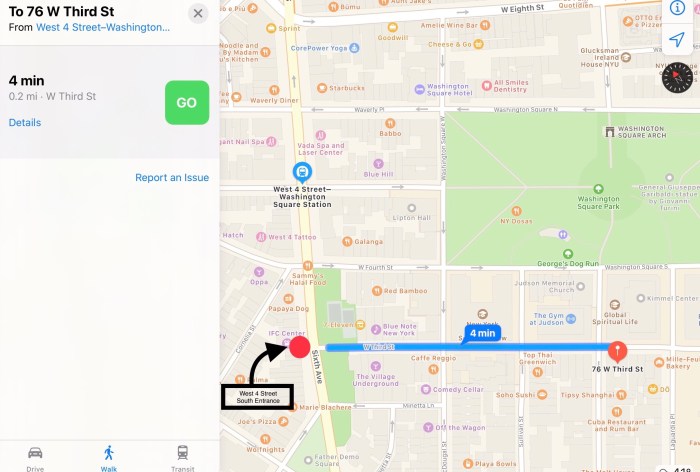
It’s only a Short Walk to Ernie’s from the Subway

What kind of place was Ernie’s? Online, there were several entries about it, including info in books and historical records. It appears Ernie’s was a jazz club that was “mostly heterosexual, but also attracted “working class” lesbians”. You have to remember this was the 1940s, and there were only limited places, even in New York City, that accepted gays or lesbians. Ernie’s was one of them. It’s mentioned in a New York City Landmarks document called “150 Years of LGBT History”.
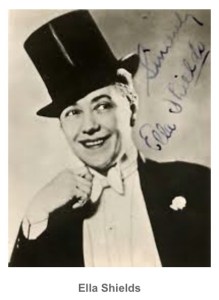
I found records of many acts performing at Ernie’s. The singer and male impersonator, Ella Shields appeared in 1943. (Julie Andrews used Ella Shields as her role model for ‘Victor’ in the film “Victor/Victoria“). On another evening, in addition to a three piece band, “Tessie the Tassel Tosser” performed. Tessie evidently had certain “talents” with her chest that demonstrated excellent muscle control. Evelyn Nesbit also appeared at Ernie’s. Nesbit was the woman the film “The Girl in the Red Velvet Swing”, starring Joan Collins and Ray Milland, was based on. She was a model and early film star, who’s husband murdered her lover.

Other interesting people frequented Ernie’s. In the book “Mafia Cop”, a woman, Tess, tells of the night she was married. They went to Ernie’s after their ceremony, and Vito Genovese was standing at the bar having a drink. When he found out they’d just married, “he closed the bar and ordered champagne drinks for everyone. We had an all night party”. For those who may not remember, Genovese was head of one of the five Mafia families in New York, and for a brief time, considered “the boss of bosses”.
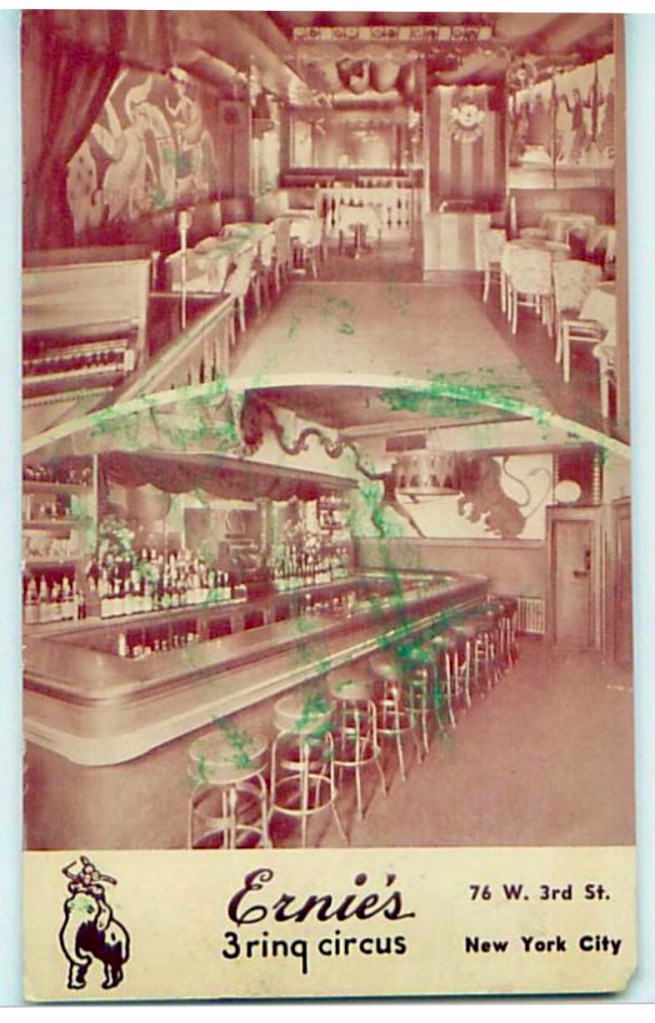
A Post Card from Ernie’s Three Ring Circus

So, did Dad ever make it to Ernies? Sadly, I don’t know. I’ve added it to a growing list of questions I wish I had asked him. It certainly sounds like the kind of place he loved. NYC was only a train ride away from North Carolina, and assuming he had some leave time, he could have gone pretty easily. What really makes me think he visited, was that my Uncle Mick was in the Navy and stationed in New York (also in Dad’s Red Book). Mick served on the SS John W Powell out of NYC, and with the Navy Armed Guard Center in Brooklyn. There’s also an entry below Mick’s name for “The Washington Hotel”, which is only a short walk front where Mick was stationed, when in port. I could easily see Dad visiting Mick, and the two of them wreaking havoc on the city. I’ve asked my cousins and sisters about it, and while we can remember stories of them partying together during the war, there’s no specific remembrance of New York City. For now, at least, it remains a mystery.
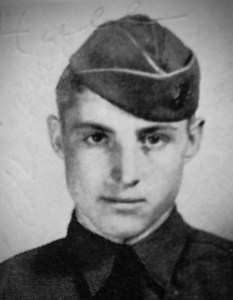
Dad in ‘42

By the way, Ernie’s Closed in 1962. The space is currently occupied by a bar called “The Half Pint” that’s been there for twelve years. It still looks like the kind of joint Dad would enjoy. Cathy and I plan to stop by on our next trip to the City and see if we pick up any “Ghost of Bill” feelings.

Addendum:

– Uncle Mick (Born in ‘25) was two years younger than dad and joined the Navy at the age of 17. The SS John W Powell was a “Liberty Ship” (cargo ship) built for the Navy during WWII. You can find more about Liberty Ships at: https://en.m.wikipedia.org/wiki/Liberty_ship . The photo here shows the two entries for Uncle Mick in Dad’s book (Mick’s real name was Lee). Also note the entry for the Washington Hotel.

Entries for Uncle Mick (Lee) in Dad’s Book

– The Lesbian and Gay scene in NYC in the 40s was discreet, but growing. This was well before the Stonewall Riots in 1969. If you want to learn more, you can get to various links from: http://lostwomynsspace.blogspot.com/2015/02/ernies-restaurantthree-ring-circus.html .

– The Vito Genovese story is interesting, although Tess may have her facts wrong. Other history books show Genovese in Italy at the time. He may have traveled back and forth.

– Evelyn Nesbit was fun to read about. She was in her 50s during WWII. Model, chorus girl, actress, she managed to attract trouble off and on through out her life. In real life, her millionaire husband, Harry Thaw, murdered her one time lover, Stanford White, in what was known at the time as “the crime of the century.”The Girl in the Red Velvet Swing” is one of those movies you might occasionally see on Turner Classic Movies.

– You can still find UTube videos of male impersonator, Ella Shields. Here’s one of them: https://youtu.be/2G2c47EtDT8

– You can read a bit of amusing information about “Tessie The Tassel Tosser” in the book: “Footprints”, by John Aicher – here’s an excerpt : https://books.google.com/books?id=8dvhAgAAQBAJ&pg=PA204&lpg=PA204&dq=tessie+the+tassel+tosser&source=bl&ots=-9iT9jLdwV&sig=ACfU3U2CoW9RxFHXhDbEhtL8cCK40HR3tg&hl=en&sa=X&ved=2ahUKEwj69u2EhLTnAhWGj3IEHd-oBcgQ6AEwCnoECAoQAQ#v=onepage&q=tessie%20the%20tassel%20tosser&f=false
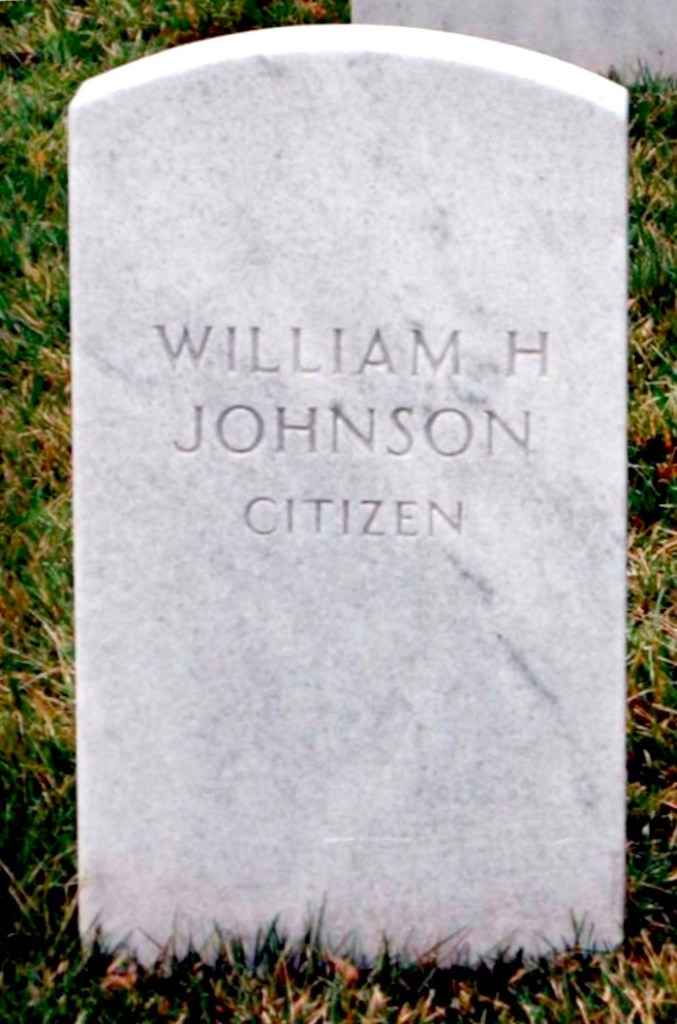
William H. Johnson, Citizen

Grave 3346, in Section 27 at Arlington National Cemetery is simple, like those around it. The inscription? William H. Johnson, Citizen. William Johnson, a free African American, was Abraham Lincoln’s valet and and tended the sick president after his Gettysburg speech. This grave might, or might not be his final resting place. As with much of history, the details aren’t exactly clear, but it makes for an interesting story.

William H. Johnson, Citizen

When Abraham Lincoln was elected president, he brought William H. Johnson with him to Washington DC in 1861. Johnson had worked as a freedman for Lincoln and his family at least since 1860. Originally employed at the White House as a valet, there was trouble between Johnson and the the other free African Americans who worked there. His skin color was quite dark and the other lighter skinned African Americans harassed him.

Lincoln tried to help solve the problem and wrote a “to whom it may concern” letter: “William Johnson, a colored boy, and bearer of this, has been with me about twelve months; and has been, so far, as I believe, honest, faithful, sober, industrious, and handy as a servant.” There were mixed results from the letter. Over the next three years, Johnson was listed as working for the Navy, a White House fireman, and a Treasury Department employee among other jobs. Throughout it all, he continued to work for Lincoln as a valet. He shaved Lincoln, shined his shoes, and took care of him in other ways, including carrying money for him.

In July of 1863, there was this little battle in Pennsylvania at a place called Gettysburg. You may have heard of it. Four months later, in November, Lincoln travelled by train to the battlefield for the dedication of the cemetery there, and took William with him. Lincoln went on to deliver his famed Gettysburg Address at the dedication. Those 272 words would become the most quoted of his entire presidency, although at the time, they weren’t particularly noticed. The address started – “ Fourscore and seven years ago our fathers brought forth, on this continent, a new nation, conceived in liberty, and dedicated to the proposition that all men are created equal…”. Written almost one year after The Emancipation Proclamation took effect, the wording was not accidental.

Fate then intervened. On the return trip to Washington, Lincoln showed signs of Smallpox and was quite ill. William Johnson is the person who nursed him back to health. Unfortunately, Johnson also caught Smallpox. Was it from Lincoln, or someone else? We’ll never know for sure. What we do know is he continued to worsen, and eventually died around January 28th, 1864.

Lincoln himself settled Johnson’s estate. The president followed his valet’s instructions as to how his pay was to be distributed. As Lincoln explained to a Chicago Tribune reporter,

⁃ “This is something out of my usual line; but a President of the United States has a multiplicity of duties not specified in the Constitution or acts of Congress. This is one of them. This money belongs to a poor negro who is … very bad with the smallpox…. He is now in hospital, and could not draw his pay because he could not sign his name. I have been at considerable trouble to overcome the difficulty and get it for him, and have at length succeeded in cutting red tape….I am now dividing the money and putting by a portion labeled, in an envelope, with my own hands, according to his wishes.”

Lincoln also paid off a loan he co-signed with William, and took responsibility for Johnson’s funeral. In fact, he paid for his coffin, grave marker, and burial.

We know all of this because Lincoln recorded much of the above in his personal papers. The next part becomes a bit murkier. That is, where is William Johnson actually buried? There are at least three different possibilities.

First, most black smallpox victims were buried in the Columbian Harmony Cemetery, in Northeast DC. Unfortunately, the cemetery was razed half a century ago for development.

Second, he may have been buried at the Congressional Cemetery. Although there is no direct record of this, some historians believe it to be the case.

Finally, many believe he may be buried at Arlington National Cemetery. Section 27 contains the graves of Civil War soldiers, a significant number of freedmen who resided in the District of Columbia, and probably formerly enslaved people from the Custis Lee Estate. There is the marker with the correct name and the man buried under the marker died in 1864. Despite this information, there are also doubts raised about the entire claim. The Custis Lee Estate (later Arlington National Cemetery) would not become an official cemetery for another few months. William Johnson was a common enough name at the time. Then there was the interesting epitaph “Citizen”. Was this Lincoln’s way of recognizing Johnson was a freedman? It turns out in the early days of burials at Arlington, civilians were also buried there. “Citizen” merely meant this was the grave for a person who was not a soldier.

I’m not sure why I have this mini-fascination with Mr Johnson, but I do. I first read about him a few years back in a book about the Gettysburg address. Since then, his name has popped up in a couple of other books about Lincoln. It’s always just a couple of paragraphs describing what he did for Lincoln, taking care of Lincoln when he contracted Smallpox, and then Lincoln settling Johnson’s estate when he died. He truly is just a minor footnote in history. And yet….. The Civil War still had well over a year to run. Here was Lincoln, during one of the worst times in our history, taking time out of his life and the national concerns to take care of this man and his affairs. Why? Did Lincoln do this because it was the right thing to do, or was there more to it?

Mary, a friend of mine helped some with my investigation. She is an amateur historian, particularly about slavery and the Civil War period (her ancestors owned enslaved people and she spends time trying to make amends for that). She found Lincoln’s census record for 1860.  There was a Johnson living in the Lincoln household, but it indicates a female, 18-years old, and no indication that she (or if mis-stated, he) was Black, and the initial appears to be “M” rather than “W.”  Nor was she able to find any William Johnsons in Springfield at that time. 

Lincoln Census Results from 1860

  Mary’s guess is that he was a fugitive from slavery and had renamed himself once he reached freedom in Illinois.  She also looked on Ancestry.com and cannot find a single person that claims a black William Johnson who worked for Abraham Lincoln as a relation.  Her words: “This is really, really strange.  I’ve never come across someone that NOBODY claimed in a family tree.”  

So, is Johnson buried at Arlington? Sometimes, we aren’t meant to solve mysteries, and I think this is one of those cases. The romantic in me hopes he is at Arlington. There would, perhaps, be some justice in that. No matter where he’s buried, I’m glad I learned about him, and his relationship with Mr. Lincoln.

Addendum:

  • Virtually all references to William H. Johnson are from President Lincoln’s own comments, requests, or papers. There is little else known about him.
  • Special thanks to my friend Mary Haak. Mary and I have had many thoughtful discussions about politics and race over the past year or two. She is a genuine human being, who quietly goes about doing the “right thing” in many ways. We should all be so dedicated.
  • Lincoln gets credit for “freeing the enslaved people”, but he was also a product of his time, and by no means perfect. Here are three examples:
  1. In August of 1858, in my home town of Ottawa, Illinois at the first Lincoln-Douglas debate, Lincoln said: “I have no purpose to introduce political and social equality between the white and the black races. There is a physical difference between the two, which, in my judgment, will probably forever forbid their living together upon the footing of perfect equality…I have never said anything to the contrary, but I hold that, notwithstanding all this, there is no reason in the world why the negro is not entitled to all the natural rights enumerated in the Declaration of Independence, the right to life, liberty, and the pursuit of happiness.”
  1. In August of 1862, Lincoln wrote to Horace Greeley, Editor of the New York Times, and famously stated: “If I could save the Union without freeing any slave I would do it, and if I could save it by freeing all the slaves I would do it; and if I could save it by freeing some and leaving others alone I would also do that. What I do about slavery, and the colored race, I do because I believe it helps to save the Union;
  1. In January of 1863, under The Emancipation Proclamation, Lincoln did free enslaved people, but not all of them. The Proclamation only freed those slaves who were in States that had seceded from the Union. It did nothing about slaves in the border states that had not seceded. Those slaves were freed by state action, or by the 13th Amendment to the Constitution, ratified in December 1865.

I Wouldn’t Give a Bean, to be a Fancy Pants Marine….

I Wouldn’t Give a Bean, to be a Fancy Pants Marine….

My first duty assignment in the Army was with the 123d Signal Battalion in the 3rd Infantry Division (3ID). We were headquartered in Würzburg, Germany.

Rocky, the 3ID Mascot

Cathy and I arrived in January 1979 and spent the next three years with 3ID. The Division had a long and storied history and earned the moniker “The Rock of the Marne” during WWI, while defending Paris and withstanding the last big attack by the Germans. Both of us learned the history, along with other details about the Division, including the unit mascot (Rocky the Bulldog) and the official 3ID song, “The Dogface Soldier”, which was played at the end of all Division level ceremonial activities.

Another tradition we learned about was the “Hail and Farewell”. The officers in our battalion held a Hail and Farewell every couple of months to welcome new officers and families, and to say goodbye to those who were returning to the States. Spouses were invited, and the events were usually held in a private room at some local German Gasthaus. There would be good food (Schnitzels, Cordon Bleu, Wurst Plates, Wild Plates, Käsespätzle and the like), and a fair amount of beer and wine involved. Stories were told, thanks given, and there was often a toast or two. Sometimes things could get a bit rowdy, but not usually.

At a Hail and Farewell in 1980, our Battalion Commander, LTC Ben Swedish, invited the 3ID Chief of Staff, COL Davis, to attend. COL Davis accepted, along with his wife. This meant things would probably be a bit quieter and more formal.

The night started out normal enough. After dinner, we said “hello” to the new officers, and “goodbye” to those leaving. Colonel Davis then stood and said a few words of thanks for our work, and our good job on a recent field exercise. He sat down to polite applause. Usually, things would quiet down at that point and people would start leaving, but Colonel and Mrs Davis didn’t depart, so no one else did. Cathy was our DD for the night, so she stopped drinking, but I, and others, drank some more beer and wine. People were circulating from table to table talking and laughing with each other. It was getting louder in the room.

I was talking with my company Commander, Captain Tom German, when there was a commotion behind us. I turned around and there was Colonel Davis with one arm around Cathy, and the other around Tom’s wife, Rhonda. The three of them started singing “The Dogface Soldier” –

I Wouldn’t Give A Bean, To Be A Fancy Pants Marine;

I’d Rather Be A Dog Face Soldier Like I Am.

I Wouldn’t Trade My Old OD’s, For All The Navy’s Dungarees,

For I’m The Walking Pride, Of Uncle Sam.

….

I’m Just A Dog Face Soldier, With A Rifle On My Shoulder.

And I Eat Raw Meat For Breakfast Every Day.

So Feed Me Ammunition, Keep Me In the Third Division

Your Dog Face Soldier’s A-Okay.

About half way through the song, others joined in, and soon the whole room was singing. Everyone was enjoying it. Well, almost everyone. Mary Lou Swedish and Mrs Davis didn’t look amused. As a matter of fact, both wore scowls on their faces. They didn’t seem particularly happy to see the Colonel cavorting with two junior officer’s wives, and they stood there frowning. You could almost see them thinking “What’s next a Roman Orgy? Virgin Sacrifices?” Cathy and Mary Lou had a bit of a history, as Cathy wasn’t exactly the “ideal” Officer’s wife – she was a bit too independent for Mary Lou’s tastes. Tom and I stood there laughing.

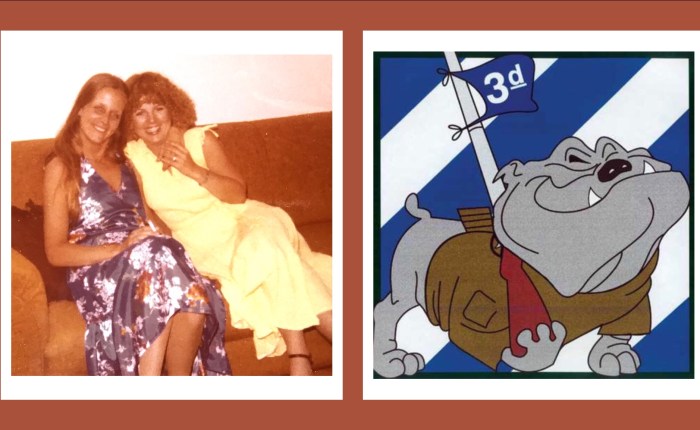
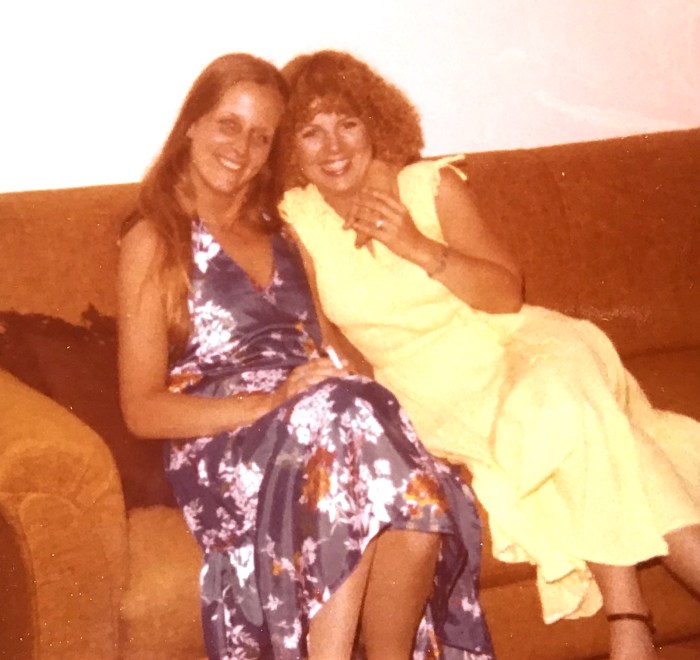
Rhonda and Cathy at another 123d Signal Battalion event

The song ended and there were many toasts to “The Rock of the Marne” among much clinking of bier-steins and wine glasses. Colonel Davis gave Cathy and Rhonda a hug, and was acting pretty happy. Tom and I both gave our wives big hugs, while everyone else was slapping them on the back. The evening eventually broke up and people headed off into the night.

Cathy and I talked on the drive home and I laughed and asked her “where’d that come from?” It turns out she and Rhonda were talking when COL Davis joined them. The conversation went here and there, and he said something about livening up the evening. He asked if they knew The Dogface Soldier song and they both said “mostly“. He asked them if they’d join him in singing, and after a bit of convincing, they agreed. The rest, as they say, is history. His plan worked and the evening ended on a very lively and upbeat note. Evidently, he hadn’t briefed Mrs. Davis on the plan…;-). Cathy and I still chuckle about the story to this day.

Rock of the Marne…..

Addendum:

• In a later twist to the story, a few years ago Cathy and I were at a German restaurant near Madison, Virginia called The Bavarian Chef. As we were having lunch and a beer, we were chatting with a couple at the table next to us, and it turned out the gentleman also served in the 3rd Infantry Division in Germany. Cathy and he sang the song together there in the restaurant, although at a more subdued level than the time with the 123d.

• At the time of this story, my West Point company mates, Chuck Allen, Bond Wells, and Steve Powell were scattered across Bavaria in other parts of the Division. Chuck returned to Germany as a Lieutenant Colonel and commanded the garrison at Kitzingen from ‘97-‘99. Kitzingen transitioned from 3ID to the First Infantry Division (The Big Red One) in 1996. Chuck told me “Germans in Kitzingen still sang The Dogface Soldier song “durch vielen bier und weinfesten” (at many beer and wine festivals), much to the dismay of the First Infantry Division’s Commanding General and Chief of Staff.”

The Dogface Soldier was originally written in 1942 by two U.S. Army infantry soldiers. It was adopted as the song of the 3rd Infantry Division, and was widely played and sung during the war, and since then. (Info from 3ID Website)

• Rocky the Bulldog is the symbol of the 3rd Infantry Division and was created by Walt Disney himself in 1965. Just as there was in Würzburg, there’s a statue of Rocky at 3ID’s current headquarters at Ft Stewart, Georgia. It should be noted that in statues, Rocky is alway intact and anatomically correct.

• The 3rd Infantry Division continued to serve our country in Iraq and Afghanistan. They were the first unit to deploy to Iraq twice and then three times. Since then, 3ID, or it’s units, have deployed multiple times to both countries.

The complete words to “The Dogface Soldier”:

I Wouldn’t Give A Bean, To Be A Fancy Pants Marine;

I’d Rather Be A Dog Face Soldier Like I Am.

I Wouldn’t Trade My Old OD’s, For All The Navy’s Dungarees.

For I’m The Walking Pride Of Uncle Sam.

On Army Posters That I Read, It Says “Be All That You Can”

So They’re Tearing Me Down, To Build Me Over Again.

I’m Just A Dog Face Soldier, With A Rifle On My Shoulder

And I Eat Raw Meat For Breakfast E’V’RY Day

So Feed Me Ammunition, Keep Me In the Third Division

Your Dog Face Soldier’s A-Okay

During WWII, the lyrics to the last four lines were a bit different:

I’m just a Dogface Soldier, With a rifle on my shoulder,

And I eat a Kraut for breakfast every day.

So feed me ammunition, Keep me in my Division,

Your Dogfaced Soldier boy is A-okay.

After his Patriotism is Questioned, A Vietnam Vet Reflects on War

My friend Ed Meagher, a Vietnam Vet, recently told this story. I asked him if I could clean it up a bit, and post it here on my blog. He readily agreed. As tensions ratchet up between us and Iran, and around the world, I think it’s good to listen to personal stories from our past wars and not just the official histories, or news articles. The voices of those who were there are always worth hearing. Here’s Ed’s story in his own words.

Whenever I hear a helicopter, I stop what I am doing and lookup. Nothing too unusual about that, except I am also hit by a momentary shot of adrenalin, the hair on my arms and neck stand up, and a feeling arises in my chest and gut I have trouble describing. It is quick, and after all these years it fades rapidly. I cover it by trying to identify the type of helicopter and unless it is an old “Huey” or “Chinook”, the whole episode is over before anyone notices. If it is one of those, it is another matter and it brings back memories.

I arrived in Vietnam about 3AM on January 30th, 1968. By coincidence, or poor luck, it was the same day the Tet Offensive started. I was a recently promoted Air Force Staff Sergeant (E-5) radio operator. I was assigned to a Comm Squadron and detailed to a place called “Paris Control” where we coordinated air strikes up and down III Corps. I worked the night shift from 6 PM to 6 AM every day. We would eat breakfast or dinner, depending on your preference, about 6:30 AM and then try to sleep in the hot, noisy barracks before getting up and doing it all again.

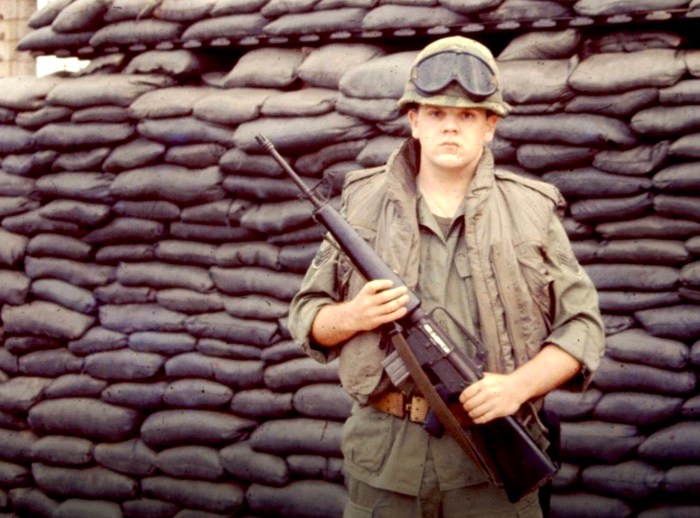
Ed in Vietnam in 1968

During daytime, they often needed warm bodies for crap details like sandbag filling, or riding shotgun on convoys, or just about any gritty, shitty job you can imagine. They would send a runner to wake you and tell you where to go and when to be there. It was a royal pain in the ass. As an NCO, I usually had to lead the details.

One time around May of ‘68, after being woken, I show up at the head-shed and am told to simply load the assembled troops into two pickup trucks and take them to the mortuary at Ton Son Knut. It is a large aluminum Quonset hut at the end of a taxiway on the northside of the runways, and away from the main base. We arrive at the mortuary and it is hot and miserable and all I am told is to “standby”.

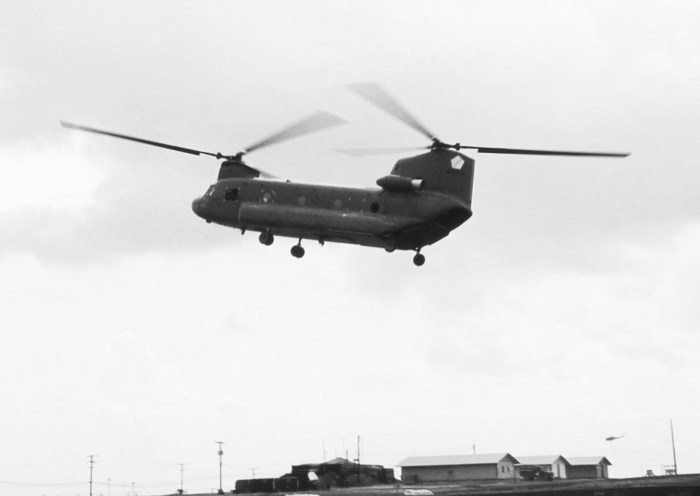
Time passes and a fire truck shows up and they know even less than we do. Finally, over the tower radio, we hear a helicopter being cleared to land near the Quonset hut. It is a big helicopter known as a Chinook. It is a twin-engined, tandem rotor, noisy beast, that throws up dirt, pebbles and small rocks in every direction.

Chinook Landing in Vietnam

Over the tower radio, we hear a request for the fire engine to move closer to the helicopter. After the fire truck moves, nothing happens for a while as the exhaust fumes from the JP4 fuel mixes with the hot humid air. It can overwhelm you, but strangely I have always loved that smell.

In the military, you learn to do a lot of standing around waiting for your orders. You learn patience and to deal with a lot of ambiguity. Time passes. Finally, and slowly, figures emerge from the Quonset hut a couple at a time. They are dressed in various colored medical scrubs and are all wearing scrub hats and masks. Some have rubber aprons and gloves on. They walk slowly, very slowly. They are not in any hurry to get to where they are going and are in fact meandering. I haven’t been told anything yet and the rest of my little detail knows better than to ask what is going on. We wait some more.

There are small conferences taking place, first with the crew chief, then the fire truck driver and then with the helicopter crew. Still not a clue. Then several of the folk from the Quonset hut wander back to the building at no better than a stroll. It is at least 100 degrees outside. We stand and wait for orders.

Finally, the folk reemerge from the hut pushing wagons and gurneys. The crew chief waves me over to the helicopter. I bend down even though the blades are 20 feet above my head. The noise up close is even worse and the crew chief screams in my ear. Something to do with my men and what is on the helicopter. I give him the classic palms up “what did you say” sign and he registers disgust and grabs me by the arm and takes me to the back of the helicopter.

The Chinook has a very large rear door/ramp. The crew chief is wearing a bulbous helmet and is tethered to the aircraft via a long cord plugged into the helicopter near the front access door. He keys his microphone and talks to the crew in the front, and suddenly the ramp starts to come down. He again grabs me by the arm and pulls me to the side.

I am not prepared for what happens next. Nothing could prepare anyone for what happens next. As the ramp touches the ground, multiple streams of liquid pour off the helicopter into the grass and dirt. I stare at it for a few seconds, before I realize the liquid is a dirty reddish-brown color. It still doesn’t register with me, when the crew chief grabs me again and pulls me further away from the aircraft. Two of the firemen, in full battle rattle, move in with a small hose and start to spray the ramp with a high-pressure stream of water.

The crew chief pantomimes to me to get my detail and bring them over. As I trot over to our pickup trucks, it begins to dawn on me what the red liquid might be. The troops are curious and have questions, but I put on my best “the NCO knows all, and does not need to explain himself to the troops” look, and tell them to just form up and follow me. When we get back, the firemen are exiting down the ramp from inside the helicopter and one of them takes a massive, both feet in the air, pratfall. We all instinctively laugh.

The crew chief grabs me again and screams directly into my ear, “Careful. It’s slippery in there. Just two guys to a bag, one bag at a time“. The guys in scrubs inch closer to the side of the helicopter with their gurneys and carts, but stop short of the back of the helicopter. I return to my waiting crew and not knowing what to say or how to give the order, I grab the first two guys and indicate to the rest to wait where they were. Again in an unneeded crouch, the three of us approach the ramp and start up. There are two corrugated metal tracks running up the ramp and they are wet. The first few steps make it clear there is no traction, so we step onto the inside of the fuselage and there it is only marginally better.

We make our way up the ramp grabbing hold of each other and anything else we can reach. It is comical and the crew chief calls us off and brings the firemen back. There is a long discussion and it is decided they are going to use a bigger hose and mix the water with some fire-retardant foam. There are pros and cons back and forth about the wisdom of this, but they decide to try it. The pressure from the larger hose is truly impressive and maybe the foam helps, or maybe it doesn’t. After 10 minutes, the fireman come out and we go back in.

We reach the top of the ramp and it takes several seconds for our eyes to adapt from the bright sunshine to the dark inside the ship. Then we see the body bags. They are piled like cords of wood on the deck and secured with brightly colored canvas straps connected to pinions in the deck. The crew chief brushes by us and begins to release the straps. The bags settle and spread out as each strap is released. There are probably six or seven bags to a pile, and there are multiple piles.

The three of us just stand there, staring with our mouths agape. The crew chief comes back to me and hits me on the shoulder and indicates I need to get started. My two guys grab the first bag and lift it. The body inside the bag is still warm and flexible and slides into more of a ball, which they have to lift higher. They raise their arms to near shoulder height for the bag to clear the ground. I watch as the two troops, who should have been asleep in bed, slither and stumble down the ramp. The crew chief hits me between the shoulder blades and indicates I am to take the other end of the next bag and we start out of the aircraft.

The first body is hoisted onto one of the gurneys and I get angry none of the folks in scrubs offer to help my guys. They just stand there. When we get close to the next gurney, I am ready to say something, then notice the look in their eyes. It dawns on me they are gearing up for the horror awaiting them, when they have to open these bags inside the Quonset hut. To us, they are still just messy bags, but to them, they would soon become bodies, soldiers, dead people.

I go over to my guys and tell them to follow me. We quickly set up an assembly line of sorts and it becomes clear we have to operate methodically so that every team takes the exact number of turns into the ship, grab the body bag, and then returns down the ramp. One trip for each of us and we became experts at this macabre parade. I wish I kept better track of how many bags we offloaded. My best guess is it was over thirty, but I can’t be sure. Some of the bags were suspiciously light. Was a small soldier inside, or was it just body parts? One of the guys later mentioned he thought one of the bags contained a dog.

It is all over in two hours. No one dismisses us, they all just leave. The firemen go back on the helicopter and spray the inside for a long time. When they are finished, the helicopter simply takes off. The firemen set out a canvas tub about 8 feet across and half-fill it with water and what looks like detergent. They step in it with their rubber boots and invited us to do the same. We step in and stomp around in our canvas jungle boots which immediately soaks our socks. After a few moments, one of the firemen releases a latch and the pool collapsed and empties. They throw it on the top of the truck and off they go.

We are now alone with no one to tell us what to do next. I’m 21 years old and the rest of the guys are about the same age, but I have one or two more stripes, so they looked to me for guidance, for direction, for orders. I have nothing.

We stand there for a few long seconds and then I say something like “who wants to go back to the barracks and who wants to go to the chow hall?”, and we split the two trucks up by destination.

The last thing I remember about the day is that as I prepared to go to work for my 6 PM shift, I took a shower and noticed my feet were pinkish. I had to wear those boots for quite a while before I could get a new pair and no matter how many times, I soaked them, they always seemed to have a stiffness to them.

Ed Meagher Today

I haven’t shared this story with too many people because it is normally not a place I want to go and it is still is a deep scar on my soul. But recently, because of my criticism of President Trump and my view that he wants to start a “wag the dog” war, a person questioned my love for my country and my unwillingness to support another war in the Middle East. All I know is someone has to stand up for all the PFC’s who will pay the price of old white men’s bloodlust, and who will end up in body bags.

Addendum:

Ed is the real deal. After his time in Vietnam, he eventually went to work for the VA, and helped his fellow veterans there for several years. After leaving the government, he continued to support veterans in other ways. 16 years ago, he and two other Vietnam vets started a charity to support veterans returning from Afghanistan and Iraq. It eventually became the Aleethia Foundation. You can find out more about it, and it’s mission at: https://www.aleethia.org

Feel free to share this blog…… https://mnhallblog.wordpress.com/2020/01/08/after-his-patriotism-is-questioned-a-vietnam-vet-reflects-on-war/

Perfectly Imperfect

I saw the pears in the grocery store a week ago, and on impulse, bought them. I don’t usually buy fruit out of season, but as I was looking at them, a phrase popped in my brain – “These are perfectly imperfect”, and I put them in my basket. They looked pretty good, although there were some blemishes on them.

Perfectly Imperfect Pears

At home, I started thinking about the phrase “perfectly imperfect” and what did I mean. And then I thought about “perfectly imperfect” and why did I use that instead of “imperfectly perfect”, and what was the difference. It was time for Google.

Google, of course, had an infinite number of things to say about perfectly imperfect as it pertains to pears, fruit, vegetables, lifestyles, and people. I explored a number of these rabbit holes. It turns out there are companies selling “perfectly imperfect” fruit, appealing to people against food waste, or people looking for a bargain, depending on the ad. There was another blog site titled “perfectlyImperfect”, with the goal of helping people with branding and home decor. These links didn’t seem to get at what I was thinking.

Then came links focused more on people. There was a HuffPost piece about “perfectly imperfect” and self acceptance. Several Psychology Today articles explored the idea, including – “We are designed to be perfectly imperfect.” Music explored the phrase, with John Legend singing “…Love your curves and all your edges, All your perfect imperfections…”. And finally, the Urban Dictionary provided: “when someone has feelings for you, they may tell you you’re “perfectly imperfect”, basically saying they accept your flaws, they like you enough that they see past your faults, a way of saying that you’re perfect to them.”

Now we were getting somewhere and I started thinking about perfectly imperfect more broadly.

I left the internet and looked back at my pears and realized what I really meant was the pears looked real, not artificial or plastic. They had experienced some bumps and bruises in their brief life. They may not look perfect, but they looked the way pears are suppose to look.

I sat there thinking about perfectly imperfect pears and people. I thought about how much time gets wasted looking for perfection, whether in food, friends, or ourselves. New Year’s Eve was almost here, and while I don’t normally make New Year’s resolutions, three immediately popped in my head and I wrote them down.

• First, I will continue to look for the “real”, in life, and try to avoid the artificial.

• Second, I will strive to do better in accepting people as they are, rather than trying to project my view of what “perfection” is on them.

• And finally, I will try and do better in accepting myself the way I am, warts, spreadsheets, to-do lists, and all. I’ll still try to improve, but I’ll also cut myself a bit of slack here and there.

I don’t know how I’ll do with these resolutions, but I’m going to give it my best.

When I first looked at those pears at the supermarket, I didn’t realize they would take me on a small journey of self assessment and awareness, but they did. As we know, insight can come to you from any number of different sources. You just need to be open to it.

All the best for 2020….

Addendum:

I didn’t go into “perfectly imperfect” versus “imperfectly perfect” in this blog. There’s a whole other discussion there. If you have a couple of hours to wander around the internet on a rainy day, go for it.

Sharing the Meaning of Christmas

My cousin, Janice Connell, shared this memory of Christmas love and joy with me. I helped clean up the writing, but it’s her own voice.

I moved to Arizona in October of 2013 to reunite with my father and my daughter. I didn’t have much in the way of furniture, dishes, or actually, anything I needed to set up a house. I’d left Illinois with a suitcase, my dog, Baby, who had lived with me eleven years, and the clothes on my back.

I was 53 years old and really wanted to live alone, something I had never had the chance to do over the course of my life. When I arrived, my dad and stepmom, Dorothy, took me under their wings. They set me up with a doctor and took care of me. They helped me find a place to live, and helped buy all I needed to live on my own. My dad and I went to rummage sales, where he and Dorothy bought me furniture, a bed, dishes, literally everything I needed for my own home. He would often stop by my new house with food and we would just sit and talk. It was nice.

I always remember that first Christmas in Arizona. I didn’t have much money and there would be no tree, or decorations in my new home. It was OK, as I was just happy to have a place of my own. I did have fun helping Dad and Dorothy decorate the Christmas Cactus they had outside their home, and that was enough for me.

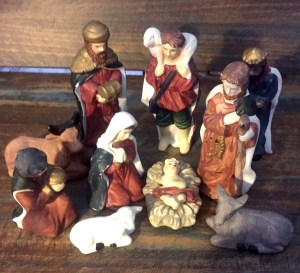
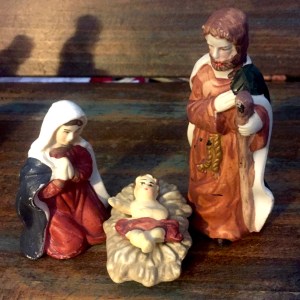
The Nativity Set from Dad

It wasn’t enough for my Dad, who knew I loved Nativity Sets. One day, as Christmas neared, Dad stopped by the house with a Christmas present and said I should open it right then. He was like a kid in a candy store beaming ear to ear when he handed me the package. I slowly opened the gift …. and …. he’d bought me a large Nativity Set! In addition to Mary and Joseph with baby Jesus, it had a barn and all the animals. There were three wise men and shepherds watching their flock. We put the set up together that first Christmas and I don’t think I’ve ever been as happy as I was that day.

I have had the set for six years now. I have loved it more each year and display it every Christmas, no matter what. The barn broke during a subsequent move, but I still put Mary and Joseph with baby Jesus out, along with the wisemen and shepherds. Mary and Joseph don’t seem to mind the lack of shelter.

Joy to the World!

Dad passed away in March and this is my first Christmas without him. I love him and miss him every day. He made sure I had everything I needed and a lot of what I just wanted. No one needs a Nativity Set, but it was important to me to have one, and he knew it. I love this Nativity Set, and will always remember the look on his face when he gave it to me in 2013. He knew the meaning of Christmas and how to share it.

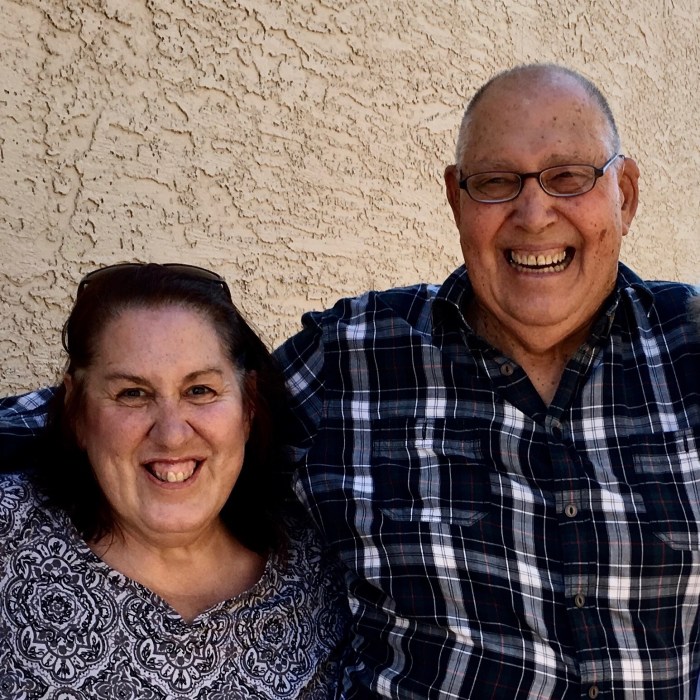
Pooch and Janice about 1 1/2 years before he passed away

Addendum:

Janice Connell is my second cousin, the daughter of my cousin Pooch. Pooch was one of those people you always remember. Halfway between my age, and that of my own father, he provided some insights and stories about my dad I only learned later in life. If you want to read more about Pooch, here are a few other blogs about him.

June 1944. Dad and Pooch on D-Day. https://mnhallblog.wordpress.com/2016/08/19/dad-and-pooch/

Pooch and Stickball in the ‘40s. – https://mnhallblog.wordpress.com/2018/03/27/stickball%EF%BB%BF/

Pooch – A Eulogy. https://mnhallblog.wordpress.com/2019/03/19/pooch/

A Different Kind of Christmas Story, Forty Years in the Making

It’s not so many miles from Ashkhabad to Kabul

My friend Tim said, “I was in Ashkhabad (Ashgabat) in June 1979, wondering why there was such a heavy Red Army presence in a sleepy place like that on the Iranian border. It was put together for me later in December of that year.”

Forty years ago, on December 24th, 1979, our current problems in Afghanistan began, when the Soviet Union invaded that country. As midnight approached on Christmas Eve, the Soviets organized a massive military airlift into Kabul. Within a few days, the Soviets had secured Kabul, but over time, they met with fierce resistance whenever they ventured into the countryside. For the next decade, the Mujahideen mounted a continuous, effective guerrilla campaign against the Soviets.

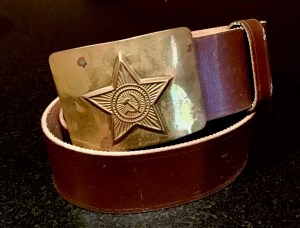
A Soviet era belt buckle from 1989

The United States became covertly involved in the war in Afghanistan, and provided about $3 billion in military and economic assistance to the Mujahideen. In addition to weapons, we provided school books, which on the surface sounds pretty nice; unfortunately, not only were the books anti-Soviet, they encouraged a jihadist outlook, and used guns and soldiers as a part of the text. One lesson instructed that only Muslims can rule Kabul, and Russians, and indeed ALL invaders, are nonbelievers.

In the late ‘80s, Al-Qaeda, under Osama Bin Laden, was born and supported the Mujahideen against the Soviets. As their situation continued to worsen, Soviet forces started withdrawing in 1988 and the last Soviet soldier crossed back into the USSR on February 15, 1989. Fifteen thousand Soviet soldiers were killed in those ten years.

The US walked away from involvement in Afghanistan during the 1990s, and with both the US and the USSR gone, a governing vacuum was created. In that vacuum, the Taliban formed in 1994. As a part of their work, they used the US provided text books to preach continued Jihad. Al-Qaeda also continued to grow in the ‘90s and began exporting violence outside of Afghanistan, culminating in the September 11th attacks in America in 2001.

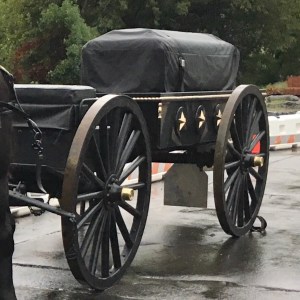
Another United States Soldier going to his final resting place

Most of us know the rest of the story. We are now in our 18th year of war in Afghanistan, the longest war in American history. More than 491,500 soldiers have served there, and at least 28,000 U.S. troops have deployed there five or more times, sometimes coming home with both wounds and PTSD. Approximately 2,400 US troops have died there, with another 20,000 wounded. This doesn’t include those who have committed suicide after they returned home. Presidents Bush, Obama and Trump have all said they “don’t want to be in the business of Nation building,”* and yet we remain in Afghanistan with no apparent end in sight. We’ve now spent $975 Billion on the war since 2001. How could those dollars have been better spent?

Although I said “most of us know the rest of the story” in the previous paragraph, it now turns out we didn’t know the whole story. The Washington Post recently published a series of articles about the war and how the American people were misled. The articles are based on “confidential government documents which … reveal that senior U.S. officials failed to tell the truth about the war in Afghanistan throughout the 18-year campaign, making rosy pronouncements they knew to be false and hiding unmistakable evidence the war had become unwinnable.”* While not quite The Pentagon Papers, the interviews are equally as damning about our involvement in Afghanistan, and again raise the question of what are we doing there? How long have we known we shouldn’t really be there? As a veteran, I’m saddened to see we have been given only half-truths. When I was at West Point, a part of the Cadet Prayer included “never be content with a half-truth when the whole can be won.” Once again, we have fallen short as a country.

An early winter’s day at Arlington National Cemetery

In addition to our country misleading us, the sad fact is, most Americans just don’t give a damn. With the average American having no skin in the game, their focus is elsewhere. We have no draft, no national service, and we’ve funded much of the war with deficit spending. There is no reason to care.

Afghanistan has long had a reputation as “The graveyard of empires”. Alexander the Great, the Arab Caliphate, and Genghis Khan all crossed that land in ancient history, without impact. Both the British and the Russians have tried their hands there and failed. After 18 years, 2,400 American deaths, the deployment of hundreds of thousands of troops, and nearly one trillion dollars in spending, maybe, just maybe, it’s time to come home.

Merry Christmas to you, and to the over 12,000 troops who remain in Afghanistan.

Addendum:

• * Both sets of quotes come from the Washington Post.

• I know it’s a bit ridiculous to try and sum up 18-40 years of history in 1,000 words or so, but felt it was worth trying to do.  I realize what I’ve presented here is incomplete and doesn’t go into many aspects of either the Soviet war in Afghanistan, or our own.  Having said that, I feel the bottom line still prevails – what are we doing there, and when are we coming home? By the way, the $975B we’ve spent is only the DoD money. It doesn’t include money spent by the CIA, VA or other agencies.

• Special thanks to Tim Stouffer for providing both historical and current information for this blog.  I’ve know Tim since 1st Grade, and he is one of my oldest and best friends.  He is an amateur historian, and knows more about Russia and the Soviet Union than anyone I know. In the ’70s and early ’80s, he travelled to the USSR multiple times.  His additonal recollections from his trip to the USSR in 1979: “Ashkhabad was just part of the trip in ‘79. We flew in from Baku on an old 2 prop Ilyushin12/14 that was a copy of a DC 3. We flew across the Caspian Sea, and if that did not scare me nothing in the air has bothered me since. There were soldiers all over and the 20 of us stood out. Supposedly we were first US student group to visit and were treated like kings compared to other places. It is also where I rode the camel 🐪. “

• Ashkhabad was from 1924 to 1990 the capital of Turkmenistan, in the USSR.  When Turkmenistan became independent,  they officially adopted the Turkmen version of the city’s name, Ashgabat In 1992.  I kept the name as Ashkhabad for this blog, keeping it consistent with Tim’s telling of events in the 1979 timeframe.

• Thanks to my friends Michael McClary and Colleen Conroy for providing much needed editorial assistance on this blog.

Skating at Varland’s Pond

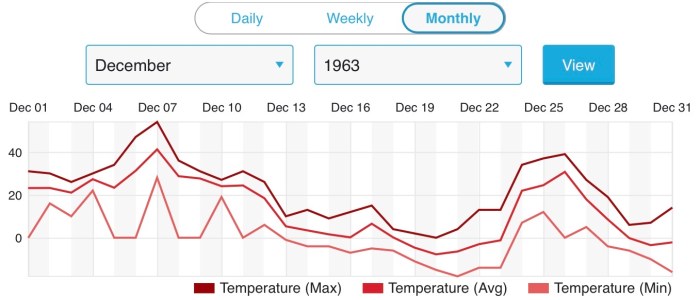
December of 1963 was cold in Ottawa, Illinois. The average temperature was 13 degrees, and it was as low as -18. This was cold, even by Illinois standards. I was in Third grade and my sister Roberta was in First. Our youngest sister, Tanya wouldn’t start kindergarten for one more year. Mom bundled Roberta and I up every morning and we’d walk the half mile to McKinley School together. Big brothers and younger sisters always have an interesting relationship – when we weren’t fighting, I like to think I was pretty protective of ‘Berta.

With the cold, the pond at Varland’s cow pasture, a block from the house, froze solid and after school, we kids went there to play on it. (Varland’s pasture later became Varland Park, and the pond was in what is now center field of the second baseball diamond). A few of the older kids had ice skates, but us younger ones just slid around the ice in our boots. That was about to change.

The Winter Olympics in Innsbruck, would start in January of ‘64. There was lots of talk of skating and skiing in the news and on TV. There was a young 16 year old by the name of Peggy Fleming who was particularly creating interest in figure skating. It spiked an interest in the winter sports, and lots of kids were hoping for skates on Christmas morning.

Christmas came and the three of us kids tore open our presents. Roberta and I were both excited to receive skates and wanted to head to the pond immediately to try them out. Common sense (and mom) prevailed, and we finished opening our presents and had breakfast. Then it was time to go.

We bundled up, grabbed our skates, and ran to the pond. It had snowed the night before, so Dad came along with a shovel to clear the pond surface. We arrived, and a couple of other kids were already there skating. As dad slid around with the shovel clearing the snow, Berta and I shucked our boots and tied on our new skates. Roberta finished first, stood up and skated off with hardly a wobble. She moved with ease and skated around the pond. Then it was my turn. I stood up and whomp! Down I went. Up again, a step or two and whomp! Down I went. I was like an extra in a Laurel and Hardy movie – you know the guy with arms and legs flying all over the place before comically falling to the ground? That was me.

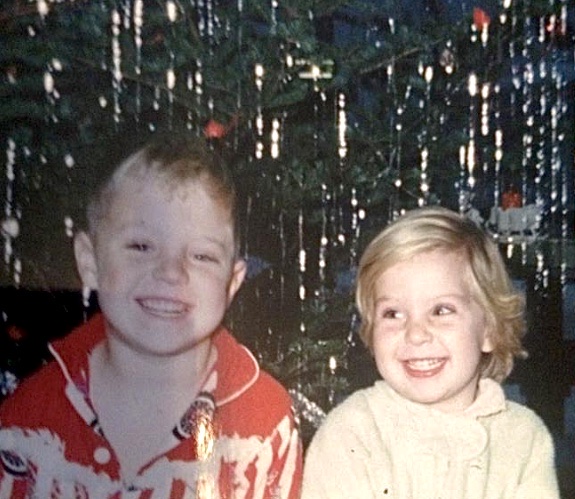
Roberta and I at Christmas, a few years before she kicked my ass ice skating

Roberta, of course, had figure skates, while I had hockey skates. The thinner blade of the hockey skates, combined with the lack of a toe pick was causing me problems. The fact I was always a bit clumsy as a kid didn’t help any either. Dad went back home, while Berta and I stayed at the pond. The morning went on and Roberta continued to skate beautifully. Me? I finally started to move and could skate across the pond, although turning and stopping were still a problem. Eventually, it was time to go home and get ready to go to Grandma and Grandpa’s house for Christmas Dinner. We changed from our skates back into our boots. Our feet were frozen blocks of ice and it was hard to walk at first.

Over the coming months, the weather stayed fairly cold and we skated many times. After school, we’d head to the pond, but on weekends dad took us to the slough from the Illinois River on the East Side, or downtown to the Illinois & Michigan Canal. The canal hadn’t been used for boat traffic in decades, and the city flooded one section to make a skating rink. My skating finally improved and I was able to join in with the pick-up hockey games going on. Roberta continued gliding effortlessly around the ice with the other girls. At the canal and the slough, there was an added bonus, as there was usually a fire built on the edge of the ice where you could warm up.

I remember skating at the slough and the canal that winter, and the fun we had with all the other kids. But my lasting memory was skating at Varland’s Pasture on Christmas Day. In my mind’s eye, I still can see my younger sister Roberta looking like Peggy Fleming gliding across the pond that morning. She sure didn’t need any protection that day.
Addendum:

Thanks to Roberta for contributing to this blog. She and I have almost exactly the same memory of that Christmas morning – her gliding off, and me stumbling all over the place. It’s actually eerie how identical our memories of the morning are. You’ll have to ask her if she was secretly laughing at her older brother….;-)

Peggy Fleming finished in 6th place in figure skating at the Innsbruck Olympics. Four years later, she would win gold at Grenoble, France. She was the only American to win a gold medal in ‘68.

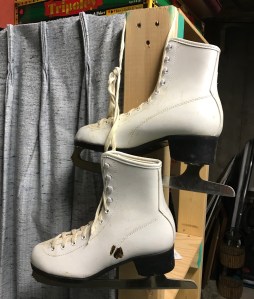
The skates in the picture are Roberta’s from later in life. When she had her own children, she bought them skates one year for Christmas. She bought herself a pair as well. They currently hang on a nail in her garage

This graph shows the daily temperature readings in December ‘63. It really was quite cold. It looks like it warmed up a bit on Christmas Day.

Grandma’s Date Nut Bread

I still remember Grandma Grubaugh’s Date Nut Bread and how wonderful it tasted at Christmas time. It was always good, but if you were there when she pulled it out of the oven, you’d cut off a slice, put a knob of butter on it and watch the butter melt into the bread. It was delicious.

Grandma made the bread at both Thanksgiving and Christmas. Talking with my sisters and cousins, we all loved her bread in our youth. Not only did it taste great, it looked different than other nut breads. First, there was the color – it was a rich dark brown, unlike the light brown of most nut breads. And second, Grandma’s loaves were round, which made it more fun than a regular loaf of bread. Years later, I learned the secret behind both of those differences.

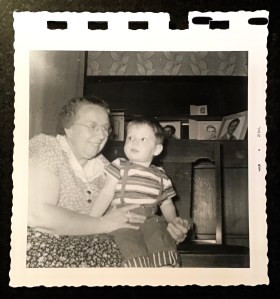
Grandma and I at Christmas in 1956

When we were young kids, Christmas dinner was at Grandma and Grandpa’s house. In addition to turkey and all the trimmings, Grandma’s Date Nut Bread was served. Later, after grandpa died, mom and dad, and the other uncles and aunts hosted Christmas at their own homes. Sometimes we were all together, but eventually, each family held their own Christmas. Grandma went to a different home each year, but always delivered a loaf or two of the Date Nut Bread to everyone’s house ahead of time. They arrived frozen and wrapped in aluminum foil. All you needed to do was thaw it out.

Time passed. I went away to West Point, and then the Army. Any time I was home, I’d stop by to see Grandma. Usually, it was during the holidays, and she’d pull out a loaf of Date Nut Bread, butter, and a glass of milk for me. We’d sit at her kitchen table and talk, while I ate a slice (or three) of the bread. I always told her how much I enjoyed the bread, and would love the recipe. She’d say “I hain’ta gonna give it to you now, but I will one day.” (“I hain’ta gonna…” was one of Grandma’s all time famous phrases. Grandma spoke well, but, “I’m not going to” wasn’t in her vocabulary. Neither was “I ain’t going to”. It was “I hain’ta gonna” pure and simple.)

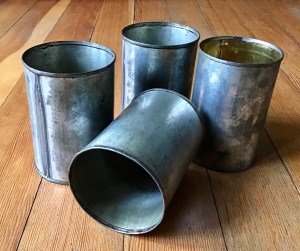
Four of Grandma’s “Baking Cans”

“One Day” finally came, around Christmas 1989. We’d returned from Germany and I hadn’t seen Grandma since we departed in 1985. We hugged each other and I sat at the kitchen table. She brought me some of the Date Nut Bread and a glass of milk. As we talked, she got up from the table, went out on her porch, and returned with 4 empty vegetable cans with the labels removed. She handed the cans to me, along with a piece of paper with the recipe on it. The empty cans were what she cooked the Date Nut Bread in. Years ago, Grandpa had filed the open edges of the cans down until they were smooth and Grandma used them to make the bread.

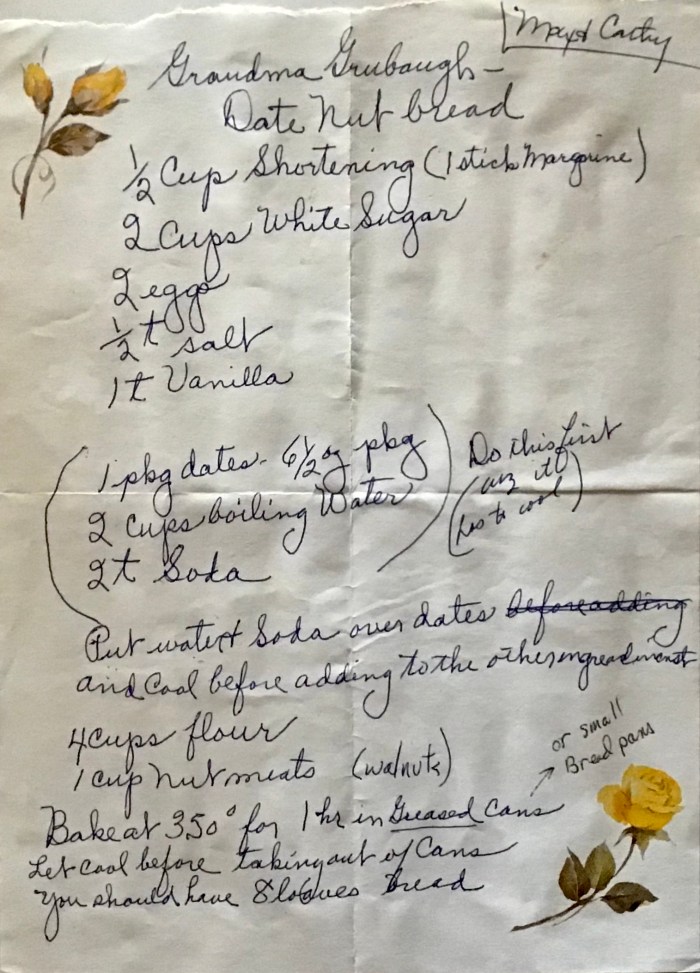
I baked the bread for Christmas at my mom and dad’s house that year. Looking at the recipe, I realized why the bread was such a dark rich color. Grandma soaked the dates in hot water, before adding the water to the recipe. This turned the water a dark brown color, which then colored the whole loaf. Grandma pronounced my version of the bread “pretty good” when she came for Christmas dinner. That was about the best compliment you received from Grandma.

Grandma’s Date Nut Bread recipe… including “Nutmeats”…

Lillian Henrietta Grubaugh died in December, 1996. She was 91 years old. I’ve made the recipe off and on over the years, and never fail to think of Grandma. Like Ebenezer, we nostalgically remember Christmases past, particularly from our youth. Often times, rose colored glasses are involved. That’s not the case with Grandma’s Date Nut Bread – It’s still delicious after all these years. With lots going on in our lives these days, I’m feeling a bit nostalgic myself and I plan to add some Date Nut Bread to our Christmas festivities this December. I’m sure Grandma will be there with me, while I’m baking the bread.

Addendum:

– Note the recipe makes 8 loaves. When Grandma gave me the 4 cans, she was holding onto the other 4 cans. I believe she told me she was going to give them to to my cousin Janice, but when I recently spoke with Janice, she didn’t have them. I don’t know if someone else ended up with the cans, or they were thrown away after she passed away. They were in a box on her back porch, and someone may have confused them for trash.

– A couple notes about the recipe – I use butter instead of the shortening or margarine called for. The recipe halves nicely, if you only have 4 cans or 4 small loaf pans. You could cook it in a regular bread pan or 2, but I’m not sure of how much time it would need to bake. Probably a bit more than an hour

– Thanks to Cathy, my sister Roberta, and my cousins Janice and Don for adding to parts of this story. They definitely filled in details, and confirmed some of my impressions from back then.

Gaining Nine Pounds in a Day

It’s not easy to gain nine pounds in a single day. It requires a bit of focus and dedication to make it happen. I did it on Thanksgiving Day of my Plebe year at West Point.

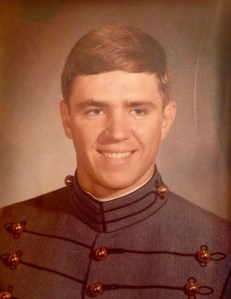
My Plebe Picture…

I had reported to West Point at the start of July that year. As a Plebe, you were under what is known as, the Fourth Class System, which prescribed everything you could and couldn’t do. One part of the system specified how to eat your meals in the dining hall. As a Plebe, you were required to eat meals while sitting ”at attention.” You sat on the edge of your chair, with back erect and your hands in your lap. Your “beady eyeballs” focused on the West Point crest at the top of your plate. As you ate, you put a small bite of food on your fork, transfer the bite to your mouth, put the fork back on your plate, put your hand back in your lap, and only then start to chew your food. Once you swallowed the bite, you could repeat the process. Of course you were in trouble for taking too big of a bite, not chewing your food enough, starting to chew before your hand was back in your lap…. you get the idea. Plebes tended to stay a bit hungry.

Now, if you were a member of an Intercollegiate team, you sat at a table with the other members of your team. The upperclassmen at your table let you eat like a regular person, fostering team unity, while also serving as something of a reward to the Plebes who made the team.

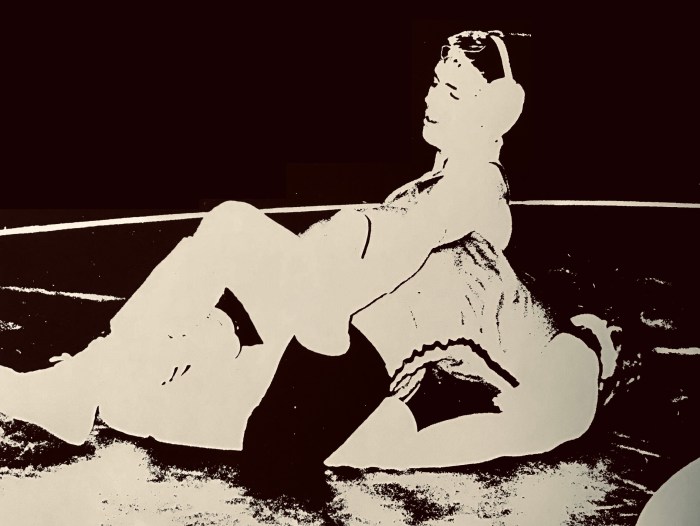
In September it was announced they were holding Plebe tryouts for the Wrestling team, and if interested, report to the gym on a certain day. In high school, I’d wrestled for four years and did well enough to Letter, but that was about it. Wrestling in college had been the last thing on my mind. Given the Fourth Class system, I decided to give it a shot and reported to the gym on the given day. They paired you with other Plebes your size and you wrestled. If you won, you came back the next day for a second match. The first day, I pinned the guy I wrestled. I came back the next day and amazingly, pinned my opponent that day as well. Evidently, I found food a powerful motivator. Two weeks later, they notified me I made the team. Life was about to get better.

On October 1st, after three months of eating at attention as a beanhead, I reported to the Corps Squad (Intercollegiate) wrestling tables, and started eating like a human being. This was great, except for one small problem. For any of you who have been around wrestlers, you know we are almost constantly trying to cut weight. At the time, my natural weight was about 174 pounds, but my wrestling weight class was 157. My weight was down a bit as a Plebe, but getting to 157 still meant dieting most of the time. You can see my problem – although I was finally able to eat normally, now I couldn’t eat as much because I was trying to cut weight. I had created my own Faustian dilemma.

Wrestling Practice….

Time passed and I was cutting the weight. By mid-November I was around 157, sometimes a little above, sometimes a little below. Thanksgiving Day arrived and we had practice in the morning. I weighed out after practice at 156 1/2 pounds. Coach told us to take it easy, and not overdo it. I heard what he said, but it must not have sunk in.

Later, our Thanksgiving meal was served and I ate, and ate, and ate some more. That night, I was still hungry and ate leftovers and snacks. Friday came and boom, boom, boom, I was like a locomotive engine needing to be stoked with more and more food. I pigged out at both breakfast and lunch. That afternoon, we had practice and unfortunately coach was there for our weigh in before practice. He put the scale at 157 and it didn’t budge. He slid the weight right, and there was no movement. Further right… further right…Finally, at 166 pounds the scale balanced out. Coach looked at me. I looked back, wisely choosing to say nothing. He started to ream me out, then stopped and just said “go.”

I chuckle when I tell the story now. I have no idea why I went on the eating binge. My guess is there was some mental reaction to being away from my family and home on Thanksgiving for the first time, but I don’t really know for sure. I’d certainly gained 3 or 4 pounds overnight while wrestling, but 9+ pounds was something new for me.

As a Plebe, even with cutting weight, sitting at Corps Squad tables was infinitely better than sitting at regular company tables. For that, I’ll always be grateful to the sport of wrestling. It also gave me a piece of trivia I occasionally pull out for laughs – I mean, how many people can say they gained 9 pounds in a single day?

Addendum:

– I wrestled in a couple of matches my Plebe year, but mostly I served as a practice partner for varsity guys. As a Yearling (Sophomore) I decided not to rejoin the wrestling team. I knew I’d never really be a good wrestler at the college level, and there were many other, and perhaps better, ways to spend my time.

– My name was evidently captured on a list of West Point Wrestlers somewhere in an archive. About 5 years ago, I started receiving monthly updates on the status of the current Army Wrestling team. The current teams look much bigger and better than anything I remember.