Selling Hindenburgers

Selling Hindenburgers

It was May of 1980 and we were stationed in Würzburg, Germany. My company commander, Captain Tom German, called me into his office. With a smile, he said he had a job for me. Our unit, the 123D Signal Battalion was tasked with running the hamburger stand for the upcoming Third Infantry Division (3ID) Bierfest. It would be my job to manage the hamburger stand.

What!?!?!? I was pissed. I hadn’t gone to West Point, joined the Army and deployed to Germany to run some damned hamburger stand. I was there to defend America and fight the Russians. I started arguing with Tom, and he stopped me. Our Battalion Commander, LTC Ben Swedish, had selected me and I had no choice, unless I wanted to discuss it with the Colonel. I sat and didn’t say anything. He looked at me and said “You’d better start. It begins in just a couple of weeks”.

I went to our platoon bay and told my platoon sergeant, SFC Paul Teague, the duty we’d drawn. He laughed and wanted to know if we‘d get free bier. The next day he sent a detail to a warehouse at Division Headquarters to inspect our booth. It was filthy and the paint was worn.

We repainted the booth, but where a big sign said “Hamburgers”, we changed it as something of a joke to “Hindenburgers”. We were stationed at Hindenburg Kaserne (Barracks) in Würzburg. Built in 1935 prior to WWII, the Kaserne was named for Paul von Hindenburg, a WWI German Field Marshall, who was later elected President of the German Reich in 1925. He was known for calling Hitler “the little corporal” *, but was also the German President who appointed Hitler Chancellor in 1933, before dying in 1934. Sergeant Teague and I both thought it was a pretty good joke and double entendre.
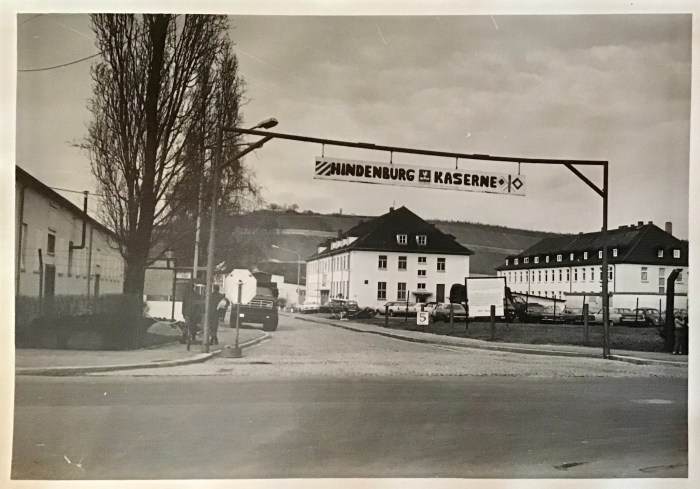
The Main Gate at Hindenburg Kaserne

In mid May, the 3ID Bierfest started, and for the next ten days, my duty station was at the Fest. It was crowded with both Germans and Americans, particularly in the evening and on the weekends. In addition to the bier tent, there was a carnival, and numerous food stands, including ice cream, corn on the cob, bratwursts, and of course our Hindenburgers.

At the time, there were no fast food places like McDonalds or Burger King in Germany, and German restaurants didn’t serve an equivalent to a hamburger. In fact, the Germans didn’t really have the concept of an American hamburger. It didn’t matter – the Hindenburgers were a big hit. We served regular Hindenburgers and also Hindenburgers mit Käse (Hamburgers with cheese). There was always a line, and as the night got later, the line grew longer. Based on the jokes from some of the Germans, I think they appreciated the humor of eating Hindenburgers as well.

Over the course of each day we rotated several crews of soldiers through the stand. Sergeant Teague or I were always there supervising, watching the till, and getting more supplies as needed. It was hot work, and we bought the occasional round of bier for the troops as they worked the griddles.

A bier mug from the 3ID Bierfest

Each night about midnight, as we closed and the troops finished cleaning up the grill, I’d make my way to the festival headquarters, and turn in the day’s cash, along with the paperwork covering the inventory used. The accounting was a bit of a pain in the ass, but Sergeant Teague and I were both sticklers ensuring the money and inventory tied out. We didn’t want, or need, any issues at the end of a long day.

After ten days, the fest ended, and I completed the final accounting and paperwork. My troops broke down the stand, and returned it to the warehouse. About a week later, we went on alert and deployed on an exercise to a classified location a few klicks from the Czech border. I was happily back in my element, and promptly forgot about Hindenburgers, and the hamburger stand.

A few days after we returned from the exercise, I was called to LTC Swedish’s office. When I reported, he asked me to take a seat and then pushed a piece of paper across the desk. I looked at the paper – it was a Letter of Appreciation from our Division Commander…. for running the Hamburger stand. I was commended for “selling Hindenburgers in record numbers….” I started laughing, when LTC Swedish held up his hand and said “let me tell you the rest of the story”. It turned out the previous two years the hamburger stand was run by other units in the Division. In both years, inventory and dollars didn’t match up. Money was lost and inventory unaccounted for. Needless to say, there were many unhappy people.
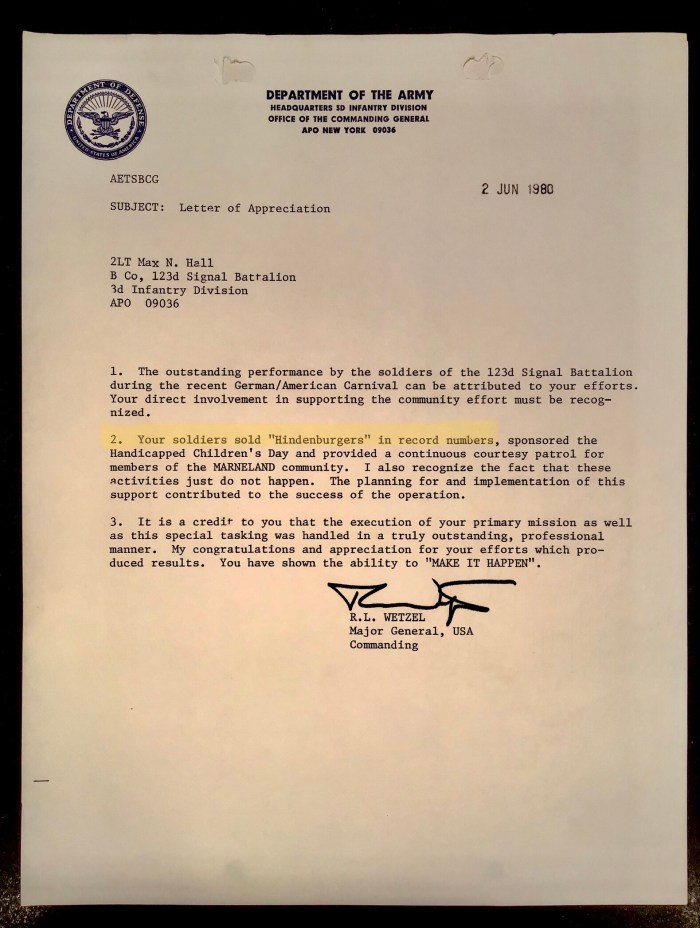
Your soldiers sold “Hindenburgers” in record numbers….”

Colonel Swedish thanked me for my efforts, and thanked me for keeping him out of hot water as well. We shook hands, and I left his office. That was that… sort of. When I received my final fitness rating from him, it could not have been any better. Coincidence? Maybe.
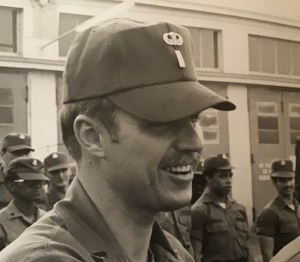
LT Hall, a couple weeks after the Bierfest

I’ve found you learn lessons in many ways throughout your life. I was lucky to learn this one early on. No matter the job you are given, do it well. If you screw up a small job, how can your boss(es) trust you with anything bigger? Do the best you can, no matter the job…even if it’s just running a hamburger stand at a bierfest.

Addendum:
  • I was lucky to have SFC Teague as my first Platoon Sergeant. I learned a lot from him.
  • In my business career, as I became a Vice President, and then a Senior Vice President, I would tell this story to new hires and recent college graduates impatient to do bigger, “more important” things than whatever job they were hired for. More than a few came back and thanked me later in their careers.
  • * At various times it is said that Hindenburg called Hitler, “the Austrian corporal”, “the little corporal”, or “the Bohemian corporal“. I chose to use “the little corporal” here, as there is no doubt that Hindenburg meant the phrase as a slap and a put down to Hitler.
  • Hindenburg is actually a fascinating person. He had near dictatorial powers for the last couple of years of WWI. He relinquished those at the end of the war, but was elected president of Germany in 1925. In 1932, he was re-elected President, over Adolf Hitler, whom he detested. Unfortunately, in January 1933, he felt compelled to appoint Hitler Chancellor, as Hitler controlled a plurality of the votes in the Reichstag through the Nazi party. The 1932 election was the last free election in Germany until 1949, and the last free election in a unified Germany until 1990. You can learn more about Paul von Hindenburg here: https://en.m.wikipedia.org/wiki/Paul_von_Hindenburg
  • You can learn more about Hindenburg Kaserne here: https://en.m.wikipedia.org/wiki/Hindenburg_Kaserne
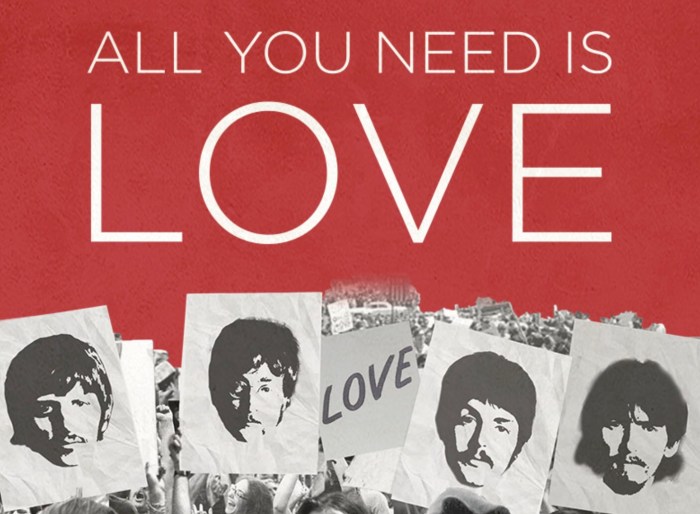
  • The Beatles got it Wrong

    All you need is love

    All you need is love

    All you need is love, love

    Love is all you need

    The Beatles, and The Summer of Love

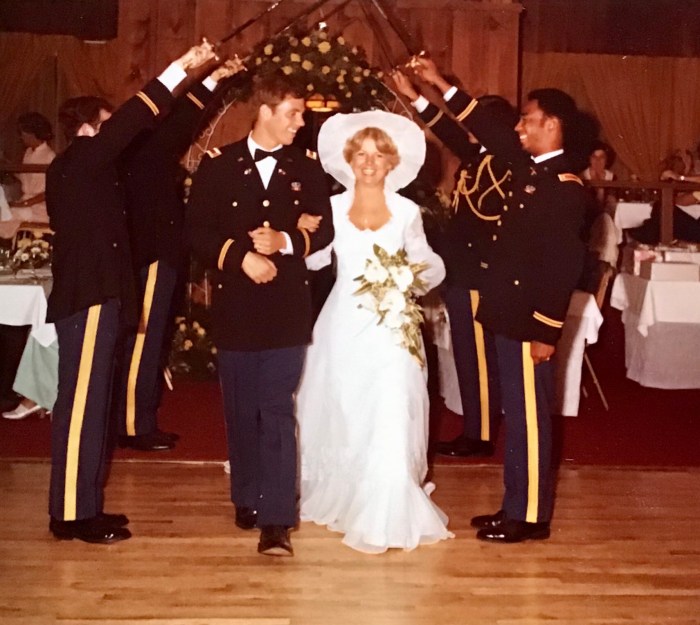
    With apologies to John Lennon, The Beatles got it wrong. Love isn’t all you need, at least when it comes to marriage. Cath and I are celebrating 42 years together on June 16th and love remains at the core of our marriage. Having said that, while we all know love is required, it’s not sufficient. Work, forgiveness, communications, growth, and having fun are perhaps less sexy than love, but all are a part of what makes our marriage work.

    June 16th, 1978

    Like all good things worth sacrificing for, successful marriages take work. Sometimes, one of you works harder than the other, and that’s OK. Over the lifetime of the marriage, it will balance out.

    You must be able to forgive your partner and yourself when the inevitable mistakes happen. We are only human, and we all make mistakes, some big, some small. Don’t hold a grudge agains your partner, or yourself.

    Marriage doesn’t go far without open and honest communications. You shouldn’t lie and you shouldn’t quibble. As with a house built on a foundation of sand, a marriage built on lies will crumble.

    Cath and I aren’t those same youngsters who married at 22 and 23 years of age. We’ve both grown and changed over the years. The world isn’t static, and hopefully you aren’t either. Recognize change is inevitable, and welcome it.

    Finally, you need to have fun along the way. If the two of you aren’t enjoying life, and taking advantage of the good times when they happen, what’s the point? It’s OK to smile, it’s OK to laugh, and it’s definitely OK to have fun, even, and maybe especially, when things are tough.

    Just another fun day in the Hall household

    By the way, this “list” didn’t just magically appear to us on day one. There have been lots of lessons learned since June 16th, 1978, some fun, some easy, some hard, and some painful. They all add up to a lifetime of love together and I wouldn’t trade any of it.

    I’ll pass on one more secret – you need to figure out what works for your marriage and make it your own. Love is key to our life, and work, forgiveness, communications, growth and fun are all important for us. My guess is your own list is a bit different. All you need is love, and a few other complementary values…

    … Love you hon – here’s to many more years together …

    PS…. I do think your salads are better than mine….

    Addendum:

    “All you Need is Love” was of course about much more than marriage. Here’s some additional info on it’s release, from Wikipedia: “All You Need Is Love was released as a single in July 1967. It was written by John Lennon. The song was the Beatles’s contribution to Our World, the first live global television link, for which the band was filmed performing in London on 25 June. The program was broadcast via satellite and seen by an audience of over 400 million in 25 countries. Lennon’s lyrics were deliberately simplistic, to allow for the show’s international audience, and captured the ideals associated with the Summer of Love.” Of course over the years, it’s become a wedding/couple love tribute, and popularized in such movies as: Love Actually and Moulin Rouge, among others.

    I am Number 35,591

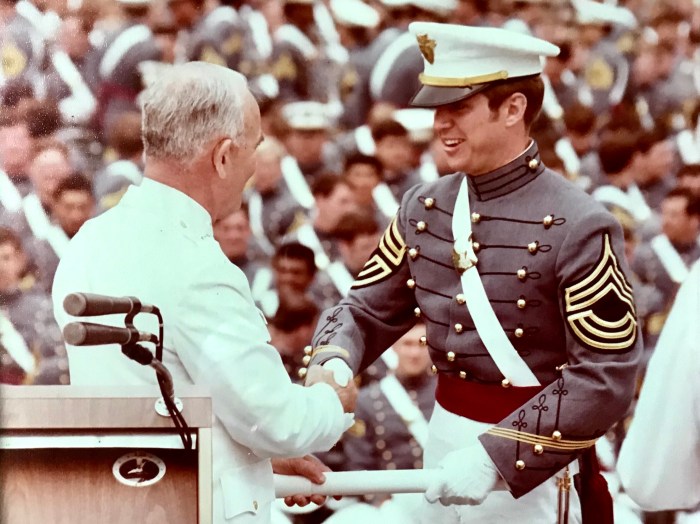
    I’ve always believed in the American Dream. June 7th, 2020 is the 42nd anniversary of my graduation from West Point and I often tell the story of how attending the United States Military Academy (USMA) recast my life. Growing up middle class in the American Heartland, I worked hard in high school, and was lucky enough to earn an appointment to the Academy. While there, I was diligent about my studies and graduated in 1978. My persistence paid off, and it literally changed the course of my life, leading to successful military and corporate careers. I was able to achieve my version of The American Dream.

    Most people aren’t aware, but every graduate of West Point is assigned a “Cullum Number”. The Cullum Numbering system started in 1802 with the very first graduate, and continued with numbering every single graduate through the years. When I graduated from West Point in 1978, my Cullem Number was 35,591. That is, in the 176 years of the Academy’s existence at the time, I was the 35,591st graduate.

    June 7th, 1978. The 35,591st Graduate of West Point.

    Prior to 1978, do you know how many African American graduates West Point produced? Fewer than 300. Let that sink in. In 175 years, out of 35,265 graduates (through the class of ‘77), there were fewer than 300 black graduates from USMA.

    White Privilege is a real thing. Sometimes, we don’t think about white privilege happening, until well after it actually occurs. Without a doubt, I worked hard to get into West Point, worked hard at the Academy, and continued to work hard after I graduated. That doesn’t mean I wasn’t also the beneficiary of White Privilege. These two things can both be true at the same time. I’m proud of graduating from West Point and happy for the life-path graduation afforded me. As I’ve become older, I’m also more aware of some of the circumstances which enabled my opportunity.

    We need to be aware of and confront racism, no matter its guise. Certainly the horrific murders of Ahmaud Arbery and George Floyd are overt examples and must be dealt with. We also need to look at our own lives and gain an awareness of who we are, and how we got to where we are. The American Dream should be something all of us can strive for.

    Feel free to share this blog.

    Addendum:

    ⁃ Thanks to my West Point classmates Stan Ford and Chuck Allen for their input and contributions to this blog. Both are teachers – Stan at a Junior High School in Syracuse, NY, and Chuck at the Army War College. They are men I deeply respect.

    ⁃ If you want to learn more about African American graduates of West Point, Chuck has written a great article. When WWII started, there were only four African American graduates from the Academy, and only two African American active duty line officers in the Army. Here’s the article: https://www.army.mil/article/40763/the_legacy_of_henry_o_flipper_in_the_u_s_army

    ⁃ I’ve written three other blogs about race relations. I have to say, they don’t appear to do much good. You can find them here:

    ⁃ If you wish to learn more about Cullum Numbers, you can find information here: https://www.westpointaog.org/Cullum

    Mrs Thelma Finkeldey

    I fondly remember my First Grade teacher, Mrs Thelma Finkeldey, along with her purple hair. She was an influence I’ve never forgotten, even though First Grade ended fifty eight years ago, in 1962. From grade school through grad school, I had a number of teachers. Many were good, some were bad, and several were forgettable. A few were special. Mrs. Finkeldey was one of the special ones. All teachers should have such a lasting impact on their students.

    She was one of a kind for many reasons, but the first thing you noticed was her hair. It was purple, or green, or pink, changing with regularity. It turned out her younger sister was a cosmetologist in Ottawa and dyed Thelma’s hair different colors. It was pretty amazing, and made her stand out among the other teachers, who all seemed staid in comparison. We kids thought it was great, although I don’t know what the other teachers made of it.

    More importantly, she made school fun. Learning was always an adventure in her class, no matter the subject. I remember one exercise which went on over several days, or weeks. We made the classroom into a “city” and each of us had a different job. Each of us made our office out of a book cover and set it on our desk. I was the radio broadcaster. My friend Howard was the banker, and cut up the money we could use at Ralph Syverson’s pizza parlor. As the Fire Chief, Leonard kept us all safe. Looking back, I’m sure we learned about math, money, working together, jobs, and any number of other subjects. At the time, it just seemed fun. Amazingly, my mom saved the book cover for ABCD Radio Station and gave it to me several decades later.

    ABCD Radio Station was on the air in 1961-1962

    We also performed plays in class. Sometimes “live”, sometimes with puppets. Howard and Mooie (Mary) both distinctly remember performing in Sleeping Beauty. Howard was horrified when he learned he needed to kiss Sleeping Beauty (Mooie) to wake her. Seeking help from Mrs Finkeldey, she advised him to fake it. Howard air-kissed Mooie from about a foot away…. 😉

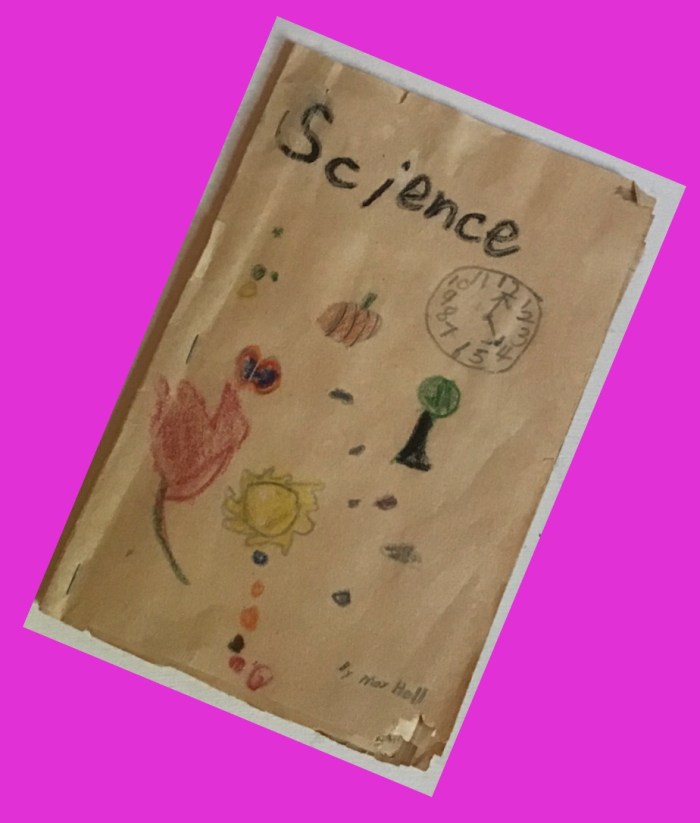
    And while we focused on reading, writing, and ‘rithmetic, I also distinctly remember science “classes” in first grade. I think even us kids were aware of the Space Race with the Soviet Union. On February 20th, 1962, a little over halfway through our school year, astronaut John Glenn became the first American to orbit the Earth. Mrs Finkeldey talked about Glenn, and taught us about the solar system and the (then nine) planets. If memory serves me correctly, there was a mobile of the planets hanging in the classroom. Combining current events and science for first graders….who knew?

    The “book” on Science I created in First Grade

    When I completed First Grade in June of 1962, Mrs. Finkeldey, sent a promotion letter to my parents. You can see in the letter she starts by mentioning “Kieth has made excellent progress…”. I assume since she used my correct name the next four times, I really was promoted. ;-). Joking aside, it amazes me that I have such clear memories of First Grade. I have to believe she is the reason.

    Evidently, both Keith and Max were promoted

    I moved on to Miss Williams and Second Grade the next year. Mrs Finkeldey moved on as well. Prior to coming to McKinley, she previously taught in Effingham and Rockford, Illinois. She moved back home to Ottawa after her husband passed away, and only taught at McKinley a year or two, before retiring as an Illinois teacher. She left Ottawa after our year, and moved to Gary, Indiana, A few years later, while teaching Third Grade in Gary, she had a student by the name of Michael Jackson. Yes, that Michael Jackson.

    Mrs Finkeldey with Marlon and Michael Jackson

    Several years later in 1976, Mrs. Finkeldey passed away at the age of seventy. She is now buried in Effingham.

    I was recently thinking about Mrs Finkeldey and some of my other “special” teachers over the years. People who were influencers, or motivators, or later, mentors. It seems a bit silly to reminisce about First Grade, and yet, Mrs. Finkeldey has stayed in my memory, while other teachers have faded away. Talking with some of my old classmates, they too remember her, and not just for her colorful hair. People remember math classes, learning to read, and the teaching and singing of Christmas songs as the holidays approached. A couple listed her as one of the influences in becoming a teacher. Other friends became involved in acting. And me? I’ve had a lifelong interest and belief in science. Although never a scientist, I became an engineer, and I can’t help but think Mrs Finkeldey was one of the reasons.

    This year, with the CoronaVirus, we all know school ended differently for most kids. Distant learning became necessary, with physical classroom time eliminated. I know most parents carried a heavy load ensuring their children were educated over the last several months. My hope and bet is there were also several Mrs. Finkeldeys keeping school fun and interesting, no matter the circumstances.

    …Teach, your children well…

    Addendum:

    • Kay Halterman was the younger sister who became a cosmetologist, and colored Thelma’s hair. According to Kay’s daughter, Judy Wunderlich, Kay was entering different styling competitions, and sometimes practiced on Thelma.
    • Many thanks to my Kindergarten teacher, Charlean Grobe, along with classmates Howard Johnson, Tim Stouffer, Mary “Mooie” Cunningham, Lynn Galley Robinson, Joy Starjak Algate, Leonard Mayberry, and Darlene Burke Vanchura for their memories. While not all were in Mrs Finkeldey’s class, all remembered her hair. It seems purple was a favorite color.
    • Special thanks to Judy Wunderlich, Thelma Finkeldey’s niece. She provided additional background information on her “Aunt Dorrit” (what they called her), and her mother Kay, the cosmetologist responsible for that colorful hair.

    Mr. Powell and Flanders Fields

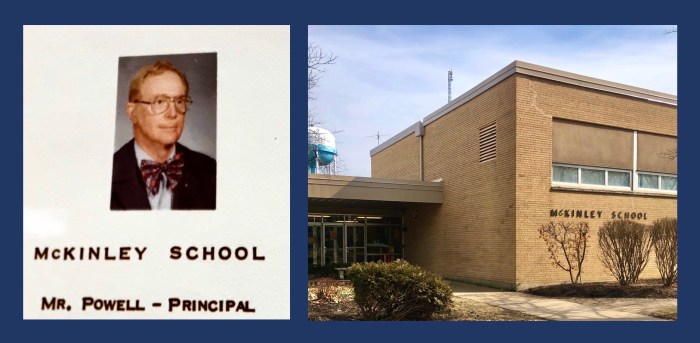
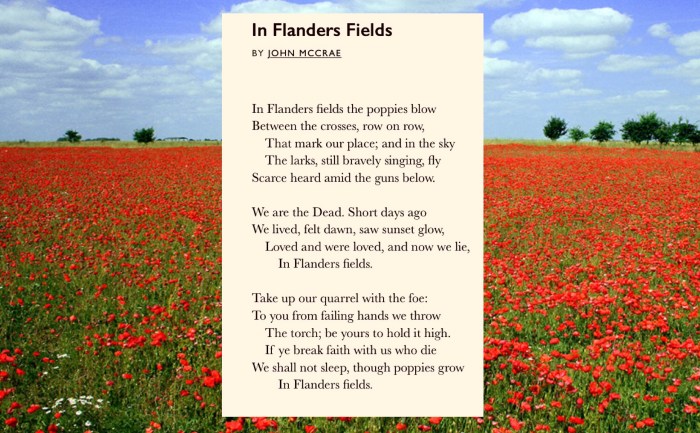
    Like the distant echoes of guns firing a salute, the memories of much of my youth are fading. And yet, I clearly remember gathering around the flagpole for Memorial Day ceremonies at McKinley School. Our principal, Mr (Willis) Powell would solemnly read “In Flanders Fields”, as we kids stood listening quietly…

    Willis Powell led McKinley School as Principal from 1957-1980

    It may just be me, but Memorial Day doesn’t seem to have the same solemnity now, as it did when I was growing up. Moving Memorial Day in 1971 from the 30th of May to the fourth Monday in May, took away some of the recognition and purpose of the day. Maybe the tumult of the Vietnam war changed how people thought in general about war and our dead. Or maybe it’s just a different time and place now, and for better or worse, this is who we have become.

    Today, Memorial Day, like Labor Day, President’s Day, and Martin Luther King’s Birthday is just one more three day weekend – an extra day off, or a chance to leave town. On Facebook, we post pictures of dead family members who served in the service. We remember to think about and thank our veterans. Do we think about why we have this most sacred of holidays?

    It wasn’t always this way. During my youth in the early 1960s, I remember somber ceremonies for Memorial Day at McKinley Grade School and in the town of Ottawa, Illinois. Mr. Powell, my grade school principal was key for both events.

    If you went to McKinley, activities took place on, or about, the 29th of May, the school day closest to Memorial Day. We kids walked in a column of twos, from our classrooms to the flagpole outside the school. There, we formed a U around the pole. Mr. Powell, started the proceedings with a few words, and then Boy Scouts from the school raised the flag, before slowly lowering it to half mast. With hands over our hearts, we recited the Pledge of Allegiance, and sang either The Star Spangled Banner or America the Beautiful. A student would recite a poem or say a few words. My friend Lynne remembers doing this as a fifth grader, although she has long forgotten the words she spoke. Mr. Powell might then recognize student’s family members who were in the service and away from home. Finally, and most clearly, he recited “In Flanders Field”, the WWI poem by John McCrae. To this day, Mr. Powell’s reading of the poem has stayed with me. In my mind, I can still hear his melodious, yet deliberate reading of McCrae’s words.

    In Flanders Fields, the Poppies Blow…..

    At the end of the ceremony, taps was played by one of the students, including my buddy Tim one year. Afterwards, we walked quietly back to our classrooms. There was no doubt about the solemnity of the day, and it left our young minds with much to think about.

    The next day, Memorial Day itself, Ottawa held a parade and ceremony downtown. The event was organized by the Ottawa Memorial Association, of which Mr Powell was a key member. The children from each of Ottawa’s grade schools formed up by school near the Courthouse. Every child was given a small American flag to carry, although my youngest sister, Tanya, also found it useful for poking her older sister in the butt. At 10AM, with the OHS band playing patriotic music, we marched down Columbus street to Washington Park in the center of town. There, we gathered around the Civil War Memorial, each school group in its assigned place.

    Following the Pledge, we heard music and speeches from local dignitaries. A child from each school would lay a wreath at the base of the Memorial. Finally, a member of the VFW, or American Legion, read the names of those veterans from the Ottawa area who died the previous year. As he finished, an honor guard fired a twenty one gun salute, followed by a trumpet player from the OHS band playing taps, with another band member echoing in the distance. The ceremony ended at 11, and as people were leaving the park, either by plan, or by happenstance, the bells in the nearby churches were ringing. Garth Powell, Mr. Powell’s son recently said to me, “We all left the park in silence. It was quite a solemn occasion, as it was meant to be.”

    It wasn’t by accident that Willis Powell was a key player in both of these events. He was born on October 10th, 1919, a little less than a year after the end of “The Great War”. The First World War was known as “The war to end all wars”, but of course it didn’t. Willis was called up in 1942 at the age of twenty two, and served in the Army for the duration of WWII. After the war, he used the GI Bill to complete his degree. He taught at both Jefferson and McKinley Schools in Ottawa, eventually becoming the full time Principal of McKinley in 1957. He also continued with his military service in the Army Reserves.

    He was a patriotic man, and passionate about impressing on both adults and school children the importance of Memorial Day – Not to thank those who served (Veteran’s Day), rather to honor those who gave “their last full measure” while serving our country. The result was the program at McKinley, and his leadership with the Ottawa Memorial Association, a group formed to ensure all citizens understood freedom came at a price. You could almost say he made it his mission to ensure we all knew and understood the importance of Memorial Day.

    Mr Powell retired as a Colonel in the Army Reserves in 1980 and retired from McKinley School later that same year. In January, 2004, he passed away. In writing this blog, I spoke and texted with many of his former teachers and students. I can tell you he was universally respected, and left a lasting impression with all. While many different memories were shared about him, all remembered the Memorial Day ceremonies at McKinley or the parade downtown.

    As Memorial Day approaches, we typically see veterans, or others, selling small red crepe paper poppies outside of stores, or on street corners. Millions of these poppies are distributed across the country in exchange for donations that assist disabled and hospitalized veterans. I typically buy a few of them over the course of the weekend. And while I think of those who died in the service of our country, I inevitably think back to Mr. Powell reciting “In Flanders Fields” at McKinley School. I recall a man who made a difference in many kid’s lives, including mine. From this former soldier’s perspective, he accomplished his mission.

    Addendum:

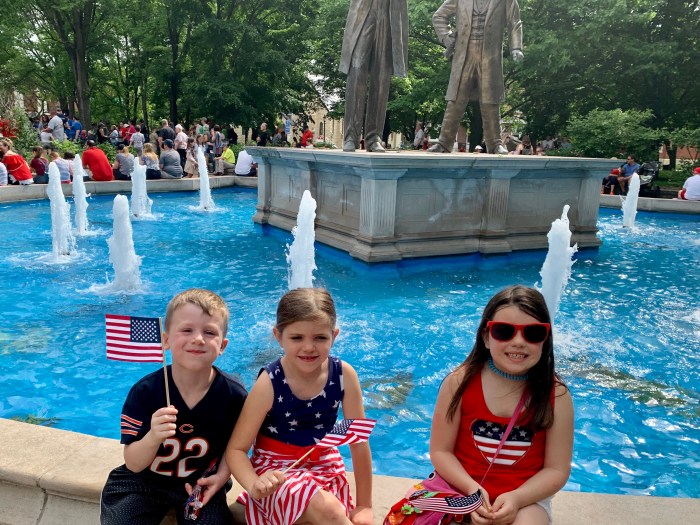
    My grand nephew and nieces attending last year’s Memorial Day Ceremony in Ottawa
    • The Ottawa Memorial Association continues to sponsor Memorial Day and Veterans Day activities in Ottawa. This year’s events are canceled due to the CoronaVirus. The photo above is from last year’s ceremonies, and courtesy of my niece, Ann McCambridge. You can learn more about the Association at: https://ottawamemorial.com/home .
    • “In Flanders Fields” was written during WWI by Canadian LTC (and doctor) John McCrae. He was inspired to write it on May 3, 1915, after presiding over the funeral of a friend, Lieutenant Alexis Helmer who died in the Second Battle of Ypres. Later, the war wore McCrae down and he contracted pneumonia and came down with cerebral meningitis. On January 28, 1918, he died and was buried in France.
    • There were many other memories of Mr Powell from his students and teachers at McKinley. Everyone remembered he wore bow ties, which were hand tied for the most part. There were memories of other events, including Veterans Day ceremonies, the Christmas singing program and tree in the gym, and tree give aways for Arbor Day. Two former students had memories of a special ceremony when a student’s father died in Vietnam. As my friend Marsali, who later became a teacher said “Such good memories from McKinley, especially Mr. Powell. I wish all principals and admins could take lessons from a guy like him”.
    • Thanks to: my sisters, Roberta and Tanya; my niece Ann McCambridge; fellow students Lynne Galley Robinson, Howard Johnson, Tim Stouffer, Joy Starjack and Marsali Classon; and teachers Charlean Grobe, Jean Mikus, and Dona Ostermeyer. All contributed memories of Mr Powell, or the activities surrounding Memorial Day at McKinley School, and in Ottawa.
    • Special thanks to Garth Powell for personal information about his father, Mr. Willis Powell, and his recollections of Memorial Day ceremonies in downtown Ottawa.

    Ramblings on a Post Covid Future

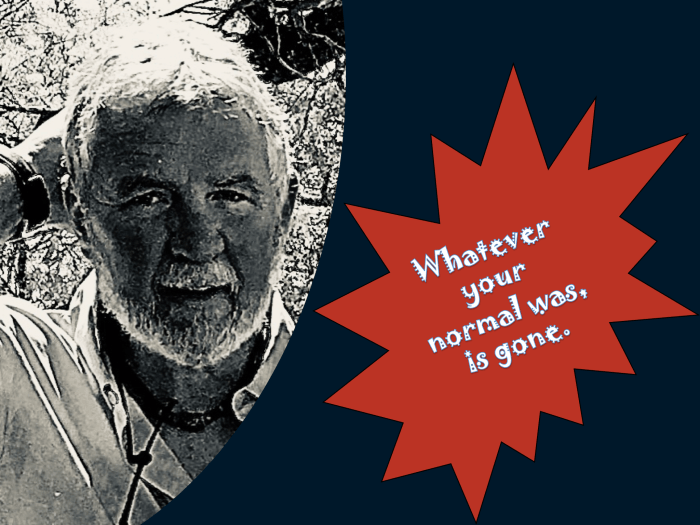
    The “normal” life we were living only two months ago, whatever that normal was, is gone, thanks to Covid-19. What about the future? How many of us will recognize, question, or accept the upcoming changes? Some friends and I have discussed this question “virtually” over the past few weeks. At one point, my friend Dave cautioned me: “I think you’re taking on an elephant here, maybe a premature elephant at that.” Elephant or no, as we look to the future, I think the discussion is worth having.

    What’s our new normal, post Covid?

    For the past eight weeks most, although not all, of us have complied with the recommendations from the CDC and others. We have practiced social distancing and self quarantining. We’ve washed our hands regularly, donned masks when in public, and used apps such as Zoom to stay in touch with friends and family. We have done all of this as good citizens, anticipating a return to our old world as soon as possible.

    We’ve also spent an inordinate amount of time complaining and trying to assess blame for our current situation. Depending on our political background, we are blaming the Chinese, or Trump, or the Dem Governors. We blame our neighbors for not treating this seriously, and endangering our lives. We blame the governors of Michigan, Minnesota and Virginia for not getting us back to work soon enough. We blame the World Heath Organization, or the deep state here in America. We blame real experts like Doctor Fauci, and fake experts like Doctor Phil. Collectively, we pretty much blame everyone.

    This pandemic is going to end. We can discuss or argue about when, but it will happen. Our lives will return to a semblance of normalcy, in a few weeks or in a few months. My question to you is what will the new normal look like? It will certainly feel different, both at a personal and a societal level. We just don’t know how different, and where the ripples will go across time. In our discussions, while my friends and I came to a few conclusions, we also generated more questions than we started with. Here are a few of the obvious conclusions. Following these, are some of the questions we are asking each other.

    • How we work. Covid-19 has blown the door to telecommuting wide open. Certainly in the past many companies embraced, or embraced to some degree, telecommuting. That’s changed forever, as many companies were forced to use telecommuting, or go under. This will continue wholesale in a post Covid world.
    • Updated business models. As with any crisis, those who adapt, do best. As an example, we have watched businesses use online, hybrid online, and curbside delivery models where they didn’t previously exist. The strong will survive, and thrive in the long term.
    • Physical Interaction. Hugging of family members and close friends will increase post Covid – we are going to realize the preciousness of those relationships a little more. On the other hand, gratuitous hugging will lessen. Certainly for awhile, people will use caution about six foot spacing – how long before we are comfortable in crowds?
    • Shopping. The trend of shopping online will continue to accelerate. As a result of the virus, people are already doing much more online shopping, and there’s no going back. As with telecommuting, I think the doors are blown wide open.
    • Voting. The election debacle in Wisconsin demonstrated the need for “No Excuse” absentee voting across the country. Currently, 39 states, including Virginia, have some version of “No Excuse absentee voting. The next argument will be over in person versus voting by mail.
    • Technology Acceptance. Self isolation was a great forcing function for the acceptance of technology in our lives. Whether shopping, banking, communicating, exercising, educating, or any number of other areas, we’ve broadened our use of technology.
    • Education. Schools are shutdown. Those schools, our teachers, and our students have become more creative about how education takes place in a distributed environment. Some good ideas will go forward, while we will deposit others in the trash can. Certainly at the college level, large lectures will trend toward professors lecturing on-line to students. Problems, such as rural broadband, have become more apparent.

    My friends and I generally agreed on those seven areas of change. There are many other areas less clear to us. This list is longer, and less complete. Here are some of the questions.

    • New Normal. Do we learn anything as a society, or is the new normal just the old rules with lipstick?
    • Politics. What’s the effect on this November’s presidential election? What will the political fallout be for both the short and long term? Will this increase government interaction in our lives? Or will pushback increase and counter the current involvement?
    • Political Interaction. Will political polarization continue to worsen before it gets better? Some of the States are already banding together in mini regional unions, as the Federal government has backed away from responsibility. Do we march into the future united, or do we further split into various tribes and regions? Will we see more social extremism, strife, and conflict? Will political violence increase?
    • Healthcare. Will we embrace changes to healthcare and meaningful changes in health insurance plans for the less fortunate? Will we be better prepared for future health crisis? Currently, other than for Covid, people aren’t going to doctors or hospitals to address health issues, whether critical or preventive. Will we investigate multilevel healthcare in hospitals and doctor’s offices so we can provide both pandemic and “normal” healthcare?
    • Healthcare – Nursing Homes. Will nursing homes improve, or disappear? Sally, a friend of ours, is a physician’s assistant. Her comment: “This pandemic is going to change things in elder care. Nursing homes are death traps and these people are sitting ducks…it’s so sad. Aging in place will be the wave of the future.”
    • The Economy. How will the effect on growth, taxes, inflation and income inequality look? How will the $2T “investment” effect our future economy? Will we see more industry return to the United States? My friend Mark believes the economy will be the most effected “question” for the next 3-5 years.
    • Environment. Will we better understand the impact we have on the environment, and that we can do something about both pollution and Global Warming?
    • Education. Will the education gap widen between the haves and have nots? What will the long term educational impact on our country look like? How much of a “gap” will there be for our current students that is never closed?
    • Rural Broadband. Will this provide the impetus forcing the implementation of Rural Broadband and treating it as a utility? Will the government finally push internet access, much as they did with Rural Utility Service Programs in the past?
    • The Arts. How will this affect the arts? What changes will we see in plays, movies, TV, music, painting, photography, dance and so on? How will audience interaction with the arts change?
    • Government. Will the US government make any changes? How often does America learn from our mistakes or experiences? As an example, a hurricane hits, some people die, some people survive in diminished ways, some people rebuild and go on as before, and others profit. A year later, another hurricane hits, and it’s the same show all over again. What will happen post Covid?

    If we think about this as an opportunity to improve our lives and our society, what changes will we consider and embrace? What chances for improvement will we ignore, freezing ourselves in time and ignorance?

    My friend Tim, who I’ve known since first grade, has something of a Russian soul. He commented: “Prognostication about the future, based on the recent past is always a dangerous exercise. Time and data tend to leaven hasty predictions and conclusions. Trial and error will be on display. Todays answers will prove to be tomorrow’s mistakes. We will see Thesis, Antithesis, and then Synthesis. Wash and repeat. We have gone from scavenger, to hunter gatherer, agricultural society, industrial revolution, technical computer evolution, and AI. Now the worm turns again. As always, we adapt or die.” We didn’t discuss whether he meant dying literally, figuratively, or both.

    I’m not a fortune teller, and as Dylan sang in “The times they are a changing”, “…don’t speak too soon, for the wheel’s still in spin…”. In my lifetime, we’ve dealt with a polio epidemic, Vietnam and the tumult of the 60s, hyper-inflation, stock market “crashes” and recessions, 9-11, and other “crisis”. In the past, we always came out of it, and always learned new lessons. Will we do so this time?

    Looking forward, author Arundhati Roy has captured a view I wish we would embrace, but I don’t know that we will:

    Whatever it is, coronavirus has made the mighty kneel and brought the world to a halt like nothing else could. Our minds are still racing back and forth, longing for a return to “normality”, trying to stitch our future to our past and refusing to acknowledge the rupture. But the rupture exists….. Historically, pandemics have forced humans to break with the past and imagine their world anew. This one is no different. It is a portal, a gateway between one world and the next. We can choose to walk through it, dragging the carcasses of our prejudice and hatred, our avarice, our data banks and dead ideas, our dead rivers and smoky skies behind us. Or we can walk through lightly, with little luggage, ready to imagine another world. And ready to fight for it.

    Addendum:

    – A complete copy of Roy’s comments on the pandemic and it’s effects here and in India can be found in The Financial Times at: https://www.ft.com/content/10d8f5e8-74eb-11ea-95fe-fcd274e920ca

    – Thanks to my friends, Tim Stouffer, Mark Dunavan, and Dave Job for their contributions to this blog and our ongoing “discussions”, which are usually via text or email. We span the spectrum both politically, and in our optimism (or lack thereof) about the future. I am usually more thoughtful after our exchanges.

    – Thanks to our friend, “Sally” (a pseudonym, so she could speak freely), for her sobering views about elder care and nursing homes. Her experiences over the past two months have been sad for her and unfortunate for many of her patients. The death toll in our nursing homes and assisted living facilities should lead to investigations and long term improvements, but I’m not holding my breath in anticipation of either.

    Bogie and Joe Testa

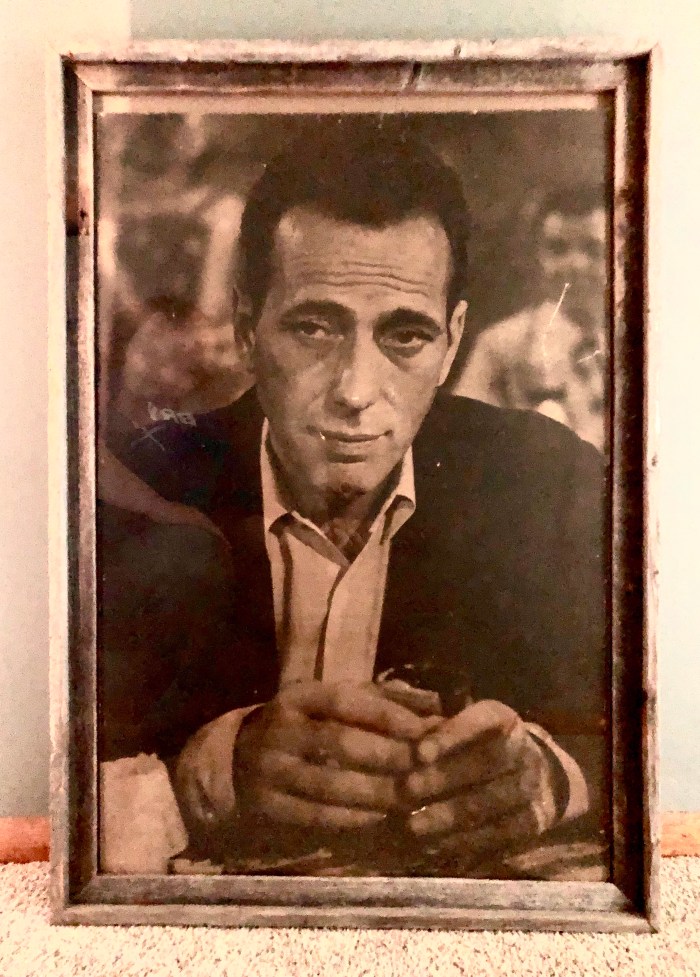
    A Humphrey Bogart picture was given to me as a gift in 1975 by a gentleman named Joe Testa. The home where Joe originally kept the picture was destroyed in an “electrical fire” in 1976. Five years later, in 1981, Joe died when a wireless bomb exploded under the car he was driving.

    Bogie at his Coolest….

    My folks, Bill and Gen Hall, first met Joe Testa in the mid ’70s, through the sister of a friend. The sister, Betty, and her husband worked for Joe managing a trailer park not far from Seneca, Illinois. Joe was a wealthy guy who lived in the Chicago suburbs, but had multiple houses, including one near Seneca, and another in Ft Lauderdale, Fla. Mom and dad ran into him a few times and always thought he was a pretty nice guy.

    Sometime in ‘75, mom and dad went to a party at Joe’s place near Seneca. In the rec room, a picture of Humphrey Bogart was hanging on the wall and mom told Betty how much of a Bogie fan I was. Betty later mentioned this to Joe, and also that I was a cadet at West Point. Joe replied with something like “That’s nice. I wouldn’t mind giving this picture to someone serving our country at West Point.” and gave Betty the picture to send to me. Betty gave the picture to mom and dad, who saw Joe one more time after that, and thanked him. At Christmas time, Bogie was waiting for me under the tree when I came home to Ottawa on break. I think it was one of the best Christmas gifts I ever received. Later, I sent Joe a note of thanks, but I didn’t hear anything back from him.

    Now for the rest of the story

    A year or so after Joe gave me the present, the house near Seneca burned to the ground due to a somewhat suspicious “electrical fire”, while Joe was out of town. Then, five years later on June 27th, 1981, a wireless bomb placed under his car was detonated as he was leaving a golf course parking lot in Florida. The car blew up, severing one of Joe’s hands, and a leg. It didn’t kill him immediately, and he remained conscious for some time. The police asked him “Is there anyone you know who could have done this?” He replied “Yea, a lot of people“. Two days later, he died of his injuries.

    It turned out, according to the press, Joe was a “reputed Chicago underworld figure” and had ties to Chicago mob boss Anthony “Big Tuna” Accardo. News reports at the time stated he was probably involved in money laundering activities in Chicago and elsewhere. He was also investigated for a reputed take over attempt of legal slot machines in Australia. There were at least four attempts made on his life, three of them by bombing.

    The man who most likely killed Joe was a guy by the name of Marshall Caifano, part of Accardo’s mob. Joe allegedly owed him $2 million dollars and refused to pay. As a side note, Caifano is one of the names that often comes up in relation to the murder of Bugsy Siegel back in the ‘40s. He was a pretty nasty guy.

    The framed picture was displayed in our home for nearly thirty five years. In May of 2013, we gave it to our niece, Tami, and her husband Jeff as a wedding present. Tami is a big movie buff, and graduated with a major in Film Studies from The Ohio State University. In the card accompanying the picture, we told the story of Joe and Bogie. We closed with “We hope the two of you write your own story as the years go by – may your tale be filled with love, joy, and an interesting life (but hopefully no car bombings…)”. Seven years later, as their anniversary approaches, they and the picture are doing just fine.

    Addendum:

    – Thanks to our niece, Tami Harmon, for providing the photo of the framed Bogart picture. In all the time we owned it, we’d never taken a picture.

    – I remember when I received the Bogart picture, there were whisperings about not prying too deeply into Joe’s background, but didn’t think about it. When he died in ‘81, we were stationed in Germany. I believe mom mentioned his death in passing when we returned in ‘83, and she saw the picture hanging in our home. She said something about him dying in Florida under suspicious circumstances. In 2013 when we decided to give the picture to Tami and Jeff, I did more research and found the whole story.

    – You can read a bit more about Joe at the links below. If you are doing your own research, make sure you type “Joe Testa Chicago”, as he is not the Joseph Testa crime figure in New York, who usually comes up first.

    Aunt Ellen and the Hanging of Charlie Birger

    On April 19th, 1928, the last public hanging in Illinois took place. My Grandpa Hall, and my Aunt Ellen, who had just turned 13, were among the thousands of people in attendance, as Charlie Birger was “hanged by the neck until dead”.

    At the time, Williamson and Franklin counties in Southern Illinois were part of an area known as “Little Egypt”, which had a long reputation for violence. In fact, Williamson County was referred to as “Bloody Williamson,” due to the ongoing outbreaks of violence throughout it’s history. From the 1870s through the 1930s, there were “Bloody Vendettas”, Klan wars, violent and deadly coal miner strikes, massacres of people, and gang wars. Hundreds of people were killed over that period of time. Chicago may have had Capone, but Little Egypt was an incredibly violent area.

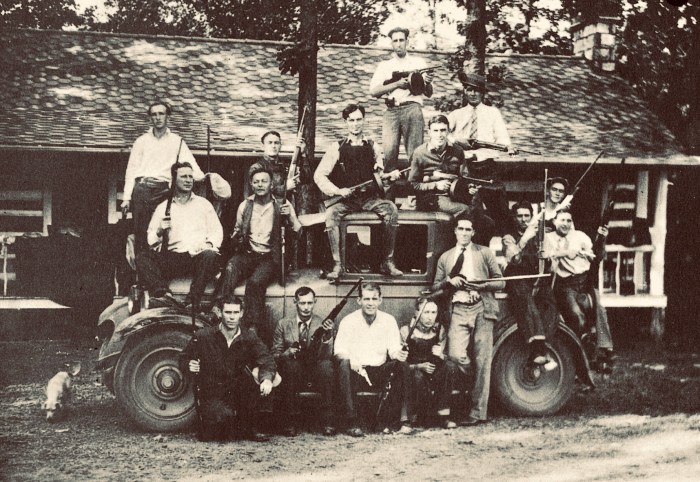
    Charlie Birger was a bootlegger and gang leader in Southern Illinois during the 1920s, and in the middle of much of the violence. For a while, some thought of him as a “Robin Hood”, but as his reputation grew, so did the violence. At the time, there were ongoing wars between Birger’s gang and the KKK, with Birger’s gang eventually killing or removing the KKK from the area in 1926. Although it sounds like he was doing a good deed, in fact it was good business. Birger was a bootlegger and the KKK was against the immigrants who were doing much of the illicit drinking in Little Egypt. Birger solved the problem by killing key Klan leaders and effectively eliminating them as a force.

    Birger’s Gang. Charlie is in the Center Sitting on the Hood with the Tommy Gun

    There were also ongoing wars with a rival group called the Shelton Gang, and this eventually caused Charlie trouble. In 1927, A man named Joe Adams was the mayor of a small nearby town. He was helping out the Sheltons, and hiding a tank they owned (yes, a tank). Birger tried to force Adams to tell where the tank was hidden. When he refused, Birger had him killed.

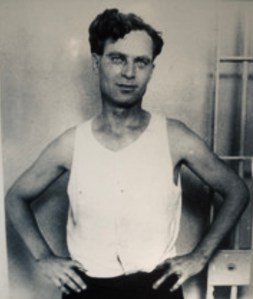
    The problem was, they killed Mayor Adams in Franklin County, not Williamson County where Birger was influential. Birger was arrested and the trial was held in the town of Benton, in Franklin County. A jury subsequently found him guilty and sentenced Charlie to death. After all appeals were denied, a date was set for the hanging – April 19th, 1928.

    Charlie Birger, April 18th, 1928

    Newspaper accounts say the 19th was a sunny day and the crowd started gathering early. They printed and distributed tickets to allow 500 people into the stockade area where they would hang Birger. Somehow Grandpa Hall obtained two of the tickets. They must have been free, as Grandpa never had any spare money. Any of his extra money went for booze, no doubt provided by either Birger’s crew, or the Shelton gang.

    Ellen, a few years after the hanging

    It turns out many children skipped school to attend the hanging and my Aunt Ellen was one of them. She had turned 13 just a few days before on April 10th, and as the oldest of the 6 children still at home*, Grandpa took her with him. The other five kids, ages 11 to 2, were in school or stayed with Grandma.

    Grandpa and Ellen took a horse and buggy to Benton, arrived early, and entered the stockade area where the hanging would take place. The crowd continued to grow, and they closed off the immediate area around the scaffold. Thousands more gathered in the streets of Benton for the event, even though they were not able to see the hanging itself.

    As Ellen and Grandpa waited for the guards to bring Birger out, Ellen heard a little girl next to her say “Can we get closer daddy? I want to hear his neck pop!” and the father and daughter moved towards the gallows. Ellen looked at Grandpa – he just shook his head no, and they stayed where they were.

    Birger was finally brought out. He was dressed in a three piece suit and spoke with some along the route. He eventually made his way to the gallows, where he shook hands with the hangman, Phil Hanna.

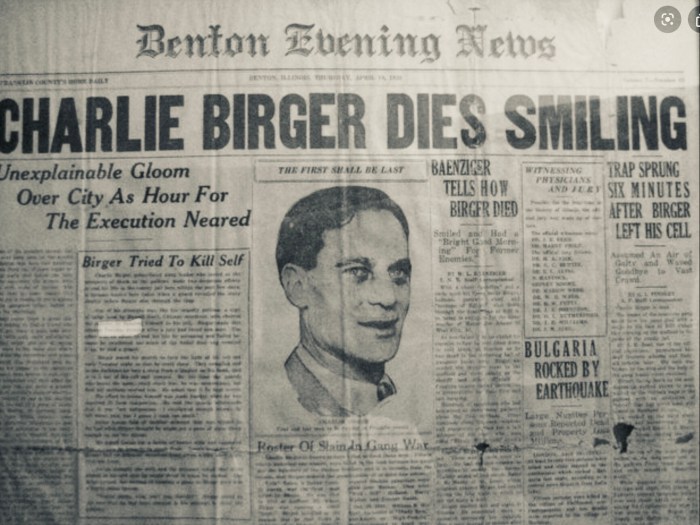
    He then spoke to the crowd. “They’ve accused me of a lot of things I was never guilty of, but I was guilty of a lot of things of which they never accused me. So I guess we’re about even.’’ Just before his head was covered with a hood, Birger smiled and said his last words, “It’s a beautiful world.’’ They then placed a black hood over his head. Normally, they used a white hood, but he asked for a black one, reputedly saying he didn’t want to be confused for a member of the Ku Klux Klan.

    Note Birger’s Smile, Shortly Before the Hanging.

    The trapdoor was sprung and Birger fell thru, breaking his neck in the drop. Fourteen minutes later, he was declared dead and the crowd, including Grandpa and Ellen began to dissipate. The last public hanging in Illinois was finished.

    The gang violence in Bloody Williamson would continue for several more years.

    The End of Charlie Birger, but not the End of Violence in Bloody Williamson

    Addendum (and don’t miss the fascinating YouTube song and video toward’s the end of the blog):

    * At thirteen, Ellen was the oldest of the six Hall kids remaining at home. The oldest sibling, my Uncle Dave, had already left Southern Illinois for Ottawa, Illinois, where he worked on the construction of the Starved Rock Dam.

    • Special thanks to my sisters Roberta and Tanya, my niece, Tami Pfau, my nephew-in-law, Tyler Ailor, and second cousins Janice, Julie and Don Connell. They contributed to this blog and provided inspiration for my writing about Charlie Birger and our family lore surrounding the story. Photos of Aunt Ellen and Uncle George were provided by Janice Connell.
    • My sisters and I first heard this story as kids, probably on a Saturday morning when aunts and uncles were having coffee around the kitchen table at our house. Stories, mostly funny, were often told about growing up poor during the depression, or some of their later escapades during WWII. Dad, or my Uncle Mick first told us this tale, and it was later confirmed by Aunt Ellen. Ellen had relayed the story to them at some point in the past. Dad and Mick were only four and two when Birger was hanged, but they knew significant details about the hanging and told the story in an animated fashion. We always laughed at the “Can we get closer daddy? I want to hear his neck pop” quote. Dad told the story for years, up until his own death at 86 years of age in 2010. His grandkids, AND their spouses all remember him telling the story of Charlie Birger. One of my nieces remembers Dad making a click/pop noise while repeating the “get closer daddy” quote.
    Aunt Ellen and Uncle George, Later in Life
    • While reviewing this blog for accuracy, my second cousin Don told me a story about Ellen’s future husband, my uncle George (his grandfather). He was a couple of years older than Ellen, and they hadn’t actually met yet. “Apparently grandpa Connell had a few dealings buying alcohol from the Birger gang, as did many in those days. The story I remember best is he once went into a barbershop, and a member of Birger’s gang was sitting in the barber’s chair with an apron on, getting his hair cut. My grandpa said he could tell the man was holding something under the apron, and once the man was finished and stood up, a machine gun was in his hands. Grandpa was quite surprised. He said it wasn’t uncommon to see the gang members carrying weapons, but usually it would just be handguns. He said they were always armed.” 

    • For a good book on Birger, and the violence in Little Egypt in general, look for “Bloody Williamson” by Paul M. Angle. It’s a nice read.
    • Southern Illinois has been known as “Little Egypt” for quite a while. Parts of the area were known as the “Land of Goshen” as early as 1799. This was a biblical reference to Egypt and the fertile Nile valley. Supposedly, Indian mounds in the area were large at the time and seemed like the pyramids of Egypt. The nickname stuck. The city furthest south in Illinois is Cairo, which is at the conjunction of the Ohio and Mississippi Rivers. More information can be found online and Wikipedia gives a reasonable report.

    Much like Bonnie and Clyde, the stories continued about Charlie Birger, long after he was hanged. Songs and poetry were composed about him. Here are a couple of examples.

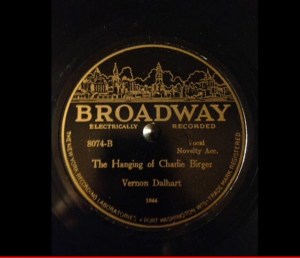
    – Here’s a fascinating song about Birger and his hanging written by Carson Robison, probably in 1928 or ’29. It’s worth listening to just to see some of the old pictures. https://youtu.be0XHb5A9ZhPg . Robison later wrote the lyrics to “Barnacle Bill the Sailor”. The song, “The Hanging of Charlie Birger” has been recorded as recently as 2013. The version by The Woodbox Gang is pretty good and can be found on Amazon and iTunes.
    .

    – Here’s another piece of poetry written in the ’80s:

    ——————- “Charlie Birger” ———————

    I heard of Charlie Birger way back when I was young

    My daddy told me all about the day that Charlie hung.

    I’ve heard so many stories, some of his ghastly deeds

    Another tells how Charlie helped poor folks in their needs.

    One said he was a kindly man who never told a lie

    But when somebody crossed him, that man was sure to die

    That Charlie had no Master you can tell from all the tales

    He fought the system all the way, and stayed out of their jails

    I’ve seen so many pictures, they’re hanging on the walls

    The pictures tell the story of Birger’s rise and fall

    And when they finally caught him he was sentenced to be hung

    But they hadn’t broke his spirit the day the trap was sprung

    When the State had had its vengeance—When Charlie’s life was done

    It made one stop to wonder, Who had lost, and who had won.

    John Lastle Gwaltney Southern Illinois Poetry (1985)

    “Letter from Birmingham Jail”, Revisited

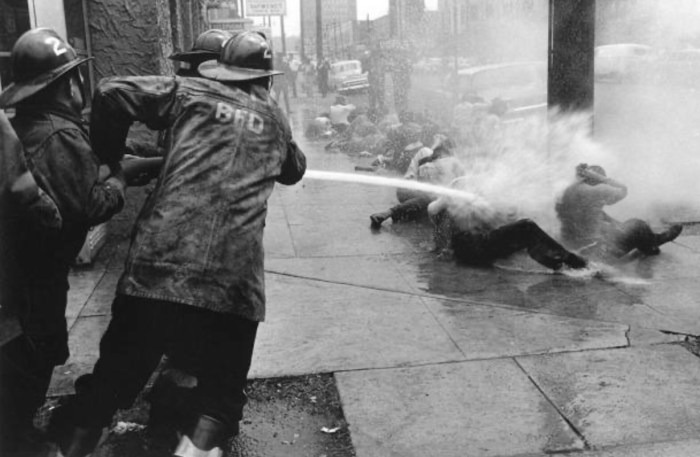
    Martin Luther King Jr was assassinated 52 years ago on April 4th, 1968. As a country, we typically celebrate his life on MLK day in January, and then forget about him for another year. This year, as Good Friday approaches, I would encourage you to take a few minutes and look at another anniversary – King’s jailing in Birmingham on Good Friday in 1963, and his subsequent publishing of “Letter from Birmingham Jail”.

    Birmingham, 1963

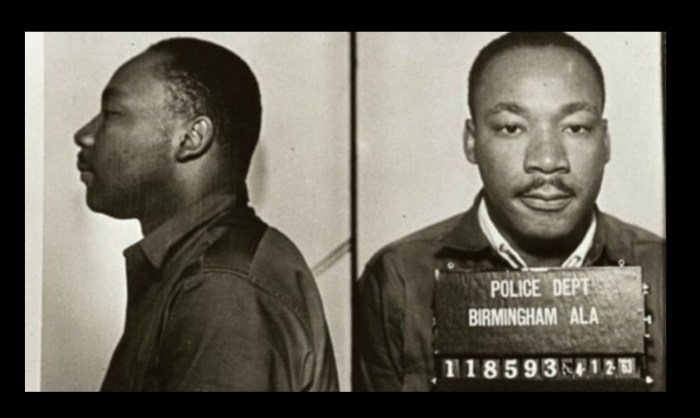
    Good Friday in 1963 was on April 12th. On that same day, King was arrested and jailed for an “illegal” parade and marching for civil rights. He was locked up for the next eight days. While there, a friend smuggled in a newspaper from April 12th. In it, was a statement from eight white Alabama clergymen titled “A Call for Unity”. The clergymen agreed racial injustice was real for African Americans, but disagreed with King’s approach and urged solutions should only be pursued through the courts. King obviously disagreed and over the next several days, using what scraps of paper were available, secretly wrote a letter to the newspaper in response. It was eventually published in June of ‘63 in several other publications.

    King’s Birmingham mug shot from April, 1963

    The “Letter” is a profound piece of writing and has many, many ideas and quotes that still ring true today. There are thoughts in it for everyone to consider. Here are just a few of them.

    • “Injustice anywhere is a threat to justice everywhere”.
    • “Too long has our beloved Southland been bogged down in a tragic effort to live in monologue, rather than dialogue”.
    • “It is an historical fact that privileged groups seldom give up their privileges voluntarily. Individuals may see the moral light, but…. groups tend to be more immoral than individuals”.
    • “Moderate whites who….paternalistically believes (they) can set the timetable for another man’s freedom; who lives by a mythical concept of time; who consistently advises the Negro to wait for a “more convenient season””.
    • “…the strangely irrational notion that there is something in the very flow of time that will inevitably cure all ills. Actually, time itself is neutral. It can be used either destructively or constructively”.
    • “Anyone who lives inside the United States can never be considered an outsider anywhere within its bounds”.
    • “I see the church as the body of Christ. But oh! How we have blemished and scarred that body through social neglect and through fear of being nonconformists”.
    • “The goal of America is freedom”.
    King in the Birmingham Jail

    I believe the first time I was presented with “Letter from Birmingham Jail” was my senior year at West Point in a Philosophy Class. In the intervening years, I have reread parts of the letter, but generally, didn’t think about it much.

    Lately? Over the past couple of years I’ve become increasingly concerned. Are we as a nation making progress, or becoming more racist? Have some of our current issues always been there, just below the surface? We certainly are seeing more overt actions, such as the violence in Charlottesville a couple of years ago, or the individuals who were hoping to start a “race war” during the Richmond 2nd Amendment rally in January of this year. We also see other troubling activities in many states, including purging of voters from election lists and disproportional closing of polling locations in African American communities. Here in Virginia, environmental racism, and the selection of gas pipeline routes overtly affecting African Americans is taking place. Currently, during the COVID 19 pandemic, there are signs of bias and disparity in access to medical care and testing. These are just a few examples, but if you look around, you can see many more.

    This Easter weekend, 57 years after King was incarcerated on Good Friday in 1963, I urge you to read his “Letter from Birmingham Jail”, or if you have previously read it, please reread it. You can easily find a copy online (I’ve provided a link below) and it only takes ten or fifteen minutes. It is as fresh and important today, as it was in 1963. King’s message is there for all of us who care about equality in America. My friend Mary and I were discussing this, and she said “As we Christians renew our faith, we should also emulate Jesus by renewing our commitment to justice.” How appropriate and true.

    We’ve certainly made progress as a country since 1963. Having said that, we still have a long ways to go. Racial inequality is something that hurts all of us and we need to stay active in our efforts to stop it. As King said, “Injustice anywhere, is a threat to justice everywhere”.

    Happy Easter.

    Addendum:

    ⁃ Thanks to my friend Mary Haak for help with this blog. Mary’s one of those people who do good deeds as a matter of course. Another comment from Mary to me was: “I encourage everyone to read…no, study, MLK’s “Letter from Birmingham Jail.”  Certainly, the “I Have a Dream” speech was moving and inspiring, but too many people use it as a prop to mischaracterize who MLK was and what he wanted.  You simply can’t read his “Letter from Birmingham Jail” in its entirety and continue to misunderstand his purpose. “

    ⁃ Here’s one online link to “Letter from Birmingham Jail” – http://web.cn.edu/kwheeler/documents/letter_birmingham_jail.pdf

    ⁃ You can also buy a copy on Amazon at: https://www.amazon.com/s?k=letter+from+birmingham+jail+by+martin+luther+king+jr&crid=3V2Y8GN7ME770&sprefix=Letter+from%2Caps%2C293&ref=nb_sb_ss_i_1_11

    ⁃ If not familiar with the folks trying to start a race war at the Second Amendment rally in Richmond this year, you can read more here: https://www.cnn.com/2020/01/21/us/the-base-suspects-race-war-virginia-gun-rally/index.html

    ⁃ Looking for info on voter purging or polling place shutdown? There are numerous articles online. Here are some interesting examples. These were provided by the AP, Vox, the ACLU, and others:

    • Seventy percent of Georgia voters purged in 2018 were Black.
    • Across the country, one in 13 Black Americans cannot vote due to disenfranchisement laws.
    • Across the country, counties with larger minority populations have fewer polling sites and poll workers per voter. Texas and Georgia are particularly guilty of closing polling locations in minority communities.

    ⁃ Want to read a bit more about environmental racism here in Virginia? Try this article: https://www.virginiamercury.com/2019/12/05/in-virginia-union-hill-and-racial-tensions-have-put-environmental-justice-back-on-the-map/

    ⁃ Here’s an NPR story about potential health care bias as we face the current Coronavirus crisis: https://www.npr.org/sections/health-shots/2020/04/02/825730141/the-coronavirus-doesnt-discriminate-but-u-s-health-care-showing-familiar-biases?fbclid=IwAR3GMb-jW388WCwrE_1FjWC5sFcLhTySFl1Z7dzXp36IZkKdZNKH4acpFhU