Grounding Problems

Grounding Problems

Colonel Bayshore called me into his office. “Max we have a problem at the new Alternate Support Headquarters (ASH) in England and need you on a plane.”  “What’s the problem?”  “A grounding issue.” “Ummm, I don’t know anything about grounding.”  “None of us do. Here’s the manual.”

In 1988 Cath and I were stationed in Germany with the Information Systems Engineering Command (ISEC).  I was a Captain at the time and had my master’s in electrical engineering. ISEC did all kinds of complex Information Technology (IT) implementations.

When Colonel Bayshore called me into his office to talk about the ASH*, it was a classified site. The US European Command (EUCOM) ASH was in High Wycombe, England and where EUCOM HQ would bug out, if they needed to evacuate Germany during a war. Originally built in 1942 during WWII for other reasons, the US government later rebuilt the bunker to support the ASH during the Cold War. It was an underground complex and built to survive not only conventional bombings, but even an ElectroMagnetic Pulse (EMP) nuclear attack.

The site wasn’t yet occupied. The system installations were handled by a different organization than ours, with much of the IT work completed by a contractor. Most work was completed with systems installed, but one of the classified rooms had a problem. Whenever you used the secure phones in the room, there was crosstalk with other phones, making it impossible to have a classified conversation. The ASH facility could not pass its security accreditation until the issue was resolved. This meant the faculty could not undergo final testing or become operational. An engineer “somewhere” thought it was a grounding problem. They contacted ISEC for outside support, resulting in Colonel Bayshore’s call to me. 

Sergeant First Class (SFC) George Walls would also go on the trip. George was great and a super technician. We would work as a team at the ASH until we solved the problem. 

The next day, George and I started reading “MIL-HDBK-419A – Grounding, Bonding, and Shielding for Electronic Equipments and Facilities Volume 2 of 2” (Volume 1 was theory.  Volume 2 was applications). At 394 pages, it was a massive document and told us everything and anything we could possibly want to know about grounding buildings and electrical systems within those buildings

Vol II of Mil-Handbook 419A – All 394 Pages of it.

A day later, we were on a plane crossing the Channel. We continued reading and rereading MIL-HDBK-419A.

Arriving in England at the ASH, we met our government point of contact (POC) and a representative from the contractor. They were skeptical we would find anything, but welcomed our help. Our job was to identify issues, but not to fix them. The contractor would complete the corrections, once tasked by the government.

After giving us a tour of the facility, they offered to accompany us as we started our work. We politely declined, and let them know if we needed any help, we would contact them. We didn’t want anyone looking over our shoulders – partly to minimize outside interference in our investigation, and partly so no one could see how green we were in our knowledge of grounding. Quoting from the book/movie “MASH”, we were “The pros from Dover”** and we didn’t want anyone questioning that. 
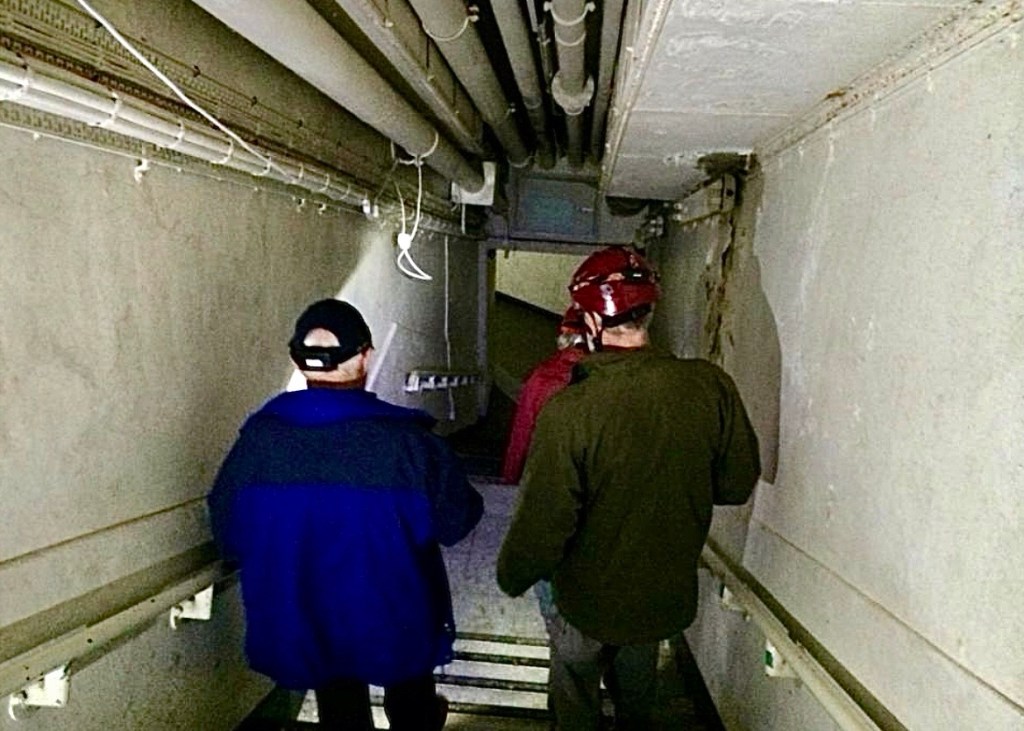
The Descent Into the Bunker Complex.

We started our work in the classified room with the crosstalk problem and spent two days checking every system, circuit, wall plate, ground connection and the entire ground grid underneath the raised floor in the room. We found some wall plates that weren’t grounded and one improperly grounded system, but found no issues related to the crosstalk problem.

From there, we proceeded to the classified phone switch room and did the same type of inspection. Again, we discovered several issues, but none that we believed caused the crosstalk. We hadn’t solved the problem, but our list of grounding issues within the facility continued growing. 

Next, we went to the Tech Control Facility (TCF) where all connectivity (cables, wires and radio channels) for the systems going into or out of the ASH passed through. We documented more and different grounding issues. 

With the growing list of problems, I called COL Bayshore and recommended we inspect the entire underground facility for grounding issues, including all rooms, systems and connections. This was outside our original scope, but both George and I were concerned with what we were finding. COL Bayshore agreed, but needed approval for the expanded work. The next day, the powers-that-be gave approval. 

We spent the next few weeks at the ASH continually documenting grounding issues. Many were minor, but some were major. As one example, in a room housing the Worldwide Military Command and Control System  (WWMCCS), all systems were properly connected to the ground grid below the raised floor, but the ground grid itself was not connected external to the room, making it worthless. In another case, the grounding cable for an external backup generator was almost cut in half. At some point in the past, the generator startup battery arced to the ground cable, nearly severing it. 
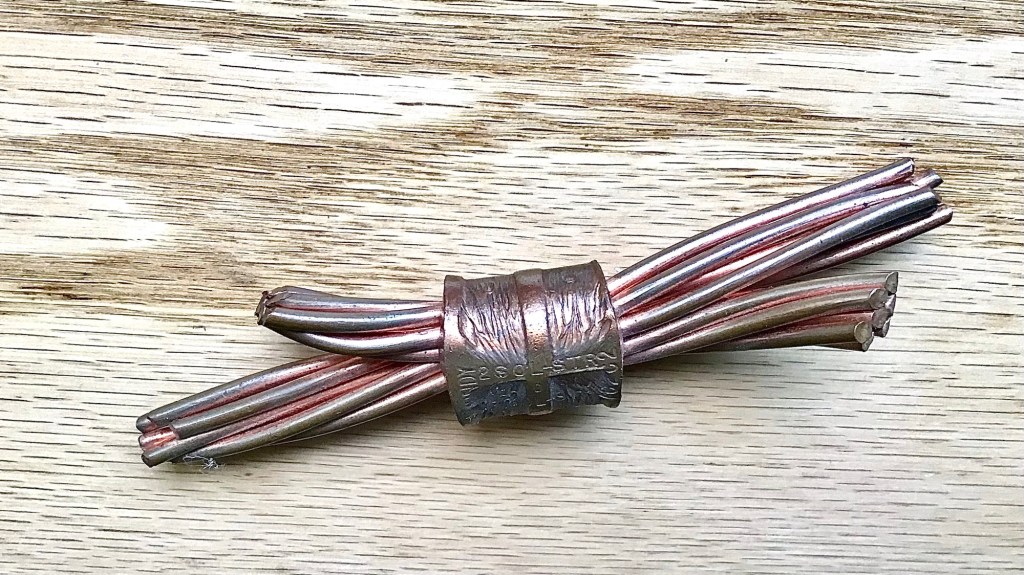
A Piece of the Below Floor Ground Grid.

After about three weeks, we finished our inspection. Our list of grounding issues was twenty or thirty pages long and many items needed correction prior to the facility going operational. We sent a copy back to our headquarters at ISEC and also gave a copy to the facility government POC. Needless to say, with the number of identified problems, there was a bit of shock both back at our unit, and in the facility. 

Unfortunately, we still hadn’t solved the crosstalk issue. 

That night as George and I were having dinner and a beer, we talked things over. We tossed some ideas back and forth, and ultimately decided we would track a single phone circuit in the classified room from the phone to the connection plate to the classified switch to the TCF and see if we could find the problem. Maybe it wasn’t a grounding issue. 

The next day, we were back in the classified room and pulled one of the phones from its cable and inspected it. Nothing…Nada…Nope. From there we traced the phone cable to the wall plate. We took apart the wall plate and pulled out the physical jack the phone plugged into. As we looked at one side we noted the connection port, a resistor, and a couple of capacitors – nothing too exciting there. We turned it over and started tracing the circuitry. HELLO! What’s this? Two capacitors were interconnected and double connected to different circuit posts in the jack where the phone itself connected. 
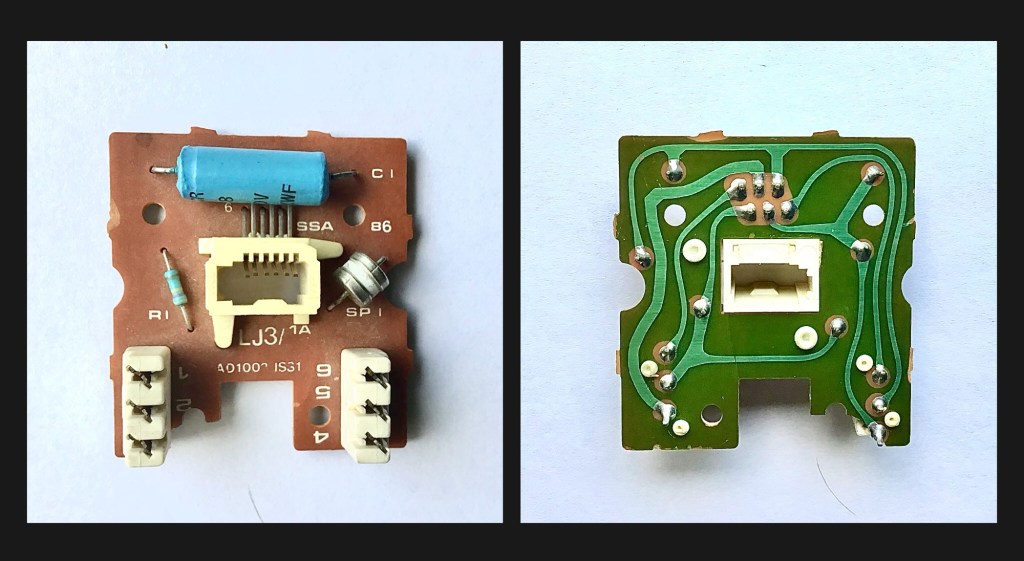
Front and Back of the Phone Jack

We stared at the wiring and started talking. Was this the issue? There was only one way to find out. George pulled out a pair of wire cutters and …snip snip… cut the connections for the suspected capacitor. 

We reassembled everything, plugged the phone in and made a call. NO CROSSTALK!

We notified COL Bayshore and then spoke with the POC and the contractor about what we found. They were shocked (and surprised we had the temerity to cut the connections). We eventually tracked down why the connectors were incorrectly wired. It turns out the phones all came from the US for the classified system. The contractor obtained the connectors in Europe. They may have worked with the European equivalent phone, but they would not work with the US version as wired. 

George and I were still in England for the next couple of days and had become minor celebrities of sorts. Calls came in from both DC and Fort Huachuca, Az where they completed the original system implementation/design work. The calls were a bit funny. People congratulated us, but couldn’t quite believe we solved the problem, or how we solved it. They asked several questions – some we could answer, some we couldn’t. It didn’t really matter to George or me by then. We’d finished something no one else had solved, mostly through detailed work, and a little bit of luck. 

A couple of days later we made our way home to Germany, mission accomplished. 

I have thought about the trip more than a few times since then. Becoming an “instant expert” was important. I knew I wasn’t really an expert at the start, but I knew we had more knowledge about grounding than anyone else connected to the program. By the time we finished, we truly were grounding experts.

Finding the many grounding problems was important. The issues probably would have gone unnoticed until a system failed, possibly during a real-world crisis. 

Lastly, it was important to remember that sometimes the problem isn’t what you think it is, or what others think it is. Sometimes it’s something so small and innocuous it goes unnoticed, just sitting there looking innocent. Keeping an open mind is always important.

Addendum:

Major Radcliffe

Major Radcliffe

Charlie sent an email to all of us company B-3 West Point ‘78 grads. Colonel Bob Radcliffe, our Tactical (TAC) Officer when we were cadets, passed away. My mind did an immediate flashback to my last two years at school. He made such a difference in my life and was a true mentor and leader. 

For me, I’ll always remember him as Major Radcliffe. That was his rank when he served as our TAC.  By way of explanation, each of the 36 companies had an active duty officer assigned as a TAC Officer. The TACs:

“Are the primary leader developers/integrators of the Academy’s developmental programs. They oversee each cadet’s individual development in the academic, military, physical, and moral-ethical dimensions within the framework of the Cadet Company. The TACs train, lead, coach, and mentor cadets, with a continual focus on leader development. The TAC is … responsible for the establishment and maintenance of a command climate that fosters individual and unit excellence in all program areas.”

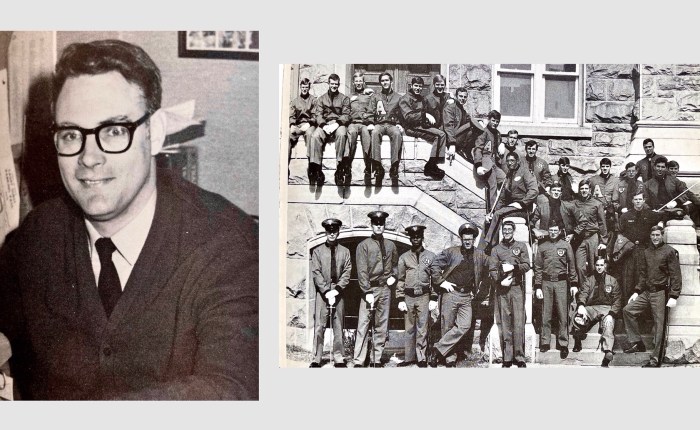
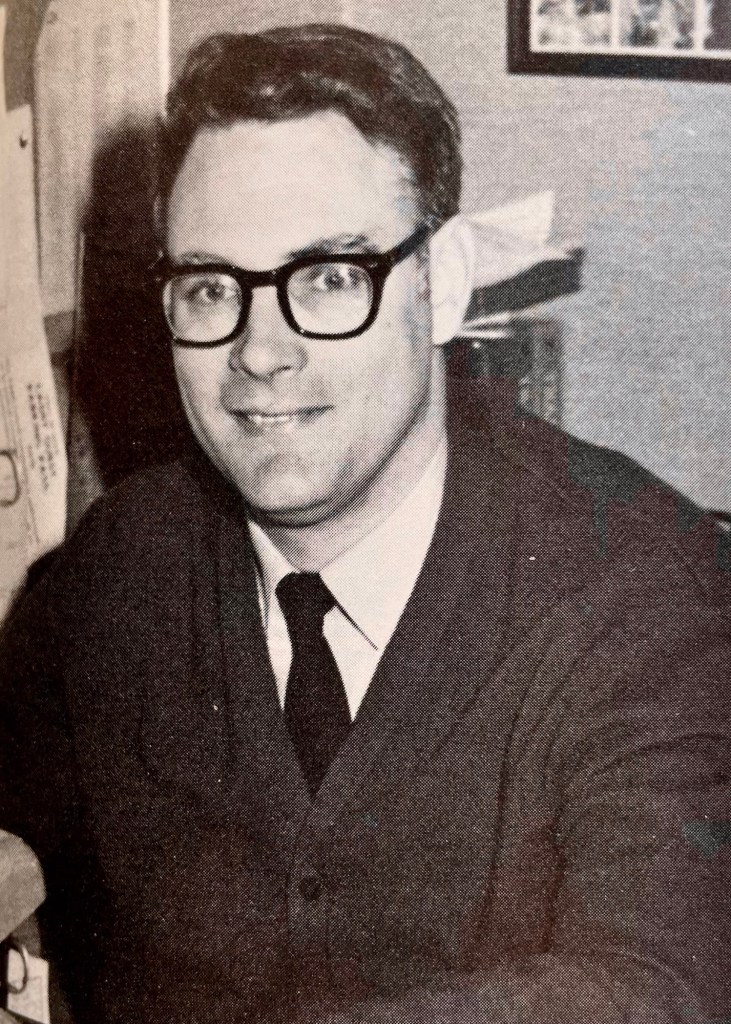
There were of course all kinds of TACs at West Point. Most were good, but some were martinets and some were too folksy. Major Radcliffe was one of the good ones. From my perspective, he was one of the great ones. He knew how to strike the right balance in his work with us.

Major Radcliffe in our 1978 Yearbook.

He was a Grad himself from the class of 1965.  He was also a first team All American Lacrosse player while at the Academy. After graduating and commissioning in the Infantry, he obtained his Airborne wings and Ranger tab. He did a couple of tours in Vietnam, where he earned the Combat Infantry Badge, the Silver Star and the Bronze Star for Valor. 

He made us toe the line as Cadets, but also had a human side. When Cathy and I learned she had MS, he worked with me to obtain an immediate weekend pass to see her in DC, which was so important for me. We weren’t engaged yet, but he came through. He also helped rescue me from myself when I screwed up on something at school. For both of those items, I will be eternally grateful.  

Additionally, Major Radcliffe had a sense of humor. I remember going to his home a few times for cookouts or dinners. On one occasion, he surprised us when he lifted his sweatshirt revealing the T-shirt he wore underneath. It said, “US Team. Southeast Asia War Games. 1960-1975. Second Place.” Sense of humor indeed. 

A Wry Sense of Humor

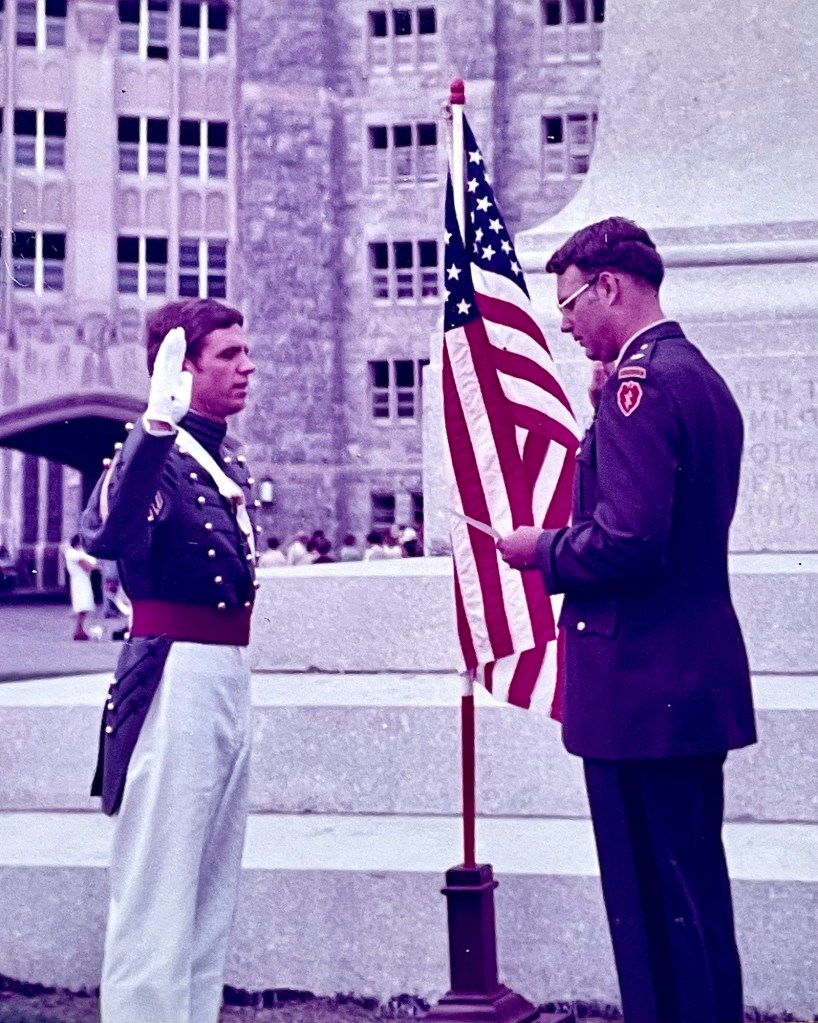
My last official interaction with Major Radcliffe was when he swore me in as a Second Lieutenant on Graduation Day. We were at Washington Monument on The Plain and I remember it as if it were yesterday. Mom, of course, snapped the picture. 

My Swearing in Ceremony with Major Radcliffe.

I only saw him a couple times after graduation.  Once in the military at an exercise or meeting somewhere. The second time was by chance in an airport. We were both civilians by then and chatted briefly, while waiting for connecting flights.  In 2020, Cathy and I were going to host a mini B-3 reunion and we invited him to the event. We traded a couple of emails back and forth and he looked forward to attending. Unfortunately, COVID intervened and we cancelled the get together. 

Yes, when Charlie’s email arrived in my inbox, I had my flashback to West Point. I also thought about his impact on my life and how he, along with West Point itself, changed the arc of my life. We didn’t call it mentorship back then, but that’s what it was. His mentorship and his leadership made a difference for many of us, and I’m glad he was in my life. It’s a debt I can’t repay.

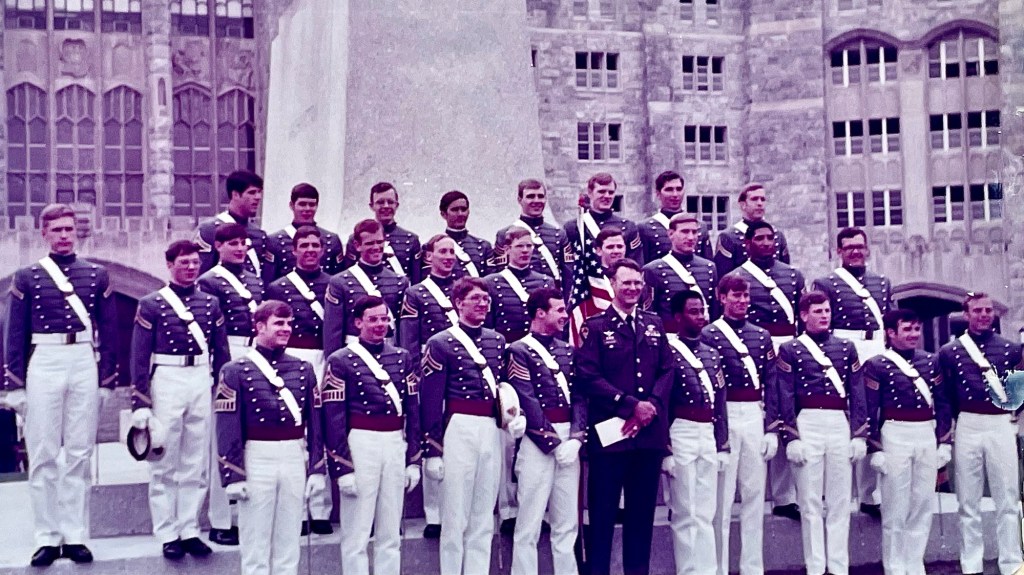
Company B-3 Firsties (Seniors) with Major Radcliffe on Graduation Day.

Addendum:

  • The photo of Major Radcliffe in the South East Asia war games shirt is courtesy of company mate Charlie Wright. I’d told the story of the shirt for years, but Charlie had the actual proof of it.
  • Thanks to company mate Charlie Bartolotta for providing some of the information in this blog.

A Hustle Culture

A Hustle Culture

Here are some powerful words from our niece, Ann – I was in high school when Columbine occurred in 1999.  I started college in 2001 and then 9/11 happened. The Virginia Tech shooting occurred in 2007.  A year later, there was a shooting at my husband’s school, Northern Illinois University. He was on campus on Valentine’s Day, 2008 when a shooter walked in and killed 5 people in a lecture hall. For Sandy Hook in 2012, I was a mom and have been for every school shooting since then

Clearly I don’t know the answer on how to fix the gun problem, or the mental health problem, or the hate problem, but much of it seems to be a uniquely American problem. 

Across the board our (collective American) priorities are wacked. The pressure on American families is through the roof. It’s a hustle culture with overconsumption as the fuel.  There are two working parents in most homes trying to keep up with rising costs of basic living. This has been the case for me since I married in 2008. Those with any extra disposable income are outsourced to death trying to enrich their kids with activities and sports that formerly came naturally in neighborhoods and local parks. 

People are living way beyond their means, building pressure inside the home. Parents are stressed, over worked, underpaid, sick and depressed. I hate to say it’s the breakdown of the American family because that is usually used as a politically charged statement, but … We have grown so much as a country and we now really do celebrate so many varieties of families. Unfortunately, there is little or no support for them. 

In so many ways, American life has become a joke. American healthcare (as privileged as I am to be here) is a joke; insurance is a joke; childcare is a joke; maternity leave is a joke; FMLA is a joke; gun laws are a joke; the Department of Child and Family Services is a joke; WIC is a joke.  Our public schools, our school boards and our city halls have become jokes.  Many of our churches have become jokes. As we watch on the big screen, our highest government offices in our state capitols and Washington DC are also a series of jokes. 

Some kids out there are fighting for their lives socially, emotionally and physically. It doesn’t seem to matter. To make it extra special, we give our kids the technology to access it all, and put it in their hands.  We kiss them goodbye in the morning and expect that things will work out OK. 

I hope our gun laws change in a way that will benefit our society. But I also hope our society changes fundamentally to benefit our future.  If not, what do we have?

Casey, Ann and Their Two Wonderful Daughters.


– – – Feel Free to Share This Blog – – –

Addendum:

  • Ann originally wrote this in response to a post I’d made on Facebook about the recent school shooting in Georgia. She was writing in response to the deaths at the school, but also because of the utter neglect the 14 year-old shooter had received from his family and the systems that should have been in place to help him. Her words were as powerful as anything I’ve heard in a while, particularly in comparison to the talking heads on TV from both sides. Thanks for having the courage to speak up Ann. We love you. 
  • I’ve written a couple of other blog about Gun violence. You can read them here: 
    • There was no urgency to write this blog. I knew another mass shooting would happen sooner or later. I didn’t have to tie it to Buffalo or California. The next shooting would come along soon enough. I wasn’t disappointed. Texas happened this past […] Continue at: https://mnhallblog.wordpress.com/2022/05/29/guns-and-murica/
    • In light of the recent 4th of July mass killings in Highland Park , I’ve been rethinking Steven Stills classic song, ‘Find the Cost of Freedom’. “Find the cost of freedom, buried in the ground. Mother earth will swallow you, lay your body down” […] Continue at: https://mnhallblog.wordpress.com/2022/07/07/the-cost-of-freedom/
    • I was invited by the Brady Organization to speak at the End Gun Violence Rally on the National Mall yesterday. This was in conjunction with the 2022 DC March for our Lives today.  Here are my words … My Name is Max Hall. I am a graduate of West Point and Veteran of the United States Army. I would also point out that I am a gun owner […] Continue at: https://mnhallblog.wordpress.com/2022/06/11/speaking-out-on-gun-violence/

Summer’s End

Summer’s End

Labor Day Weekend at the Bay was a full-on Summerpalooza. Soft shell crabs and tomatoes…Crab cakes with corn…Grilled steaks and more crabs at our neighbor Vinnie’s home…Bike rides on the island…Drinking crushes at a beach bar… Eating fresh peaches, the juice running down my chin. It’s all been great, but I’m ready for Fall. 

Ahhh Summer – Cooking Soft Shells One Night, and Drinking Crushes at a Beach Bar the Next Day

What a strange Summer it has been, and I’m not just talking about the politics. The weather was … unusual. Quite cool at the start, we endured a drought for a couple of months. In early July it turned hotter than Hades, followed by a rain of several inches, a cool week in August with nighttime temps in the 40s, and then record setting heat the week before Labor Day.

Technically, we have about three weeks until the Autumnal Equinox marks the official start of Fall on September 22d, but of course Labor Day has always served as the unofficial end of Summer. 

Growing up, Summer was my favorite season. It was even better than Christmas time. When school let out at the start of Summer, there was unlimited time with endless possibilities. It was the time of going to the pool or Pitstick’s Dairy Lake for swimming – The ding-a-ling of the ice cream truck in the evenings, with cones for a dime – Staying out late – Pick-up Baseball behind Hohner’s house next to the graveyard – Boy Scout Summer Camp at Ki-Shua-Wau  – Cicadas, grasshoppers and lightning bugs – Making funny noises into the blowing fan in the front room before we had AC – Cookouts with burgers and Mom’s potato salad – Riding bikes with my buddies Howard and Tim, and later, with Cathy. Endless Possibilities.

As I grew older, Summers became shorter. Still fun, they were no longer endless and instead became finite in their possibilities.  Rereading the previous paragraph and the list of things I enjoyed about Summer, it is perhaps no coincidence they are activities from my youth. Is Summer more of a young person’s season?

Eventually, Summer lost its claim as my favorite season. Was it the passing of youth, or did something else cause the change?  I can’t answer that, but Autumn rose to the fore. 

Ahhhh, Autumn. How do I love thee? Let me count the ways – The drop in temperature and humidity – The crispness of a fall morning – Autumnal light (yes, that’s a real thing) – Going on vacations and knowing there will be fewer children wherever we are – The color of the leaves – Eating soups, stews and roasts again – Wild (not farm raised) oysters – Wearing a sweatshirt and shorts – Steeplechase Races – Orion reappearing in the night sky – Migrating birds – Walks in the woods and the crunch of leaves underfoot.  Here in Virginia, we are extra lucky. I defy you to find anywhere with more beautiful colors and weather than Virginia in the Fall.

During Fall, I enjoy watching the slow transition from Summer to Winter and how the world changes. It makes me feel alive as we leave the lethargy of Summer heat behind, but aren’t yet forced inside by the cold and snow of Winter. Although I know Spring is the season of new beginnings, I feel most alive in the Fall. 

We spent the last few days of August and the start of September at the Bayhouse on Tilghman Island. The heat wave eventually broke and it cooled down to seasonal weather. The end of Labor Day itself was absolutely gorgeous – one of those evenings you get a few times a year. It doesn’t feel like Fall yet, but I know it’s coming soon and I am ready to greet it. Author Victoria Erickson said it best for me: “If a year was tucked inside of a clock, then Autumn would be the magic hour.”

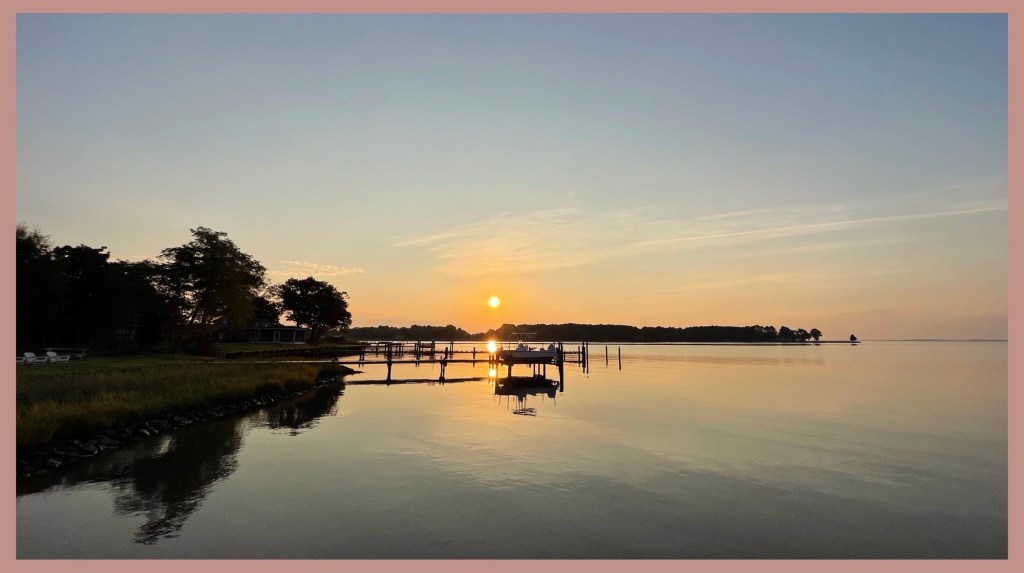
Labor Day Weekend – the End of Summer.

Addendum:

I’ve written two other Autumn related blogs:

  • As I walk and wander through the nearby woods this fall, I find my mind wandering as well. It is Autumn in the autumn of my life and I feel the passage of time. Death and decline are both more evident, and not quite the strangers they once were. It is not my own […] Continue here: https://mnhallblog.wordpress.com/2023/10/24/autumn-walks/
  • It’s not your imagination. The light actually is different this time of year. Golden and lush, it’s almost magical. It’s not just the color of the leaves, or the chill in the air. The light is different and it’s changing fast. Poets love to write about it, but there’s science behind the […] Continue at: https://mnhallblog.wordpress.com/2022/10/26/autumnal-light/

Glacier Skiing

Glacier Skiing

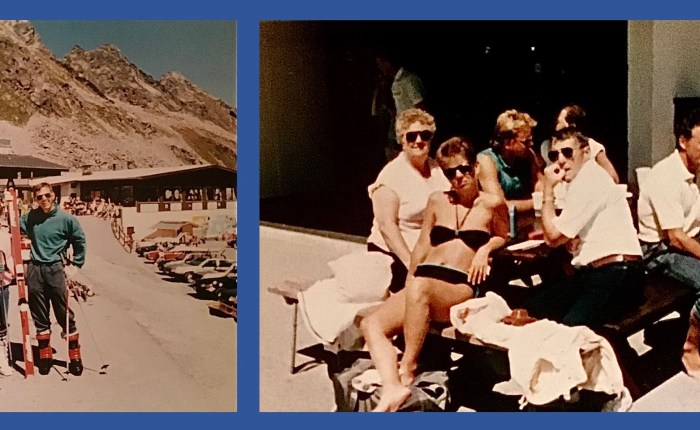
In the summer of ‘87, my folks visited us in Germany. We had a grand time touring Germany, Austria, Northern Italy and Switzerland. One of the highlights was Glacier Skiing at Sölden, Austria and then afterwards, hanging at the Lodge drinking bier, while Cathy worked on her tan.

On our first tour in Germany from ‘79-83, Mom and Dad visited once for a vacation in the summer of 1982. I was a Company Commander in the 34th Signal Battalion at the time and the day we were to leave on vacation with them, the phone rang about 4AM. Cath said, “Don’t Answer it”. I said, “I have to.” She answered back, “Don’t answer it.” I answered the phone.

The call came from Battalion Headquarters and we deployed on an alert for the next three days. While I was in the field, Cath showed Mom and Dad around Southern Germany and the Black Forest. When I returned from the alert, we travelled the next ten days together.  Dad understood what happened with the alert and why I had to go, but I’m not sure Mom did. 

When we moved back to Germany in ‘85, we didn’t think Mom and Dad could afford another visit. Airline travel was expensive, as was the trip itself. Then, fate intervened. Dad hit 5 out of 6 numbers on a lottery ticket and won several thousand dollars. Never ones to let extra money go to waste, they scheduled a visit with us in Worms in the summer of 1987. 

When they arrived, we spent the first few days near Worms and the village of Rheindurkheim, where we lived. In addition to introducing them to local friends, we spent an evening at one of our favorite Weinfests. Everyone enjoyed themselves, or at least that’s what the photos seemed to indicate. 

Prost!

Eventually, we left Rheindurkheim and headed South for the main part of the vacation. I’m not sure why, but Cath and I decided to take our skis along and get some Glacier skiing in, something we’d never done before. Looking back now, it seems an odd decision. Mom and Dad wouldn’t ski, but I’m sure we talked with them about it. In any case, off we went down the Autobahn with the skis strapped on the roof rack of our Saab.  

After visiting good friends Jim and Res in Stuttgart for a night, we made our way to the Alps. We planned a drive through Austria, Northern Italy and Switzerland, but started with Sölden, Austria where we would ski. In the 1980s, you could still ski Sölden virtually all year long*.

Glacier skiing is a bit different from regular skiing. You have to hit the slopes early, and most people only ski in the AM. By late morning, the sun has warmed the slope and the glacier starts turning to slush. Also, as the morning wears on, the snow/ice on the glacier tends to become gravelly, not quite ice and not quite snow. 

That first night at Sölden, we ate dinner in the little Gasthaus where we were staying. We discussed skiing the following morning. Cathy was thinking about skiing in her bikini and I was up for wearing a pair of shorts. Ultimately, we decided to ski in sweats and jeans. If we fell, the gravelly snow would scrape us up pretty good.  

The next day, after an early breakfast of Kaffee, Brotchen, Wurst und Käse (Coffee, rolls, sausage and cheese) we made our way to the slope and were skiing by 7:30AM. We’d told Mom and Dad they could hang at the Gasthaus, but they insisted on coming with us to the ski lodge. Dad took a photo as we headed to the lift.

Cath and I spent the next three hours skiing the glacier and it was wonderful. The piste (ski trail) wasn’t crowded, the snow was in great shape and we were skiing well.  Occasionally, we’d check on Mom and Dad who were drinking Kaffee on a picnic table outside the lodge. Dad snapped some pics of us skiing, but for the life of me, I can’t find them. Around 10:30 the snow started getting slushy. By 11, we were through. We started getting wet from the knees down and were tired from the morning’s activities. In the additional good news department, we hadn’t fallen all morning. 

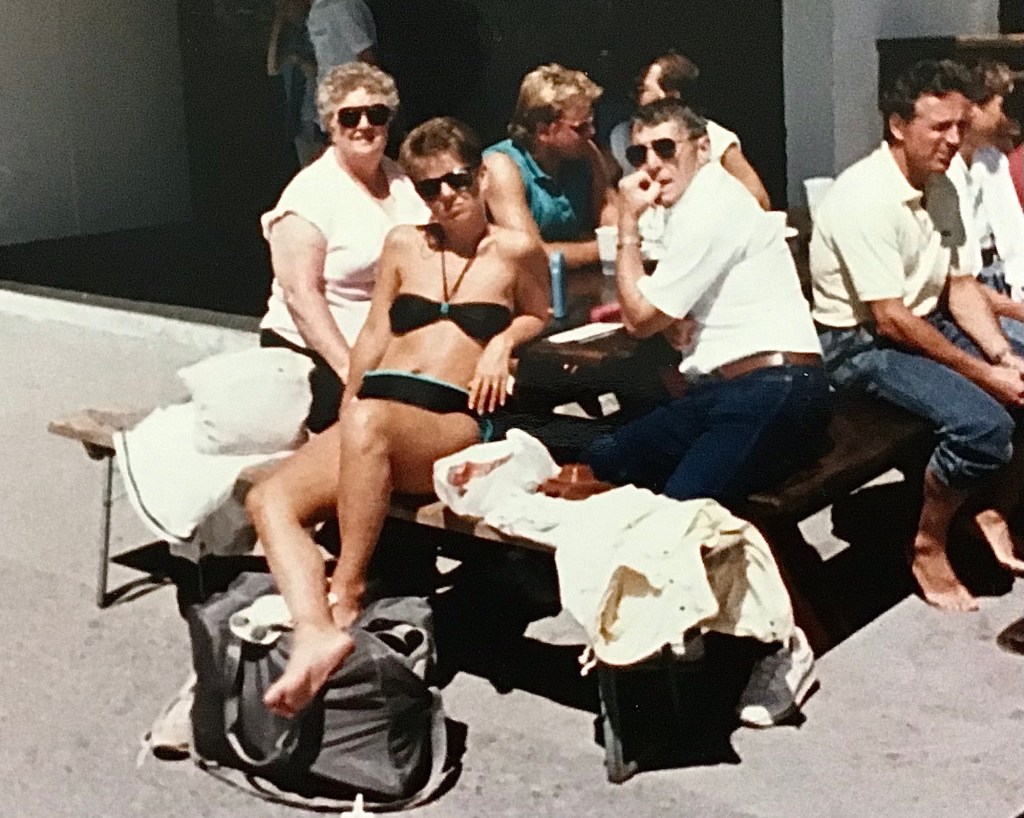
We stacked our skis in a rack, joined Mom and Dad and ordered some biers. Cathy stripped off her sweater and jeans, revealing the bikini she wore underneath. In the photo I took of Cath with Mom and Dad, I love the bored/sullen Euro look she adopted. Just another ho-hum day skiing the Alps and catching rays.

Cathy Working on Her Tan after Skiing in the Morning.

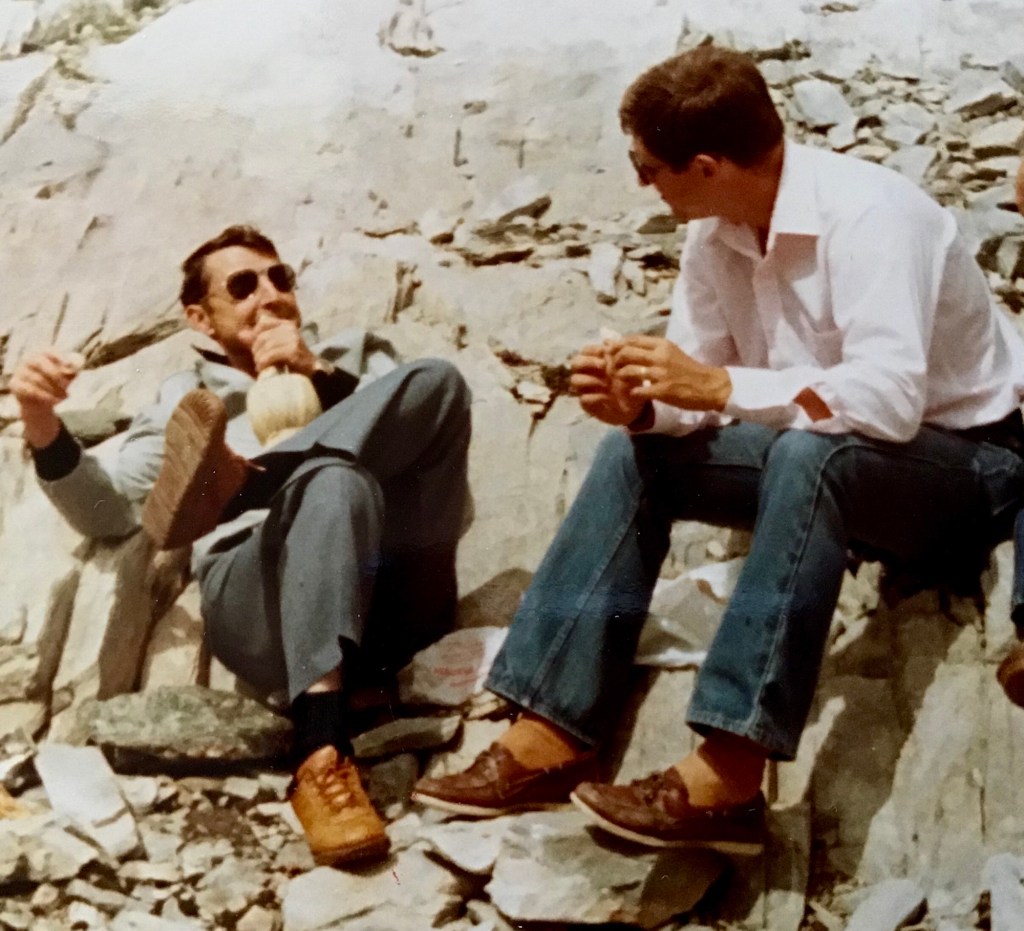
We spent one more night in Sölden, before heading for Nauders, Austria right on the Italian border. We’d previously skied a couple of winters there. After a couple of days seeing friends, we eventually crossed into Italy and then Switzerland, having an occasional roadside lunch of bread, cheese and wine. One day we forgot glasses, but that didn’t stop us. ;-). 

No Glass? No Problem!

We worked our way to Davos, where we enjoyed a multi-course 5-Star meal at a restaurant just outside of town. At our hotel that night, we saw fireworks going off in the mountains across the valley. It was the celebration of the Swiss National Day, their equivalent to our 4th of July and pretty amazing. At the time, we had no clue about the importance of Davos or the World Economic Forum. All we knew was that we ate a great meal that evening and then saw a cool light show in the Alps. 

Eventually, we returned to Rheindurkheim and other adventures, before Mom and Dad flew home. 

It’s funny, I remember many parts of that vacation**, but for some reason skiing the glacier at Sölden stands out. It was only a small part of the trip, but remains firmly in my mind. Maybe it was the fun of the day. Maybe it was the skiing. Maybe it was just the remembrance of my wife soaking up sunshine in a bikini at the ski lodge after a morning of good play. All our days should be so happy. 

Addendum:

  • I should point out that there were MANY women sunbathing in bikinis, not just Cathy. She’s the only one I took a picture of ;-).
  • * These days at Sölden, due to Global Warming the glacier is receding. Skiing stops sometime in May, and picks back up in September.
  • **When people visited us in Germany, we gave them atypical tours of Germany and Europe. We weren’t big on Churches and Museums, and instead, focused on local activities off the beaten path. On this particular vacation with Mom and Dad, we really wanted to show them parts of the Alps we’d grown to love in both the winter and summer months. I doubt we saw another American the entire time.  

March Back

March Back

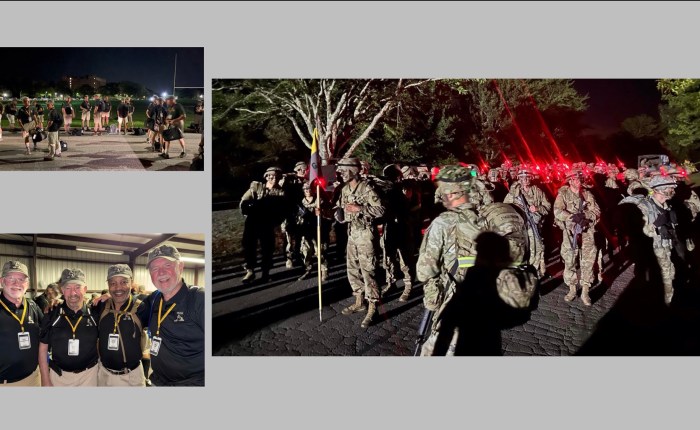
We started gathering around 0130 at Buffalo Soldier Field. Soon, buses would drive us to Lake Frederick. There we would link up with the West Point Class of 2028 and join them for their 14-mile March Back to West Point, which culminates with the end of New Cadet Summer Training, aka Beast Barracks. The Class of ‘28 will graduate exactly 50 years after we graduated in ‘78.  

Just about everyone is aware that West Point Graduates are known for being a part of “The Long Gray Line.”  The phrase “The Long Gray Line” in its simplest definition is the continuum of all graduates and cadets of the United States Military Academy at West Point, from 1802 to the present. In an effort to strengthen the concept of “The Long Gray Line”, the West Point Association of Graduates (AOG) started a 50 Year Affiliation Program (YAP).  It’s an absolutely brilliant idea.  The 50 YAP started 25 years ago in 1999, with the class of ’49 supporting ’99.

To bring some perspective, IF the program had existed when I was at West Point, our Affiliation Class would have been the Class of 1928. Classmate Frank Arduni pulled together some facts about that class:

The class graduated 261 new Lieutenants on June 9, 1928. By the time the last member of their class passed away in October 2010 at the age of 104, the class produced 78 General officers.  They became pioneers of Army Aviation, and within four years of graduation at least 6 members of the class died as 2LTs in air accidents.  Eventually 73 served in the Army Air Corps, two long enough to see it become the Air Force.

28 lost their lives in the Second World War, and at least eight of those as prisoners of war. Six members of the class were “participants” in the Bataan Death March, of whom only one would survive the ordeal. 

One member of the class, Robert Albert Howard, was the grandfather of our 1978 classmate, Eric Franks (RIP). 

Over the course of the next four years, various members of our class will attend significant events during the Class of 2028’s time at West Point. Some of those events include: their First Day at West Point and the Start of Beast Barracks; Affirmation Day at the start of Cow (Junior) year when they have officially committed to serving in the military; Ring Weekend; Branch Night Firstie (Senior) year, when they select their military branch; and of course, Graduation. 

The event that caught my eye was “March Back”. At the end of Beast Barracks, the New Cadets do a forced march of 14 miles from Lake Frederick where they have been for some of their training, back to West Point. A few days later, they transition from “New Cadets” to full fledged members of the Corps of Cadets. Each year a number of graduates (Old Grads) participate in the March Back and interact with the cadets. The 50-year affiliation class is guaranteed 50 of those slots. 

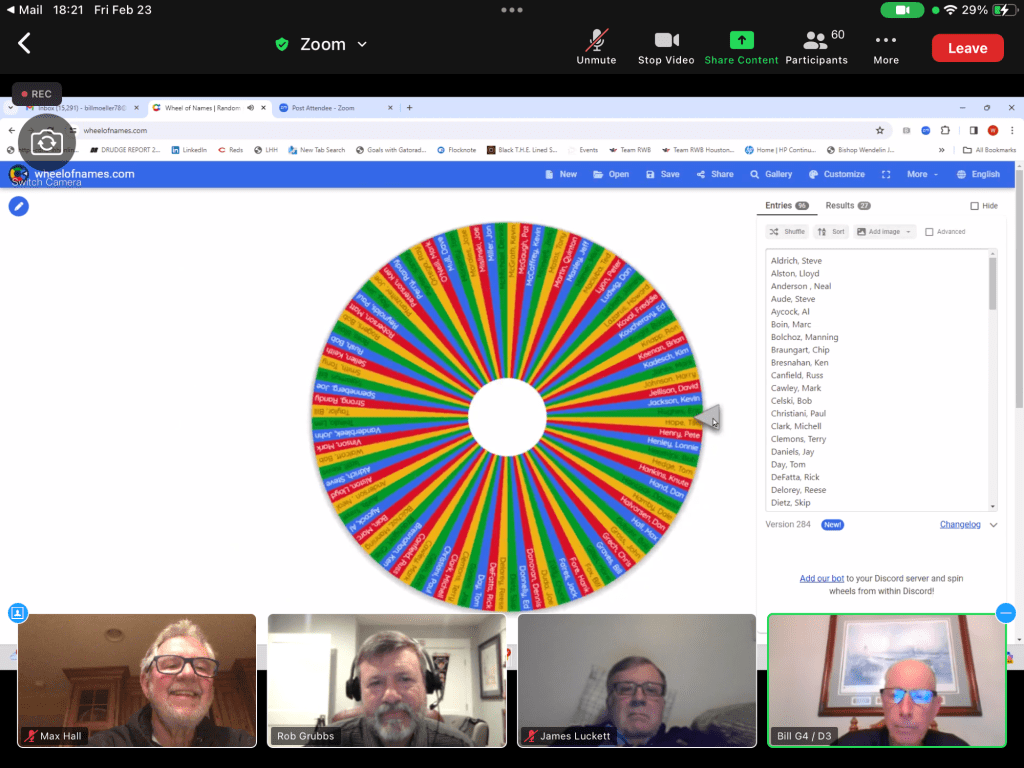
Last winter, our class announced the upcoming events. 118 of us said we wanted to do the March Back. In February, we held an online lottery via Zoom for the guaranteed 50 slots. I was number 76. D@mn. I now needed to rely on some luck and try and sign up for one of the additional slots available to all graduates later in the spring.

The Lottery

In the meantime, I increased the mileage of my daily walks and started going both farther and faster. The March Back itself is 14 miles long, with the first three miles entirely uphill.  The pace was to be at 20 minutes/mile, but we were warned the first three uphill miles could go faster. 

Route Elevation. The First 5 km Are All Uphill.

In June, I lucked out, signed up early enough online and was selected to participate in the March Back. Ultimately 73 members of the class of ‘78 would make the 14 mile March Back, with another 42 joining us for the final two miles. 

Over the next month and a half, I increased my workouts again.  I didn’t want to let myself, my classmates or the Class of 2028 down. In addition to daily 5-6 mile walks, I added several 8, 10 and 12 mile hikes over the hills here in Virginia. The longer hikes were at an 18 to 18:40 min pace. I was as ready as I was going to be. 

On Saturday, the 10th of August, I made the six-hour drive to West Point. As always when returning to the Academy, my mind filled with a mishmash of thoughts – the March Back of course, but also my own time at West Point, and its impact on my life. It’s 46 years since I graduated, but I still remember reporting to The Man in the Red Sash on my first day as if it was yesterday.

That first night was great and I had the chance to see a number of classmates who were also staying at the Thayer Hotel. We had drinks and dinner while telling stories and catching up on the activities in our lives. Our hair was grayer and we were, perhaps, heavier, but our love for life remained. 

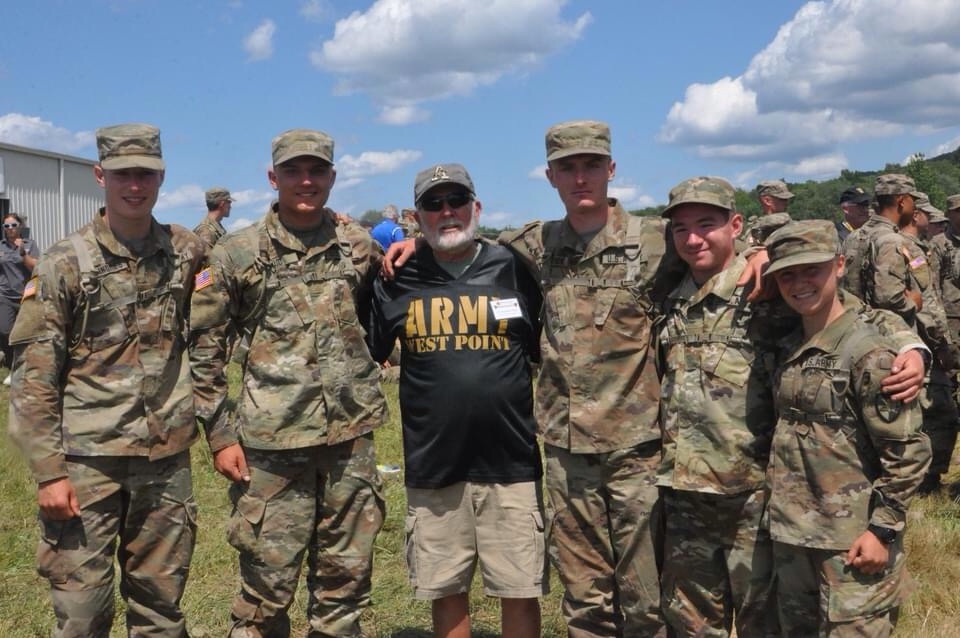
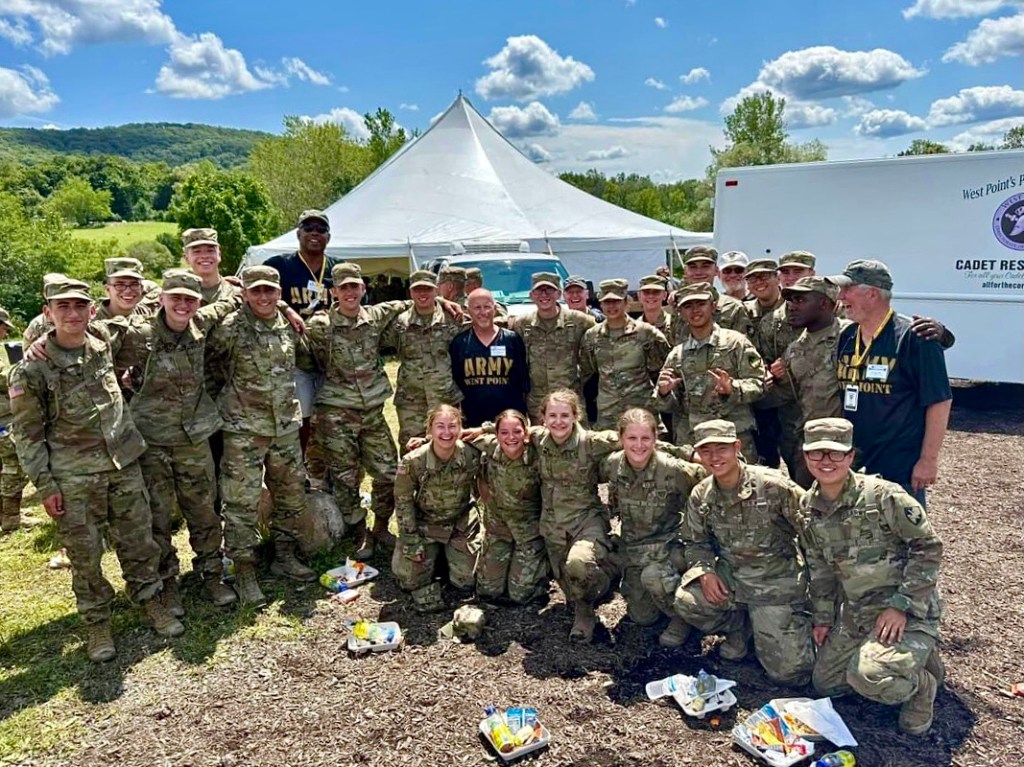
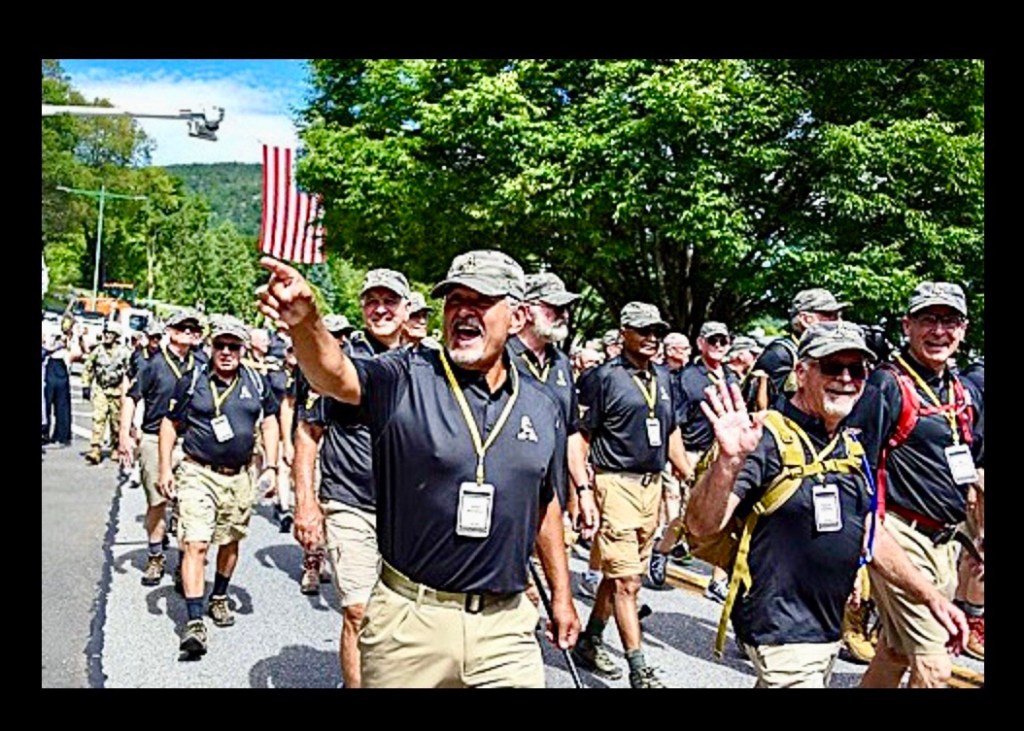
The next day, the AOG bused us ‘78ers out to Lake Frederick to interact with the class of ‘28 prior to the march later that night. At lunch we talked with the New Cadets over hotdogs and hamburgers. It was the start of an amazing 24-hour period. I probably spoke with 7 or 8 different groups during the next three hours and came away universally impressed. You hear stories about kids being unmotivated these days – nothing was further from the truth for these young men and women. They were sharp, motivated, inquisitive and fired up. They had marched 9 miles to Lake Frederick three or four days before in the remnants of Hurricane Debby. It rained during the march and for the next two nights when they slept outside without tents.  You’d have thought they would be depressed or unmotivated, but the exact opposite was true. They were charged up and attentive. I was inspired by all of those I met and spoke with. 

Classmate Bob Rush with Members of the Class of ‘28
Some of the Class of ‘28 with a Couple of us Old Grads

We eventually boarded our buses for the trip back to West Point.  My mind kept playing and replaying the time with the New Cadets. Yes, we were there to help them understand the concept of The Long Gray Line, and hopefully we were doing that. What I hadn’t understood earlier was how motivating these young people would be for me. Their enthusiasm had increased my own. They also brought home the fact that The Long Gray Line extends both into the past AND into the future.  

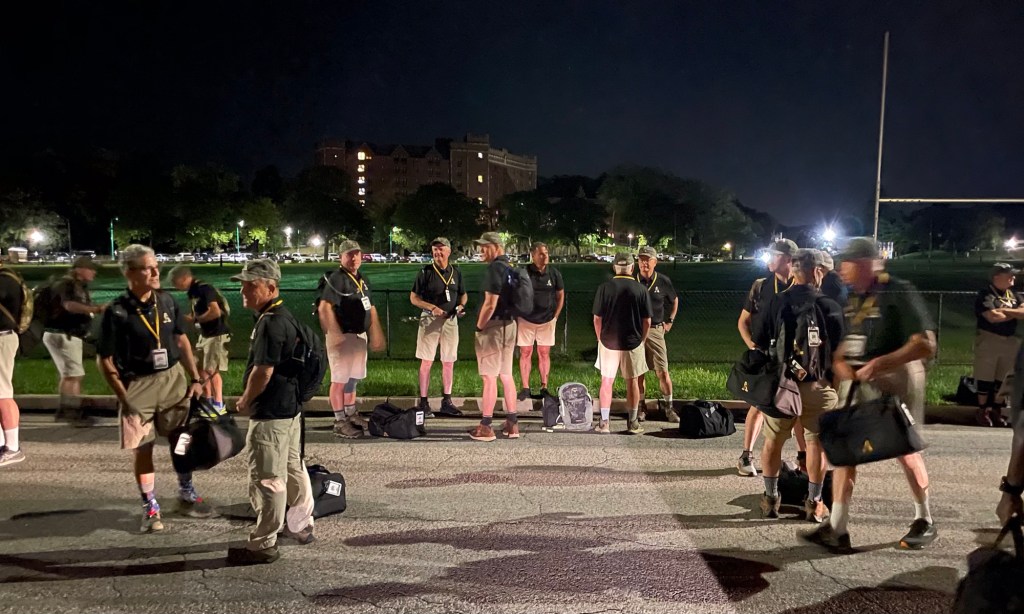
I went to bed around 2100 that night, but didn’t sleep much. Three hours and forty-five minutes later, my alarm went off at 0045.  I hopped out of bed and got ready. I left the Thayer and walked the quarter mile to our Assembly Point at Buffalo Soldier Field. When I arrived around 0130, many Grads were already there, milling around. 

“Hurry up and Wait”

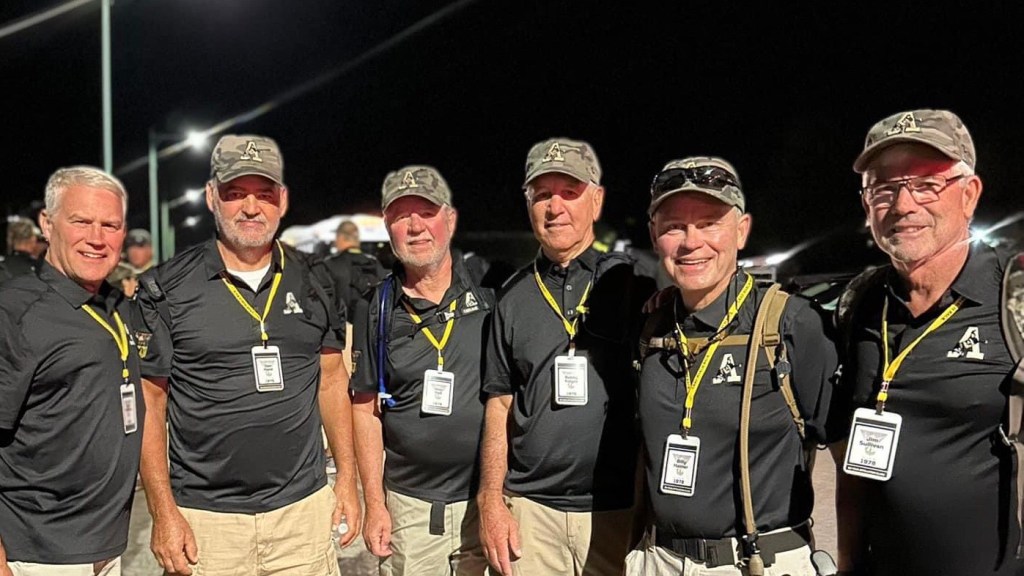
The crowd grew and in the dark we started linking up with friends and classmates.  Six of us ‘78ers were marching with Gulf Company and we snapped a pic. 

Proud and Great ‘78

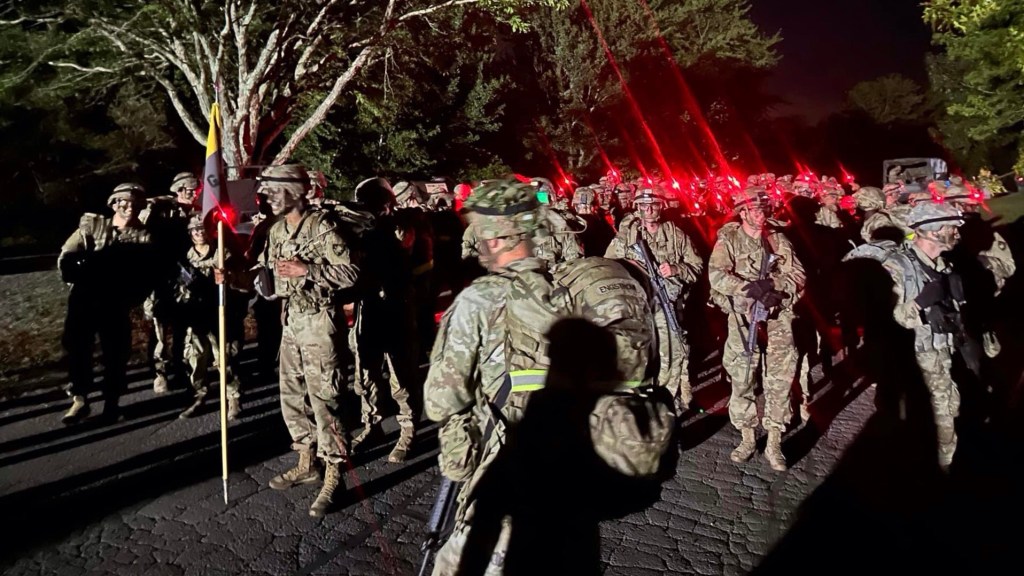
Soon, the buses arrived. We left a little after 0200 and drove to Lake Frederick. After a quick breakfast, they started linking us Old Grads with the companies and platoons we would each march with. I and several others would walk with G-4, the 4th platoon of Gulf Company and they linked us with them around 0415. We grads were only carrying small Camelbak packs with water and maybe a snack, bandaids and a pair of dry socks.  The New Cadets?  Full uniforms, helmets, 30-40 pound ruck sacks and their M4 rifles. Yep, men and women alike, they were doing a full combat march back to the Academy to start the academic phase of their Plebe year.

Gulf Company, Ready to Roll.

At 0430, right on time, Gulf Company started its return to West Point. 

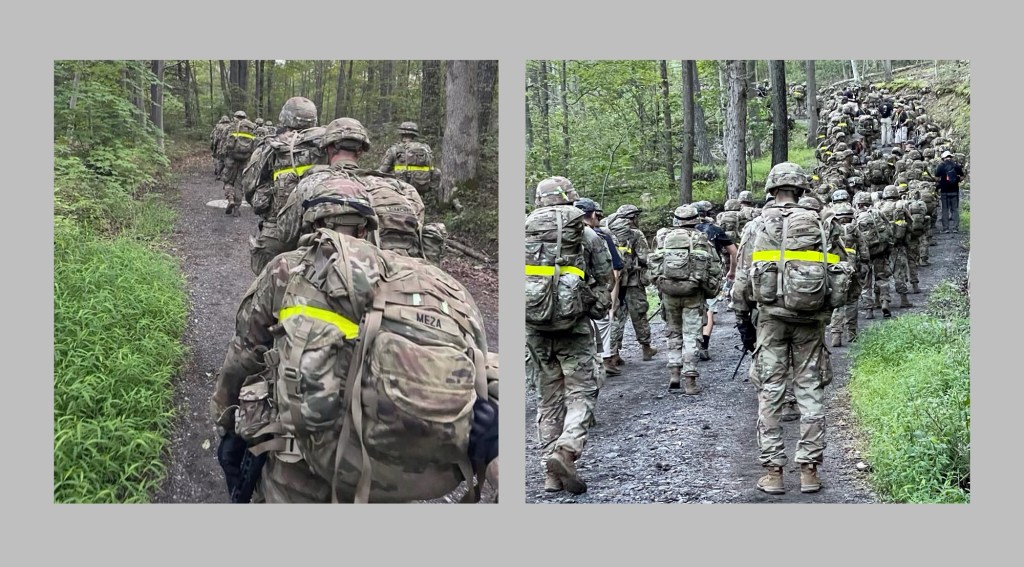
We did the first three miles uphill in the dark. The trail was gravelly and rock strewn but honestly, I didn’t really notice the dark, the climb or the rocks. I was having too much fun talking with the New Cadets and a couple of the Cadet Cadre. The New Cadets were supposed to march in silence, unless they were talking with one of us Old Grads and that’s what they did. But when you started talking with them – man did they open up. They asked me as many questions as I asked them and the time passed quickly. We arrived at the three-mile mark around 0525.  True to what they’d warned us about ahead of time, we went out at a spirited 18 Minute/mile pace, but I hadn’t noticed. 

After a short break, we continued marching as daylight approached. The New Cadets were in two columns, one on each side of the road, with the cadre and us Old Grads marching in the center between the columns. For the next three hours, I spoke with perhaps 15 or 20 New Cadets. We talked about West Point, Beast Barracks, Plebe Year, the Army, how long I stayed in and where I was stationed, Women at West Point, Women in the Army, Airborne School, the rain from Hurricane Debby, wet boots, what drew them to West Point, why they chose West Point, why I chose West Point, the best part of Beast, the worst part of Beast, square meals, and a whole host of other topics, including the Green Bay Packers and their chances this year. The conversations were full grown adult conversations, not the monosyllabic answers you sometimes receive from youth these days. The next nine miles passed in a blur. 

The Class of 2028 on the March

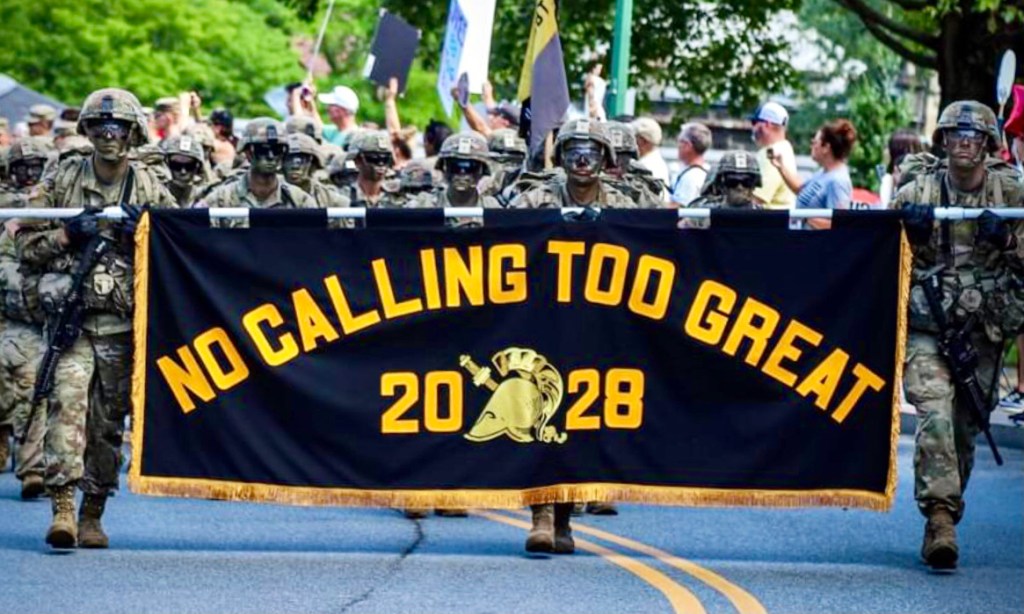
At the 12-mile mark, we arrived at the West Point Ski Slope. We Old Grads said our goodbyes and left the New Cadets. We joined our classmates who were only marching the last two miles into West Point proper. After a break the Class of ‘78 formed up. The Class of 2028 passed in front of us in company formation and unfurled their new motto, “No Calling Too Great – 2028” for the first time. We members of the Proud and Great Class of ‘78 saluted them as they passed. 

After the Class of ‘28 marched by, the class of ’78 fell in behind them, leading the Old Grad contingent of nearly 400 marchers. We picked up the cadence of the drum, and as one of my classmates mentioned, even at our age we were still marching better than the Naval Academy does. ;-).  


José Morales and the Class of ‘78 on the Parade Route

Much of the route for the final two miles was lined with people watching the parade. They too were inspiring with their claps and cheers. I think the last time I marched in a parade was around 1982 in Germany. Eventually we reached main campus and Passed in Review at the Superintendent’s house. We (‘78) chanted “Beat. Navy! Beat. Navy! Beat. Navy!” in time with the drum for the Supe and he laughed.

And then the March Back was over. The Class of ‘28 went to clean their weapons.  We ‘78ers walked across The Plain for the rededication of a Statue of Civil War General, John Sedgwick, that the Class of ‘78 had funded a restoration of (stay tuned for a future blog about Sedgwick’s Spurs.) We followed that with a short Memorial Service for our 93 classmates who have passed away and ended with classmate Harry Johnson leading us in singing The Corps. The words to The Corps always ring true, particularly with its references to The Long Gray Line. On this day, it was perhaps a double punch with both the Memorial Service for our departed Classmates and the March Back with the future of the Corps.

The Class gathered one last time a couple hours later for a cookout and a few drinks.  We all remarked about what a great time we’d had over the last 24 hours and how impressed we were with the Class of ‘28. We were still enthused, but a bit quieter by now. As evening approached, with hugs and handshakes, we went our separate ways 

On my drive home Tuesday morning, my legs were only a little sore. As I drove,I thought about the Class of ‘28 and my interactions with them. My friend and classmate Tony Matos called the weekend magical and I agree. I spoke with young men and women of all colors and ethnicities. I’d spent time with New Cadets from California, Washington, Oregon and Idaho; Oklahoma, Illinois, Indiana, Wisconsin and Minnesota; Georgia, North Carolina, Virginia, New Jersey, New York, and Connecticut.  It was as if the melting pot of America was on display for those two days. I’d made the trip to West Point to show and give them a view of the continuity of The Long Gray Line. They gave me so much more – a demonstration of grit and fortitude; a view of encouraging teamwork; a promise of both mental and physical strength; and a look at the future. From my time with the Class of 2028, I felt encouraged. I believe that both now and in the future, West Point, our Army and our Country will be in good hands as the Class of ‘28 answers the call of Duty, Honor, Country. 

No Calling Too Great, 2028

Addendum:

  • Thanks to classmate Frank Arduni for his ongoing research about the class of 1928.
  • Thanks to classmates Bill Moeller and Tony Matos for their editing support on this blog. Both had great ideas to add.
  • Thanks to classmates Bill, Tony and Billy Harner, along with the AOG for organizing the March Back activities and making it such a wonderful event for all of us.
  • The pictures in this blog are from a number of sources, including classmates, the AOG, and my own photos.
  • Thanks to my wife, Cathy, and friend, Colleen, for their continuing editorial support. I’d be lost without them.

Three Letters

Three Letters

My friend John told me a story about once taking on a high-level job after his predecessor was fired. He knew the guy (Sandy) he was replacing and asked him if he had any advice. Sandy gave him the usual pablum, and then said “I’ve left you three letters in the top drawer of the desk.  If you get in trouble, open each of the letters in turn.”

John took on the job and it was quite a challenge. After about three or four months, things weren’t going very well and he decided to open the first of the letters.  He opened it and inside was a single sheet of paper. On it, Sandy had written “Blame your predecessor (me) for the issues. That will give you some more time.”

John thought about it some.  He didn’t want to throw Sandy under the bus, but then thought, hell the advice came from Sandy himself and he decided to do it. 

At the next board meeting he explained he had uncovered some new issues and they were directly caused by Sandy and his time with the company. The board nodded in agreement and told him to proceed and fix things.

Six months later, things hadn’t improved much. John was getting a bit desperate again and opened the second letter. For the second time, there was a single sheet of paper inside and on it, Sandy had written, “Reorganize.”

John thought to himself, “Of course! Brilliant idea!” And so, at the next board meeting John explained he was reorganizing and this would bring greater efficiency and increased profits.  The chairman nodded in agreement and said, “That sounds good John, but let’s get on with it.  We’ve put our faith in you.”

Another six months went by and things didn’t get any better.  As a matter of fact, they might have become worse.  Reluctantly, John decided he needed to open the last letter from Sandy.

For the third time, there was a single sheet of paper inside. On this one, Sandy had written, “Write three letters!”

__ 😉 __

No, not a true story, but I think a funny one. And while not a true story, there is some truth to what people try and do to improve an organization. As a SR VP in a publicly traded company, a COO for a private company, and the Chairman of a small IT Services company, I’ve seen all types of leaders and managers. I’ve never thought the blame game helped anyone and I’ve never been a believer in change for changes sake. Some “leaders” seem to do both.

Grandma’s Umbrella

Grandma’s Umbrella

Last week it rained pretty heavily one day. Late at night I took Carmen out to do her business and it was still raining. I grabbed one of our umbrellas and as I opened it, thought of Grandma Grubaugh. I’d given her the umbrella as a young man. It returned to Cath and me when she passed away. 

I remember as a child, we kids would give Grandma and Grandpa Grubaugh some sort of homemade Christmas gift, or Mom would buy something and put a tag on it, saying it was from the three of us. When Grandpa died in 1968, it transferred over to just getting something for Grandma. 

At some point in time, maybe in High School, or when I left for West Point, I started buying Christmas gifts for Grandma on my own. I don’t really remember much about what I bought her. I mean, what do you buy for a woman who pretty much had everything she needed or wanted?  Inevitably it was some knick-knack or something else she didn’t really need. When at West Point, it might have been a pin or brooch related to West Point. Of course she always acted as if it was the most precious thing in the world when she opened the gift on Christmas Day. 

Grandma and I at my West Point Graduation.

Later, when Cathy and I married and were living in Germany, we typically sent her some German chocolates or something similar. Or, would have Mom and Dad pick up some steaks for her.  We’d learned over the years it was better to give her food she could actually enjoy rather than yet another gift she didn’t really need. 

Eventually Grandma passed away in 1996. It fell to Mom and my Aunt Pauline to go through her things and get her house ready for sale. Most of it was straight forward. The aunts and uncles claimed the items they wanted to remember Grandma by, and then we grandkids were offered a choice of remaining items. That’s how I ended up with the pink monkey and blue elephant glasses. I always remembered them from my childhood – drinking milk at Grandma’s kitchen table while eating her homemade date-nut bread.

Blue Monkeys and Pink Elephants

One day during all of this, I received a call from mom. They’d come across a chest and when they opened it, they were a bit shocked. It was full of Christmas and Birthday presents Grandma had received over the years and never used.  Each item had a tag saying who gave her the present. There were plates and bowls, and even unopened packages of brassieres (Grandma would never have used the word bra). 

Among the items was an umbrella, with mine and Cathy’s name on it. The plastic box was still unopened. Mom gave it to us the next time we were home visiting. 

I have to say, it’s a bit of an ugly umbrella. I suppose sometime back in the ‘70s the color combo might have been considered the height of good taste. No plain black or blue or red – it’s an in-your-face design with shades of brown and orange. Color-wise, it’s a perfect match for our 1970s era crockpot. It also turns out it is an incredibly durable product. Made in the ‘70s and first used in the late ‘90s, it’s still functional and going strong in 2024. 

‘70s Colors in Full Bloom.

It currently resides in a storage stand in the mudroom, along with a basic black umbrella, a couple of walking sticks and some snowshoes.  It’s only used a few times a year – usually late at night when I’m taking Carmen out to do her business and there’s a driving rain. Still, it never fails to make me smile and think of Grandma Grubaugh, a truly treasured gift. 

Bucket List

Bucket List

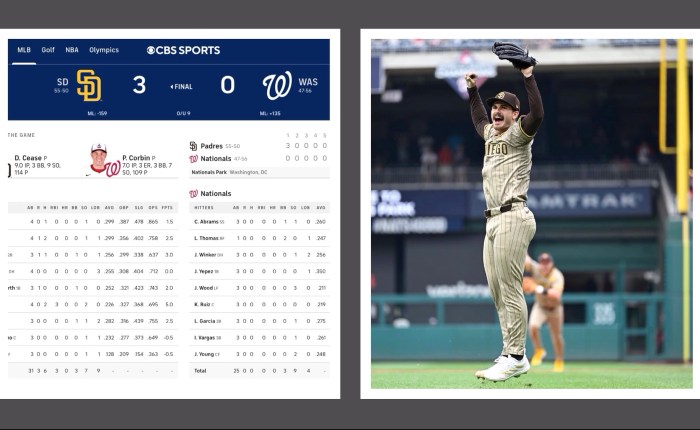
Last Thursday, I checked something off my bucket list – for the first time ever, I saw a no-hitter at Nats Park. Of course God had the last laugh. The Nats were no-hit by San Diego’s Dylan Cease.  I guess beggars can’t be choosers when it comes to bucket list items. 

No-hitters are a rarity. There might be one or three in any given baseball season. That’s one or three no-hitters, out of the 2,430 games the 30 teams play each year, not counting the playoffs. I’ve seen many grand slam home runs over the years. I’ve seen walk-off homers.  I even checked off another bucket list item when I made a Nats World Series game in 2019 (they lost the game, but won the series). But a no-hitter?  That’s a big no-no never. Until July 26th, 2024. 

The game started at noon and at 12:15, there was a rain delay of 76 minutes. The first half inning wasn’t even over. When the game resumed around 1:30, Nat’s pitcher Corbin gave up three runs. Ugghhh. After that, he settled down and both Corbin and Cease were pitching well.

Waiting Out the Rain Delay.

At the top of the 6th, I looked at my watch. Holy Cow! It was only 2:30.  4 1/2 innings were covered in one hour. THAT is some fast and effective pitching. It was also about then I noticed the Nats didn’t yet have a hit. Still plenty of time for that. 

Our Group Caught on Nats-Cam Early in the Game

By the 7th, we were talking about the possibility amongst ourselves. The Nats went no-where that inning. You could feel the tension mounting in the park. 

The 8th – the same thing. Cease got the side out on 9 pitches total. We were all talking. Could this/would this really happen?

And then it was the 9th. Vargas made him work for an eight-pitch groundout. Young ground out on the next pitch, and a yell went up inside the park. Abrams came up with two outs.  He hit a low liner that looked like it might drop, and NO! The right fielder caught it!

The San Diego fans in the stadium let out a roar. And then the Nats fans stood up and the vast majority of us also started clapping. Not for the Padres winning, but the superb effort Cease had given. You can honor effort and history without disrespecting your team and that’s what we were doing. Against the Nats, I wouldn’t have said he was dominant, but he was d@mned efficient. 

It turns out Cease has only given up two hits in the last 22 innings he has pitched. The man is currently on fire. It’s also worth pointing out he played for the White Sox before this season. Jerry Reinsdorf traded him away at the start of this season.  Did I mention no one in Chicago cares much for Reinsdorf these days?

And the Nats?  Since baseball returned to Washington in 2005, it’s only the second time they’ve been no-hit in the last 14 years. 

I’ve thought about my emotions at the end of the game.  Through the 8th, I was hoping for a hit and a rally from the Nats. In the 9th? I was holding my breath, and to be honest, I’m not quite sure what I hoped. For the Nats to win?  Certainly. But on that last at bat?  Two outs? Yea, maybe I was holding my breath, waiting to see if history would be made.  I know after the right fielder caught the line drive, I too rose, and softly clapped. You can honor effort and history without disrespecting your team. 

Cashews and Crowns

Cashews and Crowns

The cashew I was eating one evening last week cracked a filling and broke a piece off of one of my crowns. Sixteen hours later, I was sitting in a chair at Gainesville Dental Associates with the filling repaired and a temporary crown in place. I don’t think people say it very often, but I love my dentist. 

It was about 8:30 or 9:00PM and I was watching some bad TV. I decided to have a snack and went in the kitchen and served myself a half a cup of cashews. 

As I sat back on the couch, I popped one in my mouth. It crunched and somehow became totally lodged between two teeth, or so I thought at the time. I tried removing it with a toothpick, and then with floss, but when the floss cut in half three times in a row, I knew something was wrong. I eventually removed the nut, but there was a half gap where a tooth used to be. Strangely, I felt no pain. 

I called my dentist’s office, Gainesville Dental Associates, and asked if they could call me back in the morning so we could schedule an appointment to have the tooth looked at. I figured, with luck, they could get me in within the next few days.

Early the next morning as I returned from the barn, my phone rang. The dentist’s office was returning my call. I again explained what happened and was hoping for an appointment as soon as possible. “Just a moment.” the person said, and after a few seconds, “Could you be here at 2:50 this afternoon?” “Of course!”, I answered and thanked her profusely. 

That afternoon, when I arrived at the dentist’s they escorted me to the exam room. As I spoke with the tech who was taking X-rays and would be assisting the dentist, I expressed my surprise at receiving an appointment so quickly. It turns out the office runs between 7AM and 8PM (they run two shifts) and they always keep a couple of slots free during the day for emergencies. All I can say is what a brilliant idea – I certainly benefited from it. 

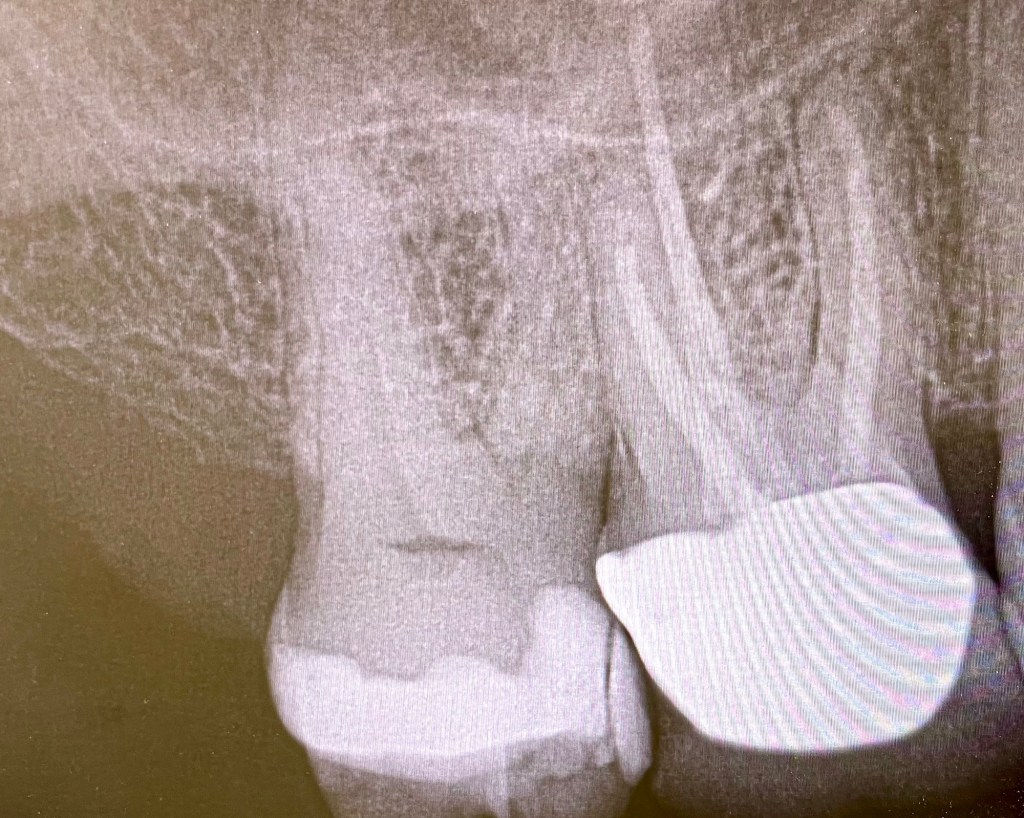
The X-rays showed one of my fillings had cracked, AND part of a crown had cracked and separated from the tooth (and disappeared). There was no pain because the crown covered a root canal from years before and hence, there was no feeling in the tooth. The sharp edge of the remaining part of the crown is what cut my floss the night before. That must have been one hard nut.

Note the Crack in the Filling in the Tooth on the Left.

The dentist came in and we spoke a bit and went over options. Ultimately, we decided to repair the cracked filling and replace the crown. He started immediately. 

For the next 1 1/2 hours, the dentist, the tech, and I became buds of sorts. Rock music played in the background and there were bits of conversation.  As they were starting to work on the crown they put a small “shield” in my mouth between the tooth and my cheek to help protect the cheek. Of course as time progressed, I kept playing with it with my tongue trying to figure it out, and then trying to decide what it was made of.  Finally, I said to the dentist during a break, “What’s the shield made of, plastic or cardboard?”  He looked at me and said, “Are you an engineer?”  I answered, “what?!”. He said again, “Are you an engineer?”, and I answered, “Well as a matter of fact I am.  Why?”  He then laughed and said, “My brother’s an engineer and that’s exactly the kind of question he asks!”  We both chuckled and talked a bit about engineers and their ways.  I told him my favorite engineer joke which he laughed at out loud and planned to tell his brother the next time he saw him.  (For the record, the shield is made out of plastic AND cardboard.)

The work continued.  They took a mold for my permanent crown and measured for a temporary crown until the permanent crown is ready. 

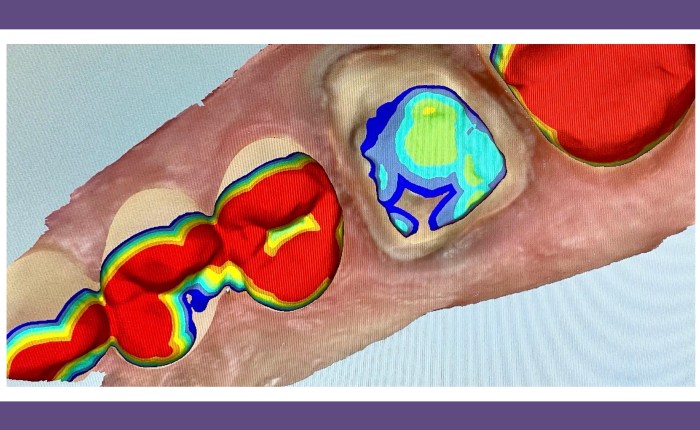
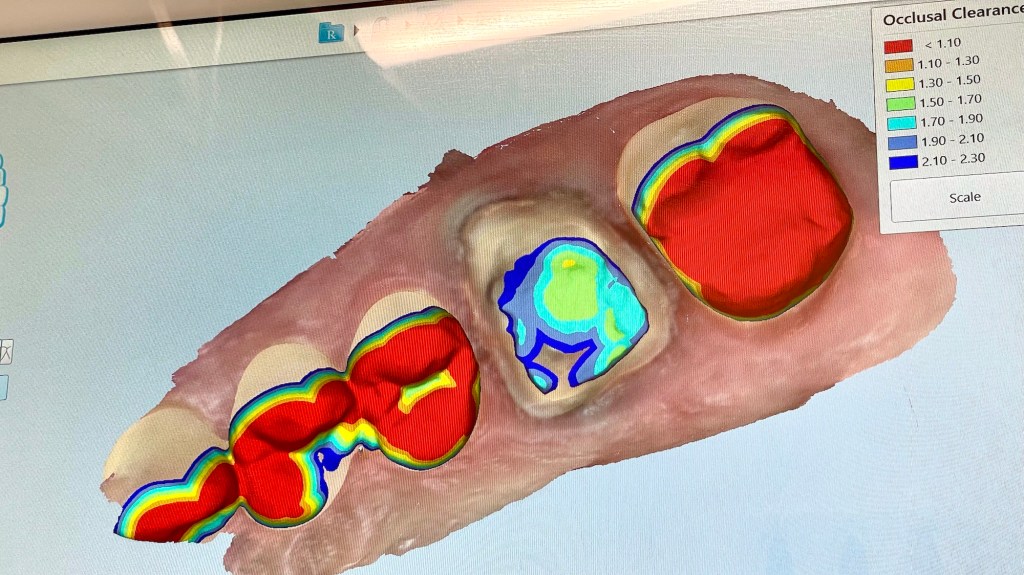
Checking Tooth Clearance, In Preparation for the Crown.

My dentist left and the tech finished putting the temporary crown in place. She then talked about things to do and not do until the permanent crown is in. Chief among the advice – “Do not eat any nuts!”

I’ve been with Gainesville Dental Associates for over 25 years. They’ve been great the whole time.  Whether routine cleaning, exams, handling a couple of issues I had, or responding to my plea for help this past week, they’ve always risen to the occasion and done an excellent job. If you live in the Warrenton/Manassas/Gainesville/Haymarket area, you should definitely consider using them. You won’t regret it.

As for me, I’ll be back on August 6th, when they’ll put my permanent crown in. 

Addendum: