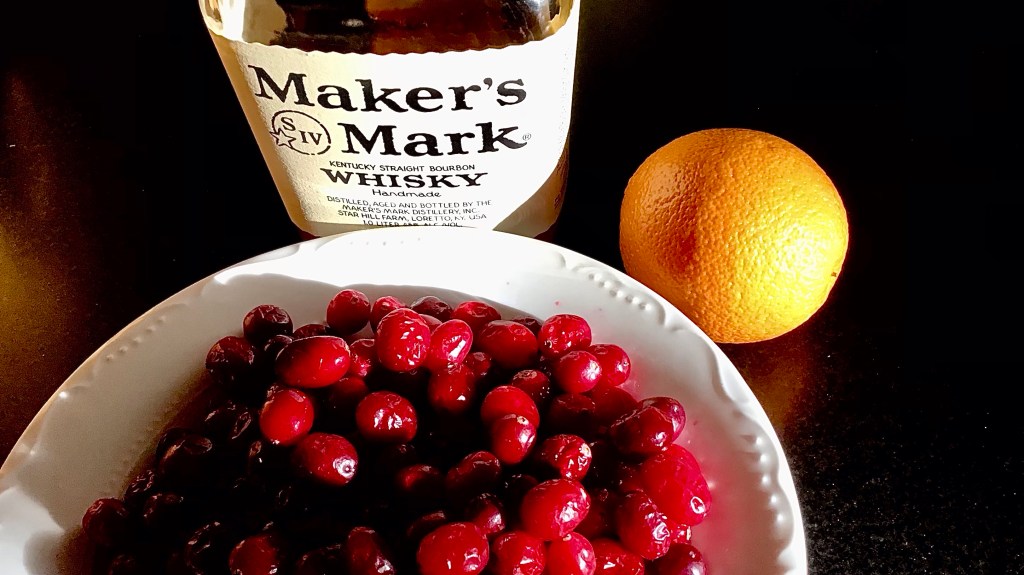
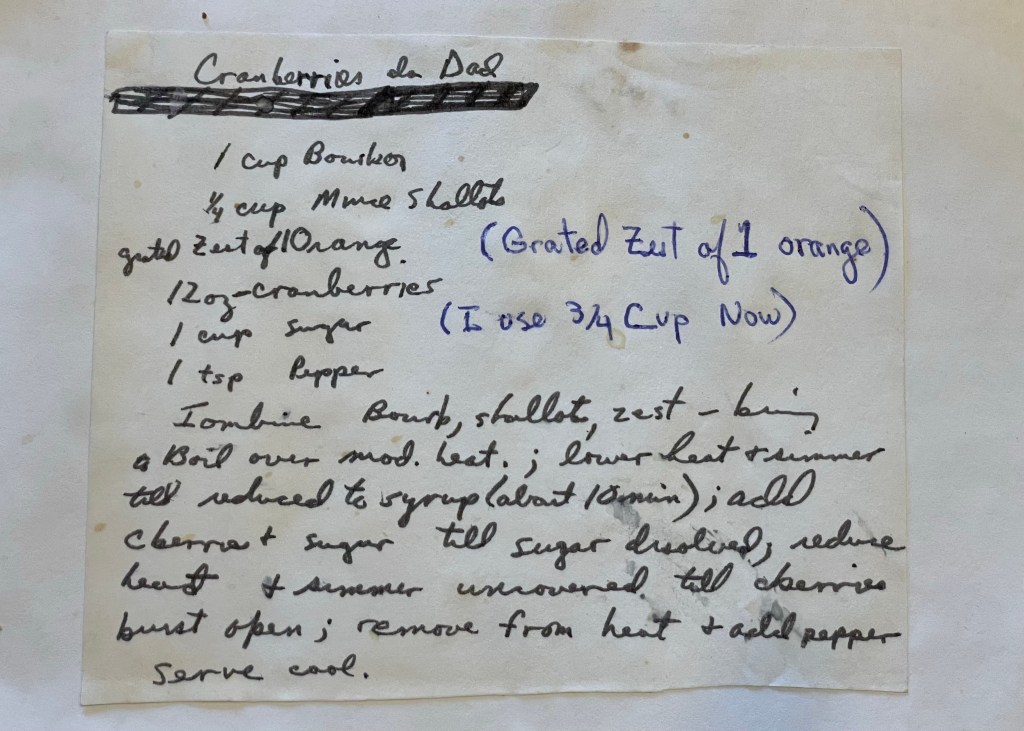
Thanksgiving, that truly American holiday, is approaching and started me to thinking about Dad and his Cranberry Sauce. It’s a great recipe filled with bourbon, cranberries, shallots, orange zest and memories. I love the fact that I get to spend a little time with Dad whenever I make it.
Cranberries, Bourbon, Orange Zest and Shallots…
Growing up in the Hall house in Ottawa, Illinois, Thanksgiving and Christmas were nearly identical meals – turkey, dressing, oyster dressing, mashed potatoes, candied sweet potatoes, corn and green bean casserole. The desserts – pumpkin pie, mincemeat pie and if we were lucky, strawberry-rhubarb pie, were all made by my Aunt Marge, a wonderful baker. Sometimes we would have a cherry pie from Aunt Diane – the cherries were from a tree in her yard. For snacks ahead of time, there were black olives and pickles (when young, my sisters put the olives on the ends of their fingers and then ate them off). There was cranberry sauce served as well – sliced out of the can.
I remember both meals as large loud affairs – Grandma, uncle Don and aunt Diane and their kids would be there. Various uncles or aunts stopping by for a slice of pie and cup of coffee after their own meals. Roberta and Tanya’s friend Marsali would inevitably stop over. Later when we were older my buddies Howard and Tim stopped in for a drink (to settle the stomach) after their own dinners.
Both meals were delicious and mostly made by mom. The kitchen was her domain. She often joked she actually spent more money on the oysters for the oyster dressing than she did on the turkey, and that’s saying something. I never thought to ask why we had exactly the same meal for both occasions and was somewhat shocked when I later learned other families served steaks or some other non-turkey meal for Christmas.
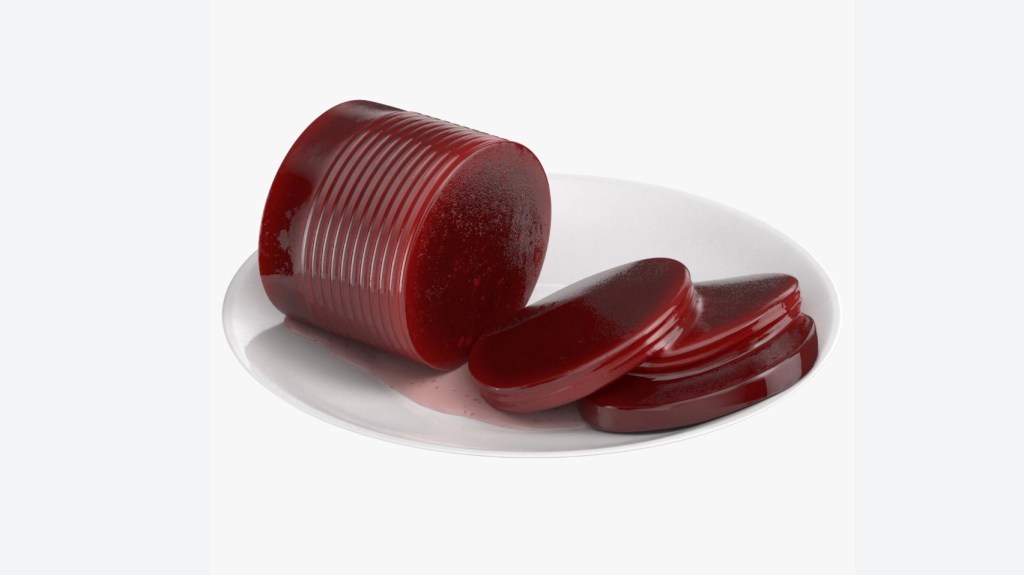
Everything for both Thanksgiving and Christmas dinner was homemade – except for the cranberry sauce. Growing up in the midwest, I think that was fairly typical – canned cranberry sauce, sliced into equal, perfectly round slices.
Sliced Cranberry Sauce. Please, No Judgement.
That changed one year, probably around 1984 or so when Dad retired from work. After he retired from the railroad, mom continued to work another seven years until she reached retirement age. As a result, Dad took over much of the cooking at home.
Cath and I were home for Christmas that year and dad had a surprise for us – homemade cranberry sauce! We all oohed and ahhhed over those cranberries and how good they were. Now mind you, mom was still making the entire rest of the meal (with help from my sisters by this point in time), but Dad now had his contribution as well. I think it came from a Bon Appétit recipe he tweaked slightly.
And so, Cranberries à la Dad became a part of the tradition for both Christmas and Thanksgiving.
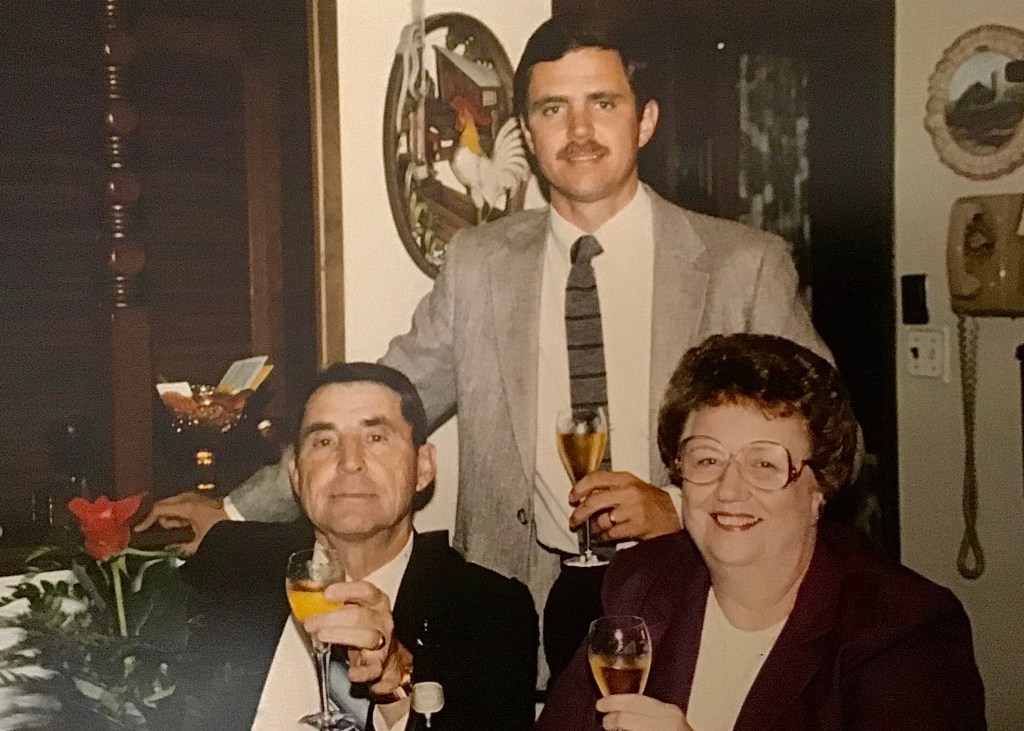
Mom, Dad and I around the Time He Started Making his Cranberry Sauce Recipe.
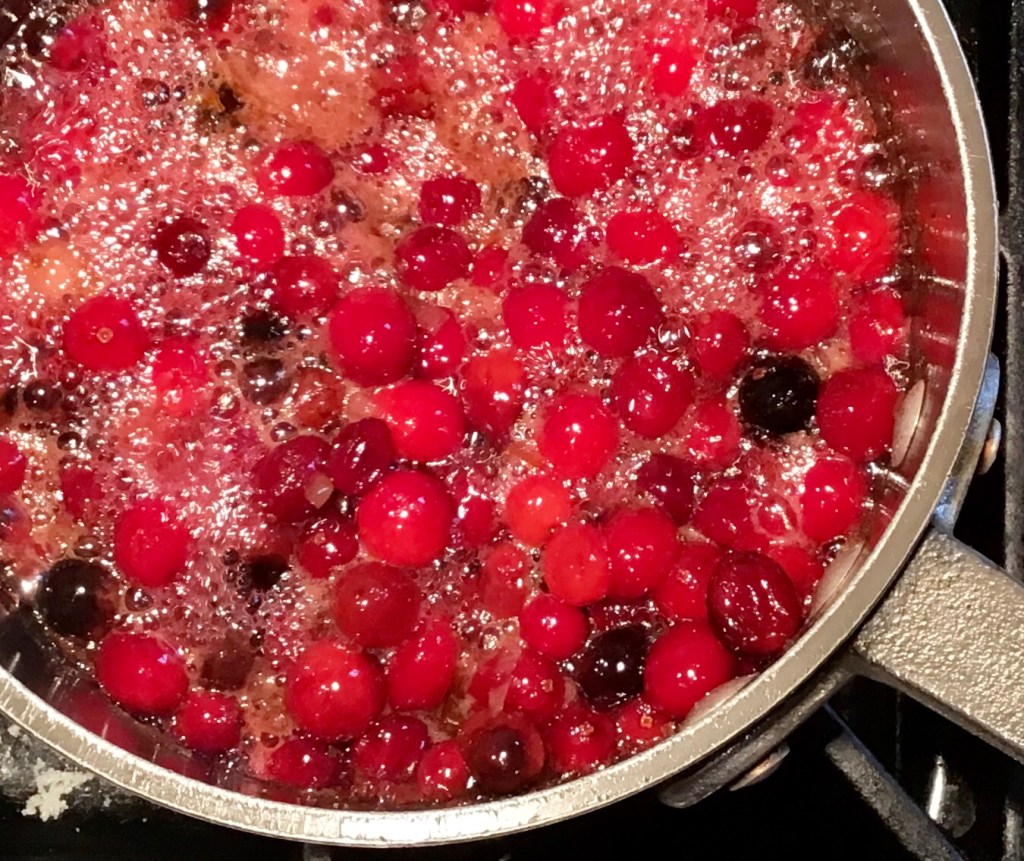
It’s carried on at Cath’s and my home for Thanksgiving as well, although these days, we are having Thanksgiving with friends at their homes as often as not. The recipe is easy to follow, and cooks quickly. Still, I enjoy the few minutes it allows me to spend with Dad. As I smell the bourbon reducing and hear the snapping and popping sound of the cranberries opening, I reminisce and think about the good times we enjoyed with Dad over the years. It’s not a bad way to spend a half hour or 45 minutes.
You can Hear the Cranberries as They Sizzle and Pop While Opening.
Here’s the recipe. You have plenty of time before the big day to buy the ingredients. I usually make it the day before Thanksgiving while sipping on a small glass of bourbon, but the morning of works as well, if there’s room for you in the kitchen. For a chunkier look, don’t let all of the cranberries burst. Cranberries, bourbon, shallots, orange zest and memories – it’s a recipe that works.
Enjoy!
Addendum:
Thanks to my sisters, Roberta and Tanya, for their input to this blog. It’s always great to share memories with those you love.
Do you know the best way to develop your wine palate? Drink more wine. I believe Cath and I have that covered. We began drinking wine together (legally) in 1974 when she started working for the FBI in DC. Seriously. We’ve had more than a couple of bottles together in the past fifty years.
After Cathy moved to DC in 1974 to work for the FBI, I’d visit from West Point for the weekend. If we were doing a “special” night out, we’d always order a bottle of wine. I think we felt more like adults. Now mind you, neither of us owned a car, and metro wasn’t here yet. We’d take a bus from her apartment to Old Town Alexandria and usually go to The Wharf, one of the nicer restaurants in town. After a seafood dinner and bottle of wine, we’d dutifully wait for the bus and take it back to her apartment. ;-). A taxi was out of our price range.
Our real wine education came after we married and were stationed in Germany in the ‘80s. Yea, we drank a lot of good German bier, but we drank our fair share of wine as well. Not only dry German and Austrian whites, but also French, Spanish or Italian reds when we traveled to those countries. Spending nine years in Europe significantly broadened our exposure to what wine could be.
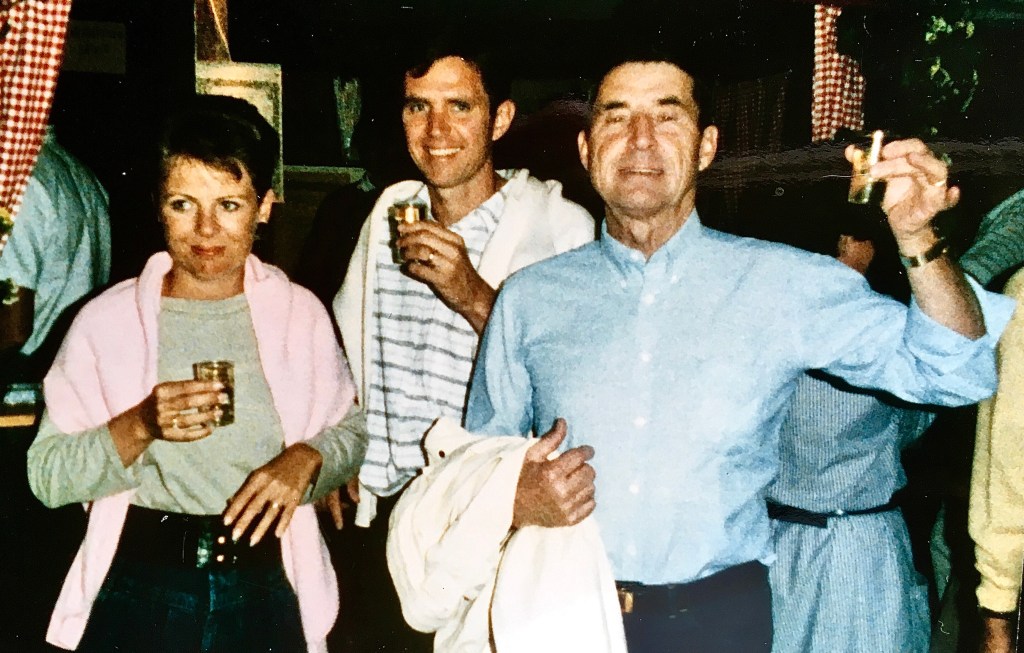
Cath, Dad and I at a Weinfest in Germany around 1987.
Returning to the States in ‘89, we discovered California wines, which we’d pretty well ignored before then. Cabs, Merlots, Zins and eventually Pinot Noir’s – Our taste buds grew once again and sometime in the ‘90s we installed our first wine rack, which held about 110 bottles.
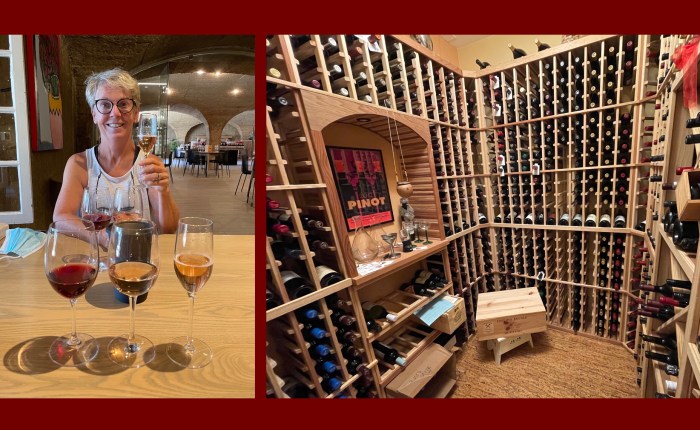
After moving to the farm in ‘99, we renovated the kitchen around 2005 and put in a wine cooler – we could store 250 bottles in it, which seemed like a pretty reasonable number. Except it wasn’t. And so…
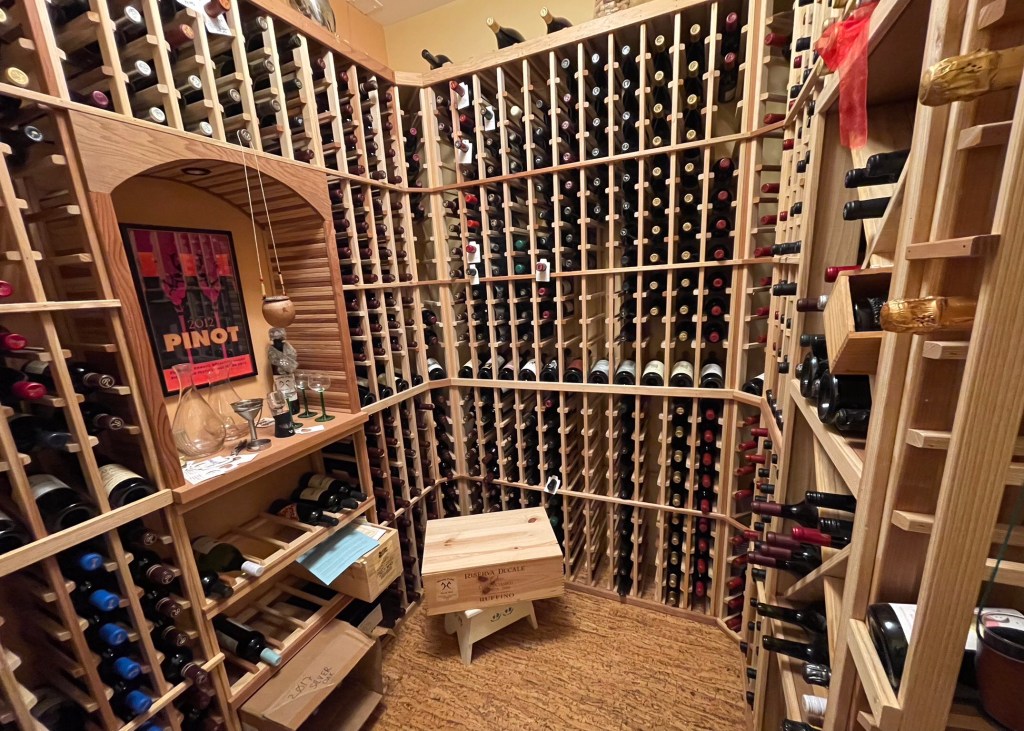
In 2011 we discussed putting in a wine room with a separate chiller. To be honest, I think Cathy was feeling a bit guilty about the money we were spending on her horses and she readily agreed we needed a cellar. Of course, she would benefit from the cellar as well. And so, we bit the bullet and installed it.
The Wine Cellar – Not quite at Capacity.
Our cellar holds around 950 bottles, although if you wanted to stack cases on the floor, you could add another 200 or so. I’d point out this is a drinking cellar. This isn’t a cellar for storing trophy wines. Everything in the cellar is meant to be consumed … over time. It’s stocked to our tastes. You’ll find sparkling wines, Virginia wines from a couple of our favorite vineyards (Linden and Glen Manor); California Pinots, Merlots, Cabs, and Zins; French, Italian, Sicilian, Spanish, South African and Portuguese reds; whites from a number of locations in the States and France; and some dessert wines. There’s a bottle of Georgian wine in there somewhere (the country, not the state). There are a couple of bottles from the late ‘90s, and then probably just about every year from 2000 to the present. We like the cellar and we like the inventory. We enjoy putting a dent in it with friends.
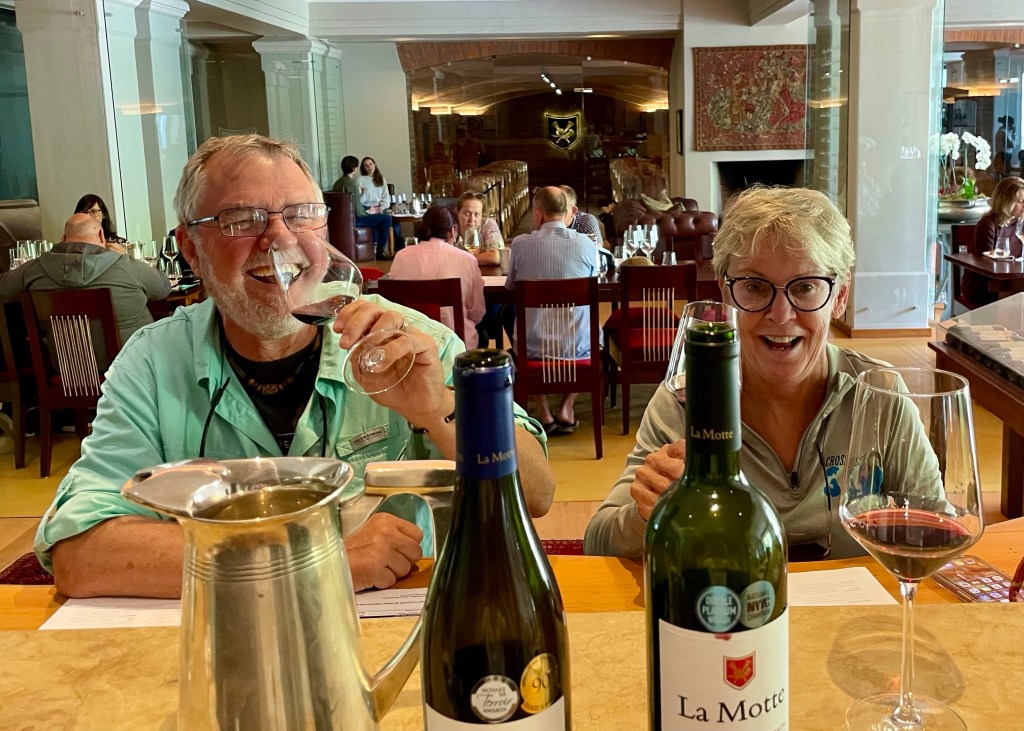
Wine Tasting in South Africa.
Now here’s the funny part. Although the cellar is ostensibly mine, Cathy has a palate that blows mine away. She’s much better in blind tastings at guessing the grape and where the wine is from. She recognizes the flavors and can talk about them. And if a wine has turned bad or is corked? She can tell just by smelling the wine before she’s even taken a sip. These days, when we go out to dinner and order a bottle of wine, I usually just tell the waiter or sommelier to let her taste the wine. She’s really good.
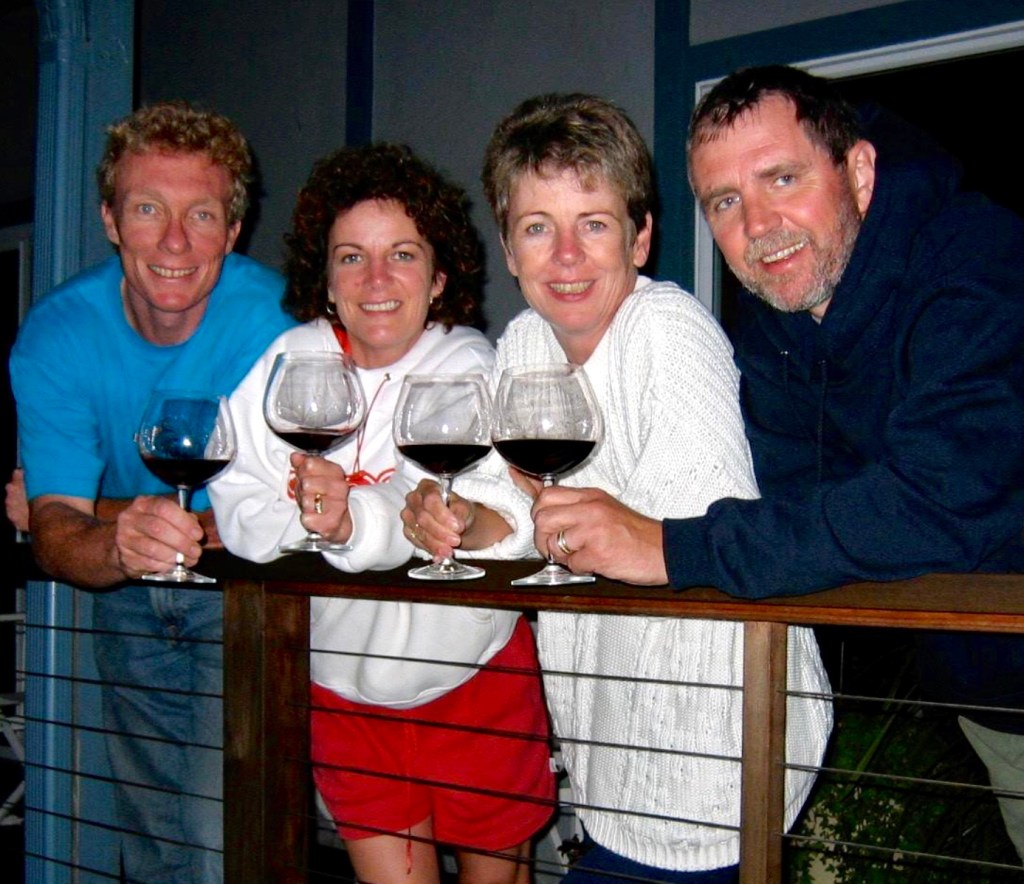
I suppose we’ve consumed thousands of bottles of wine over the last fifty years – at home or in restaurants; on picnics and vacations; at wineries; and of course with friends and family. There are lots of good memories associated with those bottles and gatherings.
Good Memories. Always.
“In vino veritas”, is a Latin phrase that means “In wine, there is truth”. The truth is we are still improving our palates, one bottle at a time.
Cathy says life is too short to drink bad wine. I think I agree.
It was raining as I left our West Point 45th reunion last Sunday. I took the longer, slower route home to Virginia rather than drive Interstate 95. Tired and emotionally spent, I didn’t trust myself on a route that would have more traffic. I knew I would be thinking about West Point, the reunion and my classmates.
And of course, that’s what happened. The reunion, mixed with memories of West Point and my time in the Army cycled through my brain. Was it really 45 years since we graduated? It turned out the answer was yes.
Due to health issues, Cathy didn’t make the trip (she’s OK). It was a tough choice for her not to go to this reunion, but it was the right decision. Having dated since high school, and marrying each other right after my graduation from West Point, she too made the journey through my time at the Academy and in the Army. We’ve known many of these folk for nearly fifty years and together we have attended every reunion since the fifteenth. If I were to pass away, she would be welcomed with open arms by my classmates at any event, and they would help her in any way they could.
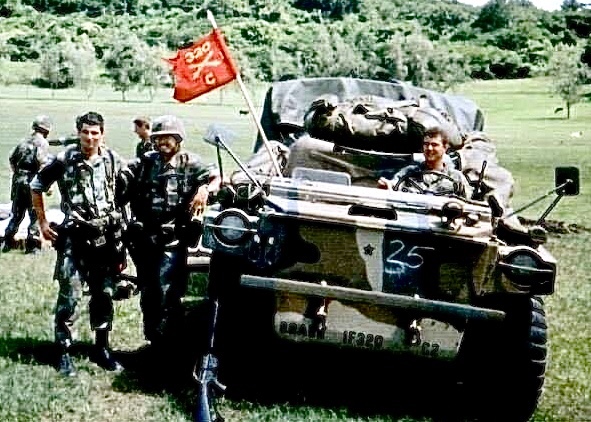
On October 25th, the day before the official start of our reunion, someone noted online the conditions were a bit nicer than 40 years previously on the same date. That was the day Operation Urgent Fury, the United States intervention in Grenada began at dawn. Several members of our class* were in the 82D Airborne Division and a part of the operation. It was a reminder that although we were “Cold Warriors” against the Russians, many of our classmates spent time in combat around the globe.
CPT Marion Seaton in Grenada. “We Were Soldiers Once, and Young”.
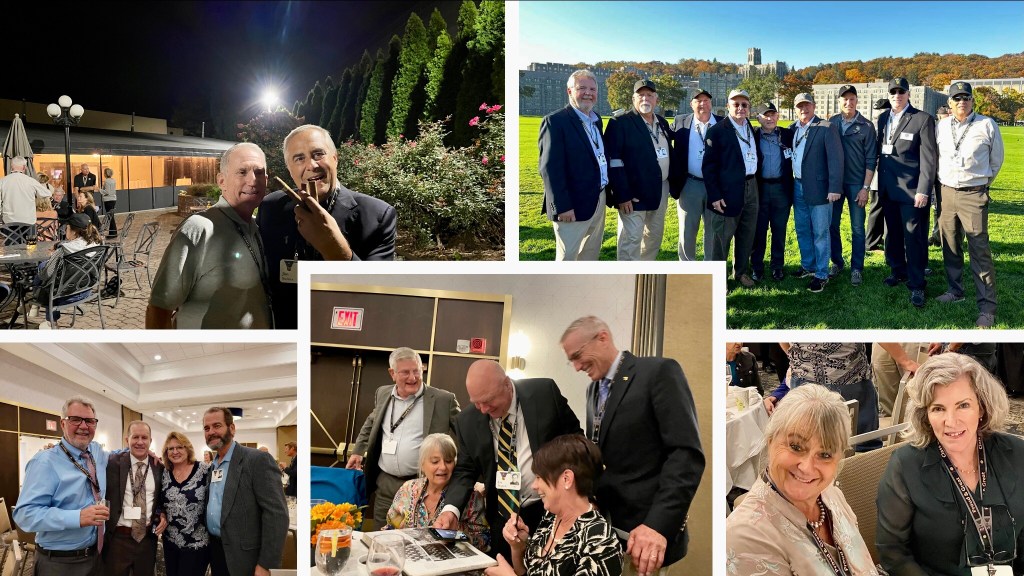
I arrived early Thursday afternoon and the weekend passed in a blur. The reunion hotel was a little over an hour from West Point. With 500+ attendees, there are no hotels at West Point or in the immediate vicinity large enough to host a gathering of our class. As is always the case at these five year reunions, not unlike our days at West Point, they are jammed with activities. We joke about it of course, but it’s true. I’m doubtful many other college reunions have days starting at 6:45AM. ;-).
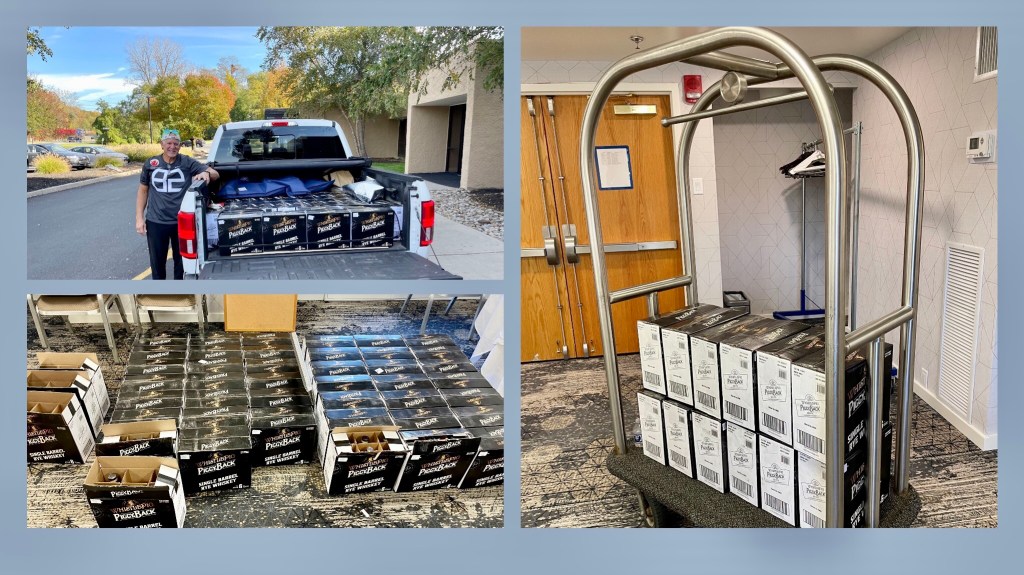
After arriving, I found Tony Matos, who had just arrived from New Hampshire. As importantly, Tony brought the 312 bottles of WhistlePig Whiskey we were going to distribute to classmates. Regular readers of this blog will recall that a group of us did a tasting at WhistlePig in Vermont last spring and bought two barrels (you can read about that tasting and why we did it at the link in the addendum). We dutifully transported the cases of whiskey to our distribution room and classmates started picking up their bottles. All were gone by Sunday morning.
The Successful Conclusion of Operation WhistlePig.
By Thursday night, things were in full swing. Around 300 classmates (about one third of our living class members) along with 250+ spouses, partners and family members were there. Dinner, drinks, and for some of us, cigars ensued. My time was divided between dinner with several of my company mates and then circling the rooms seeking out other old friends. Handshakes, hugs and toasts, along with conversations occurred several times – How are you? … Where’s Cathy – is she OK? … Do you remember … whatever happened to … where are you now … we have to do better at staying in touch … Eventually I made my way to bed and a restless night’s sleep.
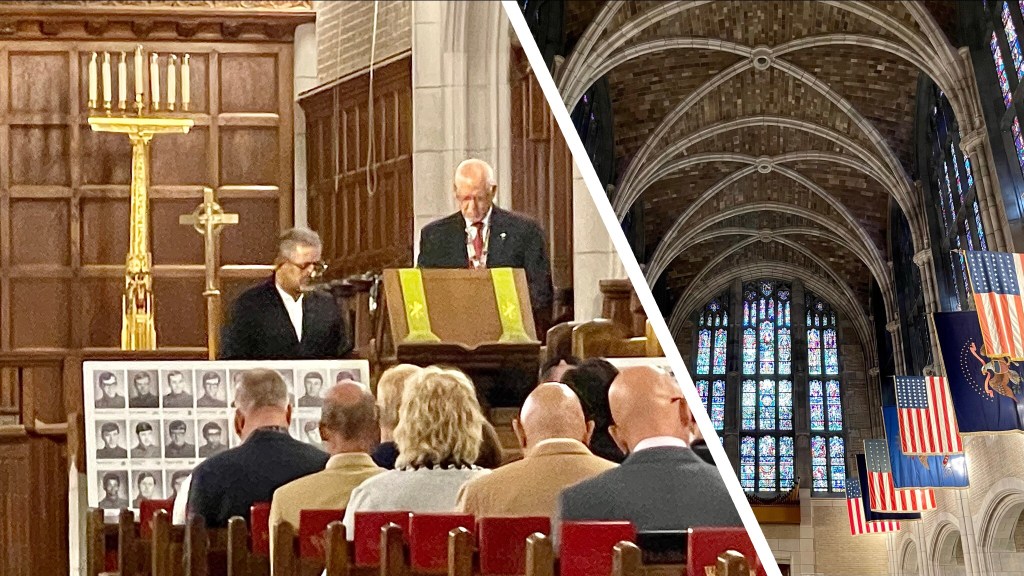
On Friday morning, we boarded buses for West Point. Our destination was the Cadet Chapel. Our first event, and for me one that has grown increasingly important, was a memorial service honoring classmates who have passed away. At our fortieth reunion, 50 classmates were so honored. This time the number was 82, including my company mate Dan Zimmerman. At the fortieth reunion, Dan sat with Cathy and I at the memorial service. This time, his name was one of the 82 called out loud. I thought a lot about Z-Man during the service. I have to say, the meaning of “The Long Grey Line” has changed, grown and become more real with the passage of time.
Memorial Service at the Chapel.
After the service, my buddies Jay, Steve and I, along with many of our classmates, walked the half mile from the Chapel to Ike Hall, although I also noticed there were more classmates taking the provided buses. Age catches up with all of us at some point. At Ike Hall we had lunch, along with a class meeting and a presentation by the Supe (Superintendent), before eventually busing back to the hotel.
At the hotel, Tony, Gus, Bob, Bill and I resumed distributing the remaining WhistlePig bottles. Classmate Al Aycock was distributing bags of coffee – the beans spent time in one of our empty whiskey barrels before bagging. We repeatedly received thanks from classmates for the arduous journey we’d made to Vermont for the WhistlePig tasting the previous spring. ;-).
After a short fifteen minute nap, it was time to get ready for the formal dinner that evening. More good food, drinking, talking and dancing. Perhaps because this was day two, things were slightly slower than the night before. It wasn’t as rushed and more faces were familiar now.
Random Pictures From the Weekend.
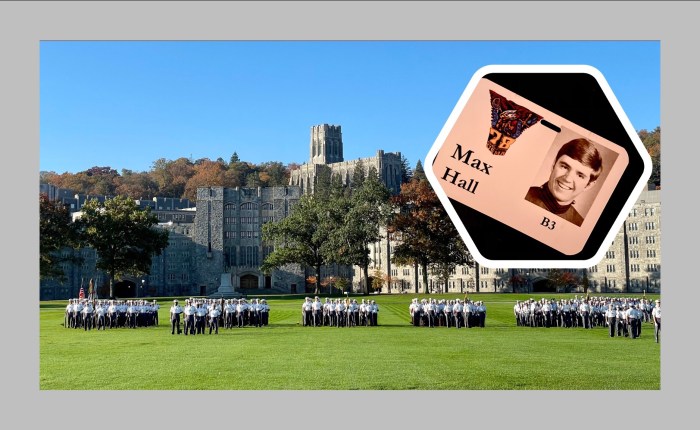
Saturday morning came early. We boarded buses for West Point at, wait for it … 6:45AM. Yes, you read that right, 6:45 in the morning. It was for a good reason – Two regiments of the Corps of Cadets were having a parade at 9:00AM, and our entire class was a part of the reviewing party. I remember as a cadet having parades and passing in review for old grads during their reunions. To put things in perspective, in the fall of 1977 our Firstie (Senior) year, the class celebrating their 45th reunion was the Class of 1932. Yikes! Back then, while waiting to pass in review, we made jokes about the OLD GRADS and of course could never see ourselves on the other side of the parade ground in the future. I’m sure the same thing was happening on this Saturday, but I have to say they looked squared away when they marched past us.
The Corps of Cadets, Passing in Review.
The Army football game that afternoon was a forgettable loss, but something happened later that left a strong impression on me. After the game, Clem, one of my company mates and his wife Nancy hosted a post-game tailgate and several of us B3ers stopped by for a beer. Three Yearling (Sophomore) cadets were there as well – members of the Class of 2026. Talking with them and listening to them made me feel good about our future, and the future of this country. If they are any indication of the quality of current West Point cadets, we have nothing to worry about. The United States Army, and our Officer Corps are in good hands.
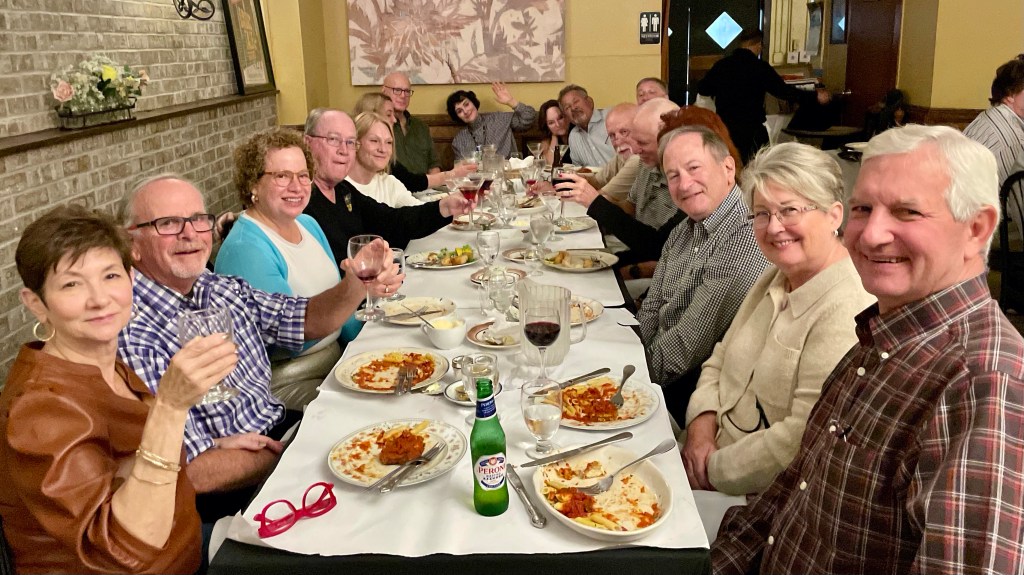
The last evening was special. There was no official event that night, and I was invited out to dinner by Jose Morales, one of the alumni from the Whistle Pig tasting in the spring. There were perhaps 18 of us at the dinner . Some I knew, some I didn’t. It didn’t matter. We were all one big happy family, talking, laughing, telling stories, eating and drinking.
One Big Happy Family at Saturday Night’s Dinner.
The next morning, I left for the drive home around 8AM. I’m not big on long goodbyes and wanted to hit the road. I spent the next six hours driving in the rain and thinking about the weekend. I wasn’t just thinking about the details of the weekend itself, as I recounted here. I was also thinking about this special brotherhood I have the great good fortune to be a member of. As time goes by, I cherish it more and more. I think we all do. It’s hard to explain to others who haven’t been a part of it.
We members of the West Point class of 1978 share a special bond that has only grown stronger with the passing of time. Yes, we still tell the old stories from cadet days, or our time in the Army, but it’s more than that. Those stories only represent the surface of our commonality. We rose to the call of Duty, Honor, Country as cadets and during our time defending this nation. Most of us have found ways to contribute to the greater good, even after our time in service to our nation ended.
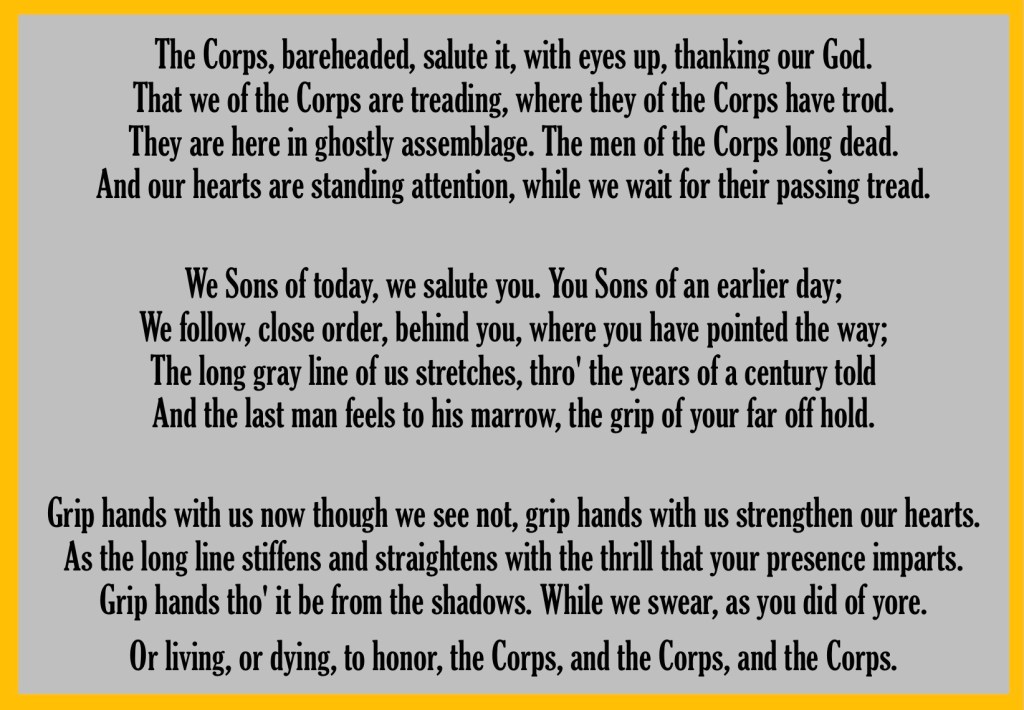
As Plebes, we were required to memorize many things. Some mundane, some of no apparent use, and some that were important. One of those requirements was the song “The Corps”. As I grow older, the song’s lyrics speak to me more directly than when I was a cadet and first memorized them. We all know our time here on Earth is limited and we all need to make the most of the time we have. Grip hands indeed.
The Corps
Addendum:
* Classmate Marion Seaton provided the photo from Grenada. In his words, “Chuck Jacoby, Brent Holmes, Dale Tatarek and I were having the time of our lives on a little spice island 40 years ago this week. We were all part of the 82nd Airborne’s mission to secure the Island of Grenada. I was the C Battery 1/320 (Airborne) Artillery Commander. We were chuted up to parachute with our equipment into Grenada. Our original plan was for the 105 howitzers to be dropped from the C141B on the first pass and we would jump on the second pass over the Drop Zone. The jump would’ve been dangerous, certainly due to the hostile fire, but more importantly, because of the dispersion of the equipment and troops onto the ground. There was a huge body of water to our left and the Ocean to our right. We would’ve lost a lot of jumpers and equipment. Lucky for us, The Rangers jumped the day before from C130s below 400 feet. They secured the Drop Zone, so we were able to fly in rather than jump. Over the course of the battle, Charlie Battery fired 152 rounds in support of the Division and Rangers.”
Marion, A Bit Before his Unit’s Jump into Grenada was Cancelled.
Dale and Jan Hamby were in charge of this reunion overall and did a great job. While a host of people worked with and for them, our class owes them a debt for the wonderful time we enjoyed. Dale’s comments after the reunion were pretty spot on: “Personally, we are determined to do a better job staying in touch with those we were able to reconnect with this weekend. We hope you will too. The reunion reminded us how important these connections are, and life is just too short not to make them a priority. Besides that, it was so great to relive cherished memories that our kids don’t want to hear about for the 50th time!”
Here’s the blog from our whiskey tasting at WhistlePig: “We were on a mission to the WhistlePig Distillery in Vermont. Twelve classmates gathered to taste whiskey from five barrels. We would select two for the West Point Proud and Great, Class of ‘78 45th reunion this coming fall. We didn’t want to let our classmates down” […] Continue here: https://mnhallblog.wordpress.com/2023/05/09/__trashed-2/
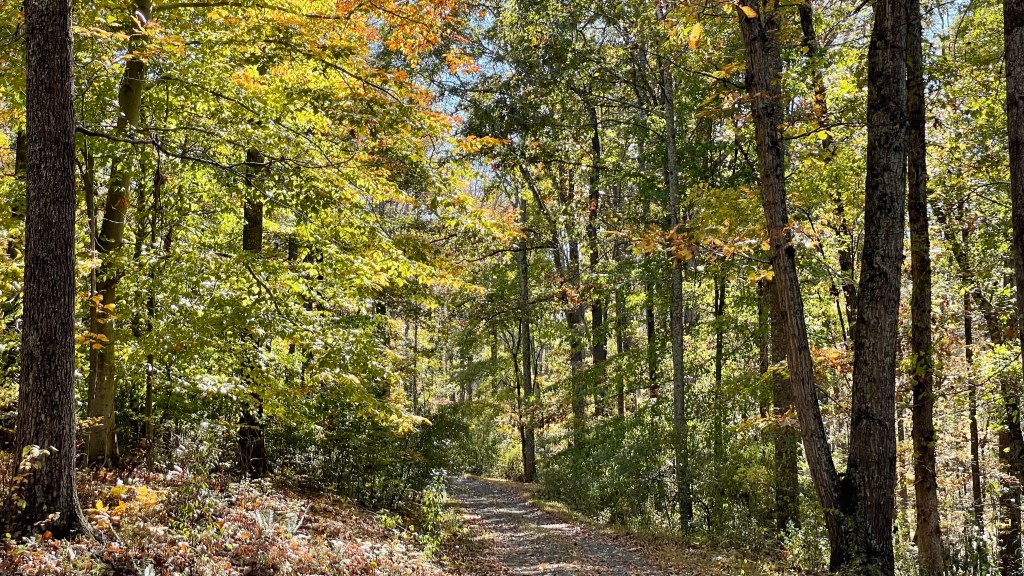
As I walk and wander through the nearby woods this fall, I find my mind wandering as well. It is autumn in the autumn of my life and I feel the passage of time. Death and decline are both more evident, and not quite the strangers they once were.
A Walk in the Woods on an Autumn Day.
It is not my own death I contemplate or fear. I have made peace with who I am, what I am, and where I am. I’ve had a good and lucky life with little to complain about. When my time comes, I hope I have the courage to accept my blessings and be thankful for the life I’ve lived.
Rather, it is the death and decline of others that I’ve been dwelling on during my walks. I think of friends or family members taken too soon and though they are now at peace, those of us left behind in this world feel the sadness and emptiness of their passing. What we wouldn’t give for one more hug, one more smile, one more drink together, or one more conversation.
For some, death has come suddenly and unexpectedly. For others, we have marked their decline, whether from old age, cancer, or some other disease. Fighters all, they eventually succumb, whether after months, or a decade. And for some lucky few, they live a good life into old age before peacefully slipping away.
I’ve thought about that last paragraph a bit. How do we measure time’s passing, and how do we measure time passing in our relationships with others?
If I do die suddenly, whether tomorrow or in five years, I would tell my friends and family do not mourn me. Instead, keep my memory alive, tell stories about me or drink a toast to me. I’ve had a good life. Don’t be sad at my passing, but rejoice at the life I was able to live.
If I fall into decline, for whatever reason, I pray I have the grace to continue to love and treasure those around me, no matter my fears of what is coming, or the pain I am in. I know that caregivers often suffer as much, or more than the person they are giving care to. I hope that I am able to continue to love and appreciate those doing their best to help me. I know that is sometimes a difficult thing to do.
And if I’m one of the lucky few who live well to a ripe old age before peacefully slipping away? If my old friends, my wife, my family were to precede me in death, I would want to honor each of them and keep their memory alive. I also know I would want to continue to live, and grow, and celebrate each day. To go for walks, talk with other friends, stay active, and challenge my mind and body to the best of my abilities. I think that is how I could best honor them, until my own time here on earth ends.
Walking in the woods on an autumn day – it’s funny where your mind sometimes goes. Two thousand years ago, the Roman Emperor Marcus Aurelius* said, “Accept the things to which fate binds you, and love the people with whom fate brings you together, but do so with all your heart”. I think his words still ring true.
Addendum:
⁃ *Marcus Aurelius in current times may be best known as the Emperor in the Movie Gladiator who is killed early in the film and gives Rome to Maximus, played by Russell Crowe. If you want to know the real Marcus Aurelius, I suggest you pick up his book, Meditations. It is a short read and filled with wisdom.
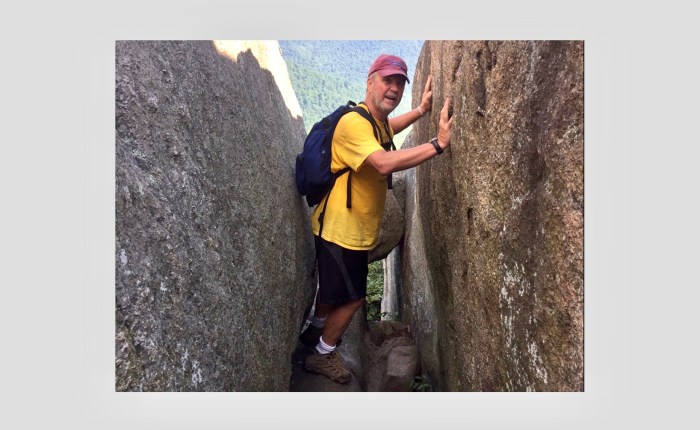
I started the blog “Live Life Exuberantly” eight years ago this week. I didn’t know where this journey would take me, but I’m somewhat amazed – 341 posts later, and it’s still going. One of the many things I’ve learned about myself along the way is that I’m more of a storyteller than a writer.
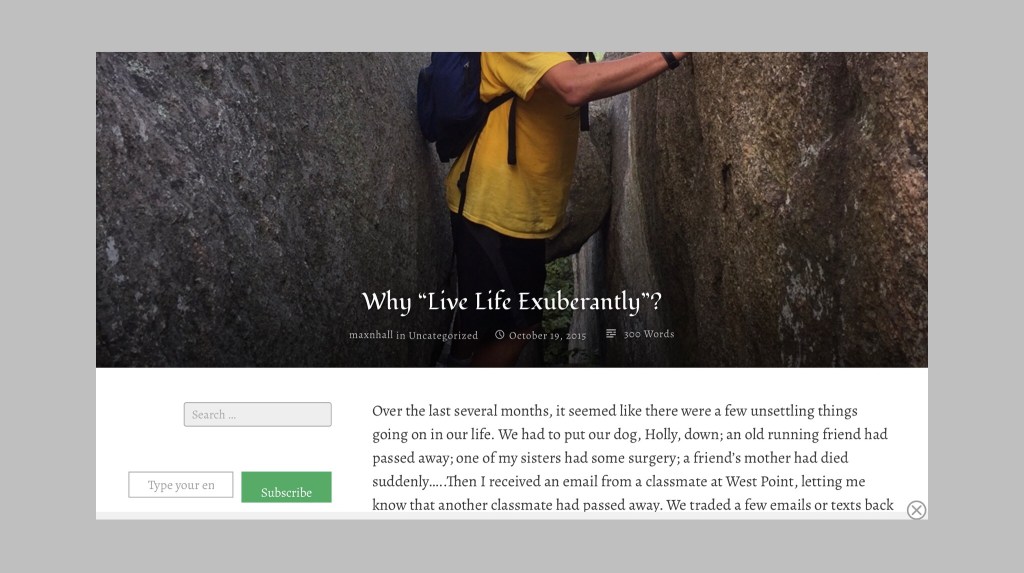
My first blog, “Why Live Life Exuberantly”, (a link is in the addendum) was published on October 19th, 2015. It was 300 words long and a reaction to a number of health issues or deaths several friends and family members were going through at the time. Looking back now, I think it was an attempt to start something new in life, partly to show myself I was still alive, and maybe growing.
The First Post – Eight Years Ago.
Since then, it’s been a strange journey. There is no discernible overall theme with the blog such as cooking, or politics, or history, or current events. In fact, it has been all over the place, which I think is both a strength and a weakness. I don’t attract people who want to focus on one subject only, whether it’s new recipes, or the latest fulminations about our current political environment. That “focused space” seems to be where most bloggers/writers are these days. This blog is pretty much the opposite, covering whatever happens to pique my interest at any given time.
Topics have included family history, Dad’s time in the Army, my time in the Army, Covid, our travels in Africa, racism, drinking stories, guest blogs from a couple of friends, current events, politics, our pets, baseball, cooking and food, Germany, Ukraine, random thoughts, friends and a host of other topics. I keep telling myself I’m going to cross reference them by general topic someday, but it hasn’t happened yet.
My 340 previous posts have generated around 83,000 views from over 60,000 visitors over the past eight years. I’ve written close to 400,000 words during that period of time. When the blog started, I averaged a post every two weeks or so. Now, I push something out on a weekly basis and average 150-250 views/post. The best ones have generated over 1,000 views. The less read, around 60-70. Those are pretty small potatoes compared to “real” bloggers. They mostly write daily and have thousands of views for each post.
My blogs with the lowest number of views tend to be cooking or baseball write ups. It’s funny, I know they aren’t going to be viewed/read much, but I can’t help myself from writing several of those over the course of a year. Sometimes a blog I think will have minimal viewing ends up exploding, while others I’ve poured my heart and soul into generate only minimal interest.
That last point led me to an observation about this effort – I’m writing as much for myself as for others. I’d be lying if I didn’t say I’m glad people read the blog and I track the statistics – but for me, a big part of the pleasure is in the writing. And, while I believe my writing has improved over the years, I know I’m not a particularly gifted writer. Ernest Hemingway and Toni Morrison can rest easy in their graves. Having said that, I do think I’ve inherited a bit of my dad’s ability to tell a story.
When we were kids sitting around the breakfast table on Saturday mornings, there would inevitably be uncles or aunts visiting and drinking coffee. Dad was great at telling stories from his childhood during the depression, or his time in the army. It didn’t matter how many times you heard them, he had a way of making them fresh, or funny, every time he told them. We’d sit there laughing as we heard for the tenth time how he and Uncle Mickey learned there was no Santa Claus. He was a natural storyteller.
Telling stories. Yea, I think that’s what I mostly do, and I thank dad for that gift. Some of these stories write themselves, and my fingers can barely keep up with my brain. Others, well, others take time and thought and struggle. The path isn’t always clear and I write, rewrite, throw away, and write again. I think I enjoy that struggle. It’s a challenge and makes me feel alive. It’s a bit like trying to solve a problem and I know I sometimes do a better job of solving the puzzle than others.
In all of this, I’d be remiss if I didn’t mention my friend Colleen and my wife Cathy. Colleen has reviewed virtually all of my blogs for the past few years with edits and suggestions. She’s a real lifesaver. And Cathy? She keeps me grounded and has no problem saying, “What the hell are you thinking here?” Or, “Really? You’re going to write about that?”
I have no idea what the future will bring for me, or for “Live Life Exuberantly”. My guess is as long as I’m having fun, I’ll keep writing. And whether you are a regular, occasional or first-time reader, thanks for joining me on this journey. If you are a routine reader, I’m guessing the randomness of my topics is something you find interesting. I hope, at least occasionally, you find something that makes you smile, or makes you think.
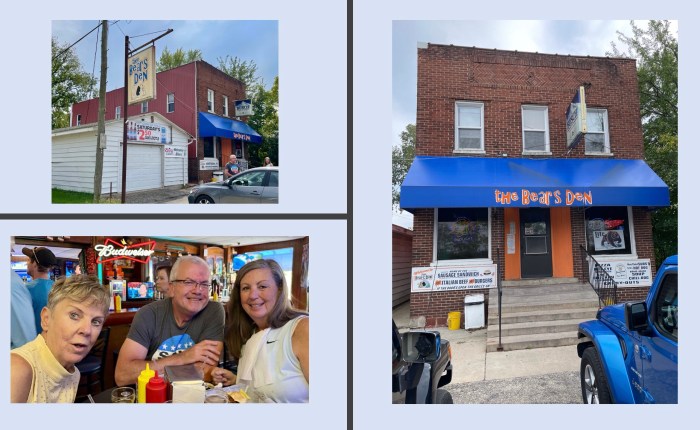
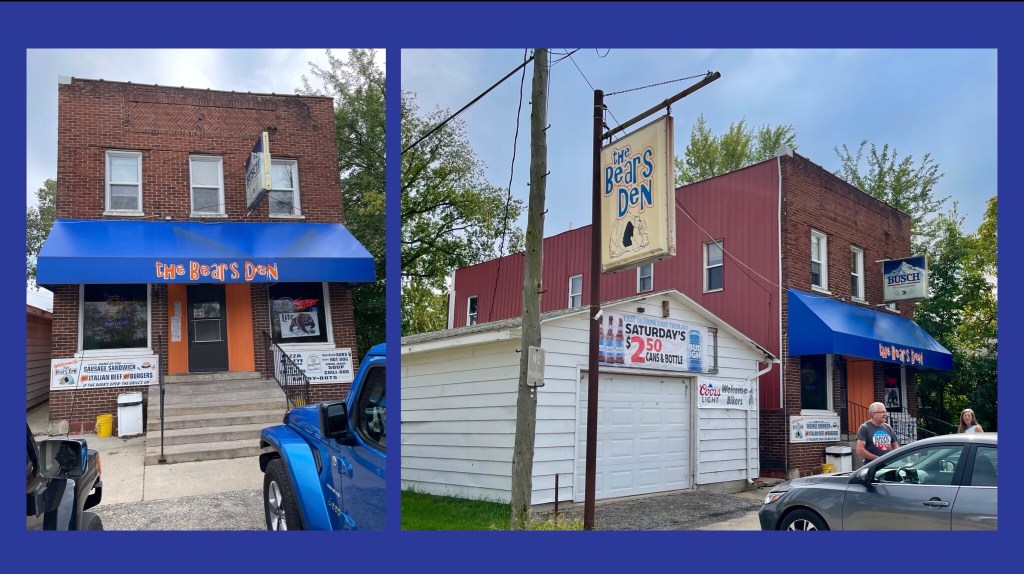
The Bears Den in Naplate, Illinois is a great little dive bar. I mean that in the best sense of the word. It’s an older place and hasn’t been updated in years. On a recent trip back home to Ottawa, we stopped in on a Sunday afternoon for lunch and Bloody Marys. We all should have such a good local place.
Naplate, a town of just over 400 people, probably has more restaurants and bars per capita than any town in America*. They are all small local places. Some more bar oriented, and some more food oriented. All have their devoted fans and regulars from Naplate, or the surrounding area. Over the years we’ve enjoyed several of them, including Casa Mia, Annie’s Hideaway, and of course, The Bears Den.
The Bears Den – It’s Been Around Awhile.
A few years ago, a really bad tornado ripped through Naplate and parts of Ottawa and Naplate were destroyed. Although Naplate restaurants were ordered closed in the immediate aftermath, The Bears Den stayed open providing food for the folk doing the cleanup and damage control. They were giving back to the community in a big way.
A couple of weeks ago we were back in Ottawa to see family and go to a reunion. We spent Saturday night with my sister Tanya and Brother-in-Law Shawn and on Sunday morning were discussing what to do. Cath previously mentioned possibly going to The Bears Den for Bloodies, and we all quickly agreed that was a great idea. It had been a few years since we were able to stop in there and we were looking forward to a good time. Shawn, the smart one among us, checked to see what time the Bears were playing that day. When they are on TV, it’s standing room only at the Den, and we wanted to avoid that. Fortunately, the game didn’t start until 3PM.
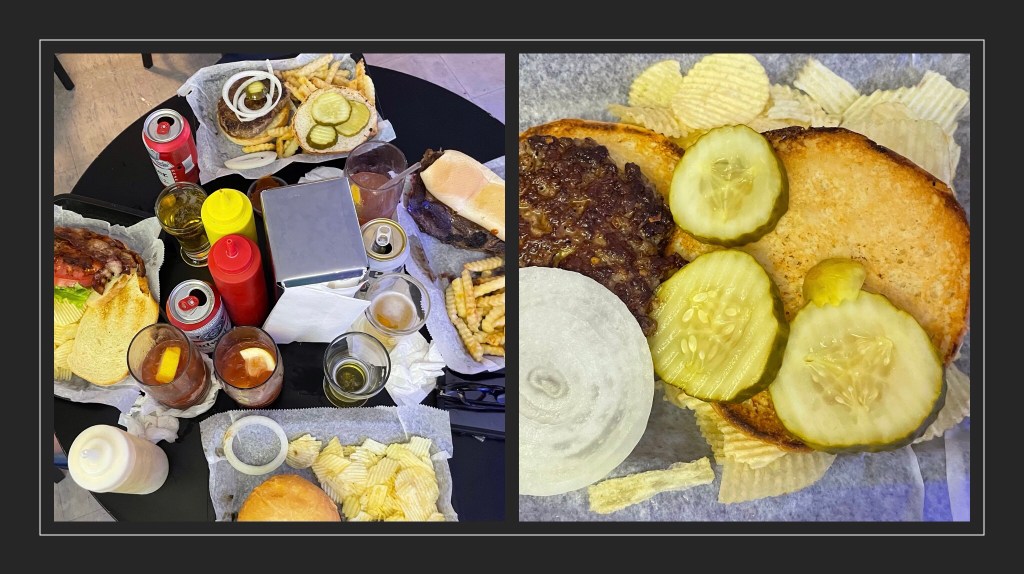
We arrived just after noon and easily grabbed a table. Several people were there, but it wasn’t crowded. The Packers were on TV, so there were both cheers and catcalls, depending on what was going on. The waitress came over and we ordered our Bloodies with sidecars. In Illinois (and maybe across the Midwest) a sidecar is a small beer, typically 7 ounces, to go with your Bloody Mary. At the Bears Den, they brought you a can of beer, and a 7 ounce glass. On Sundays, they have “build your own Bloody Mary” for $3, but we opted for the bartender to make ours.
Lunch at The Bears Den with Tanya and Shawn.
Drinks arrived and the Bloodies were as good as we remembered. Our waitress asked what we would like to eat. For me, there was only one thing to order – their Sausage Sandwich. You can have it with peppers, or cheese, or any number of other combinations, but I just ordered it with pickles and onions. It’s like a burger, but made with 1/2 pound of sausage instead. As my buddy Howard says “It rivals the pork tenderloin**as the best area sandwich. The difference? You can order the tenderloin at lots of places, but only The Bears Den has the sausage sandwich.” Shawn also ordered one, while the ladies opted for a BLT and a ribeye sandwich. One of the great things about The Bears Den is they have a decent menu, especially considering the small size of the place and the size of the kitchen.
The food came, and all I can say is, man, I love that sandwich. It was sooooo good. Yea, it didn’t help my cholesterol any, but that’s OK. In fact everyone’s sandwich was good. I think Cath’s BLT was the biggest I’d ever seen, and Tanya’s Ribeye sandwich was great. The table grew quiet for a while as we concentrated on our food. Eventually, we ordered a second round of Bloodies and Shawn had another beer.
Good Food All Around, but Man That Sausage Sandwich!
At some point, our nephew and niece Casey and Ann stopped by with their kids and we were able to catch up with them for a bit, but eventually, it was time to go. Hugs all around in the parking lot, lots of I love you’s, and we headed south to my sister Berta and her husband Jack’s place.
I know it’s a bit crazy to write about a dive bar in the middle of Illinois, when we don’t even live there anymore. Still, it’s good to have things and places you know you can count on. The Bears Den is one of those places. If you are ever near Naplate, I highly recommend it.
Addendum:
The “Bears Den” has no apostrophe in it, and I have written it that way throughout this blog.
* My friend Howard Johnson notes that Naplate was a factory town (the former Libby Owens Ford, now Pilkington,). The shift workers all converged on the Naplate bars when their shifts ended, keeping them busy 24 hours a day back in the day. That’s a big reason such a tiny village has so many bars.
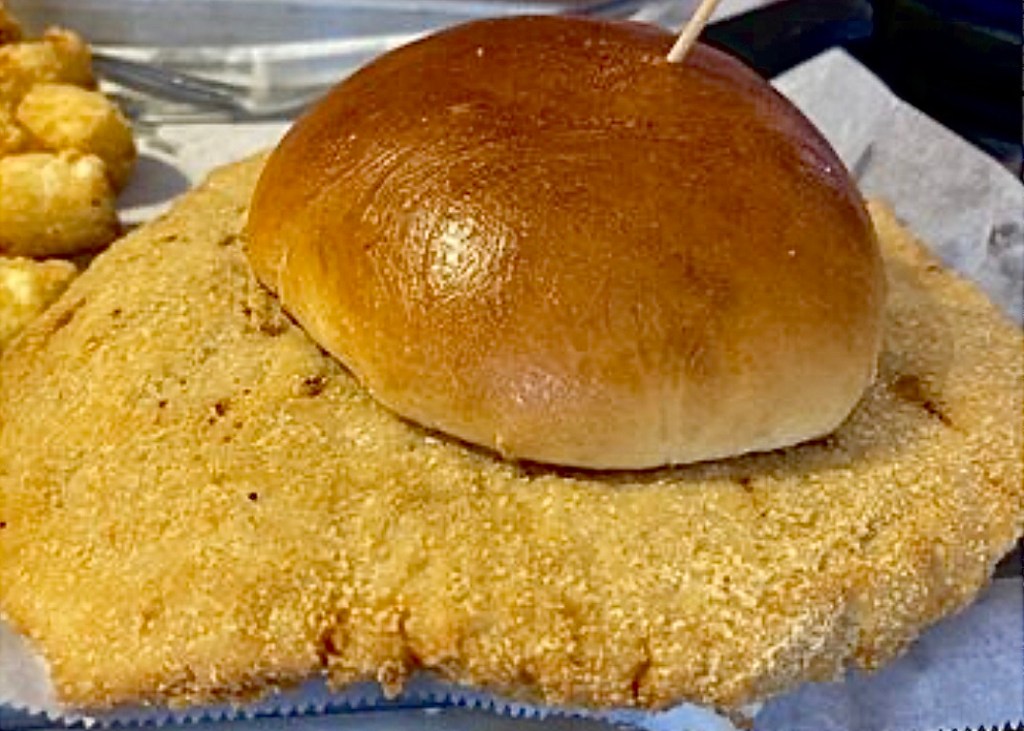
** One of the great meals you can find in the corn-belt of Indiana, Illinois and parts of Iowa is a breaded pork tenderloin sandwich. They are crazy good and something that many people who move away from the area crave, and always have when they return to Ottawa. If you are closer to Chicago, or in Wisconsin, an Italian Beef Sandwich is just as loved.
Pork Tenderloin Sandwich at The Court Street Pub in Ottawa.
The Bears are having a rough stretch in football lately and lost 14 straight games before beating the hapless Commanders last week. The Bears Den remains crowded for their games. In general, the fans are still loyal, but getting restless. One of my buddies, Mark, a diehard Bears fan, sent me this meme after I mentioned we were at The Bears Den for lunch:
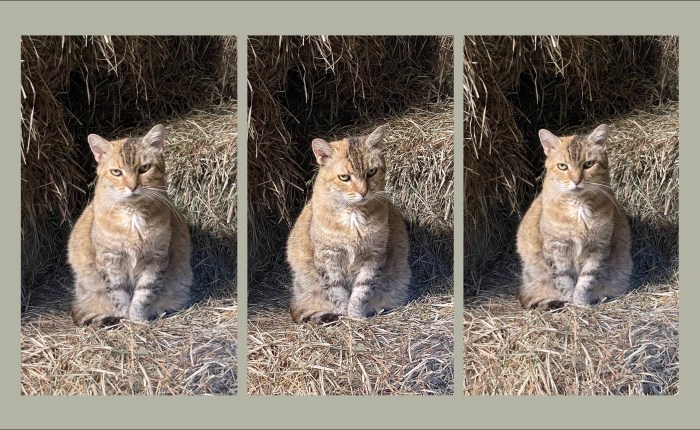
We inherited Mama Cat about four years ago. Our neighbor had to move to a small apartment and had two other cats she was taking with her, but couldn’t take three. Mama roamed the neighborhood at will and was a frequent overnight guest at our barn, so Cathy said we’d look out for her.
Mama Cat, real name “Nutmeg”, roamed the neighborhood for years. Several people around the area knew her. Early on, she was always shy. You might catch a glimpse of her, and then she was gone. While she was “indoor/outdoor”, I think she was really more of an outdoor cat, who went home to eat occasionally. Of course, she also stopped at several barns/homes in the neighborhood for snacks. Cats, like raccoons, seem to inherently know where there’s a free meal.
When Laura, her owner, had to move, I think she was relieved that Cath said she would keep an eye out for her. Laura’s life had become complicated, and this was one less thing she needed to worry about. After Laura left, we started seeing Nutmeg a bit more, although she was still shy and evasive.
Mama Cat – Also Known as Nutmeg.
At the time, we had two barn cats of our own – Stan and Ollie. Nutmeg started hanging out and generally got along with our two. Then another neighbor’s “Indoor/outdoor” black cat started coming by the barn. He was an unfixed male and wasn’t quite as nice and started chasing our cats away. We didn’t see Mama as much over that time. After about a year the black cat disappeared and we didn’t see him again. We always assumed a fox or coyote caught him at some point.
Cathy followed through on her promise to Laura and we did keep an eye out for Nutmeg. Cath is something of an animal soothsayer and slowly gained Mama’s trust. She was eventually able to pet her and take her to the vet’s office for annual shots. Mama also warmed to me and I too was lucky enough to occasionally pet her. More importantly, for the past couple of years when it turned frigid, we were able to put her in the feed room at night and provided her some heat in a small space. We kept Stan and Ollie in the tack room on those same nights. It’s funny – they were all outdoor barn cats but smart enough to know/learn there was an advantage to being scooped up in the evening and put in a room. They learned to wait around for it, although they were always eager to get out the next morning.
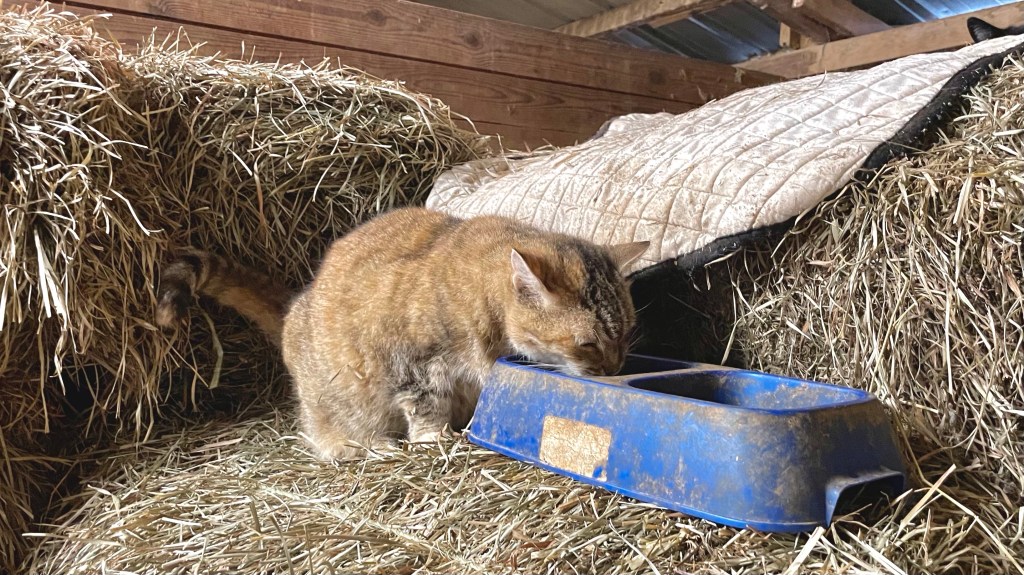
Mama became a regular at the barn and started showing up routinely at mealtimes in the morning and evening over the past year. She’d bound out of wherever she was sleeping in the hay, and report promptly for her meals. She had her own bowl by now, so the cats could all eat at the same time, with no one waiting in line. You would think they were starving with as much as they all ate, but when you picked them up, it was obvious none of them missed many meals.
Mama Cat Doesn’t Miss Many Meals.
Over the past couple of months, Cathy noticed a growing red spot on one of her toes. At first, she thought it was an abscess. Mama wouldn’t let us touch it or examine it closely. Eventually we took her to the vet a couple of weeks ago to have it treated. Unfortunately, it turned out to be an auto-immune disease, and while treatable, there is no cure. It’s not fatal, but puts her at greater risk and she will probably die sooner rather than later. The doctor treated it some and we obtained medicine and brought her home.
Since then, Mama Cat has been extra friendly. She waits to be petted and gives an occasional headbutt. Her purrs are noticeably louder as you scratch her, or she rubs up against you. She doesn’t leave the hay much, and you see her throughout the day if you are at the barn. I’ll be honest, I don’t know if she is thankful we took her to the vet, or her end is approaching and she’s just more comfortable hanging out in the hay. I suspect the latter, although I have no real reason to say it.
I feel lucky Mama Cat is a part of our life here at Rohan Farm. She’s been a project, there’s no doubt about it. At eleven years old, she’s also lived life on her terms. Her friendliness over the past couple of years warms me and I look forward to seeing her every morning when I go to the barn to feed the horses. It may be my imagination, but I think she looks forward to seeing me as well.
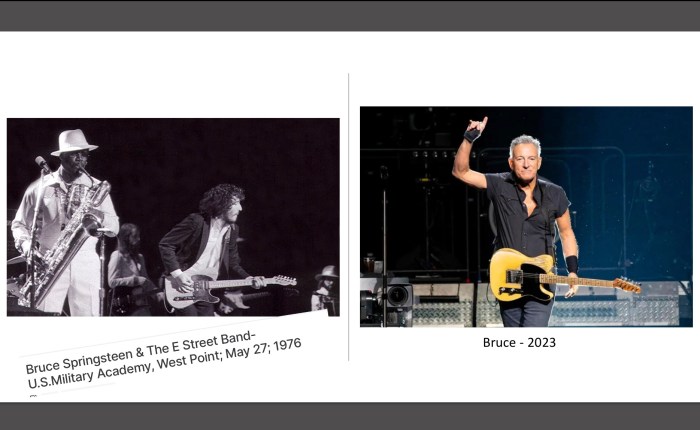
After first hearing the questions asked in 1976, I have two answers for Mr Springsteen – Yes, love is wild, and yes, love is real. September 29th of this year, Bruce was to play here in DC at Nats Park. Although I’ve previously seen him four times, we couldn’t make this show.
When I was a cadet at West Point, there was a group called the Dialectic Society that brought numerous acts to perform at Eisenhower Hall, which had an intimate setting and great acoustics. Peter Frampton, Seals & Croft, Linda Ronstadt, The Pointer Sisters, KC & the Sunshine Band, Kenny Loggins, America, James Taylor (actually substituting for Carly Simon), The J Geils Band, Kool and the Gang, Mountain, Sha Na Na, Tommy James and the Shondells, the Nitty Gritty Dirt Band – they and many others all appeared there.
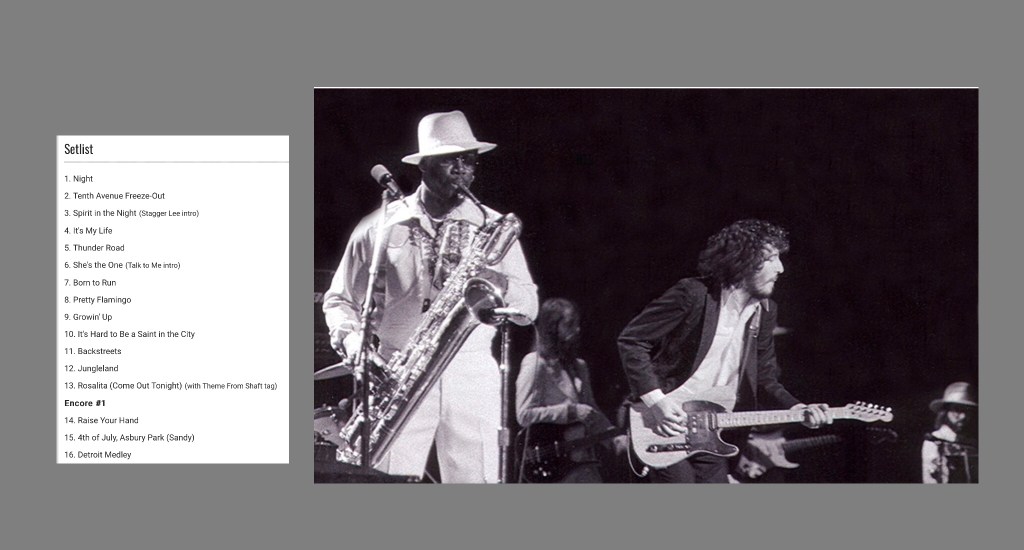
Bruce Springsteen appeared on May 27th, 1976 at West Point. This was during a mini–East Coast tour, after the Born to Run tour in 1975/76. It’s funny, I remember the show, but don’t remember being blown away by him. The music was good, and of course the “Born to Run” album was great, but hey, it was only one album. No one knew at the time he would still be around almost 50 years later.
Bruce at West Point, Along with the Set List.
Years went by and I bought the albums “Nebraska” and “Born in the USA” when they came out, but that was probably the extent of my Springsteen fix at the time. That changed on July 12th, 1988 in Frankfort, Germany. Cath and I, along with several others, took the train from Worms to Frankfort for the show. He was doing the “Tunnel of Love” tour at the time.
Unlike the show at West Point, this time I was blown away. He played for hours – 3 1/2 I think. The show was amazing and went on forever. New songs, classics and everything in between. The show went so long we actually had to leave during the second encore in order to catch the last train to Worms for the night. I remember hearing “Thunder Road” OUTSIDE the stadium as we were walking to the train station.
After returning to the States, Cath and I saw him two more times. Once in ‘92 at the Cap Center for the Human Touch tour, and another time in downtown DC in the late ‘90s. Both shows, as with Frankfort were long – again over 3 hours. NOBODY did three hour shows.
Springsteen’s music is great of course, but what draws me to him are his lyrics. He’s a wordsmith and knows how to tell a story. “Born to Run”, “The River” (Maybe my favorite Springsteen song), “Born in the USA”, “One Step Up”, “Dancing in the Dark”, “Glory Days”… you really need to listen to the words to see the pictures they paint. While the music may sound cheerful, the words often aren’t. I always chuckle at the people who love “Born in the USA”, but don’t really understand the story the lyrics are telling.
Bruce and John Mellencamp a Couple of Years ago. Note Bruce Sporting a West Point Athletic T-Shirt From his Performance at West Point.*
Years after the original version of “Born to Run”, Bruce did an acoustic interpretation. Slowing it down gave the song a whole new meaning. You can feel the weariness settling in. Maybe at that point he too knew the answer to the questions about love and whether it was wild or real for himself, but didn’t really like the answers.
The tour this year generated controversy with ticket policies and pricing. Springsteen’s comments at the time didn’t really help him. Having said that, it’s not why we are missing this show. We have too much going on these days, AND it’s been a while since I’ve seen any stadium rock concert. Sometime in the future? Maybe. In the meantime, I’ll continue to listen to his music at home and ponder the stories he tells, and the questions he asks.
Addendum:
* My friend, Donna Matturro McALeer, West Point class of 1987, first noticed the photo of Springsteen in the West Point athletic shirt. It was a couple of years ago when he was working with John Mellencamp. She did some research and it turns out there were two Bozeks (brothers) in the class of ‘79. It would have been the end of their Plebe year when Bruce played West Point. She checked in with Greg Bozek in Sept ‘21 when the photo first appeared. He had no idea how Bruce may have ended up with the shirt. Interestingly, Greg and the boss share the same birthday.
Note: In September, Bruce Springsteen and The E Street Band postponed all performances scheduled for the remainder of the year. He is being treated for symptoms of peptic ulcer disease and the decision of his medical advisors is that out of caution, he should postpone the remainder of his shows this year.
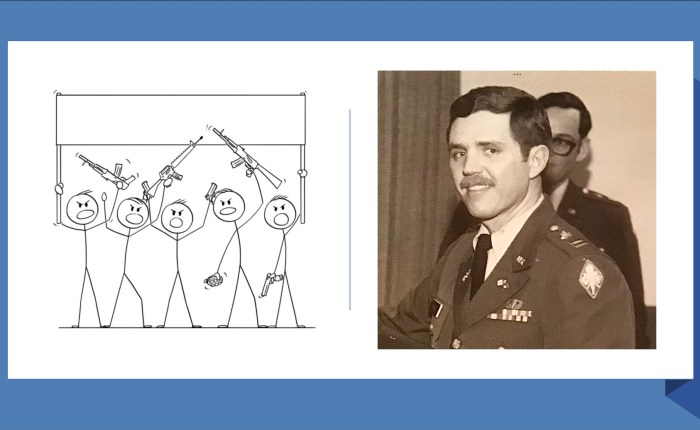
In 1984, Cath and I were back home in Ottawa for her 10-year high school reunion. I was waiting in line for a drink when a guy approached me. “Hey, aren’t you Max Hall? Didn’t you go to West Point?” I answered, “I am and I did. Why do you ask?” “I’m Joe xxx. We would love to have you come talk with our local militia.” What?
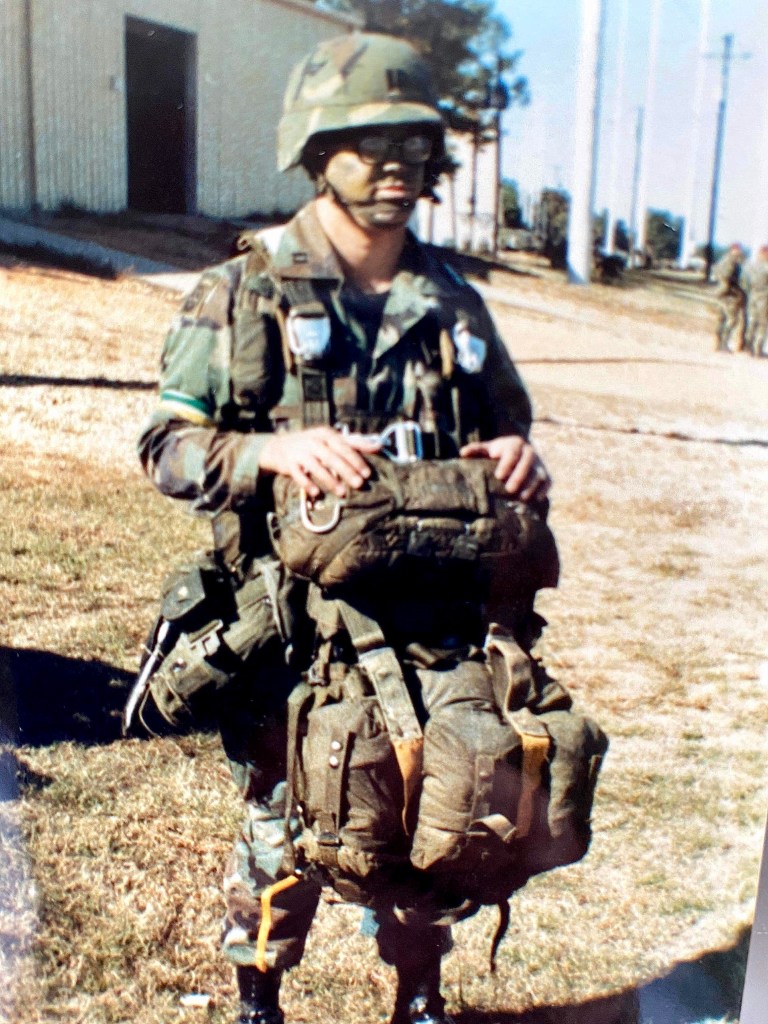
I was a Captain in the Army at the time and had recently returned from four and a half years in Germany with 3ID and VII Corps. Cath and I were stationed in Ohio and returned to Ottawa for the weekend of the reunion.
Me, About the Time of the Encounter – 1984 or ‘85.
Me: “Sure. Where’s the National Guard meeting these days, and what kind of unit is it?”
Joe: “Oh no. We aren’t with the National Guard. We started a private group as a militia. We fire our guns on weekends and do some tactical training. We want to be ready to fight the communists.”
Me:
Joe: “It would be great if you came out to meet with us and give us a talk. I think you could provide some real inspiration!”
Me: “Really?! Where do you all meet?”
He gives me a location south of town in the country.
Me: “Hmmmm. That’s great, but rather than meet there, I think we should meet on LaSalle Street, not far from Bianchi’s Pizza.”
Joe: “Really? Why there?”
Me: “We could go the Army recruiter’s office on LaSalle Street and get you guys signed up. We are always looking for a few good men!”
Joe: “What?!”
Me: “We could meet at the Army recruiter’s office. We are always looking for a few good men to enlist. If you really want to fight the communists, we could use you. I’ll be deploying back to Germany in a year. We could probably even work it out for you to join my unit!”
Joe:
Me: “That’s what I thought. See you later and quit bothering me… Bartender – I’ll have a gin and tonic please.”
Yep. Those militia toy-soldiers who always say they are going to defend our country were around 40 years ago as well. They are still eager to play soldier these days, as long as they don’t have to do anything to, you know, actually defend our country as a soldier.
*** Feel free to share this blog. ***
Addendum:
I don’t recall Joe’s actual name. I just remember that he was in Cathy’s class and I knew him some from high school.
In the ‘80s when we lived in Germany, several family members and friends visited us. To “help” them overcome jet lag, we made sure the first couple of days were action packed with eating, drinking and activities to keep them occupied. It almost proved one friend’s undoing in 1987.
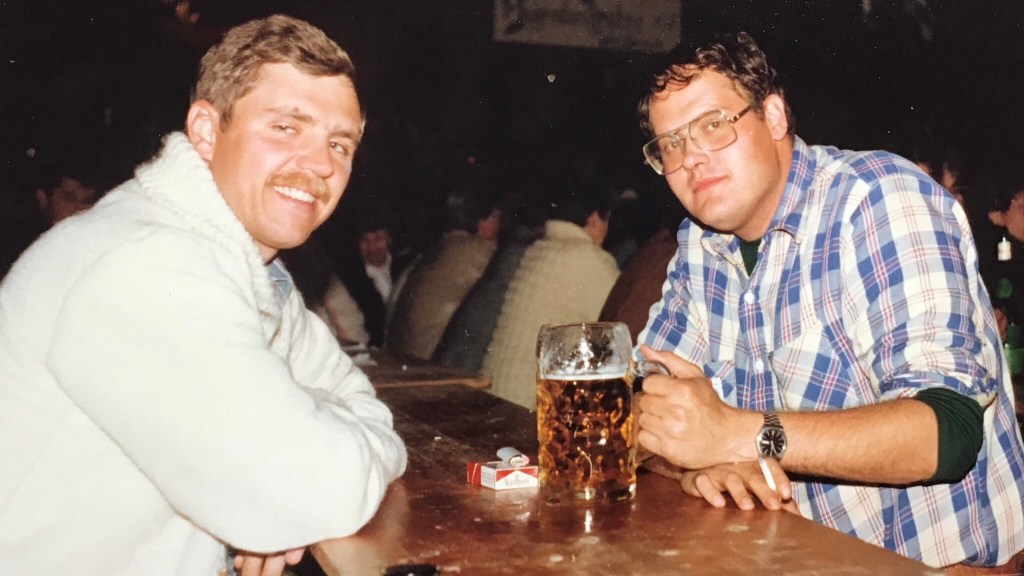
Our old friend Tim visited us several times while we were stationed in Germany. In 1987, he asked if he could visit and bring his friend/work buddy Bobby along. They planned to visit us, and then tour parts of Germany, Austria and Northern Italy, eventually arriving back in Germany for Oktoberfest in Munich. We of course said yes and looked forward to their arrival.
Tim and I at a Bierfest during a different visit.
They flew to Dusseldorf one morning in September and then took the train to Worms where we picked them up. Tim recently recalled the train paralleling the Rhein River for part of the trip, when all of a sudden the train shook a bit. He looked out the window and saw two F15s flying low, following the path of the Rhein as well.
After arriving at our home in Rheindürkheim, we ate lunch. Tim and Bobby may have slept for a couple of hours, although I don’t remember for sure. Later, we gave them a tour of town and walked along the Rhein River. That night, we went out for dinner at a local Gasthaus (pub) called Sportheim. We knew the owners, Vroni and Wolfgang well, and Tim knew them from a previous visit. It’s safe to say they greeted Tim like a long lost relative. It was a great evening and Bobby joined right in. We spent several hours at Sportheim and after many biers and wines, eventually made our way home. We may have drunk a brandy or schnapps, before making our way to bed and a good night’s sleep.
The next day, amazingly, none of us were the worse for wear. After a hearty breakfast with some good German bread, sausages and cheese, we drove around to show Bobby the area. We went into Worms, the city where Martin Luther made his famous statement “Heir stehe ich” (here I stand) before the Imperial Diet in 1521. Basically, it’s where and when Protestantism started.
That evening, we had a special treat in store for the guys. The Rheindürkheim Feuerwehrfest (Fire Department Festival) was going on in town. There were about 1,000 residents in Rheindürkheim and a majority of the adults would be at the Fest. It was a classic German wein festival with a huge tent, oompah band, dance floor and lots of adult beverage.
We made our way to the fest, found some local friends and settled in. Of course we drank our share, and ate brats and other German food, such as curry wurst or roast chicken. We also listened to the music and took turns dancing with Cathy and some of the other ladies in our group. It was a great time. Eventually it was getting late, and the fest was coming to an end. We were going to head home when one of our German friends, Michael, told me several people were going to an after party at the Zenit, basically a local Navy VFW club and wanted to know if we wished to join them. I’d been to Zenit several times and immediately said yes. For Tim and Bobby, it’d be an even greater look at the local culture. Cathy, always the wisest of us two, declined and said she was going home. We left the fest and after dropping Cath at home, walked to Zenit.
Now Zenit was actually a dry-docked ship that was turned into a club. Rheindürkheim, was on the Rhein River and traditionally, most young men of the town served in the Navy instead of the Army. That’s why their “VFW” club-equivalent was in a ship.
The Zenit in Rheindürkheim
As we arrived, we made our way to the bar and bought a couple of biers. I nudged Tim and pointed out a picture hanging in Zenit. Tim’s a history major and I thought his eyes were going to bug our when he saw who it was – Admiral Karl Dönitz*, supreme commander of the German Navy during WWII. Dönitz also took over the German government after Hitler killed himself and it was he was who actually surrendered to the Allies in May of ‘45.
We had a good time at Zenit. The party was eventually winding down when our friend Hans approached me. He and his wife Inge were having an after-after party at their home and wanted to know if we wanted to stop by. Their home was actually on the way back to our house and I again immediately said yes. We joined a group of 15 or 20 people and dutifully walked or stumbled to Hans and Inge’s house.
At Hans and Inge’s there was no oompah music. What was playing on the stereo was the soundtrack from the movie “Dirty Dancing”, released earlier that year. I remember chuckling about it at the time.
I believe they served coffee and dessert for those who wanted it. I also distinctly remember Inge walking around with a bottle of homemade schnapps and pouring people small glasses/shots. Schnapps in Germany is nothing like the sweet stuff we think of as schnapps here in the States. It’s similar to Italian grappa or French marc and can definitely have a rough edge to it. She asked if we wanted some and of course we all said yes. Bobby didn’t yet know about real schnapps. We all toasted with a “Prost”. Bobby took a small sip and may have actually turned green. He looked around and saw a nearby plant, where he discretely poured the remainder of his schnapps.
A bit later, Inge came back by, saw Bobby’s empty glass and refilled. It. At that point Bobby looked at the glass and then leaned into Tim and said, “Tim, I don’t know that I can do this for the whole two weeks.” ;-).
We left a short time later and walked the 3 or 4 blocks home and immediately went to bed.
The next morning, everyone was moving a little slowly and there were probably a couple of hangovers among us, or at least there should have been. I also know this – Tim and Bobby were no longer suffering from jet lag. ;-).
They would leave us a day or two later and head south by train. We linked up with them in Munich for Oktoberfest about ten days later and they told us tales of their travels and the good times they enjoyed. At Oktoberfest itself, other than Cathy throwing her shoulder out on a rollercoaster ride with Bobby (another story, and no, alcohol wasn’t involved), we had a grand time.
Addendum:
* Dönitz was the architect of the German U-boat campaign during WWII. He was by his own admission, a dedicated Nazi and supporter of Hitler. Following the war, he was indicted as a major war criminal at the Nuremberg trials on three counts: conspiracy to commit crimes against peace, war crimes and crimes against humanity; planning, initiating, and waging wars of aggression; and crimes against the laws of war. He was found not guilty of committing crimes against humanity, but guilty of committing crimes against peace and war crimes against the laws of war. He was sentenced to ten years’ imprisonment. After his release, he lived near Hamburg until his death in 1980.










 Live Life Exuberantly