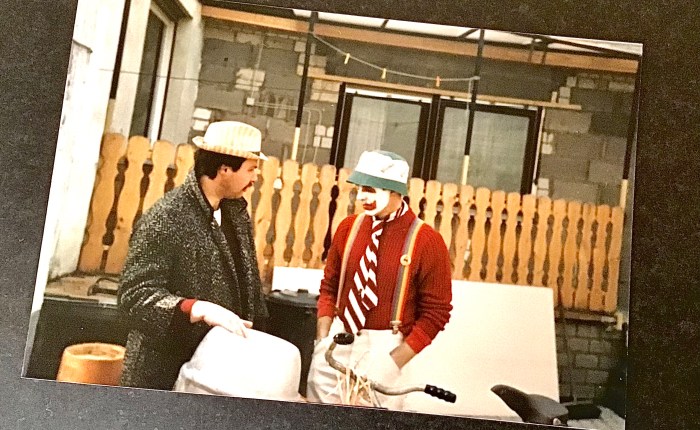
Riding a bicycle with a keg of bier mounted on the front of the bike is harder than you might think. It becomes progressively more difficult if you are riding the bike in a parade, providing glasses of bier to people you pass, and also occasionally sampling the bier yourself.
In 1987, when our German friend, Berthold, asked me to march in the local Fasching Parade, I was honored. Fasching is the German version of Mardi Gras and is a big to-do, particularly in the Catholic regions of the country. We had attended numerous Fasching Parades and parties during our first tour in Germany, but I had never actually been a parade participant.
Here in the States, we celebrate Mardi Gras on Fat Tuesday, the day before Ash Wednesday and the start of Lent. In Germany, the Fasching parties always occurred on RosenMontag (Shrove Monday), two days before Ash Wednesday. During our first tour in Germany, I learned the wisdom of taking a vacation day on Shrove Tuesday. Let’s just say the Germans know how to party on RosenMontag, and I may have over-served myself on occasion.
In the spring of 1987, we had lived in Rheindürkheim for almost a year and a half. We’d started to integrate in the little village and had several local friends. One of those friends was Berthold, who later became our landlord.
Berthold had an idea for the upcoming Fasching Parade, and he asked me, and our mutual friend Michael (pronounced Mish-I-Ell in German) to join him. Rather than just dressing as clowns, marching in the parade and throwing candy or trinkets to the crowd, we would hand out something the crowd actually wanted – Bier. Michael and I looked at Berthold and we both started to smile.
The problem was how to haul the keg with us. We talked about using a wagon, or a hand truck, either of which would work. Berthold had something else in mind. We would mount the keg on a bicycle. The front of the bicycle. The overall effect of a clown riding a bike with a keg attached did seem to elevate the comedic effect we were looking for.
Berthold built a small wood platform we could mount on the front of the bike. It would keep the keg steady (well, steadier) as we rode.
The big day came, we mounted the platform to the bike, set the keg on the platform, and then tied the keg to the bike. More importantly, we tapped the keg. It was a local bier from Worms, called EichbaumPils (Oak Tree Pils). I have to say, it tasted pretty good that morning.
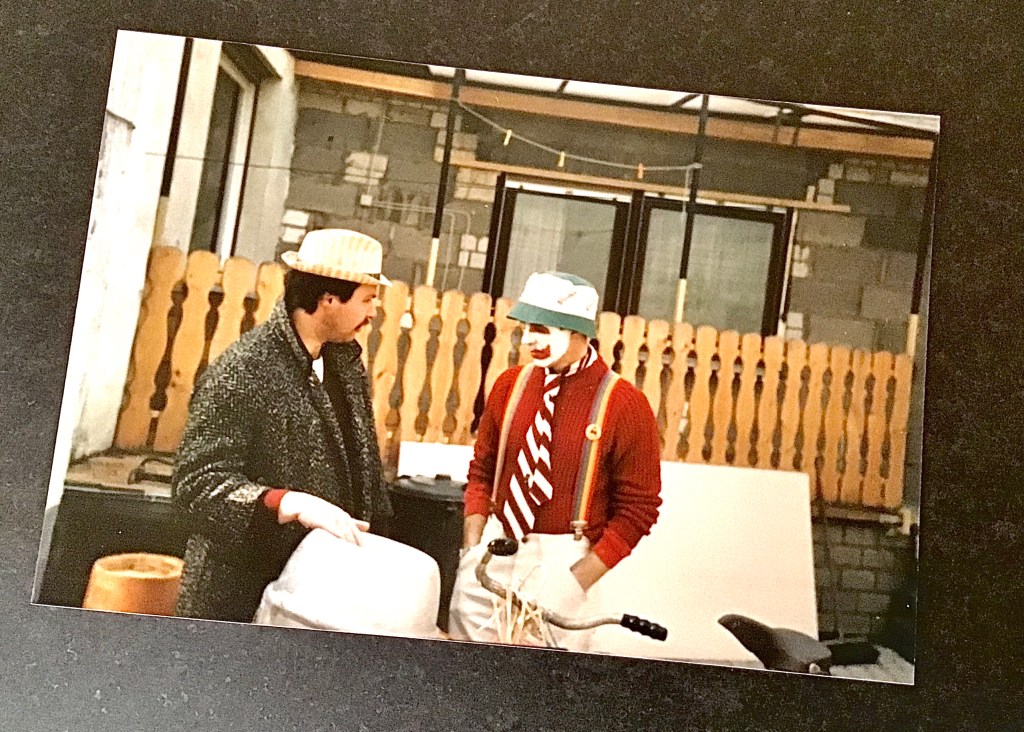
Berthold, explaining the finer points of balancing a keg of bier on a bicycle to me
It turned out the operation truly was a three-man job. One to ride the bike, one to help keep the bike and rider steady and upright, particularly when slowing or stopping, and one to pour and hand out the biers. We practiced a bit, and were ready for the big parade.
The “big parade” is perhaps, a bit of an overstatement. With about 1,000 people in Rheindürkheim, you were either in the parade, or lined up along the street watching. We walked the bike on some backstreets through town to where the parade started by the Catholic Church. When we arrived, there were floats from a Gasthaus or two, marching groups, a butcher shop on wheels, the local Fasching club, a band, assorted schools and civic organizations, people dressed as clowns… and us.
We were an immediate hit. Several people who were participating in the parade came to our bike for a glass of bier to go. The parade started, and off we went down the Main Street of town. Things were moving so slowly, we generally just pushed the bike, although we all got on the bike and did circles around a couple of the floats a time or two – purely in the interest of generating anticipation in the crowd. Of course, there were also those in the crowd who were generous, and traded shots of schnapps for one of our biers… 😉
The parade eventually came to an end. We hadn’t killed the keg, so the three of us each had one more bier. By then, I wasn’t feeling much pain. I took the route of prudence and went home for a nap. The Fasching Party that night was starting in only a few more hours and I needed to rest up.
Monday, February 15th is RosenMontag this year. While I have no plans to ride a bicycle with, or without, a keg, I will raise a toast to Berthold, Michael and our other friends in Rheindürkheim.
Interestingly, WordPress just informed me this is my 200th Blog. When I started this 5 years ago, I didn’t know how long I’d stay at it. I’m happy to say that I still enjoy the writing, and like the challenge of improving, so, will keep this going, at least for awhile.
Cocktails. There are a lot of choices. Today, let’s talk about just two – The Martini and The Manhattan. I know, I know. There are many others – some of my personal favorites include classics like the Old Fashioned, the Margarita, the Daiquiri, and the Negroni. And then of course there are other great drinks such as a Bloody Mary at brunch, a gin and tonic in the summer, or a Grapefruit Crush at a beach bar. But, let’s stay focused people – The Martini vs The Manhattan.
Where do you land in the drinking world? Light? Or Dark?
I suppose the Martini is the sexier of the two. Baltimore-born satirist H.L. Mencken called the Martini “the only American invention as perfect as the sonnet.” And we all know about James Bond and Martinis. Of course, what he mostly did was create controversy. Shaken vs Stirred. Gin vs Vodka. And then he tried to have it both ways in Casino Royale with the Vesper, which includes gin AND vodka. Make up your mind Mr. Bond.
No Martini discussion is complete without a controversy about how much vermouth. A little? A little less? Or maybe just wave the vermouth bottle over the glass? My favorite description of a very dry Martini is the one called “A Montgomery” which has a ratio of gin to vermouth of 15:1. It was named after WWII British Field Marshall Bernard Montgomery, who allegedly was so cautious in battle, he would not attack the Germans without a troop advantage of fifteen to one. Thank heavens people are more reasonable about vermouth now, and know it’s not a bad thing. Go ahead and add some. I think you’ll enjoy it. If you don’t use any vermouth, just remember you’re only drinking an iced glass of gin or vodka.
And finally, how do you garnish your Martini? A lemon twist? An olive? Make it dirty and add a little olive juice as well?
Let’s face it. The Martini is ALL about choices. If you want to have a fun argument with someone, just ask them how they make their Martini. Like fingerprints and snowflakes, it would appear no two people’s recipes are ever the same. As an example, my friends are all over the place on Martinis – vodka shaken, and up with a twist for one; vodka on the rocks with a smidgen of vermouth and two blue cheese stuffed olives for another; and gin, stirred and up, with olives galore for a third.
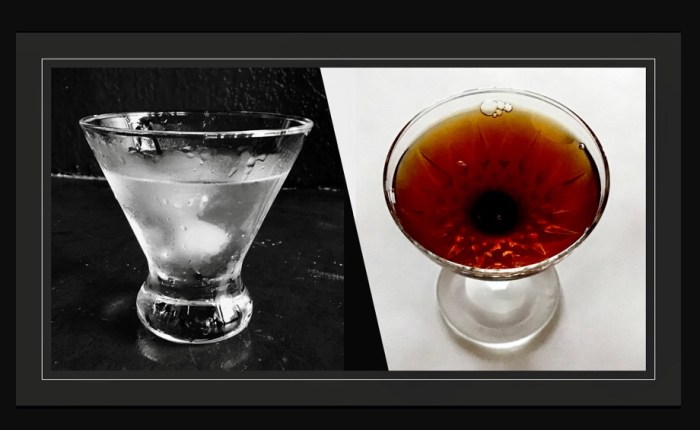
A Gin Martini, Up, with a Twist
By comparison, the Manhattan is a solid citizen with only a few choices. Use rye or bourbon, pick a red vermouth, and decide what kind of bitters you want to add. If you’re a purist, it’s rye and Angostura bitters, but you can live life on the wild side and go for bourbon instead of rye. As for bitters, we have a whole great big world out there now. Yes, Angostura bitters are great, but you can also go with Orange Bitters. If you live in the Virginia Piedmont, you might also visit the Whole Ox Butcher Shop*** in Marshall and pick up a bottle of Smoked Cherry Bitters from Artemisia**. Artmisia’s Bitters make a slightly different, and mighty tasty Manhattan as well. By the way, while at The Whole Ox, you should pick up a couple of steaks to grill, while enjoying your Manhattan.
The garnish? A Maraschino Cherry. Please don’t use the nuclear red ones. Buy the real deal. If you want to get adventurous, express an orange peel over the top of the drink. (At The Occidental in DC, the waiter will singe the orange peel with a lighter before expressing it over your drink).
A Manhattan, Up
One final choice, or controversy, for both the Martini and the Manhattan – Up, or on the Rocks? Personally, I like mine up, but many, including my wife Cathy, enjoy their’s on the rocks. Having said that, Cath’s a heathen about Martinis as far as I’m concerned. Not only does she have her Martini on the rocks, she also uses vodka instead of gin… ;-).
Which is better, a Martini, or a Manhattan? I suppose that’s a personal choice. Some go light, some go dark. Me? I go both ways. I don’t think there is any rhyme or reason to it, I just enjoy both. I started out several years ago with Martinis, but lately, it has mostly been Manhattans. I’m pretty sure it will change back soon enough. By the way, for me, it’s not seasonal, and usually, not dependent on what’s for dinner. It’s (mostly) a nightly decision around 6PM. Some evenings, I even surprise myself with my choice.
It’s now February and we’ve had some winter weather. People are bored and waiting for spring. Between winter and Covid, we are all surviving on comfort food. Maybe it’s time to add to your comfort, and do some cocktail sampling as well. Take your pick – Martini or Manhattan; Vodka or Gin; Rye or Bourbon; Shaken or Stirred; Rocks or Up; Olive or Lemon Twist. Try them out and make a choice… or two. Hell, I’m not here to judge.
Cheers!
Here are the recipes I use:
Martini
2 1/4 oz Gin (Beefeater or Gordons)
3/4 oz Dry (white) Vermouth – usually Martini and Rossi for me
A bit of olive juice (I like them only slightly dirty)
Olives for garnish
– Add the gin and vermouth to a shaker. Add a titch of olive juice. Add some ice, and shake for about 30 seconds.
– Strain into a chilled cocktail (coupe, Martini or Nick and Nora*) glass.
– Add an olive or three.
A couple of notes:
1. Yea, I know shaking breaks with tradition, but I like the little ice crystals shaking puts in the glass.
2. If you are retired and have the time, you can stuff your olives with blue cheese occasionally. It adds a nice salty flavor. (Another non traditional touch, but I love them).
3. I’m on something of a low dairy diet these days, so I often swap out the olive juice and blue cheese olives for a dash of orange bitters and a lemon peel expressed over the drink after you pour it into the cocktail glass. I still shake it. It’s an incredibly pure tasting drink.
4. It’s worth pointing out that my own taste in Martinis has evolved over the years. When I started out, I wanted them extremely dry (“Bartender, just look at the Vermouth bottle, and that will be enough”.) I migrated over time to about a 5:1, and have been at my current 3:1 ratio for a few years now.
Manhattan
2 oz Rye Whiskey – either Bulleit or Old Overholt
1 oz Sweet (red) Vermouth – I prefer Noilly Prat or Dolin
A Couple shakes of Bitters – depending on the night, Angostura, Orange, or Smoked Cherry
A Maraschino Cherry for garnish
– Add all liquid ingredients to a mixing glass.
– Add ice to the glass (more than you think you need).
– Stir the drink for about 30 seconds.
– Strain into a chilled cocktail ( coupe, Martini, or Nick and Nora*) glass.
– Garnish with the Maraschino Cherry.
A couple of notes:
1. Bitters are critical to the drink. The choice of bitters is up to you, but if you want a classic, use Angostura. If you are in a bar and they try to make you a Manhattan without bitters, just move on.
2. I know I already mentioned this in the text, but for the Maraschino Cherry, use the real deal if at all possible. They are about 500% better than the nuclear red ones you can buy at the supermarket. The originals are from Luxardo, but there are also other good brands online, such as Bada Bing, and Woodford Reserve.
Addendum:
• *Nick and Nora glasses are typically slightly rounded Martini glasses. They are named for the characters Nick and Nora Charles in the classic movie from 1934, “The Thin Man”, starring William Powell and Myrna Loy. The movie is a great comedy/drama, and I highly recommend it. A word of caution: Don’t try to keep up with Nick and Nora’s cocktail drinking throughout the movie – you’ll never make it. BTW – The movie is based on the noir novel by author Dashiell Hammett. You may know him as the author of The Maltese Falcon.
• **Artemisia is a local farm and vineyard not far from where we live in Virginia. Owned by Kelly Allen and Andrew Napier, they have established a local food CSA and are starting a vineyard. They are also making four different varieties of bitters, including the Smoked Cherry Bitters I mentioned here. I should mention they do ship, and also, demand is high. You can find more about them (and order their bitters) at this site: https://www.artemisia.farm/ .
• *** The Whole Ox is a wonderful local butcher shop in Marshall, VA. In addition to hand cut meats, and housemade sausages, they carry some hard to find cheeses, interesting wines and beers, and a few other items, like Artemisia Bitters. You can find more about them here: https://thewholeox.com/
About a month ago, I heard this Gulf War story from Christophe Ames. I’ve cleaned it up a bit, but that’s it. It is his story and history. The story is both a sad one, and one of heroics. More than anything, it’s a true story. Here is Christophe’s narrative…
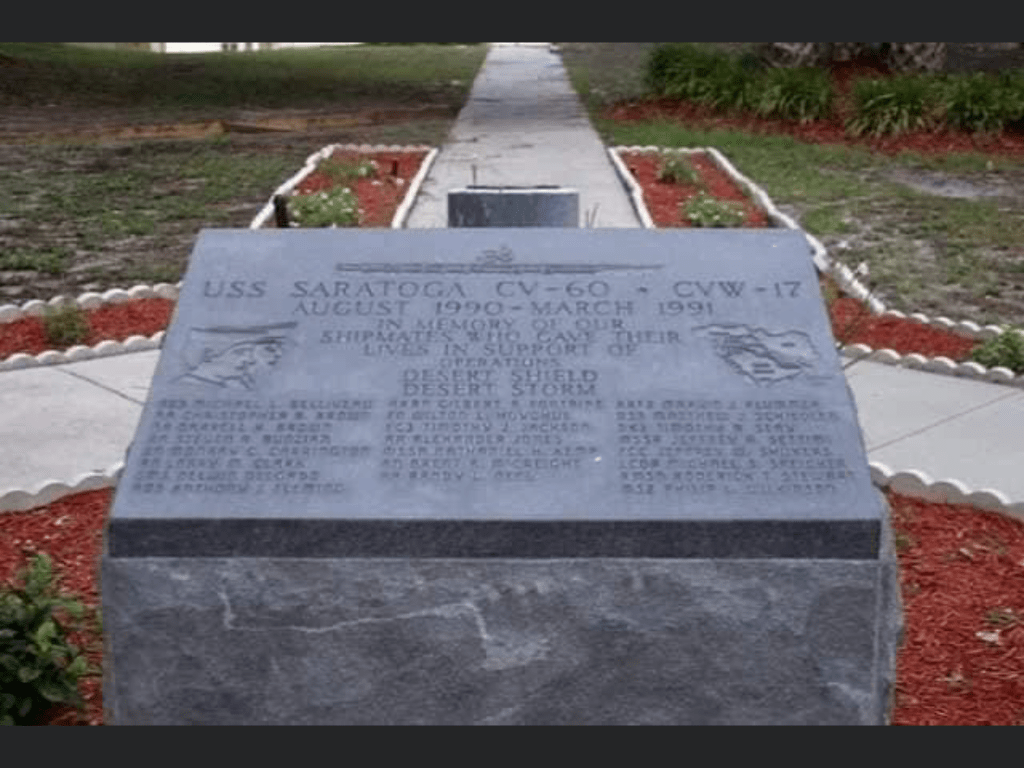
Today is the 30th anniversary of what I now consider the first day of my true adult life. The time of innocence is only a memory now. A few days after the deaths, as we stood in formation in Hangar Bay 1, aboard the USS Saratoga CV-60 in our Dress Blues, there wasn’t a dry eye aboard. We stood at attention for the reading of the names of the fallen and laying of the wreaths in the water.
That’s when it finally hit me, exhaustion abated, adrenalin subsided, my brain allowed me to think instead of only reacting. Boyish ignorance was never again to be of solace to me at the realization I was not “invincible”. I thought time might dull my recall, but as I think of it today, the memory is clear as a bell.
Christophe Michael Ames
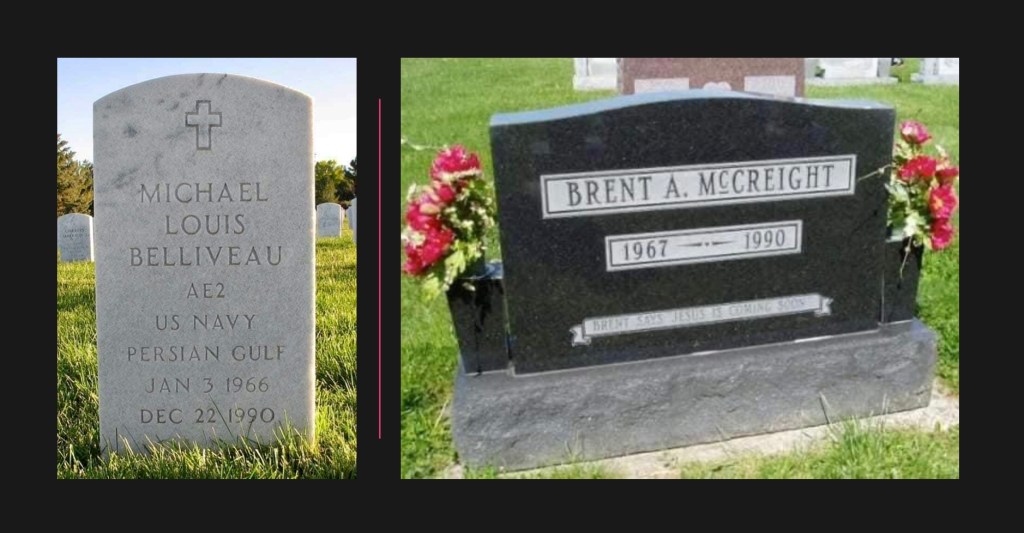
…It’s Zero dark hours on 22 December 1990, in the port at Haifa, Israel. It was my first deployment on the Saratoga during Desert Shield/Desert Storm. Airman Brent A. McCreight, Petty Officer Michael L. Bellevue, Petty Officer Mike Bray, and myself among others, had been further inland and were working our way down to the Israeli shoreline. Brent ALWAYS volunteered for the mission, but I had also asked Michael to go with us on that fateful night.
We were to rendezvous with three small egress boats piloted and crewed by Israeli Nationals. They were to take us out of the harbor, into open water and back to our ship. It was a moonless night, very cold, and the seas were rough.
The first boat filled and departed. As the second boat boarded, they only had two spots left and there were four of us from the unit. A debate ensued on who would stay. The third boat was delayed and had not yet arrived and none of us wanted to leave anyone behind. We knew the third boat could be canceled.
I spoke up and said “Brent and Mike have seniority so you guys go. Bray and I are best equipped to stay on shore in case Boat 3 doesn’t make it before dawn breaks.” At that, they boarded and departed.
After hunkering down under tarps and debris on the dock to protect us from the weather, the third boat finally arrived. We loaded the remaining sailors and departed. The seas just outside the breakwater were so rough, we actually caught up to the other two boats which were fighting to make it to the fantail aft of the carrier. Outside the harbor in the open waters, the current and waves picked up fiercely.
As Boat 1 was attempting to moor and off load people on the Saratoga, Boat 2 was in a tight holding orbit. As we approached, we were getting ready to start a wide orbit. It was pitch black and the Saratoga was at minimal lighting. All you could see of the small boats were the faint nav lights bobbing up and down in the waves.
Then it happened. The middle boat, Boat 2, went up on a wave and then just disappeared, gone in an instant. There was no warning, the lights were there one second and gone the next.
By the time we fought to get to the site of the capsizing, Boat 1 had turned around to assist, but Boat 2 was gone. It sunk so quickly, all hands aboard went under instantly. There wasn’t anything we could do except search and rescue. We were listening for survivors calls against the noise of the stirring seas and roaring wind. We didn’t know it yet, but many of the sailors went to the bottom with the boat.
There was nothing normal about what was happening. They weren’t even our boats. They were Israeli boats and crews who were familiar with the seas. Hardly any of us was wearing life jackets, let alone our normal issued life vests with chem lights.
We pulled survivors and bodies from the water. MAA3 (MAA is a Navy Military Police designation) Delwin Delggado jumped from the top deck of the boat into the cold dark waters for his shipmates. He selflessly saved seven people before succumbing to the icy waters, making the ultimate sacrifice.
Bray and I pulled aboard survivors and even performed CPR on one, until we hit bingo fuel (no fuel) in our boat and had to head back. I never saw Brent or Michael alive again.
The next few hours turned into days. I was the first one offloaded while I was giving CPR to a shipmate. I’ll never forget the person who grabbed us both, hauling us aboard. As the boat pitched and rolled in the 3-5ft swells, the fantail seemed as steady as a pier. The man who hauled me out was the EOD Diver, who also ran the hangar bay calisthenics.
He looked like the SEAL Senior Chief from the movie “GI Jane” played by Viggo Mortensen. I immediately recognized him because I’d attended most of his workouts. He hadn’t really ever invited us non-divers, I’d just show up every day, form up in the back and then try not to puke. Over time, I recruited a couple of other non-divers to come with me. After awhile, there were a bunch of us and the good natured ribbing began. We brought towels to lay on the deck because the divers didn’t share exercise mats. He’d see us coming and say, “Here come the Airedales & they brought their towels, because if they came close enough to the water they will dissolve… Bunch of sugar britches.” When we formed up with them, he’d look at me and say, “HI SUGARCUBE keep up the pace & try to stay dry.”
… That night he was half in his dry suit and a kapok (a kapok is a rudimentary military life vest), strapped to the fantail landing. He was perfectly timing his pulls, as he yanked guys off the small boats while they pitched and rolled. We picked up my fallen shipmate and put him over my shoulder, as I leaned over the side of the wildly moving boat. The Sr Chief and some medics hauled the two of us aboard. The medics grabbed the guy and took him to the Medical Bay. I’m not sure who he was, and I never knew if he made it.
I didn’t follow them. I turned and looked at Senior Chief and he said “Strap in SUGARCUBE and lend a hand” as he commenced to putting safety straps around me. A Boatswains Mate manning the boat lines threw me a Kapok. I suddenly realized the medics that had helped me off were now away and attending to my injured shipmate. Senior Chief was the only one left and needed help getting other sailors onboard. We unloaded the rest of Boat 3 and then Boat 1. The last living sailor was finally hauled aboard. 21 sailors, friends, and brothers in arms were lost that night.
I heard a soft, purposeful, immediately recognizable voice behind us say, “OK Senior Chief you can get ready to go get my boys.” Senior Chief replied “Yes sir” and mumbled, not so quietly under his breath, “It’s about time.” I turned and saw Captain Mobley, who had been close behind us the whole time. Later the OOD would say the Captain was at the Bridge moments after the man overboard alarm was sounded and then immediately went to the fantail once he heard the boats were coming in.
It came out later that the Captain had to stop Senior Chief and his SAR swimmers from just jumping in the drink as soon as they heard the “man over board” alarm. Until they knew what had happened and exactly where, going in dark with no specific direction and under a possible threat would have been disastrous. They would have most likely just added to the victims list. If that happened, no one would be left to go in after the SAR Swimmers or anyone else. The Captain made the right call, the hard call.
After our two boats were unloaded, they suspended boat operations to evaluate what happened. I went up, changed to dry clothes and headed back to the fan tail. That’s when I saw Brent one last time in the Hangar Bay. I positively identified his body and made a silent promise to NEVER forget him and to make sure EVERYONE else got back aboard. I said my goodbye and headed Aft.
Dawn broke and I arrived at the fantail which, at this point, was roped off and secured except for the small quarter deck entrance to the fantail ladder. I beelined straight there. Right as an MAA was motioning to stop me, I looked past him and said in a loud voice “Captain Mobley.” I looked at the MAA and said, “Excuse me” and walked right past him and up to the CO who was talking to the XO, and Admiral Boorda. I looked at all of them, and then right past them. Never stopping, I said with a nod for each, “Sir, Sir, Sir.” I proceeded past them and down the ladder to the landing.
I suited up and strapped in as if I’d been ordered to a duty station for the impending arrival of the first retrievals of the day. No one asked any questions. There wasn’t anyone from the earlier crew, because Senior Chief was now coordinating diving operations. They were retrieving our shipmate’s bodies still trapped in the sunken boat more than one hundred feet below.
I didn’t leave the fan tail for almost two days.
I ate brown bags in between boats unloading. Senior Chief and his crew retrieved all but one of our shipmates. We pulled every sailor’s body off those pitching and rolling boats until everyone was back aboard. Senior Chief and I saw each other a couple of times that day during his required out of water time between dives. He came over and checked on me, and made sure I had food and people to help for the remainder of the time…
…The next time I saw Senior Chief was a few weeks later before a work out. He didn’t raz me as usual. He read my name tape and from then on, he only called me “Ames.” Everyone else was teased except me. He actually asked me to lead some of the workouts when he was not available. We exchanged brief pleasantries, but never spoke of that night.
The last time I saw him was a year later when I was promoted to Petty Officer and he said, “Hey Ames, I see you got your crow. It just proves even a blind squirrel gets a nut every now and again.” He was the last to “tack” it on, he grabbed my arm, raised it up high…and then hit me in the stomach! He said, “Divers hit DEEPER.” Not being a diver, I didn’t realize at the time the honor he bestowed upon me.
That night we lost 21 Sailors and Brothers in Arms. A part of me never left that Fantail, that Harbor, that Hangar Bay. A large part of me was forged on the Saratoga, especially that night. I think of my shipmates often and have survivor guilt to this day. I was the one who had asked Mike to go. What if I hadn’t? What if I had picked someone else? What if I went on Boat 2, or Bray had? Would I have somehow survived, would he have, or would I have succumbed to the same fate as my friends? What if…What if…but I digress…
Mike and Brent – Rest In Peace
I had the opportunity to meet Brents family the summer of ‘15 at his Memorial. It was deeply meaningful for all of us and helped me immensely. This year, thirty years after the event, is just as vivid and memorable. The bite is just as deep, although now a little less sharp.
I’m keeping my promise from more than a quarter of a century ago. My shipmates, you are NOT forgotten. You fulfilled your duty, and we have the watch now. Fair Winds and Following Seas My Friends, My Shipmates, My Brothers. “Until we meet again in Valhalla, in the house not built with hands, but eternal in the heavens.”
USS Saratoga CV-60 Desert Shield/Desert Storm Memorial
_____________
A list of those fine young men who gave their Last Full Measure that night:
BELLIVEAU, Michael L., 24 years old, Lakewood, Colo.
BROWN, Christopher B., 19, Leslie, Ga.
BROWN, Darrell K., 19, Memphis, Tenn.
CARRINGTON, Monray C., 22, North Braddock, Pa.
CLARK, Larry M., 21, Decatur, Ga.
DELGADO, Delwin, 26, Jacksonville, Fla.
FLEMING, Anthony J, 25, Buffalo, NY
FONTAINE, Gilbert, 22, Spring Valley, N.Y.
HUYGHUE, Wilton L., 20, St. Thomas, Virgin Islands.
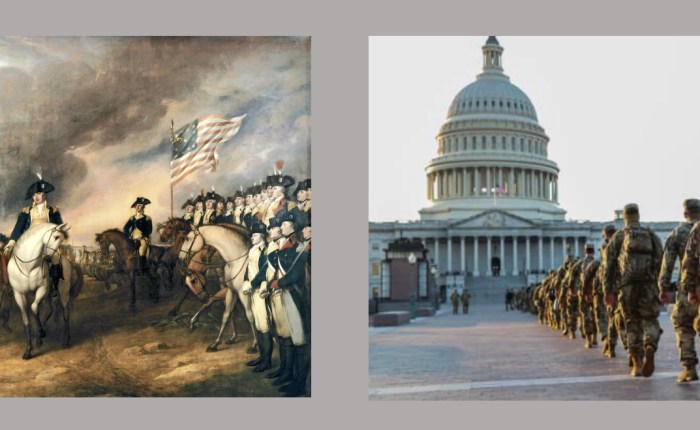
25,000 plus National Guard troops will be in our Nation’s Capitol on January 20th, Inauguration Day. This doesn’t include the National Guard troops deployed across our country at state capitols on the same day. All of this is to prevent the violence and insurrection threatened by right wing extremists.
The Insurrectionists of January 6th, might have a harder time on January 20th
People have noted the size of the contingent in our Nation’s Capitol is larger than the combined number of troops we currently have deployed in Afghanistan and Iraq (5,000 as of January 15th, 2021).
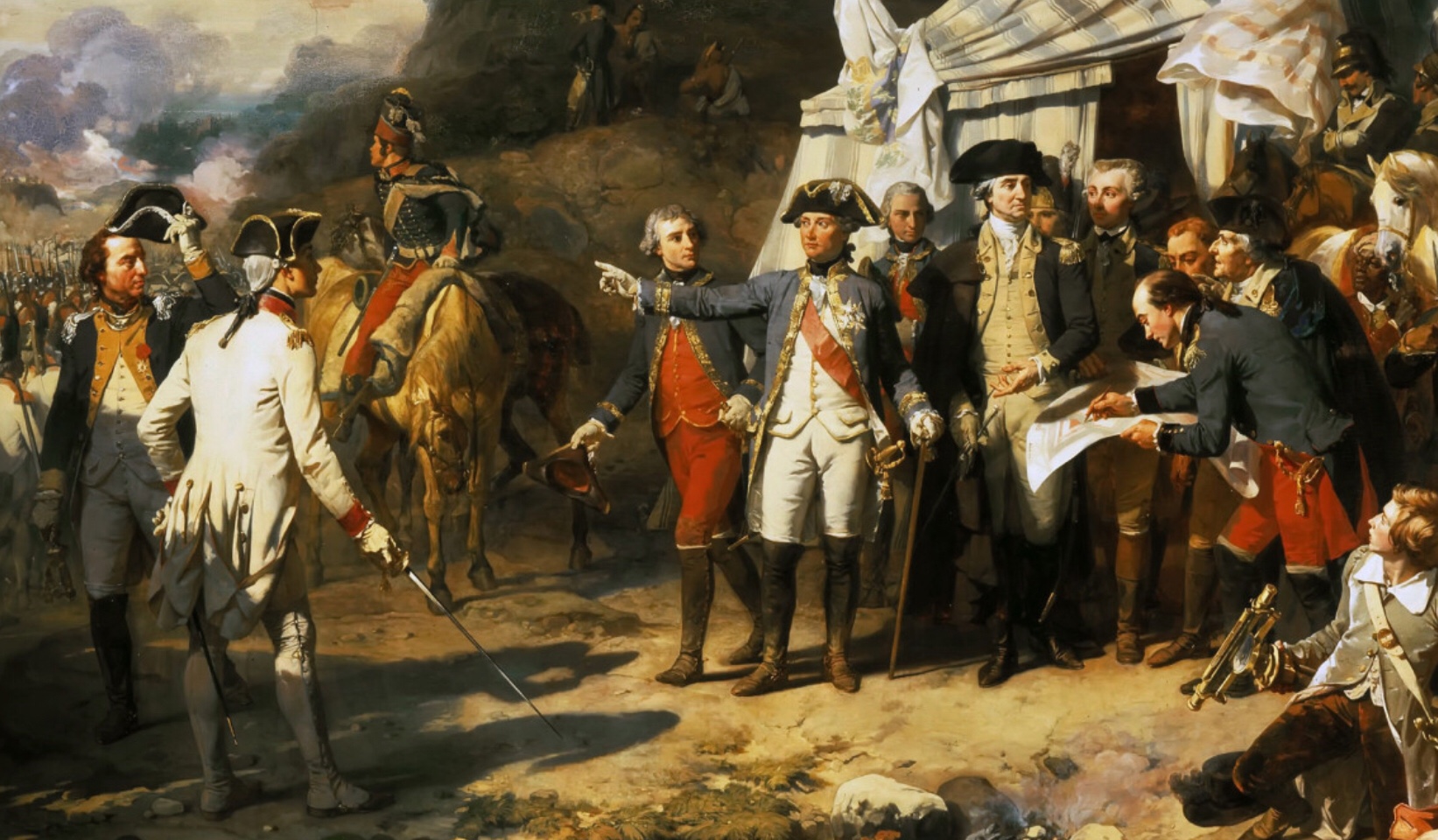
For me, there is another number that puts this deployment in perspective – The Battle of Yorktown in 1781. It was, in essence, the final battle of the American Revolution, resulting in American Independence. With a combined American/French force of approximately 18,000, General George Washington defeated the 8,000 troops under Lord Cornwallis in October of 1781.
The surrender at Yorktown, after seven years of war
Think about it. In the battle that determined American Independence, there were approximately 26,000 troops between the two sides together. America is now deploying nearly that number itself, to guarantee extremist rabble doesn’t act out it’s fantasies.
The cost to defend and ensure American democracy is never cheap. It was not in 1781, and it is not 240 years later in 2021. That we need 25,000 troops, not to mention untold numbers of law enforcement personnel, to ensure a peaceful transition of power in this country is both sad and appalling.
What is equally as sad, is that no one expects anything to change for the foreseeable future. Whither next America?
As a footnote to history, it’s worth noting that after the Battle of Yorktown, Cornwallis refused to attend the surrender ceremony, saying he was ill. Instead, his deputy, Brigadier General Charles O’Hara, led the British Army on the field that day. The official treaty between Britain and America would not be signed for another two years.
The Loser, in more ways than one, Cornwallis
Addendum:
• Thanks to my friends Tim Stouffer and Mark Dunavan for our discussions on this topic. Tim, who knows more about history than anyone I personally know, first made the comparison to Yorktown in our discussions and helped me flush out this blog.
• The official treaty between Britain and America, “The Treaty of Paris” was signed on September 3rd, 1783.
• Our Constitution was not ratified until June 21st, 1788.
He told us five years ago his thoughts about what he could do and how his supporters would react. Remember? Just prior to the Iowa caucuses in 2016, candidate Trump stated “I could stand in the middle of Fifth Avenue and shoot somebody, and I wouldn’t lose any voters, OK?”
His followers listened, and remembered. Yesterday, speaking to the mob in Washington DC, the president upped the ante – “We are going to have to fight much harder….We are walking to the Capitol…. You’ll never take back our country with weakness, you have to show strength”.
At the same rally, his personal lawyer, Rudi Giuliani, stated “Let’s have trial by combat”.
Well, the president got his “day of reckoning.” As a result of yesterday’s violence and seditious acts, they both got their wish. There are four dead, and for only the second time since the British torched the Capitol building during the War of 1812, our Capitol, was violated. Property was damaged, property was stolen, and people died.
The world continues.
⁃ The state of Georgia elected two Democrats to the United States Senate, giving Democrats control of the Senate. I have to believe this was a direct repudiation of President Trump and particularly his actions of the last two months.
⁃ Former President George W Bush, Mitt Romney, General Mattis and other prominent Republicans and former Trump staffers have all condemned this president and these actions.
⁃ Several Trump appointees are now resigning.
⁃ Congress certified and Vice President Pence announced the election of Joe Biden and Kamala Harris.
I understand for the “true believers” in the Trump camp, yesterday will change nothing in their view of this president, or the election. Nothing ever will. For the rest of us, Republicans, Democrats and Independents, lets look forward to a new day.
It’s a sad day for America when all ten of our living former Secretaries of Defense feel compelled to release a letter saying the election is over, Biden has legally won, and the military should NOT be used to intervene in the election. Think about the American reality that prompted such an op-ed piece
In their letter, they take great pains to point out that they, and those in the military have sworn “an oath to support and defend the Constitution against all enemies, foreign and domestic. We did not swear it to an individual or a party”. Seven of the ten signers are Republicans, or served under Republican presidents. Two of them, Mattis and Esper, served under President Trump.
These ten men have differing views on the direction of America, but none of them believe in any one person holding sway over the Constitution. Their belief is in The United States of America itself. That they wrote and published this letter says volumes about where we are in America.
Looking across our country right now, I am disheartened at how many of my fellow citizens have taken up the “cause” of one man’s misrepresentations and lies.
There has been much written about cults, causes and movements here in America. While cults were originally thought of in regard to religious activities, the definition has expanded to include devotion to a person, idea or movement. Arthur Koestler, author of Darkness at Noon, wrote about people who convert to cults and causes. At the time, he was writing about his own conversion to Communism, but it could be about any cult, movement, or cause:
“To say that one had “seen the light” is a poor description of the mental rapture which only the convert knows (regardless of what faith he has been converted to). The new light seems to pour from all directions across the skull; the whole universe falls into pattern like the stray pieces of a jigsaw puzzle assembled by magic at one stroke. There is now an answer to every question; doubts and conflicts are a matter of the tortured past – a past already remote, when one had lived in dismal ignorance in the tasteless, colorless world of those who don’t know. Nothing henceforth can disturb the convert’s inner peace and serenity – except the occasional fear of losing faith again…”
There are now so many cults, causes and movements here, people have published warning guides about them. Compiling lists from several articles, the signs to look for include:
• The leader/group is always right and the exclusive means of knowing “truth”. No other process of discovery is acceptable or credible.
• Although there may be outside followers, there’s usually an inner circle who follow the leader without question.
• Cults typically oppose critical thinking. There is no tolerance for questions or critical inquiry.
• Typically cults exploit their members….often financially.
• The idea that if you leave the cult, horrible things will happen to you. There is no legitimate reason to leave – former followers are always wrong in leaving.
Sound familiar at all?
We, as Americans, need to look past any one person, past any one president, and look to the future of this country. Americans have never sworn an oath to only one individual and never should. I take heart that these former Secretaries, and people like Georgia Secretary of State, Brad Raffensperger, continue to do the right thing. America will weather this storm and grow from this experience. It will be because people, not Democrats, not Republicans, but Americans, did the right thing.
I’ve been honored to enjoy many great friendships over the years. Maybe due to Covid, or maybe because I am closer to the end rather than the beginning of my life, I’m more aware of that good fortune. What I feel most blessed about though, is the continuing close friendship with my childhood buddies, Tim, Kim and Mark.
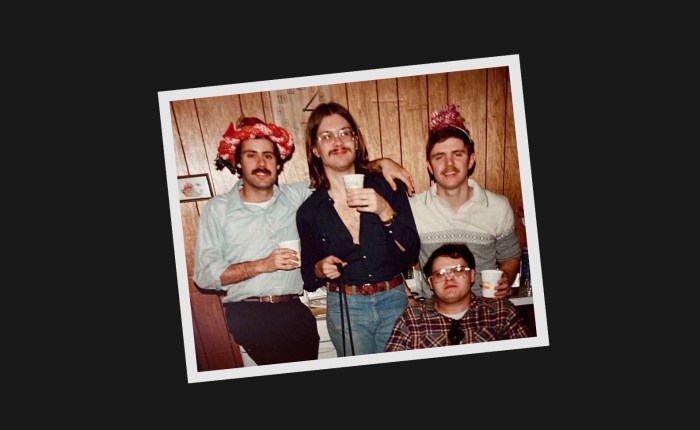
New Years Eve, 1978. Mark, Howard, Tim and I appear to be doing fine.
Mark recently sent a photo of the four of us on New Years Eve, 1978. It’s a classic New Years Eve picture. Slightly blurry, it captures us at about 3AM on January 1st, and, perhaps, slightly inebriated. Plainly we are having a good time. Although we aren’t thinking of it, our youth has passed, and our adult lives stretch out in front of us. Looking at the picture now, 42 years later, I think about our friendship and the transience of our time on this earth.
Kim, Tim, Mark and Max are also known by the nicknames Howard, June, Dunny and Ben in some circles. Those guys have been my friends forever. I first met Howard and June at about three years old in Sunday School. Kindergarten followed. Mark was a couple of years later, through Boy Scouts and youth football. I sometimes think because all of us had only sisters as siblings, we became closer over the years. Friends replacing the brothers we never had…
For the four of us, there are too many good times to count, whether in grade school, high school, college or the real world. We know and accept each other as we are, and have remained friends throughout. You might have thought with me going to West Point or serving overseas in Germany for a decade, the relationships would have faded, but they never did. Neither time, nor distance, have dimmed the closeness I feel for these guys.
Living in Virginia, I don’t see the three of them as often as they see each other, but we still make good times happen when we are together. And of course, when together, in addition to making new memories, we tell stories of the old times. Sometimes, just a name, word or phrase are all we need to generate smiles or ripples of laughter – Farrell, Wrong-Way LeBeau, The Ottawa Gluttons, The Great Wisconsin Tent Mystery, Sam’s, Wolfgang, the White Sox, certain meals or nights in Chicago…. While several of the memories are of the four of us together, many are only of two or three of us doing something. We’ve all heard the stories so often by now, it’s as if we were all at all of the events. The stories grow stale to some, but not to us. They are the chronicle of our past and the evidence to each other that we have tried to live life fully.
We are all lucky enough to have wonderful partners. Our friendships have expanded during our four marriages and one divorce. Some friendships survive neither marriage nor divorce.
Currently, one of us has serious health issues. With Covid, we can’t just rush to his side to somehow help, or try to help, or just commiserate. And so we text, email and call each other, often on a daily basis. It’s not the same as being there, but I like to think it helps him, and I know it helps me. Our communal history is a comfort that binds us beyond words.
I’ve been blessed with many great friendships over the years. From family relationships, my home town of Ottawa, West Point, the Army, neighbors, our running group, the horse world, politics… the list goes on. Tim, Howard and Mark? At the end of the movie, Stand By Me, the character played by Richard Dreyfuss says “I never had any friends later on like the ones I had when I was 12. Jesus, does anyone?” I count myself beyond lucky that my friends “when I was 12” have remained my good friends to this day. I love these guys. They are the brothers I never had.
Addendum: Thanks to Mark for sending the photo – it really did help start and formulate some things I’d been thinking about for awhile.
It was Christmas, 1965. I was ten years old and in Fifth Grade. I’d figured out a year or two before Santa Claus wasn’t real, but my Dad made me promise not to tell my sisters. Even though Santa wasn’t real, it was still an exciting season.
For Christmas at our house, you’d typically receive one “big” present, several smaller presents, and of course clothes (ughhh). For the big present, you could petition Santa at the little Christmas House in downtown Ottawa, or more importantly, make sure Mom and Dad knew. Sometimes you’d receive the present, but just as often not. Money was typically tight at home, and Santa might, or might not come through.
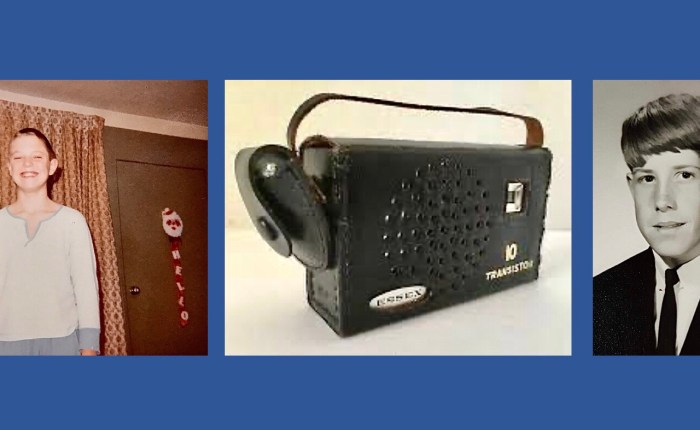
In 1965, I wanted a Transistor Radio. They’d been around for a couple of years by then, and the price was starting to come down. Before the iPhone, iPod, Boomboxes, or the Sony Walkman, there was that first mobile music device – the Transistor Radio. The Beatles and The Stones both appeared on Ed Sullivan in 1964, but more importantly, Rock ‘n Roll was on the radio. If you were a kid growing up in Illinois at the time, that meant WLS out of Chicago. Everyone listened to WLS.
Unfortunately at home in the Hall household, if the big radio was turned on, it was tuned to WMAQ, also out of Chicago, which played Big Band, some Jazz, and “popular” (not Rock) music. Dad didn’t like Rock. He was strictly a Jazz/Big Band guy, and “those kids who only played four chords” weren’t going to be on the radio in his house. A transistor radio promised freedom, but from my view the odds of getting one weren’t high.
Christmas Eve finally arrived, and then came Christmas morning itself. We kids started waking around 3:30AM, making trips to the bathroom so we could see the Christmas tree along the way. Finally, around 5:30, Mom and Dad let us get up, and we started ripping into the presents.
As we were opening the presents, there it was! The Transistor Radio! I opened the package itself, took out the radio and turned it on. Nothing. Silence. What?! I was crestfallen, it was broken. Then dad said “There is no battery in the radio. Maybe there is one somewhere else under the tree.” Hope restored, I went back to the presents.
Eventually, I found the battery. Dad showed me how to open the radio and we placed the battery inside. I turned it on…. and music! Wait, what’s this? It was old people music. Dad explained to me he received a special deal on this radio and it didn’t include WLS. It did however have WMAQ and their adult music. I was disappointed, but at least I had a radio.
Merry Christmas!
Later that morning, I was in our backyard, sitting in a tree, listening to the radio as it played Christmas music from WMAQ. A car pulled into our driveway and out came Uncle George, Aunt Mary and my cousins. They all wished me a Merry Christmas and wanted to know how Christmas had been. I said pretty good and showed them the radio. Uncle George, Aunt Mary and the older kids laughed, waved and went into the house.
My cousin Billy, who was only a couple of years older than I, came over to the tree, climbed up to another branch and joined me. We listened to the music a bit and then:
Billy: “What are you listening to?”
Me: “WMAQ’s Christmas music.”
Billy: “Why aren’t you listening to WLS?”
Me: “Dad got some kind of deal on the radio and it doesn’t get WLS”.
Billy looked at me as if I was stupid, and then exclaimed “Gimme that!”
I handed him the radio and he played with one of the wheels and all of a sudden – Boom! There were The Beach Boys singing “Little Saint Nick”! Whoa! It turned out I didn’t know about the frequency dial on the radio, and Billy had tuned it to WLS at 89 AM. (He was right to look at me the way he did. ;-). )
I raced into the house with the Radio. “Dad, Dad! The radio DOES get WLS! Billy showed me how to tune it in!” Dad looked at Billy and me, and I believe a small smile crept across his face. “What?! The salesman told me it wouldn’t receive WLS. I’ll have to talk with him”. He then made Billy and me go back outside “if we were going to play that Rock ‘n Roll”…
I recently talked with Billy about the story. He laughed at the memory and remembered thinking my Dad might kill him. He also remembers changing all the buttons in his family’s car to WLS for the drive home that day.
Having a good Christmas, and then your big cousin helping to make it even better – how cool is that?
I know with Covid, this Christmas will be different for many of us. Here’s hoping you make special memories to remember, and laugh about for years to come.
Addendum:
Dad grew to enjoy the Beatles. Many years later, we were talking after he and mom returned from a Jazz fest where a band played a medley of Beatles songs. Dad’s comment to me: “You know, those Beatles made some pretty good music”. Even old dogs can learn new tricks, or at least they could in Dad’s case…. 😉
If you want to read a couple of other Christmas memories from the Hall house, you can find them here:
The transistor radio really was the start of the revolution in portable music. You can follow the trail from Transistor radios to Walkmans, Boomboxes and iPhones. As it says in the referenced article, “The mighty transistor radio was the first piece of technology that gave young people complete musical freedom from parental disapproval.” Read more here: https://home.bt.com/tech-gadgets/internet/retro-tech-the-transistor-radio-11363937910884
Not all heroes wear capes. They aren’t all soldiers, first responders, or health workers in the time of Covid. Some are just doing their job. My friend, Kelly, is one such hero. She works for the Maricopa County Elections Department in Phoenix, Arizona and has received death threats, just for doing her job.
Kelly
On November 18th of this year, I noticed a blog I wrote in August of 2017 was getting a lot of online clicks/views. The blog is titled “This is not my America” and was my response to the horrific KKK/Nazi torch lit parade in Charlottesville, Va that year. I assumed someone liked the blog and linked to it in their own blog, or perhaps tweeted the link out. The next day, there were even more views (almost 150 in total). I decided to investigate further and traced the clicks to a specific blog site, as opposed to Facebook, Twitter, LinkedIn, or web searches, which is how most readers find me.
It turned out a right wing blogger was calling me a leftist in her blog and said I was “attacking the Founding Fathers”. The blogger went on to use my Charlottesville blog to condemn my friend, Kelly, as also being a “leftist”. (a link to my Charlottesville blog is at the end of this piece, if you want to see what a leftist I am).
The Right wing blogger attacking Kelly and misrepresenting my blog as attacking the Founding Fathers
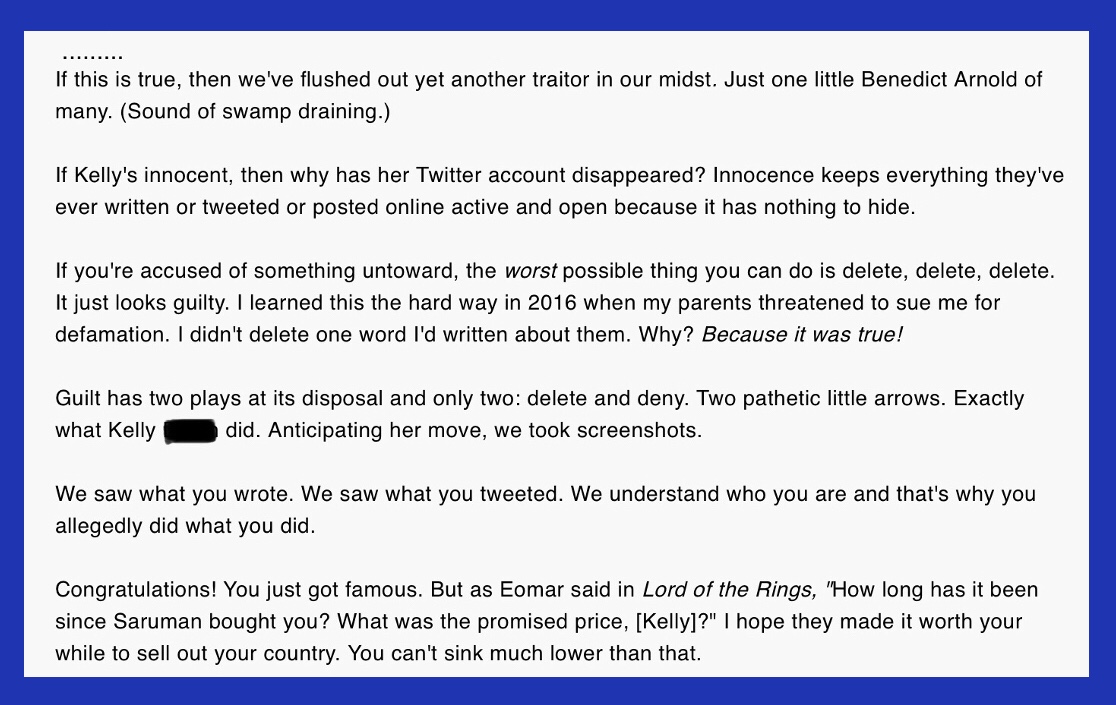
The right winger stated “no Republican/Conservative would have retweeted the blog, but Kelly did, outing herself as a leftist/Democrat”. Later, in the same blog, she commented about my friend Kelly – “If this is true, then we’ve flushed out yet another traitor in our midst. Just one little Benedict Arnold of many. ”
The blogger calling Kelly “one little Benedict Arnold of many“
Why was my friend under attack from this blogger and others? Upon further reading of the attacker’s blog, I found out Kelly now works for the Maricopa County Elections Department. In the course of her job, and at the direction of her boss, Kelly sent an email out to election workers shortly before the election, telling them voters should use the provided Sharpie pens on Election Day to mark their ballots. Evidently Kelly was an evil person and part of a cabal doing everything she could to cancel out the votes of Republicans on Election Day. Someone leaked the email to the trolls, with her full name, email address, and phone numbers.
According to conspiracy theorists, voting machines couldn’t read ballots marked with sharpies, and thus hundreds of thousands of votes for Trump on Election Day weren’t counted in Maricopa County and elsewhere. Now this was demonstrably false and was debunked multiple times. In fact, Sharpies worked better than pens, and would cause fewer issues on Election Day than ball point pens. This didn’t stop the trolls from posting about the Sharpies, or my friend. If you want to see some bizarre stuff, do a search on Sharpiegate.
I decided to contact my evil friend, and see how she was doing, but I ran into a problem or two. Her work phone went straight to voice mail. Her cell phone went straight to voice mail. Her LinkedIn account was shut down, as were her twitter and Facebook accounts. I also couldn’t reach her via Messages, or Messenger.
I was starting to worry.
I contacted a mutual friend to see if he had any other way to reach Kelly. He passed on a cell number he knew worked for her previously. I reached out…. and we connected.
While Kelly was OK, she was having some issues in Arizona. Trolls were coming after her and bombarding her accounts with threats and vulgar comments, so she shut them down. People called her names in person and online that you wouldn’t want your mother to hear. She was receiving death threats and her voicemail for work and her cellphone were porting directly to the Maricopa County Sheriff’s Office forensic team. The death threats were credible enough that the sheriff’s department discussed assigning protection to her.
Kelly and I talked about the election and what was going on in Arizona. She was in surprisingly good spirits for someone threatened with death. In her words –
“I’m OK. The County offered me a security detail because I’m getting death threats. I have all new phone numbers. There were lots of sick, disgusting messages I wish I’d never heard. These people are ugly. They’re pulling at every straw. I took everything down out of fear for my family, but they have taken that as an admission of guilt.”
The only thing Kelly was guilty of, was doing her job.
Kelly shared with me that her parents, and her wife Sarah served as her base and her foundation. They were keeping her sane with jokes, and with messages of love. Her boss and Maricopa County were also standing by her – with protection, words of support and defense of the truth.
I said to her “I’m proud of you. Now is the time for good people to stand their ground, and doing the right thing is important. You, my friend, did, and are doing, the right thing.”
She answered back “I hold that in my heart – I have nothing without my integrity.”
***
The Maricopa County Attorney’s Office completed an extensive review of all actions surrounding the election. In an interesting twist, one of those attorneys was Tom Liddy, the son of G. Gordon Liddy of Watergate fame. The Attorney’s Office found no issues with the conduct of the election, and in fact stated the Election Board did everything they should, to ensure a fair election. Mr. Liddy’s comment was “This is the best election I have ever seen… in terms of turnout, and security”.
On Friday, November 20th, the court threw out the third lawsuit raised since Election Day in Arizona. Later the same evening, the five member Maricopa County Board of Supervisors met to canvass and certify the 2020 general election results. There are four Republicans and one Democrat on the Board. In a two and a half hour meeting, they discussed the election, and listened to input from the Election Board, and the County Attorney’s Office.
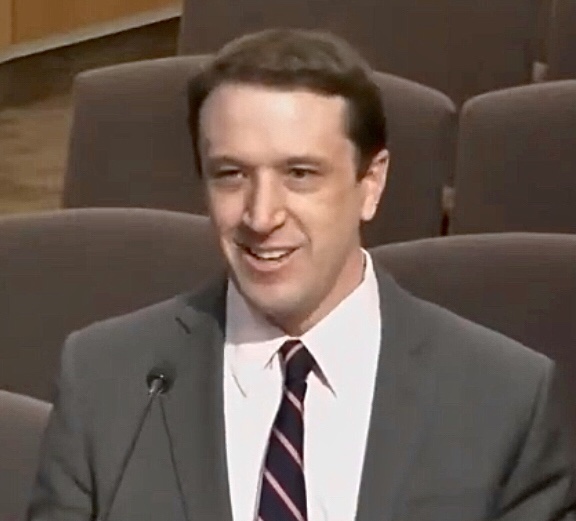
Scott Jarrett speaking at the Special Meeting of the Maricopa County Board of Supervisors
Scott Jarrett, the Director of Election Day and Emergency Voting, said this in his closing statement “The heroes of this election are the election staff…. the people who still came to work, even as people were chanting at them, and calling them names…..”
Just after 6PM, the board unanimously approved the canvass of the November election for Maricopa County.
The Chairman of the Board, Clint Hickman, said “We’ve canvassed the General Election results and can assure Maricopa County voters proper steps were taken to ensure a full and accurate count of all votes. No matter how you voted, this election was administered with integrity, transparency and in accordance with state laws.”
He went on to say “I learned a lot about the character of people in this community… I will not violate the law or deviate from my own moral compass, even though that is what some have pressured me to do… I specifically want to thank the staff who have worked tirelessly to run this election during a pandemic – Scott, Kelly, Rey…. I want to personally thank you”.
Not all heroes wear capes. One works on the presidential election in Maricopa County, Arizona. I’m proud of my friend Kelly, who continues to provide election support, even as I write this blog.
I chose to only provide a couple of screen shots of the right wing blog that linked to my site. I did not want to give the blogger any more exposure by providing a link to her site and the information she is publishing. As you may have seen in the screen shot above, there was a strange mix of comments about Kelly, the blogger possibly being sued by her own parents for defamation, and a little Lord of the Rings thrown in as well (although she misspells Eomer). It’s a strange world we live in these days.
As I was writing this blog, the trolls continue to post about Kelly. She stays in close touch with the Sheriff’s Department. Kelly was happy with me using her full name in this blog, but due to the ongoing nature of the harassment, I chose to use her first name only, and to not provide a complete picture of her.
This is a different kind of Thanksgiving story. How often do you give thanks to the owner of a septic system company on Thanksgiving Day?
In 2001, we had a family gathering at our farm for Thanksgiving. It was only two months after 9-11, and while people were still nervous about travel, many also had a strong urge to spend time with family. We didn’t realize the gathering would precipitate problems with our septic system on the day before Thanksgiving.
Mom Snow came from Alabama, along with Cathy’s aunt Bonnie from Missouri. Cathy’s sister Bonnie (Aunt Bonnie’s namesake) and husband Don flew in from California, along with Don’s folks, Shan and Daddy Don. Counting Cathy and I, there were eight of us in the house, with all bedrooms and the office occupied. We were full.
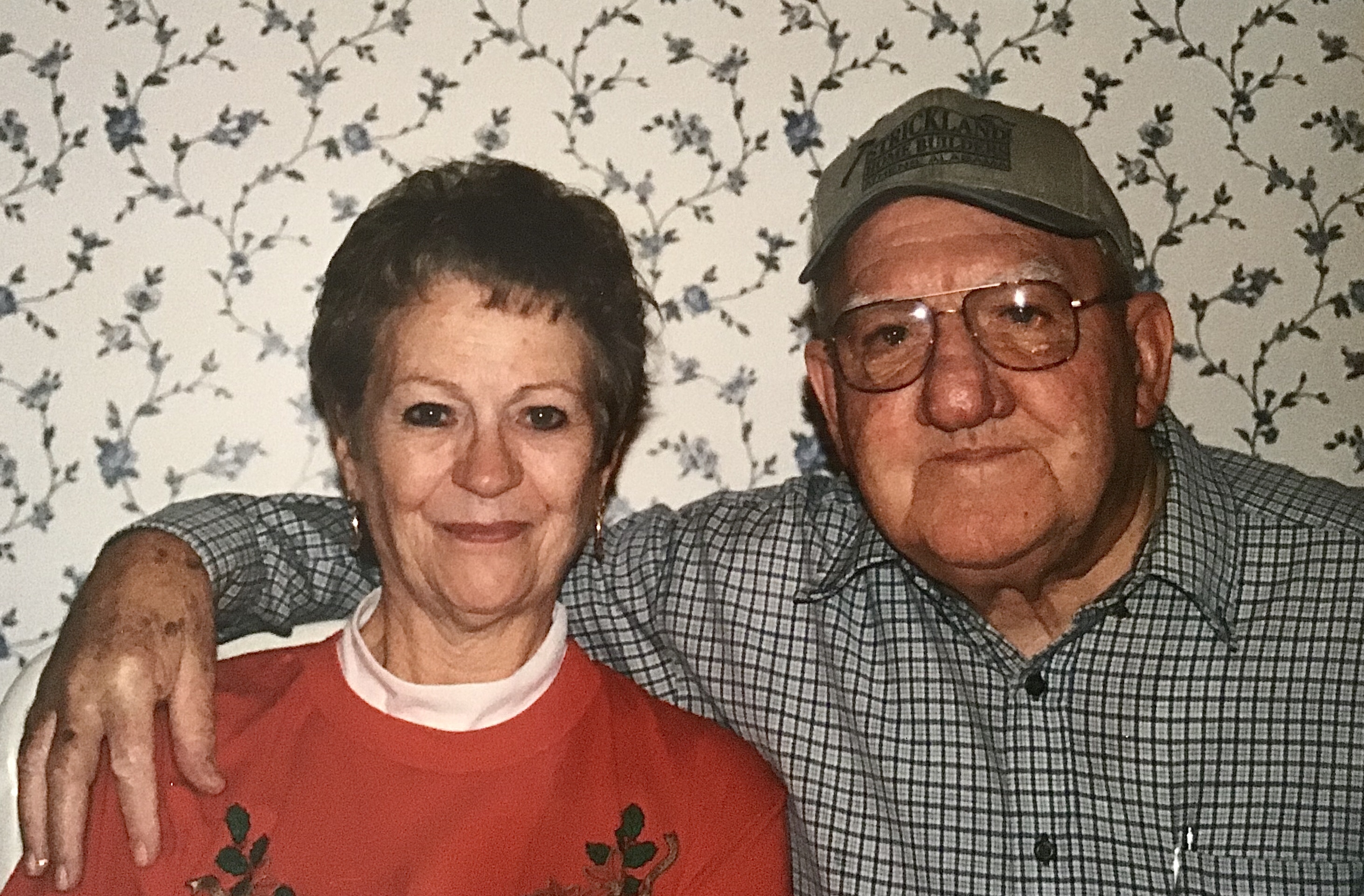
Mom and Daddy Don in 2001
People arrived the weekend before Thanksgiving, and everyone got along remarkably well. We have a nice sized house, but with eight people, and two and a half bathrooms, there could be a bit of congestion in the mornings and evenings. You might even say the bathrooms were working overtime. With the excess food and alcohol consumption that typically happens at family gatherings, and with four of our guests over 70, my observation in retrospect was there were no “regularity issues” among the group at our home.
At this juncture, it’s worth pointing out we live on a small farm in the country. The house was built in 1976. There are no city water or sewage hookups. For water, we are on a well that’s 264 feet deep and serves both the house, and the barn. For waste disposal, we have a septic system. When we bought the house in 1999, both were inspected by the county and deemed operational.
Thanksgiving week progressed and Cathy noticed a small pool of water had formed near the barn. There were recent rains, so she didn’t think anything about it. The next day, the water was still there and she mentioned it to me. Hmmmm. My first thought was perhaps a pipe from the well to the barn was leaking and the water had surfaced. We checked the water pressure in the barn, and the pump seemed fine, with plenty of pressure. To be honest, that was about the extent of my plumbing expertise at the time, and so I decided to call a plumber.
This was the day before Thanksgiving, so naturally every plumber we called was either busy, or didn’t answer the phone. As I was sitting there grumbling, Daddy Don walked by and asked what the issue was. I explained the pool of water and said I was afraid we might have a busted pipe. He asked “Where’s your septic field?” I pointed vaguely to the back yard and said “Over there.” He answered, “Well the pool of water is just below your field, maybe you have a septic problem.”
What?! Jeez, eight people in the house. I certainly hoped that wasn’t the problem. Erring on the side of caution, I thought it was worth checking out. I looked in the phone book, and found All Star Septic, in the village of Hume just a few miles away. I gave them a call and they answered. Even more miraculously, they could have someone out in a couple of hours. In the meantime, I advised everyone to stay away from the small pool of water, in case it was contaminated.
All Star Septic – “You Make it, We Take it”
An hour or so later, a septic truck pulled up, and a man climbed out. It was Chris, the Owner of All Star Septic. We shook hands, and I explained to him what the issue was. He just kind of nodded his head, then said “Where’s the pool of water?” I told him it was by the barn, and we walked over there. Chris looked around a bit and then squatted down next to the pool. He dipped a finger into the water, and held it up to his nose. He then matter of factly said,
“Uhh yep, that’s shit water”.
And with that declaration, we found out we had a septic problem.
I laughed internally to myself about all the cautions I’d taken with the water, and here was Chris dipping his finger in it. I also had the thought I probably wouldn’t shake his hand goodbye.
I mentioned to Chris about eight people at the house for the next several days through the weekend. He answered back that probably explained part of the problem. The house typically only had two people using the septic system and was now overloaded. Chris then said he couldn’t fix the problem right then (it was the day before Thanksgiving afterall), but he could pump out our tank(s) and that should help in the short term.
Chris, from All Star Septic
I thanked him profusely and he proceeded to pump out the two tanks. He commented the tanks looked fine and the problem was something “downstream” and we could tackle that a bit later.
Chris was right, and pumping the tanks removed the immediate issue. On Thanksgiving Day, much like Arlo Guthrie in Alice’s Restaurant, “We had a Thanksgiving dinner that couldn’t be beat, went to sleep, and didn’t get up until the next morning.” Unlike Arlo, for us, the rest of the week passed without incident and the pool of water disappeared. Chris had provided us with a temporary solution that worked, and held for the week everyone was there.
When I think back over the years about Thanksgiving, it is the celebrations that were different that I remember – the Thanksgivings in Germany when we had bachelor Lieutenants over, because they had no where else to go; serving Thanksgiving in the mess hall to the troops; celebrating in Vienna, Austria one year; the time I flew home on Thanksgiving Day itself, due to work delays; and yes, the year Chris, from All Star Septic, saved the day.
My guess is with Covid, Thanksgiving 2020 will also be special, or different if you prefer, and is one all of us will remember for a long time. I hope you make the most of the day, and give thanks for family, friends, and the things in your life that are important to you now, and always. Peace be with you.
Addendum:
The rest of the story about our septic field is a bit anticlimactic. Chris did return later and fix the problem. It turned out the previous owners had built the drive to the barn directly over the distribution box for the septic drain field. Over time, the distribution box caved in and the effluents were only going out through three of the distribution pipes in the drain field, instead of all nine. That was fine when just a few people were at the house, but when there were eight of us, it was too much for the three pipes to handle. The end result was the pool forming near the barn. So, our guests didn’t cause the problem, but in fact highlighted the already existing problem. It had probably been that way for years. Chris replaced the distribution box, and several of the distribution lines connected to the box. We’ve had no problems since, and that includes a couple of parties with over 100 people in attendance.
All joking aside, if you live in the Fauquier County, Virginia area and have a septic problem, Chris is the guy you want to call. He’s prompt, reliable, professional, and gets the job done. He’s been our guy ever since the “incident”. You can find his info here: https://allstarseptic.com/ , or call him at: (540) 272-9247.
If you’ve never listened to Alice’s Restaurant, by Arlo Gutherie, you need to do so. NOW KID! Set aside about 19 minutes and enjoy it for what it is. It’s a protest song, a Thanksgiving song and it’s just plain funny. I typically listen to it every Thanksgiving. Originally released in 1967, it’s full title is actually Alice’s Restaurant Massacree. Here’s one version: https://youtu.be/m57gzA2JCcM . In 2017, it was selected for preservation in the National Recording Registry by the Library of Congress as being “culturally, historically, or artistically significant”.