201 years ago, on August 23, 1825, The Marquis de Lafayette visited Warrenton, VA as part of his United States Farewell Tour. 5,000 residents cheered him. They understood how he and France made America’s Independence possible, a contrast to our current president’s attitude about the French.
It is a historic debt—one that stands in stark contrast to the dismissive rhetoric and diplomatic friction with France we see from the Trump administration today. To understand what we are losing in our modern alliances, we first need to remember what we were given by Lafayette and the French.
During the Revolutionary War, Lafayette was instrumental to the American victory through both his personal actions and his tireless advocacy in France.
Arriving in America in 1777 at the age of 20, he stood with Washington at Valley Forge and took part in several key battles over the next two years. In 1779, he returned to France to plead America’s cause. He then returned to America, having secured vital French troops, supplies, and money for the war effort.
While the Battle of Yorktown is celebrated as the decisive American victory over Cornwallis, history often overlooks that Lafayette led a critical charge during the engagement, and it was the French fleet that bottled up Cornwallis and his army to prevent their escape. It is no exaggeration to say: No Lafayette, no America.
In 1824, Lafayette returned to America for his grand Farewell Tour, visiting all 24 states that then comprised the United States. Everywhere, he received loud celebrations honoring his contributions. When he arrived in Warrenton from Jeffersonton, he was accompanied by former President James Monroe and Chief Justice John Marshall, spending a night before moving on to New Baltimore. That era of American leadership understood the value of our deepest alliance.
He returned to France a few months later and passed away in 1834. You can find his final resting place at Picpus Cemetery in Paris. His son scattered dirt from Bunker Hill over the top of the grave, allowing him to rest in both French and American Soil.
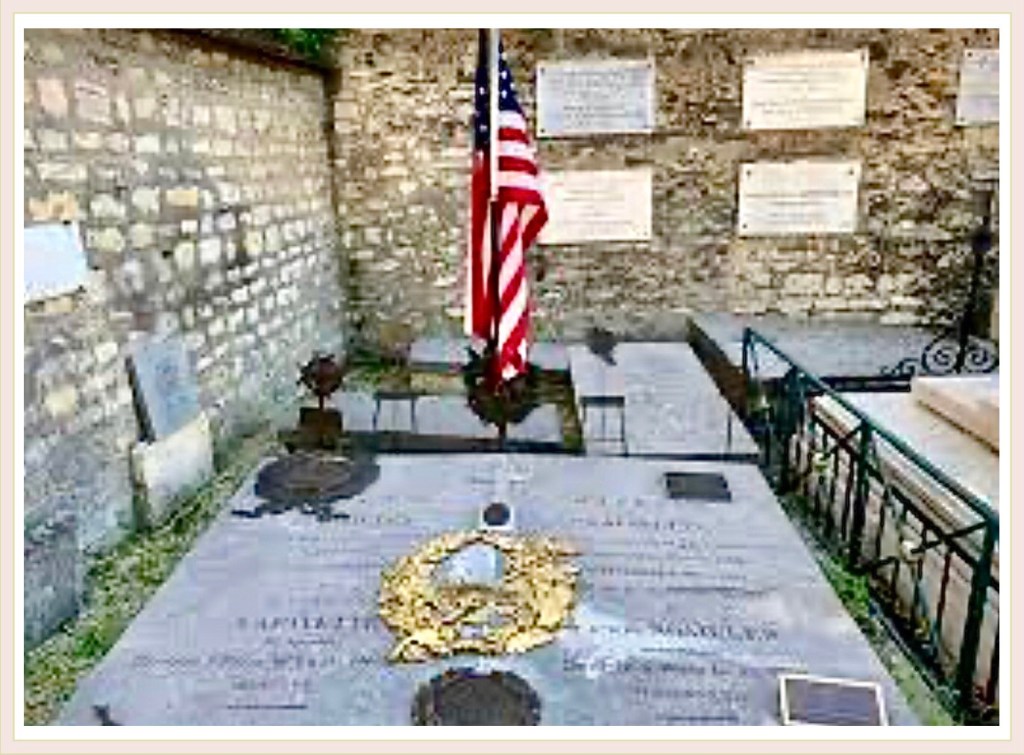
For generations, America honored the gift they gave us. On July 4, 1917, during World War I, U.S. Army Colonel Charles Stanton stood in Picpus Cemetery and famously declared, “Lafayette, we are here” signaling that America had returned to repay its Revolutionary War obligation to both Lafayette and France.
Historical memories fade, particularly in the last several years. I contrast Stanton’s words with Donald Trump’s dismissive 2018 remark to Emmanuel Macron regarding World Wars One and Two: “How did that work out for France? They were starting to learn German in Paris before the U.S. came along.” With that statement, Trump casually erased the foundation of our own nation’s birth and existence.
That friction has only escalated recently. Trump has publicly chastised France and European allies over military actions in Iran, attacked French wine with tariff threats, and falsely recounted negotiations with exaggerations.
Last month, tensions spilled over at the United Nations. US diplomats walked out on a French speech, after disagreements over human rights leadership under UN High Commissioner for Human Rights Volker Türk. The United States stood with Russia, North Korea, and Nicaragua, voting against Mr Türk. Once again, we exhibited a troubling departure from how America traditionally treats its oldest allies.
Yes, historical memories fade, through ignorance, or wanton disregard for the future. It’s sad, but true.
Not all of us forget the past.
This Saturday, on August 23rd, I will raise a glass of French wine and make a toast to honor The Marquis de Lafayette, and all that he and France did to help secure our nation:
“Lafayette, some of us are still here who remember the debt we owe you and France. We honor you, and thank you for helping give us this country of ours. We also look to a future when we as a country will again stand with and honor our allies, and not our enemies.”
Addendum:
- I used Google Gemini to generate the header sketch. Interesting the things you can do with AI. As an example, our president likes to show himself with historical figures. I don’t know if you noticed in the header, but I added a certain frowning someone to the sketch. 😉
- My friend, Irv Woods, noted that there are only two portraits permanently mounted in the U.S. House Chamber – one of George Washington and one of the Marquis d Lafayette. Painted in the 1820s, they hang on either side of the Speaker’s rostrum as historic fixtures of the room.
- The “core” historical facts of Lafayette’s personal history were gathered from Wikipedia, and an article in our local newspaper, The Fauquier Times.
Discover more from Live Life Exuberantly
Subscribe to get the latest posts sent to your email.
 Live Life Exuberantly
Trump makes a fine easter egg.
LikeLiked by 2 people
Hahahaha.
LikeLike
I pushed the button too soon. I wanted to add that the frowning face is perfect in the header image. Thank you for this reflection on a critical part of our history. Perhaps you should send it to the White House!
LikeLiked by 2 people
Now there’s an idea!
LikeLike
Max – what a fitting tribute to our old friend Lafayette
LikeLiked by 2 people
What a great history lesson! Also, great header photo – what a hoot!
LikeLiked by 2 people