October 21st, 2024 is the 156th anniversary of the 1868 dedication of a statue at West Point honoring General John Sedgwick. In August of this year, my West Point Class of ‘78 took part in a rededication ceremony for the statue. You may ask why – The story spans two centuries.
SEDGWICK
Born in 1813, John Sedgwick graduated from the United States Military Academy in 1837. During the Civil War, he was wounded three times at Antietam, promoted to Major General, took part in the battles at Chancellorsville and Fredericksburg and later led the VI Corps at Gettysburg.
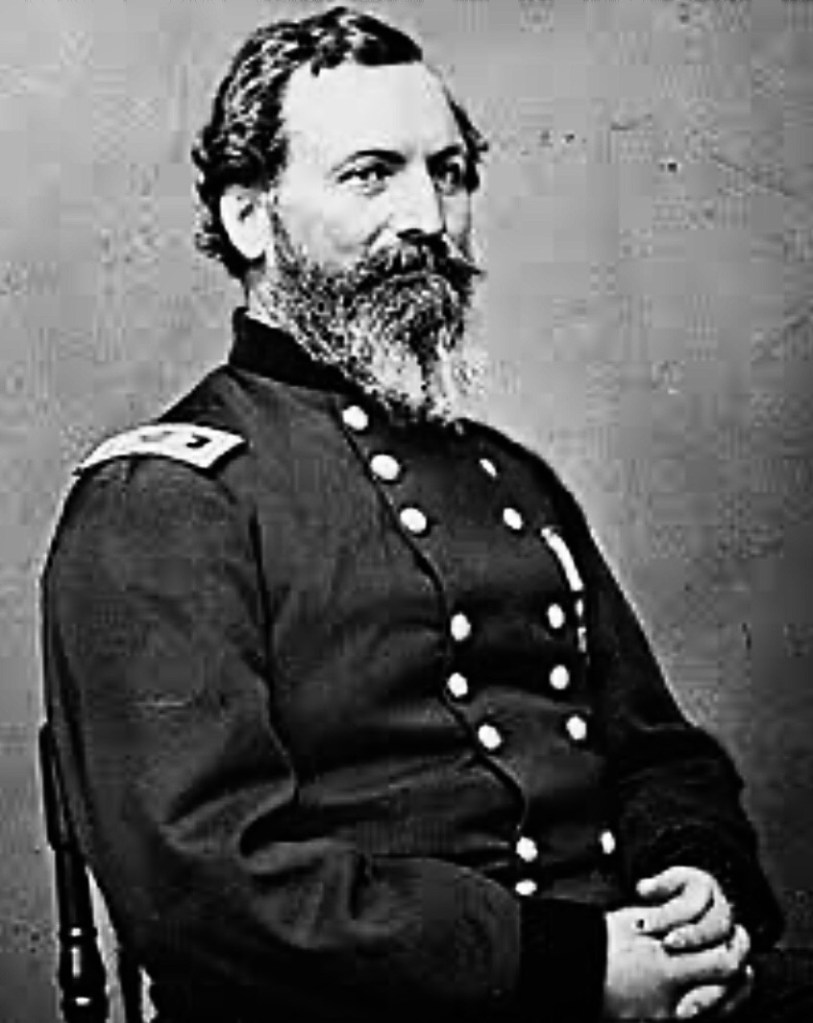
A sharpshooter killed him in 1864, during the battle at Spotsylvania Courthouse. In his last moments he was directing artillery placements while Confederate sharpshooters, about 1,000 yards away, were firing shots at the US troops. The shots caused members of his staff and nearby infantrymen to duck for cover. Sedgwick strode around in the open and allegedly said, “Why are you dodging like this? They couldn’t hit an elephant at this distance.” Seconds later, he was hit in the head by a bullet and died almost instantly. Sedgwick was the highest-ranking Union officer killed during the Civil War.
The news shocked Grant, and General George Meade wept when he heard. Even Robert E Lee, who knew Sedgwick from before the war, was saddened.
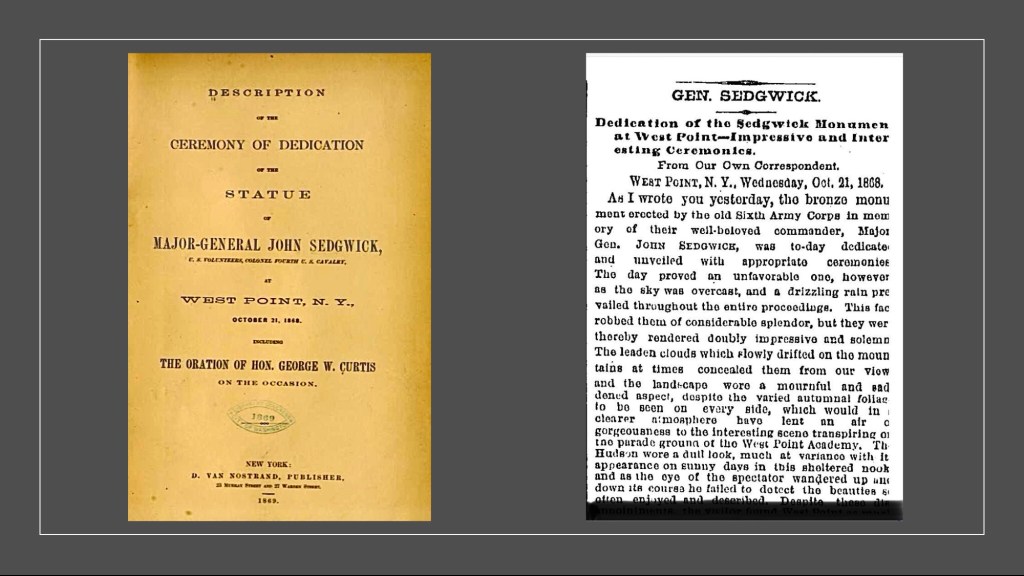
The men of VI Corps liked him and affectionately referred to him as “Uncle John”. As the war ended, the officers and soldiers of the VI Corps took up a collection to build a statue of their fallen leader. Confederate cannon, captured by the Corps during the Civil War, were recast into the statue of Sedgwick and the dedication ceremony was held at West Point on October 21st, 1868. According to New York Times coverage of the event, it was a rainy day but many luminaires were in attendance, including General George McClellan. It was only the second statue erected at the Academy at the time.
THE SPURS AND THE TRADITION
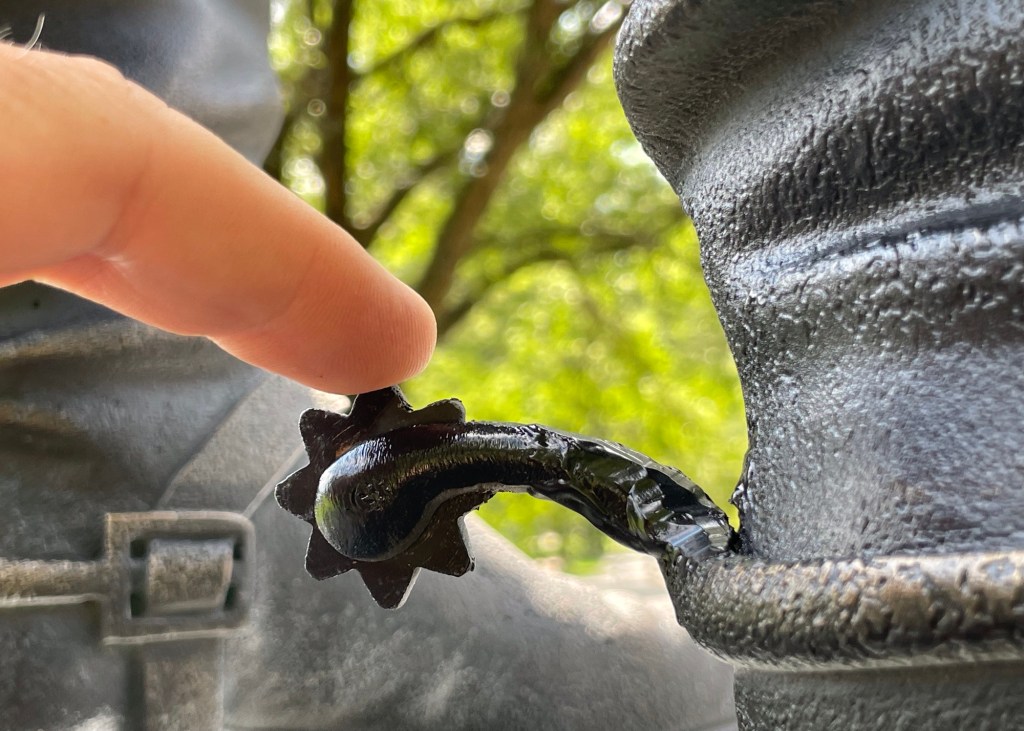
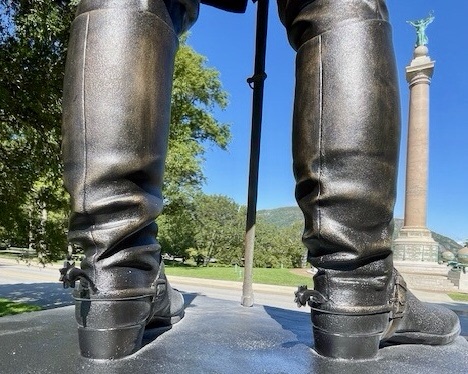
An interesting aspect of Sedgwick’s statue was that the rowels in the monument’s spurs actually spun. In later years, legend held that if a cadet was deficient in an academic course, the cadet should go to the monument at midnight the night before the term-end exam in full dress uniform, under arms. The cadet should then spin the rowels on the monument’s spurs, and with that good luck, would pass the test.
During my time at the Academy, more than a few cadets did spin Sedgwick’s spurs, often after evading the Officer in Charge. Sometimes it worked, and sometimes it didn’t. Firstie (Senior) year, my room looked out over The Plain at West Point. Sedgwick’s Statue sat on the opposite side of The Plain from our building. While I never needed to spin the spurs myself, I can remember several entertaining nights during exams, watching Cadets run from various dorms heading to the Statue at about 11:55PM. This was in January and although it was cold, there were always many open windows, as we cheered those hoping to change their outlook for an upcoming exam.
THE PROBLEM
About a year ago, classmate Peter Eschbach was at West Point attending a football game with his daughter and granddaughter. There is plenty of pageantry at the Academy on football weekends – a Parade on The Plain, parachuters, tailgating, and of course the game itself. Prior to the game Pete had some spare time and thought he’d entertain his granddaughter by showing her Sedgwick and letting her spin the spurs.
Arriving at the statue, he was shocked to see one of the spurs was broken and the other was in poor shape.
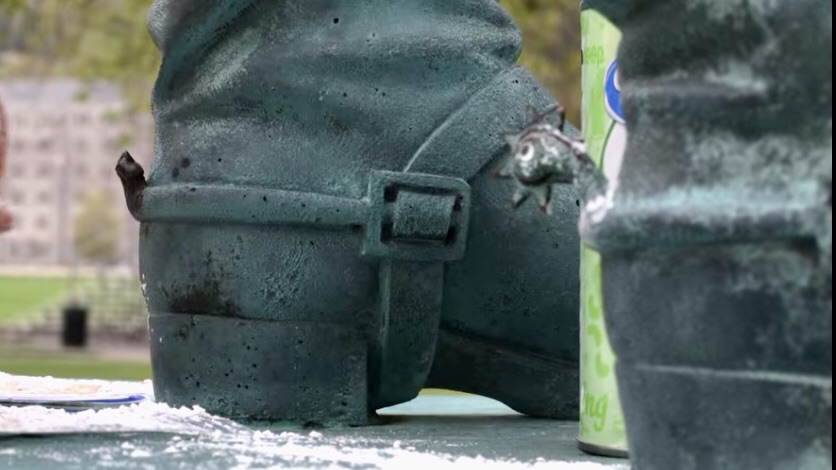
Pete never had to spin the spurs, but is a big believer in West Point traditions. His concern was the spur would remain broken, or worse, when repaired, they would just weld in a spur with no rondel. In either case, the tradition would die.
Pete wasn’t going to let that happen. In his words:
“I tracked down the West Point archeologist Paul Hudson, a great guy. While he was aware of the damage, there was some bureaucratic confusion over which office was actually responsible for the statue, and who could direct its refurbishment. Also, since this was on federal land, there were issues on where the funding would come from to pay for the repairs, and how expensive the repairs would be. Ultimately, the statue was evaluated and it was determined the cost to repair the statue, including fabrication and replacement of the spur, cleaning/restoration of the statue, cleaning/restoring the plaque and adding new mortar/caulking around the seams of the granite pedestal would be a little over $50,000. This was money West Point did not have budgeted, and the statue wasn’t on the priority list for work at the Academy. Hudson said the project would happen quicker if the funding came from private donors.”
Waiting on the bureaucracy to resolve and solve the issue could take years, leaving multiple classes without the opportunity to spin the spurs, no doubt resulting in the death of the tradition.
THE RESPONSE
Again, Pete didn’t stop or sit still. He raised the issue on the Class of ‘78 Facebook page and to our email list. There was much discussion back and forth. Many individuals were ready to donate at once to replace the spur and refurbish the statue. Instead, something else happened.
On the 14th of February, ‘24, our class president, Les Szabolcsi, sent an email to the class. He raised the prospect of paying for the renovation out of our class Gift Account. The Gift Account is for donations to support various activities or projects at West Point, and supporting this renovation was a legal use of the funds. Les put the idea to a class vote, and most of the class said yes.
The class notified West Point so the process could proceed.
THE REDEDICATION
Of course, nothing is ever quite as easy as it seems. There were still many steps before work could start. West Point itself is a historic place, as well as the home of the United States Military Academy. Many people and organization, including the Historic Preservation Committee were involved. There were many i’s to dot, and t’s to cross. The good news? All of those involved worked to make it happen.
As the actual work started, Pete met with the Academy to determine when a rededication could occur, that would also maximize attendance by members of the Class of ‘78. A possible date was found for the rededication. On August 12th, 2024, over 120 members of the class would be at West Point to take part in the 14 mile “March Back”* of the class of 2028 from Lake Frederick to West Point at the conclusion of their Plebe summer training (Beast Barracks). August 12th also gave adequate time for the craftsman to complete their work. The date was set.
On the 12th of August, as the March Back finished, the Class of 2028 went to clean their weapons. The Class of ‘78 walked across The Plain to the statue of Major General John Sedgwick for the rededication ceremony.
The Dean, BG Shane Reeves, class of ’96, was the featured speaker that day. He thanked the Class of 1978 and noted:
“With your generosity and your commitment to the Academy, whether it’s helping the cadets with the academic program or the military program, it is really the connection to the Margin of Excellence through our great Association of Graduates that creates the special bond that is West Point. I don’t think you find in other schools across the country this type of connection between our graduates and our cadets. What you’ve done today is something important, which is helping to ensure that our traditions, our lore, and our history stay at the forefront.”
After his formal comments, the Dean observed that he also thought a new legend was in place, because “legend has it that whenever Sedgwick is refurbished, the Dean can start a new legend” – if a deficient Cadet used the time he or she was taking to spin the spurs to study instead, he or she might have an equally good, or greater chance of passing the course. Or, even better, had he or she studied harder during the semester, there would be no need for Sedgwick at all. (I don’t remember the Dean having that much of a sense of humor when we were cadets.) It should also be pointed out the Dean insisted on being the first person to “officially” spin the new spur. 😉
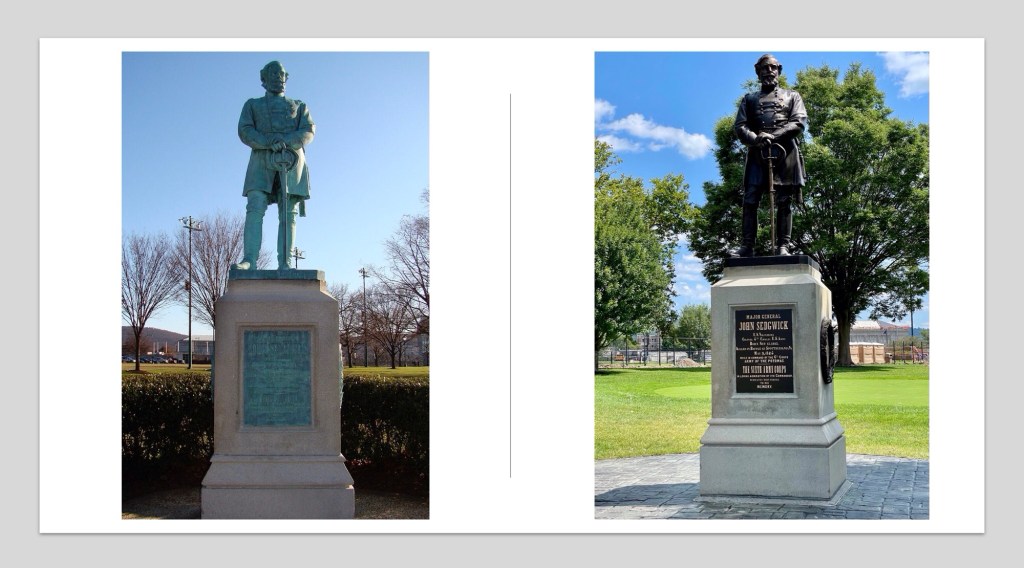
So, that’s the story. I realize it was a bit long in the telling, but I think it’s important to understand not only the history of West Point, but also a history of some of its traditions, and the involvement of the Proud and Great Class of ‘78 in preserving at least one of those traditions. The Dean is right, Cadets do need to study hard, but when all else fails…
Addendum:
• * You can read my blog about the March Back here: We started gathering around 0130. Soon, buses would take us to Lake Frederick. There we would link up with the West Point Class of 2028 and join them for their 14-mile March Back to West Point, ending their Beast Barracks. The Class of ‘28 will graduate exactly 50 years after we did in ‘78 […] Continue here: https://mnhallblog.wordpress.com/2024/08/16/march-back/
• You can see a video from the West Point Association of Graduates that describes the ceremony, including some of the refurbishment here: https://www.facebook.com/share/v/wffecQMXgFML8L1Y/?mibextid=KsPBc6
• Here’s a link to the Library of Congress and some artifacts, sketches and photos from the original dedication ceremony in 1868: https://www.loc.gov/item/12021370/
• Thanks to classmates Pete Eschbach, Les Szabolcsi and Rob Grubbs for their help with this blog.
• As I mentioned in the blog, Pete is quite interested in preserving West Point traditions. Additionally, he is an accomplished artist. He recently wrote and published a book titled An Illustrated Look at Traditions of the United States Military Academy A to Z, in which his illustrations complement the traditions discussed. If interested, you can buy it on Amazon, or directly from the publisher here: https://store.bookbaby.com/book/usmatraditions
Discover more from Live Life Exuberantly
Subscribe to get the latest posts sent to your email.
 Live Life Exuberantly
What a heartwarming story. I wish the Naval Academy had the same depth of support for maintaining its history and traditions.
But we did have a similar tradition – a left-handed salute to the statue of Tecumseh in front of the Bancroft Hall rotunda as you tossed a penny at its base with your right hand would surely help you pass the exam you were going to. He was referred to as the “God of the 2.5” – we were on a 4.0 scale and 2.5 was passing. Below a 2.5 in any course almost always meant dismissal.
LikeLike
As a history geek, another great read. I need to visit the ‘other’ Academy, one of these days.
LikeLiked by 1 person
Well done yet again Max! I don’t recall the Dean ever having the slightest sense of humor in our day – this Dean makes “Spirit Videos!”
https://x.com/DeanUsma/status/1841838682275246442
LikeLiked by 1 person
Your friend Pete did a great job. He made things happen.
LikeLiked by 1 person