I received an interesting piece of mail from one of our local Blood Donor organizations last week. After a ban of twenty years, I am eligible to donate blood again. Evidently, I am no longer likely to pass on vCJD, better known as “Mad Cow Disease”, to others via a blood transfusion.
Starting in 1973 when I turned eighteen, I was always an active blood donor. That changed in 2002.
A little back story…
From 1986-‘89, while stationed in Europe, I spent several months in England. The Army was refurbishing an old WWII era bunker to become the Alternate Support Headquarters (ASH) for the United States European Command (EUCOM). It was where EUCOM would go, if the Cold War turned Hot and they needed to evacuate the headquarters element from Germany. The facility had some grounding and communications issues, and I was flown in to solve the problems. I eventually identified the multiple grounding issues that were plaguing the facility and they were corrected. The work continued, and I spent quite a bit of time there in the late ‘80s consulting on various communications questions and issues. Eventually, we returned home to the States in June of ‘89, and I promptly forgot about the ASH and my time in England … Until the early ‘90s.

Word started coming out of Europe, and specifically the UK about something called bovine spongiform encephalopathy (BSE), more commonly known as Mad Cow Disease. Initially no one here in the US paid much attention. Some cattle in England were acting strange – sick cattle had trouble walking and getting up, and could also act nervous or violent, hence “Mad Cow Disease.” There were a few jokes on TV, and quarantines on British beef, but, that was it.
Then, things got serious.
It turned out the disease could be transferred to humans by eating contaminated beef. Variant Creutzfeldt-Jakob disease (vCJD), the human version of Mad Cow disease, was first diagnosed in 1996 in the United Kingdom. It was the first man-made health epidemic, and was called the “Frankenstein disease”*. Companies had decided to feed meat and bone meal to cattle (which are herbivores) to increase their protein consumption. This caused what was previously an animal pathogen to enter the human food chain.
Initial human symptoms include psychiatric problems, behavioral changes, and painful sensations. In the later stages of the illness, patients often exhibit poor coordination and dementia. The length of time between exposure and the development of symptoms is thought to be years, but could be decades, and the average life expectancy following the onset of symptoms is 13 months. There is no cure.** YIKES!
Sometime in 2002 or 2003, I went to donate blood at a blood drive our company was hosting. I’d done the same thing for the past decade. This time? I was turned down. There were a couple of questions in the fine print, which excluded me. It turns out, in May of 2002, due to the possibility of Mad Cow Disease, the Food and Drug Administration (FDA) instituted a ban on blood donations from anyone who spent three months or more in the UK between 1980 and 1996. I’d spent about five months in England in the late ‘80s. The kind ladies at the blood drive let me eat my cookies and drink my juice, but “sorry sir, we don’t want, or need, your blood.”
At my next physical, I spoke to the doctor about Mad Cow. He didn’t know much about it, but thought it was highly unlikely I had it. And, oh by the way, there wasn’t really any way to know if you had it. You could only verify a diagnosis of Mad Cow via brain biopsy or autopsy (that remains true to this day).
Over the next few years, when additional company blood drives were held, I tried donating again, but the questions were still on the form, and I was always turned down. Eventually, I quit trying.
In 2008, Mad Cow Disease came to TV prime time on the show Boston Legal. William Shatner’s character, Denny Crane, starts having mental lapses, memory losses, and confusion, probably caused by the onset of Alzheimer’s disease. When questioned by his coworker, Allan (James Spader) about the lapses, Crane preferred to give a self diagnosis of Mad Cow Disease, rather than the reality of Alzheimer’s. It becomes something of a running punch line off and on for the rest of the time Boston Legal was on the air.

But I digress…
Time passed. More time passed. And then, this June I received a piece of mail from INOVA, one of our local health providers. I almost threw it away, but something prompted me to open it. Lo and behold, they changed the rules for donating blood!
Twenty years after my initial ban, I was once again eligible. Why? The FDA updated their guidance in May of 2022 – “We are changing the geographic deferral recommendations for vCJD risk based on new information in risk assessments … These risk assessment models … demonstrate that the current risk of vCJD transmission by blood and blood components would expose transfusion recipients to no or minimal additional risk of vCJD in the future…”***.
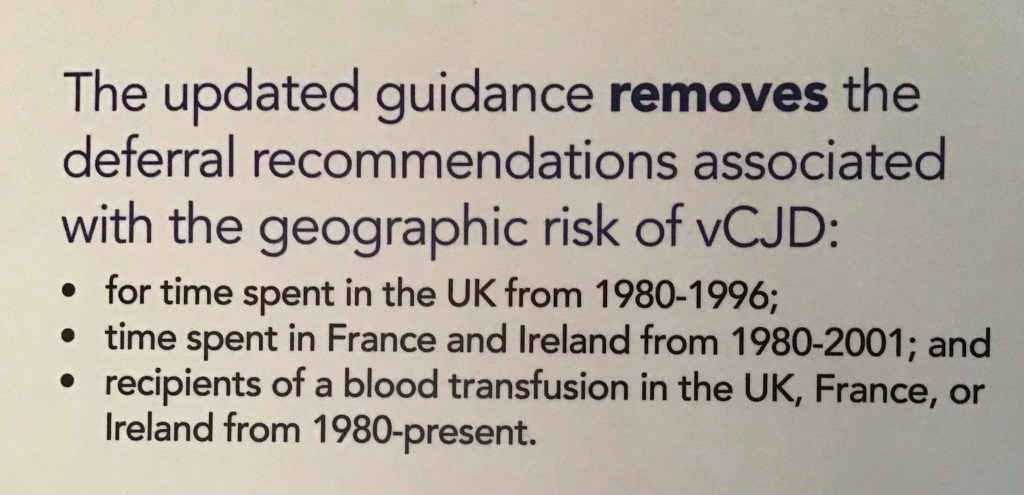
So, while I may still have Mad Cow Disease (remember, it can take decades to appear), the risk of my transferring it via blood donation is low… 😉
That’s almost everything. I plan to donate blood once again at the earliest opportunity. In the meantime, I leave you with these two additional tidbits.
First, I’m amazed my blood donor file was still active. For the past two decades, my rejection due to Mad Cow has sat quietly somewhere in a database. All that was needed was guidance from FDA for someone to hit a switch and change my eligibility in the database. Literally one month after the guidance changed, I received my letter. Don’t kid yourself, there is no privacy anymore. Everyone knows everything about us, and we are generally the ones who provided the information.
And lastly, be careful out there kiddos. While doing some research for this blog, I discovered that in 2015, a man from New York developed vCJD after eating squirrel brains. Yep, squirrel brains. You can’t make this stuff up.
Addendum:
- UPDATE: I have been informed by others that the ban on folks who lived in Germany during that time period was lifted three years ago. This update was just for those in the UK and France.
- While I joked about it in the blog, I think it is extremely unlikely that I have Mad Cow lurking somewhere in my body. Statistically, the chances are almost nil.
• * Jonathan Quick, of the Harvard Medical School coined the term “Frankenstein disease”.
• ** vCJD information is summarized from Wikipedia at this address: https://en.m.wikipedia.org/wiki/Variant_Creutzfeldt%E2%80%93Jakob_disease
• *** The complete updated 2022 FDA guidance can be found here: https://www.fda.gov/media/124156/download
Discover more from Live Life Exuberantly
Subscribe to get the latest posts sent to your email.
 Live Life Exuberantly
Max, vCJD is a prion disease. No one is known to have survived a prion disease, although one man did make it to the 8 year mark after diagnosis. Hence the rigid RC guidance.
Proud and Great!
LikeLiked by 1 person
Thanks for the update Bill!
LikeLike
I didn’t have the England restriction but had the Europe and Euphrates Valley one after the Gulf war. There are still a couple iffy parts on the questionnaire for me due to other travels but they take my blood now. Right after the Gulf War the local Red Cross did a blood drive at Ft Riley and Brigade told me my Battalion had a quota of 400 donations. Tank battalion of 650 men. We had just returned from Gulf and were in down time waiting for equipment to return to US. Informed them we only had about 40-50 new soldiers who hadn’t been in the gulf with us. Were we supposed to drain them? While we didn’t participate many did, ignoring the restrictions. Big Army
LikeLiked by 1 person
Thanks for sharing Bond! Have to love Army Quotas….
LikeLike
This is good to know/read Max. I will endeavor to give again next opportunity – like others, I haven’t been able to since leaving Germany in the 80s so hopefully, soon, I’ll be able to once again. Blessings.
LikeLike
Max, that’s good to know. They rejected me over the years because apparently we in USAREUR were exposed (possibly) to British beef. I had the same ban….
LikeLiked by 1 person
Yep! They may have lifted the ban in Germany a couple of years ago, but sounds like universally lifted now.
LikeLike