We were in the middle of the Kalahari Desert, on the edge of the Ntwetwe Salt Pan when it started to rain. I’d just started my second Gin and Tonic. Dinner was still a bit away, and we made a dash for shelter in the Land Cruiser…
We’d arrived at our Safari Camp, Leroo La Tau (The Lion’s Paw) the day before after a 1 1/2 hour flight on a six seater plane out of Kasane. Our camp was in a remote location along the Boteti River in the Makgadikgadi Game Reserve.

One of the reasons we were excited about Leroo was that we were to spend one of our nights under the stars at the the Ntwetwe Salt Pan. We would be as remote as possible in the Kalahari Desert, with no ambient light, or connection to other humans. Literally, it would be just us, the desert and the sky – vastness and emptiness, intertwined.
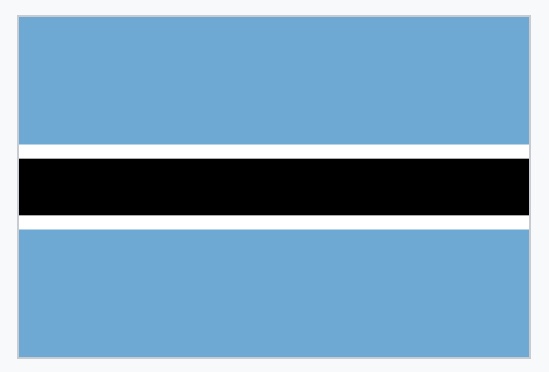
By luck, or by happenstance, we arrived at Leroo on September 30th. Our hosts were celebrating the 55th anniversary of Botswana’s Independence from the British on September 30, 1966. After dinner, they served us a cake decorated in the colors of Botswana’s flag, and explained the meaning of each of the colors*. As we were eating our cake, it started to rain – not for long, perhaps only 20 minutes. We learned it rained on September 30th, 1966 as well, and as Botswana is such a dry country, rain is considered a blessing and a sign of good luck, particularly on Independence Day. We weren’t yet aware how that rain was going to impact our trip.
The next day, as we were getting ready to leave on our five hour drive for the Pan, we learned there was some concern on the part of our guide, Isaac, and the staff. It turned out not only had it rained at Leroo the night before, it probably also rained at Ntwetwe. The condition of the Pan was unknown, and we might not be able to drive on it, or even approach it without our vehicle sinking into the mud. We would not know until we arrived.
A decision was made to give it a shot and we piled into our Land Cruiser. In addition to Cathy and I, and our friends Bill and Sharon, there was a crew of three. Our guide was Isaac, who had led previous trips to the Pan (we were only the seventh group to actually do this). He was accompanied by Dabe, a Bushman (The San People) who was very familiar with the desert environment, and Kago, a manager from the camp.
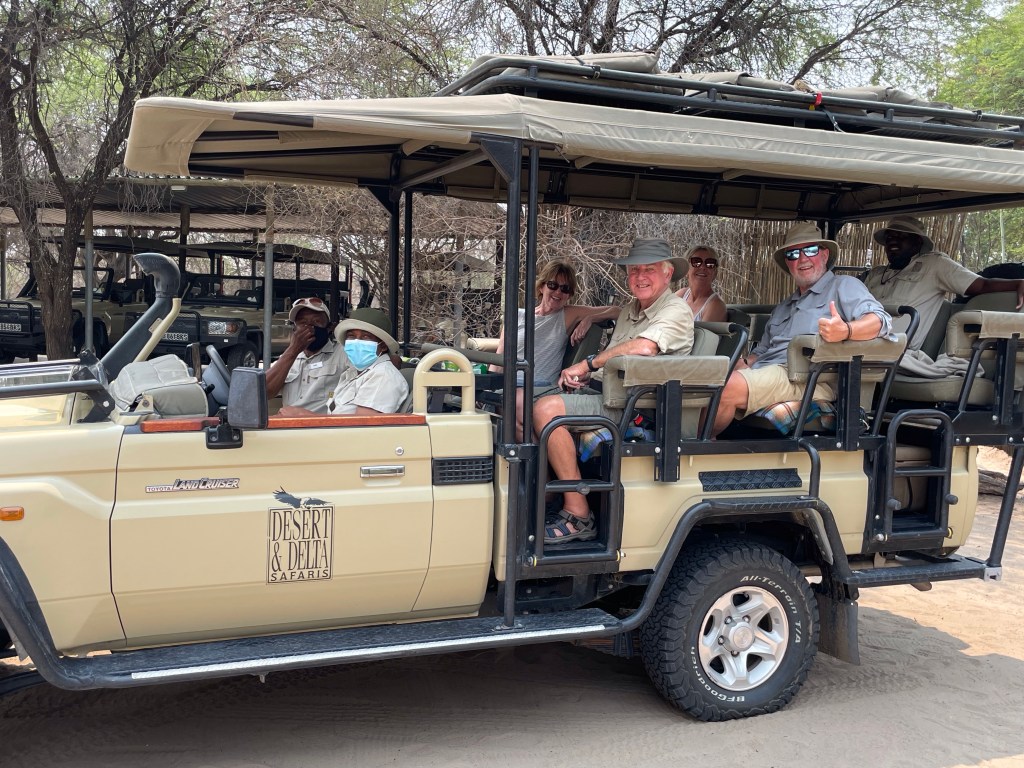
After driving nearly 50 kilometers on a highway, we turned off into the desert. We had nearly 70 kilometers to go, which doesn’t sound far, but with no real road, we would follow a path through the grass and shifting sand. There were still several hours before we reached the Pan.

As time passed, the environment became starker and vegetation started to disappear. There were no more trees, and few bushes. We were left with a sea of grass. Animals too disappeared. Other than some birds, meerkats, and mongoose, we saw no other wild game on the trip. We were told there wasn’t any real water this far into the desert, so the big game stayed away. Interestingly, we did pass some herds of cattle.

Eventually, around 5PM we arrived at the Ntwetwe Pan, with sundown still about an hour away. It had definitely rained on the Pan and it would be a bad choice to drive on it. Although it appeared dry, our Land Cruiser would have soon sunk up to the hubs and been trapped. Instead, we camped on the edge of the Pan.
We connected with Maipa and Mash who drove “The Elephant” (a vehicle with the kitchen equipment, lights, tarps, loo, etc) to the Pan earlier in the day. It was they who set up the kitchen, and the dining area. You could already smell good things cooking on the fire and stove for our dinner. We were served sundowners, and then received a safety talk and a briefing on how to use the loo.
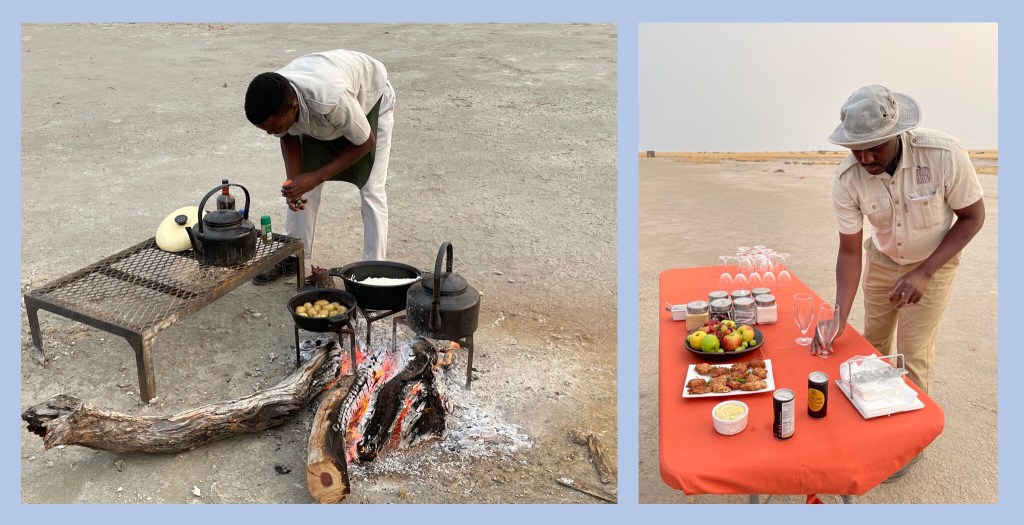
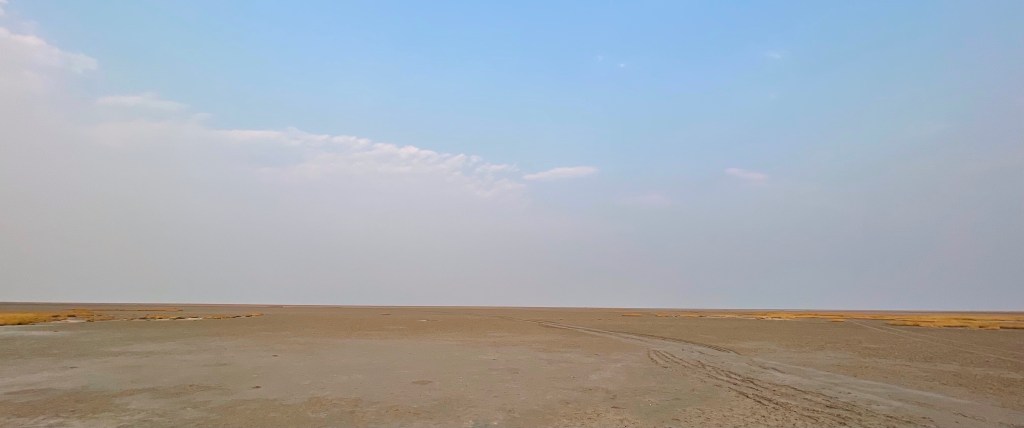
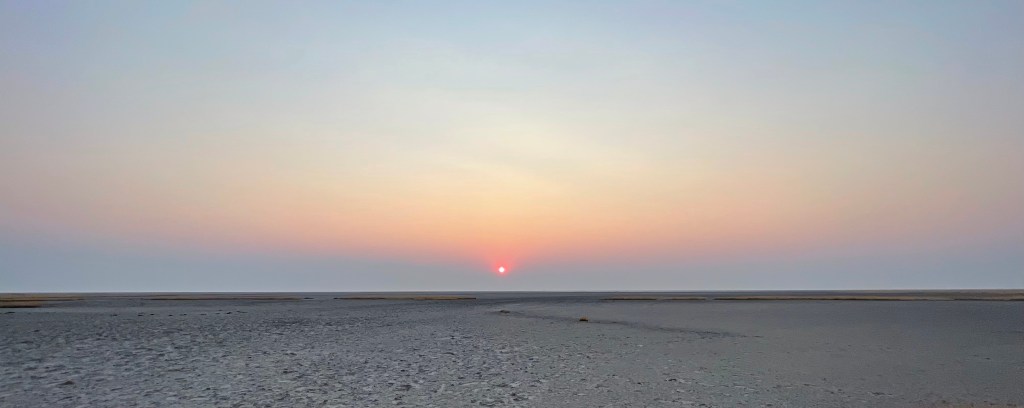
We had time before dinner and wandered around. As I took a sip of my G&T, my gaze looked to the east across the Pan. Vastness and Emptyness? Sure. The word Nothingness also came to mind. There was nothing but a line on the horizon separating the sky above from the salt pan below. Loneliness … desolation … flatness… all were also good descriptors. It was flat as far as you could see in any direction.
It started to get dark, and we viewed lightning storms on the horizon to the north of us. In Botswana, the weather generally flows east to west, so Isaac thought we were safe. Of course, there IS the occasional freak storm ;-)… I’d just started on my second G&T when the sky opened and it began to rain.
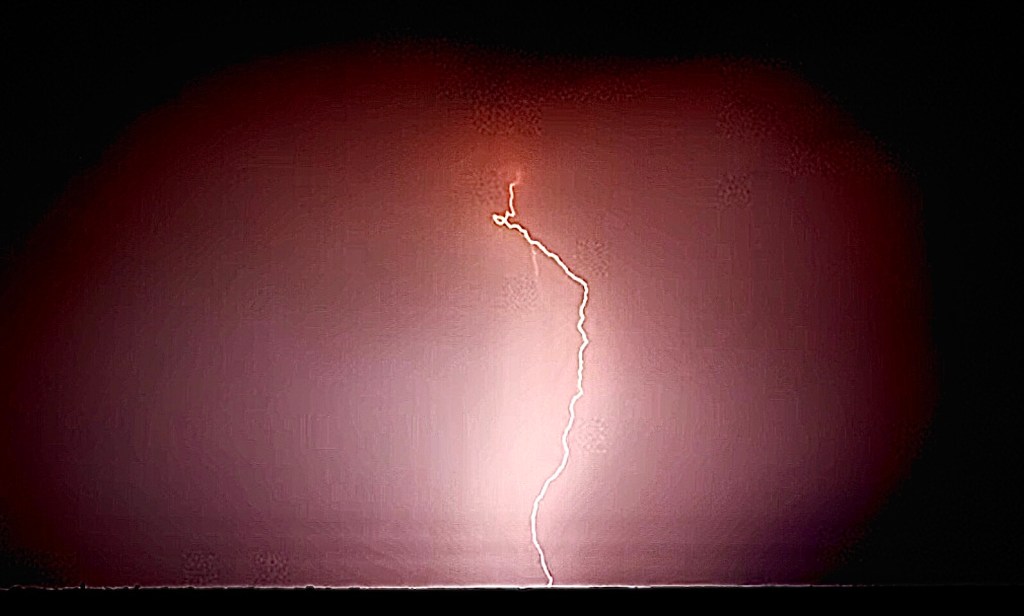
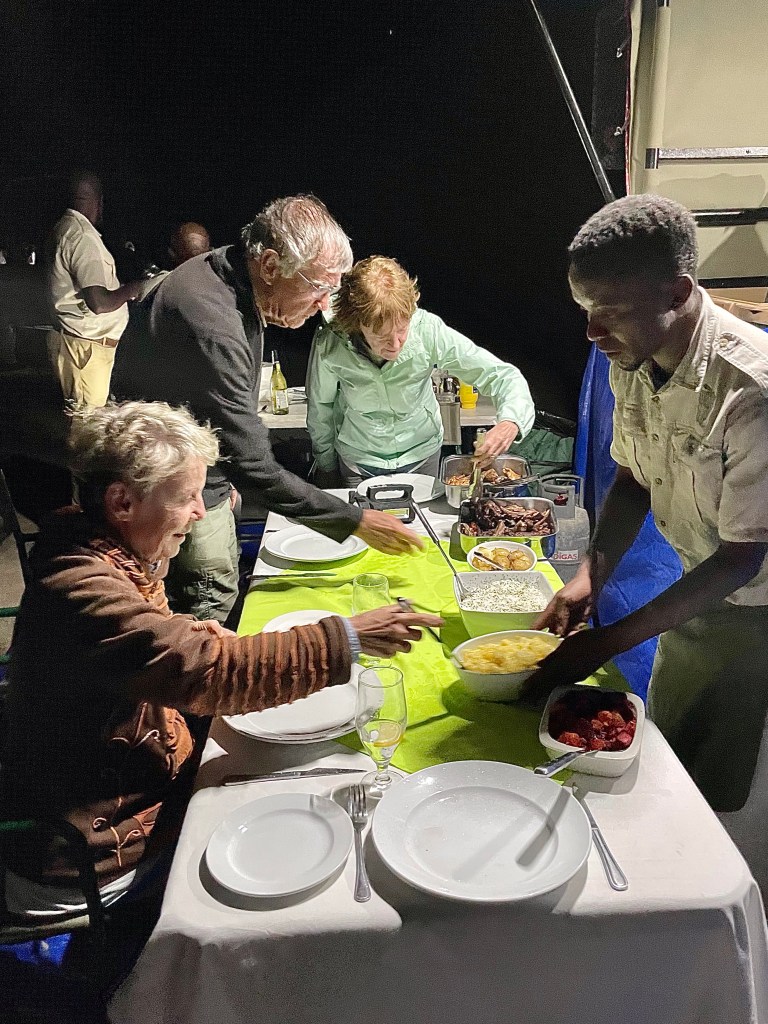
Three things then happened in quick succession. First, Isaac directed us to the Land Cruiser where we could stay dry and stay out of the way. Next, the staff divided into two crews. The first one quickly broke down the dinner settings and packed them away. Our table, complete with white table cloth, glassware and china was secured. The second crew grabbed our sleeping mattresses and at the same time popped open small two-person tents and put the mattresses in the tents to keep them dry. If you recall, we were to sleep under the stars. That was no longer going to happen.
It was pitch black, except for the occasional flash of lightning. We were staying pretty dry under the Land Cruiser roof, and then one of us started laughing. Pretty soon all of us were. Here we were, in the middle of the Kalahari Desert, one of the driest places on earth, getting rained on while sipping our drinks in a Land Cruiser. How could you not see the humor in that?
Twenty minutes later the rain stopped. The crew quickly reassembled our dining table and just before 7:30PM, we sat down to dinner. Our chef, Mash, served a feast of rolls cooked in a dutch oven, salad, beet salad, a cauliflower and cheese dish, ribs, and chicken filets in a cream sauce. White and red wines were opened. One more surprise awaited us. The tarp above our table had gathered a considerable amount of rain and while eating our first bite, some of it spilled on the table. We quickly moved the table and then we made our way through the delicious meal. We were still chuckling about the rainstorm, but it was a different chuckle as our bellies grew full.
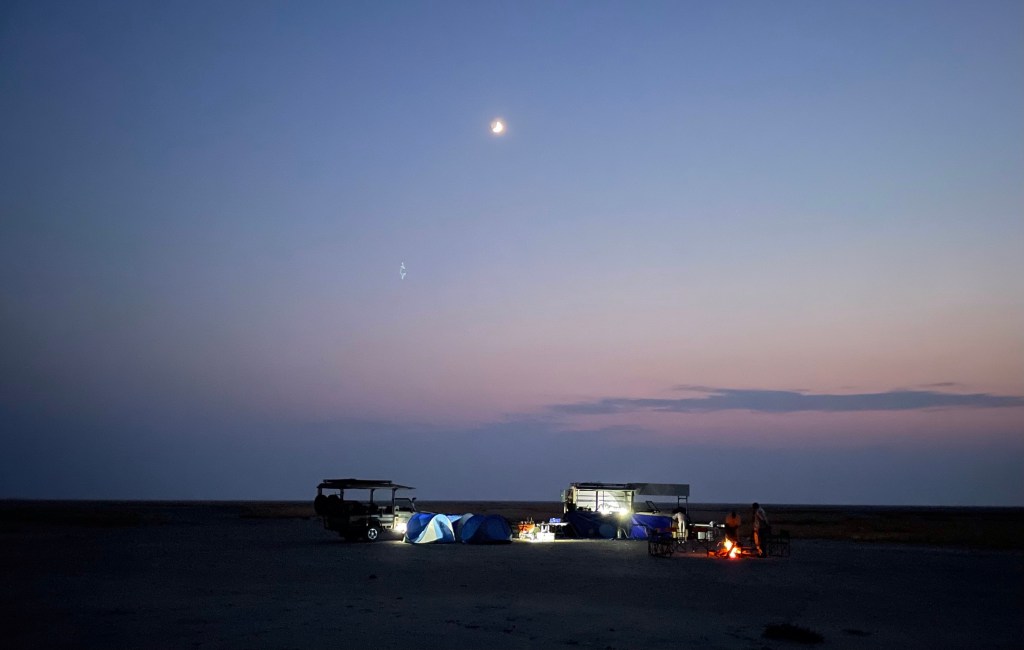
After dinner, we joined the crew around the fire. Some stories were told and of course a few jokes. A couple of us may have drunk a Jameson. The sky kept changing from clear to cloudy and Isaac confirmed we would sleep in tents. It was a good call, as it rained twice more during the night.
I woke once in the late hours of the night to go the bathroom. The sky had cleared by then and as I looked up, I saw my old friend Orion high in the sky overhead. I smiled to myself – it’s nice to know some things never change.
The next morning while still dark, I woke to a voice softly singing. It was Kago singing her morning prayers. I listened quietly and out of nowhere, felt an immense sense of peace come over me. I can’t help but wonder if the remoteness of where we were also contributed to the feeling.
The camp started stirring and I got out of bed about 5:30. Although still dark, a fire was already going, and our morning breakfast was cooking. The eastern sky was turning gold and red, as the sun was about to appear on the horizon.
As the sun rose, I walked to edge of our camp by myself. I again saw the vastness and emptiness of the Ntwetwe Pan to the east. There was a beauty to it that provoked an ache in my heart. Even now, I find it hard to describe.
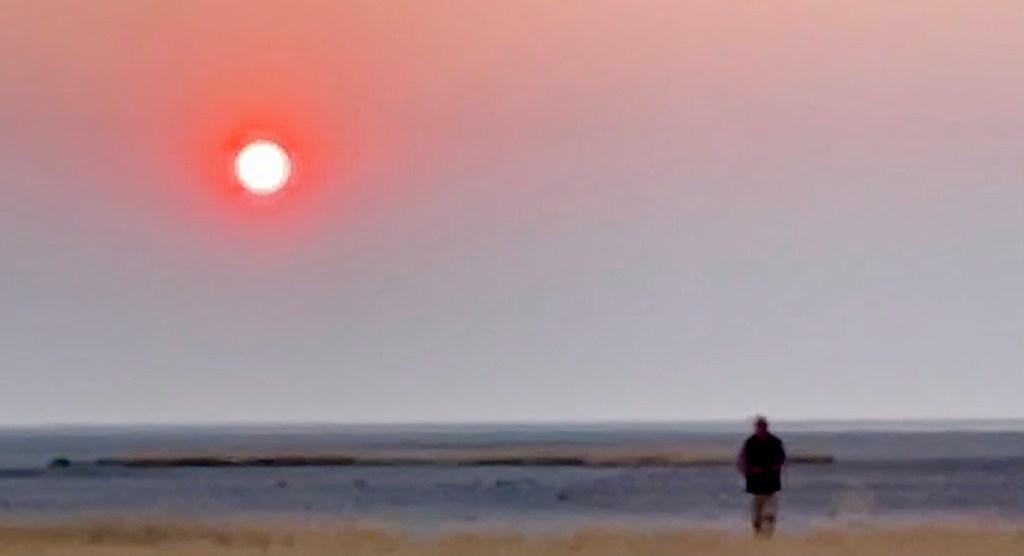
In Botswana, the word for rain is Pula*, which also means a blessing, as rain is so scarce. Although the rain the night before and on Independence Day changed the tenor of the trip, I think it also gave me something else I can’t define. As I looked at the vastness of the Pan that morning at sunrise, I felt the presence of something larger. God? Perhaps, but I don’t think so. It was more a feeling that even though I am so small, I belonged to something much larger than myself. To me, the vast emptiness I was looking at no longer felt like nothingness or loneliness. There was a weight and depth to it, and yes, a peacefulness. I felt blessed to be in such a remote location. Maybe hearing Kago sing her prayers earlier in the dark is what changed my feelings to something more spiritual. I doubt I will ever know.
A bit later, I rejoined the others and soon we ate a breakfast of bacon, sausage, eggs, pancakes, yogurt, fruit and freshly made biscuits. Afterwards, we packed up, and just after 7AM, started the five hour return trip to Leroo. Later in the afternoon while on safari, our guide Ollie tracked and showed us a Cheetah and her three cubs, which was amazing. For me, even as I was viewing the cheetahs, my mind returned to the sunrise at Ntwetwe and the ethereal feelings I experienced.
Addendum:
– *Pula actually has four different meanings: rain, a blessing, “Cheers!” If toasting someone over a drink, and lastly, it is what they call their currency. It’s a pretty versatile and important word in Botswana.
⁃ I’d like to thank Isaac Mpuchane, our guide, for reading my blog and providing input. As we traded emails, he sent me a link to an article that places the Ntwetwe Pan as one of the possible locations for the start of human civilization. Maybe my spiritual feeling wasn’t as accidental as I thought. You can read the article he sent me here: https://www.bbc.com/news/science-environment-50210701 If you want to learn more about Isaac, or see some of his amazing photography, you can do so at: http://www.instagram.com/isak_naturephotography
⁃ I’d also like to thank Bill Reichhardt for the picture of me on the edge of the Pan. Bill is quite the photographer and if you would like to see more of his pictures from Africa, you can view them here: http://billreichphoto.com/
– * The colors in the flag of Botswana have the following meanings: The light blue represents water, and specifically rain, as it is such a precious resource. The black band with the white frame has two meanings. First, they symbolise the harmony and cooperation between the black and white people who live in Botswana. Furthermore, they represent the stripes of the zebra, the national animal of Botswana.
– This is the sixth in a series of blogs about our 2021 trip to Africa. The other blogs are listed here, in the reverse order of their publishing.
- An amazing cruise on the Zambezi river that combined drink, food, wildlife and sunset: https://mnhallblog.wordpress.com/2021/10/20/an-evening-on-the-zambezi-river/
- Our visit to The Hide safari camp, with lions dominating our sightings: https://mnhallblog.wordpress.com/2021/10/16/the-hide-never-fails-to-deliver/
- Anticipation of the trip, just days before we departed: https://mnhallblog.wordpress.com/2021/09/21/our-bags-are-packed/
- Covid testing requirements for the trip were quite extensive, even though it was much safer in Africa than Florida or Texas here in America: https://mnhallblog.wordpress.com/2021/09/01/africa-and-covid-testing/
- Africa in our blood. Why we decided to return to Africa, after having “the trip of a lifetime” in 2018: https://mnhallblog.wordpress.com/2021/06/02/africa-in-our-blood/
⁃ This is the second time we have used Karen Dewhurst, of Sikeleli Travel & Expeditions as our travel consultant. After working with her in 2018, there was no doubt we would use her and Sikeleli again. All accommodations were amazing, the food and wine excellent, the logistics and travel arrangements perfect and the animal viewing exceeded all expectations. If you are coming to this part of the world, I highly recommend her and them. You can reach Karen at: karen@sikelelitravel.com | (+27) 81 067 1094 (South Africa). Their overall website is at: https://sikelelitravel.com/ .
Discover more from Live Life Exuberantly
Subscribe to get the latest posts sent to your email.
 Live Life Exuberantly
I just finished reading a No. 1 Ladies’ Detective Agency Book…I could picture Mma Ramotswe experiencing the joy of rain on the 55th anniversary of Botswana’s independence.
LikeLiked by 1 person
Those are fun books!
LikeLike