I’ve had Atrial Fibrillation (AFIB) since the summer of 2012, when I was bitten by a copperhead snake. Normally, it’s not a problem, but in February of this year, I had an incident that sent me to the Emergency Room and on a two month journey of heart tests. The result? Well….
It happened on Valentine’s Day (insert bad joke about broken heart here). Actually, it started around the 10th of February, when I stood up from the couch and walked into the kitchen and almost fainted. I just figured I’d risen to quickly and didn’t think much more about it. Then, on the 13th, I felt dizzy just while sitting, although the feeling went away relatively quickly. However, as the day went on, I felt worse, in an undefined sort of way. The next day, the 14th, I wasn’t any better. I checked my pulse and blood pressure several times, and they were, um, wildly variable is probably a good way to say it. Finally, in the afternoon, I called our friend Janet, a most excellent nurse. She listened to what I had to say, was concerned about a couple of the numbers, and advised me to go to the ER to be on the safe side.
Cathy and I talked, and I decided to drive myself to the ER (perhaps not the smartest thing to do) at Fauquier Health in Warrenton, and arrived without incident. When I described at checkin what was going on, they moved me to a room within five minutes, tops. The ER doctor and nurse were both outstanding. In a matter of minutes, they administered the first three, of what would ultimately be ten heart related tests over the next two months.
In the ER, they gave me an EKG, a blood test and a chest X-ray. The blood test and X-ray were both normal. The EKG showed AFIB and nothing else – no stroke and no heart attack. In the meantime, I was feeling more normal – whatever it was, had passed.
The ER doctor talked to the on-call cardiologist from my regular cardiologist’s office and they took me off of one drug (Metoprolol, a beta blocker, which reduces your heart rate), thinking that may have caused the dizziness. He then discharged me and told me not to drive until I could see my cardiologist. I explained I drove myself to the ER, and he looked at me and said “I didn’t hear that”.
I didn’t drive for the next week, but having no subsequent incidents, did drive to the appointment with my cardiologist, Doctor Shah. We reviewed what happened, and then he scheduled a number of tests.
First up? Wearing a Mobile Cardiac Telemetry Monitor for five days. The monitor is a sort of portable EKG type device which continually monitored my heart 24 hours a day for five days. The result? Nothing apparent, other than my normal AFIB.
Next up? Tests five, six and seven – an Abdominal Aorta Ultrasound, a Renal Artery Ultrasound and a Leg Blood Flow Ultrasound and Study. The results? No ballooning, blockages, closures, or reductions in any of the major arteries leaving the heart and subsequently going to the kidneys and legs. In other words, the major arteries all looked normal.
Let’s keep things moving along….
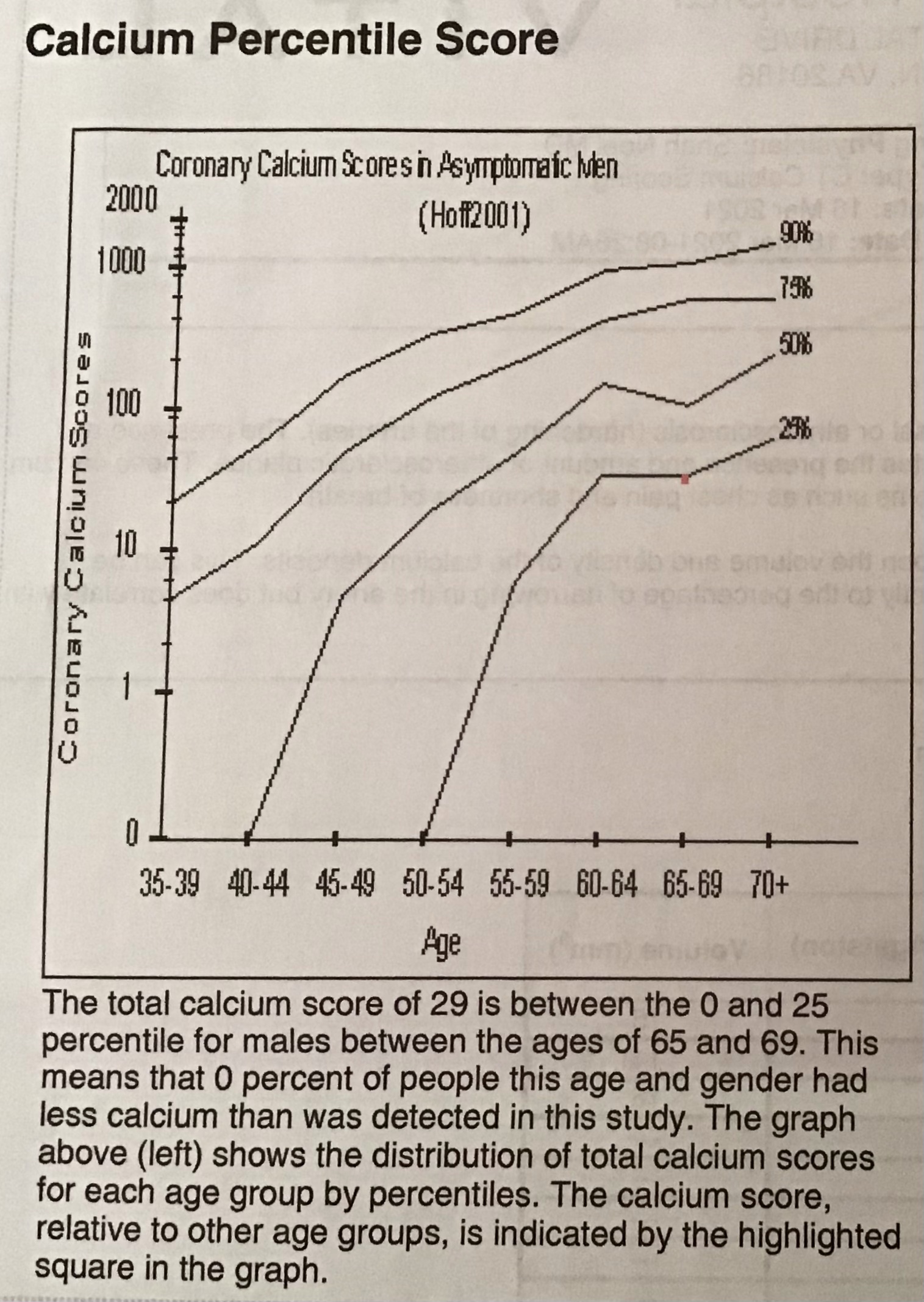
Test eight was a CT Cardiac Calcium Scoring Scan. This is a scan of the heart that looks for deposits of calcium in and around the heart. Calcium leads to blockages, and this isn’t good. The results? Uh oh. There’s some calcium found. BUT, it turns out just about all people my age have some calcium. The test results go on to say “the total calcium score of 29 is between the 0 and 25 percentile for males between the ages of 65 and 69. This means 0 percent of people this age and gender had less calcium than was detected in this study.” —whew—
Test nine – back to the hospital for a Heart Stress Test. This is essentially a type of EKG while walking or running on an inclined treadmill for a period of time. With all the walking I do on the hills near the farm, this should be a no brainer. Except it isn’t. Something trips about 7 minutes into the test, indicating there may be an issue and I may have a constriction somewhere blocking blood flow around the heart. After they stop the treadmill, they continue to monitor my heart, which returns to normal quickly. Hmmmm. The doctor thinks this may have just been a false positive, particularly since I was wearing a mask during the test (this was in the time of Covid after all).
The test result goes to DR Shah, and he and I have a conference call. Looking at the result, he thinks it might be a false positive as well. He suggests one more test, so we can verify one way or another.
And so, it’s on to test ten – A CT Angio Coronary Test Without Calcium Scoring. For this test, I go to another hospital, a bit farther away. I can have nothing to eat or drink prior to the test. They inject me with iodine and take a series of CT scans of the heart.
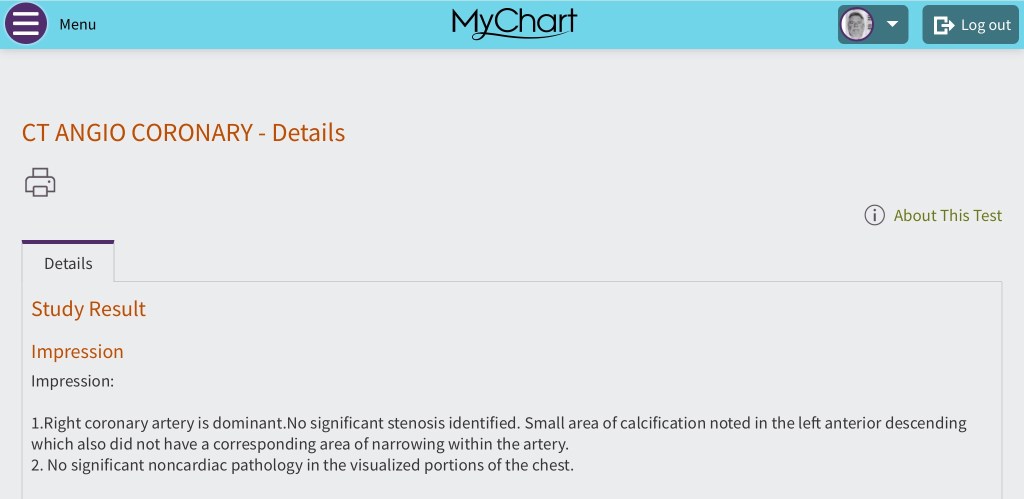
Two days go by, and then the results arrive. “No significant stenosis identified. Small area of calcification noted in the left anterior descending which also did not have a corresponding area of narrowing within the artery.” For us lay people, stenosis is the narrowing of an artery or heart valve. We already knew there was a bit of calcification from the Calcium Scoring Scan, so nothing new there. The good news is there is “no significant stenosis”. The doctor is happy with the results, and pronounces my heart to be OK. We talk about diet*, as we always do, and schedule my next appointment, several months from now.
One of the phrases I never pictured using in my life is “My cardiologist said….”. And yet, here we are.
Did the Metoprolol cause the fainting/dizziness? The doctor isn’t sure, but we are keeping me off the Metoprolol for now. My heartbeat has stayed in the normal range without the drug, even though the actual rate varies continually.
So, here I sit over two and a half months later, pondering this recent journey. Part of me is thinking – “What the hell, ten tests!? That’s crazy!” And part of me is thinking “Ten tests, and we still don’t really know what happened.” And part of me is thinking “Ten tests, and they all pretty much show my heart (other than the AFIB) and arteries are in good health. I should be thankful.” The engineer in me says “ten tests and now we have a good baseline for all of these areas.”
All things considered, I am thankful. There’s a history of heart problems in my family – my dad and one of my sisters both had strokes and an uncle and two cousins died of strokes. From my perspective, any good news on heart stuff, is just plain good news and I’ll take it.
I’ve felt fine since the Valentine’s Day visit to the ER, so maybe it was the Metoprolol. Or, maybe it’s something else lurking around, waiting for another opportunity to complicate things, but I’m not worrying about that right now. I have too much living to do, to let this slow me down.
Oh, and one other thing. I did learn a new word. “Syncope.” Syncope is the medical term for fainting or “passing out.” It’s the temporary loss of consciousness, usually related to insufficient blood flow to the brain. So, while I thought this all started with a near fainting episode, it was actually a syncope issue…. ;-).
Addendum:
If you want to read about my encounter with the Copperhead, you can find it here: https://mnhallblog.wordpress.com/2017/07/30/copperhead-hunting-in-flip-flops/
*Diet – My cardiologist would prefer that I was a vegetarian. I don’t see that happening any time soon. Having said that, Cathy and I both eat healthily – lots of salads, vegetables and fruits. Not much beef or pork. A bit more chicken, and a fair amount of seafood. We’ve greatly reduced dairy – I don’t drink milk, and now eat cheese only on special occasions. We’ve also reduced carbs significantly. Bread and pasta have become a rarity. When we have rice, it’s usually brown rice. Potatoes? We have them at one restaurant we go to, where I apparently can’t resist them, and maybe once a month at home. Neither of us have ever been dessert fans. As my cooking has expanded, I find myself gravitating to Indian, Korean and stir fry dishes – much of it, but not all, vegetarian. My diet isn’t perfect, but I believe it’s healthier than about 90% of America. I realize that’s not a particularly high bar.
Discover more from Live Life Exuberantly
Subscribe to get the latest posts sent to your email.
 Live Life Exuberantly
Stay healthy Max! Glad to hear you did all the tests you did – family history is definitely an indicator for stenosis. AFIB is completely different – as I’m sure you know it can lead to red blood cell clotting rather than infarction which is platelet related. I had no idea that snake venom could cause heart damage – I was told today that I should start carrying a machete with me when I walk on my property in Costa Rica to ward off the rattlers.
LikeLiked by 1 person
Oh yea, I understand the difference. He was just trying to eliminate all possibilities. As to snakes and AFIB, there is no conclusive proof that ties them. All I know is that I ddin’t have it at a doctor’s appt two months before, and then have had it ever since the snake bite……
Didn’t know Costa Rica had Rattlers, but I guess I should have…
LikeLike
Great information. I am on the same drug you were to regulate heart because of begnin heart palpitations. Glad you are doing well. Glad all tests were good.
LikeLiked by 1 person
Great article once again Max! I learned a lot from reading it. I’m delighted everything turned out fine after all of those tests! We’re reaching that point in our lives where we really have to pay attention to what our body is telling us. Starting my diet today….
LikeLiked by 1 person
Haha! Good luck w diet…. 😉
LikeLike
Thanks for sharing, Max! Take care! All of us over 50 have something going on, it seems! My newest challenge is spondylolysis with spondylolisthesis (slipped vertebrae and disk issue) with the result of stenosis around the sciatic nerve on my left leg! Working out a good amount helps: can’t not work out, can’t overdo it. Sometime I’ll likely have to do better with my diet too, sigh/lol!
LikeLiked by 1 person
Age ain’t for the squeamish….. 😉
LikeLike