
It was January of ‘87 and we were living in Rheindurkheim, Germany. I was sitting at Sportheim Gasthaus’s Stammtisch (regular’s table) enjoying a bier, when Jürgen sat down next to me. After a bit of small talk, he asked me how old I was. I answered 31. He then wanted to know if I’d ever played Fussball (soccer), and I told him I’d played a couple of years of intramural soccer at West Point. “Was ist los, Jürgen?” (What’s up Jürgen?)
Jürgen explained he was the captain of the local “over 30” soccer team, and wanted to know if I would be interested in joining the team. The name of the team was “Die Alte Herren” (The Old Men).
After laughing, I explained to Jürgen I wasn’t all that good. There was a large difference between a couple years of college intramural soccer and people who had played in organized leagues since they were little kids. Everyone knows the Germans are fanatics about soccer and I thought honesty was the best policy for my answer. Jürgen wasn’t deterred. He told me it was mostly about fun, and they could always use an extra guy. Sometimes it was tough to get everyone together on game day. Finally he said “Kommst du zu einer Übung, und siehst du, was du denkst” (Come to a practice and see what you think) and I agreed to give it a try.
It was early January and practices were held at night in a local gym, as our soccer field had no lights. At that first practice, I arrived and it turned out I knew about 2/3 of the players from my time at Sportheim. All were in their mid thirties to mid forties, so I was the youngster on the team. We started with some drills, and then played seven on seven. I was in good shape, better than most on the team, but the back and forth on the wood floors was brutal on my feet and I had at least one blood blister at the end of practice. Afterwards, I told Jürgen to count me in, if the offer still stood. He laughed, and I officially became an Old Man. Well, not quite officially yet. Jürgen had told one small lie.
 It wasn’t just about fun. As this was Germany, anyone playing soccer in an official league had to have a Spieler Pass (Player Identification Card). It’s actually the same ID used throughout Germany for all league play, up and down all levels. I had my picture taken, filled out the paperwork and submitted the required information and forms. In mid February, I received my Pass. You can see on the Pass, if another team ever wanted to pick me up, there are ample spaces to record transfers. ;-).
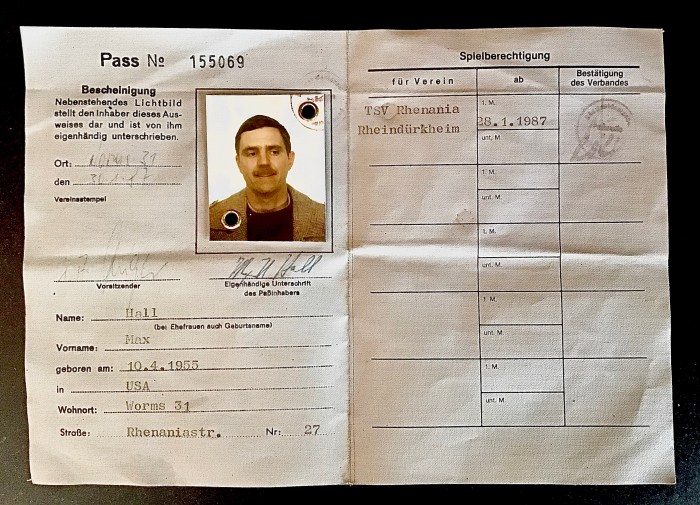
It was finally the day of our first game. Just before the start, Jürgen presented all of our ID Cards to the head referee. There was a bit of consternation when they came to my card. The refs thought the team might have hired a ringer. Jürgen explained I was stationed locally and had joined the team. He also explained I wasn’t all that good, as the ref would see if I entered the game.
I didn’t get into the first game, but we won 1-0, so there was cause for celebration. After the game, we gathered in Sportheim and there were biers all around. We also had a two-liter “boot” of bier we passed around the table. It was a good time, and we continued the tradition after every game, win or lose.
I played in the second half of the second game that year and we won that game too. My soccer skills weren’t so good, but I was in great shape and could usually make up for a mistake with speed.
The season progressed and we lost a couple, and then won again. Midseason, we received some bad news. The goalie for Rheindurkheim’s main team (TSV Rhenania, our parent club) was injured, and Hans, our goalie, was called up to the big team. It was good news for him; not so much for Die Alte Herren. Our backup goalie wasn’t as good and the season went downhill. The low point came during a game when we only had eight players. Eight on eleven isn’t a good matchup, and while we played well for most of the first half, the dam finally broke and we lost 5-0. We ended the season just under .500.
A couple of weeks later, we had our end of year Dinner at Sportheim. Vroni and Wolfgang, Sportheim’s owners, closed the restaurant and we took over the place. All the players, their wives and girlfriends were there. It was quite the night, with platters of food, bottles of wine and mugs of bier. There was singing, dancing, and lots of laughing and storytelling. As the night progressed, schnapps and brandy were also consumed, frequently in toasts to Die Alte Herren. Finally, sometime well after midnight, Cathy and I walked home. We were moving more slowly the next day.
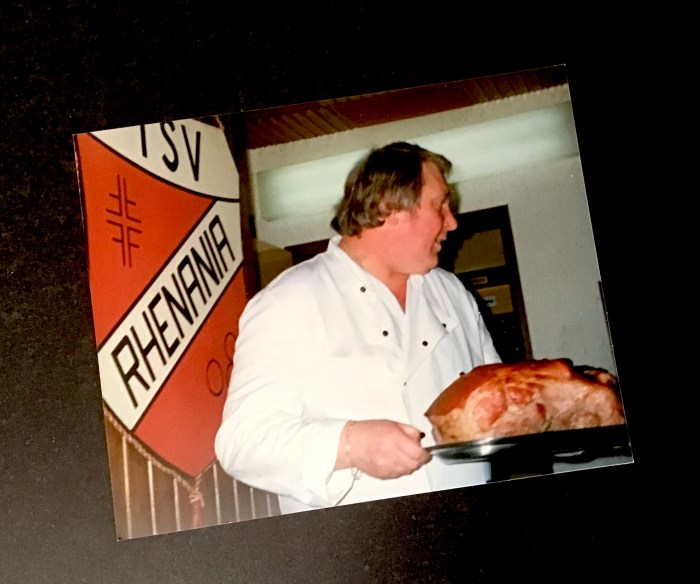
Die Alte Herren’s record didn’t show it, but it was a good season for me. The soccer was fun, and I did get better. Cathy and I had become a real part of the community. When you live in a town of around 1,000 people, everyone knows who everyone is…. what you do, what you don’t do. This was true, even if you were “a foreigner”. Did you make any efforts to integrate, or did you just stay at home? When we first came to town, we were known as “Die Amis mit dem Scwartz Weiss” – The Americans with the black and white (dog). Now, we were an active part of the town. We had people over to the house, or went to their homes. We went on vacation with Vroni and Wolfgang. Local Christmas parties and events, fests, soccer games and participating in parades all became a part of our lives. We were given a rare gift for those four years in Rheindurkheim, and Die Alte Herren were a part of making that happen.
I returned to play for the team the next year as well, and had more playing time. I was traveling to England and Belgium for the Army quite a bit that year, and missed several games, but it didn’t matter. Jürgen, Hans, Dieter, Freddy and the others always greeted me as a teammate and friend when I could be there. Mates are good to have, no matter where you live.
Addendum:
 TSV Rhenania has played soccer for a long time. The club originated in 1908, and is still active today, 122 years later. Here’s their symbol (note you can also see it above in the picture of Wolfgang serving our dinner). They have a grass field now, but at the time I played, it was dirt.
Discover more from Live Life Exuberantly
Subscribe to get the latest posts sent to your email.
 Live Life Exuberantly
One thought on “Die Alte Herren (The Old Men)”