
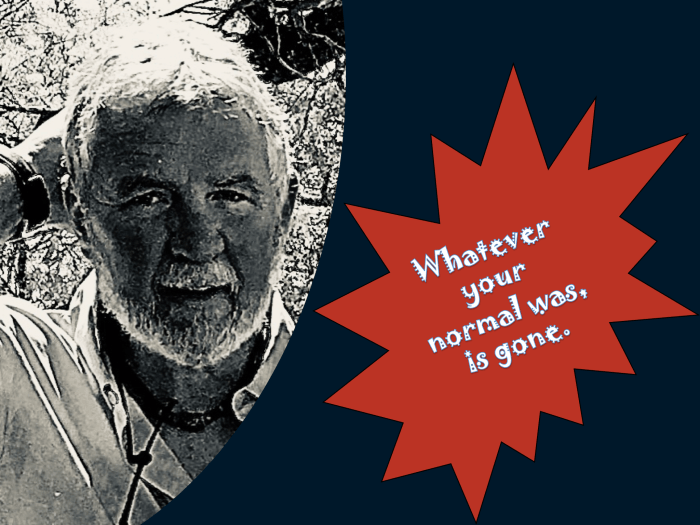
The “normal” life we were living only two months ago, whatever that normal was, is gone, thanks to Covid-19. What about the future? How many of us will recognize, question, or accept the upcoming changes? Some friends and I have discussed this question “virtually” over the past few weeks. At one point, my friend Dave cautioned me: “I think you’re taking on an elephant here, maybe a premature elephant at that.” Elephant or no, as we look to the future, I think the discussion is worth having.
For the past eight weeks most, although not all, of us have complied with the recommendations from the CDC and others. We have practiced social distancing and self quarantining. We’ve washed our hands regularly, donned masks when in public, and used apps such as Zoom to stay in touch with friends and family. We have done all of this as good citizens, anticipating a return to our old world as soon as possible.
We’ve also spent an inordinate amount of time complaining and trying to assess blame for our current situation. Depending on our political background, we are blaming the Chinese, or Trump, or the Dem Governors. We blame our neighbors for not treating this seriously, and endangering our lives. We blame the governors of Michigan, Minnesota and Virginia for not getting us back to work soon enough. We blame the World Heath Organization, or the deep state here in America. We blame real experts like Doctor Fauci, and fake experts like Doctor Phil. Collectively, we pretty much blame everyone.
This pandemic is going to end. We can discuss or argue about when, but it will happen. Our lives will return to a semblance of normalcy, in a few weeks or in a few months. My question to you is what will the new normal look like? It will certainly feel different, both at a personal and a societal level. We just don’t know how different, and where the ripples will go across time. In our discussions, while my friends and I came to a few conclusions, we also generated more questions than we started with. Here are a few of the obvious conclusions. Following these, are some of the questions we are asking each other.
- How we work. Covid-19 has blown the door to telecommuting wide open. Certainly in the past many companies embraced, or embraced to some degree, telecommuting. That’s changed forever, as many companies were forced to use telecommuting, or go under. This will continue wholesale in a post Covid world.
- Updated business models. As with any crisis, those who adapt, do best. As an example, we have watched businesses use online, hybrid online, and curbside delivery models where they didn’t previously exist. The strong will survive, and thrive in the long term.
- Physical Interaction. Hugging of family members and close friends will increase post Covid – we are going to realize the preciousness of those relationships a little more. On the other hand, gratuitous hugging will lessen. Certainly for awhile, people will use caution about six foot spacing – how long before we are comfortable in crowds?
- Shopping. The trend of shopping online will continue to accelerate. As a result of the virus, people are already doing much more online shopping, and there’s no going back. As with telecommuting, I think the doors are blown wide open.
- Voting. The election debacle in Wisconsin demonstrated the need for “No Excuse” absentee voting across the country. Currently, 39 states, including Virginia, have some version of “No Excuse absentee voting. The next argument will be over in person versus voting by mail.
- Technology Acceptance. Self isolation was a great forcing function for the acceptance of technology in our lives. Whether shopping, banking, communicating, exercising, educating, or any number of other areas, we’ve broadened our use of technology.
- Education. Schools are shutdown. Those schools, our teachers, and our students have become more creative about how education takes place in a distributed environment. Some good ideas will go forward, while we will deposit others in the trash can. Certainly at the college level, large lectures will trend toward professors lecturing on-line to students. Problems, such as rural broadband, have become more apparent.
My friends and I generally agreed on those seven areas of change. There are many other areas less clear to us. This list is longer, and less complete. Here are some of the questions.
- New Normal. Do we learn anything as a society, or is the new normal just the old rules with lipstick?
- Politics. What’s the effect on this November’s presidential election? What will the political fallout be for both the short and long term? Will this increase government interaction in our lives? Or will pushback increase and counter the current involvement?
- Political Interaction. Will political polarization continue to worsen before it gets better? Some of the States are already banding together in mini regional unions, as the Federal government has backed away from responsibility. Do we march into the future united, or do we further split into various tribes and regions? Will we see more social extremism, strife, and conflict? Will political violence increase?
- Healthcare. Will we embrace changes to healthcare and meaningful changes in health insurance plans for the less fortunate? Will we be better prepared for future health crisis? Currently, other than for Covid, people aren’t going to doctors or hospitals to address health issues, whether critical or preventive. Will we investigate multilevel healthcare in hospitals and doctor’s offices so we can provide both pandemic and “normal” healthcare?
- Healthcare – Nursing Homes. Will nursing homes improve, or disappear? Sally, a friend of ours, is a physician’s assistant. Her comment: “This pandemic is going to change things in elder care. Nursing homes are death traps and these people are sitting ducks…it’s so sad. Aging in place will be the wave of the future.”
- The Economy. How will the effect on growth, taxes, inflation and income inequality look? How will the $2T “investment” effect our future economy? Will we see more industry return to the United States? My friend Mark believes the economy will be the most effected “question” for the next 3-5 years.
- Environment. Will we better understand the impact we have on the environment, and that we can do something about both pollution and Global Warming?
- Education. Will the education gap widen between the haves and have nots? What will the long term educational impact on our country look like? How much of a “gap” will there be for our current students that is never closed?
- Rural Broadband. Will this provide the impetus forcing the implementation of Rural Broadband and treating it as a utility? Will the government finally push internet access, much as they did with Rural Utility Service Programs in the past?
- The Arts. How will this affect the arts? What changes will we see in plays, movies, TV, music, painting, photography, dance and so on? How will audience interaction with the arts change?
- Government. Will the US government make any changes? How often does America learn from our mistakes or experiences? As an example, a hurricane hits, some people die, some people survive in diminished ways, some people rebuild and go on as before, and others profit. A year later, another hurricane hits, and it’s the same show all over again. What will happen post Covid?
If we think about this as an opportunity to improve our lives and our society, what changes will we consider and embrace? What chances for improvement will we ignore, freezing ourselves in time and ignorance?
My friend Tim, who I’ve known since first grade, has something of a Russian soul. He commented: “Prognostication about the future, based on the recent past is always a dangerous exercise. Time and data tend to leaven hasty predictions and conclusions. Trial and error will be on display. Todays answers will prove to be tomorrow’s mistakes. We will see Thesis, Antithesis, and then Synthesis. Wash and repeat. We have gone from scavenger, to hunter gatherer, agricultural society, industrial revolution, technical computer evolution, and AI. Now the worm turns again. As always, we adapt or die.” We didn’t discuss whether he meant dying literally, figuratively, or both.
I’m not a fortune teller, and as Dylan sang in “The times they are a changing”, “…don’t speak too soon, for the wheel’s still in spin…”. In my lifetime, we’ve dealt with a polio epidemic, Vietnam and the tumult of the 60s, hyper-inflation, stock market “crashes” and recessions, 9-11, and other “crisis”. In the past, we always came out of it, and always learned new lessons. Will we do so this time?
Looking forward, author Arundhati Roy has captured a view I wish we would embrace, but I don’t know that we will:
“Whatever it is, coronavirus has made the mighty kneel and brought the world to a halt like nothing else could. Our minds are still racing back and forth, longing for a return to “normality”, trying to stitch our future to our past and refusing to acknowledge the rupture. But the rupture exists….. Historically, pandemics have forced humans to break with the past and imagine their world anew. This one is no different. It is a portal, a gateway between one world and the next. We can choose to walk through it, dragging the carcasses of our prejudice and hatred, our avarice, our data banks and dead ideas, our dead rivers and smoky skies behind us. Or we can walk through lightly, with little luggage, ready to imagine another world. And ready to fight for it.”
Addendum:
– A complete copy of Roy’s comments on the pandemic and it’s effects here and in India can be found in The Financial Times at: https://www.ft.com/content/10d8f5e8-74eb-11ea-95fe-fcd274e920ca
– Thanks to my friends, Tim Stouffer, Mark Dunavan, and Dave Job for their contributions to this blog and our ongoing “discussions”, which are usually via text or email. We span the spectrum both politically, and in our optimism (or lack thereof) about the future. I am usually more thoughtful after our exchanges.
– Thanks to our friend, “Sally” (a pseudonym, so she could speak freely), for her sobering views about elder care and nursing homes. Her experiences over the past two months have been sad for her and unfortunate for many of her patients. The death toll in our nursing homes and assisted living facilities should lead to investigations and long term improvements, but I’m not holding my breath in anticipation of either.
Discover more from Live Life Exuberantly
Subscribe to get the latest posts sent to your email.
 Live Life Exuberantly