
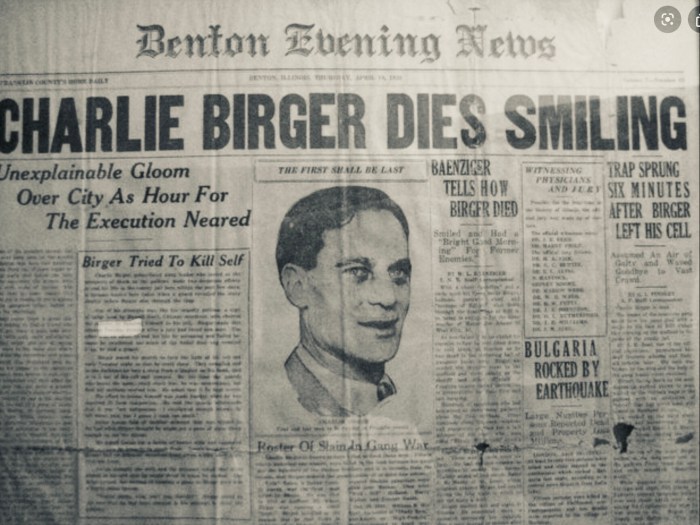
On April 19th, 1928, the last public hanging in Illinois took place. My Grandpa Hall, and my Aunt Ellen, who had just turned 13, were among the thousands of people in attendance, as Charlie Birger was “hanged by the neck until dead”.
At the time, Williamson and Franklin counties in Southern Illinois were part of an area known as “Little Egypt”, which had a long reputation for violence. In fact, Williamson County was referred to as “Bloody Williamson,” due to the ongoing outbreaks of violence throughout it’s history. From the 1870s through the 1930s, there were “Bloody Vendettas”, Klan wars, violent and deadly coal miner strikes, massacres of people, and gang wars. Hundreds of people were killed over that period of time. Chicago may have had Capone, but Little Egypt was an incredibly violent area.
Charlie Birger was a bootlegger and gang leader in Southern Illinois during the 1920s, and in the middle of much of the violence. For a while, some thought of him as a “Robin Hood”, but as his reputation grew, so did the violence. At the time, there were ongoing wars between Birger’s gang and the KKK, with Birger’s gang eventually killing or removing the KKK from the area in 1926. Although it sounds like he was doing a good deed, in fact it was good business. Birger was a bootlegger and the KKK was against the immigrants who were doing much of the illicit drinking in Little Egypt. Birger solved the problem by killing key Klan leaders and effectively eliminating them as a force.
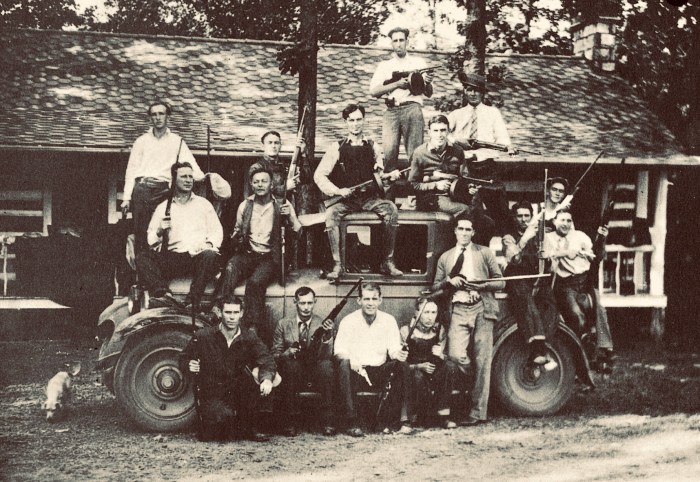
There were also ongoing wars with a rival group called the Shelton Gang, and this eventually caused Charlie trouble. In 1927, A man named Joe Adams was the mayor of a small nearby town. He was helping out the Sheltons, and hiding a tank they owned (yes, a tank). Birger tried to force Adams to tell where the tank was hidden. When he refused, Birger had him killed.
The problem was, they killed Mayor Adams in Franklin County, not Williamson County where Birger was influential. Birger was arrested and the trial was held in the town of Benton, in Franklin County. A jury subsequently found him guilty and sentenced Charlie to death. After all appeals were denied, a date was set for the hanging – April 19th, 1928.
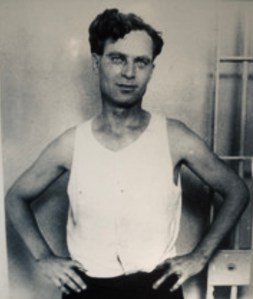
Newspaper accounts say the 19th was a sunny day and the crowd started gathering early. They printed and distributed tickets to allow 500 people into the stockade area where they would hang Birger. Somehow Grandpa Hall obtained two of the tickets. They must have been free, as Grandpa never had any spare money. Any of his extra money went for booze, no doubt provided by either Birger’s crew, or the Shelton gang.

It turns out many children skipped school to attend the hanging and my Aunt Ellen was one of them. She had turned 13 just a few days before on April 10th, and as the oldest of the 6 children still at home*, Grandpa took her with him. The other five kids, ages 11 to 2, were in school or stayed with Grandma.
Grandpa and Ellen took a horse and buggy to Benton, arrived early, and entered the stockade area where the hanging would take place. The crowd continued to grow, and they closed off the immediate area around the scaffold. Thousands more gathered in the streets of Benton for the event, even though they were not able to see the hanging itself.
As Ellen and Grandpa waited for the guards to bring Birger out, Ellen heard a little girl next to her say “Can we get closer daddy? I want to hear his neck pop!” and the father and daughter moved towards the gallows. Ellen looked at Grandpa – he just shook his head no, and they stayed where they were.
Birger was finally brought out. He was dressed in a three piece suit and spoke with some along the route. He eventually made his way to the gallows, where he shook hands with the hangman, Phil Hanna.
He then spoke to the crowd. “They’ve accused me of a lot of things I was never guilty of, but I was guilty of a lot of things of which they never accused me. So I guess we’re about even.’’ Just before his head was covered with a hood, Birger smiled and said his last words, “It’s a beautiful world.’’ They then placed a black hood over his head. Normally, they used a white hood, but he asked for a black one, reputedly saying he didn’t want to be confused for a member of the Ku Klux Klan.

The trapdoor was sprung and Birger fell thru, breaking his neck in the drop. Fourteen minutes later, he was declared dead and the crowd, including Grandpa and Ellen began to dissipate. The last public hanging in Illinois was finished.
The gang violence in Bloody Williamson would continue for several more years.
Addendum (and don’t miss the fascinating YouTube song and video toward’s the end of the blog):
* At thirteen, Ellen was the oldest of the six Hall kids remaining at home. The oldest sibling, my Uncle Dave, had already left Southern Illinois for Ottawa, Illinois, where he worked on the construction of the Starved Rock Dam.
- Special thanks to my sisters Roberta and Tanya, my niece, Tami Pfau, my nephew-in-law, Tyler Ailor, and second cousins Janice, Julie and Don Connell. They contributed to this blog and provided inspiration for my writing about Charlie Birger and our family lore surrounding the story. Photos of Aunt Ellen and Uncle George were provided by Janice Connell.
- My sisters and I first heard this story as kids, probably on a Saturday morning when aunts and uncles were having coffee around the kitchen table at our house. Stories, mostly funny, were often told about growing up poor during the depression, or some of their later escapades during WWII. Dad, or my Uncle Mick first told us this tale, and it was later confirmed by Aunt Ellen. Ellen had relayed the story to them at some point in the past. Dad and Mick were only four and two when Birger was hanged, but they knew significant details about the hanging and told the story in an animated fashion. We always laughed at the “Can we get closer daddy? I want to hear his neck pop” quote. Dad told the story for years, up until his own death at 86 years of age in 2010. His grandkids, AND their spouses all remember him telling the story of Charlie Birger. One of my nieces remembers Dad making a click/pop noise while repeating the “get closer daddy” quote.

- While reviewing this blog for accuracy, my second cousin Don told me a story about Ellen’s future husband, my uncle George (his grandfather). He was a couple of years older than Ellen, and they hadn’t actually met yet. “Apparently grandpa Connell had a few dealings buying alcohol from the Birger gang, as did many in those days. The story I remember best is he once went into a barbershop, and a member of Birger’s gang was sitting in the barber’s chair with an apron on, getting his hair cut. My grandpa said he could tell the man was holding something under the apron, and once the man was finished and stood up, a machine gun was in his hands. Grandpa was quite surprised. He said it wasn’t uncommon to see the gang members carrying weapons, but usually it would just be handguns. He said they were always armed.”
- My Grandpa Hall, also known as Old Roy, was quite the character. By today’s standards, he would be called an alcoholic. You can read about some of his other escapades at: https://mnhallblog.wordpress.com/2016/11/10/old-roy/
- For a good book on Birger, and the violence in Little Egypt in general, look for “Bloody Williamson” by Paul M. Angle. It’s a nice read.
- If you want to read more about the Klan war in Southern Illinois, here is a good source of information: https://theirishmob.com/bloody-williamson/
- Southern Illinois has been known as “Little Egypt” for quite a while. Parts of the area were known as the “Land of Goshen” as early as 1799. This was a biblical reference to Egypt and the fertile Nile valley. Supposedly, Indian mounds in the area were large at the time and seemed like the pyramids of Egypt. The nickname stuck. The city furthest south in Illinois is Cairo, which is at the conjunction of the Ohio and Mississippi Rivers. More information can be found online and Wikipedia gives a reasonable report.
Much like Bonnie and Clyde, the stories continued about Charlie Birger, long after he was hanged. Songs and poetry were composed about him. Here are a couple of examples.
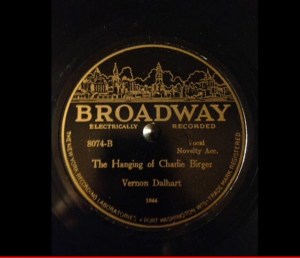 – Here’s a fascinating song about Birger and his hanging written by Carson Robison, probably in 1928 or ’29. It’s worth listening to just to see some of the old pictures. https://youtu.be0XHb5A9ZhPg . Robison later wrote the lyrics to “Barnacle Bill the Sailor”. The song, “The Hanging of Charlie Birger” has been recorded as recently as 2013. The version by The Woodbox Gang is pretty good and can be found on Amazon and iTunes.
.
– Here’s another piece of poetry written in the ’80s:
——————- “Charlie Birger” ———————
I heard of Charlie Birger way back when I was young
My daddy told me all about the day that Charlie hung.
I’ve heard so many stories, some of his ghastly deeds
Another tells how Charlie helped poor folks in their needs.
One said he was a kindly man who never told a lie
But when somebody crossed him, that man was sure to die
That Charlie had no Master you can tell from all the tales
He fought the system all the way, and stayed out of their jails
I’ve seen so many pictures, they’re hanging on the walls
The pictures tell the story of Birger’s rise and fall
And when they finally caught him he was sentenced to be hung
But they hadn’t broke his spirit the day the trap was sprung
When the State had had its vengeance—When Charlie’s life was done
It made one stop to wonder, Who had lost, and who had won.
John Lastle Gwaltney Southern Illinois Poetry (1985)
Discover more from Live Life Exuberantly
Subscribe to get the latest posts sent to your email.
 Live Life Exuberantly