
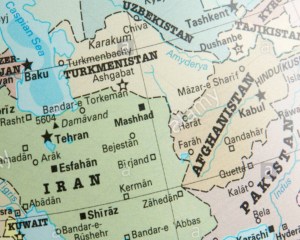
My friend Tim said, “I was in Ashkhabad (Ashgabat) in June 1979, wondering why there was such a heavy Red Army presence in a sleepy place like that on the Iranian border. It was put together for me later in December of that year.”
Forty years ago, on December 24th, 1979, our current problems in Afghanistan began, when the Soviet Union invaded that country. As midnight approached on Christmas Eve, the Soviets organized a massive military airlift into Kabul. Within a few days, the Soviets had secured Kabul, but over time, they met with fierce resistance whenever they ventured into the countryside. For the next decade, the Mujahideen mounted a continuous, effective guerrilla campaign against the Soviets.

The United States became covertly involved in the war in Afghanistan, and provided about $3 billion in military and economic assistance to the Mujahideen. In addition to weapons, we provided school books, which on the surface sounds pretty nice; unfortunately, not only were the books anti-Soviet, they encouraged a jihadist outlook, and used guns and soldiers as a part of the text. One lesson instructed that only Muslims can rule Kabul, and Russians, and indeed ALL invaders, are nonbelievers.
In the late ‘80s, Al-Qaeda, under Osama Bin Laden, was born and supported the Mujahideen against the Soviets. As their situation continued to worsen, Soviet forces started withdrawing in 1988 and the last Soviet soldier crossed back into the USSR on February 15, 1989. Fifteen thousand Soviet soldiers were killed in those ten years.
The US walked away from involvement in Afghanistan during the 1990s, and with both the US and the USSR gone, a governing vacuum was created. In that vacuum, the Taliban formed in 1994. As a part of their work, they used the US provided text books to preach continued Jihad. Al-Qaeda also continued to grow in the ‘90s and began exporting violence outside of Afghanistan, culminating in the September 11th attacks in America in 2001.
Most of us know the rest of the story. We are now in our 18th year of war in Afghanistan, the longest war in American history. More than 491,500 soldiers have served there, and at least 28,000 U.S. troops have deployed there five or more times, sometimes coming home with both wounds and PTSD. Approximately 2,400 US troops have died there, with another 20,000 wounded. This doesn’t include those who have committed suicide after they returned home. Presidents Bush, Obama and Trump have all said they “don’t want to be in the business of Nation building,”* and yet we remain in Afghanistan with no apparent end in sight. We’ve now spent $975 Billion on the war since 2001. How could those dollars have been better spent?
Although I said “most of us know the rest of the story” in the previous paragraph, it now turns out we didn’t know the whole story. The Washington Post recently published a series of articles about the war and how the American people were misled. The articles are based on “confidential government documents which … reveal that senior U.S. officials failed to tell the truth about the war in Afghanistan throughout the 18-year campaign, making rosy pronouncements they knew to be false and hiding unmistakable evidence the war had become unwinnable.”* While not quite The Pentagon Papers, the interviews are equally as damning about our involvement in Afghanistan, and again raise the question of what are we doing there? How long have we known we shouldn’t really be there? As a veteran, I’m saddened to see we have been given only half-truths. When I was at West Point, a part of the Cadet Prayer included “never be content with a half-truth when the whole can be won.” Once again, we have fallen short as a country.

In addition to our country misleading us, the sad fact is, most Americans just don’t give a damn. With the average American having no skin in the game, their focus is elsewhere. We have no draft, no national service, and we’ve funded much of the war with deficit spending. There is no reason to care.
Afghanistan has long had a reputation as “The graveyard of empires”. Alexander the Great, the Arab Caliphate, and Genghis Khan all crossed that land in ancient history, without impact. Both the British and the Russians have tried their hands there and failed. After 18 years, 2,400 American deaths, the deployment of hundreds of thousands of troops, and nearly one trillion dollars in spending, maybe, just maybe, it’s time to come home.
Merry Christmas to you, and to the over 12,000 troops who remain in Afghanistan.
Addendum:
• * Both sets of quotes come from the Washington Post.
• I know it’s a bit ridiculous to try and sum up 18-40 years of history in 1,000 words or so, but felt it was worth trying to do. I realize what I’ve presented here is incomplete and doesn’t go into many aspects of either the Soviet war in Afghanistan, or our own. Having said that, I feel the bottom line still prevails – what are we doing there, and when are we coming home? By the way, the $975B we’ve spent is only the DoD money. It doesn’t include money spent by the CIA, VA or other agencies.
• Special thanks to Tim Stouffer for providing both historical and current information for this blog. I’ve know Tim since 1st Grade, and he is one of my oldest and best friends. He is an amateur historian, and knows more about Russia and the Soviet Union than anyone I know. In the ’70s and early ’80s, he travelled to the USSR multiple times. His additonal recollections from his trip to the USSR in 1979: “Ashkhabad was just part of the trip in ‘79. We flew in from Baku on an old 2 prop Ilyushin12/14 that was a copy of a DC 3. We flew across the Caspian Sea, and if that did not scare me nothing in the air has bothered me since. There were soldiers all over and the 20 of us stood out. Supposedly we were first US student group to visit and were treated like kings compared to other places. It is also where I rode the camel 🐪. “
• Ashkhabad was from 1924 to 1990 the capital of Turkmenistan, in the USSR. When Turkmenistan became independent, they officially adopted the Turkmen version of the city’s name, Ashgabat In 1992. I kept the name as Ashkhabad for this blog, keeping it consistent with Tim’s telling of events in the 1979 timeframe.
• Thanks to my friends Michael McClary and Colleen Conroy for providing much needed editorial assistance on this blog.
Discover more from Live Life Exuberantly
Subscribe to get the latest posts sent to your email.
 Live Life Exuberantly
Conventional wisdom would dictate our continued presence there lest another created vacuum. Religious indoctrination defines non-believers as infidels.Until the end of exportation of violence from this region(not likely) , our forward deployment will probably continue for the foreseeable future. The draw of Religious indoctrination in this area of the globe is impossible to overcome.
LikeLike
Max,
So good. You are so right to do this, too long, many lives let us end this.
Larry
LikeLiked by 1 person
Max: thanks for writing down something I’ve been thinking about for some time now. Do you believe that this compares to our involvement in Vietnam? How about our late arrival to WWs I and II? I find that the most unfortunate aspect of what we’ve done in Afghanistan has been conjoined to our – also continuing – effort in Iraq, to likewise mixed, at best, results. After 9/11, I figured a commensurate number of soldiers’ casualties would be an “acceptable” level of pain – assuming positive results. Getting rid of Saddam and Osama and the Taliban (for a time, at least) were positive results. But, then, to add Syria into the mix, during the last administration showcases lack of a long view and absence of leadership, in my opinion. I find it supremely ironic that the current “cause celebre” is the Ukraine (after investigation into Russia became fruitless). What did the previous administration allow to happen, with a wink-wink to “more freedom during a second term?” — near civil war in Ukraine and annexation of Crimea. All the while, we’re still in Afghanistan, Iraq, and Syria …
LikeLike