
Next week is the 74th anniversary of the end of WWII. When the fighting ended in 1945, the GIs all wanted to go home, but it wasn’t quite that simple. You needed “points” to muster out of the service at the end of the war.
….Points…. If you ever watched the “Band of Brothers” HBO series, the last episode focused on “points” and who could get discharged from the army first. Most GIs were more than ready to get out of the Army and go home. Some were overseas for years. Others had only recently deployed. There were combat veterans who saw horrific killing. There were also REMFs (rear echelon MFers) who were never near the front line. ALL wanted to go home.
The Army, while reducing it’s size, needed to balance the needs of the service with the needs of the soldier. They wanted to find a way to balance length of service, combat service, and what sacrifice was made back home. The end result was the development of a point system used to rank soldiers according to four criteria:
1. Months in service since September 1940 = One point for each month
2. Month in service overseas = One point each, in addition to months in service
3. Combat awards (Medal of Honor, Distinguished Service Cross, Distinguished Service Medal, Legion of Merit, Silver Star Medal, Distinguished Flying Cross, Soldier’s Medal, Bronze Star Medal, Air Medal, Purple Heart), or combat campaign participation star = Five points each
4. Dependent child under eighteen years old = Twelve points each
These four criteria were the only ones from which points were calculated. In August of 1945, an enlisted man needed a score of 85 points to be considered for discharge. (This dropped to 75 after Japan’s formal surrender).
…..85 Points….. You can see from the criteria it wasn’t easy to get to that point total, and yet, in August of 1945, Dad’s total was 96 points. This photo of his awards tells the story of his 96 points.
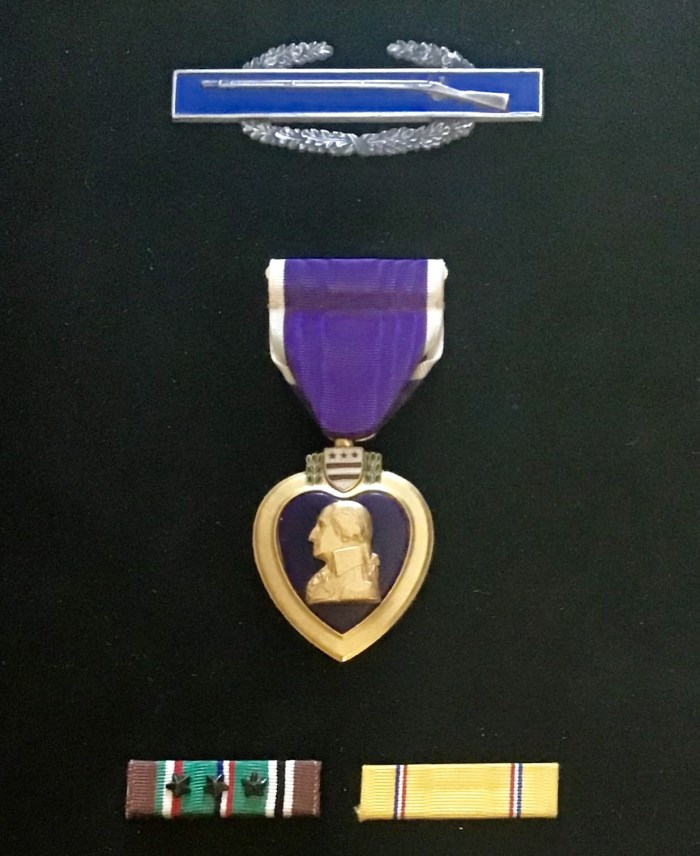
The ribbon on the lower right (yellow ribbon) is the “American Defense Service Medal” established by Roosevelt to recognize those soldiers in the military PRIOR to Pearl Harbor. Dad joined the Army in September of 1940, meaning for the first criteria (total service), he served 59 months by July of ’45, and was awarded 59 points.
Of those 59 months, he was overseas from November 8th, 1942 (The invasion of North Africa) to March of 1944 (when he finished recovering from the wounds he received in Sicily). Those 17 months overseas resulted in an additional 17 points under criteria 2.
The ribbon on the lower left (brown and green) is The European–African–Middle Eastern Campaign Medal. Dad has three stars in the ribbon for the three campaigns he participated in (criteria 3) – Algeria/French Morocco, Tunisia, and Sicily. Those campaigns counted for 5 points each, or 15 points total.
Above the two ribbons is the Purple Heart he received for being shot three times in Sicily. Under criteria 3, he earned an additional 5 points for almost dying.
It’s also interesting to note where he didn’t receive points. At the top of his medals, you see the blue badge with a rifle. This is the Combat Infantryman Badge (CIB) and was awarded only to infantrymen who fought in active ground combat while assigned as members of an infantry unit. General Eisenhower once said “he would have traded all his medals for a Combat Infantryman Badge”, which he never obtained. Dad received 0 points for this.
After the war, he was awarded the Bronze Star. If you look at criteria 3, this should have added an additional 5 points, however, because he was already discharged when the paperwork finally went through, he received 0 points.
As to criteria 4, dad was only 16 when he joined the Army, and had no (known ;-)…) dependent children under 18 years of age. This resulted in 0 points.
Total up the points and you get to 96. Because of this, he was discharged after the Japanese announced they would surrender on August 14th, but before they officially surrendered on September 2nd, 1945.
Dad joined the army in 1940 when he was 16 years old. When he was discharged in August of ‘45, he’d spent 5 years in the Army. By the end of those 5 years, he invaded two continents, fought in four countries, was shot three times, and developed malaria. Oh, and he was just 21 years old. I think he paid his dues. It was time to return home.
Addendum:
Points: You can get more information on points at: https://en.m.wikipedia.org/wiki/Adjusted_Service_Rating_Score
European campaigns: You can get more info on the European Campaigns counting towards points at: https://en.m.wikipedia.org/wiki/European–African–Middle_Eastern_Campaign_Medal
Discover more from Live Life Exuberantly
Subscribe to get the latest posts sent to your email.
 Live Life Exuberantly
It is always great to hear stories of the “Great Generation” and most who survived did not want to talk about their experiences. My Dad did not get drafted because they had 3 dependent children under the age of 7 and he had a job that was a part of the war effort. He worked at the Prairie Shipyard in Seneca. Ill. My Mom also worked there on second shift. You have every right to be proud of your Dad and there fortunately were a lot more like him in the Great Generation, otherwise we might not be speaking English today.
LikeLike
Your dad was a great guy. I grew up at 519 Cherokee so I was just across the road from your parents. As a kid I spent a lot of time talking to your dad and helping with things I could. I can remember when he was sick I drove him to a few doctors appointments in all the hours I spent around your dad he never once mentioned any of his military experience, which I guess is the norm for a lot of vets. Thank you for sharing his story as it is a great one and needs to be heard!
LikeLike
Thanks for your comments, and thanks for helping Dad. Yea, he was usually pretty quiet about it, unless telling a story of something funny happening while in the army. Keep doing good.
LikeLike
A great member of the greatest generation. That’s a wonderful blog post, Max, full of important detail. Thanks for writing and sharing it.
LikeLike
Frank – thanks so much for your comments. Yes, they did so much for us. I fear the stories are all slowly disappearing.
LikeLike
An amazing life before 21. Wish I could have known him.
LikeLike
Amazing!! All of that life experience before age 21…he must have been quite a fella…wish I could have known him. Is it too cliche to say they don’t make ‘em like that anymore ??
LikeLike
Dad was one of kind from my perspective – you would have enjoyed him. He loved life.
Of course there were so many others who equally did their duty and also came quietly home. And then there are those who never returned.
LikeLiked by 1 person